2005 Copyright – Reflective Insulation Manufacturers Association Reflective Insulation Manufacturers Association
R-Values and Thermal Performance of Reflective Insulation, Radiant Barriers and IRCCs
Overview About RIMA Thermal Resistance/R-Values Reflective Insulation Installation and Applications ASHRAE 90.1 and Reflective Insulations Comfort
About RIMA The Reflective Insulation Manufacturers Association represents manufacturers and distributors of reflective insulation, radiant barriers and IRCC materials. RIMA activities are guided by an active board of industry members who participate on national and local levels of building code organizations and governmental agencies. Visit us at www.rima.net.
Thermal Resistance  R-Values
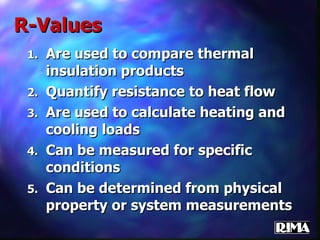
R-Values Are used to compare thermal insulation products Quantify resistance to heat flow Are used to calculate heating and cooling loads Can be measured for specific conditions Can be determined from physical property or system measurements
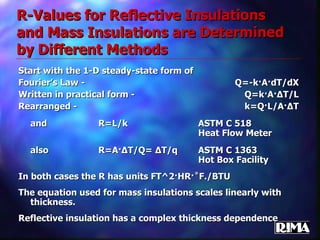
R-Values for Reflective Insulations and Mass Insulations are Determined by Different Methods Start with the 1-D steady-state form of  Fourier’s Law - Q=-k·A·dT/dX Written in practical form - Q=k·A· Δ T/L Rearranged - k=Q·L/A· Δ T and R=L/k ASTM C 518 Heat Flow Meter also R=A· Δ T/Q=  Δ T/q ASTM C 1363 Hot Box Facility In both cases the R has units FT^2·HR·˚F./BTU The equation used for mass insulations scales linearly with thickness.  Reflective insulation has a complex thickness dependence
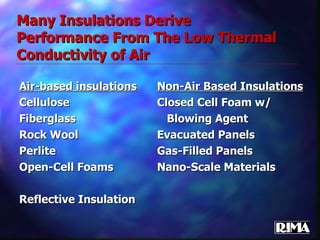
Many Insulations Derive  Performance From The Low Thermal Conductivity of Air Air-based insulations Non-Air Based Insulations Cellulose Closed Cell Foam w/ Fiberglass   Blowing Agent Rock Wool Evacuated Panels Perlite Gas-Filled Panels Open-Cell Foams Nano-Scale Materials Reflective Insulation
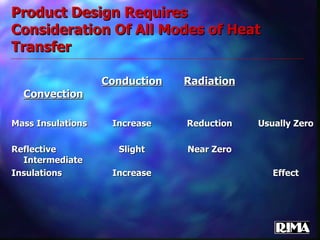
Product Design Requires Consideration Of All Modes of Heat Transfer Conduction Radiation Convection Mass Insulations Increase Reduction Usually Zero Reflective  Slight Near Zero Intermediate Insulations Increase Effect
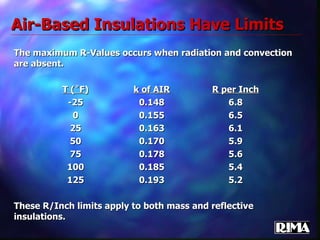
Air-Based Insulations Have Limits The maximum R-Values occurs when radiation and convection are absent. T (˚F) k of AIR R per Inch -25 0.148 6.8 0 0.155 6.5 25 0.163 6.1 50 0.170 5.9 75 0.178 5.6 100 0.185 5.4 125 0.193 5.2 These R/Inch limits apply to both mass and reflective insulations.
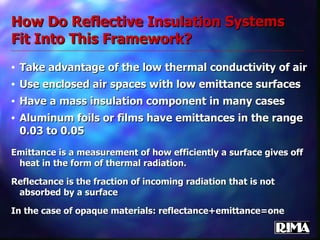
How Do Reflective Insulation Systems Fit Into This Framework? Take advantage of the low thermal conductivity of air Use enclosed air spaces with low emittance surfaces Have a mass insulation component in many cases Aluminum foils or films have emittances in the range 0.03 to 0.05 Emittance is a measurement of how efficiently a surface gives off heat in the form of thermal radiation. Reflectance is the fraction of incoming radiation that is not absorbed by a surface In the case of opaque materials: reflectance+emittance=one
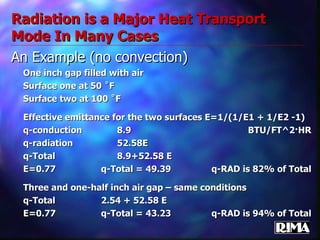
Radiation is a Major Heat Transport Mode In Many Cases An Example (no convection) One inch gap filled with air Surface one at 50 ˚F Surface two at 100 ˚F Effective emittance for the two surfaces E=1/(1/E1 + 1/E2 -1) q-conduction 8.9 BTU/FT^2·HR q-radiation 52.58E q-Total 8.9+52.58 E E=0.77 q-Total = 49.39 q-RAD is 82% of Total Three and one-half inch air gap – same conditions q-Total 2.54 + 52.58 E E=0.77 q-Total = 43.23 q-RAD is 94% of Total
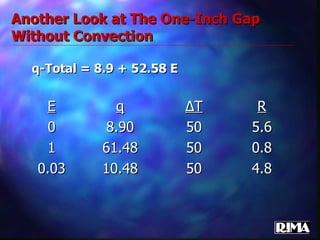
Another Look at The One-Inch Gap Without Convection q-Total = 8.9 + 52.58 E E q Δ T R 0 8.90 50 5.6 1 61.48 50 0.8 0.03 10.48 50 4.8
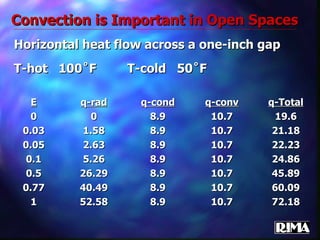
Convection is Important in Open Spaces Horizontal heat flow across a one-inch gap T-hot  100˚F   T-cold  50˚F E q-rad q-cond q-conv q-Total 0 0 8.9 10.7 19.6 0.03 1.58 8.9 10.7 21.18 0.05 2.63 8.9 10.7 22.23 0.1 5.26 8.9 10.7 24.86 0.5 26.29 8.9 10.7 45.89 0.77 40.49 8.9 10.7 60.09 1 52.58 8.9 10.7 72.18
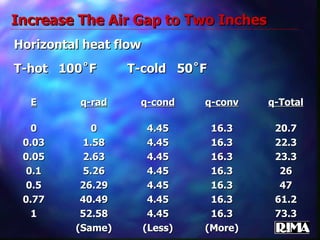
Increase The Air Gap to Two Inches Horizontal heat flow T-hot  100˚F   T-cold  50˚F E q-rad q-cond q-conv q-Total 0 0 4.45 16.3 20.7 0.03 1.58 4.45 16.3 22.3 0.05 2.63 4.45 16.3 23.3 0.1 5.26 4.45 16.3 26 0.5 26.29 4.45 16.3 47 0.77 40.49 4.45 16.3 61.2 1 52.58 4.45 16.3 73.3 (Same) (Less) (More)
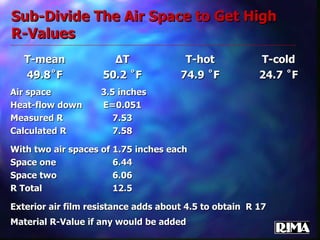
Sub-Divide The Air Space to Get High R-Values T-mean Δ T T-hot T-cold 49.8˚F 50.2 ˚F 74.9 ˚F 24.7 ˚F Air space  3.5 inches Heat-flow down  E=0.051 Measured R  7.53 Calculated R  7.58 With two air spaces of 1.75 inches each Space one  6.44 Space two  6.06 R Total  12.5 Exterior air film resistance adds about 4.5 to obtain  R 17 Material R-Value if any would be added
Summary R-Values for reflective insulation and mass insulation are based on the same fundamental equations. Both insulation types affect the three modes of heat transfer. R-Values for reflective insulation are the result of reduced radiative transport. Reflective insulation products with R-Values of practical significance are available.
Reflective Insulation Installation and Applications
Installation Typical Methods: New Construction with screw down roofs and side walls New Construction with Thermal Spacer Blocks Bottom of Purlins – new and retrofit Installation with Mass Insulation Vapor Retarders
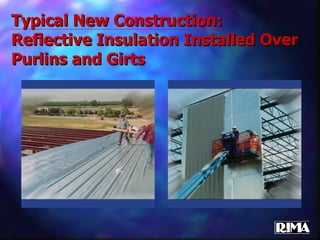
Typical New Construction: Reflective Insulation Installed Over Purlins and Girts
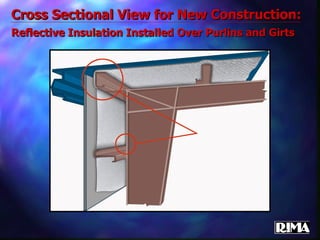
Cross Sectional View for New Construction: Reflective Insulation Installed Over Purlins and Girts
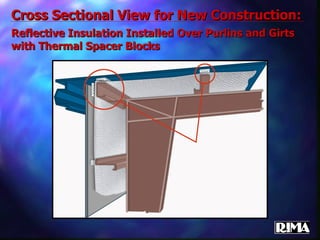
Cross Sectional View for New Construction: Reflective Insulation Installed Over Purlins and Girts with Thermal Spacer Blocks
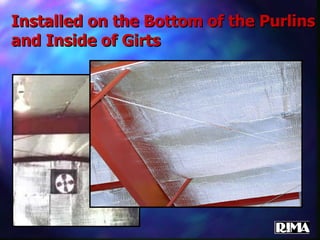
Installed on the Bottom of the Purlins and Inside of Girts
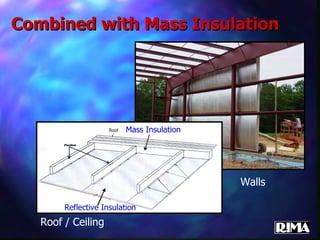
Combined with Mass Insulation Mass Insulation Walls Roof / Ceiling Reflective Insulation
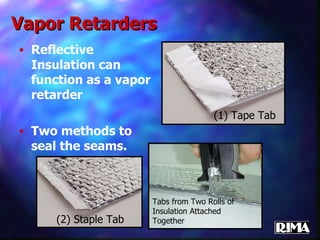
Vapor Retarders Reflective Insulation can function as a vapor retarder  Two methods to seal the seams. (1) Tape Tab Tabs from Two Rolls of Insulation Attached Together (2) Staple Tab
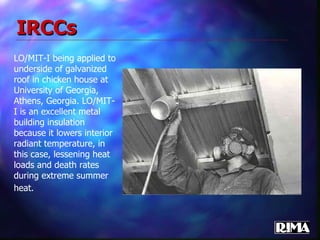
IRCCs LO/MIT-I being applied to underside of galvanized roof in chicken house at University of Georgia, Athens, Georgia. LO/MIT-I is an excellent metal building insulation because it lowers interior radiant temperature, in this case, lessening heat loads and death rates during extreme summer heat.
ASHRAE 90.1  and  Reflective Insulations How we can help you meet increasing energy demands!
What is ASHRAE 90.1? “ The Purpose of this standard is to provide requirements for energy efficient design of buildings except low-rise residential buildings” Takes into account your “U” value, not just “R” value-the entire building envelope Accepted standard across the country—code enforcement California – Title 24
When does it Apply? New buildings, new portions of buildings, or new equipment in existing buildings Buildings heated >= 3.4 BTU/h-ft² Buildings cooled >=5 BTU/h-ft² HVAC units, lighting, water heaters, belt drives, electric motors…
Residential dwellings Buildings that do not use energy or other fossil fuels Buildings used primarily for industrial, manufacturing, or commercial processes Note:   These buildings still apply  depending on heating/cooling When does it Not Apply?
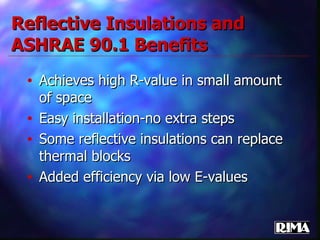
Reflective Insulations and ASHRAE 90.1 Benefits Achieves high R-value in small amount of space Easy installation-no extra steps Some reflective insulations can replace thermal blocks Added efficiency via low E-values
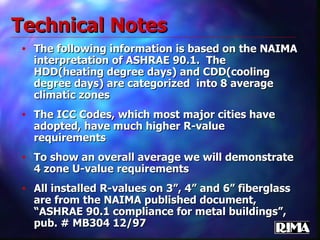
Technical Notes The following information is based on the NAIMA interpretation of ASHRAE 90.1.  The HDD(heating degree days) and CDD(cooling degree days) are categorized  into 8 average climatic zones The ICC Codes, which most major cities have adopted, have much higher R-value requirements To show an overall average we will demonstrate 4 zone U-value requirements All installed R-values on 3”, 4” and 6” fiberglass are from the NAIMA published document, “ASHRAE 90.1 compliance for metal buildings”, pub. # MB304 12/97
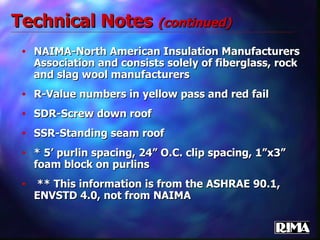
Technical Notes  (continued) NAIMA-North American Insulation Manufacturers Association and consists solely of fiberglass, rock and slag wool manufacturers R-Value numbers in yellow pass and red fail SDR-Screw down roof SSR-Standing seam roof * 5’ purlin spacing, 24” O.C. clip spacing, 1”x3” foam block on purlins ** This information is from the ASHRAE 90.1, ENVSTD 4.0, not from NAIMA
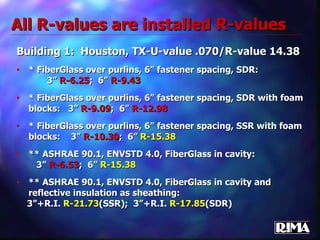
All R-values are installed R-values Building 1:  Houston, TX-U-value .070/R-value 14.38 * FiberGlass over purlins, 6” fastener spacing, SDR:  3”  R-6.25 ;  6”  R-9.43 * FiberGlass over purlins, 6” fastener spacing, SDR with foam blocks:  3”  R-9.09 ;  6”  R-12.98 * FiberGlass over purlins, 6” fastener spacing, SSR with foam blocks:  3”  R-10.30 ;  6”  R-15.38 ** ASHRAE 90.1, ENVSTD 4.0, FiberGlass in cavity:  3”  R-6.53 ;  6”  R-15.38 ** ASHRAE 90.1, ENVSTD 4.0, FiberGlass in cavity and reflective insulation as sheathing:  3”+R.I.  R-21.73 (SSR);  3”+R.I.  R-17.85 (SDR)
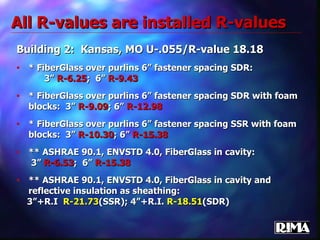
All R-values are installed R-values Building 2:  Kansas, MO U-.055/R-value 18.18 * FiberGlass over purlins 6” fastener spacing SDR:  3”  R-6.25 ;   6”  R-9.43 * FiberGlass over purlins 6” fastener spacing SDR with foam blocks:  3”  R-9.09 ; 6”  R-12.98 * FiberGlass over purlins 6” fastener spacing SSR with foam blocks:  3”  R-10.30 ; 6”  R-15.38 ** ASHRAE 90.1, ENVSTD 4.0, FiberGlass in cavity:  3”  R-6.53 ;  6”  R-15.38 ** ASHRAE 90.1, ENVSTD 4.0, FiberGlass in cavity and reflective insulation as sheathing:  3”+R.I  R-21.73 (SSR); 4”+R.I.  R-18.51 (SDR)
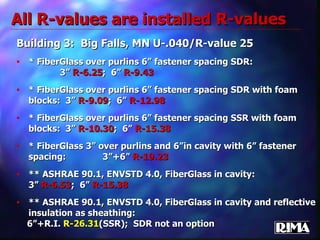
All R-values are installed R-values Building 3:  Big Falls, MN U-.040/R-value 25 * FiberGlass over purlins 6” fastener spacing SDR:  3”  R-6.25 ;  6”  R-9.43 * FiberGlass over purlins 6” fastener spacing SDR with foam blocks:  3”  R-9.09 ;  6”  R-12.98 * FiberGlass over purlins 6” fastener spacing SSR with foam blocks:  3”  R-10.30 ;   6”  R-15.38 * FiberGlass 3” over purlins and 6”in cavity with 6” fastener spacing:  3”+6”  R-19.23 ** ASHRAE 90.1, ENVSTD 4.0, FiberGlass in cavity:  3”  R-6.53 ;  6”  R-15.38 ** ASHRAE 90.1, ENVSTD 4.0, FiberGlass in cavity and reflective insulation as sheathing:  6”+R.I.  R-26.31 (SSR);  SDR not an option
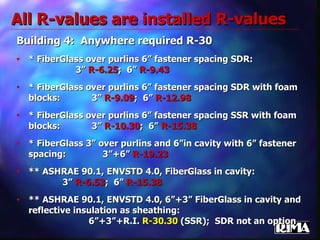
All R-values are installed R-values Building 4:  Anywhere required R-30 * FiberGlass over purlins 6” fastener spacing SDR:  3”  R-6.25 ;  6”  R-9.43 * FiberGlass over purlins 6” fastener spacing SDR with foam blocks:  3”  R-9.09 ;  6”  R-12.98 * FiberGlass over purlins 6” fastener spacing SSR with foam blocks:  3”  R-10.30 ;  6”  R-15.38 * FiberGlass 3” over purlins and 6”in cavity with 6” fastener spacing:  3”+6”  R-19.23 ** ASHRAE 90.1, ENVSTD 4.0, FiberGlass in cavity:  3”  R-6.53 ;  6”  R-15.38 ** ASHRAE 90.1, ENVSTD 4.0, 6”+3” FiberGlass in cavity and reflective insulation as sheathing:  6”+3”+R.I.  R-30.30   (SSR);  SDR not an option
Comfort
Relating to Comfort Thermal Comfort is highly subjective but can be primarily related to: Air temperature – dry bulb temperature Humidity – amount of moisture in the air Air velocity Mean Radiant Temperature
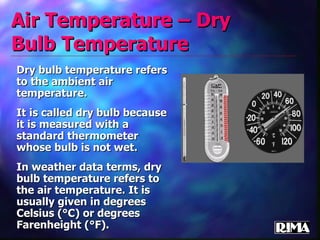
Air Temperature – Dry Bulb Temperature Dry bulb temperature refers to the ambient air temperature.  It is called dry bulb because it is measured with a standard thermometer whose bulb is not wet.  In weather data terms, dry bulb temperature refers to the air temperature. It is usually given in degrees Celsius (°C) or degrees Farenheight (°F).
Humidity – Amount of Moisture in The Air Humidity refers to the amount of moisture vapor in a specific volume of warm air. The saturation point or dew point refers to the maximum amount of moisture that the air can hold at a given temperature. Relative Humidity, is therefore the ratio between the absolute humidity of the air in its current state compared to this maximum amount, expressed as a percentage. Relative Humidity is important for human comfort mostly for its effect on the evaporation of sweat.
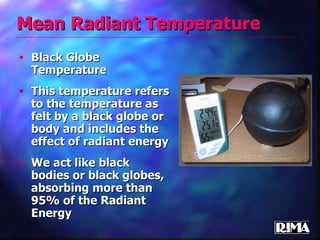
Mean   Radiant Temperature Black Globe Temperature This temperature refers to the temperature as felt by a black globe or body and includes the effect of radiant energy We act like black bodies or black globes, absorbing more than 95% of the Radiant Energy
The Comfort Index Comfort prediction is the relationship between climatic factors and the resulting comfort sensation Comfort Index is the numerical measure of a number of individuals that are comfortable in a given environment Humans are often not the most logical or reliable test subjects Most models therefore depend on a survey of a large number of people in the same conditions
The Comfort Index An ASHRAE example If at a comfortable air temperature The ceiling temperature is 40° F above the air temperature then 60% of the people below the ceiling will be uncomfortable. If the ceiling temperature is dropped to 10° F above air temperature then only 5% of the people are dissatisfied or uncomfortable. In the above examples the air temperature has not changed, but the Mean Radiant Temperature has.
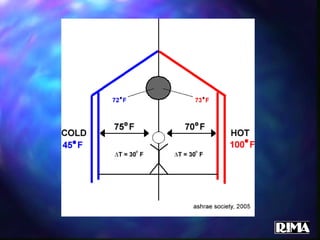
Examples of Radiant Transfer In a warm climate, the outside walls are warm and therefore are emitting Radiant Energy. The opposite is true in cold climates. Since inside the room we act like black globes – we absorb the radiant energy –raising our skin surface temperature without changing the air temperature
Changing The Emittance of The Walls If we now change the wall surface from  high emittance to  low emittance this radiant energy from the walls disappears The effect is we feel cooler There has been no change to the r-value in the walls We feel more comfortable
 
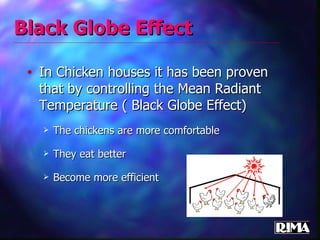
Black Globe Effect In Chicken houses it has been proven that by controlling the Mean Radiant Temperature ( Black Globe Effect) The chickens are more comfortable They eat better Become more efficient
Summary The emmissivity of the walls and ceiling on the interior of a building dramatically effect the Mean Radiant Temperature and therefore the comfort index By changing the MRT it is possible to save significant energy without changing the comfort level In this case changing the emmissivity of the surface and saving energy does not change the r-value
In Closing The physics behind the R-Values for reflective insulation systems was reviewed in the opening segment of this program with examples of the modes of heat transfer present in the building envelope and some numerical examples. Reflective insulations are an integral part of the huge field of building insulation. The basis for evaluating these systems has been well established in recent years.
Some common installation methods for various Radiant Barriers and Reflective Insulations have been discussed We talked about ASHRAE 90.1 and how reflective insulation and mass insulation combined can help meet these increasing energy code requirements. And finally we showed you the added benefit of controlling the MRT in a building that is not related to R-values. In Closing
Reflective Insulation Manufactuers Association 800/279-4123 www.rima.net

Thermal Performance

  • 1.
    2005 Copyright –Reflective Insulation Manufacturers Association Reflective Insulation Manufacturers Association
  • 2.
    R-Values and ThermalPerformance of Reflective Insulation, Radiant Barriers and IRCCs
  • 3.
    Overview About RIMAThermal Resistance/R-Values Reflective Insulation Installation and Applications ASHRAE 90.1 and Reflective Insulations Comfort
  • 4.
    About RIMA TheReflective Insulation Manufacturers Association represents manufacturers and distributors of reflective insulation, radiant barriers and IRCC materials. RIMA activities are guided by an active board of industry members who participate on national and local levels of building code organizations and governmental agencies. Visit us at www.rima.net.
  • 5.
  • 6.
    R-Values Are usedto compare thermal insulation products Quantify resistance to heat flow Are used to calculate heating and cooling loads Can be measured for specific conditions Can be determined from physical property or system measurements
  • 7.
    R-Values for ReflectiveInsulations and Mass Insulations are Determined by Different Methods Start with the 1-D steady-state form of Fourier’s Law - Q=-k·A·dT/dX Written in practical form - Q=k·A· Δ T/L Rearranged - k=Q·L/A· Δ T and R=L/k ASTM C 518 Heat Flow Meter also R=A· Δ T/Q= Δ T/q ASTM C 1363 Hot Box Facility In both cases the R has units FT^2·HR·˚F./BTU The equation used for mass insulations scales linearly with thickness. Reflective insulation has a complex thickness dependence
  • 8.
    Many Insulations Derive Performance From The Low Thermal Conductivity of Air Air-based insulations Non-Air Based Insulations Cellulose Closed Cell Foam w/ Fiberglass Blowing Agent Rock Wool Evacuated Panels Perlite Gas-Filled Panels Open-Cell Foams Nano-Scale Materials Reflective Insulation
  • 9.
    Product Design RequiresConsideration Of All Modes of Heat Transfer Conduction Radiation Convection Mass Insulations Increase Reduction Usually Zero Reflective Slight Near Zero Intermediate Insulations Increase Effect
  • 10.
    Air-Based Insulations HaveLimits The maximum R-Values occurs when radiation and convection are absent. T (˚F) k of AIR R per Inch -25 0.148 6.8 0 0.155 6.5 25 0.163 6.1 50 0.170 5.9 75 0.178 5.6 100 0.185 5.4 125 0.193 5.2 These R/Inch limits apply to both mass and reflective insulations.
  • 11.
    How Do ReflectiveInsulation Systems Fit Into This Framework? Take advantage of the low thermal conductivity of air Use enclosed air spaces with low emittance surfaces Have a mass insulation component in many cases Aluminum foils or films have emittances in the range 0.03 to 0.05 Emittance is a measurement of how efficiently a surface gives off heat in the form of thermal radiation. Reflectance is the fraction of incoming radiation that is not absorbed by a surface In the case of opaque materials: reflectance+emittance=one
  • 12.
    Radiation is aMajor Heat Transport Mode In Many Cases An Example (no convection) One inch gap filled with air Surface one at 50 ˚F Surface two at 100 ˚F Effective emittance for the two surfaces E=1/(1/E1 + 1/E2 -1) q-conduction 8.9 BTU/FT^2·HR q-radiation 52.58E q-Total 8.9+52.58 E E=0.77 q-Total = 49.39 q-RAD is 82% of Total Three and one-half inch air gap – same conditions q-Total 2.54 + 52.58 E E=0.77 q-Total = 43.23 q-RAD is 94% of Total
  • 13.
    Another Look atThe One-Inch Gap Without Convection q-Total = 8.9 + 52.58 E E q Δ T R 0 8.90 50 5.6 1 61.48 50 0.8 0.03 10.48 50 4.8
  • 14.
    Convection is Importantin Open Spaces Horizontal heat flow across a one-inch gap T-hot 100˚F T-cold 50˚F E q-rad q-cond q-conv q-Total 0 0 8.9 10.7 19.6 0.03 1.58 8.9 10.7 21.18 0.05 2.63 8.9 10.7 22.23 0.1 5.26 8.9 10.7 24.86 0.5 26.29 8.9 10.7 45.89 0.77 40.49 8.9 10.7 60.09 1 52.58 8.9 10.7 72.18
  • 15.
    Increase The AirGap to Two Inches Horizontal heat flow T-hot 100˚F T-cold 50˚F E q-rad q-cond q-conv q-Total 0 0 4.45 16.3 20.7 0.03 1.58 4.45 16.3 22.3 0.05 2.63 4.45 16.3 23.3 0.1 5.26 4.45 16.3 26 0.5 26.29 4.45 16.3 47 0.77 40.49 4.45 16.3 61.2 1 52.58 4.45 16.3 73.3 (Same) (Less) (More)
  • 16.
    Sub-Divide The AirSpace to Get High R-Values T-mean Δ T T-hot T-cold 49.8˚F 50.2 ˚F 74.9 ˚F 24.7 ˚F Air space 3.5 inches Heat-flow down E=0.051 Measured R 7.53 Calculated R 7.58 With two air spaces of 1.75 inches each Space one 6.44 Space two 6.06 R Total 12.5 Exterior air film resistance adds about 4.5 to obtain R 17 Material R-Value if any would be added
  • 17.
    Summary R-Values forreflective insulation and mass insulation are based on the same fundamental equations. Both insulation types affect the three modes of heat transfer. R-Values for reflective insulation are the result of reduced radiative transport. Reflective insulation products with R-Values of practical significance are available.
  • 18.
  • 19.
    Installation Typical Methods:New Construction with screw down roofs and side walls New Construction with Thermal Spacer Blocks Bottom of Purlins – new and retrofit Installation with Mass Insulation Vapor Retarders
  • 20.
    Typical New Construction:Reflective Insulation Installed Over Purlins and Girts
  • 21.
    Cross Sectional Viewfor New Construction: Reflective Insulation Installed Over Purlins and Girts
  • 22.
    Cross Sectional Viewfor New Construction: Reflective Insulation Installed Over Purlins and Girts with Thermal Spacer Blocks
  • 23.
    Installed on theBottom of the Purlins and Inside of Girts
  • 24.
    Combined with MassInsulation Mass Insulation Walls Roof / Ceiling Reflective Insulation
  • 25.
    Vapor Retarders ReflectiveInsulation can function as a vapor retarder Two methods to seal the seams. (1) Tape Tab Tabs from Two Rolls of Insulation Attached Together (2) Staple Tab
  • 26.
    IRCCs LO/MIT-I beingapplied to underside of galvanized roof in chicken house at University of Georgia, Athens, Georgia. LO/MIT-I is an excellent metal building insulation because it lowers interior radiant temperature, in this case, lessening heat loads and death rates during extreme summer heat.
  • 27.
    ASHRAE 90.1 and Reflective Insulations How we can help you meet increasing energy demands!
  • 28.
    What is ASHRAE90.1? “ The Purpose of this standard is to provide requirements for energy efficient design of buildings except low-rise residential buildings” Takes into account your “U” value, not just “R” value-the entire building envelope Accepted standard across the country—code enforcement California – Title 24
  • 29.
    When does itApply? New buildings, new portions of buildings, or new equipment in existing buildings Buildings heated >= 3.4 BTU/h-ft² Buildings cooled >=5 BTU/h-ft² HVAC units, lighting, water heaters, belt drives, electric motors…
  • 30.
    Residential dwellings Buildingsthat do not use energy or other fossil fuels Buildings used primarily for industrial, manufacturing, or commercial processes Note: These buildings still apply depending on heating/cooling When does it Not Apply?
  • 31.
    Reflective Insulations andASHRAE 90.1 Benefits Achieves high R-value in small amount of space Easy installation-no extra steps Some reflective insulations can replace thermal blocks Added efficiency via low E-values
  • 32.
    Technical Notes Thefollowing information is based on the NAIMA interpretation of ASHRAE 90.1. The HDD(heating degree days) and CDD(cooling degree days) are categorized into 8 average climatic zones The ICC Codes, which most major cities have adopted, have much higher R-value requirements To show an overall average we will demonstrate 4 zone U-value requirements All installed R-values on 3”, 4” and 6” fiberglass are from the NAIMA published document, “ASHRAE 90.1 compliance for metal buildings”, pub. # MB304 12/97
  • 33.
    Technical Notes (continued) NAIMA-North American Insulation Manufacturers Association and consists solely of fiberglass, rock and slag wool manufacturers R-Value numbers in yellow pass and red fail SDR-Screw down roof SSR-Standing seam roof * 5’ purlin spacing, 24” O.C. clip spacing, 1”x3” foam block on purlins ** This information is from the ASHRAE 90.1, ENVSTD 4.0, not from NAIMA
  • 34.
    All R-values areinstalled R-values Building 1: Houston, TX-U-value .070/R-value 14.38 * FiberGlass over purlins, 6” fastener spacing, SDR: 3” R-6.25 ; 6” R-9.43 * FiberGlass over purlins, 6” fastener spacing, SDR with foam blocks: 3” R-9.09 ; 6” R-12.98 * FiberGlass over purlins, 6” fastener spacing, SSR with foam blocks: 3” R-10.30 ; 6” R-15.38 ** ASHRAE 90.1, ENVSTD 4.0, FiberGlass in cavity: 3” R-6.53 ; 6” R-15.38 ** ASHRAE 90.1, ENVSTD 4.0, FiberGlass in cavity and reflective insulation as sheathing: 3”+R.I. R-21.73 (SSR); 3”+R.I. R-17.85 (SDR)
  • 35.
    All R-values areinstalled R-values Building 2: Kansas, MO U-.055/R-value 18.18 * FiberGlass over purlins 6” fastener spacing SDR: 3” R-6.25 ; 6” R-9.43 * FiberGlass over purlins 6” fastener spacing SDR with foam blocks: 3” R-9.09 ; 6” R-12.98 * FiberGlass over purlins 6” fastener spacing SSR with foam blocks: 3” R-10.30 ; 6” R-15.38 ** ASHRAE 90.1, ENVSTD 4.0, FiberGlass in cavity: 3” R-6.53 ; 6” R-15.38 ** ASHRAE 90.1, ENVSTD 4.0, FiberGlass in cavity and reflective insulation as sheathing: 3”+R.I R-21.73 (SSR); 4”+R.I. R-18.51 (SDR)
  • 36.
    All R-values areinstalled R-values Building 3: Big Falls, MN U-.040/R-value 25 * FiberGlass over purlins 6” fastener spacing SDR: 3” R-6.25 ; 6” R-9.43 * FiberGlass over purlins 6” fastener spacing SDR with foam blocks: 3” R-9.09 ; 6” R-12.98 * FiberGlass over purlins 6” fastener spacing SSR with foam blocks: 3” R-10.30 ; 6” R-15.38 * FiberGlass 3” over purlins and 6”in cavity with 6” fastener spacing: 3”+6” R-19.23 ** ASHRAE 90.1, ENVSTD 4.0, FiberGlass in cavity: 3” R-6.53 ; 6” R-15.38 ** ASHRAE 90.1, ENVSTD 4.0, FiberGlass in cavity and reflective insulation as sheathing: 6”+R.I. R-26.31 (SSR); SDR not an option
  • 37.
    All R-values areinstalled R-values Building 4: Anywhere required R-30 * FiberGlass over purlins 6” fastener spacing SDR: 3” R-6.25 ; 6” R-9.43 * FiberGlass over purlins 6” fastener spacing SDR with foam blocks: 3” R-9.09 ; 6” R-12.98 * FiberGlass over purlins 6” fastener spacing SSR with foam blocks: 3” R-10.30 ; 6” R-15.38 * FiberGlass 3” over purlins and 6”in cavity with 6” fastener spacing: 3”+6” R-19.23 ** ASHRAE 90.1, ENVSTD 4.0, FiberGlass in cavity: 3” R-6.53 ; 6” R-15.38 ** ASHRAE 90.1, ENVSTD 4.0, 6”+3” FiberGlass in cavity and reflective insulation as sheathing: 6”+3”+R.I. R-30.30 (SSR); SDR not an option
  • 38.
  • 39.
    Relating to ComfortThermal Comfort is highly subjective but can be primarily related to: Air temperature – dry bulb temperature Humidity – amount of moisture in the air Air velocity Mean Radiant Temperature
  • 40.
    Air Temperature –Dry Bulb Temperature Dry bulb temperature refers to the ambient air temperature. It is called dry bulb because it is measured with a standard thermometer whose bulb is not wet. In weather data terms, dry bulb temperature refers to the air temperature. It is usually given in degrees Celsius (°C) or degrees Farenheight (°F).
  • 41.
    Humidity – Amountof Moisture in The Air Humidity refers to the amount of moisture vapor in a specific volume of warm air. The saturation point or dew point refers to the maximum amount of moisture that the air can hold at a given temperature. Relative Humidity, is therefore the ratio between the absolute humidity of the air in its current state compared to this maximum amount, expressed as a percentage. Relative Humidity is important for human comfort mostly for its effect on the evaporation of sweat.

  • 42.
    Mean Radiant Temperature Black Globe Temperature This temperature refers to the temperature as felt by a black globe or body and includes the effect of radiant energy We act like black bodies or black globes, absorbing more than 95% of the Radiant Energy
  • 43.
    The Comfort IndexComfort prediction is the relationship between climatic factors and the resulting comfort sensation Comfort Index is the numerical measure of a number of individuals that are comfortable in a given environment Humans are often not the most logical or reliable test subjects Most models therefore depend on a survey of a large number of people in the same conditions
  • 44.
    The Comfort IndexAn ASHRAE example If at a comfortable air temperature The ceiling temperature is 40° F above the air temperature then 60% of the people below the ceiling will be uncomfortable. If the ceiling temperature is dropped to 10° F above air temperature then only 5% of the people are dissatisfied or uncomfortable. In the above examples the air temperature has not changed, but the Mean Radiant Temperature has.
  • 45.
    Examples of RadiantTransfer In a warm climate, the outside walls are warm and therefore are emitting Radiant Energy. The opposite is true in cold climates. Since inside the room we act like black globes – we absorb the radiant energy –raising our skin surface temperature without changing the air temperature
  • 46.
    Changing The Emittanceof The Walls If we now change the wall surface from high emittance to low emittance this radiant energy from the walls disappears The effect is we feel cooler There has been no change to the r-value in the walls We feel more comfortable
  • 47.
  • 48.
    Black Globe EffectIn Chicken houses it has been proven that by controlling the Mean Radiant Temperature ( Black Globe Effect) The chickens are more comfortable They eat better Become more efficient
  • 49.
    Summary The emmissivityof the walls and ceiling on the interior of a building dramatically effect the Mean Radiant Temperature and therefore the comfort index By changing the MRT it is possible to save significant energy without changing the comfort level In this case changing the emmissivity of the surface and saving energy does not change the r-value
  • 50.
    In Closing Thephysics behind the R-Values for reflective insulation systems was reviewed in the opening segment of this program with examples of the modes of heat transfer present in the building envelope and some numerical examples. Reflective insulations are an integral part of the huge field of building insulation. The basis for evaluating these systems has been well established in recent years.
  • 51.
    Some common installationmethods for various Radiant Barriers and Reflective Insulations have been discussed We talked about ASHRAE 90.1 and how reflective insulation and mass insulation combined can help meet these increasing energy code requirements. And finally we showed you the added benefit of controlling the MRT in a building that is not related to R-values. In Closing
  • 52.
    Reflective Insulation ManufactuersAssociation 800/279-4123 www.rima.net

Editor's Notes

  • #2 R-Values/Thermal Performance of Reflective Insulation, Radiant Barriers and IRCCs For more information, contact the Reflective Insulation Manufacturers Association at 800/279-4123 or visit us at www.rima.net
  • #3 R-Values/Thermal Performance of Reflective Insulation, Radiant Barriers and IRCCs For more information, contact the Reflective Insulation Manufacturers Association at 800/279-4123 or visit us at www.rima.net
  • #4 R-Values/Thermal Performance of Reflective Insulation, Radiant Barriers and IRCCs For more information, contact the Reflective Insulation Manufacturers Association at 800/279-4123 or visit us at www.rima.net
  • #5 R-Values/Thermal Performance of Reflective Insulation, Radiant Barriers and IRCCs For more information, contact the Reflective Insulation Manufacturers Association at 800/279-4123 or visit us at www.rima.net
  • #6 R-Values/Thermal Performance of Reflective Insulation, Radiant Barriers and IRCCs For more information, contact the Reflective Insulation Manufacturers Association at 800/279-4123 or visit us at www.rima.net
  • #7 R-Values/Thermal Performance of Reflective Insulation, Radiant Barriers and IRCCs For more information, contact the Reflective Insulation Manufacturers Association at 800/279-4123 or visit us at www.rima.net
  • #8 R-Values/Thermal Performance of Reflective Insulation, Radiant Barriers and IRCCs For more information, contact the Reflective Insulation Manufacturers Association at 800/279-4123 or visit us at www.rima.net
  • #9 R-Values/Thermal Performance of Reflective Insulation, Radiant Barriers and IRCCs For more information, contact the Reflective Insulation Manufacturers Association at 800/279-4123 or visit us at www.rima.net
  • #10 R-Values/Thermal Performance of Reflective Insulation, Radiant Barriers and IRCCs For more information, contact the Reflective Insulation Manufacturers Association at 800/279-4123 or visit us at www.rima.net
  • #11 R-Values/Thermal Performance of Reflective Insulation, Radiant Barriers and IRCCs For more information, contact the Reflective Insulation Manufacturers Association at 800/279-4123 or visit us at www.rima.net
  • #12 R-Values/Thermal Performance of Reflective Insulation, Radiant Barriers and IRCCs For more information, contact the Reflective Insulation Manufacturers Association at 800/279-4123 or visit us at www.rima.net
  • #13 R-Values/Thermal Performance of Reflective Insulation, Radiant Barriers and IRCCs For more information, contact the Reflective Insulation Manufacturers Association at 800/279-4123 or visit us at www.rima.net
  • #14 R-Values/Thermal Performance of Reflective Insulation, Radiant Barriers and IRCCs For more information, contact the Reflective Insulation Manufacturers Association at 800/279-4123 or visit us at www.rima.net
  • #15 R-Values/Thermal Performance of Reflective Insulation, Radiant Barriers and IRCCs For more information, contact the Reflective Insulation Manufacturers Association at 800/279-4123 or visit us at www.rima.net
  • #16 R-Values/Thermal Performance of Reflective Insulation, Radiant Barriers and IRCCs For more information, contact the Reflective Insulation Manufacturers Association at 800/279-4123 or visit us at www.rima.net
  • #17 R-Values/Thermal Performance of Reflective Insulation, Radiant Barriers and IRCCs For more information, contact the Reflective Insulation Manufacturers Association at 800/279-4123 or visit us at www.rima.net
  • #18 R-Values/Thermal Performance of Reflective Insulation, Radiant Barriers and IRCCs For more information, contact the Reflective Insulation Manufacturers Association at 800/279-4123 or visit us at www.rima.net
  • #19 R-Values/Thermal Performance of Reflective Insulation, Radiant Barriers and IRCCs For more information, contact the Reflective Insulation Manufacturers Association at 800/279-4123 or visit us at www.rima.net
  • #20 R-Values/Thermal Performance of Reflective Insulation, Radiant Barriers and IRCCs For more information, contact the Reflective Insulation Manufacturers Association at 800/279-4123 or visit us at www.rima.net
  • #21 R-Values/Thermal Performance of Reflective Insulation, Radiant Barriers and IRCCs For more information, contact the Reflective Insulation Manufacturers Association at 800/279-4123 or visit us at www.rima.net
  • #22 R-Values/Thermal Performance of Reflective Insulation, Radiant Barriers and IRCCs For more information, contact the Reflective Insulation Manufacturers Association at 800/279-4123 or visit us at www.rima.net
  • #23 R-Values/Thermal Performance of Reflective Insulation, Radiant Barriers and IRCCs For more information, contact the Reflective Insulation Manufacturers Association at 800/279-4123 or visit us at www.rima.net
  • #24 R-Values/Thermal Performance of Reflective Insulation, Radiant Barriers and IRCCs For more information, contact the Reflective Insulation Manufacturers Association at 800/279-4123 or visit us at www.rima.net
  • #25 R-Values/Thermal Performance of Reflective Insulation, Radiant Barriers and IRCCs For more information, contact the Reflective Insulation Manufacturers Association at 800/279-4123 or visit us at www.rima.net
  • #26 R-Values/Thermal Performance of Reflective Insulation, Radiant Barriers and IRCCs For more information, contact the Reflective Insulation Manufacturers Association at 800/279-4123 or visit us at www.rima.net
  • #27 R-Values/Thermal Performance of Reflective Insulation, Radiant Barriers and IRCCs For more information, contact the Reflective Insulation Manufacturers Association at 800/279-4123 or visit us at www.rima.net
  • #28 R-Values/Thermal Performance of Reflective Insulation, Radiant Barriers and IRCCs For more information, contact the Reflective Insulation Manufacturers Association at 800/279-4123 or visit us at www.rima.net
  • #29 R-Values/Thermal Performance of Reflective Insulation, Radiant Barriers and IRCCs For more information, contact the Reflective Insulation Manufacturers Association at 800/279-4123 or visit us at www.rima.net
  • #30 R-Values/Thermal Performance of Reflective Insulation, Radiant Barriers and IRCCs For more information, contact the Reflective Insulation Manufacturers Association at 800/279-4123 or visit us at www.rima.net
  • #31 R-Values/Thermal Performance of Reflective Insulation, Radiant Barriers and IRCCs For more information, contact the Reflective Insulation Manufacturers Association at 800/279-4123 or visit us at www.rima.net
  • #32 R-Values/Thermal Performance of Reflective Insulation, Radiant Barriers and IRCCs For more information, contact the Reflective Insulation Manufacturers Association at 800/279-4123 or visit us at www.rima.net
  • #33 R-Values/Thermal Performance of Reflective Insulation, Radiant Barriers and IRCCs For more information, contact the Reflective Insulation Manufacturers Association at 800/279-4123 or visit us at www.rima.net
  • #34 R-Values/Thermal Performance of Reflective Insulation, Radiant Barriers and IRCCs For more information, contact the Reflective Insulation Manufacturers Association at 800/279-4123 or visit us at www.rima.net
  • #35 R-Values/Thermal Performance of Reflective Insulation, Radiant Barriers and IRCCs For more information, contact the Reflective Insulation Manufacturers Association at 800/279-4123 or visit us at www.rima.net
  • #36 R-Values/Thermal Performance of Reflective Insulation, Radiant Barriers and IRCCs For more information, contact the Reflective Insulation Manufacturers Association at 800/279-4123 or visit us at www.rima.net
  • #37 R-Values/Thermal Performance of Reflective Insulation, Radiant Barriers and IRCCs For more information, contact the Reflective Insulation Manufacturers Association at 800/279-4123 or visit us at www.rima.net
  • #38 R-Values/Thermal Performance of Reflective Insulation, Radiant Barriers and IRCCs For more information, contact the Reflective Insulation Manufacturers Association at 800/279-4123 or visit us at www.rima.net
  • #39 R-Values/Thermal Performance of Reflective Insulation, Radiant Barriers and IRCCs For more information, contact the Reflective Insulation Manufacturers Association at 800/279-4123 or visit us at www.rima.net
  • #40 R-Values/Thermal Performance of Reflective Insulation, Radiant Barriers and IRCCs For more information, contact the Reflective Insulation Manufacturers Association at 800/279-4123 or visit us at www.rima.net
  • #41 R-Values/Thermal Performance of Reflective Insulation, Radiant Barriers and IRCCs For more information, contact the Reflective Insulation Manufacturers Association at 800/279-4123 or visit us at www.rima.net
  • #42 R-Values/Thermal Performance of Reflective Insulation, Radiant Barriers and IRCCs For more information, contact the Reflective Insulation Manufacturers Association at 800/279-4123 or visit us at www.rima.net
  • #43 R-Values/Thermal Performance of Reflective Insulation, Radiant Barriers and IRCCs For more information, contact the Reflective Insulation Manufacturers Association at 800/279-4123 or visit us at www.rima.net
  • #44 R-Values/Thermal Performance of Reflective Insulation, Radiant Barriers and IRCCs For more information, contact the Reflective Insulation Manufacturers Association at 800/279-4123 or visit us at www.rima.net
  • #45 R-Values/Thermal Performance of Reflective Insulation, Radiant Barriers and IRCCs For more information, contact the Reflective Insulation Manufacturers Association at 800/279-4123 or visit us at www.rima.net
  • #46 R-Values/Thermal Performance of Reflective Insulation, Radiant Barriers and IRCCs For more information, contact the Reflective Insulation Manufacturers Association at 800/279-4123 or visit us at www.rima.net
  • #47 R-Values/Thermal Performance of Reflective Insulation, Radiant Barriers and IRCCs For more information, contact the Reflective Insulation Manufacturers Association at 800/279-4123 or visit us at www.rima.net
  • #48 R-Values/Thermal Performance of Reflective Insulation, Radiant Barriers and IRCCs For more information, contact the Reflective Insulation Manufacturers Association at 800/279-4123 or visit us at www.rima.net
  • #49 R-Values/Thermal Performance of Reflective Insulation, Radiant Barriers and IRCCs For more information, contact the Reflective Insulation Manufacturers Association at 800/279-4123 or visit us at www.rima.net
  • #50 R-Values/Thermal Performance of Reflective Insulation, Radiant Barriers and IRCCs For more information, contact the Reflective Insulation Manufacturers Association at 800/279-4123 or visit us at www.rima.net
  • #51 R-Values/Thermal Performance of Reflective Insulation, Radiant Barriers and IRCCs For more information, contact the Reflective Insulation Manufacturers Association at 800/279-4123 or visit us at www.rima.net
  • #52 R-Values/Thermal Performance of Reflective Insulation, Radiant Barriers and IRCCs For more information, contact the Reflective Insulation Manufacturers Association at 800/279-4123 or visit us at www.rima.net
  • #53 R-Values/Thermal Performance of Reflective Insulation, Radiant Barriers and IRCCs For more information, contact the Reflective Insulation Manufacturers Association at 800/279-4123 or visit us at www.rima.net