COLOR TEMPERATURE
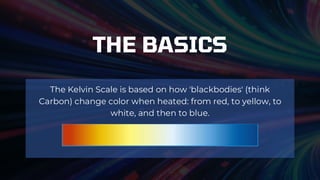
The Kelvin Scale is based on how 'blackbodies' (think
Carbon) change color when heated: from red, to yellow, to
white, and then to blue.
THE BASICS
Color temperature is measured in degrees
Kelvin, from zero to twenty thousand.
HOW IT’S MEASURED
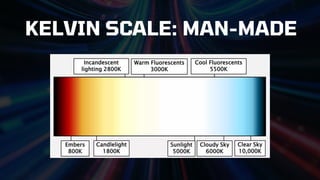
KELVIN SCALE: MAN-MADE
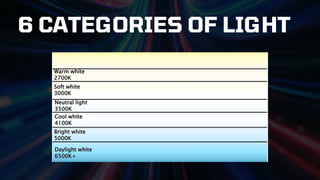
6 CATEGORIES OF LIGHT
APPLICATIONS OF
DIFFERENT COLOR
TEMPERATURE
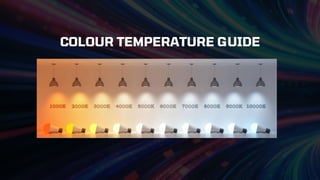
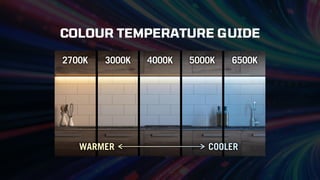
COLOUR TEMPERATURE GUIDE
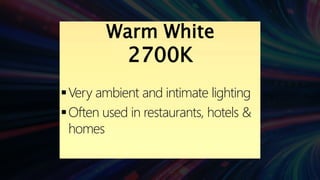
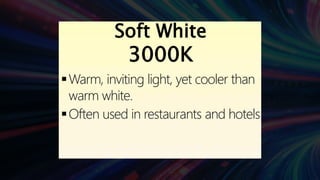
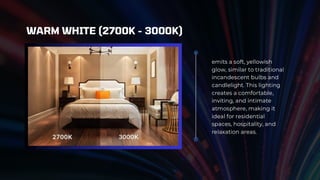
emits a soft, yellowish
glow, similar to traditional
incandescent bulbs and
candlelight. This lighting
creates a comfortable,
inviting, and intimate
atmosphere, making it
ideal for residential
spaces, hospitality, and
relaxation areas.
WARM WHITE (2700K - 3000K)
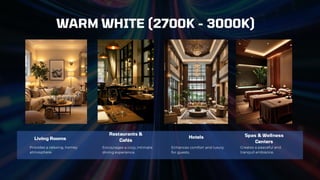
Living Rooms Hotels
Restaurants &
Cafés
Spas & Wellness
Centers
Encourages a cozy, intimate
dining experience.
Provides a relaxing, homey
atmosphere.
Creates a peaceful and
tranquil ambiance.
WARM WHITE (2700K - 3000K)
Enhances comfort and luxury
for guests.
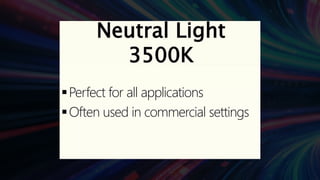
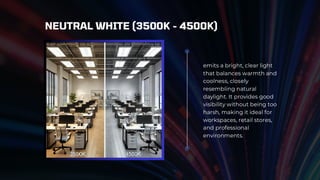
emits a bright, clear light
that balances warmth and
coolness, closely
resembling natural
daylight. It provides good
visibility without being too
harsh, making it ideal for
workspaces, retail stores,
and professional
environments.
NEUTRAL WHITE (3500K - 4500K)
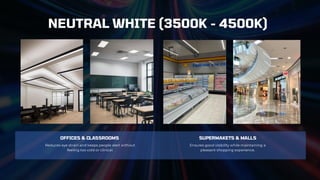
OFFICES & CLASSROOMS SUPERMAKETS & MALLS
Reduces eye strain and keeps people alert without
feeling too cold or clinical.
Ensures good visibility while maintaining a
pleasant shopping experience.
NEUTRAL WHITE (3500K - 4500K)
KITCHENS & BATHROOMS HOSPITALS & CLINICS
Provides clear lighting for food preparation,
grooming, and cleaning.
Creates a clean yet comfortable environment for
healthcare.
NEUTRAL WHITE (3500K - 4500K)
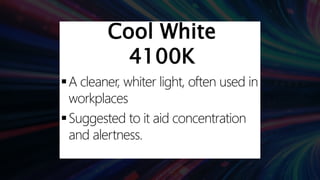
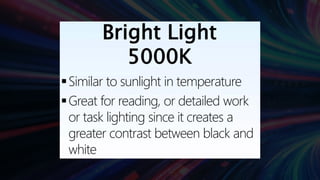
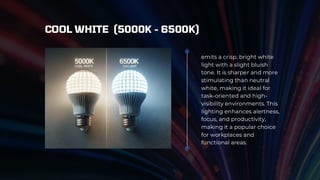
emits a crisp, bright white
light with a slight bluish
tone. It is sharper and more
stimulating than neutral
white, making it ideal for
task-oriented and high-
visibility environments. This
lighting enhances alertness,
focus, and productivity,
making it a popular choice
for workplaces and
functional areas.
COOL WHITE (5000K - 6500K)
FACTORIES, WAREHOUSES, & INDUSTRIAL SPACES
Improves visibility for safety and efficiency, especially in areas with machinery and
moving equipment.
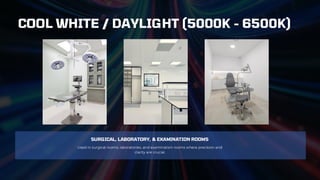
COOL WHITE / DAYLIGHT (5000K - 6500K)
SURGICAL, LABORATORY, & EXAMINATION ROOMS
Used in surgical rooms, laboratories, and examination rooms where precision and
clarity are crucial.
COOL WHITE / DAYLIGHT (5000K - 6500K)
PHOTOGRAPHY STUDIOS & SHOWROOMS
Provides accurate color rendering and eliminates unwanted shadows, ensuring
products and visuals appear as they do in natural daylight.
COOL WHITE / DAYLIGHT (5000K - 6500K)
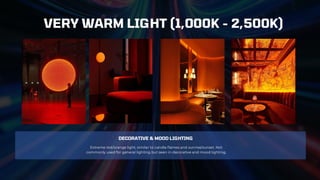
DECORATIVE & MOOD LIGHTING
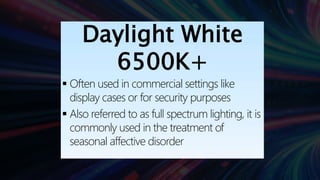
Extreme red/orange light, similar to candle flames and sunrise/sunset. Not
commonly used for general lighting but seen in decorative and mood lighting.
VERY WARM LIGHT (1,000K - 2,500K)
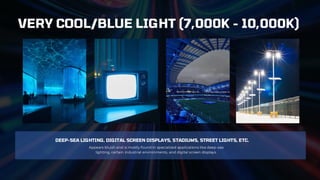
DEEP-SEA LIGHTING, DIGITAL SCREEN DISPLAYS, STADIUMS, STREET LIGHTS, ETC.
Appears bluish and is mostly found in specialized applications like deep-sea
lighting, certain industrial environments, and digital screen displays.
VERY COOL/BLUE LIGHT (7,000K - 10,000K)
COLOR APPEARANCE OF
LIGHT SOURCES
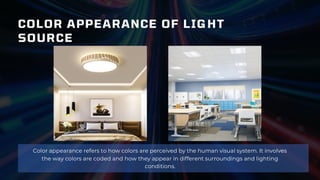
COLOR APPEARANCE OF LIGHT
SOURCE
Color appearance refers to how colors are perceived by the human visual system. It involves
the way colors are coded and how they appear in different surroundings and lighting
conditions.
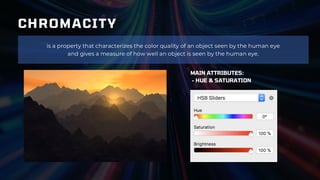
CHROMACITY
is a property that characterizes the color quality of an object seen by the human eye
and gives a measure of how well an object is seen by the human eye.
MAIN ATTRIBUTES:
- HUE & SATURATION
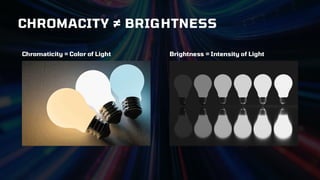
CHROMACITY ≠ BRIGHTNESS
Chromaticity = Color of Light Brightness = Intensity of Light
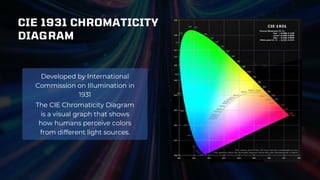
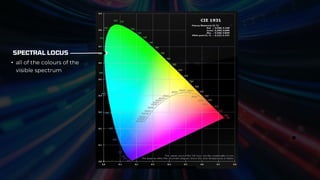
CIE 1931 CHROMATICITY
DIAGRAM
The CIE Chromaticity Diagram
is a visual graph that shows
how humans perceive colors
from different light sources.
Developed by International
Commission on Illumination in
1931
SPECTRAL LOCUS
• all of the colours of the
visible spectrum
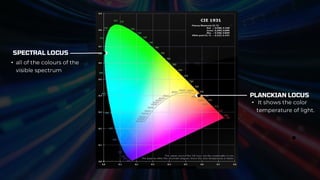
SPECTRAL LOCUS
• all of the colours of the
visible spectrum
PLANCKIAN LOCUS
• It shows the color
temperature of light.
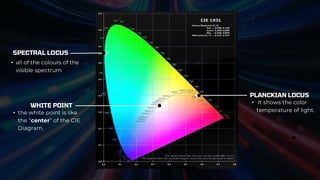
SPECTRAL LOCUS
• all of the colours of the
visible spectrum
PLANCKIAN LOCUS
• It shows the color
temperature of light.
WHITE POINT
• the white point is like
the “center” of the CIE
Diagram.
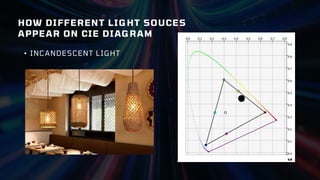
HOW DIFFERENT LIGHT SOUCES
APPEAR ON CIE DIAGRAM
• INCANDESCENT LIGHT
HOW DIFFERENT LIGHT SOUCES
APPEAR ON CIE DIAGRAM
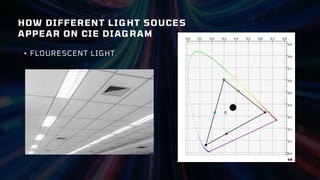
• FLOURESCENT LIGHT
HOW DIFFERENT LIGHT SOUCES
APPEAR ON CIE DIAGRAM
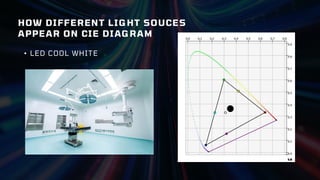
• LED COOL WHITE
HOW DIFFERENT LIGHT SOUCES
APPEAR ON CIE DIAGRAM
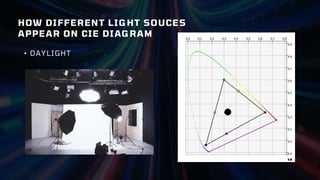
• DAYLIGHT
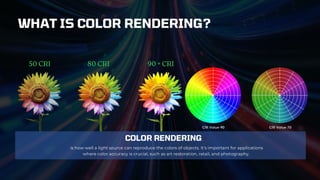
COLOR RENDERING
COLOR RENDERING
is how well a light source can reproduce the colors of objects. It's important for applications
where color accuracy is crucial, such as art restoration, retail, and photography.
WHAT IS COLOR RENDERING?
HOW IS COLOR RENDERING
MEASURED?
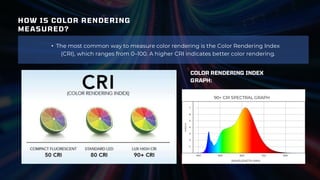
• The most common way to measure color rendering is the Color Rendering Index
(CRI), which ranges from 0–100. A higher CRI indicates better color rendering.
COLOR RENDERING INDEX
GRAPH:
WHAT ARE THE BENEFITS OF
GOOD COLOR RENDERING
Visual comfort - Accurate color rendering reduces eye strain and creates a more
pleasant environment.
Task performance - Accurate color perception improves efficiency and accuracy when performing
tasks like reading, cooking, and working on hobbies.
COLOR RENDERING INDEX
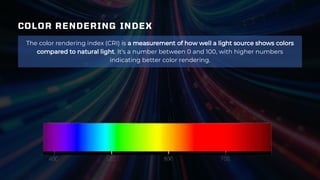
The color rendering index (CRI) is a measurement of how well a light source shows colors
compared to natural light. It's a number between 0 and 100, with higher numbers
indicating better color rendering.
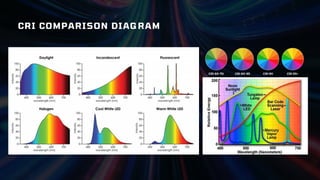
CRI COMPARISON DIAGRAM
DIFFERENT CRI
REQUIREMENTS FOR
TYPES OF SPACES
TH E FI NAN CIA L I ND U STRY
COLOR RENDERING INDEX
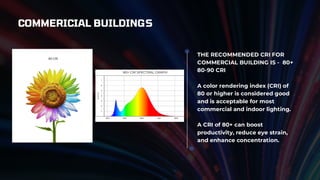
THE RECOMMENDED CRI FOR
COMMERCIAL BUILDING IS - 80+
80-90 CRI
A color rendering index (CRI) of
80 or higher is considered good
and is acceptable for most
commercial and indoor lighting.
A CRI of 80+ can boost
productivity, reduce eye strain,
and enhance concentration.
COMMERICIAL BUILDINGS
OFFICE SCHOOL COMMON AREAS
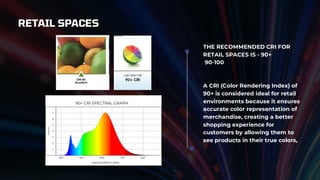
RETAIL SPACES
THE RECOMMENDED CRI FOR
RETAIL SPACES IS - 90+
90-100
A CRI (Color Rendering Index) of
90+ is considered ideal for retail
environments because it ensures
accurate color representation of
merchandise, creating a better
shopping experience for
customers by allowing them to
see products in their true colors,
RETAIL SPACES
GROCERY STORES
& SUPERMARKETS
JEWELRY STORES
INDUSTRIAL
THE RECOMMENDED CRI FOR
INDUSTRIAL IS - 70+
70-90
A CRI (Color Rendering Index)
value between 70-90 is generally
considered acceptable for most
industrial lighting applications, as
it provides a good balance
between color accuracy and cost-
effectiveness, meaning that while
colors may not be perfectly
rendered, they will still be
recognizable enough for most
industrial tasks.
INDUSTRIAL
GENERAL
MANUFACTURING &
ASSEMBLY AREAS
WAREHOUSES &
STORAGE FACILITIES
ROADWAYS & PARKING THE RECOMMENDED CRI FOR
ROADWAY & PARKING IS - 50+
50-70
Roadway and parking lot lighting
prioritizes visibility, contrast, and
safety over color accuracy. A CRI
of 50-70 is sufficient, as it ensures
clear differentiation of objects,
vehicles, and pedestrians without
unnecessary energy
consumption. Lower CRI (50-60)
is suitable for highways and open
parking lots, while higher CRI
(60-70) enhances security and
facial recognition in urban
streets, intersections, and
garages.
LANDSCAPING
THE RECOMMENDED CRI FOR
INLANDSCAPE IS - 60+
60-80
Recommended CRI: 60-80
Landscape lighting prioritizes
ambiance, visibility, and
aesthetics, with CRI requirements
varying based on the purpose of
the lighting.
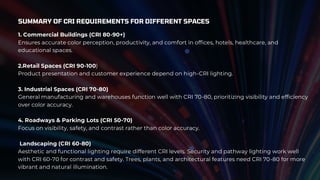
SUMMARY OF CRI REQUIREMENTS FOR DIFFERENT SPACES
1. Commercial Buildings (CRI 80-90+)
Ensures accurate color perception, productivity, and comfort in offices, hotels, healthcare, and
educational spaces.
2.Retail Spaces (CRI 90-100)
Product presentation and customer experience depend on high-CRI lighting.
3. Industrial Spaces (CRI 70-80)
General manufacturing and warehouses function well with CRI 70-80, prioritizing visibility and efficiency
over color accuracy.
4. Roadways & Parking Lots (CRI 50-70)
Focus on visibility, safety, and contrast rather than color accuracy.
Landscaping (CRI 60-80)
Aesthetic and functional lighting require different CRI levels. Security and pathway lighting work well
with CRI 60-70 for contrast and safety. Trees, plants, and architectural features need CRI 70-80 for more
vibrant and natural illumination.
THANK YOU

GROUP2_BUILDING UTILITIES 3 color temperature

  • 1.
  • 2.
    The Kelvin Scaleis based on how 'blackbodies' (think Carbon) change color when heated: from red, to yellow, to white, and then to blue. THE BASICS
  • 3.
    Color temperature ismeasured in degrees Kelvin, from zero to twenty thousand. HOW IT’S MEASURED
  • 4.
  • 5.
  • 12.
  • 13.
  • 14.
  • 15.
    emits a soft,yellowish glow, similar to traditional incandescent bulbs and candlelight. This lighting creates a comfortable, inviting, and intimate atmosphere, making it ideal for residential spaces, hospitality, and relaxation areas. WARM WHITE (2700K - 3000K)
  • 16.
    Living Rooms Hotels Restaurants& Cafés Spas & Wellness Centers Encourages a cozy, intimate dining experience. Provides a relaxing, homey atmosphere. Creates a peaceful and tranquil ambiance. WARM WHITE (2700K - 3000K) Enhances comfort and luxury for guests.
  • 17.
    emits a bright,clear light that balances warmth and coolness, closely resembling natural daylight. It provides good visibility without being too harsh, making it ideal for workspaces, retail stores, and professional environments. NEUTRAL WHITE (3500K - 4500K)
  • 18.
    OFFICES & CLASSROOMSSUPERMAKETS & MALLS Reduces eye strain and keeps people alert without feeling too cold or clinical. Ensures good visibility while maintaining a pleasant shopping experience. NEUTRAL WHITE (3500K - 4500K)
  • 19.
    KITCHENS & BATHROOMSHOSPITALS & CLINICS Provides clear lighting for food preparation, grooming, and cleaning. Creates a clean yet comfortable environment for healthcare. NEUTRAL WHITE (3500K - 4500K)
  • 20.
    emits a crisp,bright white light with a slight bluish tone. It is sharper and more stimulating than neutral white, making it ideal for task-oriented and high- visibility environments. This lighting enhances alertness, focus, and productivity, making it a popular choice for workplaces and functional areas. COOL WHITE (5000K - 6500K)
  • 21.
    FACTORIES, WAREHOUSES, &INDUSTRIAL SPACES Improves visibility for safety and efficiency, especially in areas with machinery and moving equipment. COOL WHITE / DAYLIGHT (5000K - 6500K)
  • 22.
    SURGICAL, LABORATORY, &EXAMINATION ROOMS Used in surgical rooms, laboratories, and examination rooms where precision and clarity are crucial. COOL WHITE / DAYLIGHT (5000K - 6500K)
  • 23.
    PHOTOGRAPHY STUDIOS &SHOWROOMS Provides accurate color rendering and eliminates unwanted shadows, ensuring products and visuals appear as they do in natural daylight. COOL WHITE / DAYLIGHT (5000K - 6500K)
  • 24.
    DECORATIVE & MOODLIGHTING Extreme red/orange light, similar to candle flames and sunrise/sunset. Not commonly used for general lighting but seen in decorative and mood lighting. VERY WARM LIGHT (1,000K - 2,500K)
  • 25.
    DEEP-SEA LIGHTING, DIGITALSCREEN DISPLAYS, STADIUMS, STREET LIGHTS, ETC. Appears bluish and is mostly found in specialized applications like deep-sea lighting, certain industrial environments, and digital screen displays. VERY COOL/BLUE LIGHT (7,000K - 10,000K)
  • 26.
  • 27.
    COLOR APPEARANCE OFLIGHT SOURCE Color appearance refers to how colors are perceived by the human visual system. It involves the way colors are coded and how they appear in different surroundings and lighting conditions.
  • 28.
    CHROMACITY is a propertythat characterizes the color quality of an object seen by the human eye and gives a measure of how well an object is seen by the human eye. MAIN ATTRIBUTES: - HUE & SATURATION
  • 29.
    CHROMACITY ≠ BRIGHTNESS Chromaticity= Color of Light Brightness = Intensity of Light
  • 30.
    CIE 1931 CHROMATICITY DIAGRAM TheCIE Chromaticity Diagram is a visual graph that shows how humans perceive colors from different light sources. Developed by International Commission on Illumination in 1931
  • 31.
    SPECTRAL LOCUS • allof the colours of the visible spectrum
  • 32.
    SPECTRAL LOCUS • allof the colours of the visible spectrum PLANCKIAN LOCUS • It shows the color temperature of light.
  • 33.
    SPECTRAL LOCUS • allof the colours of the visible spectrum PLANCKIAN LOCUS • It shows the color temperature of light. WHITE POINT • the white point is like the “center” of the CIE Diagram.
  • 34.
    HOW DIFFERENT LIGHTSOUCES APPEAR ON CIE DIAGRAM • INCANDESCENT LIGHT
  • 35.
    HOW DIFFERENT LIGHTSOUCES APPEAR ON CIE DIAGRAM • FLOURESCENT LIGHT
  • 36.
    HOW DIFFERENT LIGHTSOUCES APPEAR ON CIE DIAGRAM • LED COOL WHITE
  • 37.
    HOW DIFFERENT LIGHTSOUCES APPEAR ON CIE DIAGRAM • DAYLIGHT
  • 38.
  • 39.
    COLOR RENDERING is howwell a light source can reproduce the colors of objects. It's important for applications where color accuracy is crucial, such as art restoration, retail, and photography. WHAT IS COLOR RENDERING?
  • 40.
    HOW IS COLORRENDERING MEASURED? • The most common way to measure color rendering is the Color Rendering Index (CRI), which ranges from 0–100. A higher CRI indicates better color rendering. COLOR RENDERING INDEX GRAPH:
  • 41.
    WHAT ARE THEBENEFITS OF GOOD COLOR RENDERING Visual comfort - Accurate color rendering reduces eye strain and creates a more pleasant environment. Task performance - Accurate color perception improves efficiency and accuracy when performing tasks like reading, cooking, and working on hobbies.
  • 42.
    COLOR RENDERING INDEX Thecolor rendering index (CRI) is a measurement of how well a light source shows colors compared to natural light. It's a number between 0 and 100, with higher numbers indicating better color rendering.
  • 43.
  • 44.
    DIFFERENT CRI REQUIREMENTS FOR TYPESOF SPACES TH E FI NAN CIA L I ND U STRY
  • 45.
  • 46.
    THE RECOMMENDED CRIFOR COMMERCIAL BUILDING IS - 80+ 80-90 CRI A color rendering index (CRI) of 80 or higher is considered good and is acceptable for most commercial and indoor lighting. A CRI of 80+ can boost productivity, reduce eye strain, and enhance concentration. COMMERICIAL BUILDINGS
  • 47.
  • 48.
    RETAIL SPACES THE RECOMMENDEDCRI FOR RETAIL SPACES IS - 90+ 90-100 A CRI (Color Rendering Index) of 90+ is considered ideal for retail environments because it ensures accurate color representation of merchandise, creating a better shopping experience for customers by allowing them to see products in their true colors,
  • 49.
    RETAIL SPACES GROCERY STORES &SUPERMARKETS JEWELRY STORES
  • 50.
    INDUSTRIAL THE RECOMMENDED CRIFOR INDUSTRIAL IS - 70+ 70-90 A CRI (Color Rendering Index) value between 70-90 is generally considered acceptable for most industrial lighting applications, as it provides a good balance between color accuracy and cost- effectiveness, meaning that while colors may not be perfectly rendered, they will still be recognizable enough for most industrial tasks.
  • 51.
  • 52.
    ROADWAYS & PARKINGTHE RECOMMENDED CRI FOR ROADWAY & PARKING IS - 50+ 50-70 Roadway and parking lot lighting prioritizes visibility, contrast, and safety over color accuracy. A CRI of 50-70 is sufficient, as it ensures clear differentiation of objects, vehicles, and pedestrians without unnecessary energy consumption. Lower CRI (50-60) is suitable for highways and open parking lots, while higher CRI (60-70) enhances security and facial recognition in urban streets, intersections, and garages.
  • 53.
    LANDSCAPING THE RECOMMENDED CRIFOR INLANDSCAPE IS - 60+ 60-80 Recommended CRI: 60-80 Landscape lighting prioritizes ambiance, visibility, and aesthetics, with CRI requirements varying based on the purpose of the lighting.
  • 54.
    SUMMARY OF CRIREQUIREMENTS FOR DIFFERENT SPACES 1. Commercial Buildings (CRI 80-90+) Ensures accurate color perception, productivity, and comfort in offices, hotels, healthcare, and educational spaces. 2.Retail Spaces (CRI 90-100) Product presentation and customer experience depend on high-CRI lighting. 3. Industrial Spaces (CRI 70-80) General manufacturing and warehouses function well with CRI 70-80, prioritizing visibility and efficiency over color accuracy. 4. Roadways & Parking Lots (CRI 50-70) Focus on visibility, safety, and contrast rather than color accuracy. Landscaping (CRI 60-80) Aesthetic and functional lighting require different CRI levels. Security and pathway lighting work well with CRI 60-70 for contrast and safety. Trees, plants, and architectural features need CRI 70-80 for more vibrant and natural illumination.
  • 55.