Light Sources
The light source produces illumination and emits
light, which can be divided into three parts:
1. Incandescent lamp
2. Discharge lamp
3. Solid state lamp
Incandescent lamp
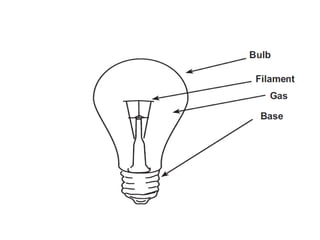
• It is an electric light which produces light with
a coiled tungsten filament heated to a high
temperature by an electric current passing
through it, until it glows.
• The hot filament is protected from oxidation
with a glass or quartz bulb that is filled with
inert gas or evacuated.
• Today, commonly available incandescent lamps
have average lives of between 750 and 2000
hours.
• These are manufactured in a wide range of sizes,
light output, and voltage ratings from 1.5 v to
about 300 v. They require no external regulating
equipment, have low manufacturing costs and
work equally well on either alternating current or
direct current.
• Incandescent lamps are strongly affected by
input voltage. For example, reducing input
voltage from the normal 110 volts (V) to 104.5
V (95%) can double the life of a standard
incandescent lamp .
• Voltage variations also affect light output
(lumens), power (watts), and efficacy (lumens
per watt)
Discharge lamps
• Discharge lamps produce light by passing an
electric current through a gas that emits light
when ionized by the current.
• Typically, such lamps use a noble gas (argon,
neon, krypton, xenon) or a mixture of these
gases.
• In operation the gas is ionized, and free
electrons, accelerated by the electric fields in
the tube, collide with gas and metal atoms.
• The fluorescent lamp is perhaps the best
known gas-discharge lamp.
• Compared to incandescent lamps, gas-
discharge lamps offer higher efficiency.
• They require auxiliary electronic equipment
such as ballasts to control current flow
through the gas.
Solid state lamp
• It refers to a type of lighting that uses light
emitting diodes (LEDs), organic light emitting
diodes (OLED), or polymer light emitting
diodes(PLED) as sources of illumination rather
than electrical filaments.
• The term "solid state" refers commonly to
light emitted by solid-state
electroluminescence, as opposed to
incandescent lamps.
• The typically small mass of a solid-state
electronic lighting device provides for greater
resistance to shock and vibration compared to
brittle glass tubes/bulbs.
• Solid-state lamp is often used in traffic
lights and is also used frequently in modern
vehicle lights, street and parking lights, train
marker lights, building exteriors, remote
controls etc
• Compared to incandescent lamps, SSL creates
visible light with reduced heat generation.
• The composition of the materials determines
the wavelength and therefore the colour of
light.
• LEDs can generate red, yellow, green, blue or
white light, have a life up to 100,000 hours.
Spectral power distribution(SPD)
• It is defined as the radiant power at each
wavelength or band of wavelengths in the
visible region
• It is typically used to characterize light.
• In order to quantify colour, the spectrum or
wavelength composition of light must be
known, which is SPD.
• The necessity of SPD to classified the nature of
spectral lines across the visible spectrum of all
three sources.
• The SPD of light can vary from continuous
across the visible spectrum to discrete across
the spectrum to a narrow band at a particular
wavelength depending how light is generated
by the sources.
• For example, the light emitted from an
incandescent filament has a smooth
continuous SPD across the visible spectrum,
while the light emitted from a fluorescent
lamp has an SPD with a low-level continuum
with discrete spikes at specific wavelengths.
The light emitted from an LED has a smooth
distribution but is only in a narrow region near
one wavelength. (Please refer the pdf
resources).
Colour Rendering Index(CRI)
• Colour rendering index(CRI) is the measure of
how colours of surfaces will appear when
illuminated by a light source.
• Light that has an even SPD across the visible
spectrum, such as daylight or incandescent
light, has a high CRI.
• Light that has an odd or gaps SPD across the
visible spectrum, such as fluorescent light,
has a lower CRI.
Correlated Colour Temperature(CCT)
• Correlated colour temperature(CCT) describes
the appearance of light generated by a hot
object, such as an incandescent filament.
• It is measured in Kelvins (K). This is the temp.
at which a full radiator produces a light that
most nearly matches the light from the given
source.
• As the body is heated it produces light, which
is correlated to the black body curve.
• As the temperature increases the light
appears to shift from red to reddish-yellow to
yellowish-white to white to bluish-white at
high temperatures.
• Light with a CCT between 2700 K and 3200 K is
a yellowish-white light and is described as
“warm” while light with a CCT between 4000 K
and 7500 K is a bluish-white light and is
described as “cool”.

light source.ppt

  • 1.
    Light Sources The lightsource produces illumination and emits light, which can be divided into three parts: 1. Incandescent lamp 2. Discharge lamp 3. Solid state lamp
  • 2.
    Incandescent lamp • Itis an electric light which produces light with a coiled tungsten filament heated to a high temperature by an electric current passing through it, until it glows. • The hot filament is protected from oxidation with a glass or quartz bulb that is filled with inert gas or evacuated.
  • 4.
    • Today, commonlyavailable incandescent lamps have average lives of between 750 and 2000 hours. • These are manufactured in a wide range of sizes, light output, and voltage ratings from 1.5 v to about 300 v. They require no external regulating equipment, have low manufacturing costs and work equally well on either alternating current or direct current.
  • 5.
    • Incandescent lampsare strongly affected by input voltage. For example, reducing input voltage from the normal 110 volts (V) to 104.5 V (95%) can double the life of a standard incandescent lamp . • Voltage variations also affect light output (lumens), power (watts), and efficacy (lumens per watt)
  • 6.
    Discharge lamps • Dischargelamps produce light by passing an electric current through a gas that emits light when ionized by the current. • Typically, such lamps use a noble gas (argon, neon, krypton, xenon) or a mixture of these gases. • In operation the gas is ionized, and free electrons, accelerated by the electric fields in the tube, collide with gas and metal atoms.
  • 7.
    • The fluorescentlamp is perhaps the best known gas-discharge lamp. • Compared to incandescent lamps, gas- discharge lamps offer higher efficiency. • They require auxiliary electronic equipment such as ballasts to control current flow through the gas.
  • 8.
    Solid state lamp •It refers to a type of lighting that uses light emitting diodes (LEDs), organic light emitting diodes (OLED), or polymer light emitting diodes(PLED) as sources of illumination rather than electrical filaments. • The term "solid state" refers commonly to light emitted by solid-state electroluminescence, as opposed to incandescent lamps.
  • 9.
    • The typicallysmall mass of a solid-state electronic lighting device provides for greater resistance to shock and vibration compared to brittle glass tubes/bulbs. • Solid-state lamp is often used in traffic lights and is also used frequently in modern vehicle lights, street and parking lights, train marker lights, building exteriors, remote controls etc
  • 10.
    • Compared toincandescent lamps, SSL creates visible light with reduced heat generation. • The composition of the materials determines the wavelength and therefore the colour of light. • LEDs can generate red, yellow, green, blue or white light, have a life up to 100,000 hours.
  • 11.
    Spectral power distribution(SPD) •It is defined as the radiant power at each wavelength or band of wavelengths in the visible region • It is typically used to characterize light. • In order to quantify colour, the spectrum or wavelength composition of light must be known, which is SPD.
  • 12.
    • The necessityof SPD to classified the nature of spectral lines across the visible spectrum of all three sources. • The SPD of light can vary from continuous across the visible spectrum to discrete across the spectrum to a narrow band at a particular wavelength depending how light is generated by the sources.
  • 13.
    • For example,the light emitted from an incandescent filament has a smooth continuous SPD across the visible spectrum, while the light emitted from a fluorescent lamp has an SPD with a low-level continuum with discrete spikes at specific wavelengths. The light emitted from an LED has a smooth distribution but is only in a narrow region near one wavelength. (Please refer the pdf resources).
  • 14.
    Colour Rendering Index(CRI) •Colour rendering index(CRI) is the measure of how colours of surfaces will appear when illuminated by a light source. • Light that has an even SPD across the visible spectrum, such as daylight or incandescent light, has a high CRI. • Light that has an odd or gaps SPD across the visible spectrum, such as fluorescent light, has a lower CRI.
  • 15.
    Correlated Colour Temperature(CCT) •Correlated colour temperature(CCT) describes the appearance of light generated by a hot object, such as an incandescent filament. • It is measured in Kelvins (K). This is the temp. at which a full radiator produces a light that most nearly matches the light from the given source. • As the body is heated it produces light, which is correlated to the black body curve.
  • 16.
    • As thetemperature increases the light appears to shift from red to reddish-yellow to yellowish-white to white to bluish-white at high temperatures. • Light with a CCT between 2700 K and 3200 K is a yellowish-white light and is described as “warm” while light with a CCT between 4000 K and 7500 K is a bluish-white light and is described as “cool”.