





Adolescence Physical and Cognitive Development  PSYC290 Dr. Debi Smith Azusa Pacific University
Adolescence: Physical and Cognitive Development Adolescent Development in a Cultural and Historical Context Physical Development and Adaptation Gender Identity and Sexual Practices Cognitive Changes in Adolescence
Adolescent Development in Cultural and Historical Context The adolescent period, between childhood and adulthood, is apparent in all cultures, often associated with a rite of passage. Adolescence is a period of transition, and involves planning for adulthood. Adolescence in the United States is characterized by: age-segregated economic dependence mass media instability, uncertainty, and challenge
Physical Development and Adaptation Physical Growth and Change Rapid biological changes occur. Secondary sex characteristics develop, controlled by increased hormones. Growth spurt takes place. Hormones have powerful effects on the brain, influencing development and emotionality. Girls experience menarche; boys produce the first sperm emission.
Growth Rates and Sexual Development During Puberty
Physical Changes and Adaptation In many industrialized countries, puberty occurs at younger ages than in the past ( secular trend ). Adolescents comprise a marginal group, on the fringe of dominant culture. Body image is of major concern. Girls worry about being too fat or too tall. Focus on obesity can lead to eating disorders, like  anorexia nervosa  and  bulimia nervosa .
Physical Development and Adaptation Boys and girls mature at different ages. Girls mature 2 years earlier than boys, on average.
Physical Development and Adaptation Late maturation is a disadvantage for boys. Early maturation can be a problem for boys and girls, because childhood is cut short. Late maturation can be an advantage for girls, because then they are in more in sync with boys.
Gender Identity and Sexual Practices Sexual customs are more relaxed in the United States today than in the past. Teenagers today are highly sexually active, with about 60% of 18-year-olds having had intercourse. Early sexual activity is associated with being raised in single family homes or with overly restrictive or overly permissive parents.
Age and First Sexual Intercourse in the United States
Consequences of Adolescent Sexual Behavior Sexually transmitted diseases (STDs) About 20% of sexually active teens have an STD. By age 24,  the number increases to 33%. Teenage pregnancy About 8% of teen girls become pregnant. Black and Hispanic girls are twice as likely to become unwed mothers as are White girls. Thirty percent of sexually active teens use no contraception. Rates of teen pregnancy have fallen 30% over the past decade.
Live U.S. Birth Rates for Teen Mothers (ages 15 - 17) from 1991 to 2002
Teenage Parenthood In the United States, associated with difficult economic circumstances and personal challenges Becoming a teen father may have negative consequences, especially due to the need to financially support the child. Marriage of teen parents generally does not produce positive outcomes in part because marriage leads to school dropout. Most teen parents are stressed, frustrated, economically challenged, and inexperienced.
Cognitive Changes in Adolescence New research using brain imaging techniques shows that the brain is not fully developed. Synaptic pruning Gray matter (neural tissue) and white matter (myelin) increase until about the age of 40. Last area of brain development in teens is in frontal lobes, where decision making, problem solving, and thinking occur.  Judgment skills are the last to develop.
Cognitive Changes in Adolescence Hormones affect brain development, especially in the amygdala, where emotions are regulated. Risky behaviors and emotionality may be the result of brain areas developing at different rates.
Cognitive Changes in Adolescence Cognitive development in adolescence acquiring more knowledge using abstract thought metacognition Piaget’s formal operations stage associated with hypothetical (scientific) reasoning
Examples of Problems Used to  Test Hypothetical Thinking
The Scope and Content of Adolescent Thought More breadth and complexity in their thought content Parent-child relationships may be affected. Adolescents want to “negotiate” at this age. Teens show increasing concern with social, political, and moral issues.
Adolescent Egocentrism They are self-absorbed and self-centered. They imagine themselves as the center of everyone’s scrutiny — imaginary audience . Personal fable , the teen’s belief that he or she is so special that nothing bad can happen to them, is often apparent in adolescent thinking.
Moral Development in Adolescence Most teens move beyond Kolhberg’s conventional stage (at least sometimes), where judgments conform to social expectations and stereotypes. They may begin to rely on internalized moral principles (post conventional stage). Giving teens more complex moral issues to consider creates a disequilibrium that encourages them to struggle to resolve contradictions.
Summary Adolescence is a complex time of development, and how and when children experience it depends on their culture. In the United States, adolescents spend more time with their peers than younger children or adults, they are economically dependent on their parents, and they are heavily influenced by the media. It is a time of rapid biological change, which preoccupies them.
Summary Puberty is characterized by the first menstrual period in girls (ages 10 to 16), and by the first emission of semen with sperm for boys (ages 11 to 16). Puberty is occurring at earlier ages now than in the past. Adolescents are on the fringes of dominant culture and feel a strong pressure to conform. Body image is critical to boys and girls; as a result, eating orders may develop. Teens today in the United States are highly sexually active, and teen pregnancy and sexually transmitted disease are some of the problems associated with early sexual activity.
Summary Brain development continues, including development in the frontal lobes between the ages of 12 and 15. Adolescents enter the stage of cognitive development Piaget called formal operations. They can reason abstractly and think hypothetically. Parent-child relationships are challenging at this time. Teens develop a sense that they are invulnerable (personal fable) and believe that they are the center of everyone’s attention. Morally, they begin to make choices that don’t necessarily conform to social standards, but that rely on internalized moral principles.
Adolescence Personality and Sociocultural Development
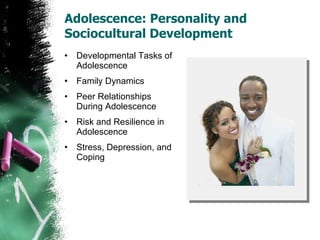
Adolescence: Personality and Sociocultural Development Developmental Tasks of Adolescence Family Dynamics Peer Relationships During Adolescence Risk and Resilience in Adolescence Stress, Depression, and Coping
Developmental Tasks of Adulthood Adolescents confront two developmental tasks: achieving autonomy and independence from their parents forming an identity, creating an integrated self Most adolescents adjust quite well to this period, even though adolescence is often portrayed as a stressful time. Adolescents must learn to control their own behavior — self-regulation. Adolescents and their parents need to cooperate and share their thoughts and feelings — interdependence.
Forming an Identity Involves teens gaining a sense of who they are and how they fit into society. Social reference groups help teens to define themselves. Erikson viewed identity development as the critical task of adolescence (identity versus identity confusion).
Modes of Identity Formation James Marcia categorized identity formation into four modes, or statuses, with the status determined by whether or not there has been a crisis and a commitment: Foreclosure Diffusion Moratorium Identity achievement
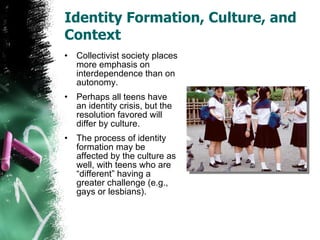
Identity Formation, Culture, and Context Collectivist society places more emphasis on interdependence than on autonomy. Perhaps all teens have an identity crisis, but the resolution favored will differ by culture. The process of identity formation may be affected by the culture as well, with teens who are “different” having a greater challenge (e.g., gays or lesbians).
Family Dynamics Parents must support their children but allow their independence. Family conflict during adolescence is common. Families are more successful if they work together, while maintaining appropriate boundaries. Adolescents with authoritarian parents may be more dependent, anxious, defiant, and/or resentful. Authoritative parenting is best, as it fosters warmth and control, with good communication.
Family Dynamics Parental roles with their teens differ. Fathers are more involved in intellectual development, and give their children more freedom. Mothers’ relationships with boys and girls involve greater strain and conflict. Parental monitoring of teens cannot be successful without open communication and adolescents’ willingness to disclose details of their lives.
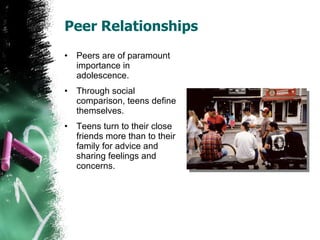
Peer Relationships Peers are of paramount importance in adolescence. Through social comparison, teens define themselves. Teens turn to their close friends more than to their family for advice and sharing feelings and concerns.
Peer Relationships Cliques 3 to 9 member cohesive peer groups Crowds 15 to 30 members Twenty percent of teens are loners, belonging to no group. Dating evolves through adolescence. Teens select dates who are similar to themselves in social class, values, and academic ambitions. Boys more interested in sexual intimacy, girls in emotional intimacy. Same-sex dating follows general patterns of opposite-sex dating.
Functions of Dating Recreation Socialization Status Companionship Intimacy Sex Mate selection
Peer Relationships Culture clash  can occur in immigrant families or when teens associate with peers whose values and world views are dramatically different from their parents. Gay and lesbian teens may have turbulent relationships with their parents. Teens who clash with parents over their peers may be more likely to use drugs or act out.
Risk and Resilience in Adolescence Adolescence is characterized by risk-taking behaviors, in part because brain areas devoted to higher-order thinking are still developing. Teens may feel invulnerable, pursuant to their  personal fables . Use of alcohol and other drugs peaks during adolescence.
A Conceptual Framework for Adolescent Risk Behavior
Drug Use by Age, 2003
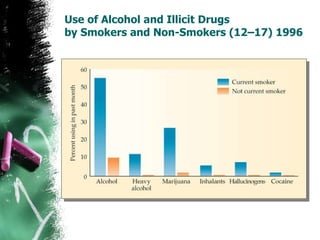
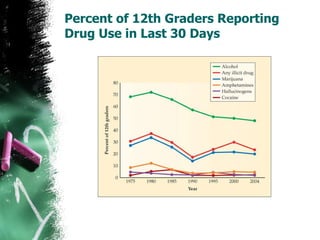
Alcohol and Other Drug Use Alcohol and tobacco are the most commonly used drugs among teens. Tobacco use among teens is lower now than in the 1970s, but more than half of high school seniors try smoking.  Smokers are more likely to use other drugs than are nonsmokers.
Use of Alcohol and Illicit Drugs  by Smokers and Non-Smokers (12–17) 1996
Alcohols and Other Drug Use After alcohol and tobacco, marijuana is the most widely used drug in adolescence, with about 25% of high school seniors reporting use within the past month. Many other drugs are available—cocaine, heroin, and LSD. Use of “designer drugs” like ecstasy is on the rise.
Percent of 12th Graders Reporting Drug Use in Last 30 Days
Delinquency People under age 18 who commit crimes are called  delinquents . Delinquent behavior linked to living in disadvantaged or stressful conditions being impulsive or engaging in other problem behavior belonging to deviant peer groups media modeling of violence
Sexual Abuse of Adolescence One third of women report being sexually abused before the age of 18. Half of college-age men report forcing sexual activity. The most common form of sexual abuse in adolescence is a girl being abused by an adult male friend or family member. Sexual abuse can have long-term negative effects on identity formation and healthy adult development.
Stress, Depression, and Coping  As many as 20% of college students report having been depressed as teens. Girls are twice as likely to be depressed than are boys. Depression is related to: brain chemistry genetic links psychological and social variables
Suicide Suicide linked to: long-standing personal or family problems excessive pressure and responsibility belief that future goals are unattainable Crisis intervention services and telephone hotlines exist to prevent suicide.
APA Guidelines for  Suicide Prevention Provide professional education for educators, health workers, and mental health workers. Restrict access to firearms by passing strict gun control laws. Provide suicide education for media personnel to ensure correct information and appropriate reporting. Identify and treat at-risk youth.
Risk Factors Associated with Psychological Problems Risk Factors are cumulative—the more that exist, the greater likelihood there is that problems will occur. Risk factors include: teenage sexual activity abuse of alcohol and other drugs antisocial behavior poor school performance
Protective Factors Associated with Psychological Problems Protective Factors Resilient teens have more positive personal qualities and more positive coping mechanisms. They have more supportive and functional families, and tend to live in “good” neighborhoods and attend “good” schools.
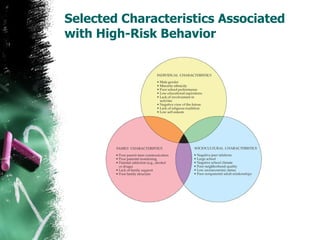
Selected Characteristics Associated with High-Risk Behavior
How to Support Positive Adolescent Development Support and strengthen families Provide teens with opportunities to succeed Encourage teens to help others Teach teens positive coping skills
Selected Characteristics of Resilient Children and Adolescents
Summary Personality and social development during adolescence is characterized by two developmental tasks: achieving autonomy and independence from their parents and forming an identity. Adolescents must learn to make their own judgments and control their own behavior. Parents and teens need to develop reciprocal dependence. For Erikson, the critical task of this stage was identity versus identity confusion, often involving an identity crisis. Identity formation is more difficult when individuals belong to groups outside the majority culture.
Summary Parents of teens must support them but allow them independence. Maintaining communication helps reduce conflict. Social comparison with others is a way teens define themselves. Peers become more important than parents in terms or advice and lifestyle issues. Peer groups contribute greatly to identity formation. Adolescent development is more difficult when peer and family values are different.
Summary Adolescence is often characterized by risk-taking behaviors, partly because the brain regions related to judgment and emotional control are still developing. The use of alcohol and other drugs peaks during adolescence and early adulthood, with alcohol and tobacco being the most common. Adolescents may display delinquent behavior, criminal conduct and violating laws pertaining only to teens. Depression and stress are commonly reported by adolescents, and suicide is the third-leading cause of death at this age. Adolescents need maximum support in order to learn to cope with the risks associated with this development period.

10 Adolescence

  • 1.
    Adolescence Physical andCognitive Development PSYC290 Dr. Debi Smith Azusa Pacific University
  • 2.
    Adolescence: Physical andCognitive Development Adolescent Development in a Cultural and Historical Context Physical Development and Adaptation Gender Identity and Sexual Practices Cognitive Changes in Adolescence
  • 3.
    Adolescent Development inCultural and Historical Context The adolescent period, between childhood and adulthood, is apparent in all cultures, often associated with a rite of passage. Adolescence is a period of transition, and involves planning for adulthood. Adolescence in the United States is characterized by: age-segregated economic dependence mass media instability, uncertainty, and challenge
  • 4.
    Physical Development andAdaptation Physical Growth and Change Rapid biological changes occur. Secondary sex characteristics develop, controlled by increased hormones. Growth spurt takes place. Hormones have powerful effects on the brain, influencing development and emotionality. Girls experience menarche; boys produce the first sperm emission.
  • 5.
    Growth Rates andSexual Development During Puberty
  • 6.
    Physical Changes andAdaptation In many industrialized countries, puberty occurs at younger ages than in the past ( secular trend ). Adolescents comprise a marginal group, on the fringe of dominant culture. Body image is of major concern. Girls worry about being too fat or too tall. Focus on obesity can lead to eating disorders, like anorexia nervosa and bulimia nervosa .
  • 7.
    Physical Development andAdaptation Boys and girls mature at different ages. Girls mature 2 years earlier than boys, on average.
  • 8.
    Physical Development andAdaptation Late maturation is a disadvantage for boys. Early maturation can be a problem for boys and girls, because childhood is cut short. Late maturation can be an advantage for girls, because then they are in more in sync with boys.
  • 9.
    Gender Identity andSexual Practices Sexual customs are more relaxed in the United States today than in the past. Teenagers today are highly sexually active, with about 60% of 18-year-olds having had intercourse. Early sexual activity is associated with being raised in single family homes or with overly restrictive or overly permissive parents.
  • 10.
    Age and FirstSexual Intercourse in the United States
  • 11.
    Consequences of AdolescentSexual Behavior Sexually transmitted diseases (STDs) About 20% of sexually active teens have an STD. By age 24, the number increases to 33%. Teenage pregnancy About 8% of teen girls become pregnant. Black and Hispanic girls are twice as likely to become unwed mothers as are White girls. Thirty percent of sexually active teens use no contraception. Rates of teen pregnancy have fallen 30% over the past decade.
  • 12.
    Live U.S. BirthRates for Teen Mothers (ages 15 - 17) from 1991 to 2002
  • 13.
    Teenage Parenthood Inthe United States, associated with difficult economic circumstances and personal challenges Becoming a teen father may have negative consequences, especially due to the need to financially support the child. Marriage of teen parents generally does not produce positive outcomes in part because marriage leads to school dropout. Most teen parents are stressed, frustrated, economically challenged, and inexperienced.
  • 14.
    Cognitive Changes inAdolescence New research using brain imaging techniques shows that the brain is not fully developed. Synaptic pruning Gray matter (neural tissue) and white matter (myelin) increase until about the age of 40. Last area of brain development in teens is in frontal lobes, where decision making, problem solving, and thinking occur. Judgment skills are the last to develop.
  • 15.
    Cognitive Changes inAdolescence Hormones affect brain development, especially in the amygdala, where emotions are regulated. Risky behaviors and emotionality may be the result of brain areas developing at different rates.
  • 16.
    Cognitive Changes inAdolescence Cognitive development in adolescence acquiring more knowledge using abstract thought metacognition Piaget’s formal operations stage associated with hypothetical (scientific) reasoning
  • 17.
    Examples of ProblemsUsed to Test Hypothetical Thinking
  • 18.
    The Scope andContent of Adolescent Thought More breadth and complexity in their thought content Parent-child relationships may be affected. Adolescents want to “negotiate” at this age. Teens show increasing concern with social, political, and moral issues.
  • 19.
    Adolescent Egocentrism Theyare self-absorbed and self-centered. They imagine themselves as the center of everyone’s scrutiny — imaginary audience . Personal fable , the teen’s belief that he or she is so special that nothing bad can happen to them, is often apparent in adolescent thinking.
  • 20.
    Moral Development inAdolescence Most teens move beyond Kolhberg’s conventional stage (at least sometimes), where judgments conform to social expectations and stereotypes. They may begin to rely on internalized moral principles (post conventional stage). Giving teens more complex moral issues to consider creates a disequilibrium that encourages them to struggle to resolve contradictions.
  • 21.
    Summary Adolescence isa complex time of development, and how and when children experience it depends on their culture. In the United States, adolescents spend more time with their peers than younger children or adults, they are economically dependent on their parents, and they are heavily influenced by the media. It is a time of rapid biological change, which preoccupies them.
  • 22.
    Summary Puberty ischaracterized by the first menstrual period in girls (ages 10 to 16), and by the first emission of semen with sperm for boys (ages 11 to 16). Puberty is occurring at earlier ages now than in the past. Adolescents are on the fringes of dominant culture and feel a strong pressure to conform. Body image is critical to boys and girls; as a result, eating orders may develop. Teens today in the United States are highly sexually active, and teen pregnancy and sexually transmitted disease are some of the problems associated with early sexual activity.
  • 23.
    Summary Brain developmentcontinues, including development in the frontal lobes between the ages of 12 and 15. Adolescents enter the stage of cognitive development Piaget called formal operations. They can reason abstractly and think hypothetically. Parent-child relationships are challenging at this time. Teens develop a sense that they are invulnerable (personal fable) and believe that they are the center of everyone’s attention. Morally, they begin to make choices that don’t necessarily conform to social standards, but that rely on internalized moral principles.
  • 24.
    Adolescence Personality andSociocultural Development
  • 25.
    Adolescence: Personality andSociocultural Development Developmental Tasks of Adolescence Family Dynamics Peer Relationships During Adolescence Risk and Resilience in Adolescence Stress, Depression, and Coping
  • 26.
    Developmental Tasks ofAdulthood Adolescents confront two developmental tasks: achieving autonomy and independence from their parents forming an identity, creating an integrated self Most adolescents adjust quite well to this period, even though adolescence is often portrayed as a stressful time. Adolescents must learn to control their own behavior — self-regulation. Adolescents and their parents need to cooperate and share their thoughts and feelings — interdependence.
  • 27.
    Forming an IdentityInvolves teens gaining a sense of who they are and how they fit into society. Social reference groups help teens to define themselves. Erikson viewed identity development as the critical task of adolescence (identity versus identity confusion).
  • 28.
    Modes of IdentityFormation James Marcia categorized identity formation into four modes, or statuses, with the status determined by whether or not there has been a crisis and a commitment: Foreclosure Diffusion Moratorium Identity achievement
  • 29.
    Identity Formation, Culture,and Context Collectivist society places more emphasis on interdependence than on autonomy. Perhaps all teens have an identity crisis, but the resolution favored will differ by culture. The process of identity formation may be affected by the culture as well, with teens who are “different” having a greater challenge (e.g., gays or lesbians).
  • 30.
    Family Dynamics Parentsmust support their children but allow their independence. Family conflict during adolescence is common. Families are more successful if they work together, while maintaining appropriate boundaries. Adolescents with authoritarian parents may be more dependent, anxious, defiant, and/or resentful. Authoritative parenting is best, as it fosters warmth and control, with good communication.
  • 31.
    Family Dynamics Parentalroles with their teens differ. Fathers are more involved in intellectual development, and give their children more freedom. Mothers’ relationships with boys and girls involve greater strain and conflict. Parental monitoring of teens cannot be successful without open communication and adolescents’ willingness to disclose details of their lives.
  • 32.
    Peer Relationships Peersare of paramount importance in adolescence. Through social comparison, teens define themselves. Teens turn to their close friends more than to their family for advice and sharing feelings and concerns.
  • 33.
    Peer Relationships Cliques3 to 9 member cohesive peer groups Crowds 15 to 30 members Twenty percent of teens are loners, belonging to no group. Dating evolves through adolescence. Teens select dates who are similar to themselves in social class, values, and academic ambitions. Boys more interested in sexual intimacy, girls in emotional intimacy. Same-sex dating follows general patterns of opposite-sex dating.
  • 34.
    Functions of DatingRecreation Socialization Status Companionship Intimacy Sex Mate selection
  • 35.
    Peer Relationships Cultureclash can occur in immigrant families or when teens associate with peers whose values and world views are dramatically different from their parents. Gay and lesbian teens may have turbulent relationships with their parents. Teens who clash with parents over their peers may be more likely to use drugs or act out.
  • 36.
    Risk and Resiliencein Adolescence Adolescence is characterized by risk-taking behaviors, in part because brain areas devoted to higher-order thinking are still developing. Teens may feel invulnerable, pursuant to their personal fables . Use of alcohol and other drugs peaks during adolescence.
  • 37.
    A Conceptual Frameworkfor Adolescent Risk Behavior
  • 38.
    Drug Use byAge, 2003
  • 39.
    Alcohol and OtherDrug Use Alcohol and tobacco are the most commonly used drugs among teens. Tobacco use among teens is lower now than in the 1970s, but more than half of high school seniors try smoking. Smokers are more likely to use other drugs than are nonsmokers.
  • 40.
    Use of Alcoholand Illicit Drugs by Smokers and Non-Smokers (12–17) 1996
  • 41.
    Alcohols and OtherDrug Use After alcohol and tobacco, marijuana is the most widely used drug in adolescence, with about 25% of high school seniors reporting use within the past month. Many other drugs are available—cocaine, heroin, and LSD. Use of “designer drugs” like ecstasy is on the rise.
  • 42.
    Percent of 12thGraders Reporting Drug Use in Last 30 Days
  • 43.
    Delinquency People underage 18 who commit crimes are called delinquents . Delinquent behavior linked to living in disadvantaged or stressful conditions being impulsive or engaging in other problem behavior belonging to deviant peer groups media modeling of violence
  • 44.
    Sexual Abuse ofAdolescence One third of women report being sexually abused before the age of 18. Half of college-age men report forcing sexual activity. The most common form of sexual abuse in adolescence is a girl being abused by an adult male friend or family member. Sexual abuse can have long-term negative effects on identity formation and healthy adult development.
  • 45.
    Stress, Depression, andCoping As many as 20% of college students report having been depressed as teens. Girls are twice as likely to be depressed than are boys. Depression is related to: brain chemistry genetic links psychological and social variables
  • 46.
    Suicide Suicide linkedto: long-standing personal or family problems excessive pressure and responsibility belief that future goals are unattainable Crisis intervention services and telephone hotlines exist to prevent suicide.
  • 47.
    APA Guidelines for Suicide Prevention Provide professional education for educators, health workers, and mental health workers. Restrict access to firearms by passing strict gun control laws. Provide suicide education for media personnel to ensure correct information and appropriate reporting. Identify and treat at-risk youth.
  • 48.
    Risk Factors Associatedwith Psychological Problems Risk Factors are cumulative—the more that exist, the greater likelihood there is that problems will occur. Risk factors include: teenage sexual activity abuse of alcohol and other drugs antisocial behavior poor school performance
  • 49.
    Protective Factors Associatedwith Psychological Problems Protective Factors Resilient teens have more positive personal qualities and more positive coping mechanisms. They have more supportive and functional families, and tend to live in “good” neighborhoods and attend “good” schools.
  • 50.
    Selected Characteristics Associatedwith High-Risk Behavior
  • 51.
    How to SupportPositive Adolescent Development Support and strengthen families Provide teens with opportunities to succeed Encourage teens to help others Teach teens positive coping skills
  • 52.
    Selected Characteristics ofResilient Children and Adolescents
  • 53.
    Summary Personality andsocial development during adolescence is characterized by two developmental tasks: achieving autonomy and independence from their parents and forming an identity. Adolescents must learn to make their own judgments and control their own behavior. Parents and teens need to develop reciprocal dependence. For Erikson, the critical task of this stage was identity versus identity confusion, often involving an identity crisis. Identity formation is more difficult when individuals belong to groups outside the majority culture.
  • 54.
    Summary Parents ofteens must support them but allow them independence. Maintaining communication helps reduce conflict. Social comparison with others is a way teens define themselves. Peers become more important than parents in terms or advice and lifestyle issues. Peer groups contribute greatly to identity formation. Adolescent development is more difficult when peer and family values are different.
  • 55.
    Summary Adolescence isoften characterized by risk-taking behaviors, partly because the brain regions related to judgment and emotional control are still developing. The use of alcohol and other drugs peaks during adolescence and early adulthood, with alcohol and tobacco being the most common. Adolescents may display delinquent behavior, criminal conduct and violating laws pertaining only to teens. Depression and stress are commonly reported by adolescents, and suicide is the third-leading cause of death at this age. Adolescents need maximum support in order to learn to cope with the risks associated with this development period.