In Europe, a woman was near death from a special kind of
                           cancer.

 There was one drug that the doctors thought might save her.
 It was a form of radium that a druggist in the same town had
                       recently discovered.

The drug was expensive to make, but the druggist was charging
           ten times what the drug cost him to make.

He paid $400 for the radium and charged $4,000 for a small dose
                           of the drug.

  The sick woman's husband, Heinz, went to everyone he
      knew to borrow the money and tried every legal
  means, but he could only get together about $2,000, which
                   is half of what it cost.
He told the druggist that his wife was dying, and
 asked him to sell it cheaper or let him pay later.

But the druggist said, "No, I discovered the drug
      and I'm going to make money from it.“

 So, having tried every legal means, Heinz gets
 anxious and considers breaking into the man's
        store to steal the drug for his wife.
Should Heinz steal the drug? Why
          or why not?


    Kohlberg’s Moral Dilemma
   Presented By: Ms. Gurkirat Kaur, Asst. Prof. Chitkara
                       University
Kohlberg’s Theory
       of
Moral Development
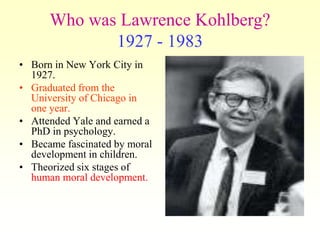
Who was Lawrence Kohlberg?
             1927 - 1983
• Born in New York City in
  1927.
• Graduated from the
  University of Chicago in
  one year.
• Attended Yale and earned a
  PhD in psychology.
• Became fascinated by moral
  development in children.
• Theorized six stages of
  human moral development.
Kohlberg's Stages
Pre-conventional level
• Stage 1: The punishment and obedience orientation
• Stage 2: The instrumental purpose orientation
Conventional level
• Stage 3: The "good boy-good girl" orientation
• Stage 4: The social-order-maintaining orientation
Post-conventional level
• Stage 5: The social-contract orientation
• Stage 6: The universal ethical principle orientation
Levels of Moral Reasoning
• Preconventional—moral reasoning is
  based on external rewards and
  punishments
• Conventional—laws and rules are upheld
  simply because they are laws and rules
• Postconventional—reasoning based on
  personal moral standards
PRECONVENTIONAL LEVEL
• Punishments and rewards dominate the
  sense of right & wrong
• Morality is externally controlled
• Rules of authority figures must be respected.
• Behaviour that results in punishment are
  bad
• Behaviour that results in rewards are good
Stage #1:Obedience and Punishment
             Orientation
Morality is based upon the
 physical punishment that
 follows an action, rather
 than right or wrong. The
 concern is for self - "Will I
 get into trouble for doing (or
 not doing) it?" Good
 behavior is associated with
 avoiding punishment.
EX: The child won’t grab
the candy at the supermarket
for fear of being slapped
Possible answers for Kohlberg’s dilemma by
  children of Stage 1

For stealing: If you let your wife die, you will
  get into trouble. You’ll be blamed for not
  spending your money to save her and there
  will be an investigation of you and the druggist
  for your wife’s death.

Against stealing: You should not steal the drug
 because you’ll be caught and sent to jail if you
 do. If you do get away, your conscience would
 bother you thinking how the police would
 catch you at any minute.
Stage #2: Relativist Orientation
• The concern is "What's in
  it for me?" Action is
  judged right if it helps in
  satisfying one's needs or
  involves a fair exchange.

EX: A mother tells her child:
  “If you are quiet at the
  mall, I will buy you an ice
  cream.”
Possible answers for Kohlberg’s dilemma by
  children of Stage 2

• For stealing: If you do happen to get caught
  you could give the drug back and you
  wouldn’t get much of a sentence. It wouldn’t
  bother you much to serve a little jail term if
  you have your wife when you get out.

• Against stealing : He may not get much of a
  jail term if steals the drug, but his wife will
  probably die before he gets out so it won’t
  do him much good. If his wife dies, he
  shouldn’t blame himself. It wasn’t his fault
  that she has cancer.
THE CONVENTIONAL LEVEL
• Needs of Laws and society are the defining
  features.
• “Don't steal” because it is against the law
• Good behaviour is motivated to maintain the
  affection and approval of friends and relatives
• Understand that standards are set for the current
  social system, not getting that there is self-interest
  involved (e.g., no such thing as a bad law)
Stage #3: Good Boy/Nice Girl
                Orientation
People should live up to the
  expectations of the family
  and community and
  behave in "good" ways.
  Good behavior means
  having good motives and
  interpersonal feelings such
  as
  love, empathy, trust, and
  concern for others.

EX: Volunteering at a
  nursing home is the right
  thing to do.
Possible answers for Kohlberg’s dilemma by children of
  Stage 3

• For stealing: Nobody will think you’re bad if you steal
  the drug but your family will think you’re an inhuman
  husband if you don’t. If you let your wife die, you’ll
  never be able to look anybody in the face again.
• Against stealing: It isn’t just the druggist who will
  think you are a criminal, everyone else will, too. After
  you steal it, you’ll feel bad thinking about how you’ve
  brought dishonor on your family and yourself. You
  won’t be able to face anyone again.
Stage #4: Law and Order Orientation
While stage three actions are
 more concerned with
 pleasing your family, stage
 four is associated with
 following society as a
 whole. Emphasis is spent
 on obeying laws to
 maintain social order.

EX: If you drink and drive
  your endangering the lives
  of others on the road, not
  just yourself.
Possible answers for Kohlberg’s dilemma by children of
  Stage 4

• For stealing: If you have any sense of honor, you won’t let
  your wife die because you’re afraid to do the only thing
  that will save her. You’ll always feel guilty that you caused
  her death if you don’t do your duty to her.

• Against stealing: You’re desperate and you may not know
  you’re doing wrong when you steal the drug. But you’ll
  know you did wrong after you’re punished and sent to jail.
  You’ll always feel guilty for your dishonesty and
  lawbreaking
THE POSTCONVENTIONAL
            LEVEL
• Personal moral beliefs and values

• Characterized by references to
  universal ethical principles that
  represent protecting the rights or of
  all people
• Most adults do not reach this level.
Stage #5: Social Contract Orientation
At stage 4, people want to keep
   society functioning.
   However, a smoothly
   functioning society is not
   necessarily a good one. Nazi
   Germany was a well
   organized society, but nine
   million were murdered in the
   process.

At stage 5, people begin to
  ask, "What makes for a good
  society?" They begin to think
  about society considering the
  rights and values that a
  society ought to uphold.
Possible answers for Kohlberg’s dilemma by children of
  Stage 5

• For stealing: The law wasn’t set up for these
  circumstances. Taking the drug in this situation isn’t really
  right, but it’s justified to do it.

• Against stealing: You can’t completely blame someone for
  stealing but extreme circumstances don’t really justify
  taking the law in your own hands. You can’t have everyone
  stealing whenever they get desperate. The end may be
  good, but the ends don’t justify the means
Stage #6: Universal Ethical Principal
              Orientation
As human beings we are
  obligated to live by the
  principal that “all men are
  created equal” regardless of
  race, religion, sexual
  orientation, or political
  belief. Justice is universal, so
  unjust laws must be broken.

EX: Rosa Parks refused to sit in
  the back of the bus because it
  was an unjust law
  discriminating against
  African Americans.
Possible answers for Kohlberg’s dilemma by children of
  Stage 6

• For stealing: This is a situation which forces him to
  choose between stealing and letting his wife die. In a
  situation where the choice must be made, it is morally
  right to steal. He has to act in terms if the principle of
  preserving and respecting life.

• Against stealing: Heinz is faced with the decision of
  whether to consider the other people who need the drug
  just as badly as his wife. Heinz ought to act not
  according to his particular feelings toward his wife, but
  considering the value of all the loves involved.
Criticisms of Kohlberg’s theory
• Research has not supported Kohlberg’s belief that the
  development of abstract thinking in adolescence
  invariably leads people to the formation of idealistic
  moral principles
• Some cross-cultural psychologists argue that
  Kohlberg’s stories and scoring system reflect a
  Western emphasis on individual rights, harm, and
  justice that is not shared in many cultures.
• Kohlberg’s early research was conducted entirely
  with male subjects, yet it became the basis for a
  theory applied to both males and females.
Carol Gilligan’s Model
• Feels Kohlberg’s model is based on an ethic
  of individual rights and justice, which is a
  more common perspective for males
• Gilligan’s model of women’s moral
  development is based on an ethic of care
  and responsibility.
• However, when subjects are carefully
  matched, there do not seem to be
  systematic gender differences in moral
  reasoning
Other Dilemmas to Consider
Kohlberg's moral development

Kohlberg's moral development

  • 1.
    In Europe, awoman was near death from a special kind of cancer. There was one drug that the doctors thought might save her. It was a form of radium that a druggist in the same town had recently discovered. The drug was expensive to make, but the druggist was charging ten times what the drug cost him to make. He paid $400 for the radium and charged $4,000 for a small dose of the drug. The sick woman's husband, Heinz, went to everyone he knew to borrow the money and tried every legal means, but he could only get together about $2,000, which is half of what it cost.
  • 2.
    He told thedruggist that his wife was dying, and asked him to sell it cheaper or let him pay later. But the druggist said, "No, I discovered the drug and I'm going to make money from it.“ So, having tried every legal means, Heinz gets anxious and considers breaking into the man's store to steal the drug for his wife.
  • 3.
    Should Heinz stealthe drug? Why or why not? Kohlberg’s Moral Dilemma Presented By: Ms. Gurkirat Kaur, Asst. Prof. Chitkara University
  • 4.
    Kohlberg’s Theory of Moral Development
  • 5.
    Who was LawrenceKohlberg? 1927 - 1983 • Born in New York City in 1927. • Graduated from the University of Chicago in one year. • Attended Yale and earned a PhD in psychology. • Became fascinated by moral development in children. • Theorized six stages of human moral development.
  • 6.
    Kohlberg's Stages Pre-conventional level •Stage 1: The punishment and obedience orientation • Stage 2: The instrumental purpose orientation Conventional level • Stage 3: The "good boy-good girl" orientation • Stage 4: The social-order-maintaining orientation Post-conventional level • Stage 5: The social-contract orientation • Stage 6: The universal ethical principle orientation
  • 7.
    Levels of MoralReasoning • Preconventional—moral reasoning is based on external rewards and punishments • Conventional—laws and rules are upheld simply because they are laws and rules • Postconventional—reasoning based on personal moral standards
  • 8.
    PRECONVENTIONAL LEVEL • Punishmentsand rewards dominate the sense of right & wrong • Morality is externally controlled • Rules of authority figures must be respected. • Behaviour that results in punishment are bad • Behaviour that results in rewards are good
  • 9.
    Stage #1:Obedience andPunishment Orientation Morality is based upon the physical punishment that follows an action, rather than right or wrong. The concern is for self - "Will I get into trouble for doing (or not doing) it?" Good behavior is associated with avoiding punishment. EX: The child won’t grab the candy at the supermarket for fear of being slapped
  • 10.
    Possible answers forKohlberg’s dilemma by children of Stage 1 For stealing: If you let your wife die, you will get into trouble. You’ll be blamed for not spending your money to save her and there will be an investigation of you and the druggist for your wife’s death. Against stealing: You should not steal the drug because you’ll be caught and sent to jail if you do. If you do get away, your conscience would bother you thinking how the police would catch you at any minute.
  • 11.
    Stage #2: RelativistOrientation • The concern is "What's in it for me?" Action is judged right if it helps in satisfying one's needs or involves a fair exchange. EX: A mother tells her child: “If you are quiet at the mall, I will buy you an ice cream.”
  • 12.
    Possible answers forKohlberg’s dilemma by children of Stage 2 • For stealing: If you do happen to get caught you could give the drug back and you wouldn’t get much of a sentence. It wouldn’t bother you much to serve a little jail term if you have your wife when you get out. • Against stealing : He may not get much of a jail term if steals the drug, but his wife will probably die before he gets out so it won’t do him much good. If his wife dies, he shouldn’t blame himself. It wasn’t his fault that she has cancer.
  • 13.
    THE CONVENTIONAL LEVEL •Needs of Laws and society are the defining features. • “Don't steal” because it is against the law • Good behaviour is motivated to maintain the affection and approval of friends and relatives • Understand that standards are set for the current social system, not getting that there is self-interest involved (e.g., no such thing as a bad law)
  • 14.
    Stage #3: GoodBoy/Nice Girl Orientation People should live up to the expectations of the family and community and behave in "good" ways. Good behavior means having good motives and interpersonal feelings such as love, empathy, trust, and concern for others. EX: Volunteering at a nursing home is the right thing to do.
  • 15.
    Possible answers forKohlberg’s dilemma by children of Stage 3 • For stealing: Nobody will think you’re bad if you steal the drug but your family will think you’re an inhuman husband if you don’t. If you let your wife die, you’ll never be able to look anybody in the face again. • Against stealing: It isn’t just the druggist who will think you are a criminal, everyone else will, too. After you steal it, you’ll feel bad thinking about how you’ve brought dishonor on your family and yourself. You won’t be able to face anyone again.
  • 16.
    Stage #4: Lawand Order Orientation While stage three actions are more concerned with pleasing your family, stage four is associated with following society as a whole. Emphasis is spent on obeying laws to maintain social order. EX: If you drink and drive your endangering the lives of others on the road, not just yourself.
  • 17.
    Possible answers forKohlberg’s dilemma by children of Stage 4 • For stealing: If you have any sense of honor, you won’t let your wife die because you’re afraid to do the only thing that will save her. You’ll always feel guilty that you caused her death if you don’t do your duty to her. • Against stealing: You’re desperate and you may not know you’re doing wrong when you steal the drug. But you’ll know you did wrong after you’re punished and sent to jail. You’ll always feel guilty for your dishonesty and lawbreaking
  • 18.
    THE POSTCONVENTIONAL LEVEL • Personal moral beliefs and values • Characterized by references to universal ethical principles that represent protecting the rights or of all people • Most adults do not reach this level.
  • 19.
    Stage #5: SocialContract Orientation At stage 4, people want to keep society functioning. However, a smoothly functioning society is not necessarily a good one. Nazi Germany was a well organized society, but nine million were murdered in the process. At stage 5, people begin to ask, "What makes for a good society?" They begin to think about society considering the rights and values that a society ought to uphold.
  • 20.
    Possible answers forKohlberg’s dilemma by children of Stage 5 • For stealing: The law wasn’t set up for these circumstances. Taking the drug in this situation isn’t really right, but it’s justified to do it. • Against stealing: You can’t completely blame someone for stealing but extreme circumstances don’t really justify taking the law in your own hands. You can’t have everyone stealing whenever they get desperate. The end may be good, but the ends don’t justify the means
  • 21.
    Stage #6: UniversalEthical Principal Orientation As human beings we are obligated to live by the principal that “all men are created equal” regardless of race, religion, sexual orientation, or political belief. Justice is universal, so unjust laws must be broken. EX: Rosa Parks refused to sit in the back of the bus because it was an unjust law discriminating against African Americans.
  • 22.
    Possible answers forKohlberg’s dilemma by children of Stage 6 • For stealing: This is a situation which forces him to choose between stealing and letting his wife die. In a situation where the choice must be made, it is morally right to steal. He has to act in terms if the principle of preserving and respecting life. • Against stealing: Heinz is faced with the decision of whether to consider the other people who need the drug just as badly as his wife. Heinz ought to act not according to his particular feelings toward his wife, but considering the value of all the loves involved.
  • 23.
    Criticisms of Kohlberg’stheory • Research has not supported Kohlberg’s belief that the development of abstract thinking in adolescence invariably leads people to the formation of idealistic moral principles • Some cross-cultural psychologists argue that Kohlberg’s stories and scoring system reflect a Western emphasis on individual rights, harm, and justice that is not shared in many cultures. • Kohlberg’s early research was conducted entirely with male subjects, yet it became the basis for a theory applied to both males and females.
  • 24.
    Carol Gilligan’s Model •Feels Kohlberg’s model is based on an ethic of individual rights and justice, which is a more common perspective for males • Gilligan’s model of women’s moral development is based on an ethic of care and responsibility. • However, when subjects are carefully matched, there do not seem to be systematic gender differences in moral reasoning
  • 25.