Social Context of Curriculum
What’s Society got to do with it? Can’t divorce education from its past Select which to maintain Which to improve Which to discard
Interesting Facts In February of 1990, the President of the United States and fifty governors met in an educational summit to establish expectations for the future. From the meeting emerged five goals for the year 2000:  All children will start school ready to learn.  High school graduation will increase to at least 90 percent.  Students will demonstrate competence over challenging subject matter.  Every American will be literate.  Every school will be free of violence and drugs.
In contrast to the Goals 2000 are statistics from the Children's Defense Fund that include:  every 8 seconds a student drops out of school in America;  every 7 minutes a child is arrested for drug use in America;  each year approximately 700,000 students are graduated from American high schools unable to read their diploma.
Article – Life in Classrooms Guiding Question  When completing this reading, think about the following question, Does this article mirror in any way your work setting?
Social Forces learners come from a variety of family situations, income strata, and cultural backgrounds  factors such as family income, family structure, and parents' education have been shown to influence a child's educational opportunities  these factors can influence whether or not a child will have problems such as repeating a grade, requiring special services, being suspended or dropping out of school
Social Forces the composition/diversity of the school population has increased over the past several decades  changes over time in terms of factors such as English language proficiency, family income, parents' education, and family structure affect the social context of education  curriculum workers must be aware of differences in the backgrounds of students, as well as differences in the climate and resources of schools
The Curriculum Worker Challenge… make sense of large and shifting bases of information;  be flexible in adapting to changing environments;  work effectively in teams;  understand and value groups with backgrounds and cultures different from their own.
American Modal Personality Belief in the possible Preference for duality Belief in moral bases for right action Belief in the work ethic Belief in equity
Canadian Modal Personality? Read a little more about the American Modal Personality. What about Canadians? Similiarities? Differences?
What’s your class makeup?
Societal Change the economy has shifted from a traditional industrial base to an information and service base;  individuals will have a number of jobs during their working careers: these jobs will be continually redefined by rapidly advancing technology and norms that define the workplace;  social arrangements have changed; people move from place to place, families are configured differently, child-care responsibilities are assumed by individuals both within and outside the immediate family;  estimates of the rate at which organized knowledge has doubled its volume ranged from every seven years in the mid-60s to every two years by the mid-70s.
Social – Educational Priorities Education for all students Focus on academically talented students Focus on subject matter Focus on disadvantaged students
Reform at the local level Schools of Choice Unique twists of curriculum Own variations of instruction Passionate people within the walls Eagerness for learning, exploring, sharing, revising Small schools are social schools
Charter Schools Publicly funded! Curricular focus Serve particular student population Distinct from the school district Must meet curricular guidelines of their particular state education offices Freed from unnecessary rules, regulations, and red tape that keep innovation from happening
River Oak Charter School http://video.yahoo.com/watch/747131/3242712
In Canada? http://www.westmountcharter.com/charter_schools/charter_schools.html
Traditional vs. Charter Accept and mirror the tendencies of the times (perennialist) traditional Appraise and improve the times (reconstructionist) futuristic
What’s your job? Think about a typical day… Write down all of the jobs you perform E.g. counsellor, nurse etc.
Self-Evaluation Activity Whose Job is it? minority students are projected to make up an increasing share of the school age population during the coming decades;  the percentage of children having difficulty speaking English has increased in recent years;  the definition of a "family" has greatly changed in the past three decades; today children may live in a variety of family structures;  public secondary teachers in high poverty schools are more likely to report that student absenteeism and tardiness are serious problems in their schools than public secondary teachers in low poverty schools;  an increasing percentage of public school teachers report that physical conflicts and weapons possession are moderate or serious problems in their schools.;  fourth-graders in high poverty public schools are less likely to be in schools with gifted and talented programs or extended day programs than fourth-graders in low poverty schools;  public schools with high levels of poverty are less likely to be connected to the Internet than schools with lower levels of student poverty.  (taken from  Findings of The Condition of Education 1997: Teachers' Working Conditions  )
Telling Your Own Narrative Share at least one experience from your teaching/curriculum work where you have attempted (either successfully or unsuccessfully) to transform the formal curriculum you have been given to teach, into an experience which has personal meaning for your students in the context of the social, political, and cultural milieu in which they live.
Children: At Promise or At Risk?  The following Web sites correspond to the six "At Risk" categories discussed in your textbook. Of course, there are many other organizations working to solve these problems, but these sites will give you a good idea of how some educators, mental health professionals, government groups, and local communities are trying to address these important issues. Take a few moments to peruse each site. Then choose the three organizations that are most interesting to you and answer the questions below.  National Dropout Prevention Center National Campaign to Prevent Teen Pregnancy NEA Health Information Network National Institute on Drug Abuse: NIDA Goes to School Youth Suicide Prevention Program (Washington State) Gay, Lesbian, and Straight Education Network No matter which three sites you chose, you will find that they offer guidelines, statistics and strategies to assist youth at risk. What patterns do you notice in the data? Resources? Strategies?  How might these organizations work together? Based on these Web sites, how do you think school districts can respond to the needs of students who fall into several of these categories (e.g., homosexual and suicidal)?
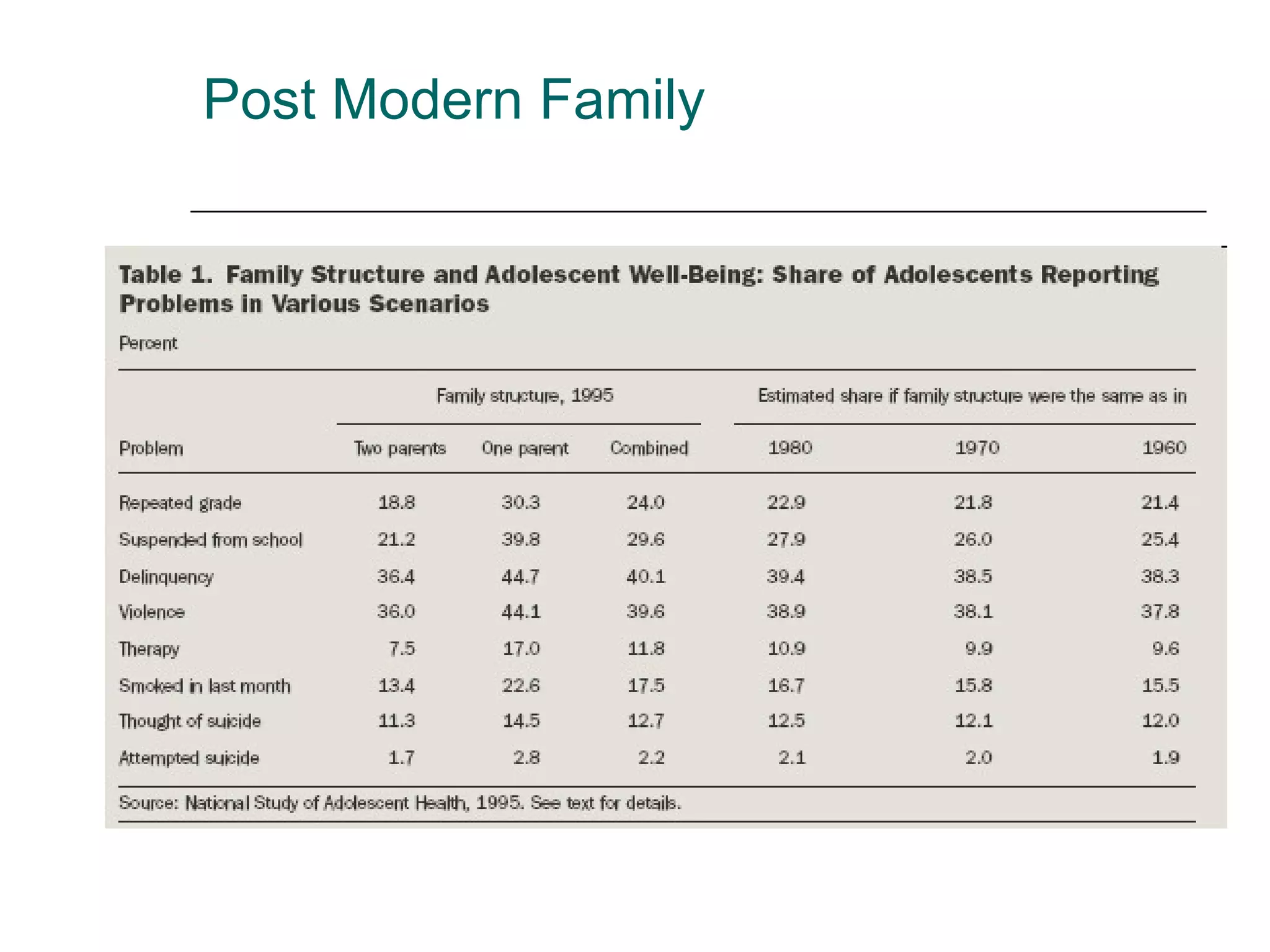
Post Modern Family - New Family Types - New Mores, New Customs  
Post Modern Family
Article http://www.americanvalues.org/briefs/No1_Nov05.pdf Family Structure and Children’s Educational Outcomes What do we do?
Sex Roles and Sex Differences - The Feminization of Schools - From Dick and Jane to Harry Potter
Feminization of Schools http://www.thefreelibrary.com/Feminization+of+schools%3A+if+young+boys+are+being+left+behind,+what...-a0208273743 Raising Cain documentary by Michael Thompson
Raising Cain Notice what issues come up for the boys in the documentary •  Notice how the adults in the film address the issues •  Notice what the adults in the film do that you think is especially effective at addressing the boys’ issues (or not) •  Does viewing trigger any memories of your own experiences growing up? •  Notice what else comes to your mind as you view http://www.pbs.org/opb/raisingcain/index.html
What’s realistic – what can YOU do? Implement single – sex classrooms in public schools? Combine cooperative and competitive learning strategies? Delay formal reading and writing instruction until boys are ready developmentally? Adjust middle school instruction in math and science to the learning preferences of the sexes? Include written – analytical formats for girls while allowing boys to use spatial (abstract) formats to get to the answer? Lobby and educate legislators?
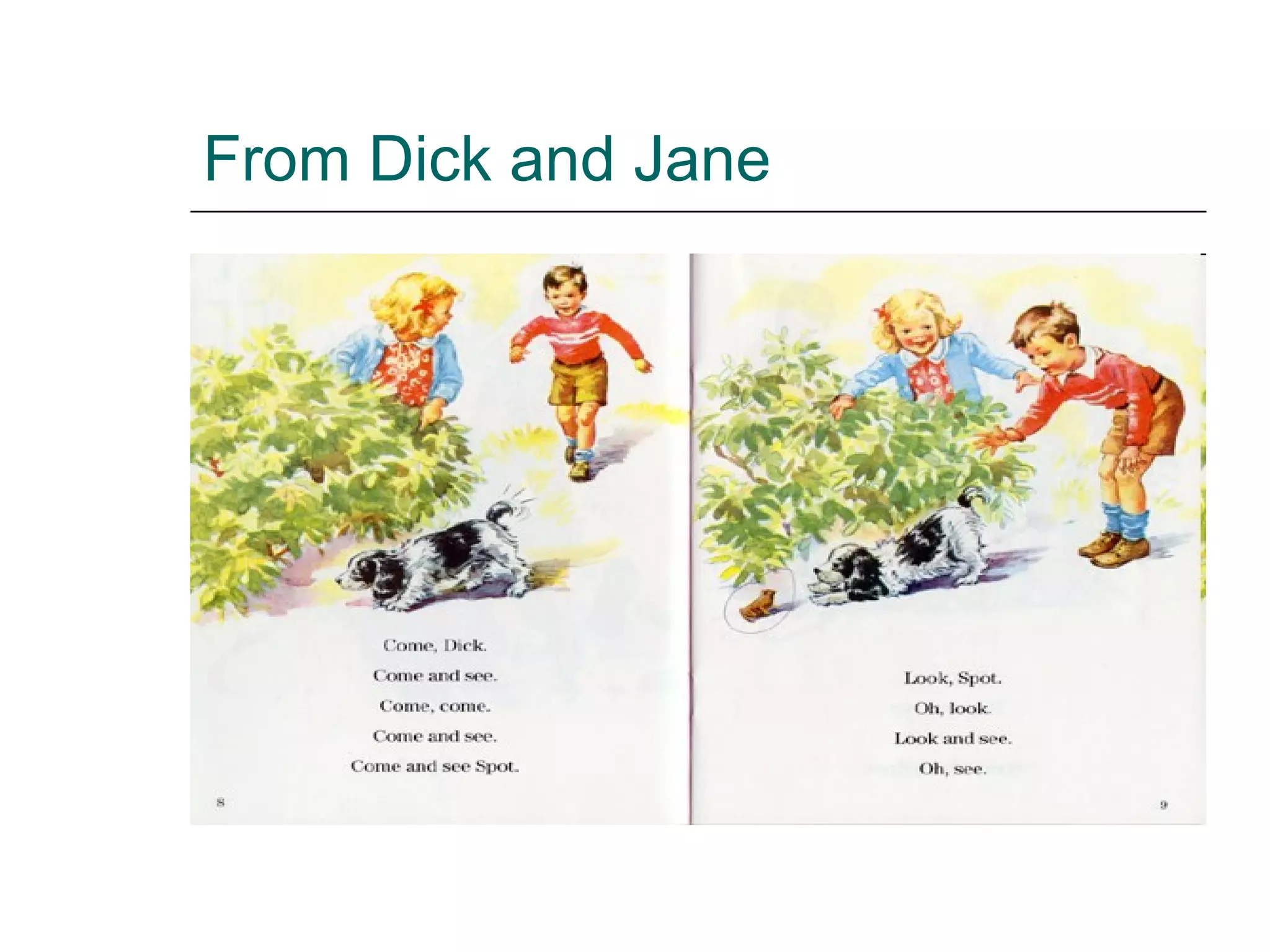
From Dick and Jane
Simple, repetitive sentences, colorful illustrations, and a secure, unhurried sense of childhood characterize Dick and Jane readers, a staple of American education from the 1930s through the 1960s. Dick and Jane textbooks, however, presented a world that was more ideal than true-to-life for many Depression-era schoolchildren, as Carole Kismaric and Marvin Heiferman suggest in  Growing Up with Dick and Jane: Learning and Living the American Dream . In the images below, Dick and Jane delight in their dog Spot's adventure with a frog, while the pictures encourage young readers to fill in the plot line.

…to Harry Potter
Think of books you read as a child at school and books children read today – gender roles?
Bias Evaluation Instrument http://rch.avrsb.ednet.ns.ca/home/11
Debate http://www.singlesexschools.org/home-introduction.htm Pros and Cons of Single-Sex Education
2020 Vision http://thefischbowl.blogspot.com/2006/11/2020-vision.html
Working Definition Add to journal entry for your working definition of curriculum.
So…Shift Happens? Curriculum is dynamic and ever changing “Truth and reality are whatever the individual or group discuss it to be.” http://www.youtube.com/watch?v=FqfunyCeU5g&feature=related Now What?
Did you Know? http://www.youtube.com/watch?v=6ILQrUrEWe8&feature=player_embedded

Final day 4 social context of curriculum 2011 bridgewater

  • 1.
  • 2.
    What’s Society gotto do with it? Can’t divorce education from its past Select which to maintain Which to improve Which to discard
  • 3.
    Interesting Facts InFebruary of 1990, the President of the United States and fifty governors met in an educational summit to establish expectations for the future. From the meeting emerged five goals for the year 2000: All children will start school ready to learn. High school graduation will increase to at least 90 percent. Students will demonstrate competence over challenging subject matter. Every American will be literate. Every school will be free of violence and drugs.
  • 4.
    In contrast tothe Goals 2000 are statistics from the Children's Defense Fund that include: every 8 seconds a student drops out of school in America; every 7 minutes a child is arrested for drug use in America; each year approximately 700,000 students are graduated from American high schools unable to read their diploma.
  • 5.
    Article – Lifein Classrooms Guiding Question When completing this reading, think about the following question, Does this article mirror in any way your work setting?
  • 6.
    Social Forces learnerscome from a variety of family situations, income strata, and cultural backgrounds factors such as family income, family structure, and parents' education have been shown to influence a child's educational opportunities these factors can influence whether or not a child will have problems such as repeating a grade, requiring special services, being suspended or dropping out of school
  • 7.
    Social Forces thecomposition/diversity of the school population has increased over the past several decades changes over time in terms of factors such as English language proficiency, family income, parents' education, and family structure affect the social context of education curriculum workers must be aware of differences in the backgrounds of students, as well as differences in the climate and resources of schools
  • 8.
    The Curriculum WorkerChallenge… make sense of large and shifting bases of information; be flexible in adapting to changing environments; work effectively in teams; understand and value groups with backgrounds and cultures different from their own.
  • 9.
    American Modal PersonalityBelief in the possible Preference for duality Belief in moral bases for right action Belief in the work ethic Belief in equity
  • 10.
    Canadian Modal Personality?Read a little more about the American Modal Personality. What about Canadians? Similiarities? Differences?
  • 11.
  • 12.
    Societal Change theeconomy has shifted from a traditional industrial base to an information and service base; individuals will have a number of jobs during their working careers: these jobs will be continually redefined by rapidly advancing technology and norms that define the workplace; social arrangements have changed; people move from place to place, families are configured differently, child-care responsibilities are assumed by individuals both within and outside the immediate family; estimates of the rate at which organized knowledge has doubled its volume ranged from every seven years in the mid-60s to every two years by the mid-70s.
  • 13.
    Social – EducationalPriorities Education for all students Focus on academically talented students Focus on subject matter Focus on disadvantaged students
  • 14.
    Reform at thelocal level Schools of Choice Unique twists of curriculum Own variations of instruction Passionate people within the walls Eagerness for learning, exploring, sharing, revising Small schools are social schools
  • 15.
    Charter Schools Publiclyfunded! Curricular focus Serve particular student population Distinct from the school district Must meet curricular guidelines of their particular state education offices Freed from unnecessary rules, regulations, and red tape that keep innovation from happening
  • 16.
    River Oak CharterSchool http://video.yahoo.com/watch/747131/3242712
  • 17.
  • 18.
    Traditional vs. CharterAccept and mirror the tendencies of the times (perennialist) traditional Appraise and improve the times (reconstructionist) futuristic
  • 19.
    What’s your job?Think about a typical day… Write down all of the jobs you perform E.g. counsellor, nurse etc.
  • 20.
    Self-Evaluation Activity WhoseJob is it? minority students are projected to make up an increasing share of the school age population during the coming decades; the percentage of children having difficulty speaking English has increased in recent years; the definition of a "family" has greatly changed in the past three decades; today children may live in a variety of family structures; public secondary teachers in high poverty schools are more likely to report that student absenteeism and tardiness are serious problems in their schools than public secondary teachers in low poverty schools; an increasing percentage of public school teachers report that physical conflicts and weapons possession are moderate or serious problems in their schools.; fourth-graders in high poverty public schools are less likely to be in schools with gifted and talented programs or extended day programs than fourth-graders in low poverty schools; public schools with high levels of poverty are less likely to be connected to the Internet than schools with lower levels of student poverty. (taken from Findings of The Condition of Education 1997: Teachers' Working Conditions )
  • 21.
    Telling Your OwnNarrative Share at least one experience from your teaching/curriculum work where you have attempted (either successfully or unsuccessfully) to transform the formal curriculum you have been given to teach, into an experience which has personal meaning for your students in the context of the social, political, and cultural milieu in which they live.
  • 22.
    Children: At Promiseor At Risk? The following Web sites correspond to the six "At Risk" categories discussed in your textbook. Of course, there are many other organizations working to solve these problems, but these sites will give you a good idea of how some educators, mental health professionals, government groups, and local communities are trying to address these important issues. Take a few moments to peruse each site. Then choose the three organizations that are most interesting to you and answer the questions below. National Dropout Prevention Center National Campaign to Prevent Teen Pregnancy NEA Health Information Network National Institute on Drug Abuse: NIDA Goes to School Youth Suicide Prevention Program (Washington State) Gay, Lesbian, and Straight Education Network No matter which three sites you chose, you will find that they offer guidelines, statistics and strategies to assist youth at risk. What patterns do you notice in the data? Resources? Strategies? How might these organizations work together? Based on these Web sites, how do you think school districts can respond to the needs of students who fall into several of these categories (e.g., homosexual and suicidal)?
  • 23.
    Post Modern Family- New Family Types - New Mores, New Customs  
  • 24.
  • 25.
    Article http://www.americanvalues.org/briefs/No1_Nov05.pdf FamilyStructure and Children’s Educational Outcomes What do we do?
  • 26.
    Sex Roles andSex Differences - The Feminization of Schools - From Dick and Jane to Harry Potter
  • 27.
    Feminization of Schoolshttp://www.thefreelibrary.com/Feminization+of+schools%3A+if+young+boys+are+being+left+behind,+what...-a0208273743 Raising Cain documentary by Michael Thompson
  • 28.
    Raising Cain Noticewhat issues come up for the boys in the documentary • Notice how the adults in the film address the issues • Notice what the adults in the film do that you think is especially effective at addressing the boys’ issues (or not) • Does viewing trigger any memories of your own experiences growing up? • Notice what else comes to your mind as you view http://www.pbs.org/opb/raisingcain/index.html
  • 29.
    What’s realistic –what can YOU do? Implement single – sex classrooms in public schools? Combine cooperative and competitive learning strategies? Delay formal reading and writing instruction until boys are ready developmentally? Adjust middle school instruction in math and science to the learning preferences of the sexes? Include written – analytical formats for girls while allowing boys to use spatial (abstract) formats to get to the answer? Lobby and educate legislators?
  • 30.
  • 31.
    Simple, repetitive sentences,colorful illustrations, and a secure, unhurried sense of childhood characterize Dick and Jane readers, a staple of American education from the 1930s through the 1960s. Dick and Jane textbooks, however, presented a world that was more ideal than true-to-life for many Depression-era schoolchildren, as Carole Kismaric and Marvin Heiferman suggest in Growing Up with Dick and Jane: Learning and Living the American Dream . In the images below, Dick and Jane delight in their dog Spot's adventure with a frog, while the pictures encourage young readers to fill in the plot line.
  • 32.
  • 33.
    Think of booksyou read as a child at school and books children read today – gender roles?
  • 34.
    Bias Evaluation Instrumenthttp://rch.avrsb.ednet.ns.ca/home/11
  • 35.
  • 36.
  • 37.
    Working Definition Addto journal entry for your working definition of curriculum.
  • 38.
    So…Shift Happens? Curriculumis dynamic and ever changing “Truth and reality are whatever the individual or group discuss it to be.” http://www.youtube.com/watch?v=FqfunyCeU5g&feature=related Now What?
  • 39.
    Did you Know?http://www.youtube.com/watch?v=6ILQrUrEWe8&feature=player_embedded

Editor's Notes

  • #6 http://books.google.ca/books?hl=en&lr=&id=SpsTi3LOFo0C&oi=fnd&pg=PA93&dq=%22life+in+classrooms%22+and+jackson&ots=gs6DFEa2j1&sig=Iq0MbeKQmmXaxq-284sdp4nxPj4#v=onepage&q=%22life%20in%20classrooms%22%20and%20jackson&f=false http://books.google.ca/books?hl=en&lr=&id=bN0BTz60DNAC&oi=fnd&pg=PA155&ots=XnRZGo92-J&sig=vQoinvCvqheJIhCthwo7wMxM-eA#v=onepage&q&f=false http://books.google.ca/books?hl=en&lr=&id=KOsXN9eJvDkC&oi=fnd&pg=PA113&ots=f4SapDKKc3&sig=JxWV6hn0ATi7Ceq-jE_bJccYh7c#v=onepage&q&f=false
  • #11 P 136 on in textbook
  • #13 the relationship between education and change is dynamic and interdependent. societal changes compel educators to create new curricula that emphasizes higher-order thinking. Consider the following shifts:
  • #23 Handout to take notes etc.