PSY 375
LIFESPAN
DEVELOPMENT
Physical Development
Week 3
Body Growth and Change
Patterns of growth
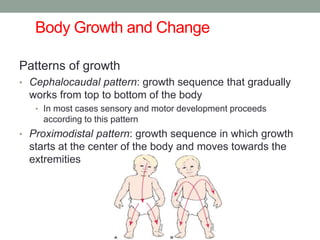
• Cephalocaudal pattern: growth sequence that gradually
works from top to bottom of the body
• In most cases sensory and motor development proceeds
according to this pattern
• Proximodistal pattern: growth sequence in which growth
starts at the center of the body and moves towards the
extremities
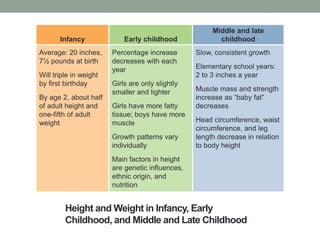
Height and Weight in Infancy, Early
Childhood, and Middle and Late Childhood
Infancy Early childhood
Middle and late
childhood
Average: 20 inches,
7½ pounds at birth
Will triple in weight
by first birthday
By age 2, about half
of adult height and
one-fifth of adult
weight
Percentage increase
decreases with each
year
Girls are only slightly
smaller and lighter
Girls have more fatty
tissue; boys have more
muscle
Growth patterns vary
individually
Main factors in height
are genetic influences,
ethnic origin, and
nutrition
Slow, consistent growth
Elementary school years:
2 to 3 inches a year
Muscle mass and strength
increase as “baby fat”
decreases
Head circumference, waist
circumference, and leg
length decrease in relation
to body height
Body Growth and Change: Puberty 1
Puberty: a brain-neuroendocrine process that stimulates
rapid physical changes, primarily in early adolescence
• Sexual maturation
• Growth spurt, in both weight and height
Early puberty
• U.S. children mature up to a year earlier than in Europe
• Average age of menarche has declined
• Nutrition, health, family stress, and other environmental factors affect
puberty’s timing
• For most boys, puberty begins between 10 and 13½; and ends
between 13 and 17
• For most girls, menarche appears between 9 and 15
• What does this tie into from our last class?
Body Growth and Change: Puberty
Early and late maturation
• Studies suggest early-maturing boys perceive
themselves more positively and have more successful
peer relationships than late-maturing boys
• Similar findings with girls, but not as strong
• When late-maturing boys reached their thirties, they had a more
positive identity
• Early maturation may increase girls’ vulnerability to a
number of problems
• Smoking, drinking, depression, eating disorders, struggles for
independence, older friends, earlier sexual intercourse, and a
heightened sensitivity to stress
Body Growth and Change: Puberty
Hormonal changes
• Hormones: powerful chemical substances secreted by
endocrine glands and carried by the bloodstream
• Hypothalamus: a brain structure involved in eating and sexual
behavior
• Pituitary gland: an endocrine gland that controls growth and
regulates other glands, including the gonads
• Gonads, or sex glands: testes in males, ovaries in females
• Pituitary gland sends a signal via gonadotropins,
hormones that stimulate the testes or ovaries
• Prompt changes such as sperm production in males and
menstruation and the release of eggs in females
Body Growth and Change: Puberty
Hormonal changes
• Testosterone: a hormone associated in boys with the
development of the genitals, increased height, and voice
changes
• Estradiol (a type of estrogen): a hormone associated in
girls with breast, uterine, and skeletal development
• Hormonal effects by themselves do not account for
psychological development
Body Growth and Change: Puberty
Psychological accompaniments of puberty
• Body image
• Adolescents are preoccupied with their bodies
• Body dissatisfaction is more acute during puberty than in late
adolescence
• Gender differences
Body Growth and Change:
Early Adulthood
Subtle physical changes happen through early
adulthood
• Height remains rather constant
• For many individuals, peak muscle tone and strength is
reached in the late teens and twenties
• Peak functioning of joints occurs in the twenties
• Decline begins in the thirties
Body Growth and Change:
Middle Adulthood 1
Physical changes of middle adulthood are gradual
• Genetic and lifestyle factors play a role in chronic
disease
Physical appearance
• Loss in height and gain in weight
• Noticeable signs of aging by the forties or fifties
• Examples: skin sags and wrinkles, hair thins and grays
Body Growth and Change:
Middle Adulthood
Strength, joints, and bones
• Sarcopenia: age-related loss of lean muscle and strength
• “Sarcopenic obesity”—sarcopenia and are obese
• Progressive loss of bone density
• In women, nearly twice that of men
Body Growth and Change:
Middle Adulthood 3
Cardiovascular system
• Cardiovascular disease increases considerably
• Cholesterol levels increase through the adult years, and
cholesterol begins to accumulate on artery walls
• Low-density lipoprotein, or LDL: “bad” cholesterol
• High-density lipoprotein, or HDL: “good” cholesterol
• Blood pressure rises
Lungs
• After about age 55, the proteins in lung tissue become
less elastic, decreasing oxygen-handling capacity
• Lung capacity of smokers drops precipitously in middle age
Body Growth and Change:
Middle Adulthood
Sexuality
• Climacteric: midlife transition in which fertility declines
• Menopause: end of menstrual periods, usually in the late
forties or early fifties
• Production of estrogen declines, producing uncomfortable
symptoms in some women
• Hormone replacement therapy? Yay or nay?
Body Growth and Change:
Late Adulthood
Physical appearance
• Midlife changes become more pronounced in late
adulthood
• Face wrinkles, age spots
• Weight drops because of lost muscle mass
Circulatory system
• Increased blood pressure, linked to heart attack, stroke,
and kidney disease
• Various drugs, a healthy diet, and exercise can reduce
the risk of cardiovascular disease
The Brain
Rather than being “wired” by genes, the brain’s
connections are determined by experiences
• Before birth, genes mainly direct basic wiring patterns
• After birth, sights, sounds, smells, touches, language,
and eye contact help shape neural connections
Neuroconstructivist view:
• Biological processes and environmental experiences
influence the brain’s development
• Brain has plasticity and is context dependent
• Development of the brain and cognitive development are
closely linked
Brain Physiology
Structure and function
• Brain has two hemispheres, each with four lobes that
work together
Brain Physiology
Structure and function
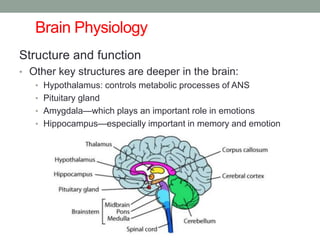
• Other key structures are deeper in the brain:
• Hypothalamus: controls metabolic processes of ANS
• Pituitary gland
• Amygdala—which plays an important role in emotions
• Hippocampus—especially important in memory and emotion
Brain Physiology
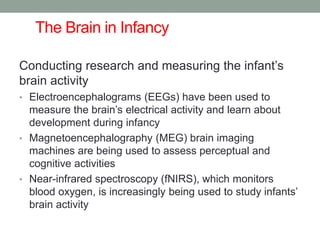
The Brain in Infancy
Conducting research and measuring the infant’s
brain activity
• Electroencephalograms (EEGs) have been used to
measure the brain’s electrical activity and learn about
development during infancy
• Magnetoencephalography (MEG) brain imaging
machines are being used to assess perceptual and
cognitive activities
• Near-infrared spectroscopy (fNIRS), which monitors
blood oxygen, is increasingly being used to study infants’
brain activity
The Brain in Infancy
Early experience and the brain
Spotlight on: Bucharest Early Intervention Project
Revisiting Nature vs. Nurture
Think about these questions:
• What does the BEIP tell you about the debate
we went over last week?
• Any ethical concerns involved in the project?
• You can see these in the notes section of the PPT
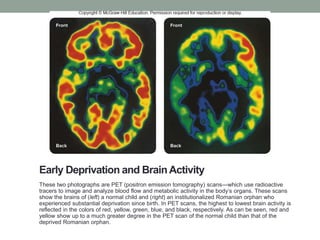
Early Deprivation and BrainActivity
These two photographs are PET (positron emission tomography) scans—which use radioactive
tracers to image and analyze blood flow and metabolic activity in the body’s organs. These scans
show the brains of (left) a normal child and (right) an institutionalized Romanian orphan who
experienced substantial deprivation since birth. In PET scans, the highest to lowest brain activity is
reflected in the colors of red, yellow, green, blue, and black, respectively. As can be seen, red and
yellow show up to a much greater degree in the PET scan of the normal child than that of the
deprived Romanian orphan.
Courtesy of Dr. Harry T. Chugani, Children’s Hospital of Michigan
The Brain in Childhood
During early childhood, the brain and head grow
more rapidly than any other part of body
• Continuing myelination and synaptic growth is linked to
substantial increases in memory and rapid learning
• Contextual factors such as poverty and parenting quality
affect brain development
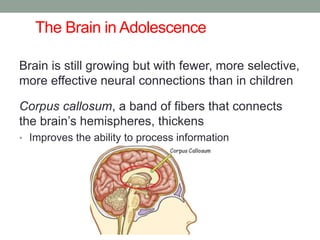
The Brain in Adolescence
Brain is still growing but with fewer, more selective,
more effective neural connections than in children
Corpus callosum, a band of fibers that connects
the brain’s hemispheres, thickens
• Improves the ability to process information
The Brain in Adolescence
Limbic system, the seat of emotions and
experience of rewards, is almost completely
developed
• Amygdala: the limbic system structure especially
involved in emotion
Levels of neurotransmitters change with puberty
• Some, such as dopamine, are linked to behavioral
changes
The Brain in Adulthood and Aging
The shrinking, slowing brain
• On average, the brain loses 5% to 10% of its weight
between the ages of 20 and 90
• Brain volume also decreases
• Prefrontal cortex shrinks more than some other areas
• Linked with a decrease in working memory
• General slowing of brain and spinal cord function begins
in middle age and accelerates in late adulthood
• Production of some neurotransmitters declines
• Reduction in acetylcholine is linked to memory loss, especially
with Alzheimer disease; and reduction in dopamine is involved in
decreased motor control in Parkinson disease
The Brain in Adulthood and Aging
The adapting brain
• Brain loses only a portion of its ability to function
• Activities continue to influence the brain’s development
• Aerobic fitness is linked with greater volume in the hippocampus,
which translates into better memory
• Neurogenesis, dendritic growth, and delateralization
reflect the adaptiveness of the brain
• Neurogenesis, the generation of new neurons, can occur but may
be limited to certain areas
• Dendritic growth may be possible in older adults but is perhaps
limited, by the nineties, by lack of stimulation and activity
• Decreased lateralization may play a compensatory role
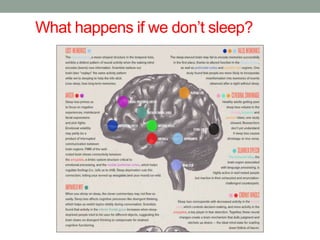
What happens if we don’t sleep?
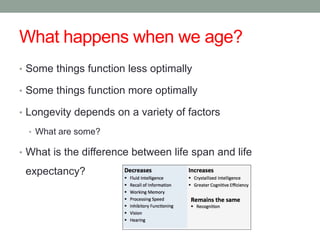
What happens when we age?
• Some things function less optimally
• Some things function more optimally
• Longevity depends on a variety of factors
• What are some?
• What is the difference between life span and life
expectancy?
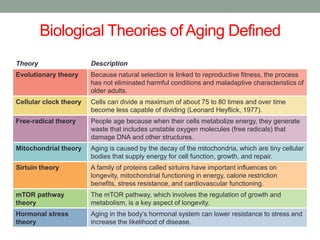
Biological Theories of Aging Defined
Theory Description
Evolutionary theory Because natural selection is linked to reproductive fitness, the process
has not eliminated harmful conditions and maladaptive characteristics of
older adults.
Cellular clock theory Cells can divide a maximum of about 75 to 80 times and over time
become less capable of dividing (Leonard Heyflick, 1977).
Free-radical theory People age because when their cells metabolize energy, they generate
waste that includes unstable oxygen molecules (free radicals) that
damage DNA and other structures.
Mitochondrial theory Aging is caused by the decay of the mitochondria, which are tiny cellular
bodies that supply energy for cell function, growth, and repair.
Sirtuin theory A family of proteins called sirtuins have important influences on
longevity, mitochondrial functioning in energy, calorie restriction
benefits, stress resistance, and cardiovascular functioning.
mTOR pathway
theory
The mTOR pathway, which involves the regulation of growth and
metabolism, is a key aspect of longevity.
Hormonal stress
theory
Aging in the body’s hormonal system can lower resistance to stress and
increase the likelihood of disease.

Week 3 Physical Development

  • 1.
  • 2.
    Body Growth andChange Patterns of growth • Cephalocaudal pattern: growth sequence that gradually works from top to bottom of the body • In most cases sensory and motor development proceeds according to this pattern • Proximodistal pattern: growth sequence in which growth starts at the center of the body and moves towards the extremities
  • 3.
    Height and Weightin Infancy, Early Childhood, and Middle and Late Childhood Infancy Early childhood Middle and late childhood Average: 20 inches, 7½ pounds at birth Will triple in weight by first birthday By age 2, about half of adult height and one-fifth of adult weight Percentage increase decreases with each year Girls are only slightly smaller and lighter Girls have more fatty tissue; boys have more muscle Growth patterns vary individually Main factors in height are genetic influences, ethnic origin, and nutrition Slow, consistent growth Elementary school years: 2 to 3 inches a year Muscle mass and strength increase as “baby fat” decreases Head circumference, waist circumference, and leg length decrease in relation to body height
  • 4.
    Body Growth andChange: Puberty 1 Puberty: a brain-neuroendocrine process that stimulates rapid physical changes, primarily in early adolescence • Sexual maturation • Growth spurt, in both weight and height Early puberty • U.S. children mature up to a year earlier than in Europe • Average age of menarche has declined • Nutrition, health, family stress, and other environmental factors affect puberty’s timing • For most boys, puberty begins between 10 and 13½; and ends between 13 and 17 • For most girls, menarche appears between 9 and 15 • What does this tie into from our last class?
  • 5.
    Body Growth andChange: Puberty Early and late maturation • Studies suggest early-maturing boys perceive themselves more positively and have more successful peer relationships than late-maturing boys • Similar findings with girls, but not as strong • When late-maturing boys reached their thirties, they had a more positive identity • Early maturation may increase girls’ vulnerability to a number of problems • Smoking, drinking, depression, eating disorders, struggles for independence, older friends, earlier sexual intercourse, and a heightened sensitivity to stress
  • 6.
    Body Growth andChange: Puberty Hormonal changes • Hormones: powerful chemical substances secreted by endocrine glands and carried by the bloodstream • Hypothalamus: a brain structure involved in eating and sexual behavior • Pituitary gland: an endocrine gland that controls growth and regulates other glands, including the gonads • Gonads, or sex glands: testes in males, ovaries in females • Pituitary gland sends a signal via gonadotropins, hormones that stimulate the testes or ovaries • Prompt changes such as sperm production in males and menstruation and the release of eggs in females
  • 7.
    Body Growth andChange: Puberty Hormonal changes • Testosterone: a hormone associated in boys with the development of the genitals, increased height, and voice changes • Estradiol (a type of estrogen): a hormone associated in girls with breast, uterine, and skeletal development • Hormonal effects by themselves do not account for psychological development
  • 8.
    Body Growth andChange: Puberty Psychological accompaniments of puberty • Body image • Adolescents are preoccupied with their bodies • Body dissatisfaction is more acute during puberty than in late adolescence • Gender differences
  • 9.
    Body Growth andChange: Early Adulthood Subtle physical changes happen through early adulthood • Height remains rather constant • For many individuals, peak muscle tone and strength is reached in the late teens and twenties • Peak functioning of joints occurs in the twenties • Decline begins in the thirties
  • 10.
    Body Growth andChange: Middle Adulthood 1 Physical changes of middle adulthood are gradual • Genetic and lifestyle factors play a role in chronic disease Physical appearance • Loss in height and gain in weight • Noticeable signs of aging by the forties or fifties • Examples: skin sags and wrinkles, hair thins and grays
  • 11.
    Body Growth andChange: Middle Adulthood Strength, joints, and bones • Sarcopenia: age-related loss of lean muscle and strength • “Sarcopenic obesity”—sarcopenia and are obese • Progressive loss of bone density • In women, nearly twice that of men
  • 12.
    Body Growth andChange: Middle Adulthood 3 Cardiovascular system • Cardiovascular disease increases considerably • Cholesterol levels increase through the adult years, and cholesterol begins to accumulate on artery walls • Low-density lipoprotein, or LDL: “bad” cholesterol • High-density lipoprotein, or HDL: “good” cholesterol • Blood pressure rises Lungs • After about age 55, the proteins in lung tissue become less elastic, decreasing oxygen-handling capacity • Lung capacity of smokers drops precipitously in middle age
  • 13.
    Body Growth andChange: Middle Adulthood Sexuality • Climacteric: midlife transition in which fertility declines • Menopause: end of menstrual periods, usually in the late forties or early fifties • Production of estrogen declines, producing uncomfortable symptoms in some women • Hormone replacement therapy? Yay or nay?
  • 14.
    Body Growth andChange: Late Adulthood Physical appearance • Midlife changes become more pronounced in late adulthood • Face wrinkles, age spots • Weight drops because of lost muscle mass Circulatory system • Increased blood pressure, linked to heart attack, stroke, and kidney disease • Various drugs, a healthy diet, and exercise can reduce the risk of cardiovascular disease
  • 15.
    The Brain Rather thanbeing “wired” by genes, the brain’s connections are determined by experiences • Before birth, genes mainly direct basic wiring patterns • After birth, sights, sounds, smells, touches, language, and eye contact help shape neural connections Neuroconstructivist view: • Biological processes and environmental experiences influence the brain’s development • Brain has plasticity and is context dependent • Development of the brain and cognitive development are closely linked
  • 16.
    Brain Physiology Structure andfunction • Brain has two hemispheres, each with four lobes that work together
  • 17.
    Brain Physiology Structure andfunction • Other key structures are deeper in the brain: • Hypothalamus: controls metabolic processes of ANS • Pituitary gland • Amygdala—which plays an important role in emotions • Hippocampus—especially important in memory and emotion
  • 18.
  • 19.
    The Brain inInfancy Conducting research and measuring the infant’s brain activity • Electroencephalograms (EEGs) have been used to measure the brain’s electrical activity and learn about development during infancy • Magnetoencephalography (MEG) brain imaging machines are being used to assess perceptual and cognitive activities • Near-infrared spectroscopy (fNIRS), which monitors blood oxygen, is increasingly being used to study infants’ brain activity
  • 20.
    The Brain inInfancy Early experience and the brain Spotlight on: Bucharest Early Intervention Project
  • 21.
    Revisiting Nature vs.Nurture Think about these questions: • What does the BEIP tell you about the debate we went over last week? • Any ethical concerns involved in the project? • You can see these in the notes section of the PPT
  • 22.
    Early Deprivation andBrainActivity These two photographs are PET (positron emission tomography) scans—which use radioactive tracers to image and analyze blood flow and metabolic activity in the body’s organs. These scans show the brains of (left) a normal child and (right) an institutionalized Romanian orphan who experienced substantial deprivation since birth. In PET scans, the highest to lowest brain activity is reflected in the colors of red, yellow, green, blue, and black, respectively. As can be seen, red and yellow show up to a much greater degree in the PET scan of the normal child than that of the deprived Romanian orphan. Courtesy of Dr. Harry T. Chugani, Children’s Hospital of Michigan
  • 23.
    The Brain inChildhood During early childhood, the brain and head grow more rapidly than any other part of body • Continuing myelination and synaptic growth is linked to substantial increases in memory and rapid learning • Contextual factors such as poverty and parenting quality affect brain development
  • 24.
    The Brain inAdolescence Brain is still growing but with fewer, more selective, more effective neural connections than in children Corpus callosum, a band of fibers that connects the brain’s hemispheres, thickens • Improves the ability to process information
  • 25.
    The Brain inAdolescence Limbic system, the seat of emotions and experience of rewards, is almost completely developed • Amygdala: the limbic system structure especially involved in emotion Levels of neurotransmitters change with puberty • Some, such as dopamine, are linked to behavioral changes
  • 26.
    The Brain inAdulthood and Aging The shrinking, slowing brain • On average, the brain loses 5% to 10% of its weight between the ages of 20 and 90 • Brain volume also decreases • Prefrontal cortex shrinks more than some other areas • Linked with a decrease in working memory • General slowing of brain and spinal cord function begins in middle age and accelerates in late adulthood • Production of some neurotransmitters declines • Reduction in acetylcholine is linked to memory loss, especially with Alzheimer disease; and reduction in dopamine is involved in decreased motor control in Parkinson disease
  • 27.
    The Brain inAdulthood and Aging The adapting brain • Brain loses only a portion of its ability to function • Activities continue to influence the brain’s development • Aerobic fitness is linked with greater volume in the hippocampus, which translates into better memory • Neurogenesis, dendritic growth, and delateralization reflect the adaptiveness of the brain • Neurogenesis, the generation of new neurons, can occur but may be limited to certain areas • Dendritic growth may be possible in older adults but is perhaps limited, by the nineties, by lack of stimulation and activity • Decreased lateralization may play a compensatory role
  • 28.
    What happens ifwe don’t sleep?
  • 29.
    What happens whenwe age? • Some things function less optimally • Some things function more optimally • Longevity depends on a variety of factors • What are some? • What is the difference between life span and life expectancy?
  • 30.
    Biological Theories ofAging Defined Theory Description Evolutionary theory Because natural selection is linked to reproductive fitness, the process has not eliminated harmful conditions and maladaptive characteristics of older adults. Cellular clock theory Cells can divide a maximum of about 75 to 80 times and over time become less capable of dividing (Leonard Heyflick, 1977). Free-radical theory People age because when their cells metabolize energy, they generate waste that includes unstable oxygen molecules (free radicals) that damage DNA and other structures. Mitochondrial theory Aging is caused by the decay of the mitochondria, which are tiny cellular bodies that supply energy for cell function, growth, and repair. Sirtuin theory A family of proteins called sirtuins have important influences on longevity, mitochondrial functioning in energy, calorie restriction benefits, stress resistance, and cardiovascular functioning. mTOR pathway theory The mTOR pathway, which involves the regulation of growth and metabolism, is a key aspect of longevity. Hormonal stress theory Aging in the body’s hormonal system can lower resistance to stress and increase the likelihood of disease.

Editor's Notes

  • #17 Frontal lobes: voluntary movement, thinking, personality, emotion, memory, sustained attention, and intentionality or purpose Occipital lobes: vision Temporal lobes: hearing, language processing, and memory Parietal lobes: spatial location, focusing attention, and maintaining motor control Cerebral cortex—outer layer of cells—is responsible for 80% of the brain’s volume and is critical in perception, thinking, language, and other functions
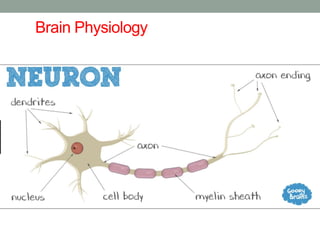
  • #19 Neurons Neurons process information Through the release of chemical substances called neurotransmitters, an axon in one neuron communicates with the dendrites of another at tiny gaps called synapses Most axons are covered by a myelin sheath—a layer of fat cells Myelination: the process of encasing axons with a myelin sheath, improving the speed and efficiency of information processing Lateralization: specialization of function in one hemisphere or the other of the cerebral cortex
  • #21 The Bucharest Early Intervention Project (BEIP) was a randomized controlled trial of foster care as an intervention for children abandoned at or around the time of birth and placed in one of six institutions for young children in Bucharest, Romania (Zeanah, et al., 2003).   The BEIP began in 2000 with a comprehensive baseline assessment of 136 children and their caregiving environments. Following this assessment, half the children were randomly assigned to high-quality foster care (designed specifically for this study) and the other half to remain in institutional care. The average age at entry into foster care was 22 months (range=6-31 months). All children were seen for follow-up assessments at 30, 42 and 54 months, 8 years, and 12 years*, and the development of children in foster care was compared to the development of children randomized to remain in institutional care and to a group of never institutionalized children (community controls).   Findings through the assessment at 12 years of age suggest that early institutionalization leads to profound deficits in many domains examined to date, including cognitive (i.e., IQ) and socio-emotional behaviors (i.e., attachment), brain activity and structure, alterations in reward sensitivity and processing, and a greatly elevated incidence of psychiatric disorders and impairment.    Our foster care intervention was broadly effective in enhancing children’s development, and for specific domains, including brain activity (EEG), attachment, language, and cognition, there appear to be sensitive periods regulating their recovery. That is, the earlier a child was placed in foster care, the better their recovery. Although the sensitive periods for recovery vary by domain, our results suggest that placement before the age of 2 years is key.  
  • #22 Ethics of randomly assigning to foster care We already know that foster care is better Kids cannot consent to participate Issues with govt invovlement
  • #27 Warmup Questions: What are some common attitudes or preconceptions about “old people”? What are some characteristics by which we define someone as “old”? How does their behavior differ from that of children? Explanation: By 2030, when the last of the Baby Boomers reach age 65, the U.S. older population will be twice that of 2010. Furthermore, due to increases in average life expectancy, each successive generation can expect to live longer than their parents’ generation and certainly longer than their grandparents’ generation. Considering the approaching reality of prolonged “old age”, the implications of understanding aging take on a pronounced significance. Optional Activity: Before class, have students survey friends for the first three words or phrases that come to mind when they hear the word “elderly”. Have them record the age and gender of their participants. Prepare a master list, ordered from most common to least common. (Alternately, you might administer a written poll to the students then write their answers on the board.)