Life, IT and everything
about revolutions, outside-the-box journeys and the daily IT madness

Uwe Friedrichsen – codecentric AG – 2014-2016
@ufried
Uwe Friedrichsen | uwe.friedrichsen@codecentric.de | http://slideshare.net/ufried | http://ufried.tumblr.com
Be flexible

… but stick to the plan!
Be innovative

… but don’t break anything!
Be agile

… but adhere to all processes!
Be disruptive

… but don’t change anything!
Be the new Netflix

… but don’t spend any money!
Woot ?!?
Have they all gone nuts?
Or is there a bigger schema,
we just don’t recognize?
Meaning
Madness
Time for a short journey

through space and time ...
Journey #1

The evolution of markets
Formal part of
value creation
Solution:
machine
Dynamic part
of value
creation
Solution: man
sluggishness/low dynamic high dynamichigh dynamic
The historical course of market dynamics
and the recent rise of highly dynamic and complex markets
The dominance of high dynamics and complexity is neither good nor bad. It‘s a historical fact.
t1970/80 today
Age of
crafts manu-
facturing
Age of
tayloristic
industry
Age of
global
markets
1850/1900
Spacious markets,
little competition
Local markets,
high customi-
zation
Outperformers exercise
market pressure over
conventional companies
We call the graph shown here the “Taylor Bathtub”.
The “bathtub” curve
Source: BetaCodex Network Associates, “Organize for complexity”, BetaCodex Network White Paper 12 & 13
Formal part of
value creation
Solution:
machine
Dynamic part
of value
creation
Solution: man
sluggishness/low dynamic high dynamichigh dynamic
The historical course of market dynamics
and the recent rise of highly dynamic and complex markets
The dominance of high dynamics and complexity is neither good nor bad. It‘s a historical fact.
t1970/80 today
Age of
crafts manu-
facturing
Age of
tayloristic
industry
Age of
global
markets
1850/1900
Spacious markets,
little competition
Local markets,
high customi-
zation
Outperformers exercise
market pressure over
conventional companies
We call the graph shown here the “Taylor Bathtub”.
Pre-industrial era
Source: BetaCodex Network Associates, “Organize for complexity”, BetaCodex Network White Paper 12 & 13
Tailor-made
solutions
“Mastery
is key to success”
Formal part of
value creation
Solution:
machine
Dynamic part
of value
creation
Solution: man
sluggishness/low dynamic high dynamichigh dynamic
The historical course of market dynamics
and the recent rise of highly dynamic and complex markets
The dominance of high dynamics and complexity is neither good nor bad. It‘s a historical fact.
t1970/80 today
Age of
crafts manu-
facturing
Age of
tayloristic
industry
Age of
global
markets
1850/1900
Spacious markets,
little competition
Local markets,
high customi-
zation
Outperformers exercise
market pressure over
conventional companies
We call the graph shown here the “Taylor Bathtub”.
Industrial era
Source: BetaCodex Network Associates, “Organize for complexity”, BetaCodex Network White Paper 12 & 13
Cost-efficiently
scale production
“Get more done with less people
is key to success”
Formal part of
value creation
Solution:
machine
Dynamic part
of value
creation
Solution: man
sluggishness/low dynamic high dynamichigh dynamic
The historical course of market dynamics
and the recent rise of highly dynamic and complex markets
The dominance of high dynamics and complexity is neither good nor bad. It‘s a historical fact.
t1970/80 today
Age of
crafts manu-
facturing
Age of
tayloristic
industry
Age of
global
markets
1850/1900
Spacious markets,
little competition
Local markets,
high customi-
zation
Outperformers exercise
market pressure over
conventional companies
We call the graph shown here the “Taylor Bathtub”.
Post-industrial era
Source: BetaCodex Network Associates, “Organize for complexity”, BetaCodex Network White Paper 12 & 13
Continuously respond
to changing demands
“Continuous
customer communication
is key to success”
Industrial era

•  Cost-efficiency
•  Scalability
•  Repeatability
•  Stability
Changing markets create new drivers
Post-industrial era

•  Cycle times
•  Adaptability
•  Flexibility
•  Resilience
Side note

Organizations as enablers and preventers
Journey #2

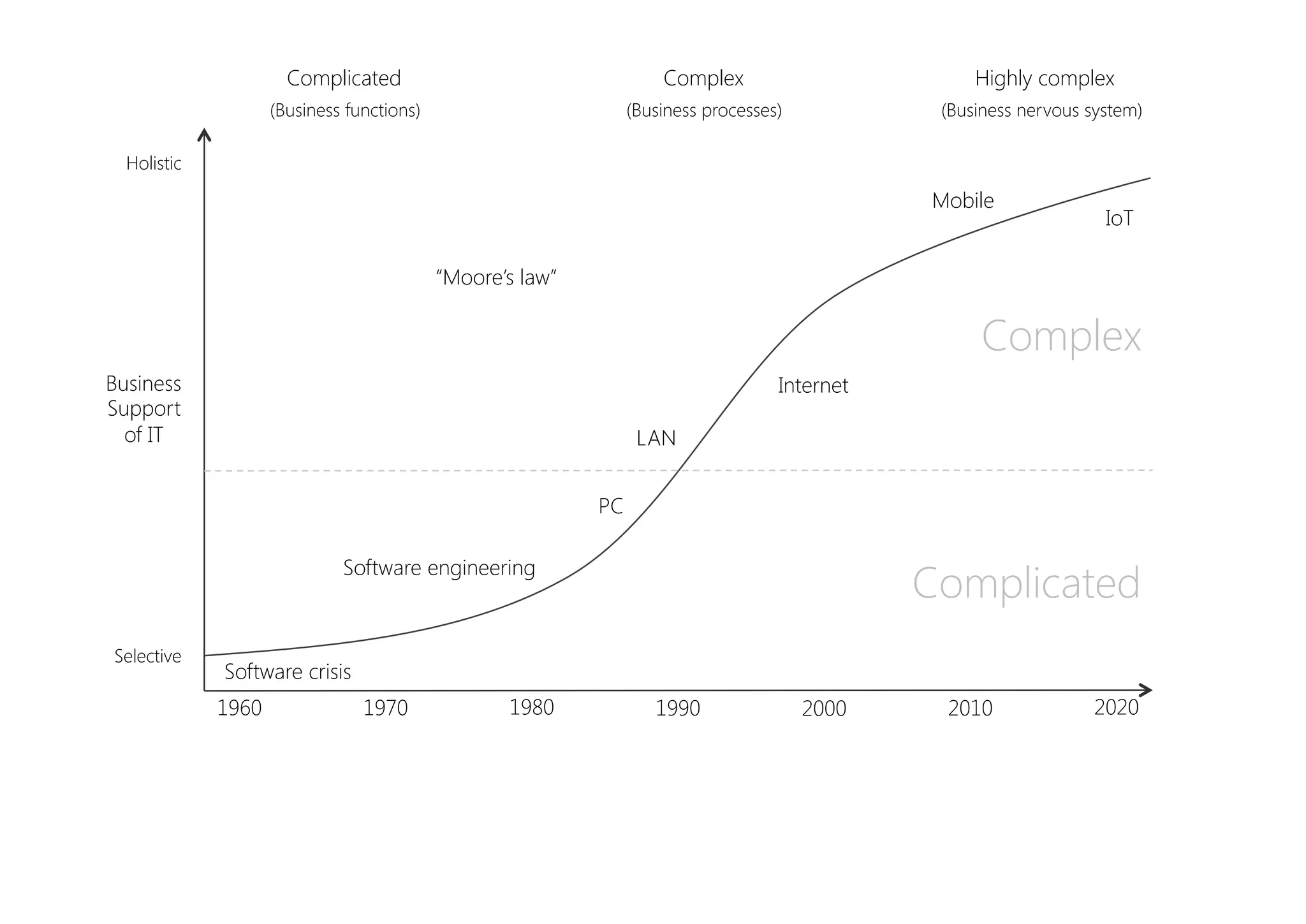
The evolution of IT
1960
 1970
 1980
 1990
 2000
 2010
 2020
Complicated

(Business functions)
Complex

(Business processes)
Highly complex

(Business nervous system)
Software crisis
Software engineering
PC
LAN
Internet
Business
Support
of IT
Selective
Holistic
Complicated
Complex
“Moore’s law”
Mobile
IoT
1960
 1970
 1980
 1990
 2000
 2010
 2020
Complicated

(Business functions)
Complex

(business processes)
Highly complex

(Business nervous system)
Software crisis
Software engineering
PC
LAN
Internet
Business
Support
of IT
Selective
Holistic
Complicated
Complex
“Moore’s law”
Mobile
IoT
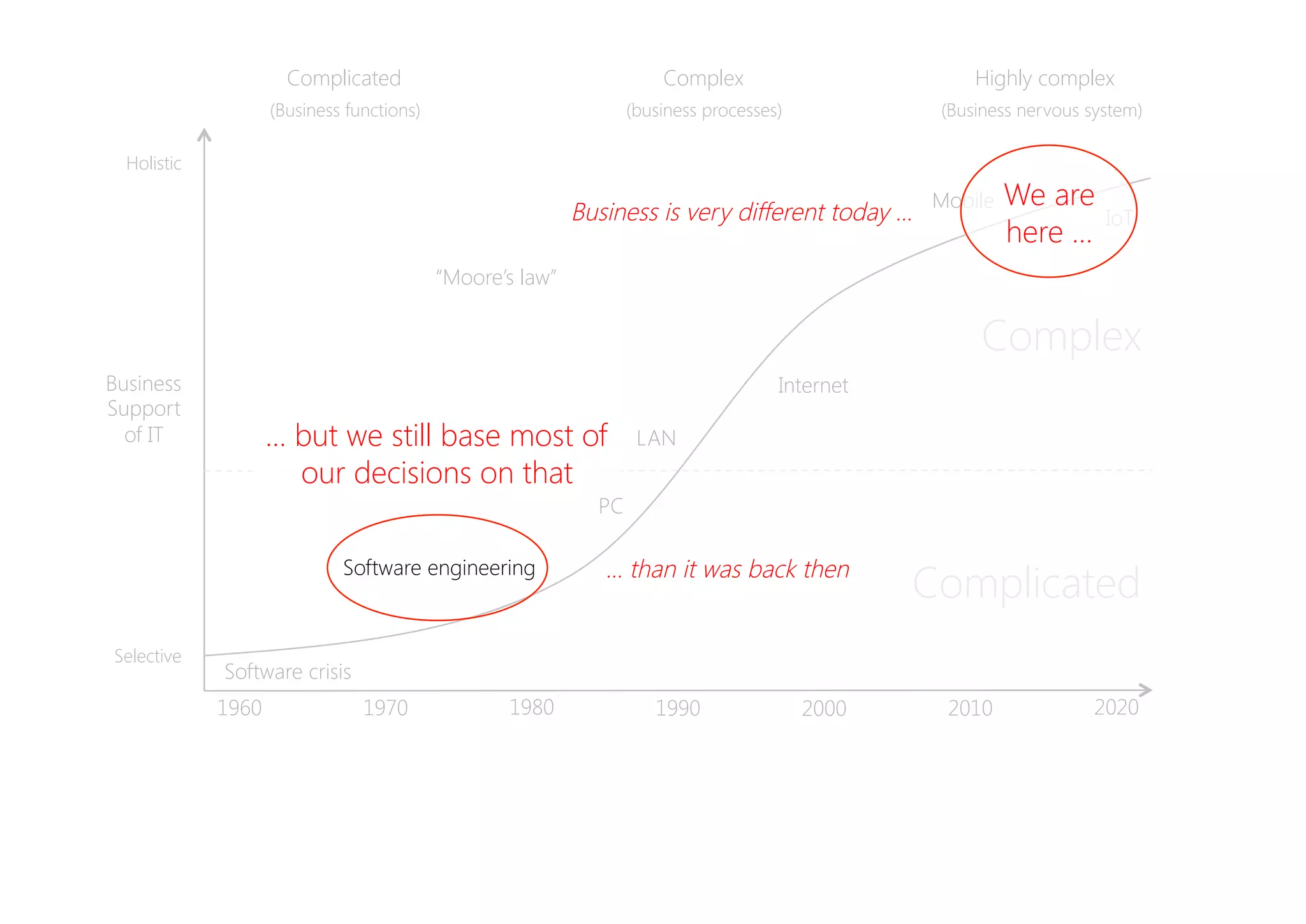
We are
here …
1960
 1970
 1980
 1990
 2000
 2010
 2020
Complicated

(Business functions)
Complex

(business processes)
Highly complex

(Business nervous system)
Software crisis
Software engineering
PC
LAN
Internet
Business
Support
of IT
Selective
Holistic
Complicated
Complex
“Moore’s law”
Mobile
IoT
… but we still base most of
our decisions on that
We are
here …
Formal part of
value creation
Solution:
machine
Dynamic part
of value
creation
Solution: man
sluggishness/low dynamic high dynamichigh dynamic
The historical course of market dynamics
and the recent rise of highly dynamic and complex markets
The dominance of high dynamics and complexity is neither good nor bad. It‘s a historical fact.
t1970/80 today
Age of
crafts manu-
facturing
Age of
tayloristic
industry
Age of
global
markets
1850/1900
Spacious markets,
little competition
Local markets,
high customi-
zation
Outperformers exercise
market pressure over
conventional companies
We call the graph shown here the “Taylor Bathtub”.
Remember the bathtub curve?


This adds an additional twist …
1960
 1970
 1980
 1990
 2000
 2010
 2020
Complicated

(Business functions)
Complex

(business processes)
Highly complex

(Business nervous system)
Software crisis
Software engineering
PC
LAN
Internet
Business
Support
of IT
Selective
Holistic
Complicated
Complex
“Moore’s law”
Mobile
IoT
… but we still base most of
our decisions on that
We are
here …
Business is very different today …
… than it was back then
Business
Market
IT today is a …
… Nervous System
… Medium
… Product
… Differentiator
Disruptive
Technologies
Business
Support
Systems
Continuous
Conversation
Digitization
Business is IT and IT is business
The traditional IT “best practices” are
counterproductive because they solve

a completely different problem
What can we learn?
We are in the middle of a revolution
Unfortunately, quite often

we do not feel like them …
... but more like them
How can we avoid becoming
revolution roadkill?
A few recommendations …
#1

Understand the post-industrial IT
Rethinking IT
What are the new drivers?
IT
Post-Industrialism
Highly dynamic markets
Economic Darwinism
Lean startup/lean enterprise
Continuous design
Digitization
IT as a product
Digital conversation
Social media
Contextual computing
Disruption
Innovation through disruption
Cloud, mobile, IoT, serverless
Big data analytics
Data-driven enterprise
force
change
on
What are the new goals?
IT
… be quick
Short response times
Holistic IT value chain consideration
… be effective
Focus on outcome, not output
… improve continuously
Improvement as planned activity
needs
to …
… be efficient
Provide required throughput 
… be reliable
High availability and reliability
… be flexible
Flexible response to changing needs
Process & Org
needs to be …
Quick
Flexible
 Effective
Software
needs to be …
Secure
Changeable
 Robust
… and improve continuously
Process & Org
needs to be …
Software
needs to be …
Quick
Flexible
 Effective
 Secure
Changeable
 Robust
… and improve continuously
How can we achieve the new goals?
Let’s learn from the digitization natives
Adaption

DevOps
Systemic optimization
Inspect and adapt
Quick feedback loops
Continuous improvement
…
Process

DevOps
Agile
Lean
Feature Flow (no projects)
Design Thinking
…
Governance

Beyond Budgeting
Decentralized control
Outcome-driven
Lean EAM
…
Organization

DevOps
Autonomous teams
Cross-functional teams
End-2-end responsibility
Routine task automation
…
People

Craftsmanship
T-shaped
Responsibility
Curiosity
Empathy
…
Technology

Cloud
Automation
Microservice
Heterogeneity
Resilience
…
(Some) Building Blocks
These building blocks don’t sum up,

they multiply up
Cross-functional teams
(organized by business capabilities)
Autonomy
(incl. E2E responsibility)
Decentralized control
Microservices
Continuous Delivery
Heterogeneity
Cloud and Containers
Resilience
Operations automation
Craftsmanship & mastery
Outcome-driven
Beyond budgeting
Feature flow
Lean EAM
Continuous improvement
T-Shaped people
(being empathic)
DevOps
Quick feedback loops
Curiosity
#2

Know your place in the revolution
Take the real magic triangle …
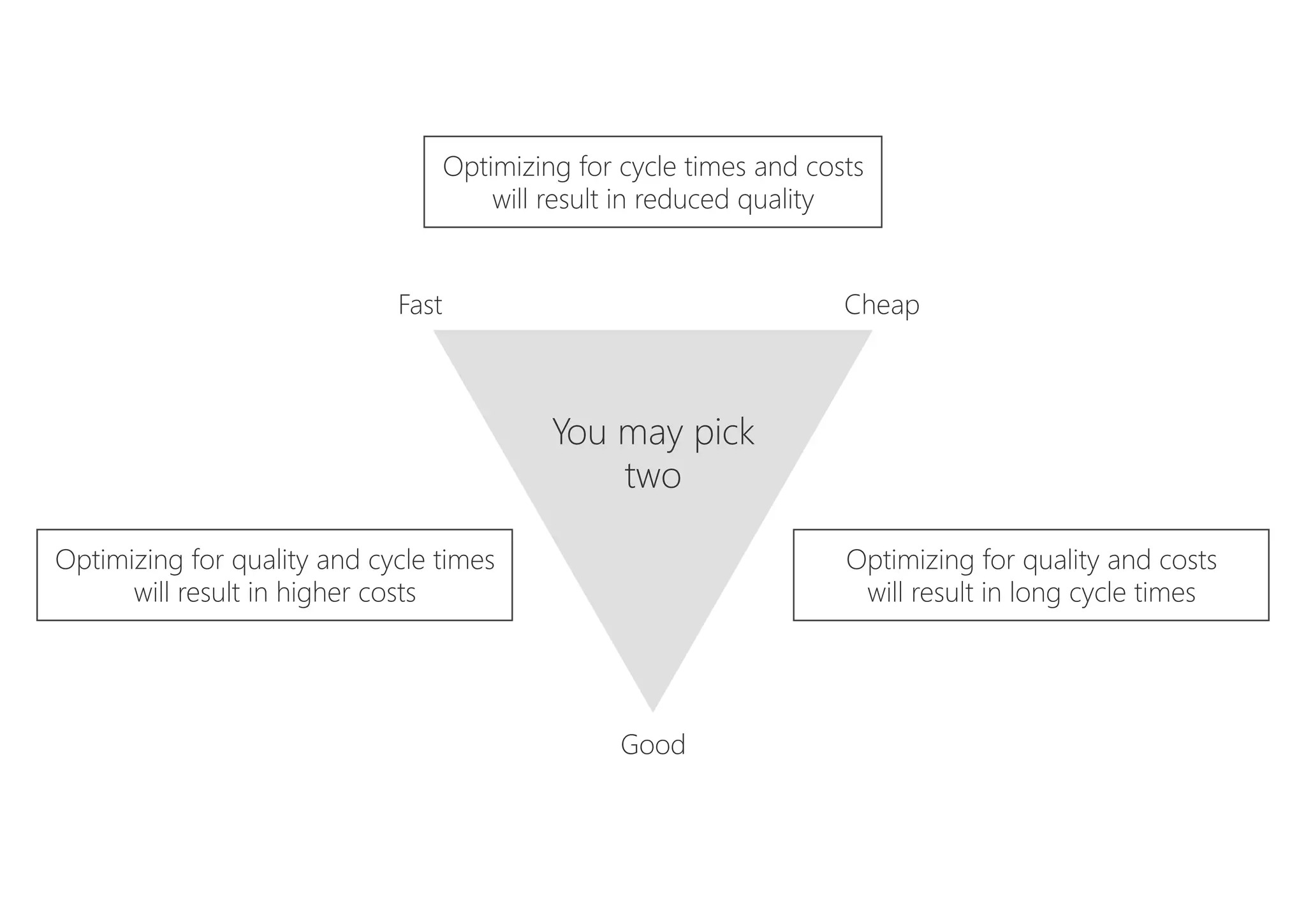
You may pick
two
Good
Fast
 Cheap
Optimizing for quality and cycle times
will result in higher costs
Optimizing for quality and costs

will result in long cycle times
Optimizing for cycle times and costs
will result in reduced quality
... and ask for the two properties to pick
You may pick
two
Good
Fast
 Cheap
Industrial IT

Deliver large batches at minimized costs

towards slow markets
Post-industrial IT

Quickly adapt to ever-changing needs
of dynamic, fast-moving markets
Startup IT

Test hypotheses and pivot as fast as possible
to discover a product-market fit
#3

Pick the appropriate weapons
#4

Discuss change based on pain, not tools
#5

Be prepared
Be prepared

•  Learn the tools and technologies

of the post-industrial IT

•  Keep your current skills and tools sharp

•  Understand which knowledge will become

less valuable (or even contra-productive)

•  Be curious and understand the concepts
outside your domain (become T-shaped)

•  Improve your empathic skills!
add. #1

Visit the Java Forum Nord … ;)
add. #2

Stick to the hitchhiker‘s guide …
Life, IT and everything

Life, IT and everything

  • 1.
    Life, IT andeverything about revolutions, outside-the-box journeys and the daily IT madness Uwe Friedrichsen – codecentric AG – 2014-2016
  • 2.
    @ufried Uwe Friedrichsen |uwe.friedrichsen@codecentric.de | http://slideshare.net/ufried | http://ufried.tumblr.com
  • 3.
    Be flexible … butstick to the plan!
  • 4.
    Be innovative … butdon’t break anything!
  • 5.
    Be agile … butadhere to all processes!
  • 6.
    Be disruptive … butdon’t change anything!
  • 7.
    Be the newNetflix … but don’t spend any money!
  • 8.
  • 9.
    Have they allgone nuts?
  • 10.
    Or is therea bigger schema, we just don’t recognize? Meaning Madness
  • 11.
    Time for ashort journey
 through space and time ...
  • 12.
  • 13.
    Formal part of valuecreation Solution: machine Dynamic part of value creation Solution: man sluggishness/low dynamic high dynamichigh dynamic The historical course of market dynamics and the recent rise of highly dynamic and complex markets The dominance of high dynamics and complexity is neither good nor bad. It‘s a historical fact. t1970/80 today Age of crafts manu- facturing Age of tayloristic industry Age of global markets 1850/1900 Spacious markets, little competition Local markets, high customi- zation Outperformers exercise market pressure over conventional companies We call the graph shown here the “Taylor Bathtub”. The “bathtub” curve Source: BetaCodex Network Associates, “Organize for complexity”, BetaCodex Network White Paper 12 & 13
  • 14.
    Formal part of valuecreation Solution: machine Dynamic part of value creation Solution: man sluggishness/low dynamic high dynamichigh dynamic The historical course of market dynamics and the recent rise of highly dynamic and complex markets The dominance of high dynamics and complexity is neither good nor bad. It‘s a historical fact. t1970/80 today Age of crafts manu- facturing Age of tayloristic industry Age of global markets 1850/1900 Spacious markets, little competition Local markets, high customi- zation Outperformers exercise market pressure over conventional companies We call the graph shown here the “Taylor Bathtub”. Pre-industrial era Source: BetaCodex Network Associates, “Organize for complexity”, BetaCodex Network White Paper 12 & 13 Tailor-made solutions “Mastery is key to success”
  • 15.
    Formal part of valuecreation Solution: machine Dynamic part of value creation Solution: man sluggishness/low dynamic high dynamichigh dynamic The historical course of market dynamics and the recent rise of highly dynamic and complex markets The dominance of high dynamics and complexity is neither good nor bad. It‘s a historical fact. t1970/80 today Age of crafts manu- facturing Age of tayloristic industry Age of global markets 1850/1900 Spacious markets, little competition Local markets, high customi- zation Outperformers exercise market pressure over conventional companies We call the graph shown here the “Taylor Bathtub”. Industrial era Source: BetaCodex Network Associates, “Organize for complexity”, BetaCodex Network White Paper 12 & 13 Cost-efficiently scale production “Get more done with less people is key to success”
  • 16.
    Formal part of valuecreation Solution: machine Dynamic part of value creation Solution: man sluggishness/low dynamic high dynamichigh dynamic The historical course of market dynamics and the recent rise of highly dynamic and complex markets The dominance of high dynamics and complexity is neither good nor bad. It‘s a historical fact. t1970/80 today Age of crafts manu- facturing Age of tayloristic industry Age of global markets 1850/1900 Spacious markets, little competition Local markets, high customi- zation Outperformers exercise market pressure over conventional companies We call the graph shown here the “Taylor Bathtub”. Post-industrial era Source: BetaCodex Network Associates, “Organize for complexity”, BetaCodex Network White Paper 12 & 13 Continuously respond to changing demands “Continuous customer communication is key to success”
  • 17.
    Industrial era •  Cost-efficiency • Scalability •  Repeatability •  Stability Changing markets create new drivers Post-industrial era •  Cycle times •  Adaptability •  Flexibility •  Resilience
  • 18.
    Side note Organizations asenablers and preventers
  • 19.
  • 20.
    1960 1970 1980 1990 2000 2010 2020 Complicated (Business functions) Complex (Business processes) Highly complex (Business nervous system) Software crisis Software engineering PC LAN Internet Business Support of IT Selective Holistic Complicated Complex “Moore’s law” Mobile IoT
  • 21.
    1960 1970 1980 1990 2000 2010 2020 Complicated (Business functions) Complex (business processes) Highly complex (Business nervous system) Software crisis Software engineering PC LAN Internet Business Support of IT Selective Holistic Complicated Complex “Moore’s law” Mobile IoT We are here …
  • 22.
    1960 1970 1980 1990 2000 2010 2020 Complicated (Business functions) Complex (business processes) Highly complex (Business nervous system) Software crisis Software engineering PC LAN Internet Business Support of IT Selective Holistic Complicated Complex “Moore’s law” Mobile IoT … but we still base most of our decisions on that We are here …
  • 23.
    Formal part of valuecreation Solution: machine Dynamic part of value creation Solution: man sluggishness/low dynamic high dynamichigh dynamic The historical course of market dynamics and the recent rise of highly dynamic and complex markets The dominance of high dynamics and complexity is neither good nor bad. It‘s a historical fact. t1970/80 today Age of crafts manu- facturing Age of tayloristic industry Age of global markets 1850/1900 Spacious markets, little competition Local markets, high customi- zation Outperformers exercise market pressure over conventional companies We call the graph shown here the “Taylor Bathtub”. Remember the bathtub curve? This adds an additional twist …
  • 24.
    1960 1970 1980 1990 2000 2010 2020 Complicated (Business functions) Complex (business processes) Highly complex (Business nervous system) Software crisis Software engineering PC LAN Internet Business Support of IT Selective Holistic Complicated Complex “Moore’s law” Mobile IoT … but we still base most of our decisions on that We are here … Business is very different today … … than it was back then
  • 25.
    Business Market IT today isa … … Nervous System … Medium … Product … Differentiator Disruptive Technologies Business Support Systems Continuous Conversation Digitization
  • 26.
    Business is ITand IT is business
  • 27.
    The traditional IT“best practices” are counterproductive because they solve
 a completely different problem
  • 28.
  • 29.
    We are inthe middle of a revolution
  • 30.
    Unfortunately, quite often
 wedo not feel like them …
  • 31.
    ... but morelike them
  • 32.
    How can weavoid becoming revolution roadkill?
  • 33.
  • 34.
  • 35.
  • 36.
    What are thenew drivers?
  • 37.
    IT Post-Industrialism Highly dynamic markets EconomicDarwinism Lean startup/lean enterprise Continuous design Digitization IT as a product Digital conversation Social media Contextual computing Disruption Innovation through disruption Cloud, mobile, IoT, serverless Big data analytics Data-driven enterprise force change on
  • 38.
    What are thenew goals?
  • 39.
    IT … be quick Shortresponse times Holistic IT value chain consideration … be effective Focus on outcome, not output … improve continuously Improvement as planned activity needs to … … be efficient Provide required throughput … be reliable High availability and reliability … be flexible Flexible response to changing needs
  • 40.
    Process & Org needsto be … Quick Flexible Effective Software needs to be … Secure Changeable Robust … and improve continuously
  • 41.
    Process & Org needsto be … Software needs to be … Quick Flexible Effective Secure Changeable Robust … and improve continuously How can we achieve the new goals?
  • 42.
    Let’s learn fromthe digitization natives
  • 43.
    Adaption DevOps Systemic optimization Inspect andadapt Quick feedback loops Continuous improvement … Process DevOps Agile Lean Feature Flow (no projects) Design Thinking … Governance Beyond Budgeting Decentralized control Outcome-driven Lean EAM … Organization DevOps Autonomous teams Cross-functional teams End-2-end responsibility Routine task automation … People Craftsmanship T-shaped Responsibility Curiosity Empathy … Technology Cloud Automation Microservice Heterogeneity Resilience … (Some) Building Blocks
  • 44.
    These building blocksdon’t sum up,
 they multiply up
  • 45.
    Cross-functional teams (organized bybusiness capabilities) Autonomy (incl. E2E responsibility) Decentralized control Microservices Continuous Delivery Heterogeneity Cloud and Containers Resilience Operations automation Craftsmanship & mastery Outcome-driven Beyond budgeting Feature flow Lean EAM Continuous improvement T-Shaped people (being empathic) DevOps Quick feedback loops Curiosity
  • 46.
    #2 Know your placein the revolution
  • 47.
    Take the realmagic triangle …
  • 48.
    You may pick two Good Fast Cheap Optimizing for quality and cycle times will result in higher costs Optimizing for quality and costs
 will result in long cycle times Optimizing for cycle times and costs will result in reduced quality
  • 49.
    ... and askfor the two properties to pick
  • 50.
    You may pick two Good Fast Cheap Industrial IT Deliver large batches at minimized costs
 towards slow markets Post-industrial IT Quickly adapt to ever-changing needs of dynamic, fast-moving markets Startup IT Test hypotheses and pivot as fast as possible to discover a product-market fit
  • 51.
  • 52.
    #4 Discuss change basedon pain, not tools
  • 53.
  • 54.
    Be prepared •  Learnthe tools and technologies
 of the post-industrial IT •  Keep your current skills and tools sharp •  Understand which knowledge will become
 less valuable (or even contra-productive) •  Be curious and understand the concepts outside your domain (become T-shaped) •  Improve your empathic skills!
  • 55.
    add. #1 Visit theJava Forum Nord … ;)
  • 56.
    add. #2 Stick tothe hitchhiker‘s guide …