































Digital Technologies and the Future of Work
#BEM2034 (Streatham)
#BEP2120 (Penryn)
Professor Mark Thompson
Cambridge Judge Business School
…With thanks to Simon Wardley 
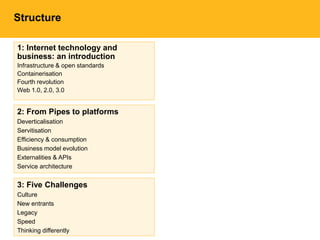
Structure
1: Internet technology and
business: an introduction
Infrastructure & open standards
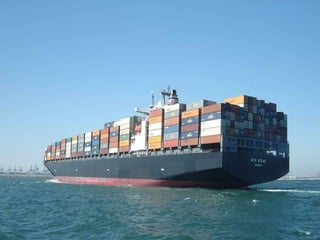
Containerisation
Fourth revolution
Web 1.0, 2.0, 3.0
2: From Pipes to platforms
Deverticalisation
Servitisation
Efficiency & consumption
Business model evolution
Externalities & APIs
Service architecture
3: Five Challenges
Culture
New entrants
Legacy
Speed
Thinking differently
Part 1: Internet technology & business:
An introduction
The internet
(stupid)
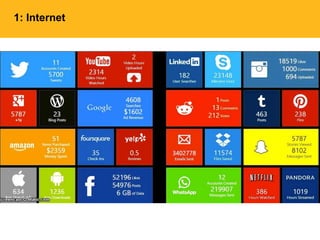
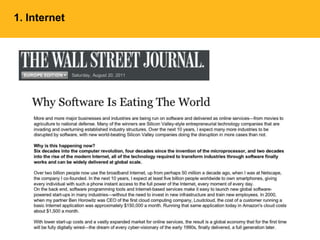
1: Internet
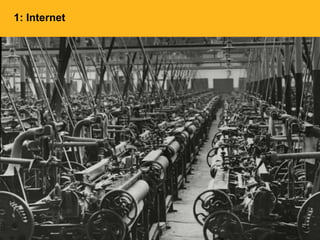
1: Internet
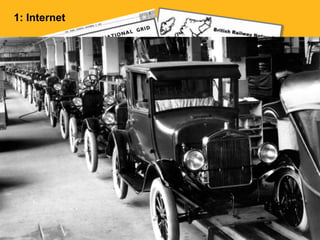
1: Internet
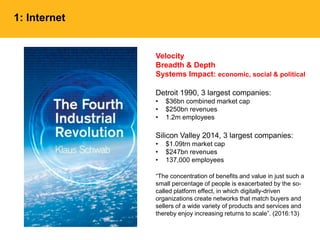
Velocity
Breadth & Depth
Systems Impact: economic, social & political
Detroit 1990, 3 largest companies:
• $36bn combined market cap
• $250bn revenues
• 1.2m employees
Silicon Valley 2014, 3 largest companies:
• $1.09trn market cap
• $247bn revenues
• 137,000 employees
“The concentration of benefits and value in just such a
small percentage of people is exacerbated by the so-
called platform effect, in which digitally-driven
organizations create networks that match buyers and
sellers of a wide variety of products and services and
thereby enjoy increasing returns to scale”. (2016:13)
1: Internet
1: Internet
1: Internet
1: Internet
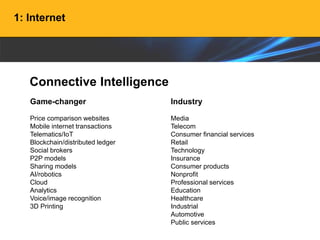
Game-changer
Price comparison websites
Mobile internet transactions
Telematics/IoT
Blockchain/distributed ledger
Social brokers
P2P models
Sharing models
AI/robotics
Cloud
Analytics
Voice/image recognition
3D Printing
Industry
Media
Telecom
Consumer financial services
Retail
Technology
Insurance
Consumer products
Nonprofit
Professional services
Education
Healthcare
Industrial
Automotive
Public services
Connective Intelligence
1: Internet
Game-changer
Price comparison websites
Mobile internet transactions
Telematics/IoT
Blockchain/distributed ledger
Social brokers
P2P models
Sharing models
AI/robotics
Cloud
Analytics
Voice/image recognition
3D Printing
Industry
Media
Telecom
Consumer financial services
Retail
Technology
Insurance
Consumer products
Nonprofit
Professional services
Education
Healthcare
Industrial
Automotive
Public services
Connective Intelligence
Moore’s Law is a
law of demand as
well as supply
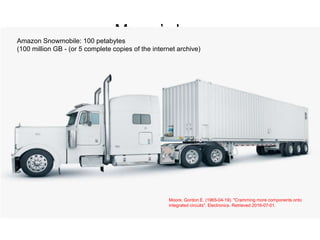
Moore’s LawAmazon Snowmobile: 100 petabytes
(100 million GB - (or 5 complete copies of the internet archive)
Moore, Gordon E. (1965-04-19). "Cramming more components onto
integrated circuits". Electronics. Retrieved 2016-07-01.
1: Internet
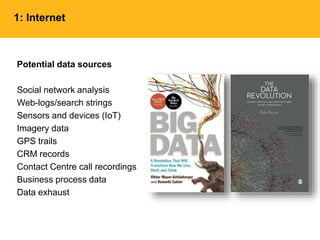
Potential data sources
Social network analysis
Web-logs/search strings
Sensors and devices (IoT)
Imagery data
GPS trails
CRM records
Contact Centre call recordings
Business process data
Data exhaust
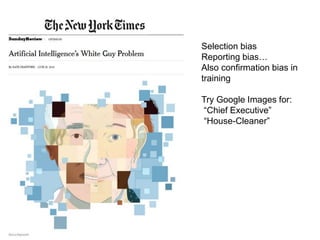
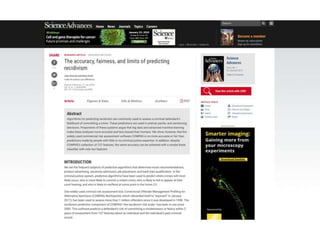
Selection bias
Reporting bias…
Also confirmation bias in
training
Try Google Images for:
“Chief Executive”
“House-Cleaner”
1: Internet
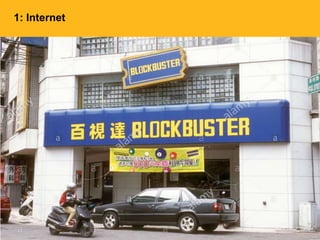
Web 1.0
(static infrastructure)
1: Internet
Web
Internet
1: Internet
Web 2.0
(User-generated content)
1: Internet
1: Internet
1: Internet
1: Internet
1: Internet
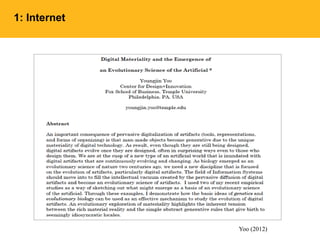
Yoo (2012)
Internet
1: Internet
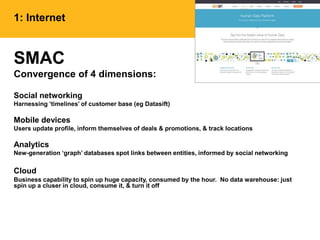
SMAC
Convergence of 4 dimensions:
Social networking
Harnessing ‘timelines’ of customer base (eg Datasift)
Mobile devices
Users update profile, inform themselves of deals & promotions, & track locations
Analytics
New-generation ‘graph’ databases spot links between entities, informed by social networking
Cloud
Business capability to spin up huge capacity, consumed by the hour. No data warehouse: just
spin up a cluser in cloud, consume it, & turn it off
1. Internet
1: Internet: Key points
New ‘shared plumbing’ of infrastructure disrupts
Arrival of shared infrastructure privileges adoption of standards &
containerisation
Mobile ubiquity
Web 2.0: Shift to the user
SMAC
Take a fresh sheet of A4, fold into 8 squares
You will generate ideas rapidly – 1 idea per square
1 minute per square
Think of 8 goods or services have you bought or
consumed recently, where the internet must have
been essential. 1 per square.
Write down:
• The name of the good/service
• The way this was provided before (who has
been disrupted?)
Part 2: Pipes to Platforms
2: Pipes to platforms
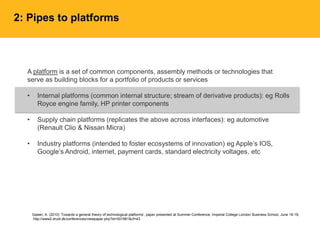
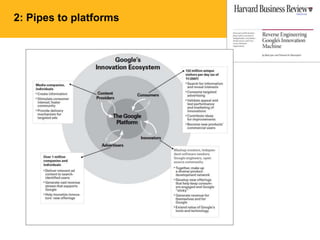
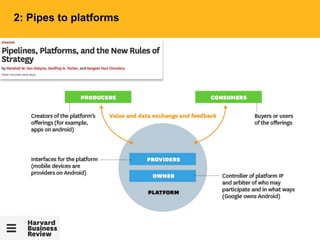
A platform is a set of common components, assembly methods or technologies that
serve as building blocks for a portfolio of products or services
• Internal platforms (common internal structure; stream of derivative products): eg Rolls
Royce engine family, HP printer components
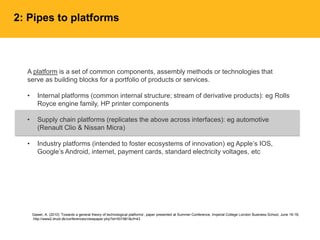
• Supply chain platforms (replicates the above across interfaces): eg automotive
(Renault Clio & Nissan Micra)
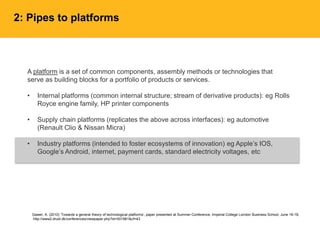
• Industry platforms (intended to foster ecosystems of innovation) eg Apple’s IOS,
Google’s Android, internet, payment cards, standard electricity voltages, etc
Gawer, A. (2010) ‘Towards a general theory of technological platforms’, paper presented at Summer Conference, Imperial College London Business School, June 16-18,
http://www2.druid.dk/conferences/viewpaper.php?id=501981&cf=43
2: Pipes to platforms
A platform is a set of common components, assembly methods or technologies that
serve as building blocks for a portfolio of products or services.
• Internal platforms (common internal structure; stream of derivative products): eg Rolls
Royce engine family, HP printer components
• Supply chain platforms (replicates the above across interfaces): eg automotive
(Renault Clio & Nissan Micra)
• Industry platforms (intended to foster ecosystems of innovation) eg Apple’s IOS,
Google’s Android, internet, payment cards, standard electricity voltages, etc
Gawer, A. (2010) ‘Towards a general theory of technological platforms’, paper presented at Summer Conference, Imperial College London Business School, June 16-18,
http://www2.druid.dk/conferences/viewpaper.php?id=501981&cf=43
2: Pipes to platforms
A platform is a set of common components, assembly methods or technologies that
serve as building blocks for a portfolio of products or services.
• Internal platforms (common internal structure; stream of derivative products): eg Rolls
Royce engine family, HP printer components
• Supply chain platforms (replicates the above across interfaces): eg automotive
(Renault Clio & Nissan Micra)
• Industry platforms (intended to foster ecosystems of innovation) eg Apple’s IOS,
Google’s Android, internet, payment cards, standard electricity voltages, etc
Gawer, A. (2010) ‘Towards a general theory of technological platforms’, paper presented at Summer Conference, Imperial College London Business School, June 16-18,
http://www2.druid.dk/conferences/viewpaper.php?id=501981&cf=43
2: Pipes to platforms
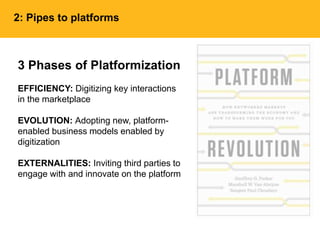
3 Phases of Platformization
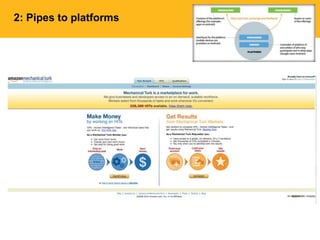
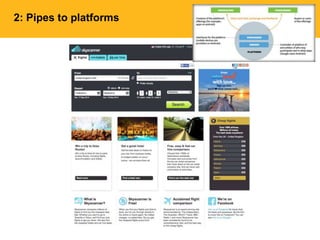
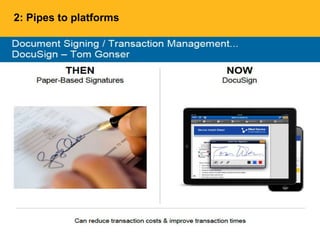
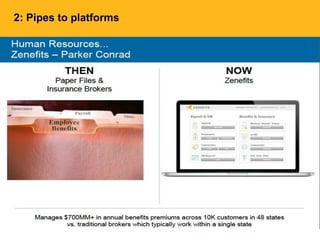
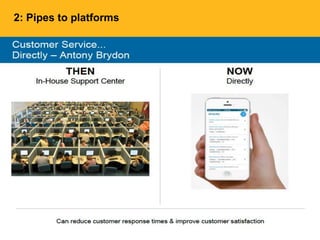
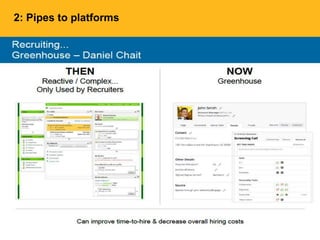
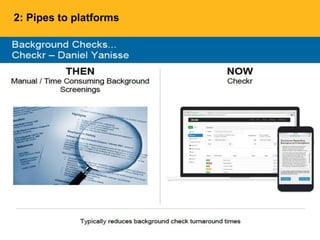
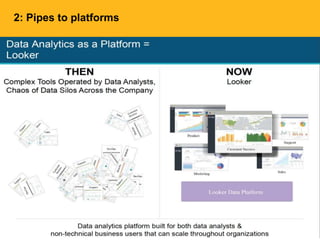
EFFICIENCY: Digitizing key interactions
in the marketplace
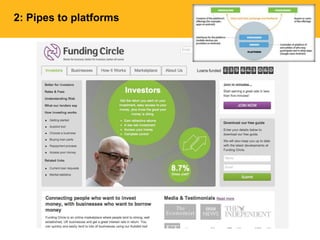
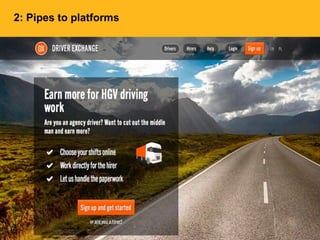
EVOLUTION: Adopting new, platform-
enabled business models enabled by
digitization
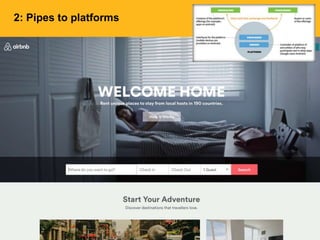
EXTERNALITIES: Inviting third parties to
engage with and innovate on the platform
2: Pipes to platforms
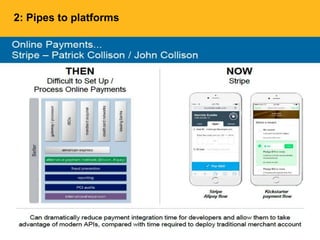
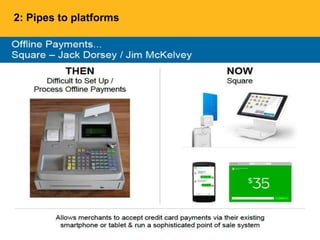
EFFICIENCY
2: Pipes to platforms
EVOLUTION
2: Pipes to platforms
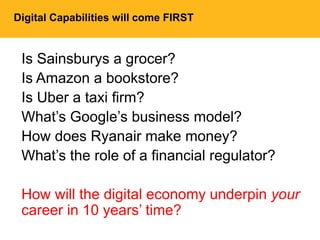
Digital Capabilities will come FIRST
Is Sainsburys a grocer?
Is Amazon a bookstore?
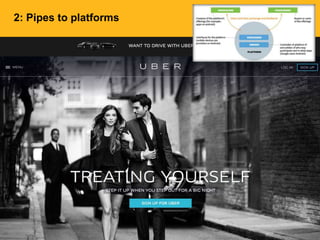
Is Uber a taxi firm?
What’s Google’s business model?
How does Ryanair make money?
What’s the role of a financial regulator?
How will the digital economy underpin your
career in 10 years’ time?
EXTERNALITIES
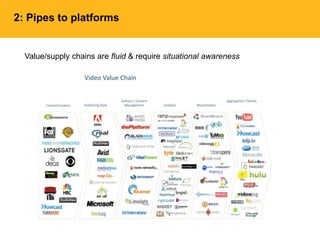
Value/supply chains are fluid & require situational awareness
2: Pipes to platforms
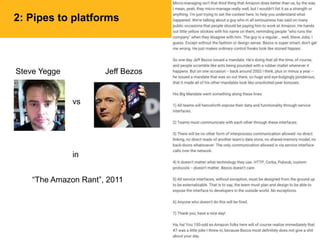
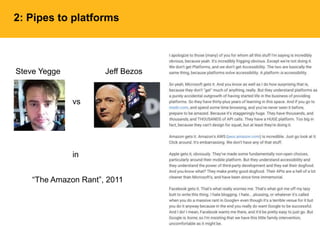
Steve Yegge Jeff Bezos
vs
in
“The Amazon Rant”, 2011
2: Pipes to platforms
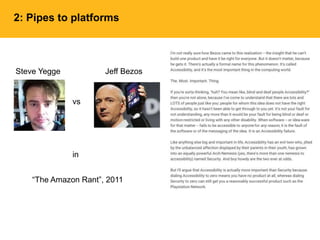
Steve Yegge Jeff Bezos
vs
in
“The Amazon Rant”, 2011
2: Pipes to platforms
Steve Yegge Jeff Bezos
vs
in
“The Amazon Rant”, 2011
2: Pipes to platforms
What can we all learn from
THIS MAN?
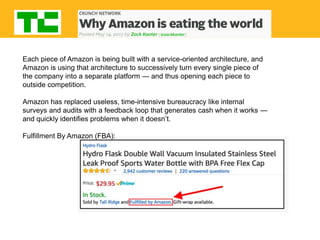
Each piece of Amazon is being built with a service-oriented architecture, and
Amazon is using that architecture to successively turn every single piece of
the company into a separate platform — and thus opening each piece to
outside competition.
Amazon has replaced useless, time-intensive bureaucracy like internal
surveys and audits with a feedback loop that generates cash when it works —
and quickly identifies problems when it doesn’t.
Fulfillment By Amazon (FBA):
2: Pipes to platforms
2. Pipes to platforms: Key points
We can conclude that:
• New organizing logic underpinning digital business
• Unbundling service processes & tech stacks via modularisation
• Organisations/industries are becoming necessarily modular and
subject to the inertia of their service components
• They are dynamic, entwined and increasingly constructed from
modular service platforms
The
Challenges:
#1: Culture
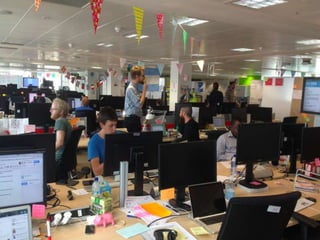
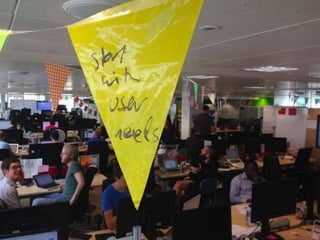
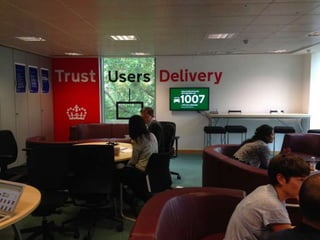
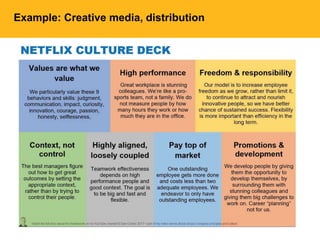
Example: Creative media, distribution
The
Challenges:
#2: New entrants
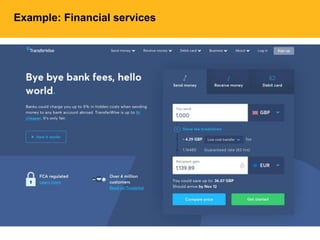
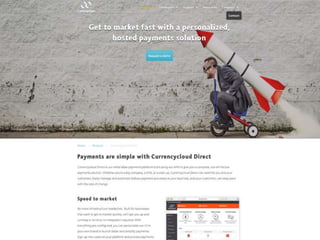
Example: Financial services
The
Challenges:
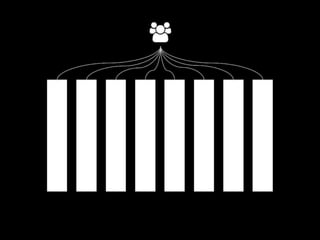
#3: Legacy
Example: Government
The
Challenges:
#4: Speed
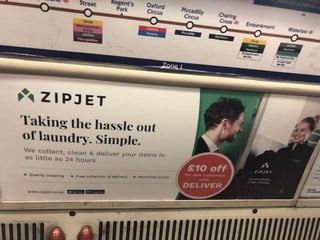
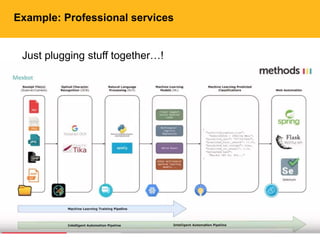
Example: Professional services
Just plugging stuff together…!
The
Challenges:
#5:
Thinking differently
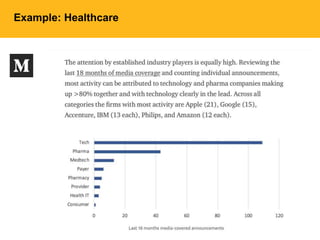
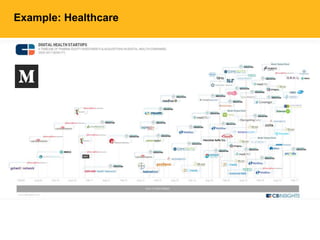
Example: Healthcare
Example: Healthcare
The
Challenge
for
YOU
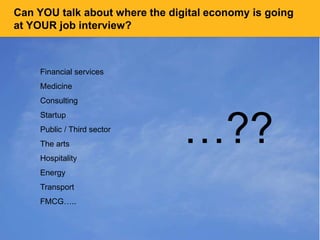
Can YOU talk about where the digital economy is going
at YOUR job interview?
Financial services
Medicine
Consulting
Startup
Public / Third sector
The arts
Hospitality
Energy
Transport
FMCG…..
…??
Remember…it’s all about…
the
INTERNET!

Bem2034

  • 1.
    Digital Technologies andthe Future of Work #BEM2034 (Streatham) #BEP2120 (Penryn) Professor Mark Thompson
  • 7.
  • 8.
  • 11.
    …With thanks toSimon Wardley 
  • 12.
    …With thanks toSimon Wardley 
  • 13.
    …With thanks toSimon Wardley 
  • 14.
    …With thanks toSimon Wardley 
  • 15.
    …With thanks toSimon Wardley 
  • 17.
    Structure 1: Internet technologyand business: an introduction Infrastructure & open standards Containerisation Fourth revolution Web 1.0, 2.0, 3.0 2: From Pipes to platforms Deverticalisation Servitisation Efficiency & consumption Business model evolution Externalities & APIs Service architecture 3: Five Challenges Culture New entrants Legacy Speed Thinking differently
  • 19.
    Part 1: Internettechnology & business: An introduction
  • 20.
  • 21.
  • 22.
    1: Internet Velocity Breadth &Depth Systems Impact: economic, social & political Detroit 1990, 3 largest companies: • $36bn combined market cap • $250bn revenues • 1.2m employees Silicon Valley 2014, 3 largest companies: • $1.09trn market cap • $247bn revenues • 137,000 employees “The concentration of benefits and value in just such a small percentage of people is exacerbated by the so- called platform effect, in which digitally-driven organizations create networks that match buyers and sellers of a wide variety of products and services and thereby enjoy increasing returns to scale”. (2016:13)
  • 23.
  • 24.
  • 25.
  • 26.
    1: Internet Game-changer Price comparisonwebsites Mobile internet transactions Telematics/IoT Blockchain/distributed ledger Social brokers P2P models Sharing models AI/robotics Cloud Analytics Voice/image recognition 3D Printing Industry Media Telecom Consumer financial services Retail Technology Insurance Consumer products Nonprofit Professional services Education Healthcare Industrial Automotive Public services Connective Intelligence
  • 27.
    1: Internet Game-changer Price comparisonwebsites Mobile internet transactions Telematics/IoT Blockchain/distributed ledger Social brokers P2P models Sharing models AI/robotics Cloud Analytics Voice/image recognition 3D Printing Industry Media Telecom Consumer financial services Retail Technology Insurance Consumer products Nonprofit Professional services Education Healthcare Industrial Automotive Public services Connective Intelligence
  • 29.
    Moore’s Law isa law of demand as well as supply
  • 30.
    Moore’s LawAmazon Snowmobile:100 petabytes (100 million GB - (or 5 complete copies of the internet archive) Moore, Gordon E. (1965-04-19). "Cramming more components onto integrated circuits". Electronics. Retrieved 2016-07-01.
  • 31.
    1: Internet Potential datasources Social network analysis Web-logs/search strings Sensors and devices (IoT) Imagery data GPS trails CRM records Contact Centre call recordings Business process data Data exhaust
  • 33.
    Selection bias Reporting bias… Alsoconfirmation bias in training Try Google Images for: “Chief Executive” “House-Cleaner”
  • 39.
  • 40.
  • 41.
  • 42.
  • 47.
  • 49.
  • 50.
  • 51.
  • 52.
  • 53.
  • 54.
    1: Internet SMAC Convergence of4 dimensions: Social networking Harnessing ‘timelines’ of customer base (eg Datasift) Mobile devices Users update profile, inform themselves of deals & promotions, & track locations Analytics New-generation ‘graph’ databases spot links between entities, informed by social networking Cloud Business capability to spin up huge capacity, consumed by the hour. No data warehouse: just spin up a cluser in cloud, consume it, & turn it off
  • 55.
  • 56.
    1: Internet: Keypoints New ‘shared plumbing’ of infrastructure disrupts Arrival of shared infrastructure privileges adoption of standards & containerisation Mobile ubiquity Web 2.0: Shift to the user SMAC
  • 60.
    Take a freshsheet of A4, fold into 8 squares You will generate ideas rapidly – 1 idea per square 1 minute per square
  • 61.
    Think of 8goods or services have you bought or consumed recently, where the internet must have been essential. 1 per square. Write down: • The name of the good/service • The way this was provided before (who has been disrupted?)
  • 62.
    Part 2: Pipesto Platforms
  • 63.
    2: Pipes toplatforms
  • 64.
    2: Pipes toplatforms
  • 65.
    A platform isa set of common components, assembly methods or technologies that serve as building blocks for a portfolio of products or services • Internal platforms (common internal structure; stream of derivative products): eg Rolls Royce engine family, HP printer components • Supply chain platforms (replicates the above across interfaces): eg automotive (Renault Clio & Nissan Micra) • Industry platforms (intended to foster ecosystems of innovation) eg Apple’s IOS, Google’s Android, internet, payment cards, standard electricity voltages, etc Gawer, A. (2010) ‘Towards a general theory of technological platforms’, paper presented at Summer Conference, Imperial College London Business School, June 16-18, http://www2.druid.dk/conferences/viewpaper.php?id=501981&cf=43 2: Pipes to platforms
  • 66.
    A platform isa set of common components, assembly methods or technologies that serve as building blocks for a portfolio of products or services. • Internal platforms (common internal structure; stream of derivative products): eg Rolls Royce engine family, HP printer components • Supply chain platforms (replicates the above across interfaces): eg automotive (Renault Clio & Nissan Micra) • Industry platforms (intended to foster ecosystems of innovation) eg Apple’s IOS, Google’s Android, internet, payment cards, standard electricity voltages, etc Gawer, A. (2010) ‘Towards a general theory of technological platforms’, paper presented at Summer Conference, Imperial College London Business School, June 16-18, http://www2.druid.dk/conferences/viewpaper.php?id=501981&cf=43 2: Pipes to platforms
  • 67.
    A platform isa set of common components, assembly methods or technologies that serve as building blocks for a portfolio of products or services. • Internal platforms (common internal structure; stream of derivative products): eg Rolls Royce engine family, HP printer components • Supply chain platforms (replicates the above across interfaces): eg automotive (Renault Clio & Nissan Micra) • Industry platforms (intended to foster ecosystems of innovation) eg Apple’s IOS, Google’s Android, internet, payment cards, standard electricity voltages, etc Gawer, A. (2010) ‘Towards a general theory of technological platforms’, paper presented at Summer Conference, Imperial College London Business School, June 16-18, http://www2.druid.dk/conferences/viewpaper.php?id=501981&cf=43 2: Pipes to platforms
  • 68.
    2: Pipes toplatforms
  • 69.
    2: Pipes toplatforms
  • 70.
    2: Pipes toplatforms
  • 71.
    2: Pipes toplatforms
  • 72.
    2: Pipes toplatforms
  • 73.
    2: Pipes toplatforms
  • 74.
    2: Pipes toplatforms
  • 75.
    2: Pipes toplatforms
  • 76.
    2: Pipes toplatforms
  • 77.
    3 Phases ofPlatformization EFFICIENCY: Digitizing key interactions in the marketplace EVOLUTION: Adopting new, platform- enabled business models enabled by digitization EXTERNALITIES: Inviting third parties to engage with and innovate on the platform 2: Pipes to platforms
  • 78.
  • 79.
    2: Pipes toplatforms
  • 80.
    2: Pipes toplatforms
  • 81.
    2: Pipes toplatforms
  • 82.
    2: Pipes toplatforms
  • 83.
    2: Pipes toplatforms
  • 84.
    2: Pipes toplatforms
  • 85.
    2: Pipes toplatforms
  • 86.
    2: Pipes toplatforms
  • 87.
  • 88.
    2: Pipes toplatforms
  • 89.
    Digital Capabilities willcome FIRST Is Sainsburys a grocer? Is Amazon a bookstore? Is Uber a taxi firm? What’s Google’s business model? How does Ryanair make money? What’s the role of a financial regulator? How will the digital economy underpin your career in 10 years’ time?
  • 90.
  • 91.
    Value/supply chains arefluid & require situational awareness 2: Pipes to platforms
  • 92.
    Steve Yegge JeffBezos vs in “The Amazon Rant”, 2011 2: Pipes to platforms
  • 93.
    Steve Yegge JeffBezos vs in “The Amazon Rant”, 2011 2: Pipes to platforms
  • 94.
    Steve Yegge JeffBezos vs in “The Amazon Rant”, 2011 2: Pipes to platforms
  • 95.
    What can weall learn from THIS MAN?
  • 96.
    Each piece ofAmazon is being built with a service-oriented architecture, and Amazon is using that architecture to successively turn every single piece of the company into a separate platform — and thus opening each piece to outside competition. Amazon has replaced useless, time-intensive bureaucracy like internal surveys and audits with a feedback loop that generates cash when it works — and quickly identifies problems when it doesn’t. Fulfillment By Amazon (FBA):
  • 100.
    2: Pipes toplatforms
  • 102.
    2. Pipes toplatforms: Key points We can conclude that: • New organizing logic underpinning digital business • Unbundling service processes & tech stacks via modularisation • Organisations/industries are becoming necessarily modular and subject to the inertia of their service components • They are dynamic, entwined and increasingly constructed from modular service platforms
  • 103.
  • 108.
  • 109.
  • 111.
  • 114.
  • 115.
  • 118.
  • 126.
    Example: Professional services Justplugging stuff together…!
  • 128.
  • 130.
  • 131.
  • 132.
  • 133.
    Can YOU talkabout where the digital economy is going at YOUR job interview? Financial services Medicine Consulting Startup Public / Third sector The arts Hospitality Energy Transport FMCG….. …??
  • 134.