Resilience reloaded
More resilience patterns
Uwe Friedrichsen, codecentric AG, 2015-2016
@ufried
Uwe Friedrichsen | uwe.friedrichsen@codecentric.de | http://slideshare.net/ufried | http://ufried.tumblr.com
Previously on “Resilience” …
Why resilience?
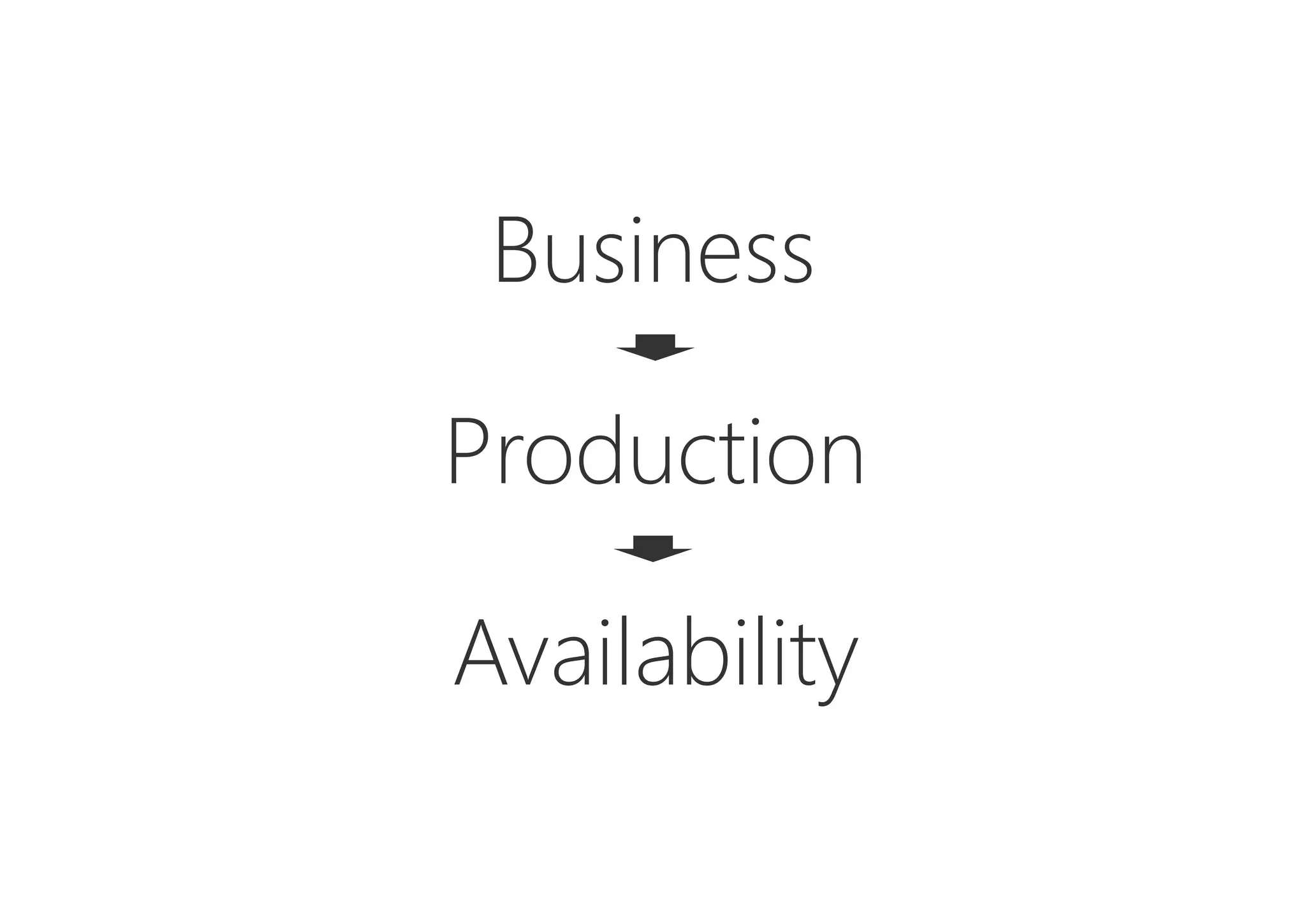
It‘s all about production!
Business
Production
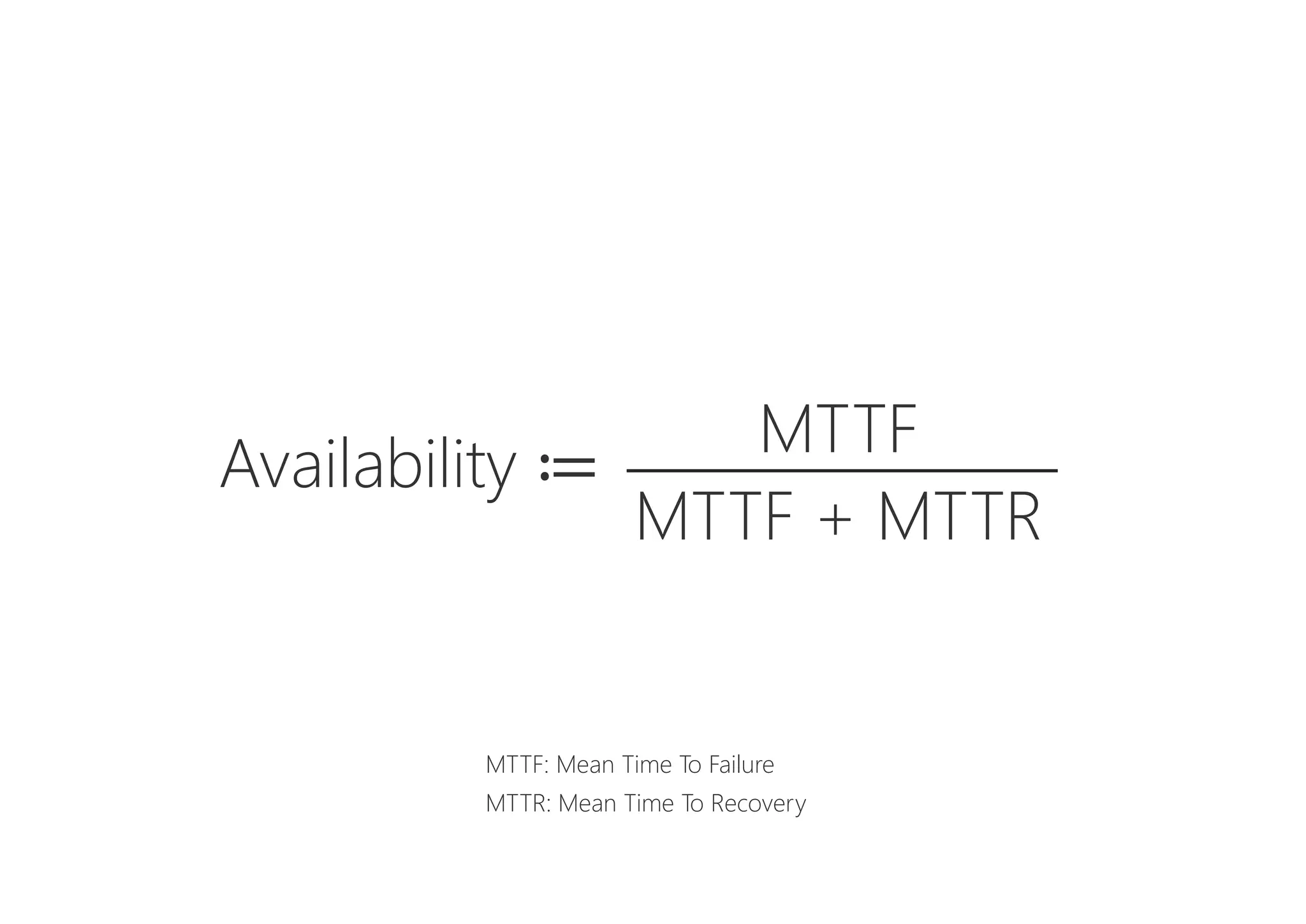
Availability
Availability ≔
MTTF
MTTF + MTTR
MTTF: Mean Time To Failure
MTTR: Mean Time To Recovery
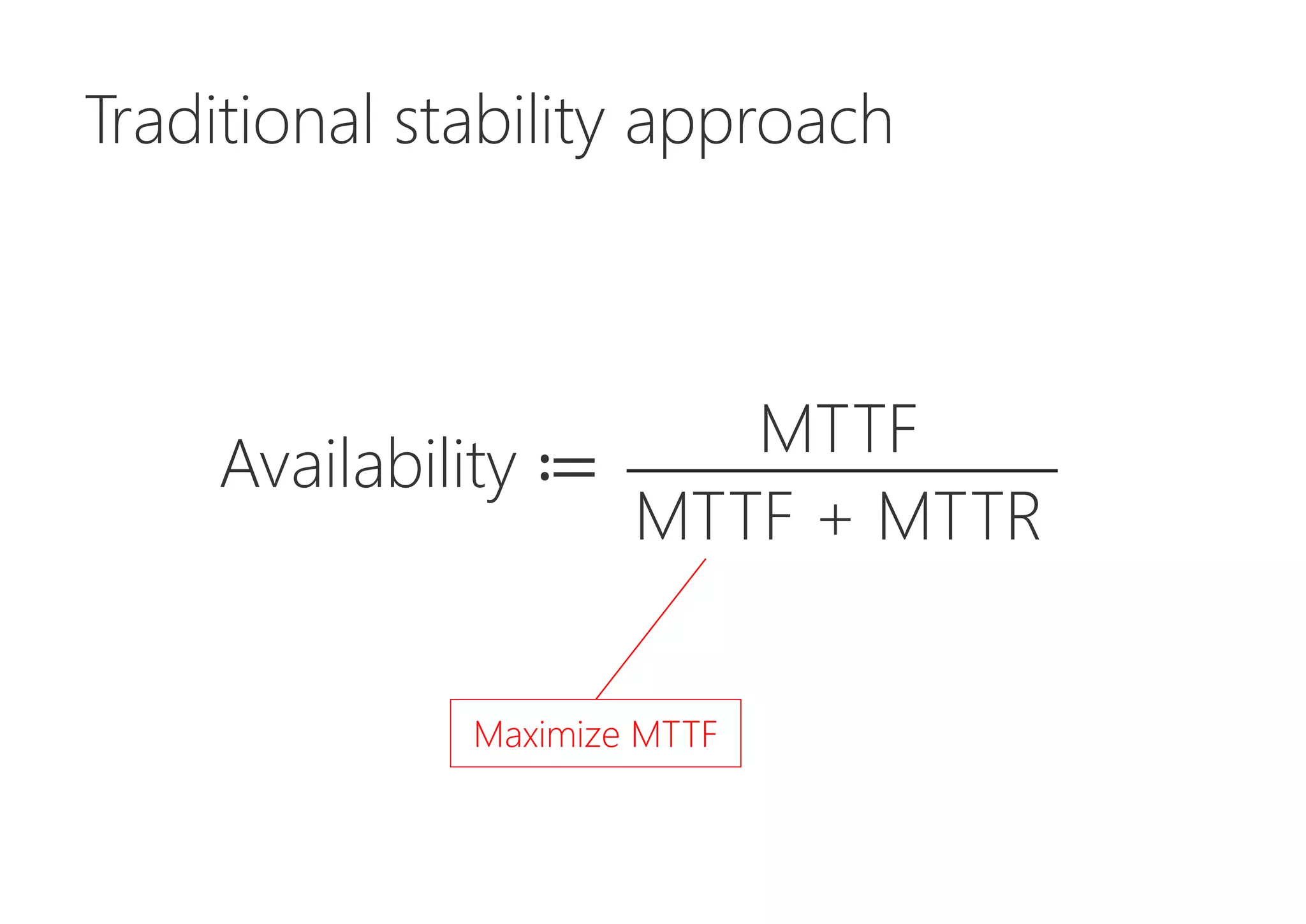
Traditional stability approach
Availability ≔
MTTF
MTTF + MTTR
Maximize MTTF
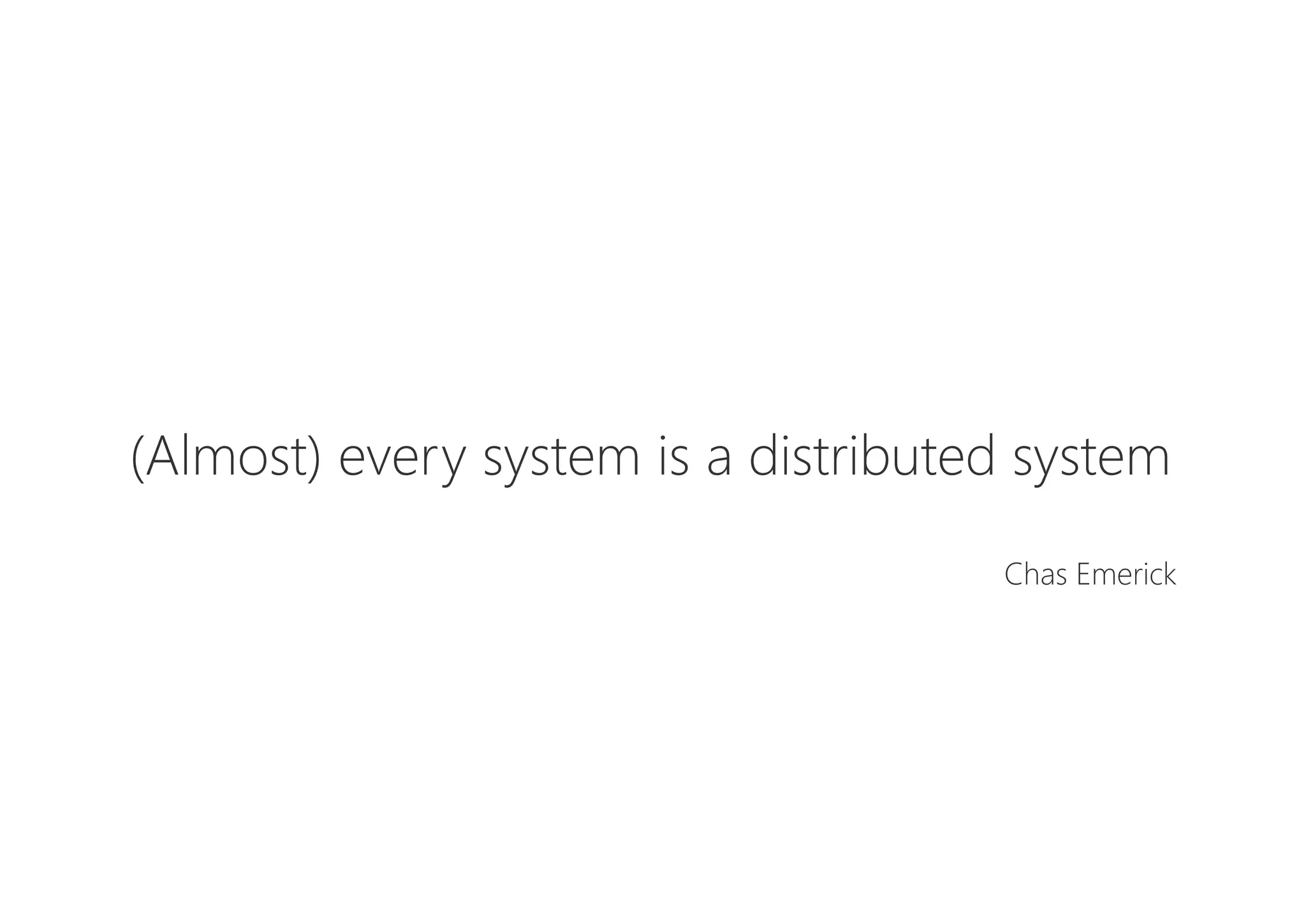
(Almost) every system is a distributed system
Chas Emerick
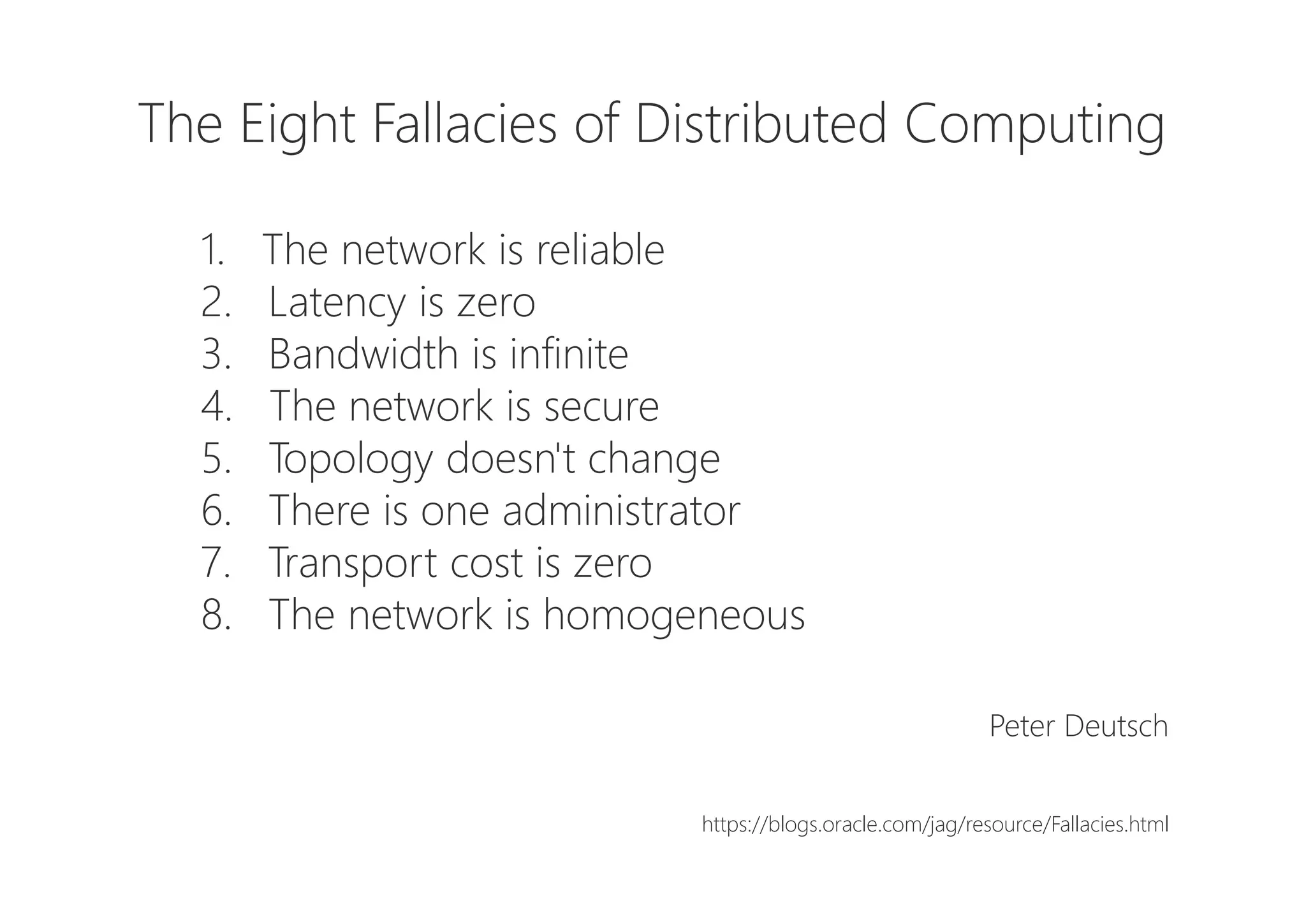
The Eight Fallacies of Distributed Computing
1. The network is reliable
2. Latency is zero
3. Bandwidth is infinite
4. The network is secure
5. Topology doesn't change
6. There is one administrator
7. Transport cost is zero
8. The network is homogeneous
Peter Deutsch
https://blogs.oracle.com/jag/resource/Fallacies.html
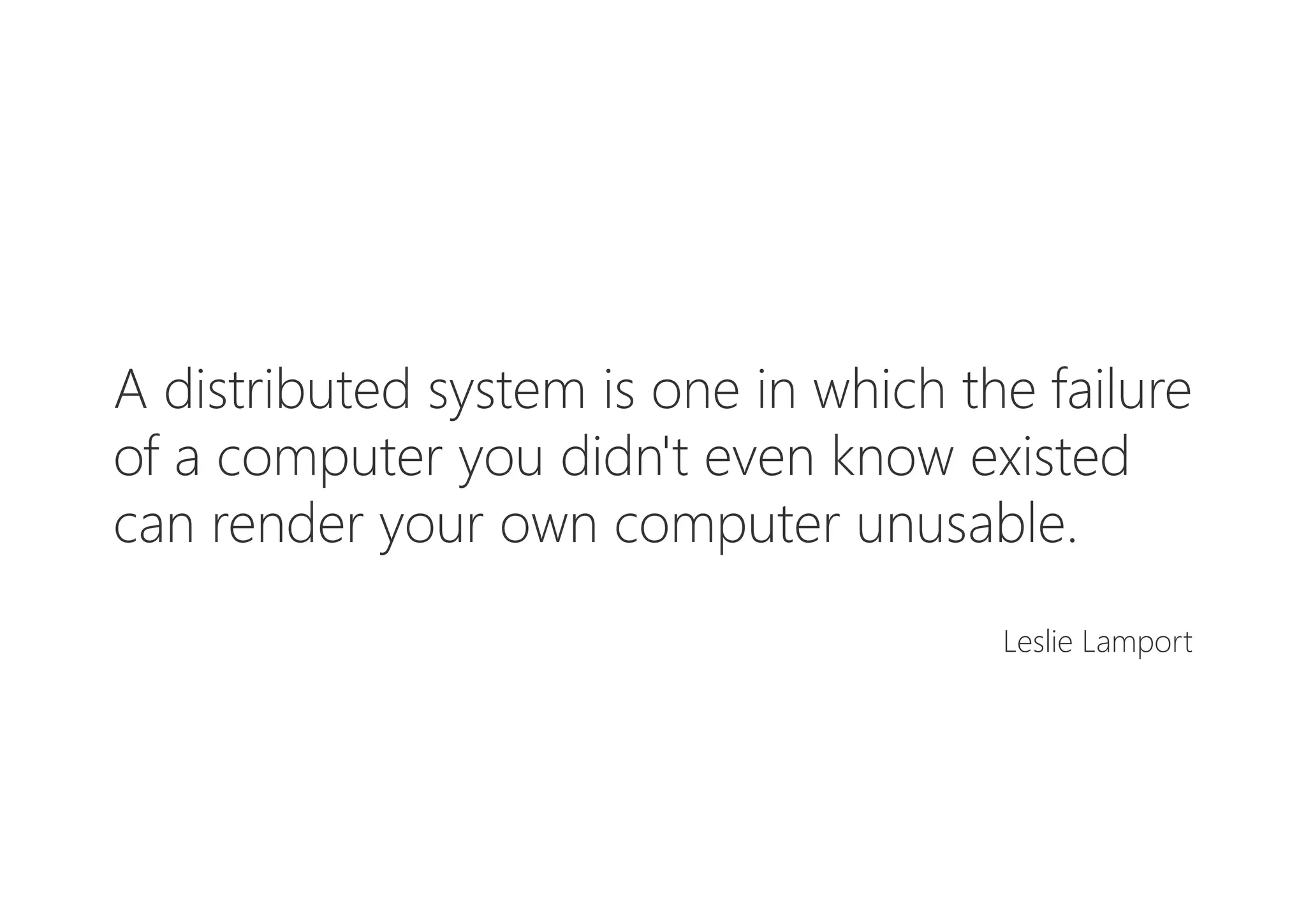
A distributed system is one in which the failure
of a computer you didn't even know existed
can render your own computer unusable.
Leslie Lamport
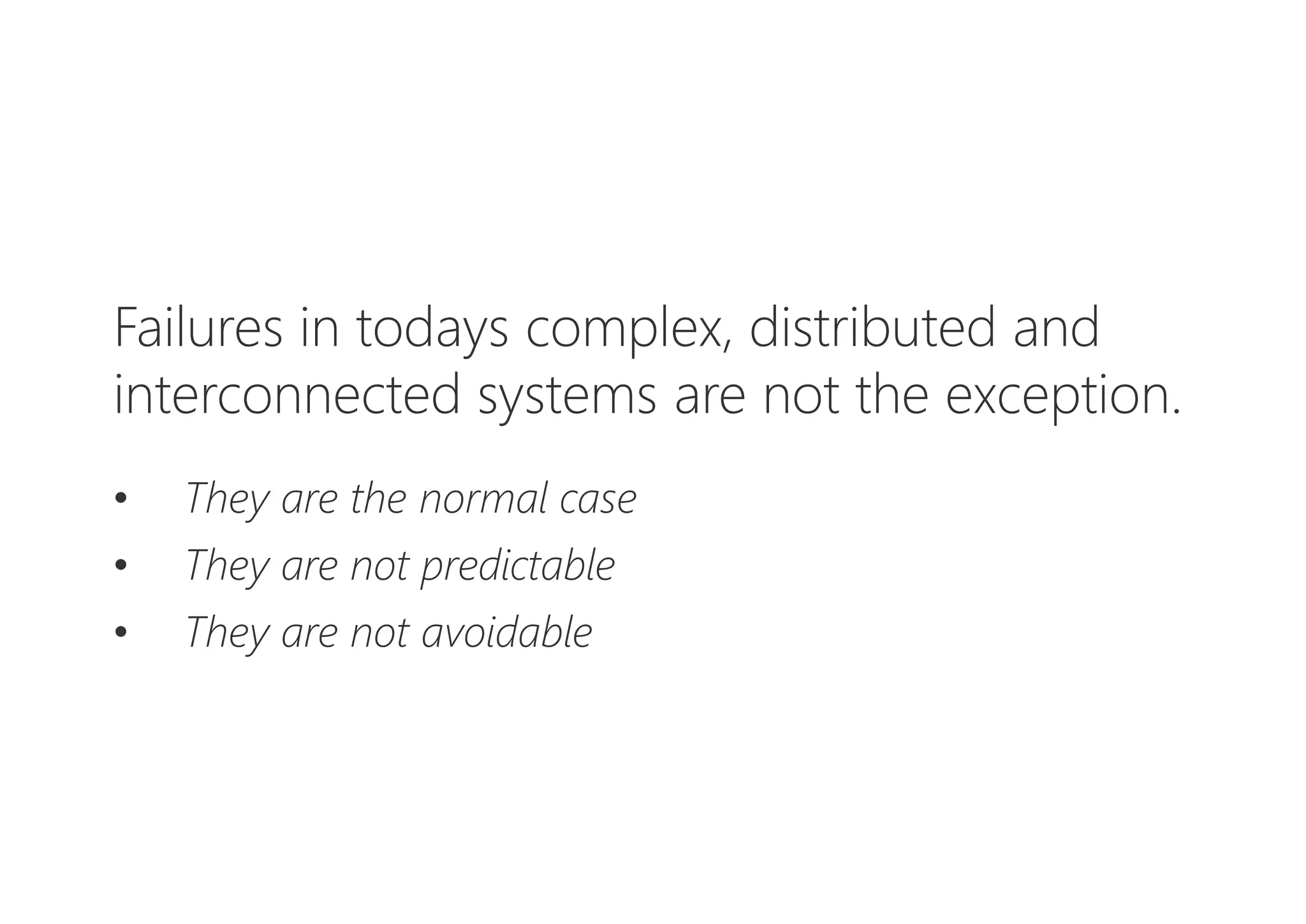
Failures in todays complex, distributed and
interconnected systems are not the exception.
• They are the normal case
• They are not predictable
• They are not avoidable
Do not try to avoid failures. Embrace them.
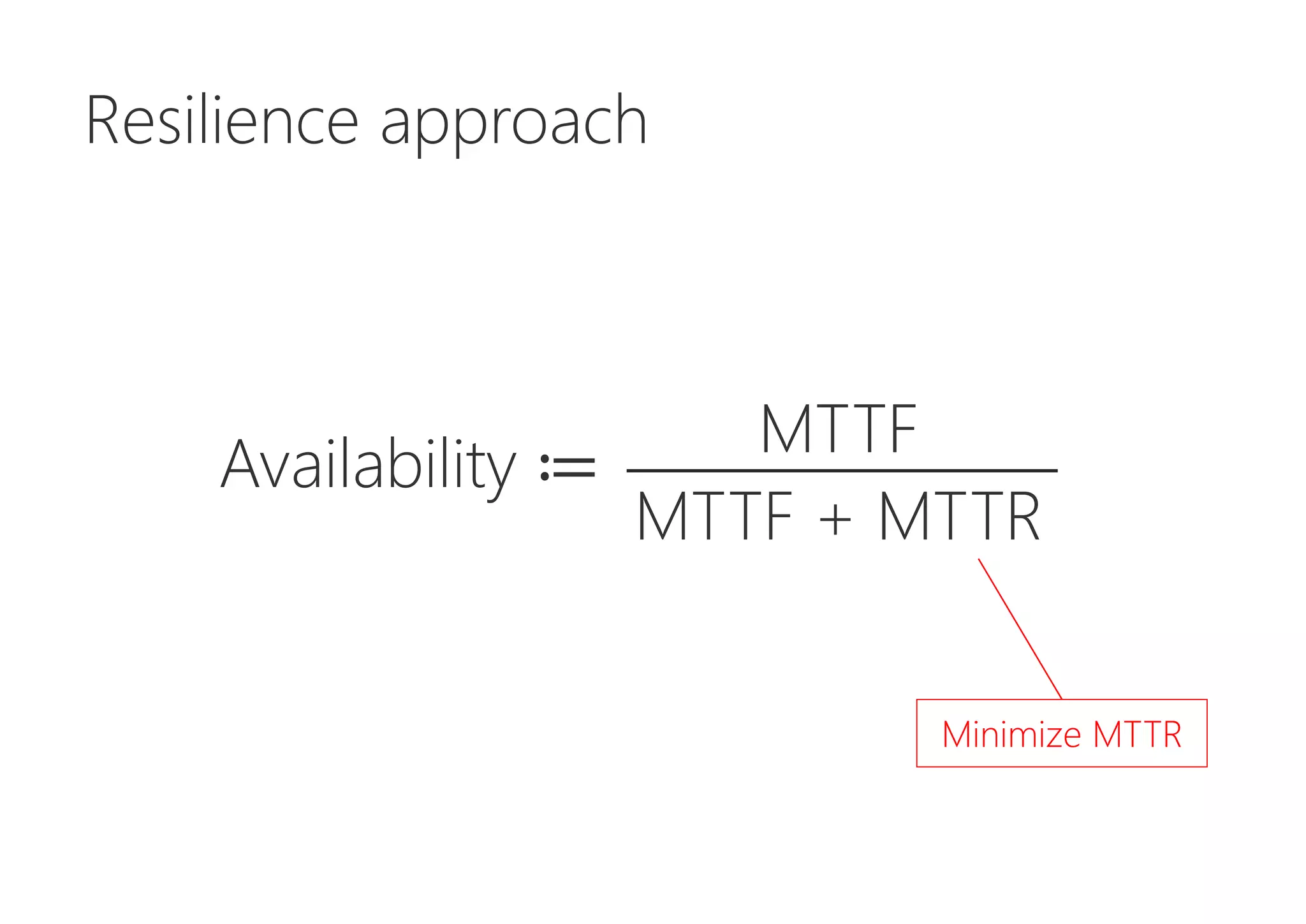
Resilience approach
Availability ≔
MTTF
MTTF + MTTR
Minimize MTTR
resilience (IT)
the ability of a system to handle unexpected situations
 without the user noticing it (best case)
 with a graceful degradation of service (worst case)
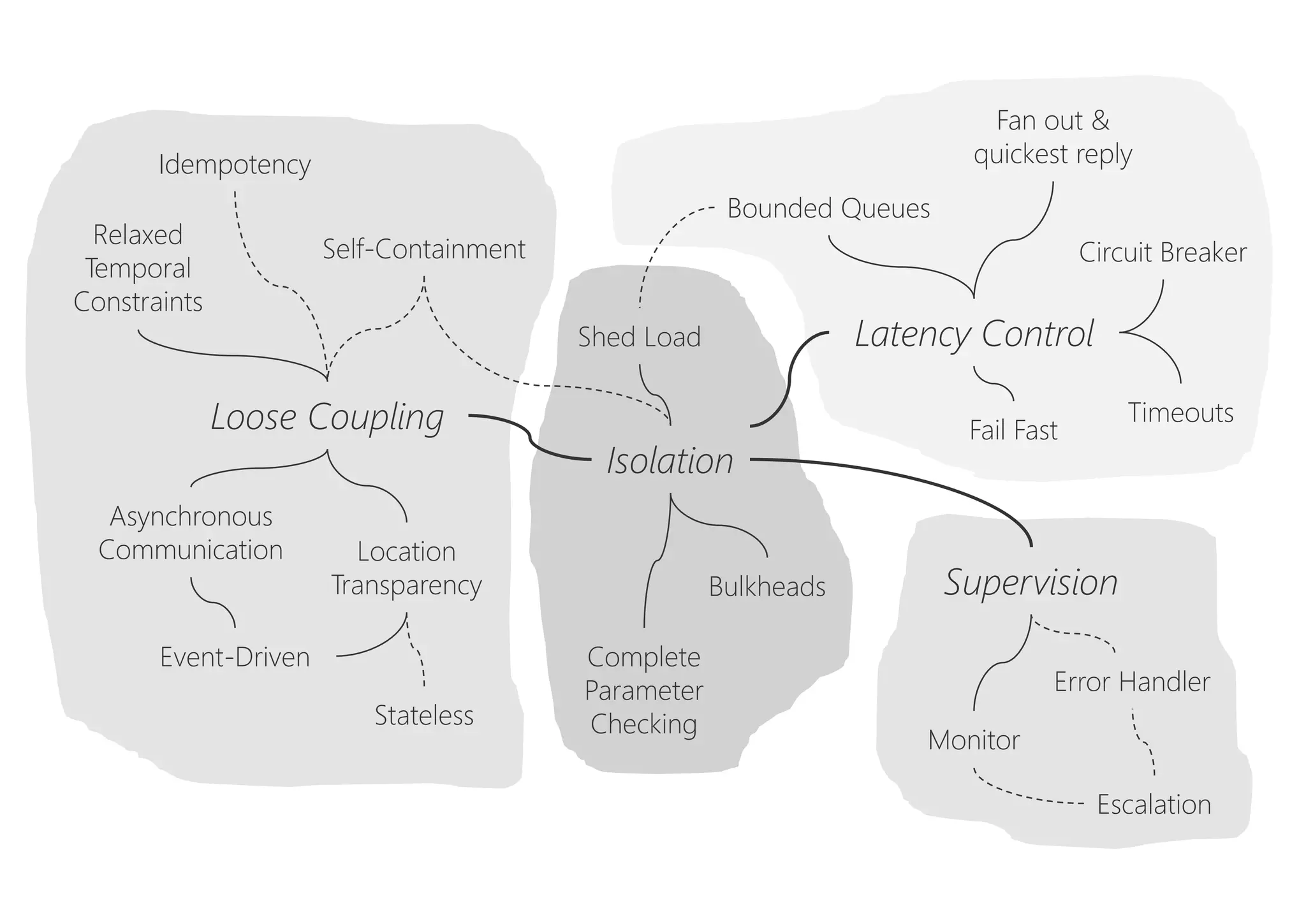
Isolation
Latency Control
Fail Fast
Circuit Breaker
Timeouts
Fan out &
quickest reply
Bounded Queues
Shed Load
Bulkheads
Loose Coupling
Asynchronous
Communication
Event-Driven
Idempotency
Self-Containment
Relaxed
Temporal
Constraints
Location
Transparency
Stateless
Supervision
Monitor
Complete
Parameter
Checking
Error Handler
Escalation
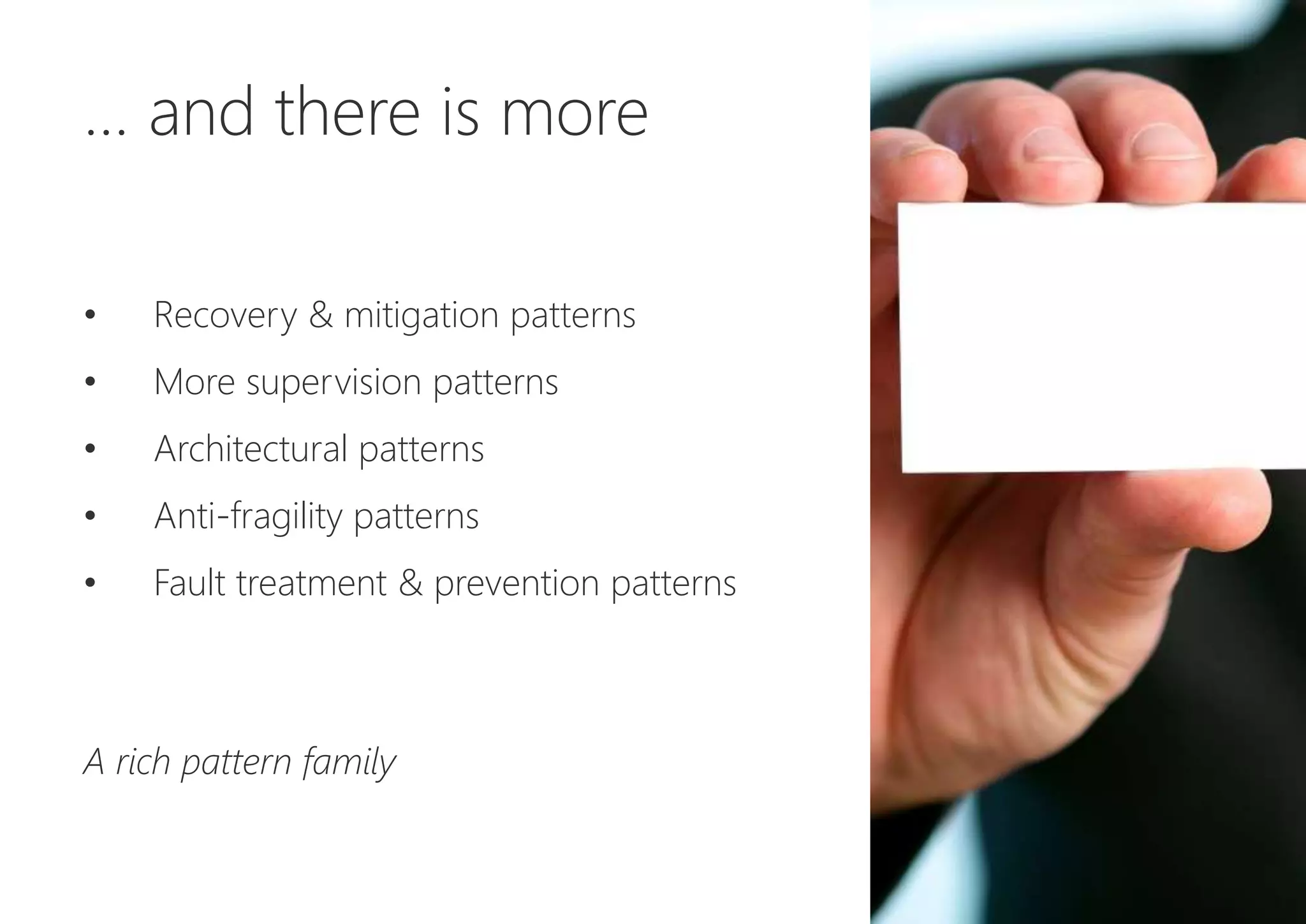
… and there is more
• Recovery & mitigation patterns
• More supervision patterns
• Architectural patterns
• Anti-fragility patterns
• Fault treatment & prevention patterns
A rich pattern family
(Title music starts & opening credits shown)
Let’s complete the picture first …
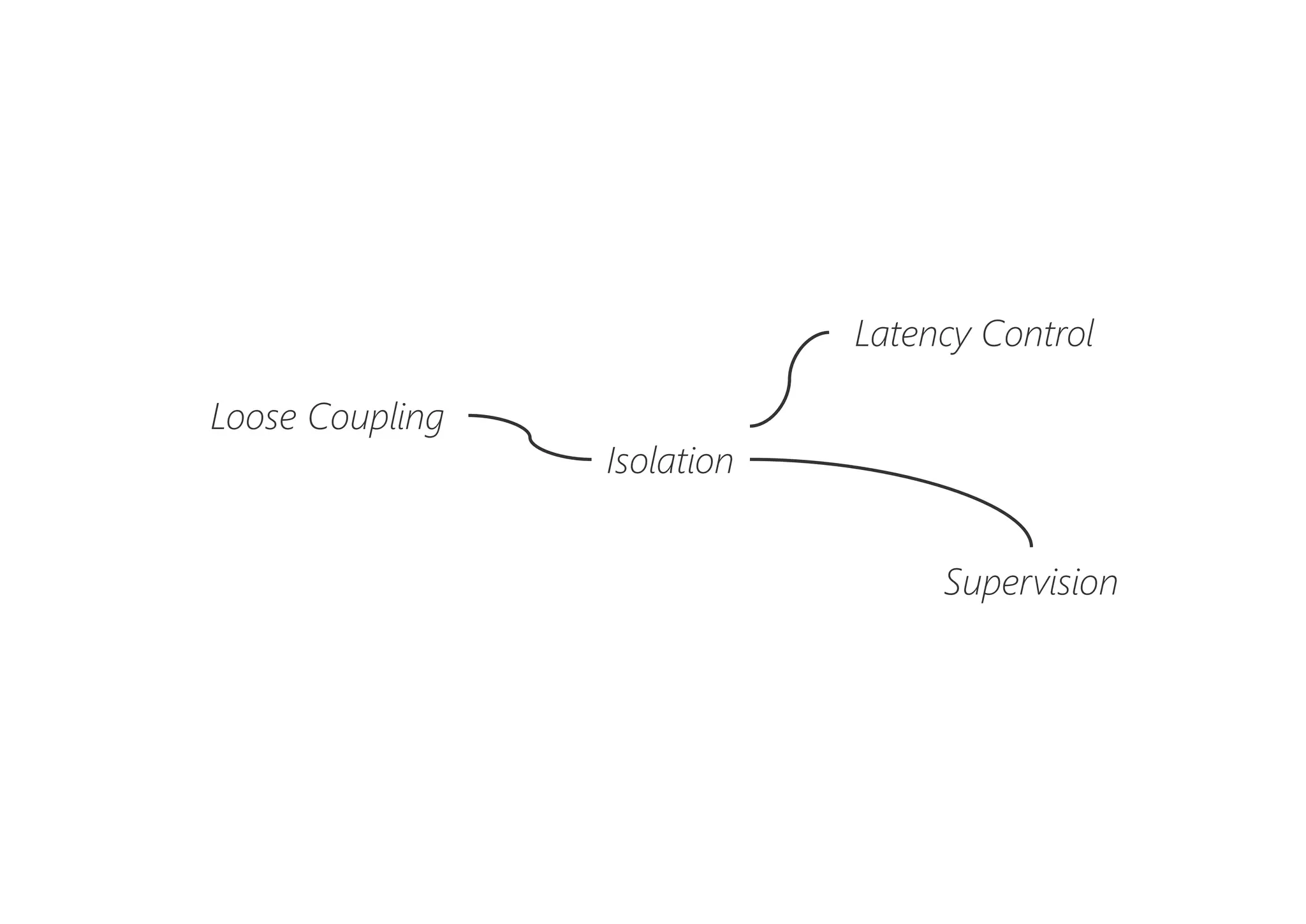
Isolation
Latency Control
Loose Coupling
Supervision
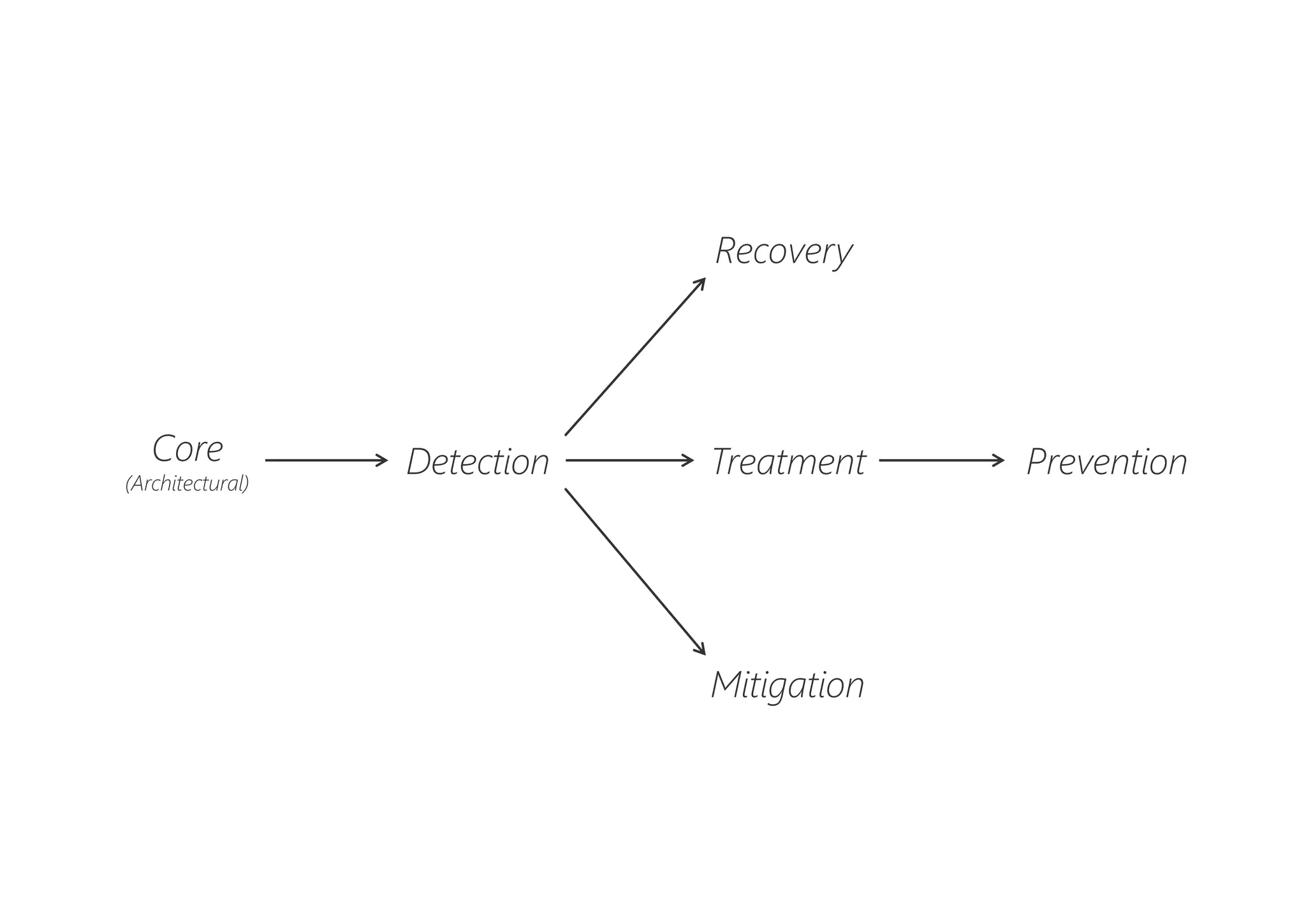
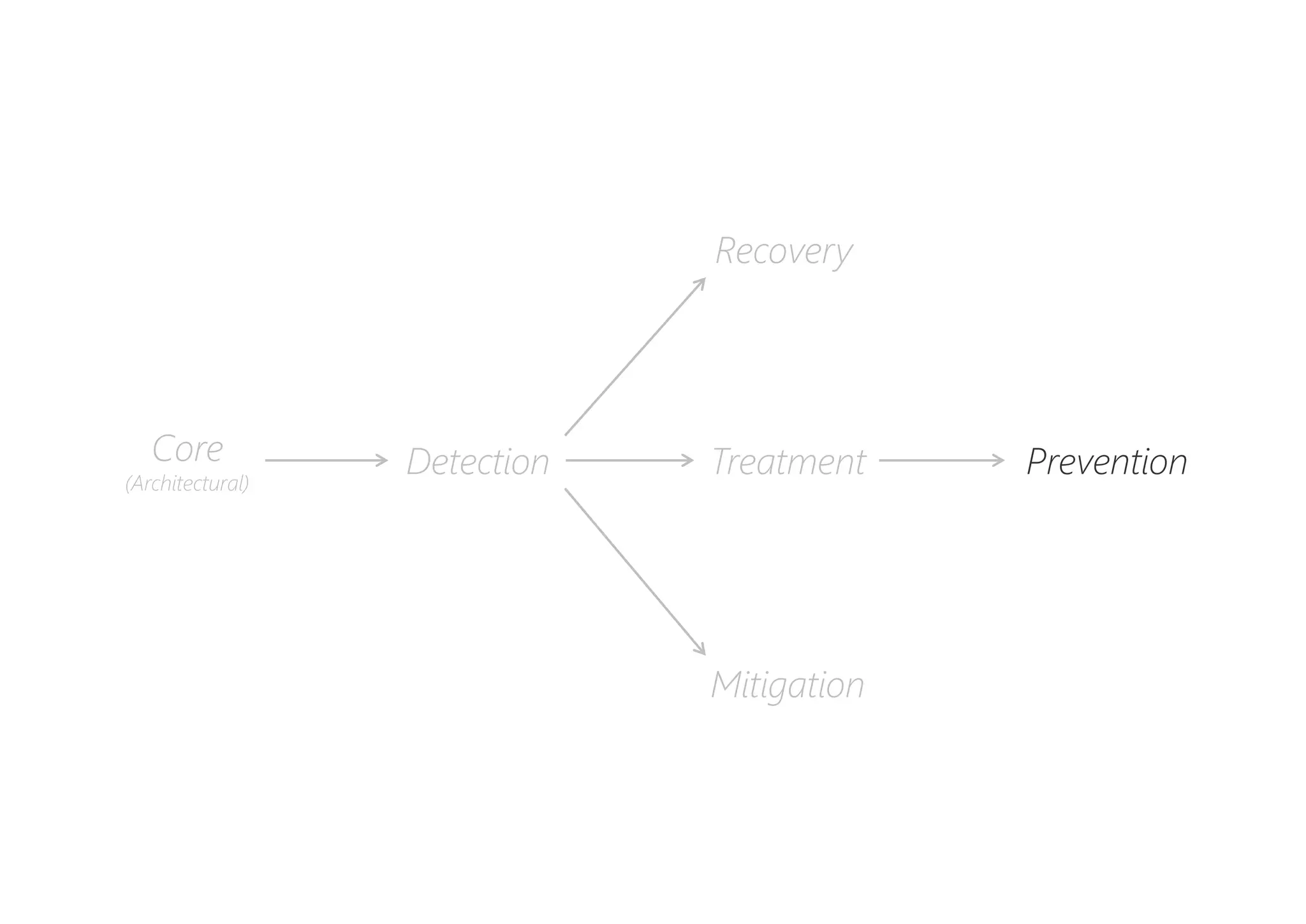
Core
(Architectural)
Detection Treatment Prevention
Recovery
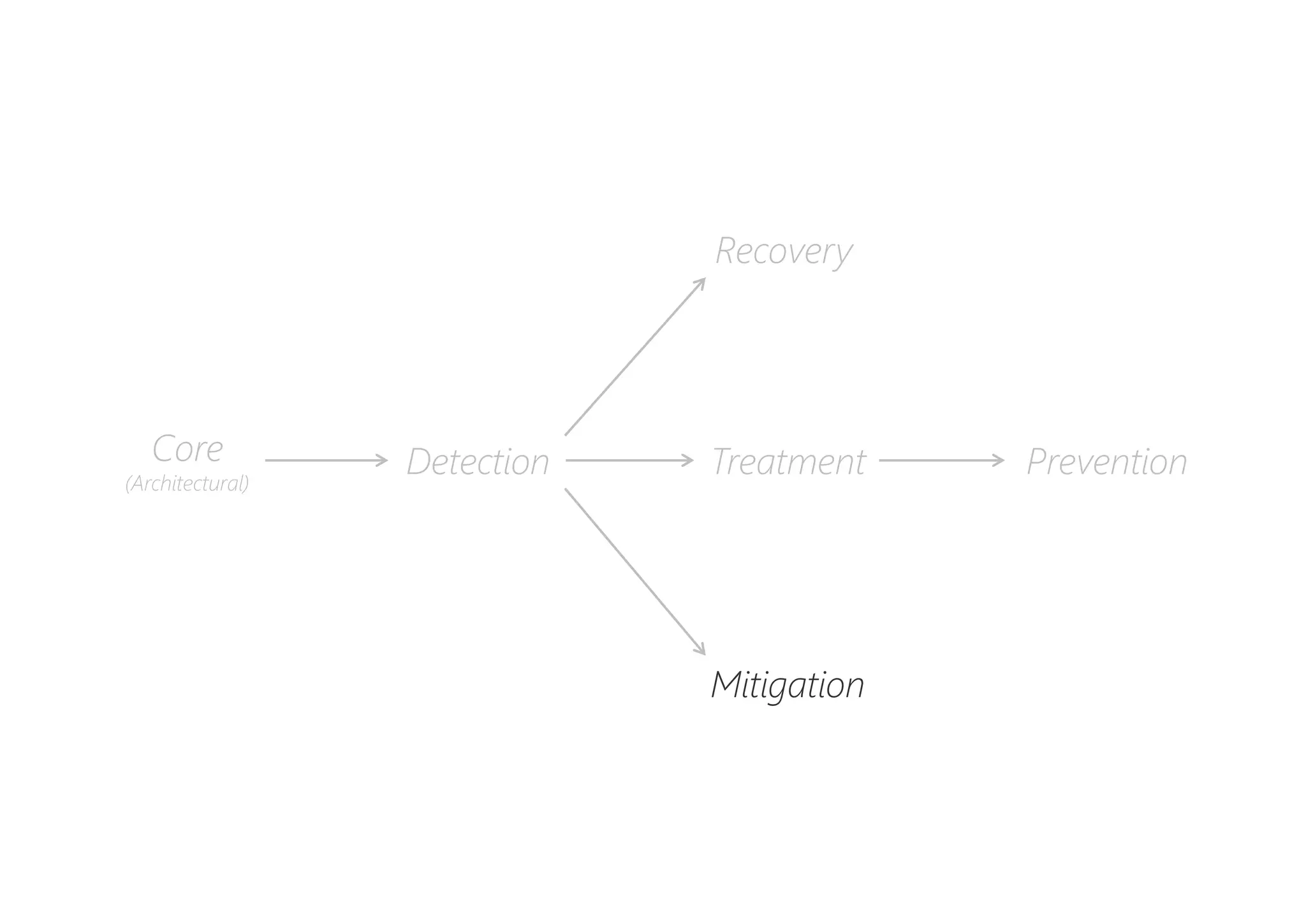
Mitigation
PreventionDetectionCore
(Architectural)
Recovery
Mitigation
Treatment
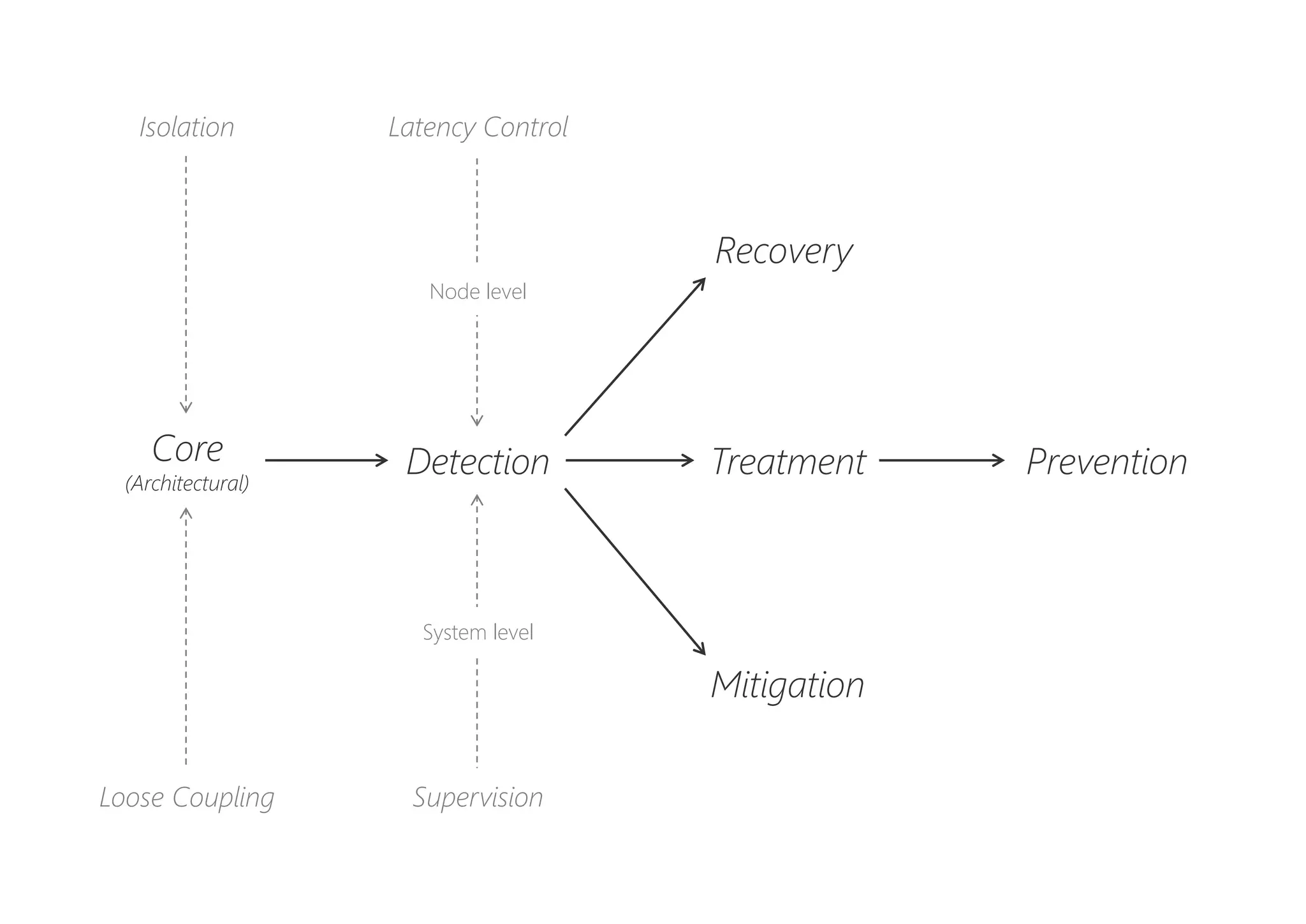
Isolation
Loose Coupling
Latency Control
Node level
Supervision
System level
PreventionDetectionCore
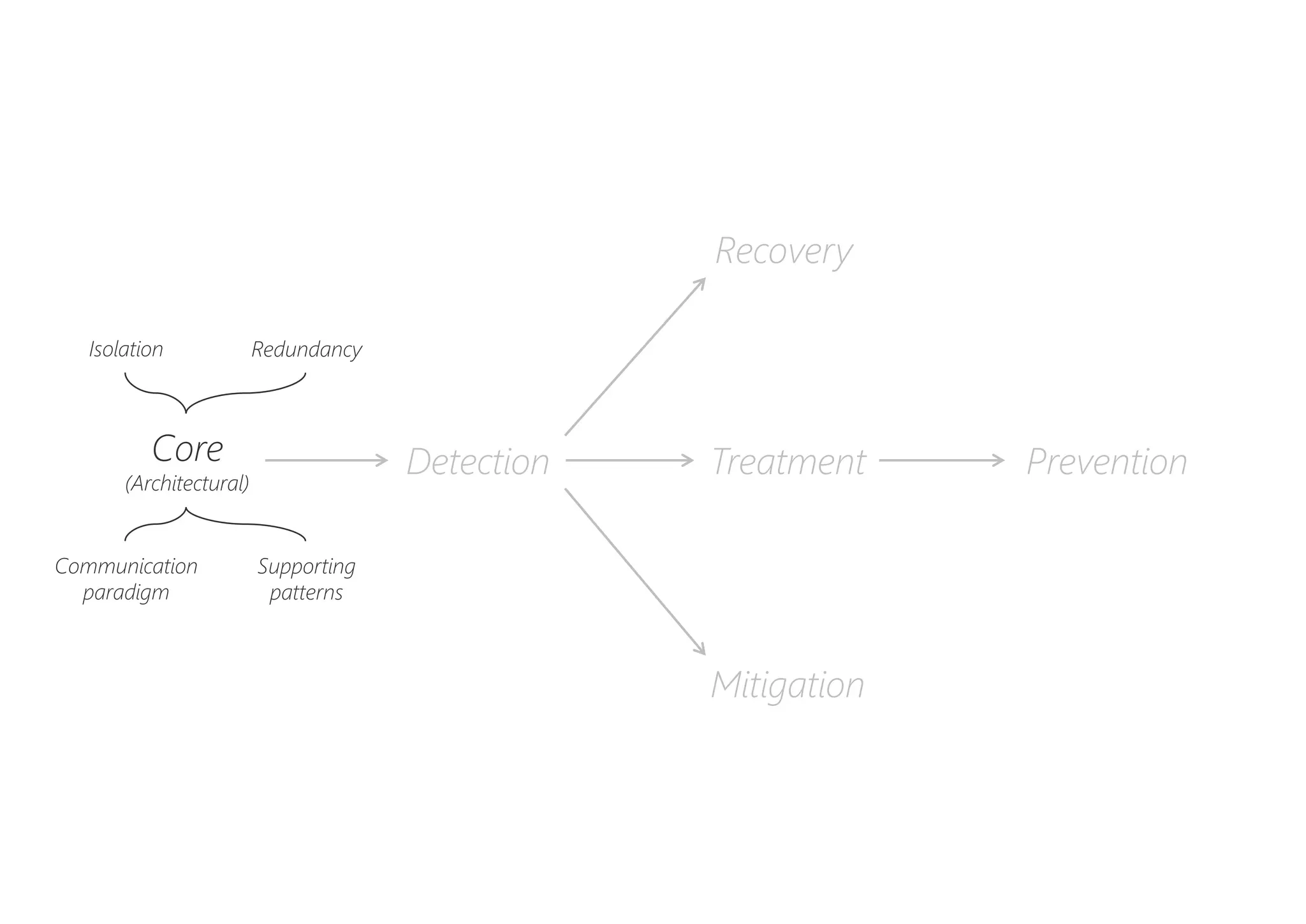
(Architectural)
Recovery
Mitigation
Treatment
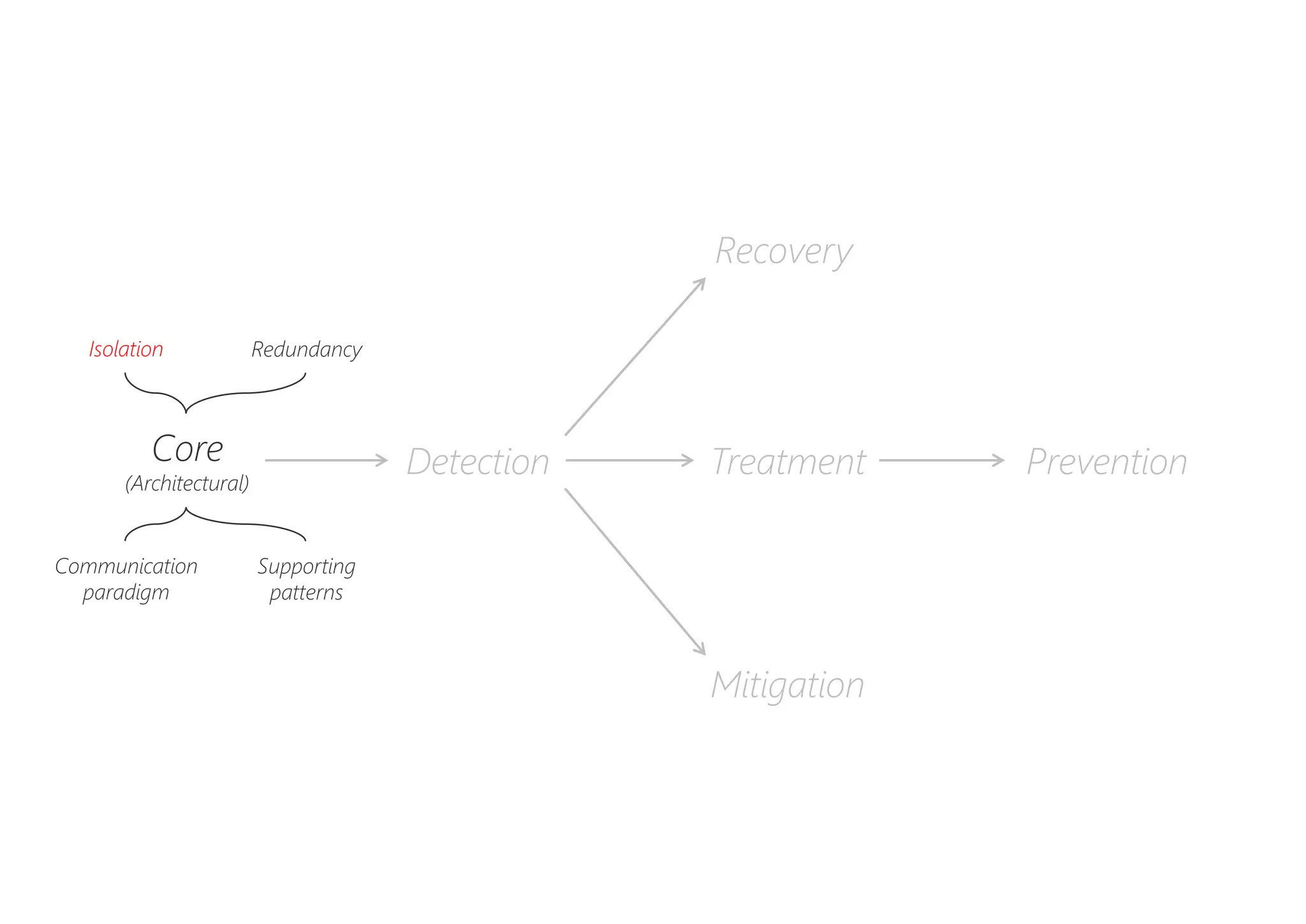
Isolation Redundancy
Communication
paradigm
Supporting
patterns
PreventionDetectionCore
(Architectural)
Recovery
Mitigation
Treatment
Supporting
patterns
Communication
paradigm
RedundancyIsolation
PreventionDetectionCore
(Architectural)
Recovery
Mitigation
Treatment
Supporting
patterns
Communication
paradigm
RedundancyIsolation
Bulkhead
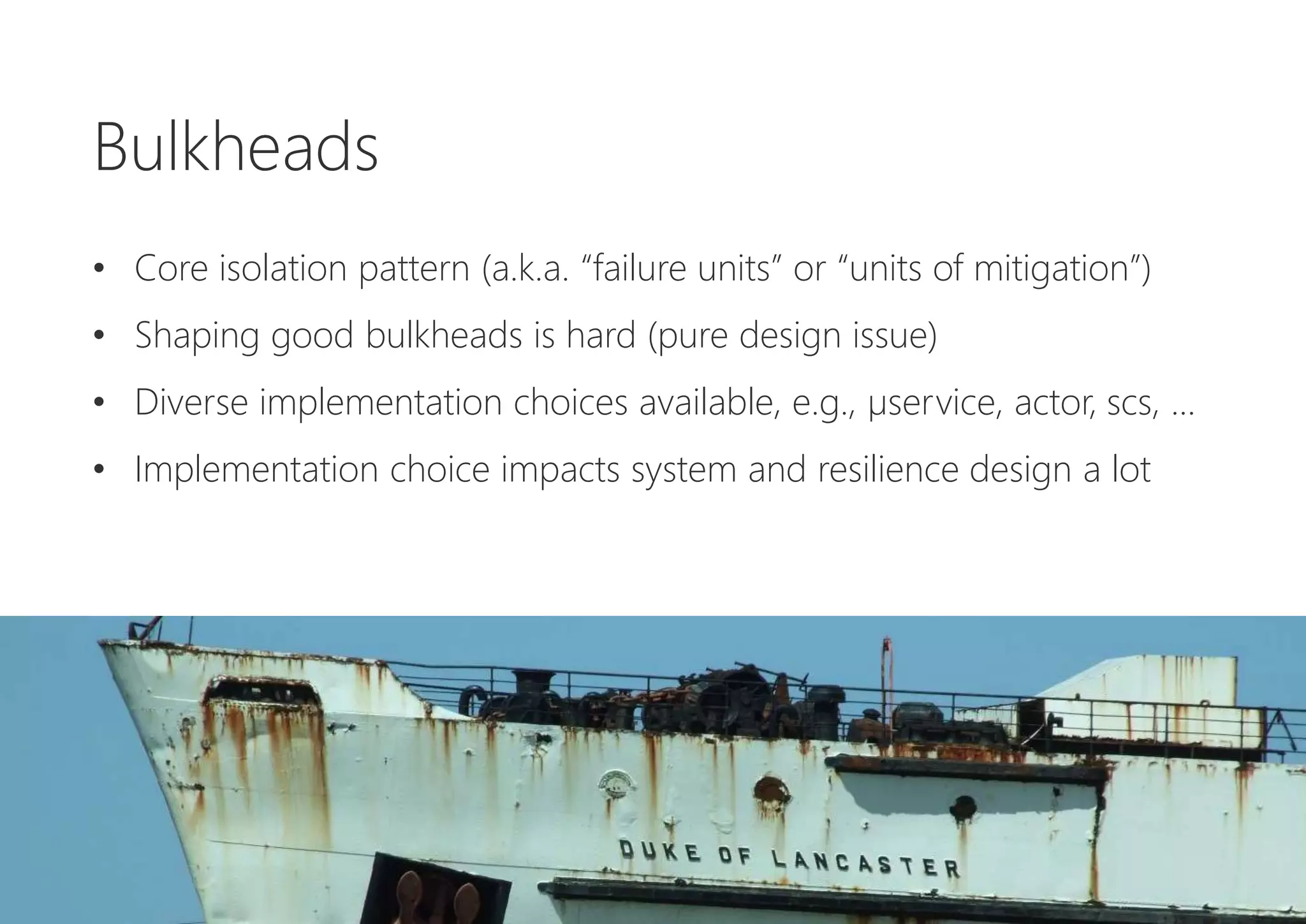
Bulkheads
• Core isolation pattern (a.k.a. “failure units” or “units of mitigation”)
• Shaping good bulkheads is hard (pure design issue)
• Diverse implementation choices available, e.g., µservice, actor, scs, ...
• Implementation choice impacts system and resilience design a lot
PreventionDetectionCore
(Architectural)
Recovery
Mitigation
Treatment
Supporting
patterns
Communication
paradigm
RedundancyIsolation
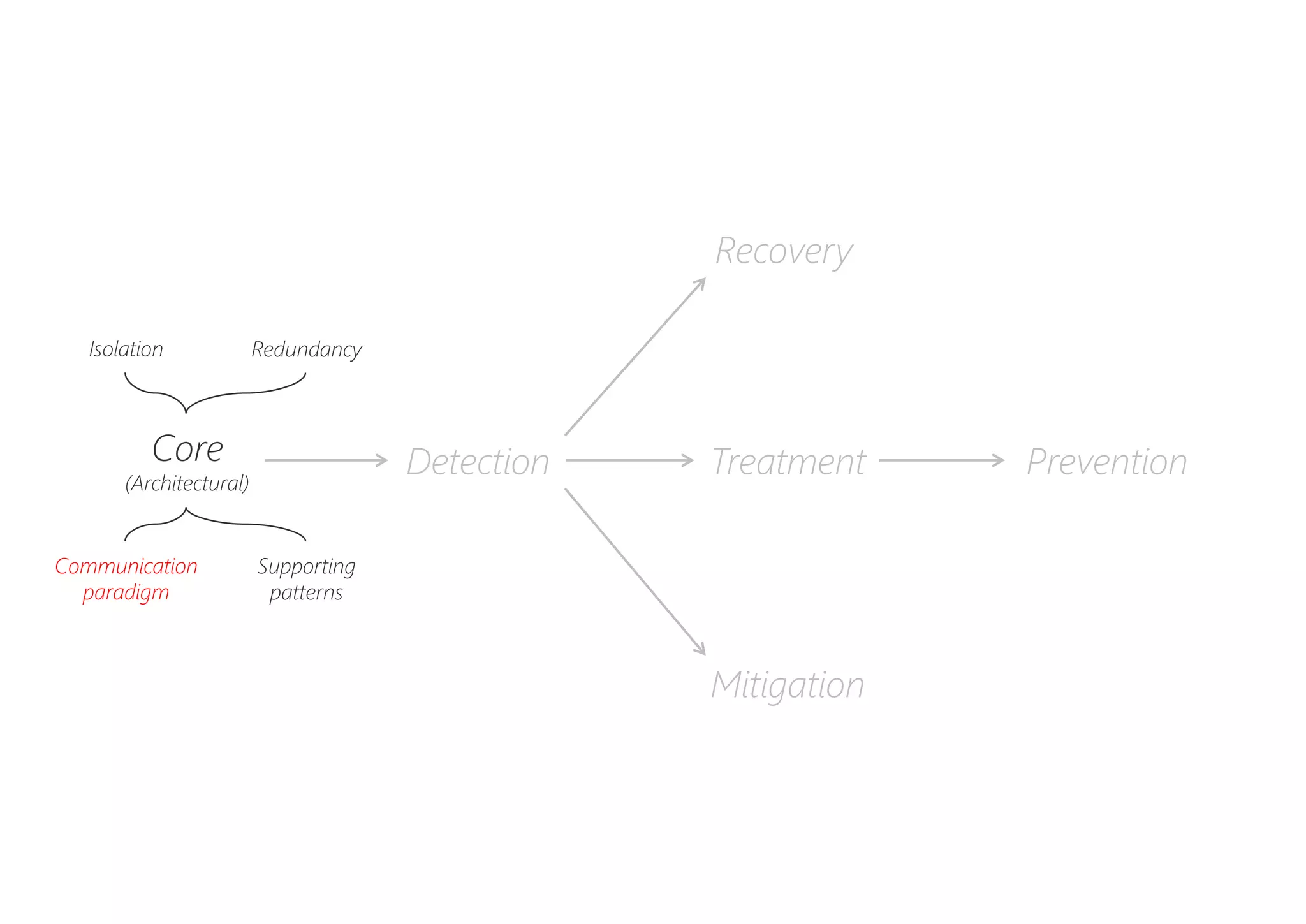
Communication paradigm
• Request-response <-> messaging <-> events
• Not a pattern, but heavily influences resilience patterns to be used
• Also heavily influences functional bulkhead design
• Very fundamental decision which is often underestimated
PreventionDetectionCore
(Architectural)
Recovery
Mitigation
Treatment
Supporting
patterns
Communication
paradigm
RedundancyIsolation
Redundancy
• Core resilience concept
• Applicable to all failure types
• Basis for many recovery and mitigation patterns
• Often different variants implemented in a system
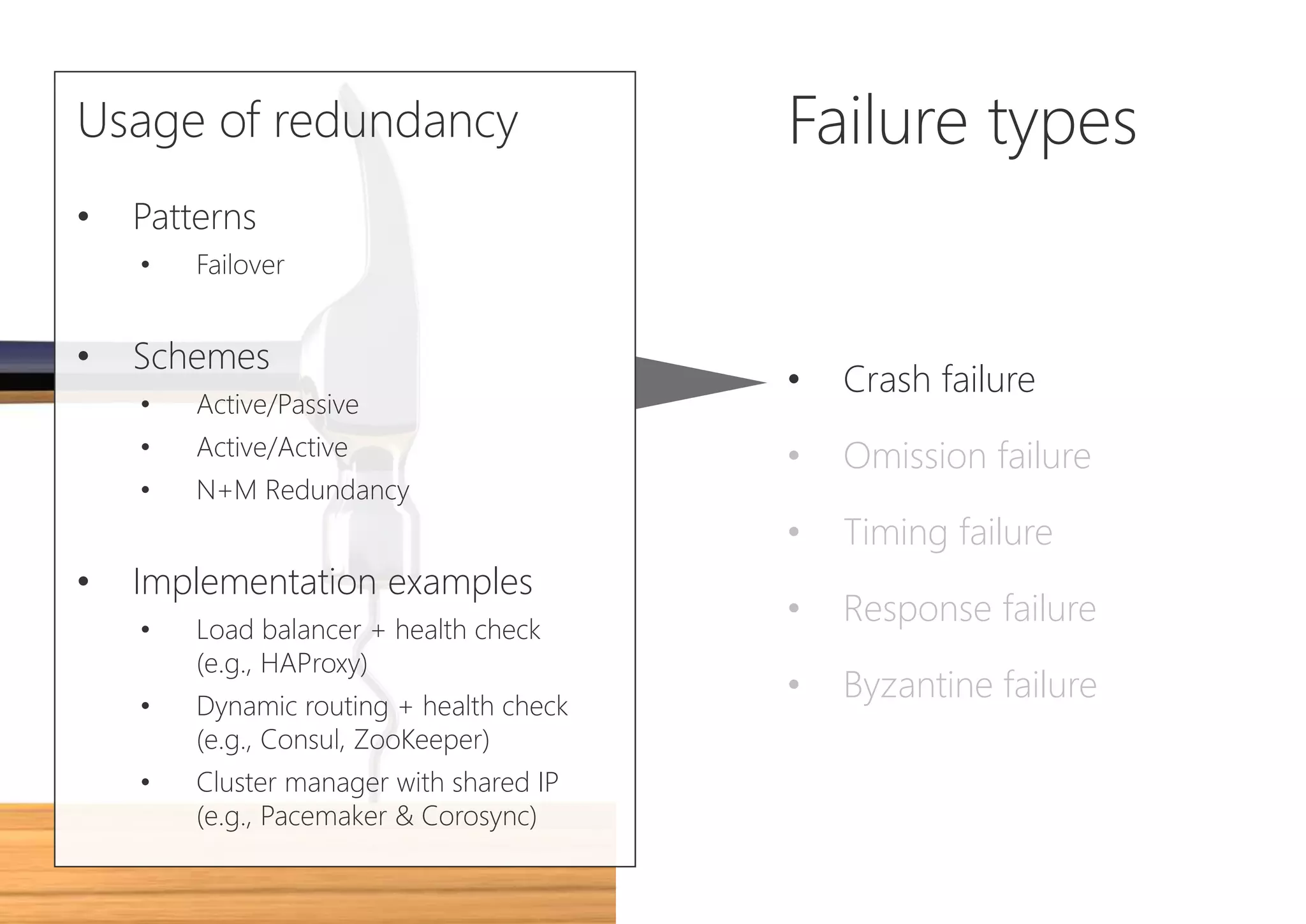
Failure types
• Crash failure
• Omission failure
• Timing failure
• Response failure
• Byzantine failure
Failure types
• Crash failure
• Omission failure
• Timing failure
• Response failure
• Byzantine failure
Usage of redundancy
• Patterns
• Failover
• Schemes
• Active/Passive
• Active/Active
• N+M Redundancy
• Implementation examples
• Load balancer + health check
(e.g., HAProxy)
• Dynamic routing + health check
(e.g., Consul, ZooKeeper)
• Cluster manager with shared IP
(e.g., Pacemaker & Corosync)
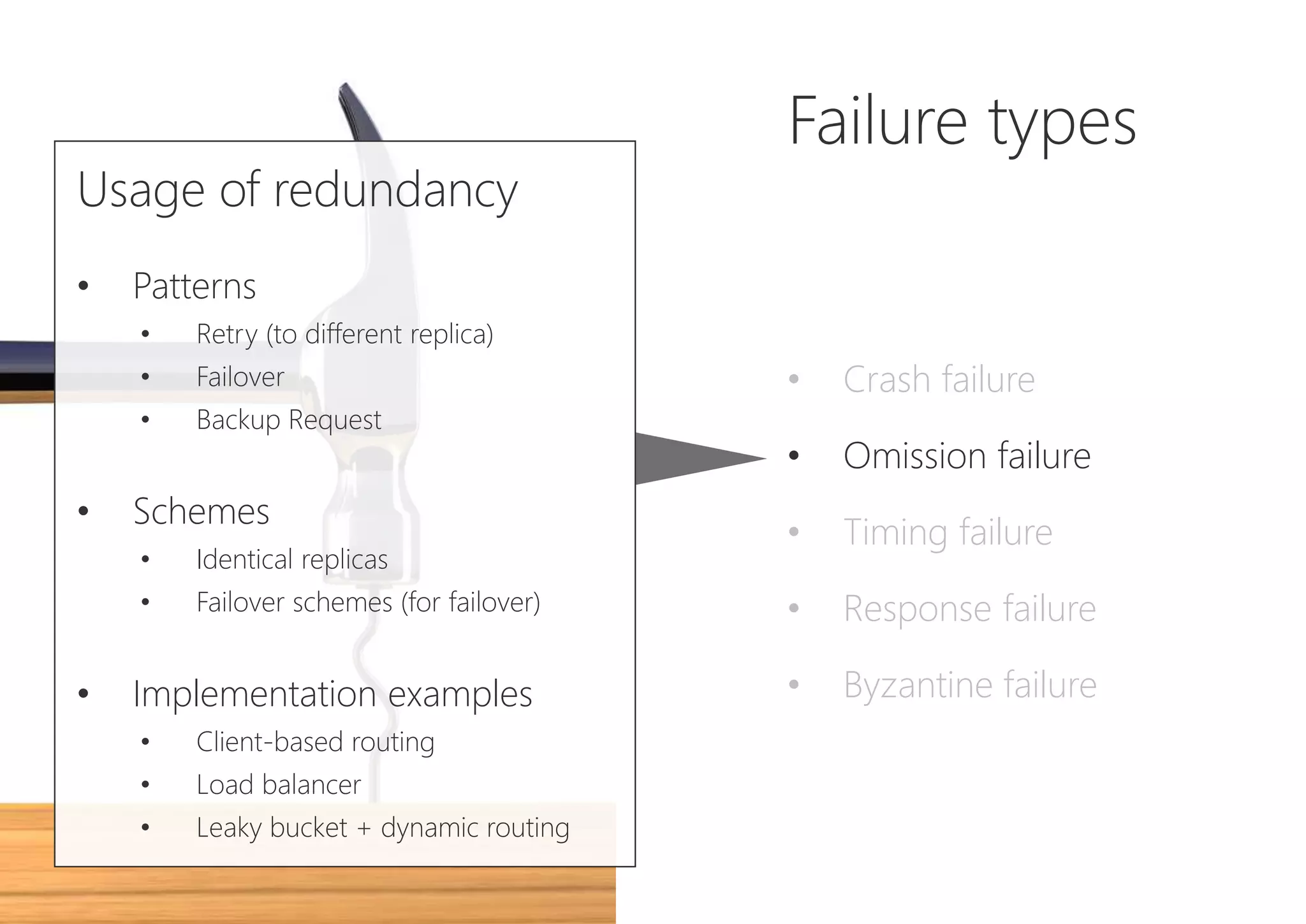
Failure types
• Crash failure
• Omission failure
• Timing failure
• Response failure
• Byzantine failure
Usage of redundancy
• Patterns
• Retry (to different replica)
• Failover
• Backup Request
• Schemes
• Identical replicas
• Failover schemes (for failover)
• Implementation examples
• Client-based routing
• Load balancer
• Leaky bucket + dynamic routing
Failure types
• Crash failure
• Omission failure
• Timing failure
• Response failure
• Byzantine failure
Usage of redundancy
• Patterns
• Timeout + retry to different replica
• Timeout + failover
• Backup Request
• Schemes
• Identical replicas
• Failover schemes (for failover)
• Implementation examples
• Client-based routing
• Load balancer
• Circuit breaker + dynamic routing
Failure types
• Crash failure
• Omission failure
• Timing failure
• Response failure
• Byzantine failure
Usage of redundancy
• Patterns
• Voting
• Recovery blocks
• Routine exercise
• Schemes
• Identical replicas
• Different replicas (recovery blocks)
• Implementation examples
• Majority based quorum
• Adaptive weighted sum
• Synthetic computation
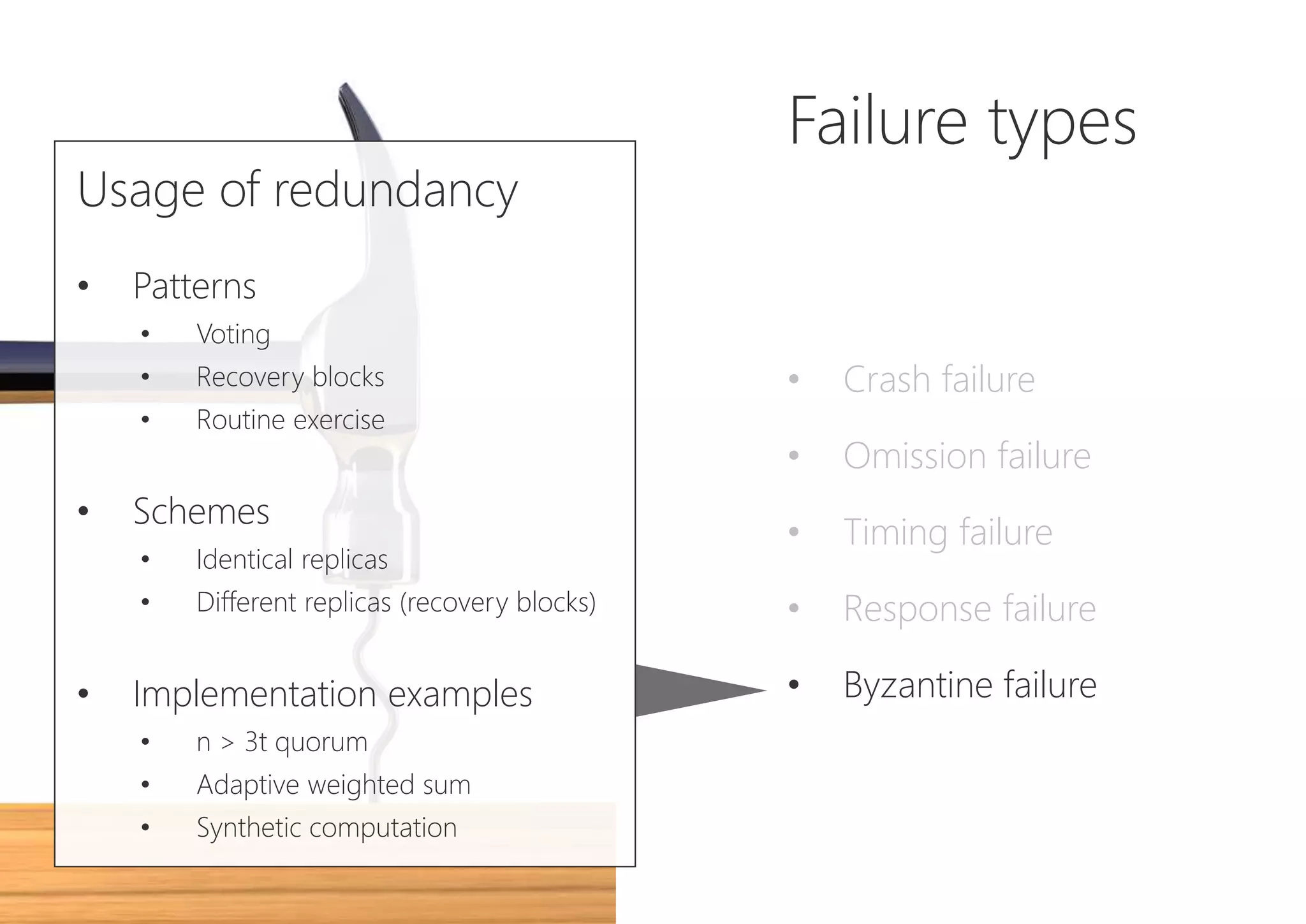
Failure types
• Crash failure
• Omission failure
• Timing failure
• Response failure
• Byzantine failure
Usage of redundancy
• Patterns
• Voting
• Recovery blocks
• Routine exercise
• Schemes
• Identical replicas
• Different replicas (recovery blocks)
• Implementation examples
• n > 3t quorum
• Adaptive weighted sum
• Synthetic computation
PreventionDetectionCore
(Architectural)
Recovery
Mitigation
Treatment
Supporting
patterns
Communication
paradigm
RedundancyIsolation
Stateless Idempotency
Escalation
Structural Behavioral
Zero
downtime
deployment
Location
transparency
Relaxed
temporal
constraints
PreventionDetectionCore
(Architectural)
Recovery
Mitigation
Treatment
Node level
Supporting
patterns
System level
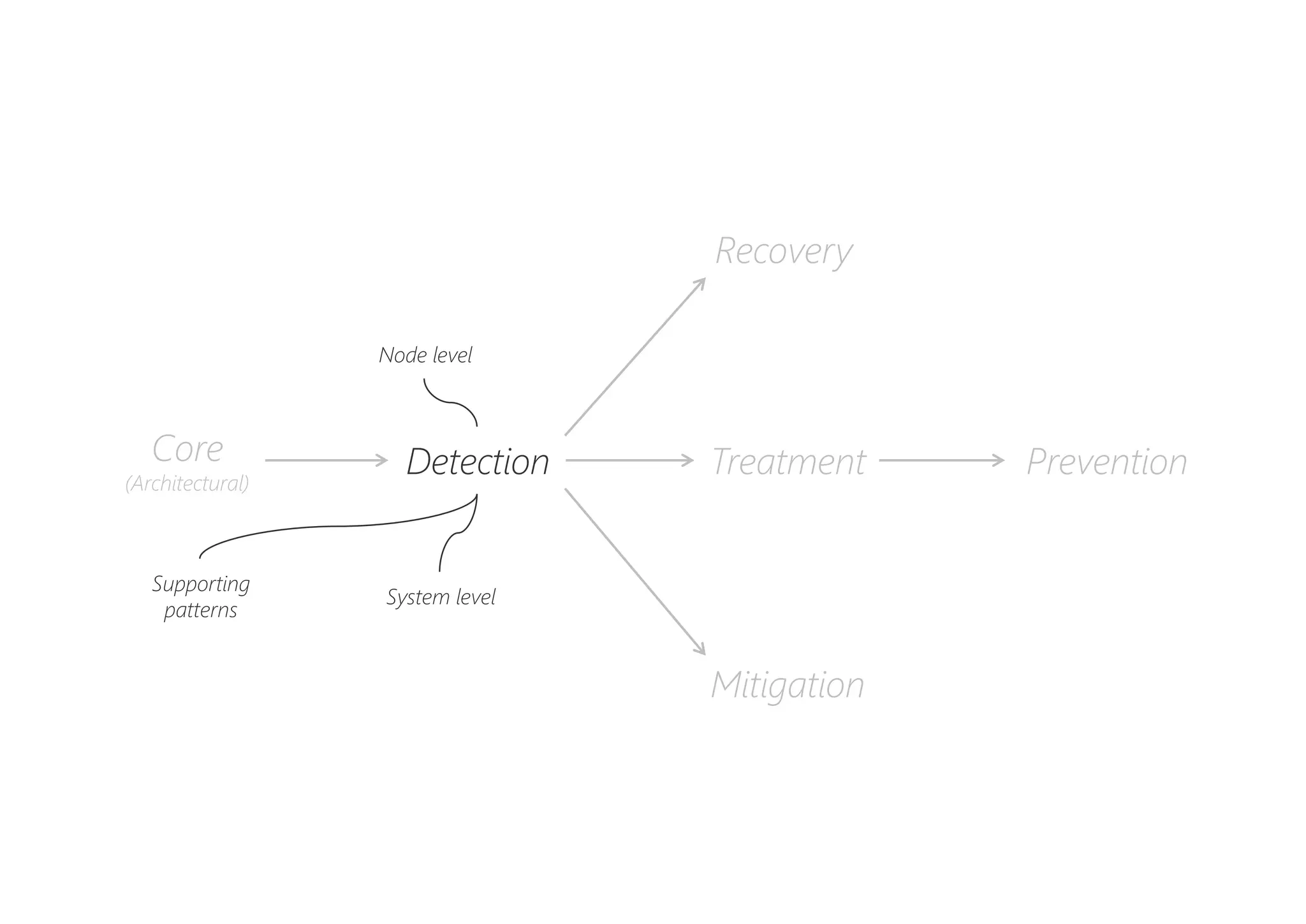
PreventionDetectionCore
(Architectural)
Recovery
Mitigation
Treatment
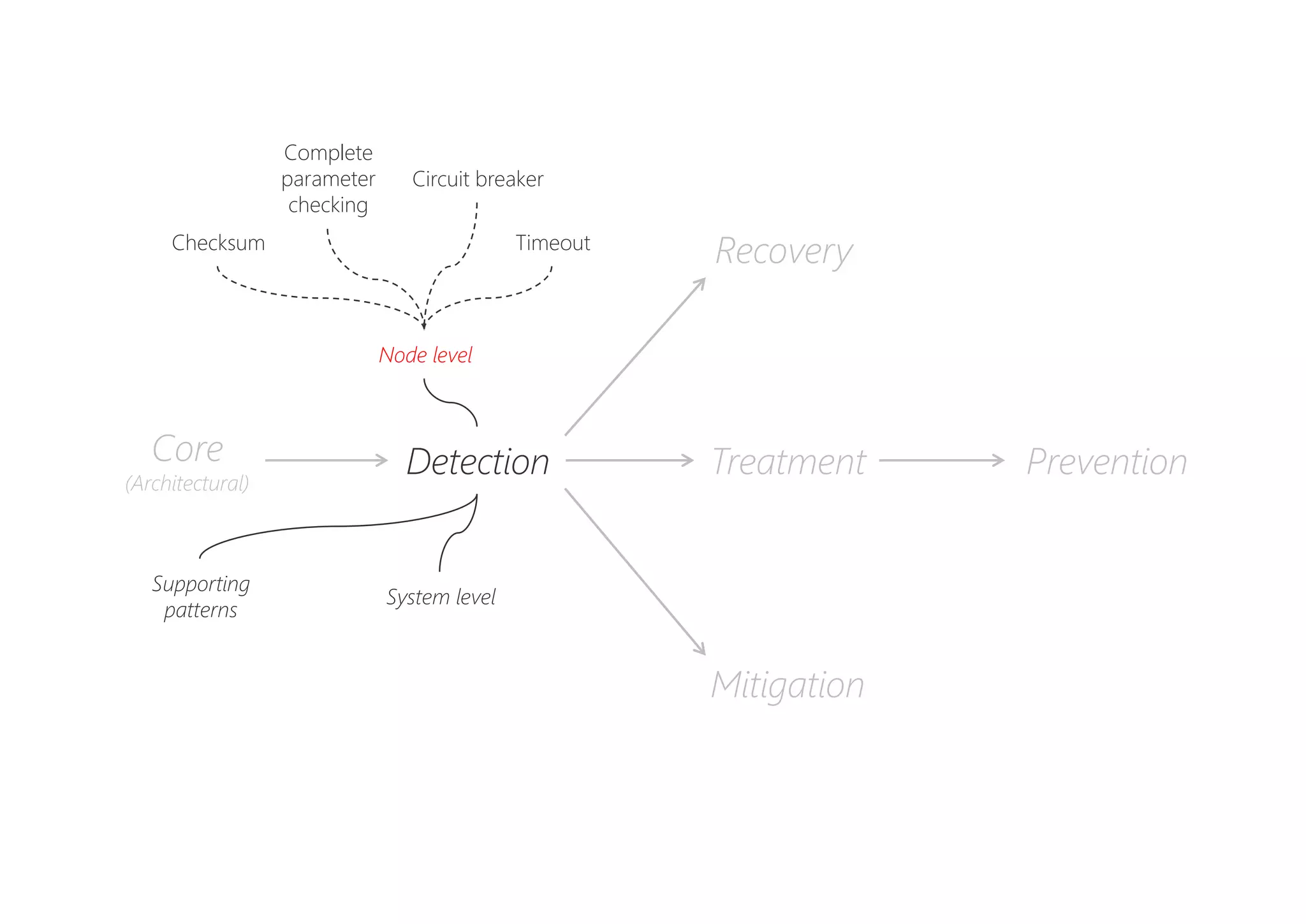
Node level
Supporting
patterns
System level
Timeout
Circuit breaker
Complete
parameter
checking
Checksum
PreventionDetectionCore
(Architectural)
Recovery
Mitigation
Treatment
Node level
Supporting
patterns
System level
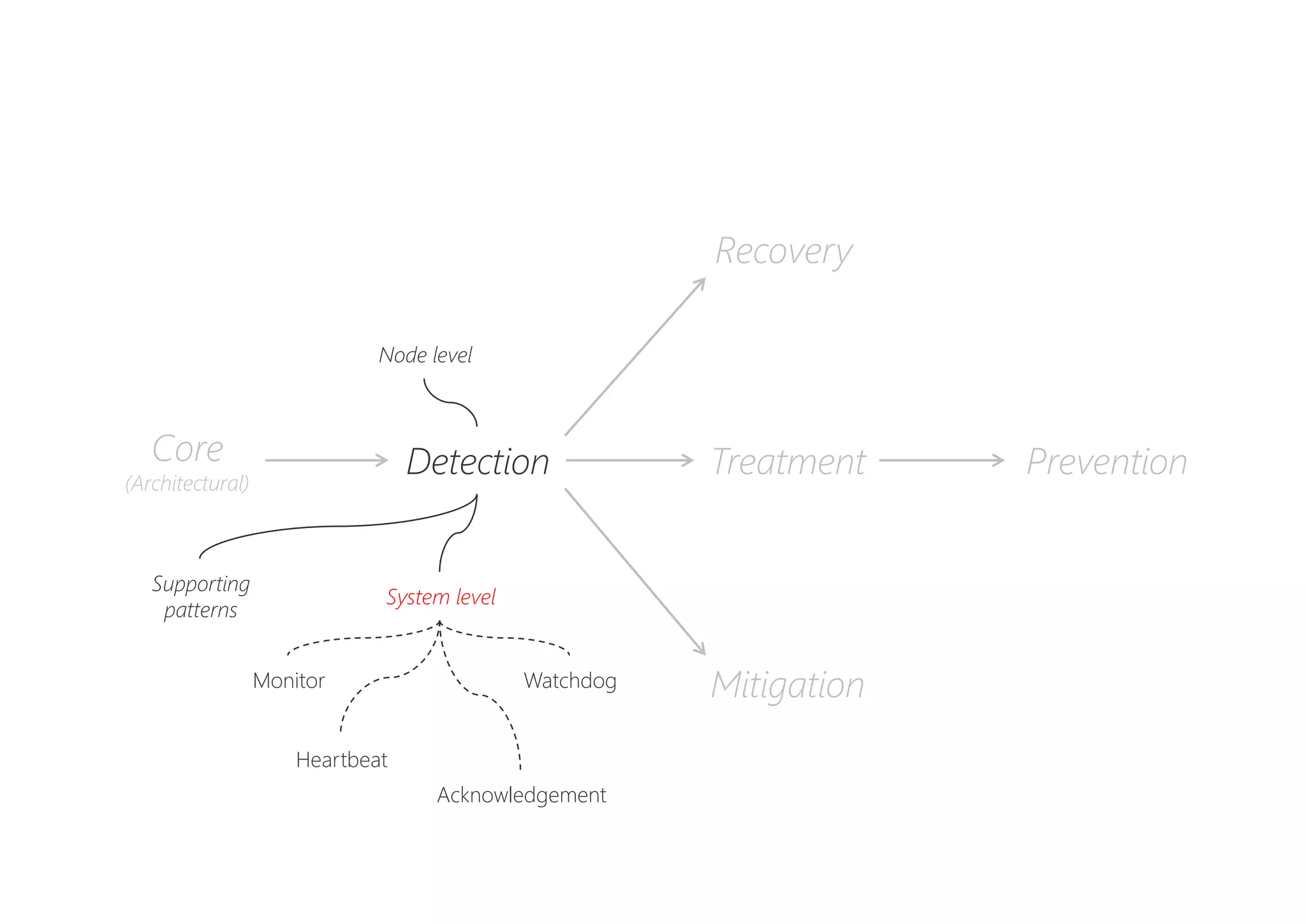
Monitor Watchdog
Heartbeat
Acknowledgement
PreventionDetectionCore
(Architectural)
Recovery
Mitigation
Treatment
Node level
Supporting
patterns
System level
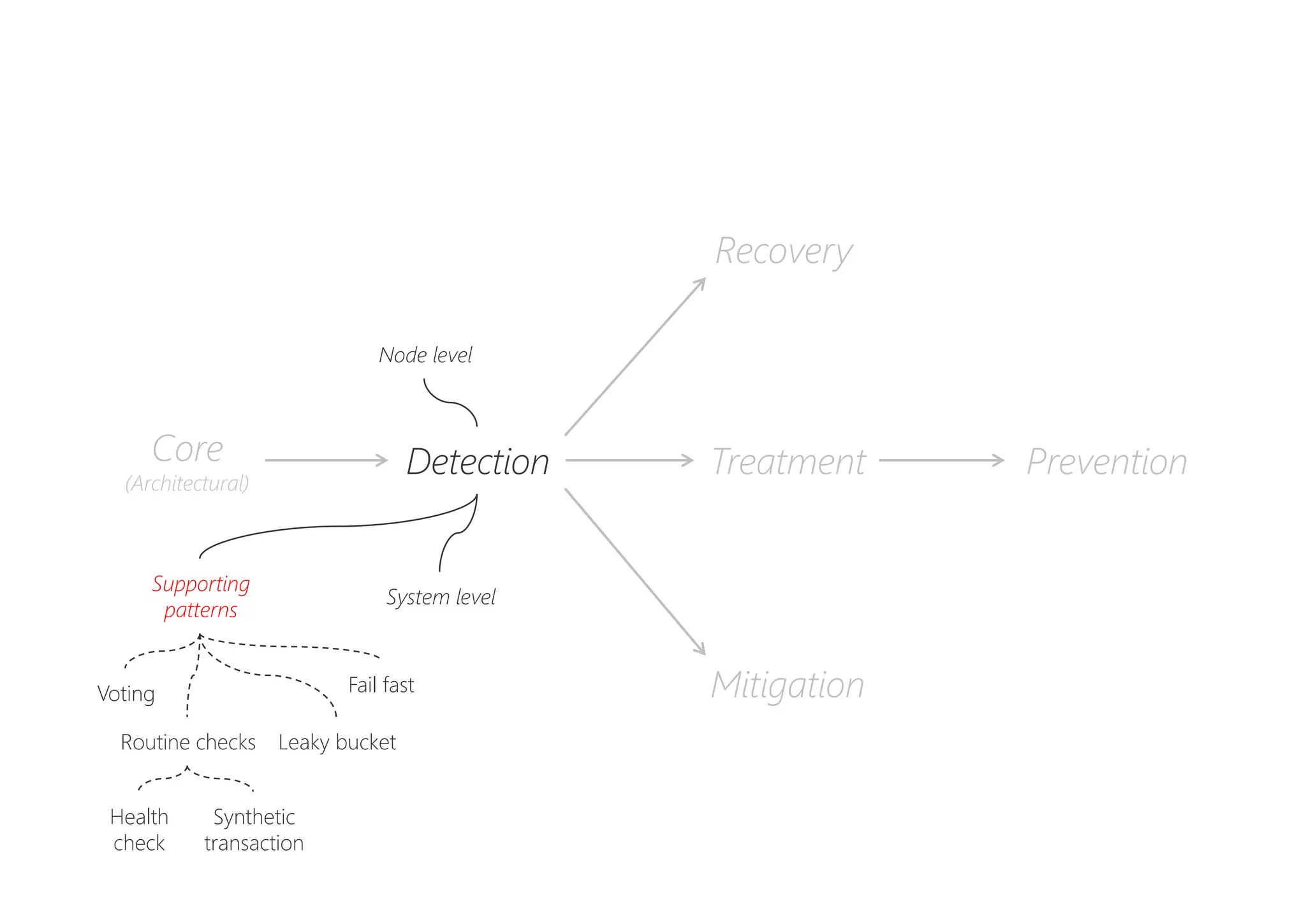
Voting
Synthetic
transaction
Leaky bucketRoutine checks
Health
check
Fail fast
PreventionDetectionCore
(Architectural)
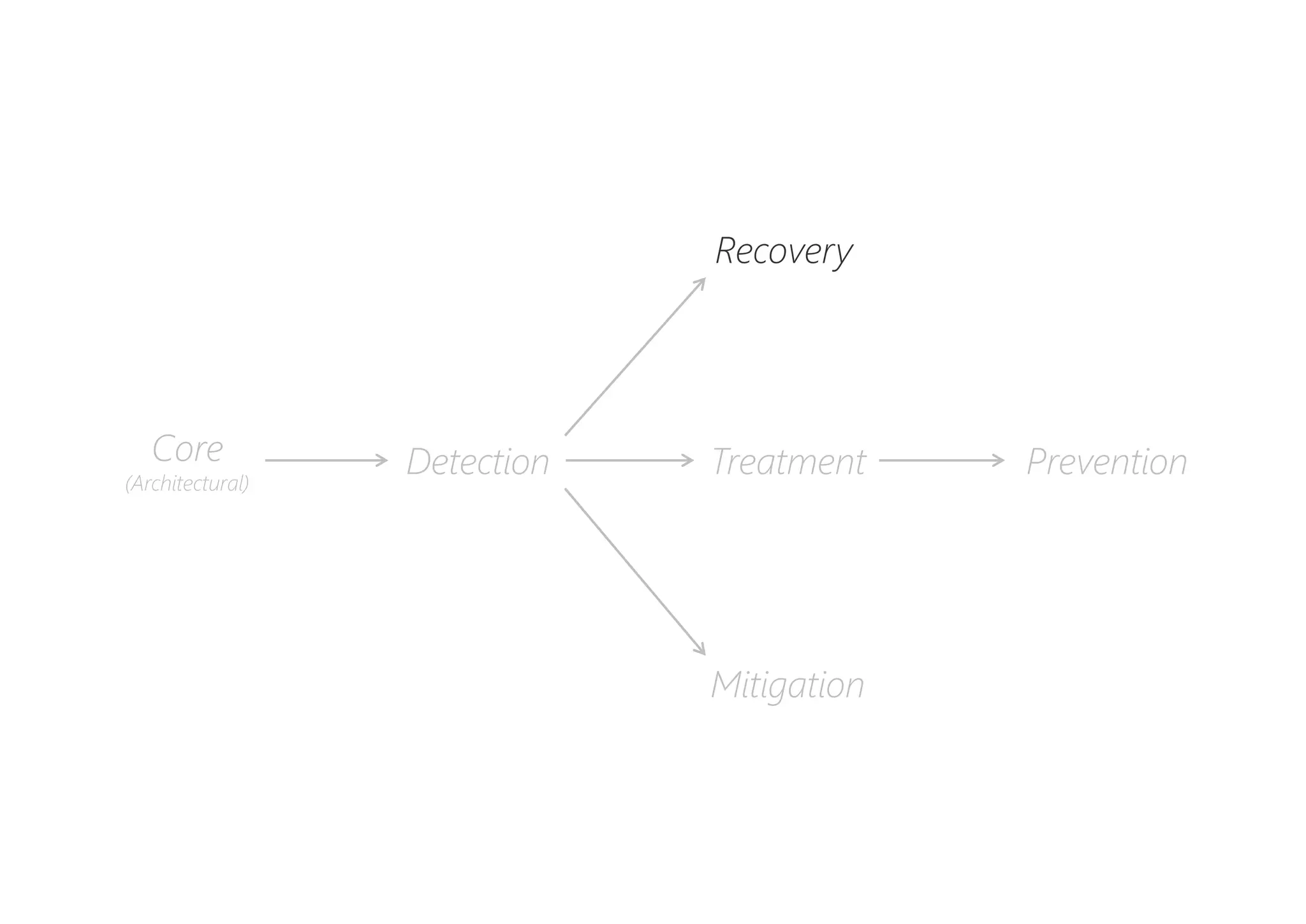
Recovery
Mitigation
Treatment
PreventionDetectionCore
(Architectural)
Recovery
Mitigation
Treatment
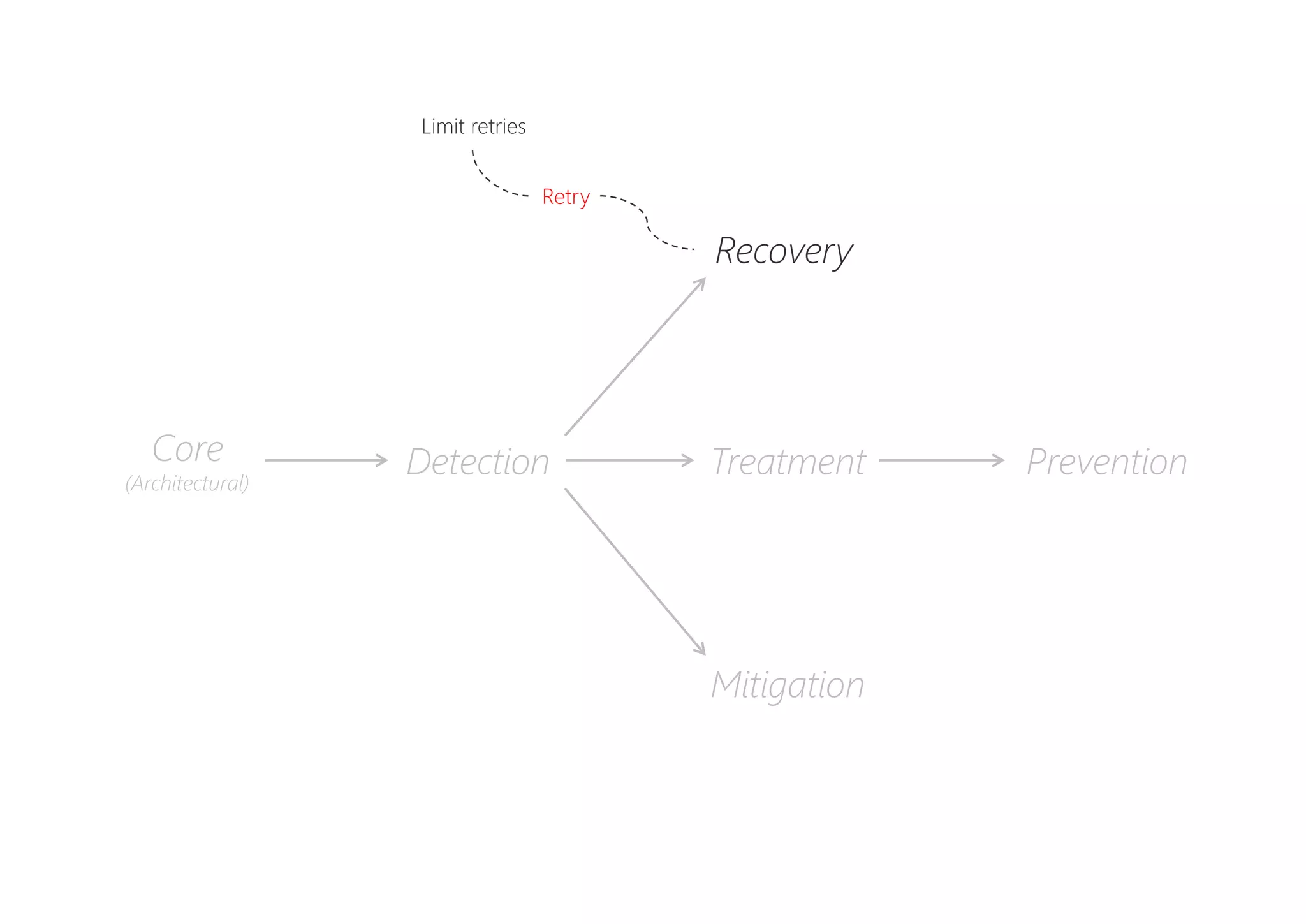
Retry
Limit retries
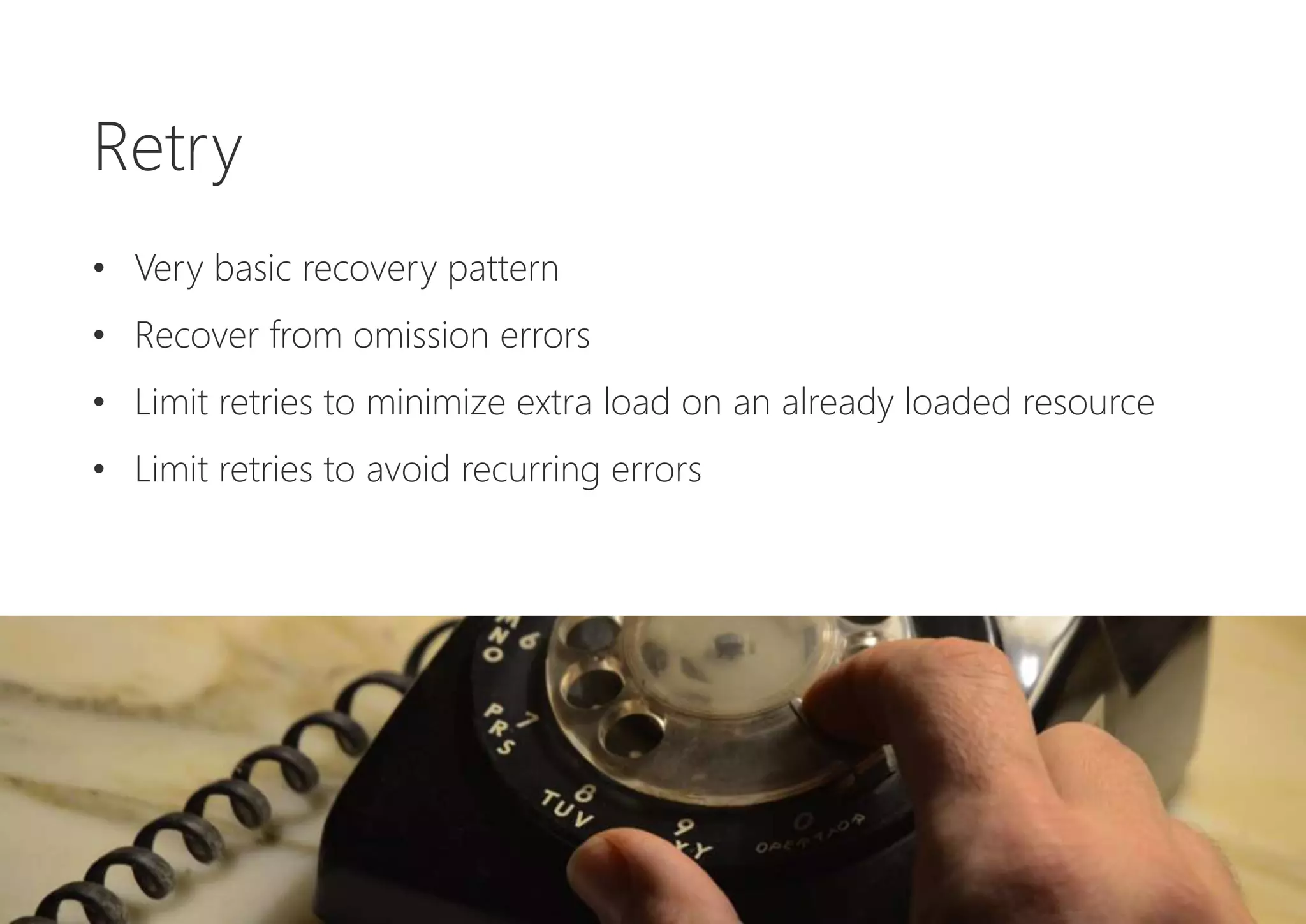
Retry
• Very basic recovery pattern
• Recover from omission errors
• Limit retries to minimize extra load on an already loaded resource
• Limit retries to avoid recurring errors
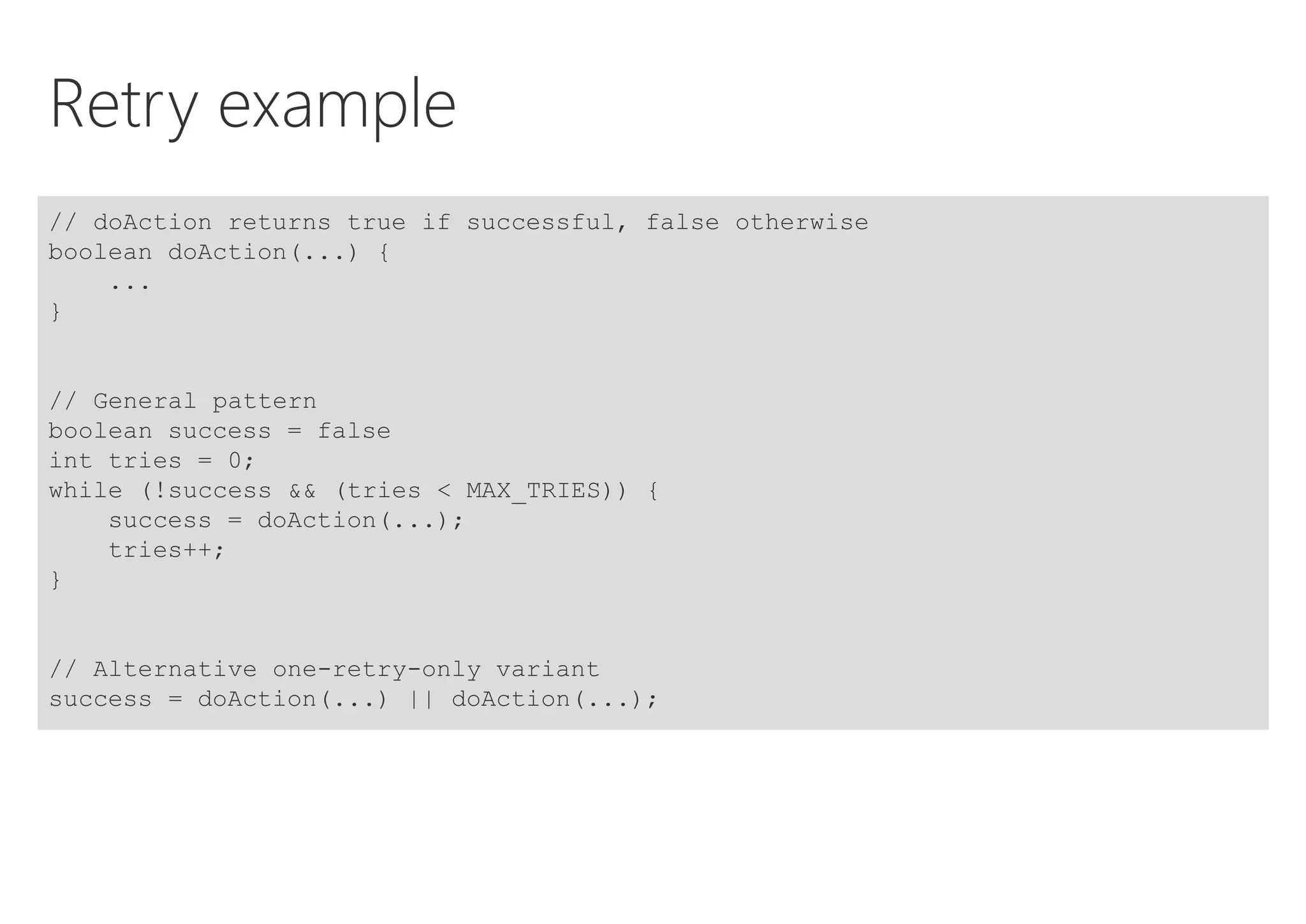
Retry example
// doAction returns true if successful, false otherwise
boolean doAction(...) {
...
}
// General pattern
boolean success = false
int tries = 0;
while (!success && (tries < MAX_TRIES)) {
success = doAction(...);
tries++;
}
// Alternative one-retry-only variant
success = doAction(...) || doAction(...);
PreventionDetectionCore
(Architectural)
Recovery
Mitigation
Treatment
Retry
Limit retries
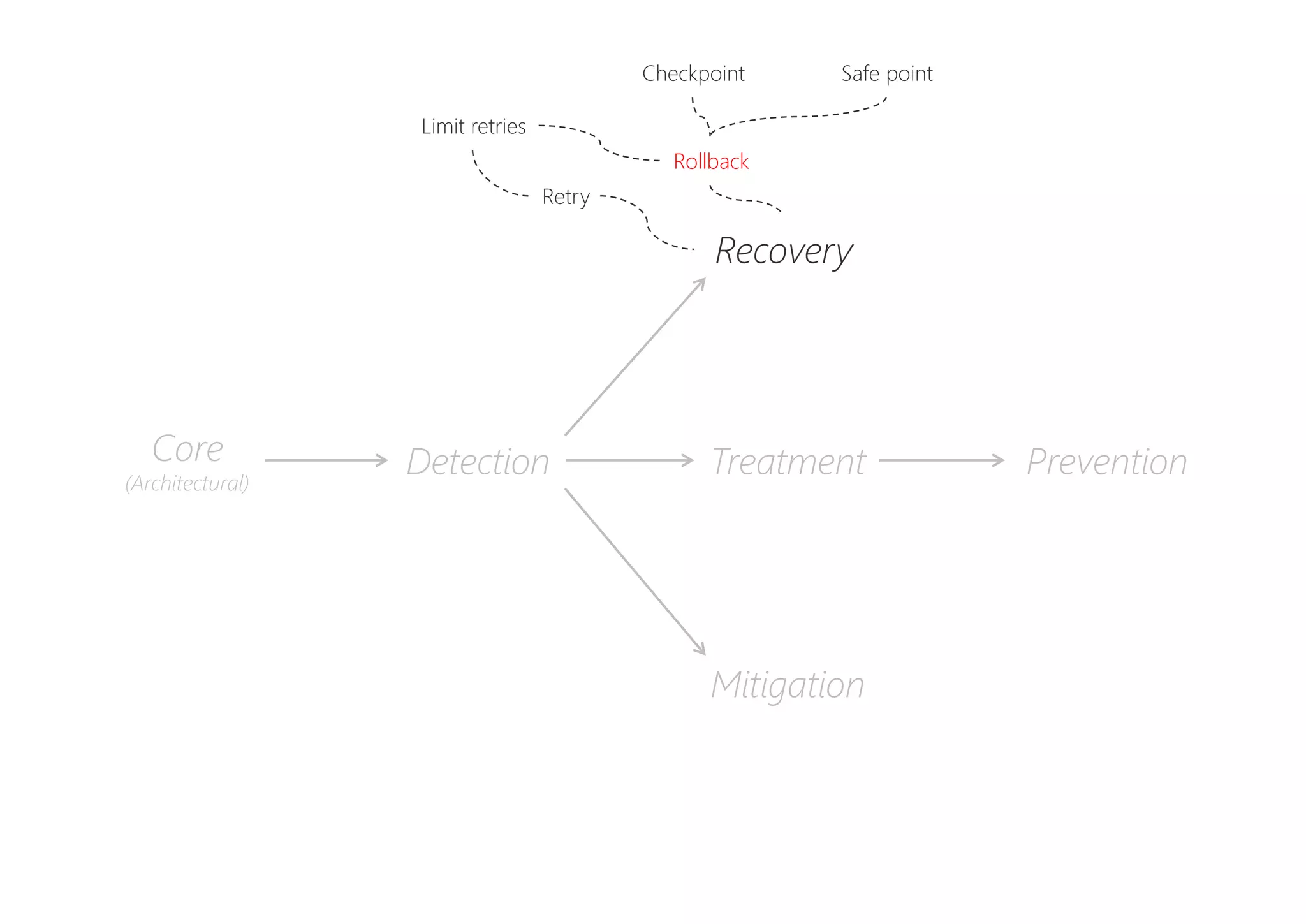
Rollback
Checkpoint Safe point
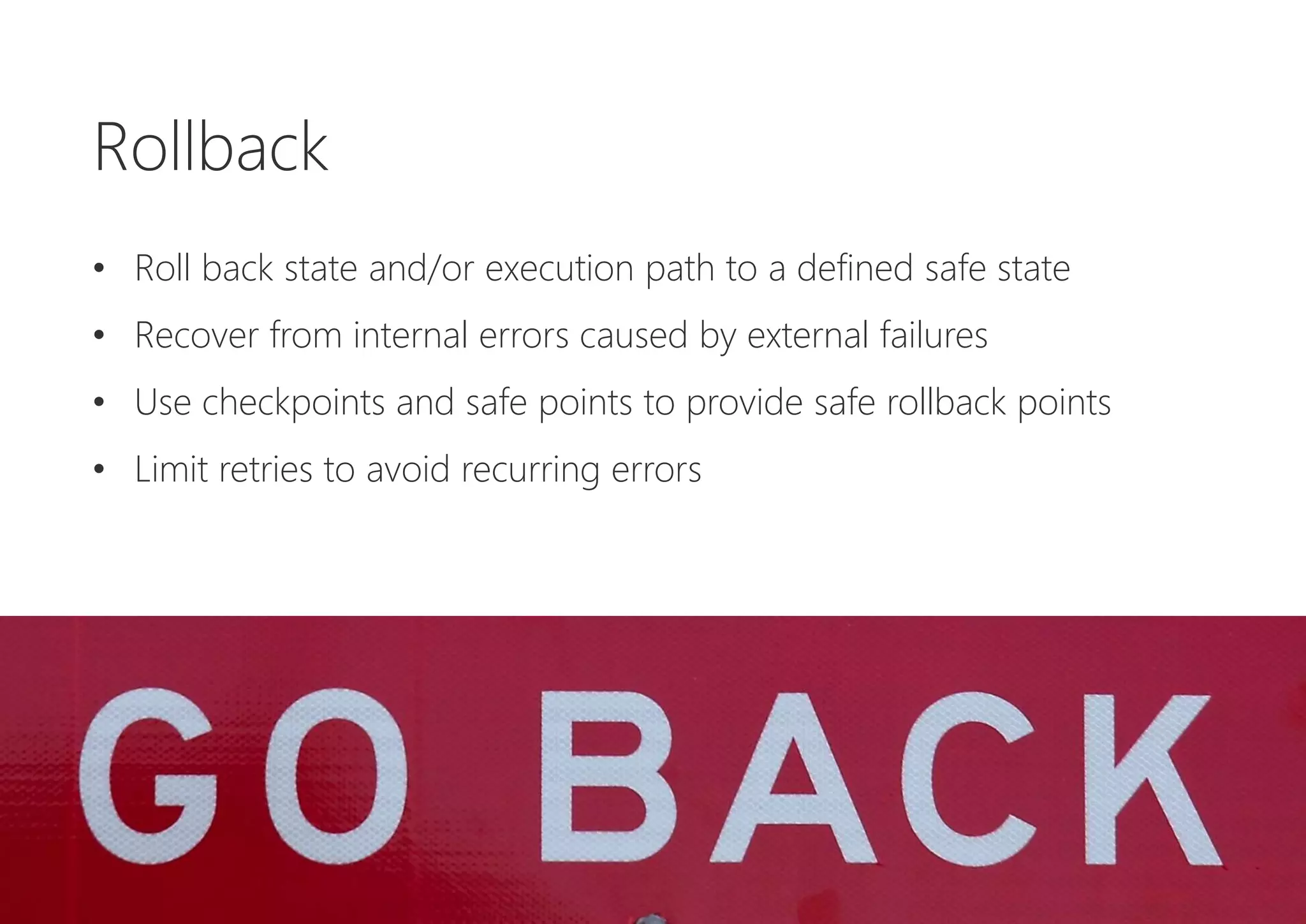
Rollback
• Roll back state and/or execution path to a defined safe state
• Recover from internal errors caused by external failures
• Use checkpoints and safe points to provide safe rollback points
• Limit retries to avoid recurring errors
PreventionDetectionCore
(Architectural)
Recovery
Mitigation
Treatment
Retry
Limit retries
Rollback
Checkpoint Safe point
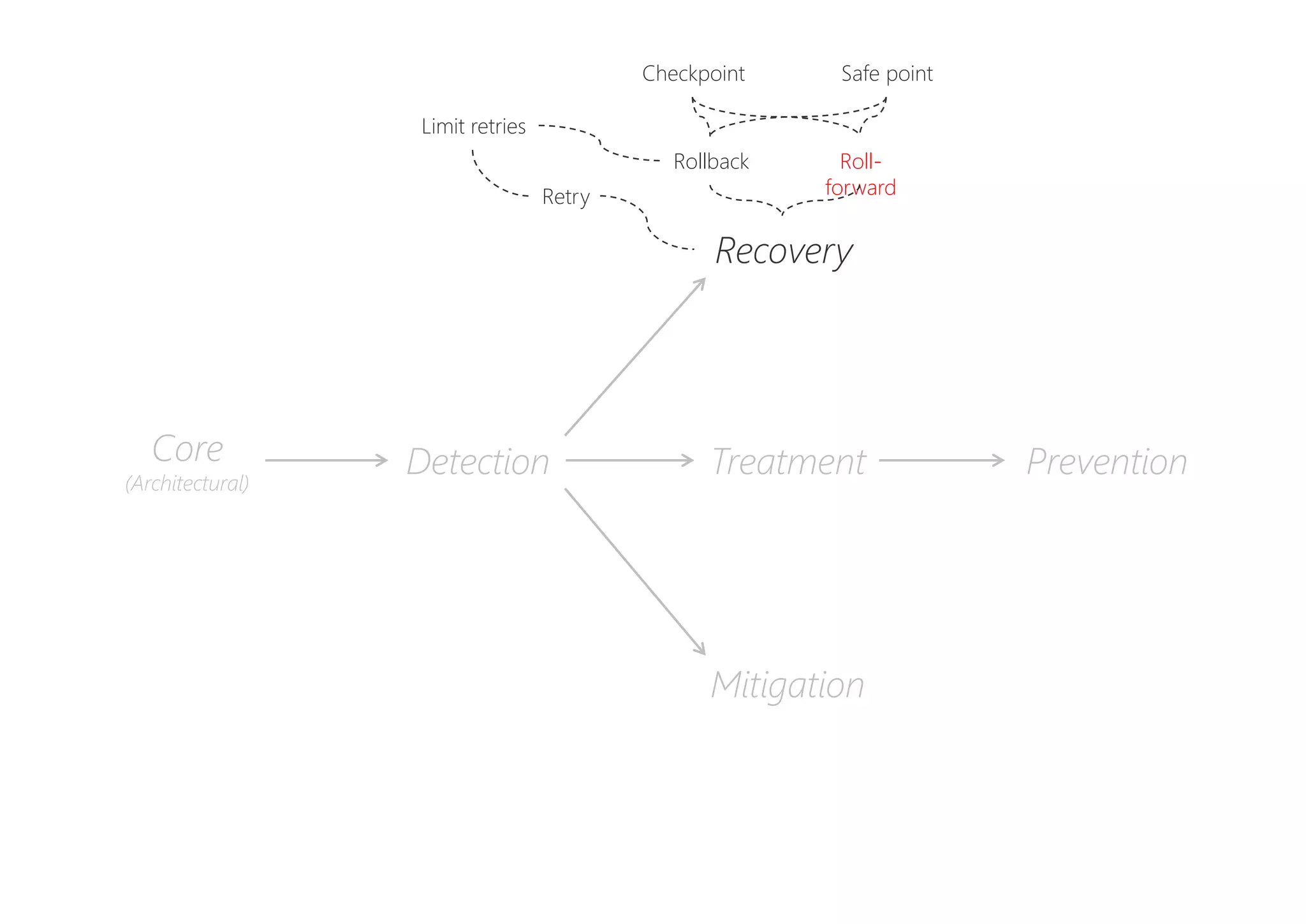
Roll-
forward
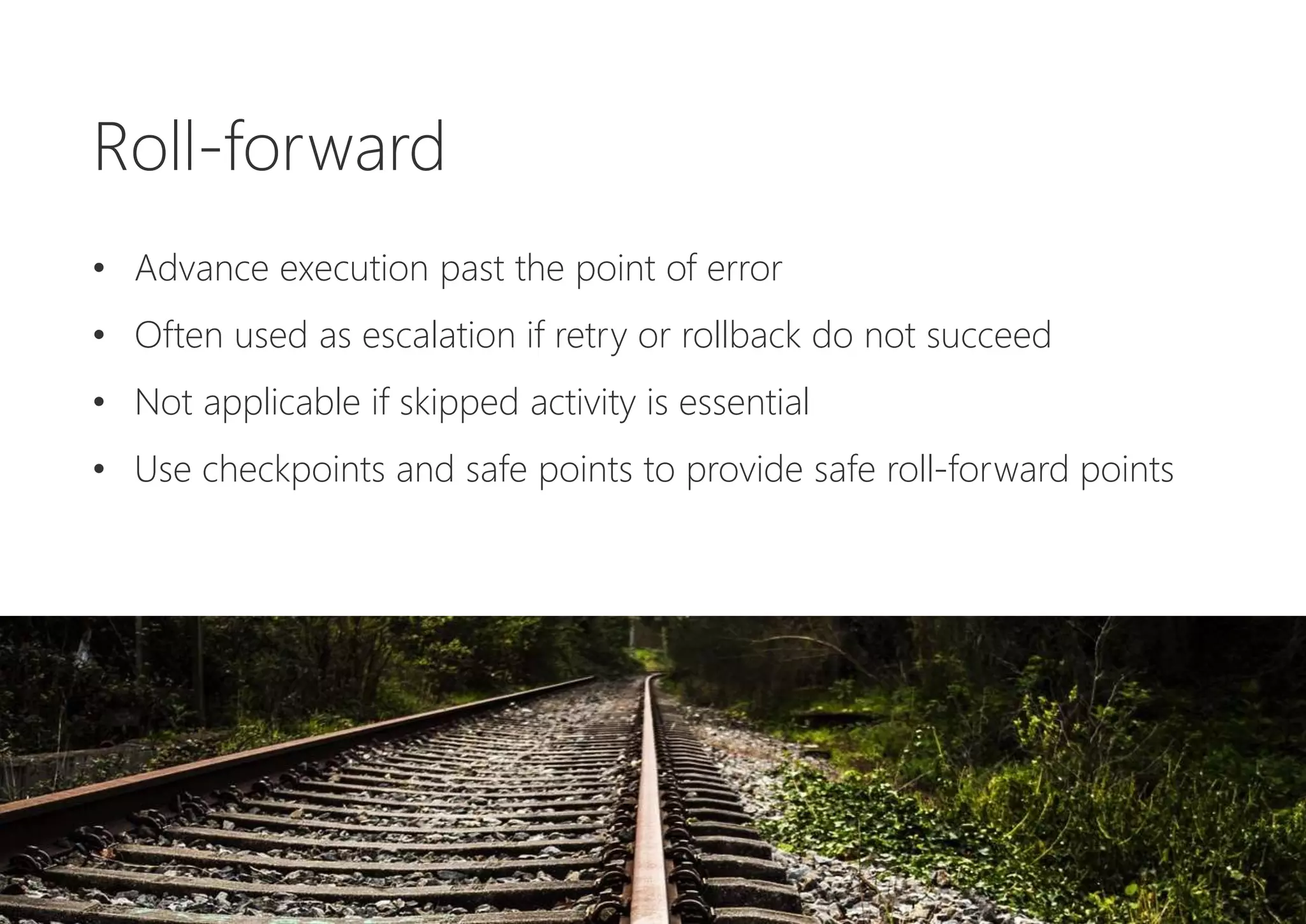
Roll-forward
• Advance execution past the point of error
• Often used as escalation if retry or rollback do not succeed
• Not applicable if skipped activity is essential
• Use checkpoints and safe points to provide safe roll-forward points
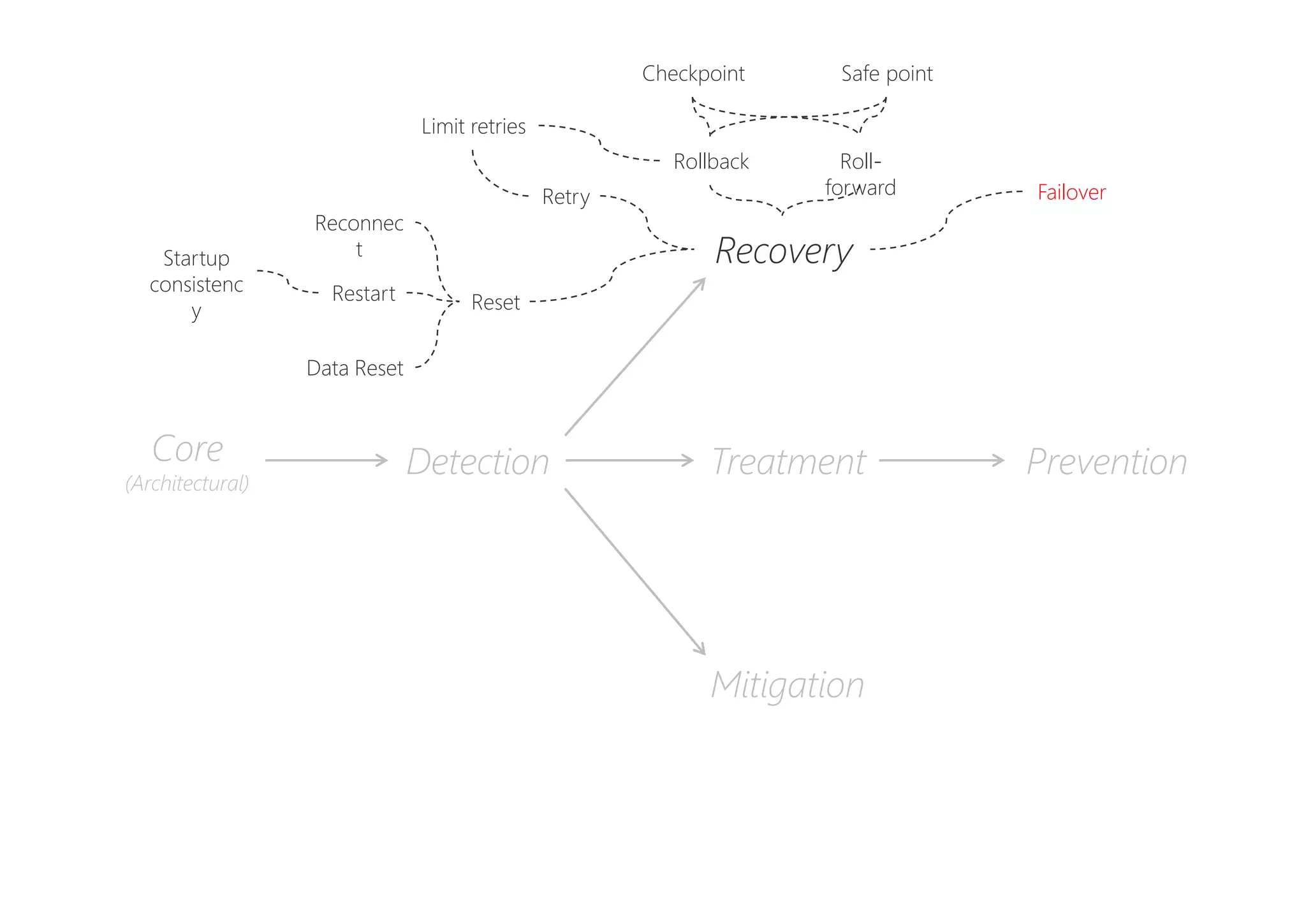
PreventionDetectionCore
(Architectural)
Recovery
Mitigation
Treatment
Retry
Limit retries
Rollback Roll-
forward
Checkpoint Safe point
Restart
Reconnec
t
Data Reset
Startup
consistenc
y Reset
Reset
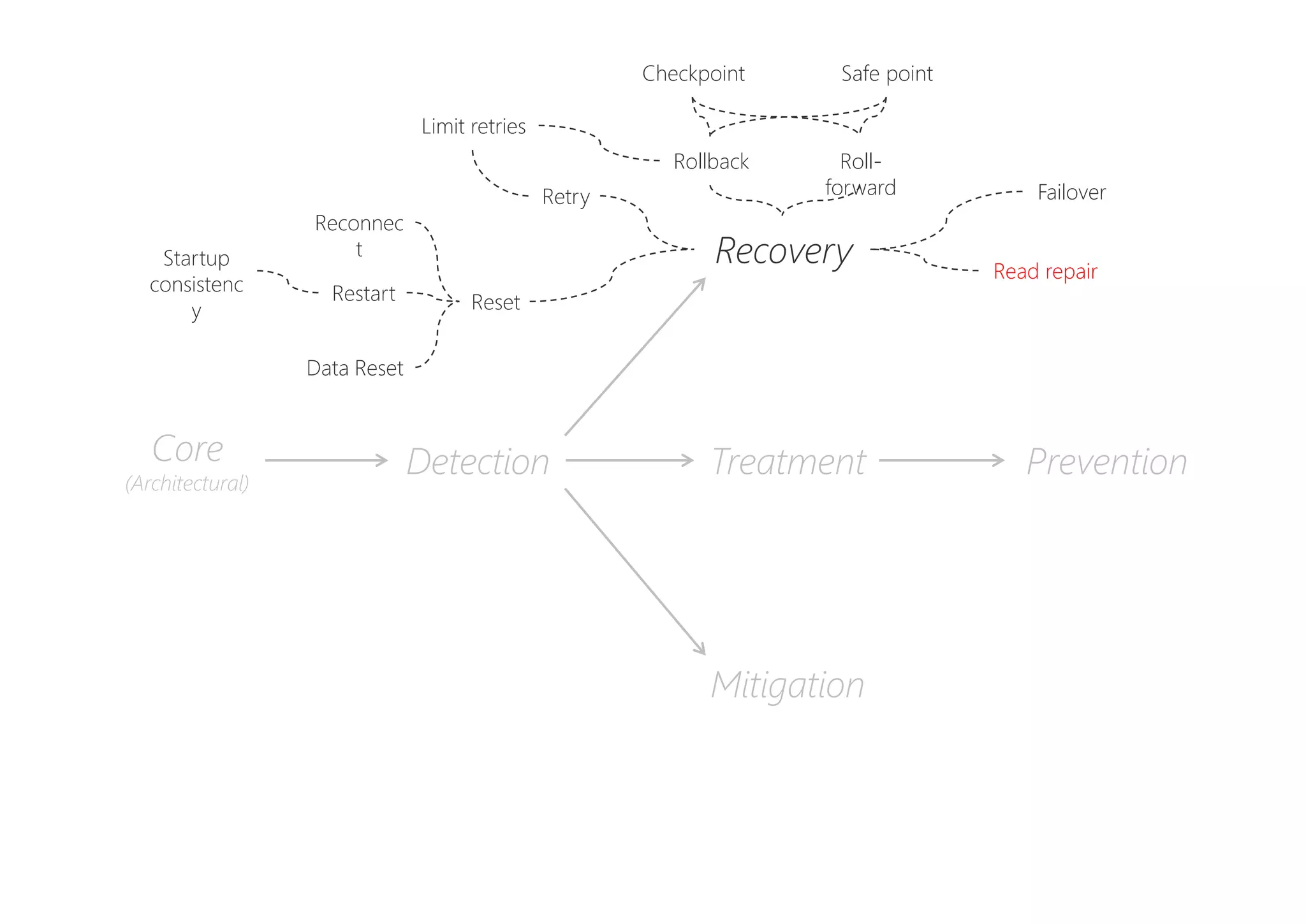
• Often used as radical escalation if all other measures failed
• Restart service – do not forget to provide a consistent startup state
• Reset data to a guaranteed consistent state if nothing else helps
• Sometimes simply trying to reconnect helps (often forgotten)
PreventionDetectionCore
(Architectural)
Recovery
Mitigation
Treatment
Retry
Limit retries
Rollback
Restart
Roll-
forward
Reconnec
t
Checkpoint Safe point
Data Reset
Startup
consistenc
y Reset
Failover
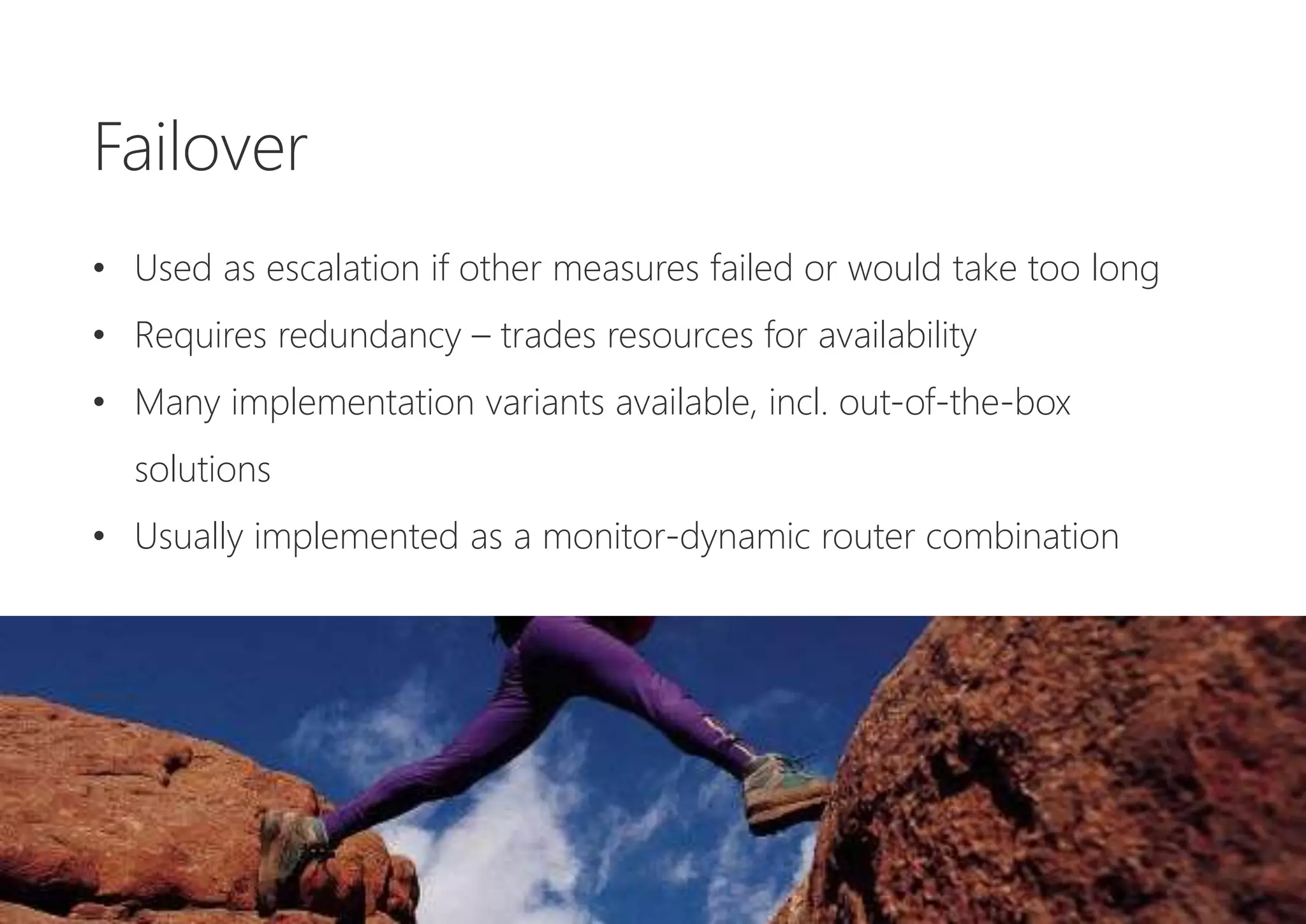
Failover
• Used as escalation if other measures failed or would take too long
• Requires redundancy – trades resources for availability
• Many implementation variants available, incl. out-of-the-box
solutions
• Usually implemented as a monitor-dynamic router combination
PreventionDetectionCore
(Architectural)
Recovery
Mitigation
Treatment
Retry
Limit retries
Rollback
Restart
Roll-
forward
Reconnec
t
Checkpoint Safe point
Data Reset
Startup
consistenc
y
Failover
Reset
Read repair
Read repair
• Handle response failures due to relaxed temporal constraints
• Requires redundancy – trades resources for availability
• Decides correct state based on conflicting siblings
• Often implemented in NoSQL databases (but not always accessible)
Read repair example (Riak, Java) 1/2
public class FooResolver implements ConflictResolver<Foo> {
@Override
public Foo resolve(List<Foo> siblings) {
// Insert your sibling resolution logic here
}
}
public class Buddy {
public String name;
public Set<String> nicknames;
public Buddy(String name, Set<String> nicknames) {
this.name = name;
this.nicknames = nicknames;
}
}
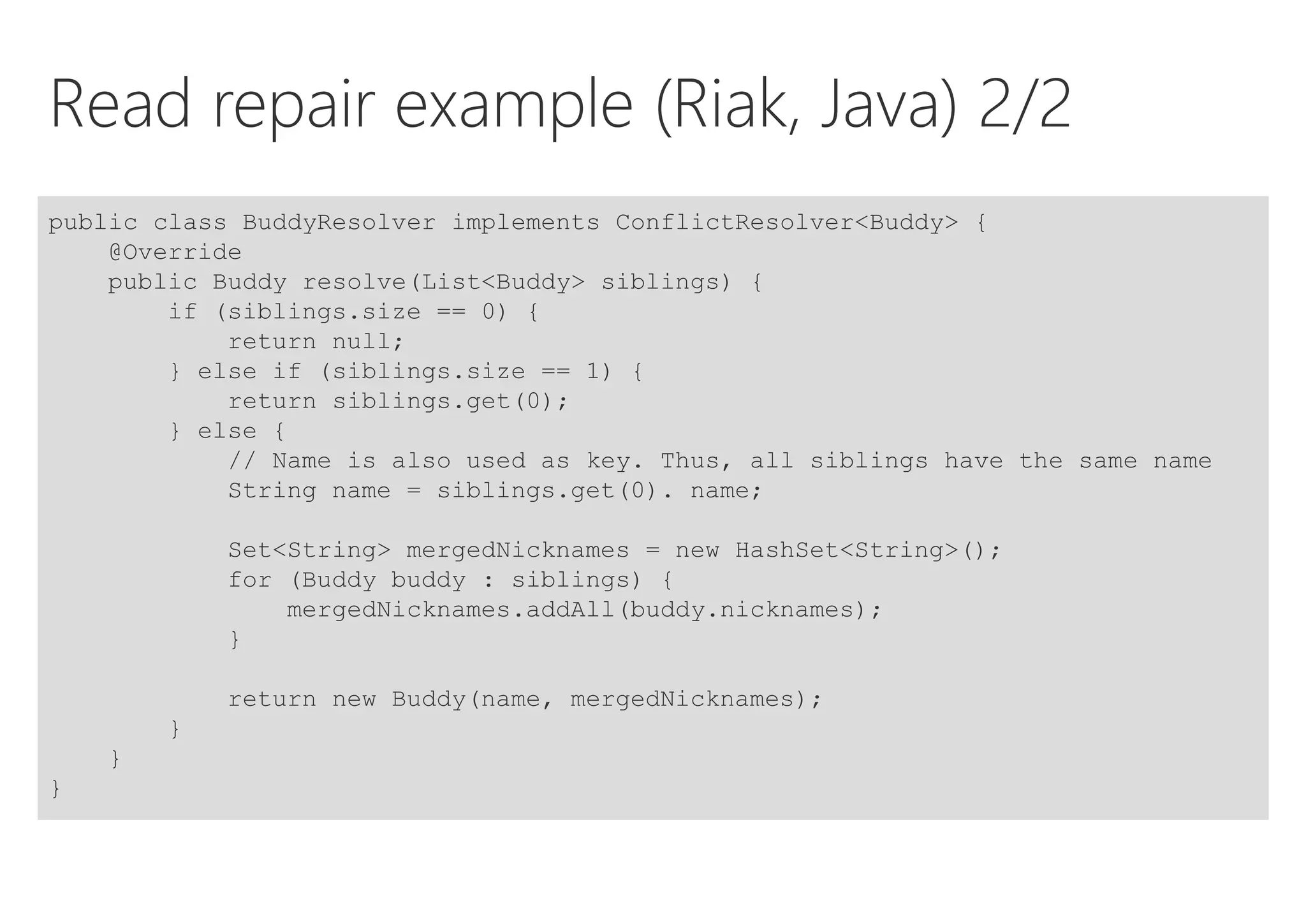
Read repair example (Riak, Java) 2/2
public class BuddyResolver implements ConflictResolver<Buddy> {
@Override
public Buddy resolve(List<Buddy> siblings) {
if (siblings.size == 0) {
return null;
} else if (siblings.size == 1) {
return siblings.get(0);
} else {
// Name is also used as key. Thus, all siblings have the same name
String name = siblings.get(0). name;
Set<String> mergedNicknames = new HashSet<String>();
for (Buddy buddy : siblings) {
mergedNicknames.addAll(buddy.nicknames);
}
return new Buddy(name, mergedNicknames);
}
}
}
PreventionDetectionCore
(Architectural)
Recovery
Mitigation
Treatment
Retry
Limit retries
Rollback
Restart
Roll-
forward
Reconnec
t
Checkpoint Safe point
Data Reset
Startup
consistenc
y
Failover
Read repair
Reset
Error handler
Error Handler
• Separate business logic and error handling
• Business logic just focuses on getting the task done
• Error handler focuses on recovering from errors

• Easier to maintain – can be extended to structural escalation
PreventionDetectionCore
(Architectural)
Recovery
Mitigation
Treatment
Retry
Limit retries
Rollback
Restart
Roll-
forward
Reconnec
t
Checkpoint Safe point
Data Reset
Startup
consistenc
y
Failover
Read repair
Error handler
Reset
PreventionDetectionCore
(Architectural)
Recovery
Mitigation
Treatment
PreventionDetectionCore
(Architectural)
Recovery
Mitigation
Treatment
Fallback
Fail
silently
Alternative action
Default value
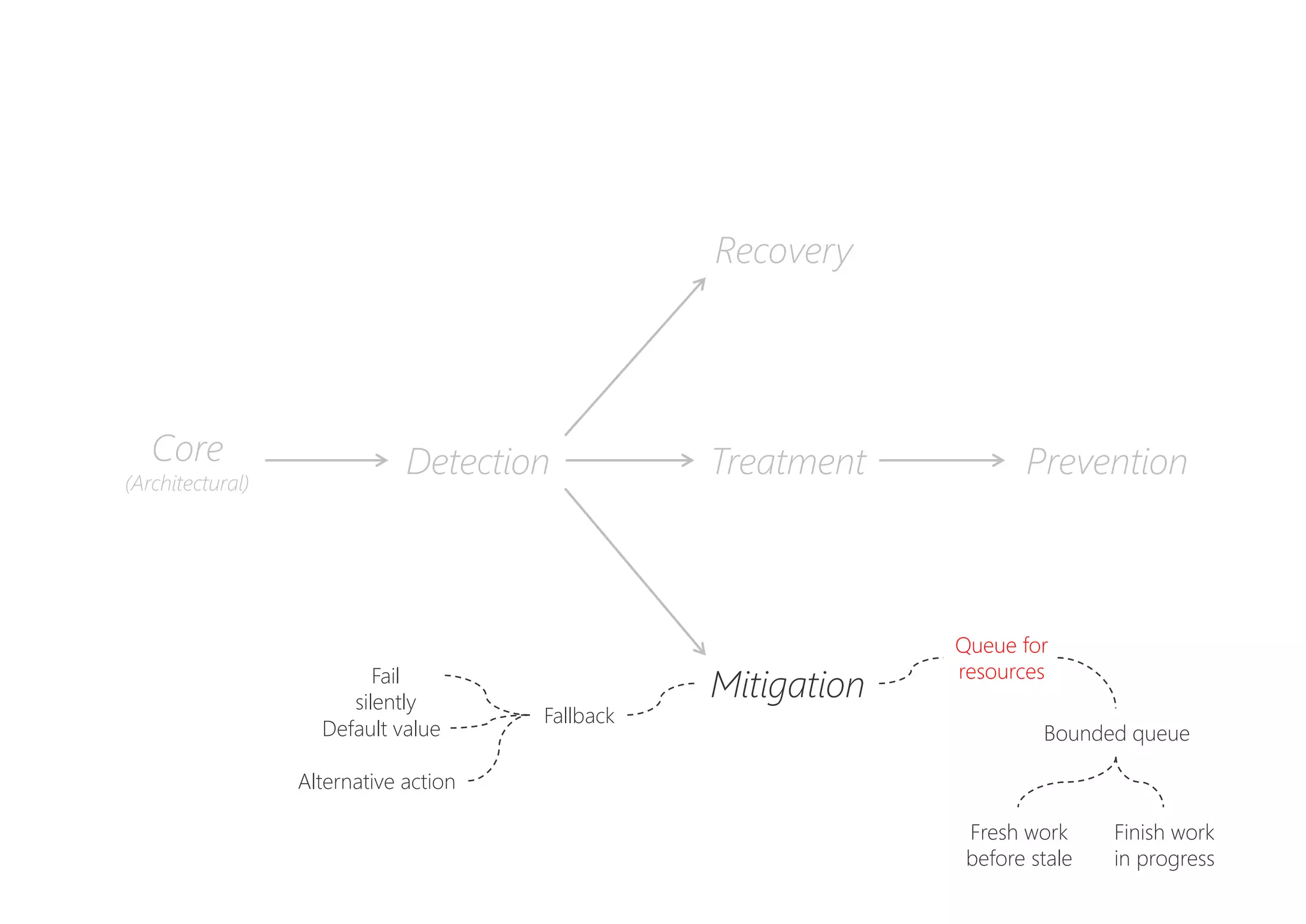
Fallback
• Execute an alternative action if the original action fails
• Basis for most mitigation patterns
• Fail silently – silently ignore the error and continue processing
• Default value – return a predefined default value if an error occurs
Default value example (Hystrix, Java) 1/2
public class DefaultValueCommand extends HystrixCommand<String> {
private static final String COMMAND_GROUP = "default”;
private final boolean preCondition;
public DefaultValueCommand(boolean preCondition) {
super(HystrixCommandGroupKey.Factory.asKey(COMMAND_GROUP));
this.preCondition = preCondition;
}
@Override
protected String run() throws Exception {
if (!preCondition)
throw new RuntimeException((”Action failed"));
return ”I am a result";
}
@Override
protected String getFallback() {
return ”I am a default value"; // Return default value if action fails
}
}
Default value example (Hystrix, Java) 2/2
@Test
public void shouldSucceed() {
DefaultValueCommand command = new DefaultValueCommand(true);
String s = command.execute();
assertEquals(”I am a result", s);
}
@Test
public void shouldProvideDefaultValue () {
DefaultValueCommand command = new DefaultValueCommand(false);
String s = null;
try {
s = command.execute();
} catch (Exception e) {
fail("Did not return default value");
}
assertEquals(”I am a default value", s);
}
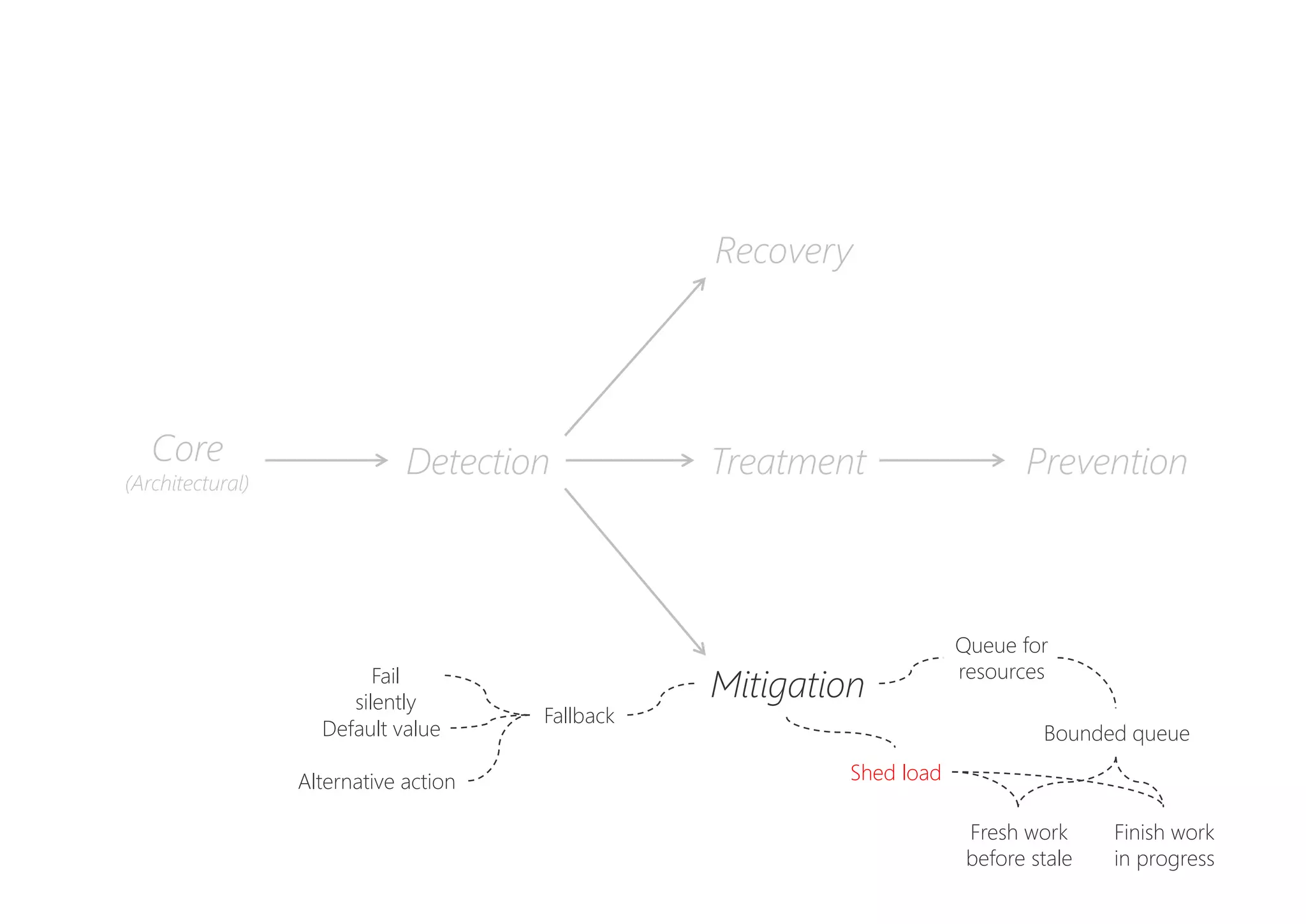
PreventionDetectionCore
(Architectural)
Recovery
Mitigation
Treatment
Fallback
Fail
silently
Alternative action
Default value
Queue for
resources
Bounded queue
Finish work
in progress
Fresh work
before stale
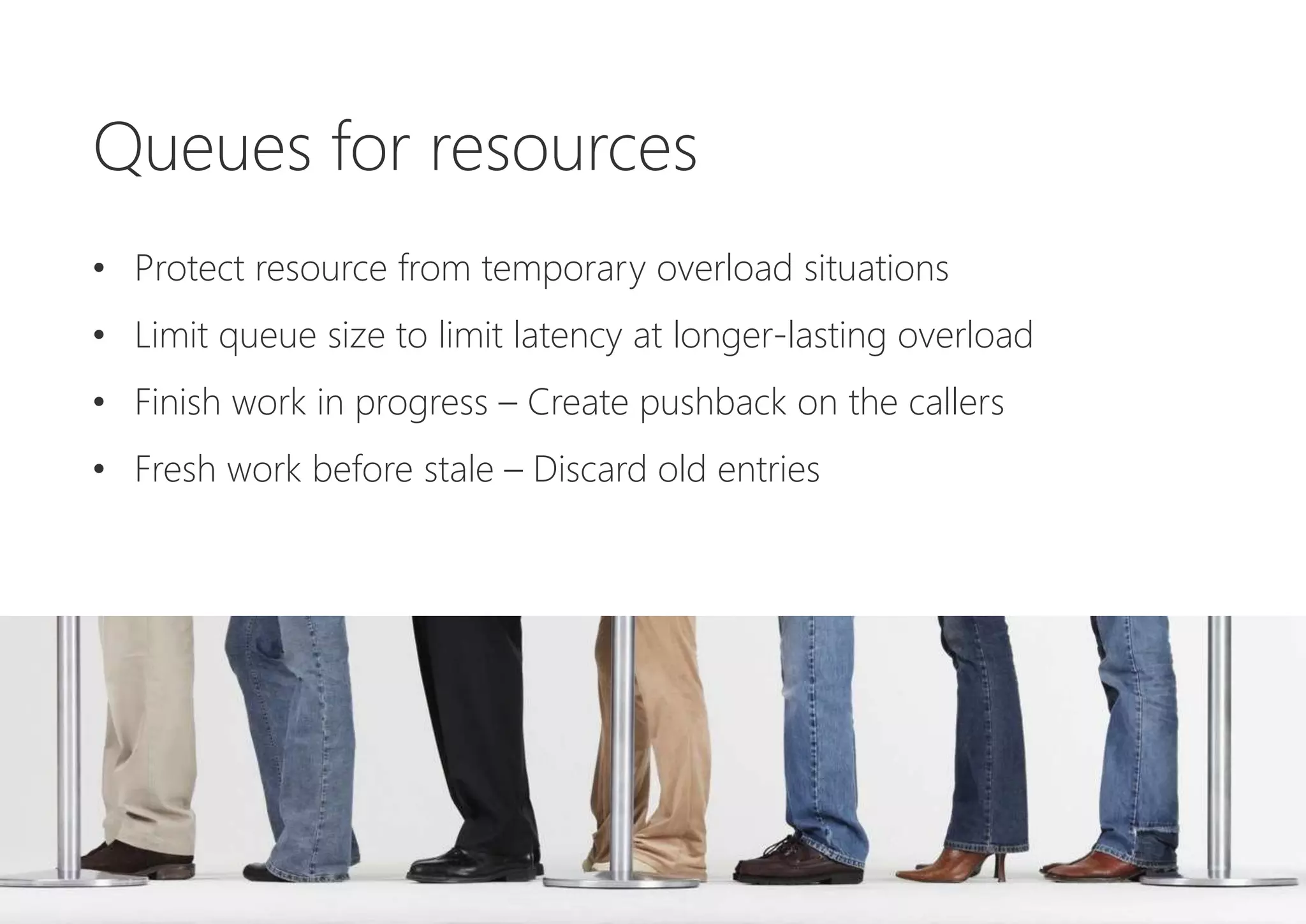
Queues for resources
• Protect resource from temporary overload situations
• Limit queue size to limit latency at longer-lasting overload
• Finish work in progress – Create pushback on the callers
• Fresh work before stale – Discard old entries
PreventionDetectionCore
(Architectural)
Recovery
Mitigation
Treatment
Fallback
Fail
silently
Alternative action
Default value
Queue for
resources
Bounded queue
Finish work
in progress
Fresh work
before stale
Shed load
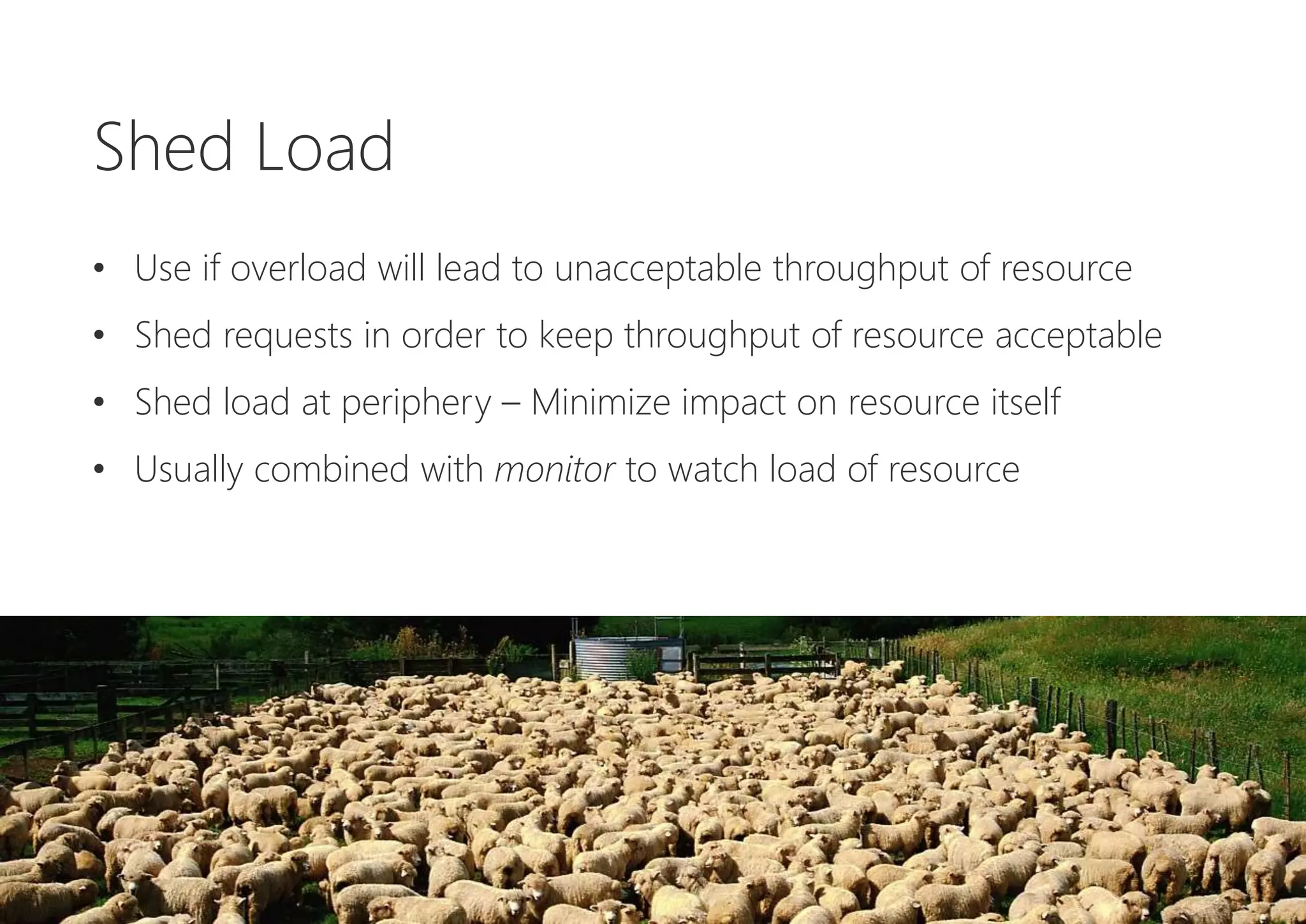
Shed Load
• Use if overload will lead to unacceptable throughput of resource
• Shed requests in order to keep throughput of resource acceptable
• Shed load at periphery – Minimize impact on resource itself
• Usually combined with monitor to watch load of resource
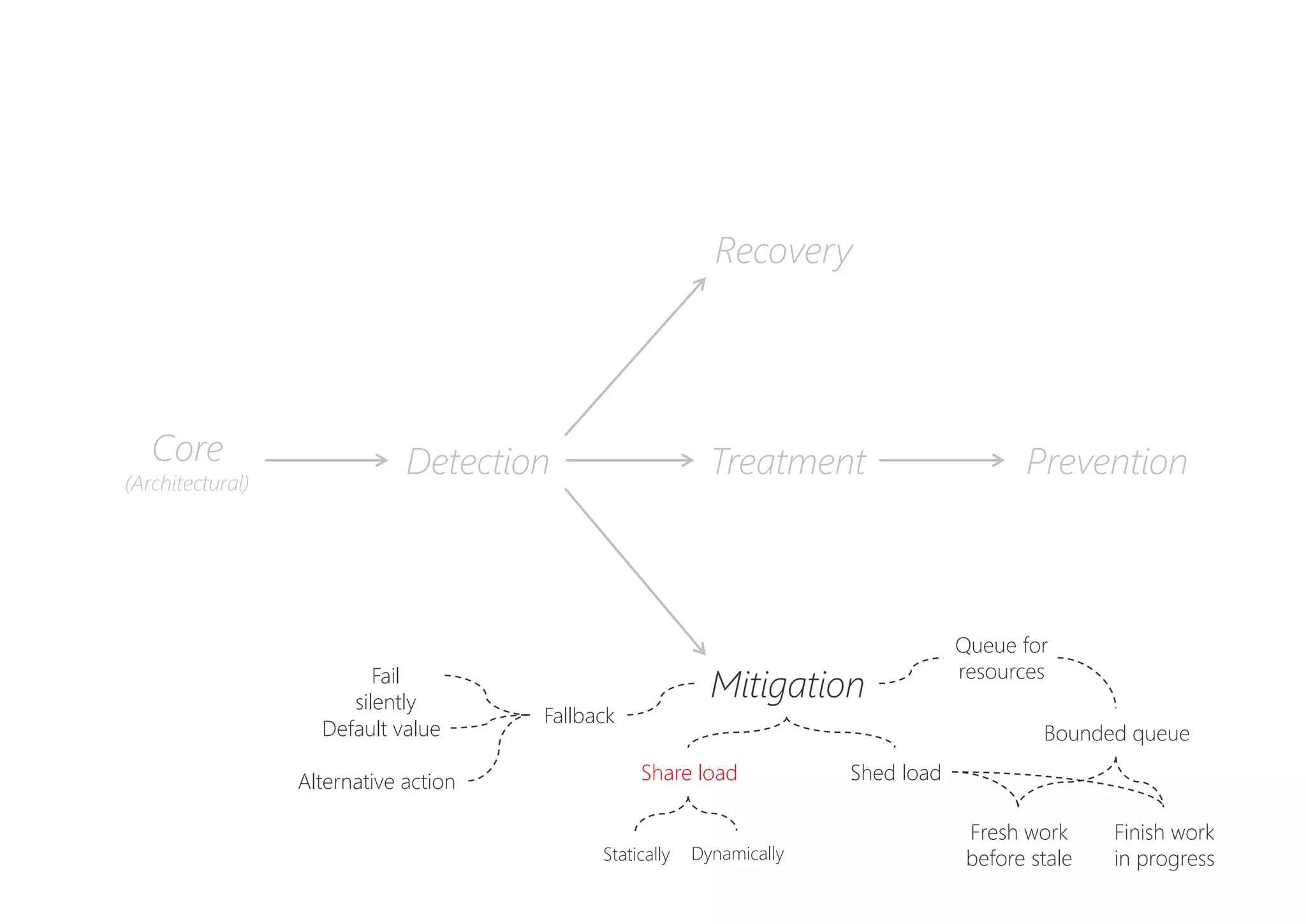
PreventionDetectionCore
(Architectural)
Recovery
Mitigation
Treatment
Fallback
Fail
silently
Alternative action
Default value
Shed load
Queue for
resources
Bounded queue
Finish work
in progress
Fresh work
before stale
Share load
Statically Dynamically
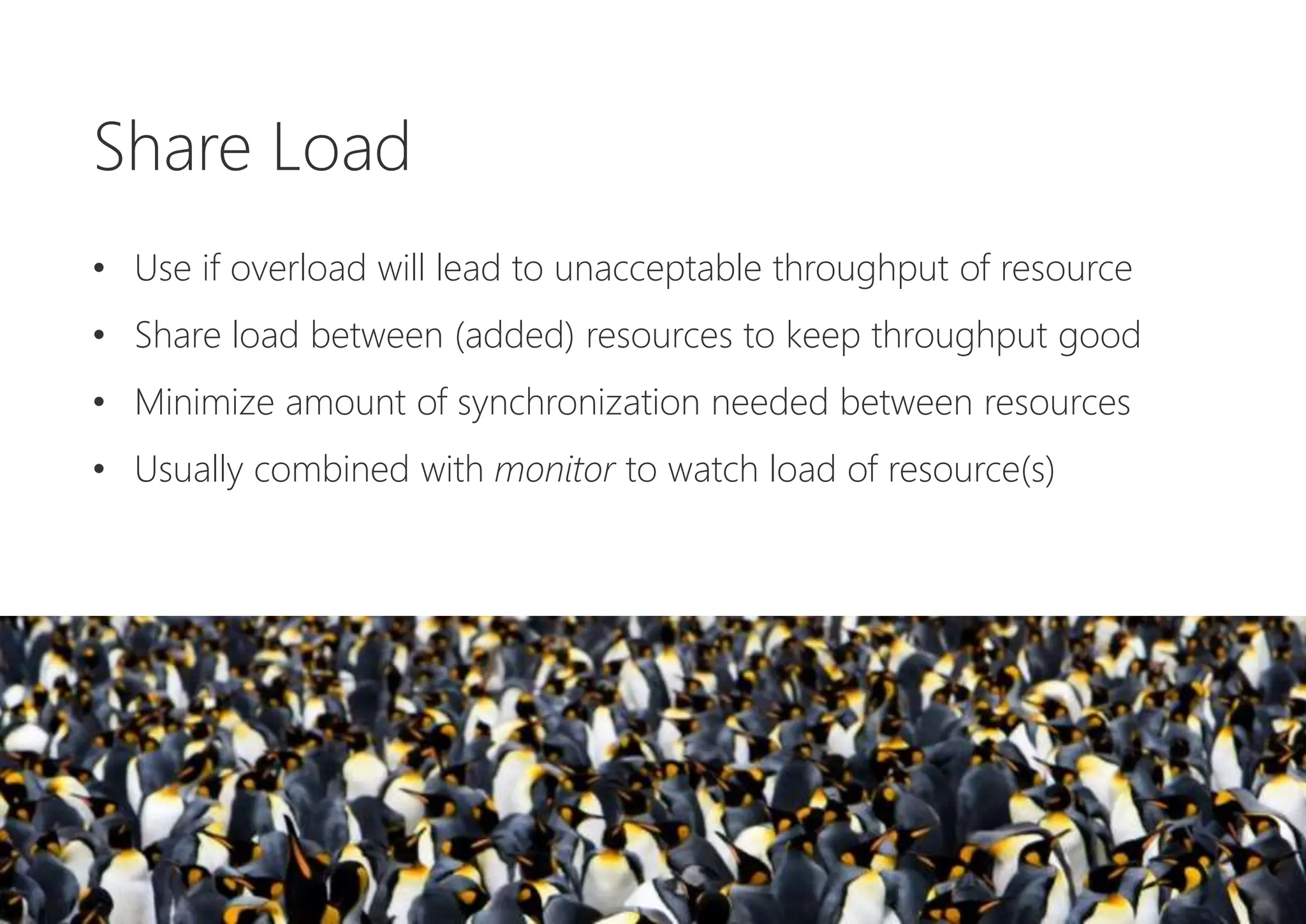
Share Load
• Use if overload will lead to unacceptable throughput of resource
• Share load between (added) resources to keep throughput good
• Minimize amount of synchronization needed between resources
• Usually combined with monitor to watch load of resource(s)
PreventionDetectionCore
(Architectural)
Recovery
Mitigation
Treatment
Fallback
Fail
silently
Alternative action
Default value
Shed loadShare load
Queue for
resources
Bounded queue
Finish work
in progress
Fresh work
before staleStatically Dynamically
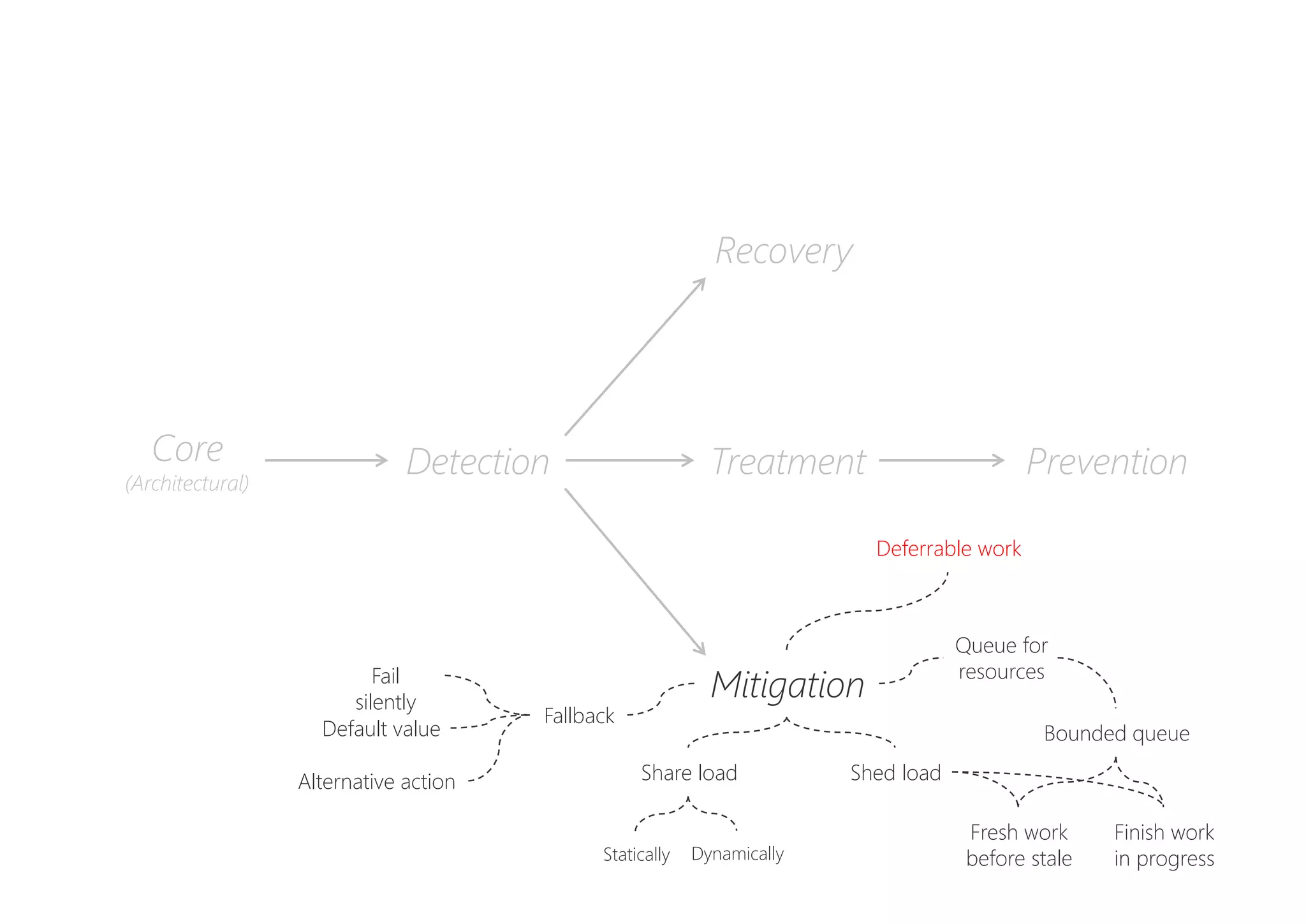
Deferrable work
Deferrable work
• Maximize resources for online request processing under high load
• Pause or slow down routine and batch jobs
• Provide a means to pause routine and batch jobs from outside
• Alternatively use a scheduler with dynamic resource allocation
PreventionDetectionCore
(Architectural)
Recovery
Mitigation
Treatment
Fallback
Fail
silently
Alternative action
Default value
Shed loadShare load
Queue for
resources
Bounded queue
Finish work
in progress
Fresh work
before stale
Marked data
Statically Dynamically
Deferrable work
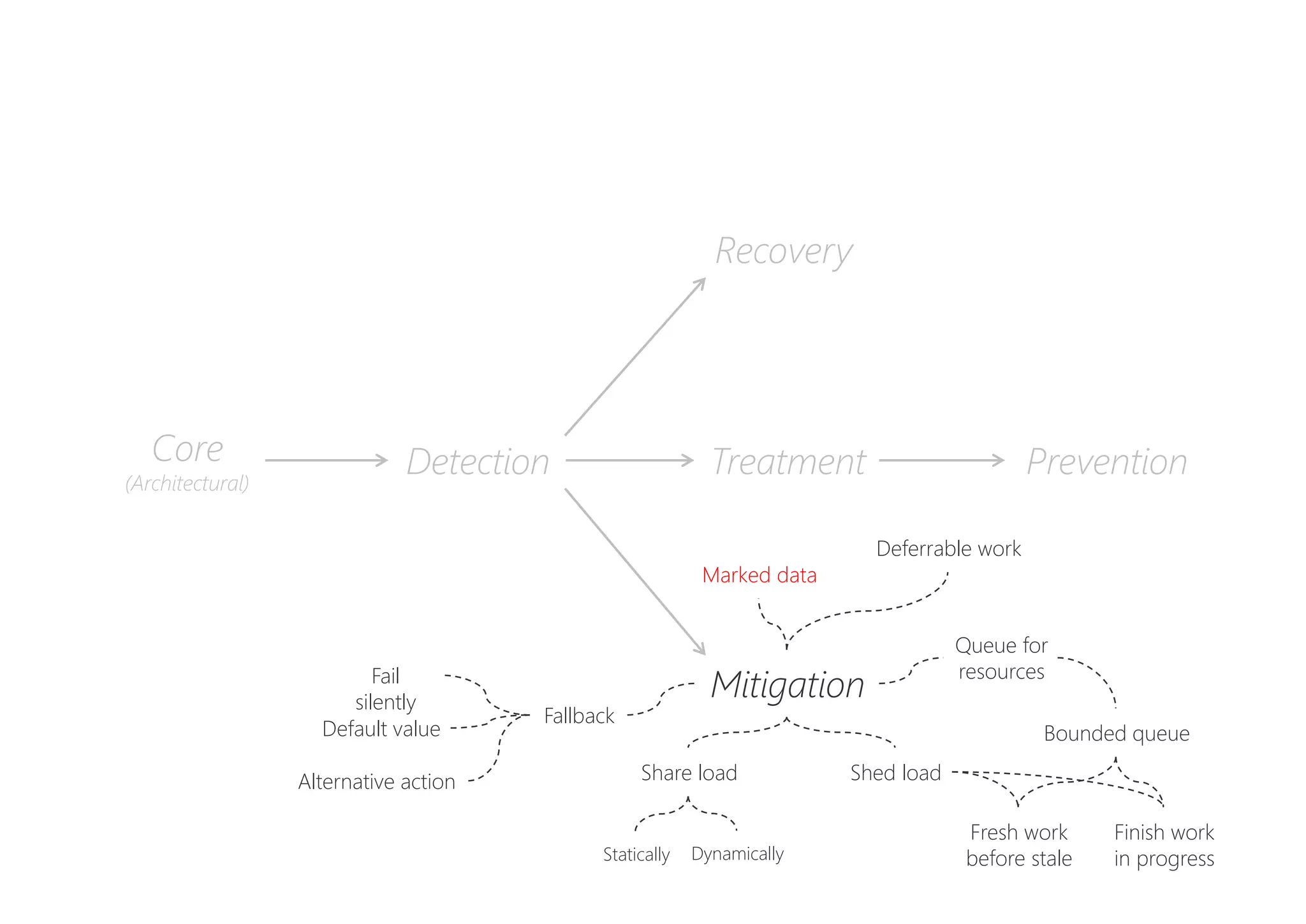
Marked data
• Avoid repeated and/or spreading errors due to erroneous data
• Use if time or information to correct data immediately is missing
• Mark data as being erroneous – check flag before processing data
• Use routine maintenance job to correct data
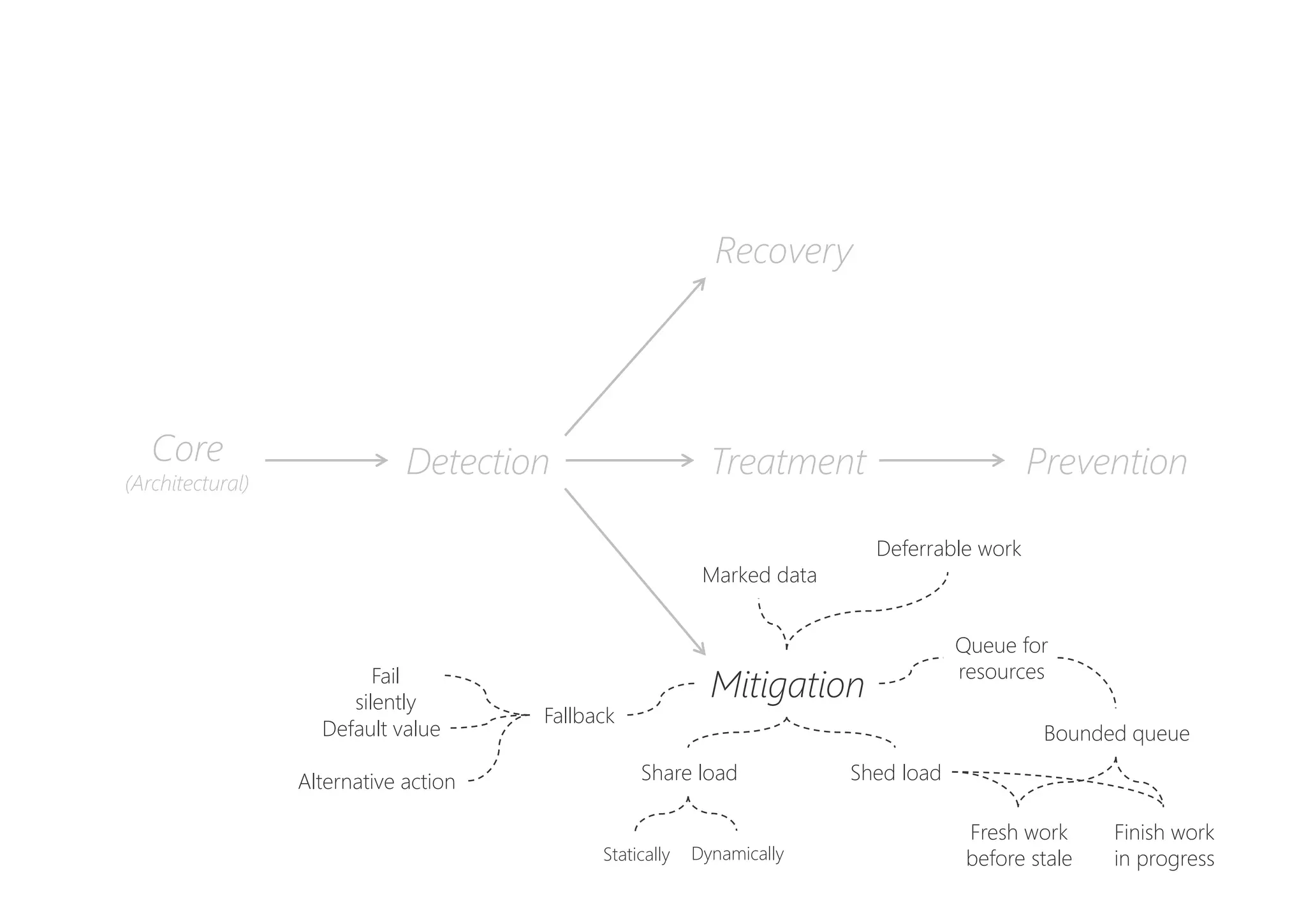
PreventionDetectionCore
(Architectural)
Recovery
Mitigation
Treatment
Fallback
Fail
silently
Alternative action
Default value
Shed loadShare load
Marked data
Queue for
resources
Bounded queue
Finish work
in progress
Fresh work
before staleStatically Dynamically
Deferrable work
PreventionDetectionCore
(Architectural)
Recovery
Mitigation
Treatment
PreventionDetectionCore
(Architectural)
Recovery
Mitigation
Treatment
Let sleeping dogs lie
Small releasesHot deployments
PreventionDetectionCore
(Architectural)
Recovery
Mitigation
Treatment
PreventionDetectionCore
(Architectural)
Recovery
Mitigation
Treatment
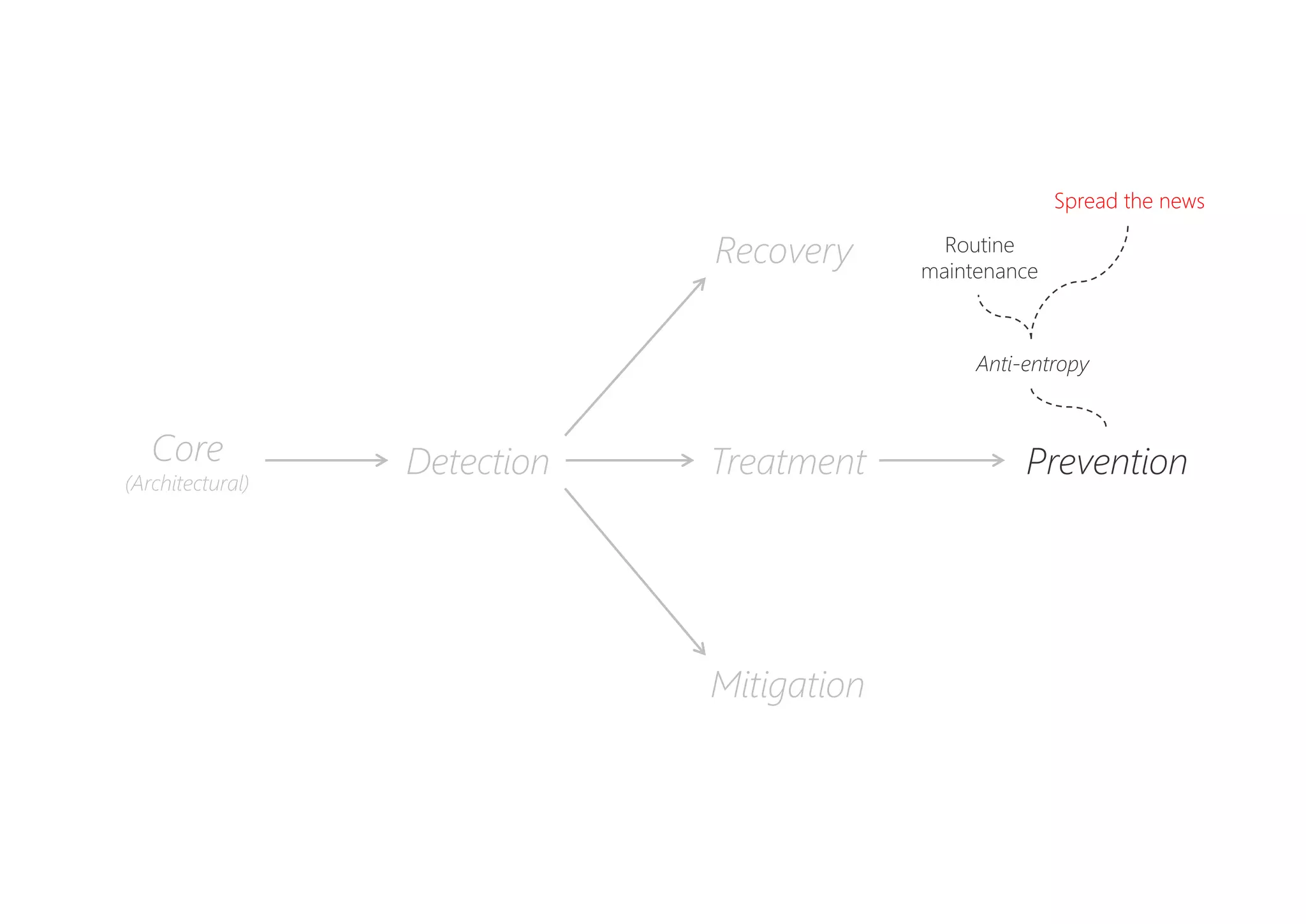
Routine
maintenance
Anti-entropy
Routine maintenance
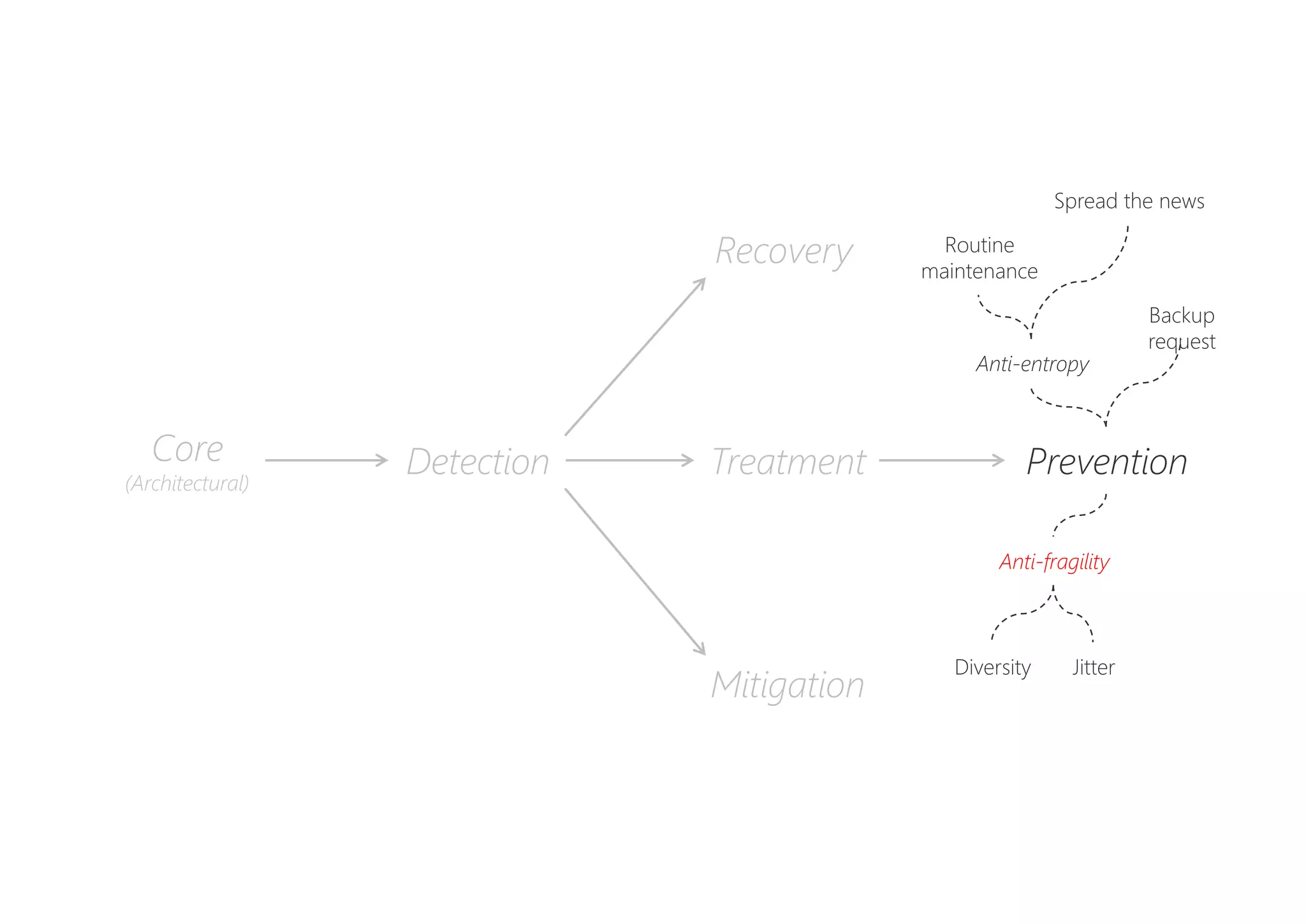
• Reduce system entropy – keep preventable errors from occurring
• Especially important if errors were only mitigated, not corrected
• Check system periodically and fix detected faults and errors
• Balance benefits, costs and additional system load
PreventionDetectionCore
(Architectural)
Recovery
Mitigation
Treatment
Routine
maintenance
Spread the news
Anti-entropy
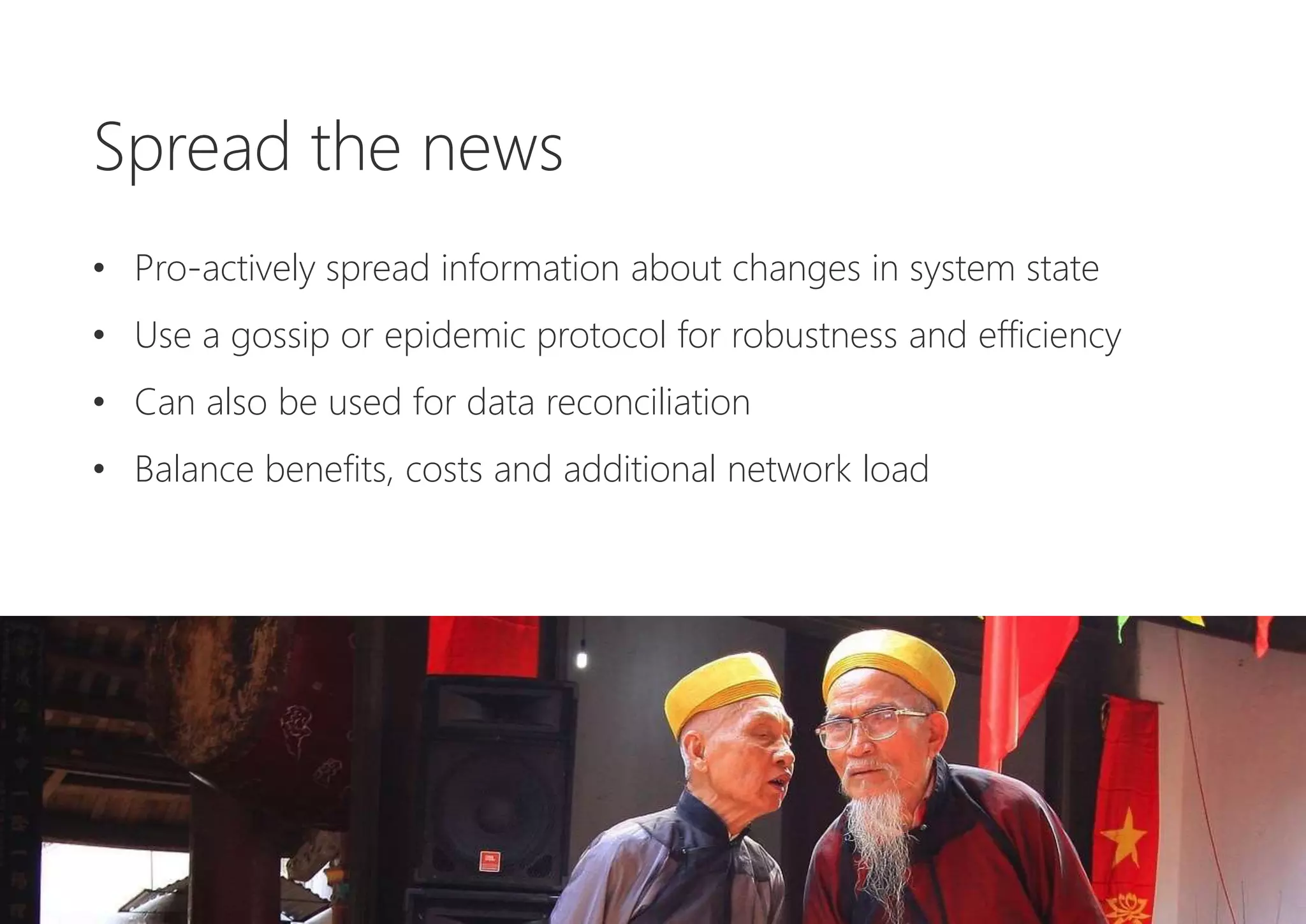
Spread the news
• Pro-actively spread information about changes in system state
• Use a gossip or epidemic protocol for robustness and efficiency
• Can also be used for data reconciliation
• Balance benefits, costs and additional network load
PreventionDetectionCore
(Architectural)
Recovery
Mitigation
Treatment
Routine
maintenance
Backup
request
Spread the news
Anti-entropy
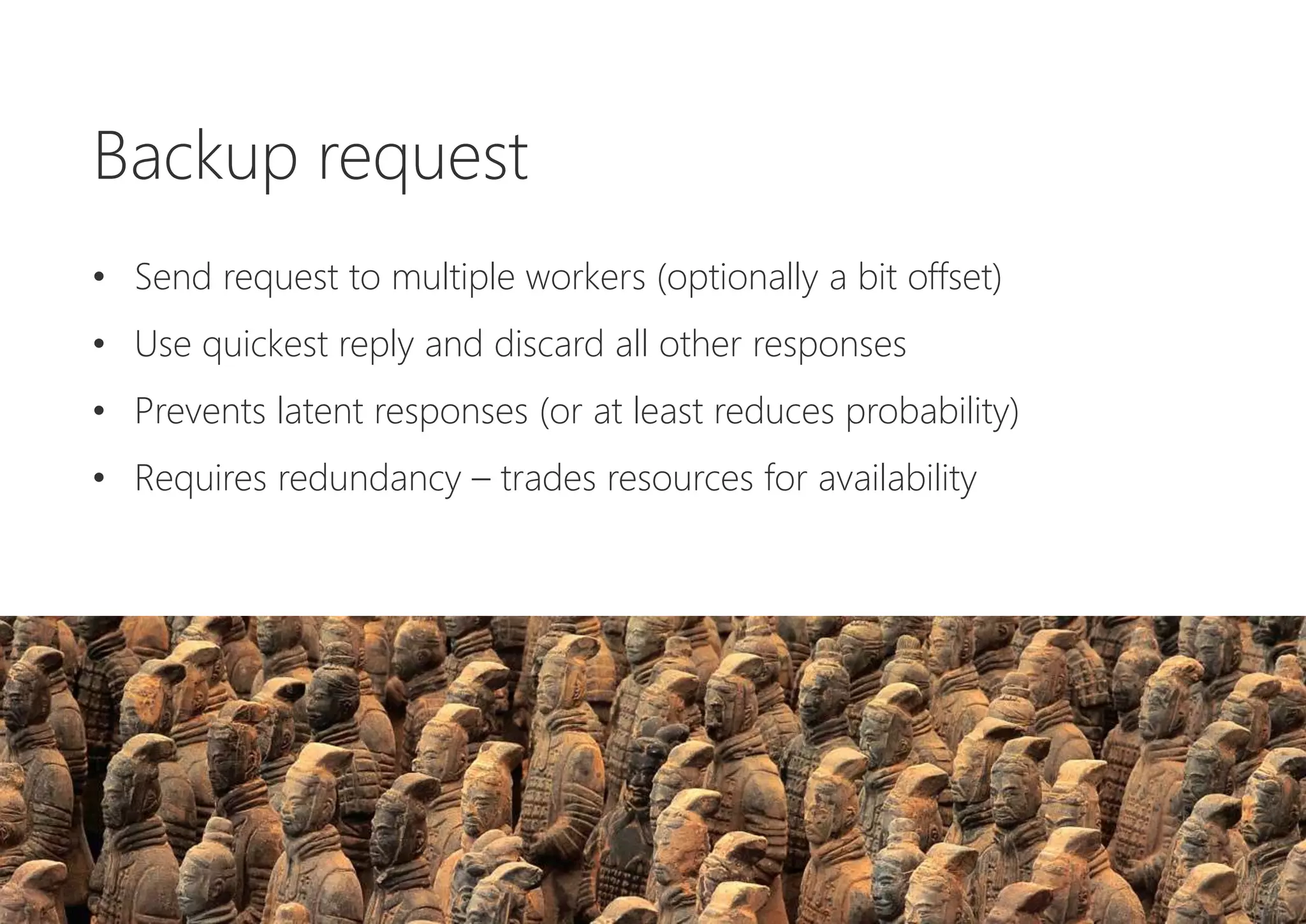
Backup request
• Send request to multiple workers (optionally a bit offset)
• Use quickest reply and discard all other responses
• Prevents latent responses (or at least reduces probability)
• Requires redundancy – trades resources for availability
PreventionDetectionCore
(Architectural)
Recovery
Mitigation
Treatment
Routine
maintenance
Backup
request
Anti-fragility
Diversity Jitter
Spread the news
Anti-entropy
Anti-fragility
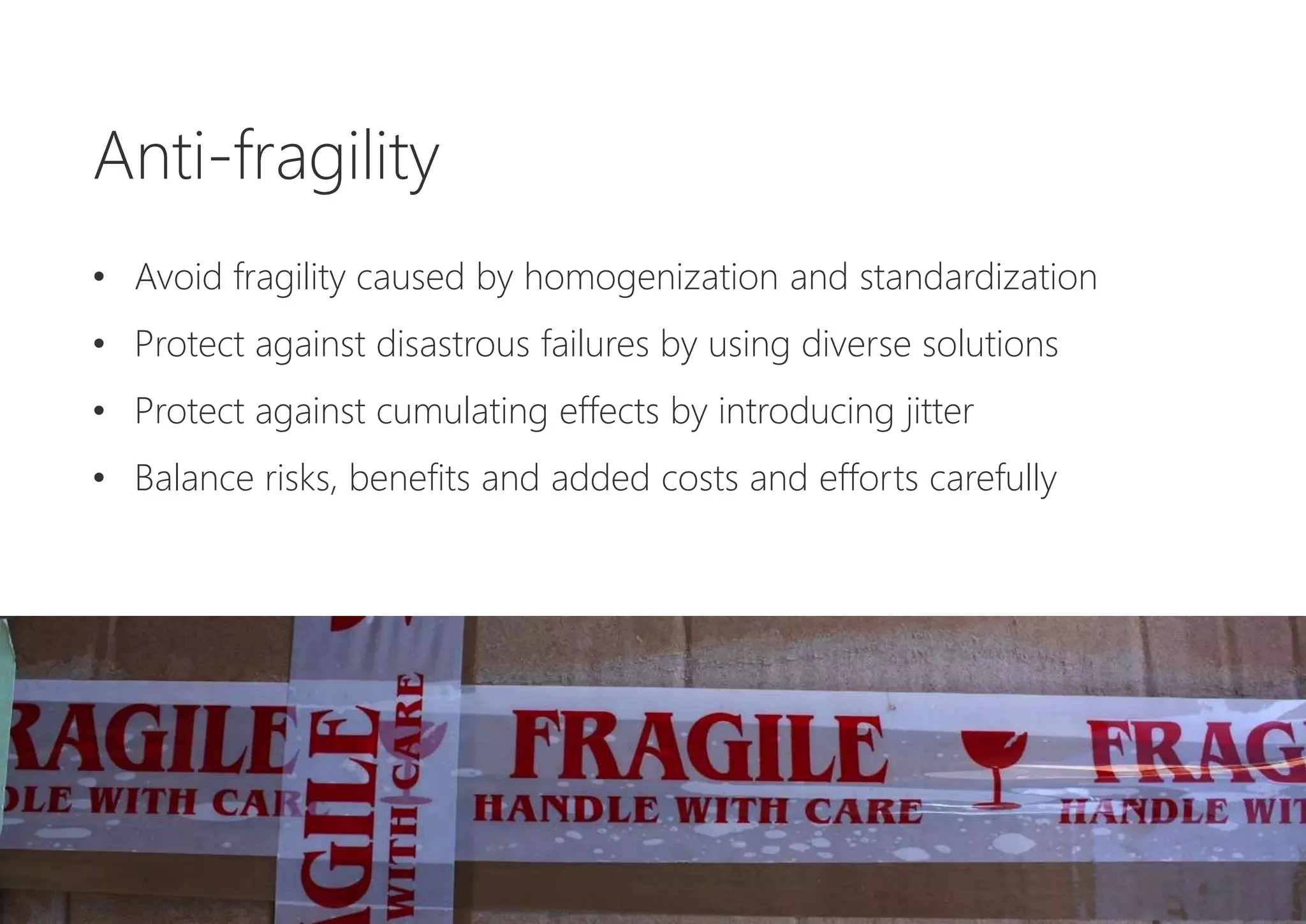
• Avoid fragility caused by homogenization and standardization
• Protect against disastrous failures by using diverse solutions
• Protect against cumulating effects by introducing jitter
• Balance risks, benefits and added costs and efforts carefully
PreventionDetectionCore
(Architectural)
Recovery
Mitigation
Treatment
Routine
maintenance
Backup
request
Anti-fragility
Diversity Jitter
Error
injection
Spread the news
Anti-entropy
Error injection
• Make resilient software design sustainable
• Inject errors at runtime and observe how the system reacts
• Can also be used to detect yet unknown failure modes
• Make sure to inject errors of all types
• Chaos Monkey
• Chaos Gorilla
• Chaos Kong
• Latency Monkey
• Compliance Monkey
• Security Monkey
• Janitor Monkey
• Doctor Monkey
https://github.com/Netflix/SimianArmy
PreventionDetectionCore
(Architectural)
Recovery
Mitigation
Treatment
Routine
maintenance
Backup
request
Anti-fragility
Diversity Jitter
Error
injection
Spread the news
Anti-entropy
Towards a pattern language …
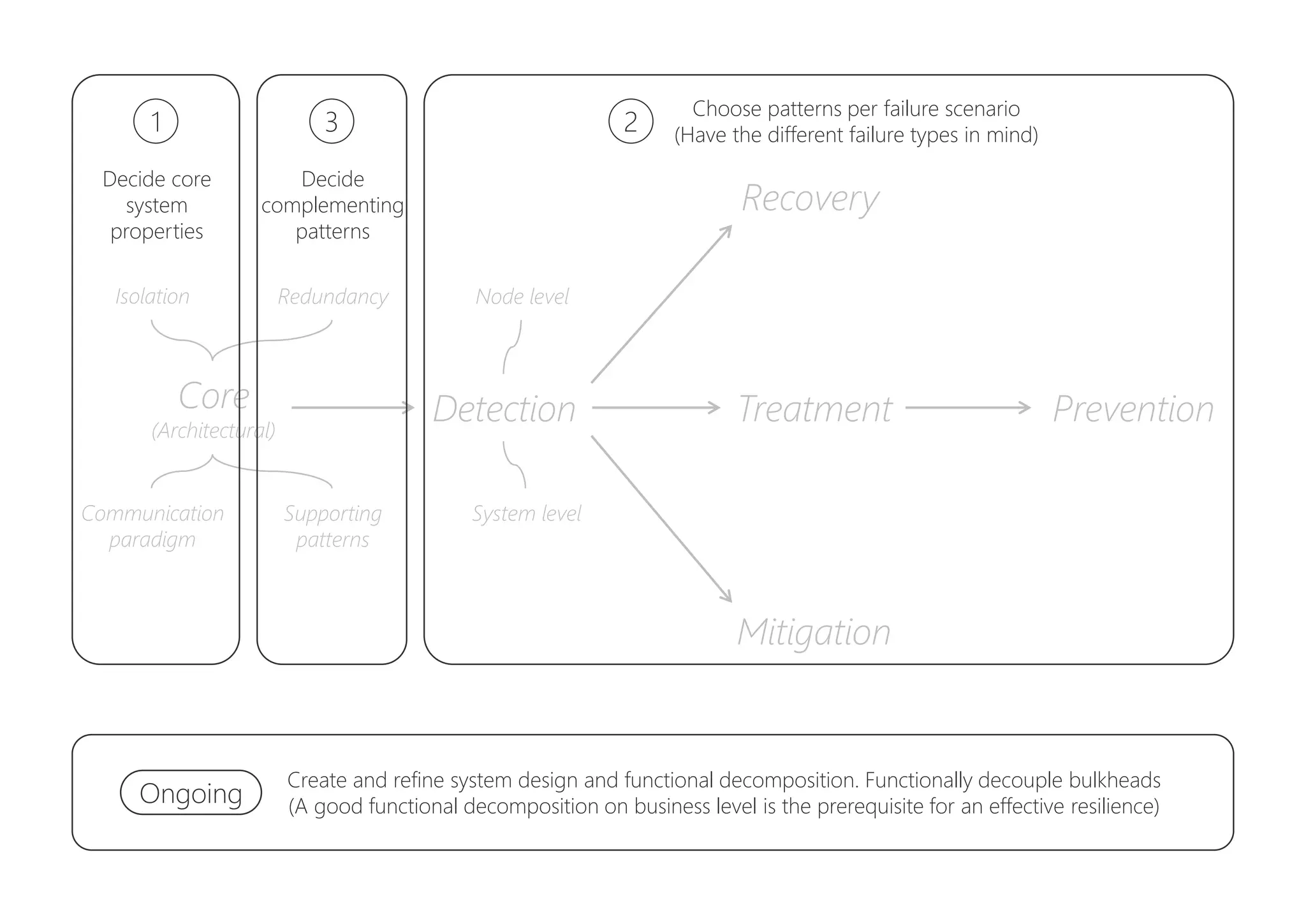
Decisions to make
• General decisions
• Bulkhead type
• Communication paradigm
• Decisions per failure scenario (repeat)
• Error detection on node & system level
• Recovery/mitigation mechanism
• Supporting treatment mechanism
• Supporting prevention mechanism
• Complementing decisions
• Complementing redundancy mechanism(s)
• Complementing architectural patterns
Core
(Architectural)
Detection Treatment Prevention
Recovery
Mitigation
Isolation Redundancy
Communication
paradigm
Supporting
patterns
Node level
System level
1
Decide core
system
properties
2
Choose patterns per failure scenario
(Have the different failure types in mind)3
Decide
complementing
patterns
Ongoing
Create and refine system design and functional decomposition. Functionally decouple bulkheads
(A good functional decomposition on business level is the prerequisite for an effective resilience)
Core
(Architectural)
Detection Treatment Prevention
Recovery
Mitigation
Isolation Redundancy
Communication
paradigm
Supporting
patterns
Node level
System level
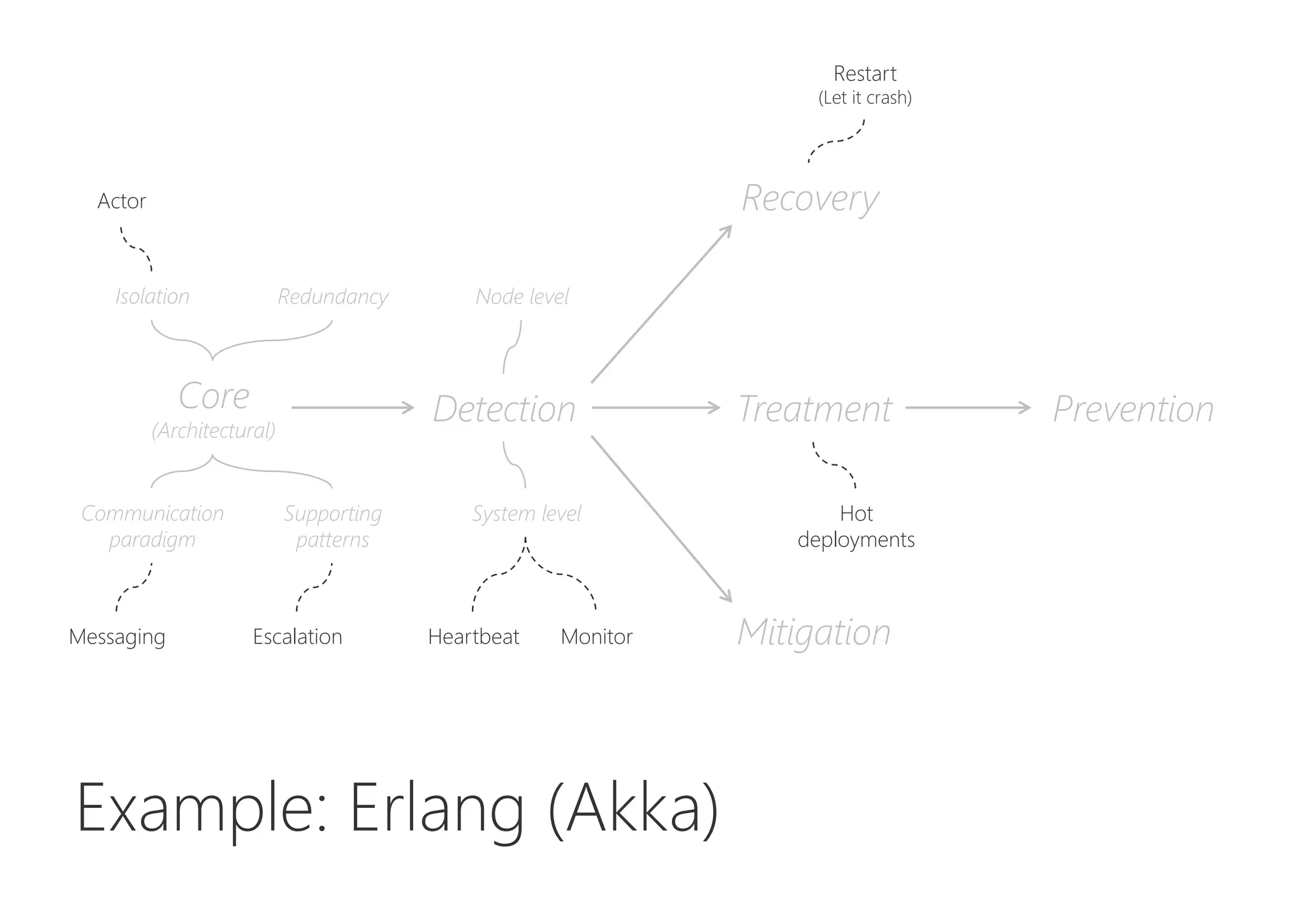
Example: Erlang (Akka)
MonitorMessaging
Actor
Escalation Heartbeat
Restart
(Let it crash)
Hot
deployments
Core
(Architectural)
Detection Treatment Prevention
Recovery
Mitigation
Isolation Redundancy
Communication
paradigm
Supporting
patterns
Node level
System level
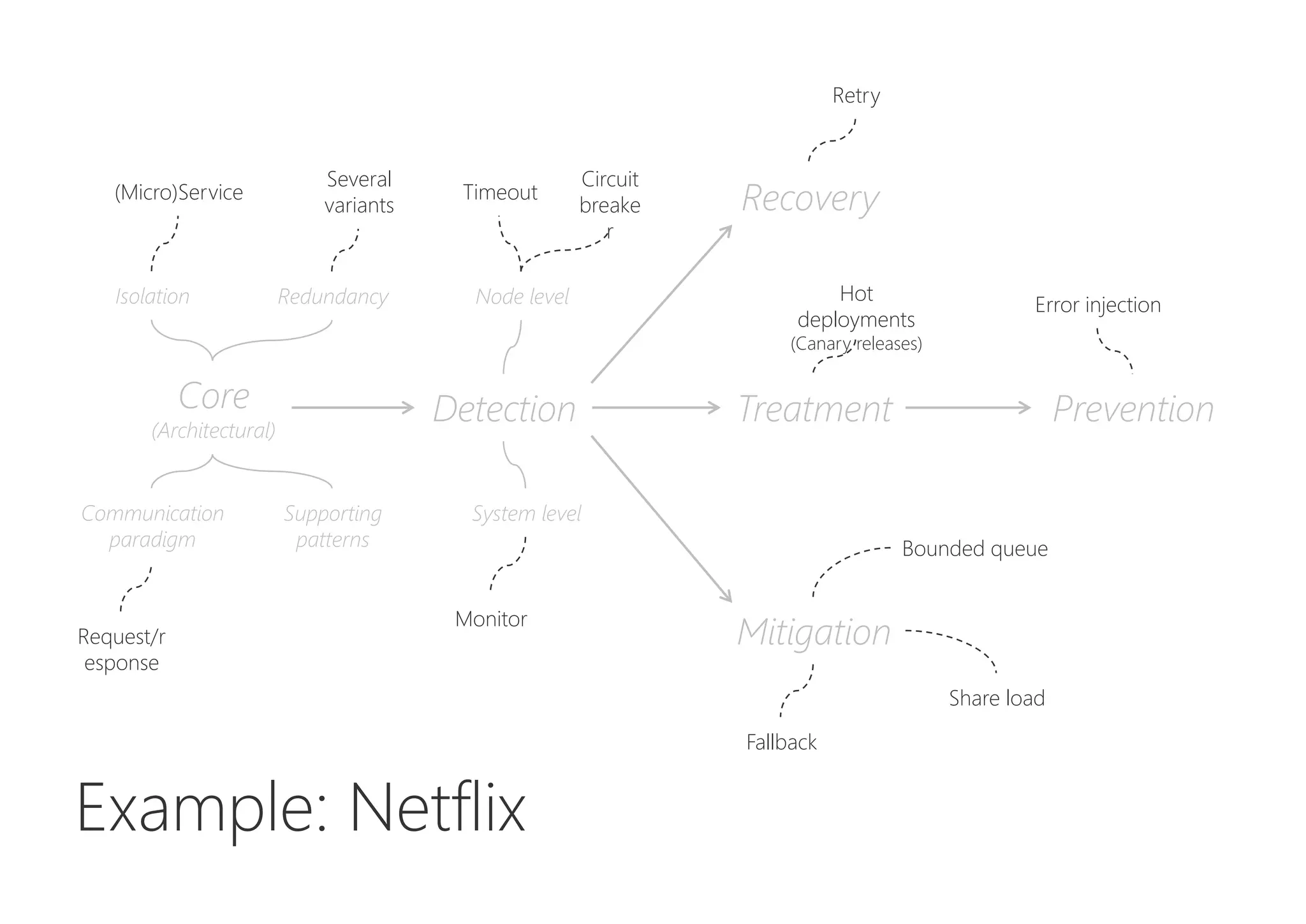
Example: Netflix
Monitor
Request/r
esponse
(Micro)Service
Retry
Hot
deployments
(Canary releases)
Fallback
Share load
Bounded queue
Timeout
Circuit
breake
r
Several
variants
Error injection
Core
(Architectural)
Detection Treatment Prevention
Recovery
Mitigation
Isolation Redundancy
Communication
paradigm
Supporting
patterns
Node level
System level
What is your pattern language?
Wrap-up
• Today’s systems are distributed
• Failures are not avoidable
• Failures are not predictable
• Resilient software design needed
• Rich pattern language
• Start with core system properties
• Choose patterns based on failure scenarios
• Complement with careful functional design
Further reading
1. Michael T. Nygard, Release It!,
Pragmatic Bookshelf, 2007
2. Robert S. Hanmer,
Patterns for Fault Tolerant Software, Wiley, 2007
3. Andrew Tanenbaum, Marten van Steen,
Distributed Systems – Principles and Paradigms,
Prentice Hall, 2nd Edition, 2006
4. Hystrix Wiki,
https://github.com/Netflix/Hystrix/wiki
5. Uwe Friedrichsen, Patterns of resilience,
http://de.slideshare.net/ufried/patterns-of-
resilience
Do not avoid failures. Embrace them!
@ufried
Uwe Friedrichsen | uwe.friedrichsen@codecentric.de | http://slideshare.net/ufried | http://ufried.tumblr.com
Resilience reloaded - more resilience patterns

Resilience reloaded - more resilience patterns