Production-ready software
instead of just being “feature complete”

Uwe Friedrichsen – codecentric AG – 2014-2016
@ufried
Uwe Friedrichsen | uwe.friedrichsen@codecentric.de | http://slideshare.net/ufried | http://ufried.tumblr.com
Why this talk?
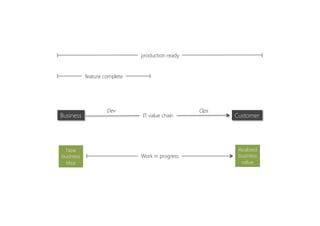
Ops
Dev
Business
 IT value chain
 Customer
feature complete
production ready
Work in progress
Realized
business
value
New
business
idea
It‘s all about production!
But before we talk about production …
… let’s talk about DevOps briefly
What is that DevOps thing anyway?
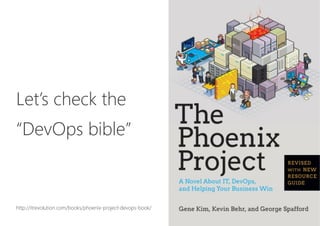
Let’s check the

“DevOps bible”


http://itrevolution.com/books/phoenix-project-devops-book/
DevOps in a nutshell
The 3 ways of DevOps


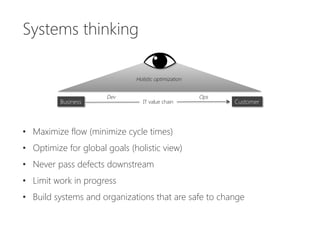
Systems thinking
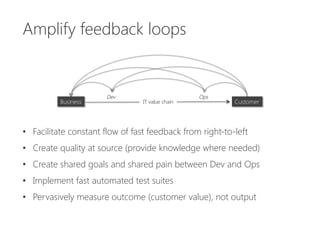
Amplify feedback loops
Culture of continual experimentation & learning


http://itrevolution.com/the-three-ways-principles-underpinning-devops/
•  Maximize flow (minimize cycle times)
•  Optimize for global goals (holistic view)
•  Never pass defects downstream
•  Limit work in progress
•  Build systems and organizations that are safe to change
Ops
Dev
Business
 IT value chain
 Customer
Holistic optimization
Systems thinking
•  Facilitate constant flow of fast feedback from right-to-left
•  Create quality at source (provide knowledge where needed)
•  Create shared goals and shared pain between Dev and Ops
•  Implement fast automated test suites
•  Pervasively measure outcome (customer value), not output
Ops
Dev
Business
 IT value chain
 Customer
Amplify feedback loops
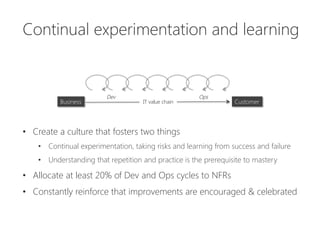
•  Create a culture that fosters two things
•  Continual experimentation, taking risks and learning from success and failure
•  Understanding that repetition and practice is the prerequisite to mastery
•  Allocate at least 20% of Dev and Ops cycles to NFRs
•  Constantly reinforce that improvements are encouraged & celebrated
Ops
Dev
Business
 IT value chain
 Customer
Continual experimentation and learning
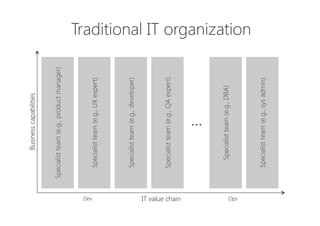
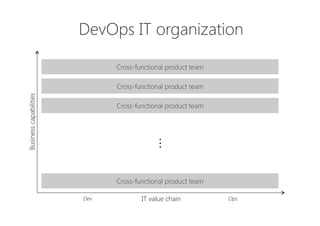
If taken seriously DevOps will eventually
rotate your IT organization by 90°
Ops
Dev
 IT value chain
Businesscapabilities
Specialistteam(e.g.,productmanager)
Specialistteam(e.g.,UXexpert)
Specialistteam(e.g.,developer)
Specialistteam(e.g.,QAexpert)
Specialistteam(e.g.,sysadmin)
Specialistteam(e.g.,DBA)
…
Traditional IT organization
Ops
Dev
 IT value chain
Businesscapabilities
Cross-functional product team
…
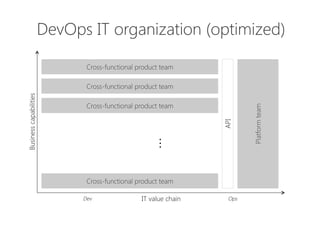
DevOps IT organization
Cross-functional product team
Ops
Dev
 IT value chain
Businesscapabilities
Cross-functional product team
…
DevOps IT organization (optimized)
Cross-functional product team
Platformteam
API
But that’s still a long way to go

for many organizations …
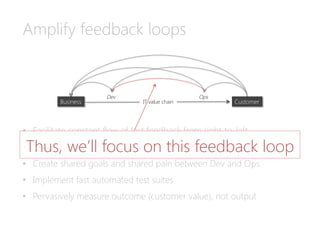
Amplify feedback loops


•  Facilitate constant flow of fast feedback from right-to-left
•  Create quality at source (provide knowledge where needed)
•  Create shared goals and shared pain between Dev and Ops
•  Implement fast automated test suites
•  Pervasively measure outcome (customer value), not output
Ops
Dev
Business
 IT value chain
 Customer
Thus, we’ll focus on this feedback loop
Let’s talk about operations …
Operations
Developers Point of View
Admin
Developers Point of View
Admin
Closer to Reality Point of View
Top 5 Needs of an Admin


1.  Give me my peace and quiet!
2.  Don‘t make me think!
3.  Let me see that everything is fine!
4.  Show me the problem – now!
5.  Tell me what to do!
Top 5 Needs of an Admin (translated)

1.  Give me my peace and quiet!

(The application should just run smoothly)
2.  Don‘t make me think!

(Rollout, setup and operation of the application should be easy)
3.  Let me see that everything is fine!

(The application should show its state)
4.  Show me the problem – now!

(The application should provide concise error messages and enable easy root cause drilldown)
5.  Tell me what to do!

(The application should be documented properly – including error handling instructions)
Top 3 Dev Challenges


1.  Manageability
2.  Resilience
3.  Transparency
4.  Documentation
11 Design Principles

For production-ready Applications


•  Manageability (4)
•  Resilience (5)
•  Transparency (2)
Manageability
Deployment

(Manageability)
•  One-click deployment
•  Preserve settings
•  Provide rollbacks or roll-forward
•  Go for containers
Configuration

(Manageability)
•  Avoid multiple configuration procedures
•  Define default value handling
•  Organize change traceability
•  Notification about new parameters
Configuration Parameter Types

(Manageability)
•  Context-related parameters

Do not stage – managed by stage admin
•  Application-related parameters

Must be staged – managed by application admin
•  Business-related parameters

Must be staged – managed by business admin
Backup

(Manageability)
•  Think about backup purpose
•  Define backup strategy
•  Provide tooling
•  What about backup in cloud environments?
Resilience
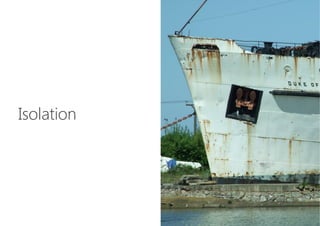
Isolation
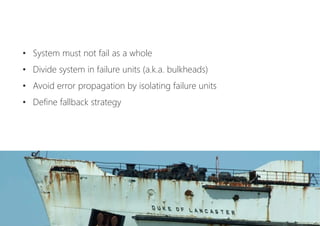
•  System must not fail as a whole
•  Divide system in failure units (a.k.a. bulkheads)
•  Avoid error propagation by isolating failure units
•  Define fallback strategy
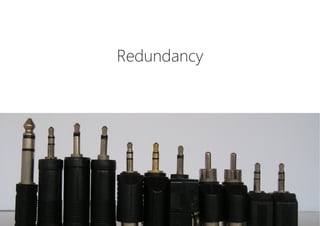
Redundancy
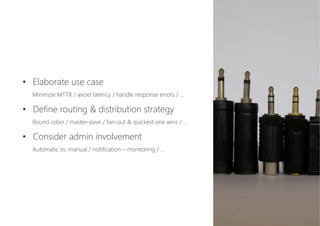
•  Elaborate use case

Minimize MTTR / avoid latency / handle response errors / …
•  Define routing & distribution strategy

Round robin / master-slave / fan-out & quickest one wins / …
•  Consider admin involvement

Automatic vs. manual / notification – monitoring / …
Loose Coupling
•  Isolate failure units (complements bulkheads)
•  Go asynchronous wherever possible
•  Use timeouts & circuit breakers
•  Make actions idempotent
Implementation Example #1

Timeouts
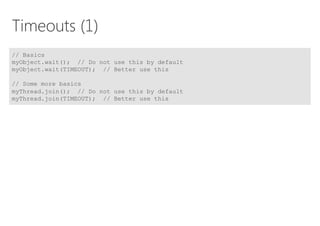
Timeouts (1)
// Basics
myObject.wait(); // Do not use this by default
myObject.wait(TIMEOUT); // Better use this
// Some more basics
myThread.join(); // Do not use this by default
myThread.join(TIMEOUT); // Better use this
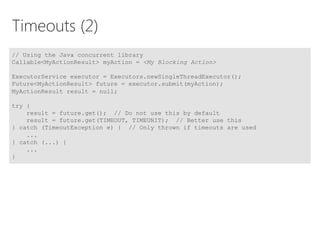
Timeouts (2)
// Using the Java concurrent library
Callable<MyActionResult> myAction = <My Blocking Action>
ExecutorService executor = Executors.newSingleThreadExecutor();
Future<MyActionResult> future = executor.submit(myAction);
MyActionResult result = null;
try {
result = future.get(); // Do not use this by default
result = future.get(TIMEOUT, TIMEUNIT); // Better use this
} catch (TimeoutException e) { // Only thrown if timeouts are used
...
} catch (...) {
...
}
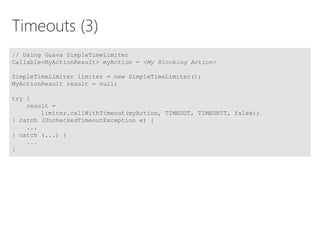
Timeouts (3)
// Using Guava SimpleTimeLimiter
Callable<MyActionResult> myAction = <My Blocking Action>
SimpleTimeLimiter limiter = new SimpleTimeLimiter();
MyActionResult result = null;
try {
result =
limiter.callWithTimeout(myAction, TIMEOUT, TIMEUNIT, false);
} catch (UncheckedTimeoutException e) {
...
} catch (...) {
...
}
Implementation Example #2

Circuit Breaker
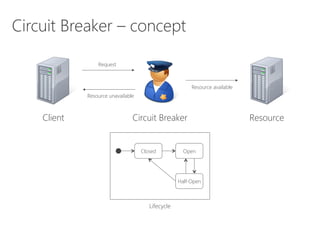
Circuit Breaker – concept
Client
 Resource
Circuit Breaker
Request
Resource unavailable
Resource available
Closed
 Open
Half-Open
Lifecycle
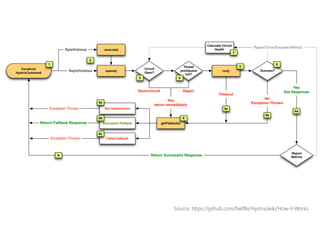
Implemented patterns


•  Timeout
•  Circuit breaker
•  Load shedder
•  Fallback
Supported patterns

•  Bulkheads

(a.k.a. Failure Units)
•  Fail fast
•  Fail silently
•  Graceful degradation of service
•  Failover
•  Escalation
•  Retry
•  ...
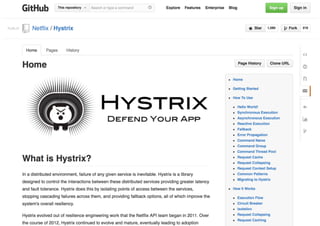
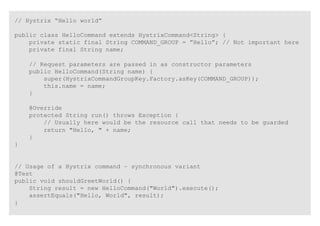
Hello, world!
// Hystrix “Hello world”
public class HelloCommand extends HystrixCommand<String> {
private static final String COMMAND_GROUP = ”Hello”; // Not important here
private final String name;
// Request parameters are passed in as constructor parameters
public HelloCommand(String name) {
super(HystrixCommandGroupKey.Factory.asKey(COMMAND_GROUP));
this.name = name;
}
@Override
protected String run() throws Exception {
// Usually here would be the resource call that needs to be guarded
return "Hello, " + name;
}
}
// Usage of a Hystrix command – synchronous variant
@Test
public void shouldGreetWorld() {
String result = new HelloCommand("World").execute();
assertEquals("Hello, World", result);
}
Source: https://github.com/Netflix/Hystrix/wiki/How-it-Works
Fallbacks
•  What will you do if a request fails?
•  Consider failure handling from the very beginning
•  Supplement with general failure handling strategies
Scalability
•  Define scaling strategy
•  Think full stack
•  Design for elasticity
•  At least apply D-I-D rule
Transparency
Monitoring

(Transparency)
•  Think about required metrics
•  Provide correlation Ids
•  Design hook or event mechanism
•  Plan for changing metrics
Logging

(Transparency)
•  Consider log message structure

Assume centralized logging: required information / machine readable / human readable
•  Define logging policy

Debug and less: developers perspective / Info and more: operations perspective
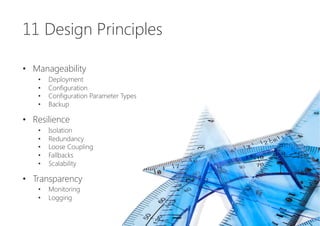
11 Design Principles

•  Manageability
•  Deployment
•  Configuration
•  Configuration Parameter Types
•  Backup

•  Resilience
•  Isolation
•  Redundancy
•  Loose Coupling
•  Fallbacks
•  Scalability

•  Transparency
•  Monitoring
•  Logging
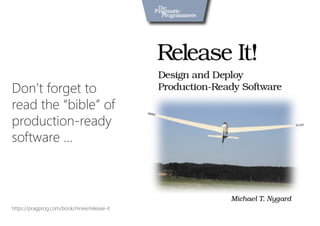
Don’t forget to

read the “bible” of
production-ready
software …


https://pragprog.com/book/mnee/release-it
Wrap-up


•  The importance of “production readiness”
•  The 3 ways of DevOps
•  The needs of Ops
•  The resulting challenges for Dev
•  Design principles to support the needs
•  Manageability
•  Resilience
•  Transparency
It’s all about production!
@ufried
Uwe Friedrichsen | uwe.friedrichsen@codecentric.de | http://slideshare.net/ufried | http://ufried.tumblr.com
Production-ready Software

Production-ready Software

  • 1.
    Production-ready software instead ofjust being “feature complete” Uwe Friedrichsen – codecentric AG – 2014-2016
  • 2.
    @ufried Uwe Friedrichsen |uwe.friedrichsen@codecentric.de | http://slideshare.net/ufried | http://ufried.tumblr.com
  • 3.
  • 4.
    Ops Dev Business IT valuechain Customer feature complete production ready Work in progress Realized business value New business idea
  • 5.
    It‘s all aboutproduction!
  • 6.
    But before wetalk about production …
  • 7.
    … let’s talkabout DevOps briefly
  • 8.
    What is thatDevOps thing anyway?
  • 9.
    Let’s check the “DevOpsbible” http://itrevolution.com/books/phoenix-project-devops-book/
  • 10.
    DevOps in anutshell
  • 11.
    The 3 waysof DevOps Systems thinking Amplify feedback loops Culture of continual experimentation & learning http://itrevolution.com/the-three-ways-principles-underpinning-devops/
  • 12.
    •  Maximize flow(minimize cycle times) •  Optimize for global goals (holistic view) •  Never pass defects downstream •  Limit work in progress •  Build systems and organizations that are safe to change Ops Dev Business IT value chain Customer Holistic optimization Systems thinking
  • 13.
    •  Facilitate constantflow of fast feedback from right-to-left •  Create quality at source (provide knowledge where needed) •  Create shared goals and shared pain between Dev and Ops •  Implement fast automated test suites •  Pervasively measure outcome (customer value), not output Ops Dev Business IT value chain Customer Amplify feedback loops
  • 14.
    •  Create aculture that fosters two things •  Continual experimentation, taking risks and learning from success and failure •  Understanding that repetition and practice is the prerequisite to mastery •  Allocate at least 20% of Dev and Ops cycles to NFRs •  Constantly reinforce that improvements are encouraged & celebrated Ops Dev Business IT value chain Customer Continual experimentation and learning
  • 15.
    If taken seriouslyDevOps will eventually rotate your IT organization by 90°
  • 16.
    Ops Dev IT valuechain Businesscapabilities Specialistteam(e.g.,productmanager) Specialistteam(e.g.,UXexpert) Specialistteam(e.g.,developer) Specialistteam(e.g.,QAexpert) Specialistteam(e.g.,sysadmin) Specialistteam(e.g.,DBA) … Traditional IT organization
  • 17.
    Ops Dev IT valuechain Businesscapabilities Cross-functional product team … DevOps IT organization Cross-functional product team Cross-functional product team Cross-functional product team
  • 18.
    Ops Dev IT valuechain Businesscapabilities Cross-functional product team … DevOps IT organization (optimized) Cross-functional product team Cross-functional product team Cross-functional product team Platformteam API
  • 19.
    But that’s stilla long way to go
 for many organizations …
  • 20.
    Amplify feedback loops • Facilitate constant flow of fast feedback from right-to-left •  Create quality at source (provide knowledge where needed) •  Create shared goals and shared pain between Dev and Ops •  Implement fast automated test suites •  Pervasively measure outcome (customer value), not output Ops Dev Business IT value chain Customer Thus, we’ll focus on this feedback loop
  • 21.
    Let’s talk aboutoperations …
  • 22.
  • 23.
  • 24.
  • 25.
    Top 5 Needsof an Admin 1.  Give me my peace and quiet! 2.  Don‘t make me think! 3.  Let me see that everything is fine! 4.  Show me the problem – now! 5.  Tell me what to do!
  • 26.
    Top 5 Needsof an Admin (translated) 1.  Give me my peace and quiet!
 (The application should just run smoothly) 2.  Don‘t make me think!
 (Rollout, setup and operation of the application should be easy) 3.  Let me see that everything is fine!
 (The application should show its state) 4.  Show me the problem – now!
 (The application should provide concise error messages and enable easy root cause drilldown) 5.  Tell me what to do!
 (The application should be documented properly – including error handling instructions)
  • 27.
    Top 3 DevChallenges 1.  Manageability 2.  Resilience 3.  Transparency 4.  Documentation
  • 28.
    11 Design Principles Forproduction-ready Applications •  Manageability (4) •  Resilience (5) •  Transparency (2)
  • 29.
  • 30.
  • 31.
    •  One-click deployment • Preserve settings •  Provide rollbacks or roll-forward •  Go for containers
  • 32.
  • 33.
    •  Avoid multipleconfiguration procedures •  Define default value handling •  Organize change traceability •  Notification about new parameters
  • 34.
  • 35.
    •  Context-related parameters
 Donot stage – managed by stage admin •  Application-related parameters
 Must be staged – managed by application admin •  Business-related parameters
 Must be staged – managed by business admin
  • 36.
  • 37.
    •  Think aboutbackup purpose •  Define backup strategy •  Provide tooling •  What about backup in cloud environments?
  • 38.
  • 39.
  • 40.
    •  System mustnot fail as a whole •  Divide system in failure units (a.k.a. bulkheads) •  Avoid error propagation by isolating failure units •  Define fallback strategy
  • 41.
  • 42.
    •  Elaborate usecase
 Minimize MTTR / avoid latency / handle response errors / … •  Define routing & distribution strategy
 Round robin / master-slave / fan-out & quickest one wins / … •  Consider admin involvement
 Automatic vs. manual / notification – monitoring / …
  • 43.
  • 44.
    •  Isolate failureunits (complements bulkheads) •  Go asynchronous wherever possible •  Use timeouts & circuit breakers •  Make actions idempotent
  • 45.
  • 46.
    Timeouts (1) // Basics myObject.wait();// Do not use this by default myObject.wait(TIMEOUT); // Better use this // Some more basics myThread.join(); // Do not use this by default myThread.join(TIMEOUT); // Better use this
  • 47.
    Timeouts (2) // Usingthe Java concurrent library Callable<MyActionResult> myAction = <My Blocking Action> ExecutorService executor = Executors.newSingleThreadExecutor(); Future<MyActionResult> future = executor.submit(myAction); MyActionResult result = null; try { result = future.get(); // Do not use this by default result = future.get(TIMEOUT, TIMEUNIT); // Better use this } catch (TimeoutException e) { // Only thrown if timeouts are used ... } catch (...) { ... }
  • 48.
    Timeouts (3) // UsingGuava SimpleTimeLimiter Callable<MyActionResult> myAction = <My Blocking Action> SimpleTimeLimiter limiter = new SimpleTimeLimiter(); MyActionResult result = null; try { result = limiter.callWithTimeout(myAction, TIMEOUT, TIMEUNIT, false); } catch (UncheckedTimeoutException e) { ... } catch (...) { ... }
  • 49.
  • 50.
    Circuit Breaker –concept Client Resource Circuit Breaker Request Resource unavailable Resource available Closed Open Half-Open Lifecycle
  • 52.
    Implemented patterns •  Timeout • Circuit breaker •  Load shedder •  Fallback
  • 53.
    Supported patterns •  Bulkheads
 (a.k.a.Failure Units) •  Fail fast •  Fail silently •  Graceful degradation of service •  Failover •  Escalation •  Retry •  ...
  • 54.
  • 55.
    // Hystrix “Helloworld” public class HelloCommand extends HystrixCommand<String> { private static final String COMMAND_GROUP = ”Hello”; // Not important here private final String name; // Request parameters are passed in as constructor parameters public HelloCommand(String name) { super(HystrixCommandGroupKey.Factory.asKey(COMMAND_GROUP)); this.name = name; } @Override protected String run() throws Exception { // Usually here would be the resource call that needs to be guarded return "Hello, " + name; } } // Usage of a Hystrix command – synchronous variant @Test public void shouldGreetWorld() { String result = new HelloCommand("World").execute(); assertEquals("Hello, World", result); }
  • 56.
  • 57.
  • 58.
    •  What willyou do if a request fails? •  Consider failure handling from the very beginning •  Supplement with general failure handling strategies
  • 59.
  • 60.
    •  Define scalingstrategy •  Think full stack •  Design for elasticity •  At least apply D-I-D rule
  • 61.
  • 62.
  • 63.
    •  Think aboutrequired metrics •  Provide correlation Ids •  Design hook or event mechanism •  Plan for changing metrics
  • 64.
  • 65.
    •  Consider logmessage structure
 Assume centralized logging: required information / machine readable / human readable •  Define logging policy
 Debug and less: developers perspective / Info and more: operations perspective
  • 66.
    11 Design Principles • Manageability •  Deployment •  Configuration •  Configuration Parameter Types •  Backup •  Resilience •  Isolation •  Redundancy •  Loose Coupling •  Fallbacks •  Scalability •  Transparency •  Monitoring •  Logging
  • 67.
    Don’t forget to
 readthe “bible” of production-ready software … https://pragprog.com/book/mnee/release-it
  • 68.
    Wrap-up •  The importanceof “production readiness” •  The 3 ways of DevOps •  The needs of Ops •  The resulting challenges for Dev •  Design principles to support the needs •  Manageability •  Resilience •  Transparency
  • 69.
    It’s all aboutproduction!
  • 70.
    @ufried Uwe Friedrichsen |uwe.friedrichsen@codecentric.de | http://slideshare.net/ufried | http://ufried.tumblr.com