DevOps is not enough
Embedding DevOps in a broader context

Uwe Friedrichsen – codecentric AG – 2014-2016
@ufried
Uwe Friedrichsen | uwe.friedrichsen@codecentric.de | http://slideshare.net/ufried | http://ufried.tumblr.com
What is the current state of affairs?
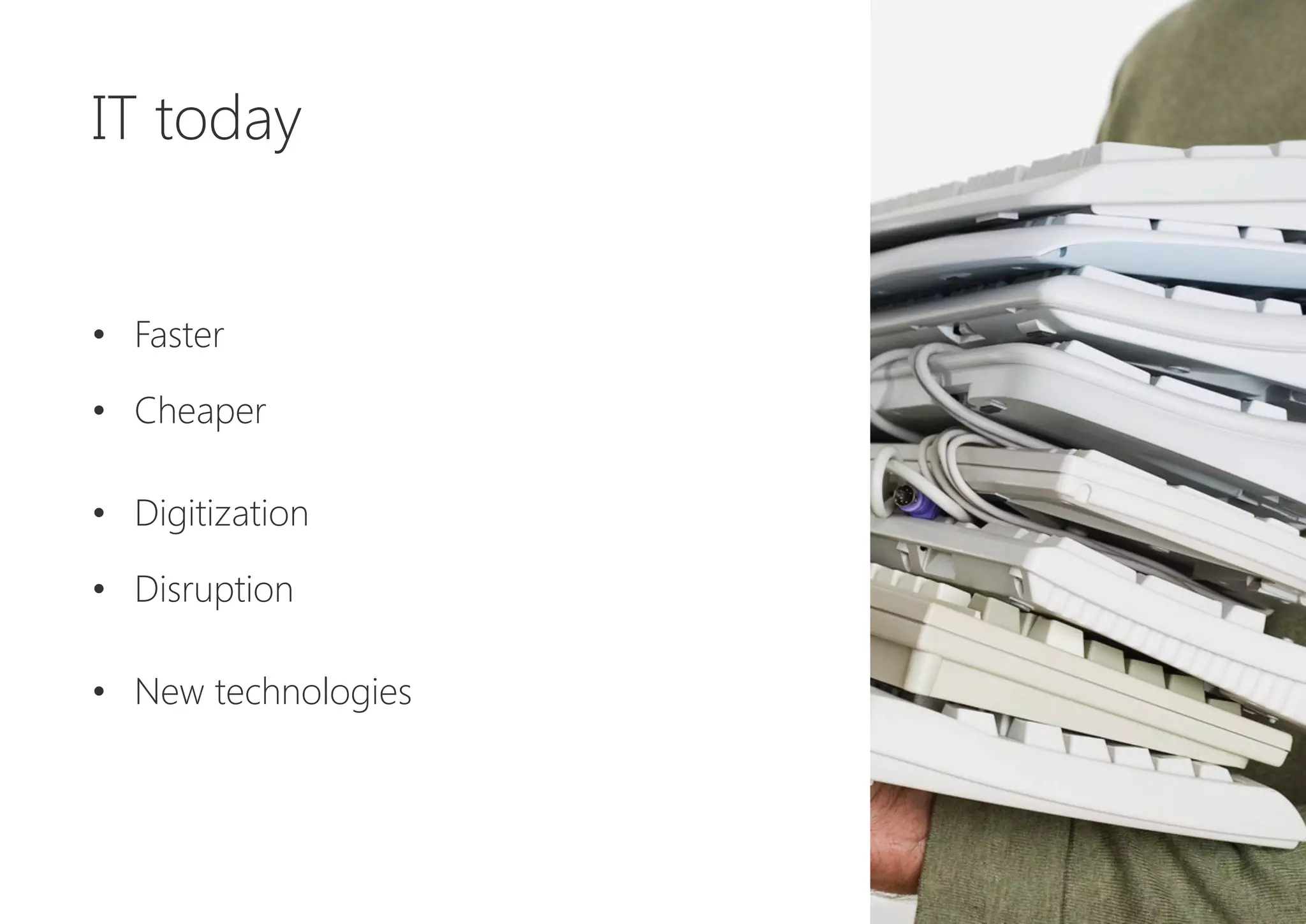
IT today
IT today


•  Faster
•  Cheaper
•  Digitization
•  Disruption
•  New technologies
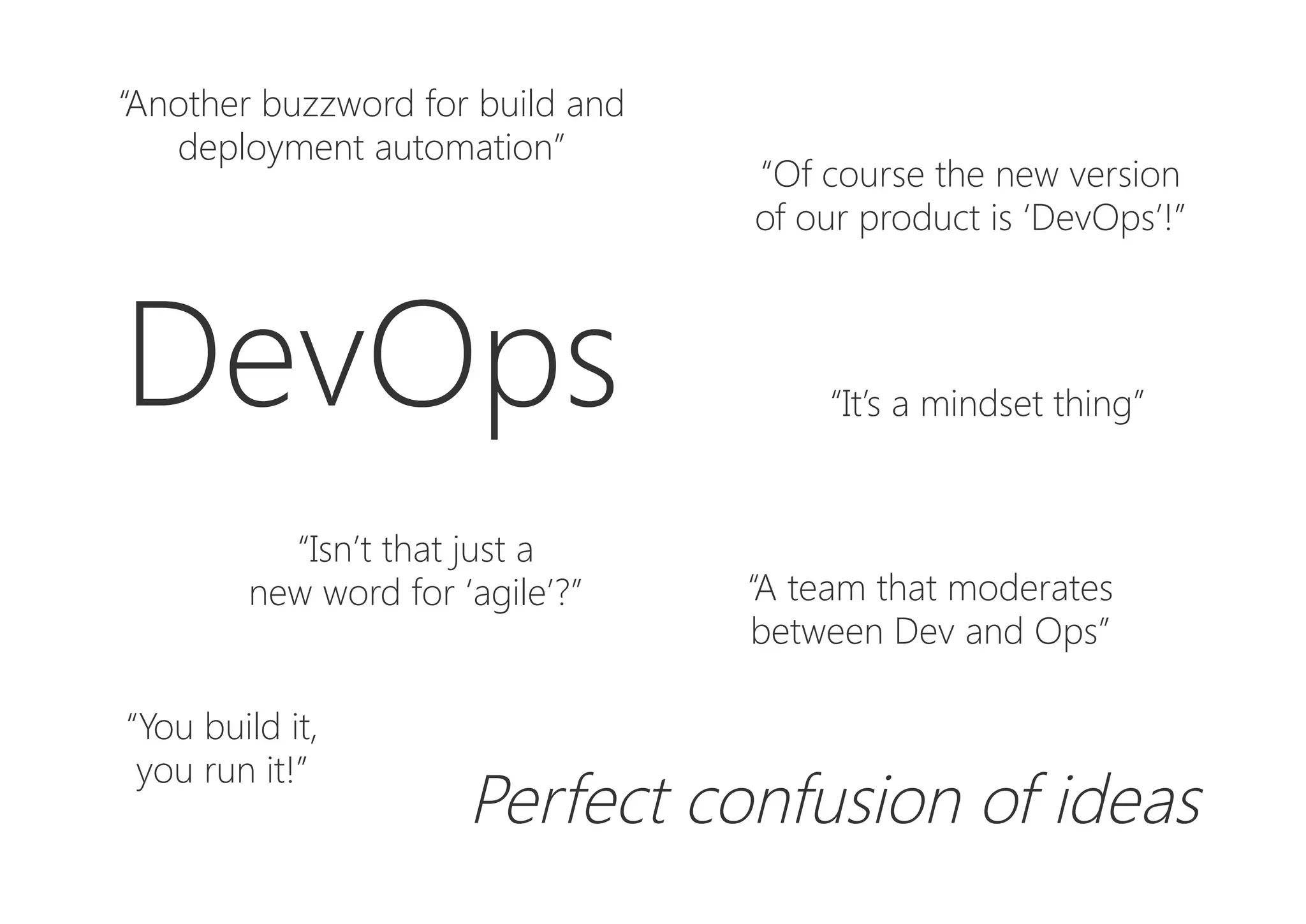
DevOps
“Another buzzword for build and
deployment automation”
“A team that moderates
between Dev and Ops”
“You build it,
you run it!”
“Isn’t that just a
new word for ‘agile’?”
“It’s a mindset thing”
“Of course the new version
of our product is ‘DevOps’!”
Perfect confusion of ideas
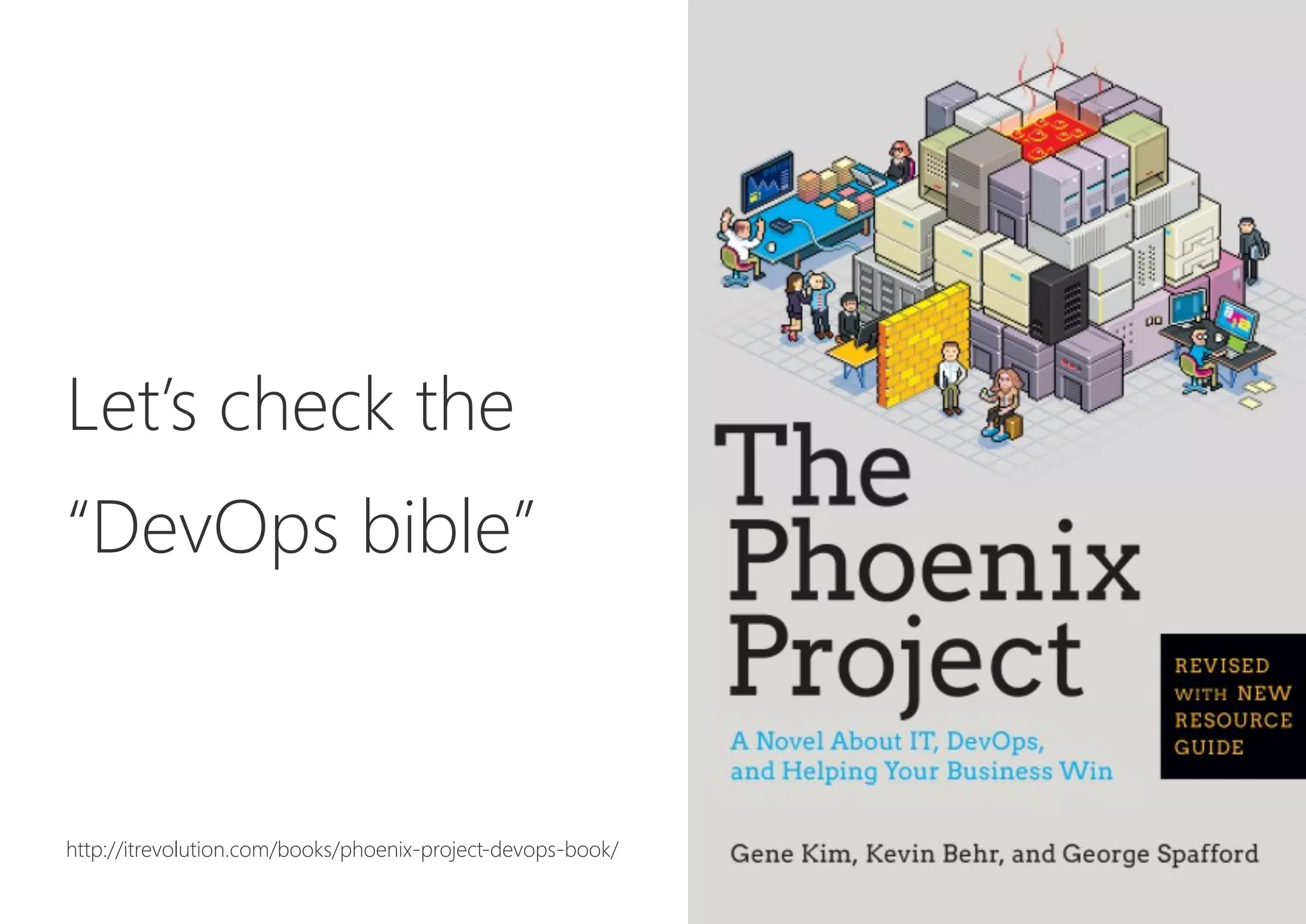
Let’s check the

“DevOps bible”


http://itrevolution.com/books/phoenix-project-devops-book/
DevOps in a nutshell
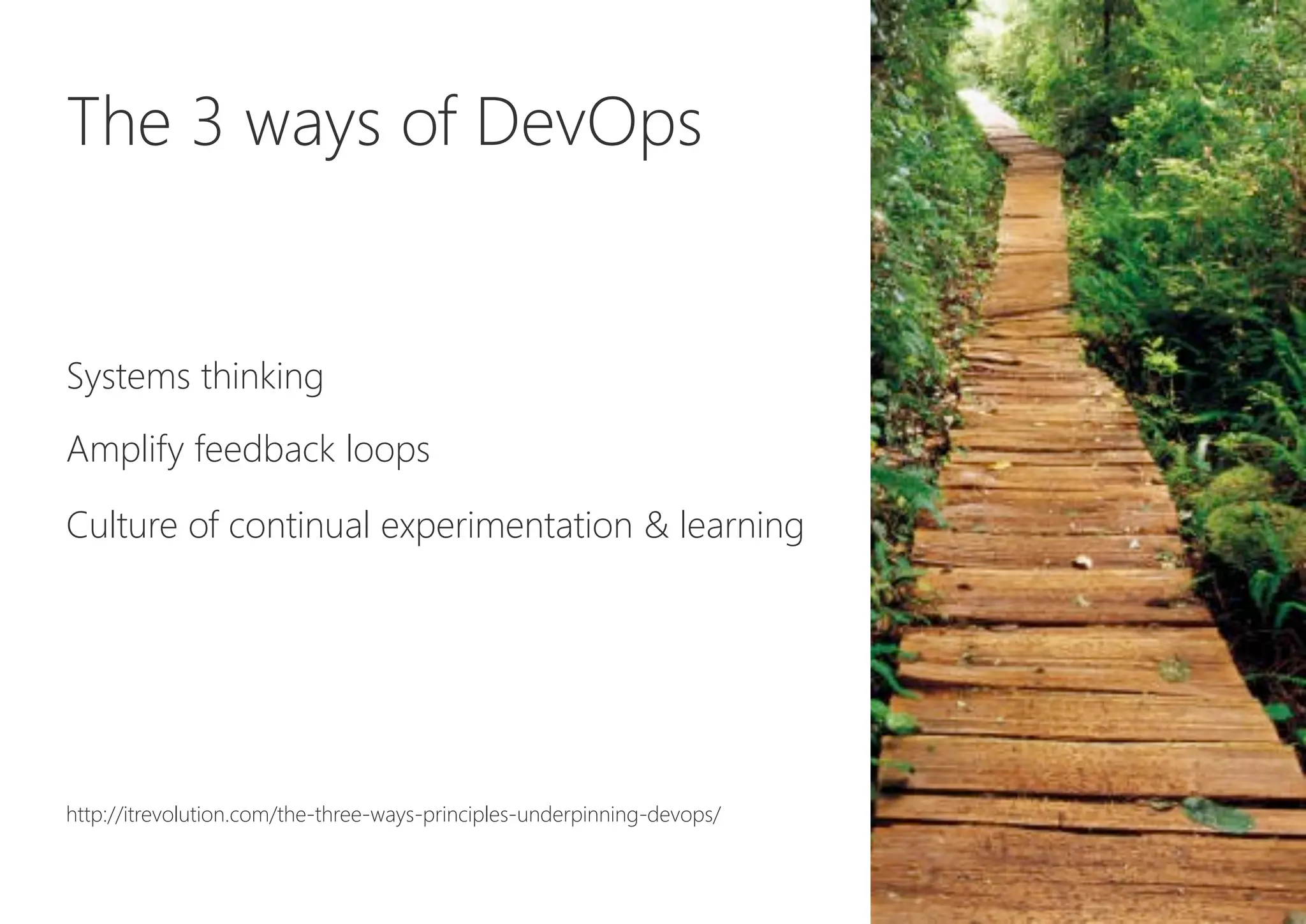
The 3 ways of DevOps


Systems thinking
Amplify feedback loops
Culture of continual experimentation & learning


http://itrevolution.com/the-three-ways-principles-underpinning-devops/
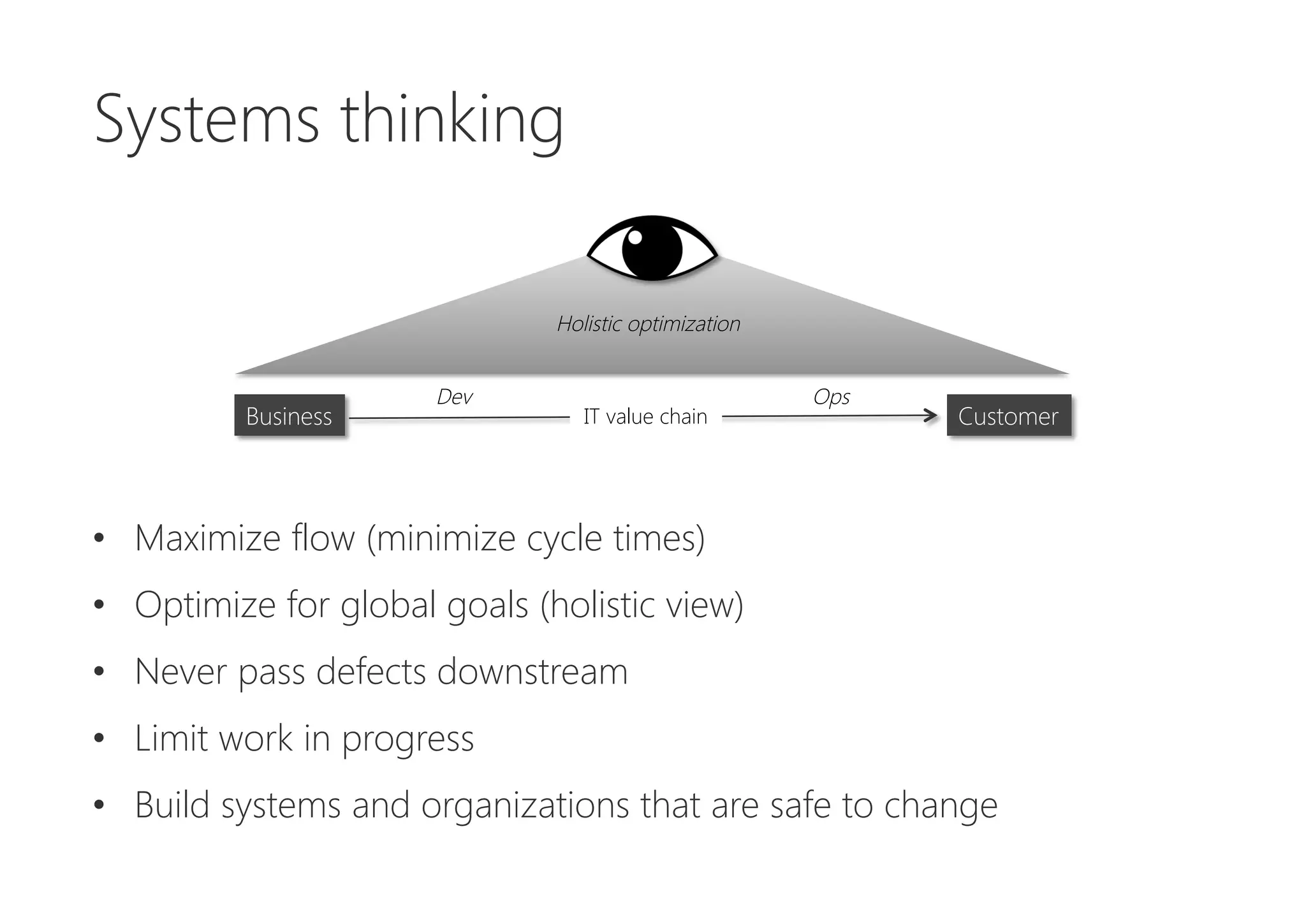
•  Maximize flow (minimize cycle times)
•  Optimize for global goals (holistic view)
•  Never pass defects downstream
•  Limit work in progress
•  Build systems and organizations that are safe to change
Ops
Dev
Business
 IT value chain
 Customer
Holistic optimization
Systems thinking
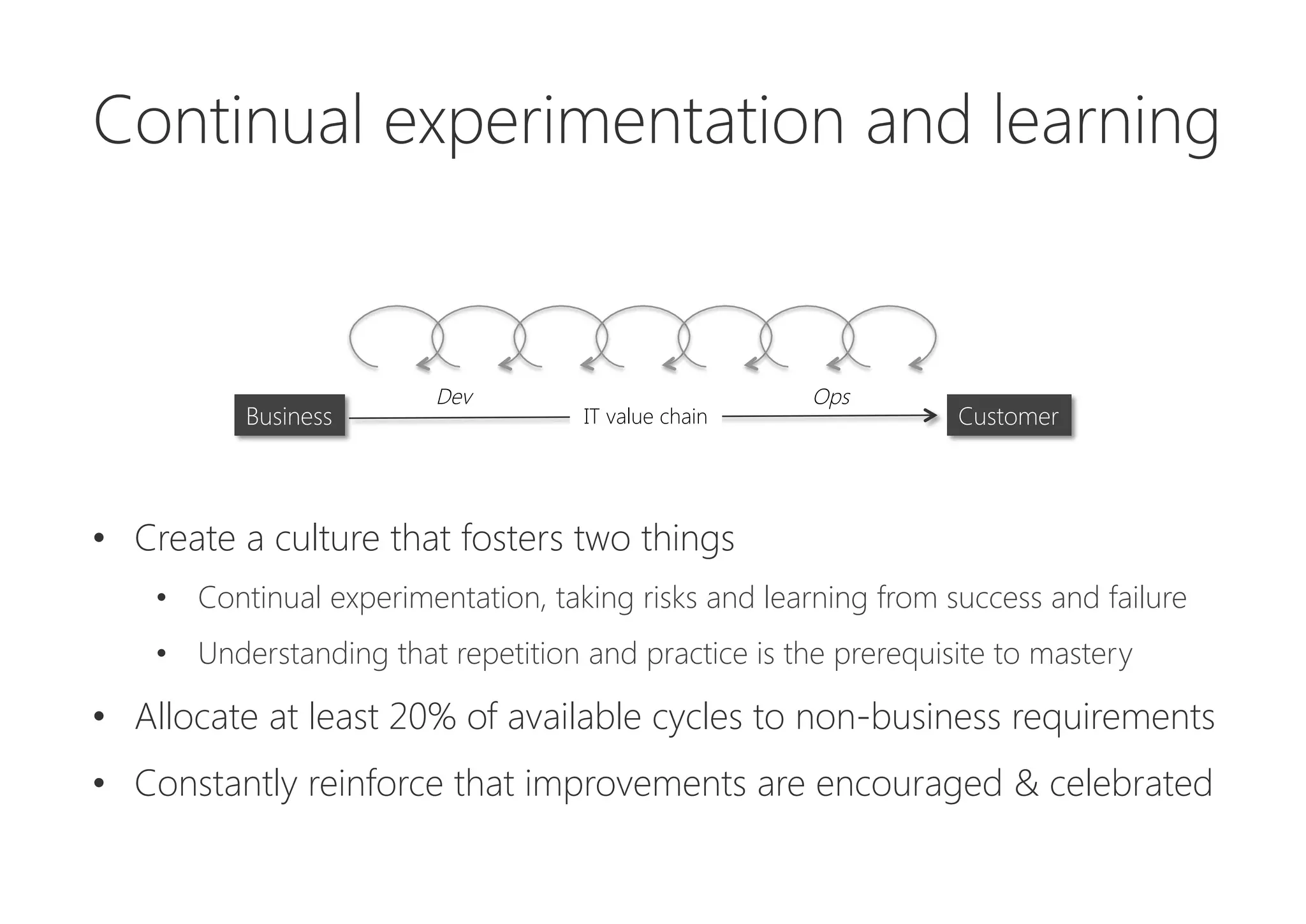
•  Facilitate constant flow of fast feedback from right-to-left
•  Create quality at source (provide knowledge where needed)
•  Create shared goals and shared pain for everyone involved
•  Implement fast automated test suites
•  Pervasively measure outcome (customer value), not output
Ops
Dev
Business
 IT value chain
 Customer
Amplify feedback loops
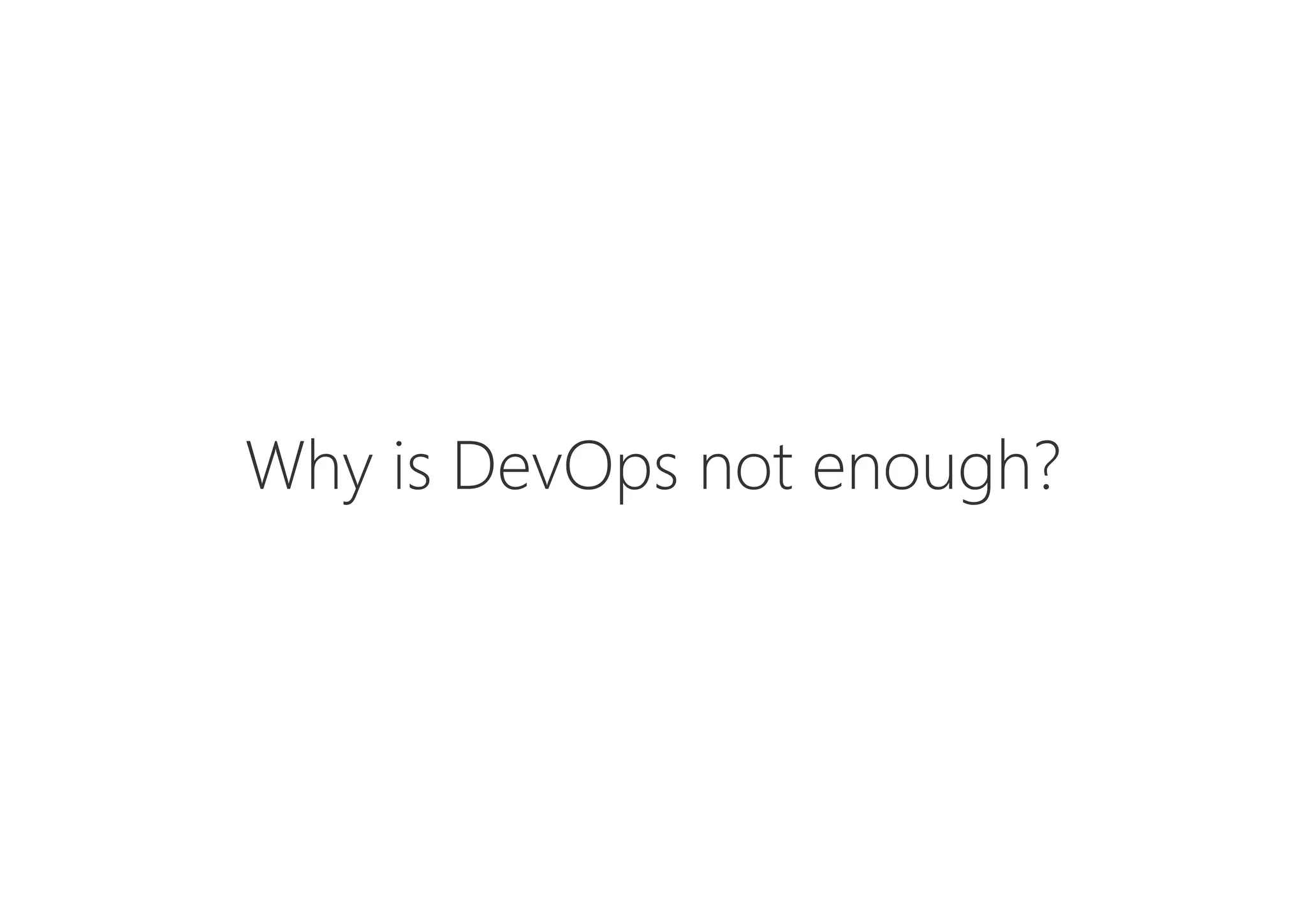
•  Create a culture that fosters two things
•  Continual experimentation, taking risks and learning from success and failure
•  Understanding that repetition and practice is the prerequisite to mastery
•  Allocate at least 20% of available cycles to non-business requirements
•  Constantly reinforce that improvements are encouraged & celebrated
Ops
Dev
Business
 IT value chain
 Customer
Continual experimentation and learning
Okay, but …
Why is DevOps not enough?
A bit of background …
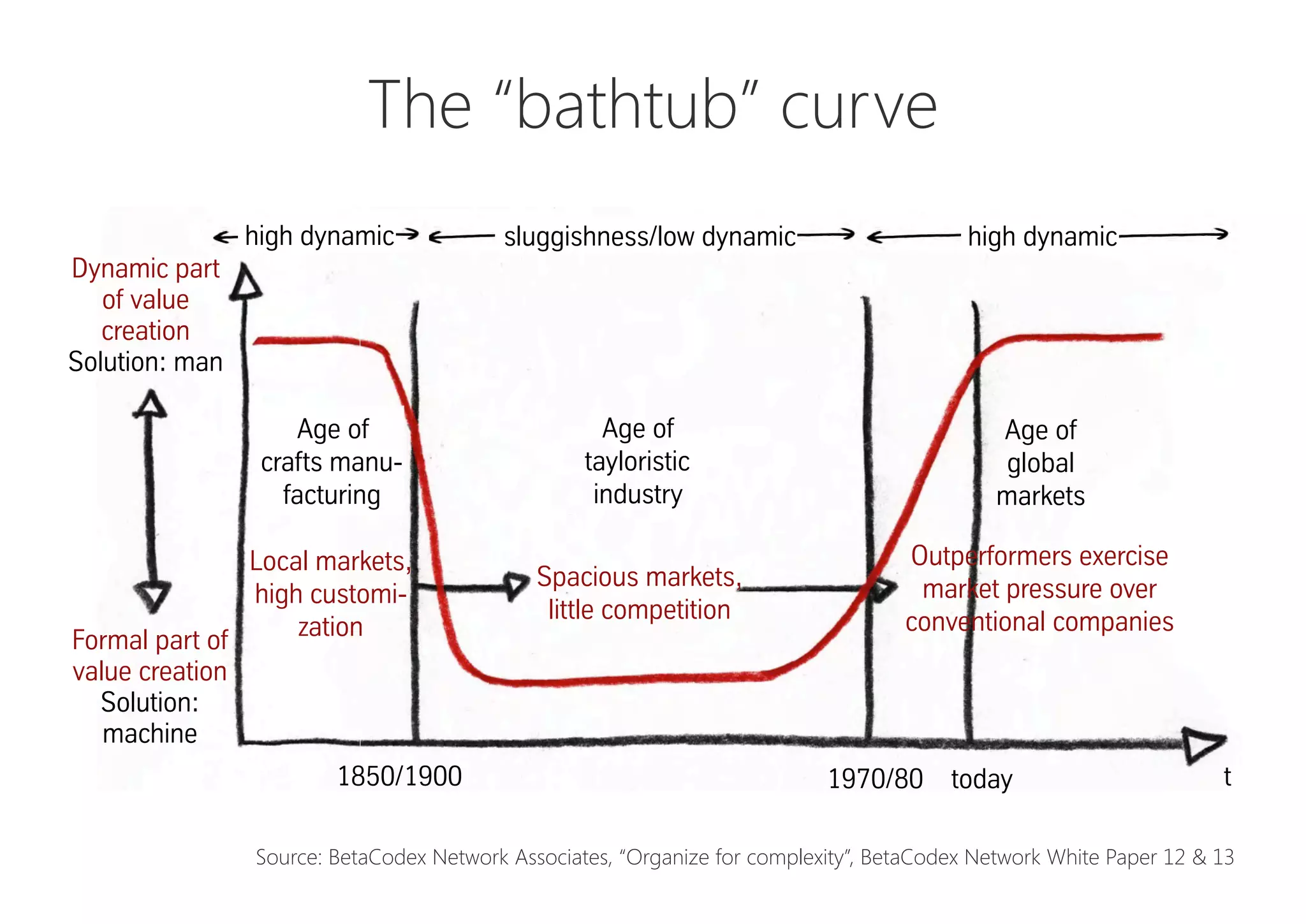
Evolution of economy & markets
Formal part of
value creation
Solution:
machine
Dynamic part
of value
creation
Solution: man
sluggishness/low dynamic high dynamichigh dynamic
The historical course of market dynamics
and the recent rise of highly dynamic and complex markets
The dominance of high dynamics and complexity is neither good nor bad. It‘s a historical fact.
t1970/80 today
Age of
crafts manu-
facturing
Age of
tayloristic
industry
Age of
global
markets
1850/1900
Spacious markets,
little competition
Local markets,
high customi-
zation
Outperformers exercise
market pressure over
conventional companies
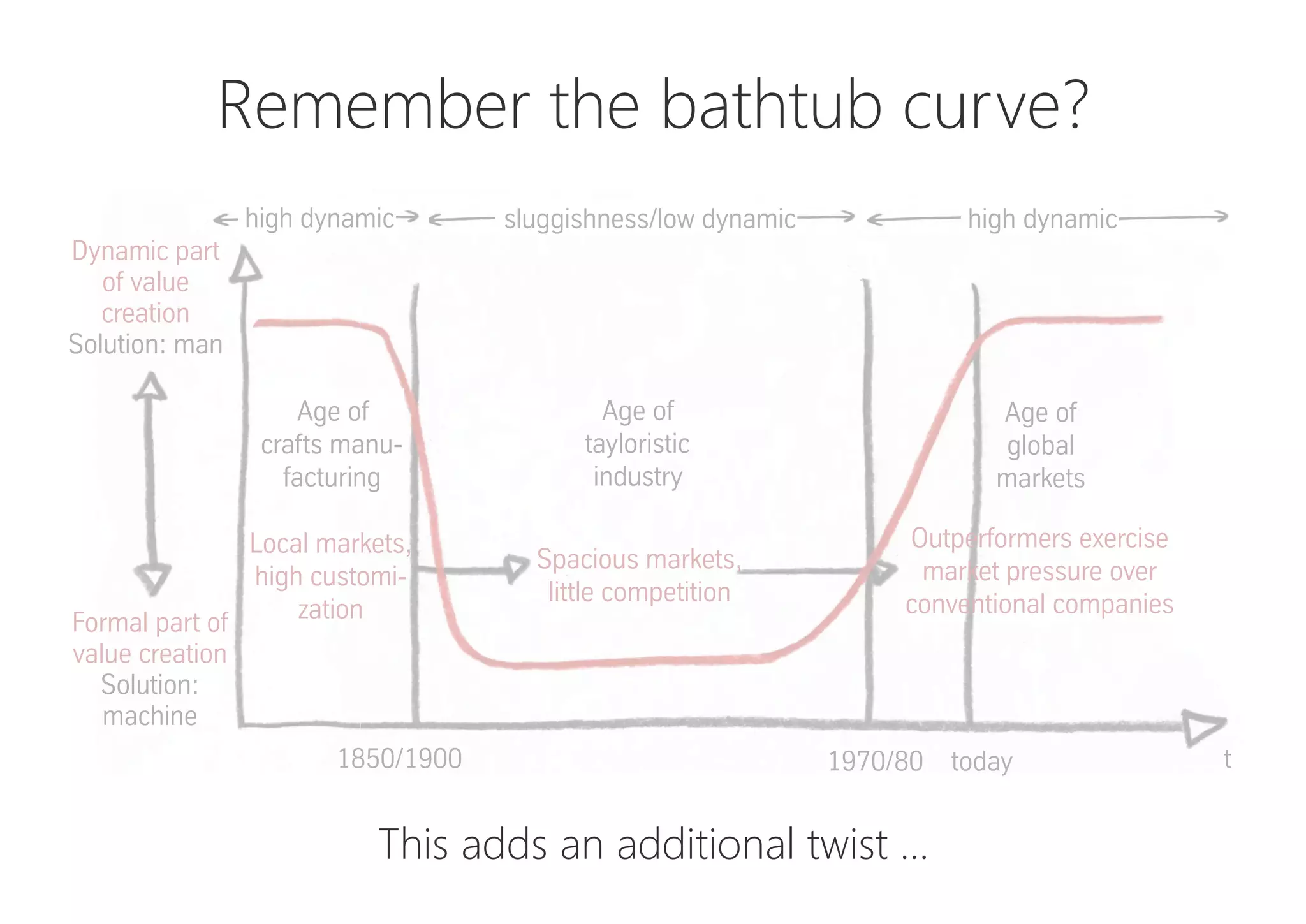
We call the graph shown here the “Taylor Bathtub”.
The “bathtub” curve
Source: BetaCodex Network Associates, “Organize for complexity”, BetaCodex Network White Paper 12 & 13
Formal part of
value creation
Solution:
machine
Dynamic part
of value
creation
Solution: man
sluggishness/low dynamic high dynamichigh dynamic
The historical course of market dynamics
and the recent rise of highly dynamic and complex markets
The dominance of high dynamics and complexity is neither good nor bad. It‘s a historical fact.
t1970/80 today
Age of
crafts manu-
facturing
Age of
tayloristic
industry
Age of
global
markets
1850/1900
Spacious markets,
little competition
Local markets,
high customi-
zation
Outperformers exercise
market pressure over
conventional companies
We call the graph shown here the “Taylor Bathtub”.
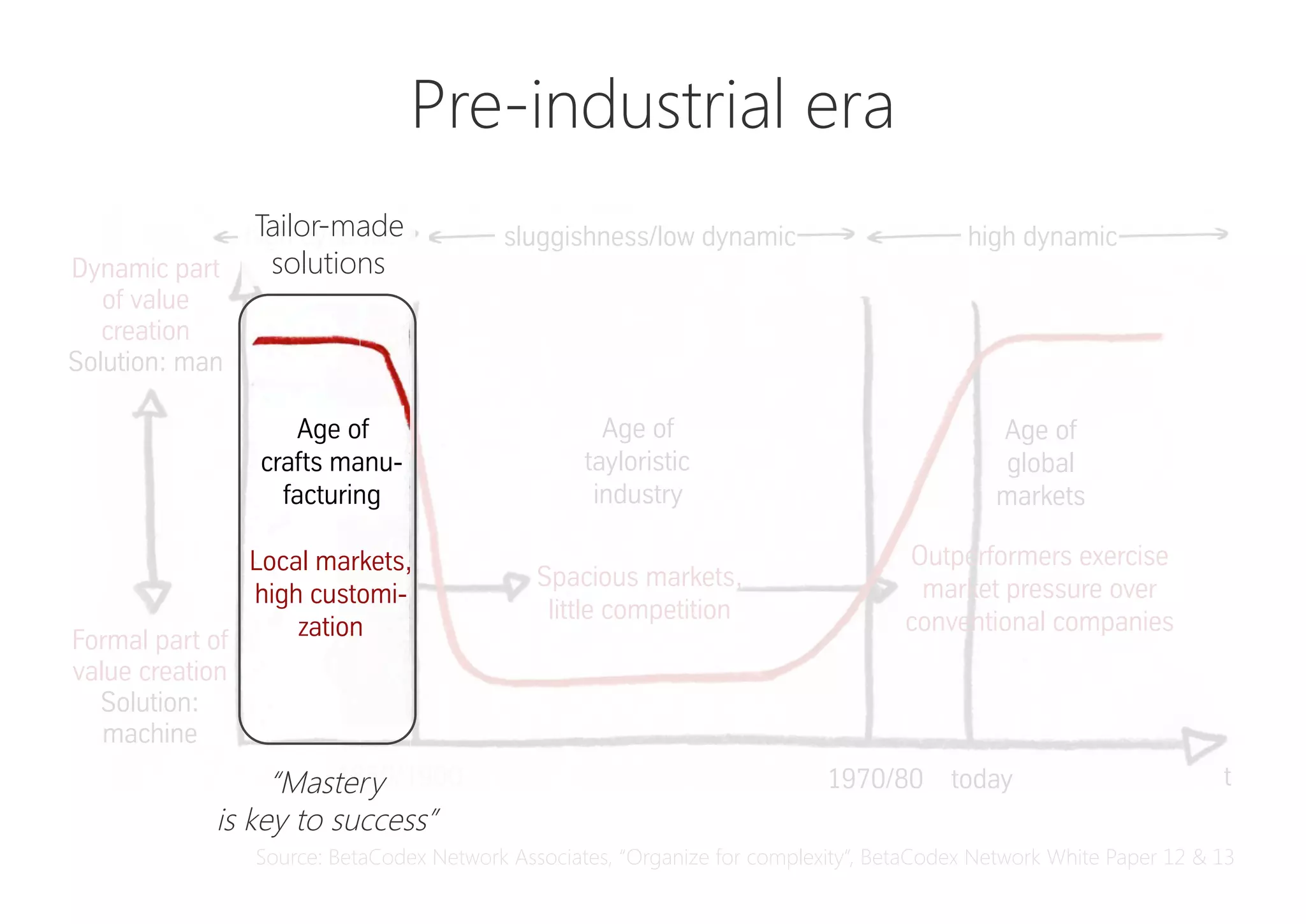
Pre-industrial era
Source: BetaCodex Network Associates, “Organize for complexity”, BetaCodex Network White Paper 12 & 13
Tailor-made
solutions
“Mastery
is key to success”
Formal part of
value creation
Solution:
machine
Dynamic part
of value
creation
Solution: man
sluggishness/low dynamic high dynamichigh dynamic
The historical course of market dynamics
and the recent rise of highly dynamic and complex markets
The dominance of high dynamics and complexity is neither good nor bad. It‘s a historical fact.
t1970/80 today
Age of
crafts manu-
facturing
Age of
tayloristic
industry
Age of
global
markets
1850/1900
Spacious markets,
little competition
Local markets,
high customi-
zation
Outperformers exercise
market pressure over
conventional companies
We call the graph shown here the “Taylor Bathtub”.
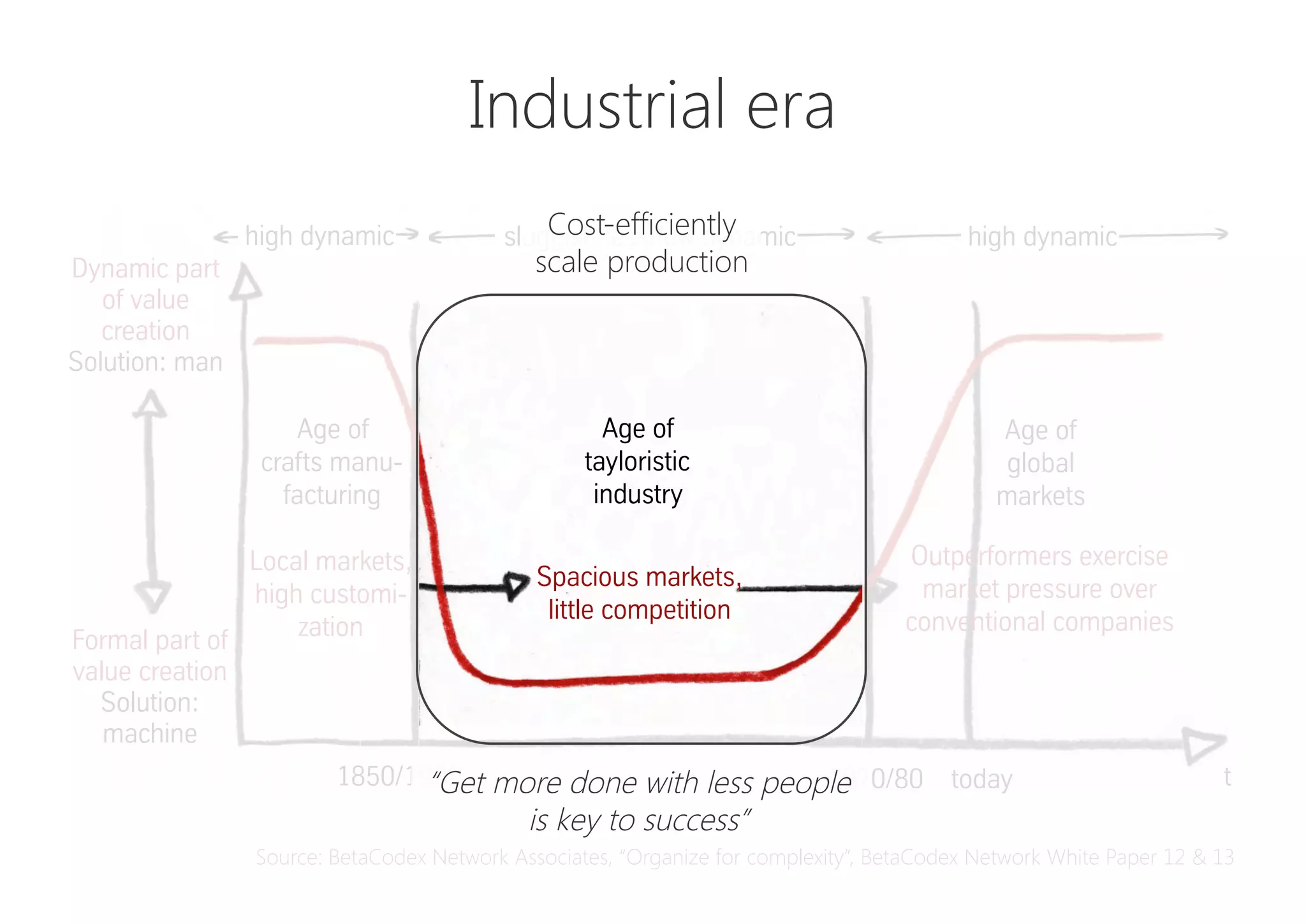
Industrial era
Source: BetaCodex Network Associates, “Organize for complexity”, BetaCodex Network White Paper 12 & 13
Cost-efficiently
scale production
“Get more done with less people
is key to success”
Formal part of
value creation
Solution:
machine
Dynamic part
of value
creation
Solution: man
sluggishness/low dynamic high dynamichigh dynamic
The historical course of market dynamics
and the recent rise of highly dynamic and complex markets
The dominance of high dynamics and complexity is neither good nor bad. It‘s a historical fact.
t1970/80 today
Age of
crafts manu-
facturing
Age of
tayloristic
industry
Age of
global
markets
1850/1900
Spacious markets,
little competition
Local markets,
high customi-
zation
Outperformers exercise
market pressure over
conventional companies
We call the graph shown here the “Taylor Bathtub”.
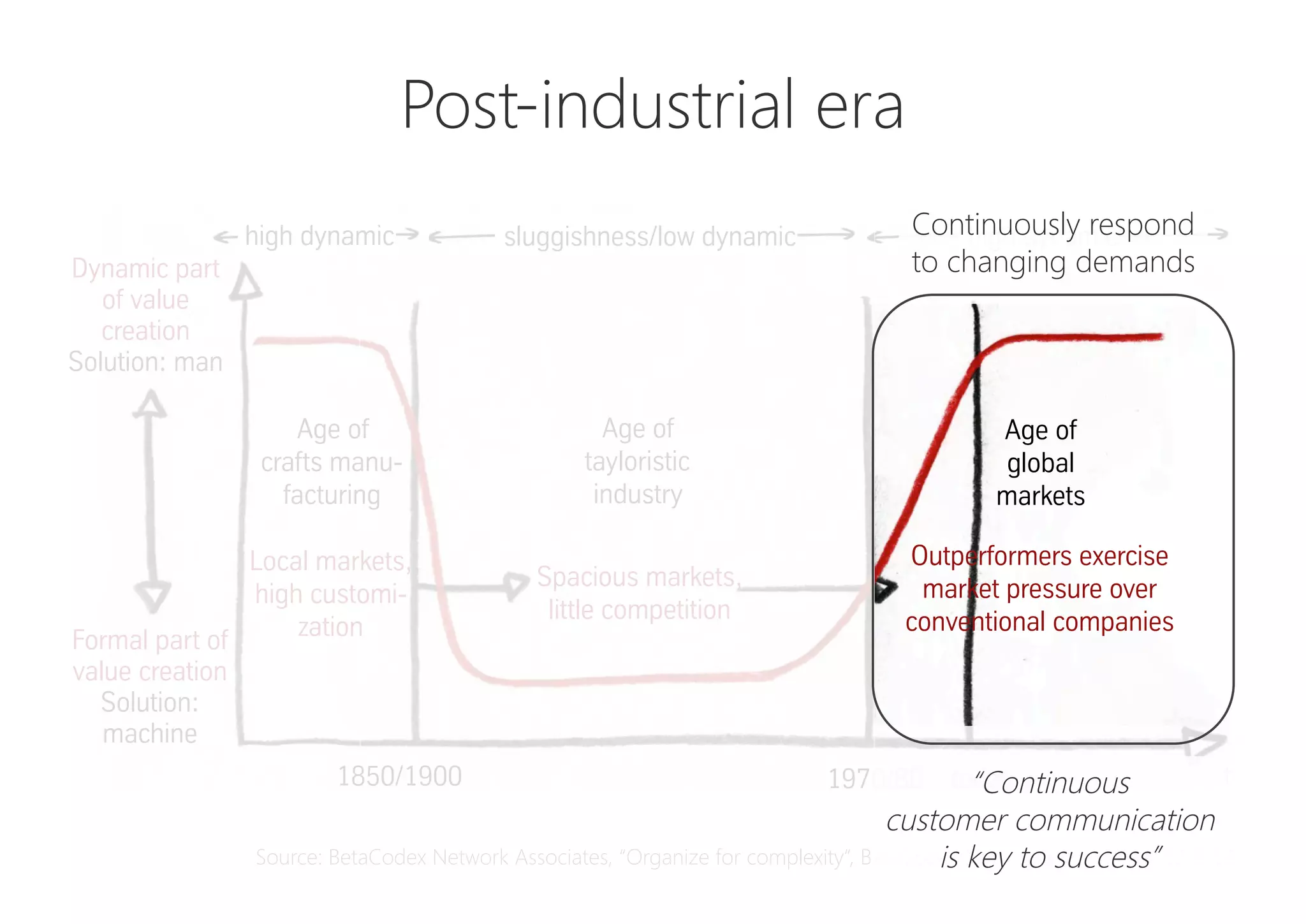
Post-industrial era
Source: BetaCodex Network Associates, “Organize for complexity”, BetaCodex Network White Paper 12 & 13
Continuously respond
to changing demands
“Continuous
customer communication
is key to success”
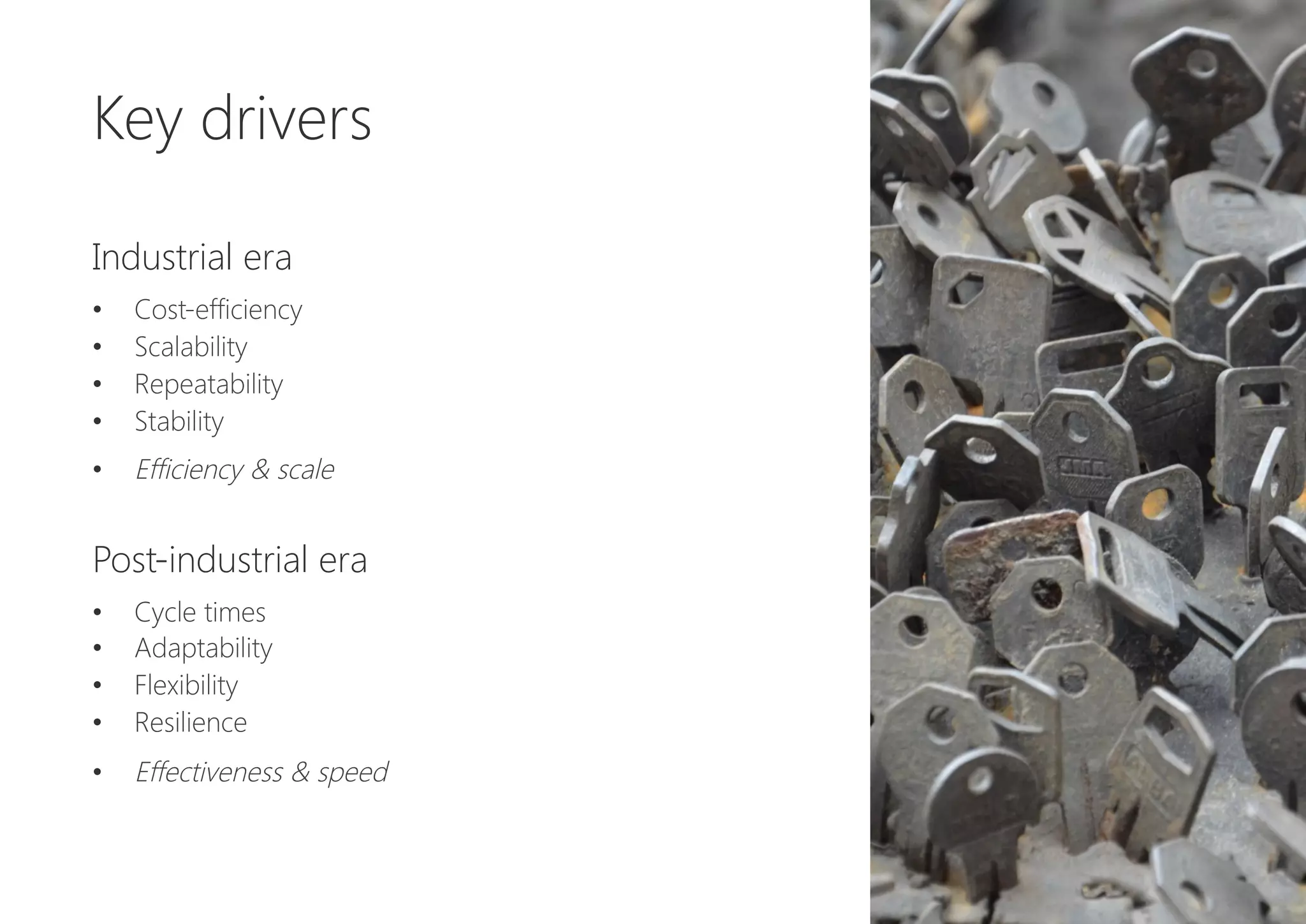
Key drivers

Industrial era

•  Cost-efficiency
•  Scalability
•  Repeatability
•  Stability
•  Efficiency & scale

Post-industrial era

•  Cycle times
•  Adaptability
•  Flexibility
•  Resilience
•  Effectiveness & speed
Evolution of IT
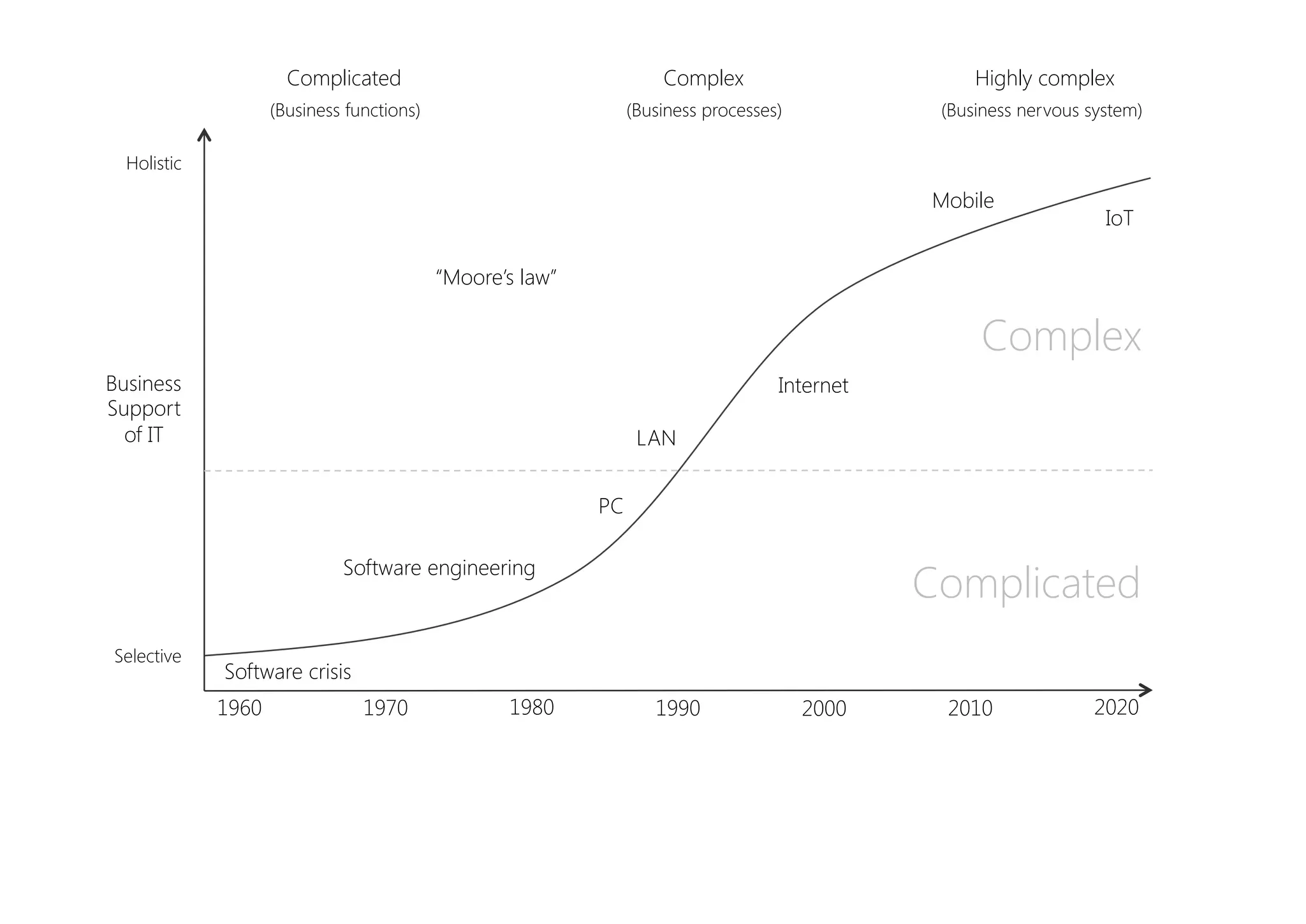
1960
 1970
 1980
 1990
 2000
 2010
 2020
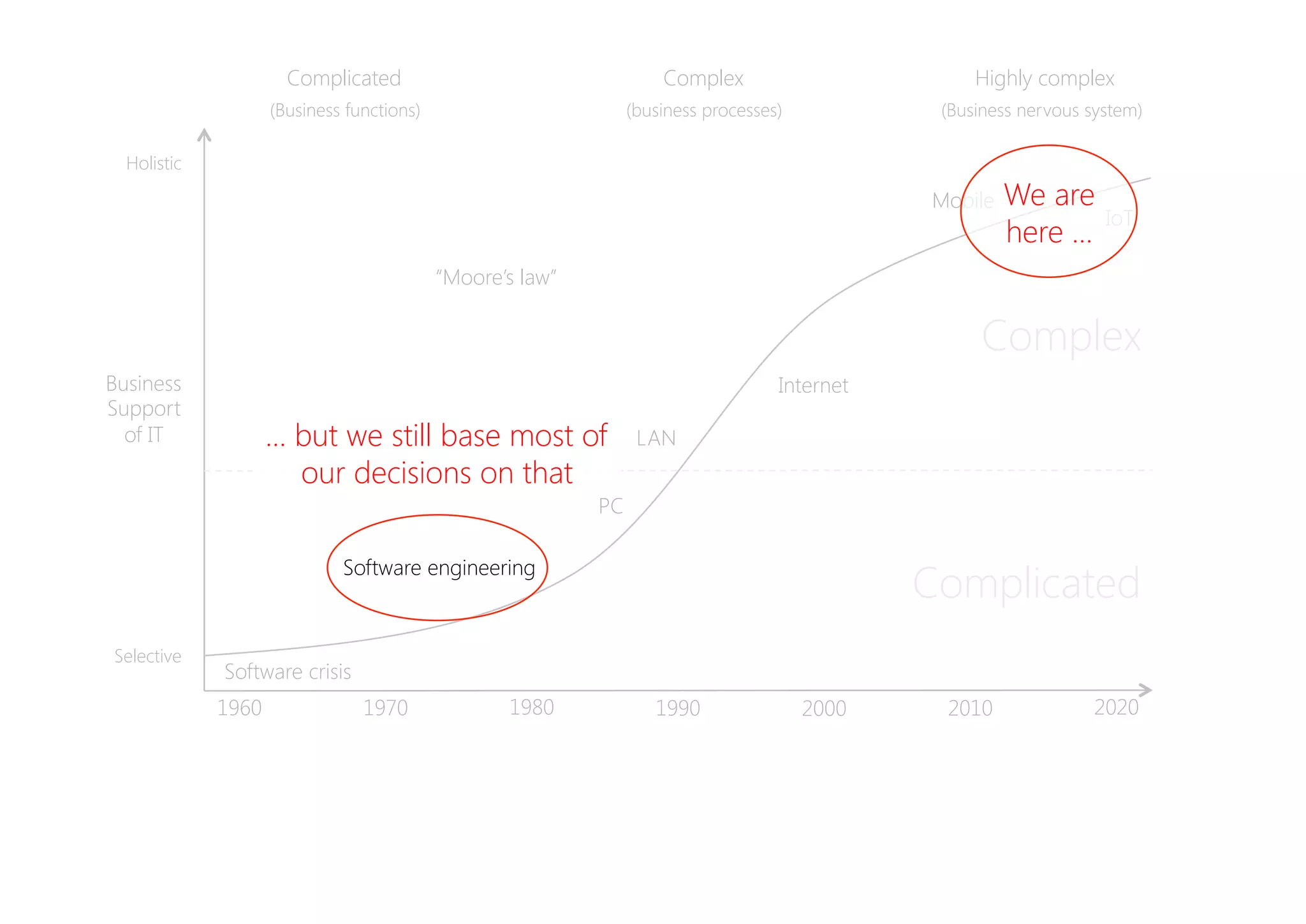
Complicated

(Business functions)
Complex

(Business processes)
Highly complex

(Business nervous system)
Software crisis
Software engineering
PC
LAN
Internet
Business
Support
of IT
Selective
Holistic
Complicated
Complex
“Moore’s law”
Mobile
IoT
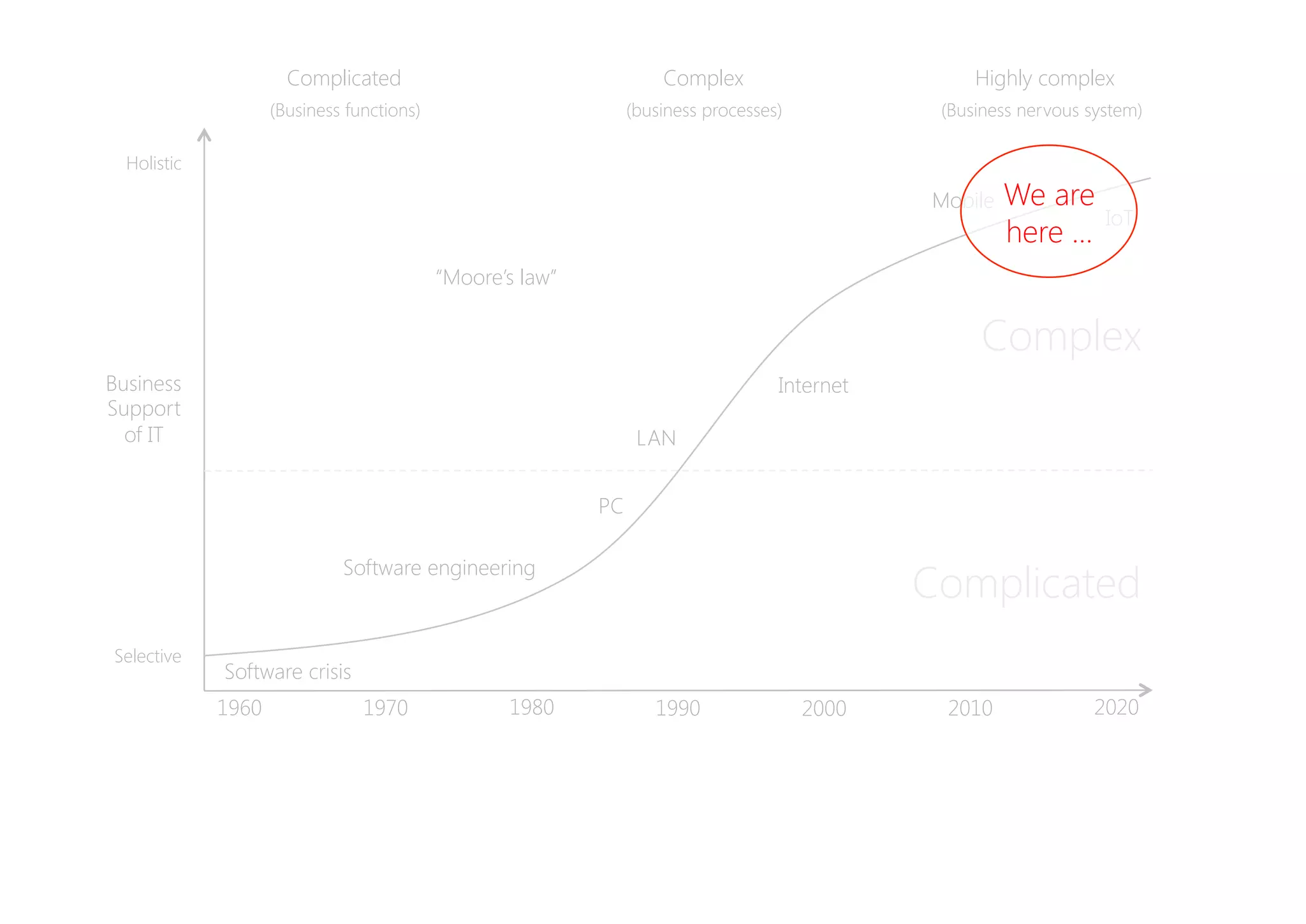
1960
 1970
 1980
 1990
 2000
 2010
 2020
Complicated

(Business functions)
Complex

(business processes)
Highly complex

(Business nervous system)
Software crisis
Software engineering
PC
LAN
Internet
Business
Support
of IT
Selective
Holistic
Complicated
Complex
“Moore’s law”
Mobile
IoT
We are
here …
1960
 1970
 1980
 1990
 2000
 2010
 2020
Complicated

(Business functions)
Complex

(business processes)
Highly complex

(Business nervous system)
Software crisis
Software engineering
PC
LAN
Internet
Business
Support
of IT
Selective
Holistic
Complicated
Complex
“Moore’s law”
Mobile
IoT
… but we still base most of
our decisions on that
We are
here …
Formal part of
value creation
Solution:
machine
Dynamic part
of value
creation
Solution: man
sluggishness/low dynamic high dynamichigh dynamic
The historical course of market dynamics
and the recent rise of highly dynamic and complex markets
The dominance of high dynamics and complexity is neither good nor bad. It‘s a historical fact.
t1970/80 today
Age of
crafts manu-
facturing
Age of
tayloristic
industry
Age of
global
markets
1850/1900
Spacious markets,
little competition
Local markets,
high customi-
zation
Outperformers exercise
market pressure over
conventional companies
We call the graph shown here the “Taylor Bathtub”.
Remember the bathtub curve?


This adds an additional twist …
1960
 1970
 1980
 1990
 2000
 2010
 2020
Complicated

(Business functions)
Complex

(business processes)
Highly complex

(Business nervous system)
Software crisis
Software engineering
PC
LAN
Internet
Business
Support
of IT
Selective
Holistic
Complicated
Complex
“Moore’s law”
Mobile
IoT
… but we still base most of
our decisions on that
We are
here …
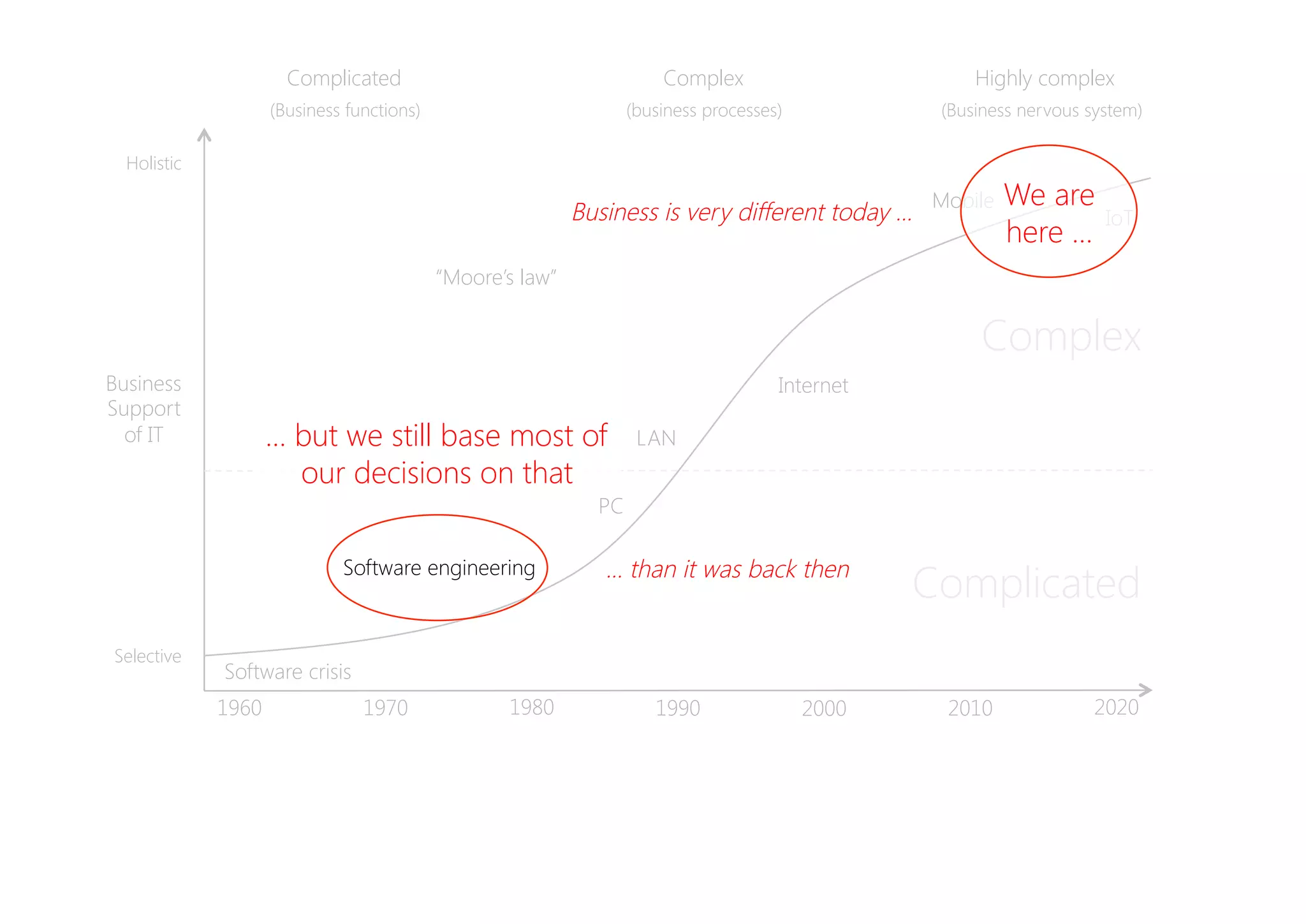
Business is very different today …
… than it was back then
Business
Market
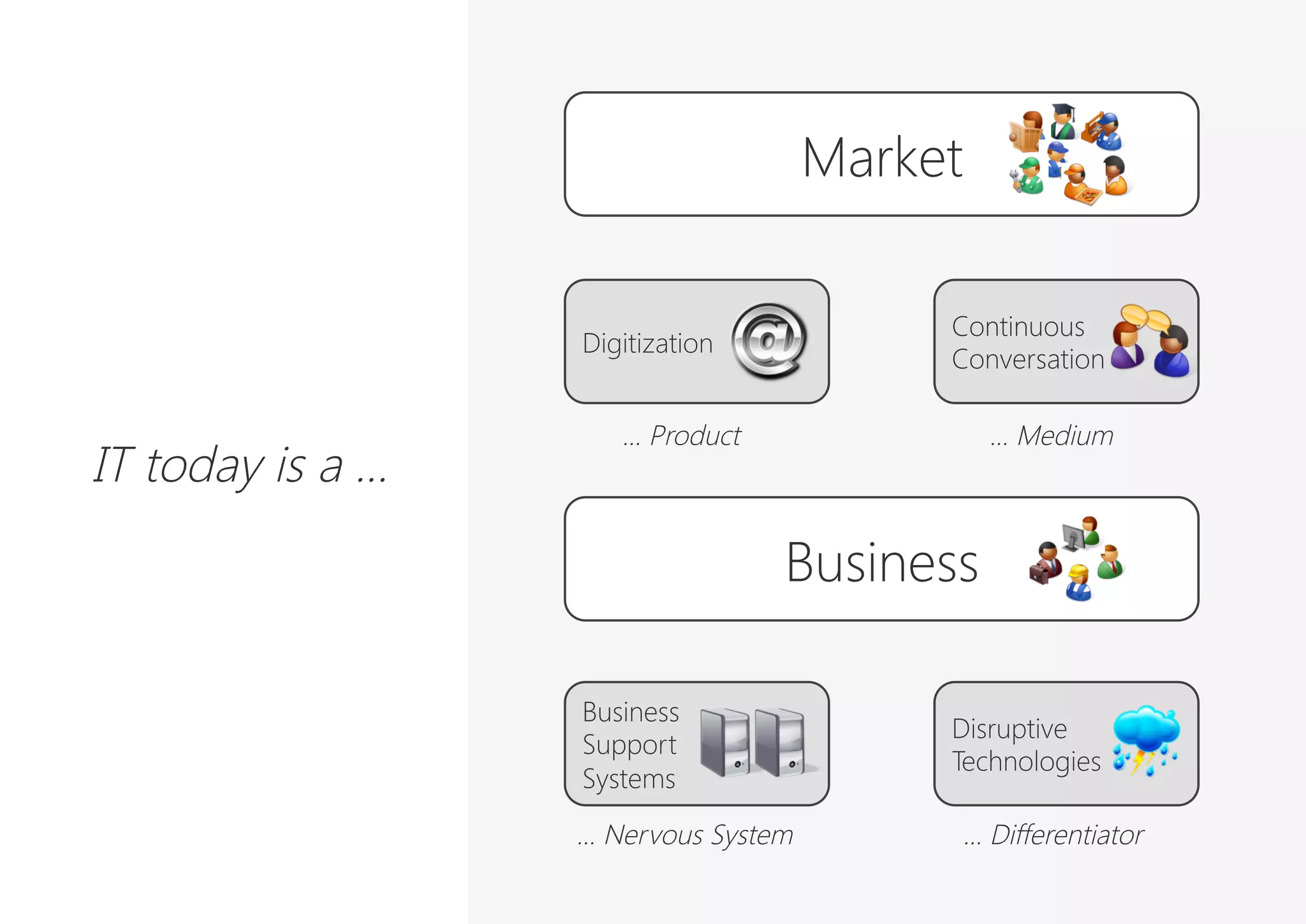
IT today is a …
… Nervous System
… Medium
… Product
… Differentiator
Disruptive
Technologies
Business
Support
Systems
Continuous
Conversation
Digitization
IT today is a key success factor to survive
in a post-industrial market
The traditional IT “best practices” are
counterproductive because they solve

a completely different problem
We need to rethink IT!
Rethinking IT
What are the new drivers?
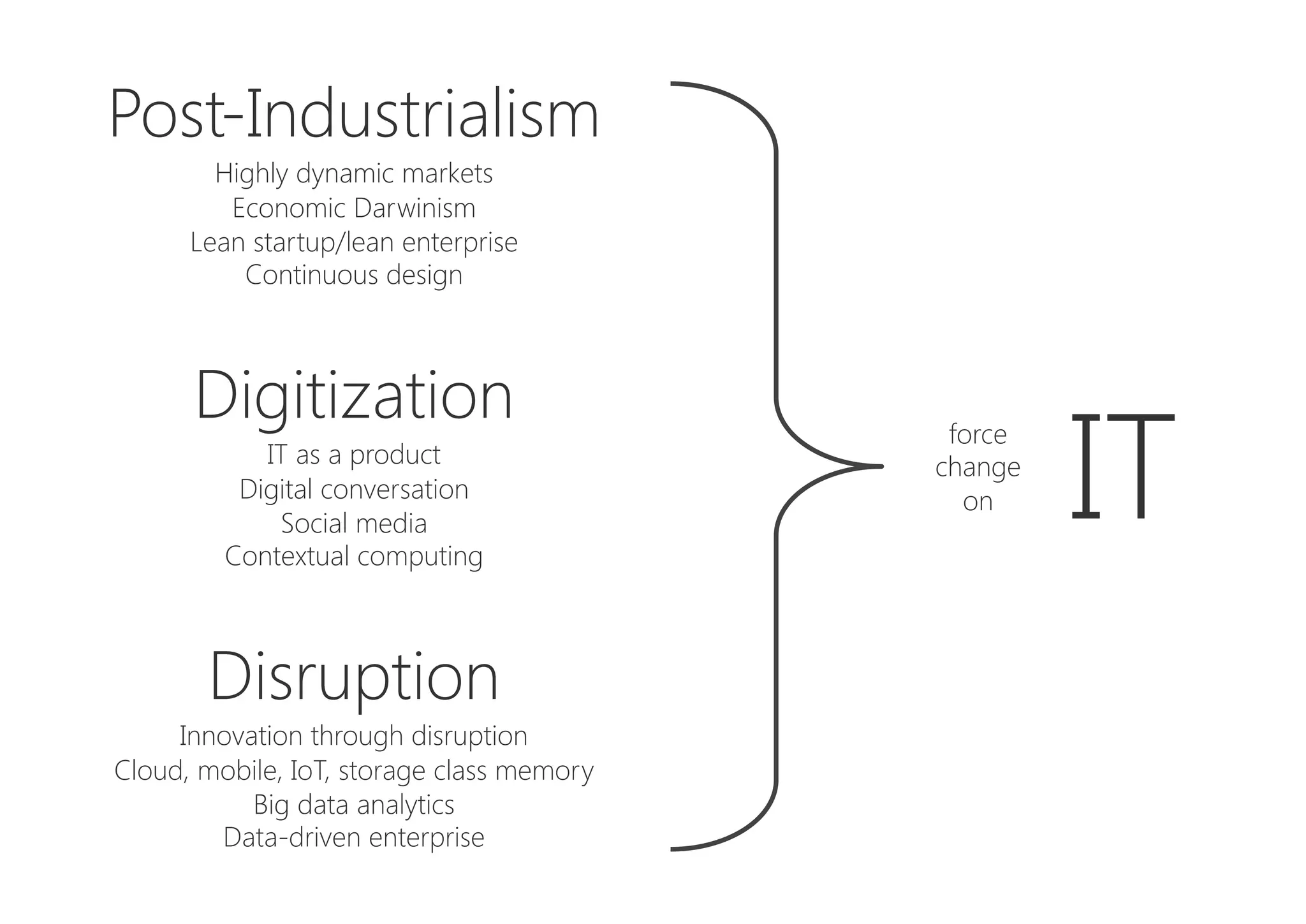
IT
Post-Industrialism
Highly dynamic markets
Economic Darwinism
Lean startup/lean enterprise
Continuous design
Digitization
IT as a product
Digital conversation
Social media
Contextual computing
Disruption
Innovation through disruption
Cloud, mobile, IoT, storage class memory
Big data analytics
Data-driven enterprise
force
change
on
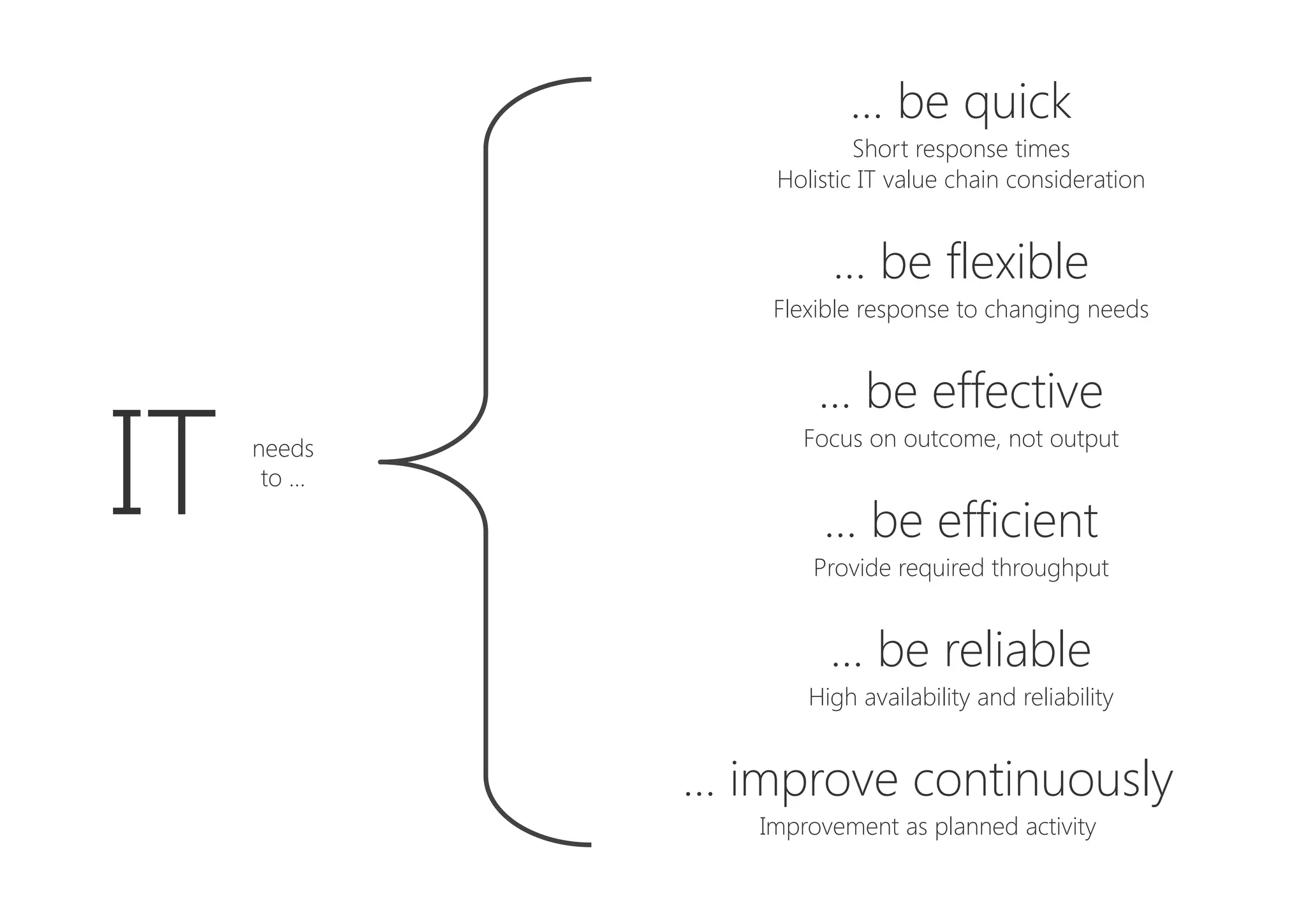
What are the new goals?
IT
… be quick
Short response times

Holistic IT value chain consideration
… be effective
Focus on outcome, not output
… improve continuously
Improvement as planned activity
needs
to …
… be efficient
Provide required throughput 
… be robust
High availability and adaptability
… be flexible
Flexible response to changing needs
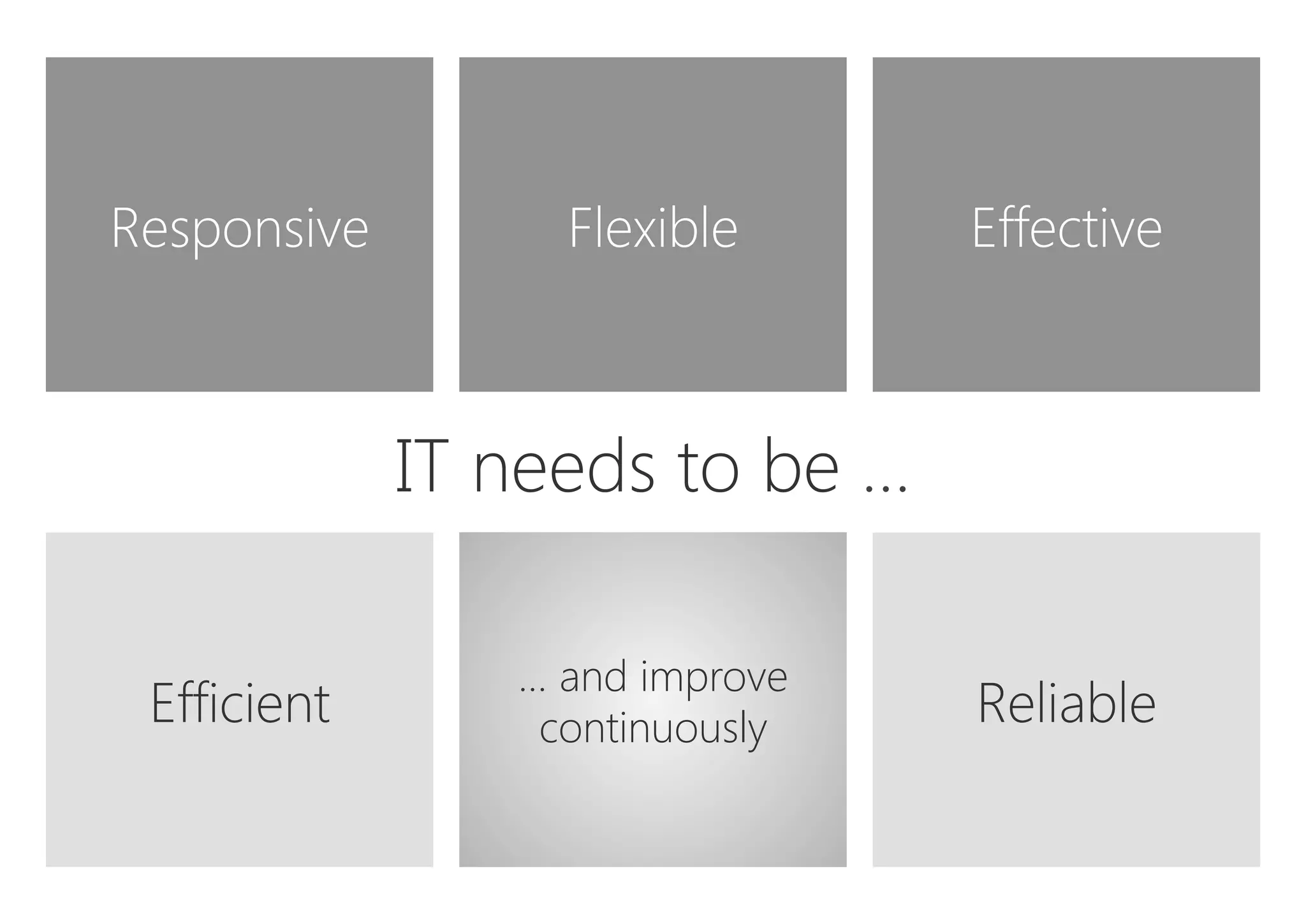
Process & Org
needs to be …
Quick
Flexible
 Effective
Software
needs to be …
Secure
Changeable
 Robust
… and improve continuously
Process & Org
needs to be …
Software
needs to be …
Quick
Flexible
 Effective
 Secure
Changeable
 Robust
… and improve continuously
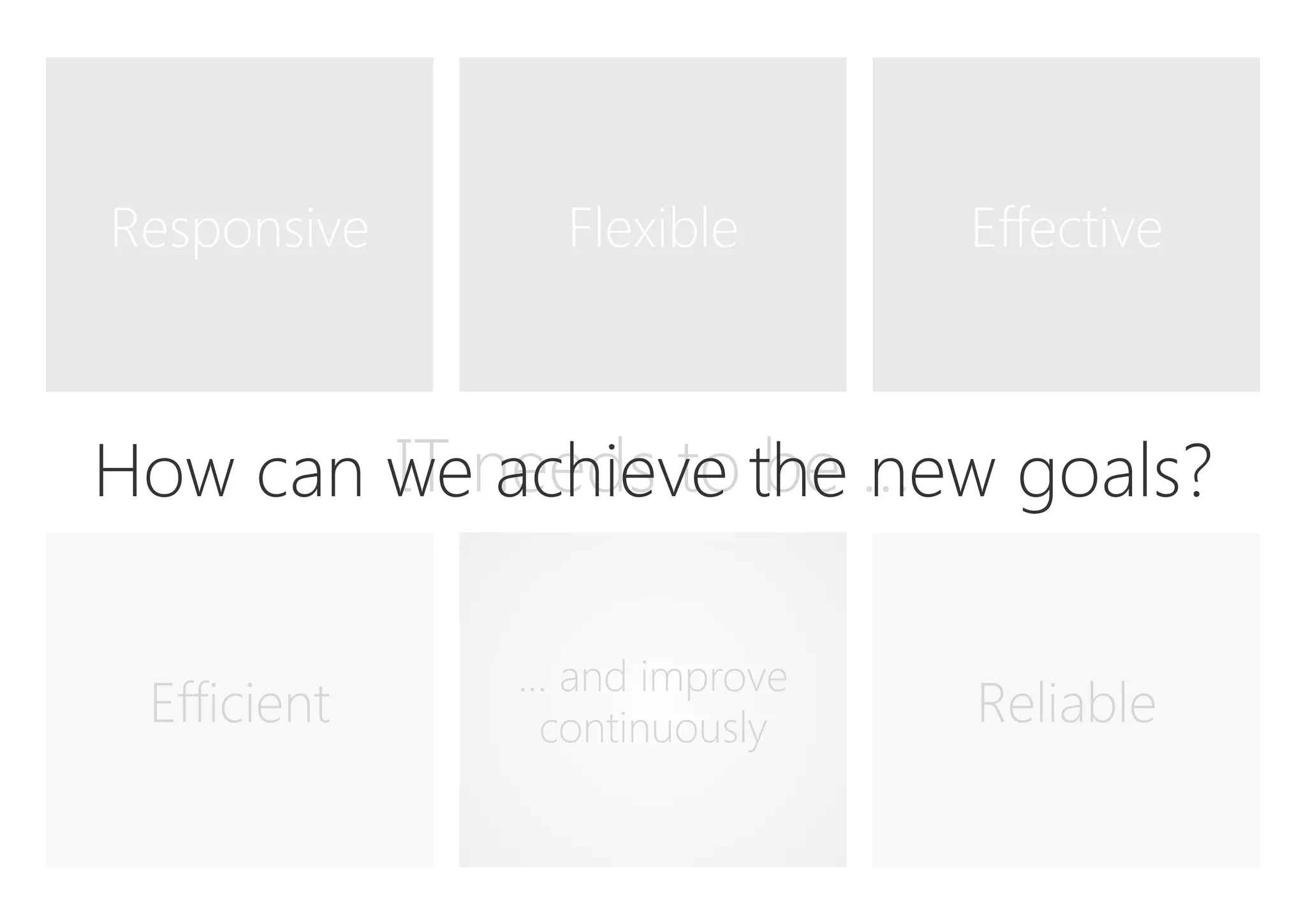
How can we achieve the new goals?
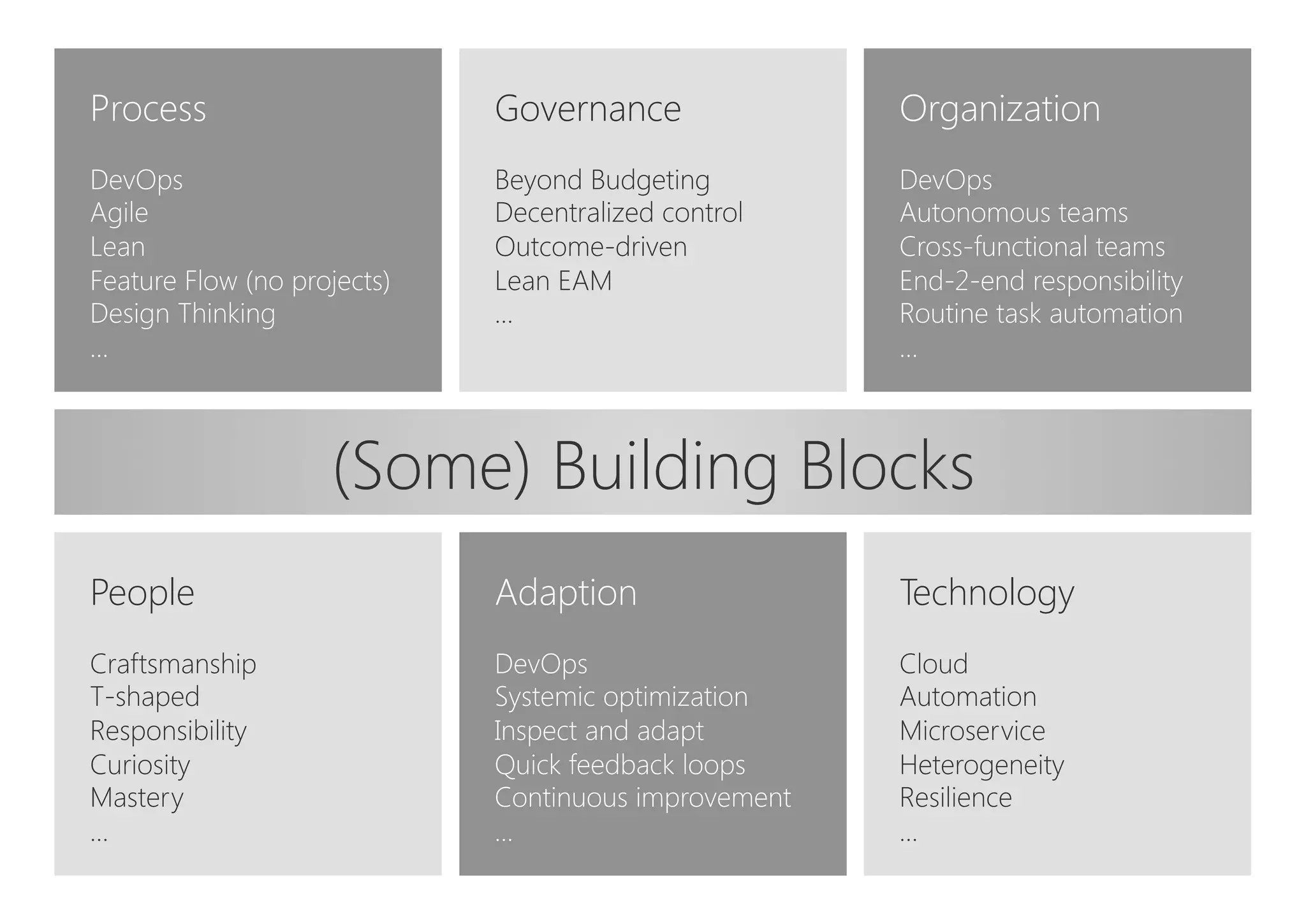
What are the building blocks?
Adaption

DevOps
Systemic optimization
Inspect and adapt
Quick feedback loops
Continuous improvement
…
Process

DevOps
Agile
Lean
Feature Flow (no projects)
Design Thinking
…
Governance

Beyond Budgeting
Decentralized control
Outcome-driven
Lean EAM
…
Organization

DevOps
Autonomous teams
Cross-functional teams
End-2-end responsibility
Routine task automation
…
People

Craftsmanship
T-shaped
Responsibility
Curiosity
Empathy
…
Technology

Cloud
Automation
Microservice
Heterogeneity
Resilience
…
(Some) Building Blocks
The role of DevOps
Quick repetition …
The 3 ways of DevOps


Systems thinking
Amplify feedback loops
Culture of continual experimentation & learning


http://itrevolution.com/the-three-ways-principles-underpinning-devops/
If taken seriously DevOps will eventually
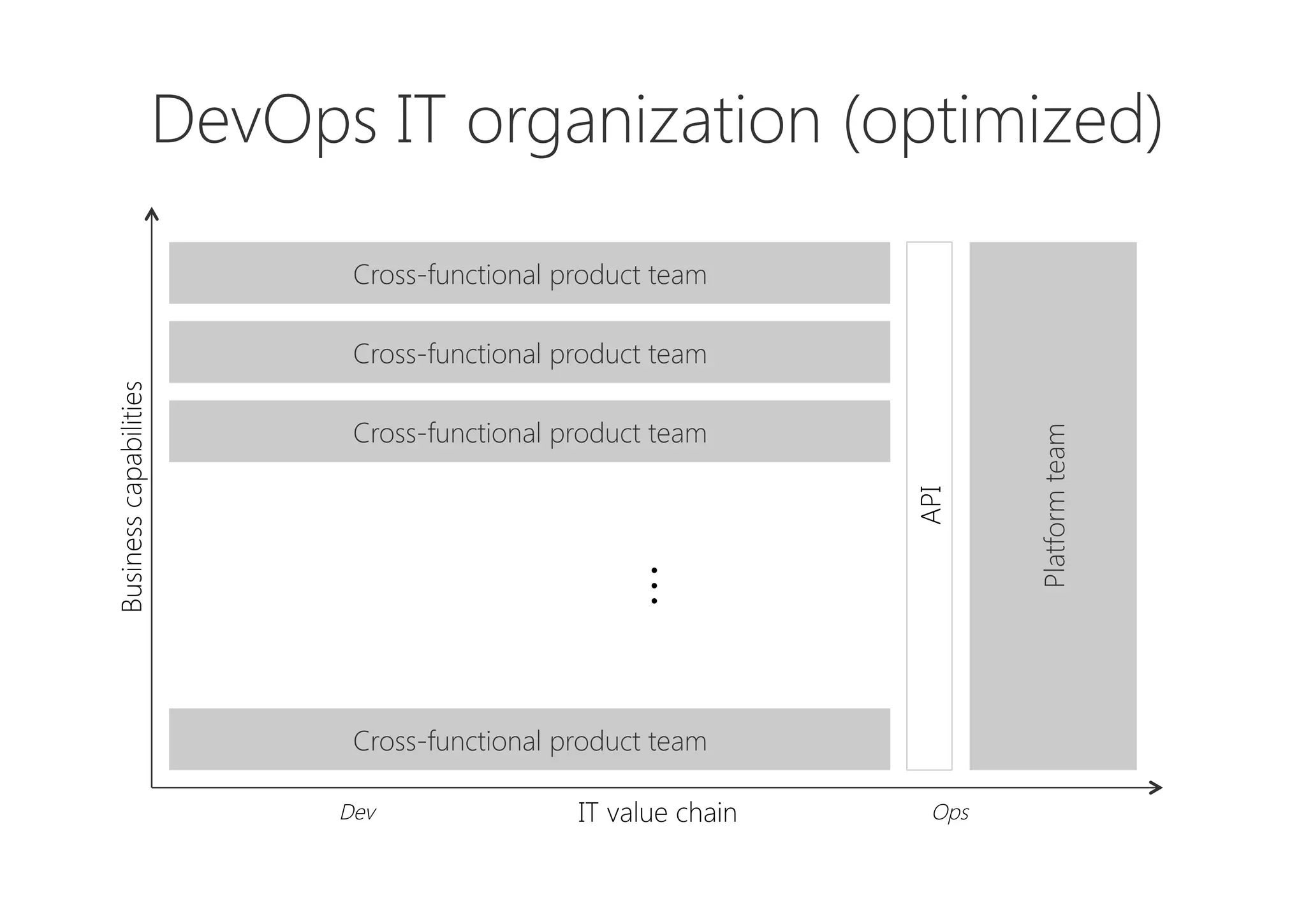
rotate your IT organization by 90°
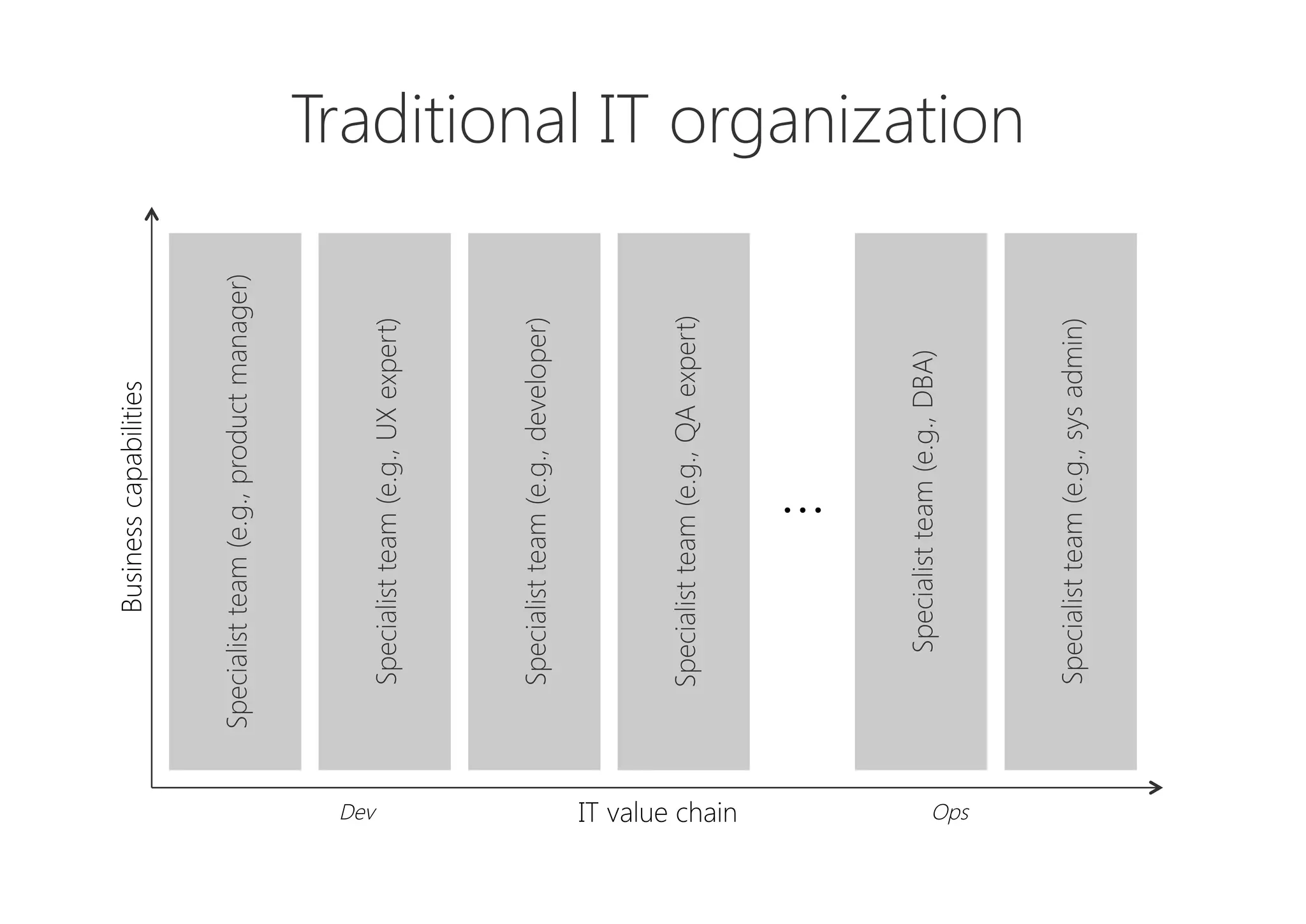
Ops
Dev
 IT value chain
Businesscapabilities
Specialistteam(e.g.,productmanager)
Specialistteam(e.g.,UXexpert)
Specialistteam(e.g.,developer)
Specialistteam(e.g.,QAexpert)
Specialistteam(e.g.,sysadmin)
Specialistteam(e.g.,DBA)
…
Traditional IT organization
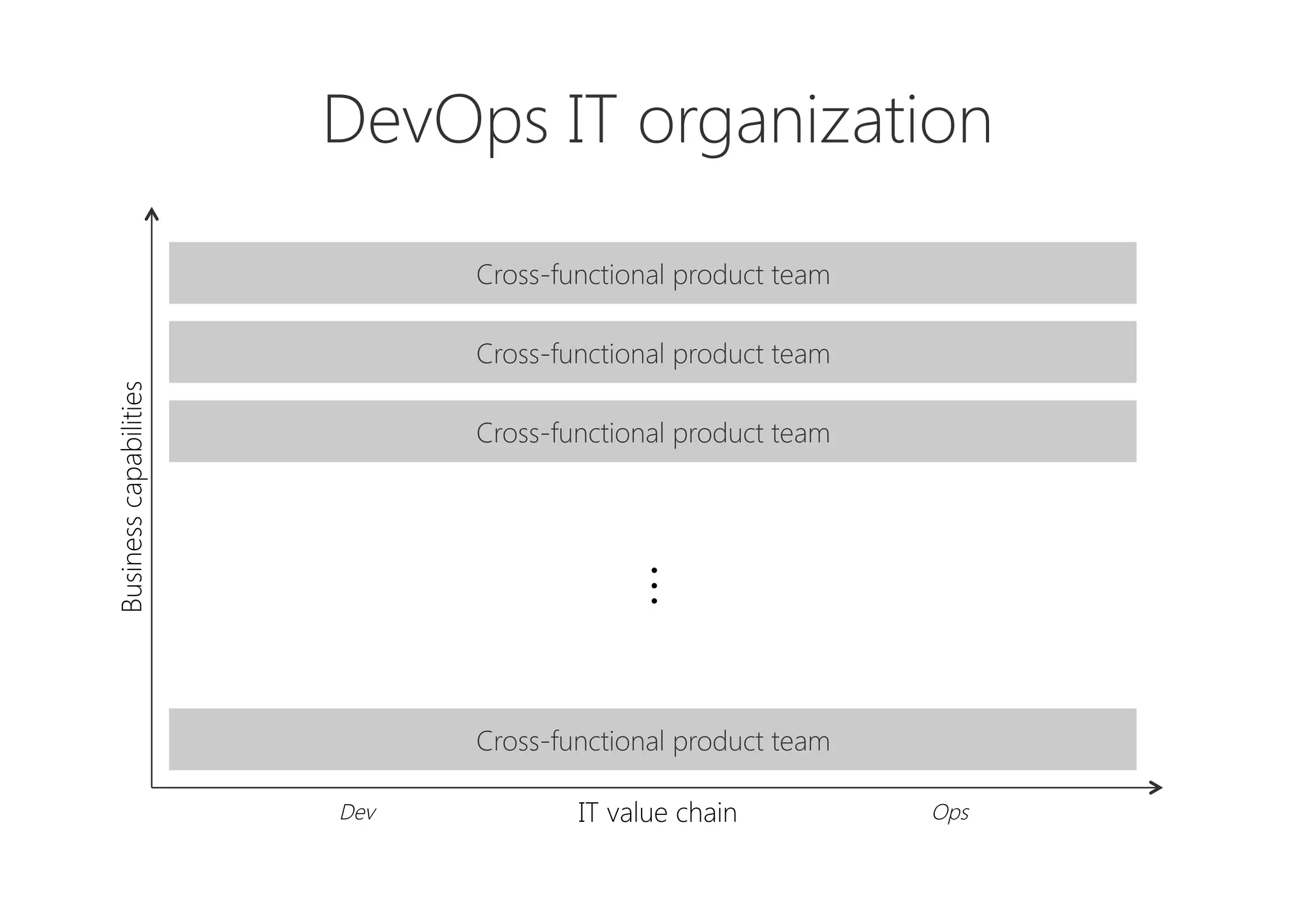
Ops
Dev
 IT value chain
Businesscapabilities
Cross-functional product team
…
DevOps IT organization
Cross-functional product team
Ops
Dev
 IT value chain
Businesscapabilities
Cross-functional product team
…
DevOps IT organization (optimized)
Cross-functional product team
Platformteam
API
DevOps also triggers

a lot of additional changes
“Okay, let’s start with DevOps …”
DevOps
“But our IT department is too big.
We need to organize differently.”
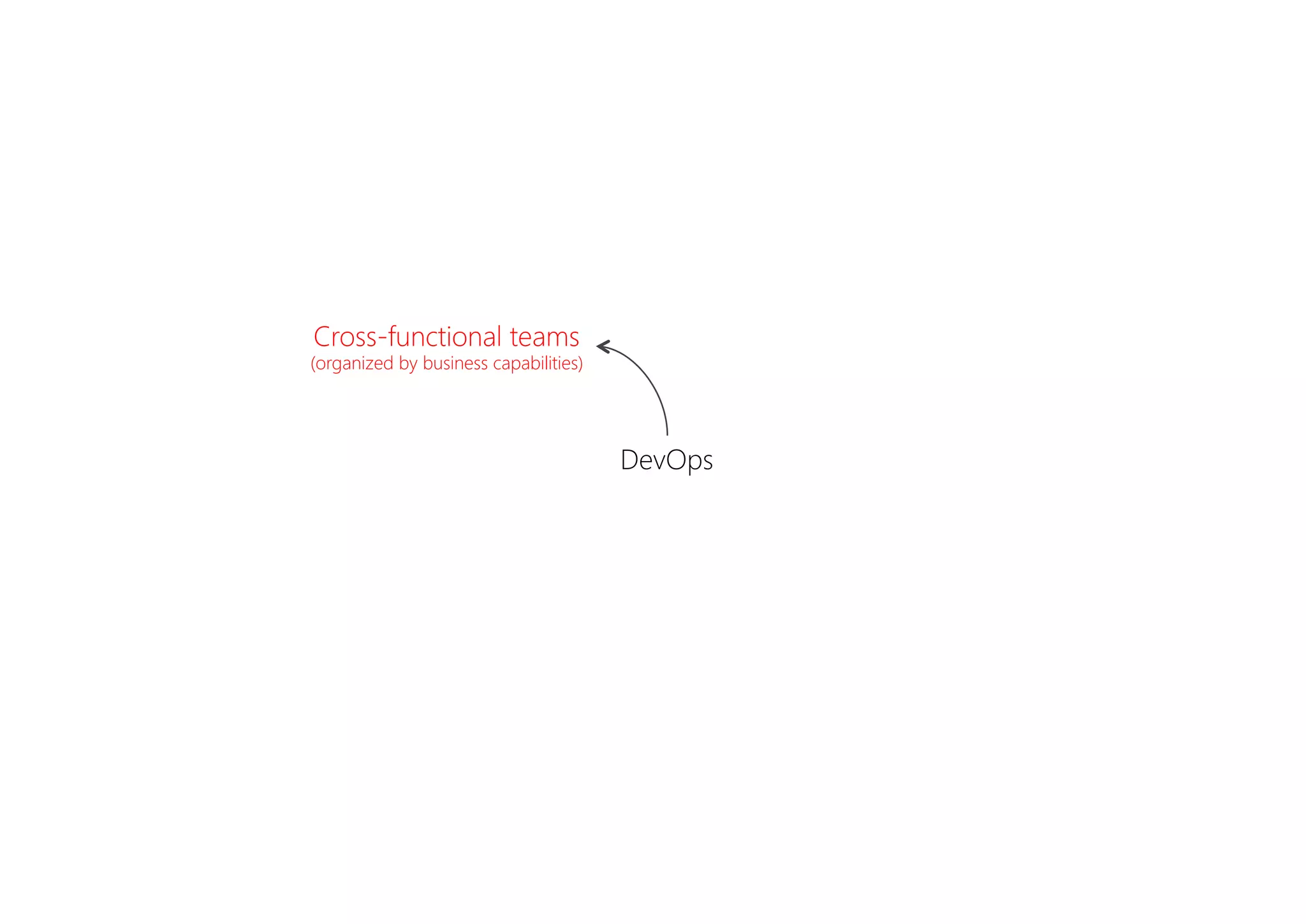
DevOps
Cross-functional teams
(organized by business capabilities)
“How can we enable
the teams to become faster?”
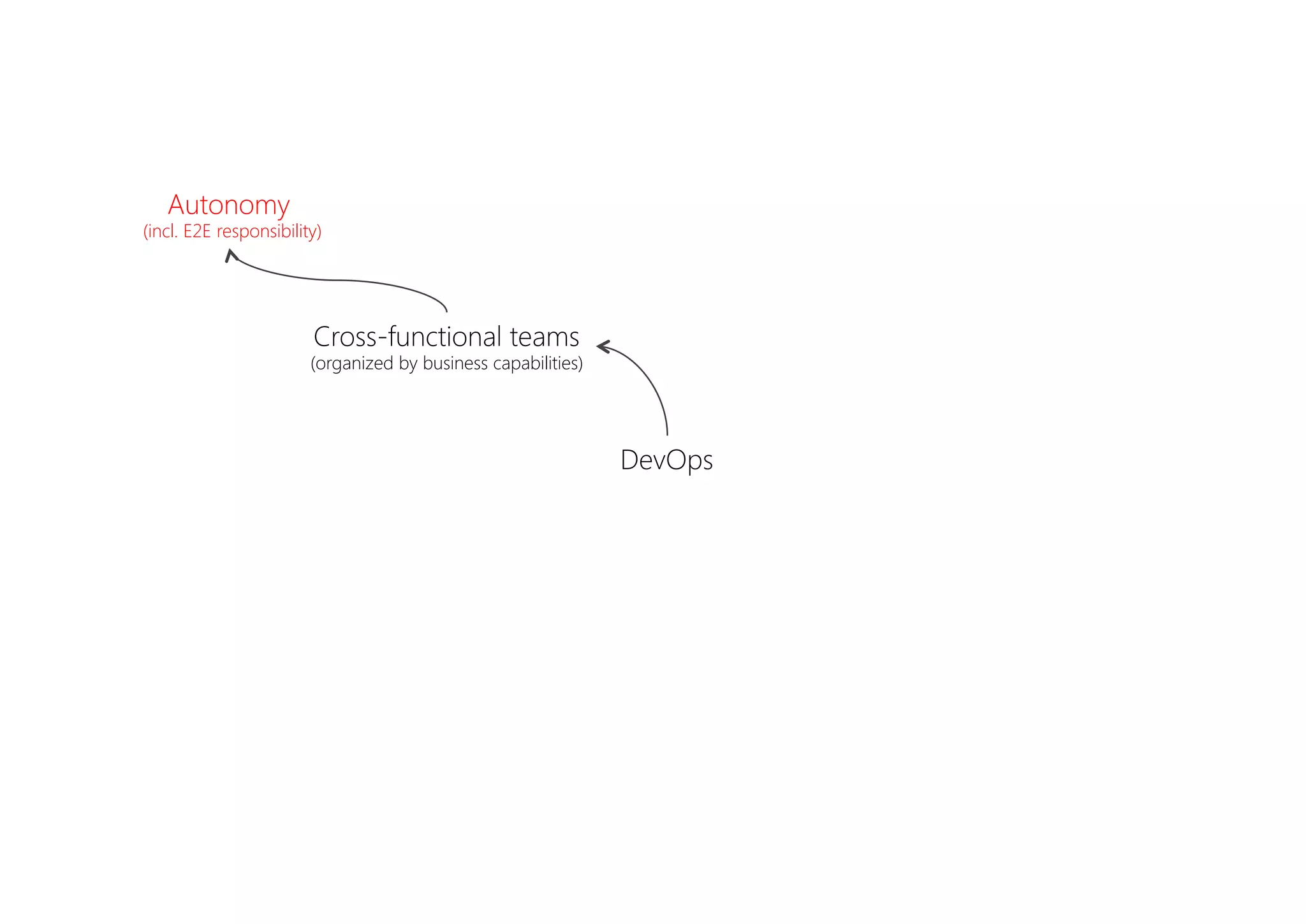
DevOps
Cross-functional teams
(organized by business capabilities)
Autonomy
(incl. E2E responsibility)
“How can we manage those teams?”
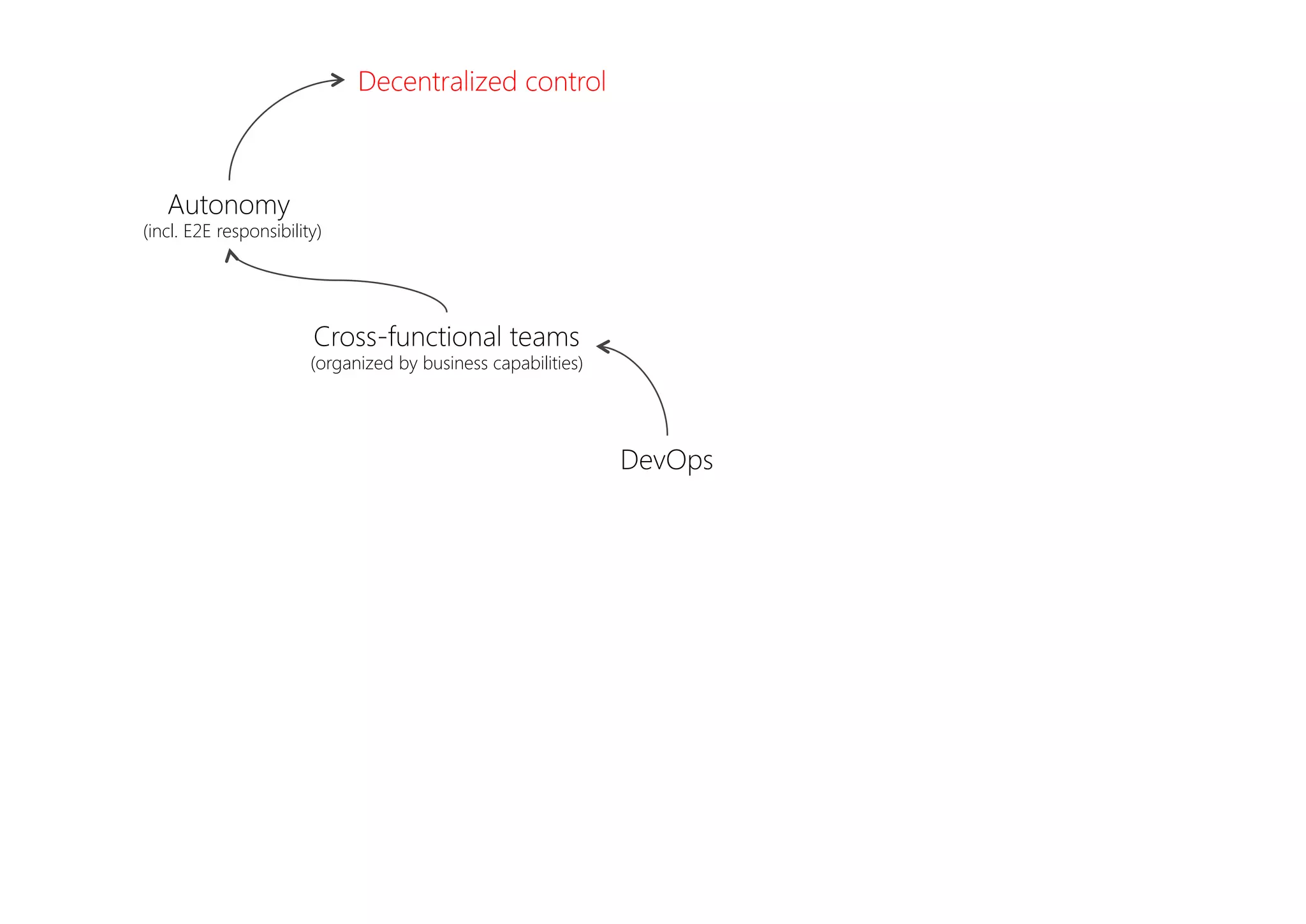
DevOps
Cross-functional teams
(organized by business capabilities)
Autonomy
(incl. E2E responsibility)
Decentralized control
“How can we control
if the teams are on the right track?”
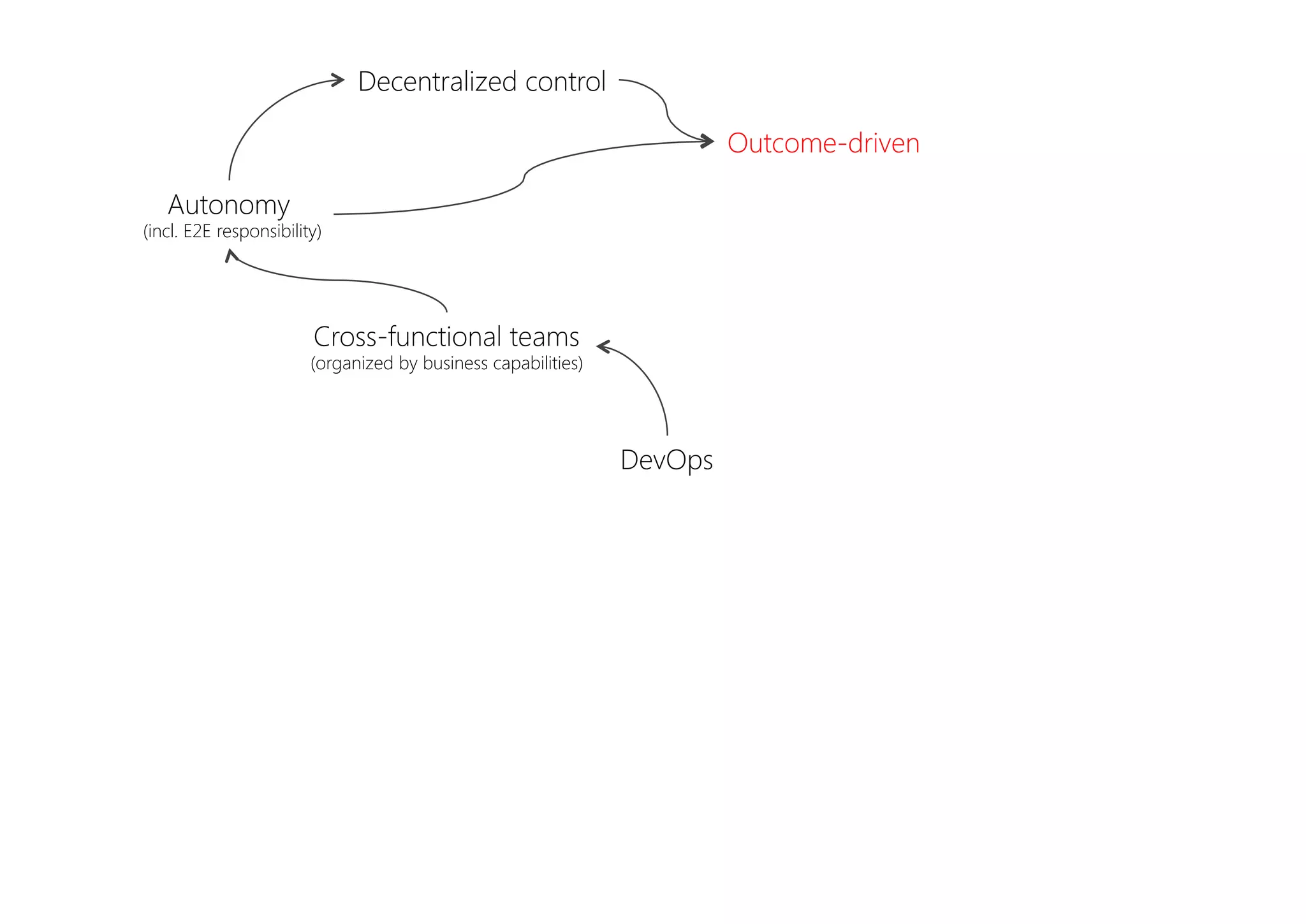
DevOps
Cross-functional teams
(organized by business capabilities)
Autonomy
(incl. E2E responsibility)
Decentralized control
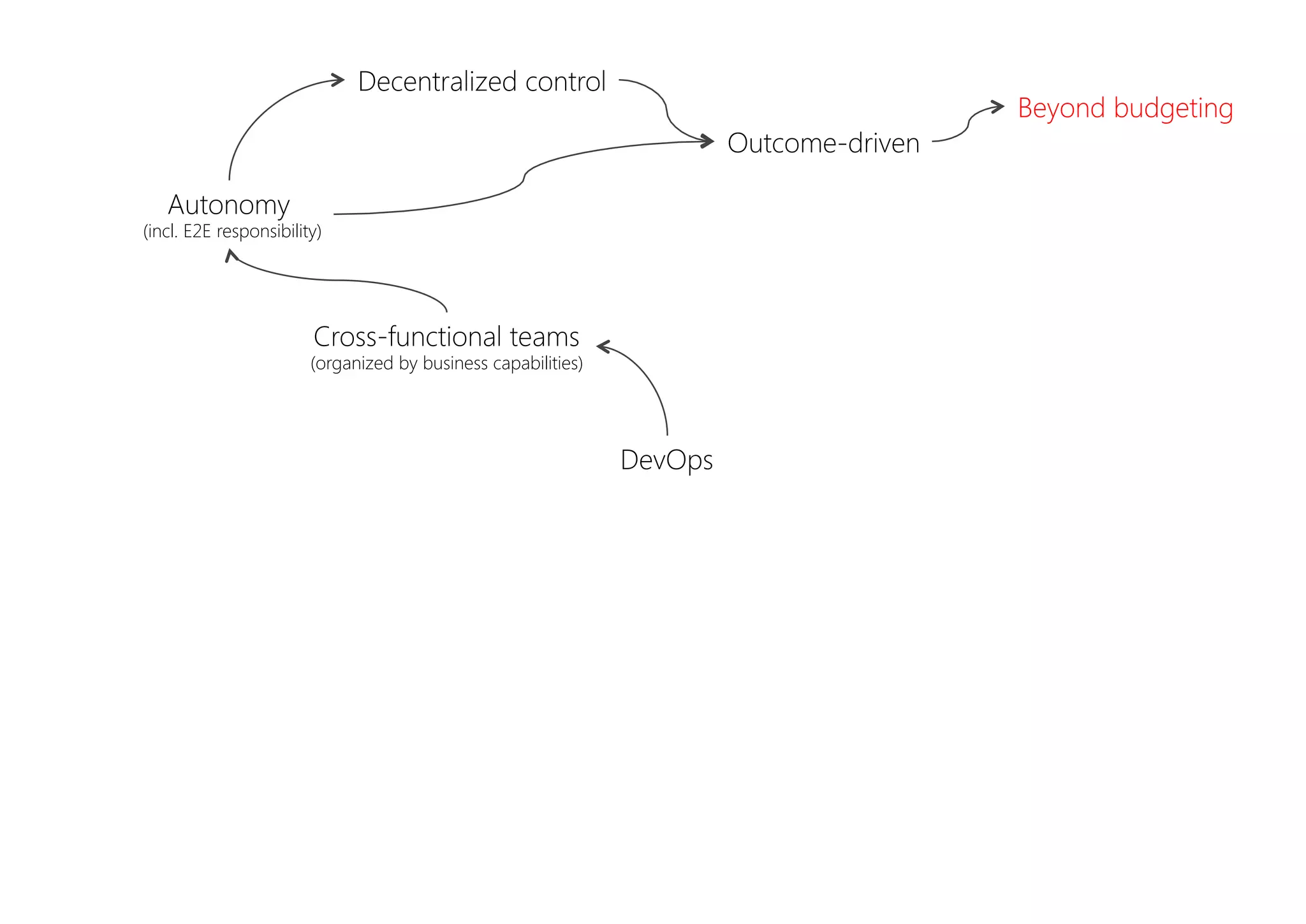
Outcome-driven
“We need to rethink our overall
governance model.”
DevOps
Cross-functional teams
(organized by business capabilities)
Autonomy
(incl. E2E responsibility)
Decentralized control
Outcome-driven
Beyond budgeting
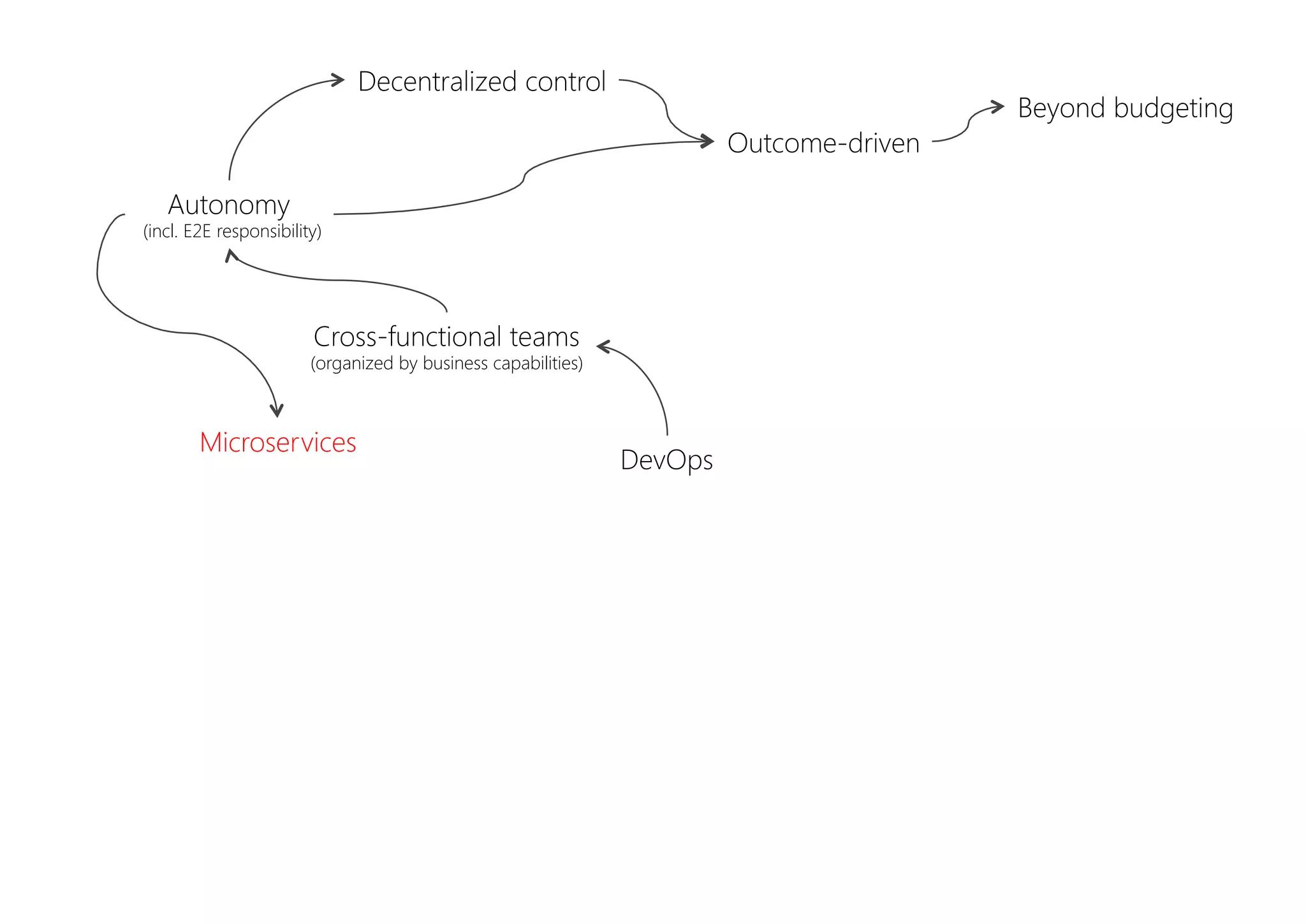
“How can we support autonomy
on the architectural level?”
DevOps
Cross-functional teams
(organized by business capabilities)
Autonomy
(incl. E2E responsibility)
Decentralized control
Outcome-driven
Beyond budgeting
Microservices
“Can we help teams getting faster
on the technological level?”
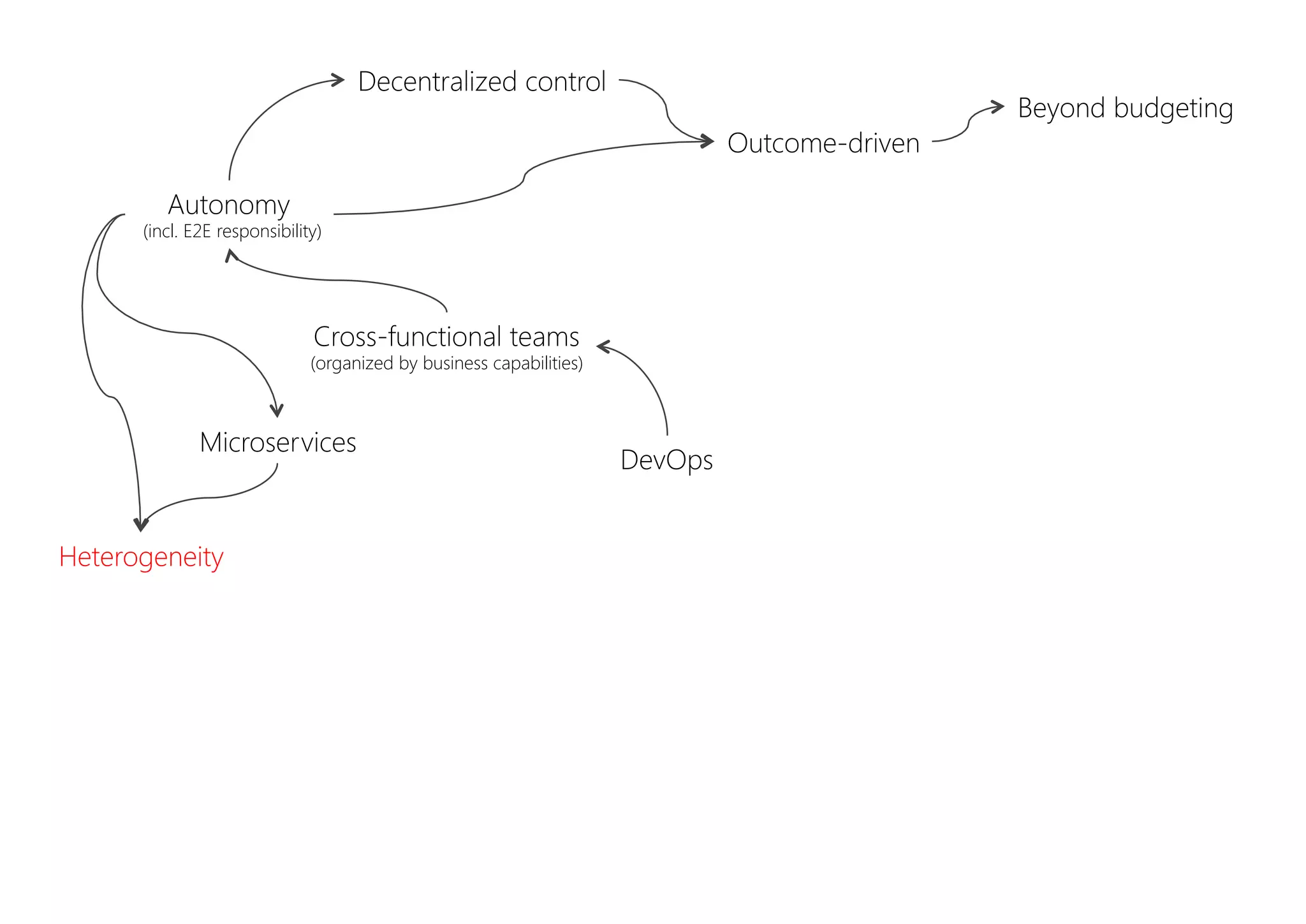
DevOps
Cross-functional teams
(organized by business capabilities)
Autonomy
(incl. E2E responsibility)
Decentralized control
Outcome-driven
Beyond budgeting
Microservices
Heterogeneity
“How can we ensure
the required speed and flexibility
at the infrastructure level?”
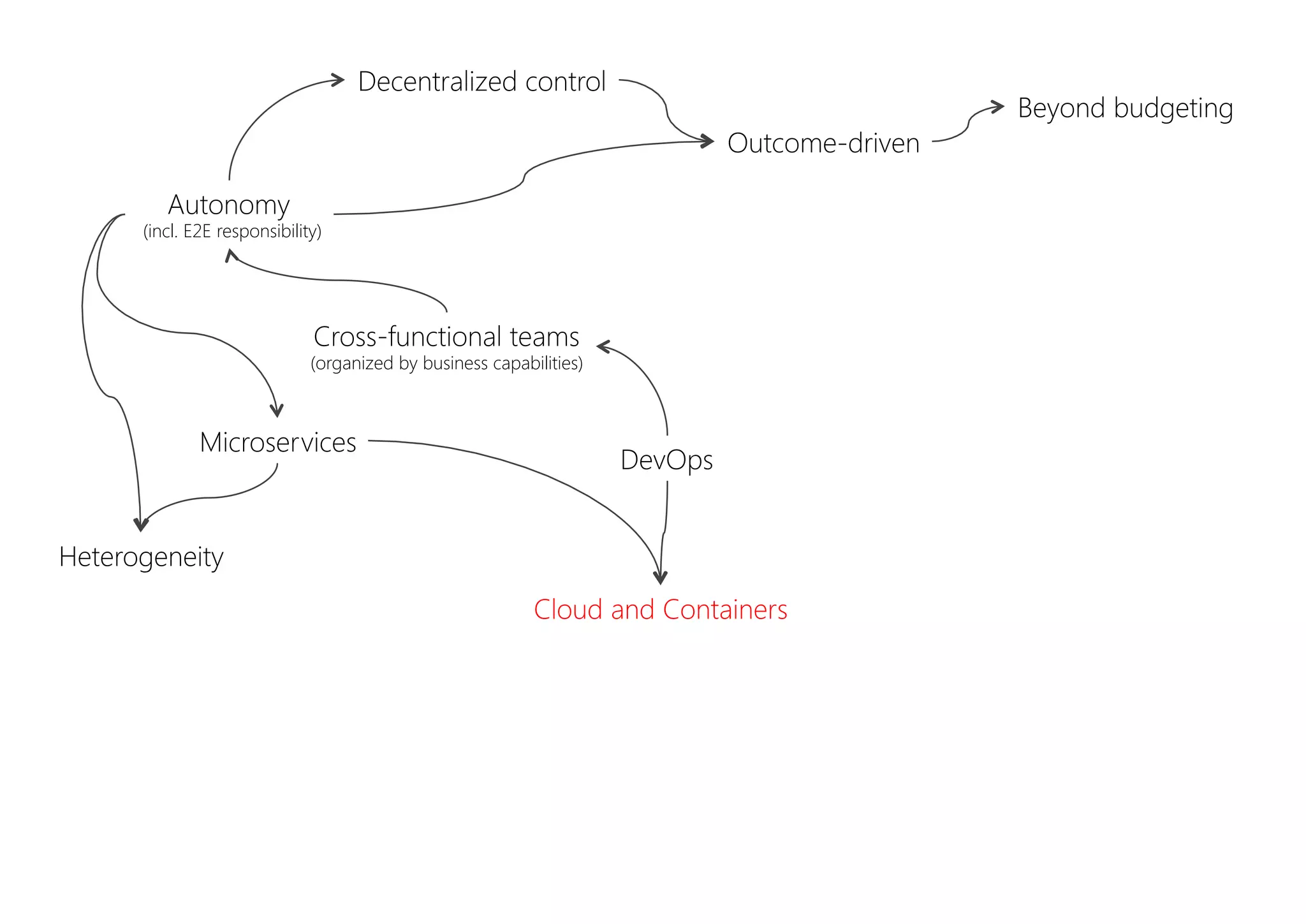
DevOps
Cross-functional teams
(organized by business capabilities)
Autonomy
(incl. E2E responsibility)
Decentralized control
Outcome-driven
Beyond budgeting
Microservices
Heterogeneity
Cloud and Containers
“How can we guarantee
high speed and high quality delivery?”
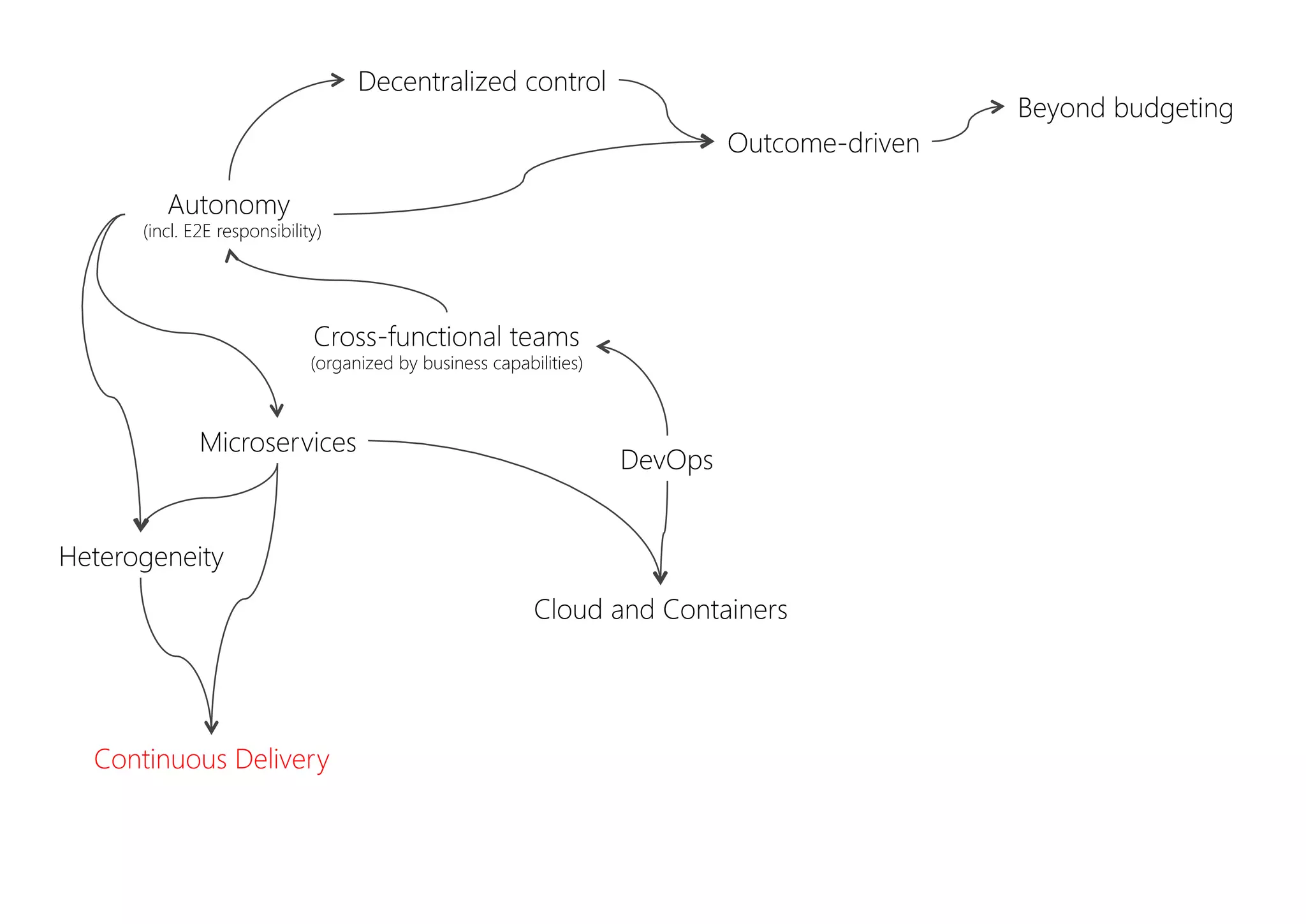
DevOps
Cross-functional teams
(organized by business capabilities)
Autonomy
(incl. E2E responsibility)
Decentralized control
Outcome-driven
Beyond budgeting
Microservices
Heterogeneity
Cloud and Containers
Continuous Delivery
“How can we guarantee
high availability in production?”
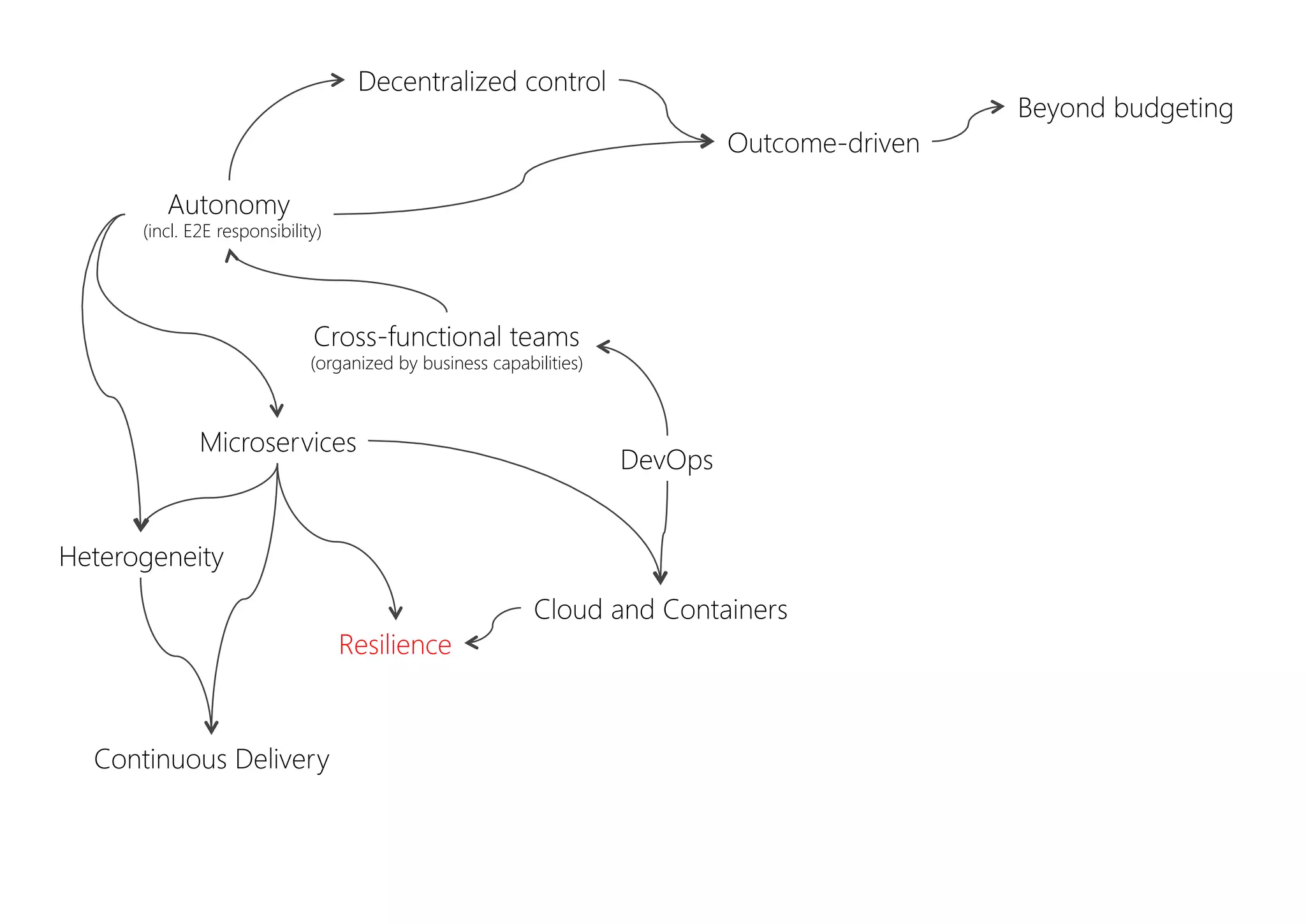
DevOps
Cross-functional teams
(organized by business capabilities)
Autonomy
(incl. E2E responsibility)
Decentralized control
Outcome-driven
Beyond budgeting
Microservices
Heterogeneity
Cloud and Containers
Continuous Delivery
Resilience
“How can we manage
all those moving parts in production?”
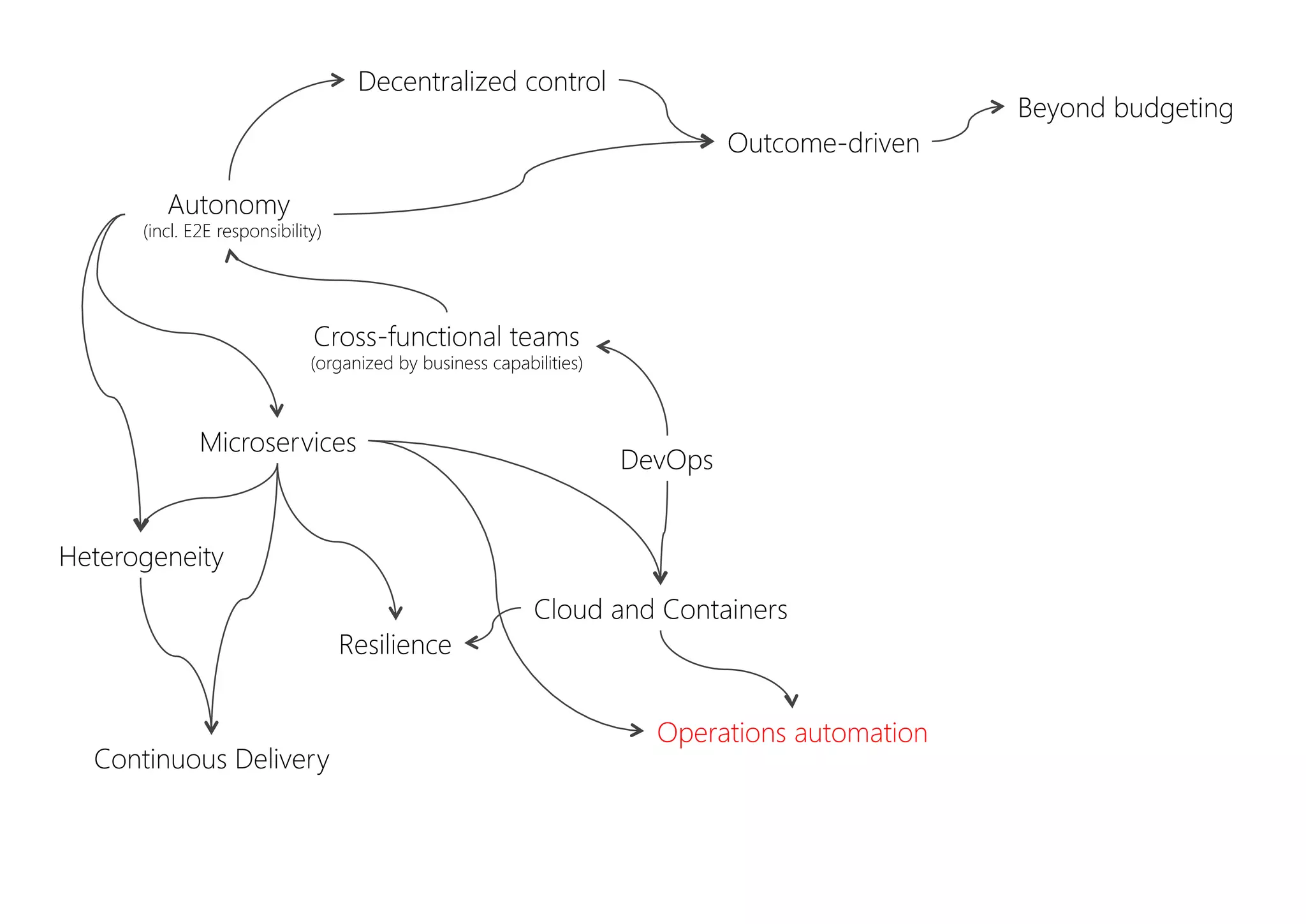
DevOps
Cross-functional teams
(organized by business capabilities)
Autonomy
(incl. E2E responsibility)
Decentralized control
Outcome-driven
Beyond budgeting
Microservices
Heterogeneity
Cloud and Containers
Continuous Delivery
Resilience
Operations automation
“How can we make sure
the services of different teams
work smoothly together?”
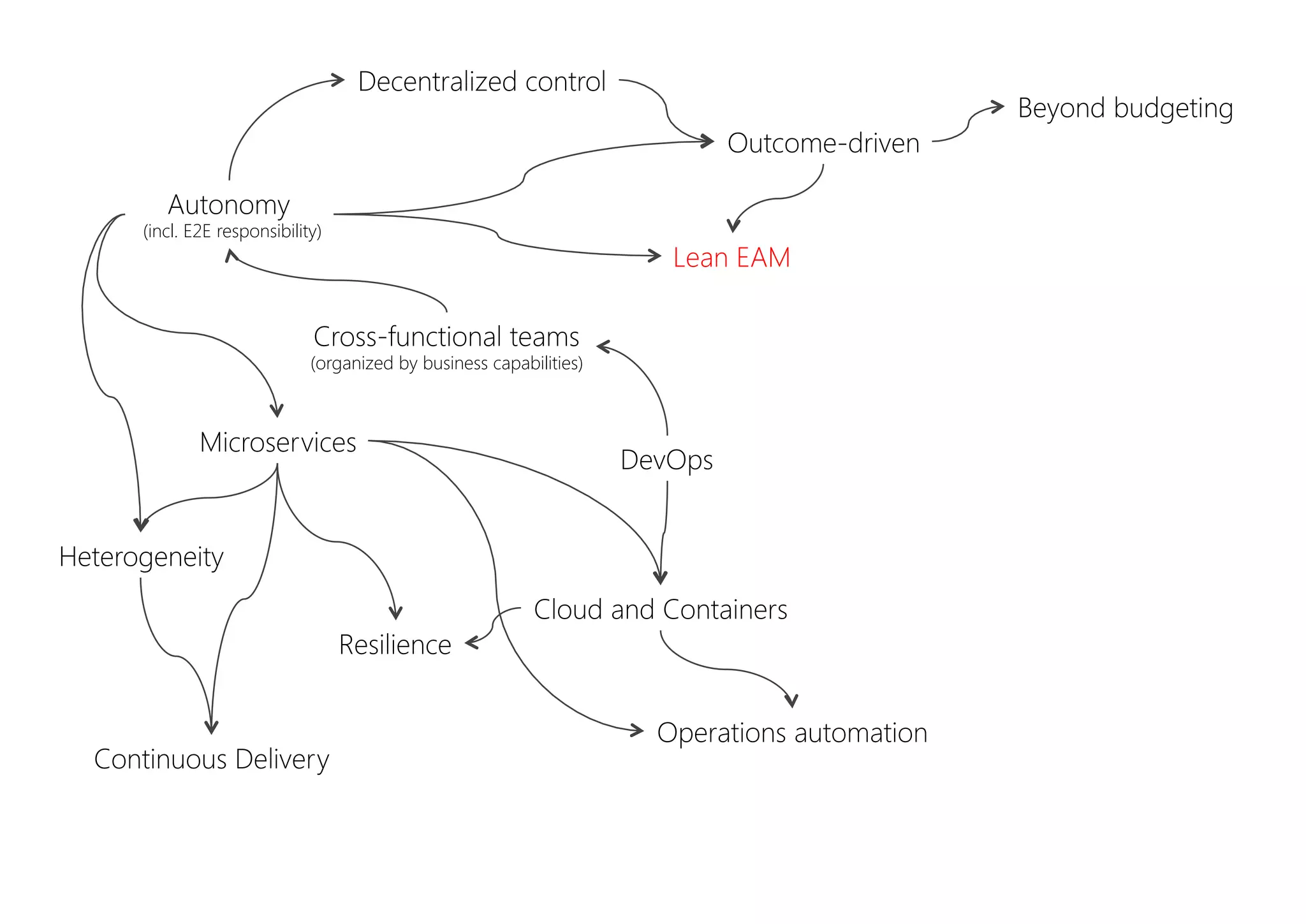
DevOps
Cross-functional teams
(organized by business capabilities)
Autonomy
(incl. E2E responsibility)
Decentralized control
Outcome-driven
Beyond budgeting
Microservices
Heterogeneity
Cloud and Containers
Continuous Delivery
Resilience
Operations automation
Lean EAM
“How can we make
our efforts sustainable?”
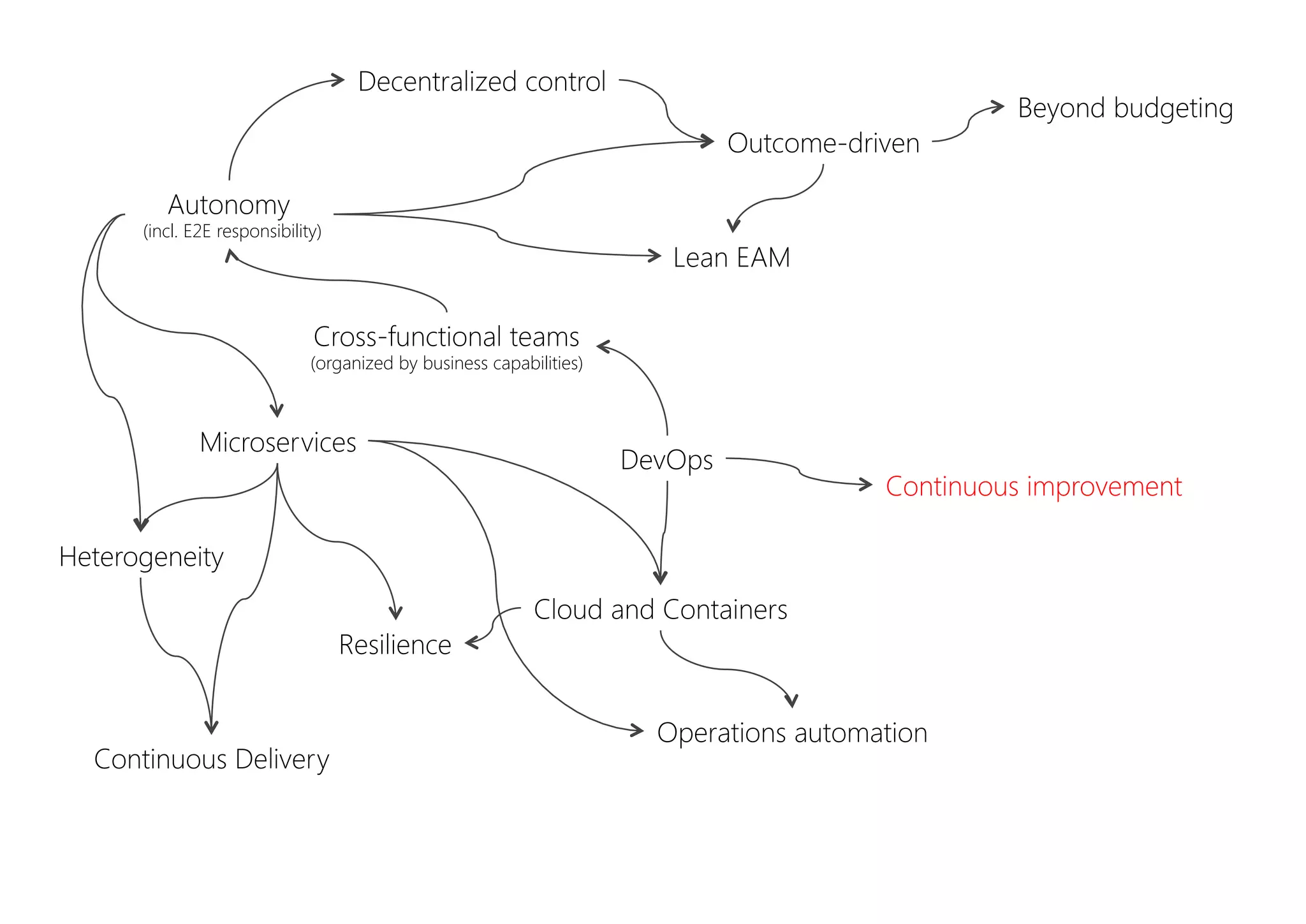
DevOps
Cross-functional teams
(organized by business capabilities)
Autonomy
(incl. E2E responsibility)
Decentralized control
Outcome-driven
Beyond budgeting
Microservices
Heterogeneity
Cloud and Containers
Continuous Delivery
Resilience
Operations automation
Lean EAM
Continuous improvement
“How do we get enough input
for improvement?”
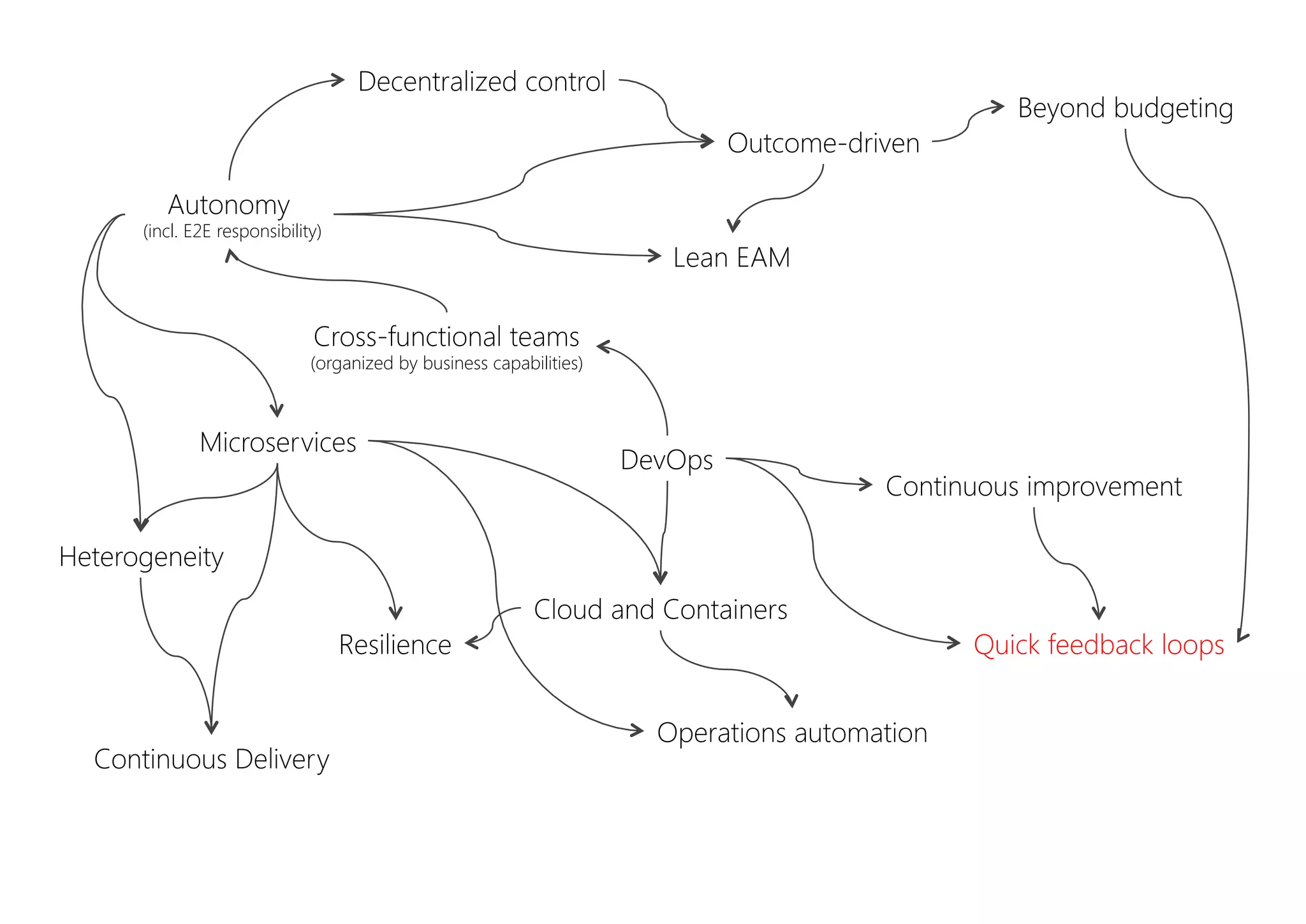
DevOps
Cross-functional teams
(organized by business capabilities)
Autonomy
(incl. E2E responsibility)
Decentralized control
Outcome-driven
Beyond budgeting
Microservices
Heterogeneity
Cloud and Containers
Continuous Delivery
Resilience
Operations automation
Lean EAM
Continuous improvement
Quick feedback loops
“How can we establish those
quick feedback loops?”
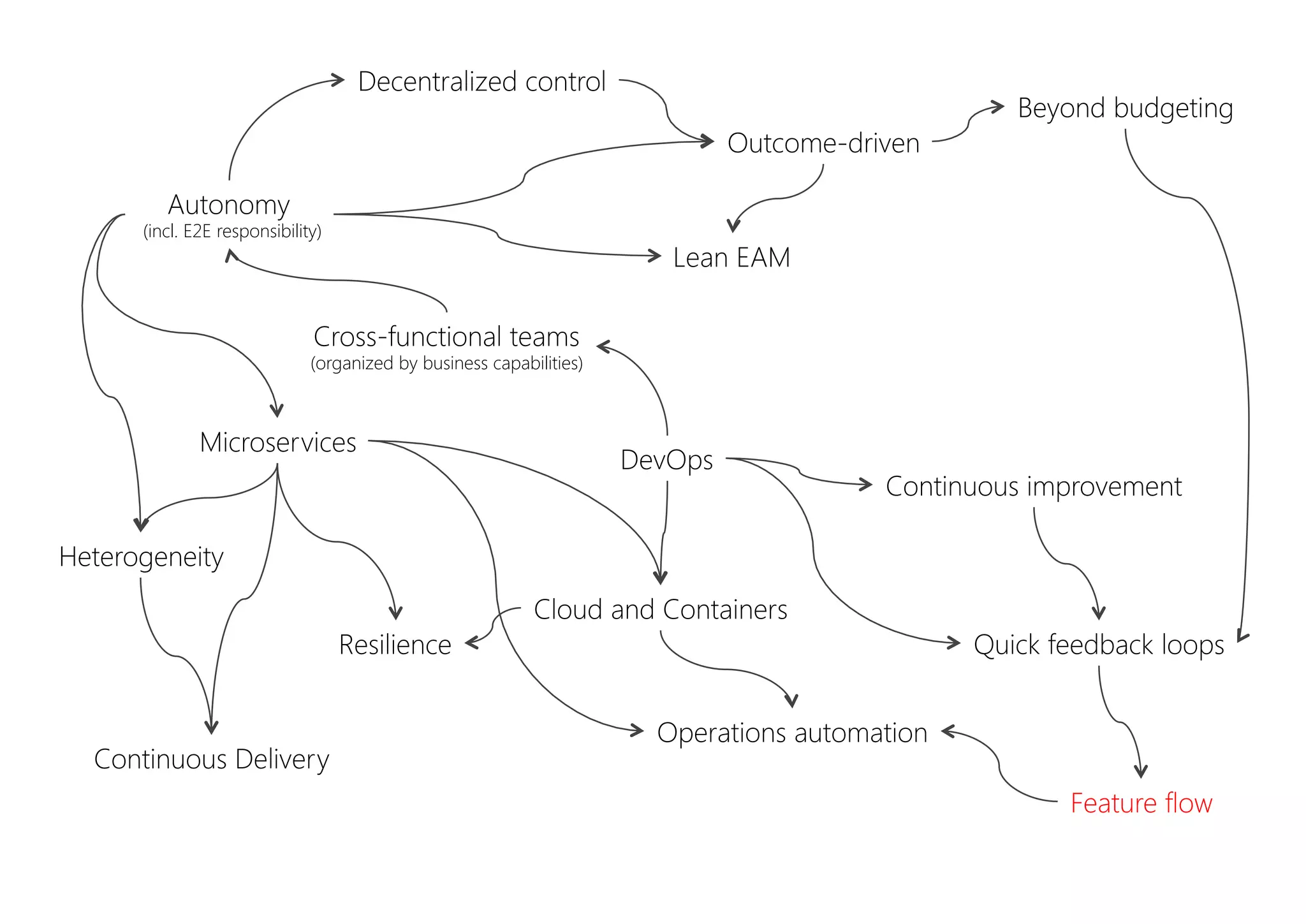
DevOps
Cross-functional teams
(organized by business capabilities)
Autonomy
(incl. E2E responsibility)
Decentralized control
Outcome-driven
Beyond budgeting
Microservices
Heterogeneity
Cloud and Containers
Continuous Delivery
Resilience
Operations automation
Lean EAM
Continuous improvement
Quick feedback loops
Feature flow
“And what does this all mean for
the people involved in this?”
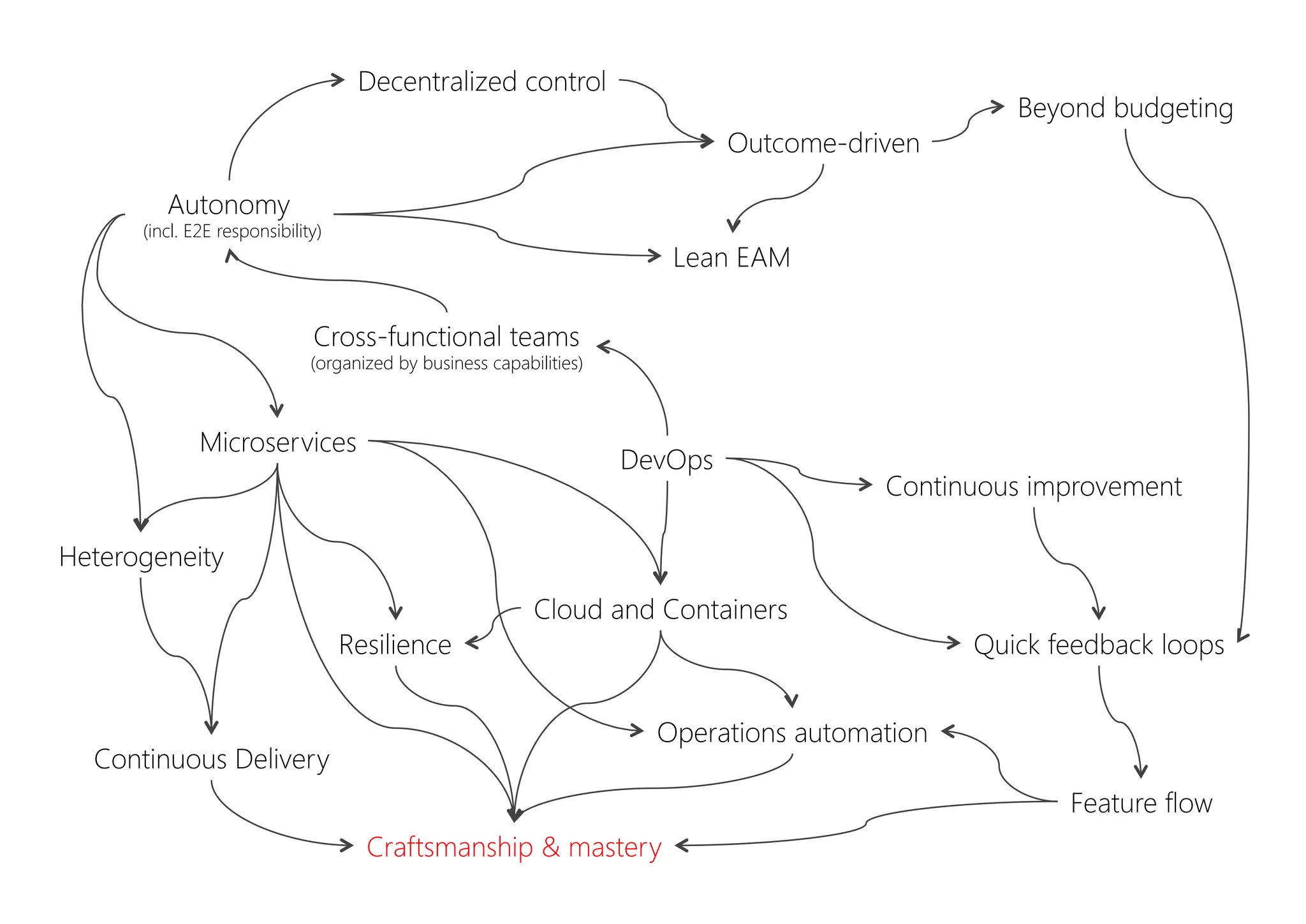
DevOps
Cross-functional teams
(organized by business capabilities)
Autonomy
(incl. E2E responsibility)
Decentralized control
Outcome-driven
Beyond budgeting
Microservices
Heterogeneity
Cloud and Containers
Continuous Delivery
Resilience
Operations automation
Lean EAM
Continuous improvement
Quick feedback loops
Feature flow
Craftsmanship & mastery
DevOps
Cross-functional teams
(organized by business capabilities)
Autonomy
(incl. E2E responsibility)
Decentralized control
Outcome-driven
Beyond budgeting
Microservices
Heterogeneity
Cloud and Containers
Continuous Delivery
Resilience
Operations automation
Lean EAM
Continuous improvement
Quick feedback loops
Feature flow
Craftsmanship & mastery
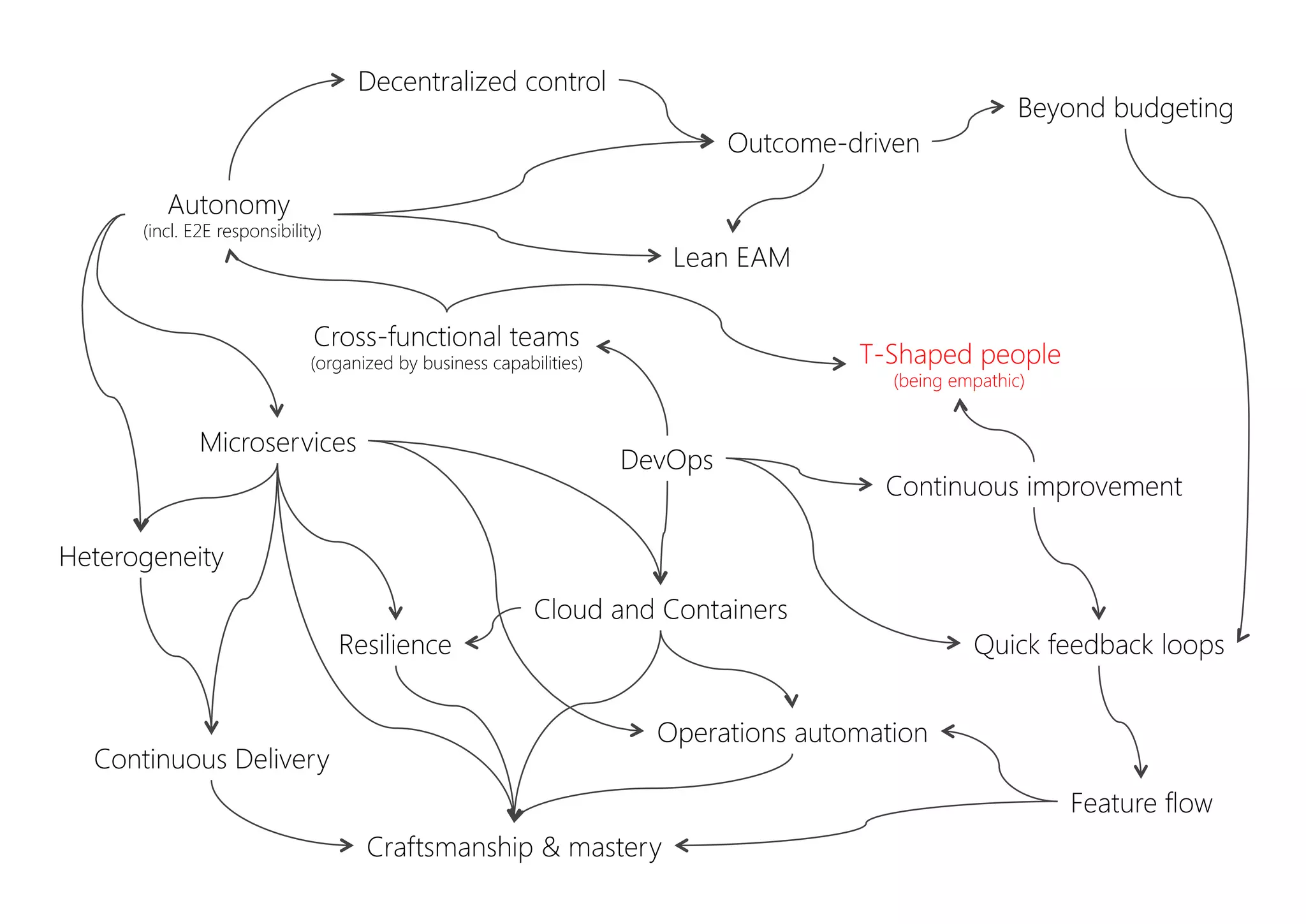
T-Shaped people
(being empathic)
Cross-functional teams
(organized by business capabilities)
Autonomy
(incl. E2E responsibility)
Decentralized control
Microservices
Continuous Delivery
Heterogeneity
Cloud and Containers
Resilience
Operations automation
Craftsmanship & mastery
Outcome-driven
Beyond budgeting
Feature flow
Lean EAM
Continuous improvement
T-Shaped people
(being empathic)
DevOps
Quick feedback loops
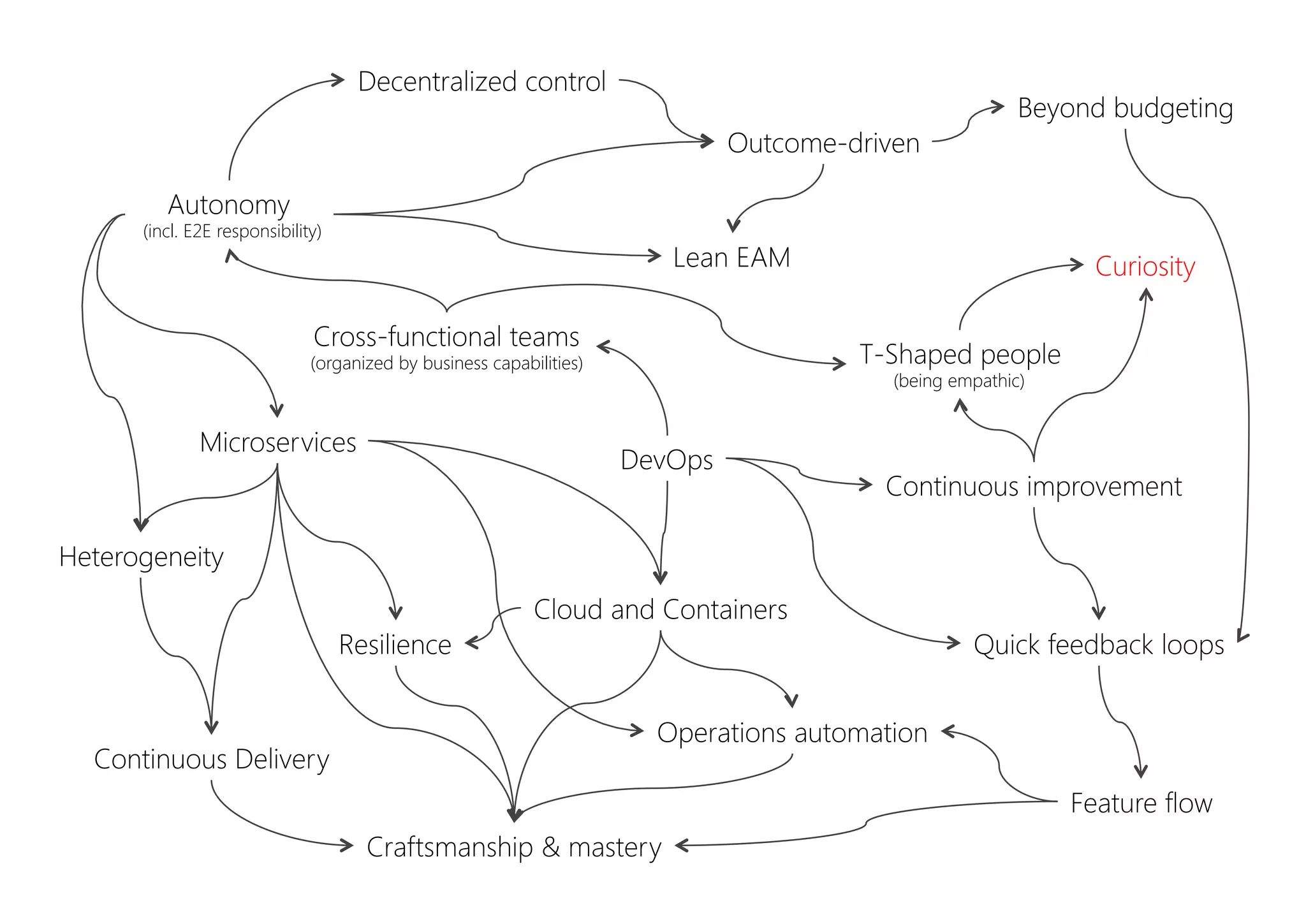
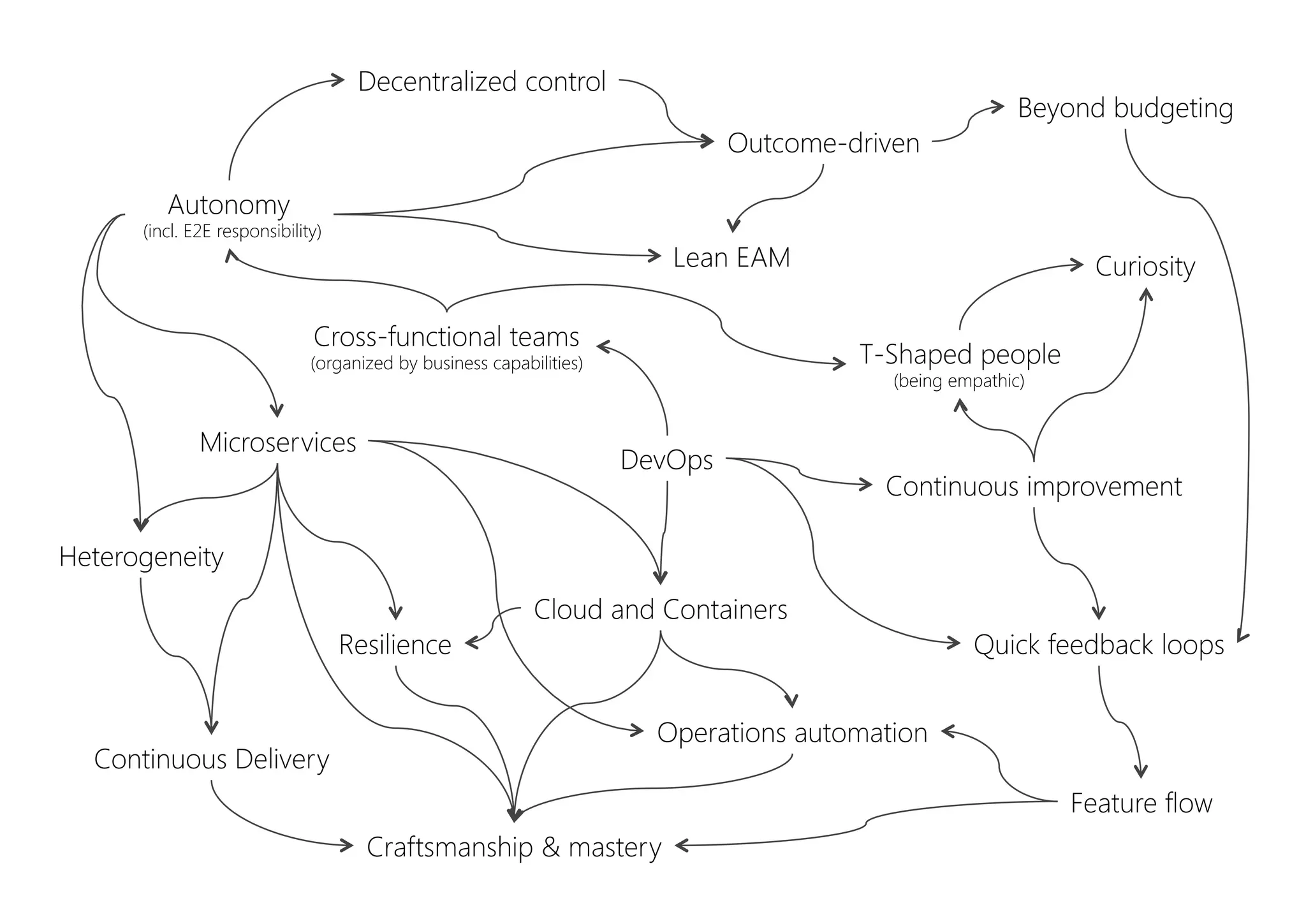
Curiosity
Cross-functional teams
(organized by business capabilities)
Autonomy
(incl. E2E responsibility)
Decentralized control
Microservices
Continuous Delivery
Heterogeneity
Cloud and Containers
Resilience
Operations automation
Craftsmanship & mastery
Outcome-driven
Beyond budgeting
Feature flow
Lean EAM
Continuous improvement
T-Shaped people
(being empathic)
DevOps
Quick feedback loops
Curiosity
DevOps drives the implementation
of the new IT
Wrap-up

•  Markets have changed
•  IT has changed
•  The role of IT has changed
•  New drivers
•  New goals
•  New building blocks
•  DevOps results in a re-org of IT
•  DevOps drives implementation of a new IT
We need to rethink IT!


Join the most disruptive and exciting change
we have seen in IT for many years
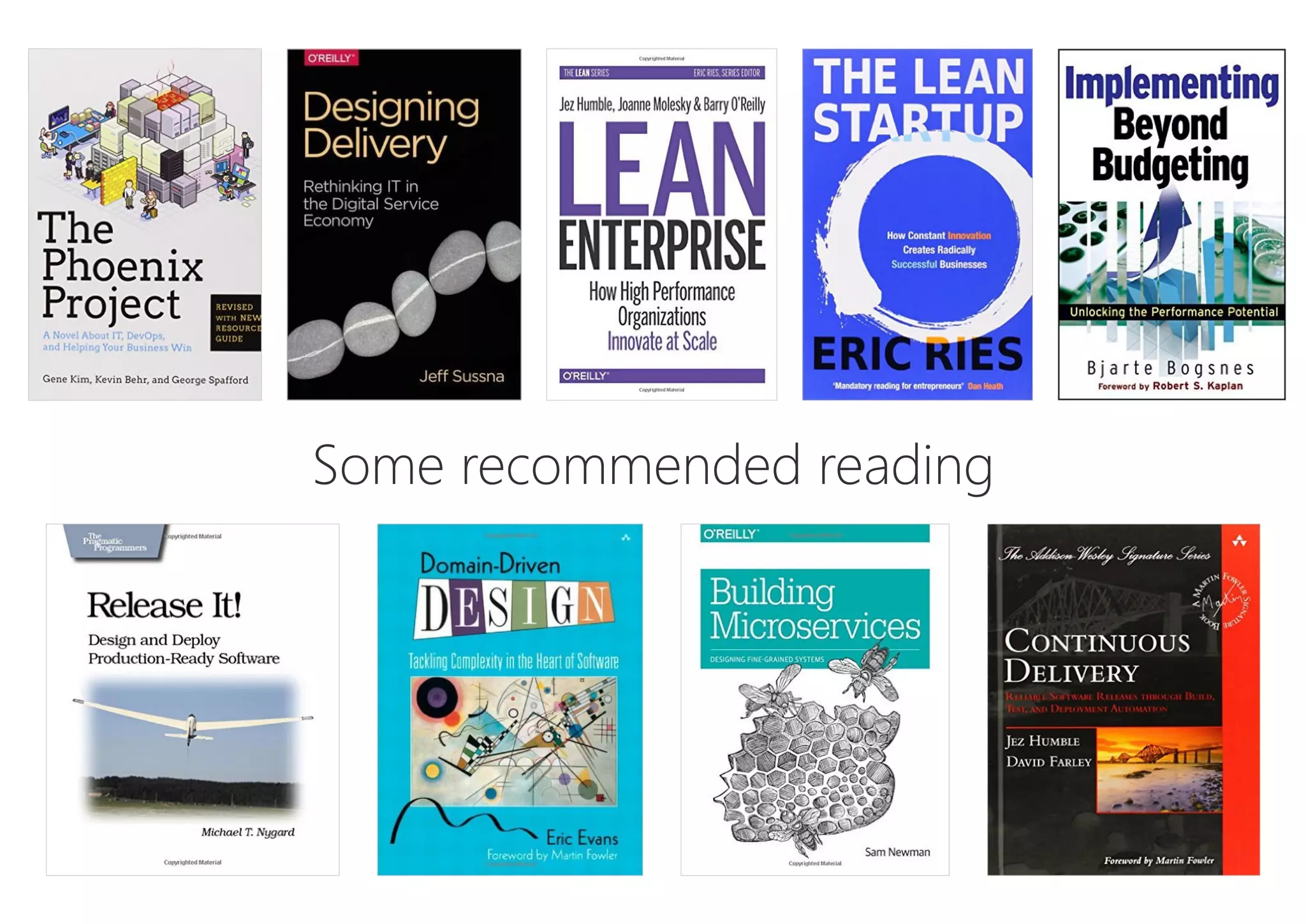
Some recommended reading
@ufried
Uwe Friedrichsen | uwe.friedrichsen@codecentric.de | http://slideshare.net/ufried | http://ufried.tumblr.com
DevOps is not enough - Embedding DevOps in a broader context

DevOps is not enough - Embedding DevOps in a broader context

  • 1.
    DevOps is notenough Embedding DevOps in a broader context Uwe Friedrichsen – codecentric AG – 2014-2016
  • 2.
    @ufried Uwe Friedrichsen |uwe.friedrichsen@codecentric.de | http://slideshare.net/ufried | http://ufried.tumblr.com
  • 3.
    What is thecurrent state of affairs?
  • 4.
  • 5.
    IT today •  Faster • Cheaper •  Digitization •  Disruption •  New technologies
  • 6.
    DevOps “Another buzzword forbuild and deployment automation” “A team that moderates between Dev and Ops” “You build it, you run it!” “Isn’t that just a new word for ‘agile’?” “It’s a mindset thing” “Of course the new version of our product is ‘DevOps’!” Perfect confusion of ideas
  • 7.
    Let’s check the “DevOpsbible” http://itrevolution.com/books/phoenix-project-devops-book/
  • 8.
    DevOps in anutshell
  • 9.
    The 3 waysof DevOps Systems thinking Amplify feedback loops Culture of continual experimentation & learning http://itrevolution.com/the-three-ways-principles-underpinning-devops/
  • 10.
    •  Maximize flow(minimize cycle times) •  Optimize for global goals (holistic view) •  Never pass defects downstream •  Limit work in progress •  Build systems and organizations that are safe to change Ops Dev Business IT value chain Customer Holistic optimization Systems thinking
  • 11.
    •  Facilitate constantflow of fast feedback from right-to-left •  Create quality at source (provide knowledge where needed) •  Create shared goals and shared pain for everyone involved •  Implement fast automated test suites •  Pervasively measure outcome (customer value), not output Ops Dev Business IT value chain Customer Amplify feedback loops
  • 12.
    •  Create aculture that fosters two things •  Continual experimentation, taking risks and learning from success and failure •  Understanding that repetition and practice is the prerequisite to mastery •  Allocate at least 20% of available cycles to non-business requirements •  Constantly reinforce that improvements are encouraged & celebrated Ops Dev Business IT value chain Customer Continual experimentation and learning
  • 13.
  • 14.
    Why is DevOpsnot enough?
  • 15.
    A bit ofbackground …
  • 16.
  • 17.
    Formal part of valuecreation Solution: machine Dynamic part of value creation Solution: man sluggishness/low dynamic high dynamichigh dynamic The historical course of market dynamics and the recent rise of highly dynamic and complex markets The dominance of high dynamics and complexity is neither good nor bad. It‘s a historical fact. t1970/80 today Age of crafts manu- facturing Age of tayloristic industry Age of global markets 1850/1900 Spacious markets, little competition Local markets, high customi- zation Outperformers exercise market pressure over conventional companies We call the graph shown here the “Taylor Bathtub”. The “bathtub” curve Source: BetaCodex Network Associates, “Organize for complexity”, BetaCodex Network White Paper 12 & 13
  • 18.
    Formal part of valuecreation Solution: machine Dynamic part of value creation Solution: man sluggishness/low dynamic high dynamichigh dynamic The historical course of market dynamics and the recent rise of highly dynamic and complex markets The dominance of high dynamics and complexity is neither good nor bad. It‘s a historical fact. t1970/80 today Age of crafts manu- facturing Age of tayloristic industry Age of global markets 1850/1900 Spacious markets, little competition Local markets, high customi- zation Outperformers exercise market pressure over conventional companies We call the graph shown here the “Taylor Bathtub”. Pre-industrial era Source: BetaCodex Network Associates, “Organize for complexity”, BetaCodex Network White Paper 12 & 13 Tailor-made solutions “Mastery is key to success”
  • 19.
    Formal part of valuecreation Solution: machine Dynamic part of value creation Solution: man sluggishness/low dynamic high dynamichigh dynamic The historical course of market dynamics and the recent rise of highly dynamic and complex markets The dominance of high dynamics and complexity is neither good nor bad. It‘s a historical fact. t1970/80 today Age of crafts manu- facturing Age of tayloristic industry Age of global markets 1850/1900 Spacious markets, little competition Local markets, high customi- zation Outperformers exercise market pressure over conventional companies We call the graph shown here the “Taylor Bathtub”. Industrial era Source: BetaCodex Network Associates, “Organize for complexity”, BetaCodex Network White Paper 12 & 13 Cost-efficiently scale production “Get more done with less people is key to success”
  • 20.
    Formal part of valuecreation Solution: machine Dynamic part of value creation Solution: man sluggishness/low dynamic high dynamichigh dynamic The historical course of market dynamics and the recent rise of highly dynamic and complex markets The dominance of high dynamics and complexity is neither good nor bad. It‘s a historical fact. t1970/80 today Age of crafts manu- facturing Age of tayloristic industry Age of global markets 1850/1900 Spacious markets, little competition Local markets, high customi- zation Outperformers exercise market pressure over conventional companies We call the graph shown here the “Taylor Bathtub”. Post-industrial era Source: BetaCodex Network Associates, “Organize for complexity”, BetaCodex Network White Paper 12 & 13 Continuously respond to changing demands “Continuous customer communication is key to success”
  • 21.
    Key drivers Industrial era • Cost-efficiency •  Scalability •  Repeatability •  Stability •  Efficiency & scale Post-industrial era •  Cycle times •  Adaptability •  Flexibility •  Resilience •  Effectiveness & speed
  • 22.
  • 23.
    1960 1970 1980 1990 2000 2010 2020 Complicated (Business functions) Complex (Business processes) Highly complex (Business nervous system) Software crisis Software engineering PC LAN Internet Business Support of IT Selective Holistic Complicated Complex “Moore’s law” Mobile IoT
  • 24.
    1960 1970 1980 1990 2000 2010 2020 Complicated (Business functions) Complex (business processes) Highly complex (Business nervous system) Software crisis Software engineering PC LAN Internet Business Support of IT Selective Holistic Complicated Complex “Moore’s law” Mobile IoT We are here …
  • 25.
    1960 1970 1980 1990 2000 2010 2020 Complicated (Business functions) Complex (business processes) Highly complex (Business nervous system) Software crisis Software engineering PC LAN Internet Business Support of IT Selective Holistic Complicated Complex “Moore’s law” Mobile IoT … but we still base most of our decisions on that We are here …
  • 26.
    Formal part of valuecreation Solution: machine Dynamic part of value creation Solution: man sluggishness/low dynamic high dynamichigh dynamic The historical course of market dynamics and the recent rise of highly dynamic and complex markets The dominance of high dynamics and complexity is neither good nor bad. It‘s a historical fact. t1970/80 today Age of crafts manu- facturing Age of tayloristic industry Age of global markets 1850/1900 Spacious markets, little competition Local markets, high customi- zation Outperformers exercise market pressure over conventional companies We call the graph shown here the “Taylor Bathtub”. Remember the bathtub curve? This adds an additional twist …
  • 27.
    1960 1970 1980 1990 2000 2010 2020 Complicated (Business functions) Complex (business processes) Highly complex (Business nervous system) Software crisis Software engineering PC LAN Internet Business Support of IT Selective Holistic Complicated Complex “Moore’s law” Mobile IoT … but we still base most of our decisions on that We are here … Business is very different today … … than it was back then
  • 28.
    Business Market IT today isa … … Nervous System … Medium … Product … Differentiator Disruptive Technologies Business Support Systems Continuous Conversation Digitization
  • 29.
    IT today isa key success factor to survive in a post-industrial market
  • 30.
    The traditional IT“best practices” are counterproductive because they solve
 a completely different problem
  • 31.
    We need torethink IT!
  • 32.
  • 33.
    What are thenew drivers?
  • 34.
    IT Post-Industrialism Highly dynamic markets EconomicDarwinism Lean startup/lean enterprise Continuous design Digitization IT as a product Digital conversation Social media Contextual computing Disruption Innovation through disruption Cloud, mobile, IoT, storage class memory Big data analytics Data-driven enterprise force change on
  • 35.
    What are thenew goals?
  • 36.
    IT … be quick Shortresponse times Holistic IT value chain consideration … be effective Focus on outcome, not output … improve continuously Improvement as planned activity needs to … … be efficient Provide required throughput … be robust High availability and adaptability … be flexible Flexible response to changing needs
  • 37.
    Process & Org needsto be … Quick Flexible Effective Software needs to be … Secure Changeable Robust … and improve continuously
  • 38.
    Process & Org needsto be … Software needs to be … Quick Flexible Effective Secure Changeable Robust … and improve continuously How can we achieve the new goals?
  • 39.
    What are thebuilding blocks?
  • 40.
    Adaption DevOps Systemic optimization Inspect andadapt Quick feedback loops Continuous improvement … Process DevOps Agile Lean Feature Flow (no projects) Design Thinking … Governance Beyond Budgeting Decentralized control Outcome-driven Lean EAM … Organization DevOps Autonomous teams Cross-functional teams End-2-end responsibility Routine task automation … People Craftsmanship T-shaped Responsibility Curiosity Empathy … Technology Cloud Automation Microservice Heterogeneity Resilience … (Some) Building Blocks
  • 41.
  • 42.
  • 43.
    The 3 waysof DevOps Systems thinking Amplify feedback loops Culture of continual experimentation & learning http://itrevolution.com/the-three-ways-principles-underpinning-devops/
  • 44.
    If taken seriouslyDevOps will eventually rotate your IT organization by 90°
  • 45.
    Ops Dev IT valuechain Businesscapabilities Specialistteam(e.g.,productmanager) Specialistteam(e.g.,UXexpert) Specialistteam(e.g.,developer) Specialistteam(e.g.,QAexpert) Specialistteam(e.g.,sysadmin) Specialistteam(e.g.,DBA) … Traditional IT organization
  • 46.
    Ops Dev IT valuechain Businesscapabilities Cross-functional product team … DevOps IT organization Cross-functional product team Cross-functional product team Cross-functional product team
  • 47.
    Ops Dev IT valuechain Businesscapabilities Cross-functional product team … DevOps IT organization (optimized) Cross-functional product team Cross-functional product team Cross-functional product team Platformteam API
  • 48.
    DevOps also triggers
 alot of additional changes
  • 49.
    “Okay, let’s startwith DevOps …”
  • 50.
  • 51.
    “But our ITdepartment is too big. We need to organize differently.”
  • 52.
  • 53.
    “How can weenable the teams to become faster?”
  • 54.
    DevOps Cross-functional teams (organized bybusiness capabilities) Autonomy (incl. E2E responsibility)
  • 55.
    “How can wemanage those teams?”
  • 56.
    DevOps Cross-functional teams (organized bybusiness capabilities) Autonomy (incl. E2E responsibility) Decentralized control
  • 57.
    “How can wecontrol if the teams are on the right track?”
  • 58.
    DevOps Cross-functional teams (organized bybusiness capabilities) Autonomy (incl. E2E responsibility) Decentralized control Outcome-driven
  • 59.
    “We need torethink our overall governance model.”
  • 60.
    DevOps Cross-functional teams (organized bybusiness capabilities) Autonomy (incl. E2E responsibility) Decentralized control Outcome-driven Beyond budgeting
  • 61.
    “How can wesupport autonomy on the architectural level?”
  • 62.
    DevOps Cross-functional teams (organized bybusiness capabilities) Autonomy (incl. E2E responsibility) Decentralized control Outcome-driven Beyond budgeting Microservices
  • 63.
    “Can we helpteams getting faster on the technological level?”
  • 64.
    DevOps Cross-functional teams (organized bybusiness capabilities) Autonomy (incl. E2E responsibility) Decentralized control Outcome-driven Beyond budgeting Microservices Heterogeneity
  • 65.
    “How can weensure the required speed and flexibility at the infrastructure level?”
  • 66.
    DevOps Cross-functional teams (organized bybusiness capabilities) Autonomy (incl. E2E responsibility) Decentralized control Outcome-driven Beyond budgeting Microservices Heterogeneity Cloud and Containers
  • 67.
    “How can weguarantee high speed and high quality delivery?”
  • 68.
    DevOps Cross-functional teams (organized bybusiness capabilities) Autonomy (incl. E2E responsibility) Decentralized control Outcome-driven Beyond budgeting Microservices Heterogeneity Cloud and Containers Continuous Delivery
  • 69.
    “How can weguarantee high availability in production?”
  • 70.
    DevOps Cross-functional teams (organized bybusiness capabilities) Autonomy (incl. E2E responsibility) Decentralized control Outcome-driven Beyond budgeting Microservices Heterogeneity Cloud and Containers Continuous Delivery Resilience
  • 71.
    “How can wemanage all those moving parts in production?”
  • 72.
    DevOps Cross-functional teams (organized bybusiness capabilities) Autonomy (incl. E2E responsibility) Decentralized control Outcome-driven Beyond budgeting Microservices Heterogeneity Cloud and Containers Continuous Delivery Resilience Operations automation
  • 73.
    “How can wemake sure the services of different teams work smoothly together?”
  • 74.
    DevOps Cross-functional teams (organized bybusiness capabilities) Autonomy (incl. E2E responsibility) Decentralized control Outcome-driven Beyond budgeting Microservices Heterogeneity Cloud and Containers Continuous Delivery Resilience Operations automation Lean EAM
  • 75.
    “How can wemake our efforts sustainable?”
  • 76.
    DevOps Cross-functional teams (organized bybusiness capabilities) Autonomy (incl. E2E responsibility) Decentralized control Outcome-driven Beyond budgeting Microservices Heterogeneity Cloud and Containers Continuous Delivery Resilience Operations automation Lean EAM Continuous improvement
  • 77.
    “How do weget enough input for improvement?”
  • 78.
    DevOps Cross-functional teams (organized bybusiness capabilities) Autonomy (incl. E2E responsibility) Decentralized control Outcome-driven Beyond budgeting Microservices Heterogeneity Cloud and Containers Continuous Delivery Resilience Operations automation Lean EAM Continuous improvement Quick feedback loops
  • 79.
    “How can weestablish those quick feedback loops?”
  • 80.
    DevOps Cross-functional teams (organized bybusiness capabilities) Autonomy (incl. E2E responsibility) Decentralized control Outcome-driven Beyond budgeting Microservices Heterogeneity Cloud and Containers Continuous Delivery Resilience Operations automation Lean EAM Continuous improvement Quick feedback loops Feature flow
  • 81.
    “And what doesthis all mean for the people involved in this?”
  • 82.
    DevOps Cross-functional teams (organized bybusiness capabilities) Autonomy (incl. E2E responsibility) Decentralized control Outcome-driven Beyond budgeting Microservices Heterogeneity Cloud and Containers Continuous Delivery Resilience Operations automation Lean EAM Continuous improvement Quick feedback loops Feature flow Craftsmanship & mastery
  • 83.
    DevOps Cross-functional teams (organized bybusiness capabilities) Autonomy (incl. E2E responsibility) Decentralized control Outcome-driven Beyond budgeting Microservices Heterogeneity Cloud and Containers Continuous Delivery Resilience Operations automation Lean EAM Continuous improvement Quick feedback loops Feature flow Craftsmanship & mastery T-Shaped people (being empathic)
  • 84.
    Cross-functional teams (organized bybusiness capabilities) Autonomy (incl. E2E responsibility) Decentralized control Microservices Continuous Delivery Heterogeneity Cloud and Containers Resilience Operations automation Craftsmanship & mastery Outcome-driven Beyond budgeting Feature flow Lean EAM Continuous improvement T-Shaped people (being empathic) DevOps Quick feedback loops Curiosity
  • 85.
    Cross-functional teams (organized bybusiness capabilities) Autonomy (incl. E2E responsibility) Decentralized control Microservices Continuous Delivery Heterogeneity Cloud and Containers Resilience Operations automation Craftsmanship & mastery Outcome-driven Beyond budgeting Feature flow Lean EAM Continuous improvement T-Shaped people (being empathic) DevOps Quick feedback loops Curiosity
  • 86.
    DevOps drives theimplementation of the new IT
  • 87.
    Wrap-up •  Markets havechanged •  IT has changed •  The role of IT has changed •  New drivers •  New goals •  New building blocks •  DevOps results in a re-org of IT •  DevOps drives implementation of a new IT
  • 88.
    We need torethink IT! Join the most disruptive and exciting change we have seen in IT for many years
  • 89.
  • 90.
    @ufried Uwe Friedrichsen |uwe.friedrichsen@codecentric.de | http://slideshare.net/ufried | http://ufried.tumblr.com