












Devops for Developers
How Dev can write applications ready for Ops

Uwe Friedrichsen, codecentric AG, 2013-2014
@ufried
Uwe Friedrichsen | uwe.friedrichsen@codecentric.de | http://slideshare.net/ufried | http://ufried.tumblr.com
DevOps
DevOps
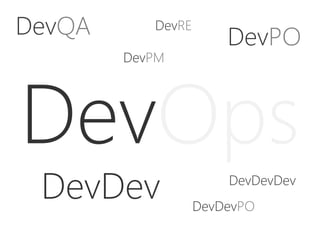
DevQA
 DevPO
DevRE
DevPM
DevDev
 DevDevPO
DevDevDev
It‘s all about production!
Operations
Developers Point of View
Admin
Developers Point of View
Admin
Closer to Reality Point of View
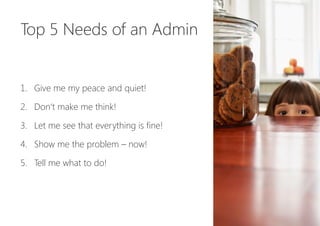
Top 5 Needs of an Admin


1.  Give me my peace and quiet!
2.  Don‘t make me think!
3.  Let me see that everything is fine!
4.  Show me the problem – now!
5.  Tell me what to do!
Top 5 Needs of an Admin (translated)

1.  Give me my peace and quiet!

(The application should just run smoothly)
2.  Don‘t make me think!

(Rollout, setup and operation of the application should be easy)
3.  Let me see that everything is fine!

(The application should show its state)
4.  Show me the problem – now!

(The application should provide concise error messages and enable easy root cause drilldown)
5.  Tell me what to do!

(The application should be documented properly – including error handling instructions)
Top 3 Dev Challenges


1.  Manageability
2.  Resilience
3.  Transparency
4.  Documentation
11 Design Principles

for DevOps-ready Applications


•  Manageability (4)
•  Resilience (5)
•  Transparency (2)
Manageability
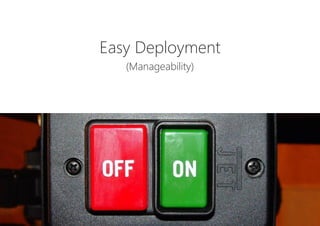
Deployment

(Manageability)
•  One-click deployment
•  Preserve settings
•  Provide rollbacks (or roll-forward)
Configuration

(Manageability)
•  Avoid multiple configuration procedures
•  Define default value handling
•  Organize change traceability
•  Notification about new parameters
Configuration Parameter Types

(Manageability)
•  Context-related parameters

Do not stage – managed by stage admin
•  Application-related parameters

Must be staged – managed by application admin
•  Business-related parameters

Must be staged – managed by business admin
Backup

(Manageability)
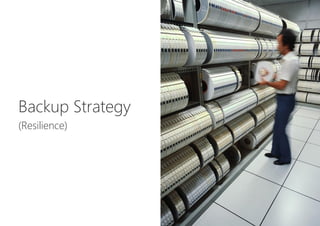
•  Think about backup purpose
•  Define backup strategy
•  Provide tooling
Resilience
Bulkheads

(Resilience)
•  Divide system in failure units
•  Isolate failure units
•  Define fallback strategy
Redundancy

(Resilience)
•  Elaborate use case

Minimize MTTR / scale transactions / handle response errors / …
•  Define routing & balancing strategy

Round robin / master-slave / fan-out & quickest one wins / …
•  Consider admin involvement

Automatic vs. manual / notification – monitoring / …
Loose Coupling

(Resilience)
•  Isolate failure units (complements bulkheads)
•  Go asynchronous wherever possible
•  Use timeouts & circuit breakers
•  Make actions idempotent
Fallbacks

(Resilience)
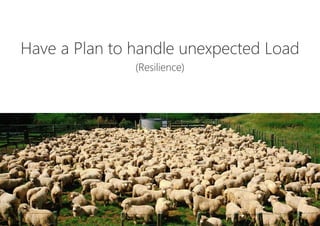
•  What will you do if a request fails?
•  Consider failure handling from the very beginning
•  Supplement with general failure handling strategies
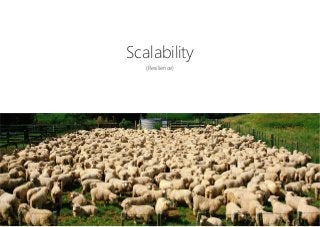
Scalability

(Resilience)
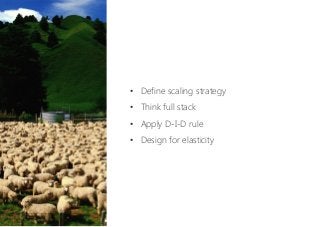
•  Define scaling strategy
•  Think full stack
•  Apply D-I-D rule
•  Design for elasticity
Transparency
Monitoring

(Transparency)
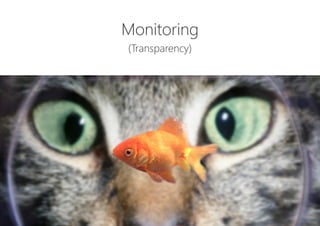
•  Think about required metrics
•  Design hook or event mechanism
•  Plan for changing metrics
•  Consider event sourcing
Logging

(Transparency)
•  Consider log message structure

All required information / machine readable / human readable
•  Define logging policy

Debug and less: developers perspective / Info and more: operations perspective
11 Design Principles

•  Manageability
•  Deployment
•  Configuration
•  Configuration Parameter Types
•  Backup

•  Resilience
•  Bulkheads
•  Redundancy
•  Loose Coupling
•  Fallbacks
•  Scalability

•  Transparency
•  Monitoring
•  Logging
Wrap-up


•  Dev often does not know Ops
•  Know the needs of an admin
•  Face the challenges for a developer
•  Apply the design principles


… and then you‘re ready for DevOps
@ufried
Uwe Friedrichsen | uwe.friedrichsen@codecentric.de | http://slideshare.net/ufried | http://ufried.tumblr.com
Devops for Developers

Devops for Developers