The Technologist’s Dilemma 
Refocusing on Innovation and Growth 
26 June 2014 
DISTRIBUTION COPY
2 
SPEAKER 
Todd Ray 
EVP of Strategy, Blue Rooster 
toddr@bluerooster.com 
Blue Rooster is a Seattle-based Microsoft Gold-Certified partner that develops innovative solutions to meet the needs of modern, digital enterprises 
…specializing in social, mobile, responsive and business process- specific applications
3 
Introduction 
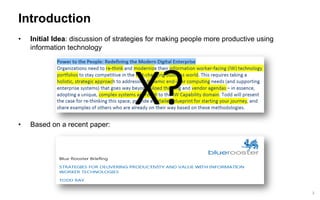
•Initial Idea: discussion of strategies for making people more productive using information technology 
•Based on a recent paper: 
X?
4 
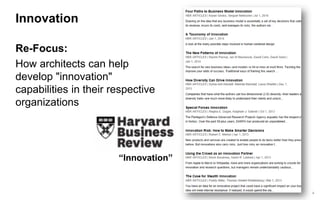
Innovation 
Re-Focus: 
How architects can help develop "innovation" capabilities in their respective organizations 
“Innovation”
5 
TOPICS 
Part I: Business Context 
Part II: Innovation Today 
Part III: Innovation Mandate 
Discussion/Q&A
6 
PART I –Business Context 
GDP 
Jobs 
Cash 
Cost of Capital 
Forecast
7 
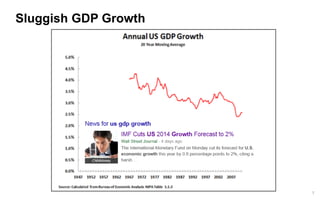
Sluggish GDP Growth
8 
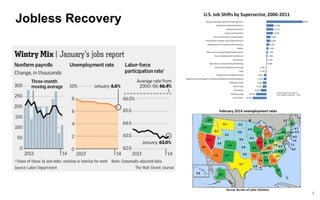
Jobless Recovery
9 
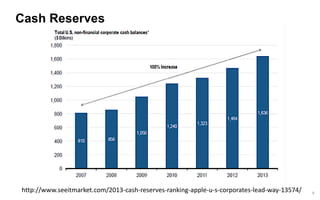
Cash Reserves 
http://www.seeitmarket.com/2013-cash-reserves-ranking-apple-u-s-corporates-lead-way-13574/
10 
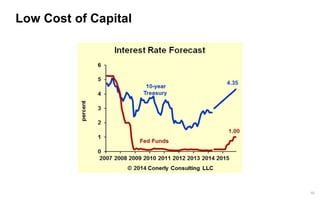
Low Cost of Capital
11 
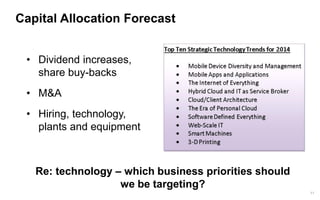
Capital Allocation Forecast 
•Dividend increases, share buy-backs 
•M&A 
•Hiring, technology, plants and equipment 
Re: technology –which business priorities should we be targeting?
12 
PART II –Innovation Today 
Innovation Types 
Capitalist’s Dilemma 
Re-thinking IT’s Role 
Current Investment
13 
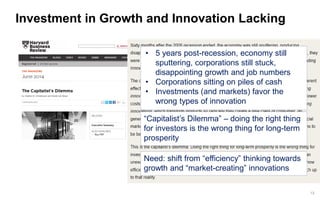
Investment in Growth and Innovation Lacking 
“Capitalist’s Dilemma” –doing the right thing for investors is the wrong thing for long-term prosperity 
Need: shift from “efficiency” thinking towards growth and “market-creating” innovations 
•5 years post-recession, economy still sputtering, corporations still stuck, disappointing growth and job numbers 
•Corporations sitting on piles of cash 
•Investments (and markets) favor the wrong types of innovation
14 
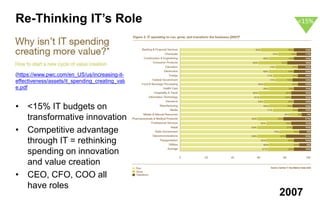
Re-Thinking IT’s Role 
(https://www.pwc.com/en_US/us/increasing-it- effectiveness/assets/it_spending_creating_value.pdf 
2007 
•<15% IT budgets on transformative innovation 
•Competitive advantage through IT = rethinking spending on innovation and value creation 
•CEO, CFO, COO all have roles 
<15%
15 
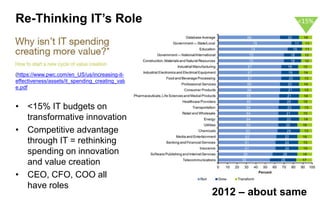
Re-Thinking IT’s Role 
(https://www.pwc.com/en_US/us/increasing-it- effectiveness/assets/it_spending_creating_value.pdf 
2007 
2012 –about same 
•<15% IT budgets on transformative innovation 
•Competitive advantage through IT = rethinking spending on innovation and value creation 
•CEO, CFO, COO all have roles 
<15%
16 
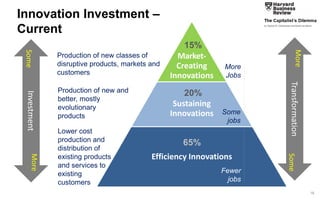
Innovation Investment – 
Current 
Lower cost production and distribution of existing products and services to existing customers 
Production of new and better, mostly evolutionary products 
Production of new classes of disruptive products, markets and customers 
Market- Creating Innovations 
Sustaining Innovations 
Efficiency Innovations 
More 
Jobs 
Fewer jobs 
15% 
20% 
65% 
Some jobs 
Investment 
Transformation 
Some 
Some 
More 
More
17 
Innovation Type Drill Downs 
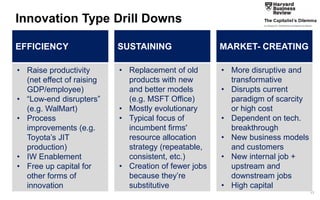
•Raise productivity (net effect of raising GDP/employee) 
•“Low-end disrupters” (e.g. WalMart) 
•Process improvements (e.g. Toyota’s JIT production) 
•IW Enablement 
•Free up capital for other forms of innovation 
EFFICIENCY 
•Replacement of old products with new and better models (e.g. MSFT Office) 
•Mostly evolutionary 
•Typical focus of incumbent firms' resource allocation strategy (repeatable, consistent, etc.) 
•Creation of fewer jobs because they’re substitutive 
SUSTAINING 
•More disruptive and transformative 
•Disrupts current paradigm of scarcity or high cost 
•Dependent on tech. breakthrough 
•New business models and customers 
•New internal job + upstream and downstream jobs 
•High capital 
MARKET-CREATING
18 
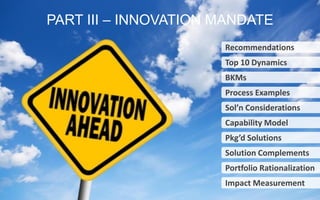
PART III –INNOVATION MANDATE 
Process Examples 
Recommendations 
Top 10 Dynamics 
BKMs 
Solution Complements 
Sol’nConsiderations 
Capability Model 
Pkg’dSolutions 
Portfolio Rationalization 
Impact Measurement
19 
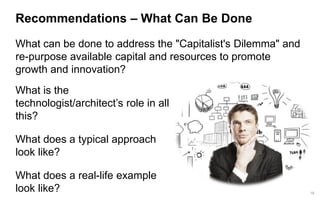
Recommendations –What Can Be Done 
What can be done to address the "Capitalist's Dilemma" and re-purpose available capital and resources to promote growth and innovation? 
What is the technologist/architect’s role in all this? 
What does a typical approach look like? 
What does a real-life example look like?
20 
Promote portfolio rationalization methods that address long term growth and innovation needs 
•Focus on capabilities and systems that address all three forms of innovation, especially those targeted at market-creating innovations 
•Leverage learnings from past innovation efforts from other firms 
•Adopt best practices for ideation, innovation and commercialization 
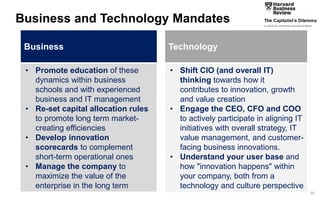
Business and Technology Mandates 
•Promote education of these dynamics within business schools and with experienced business and IT management 
•Re-set capital allocation rules to promote long term market- creating efficiencies 
•Develop innovation scorecards to complement short-term operational ones 
•Manage the company to maximize the value of the enterprise in the long term 
Business 
•Shift CIO (and overall IT) thinking towards how it contributes to innovation, growth and value creation 
•Engage the CEO, CFO and COO to actively participate in aligning IT initiatives with overall strategy, IT value management, and customer- facing business innovations. 
•Understand your user base and how "innovation happens" within your company, both from a technology and culture perspective 
Technology
21 
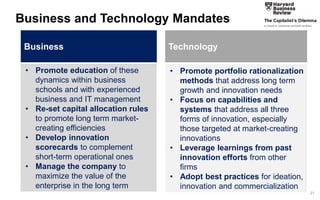
•Promote portfolio rationalization methods that address long term growth and innovation needs 
•Focus on capabilities and systems that address all three forms of innovation, especially those targeted at market-creating innovations 
•Leverage learnings from past innovation efforts from other firms 
•Adopt best practices for ideation, innovation and commercialization 
Business and Technology Mandates 
•Promote education of these dynamics within business schools and with experienced business and IT management 
•Re-set capital allocation rules to promote long term market- creating efficiencies 
•Develop innovation scorecards to complement short-term operational ones 
•Manage the company to maximize the value of the enterprise in the long term 
Business 
Technology
22 
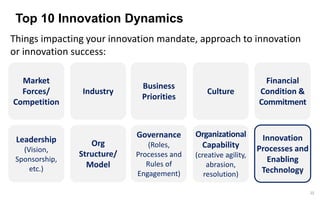
Top 10 Innovation Dynamics 
Market Forces/ Competition 
Industry 
Business Priorities 
Culture 
Financial Condition & Commitment 
Things impacting your innovation mandate, approach to innovation or innovation success: 
Leadership (Vision, Sponsorship, etc.) 
Org Structure/ Model 
Governance(Roles, Processes and Rules of Engagement) 
Organizational Capability (creative agility, abrasion, resolution) 
Innovation Processes and Enabling Technology
23 
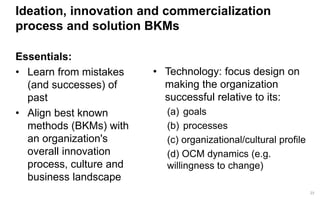
Ideation, innovation and commercialization process and solution BKMs 
Essentials: 
•Learn from mistakes (and successes) of past 
•Align best known methods (BKMs) with an organization's overall innovation process, culture and business landscape 
•Technology: focus design on making the organization successful relative to its: 
(a)goals 
(b)processes 
(c) organizational/cultural profile 
(d) OCM dynamics (e.g. willingness to change)
24 
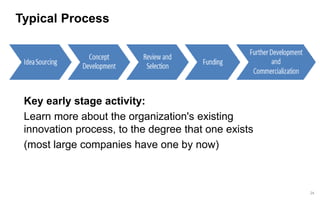
Typical Process 
Key early stage activity: 
Learn more about the organization's existing innovation process, to the degree that one exists 
(most large companies have one by now)
25 
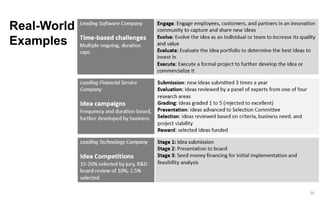
Real-World Examples
26 
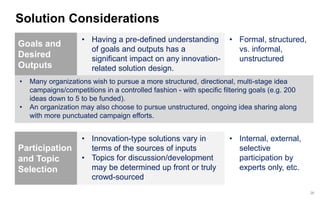
Solution Considerations 
•Having a pre-defined understanding of goals and outputs has a significant impact on any innovation- related solution design. 
Goals and Desired Outputs 
•Formal, structured, vs. informal, unstructured 
•Many organizations wish to pursue a more structured, directional, multi-stage idea campaigns/competitions in a controlled fashion -with specific filtering goals (e.g. 200 ideas down to 5 to be funded). 
•An organization may also choose to pursue unstructured, ongoing idea sharing along with more punctuated campaign efforts. 
•Innovation-type solutions vary in terms of the sources of inputs 
•Topics for discussion/development may be determined up front or truly crowd-sourced 
Participation and Topic Selection 
•Internal, external, selective participation by experts only, etc.
27 
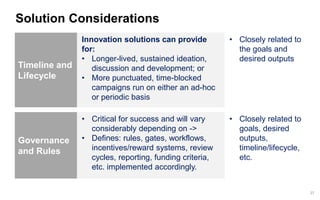
Solution Considerations 
Innovation solutions can provide for: 
•Longer-lived, sustained ideation, discussion and development; or 
•More punctuated, time-blocked campaigns run on either an ad-hoc or periodic basis 
Timeline and Lifecycle 
•Closely related to the goals and desired outputs 
•Critical for success and will vary considerably depending on -> 
•Defines: rules, gates, workflows, incentives/reward systems, review cycles, reporting, funding criteria, etc. implemented accordingly. 
Governance and Rules 
•Closely related to goals, desired outputs, timeline/lifecycle, etc.
28 
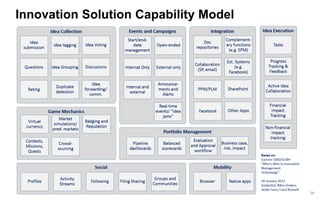
Innovation Solution Capability Model
29 
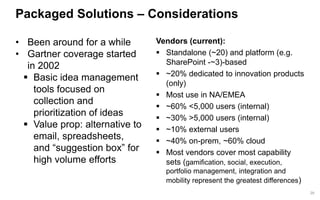
Packaged Solutions –Considerations 
•Been around for a while 
•Gartner coverage started in 2002 
Basic idea management tools focused on collection and prioritization of ideas 
Value prop: alternative to email, spreadsheets, and “suggestion box” for high volume efforts 
Vendors (current): 
Standalone (~20) and platform (e.g. SharePoint -~3)-based 
~20% dedicated to innovation products (only) 
Most use in NA/EMEA 
~60% <5,000 users (internal) 
~30% >5,000 users (internal) 
~10% external users 
~40% on-prem, ~60% cloud 
Most vendors cover most capability sets (gamification, social, execution, portfolio management, integration and mobility represent the greatest differences)
31 
Solution Alternatives and/or Complements 
•Innovation and IP marketplaces 
•Crowdsourcing sites 
•Voice of the customer 
•Prediction markets 
•Team meetings and brainstorming 
•Storytelling and scenarios 
•Focus groups 
•Customer-centric design 
•Problem solving (Triz) 
•Patent exploration 
•Pattern based modeling 
•Social monitoring and analytics
32 
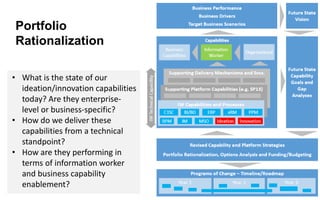
Portfolio Rationalization 
•What is our vision for further innovation in the future to move closer to our needs in the areas of things like market-creating innovations? 
•What do we need to change in terms of technical and organizational capabilities to meet our future state vision? 
•What is our strategy to address future state needs from a technical standpoint 
•What sort of specific programs of change are needed over what time frame? 
•What is the state of our ideation/innovation capabilities today? Are they enterprise- level or business-specific? 
•How do we deliver these from a technical standpoint? 
•How are they performing in terms of information worker and business capability enablement?
33 
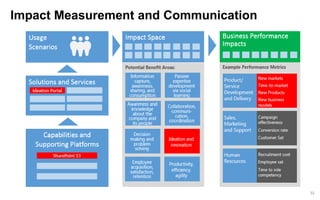
Impact Measurement and Communication
34 
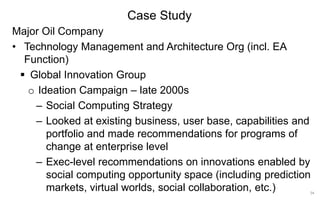
Case Study 
Major Oil Company 
•Technology Management and Architecture Org (incl. EA Function) 
Global Innovation Group 
oIdeation Campaign –late 2000s 
–Social Computing Strategy 
–Looked at existing business, user base, capabilities and portfolio and made recommendations for programs of change at enterprise level 
–Exec-level recommendations on innovations enabled by social computing opportunity space (including prediction markets, virtual worlds, social collaboration, etc.)
35 
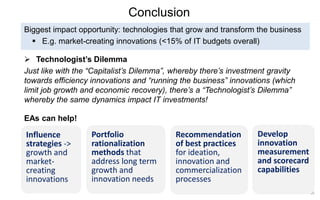
Conclusion 
Technologist’s Dilemma 
Just like with the “Capitalist’s Dilemma”, whereby there’s investment gravity towards efficiency innovations and “running the business” innovations (which limit job growth and economic recovery), there’s a “Technologist’s Dilemma” whereby the same dynamics impact IT investments! 
Biggest impact opportunity: technologies that grow and transform the business 
E.g. market-creating innovations (<15% of IT budgets overall) 
EAs can help! 
Influence strategies -> growth and market- creating innovations 
Portfolio rationalization methods that address long term growth and innovation needs 
Recommendation of best practices for ideation, innovation and commercialization processes 
Develop innovation measurement and scorecard capabilities
36 
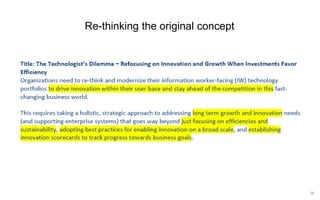
Re-thinking the original concept
37 
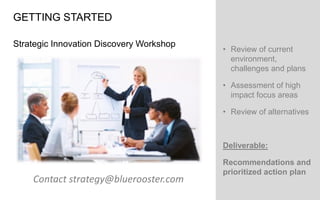
GETTING STARTED 
Strategic Innovation Discovery Workshop 
•Review of current environment, challenges and plans 
•Assessment of high impact focus areas 
•Review of alternatives 
Deliverable: 
Recommendations and prioritized action plan 
Contact strategy@bluerooster.com
38 
Additional Information 
Blogs: 
•Re-Launching Your SharePoint Strategy for the SoMo Generation(June 2014) 
•Critically Re-thinking Governance, Again: Modernizing How You Manage SharePoint(May 2014) 
•Re-thinking Adoption, Again –Novel Ways to Modernize SharePoint(April 2014) 
•Avoiding Social Entropy –Getting out of your Social Silo and Into the Big Tent (March 2014) 
•What’s Your Altitude? Navigating the 5 Levels of Strategy(March 2014) 
•Productivity is Not Just a Buzzword(January 2014) 
•An Un-radical Vision for Intranets in 2014 –Back to Basics, Dialing Back the Hype(December 2013) 
•Adapting Social Solutions to Modern Workstyles(October 2013) 
•Developing Agile UX Strategies(September 2013) 
•A Case for Agile Digital Strategy(September 2013) 
Papers: (available upon request) 
“What’s Your Altitude? Navigating the 5 Levels of Strategy Relevant to the Modern Digital Enterprise”, February 2014 
“Strategies for Delivering Productivity and Value with Information Worker Technologies”, December 2013 
“An Un-Radical Vision for Intranets in 2014 - Back to Basics, Dialing Back the Hype”, December 2013 
“Adapting Social Solutions to Modern Workstyles”, October 2013
39 
Discussion
create. build. experience.
The Technologists Dilemma by Todd Ray

  • 1.
    The Technologist’s Dilemma Refocusing on Innovation and Growth 26 June 2014 DISTRIBUTION COPY
  • 2.
    2 SPEAKER ToddRay EVP of Strategy, Blue Rooster toddr@bluerooster.com Blue Rooster is a Seattle-based Microsoft Gold-Certified partner that develops innovative solutions to meet the needs of modern, digital enterprises …specializing in social, mobile, responsive and business process- specific applications
  • 3.
    3 Introduction •InitialIdea: discussion of strategies for making people more productive using information technology •Based on a recent paper: X?
  • 4.
    4 Innovation Re-Focus: How architects can help develop "innovation" capabilities in their respective organizations “Innovation”
  • 5.
    5 TOPICS PartI: Business Context Part II: Innovation Today Part III: Innovation Mandate Discussion/Q&A
  • 6.
    6 PART I–Business Context GDP Jobs Cash Cost of Capital Forecast
  • 7.
  • 8.
  • 9.
    9 Cash Reserves http://www.seeitmarket.com/2013-cash-reserves-ranking-apple-u-s-corporates-lead-way-13574/
  • 10.
    10 Low Costof Capital
  • 11.
    11 Capital AllocationForecast •Dividend increases, share buy-backs •M&A •Hiring, technology, plants and equipment Re: technology –which business priorities should we be targeting?
  • 12.
    12 PART II–Innovation Today Innovation Types Capitalist’s Dilemma Re-thinking IT’s Role Current Investment
  • 13.
    13 Investment inGrowth and Innovation Lacking “Capitalist’s Dilemma” –doing the right thing for investors is the wrong thing for long-term prosperity Need: shift from “efficiency” thinking towards growth and “market-creating” innovations •5 years post-recession, economy still sputtering, corporations still stuck, disappointing growth and job numbers •Corporations sitting on piles of cash •Investments (and markets) favor the wrong types of innovation
  • 14.
    14 Re-Thinking IT’sRole (https://www.pwc.com/en_US/us/increasing-it- effectiveness/assets/it_spending_creating_value.pdf 2007 •<15% IT budgets on transformative innovation •Competitive advantage through IT = rethinking spending on innovation and value creation •CEO, CFO, COO all have roles <15%
  • 15.
    15 Re-Thinking IT’sRole (https://www.pwc.com/en_US/us/increasing-it- effectiveness/assets/it_spending_creating_value.pdf 2007 2012 –about same •<15% IT budgets on transformative innovation •Competitive advantage through IT = rethinking spending on innovation and value creation •CEO, CFO, COO all have roles <15%
  • 16.
    16 Innovation Investment– Current Lower cost production and distribution of existing products and services to existing customers Production of new and better, mostly evolutionary products Production of new classes of disruptive products, markets and customers Market- Creating Innovations Sustaining Innovations Efficiency Innovations More Jobs Fewer jobs 15% 20% 65% Some jobs Investment Transformation Some Some More More
  • 17.
    17 Innovation TypeDrill Downs •Raise productivity (net effect of raising GDP/employee) •“Low-end disrupters” (e.g. WalMart) •Process improvements (e.g. Toyota’s JIT production) •IW Enablement •Free up capital for other forms of innovation EFFICIENCY •Replacement of old products with new and better models (e.g. MSFT Office) •Mostly evolutionary •Typical focus of incumbent firms' resource allocation strategy (repeatable, consistent, etc.) •Creation of fewer jobs because they’re substitutive SUSTAINING •More disruptive and transformative •Disrupts current paradigm of scarcity or high cost •Dependent on tech. breakthrough •New business models and customers •New internal job + upstream and downstream jobs •High capital MARKET-CREATING
  • 18.
    18 PART III–INNOVATION MANDATE Process Examples Recommendations Top 10 Dynamics BKMs Solution Complements Sol’nConsiderations Capability Model Pkg’dSolutions Portfolio Rationalization Impact Measurement
  • 19.
    19 Recommendations –WhatCan Be Done What can be done to address the "Capitalist's Dilemma" and re-purpose available capital and resources to promote growth and innovation? What is the technologist/architect’s role in all this? What does a typical approach look like? What does a real-life example look like?
  • 20.
    20 Promote portfoliorationalization methods that address long term growth and innovation needs •Focus on capabilities and systems that address all three forms of innovation, especially those targeted at market-creating innovations •Leverage learnings from past innovation efforts from other firms •Adopt best practices for ideation, innovation and commercialization Business and Technology Mandates •Promote education of these dynamics within business schools and with experienced business and IT management •Re-set capital allocation rules to promote long term market- creating efficiencies •Develop innovation scorecards to complement short-term operational ones •Manage the company to maximize the value of the enterprise in the long term Business •Shift CIO (and overall IT) thinking towards how it contributes to innovation, growth and value creation •Engage the CEO, CFO and COO to actively participate in aligning IT initiatives with overall strategy, IT value management, and customer- facing business innovations. •Understand your user base and how "innovation happens" within your company, both from a technology and culture perspective Technology
  • 21.
    21 •Promote portfoliorationalization methods that address long term growth and innovation needs •Focus on capabilities and systems that address all three forms of innovation, especially those targeted at market-creating innovations •Leverage learnings from past innovation efforts from other firms •Adopt best practices for ideation, innovation and commercialization Business and Technology Mandates •Promote education of these dynamics within business schools and with experienced business and IT management •Re-set capital allocation rules to promote long term market- creating efficiencies •Develop innovation scorecards to complement short-term operational ones •Manage the company to maximize the value of the enterprise in the long term Business Technology
  • 22.
    22 Top 10Innovation Dynamics Market Forces/ Competition Industry Business Priorities Culture Financial Condition & Commitment Things impacting your innovation mandate, approach to innovation or innovation success: Leadership (Vision, Sponsorship, etc.) Org Structure/ Model Governance(Roles, Processes and Rules of Engagement) Organizational Capability (creative agility, abrasion, resolution) Innovation Processes and Enabling Technology
  • 23.
    23 Ideation, innovationand commercialization process and solution BKMs Essentials: •Learn from mistakes (and successes) of past •Align best known methods (BKMs) with an organization's overall innovation process, culture and business landscape •Technology: focus design on making the organization successful relative to its: (a)goals (b)processes (c) organizational/cultural profile (d) OCM dynamics (e.g. willingness to change)
  • 24.
    24 Typical Process Key early stage activity: Learn more about the organization's existing innovation process, to the degree that one exists (most large companies have one by now)
  • 25.
  • 26.
    26 Solution Considerations •Having a pre-defined understanding of goals and outputs has a significant impact on any innovation- related solution design. Goals and Desired Outputs •Formal, structured, vs. informal, unstructured •Many organizations wish to pursue a more structured, directional, multi-stage idea campaigns/competitions in a controlled fashion -with specific filtering goals (e.g. 200 ideas down to 5 to be funded). •An organization may also choose to pursue unstructured, ongoing idea sharing along with more punctuated campaign efforts. •Innovation-type solutions vary in terms of the sources of inputs •Topics for discussion/development may be determined up front or truly crowd-sourced Participation and Topic Selection •Internal, external, selective participation by experts only, etc.
  • 27.
    27 Solution Considerations Innovation solutions can provide for: •Longer-lived, sustained ideation, discussion and development; or •More punctuated, time-blocked campaigns run on either an ad-hoc or periodic basis Timeline and Lifecycle •Closely related to the goals and desired outputs •Critical for success and will vary considerably depending on -> •Defines: rules, gates, workflows, incentives/reward systems, review cycles, reporting, funding criteria, etc. implemented accordingly. Governance and Rules •Closely related to goals, desired outputs, timeline/lifecycle, etc.
  • 28.
    28 Innovation SolutionCapability Model
  • 29.
    29 Packaged Solutions–Considerations •Been around for a while •Gartner coverage started in 2002 Basic idea management tools focused on collection and prioritization of ideas Value prop: alternative to email, spreadsheets, and “suggestion box” for high volume efforts Vendors (current): Standalone (~20) and platform (e.g. SharePoint -~3)-based ~20% dedicated to innovation products (only) Most use in NA/EMEA ~60% <5,000 users (internal) ~30% >5,000 users (internal) ~10% external users ~40% on-prem, ~60% cloud Most vendors cover most capability sets (gamification, social, execution, portfolio management, integration and mobility represent the greatest differences)
  • 30.
    31 Solution Alternativesand/or Complements •Innovation and IP marketplaces •Crowdsourcing sites •Voice of the customer •Prediction markets •Team meetings and brainstorming •Storytelling and scenarios •Focus groups •Customer-centric design •Problem solving (Triz) •Patent exploration •Pattern based modeling •Social monitoring and analytics
  • 31.
    32 Portfolio Rationalization •What is our vision for further innovation in the future to move closer to our needs in the areas of things like market-creating innovations? •What do we need to change in terms of technical and organizational capabilities to meet our future state vision? •What is our strategy to address future state needs from a technical standpoint •What sort of specific programs of change are needed over what time frame? •What is the state of our ideation/innovation capabilities today? Are they enterprise- level or business-specific? •How do we deliver these from a technical standpoint? •How are they performing in terms of information worker and business capability enablement?
  • 32.
    33 Impact Measurementand Communication
  • 33.
    34 Case Study Major Oil Company •Technology Management and Architecture Org (incl. EA Function) Global Innovation Group oIdeation Campaign –late 2000s –Social Computing Strategy –Looked at existing business, user base, capabilities and portfolio and made recommendations for programs of change at enterprise level –Exec-level recommendations on innovations enabled by social computing opportunity space (including prediction markets, virtual worlds, social collaboration, etc.)
  • 34.
    35 Conclusion Technologist’sDilemma Just like with the “Capitalist’s Dilemma”, whereby there’s investment gravity towards efficiency innovations and “running the business” innovations (which limit job growth and economic recovery), there’s a “Technologist’s Dilemma” whereby the same dynamics impact IT investments! Biggest impact opportunity: technologies that grow and transform the business E.g. market-creating innovations (<15% of IT budgets overall) EAs can help! Influence strategies -> growth and market- creating innovations Portfolio rationalization methods that address long term growth and innovation needs Recommendation of best practices for ideation, innovation and commercialization processes Develop innovation measurement and scorecard capabilities
  • 35.
    36 Re-thinking theoriginal concept
  • 36.
    37 GETTING STARTED Strategic Innovation Discovery Workshop •Review of current environment, challenges and plans •Assessment of high impact focus areas •Review of alternatives Deliverable: Recommendations and prioritized action plan Contact strategy@bluerooster.com
  • 37.
    38 Additional Information Blogs: •Re-Launching Your SharePoint Strategy for the SoMo Generation(June 2014) •Critically Re-thinking Governance, Again: Modernizing How You Manage SharePoint(May 2014) •Re-thinking Adoption, Again –Novel Ways to Modernize SharePoint(April 2014) •Avoiding Social Entropy –Getting out of your Social Silo and Into the Big Tent (March 2014) •What’s Your Altitude? Navigating the 5 Levels of Strategy(March 2014) •Productivity is Not Just a Buzzword(January 2014) •An Un-radical Vision for Intranets in 2014 –Back to Basics, Dialing Back the Hype(December 2013) •Adapting Social Solutions to Modern Workstyles(October 2013) •Developing Agile UX Strategies(September 2013) •A Case for Agile Digital Strategy(September 2013) Papers: (available upon request) “What’s Your Altitude? Navigating the 5 Levels of Strategy Relevant to the Modern Digital Enterprise”, February 2014 “Strategies for Delivering Productivity and Value with Information Worker Technologies”, December 2013 “An Un-Radical Vision for Intranets in 2014 - Back to Basics, Dialing Back the Hype”, December 2013 “Adapting Social Solutions to Modern Workstyles”, October 2013
  • 38.
  • 39.