Modern Times
Architectures for a Next Generation of IT

Uwe Friedrichsen, codecentric AG, 2014-2015
@ufried
Uwe Friedrichsen | uwe.friedrichsen@codecentric.de | http://slideshare.net/ufried | http://ufried.tumblr.com
Why do we need a “Next Generation IT”?
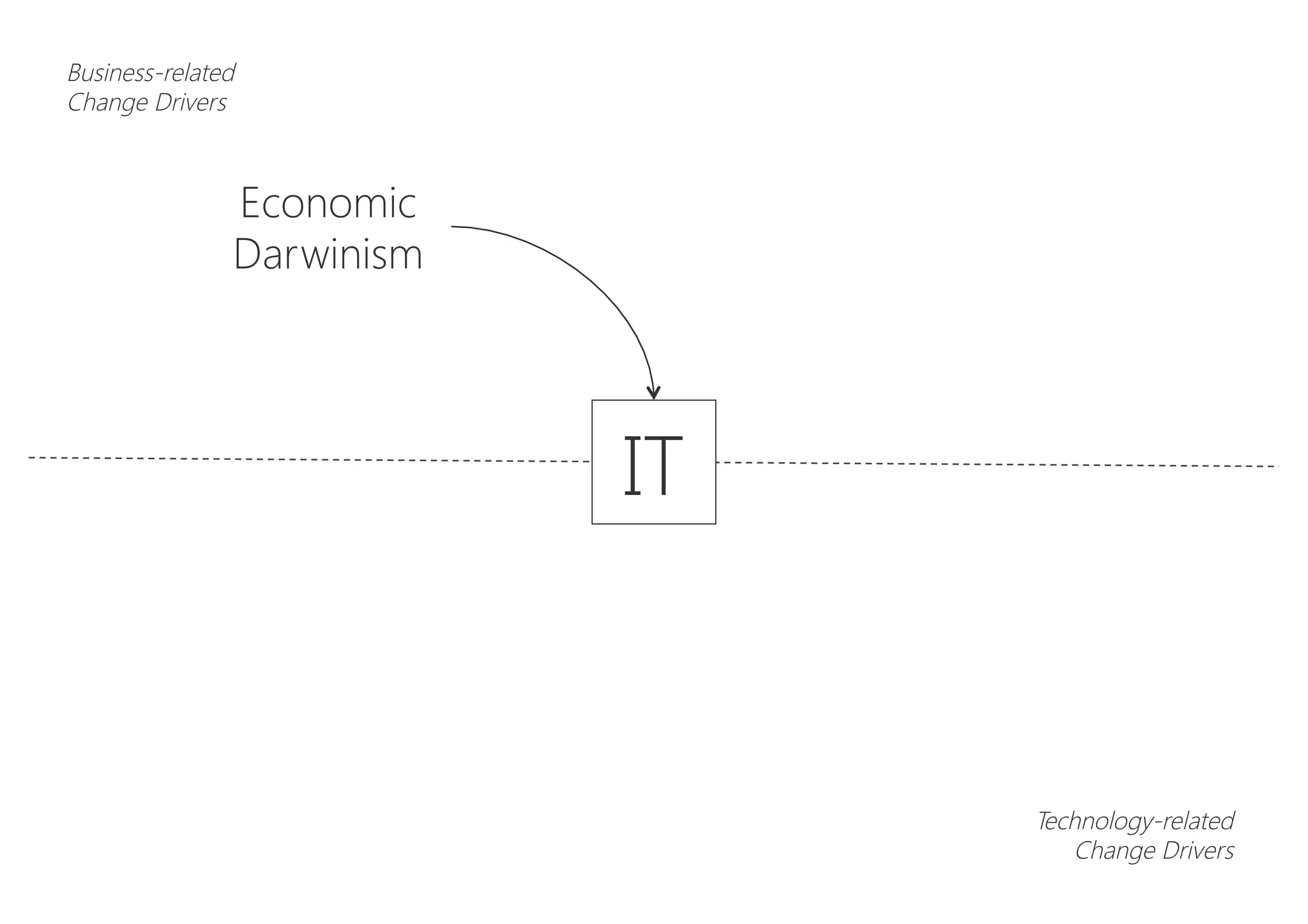
Economic Darwinism
Economic Darwinism

Everyone is affected by Economic Darwinism

•  All sectors
•  Growing globalization on all levels
•  Internet business
•  More competitors per customer
•  Higher customer expectations
•  Lower customer loyalty

à In the long run only those will survive who
meet the customer needs and demands best
Nice, but how does this relate to IT?
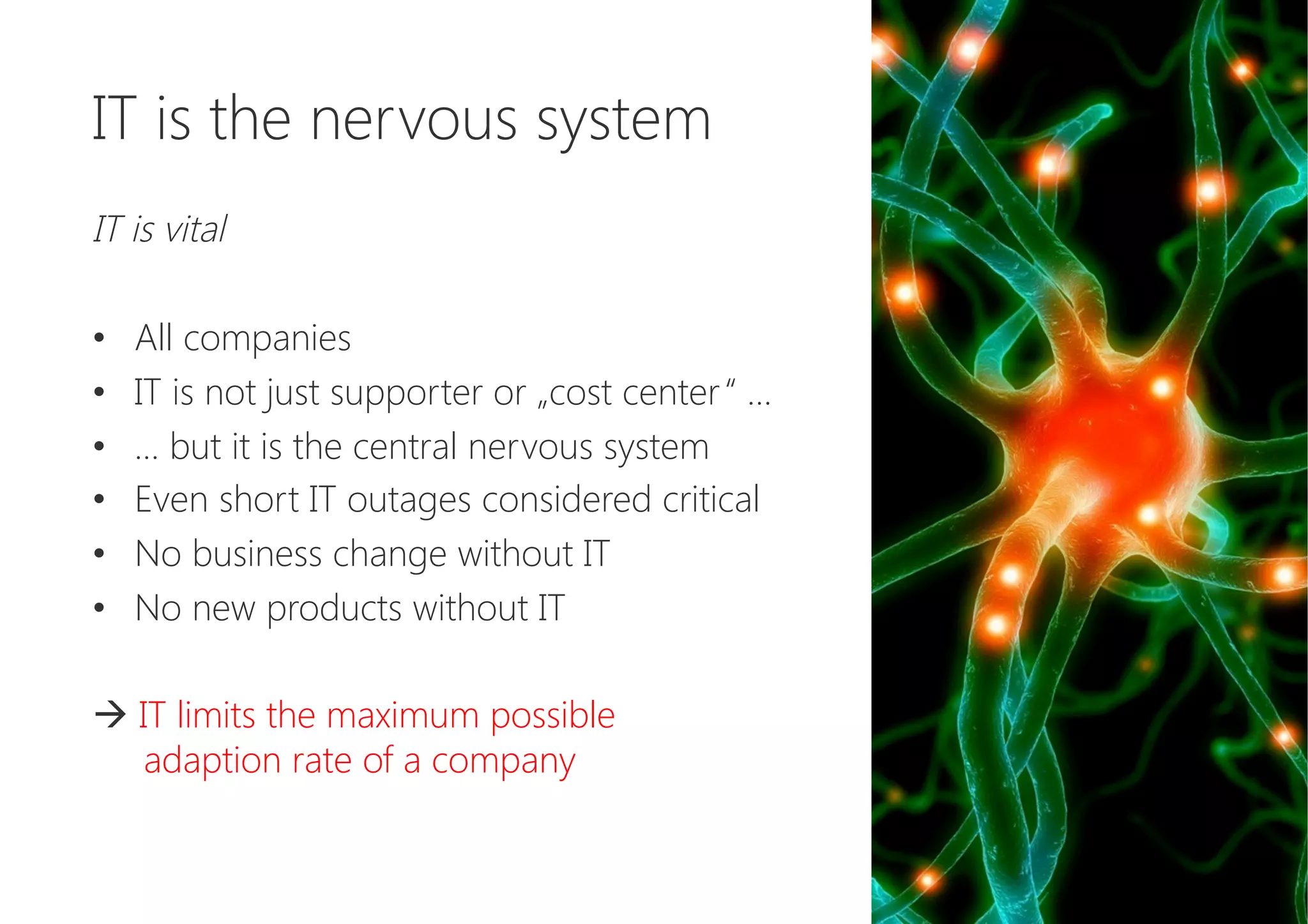
IT is the nervous system

IT is vital

•  All companies
•  IT is not just supporter or „cost center“ …
•  … but it is the central nervous system
•  Even short IT outages considered critical
•  No business change without IT
•  No new products without IT

à IT limits the maximum possible

adaption rate of a company
IT is a key success factor for belonging to
the survivors of the economic darwinism
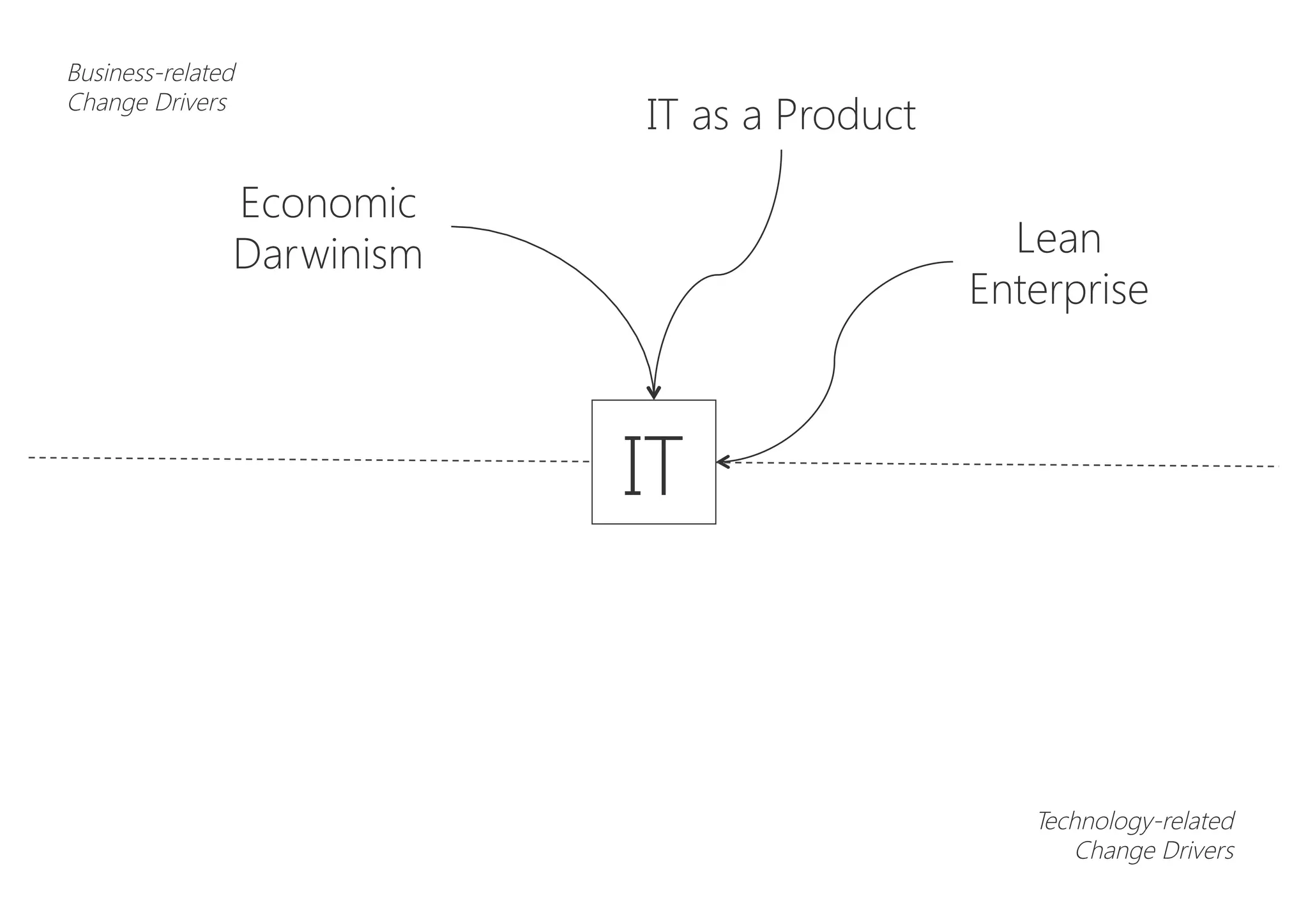
What business needs from IT …
How IT serves business …
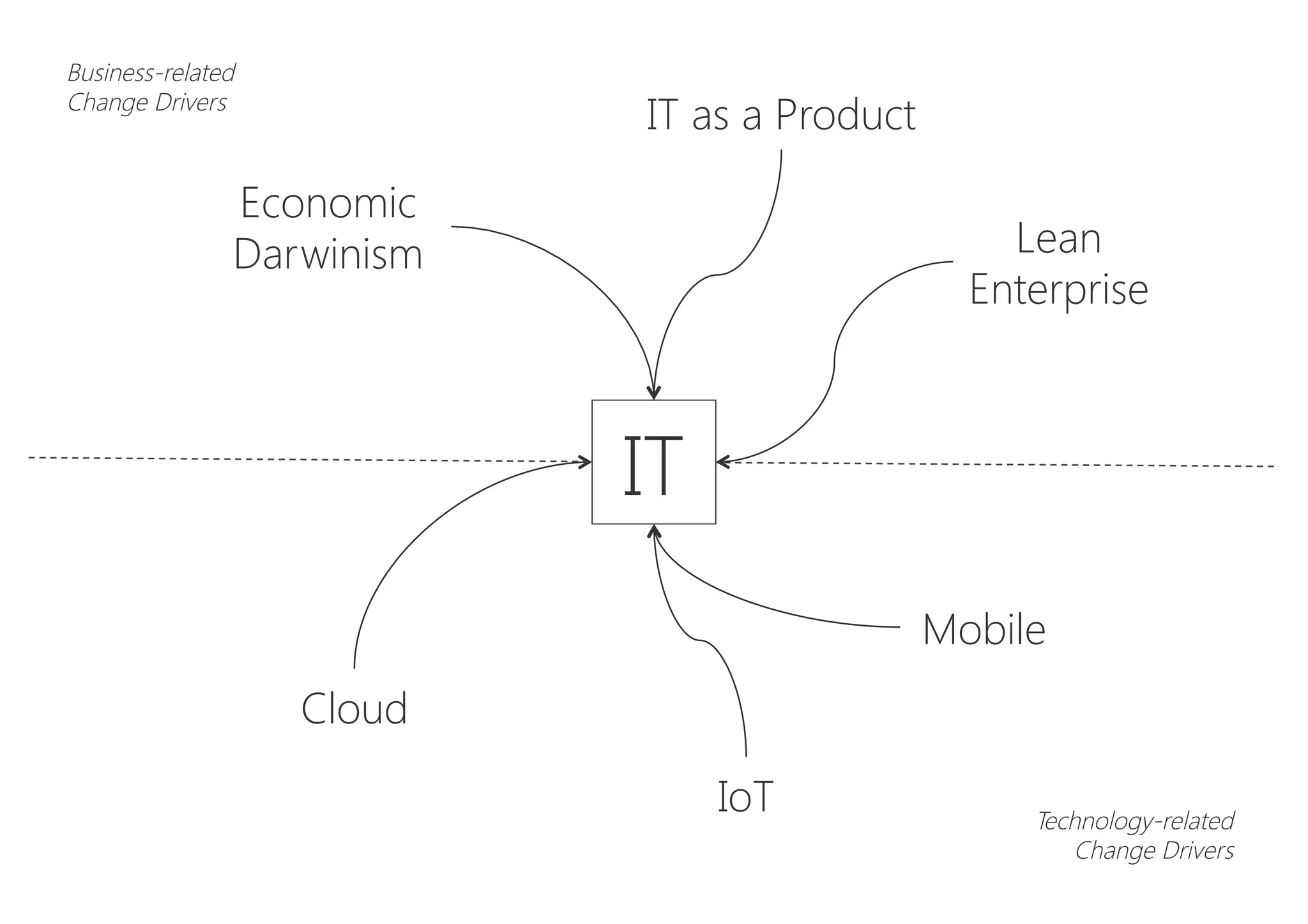
Economic
Darwinism
Business-related
Change Drivers
IT
Technology-related
Change Drivers
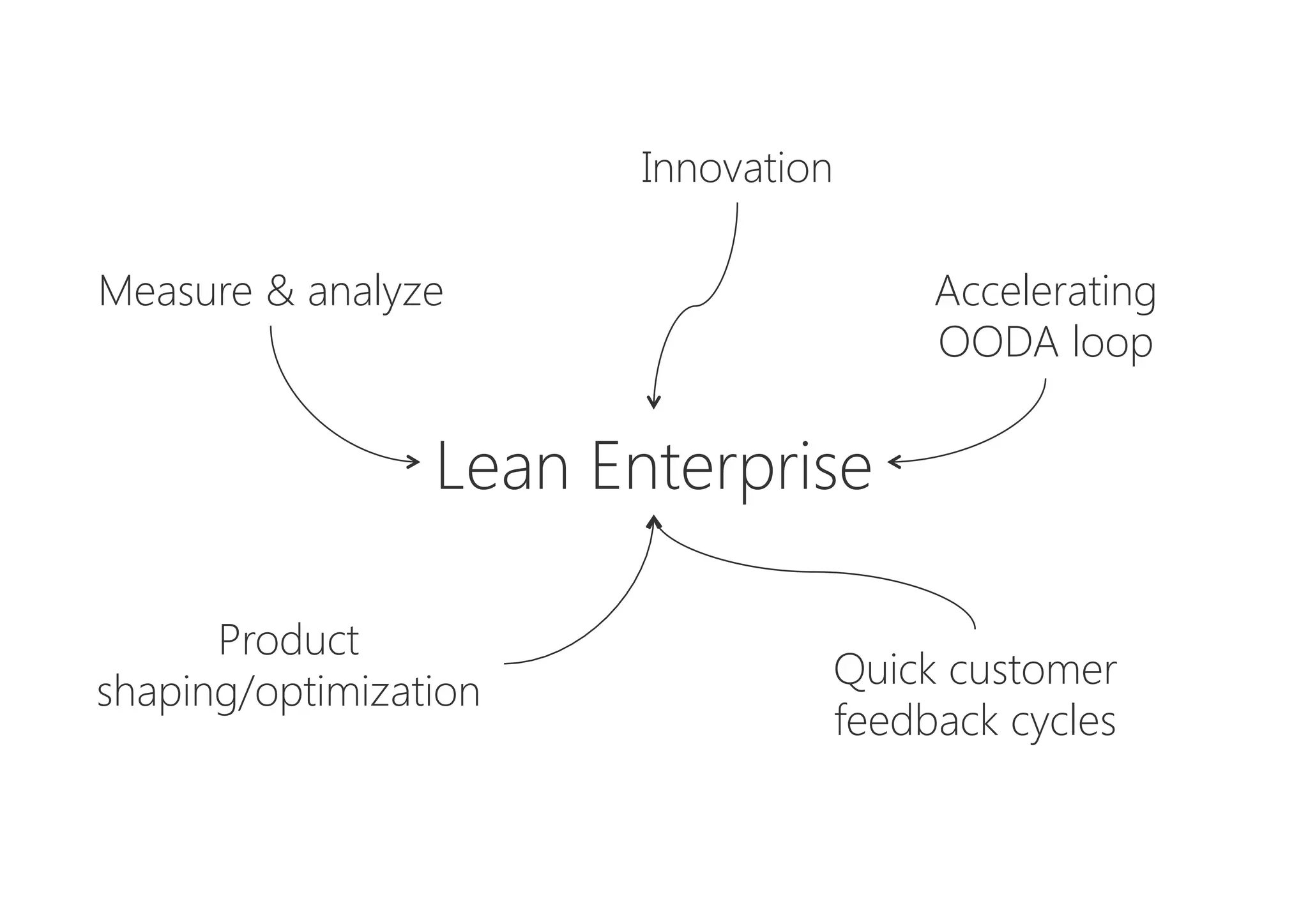
But there is more …
Lean Enterprise
Product

shaping/optimization
Innovation
Measure & analyze
 Accelerating
OODA loop
Quick customer
feedback cycles
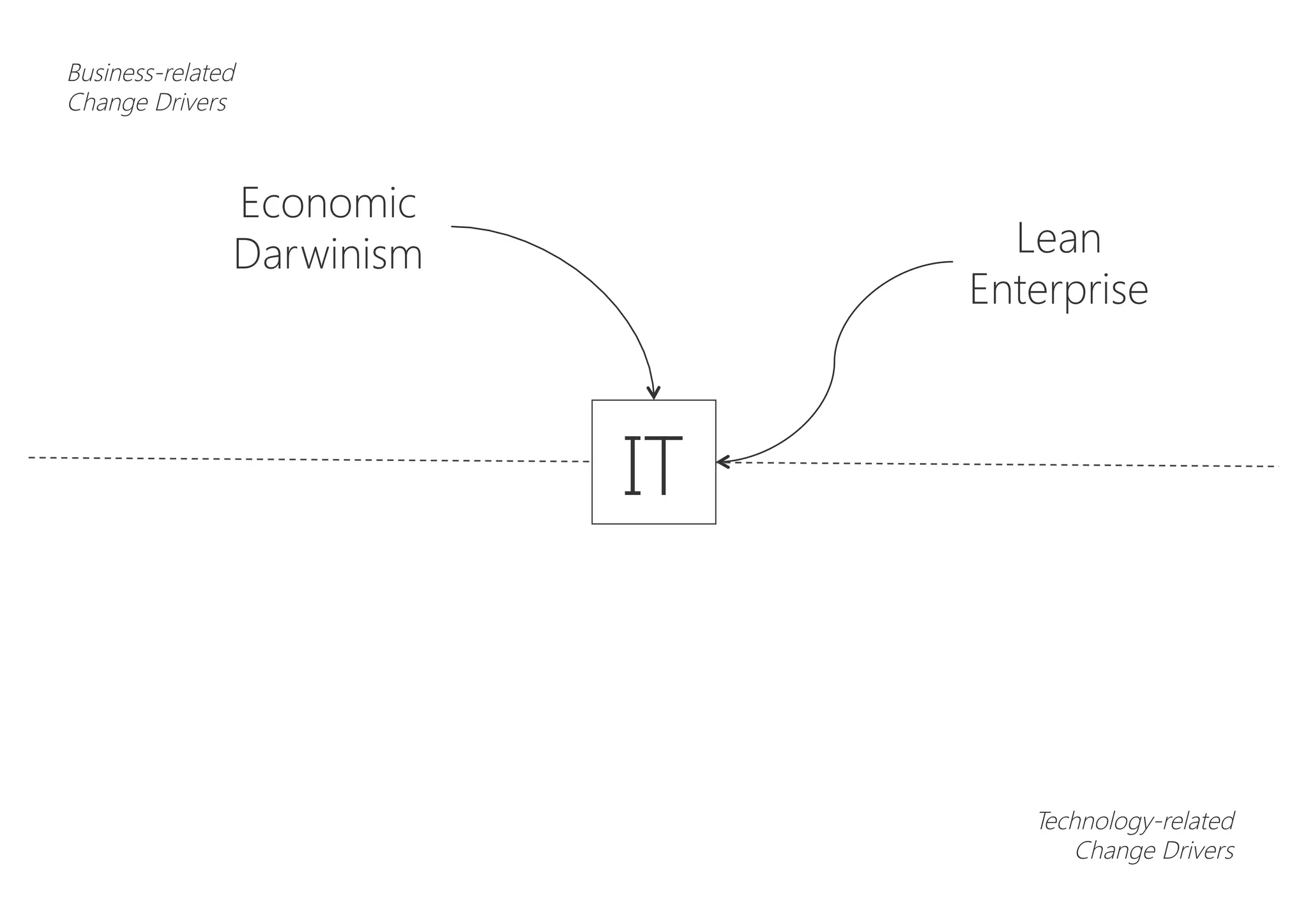
Economic
Darwinism
Business-related
Change Drivers
Lean
Enterprise
IT
Technology-related
Change Drivers
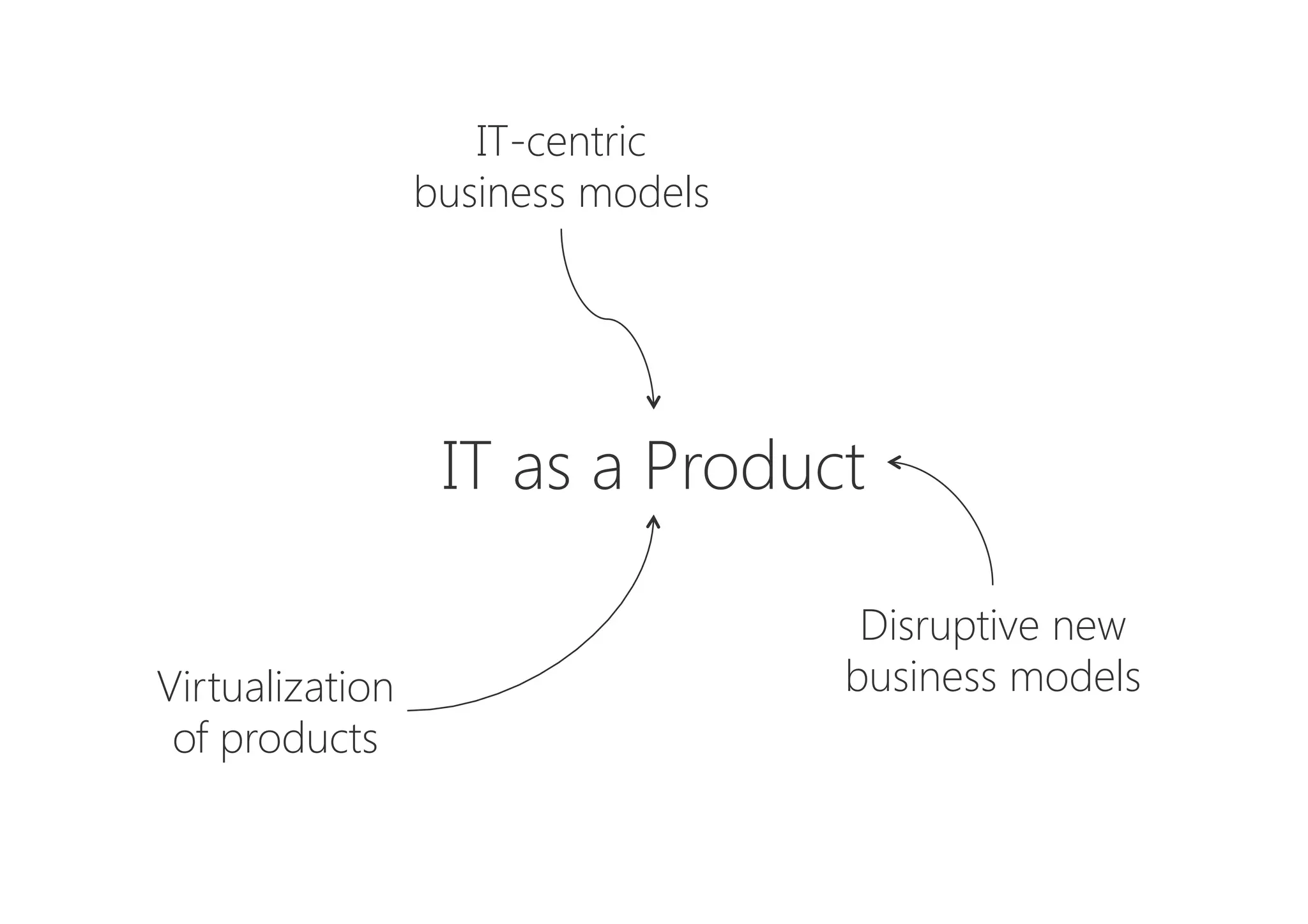
IT as a Product
Virtualization
of products
IT-centric
business models
Disruptive new
business models
Economic
Darwinism
Business-related
Change Drivers
Lean
Enterprise
IT as a Product
IT
Technology-related
Change Drivers
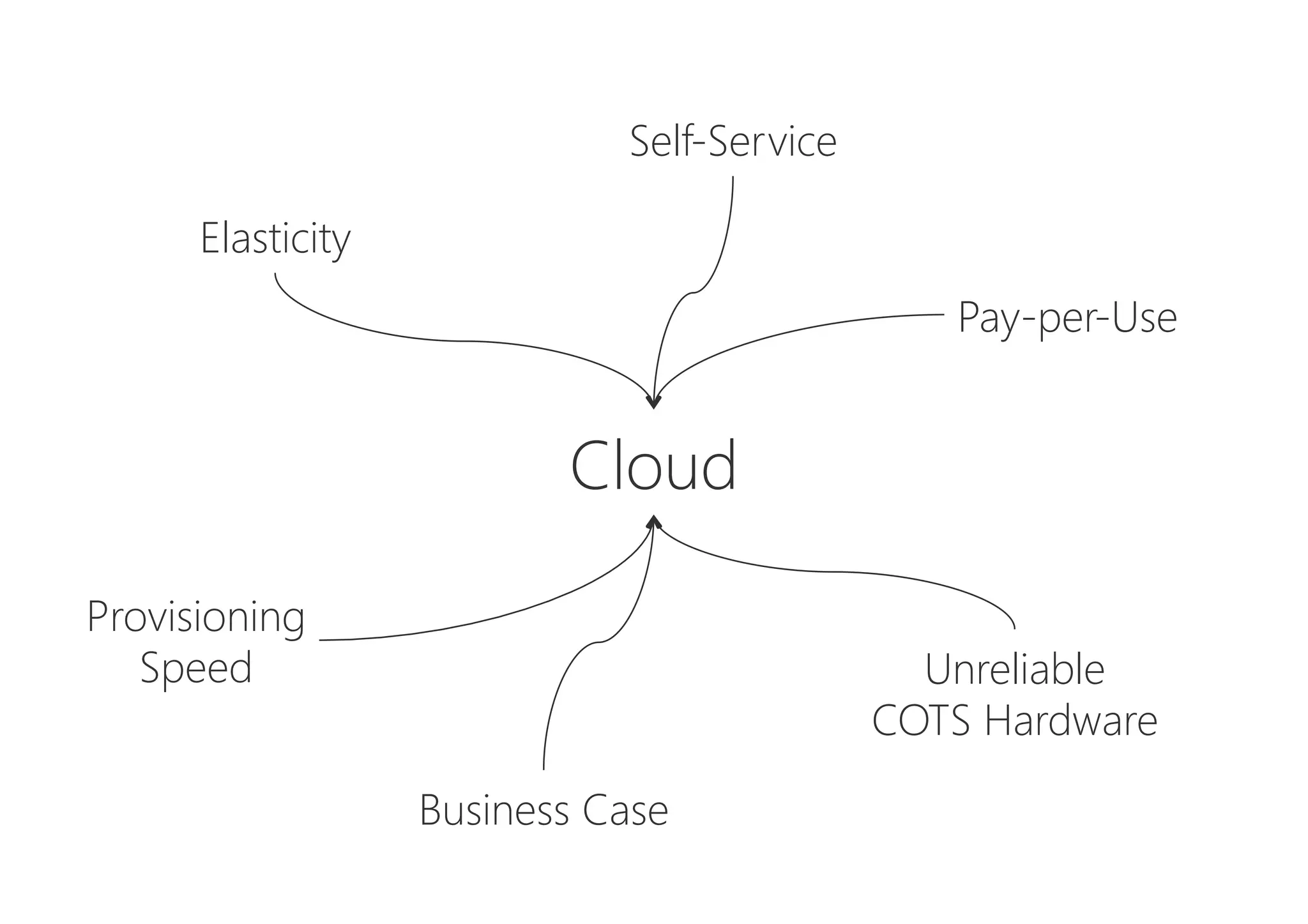
Pay-per-Use
Business Case
Self-Service
Cloud
Elasticity
Unreliable

COTS Hardware
Provisioning
Speed
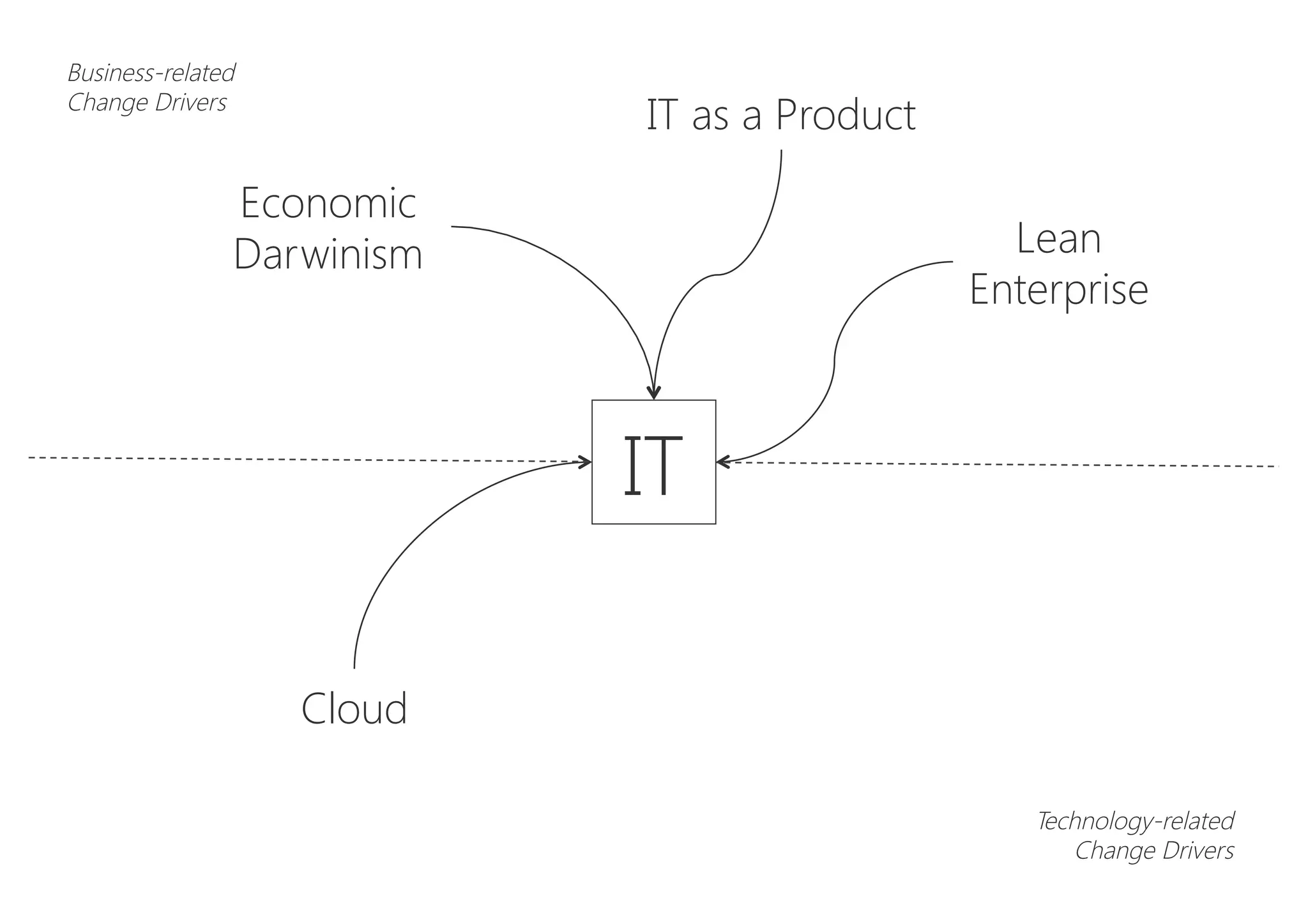
Economic
Darwinism
Business-related
Change Drivers
Lean
Enterprise
IT as a Product
Cloud
IT
Technology-related
Change Drivers
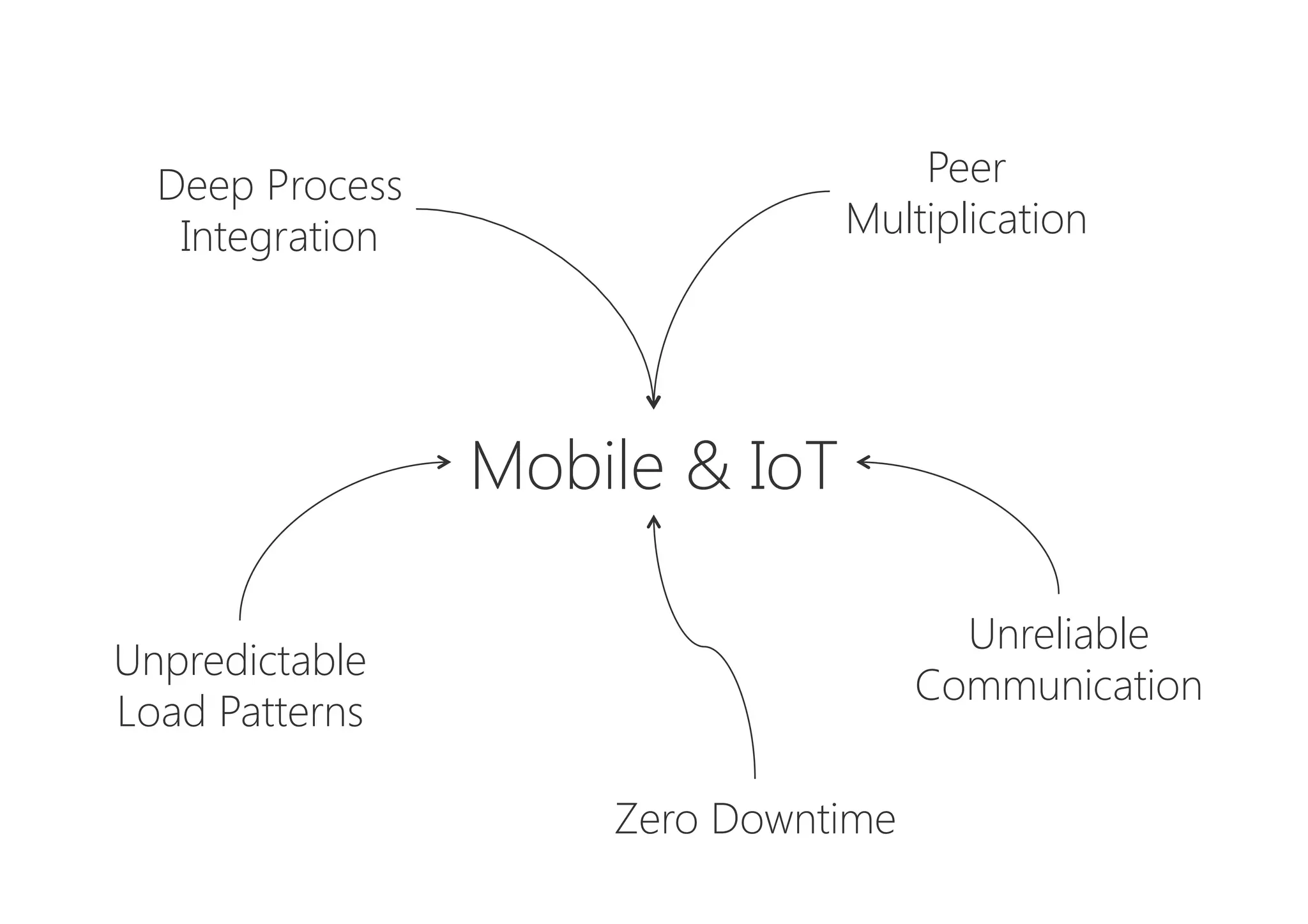
Zero Downtime
Peer
Multiplication 
Mobile & IoT
Deep Process
Integration
Unreliable

Communication
Unpredictable
Load Patterns
Economic
Darwinism
Business-related
Change Drivers
Lean
Enterprise
IT as a Product
Cloud
IoT
Mobile
IT
Technology-related
Change Drivers
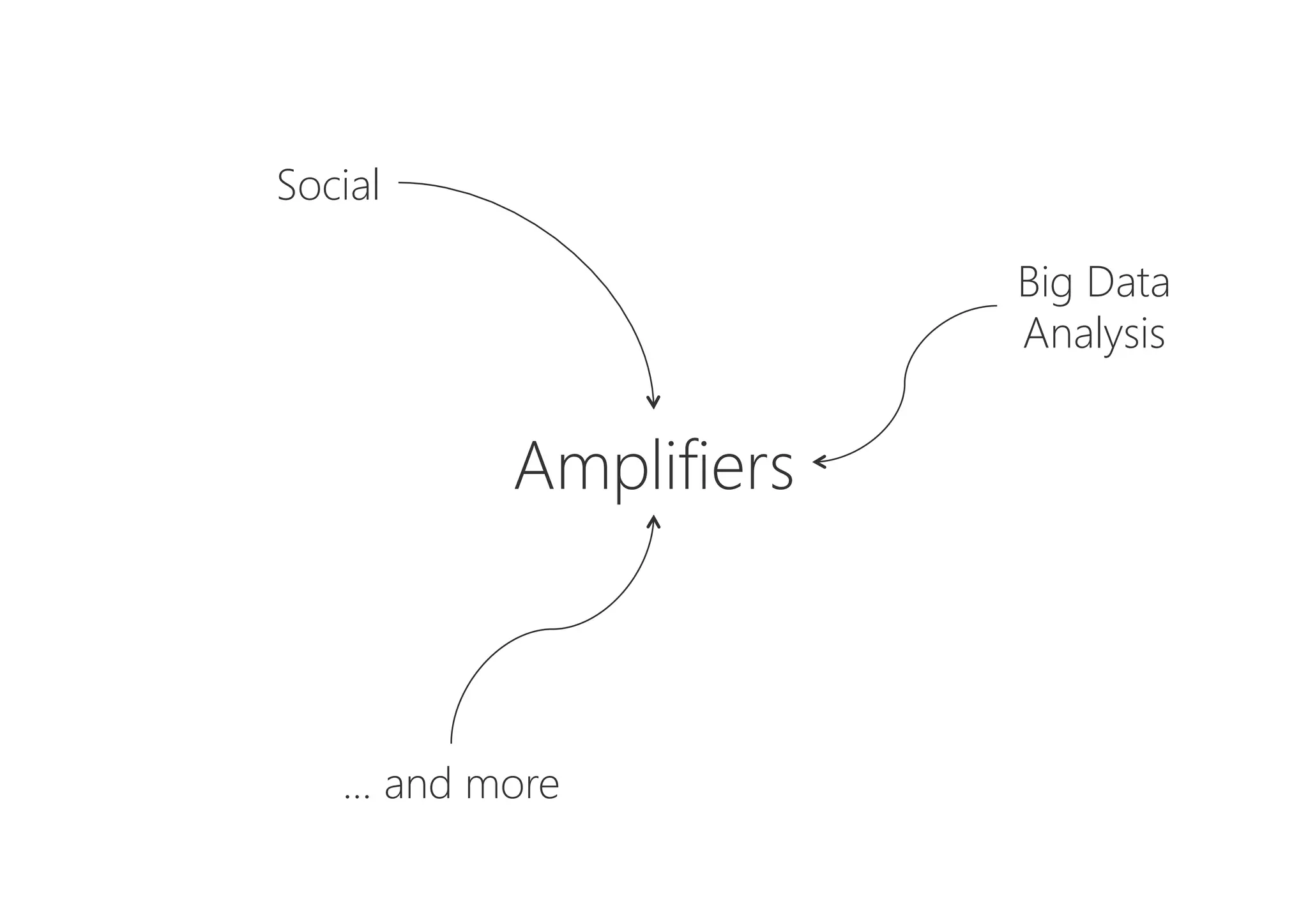
… and more
Big Data
Analysis
Amplifiers
Social
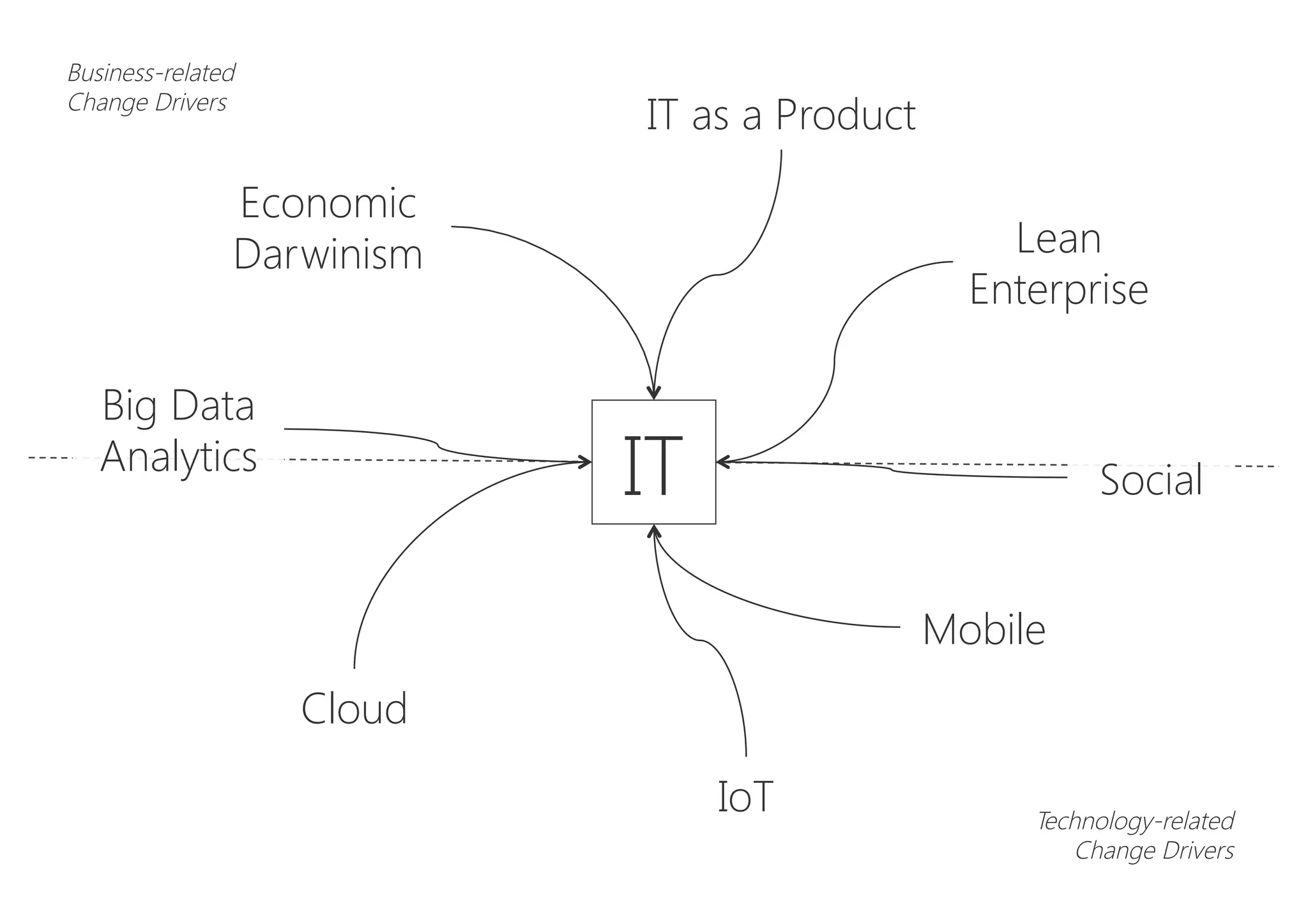
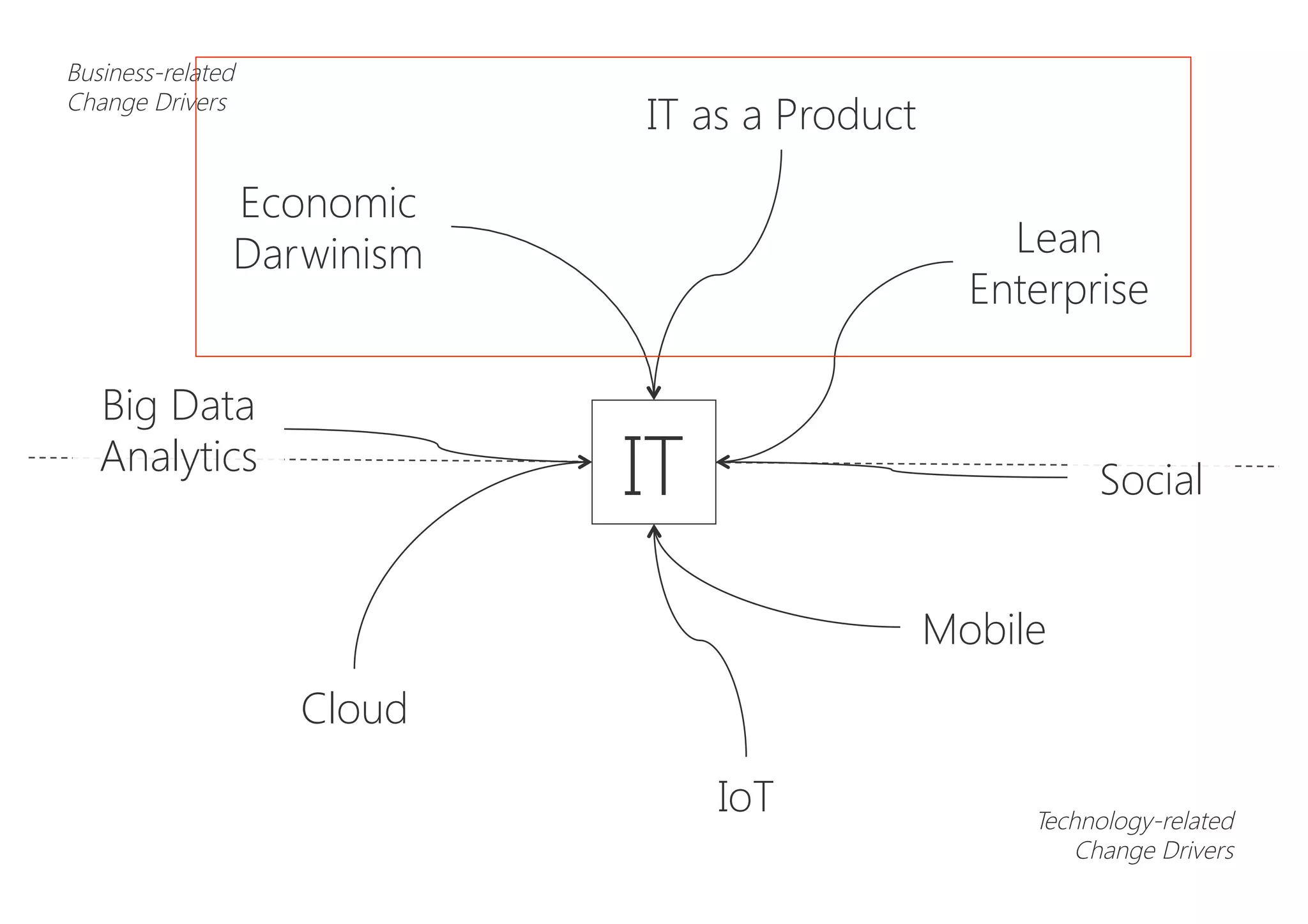
Economic
Darwinism
Business-related
Change Drivers
Lean
Enterprise
IT as a Product
Cloud
IoT
Mobile
IT
Big Data
Analytics
Social
Technology-related
Change Drivers
Why does traditional IT usually fail

to respond to those challenges?
Traditional IT bases its optimization efforts

on the wrong goals and principles
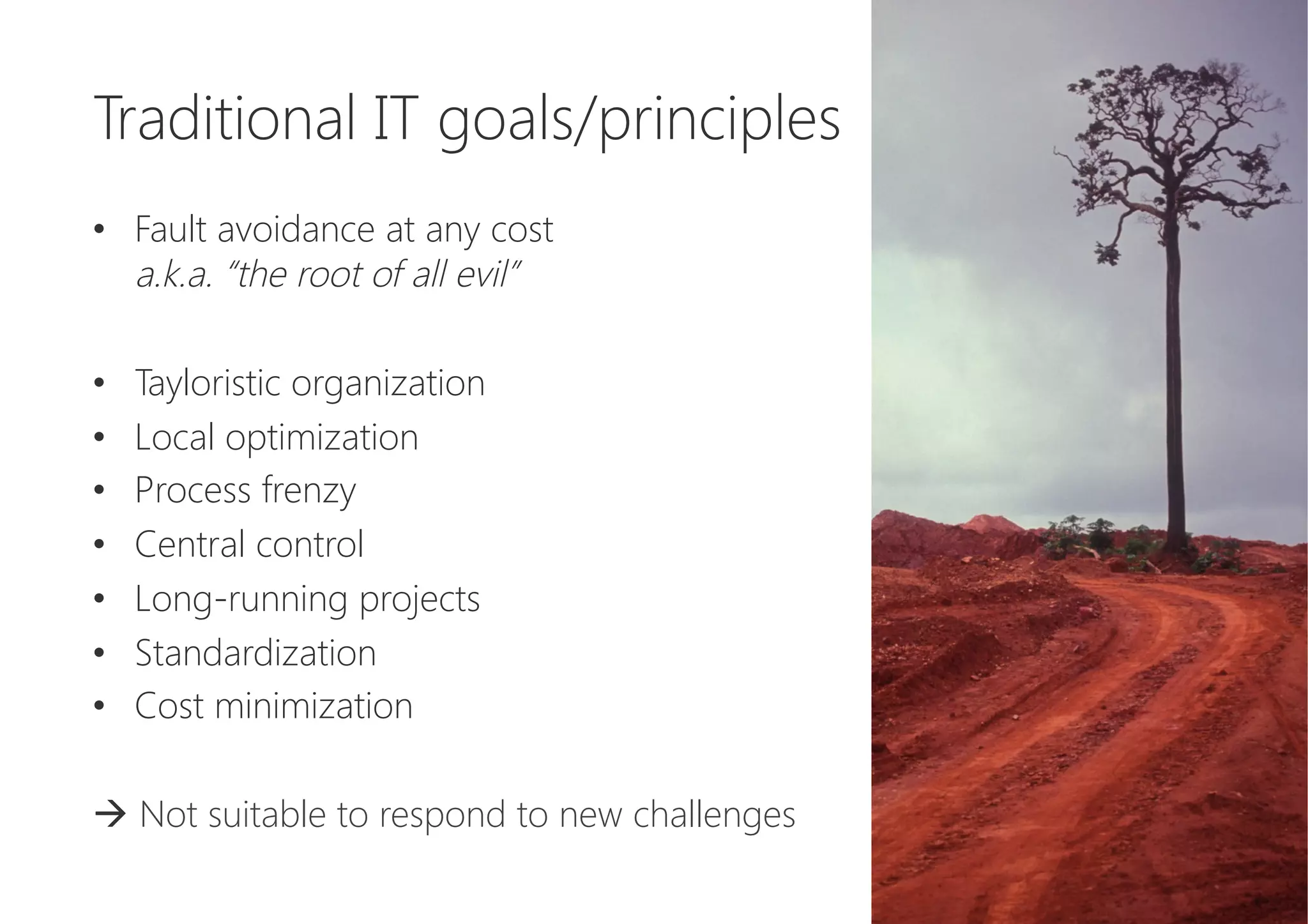
Traditional IT goals/principles

•  Fault avoidance at any cost

a.k.a. “the root of all evil”
•  Tayloristic organization
•  Local optimization
•  Process frenzy
•  Central control
•  Long-running projects
•  Standardization
•  Cost minimization
à Not suitable to respond to new challenges
Then, what are the new goals?
Economic
Darwinism
Business-related
Change Drivers
Lean
Enterprise
IT as a Product
Cloud
IoT
Mobile
IT
Big Data
Analytics
Social
Technology-related
Change Drivers
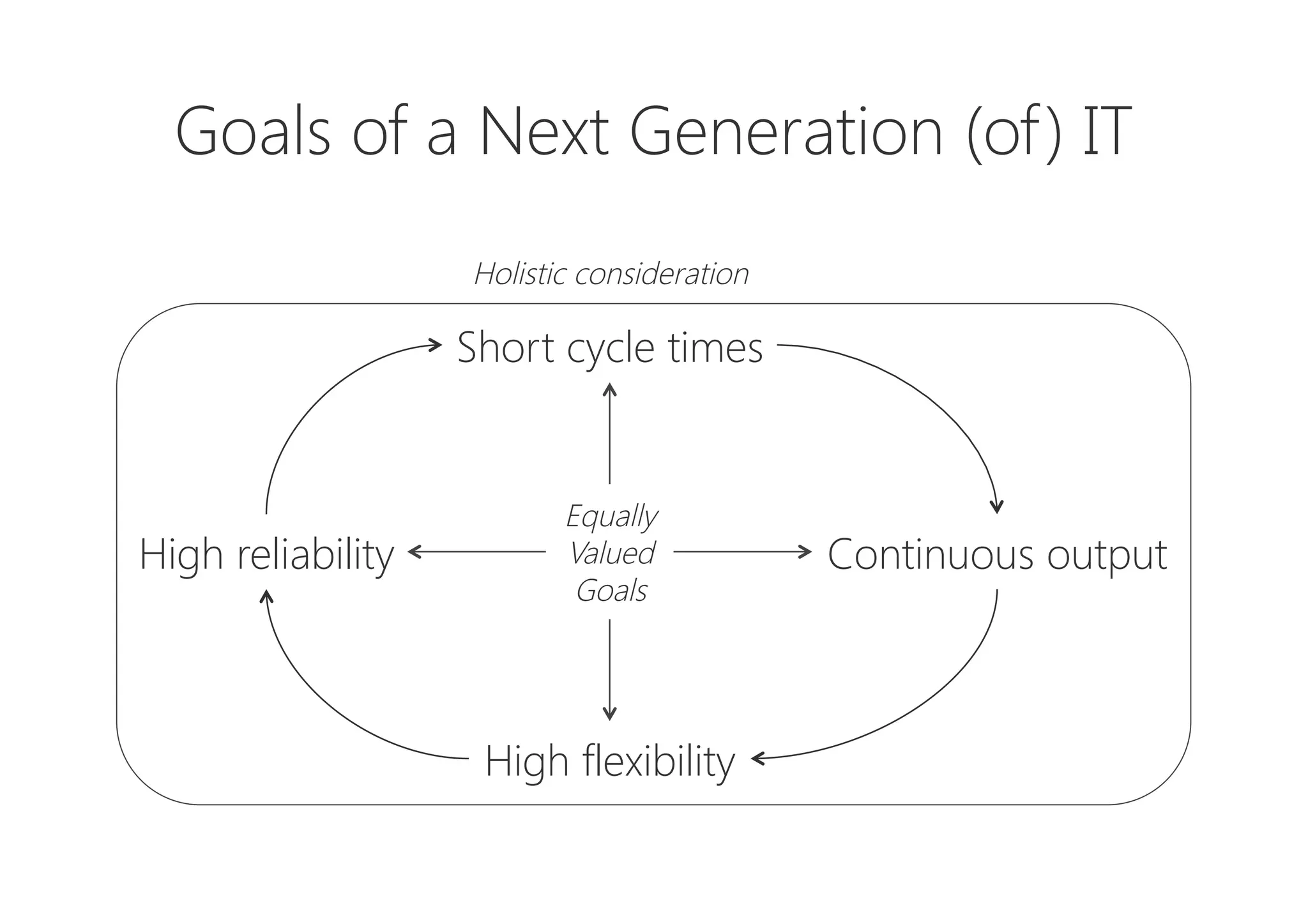
Short cycle times
Continuous output
High flexibility
High reliability
Equally
Valued
Goals
Holistic consideration
Goals of a Next Generation (of) IT
And what are the new principles?
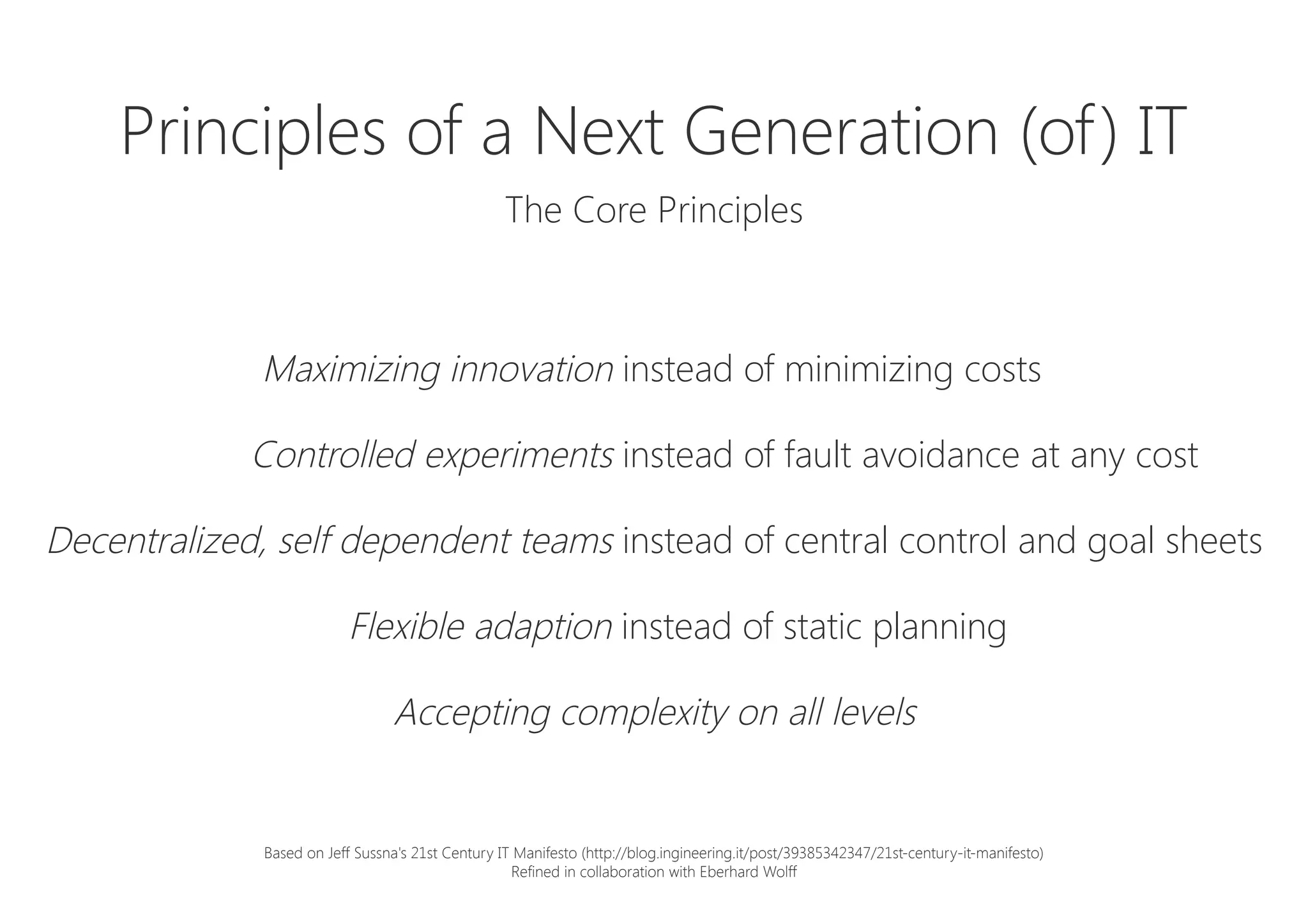
Principles of a Next Generation (of) IT

The Core Principles
Maximizing innovation instead of minimizing costs
Controlled experiments instead of fault avoidance at any cost
Decentralized, self dependent teams instead of central control and goal sheets
Flexible adaption instead of static planning
Accepting complexity on all levels
Based on Jeff Sussna's 21st Century IT Manifesto (http://blog.ingineering.it/post/39385342347/21st-century-it-manifesto)
Refined in collaboration with Eberhard Wolff
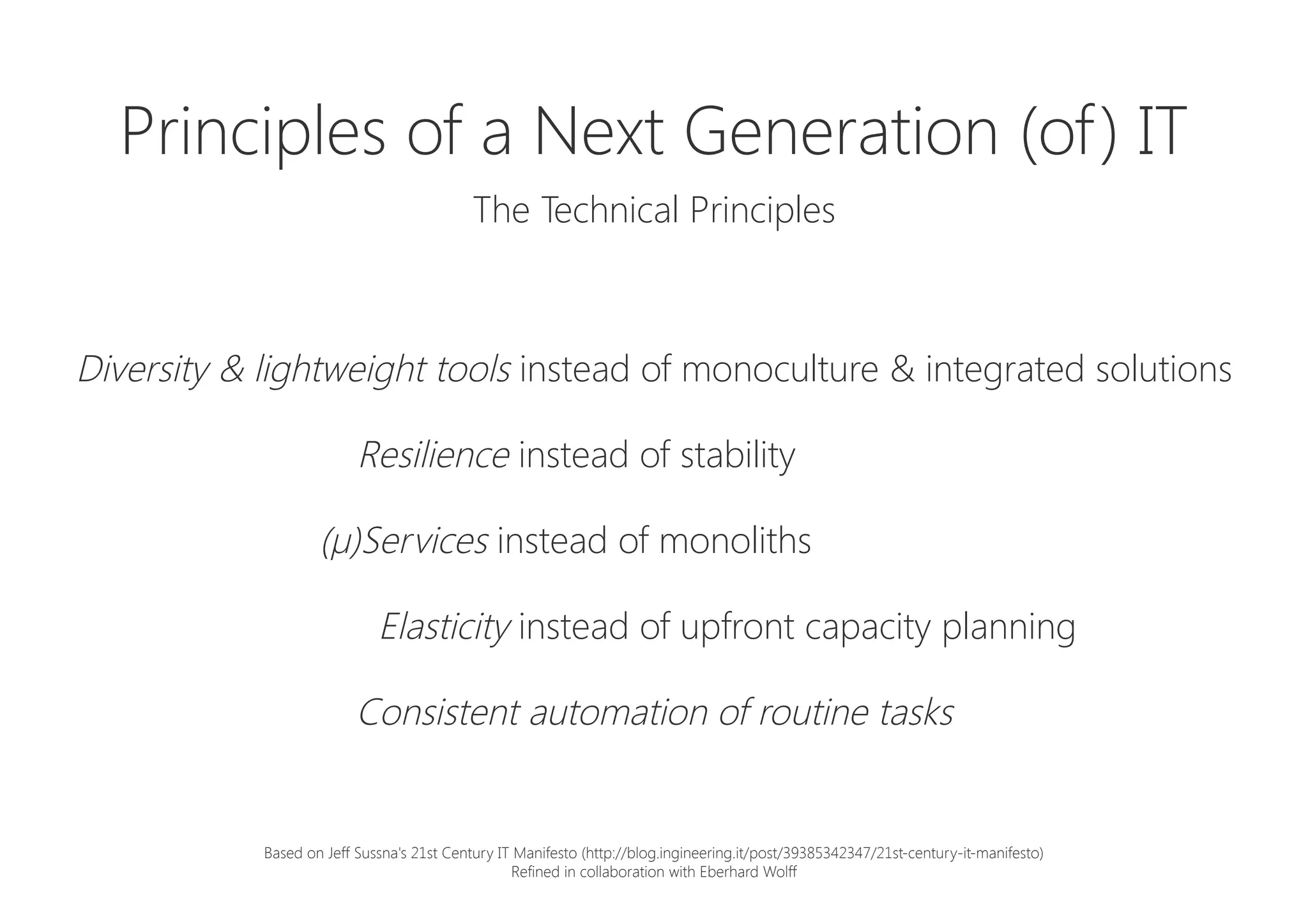
Principles of a Next Generation (of) IT

The Technical Principles
Diversity & lightweight tools instead of monoculture & integrated solutions
Resilience instead of stability
(µ)Services instead of monoliths
Elasticity instead of upfront capacity planning
Consistent automation of routine tasks
Based on Jeff Sussna's 21st Century IT Manifesto (http://blog.ingineering.it/post/39385342347/21st-century-it-manifesto)
Refined in collaboration with Eberhard Wolff
Nice (again), but how does this

relate to architecture?
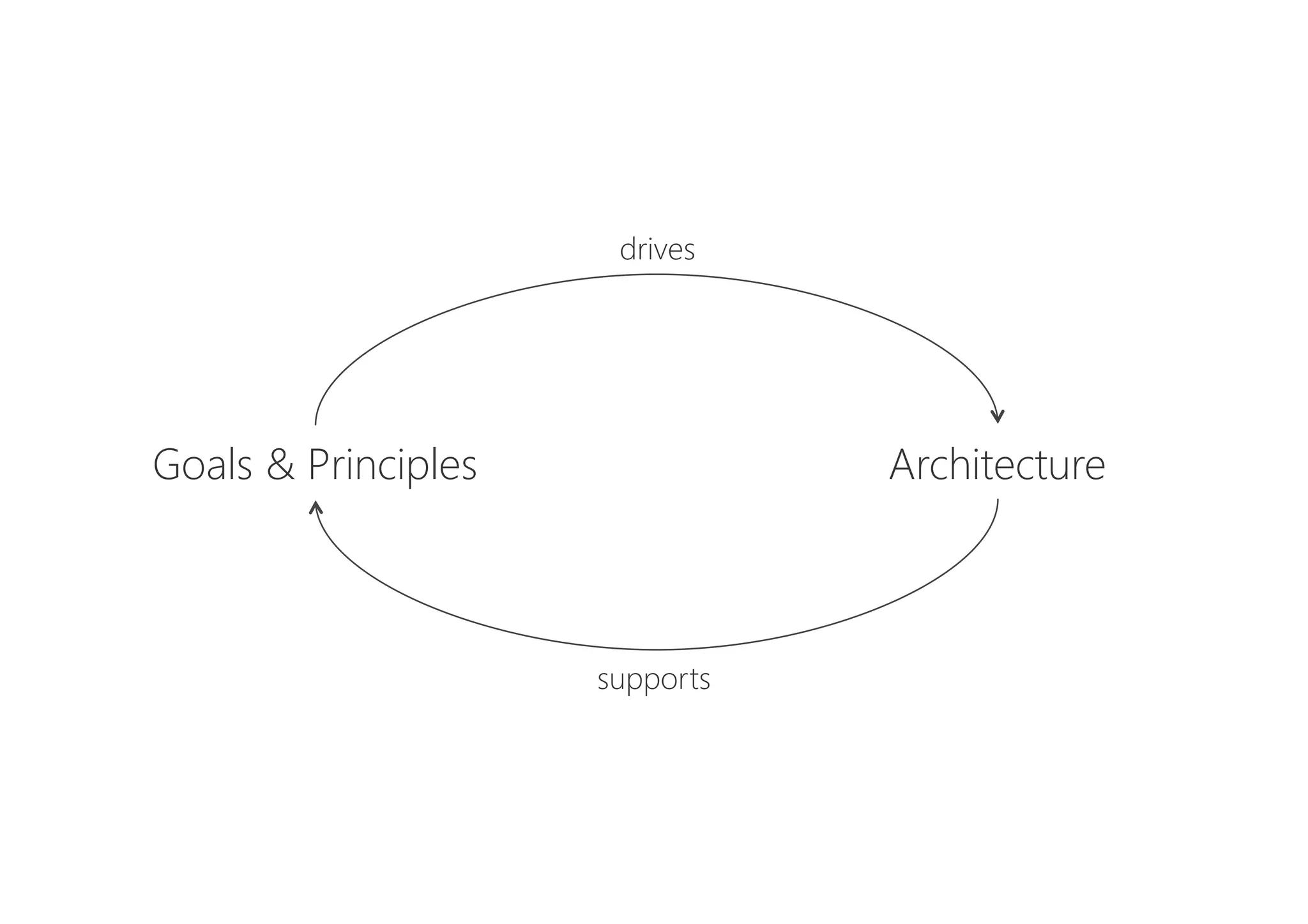
Goals & Principles
 Architecture
drives
supports
What does that mean for architecture?
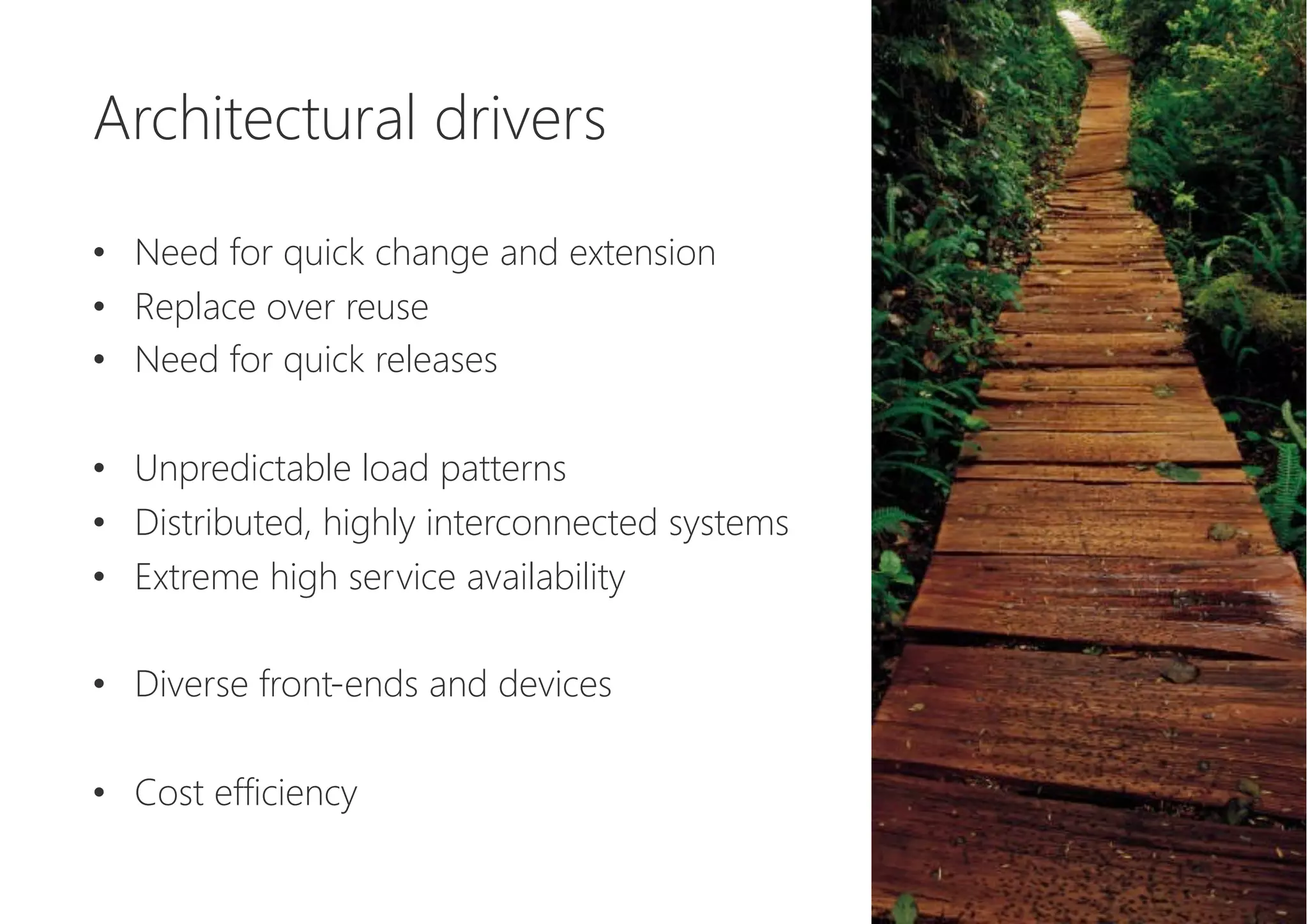
Architectural drivers

•  Need for quick change and extension
•  Replace over reuse
•  Need for quick releases
•  Unpredictable load patterns
•  Distributed, highly interconnected systems
•  Extreme high service availability
•  Diverse front-ends and devices
•  Cost efficiency
Architectural requirements

•  Easy to understand
•  Easy to extend
•  Easy to change
•  Easy to replace
•  Easy to deploy
•  Easy to scale
•  Easy to recover
•  Easy to connect
•  Easy to afford
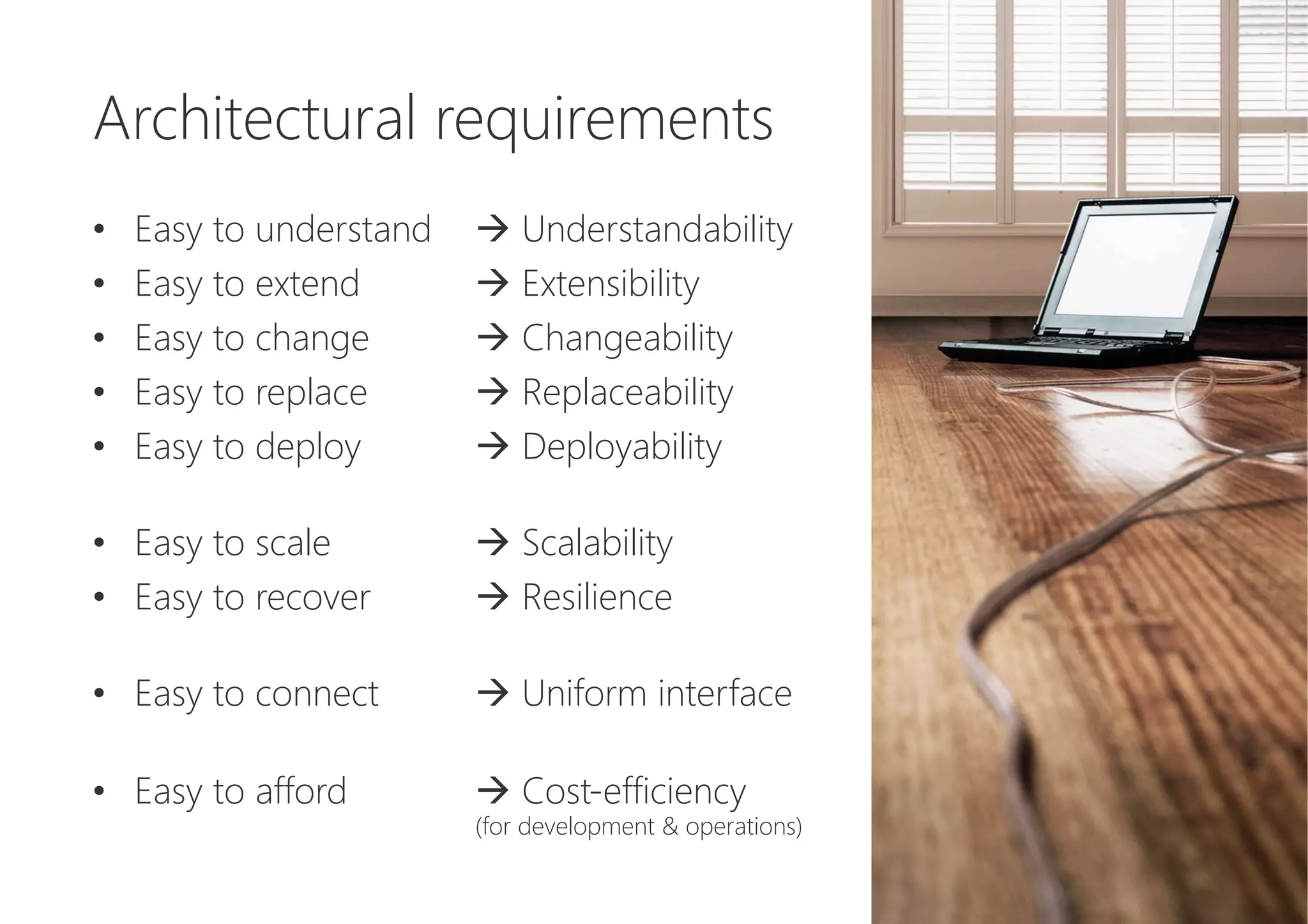
Architectural requirements

•  Easy to understand 
à Understandability
•  Easy to extend 
à Extensibility
•  Easy to change 
à Changeability
•  Easy to replace 
à Replaceability
•  Easy to deploy 
à Deployability
•  Easy to scale 
à Scalability
•  Easy to recover 
à Resilience
•  Easy to connect 
à Uniform interface
•  Easy to afford 
à Cost-efficiency


(for development & operations)
What are the appropriate solutions?
Let’s check a few hype topics …
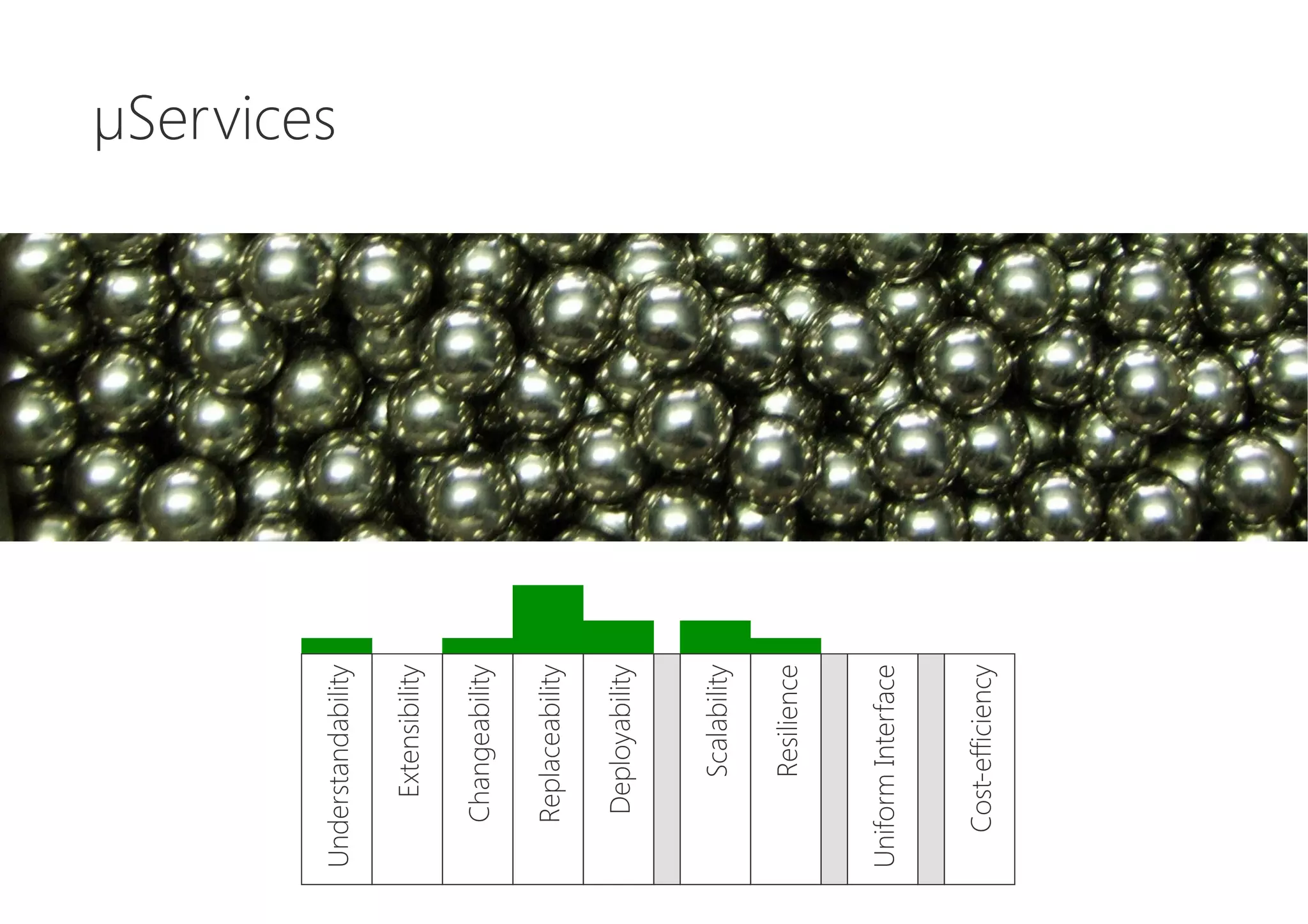
µServices


•  Built for replacement (not reuse)
•  Self-dependent, loosely coupled services
•  Should be aligned with business capability
•  Size should not exceed what one brain can grasp
µServices
Cost-efficiency
UniformInterface
Resilience
Scalability
Deployability
Replaceability
Changeability
Extensibility
Understandability
REST


•  Uniform access interface to resources
•  Closely related to the HTTP protocol
•  HATEOAS (Hypermedia as the engine of application state)
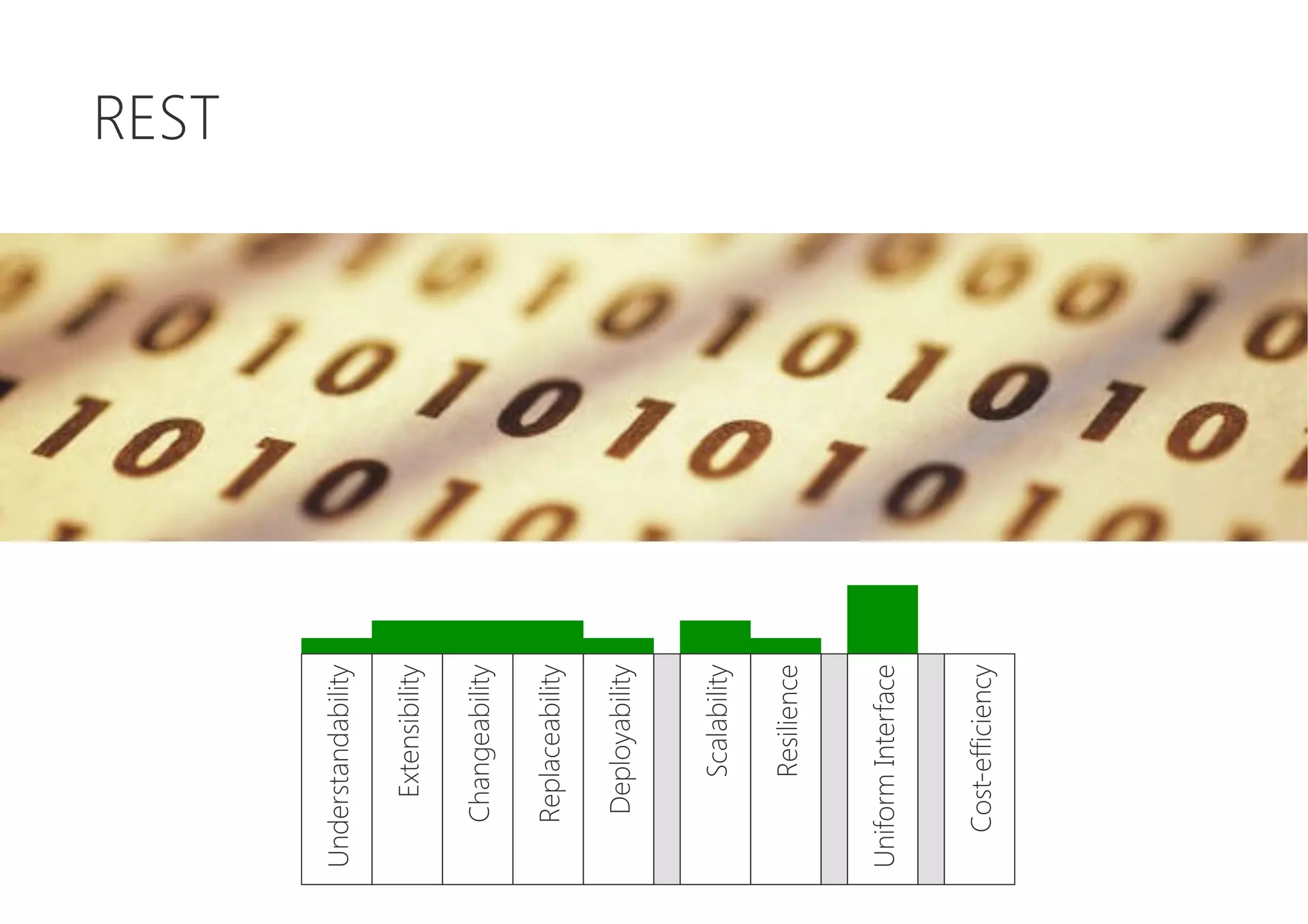
REST
Cost-efficiency
UniformInterface
Resilience
Scalability
Deployability
Replaceability
Changeability
Extensibility
Understandability
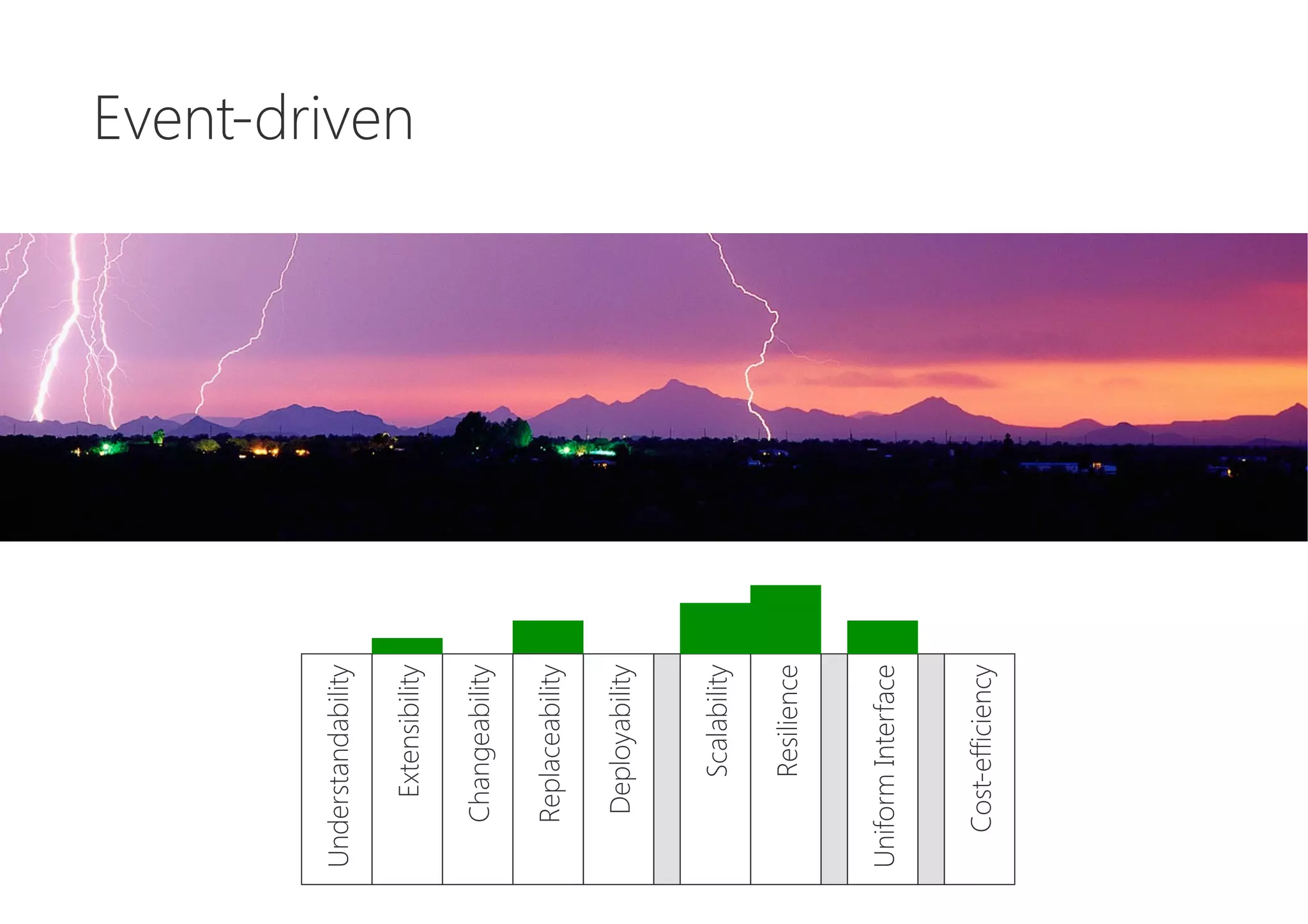
Event-driven


•  Asynchronous communication paradigm
•  Technical decoupling of communication peers (isolation)
•  Location transparency in conjunction with MOM
•  Call-stack paradigm replaced by (complex) message networks
Event-driven
Cost-efficiency
UniformInterface
Resilience
Scalability
Deployability
Replaceability
Changeability
Extensibility
Understandability
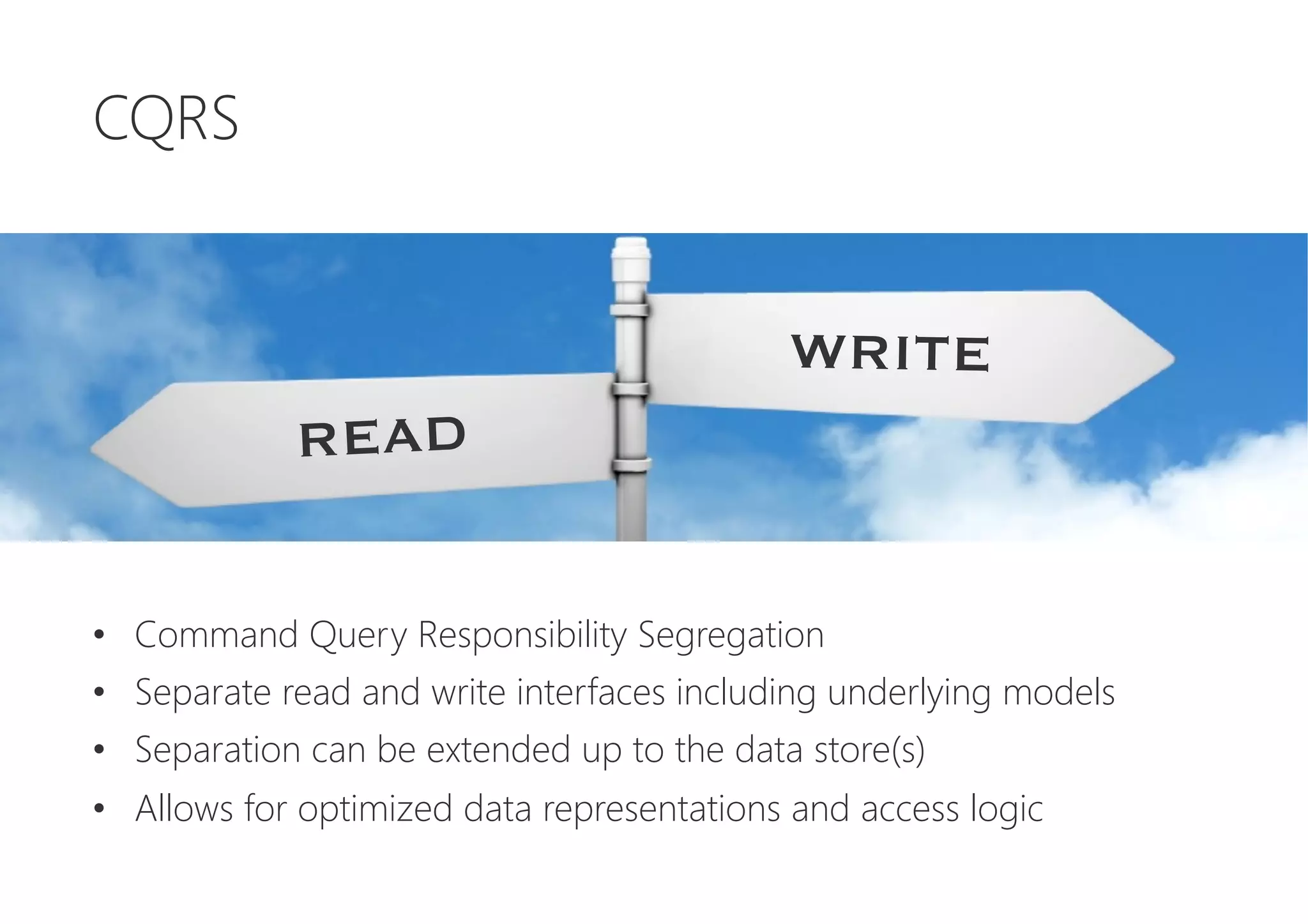
CQRS


•  Command Query Responsibility Segregation
•  Separate read and write interfaces including underlying models
•  Separation can be extended up to the data store(s)
•  Allows for optimized data representations and access logic
READ
WRITE
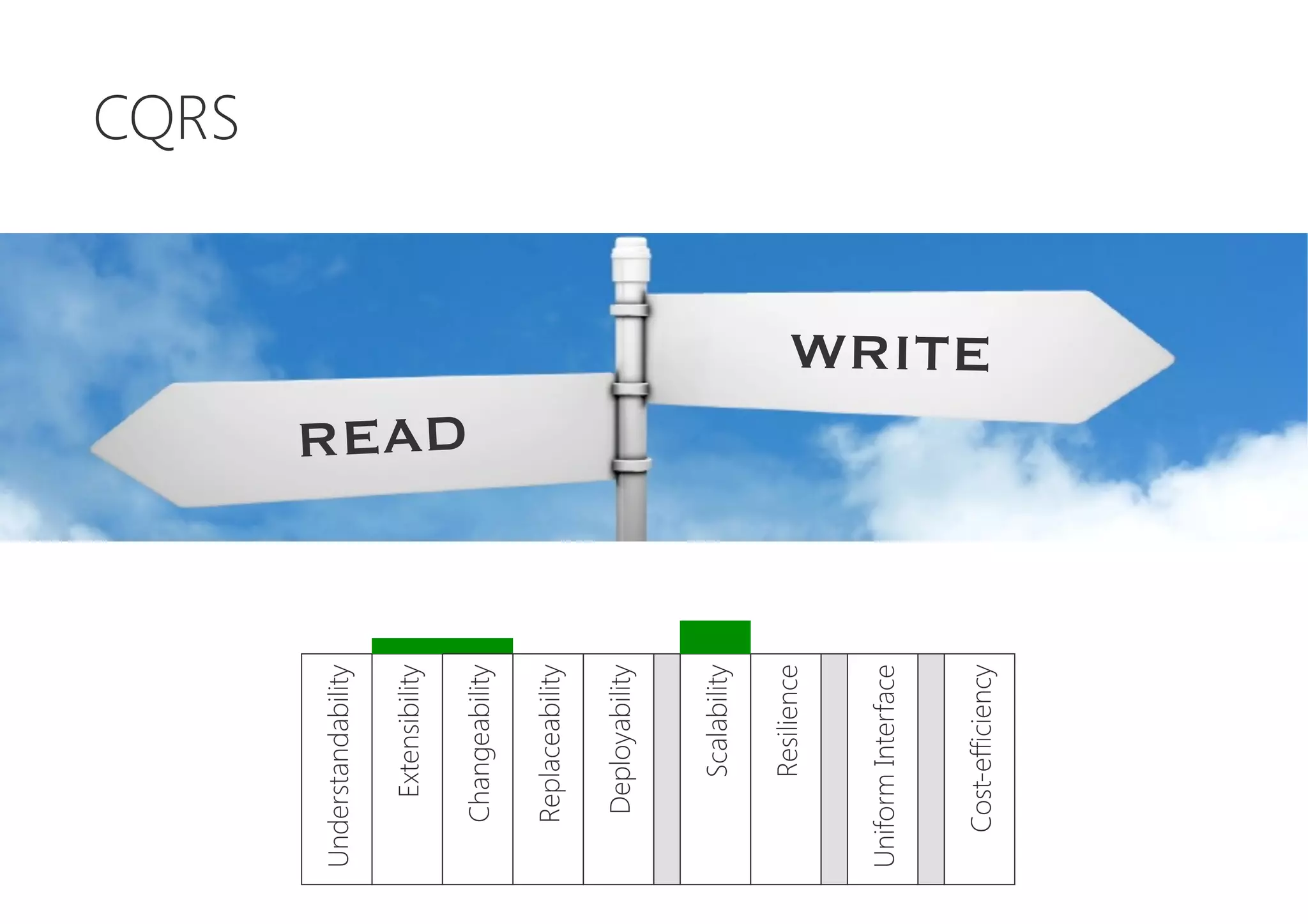
CQRS
Cost-efficiency
UniformInterface
Resilience
Scalability
Deployability
Replaceability
Changeability
Extensibility
Understandability
READ
WRITE
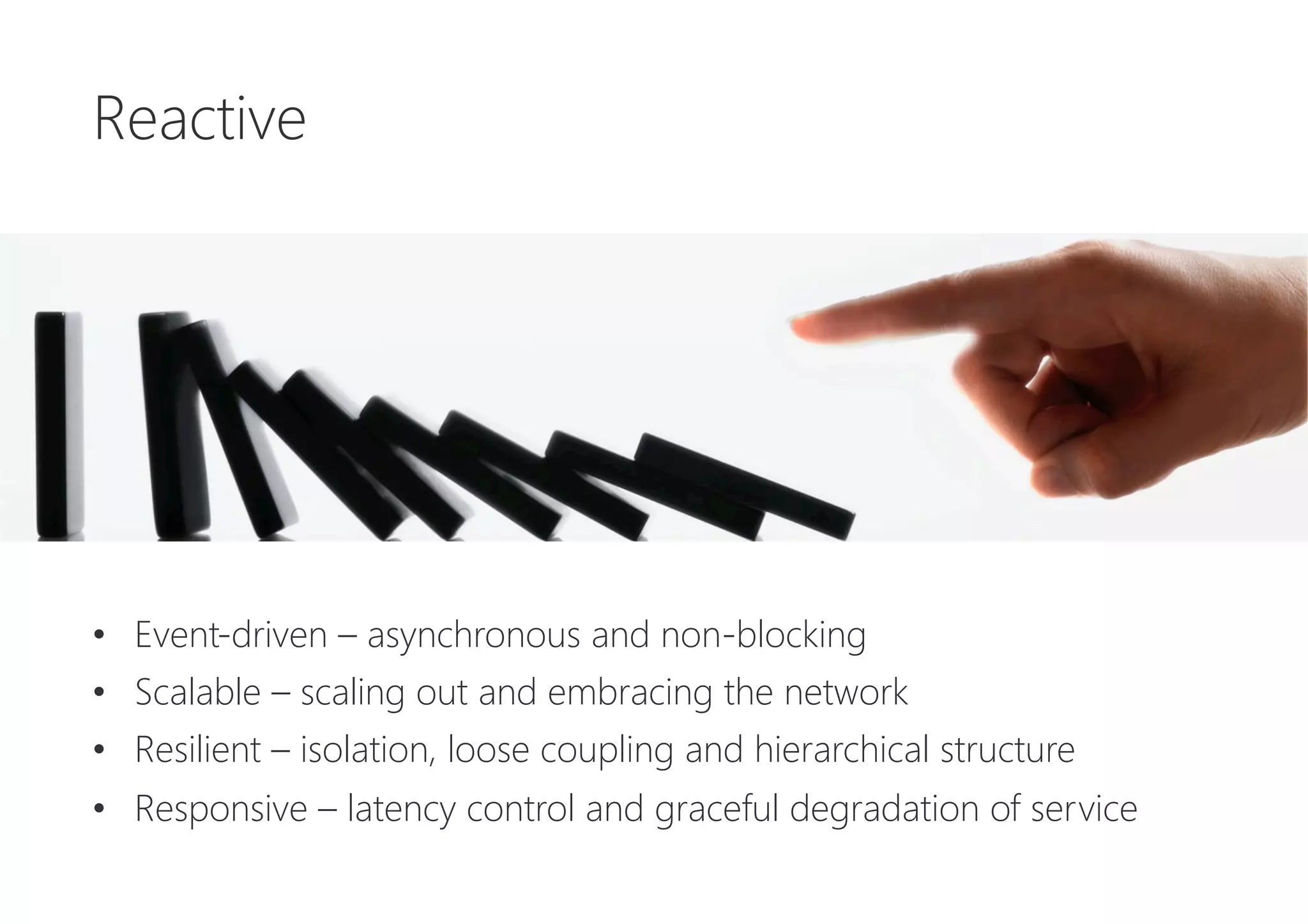
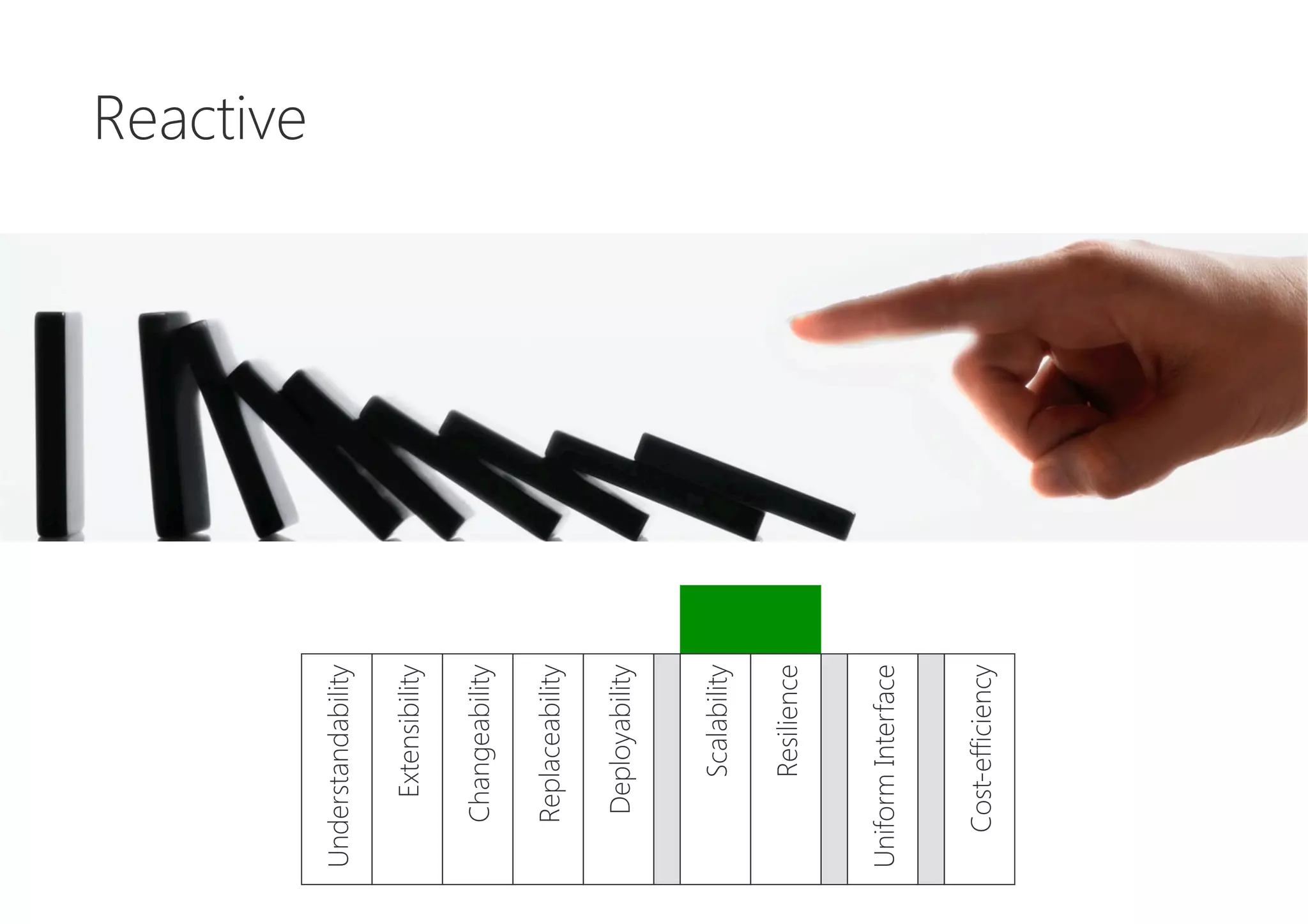
Reactive


•  Event-driven – asynchronous and non-blocking
•  Scalable – scaling out and embracing the network
•  Resilient – isolation, loose coupling and hierarchical structure
•  Responsive – latency control and graceful degradation of service
Reactive
Cost-efficiency
UniformInterface
Resilience
Scalability
Deployability
Replaceability
Changeability
Extensibility
Understandability
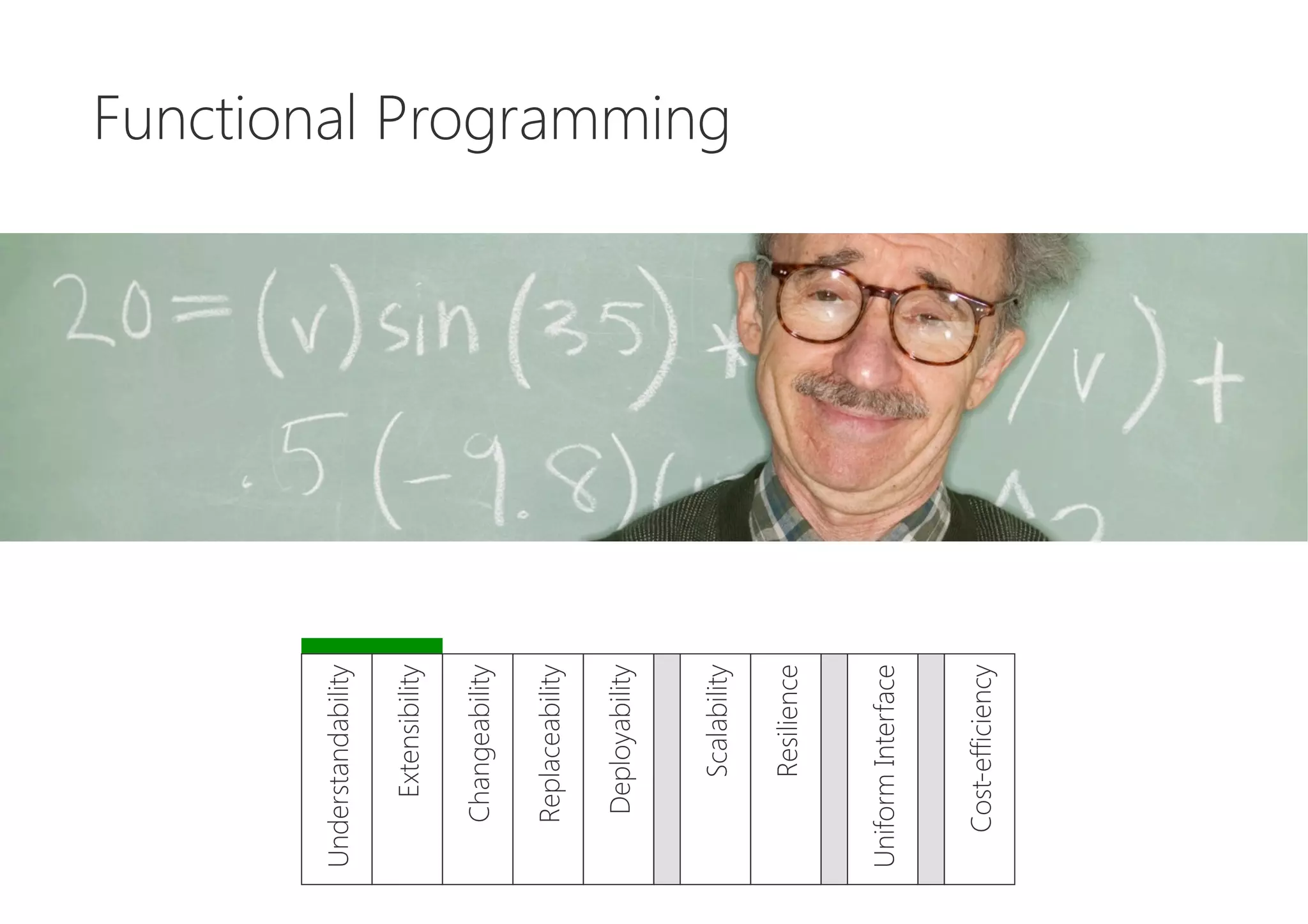
Functional Programming


•  Alternative programming paradigm
•  Functional languages (Erlang, Haskell, Clojure, …)
•  Hybrid languages (Scala, …)
•  Languages with functional extensions (Python, JavaScript, Java, …)
Functional Programming
Cost-efficiency
UniformInterface
Resilience
Scalability
Deployability
Replaceability
Changeability
Extensibility
Understandability
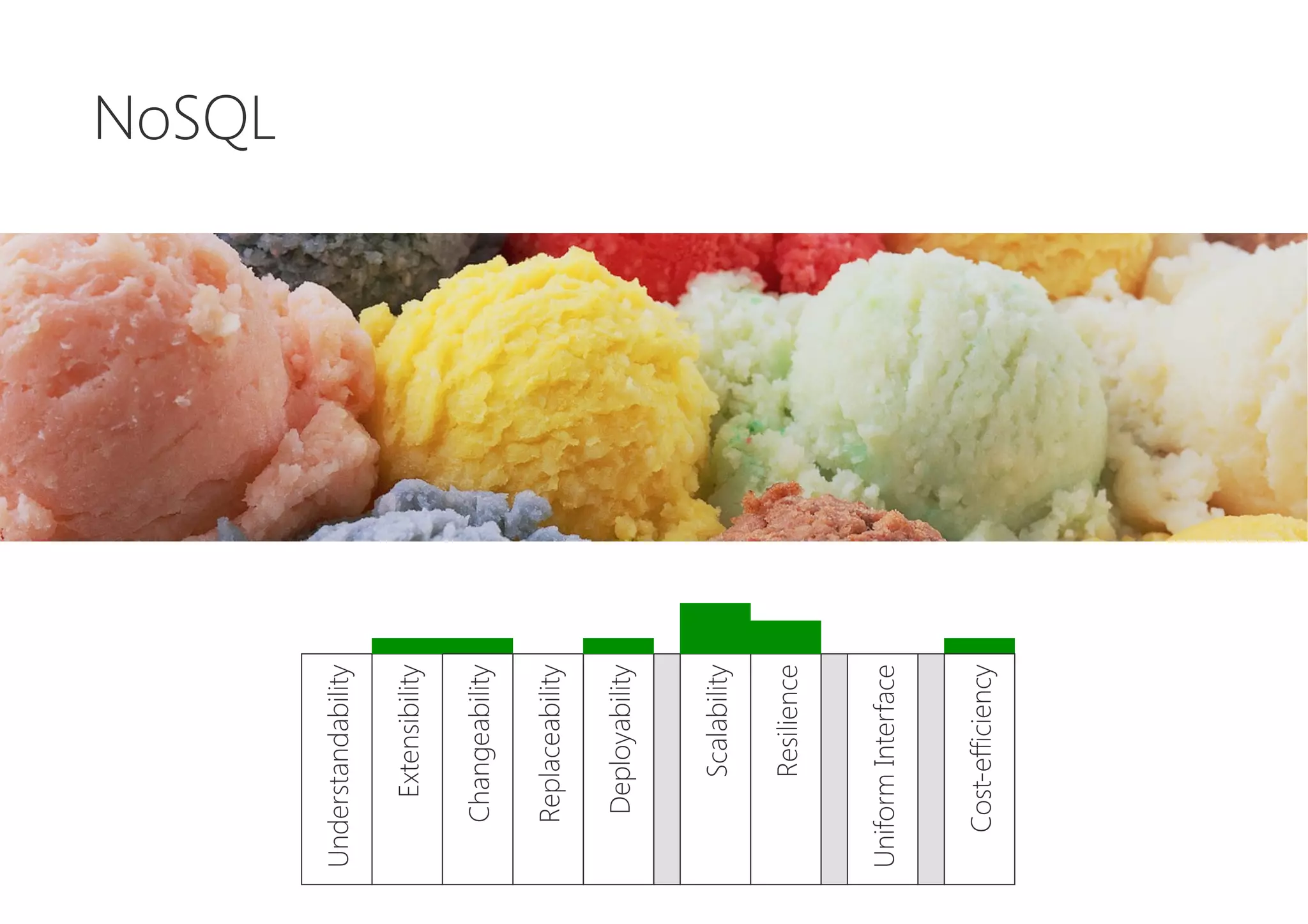
NoSQL


•  Augments the data store solution space
•  Different sweet spots than RDBMS
•  Key-Value Store – Wide Column Store – Document Store
•  Graph Database
NoSQL
Cost-efficiency
UniformInterface
Resilience
Scalability
Deployability
Replaceability
Changeability
Extensibility
Understandability
Continuous Delivery


•  Automate the software delivery chain
•  Build – Continuous Integration, …
•  Test – Test Automation, …
•  Deploy – Infrastructure as Code, …
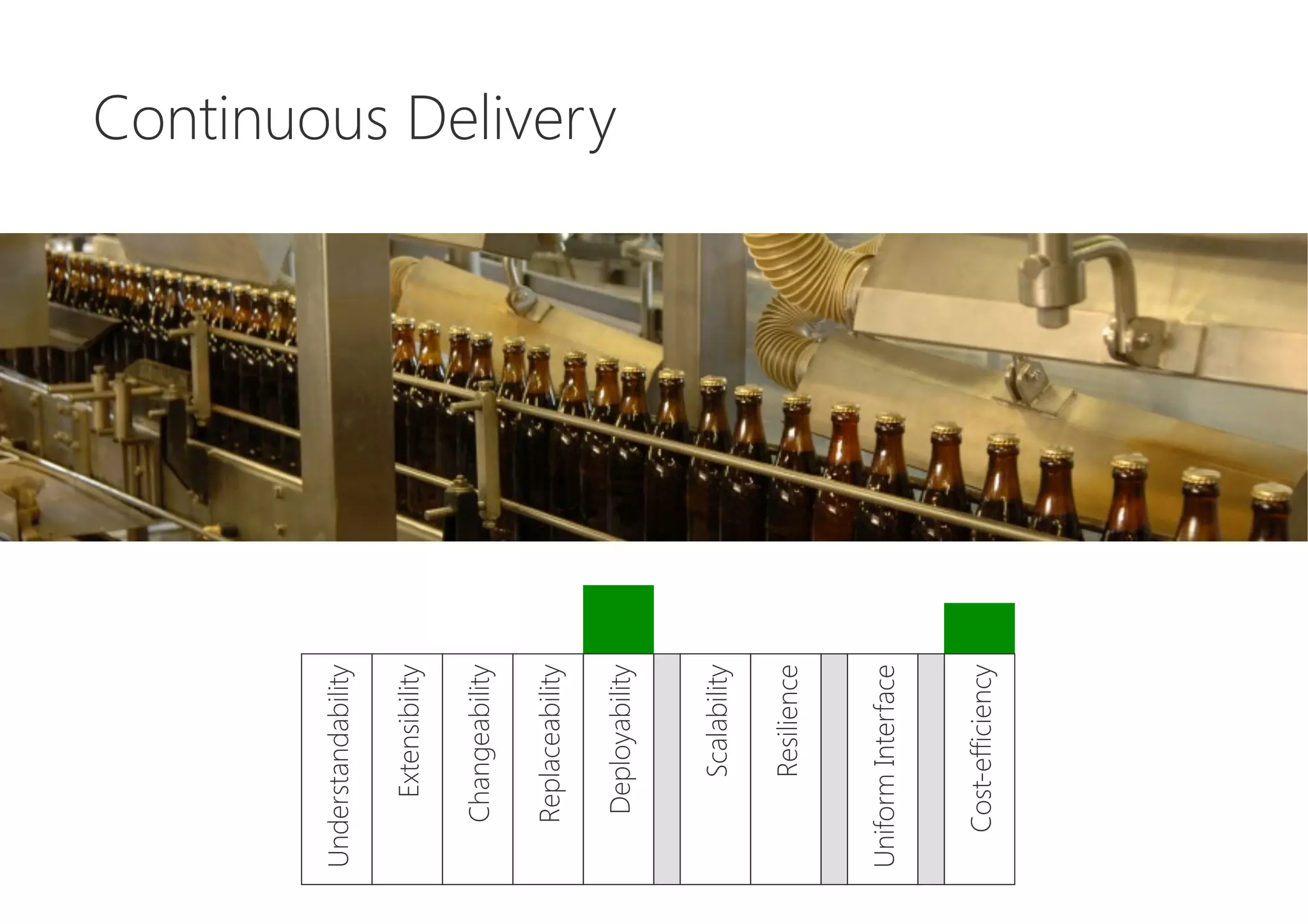
Continuous Delivery
Cost-efficiency
UniformInterface
Resilience
Scalability
Deployability
Replaceability
Changeability
Extensibility
Understandability
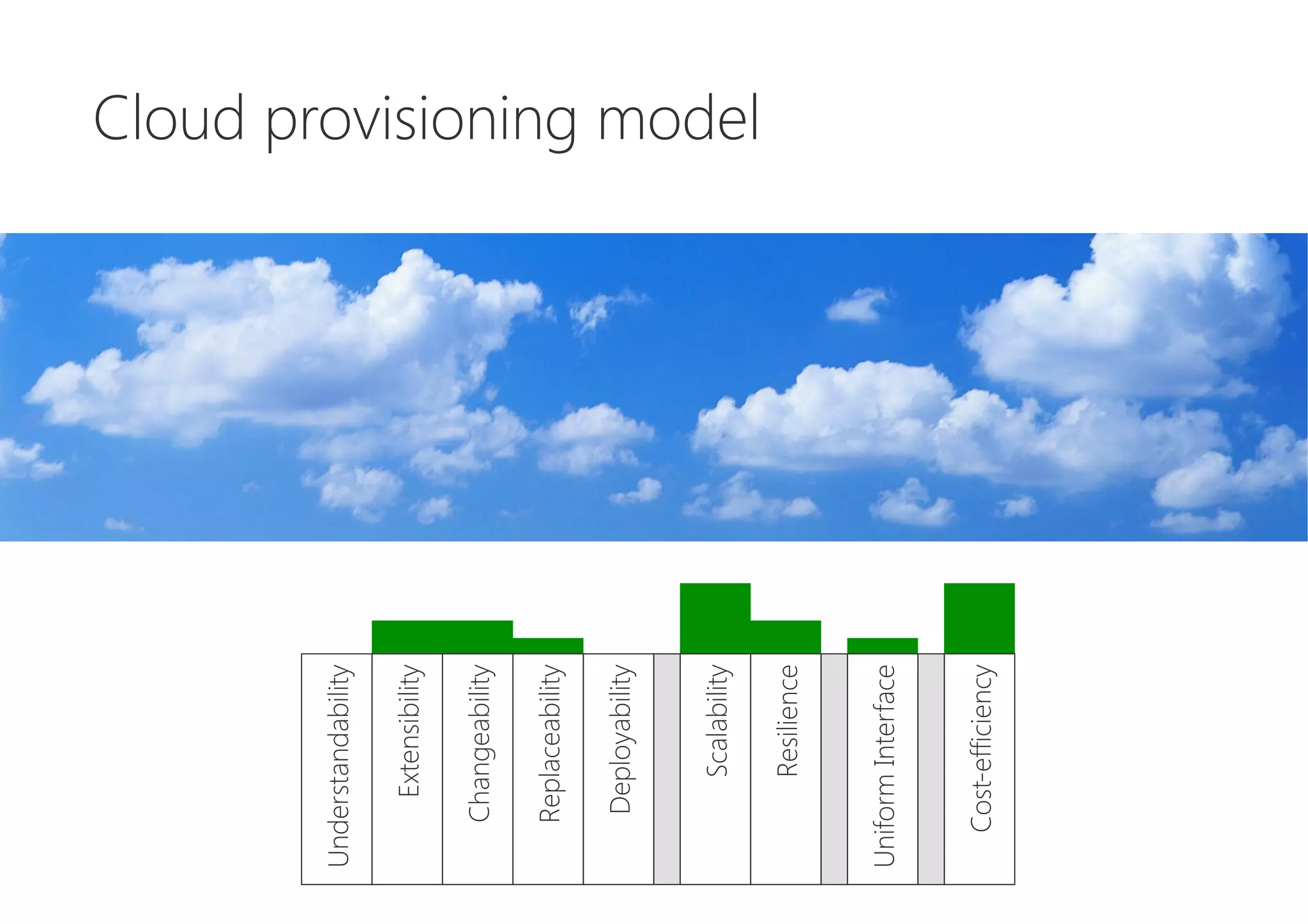
Cloud provisioning model


•  On-demand provisioning and de-provisioning
•  Instant availability
•  Self-service
•  Pay-per-use
Cloud provisioning model
Cost-efficiency
UniformInterface
Resilience
Scalability
Deployability
Replaceability
Changeability
Extensibility
Understandability
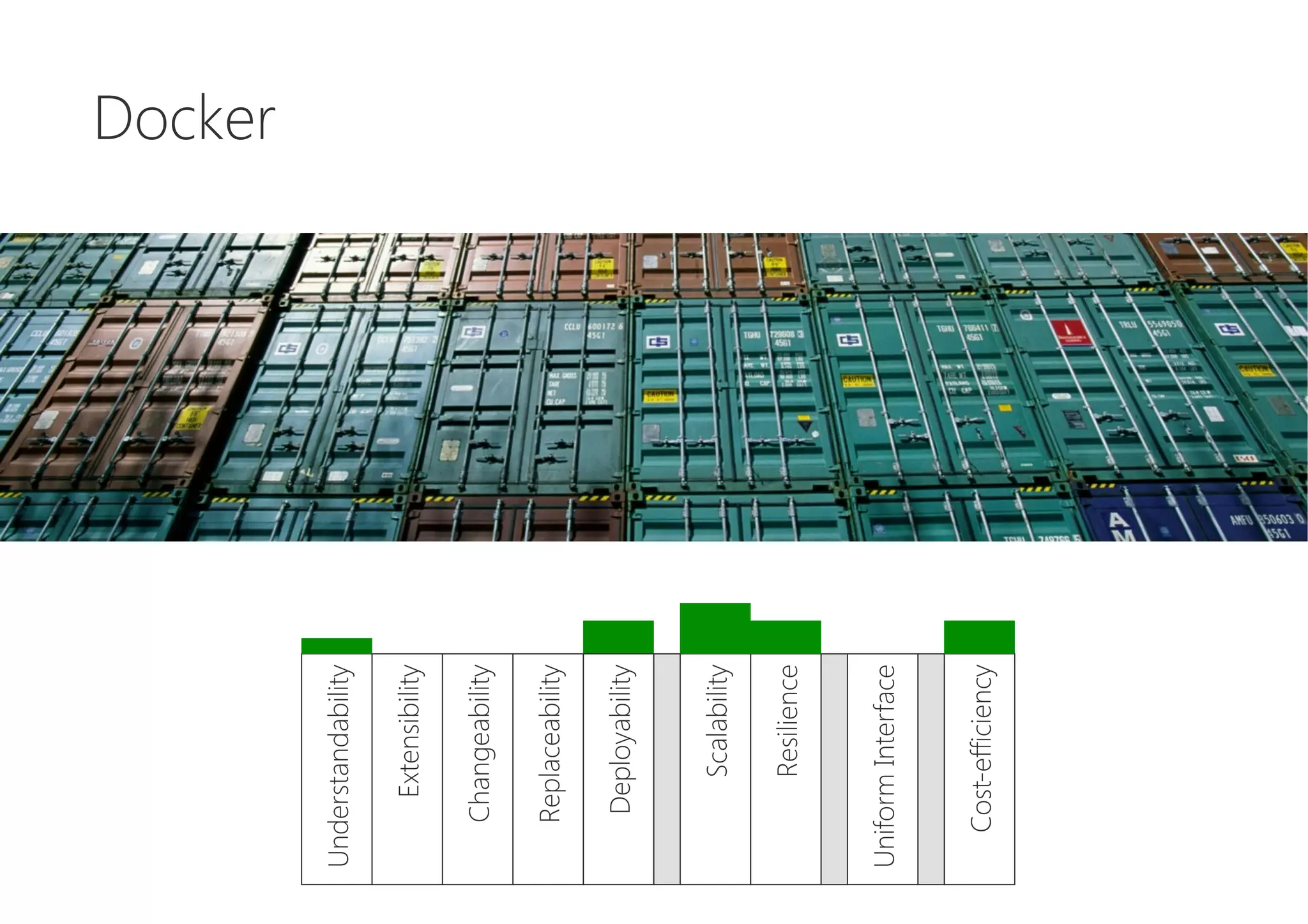
Docker


•  Build, ship, run on container-basis
•  Process-level isolation
•  Declarative communication path configuration
•  Cambrian explosion of ecosystem at the moment
Docker
Cost-efficiency
UniformInterface
Resilience
Scalability
Deployability
Replaceability
Changeability
Extensibility
Understandability
… and there are many more
What can we learn from this?
Findings


•  There is not a simple solution and no “one size fits all”
•  Some of the topics evaluated have a high potential
•  Some of the topics evaluated do not help so much
•  A combination of several approaches is needed
How would an architectural style look like?
µServices

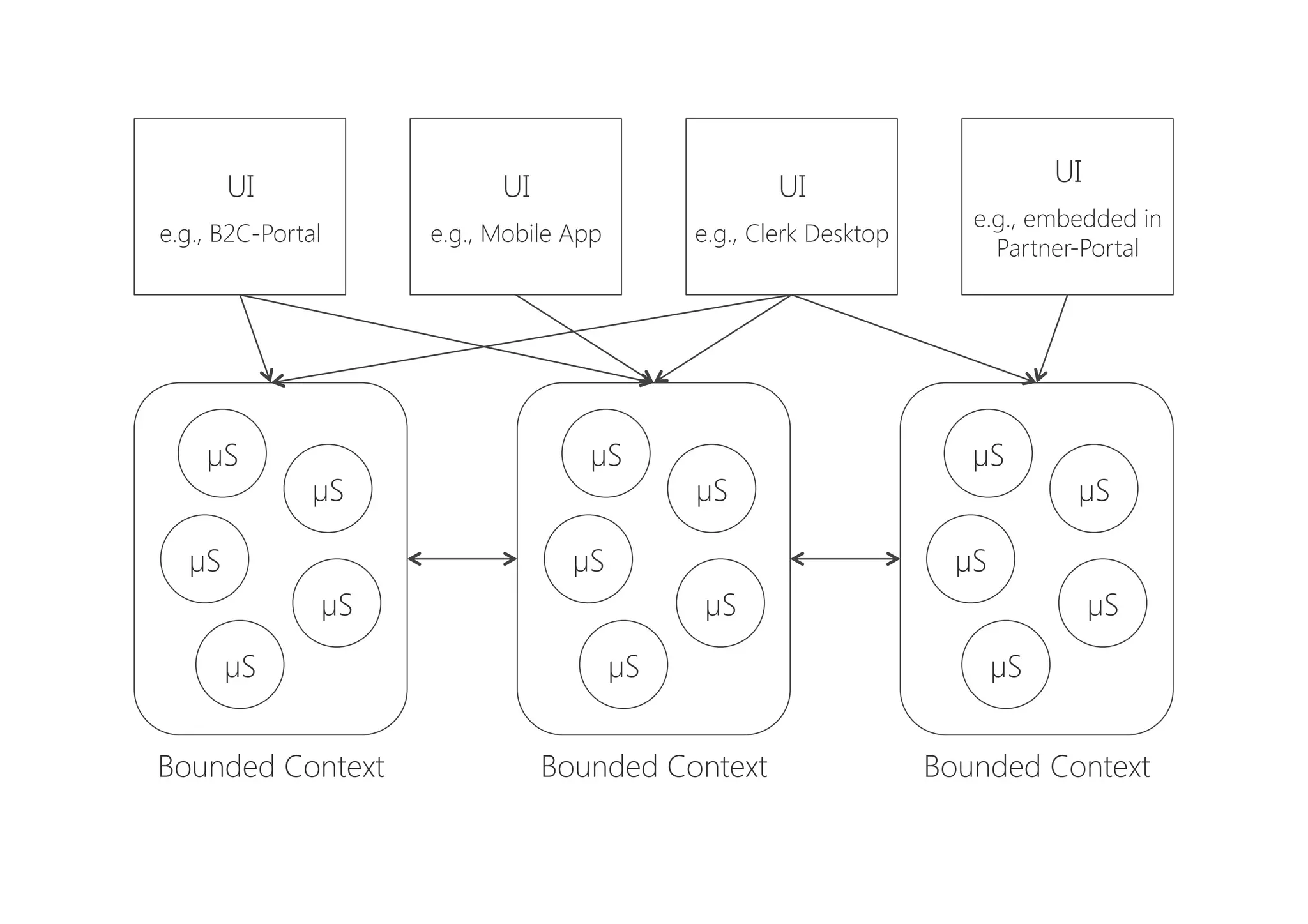
•  Conway’s law
•  Built for replacement
•  Aligned with business capabilities
•  Bounded Context (Domain-Driven Design)
•  Separate UI and service
Bounded Context
 Bounded Context
Bounded Context
µS
µS
µS
µS
µS
µS
µS
µS
µS
µS
µS
µS
µS
µS
µS
UI

e.g., B2C-Portal
UI

e.g., embedded in
Partner-Portal
UI

e.g., Mobile App
UI

e.g., Clerk Desktop
REST interfaces

•  Use as API gateway for client access
•  Encapsulate dynamics and complexity of service landscape
•  Provide client-driven, coarse-grained service calls

behind a uniform API based on a proven protocol
•  Should be provided on bounded context level
•  Decouple speed of evolvement (services vs. API)
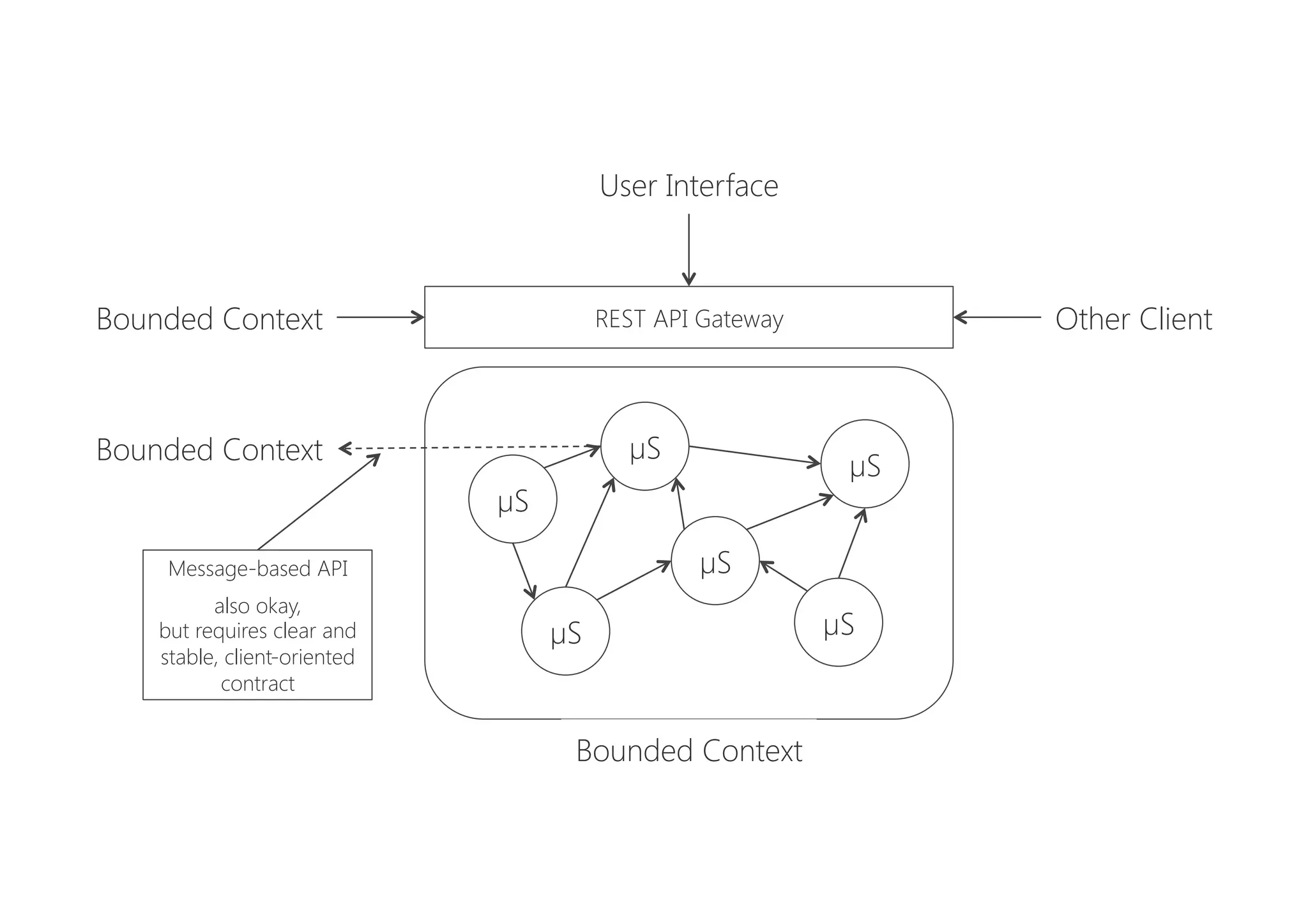
Bounded Context
µS
µS
µS
µS
µS
REST API Gateway
µS
Bounded Context
 Other Client
User Interface
Bounded Context
Message-based API

also okay,

but requires clear and
stable, client-oriented
contract
Event-driven communication

•  Use for inter-service communication
•  Decoupling and isolation
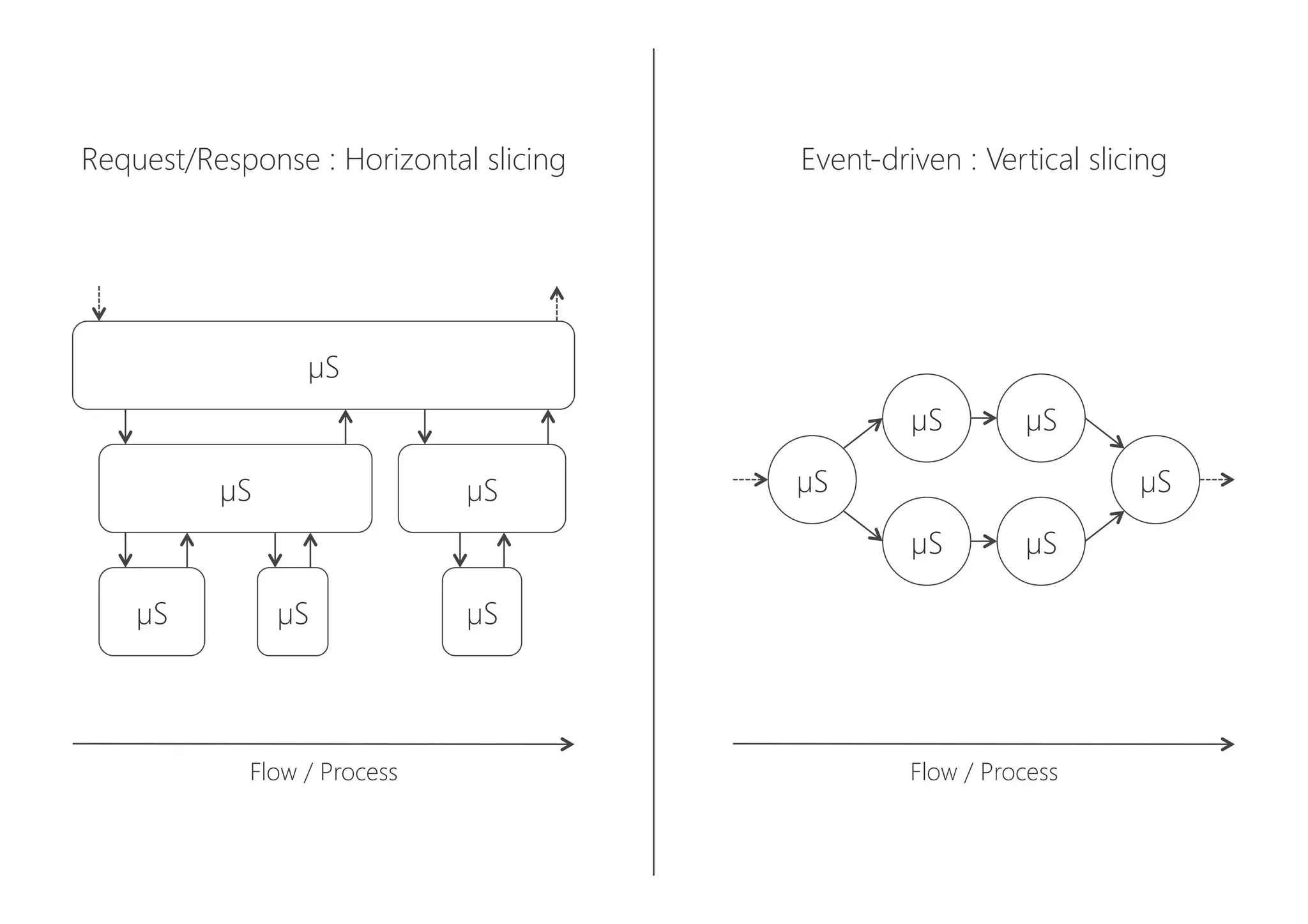
•  Vertical slicing of functionality
•  Easier evolution of flows and processes
•  Configuration-visualization-monitoring support required
µS
Request/Response : Horizontal slicing
Flow / Process
µS
 µS
µS
 µS
 µS
µS
Event-driven : Vertical slicing
µS
 µS
µS
µS
 µS
Flow / Process
Resilient/reactive design

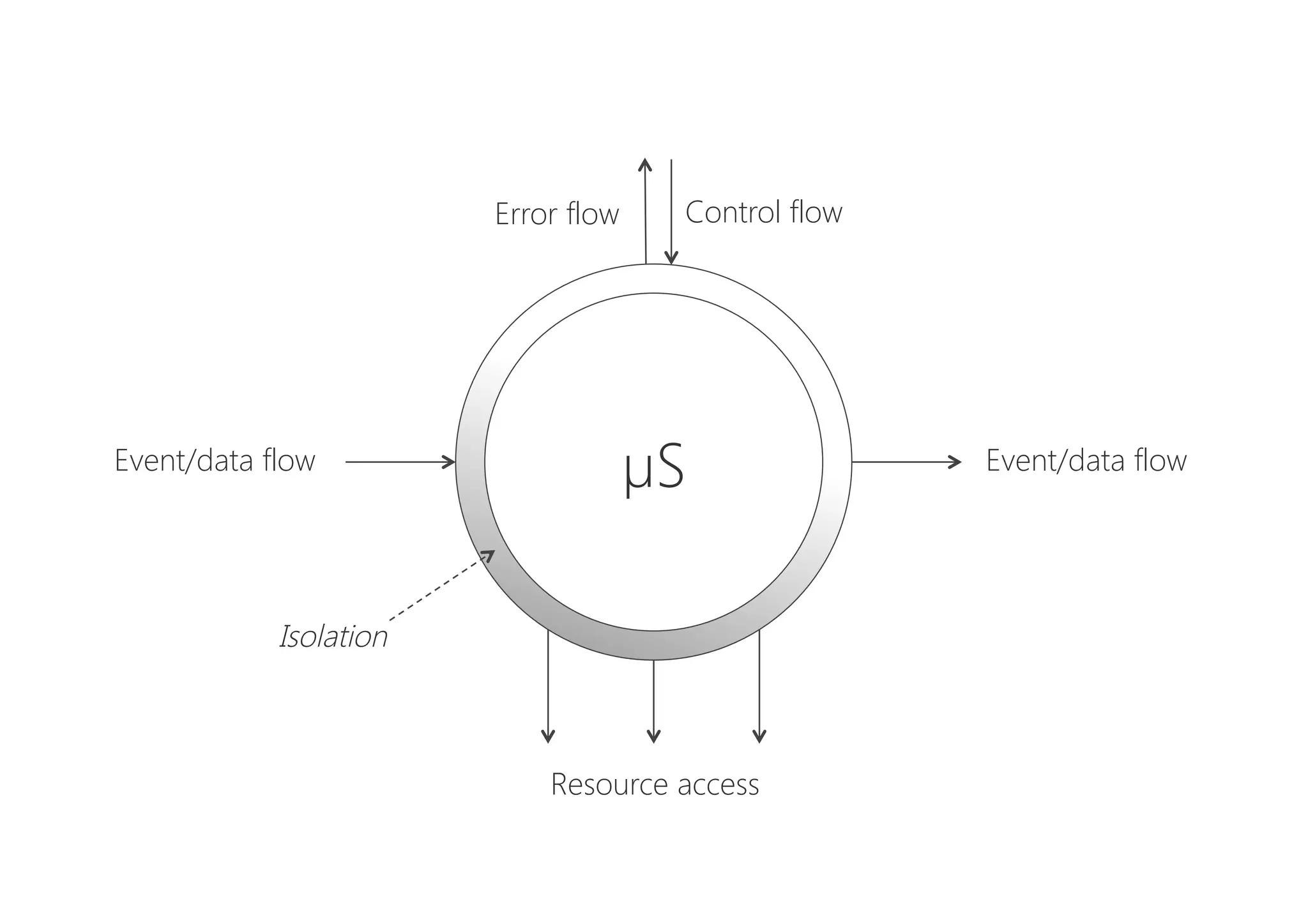
•  Resilience and responsiveness are mandatory
•  Elastic design for scalability
•  Start with isolation and latency control
•  Separate control and data flow
•  Many new challenges for developers
Event/data flow
 Event/data flow
Resource access
Error flow
 Control flow
µS
Isolation
Cloud provisioning model

•  Basis for elasticity at runtime
•  Basis for speed and flexibility at development time
•  Private, hybrid or public
•  Should be combined with container approaches (e.g., Docker)
•  “Natural” infrastructure for µService architecture
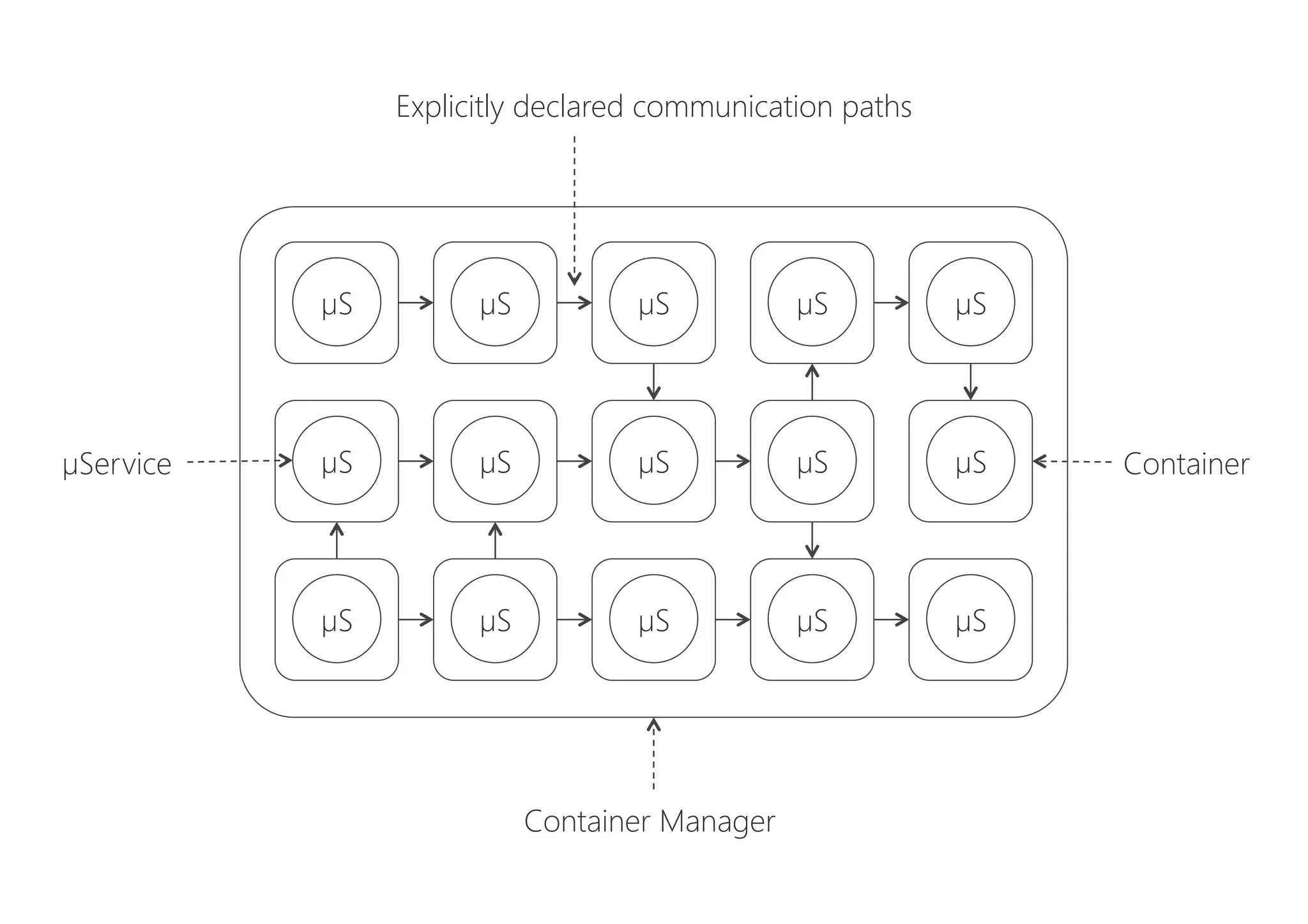
Container Manager
µS
µS
µS
µS
µS
µS
µS
µS
µS
µS
µS
µS
µS
µS
µS
Container
Explicitly declared communication paths
µService
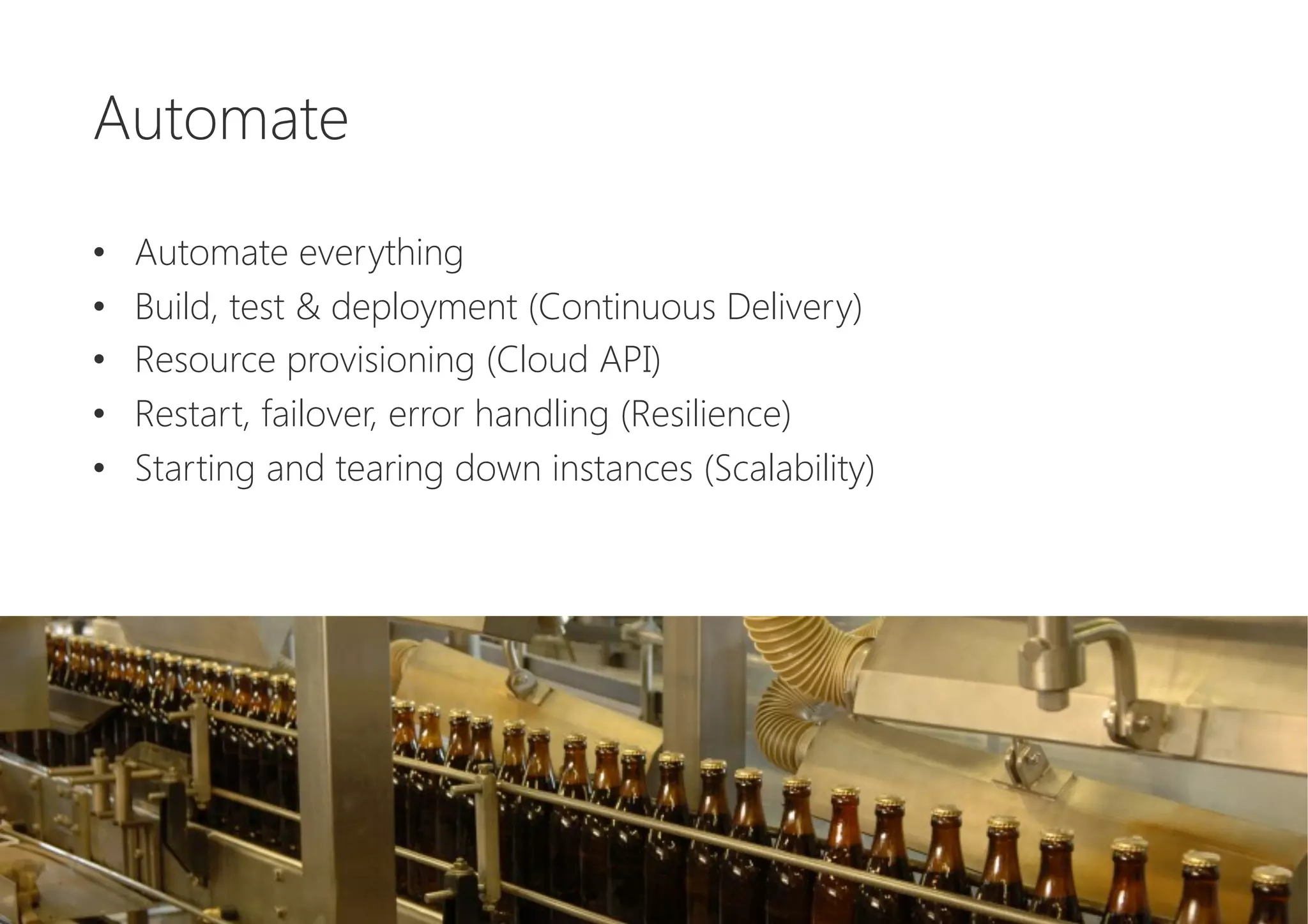
Automate

•  Automate everything
•  Build, test & deployment (Continuous Delivery)
•  Resource provisioning (Cloud API)
•  Restart, failover, error handling (Resilience)
•  Starting and tearing down instances (Scalability)
Wrap-up


•  IT is the nervous system of a company
•  Delivery speed is the new benchmark
•  Architecture must support the drivers
•  The new architectures are different
•  New challenges for developers (& ops)
It’s the most disruptive and exciting change

we have seen in IT for many years


Join the IT revolution!
@ufried
Uwe Friedrichsen | uwe.friedrichsen@codecentric.de | http://slideshare.net/ufried | http://ufried.tumblr.com
Modern times - architectures for a Next Generation of IT

Modern times - architectures for a Next Generation of IT