Library Management System
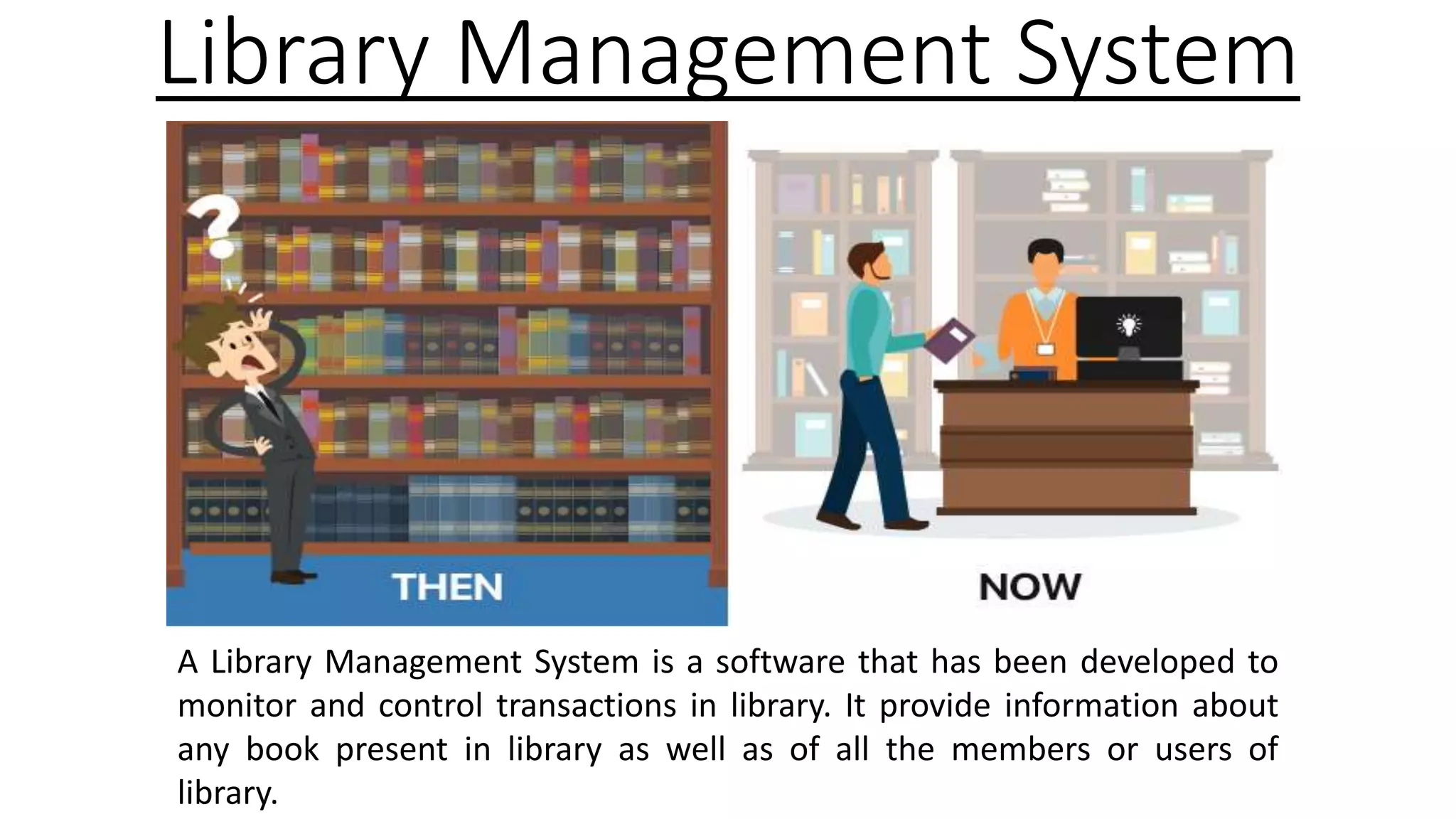
A Library Management System is a software that has been developed to
monitor and control transactions in library. It provide information about
any book present in library as well as of all the members or users of
library.
Software Development Life Cycle | Waterfall Model
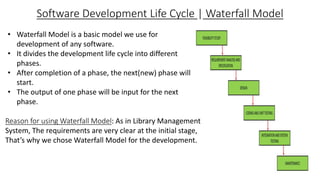
• Waterfall Model is a basic model we use for
development of any software.
• It divides the development life cycle into different
phases.
• After completion of a phase, the next(new) phase will
start.
• The output of one phase will be input for the next
phase.
Reason for using Waterfall Model: As in Library Management
System, The requirements are very clear at the initial stage,
That’s why we chose Waterfall Model for the development.
Software Development Life Cycle | Waterfall Model
• Feasibility Study: The main goal of this phase is to determine whether it would be
financially and technically feasible to develop the software.
Feasibility Study of Library Management System:
• Financial Feasibility: Development of this application is highly economically
feasible. The organization needed not spend much money for the digital
development of the system already available.
• Technical Feasibility: We can strongly say that it is technically feasible, since there
will not be much difficulty in getting required resources for the development and
maintaining the system as well.
Software Development Life Cycle | Waterfall Model
• Requirement Analysis and Specification: All possible requirements of the system
to be developed are captured in this phase and documented in a requirement
specification document.
• Requirement Analysis and Specification of Library Management System:
1. The Library Management System shall be required to maintain information
about its users and books.
2. It shall store databases for students, teachers and books.
3. The student database stores information about a student’s roll no., Course and
year.
4. The book database stores information about a book id, book title, author,
publisher and year of publishing.
5. The teacher database stores information about a teacher’s id, name,
department and designation and telephone number.
Software Development Life Cycle | Waterfall Model
• System Design: The requirement specifications from first phase are studied in this
phase and the system design is prepared. This system design helps in specifying
hardware and system requirements and helps in defining the overall system
architecture.
• System Design of Library Management System: Library Management System is
used by librarian and admin so it just simply designed and not colorful. The
interface is user friendly and easy to use. This can be proving when user can know
what the button’s function is when he/she looks at the button. It is because the
button’s text is clear and easy to understand.
• In this phase, We design the architecture of Library management system
according to requirements of user.
1. Login Page
2. Books issue/return Page
3. Student/Teacher Details Page
Software Development Life Cycle | Waterfall Model
• Coding and Unit Testing: With inputs from the system design, the system is first
developed in small programs called units, which are integrated in the next phase.
Each unit is developed and tested for its functionality, which is referred to as Unit
Testing.
• Coding and Unit Testing of Library Management System: In this phase, small parts
of Library Management System are developed using desired or compatible coding
languages, in the form of units by the developers and then tested for its
functionality separately as units. The software design is converted into source
code using SQL. For validating the data from source, We ran some test query and
we got proper output from source tables. In this way we performed the unit
testing of every schema of every table.
Software Development Life Cycle | Waterfall Model
• Integration and System Testing: All the units developed in the implementation
phase are integrated into a system after testing of each unit. Post integration the
entire system is tested for any faults and failures.
• Integration and System Testing of Library Management System: After the coding
and unit testing phase, when we got all the units coded and tested, the
integration of all the parts/units is done to get the desired software.
Then after the integration, The final output (Integrated Software) is tested in the
system to check its workflow and compatibility with the system and user.
Deployment: Once the functional and non-functional testing is done, the product is
deployed in the customer environment.
Software Development Life Cycle | Waterfall Model
• Maintenance: There are some issues which come up in the client environment. To
fix those issues, patches are released. Also to enhance the product some better
versions are released. Maintenance is done to deliver these changes in the
customer environment.
• Maintenance of Library Management System:
After the deployment of the final software, to update the software after some time
intervals or to make any changes according to the user requirements maintenance
is done accordingly.
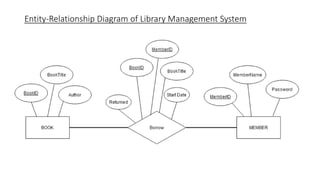
Entity-Relationship Diagram of Library Management System
Credits:
Himanshu Singhal : 22BSOCBL0571
Rekha Kumari :
Viraj Vaste :
Muskan Khan :
Hari Krishna :

Library Management System.pptx

  • 1.
    Library Management System ALibrary Management System is a software that has been developed to monitor and control transactions in library. It provide information about any book present in library as well as of all the members or users of library.
  • 2.
    Software Development LifeCycle | Waterfall Model • Waterfall Model is a basic model we use for development of any software. • It divides the development life cycle into different phases. • After completion of a phase, the next(new) phase will start. • The output of one phase will be input for the next phase. Reason for using Waterfall Model: As in Library Management System, The requirements are very clear at the initial stage, That’s why we chose Waterfall Model for the development.
  • 3.
    Software Development LifeCycle | Waterfall Model • Feasibility Study: The main goal of this phase is to determine whether it would be financially and technically feasible to develop the software. Feasibility Study of Library Management System: • Financial Feasibility: Development of this application is highly economically feasible. The organization needed not spend much money for the digital development of the system already available. • Technical Feasibility: We can strongly say that it is technically feasible, since there will not be much difficulty in getting required resources for the development and maintaining the system as well.
  • 4.
    Software Development LifeCycle | Waterfall Model • Requirement Analysis and Specification: All possible requirements of the system to be developed are captured in this phase and documented in a requirement specification document. • Requirement Analysis and Specification of Library Management System: 1. The Library Management System shall be required to maintain information about its users and books. 2. It shall store databases for students, teachers and books. 3. The student database stores information about a student’s roll no., Course and year. 4. The book database stores information about a book id, book title, author, publisher and year of publishing. 5. The teacher database stores information about a teacher’s id, name, department and designation and telephone number.
  • 5.
    Software Development LifeCycle | Waterfall Model • System Design: The requirement specifications from first phase are studied in this phase and the system design is prepared. This system design helps in specifying hardware and system requirements and helps in defining the overall system architecture. • System Design of Library Management System: Library Management System is used by librarian and admin so it just simply designed and not colorful. The interface is user friendly and easy to use. This can be proving when user can know what the button’s function is when he/she looks at the button. It is because the button’s text is clear and easy to understand. • In this phase, We design the architecture of Library management system according to requirements of user. 1. Login Page 2. Books issue/return Page 3. Student/Teacher Details Page
  • 6.
    Software Development LifeCycle | Waterfall Model • Coding and Unit Testing: With inputs from the system design, the system is first developed in small programs called units, which are integrated in the next phase. Each unit is developed and tested for its functionality, which is referred to as Unit Testing. • Coding and Unit Testing of Library Management System: In this phase, small parts of Library Management System are developed using desired or compatible coding languages, in the form of units by the developers and then tested for its functionality separately as units. The software design is converted into source code using SQL. For validating the data from source, We ran some test query and we got proper output from source tables. In this way we performed the unit testing of every schema of every table.
  • 7.
    Software Development LifeCycle | Waterfall Model • Integration and System Testing: All the units developed in the implementation phase are integrated into a system after testing of each unit. Post integration the entire system is tested for any faults and failures. • Integration and System Testing of Library Management System: After the coding and unit testing phase, when we got all the units coded and tested, the integration of all the parts/units is done to get the desired software. Then after the integration, The final output (Integrated Software) is tested in the system to check its workflow and compatibility with the system and user. Deployment: Once the functional and non-functional testing is done, the product is deployed in the customer environment.
  • 8.
    Software Development LifeCycle | Waterfall Model • Maintenance: There are some issues which come up in the client environment. To fix those issues, patches are released. Also to enhance the product some better versions are released. Maintenance is done to deliver these changes in the customer environment. • Maintenance of Library Management System: After the deployment of the final software, to update the software after some time intervals or to make any changes according to the user requirements maintenance is done accordingly.
  • 9.
    Entity-Relationship Diagram ofLibrary Management System
  • 10.
    Credits: Himanshu Singhal :22BSOCBL0571 Rekha Kumari : Viraj Vaste : Muskan Khan : Hari Krishna :