Diploma in Software Engineering
Module I: Introduction to Software
Engineering
Rasan Samarasinghe
ESOFT Computer Studies (pvt) Ltd.
No 68/1, Main Street, Pallegama, Embilipitiya.
Contents
1. What is software?
2. Software classification
3. Generic Software vs Custom Software
4. Attributes of Software
5. What is Software Engineering?
6. Software Engineering Process Model
7. Waterfall Model
8. Waterfall Model Stages
9. Extended Waterfall Model
10. Prototype Model
11. Throw away prototype model
12. Evolutionary prototype model
13. Rapid application development model (RAD)
14. Stages in the RAD
What is software?
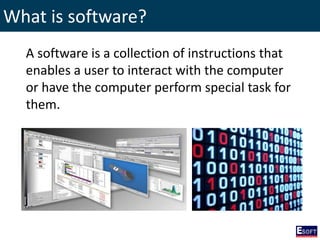
A software is a collection of instructions that
enables a user to interact with the computer
or have the computer perform special task for
them.
Software classification
• System Software
– Directly controlling the hardware resources and
supports the operation of application software.
• Application Software
– Serves the user requirements in a particular
application domain.
Software classification
• Generic Software (off the shelf)
– Available on open market to any customer who is
able to buy it.
• Custom Software (bespoke)
– Developed specially for a customer requirement.
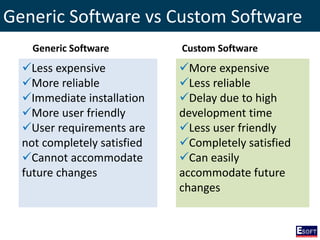
Generic Software vs Custom Software
Less expensive
More reliable
Immediate installation
More user friendly
User requirements are
not completely satisfied
Cannot accommodate
future changes
More expensive
Less reliable
Delay due to high
development time
Less user friendly
Completely satisfied
Can easily
accommodate future
changes
Generic Software Custom Software
Attributes of Software
• Maintainability
• Dependability
• Efficiency
• Usability
• Security
• Reliability
• Robustness
• Customizability
• Scalability
• Accessibility
• Extensibility
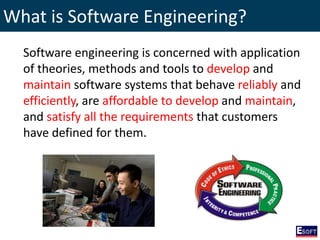
What is Software Engineering?
Software engineering is concerned with application
of theories, methods and tools to develop and
maintain software systems that behave reliably and
efficiently, are affordable to develop and maintain,
and satisfy all the requirements that customers
have defined for them.
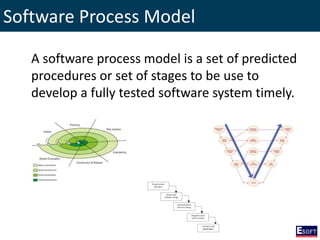
Software Engineering Process ModelA software process model is a set of predicted
procedures or set of stages to be use to
develop a fully tested software system timely.
Software Process Model
• Waterfall model
• Prototyping model
• Rapid application development model
• Spiral model
• V-model
• Join application development model
• Incremental development model
Software Process Models
Waterfall Model
Waterfall Model
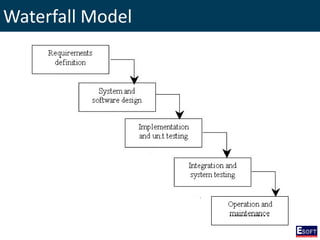
• A linear sequential development model.
• Because of the cascade form one stage to
another it is known as waterfall model.
• Divided project activities into isolated stages and
each stage should complete before next started.
• Concurrent activities are not possible.
• Need to wait until end of the life cycle to see the
outcome.
• Suitable for develop systems which has stable
requirements.
Waterfall Model Stages
Stage 1: Requirement Definition
• The system services, constraints and goals are
established by consulting with the system
users.
• They are define in a manner which is
understandable by both users and the
development staff.
Waterfall Model Stages
Stage 2: System and Software designing
• Partitions the requirements either hardware or
software.
• Involves representing the software system
functions in a form the may be transformed into
executable programs.
• Identifying and describing fundamental software
system abstraction and there relationships.
Waterfall Model Stages
Stage 3: Implementation and unit testing
• Implementation consists of converting the
physical designing into set of actual programs
and a set of database tables.
• The software is realized as a set of programs
or program units.
• Unit testing involves verifying that each unit
meets it’s requirements.
Waterfall Model Stages
Stage 4: integration and system testing
• Individual program units are integrated and
tested as a complete system.
• Ensure the software requirements have been
met.
• After testing the software system is delivered
to the customer.
Waterfall Model Stages
Stage 5: Operation and maintenance
• The system installed and put into practical use.
• Involved correcting errors which were not
discovered in earlier stages.
• Improving implementation as new requirements
are discovered.
• Normally this is the longest life cycle phase.
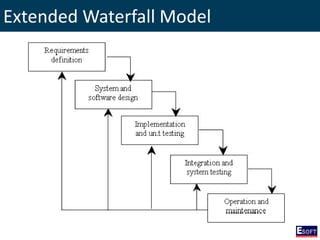
Extended Waterfall Model
• Due to the above discussed disadvantages, the
waterfall model was modified with the
concept of backtracking.
• As a result, the Extended Waterfall Model
introduced.
Extended Waterfall Model
Prototype Model
Prototype is a working model of the actual
System
There are two types of prototype model.
1. Throw away prototype model
2. Evolutionary prototype model
Throw away prototype model
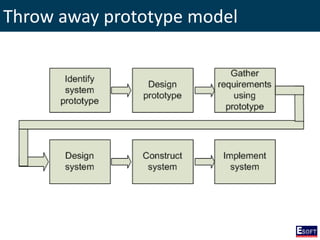
• Prototype is used to gather requirements and
there after it will be thrown away.
• Further designing, construction and
implementation will be done using the normal life
cycle stages.
• Requirements gathering can be exactly done by
using the prototype.
• Even to develop prototype consumes lot of time
and effort , therefore once a prototype is thrown
away it’s a waste of time and money.
Evolutionary prototype model
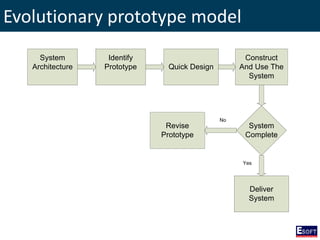
System
Complete
System
Architecture
Identify
Prototype Quick Design
Construct
And Use The
System
Revise
Prototype
Deliver
System
Yes
No
Evolutionary prototype model
• Prototype is used to gather requirements and
it will become the final system.
• Both the prototyping process as well as the
development process will be combine
together.
• Prototype will not be thrown away and it is
not wasting effort and cost like throw away
prototype.
Rapid Application Development (RAD)
Rapid application development model (RAD)
• This is a software process model which uses to
develop applications rather quickly.
• The entire system is broken down into several
manageable stages and each stage analyzed,
designed, developed, tested and implemented
simultaneously
Rapid Application Development (RAD)
Stages in the RAD
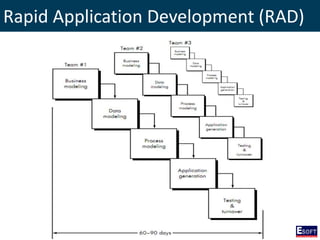
1. Business modeling
• The information flow among business
functions is modeled.
• Find answers for the following questions:
What information drives the business process?
What information is generated?
Who generate it?
Where does information go?
Who process it?
Stages in the RAD
2. Data modeling
• The information flows are refined into set of
data objects.
• The attributes of each objects and
relationships between these objects defined.
Stages in the RAD
3. Process modeling
• The data objects are transformed to achieve
the information flow necessary to implement
the business function.
• Processes are created for adding, modifying,
deleting and retrieving data objects.
Stages in the RAD
4. Application generation
• Using fourth generation techniques rather
than using conventional third generation
programming languages.
• In possible cases automated tools/reusable
components are use to facilitate construction
of the software. (Ex: DB query tools, reports,
graphics manipulation, interface designs)
Stages in the RAD
5. Testing and turnover
• Since the RAD process use many reusable
components that have been tested, it reduces
the overall testing time.
• How ever the new components should be
tested.
The End
http://twitter.com/rasansmn

DISE - Introduction to Software Engineering

  • 1.
    Diploma in SoftwareEngineering Module I: Introduction to Software Engineering Rasan Samarasinghe ESOFT Computer Studies (pvt) Ltd. No 68/1, Main Street, Pallegama, Embilipitiya.
  • 2.
    Contents 1. What issoftware? 2. Software classification 3. Generic Software vs Custom Software 4. Attributes of Software 5. What is Software Engineering? 6. Software Engineering Process Model 7. Waterfall Model 8. Waterfall Model Stages 9. Extended Waterfall Model 10. Prototype Model 11. Throw away prototype model 12. Evolutionary prototype model 13. Rapid application development model (RAD) 14. Stages in the RAD
  • 3.
    What is software? Asoftware is a collection of instructions that enables a user to interact with the computer or have the computer perform special task for them.
  • 4.
    Software classification • SystemSoftware – Directly controlling the hardware resources and supports the operation of application software. • Application Software – Serves the user requirements in a particular application domain.
  • 5.
    Software classification • GenericSoftware (off the shelf) – Available on open market to any customer who is able to buy it. • Custom Software (bespoke) – Developed specially for a customer requirement.
  • 6.
    Generic Software vsCustom Software Less expensive More reliable Immediate installation More user friendly User requirements are not completely satisfied Cannot accommodate future changes More expensive Less reliable Delay due to high development time Less user friendly Completely satisfied Can easily accommodate future changes Generic Software Custom Software
  • 7.
    Attributes of Software •Maintainability • Dependability • Efficiency • Usability • Security • Reliability • Robustness • Customizability • Scalability • Accessibility • Extensibility
  • 8.
    What is SoftwareEngineering? Software engineering is concerned with application of theories, methods and tools to develop and maintain software systems that behave reliably and efficiently, are affordable to develop and maintain, and satisfy all the requirements that customers have defined for them.
  • 9.
    Software Engineering ProcessModelA software process model is a set of predicted procedures or set of stages to be use to develop a fully tested software system timely. Software Process Model
  • 10.
    • Waterfall model •Prototyping model • Rapid application development model • Spiral model • V-model • Join application development model • Incremental development model Software Process Models
  • 11.
  • 12.
    Waterfall Model • Alinear sequential development model. • Because of the cascade form one stage to another it is known as waterfall model. • Divided project activities into isolated stages and each stage should complete before next started. • Concurrent activities are not possible. • Need to wait until end of the life cycle to see the outcome. • Suitable for develop systems which has stable requirements.
  • 13.
    Waterfall Model Stages Stage1: Requirement Definition • The system services, constraints and goals are established by consulting with the system users. • They are define in a manner which is understandable by both users and the development staff.
  • 14.
    Waterfall Model Stages Stage2: System and Software designing • Partitions the requirements either hardware or software. • Involves representing the software system functions in a form the may be transformed into executable programs. • Identifying and describing fundamental software system abstraction and there relationships.
  • 15.
    Waterfall Model Stages Stage3: Implementation and unit testing • Implementation consists of converting the physical designing into set of actual programs and a set of database tables. • The software is realized as a set of programs or program units. • Unit testing involves verifying that each unit meets it’s requirements.
  • 16.
    Waterfall Model Stages Stage4: integration and system testing • Individual program units are integrated and tested as a complete system. • Ensure the software requirements have been met. • After testing the software system is delivered to the customer.
  • 17.
    Waterfall Model Stages Stage5: Operation and maintenance • The system installed and put into practical use. • Involved correcting errors which were not discovered in earlier stages. • Improving implementation as new requirements are discovered. • Normally this is the longest life cycle phase.
  • 18.
    Extended Waterfall Model •Due to the above discussed disadvantages, the waterfall model was modified with the concept of backtracking. • As a result, the Extended Waterfall Model introduced.
  • 19.
  • 20.
    Prototype Model Prototype isa working model of the actual System There are two types of prototype model. 1. Throw away prototype model 2. Evolutionary prototype model
  • 21.
  • 22.
    Throw away prototypemodel • Prototype is used to gather requirements and there after it will be thrown away. • Further designing, construction and implementation will be done using the normal life cycle stages. • Requirements gathering can be exactly done by using the prototype. • Even to develop prototype consumes lot of time and effort , therefore once a prototype is thrown away it’s a waste of time and money.
  • 23.
    Evolutionary prototype model System Complete System Architecture Identify PrototypeQuick Design Construct And Use The System Revise Prototype Deliver System Yes No
  • 24.
    Evolutionary prototype model •Prototype is used to gather requirements and it will become the final system. • Both the prototyping process as well as the development process will be combine together. • Prototype will not be thrown away and it is not wasting effort and cost like throw away prototype.
  • 25.
  • 26.
    Rapid application developmentmodel (RAD) • This is a software process model which uses to develop applications rather quickly. • The entire system is broken down into several manageable stages and each stage analyzed, designed, developed, tested and implemented simultaneously Rapid Application Development (RAD)
  • 27.
    Stages in theRAD 1. Business modeling • The information flow among business functions is modeled. • Find answers for the following questions: What information drives the business process? What information is generated? Who generate it? Where does information go? Who process it?
  • 28.
    Stages in theRAD 2. Data modeling • The information flows are refined into set of data objects. • The attributes of each objects and relationships between these objects defined.
  • 29.
    Stages in theRAD 3. Process modeling • The data objects are transformed to achieve the information flow necessary to implement the business function. • Processes are created for adding, modifying, deleting and retrieving data objects.
  • 30.
    Stages in theRAD 4. Application generation • Using fourth generation techniques rather than using conventional third generation programming languages. • In possible cases automated tools/reusable components are use to facilitate construction of the software. (Ex: DB query tools, reports, graphics manipulation, interface designs)
  • 31.
    Stages in theRAD 5. Testing and turnover • Since the RAD process use many reusable components that have been tested, it reduces the overall testing time. • How ever the new components should be tested.
  • 32.

Editor's Notes

  • #8 Maintenability Ability to evolve with the changing needs of the customer Dependability What it is depends on Efficiency Efficiency is the ability of the software to do the required processing on least amount of hardware. Usability Usability is the ability of a software to offer its interfaces in a user friendly and elegant way. Security Security is the ability of the software to remain protected from unauthorized access. This includes both change access and view access. Reliability High Reliability is the measure of how a product behaves in varying circumstances. Robustness Robustness is defined as the ability of a software product to cope with unusual situation. Customizability Customizability is the ability of a software to offer extensions to existing functionality to better suite the needs of a user. Scalability Scalability is the ability of the software to cater for heavier processing loads as the needs arise. Accessibility Accessibility is the ability of a software to be accessible from a multitude of devices and for a number of different types of users. Extensibility (Data model) Extensibility is the ability of the software to be extended beyond the functionality of the original product.