Team -7
Chang Fu
Rizwan Chand
Natsuko Matsuda
Kyeung Ah Lee
Sindhu Nagalingam
Background
• Automobile Manufacturer established in 1942
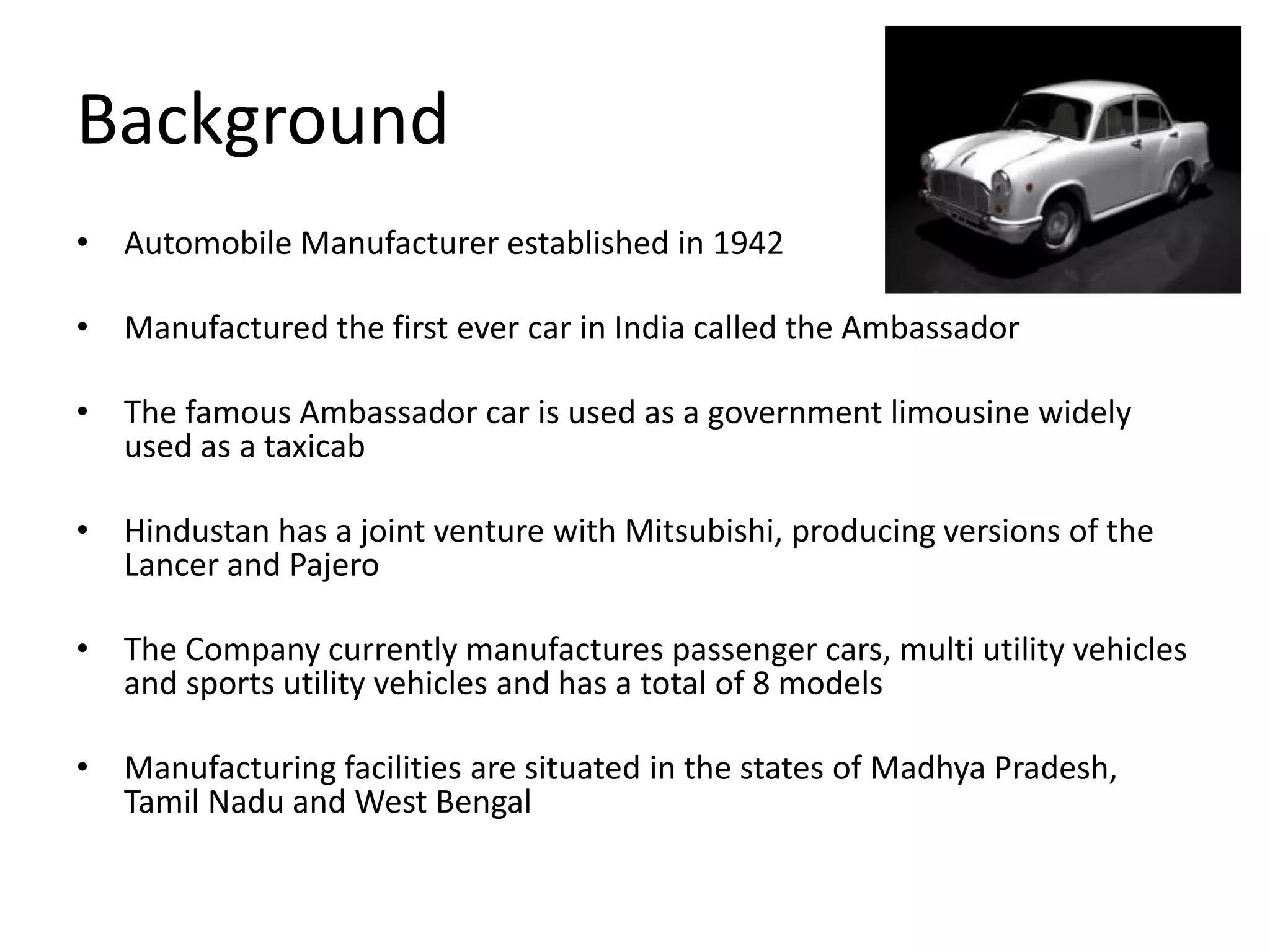
• Manufactured the first ever car in India called the Ambassador
• The famous Ambassador car is used as a government limousine widely
used as a taxicab
• Hindustan has a joint venture with Mitsubishi, producing versions of the
Lancer and Pajero
• The Company currently manufactures passenger cars, multi utility vehicles
and sports utility vehicles and has a total of 8 models
• Manufacturing facilities are situated in the states of Madhya Pradesh,
Tamil Nadu and West Bengal
Financials
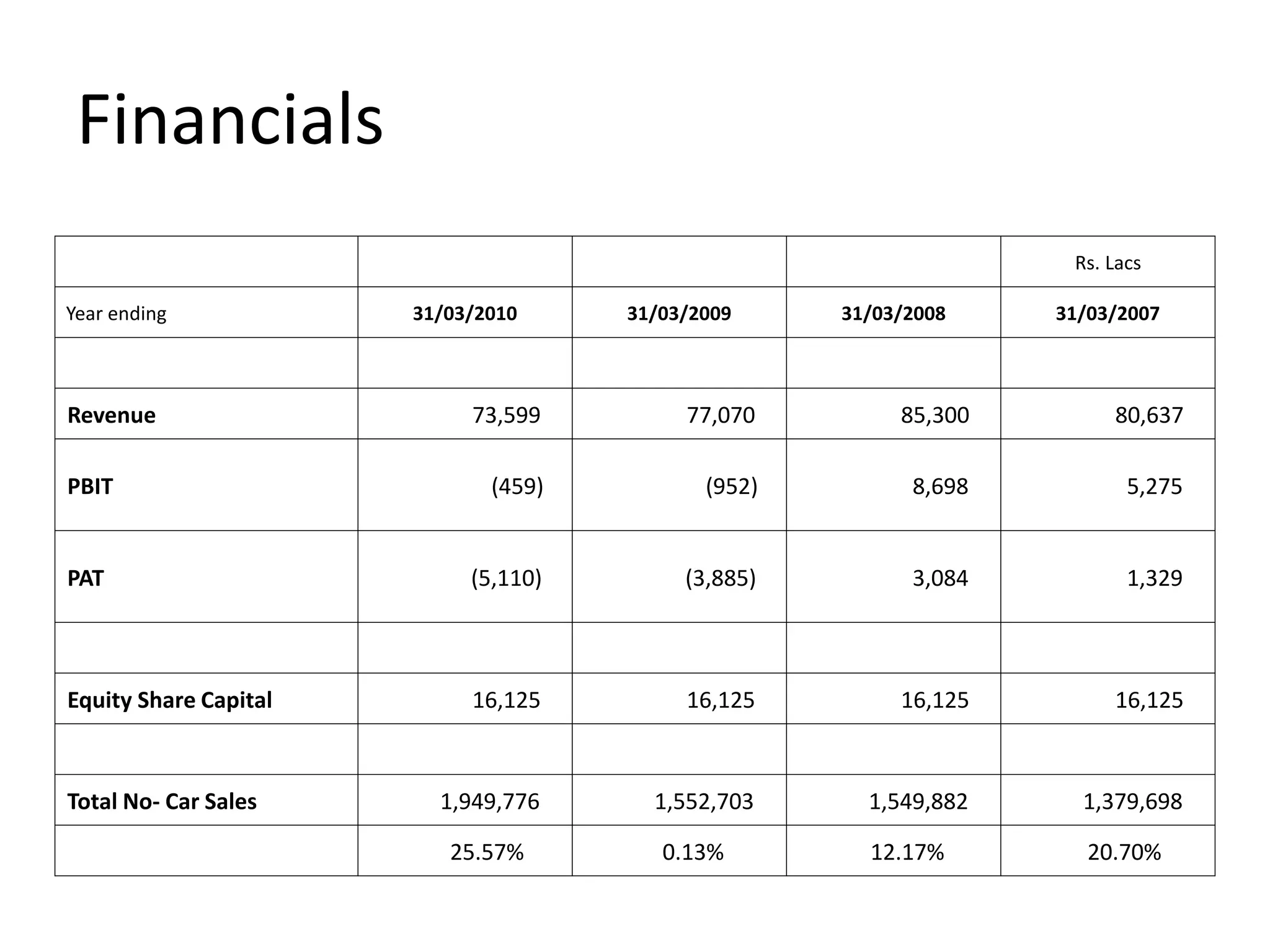
Rs. Lacs
Year ending 31/03/2010 31/03/2009 31/03/2008 31/03/2007
Revenue 73,599 77,070 85,300 80,637
PBIT (459) (952) 8,698 5,275
PAT (5,110) (3,885) 3,084 1,329
Equity Share Capital 16,125 16,125 16,125 16,125
Total No- Car Sales 1,949,776 1,552,703 1,549,882 1,379,698
25.57% 0.13% 12.17% 20.70%
PEST Analysis
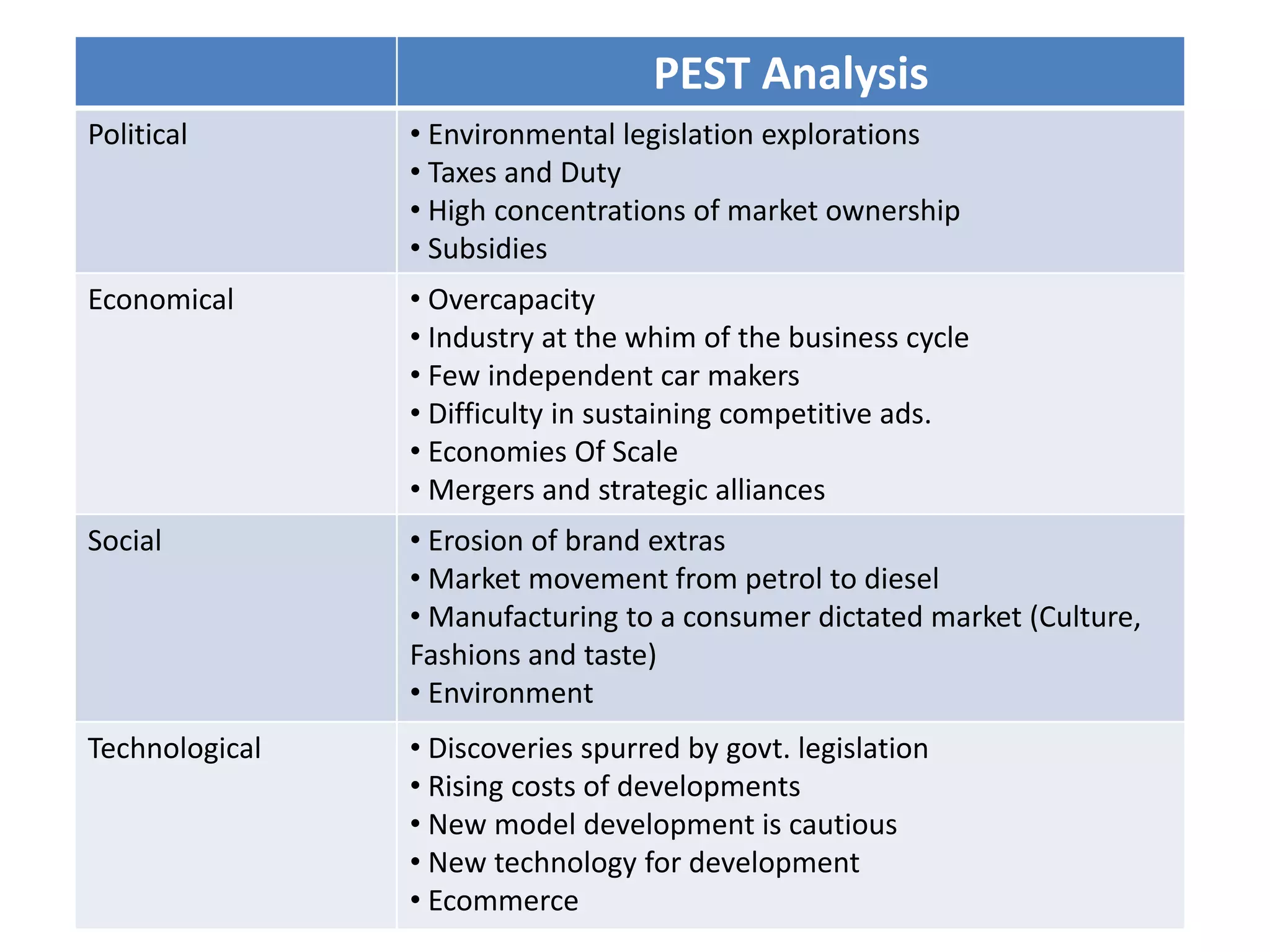
Political • Environmental legislation explorations
• Taxes and Duty
• High concentrations of market ownership
• Subsidies
Economical • Overcapacity
• Industry at the whim of the business cycle
• Few independent car makers
• Difficulty in sustaining competitive ads.
• Economies Of Scale
• Mergers and strategic alliances
Social • Erosion of brand extras
• Market movement from petrol to diesel
• Manufacturing to a consumer dictated market (Culture,
Fashions and taste)
• Environment
Technological • Discoveries spurred by govt. legislation
• Rising costs of developments
• New model development is cautious
• New technology for development
• Ecommerce
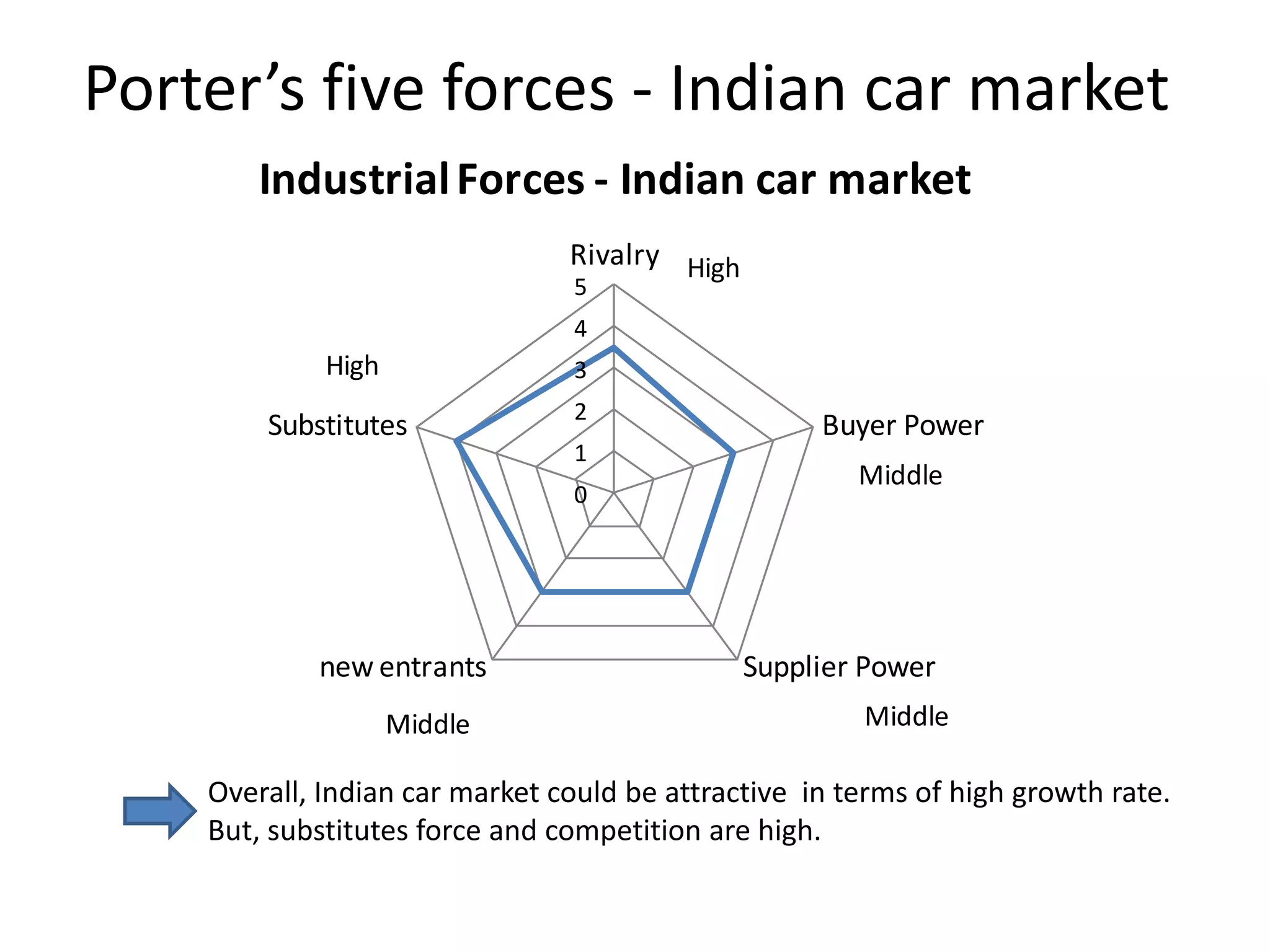
Porter’s five forces - Indian car market
0
1
2
3
4
5
Rivalry
Buyer Power
Supplier Power
new entrants
Substitutes
IndustrialForces - Indian car market
Middle
High
Middle
High
Middle
Overall, Indian car market could be attractive in terms of high growth rate.
But, substitutes force and competition are high.
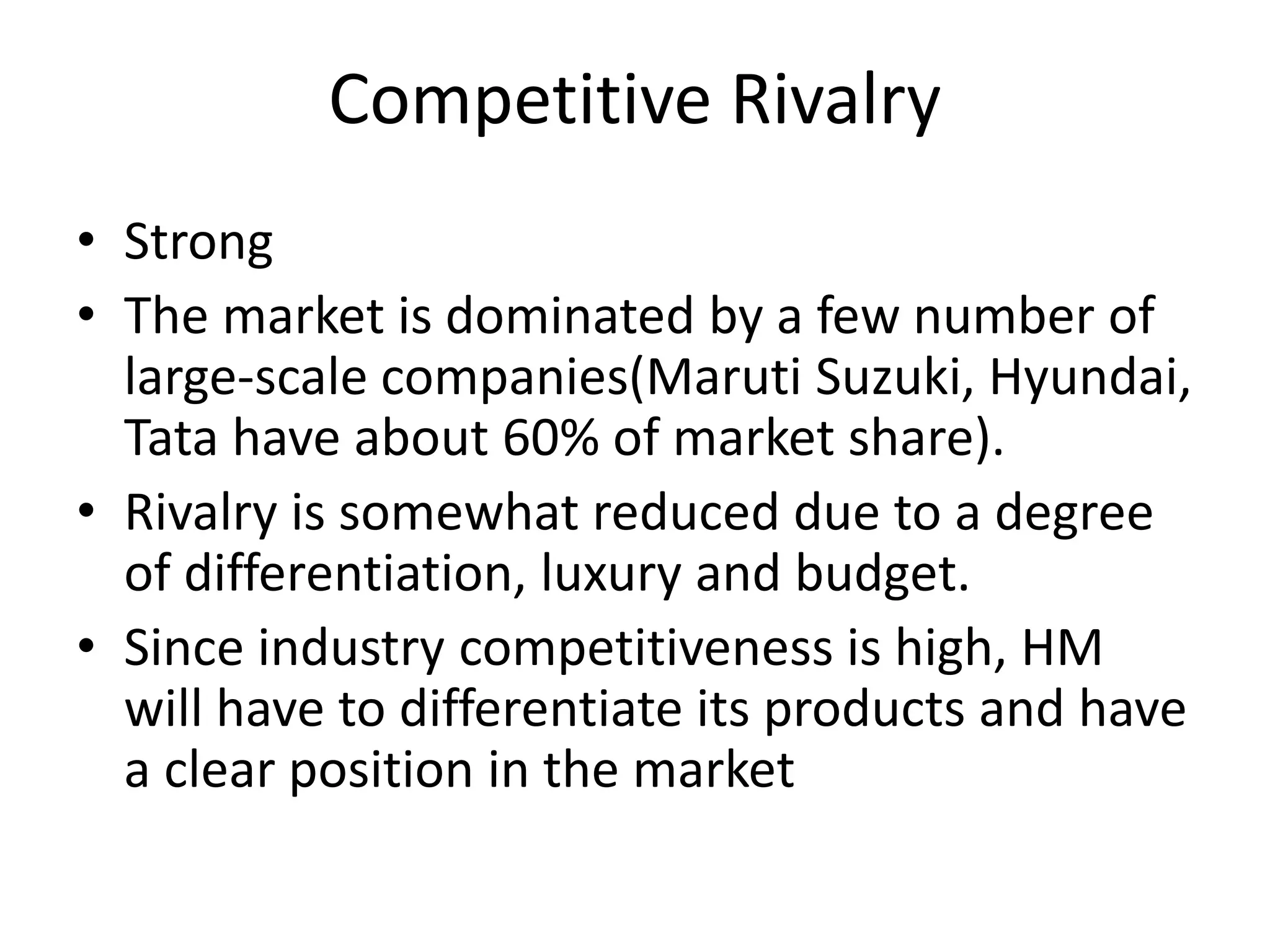
Competitive Rivalry
• Strong
• The market is dominated by a few number of
large-scale companies(Maruti Suzuki, Hyundai,
Tata have about 60% of market share).
• Rivalry is somewhat reduced due to a degree
of differentiation, luxury and budget.
• Since industry competitiveness is high, HM
will have to differentiate its products and have
a clear position in the market
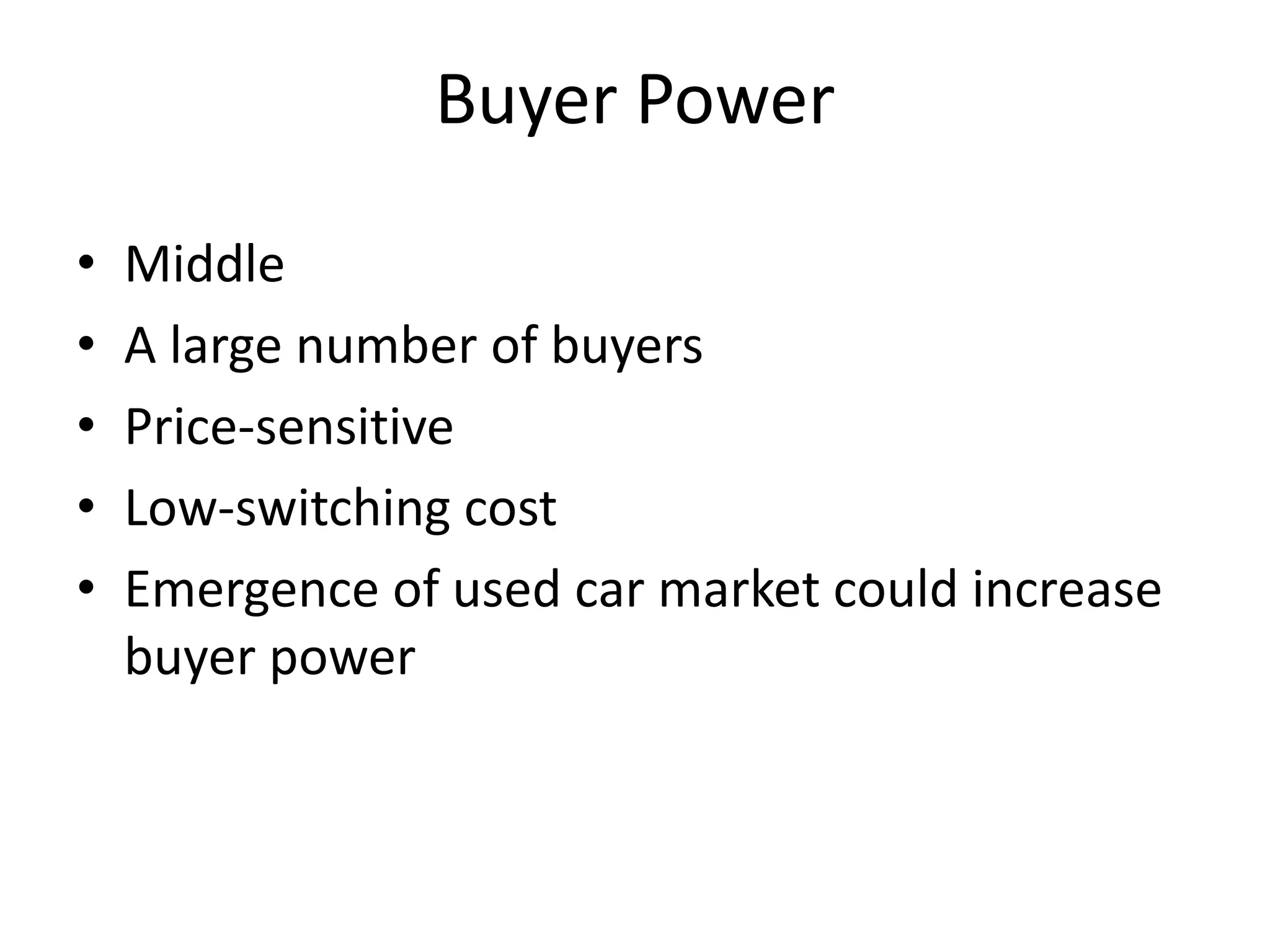
Buyer Power
• Middle
• A large number of buyers
• Price-sensitive
• Low-switching cost
• Emergence of used car market could increase
buyer power
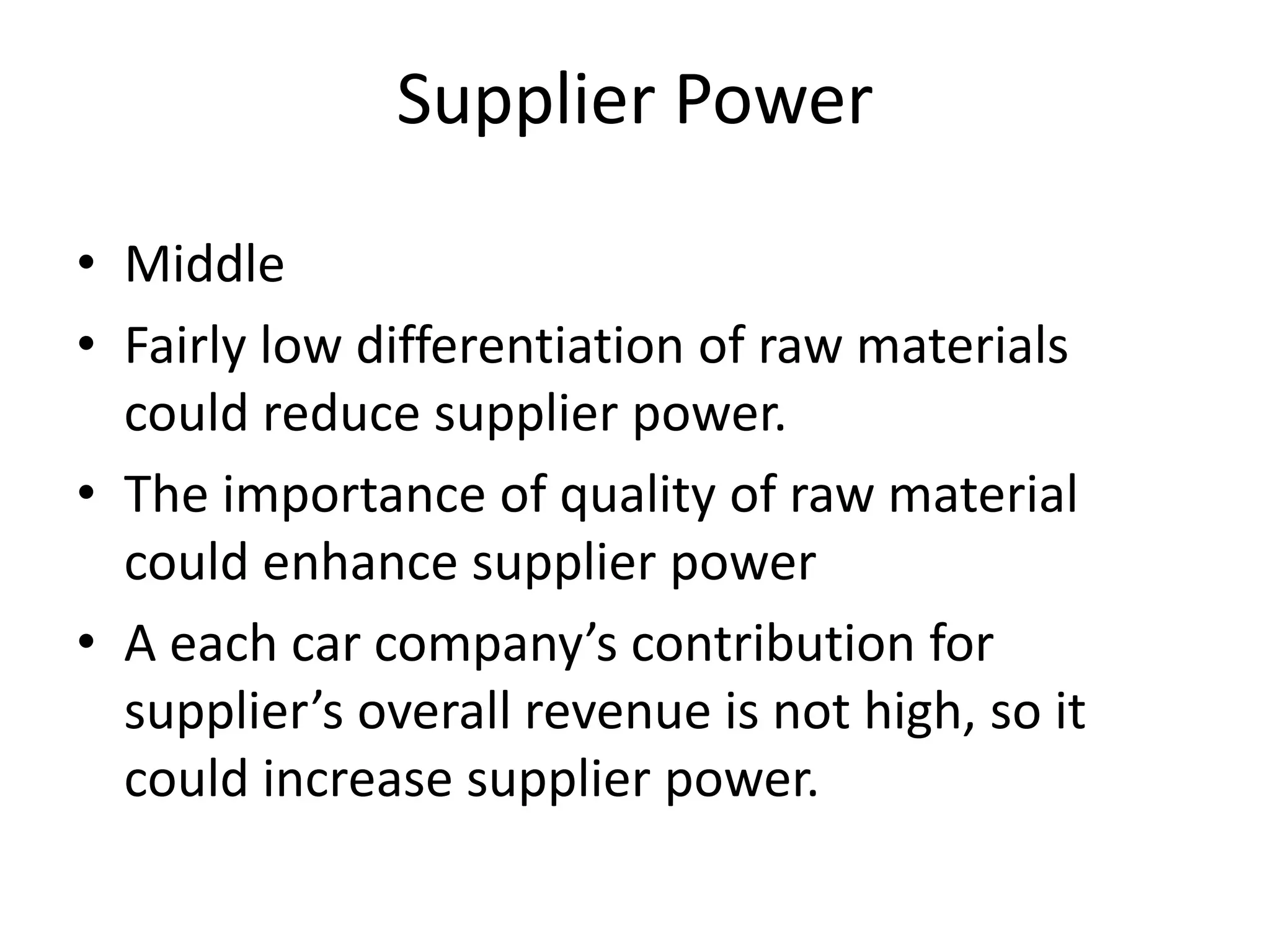
Supplier Power
• Middle
• Fairly low differentiation of raw materials
could reduce supplier power.
• The importance of quality of raw material
could enhance supplier power
• A each car company’s contribution for
supplier’s overall revenue is not high, so it
could increase supplier power.
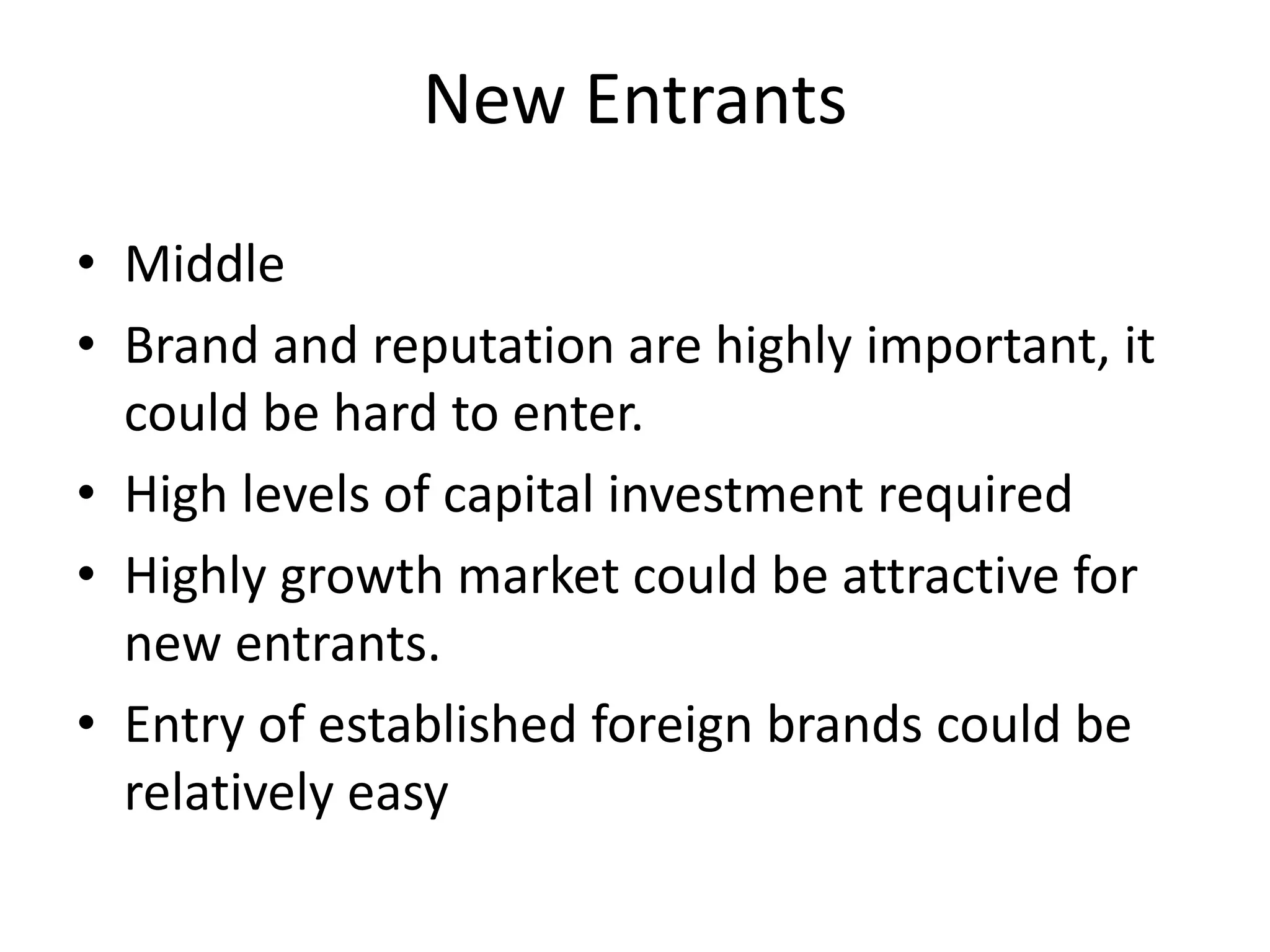
New Entrants
• Middle
• Brand and reputation are highly important, it
could be hard to enter.
• High levels of capital investment required
• Highly growth market could be attractive for
new entrants.
• Entry of established foreign brands could be
relatively easy
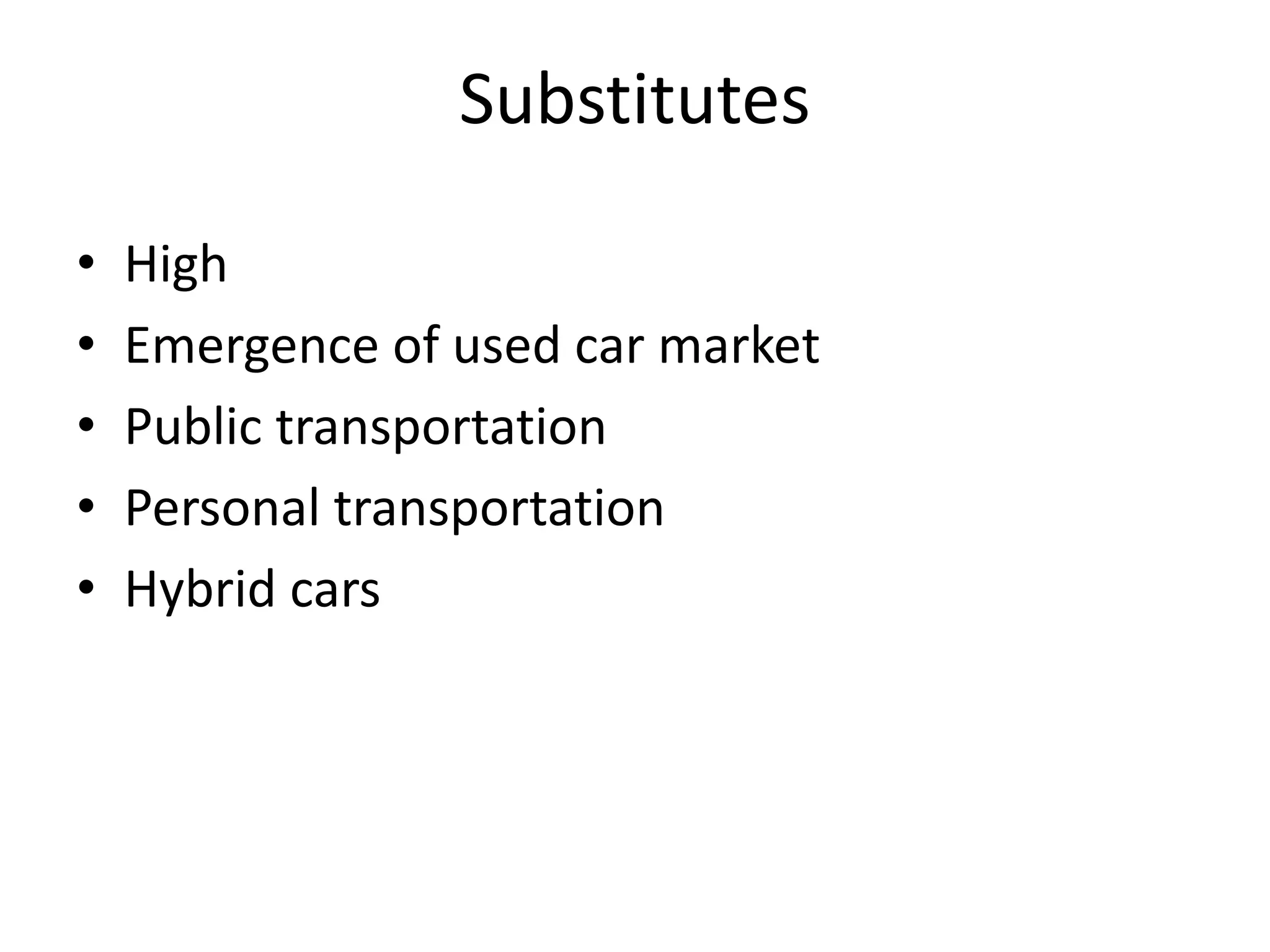
Substitutes
• High
• Emergence of used car market
• Public transportation
• Personal transportation
• Hybrid cars
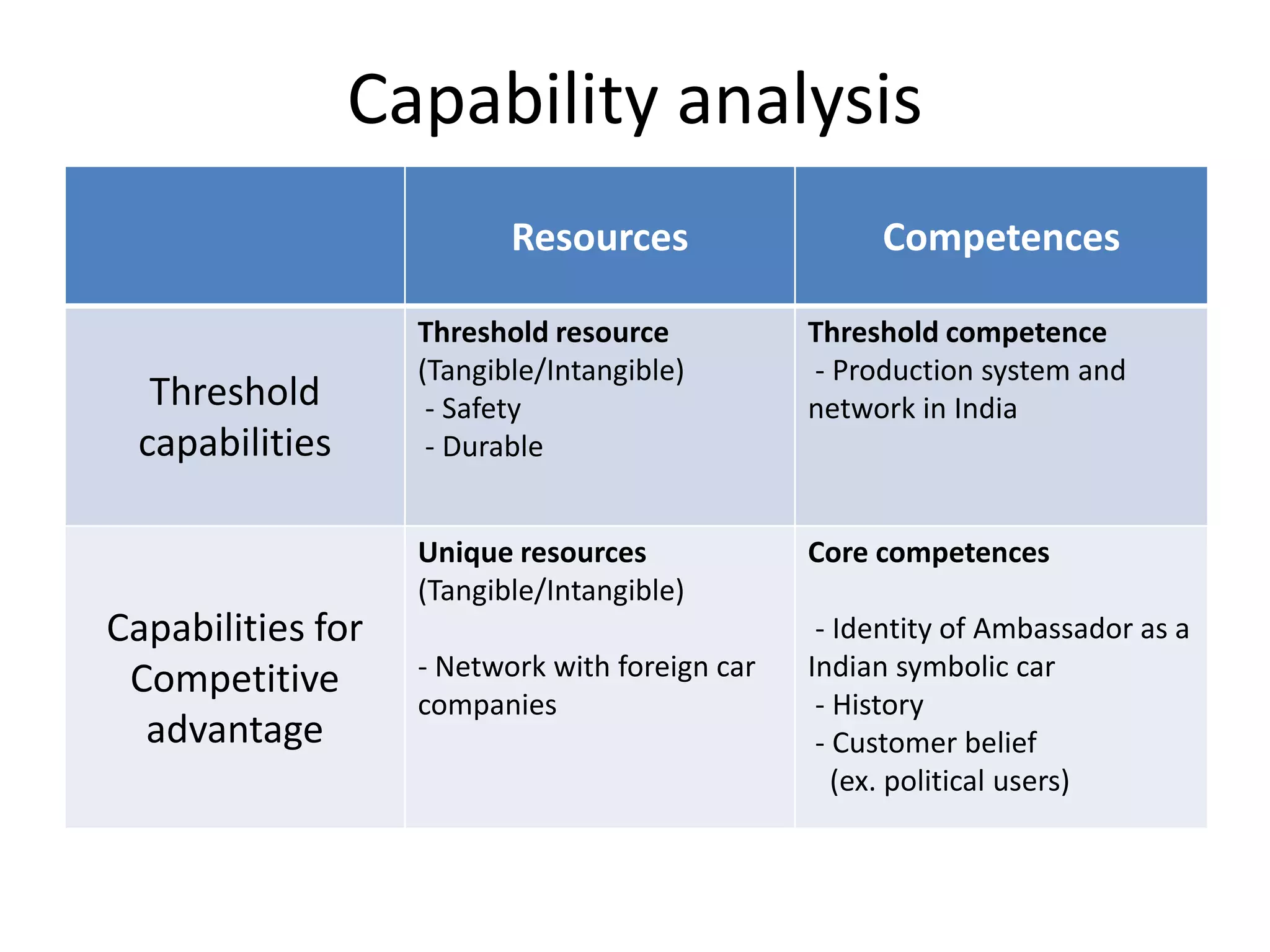
Capability analysis
Resources Competences
Threshold
capabilities
Threshold resource
(Tangible/Intangible)
- Safety
- Durable
Threshold competence
- Production system and
network in India
Capabilities for
Competitive
advantage
Unique resources
(Tangible/Intangible)
- Network with foreign car
companies
Core competences
- Identity of Ambassador as a
Indian symbolic car
- History
- Customer belief
(ex. political users)
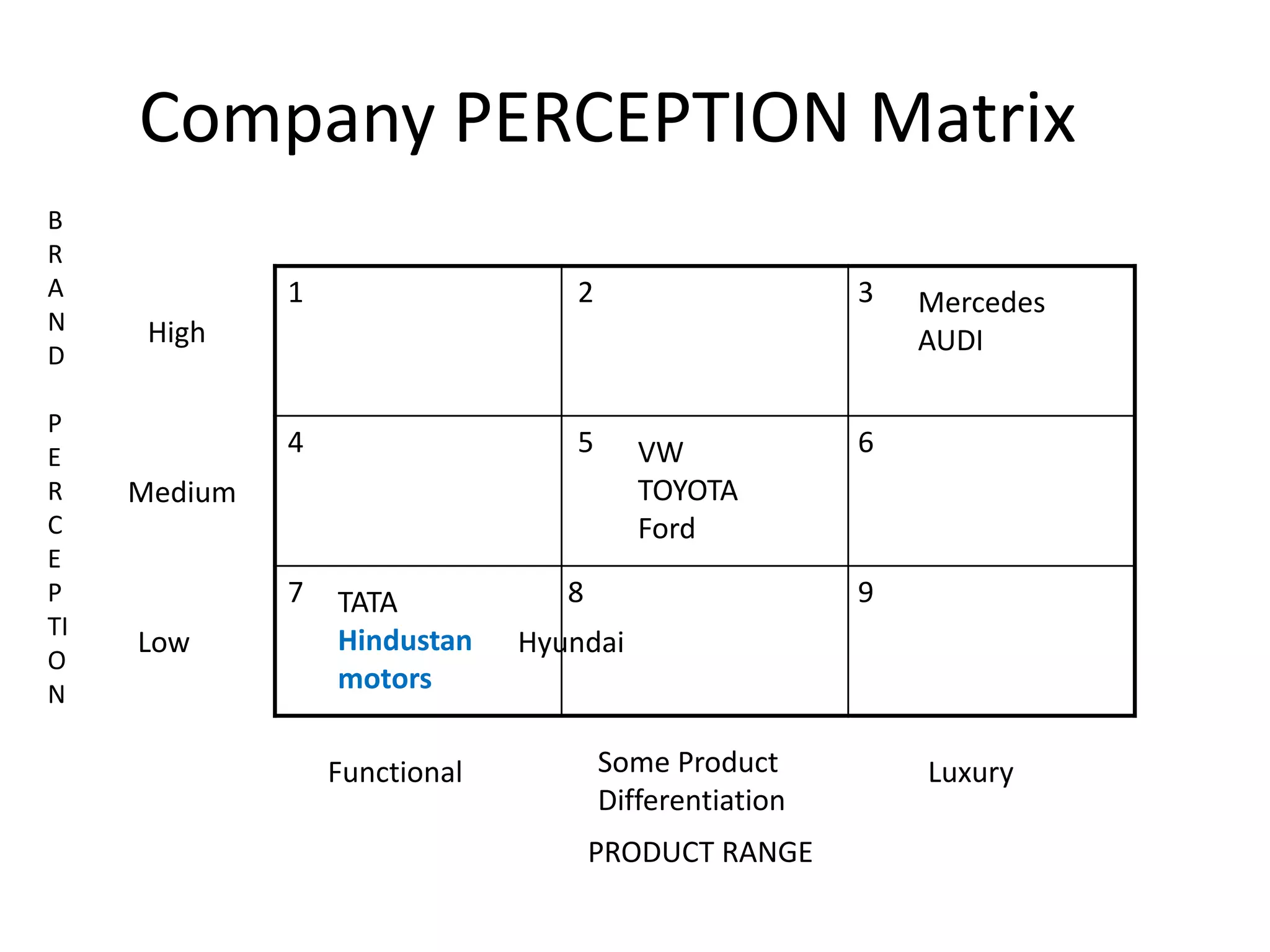
Company PERCEPTION Matrix
1 2 3
5
4
7
6
9
8
High
Medium
Low
B
R
A
N
D
P
E
R
C
E
P
TI
O
N
Functional Some Product
Differentiation
Luxury
PRODUCT RANGE
VW
TOYOTA
Ford
TATA
Hindustan
motors
Hyundai
Mercedes
AUDI
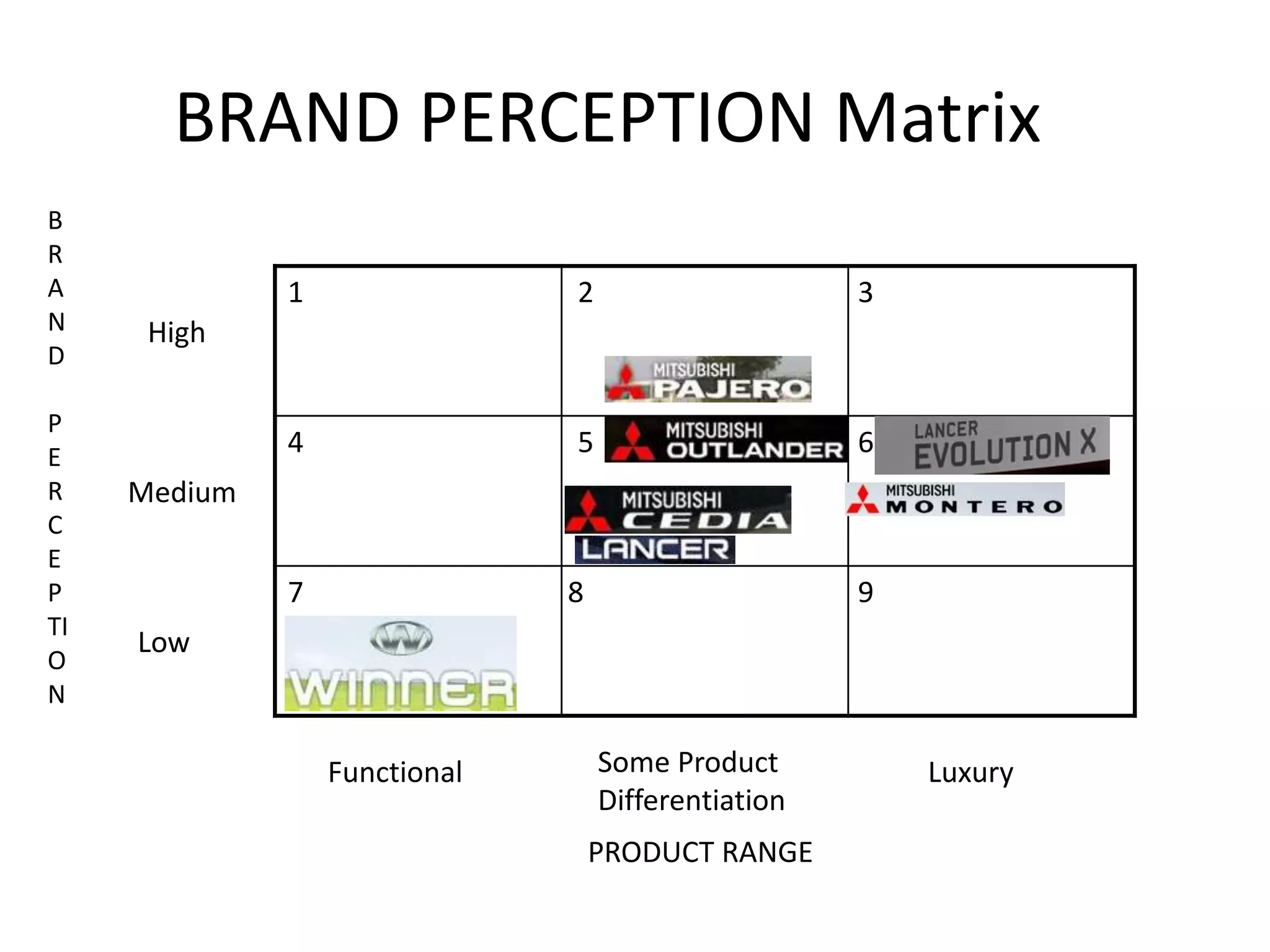
BRAND PERCEPTION Matrix
1 2 3
5
4
7
6
9
8
High
Medium
Low
B
R
A
N
D
P
E
R
C
E
P
TI
O
N
Functional Some Product
Differentiation
Luxury
PRODUCT RANGE
Positioning
• Ambassador offers unique design, unmatched
space, comfort, safety & sturdiness, which no
other new age car of this segment
(Taxi/tourist) offers.
• Tap new segments and through customer
relations enhancement initiatives with the
launch of the ‘click and customize’ service for
Lancer customers.
Positioning
• Further consolidate its position in the SUV
segment.
• Explored the global auto components business.
• In order to use its design and engineering
skills to enter new businesses.
Key Success Factors
 The first Indian Car Company to start production in
India in 1942
 Through the collaboration with Mitsubishi of Japan, the
manufacture of the new Mitsubishi Lancer
 HM has a vast service network in The Passenger Car
and Utility Vehicle market:
 115 strong dealer network, 50 Service and Parts dealers and
additional 60 exclusive Parts dealers.
 The support by 4 Regional Offices and Nation-wide Territory
Offices
Key Success Factors
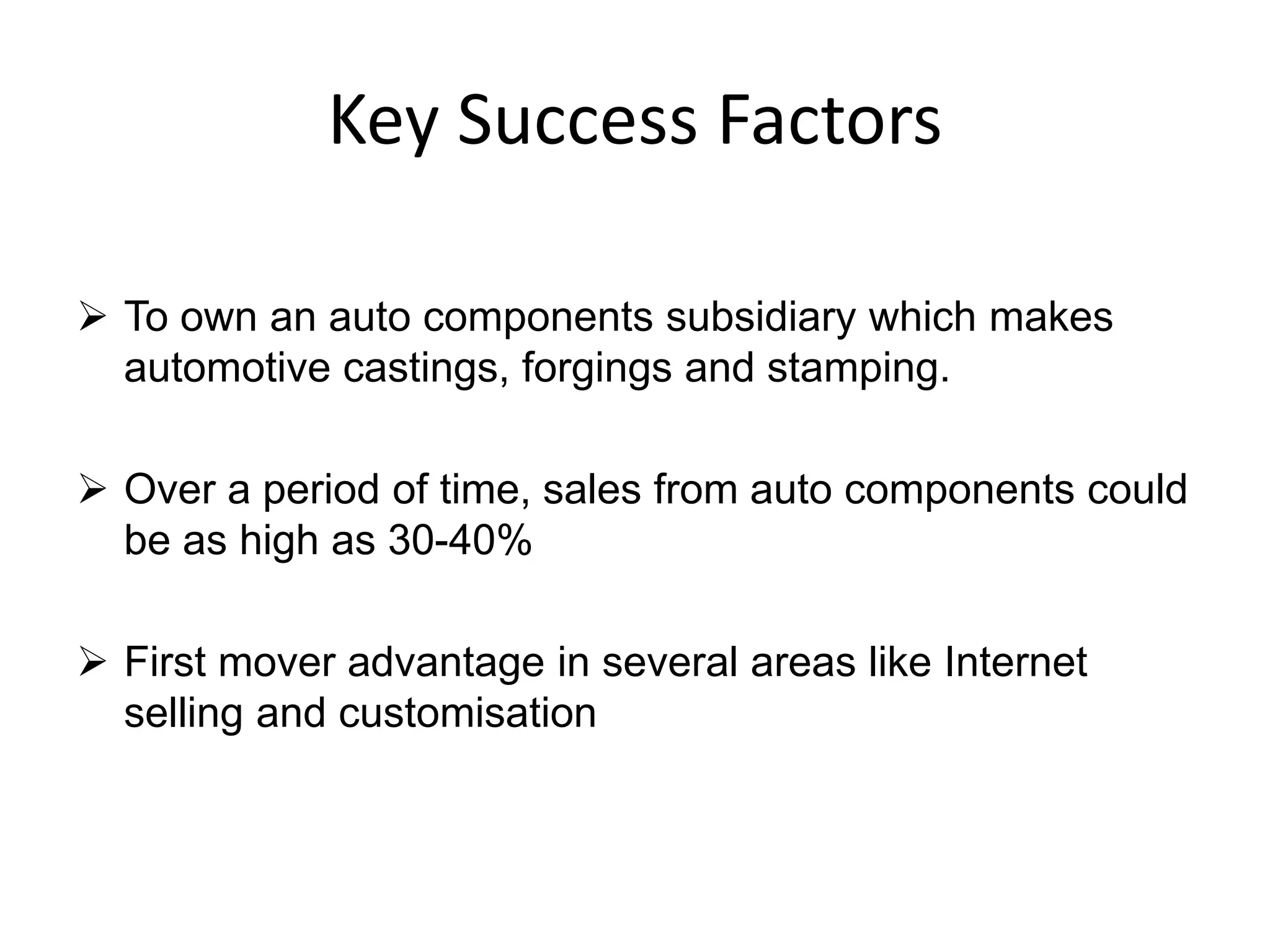
 To own an auto components subsidiary which makes
automotive castings, forgings and stamping.
 Over a period of time, sales from auto components could
be as high as 30-40%
 First mover advantage in several areas like Internet
selling and customisation
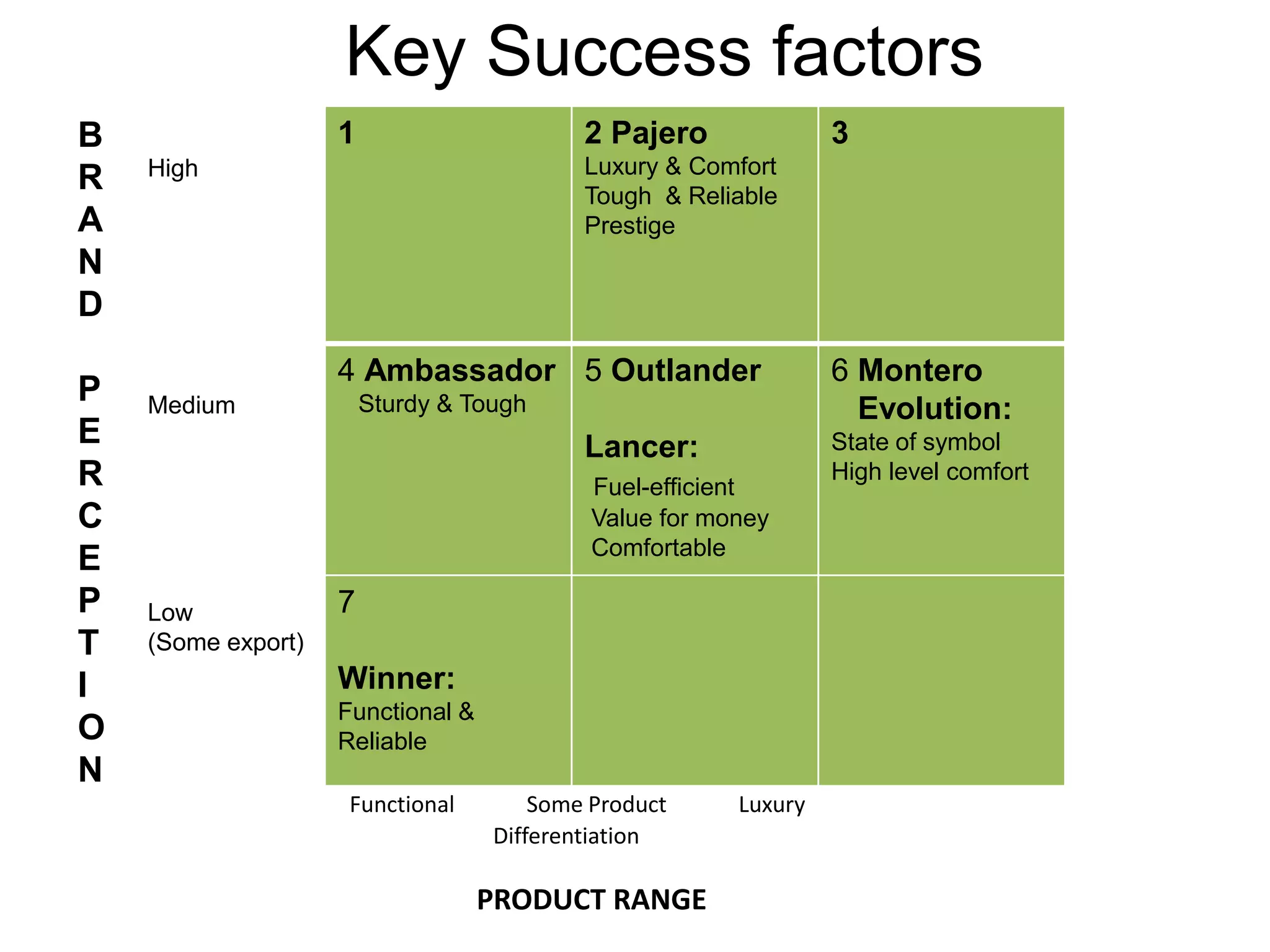
Key Success factors
1 2 Pajero
Luxury & Comfort
Tough & Reliable
Prestige
3
4 Ambassador
Sturdy & Tough
5 Outlander
Lancer:
Fuel-efficient
Value for money
Comfortable
6 Montero
Evolution:
State of symbol
High level comfort
7
Winner:
Functional &
Reliable
B
R
A
N
D
P
E
R
C
E
P
T
I
O
N
Functional Some Product Luxury
Differentiation
PRODUCT RANGE
High
Medium
Low
(Some export)
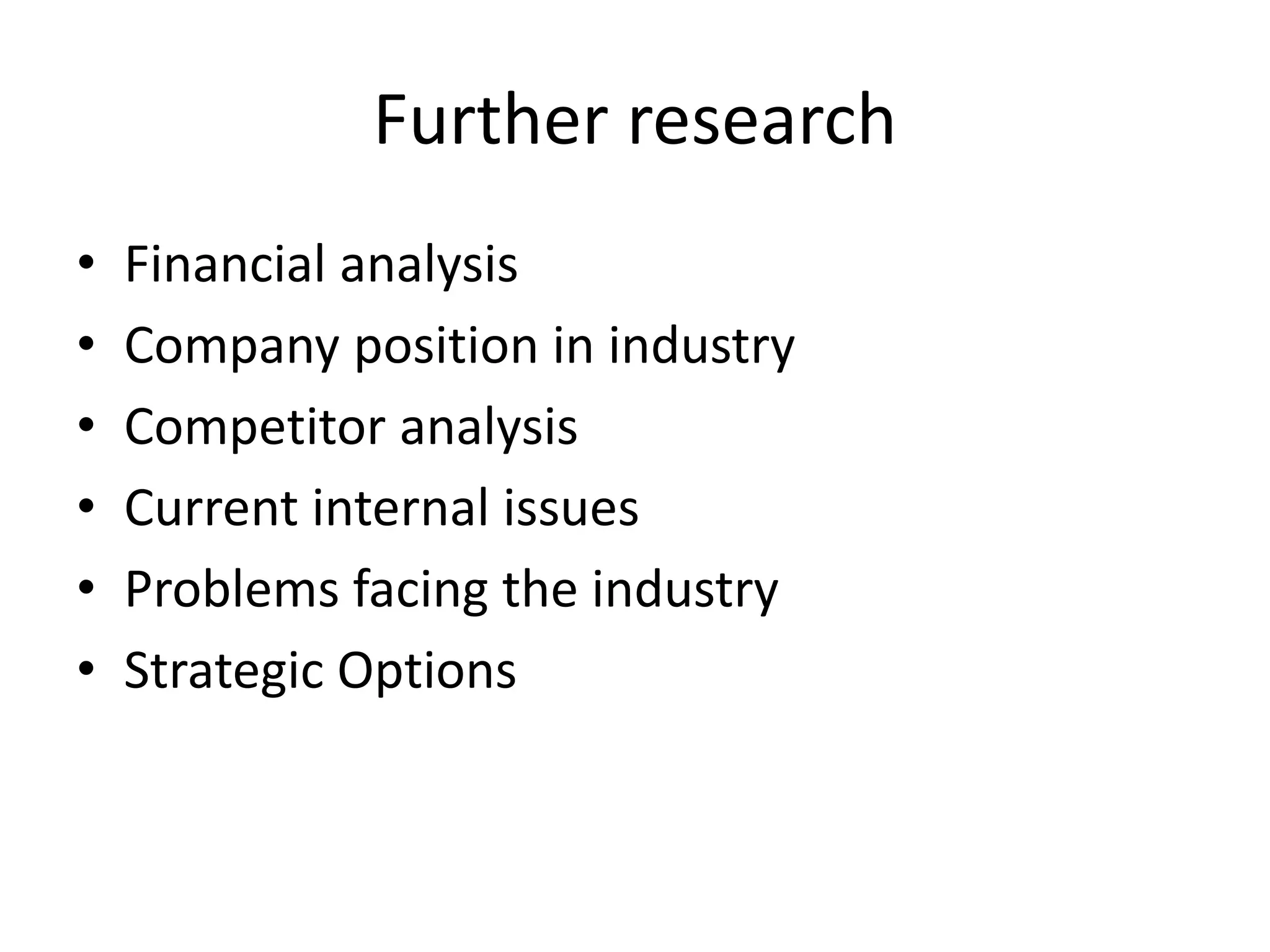
Further research
• Financial analysis
• Company position in industry
• Competitor analysis
• Current internal issues
• Problems facing the industry
• Strategic Options
Thank You

hm-150201110411-conversion-gate02 (1).pdf

  • 1.
    Team -7 Chang Fu RizwanChand Natsuko Matsuda Kyeung Ah Lee Sindhu Nagalingam
  • 2.
    Background • Automobile Manufacturerestablished in 1942 • Manufactured the first ever car in India called the Ambassador • The famous Ambassador car is used as a government limousine widely used as a taxicab • Hindustan has a joint venture with Mitsubishi, producing versions of the Lancer and Pajero • The Company currently manufactures passenger cars, multi utility vehicles and sports utility vehicles and has a total of 8 models • Manufacturing facilities are situated in the states of Madhya Pradesh, Tamil Nadu and West Bengal
  • 3.
    Financials Rs. Lacs Year ending31/03/2010 31/03/2009 31/03/2008 31/03/2007 Revenue 73,599 77,070 85,300 80,637 PBIT (459) (952) 8,698 5,275 PAT (5,110) (3,885) 3,084 1,329 Equity Share Capital 16,125 16,125 16,125 16,125 Total No- Car Sales 1,949,776 1,552,703 1,549,882 1,379,698 25.57% 0.13% 12.17% 20.70%
  • 4.
    PEST Analysis Political •Environmental legislation explorations • Taxes and Duty • High concentrations of market ownership • Subsidies Economical • Overcapacity • Industry at the whim of the business cycle • Few independent car makers • Difficulty in sustaining competitive ads. • Economies Of Scale • Mergers and strategic alliances Social • Erosion of brand extras • Market movement from petrol to diesel • Manufacturing to a consumer dictated market (Culture, Fashions and taste) • Environment Technological • Discoveries spurred by govt. legislation • Rising costs of developments • New model development is cautious • New technology for development • Ecommerce
  • 5.
    Porter’s five forces- Indian car market 0 1 2 3 4 5 Rivalry Buyer Power Supplier Power new entrants Substitutes IndustrialForces - Indian car market Middle High Middle High Middle Overall, Indian car market could be attractive in terms of high growth rate. But, substitutes force and competition are high.
  • 6.
    Competitive Rivalry • Strong •The market is dominated by a few number of large-scale companies(Maruti Suzuki, Hyundai, Tata have about 60% of market share). • Rivalry is somewhat reduced due to a degree of differentiation, luxury and budget. • Since industry competitiveness is high, HM will have to differentiate its products and have a clear position in the market
  • 7.
    Buyer Power • Middle •A large number of buyers • Price-sensitive • Low-switching cost • Emergence of used car market could increase buyer power
  • 8.
    Supplier Power • Middle •Fairly low differentiation of raw materials could reduce supplier power. • The importance of quality of raw material could enhance supplier power • A each car company’s contribution for supplier’s overall revenue is not high, so it could increase supplier power.
  • 9.
    New Entrants • Middle •Brand and reputation are highly important, it could be hard to enter. • High levels of capital investment required • Highly growth market could be attractive for new entrants. • Entry of established foreign brands could be relatively easy
  • 10.
    Substitutes • High • Emergenceof used car market • Public transportation • Personal transportation • Hybrid cars
  • 11.
    Capability analysis Resources Competences Threshold capabilities Thresholdresource (Tangible/Intangible) - Safety - Durable Threshold competence - Production system and network in India Capabilities for Competitive advantage Unique resources (Tangible/Intangible) - Network with foreign car companies Core competences - Identity of Ambassador as a Indian symbolic car - History - Customer belief (ex. political users)
  • 12.
    Company PERCEPTION Matrix 12 3 5 4 7 6 9 8 High Medium Low B R A N D P E R C E P TI O N Functional Some Product Differentiation Luxury PRODUCT RANGE VW TOYOTA Ford TATA Hindustan motors Hyundai Mercedes AUDI
  • 13.
    BRAND PERCEPTION Matrix 12 3 5 4 7 6 9 8 High Medium Low B R A N D P E R C E P TI O N Functional Some Product Differentiation Luxury PRODUCT RANGE
  • 14.
    Positioning • Ambassador offersunique design, unmatched space, comfort, safety & sturdiness, which no other new age car of this segment (Taxi/tourist) offers. • Tap new segments and through customer relations enhancement initiatives with the launch of the ‘click and customize’ service for Lancer customers.
  • 15.
    Positioning • Further consolidateits position in the SUV segment. • Explored the global auto components business. • In order to use its design and engineering skills to enter new businesses.
  • 16.
    Key Success Factors The first Indian Car Company to start production in India in 1942  Through the collaboration with Mitsubishi of Japan, the manufacture of the new Mitsubishi Lancer  HM has a vast service network in The Passenger Car and Utility Vehicle market:  115 strong dealer network, 50 Service and Parts dealers and additional 60 exclusive Parts dealers.  The support by 4 Regional Offices and Nation-wide Territory Offices
  • 17.
    Key Success Factors To own an auto components subsidiary which makes automotive castings, forgings and stamping.  Over a period of time, sales from auto components could be as high as 30-40%  First mover advantage in several areas like Internet selling and customisation
  • 18.
    Key Success factors 12 Pajero Luxury & Comfort Tough & Reliable Prestige 3 4 Ambassador Sturdy & Tough 5 Outlander Lancer: Fuel-efficient Value for money Comfortable 6 Montero Evolution: State of symbol High level comfort 7 Winner: Functional & Reliable B R A N D P E R C E P T I O N Functional Some Product Luxury Differentiation PRODUCT RANGE High Medium Low (Some export)
  • 19.
    Further research • Financialanalysis • Company position in industry • Competitor analysis • Current internal issues • Problems facing the industry • Strategic Options
  • 20.