Personality
Definition
• Personality is the relatively stable set of psychological
attributes that distinguish one person from another
• Personality can be defined as the sum total of ways in which
an individual interacts with people and reacts to situations
Big Five Personality Traits
• Agreeableness: Ability to get long with others
• Conscientiousness: Number of goals on which a person focuses.
• Emotional stability/Neuroticism: Individual’s ability to experience
unpleasant emotions such as anger, stress, anxiety depression etc
• Extraversion: Extent to which a person is comfortable with other
people/relationships
• Openness to experience: Refers to an individual’s range of interests
and indicates how innovative or how rigid he/she is in beliefs
Personality Determinants
• Biological factors: physiological and psychological
and hereditary characteristics inherited from parents
• Environmental Factors: The environment (Cultural-
values, traditions, norms; and social factors-
community, society, organization, workplace,
relationships, family)
• Situational factors: The situation in which an
individual is in (work/home) influence his/her
personality
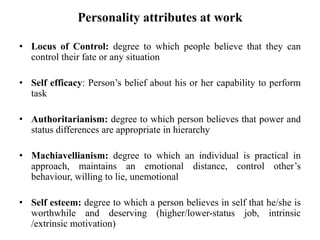
Personality attributes at work
• Locus of Control: degree to which people believe that they can
control their fate or any situation
• Self efficacy: Person’s belief about his or her capability to perform
task
• Authoritarianism: degree to which person believes that power and
status differences are appropriate in hierarchy
• Machiavellianism: degree to which an individual is practical in
approach, maintains an emotional distance, control other’s
behaviour, willing to lie, unemotional
• Self esteem: degree to which a person believes in self that he/she is
worthwhile and deserving (higher/lower-status job, intrinsic
/extrinsic motivation)
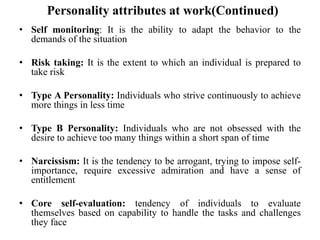
Personality attributes at work(Continued)
• Self monitoring: It is the ability to adapt the behavior to the
demands of the situation
• Risk taking: It is the extent to which an individual is prepared to
take risk
• Type A Personality: Individuals who strive continuously to achieve
more things in less time
• Type B Personality: Individuals who are not obsessed with the
desire to achieve too many things within a short span of time
• Narcissism: It is the tendency to be arrogant, trying to impose self-
importance, require excessive admiration and have a sense of
entitlement
• Core self-evaluation: tendency of individuals to evaluate
themselves based on capability to handle the tasks and challenges
they face
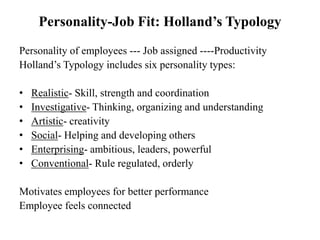
Personality-Job Fit: Holland’s Typology
Personality of employees --- Job assigned ----Productivity
Holland’s Typology includes six personality types:
• Realistic- Skill, strength and coordination
• Investigative- Thinking, organizing and understanding
• Artistic- creativity
• Social- Helping and developing others
• Enterprising- ambitious, leaders, powerful
• Conventional- Rule regulated, orderly
Motivates employees for better performance
Employee feels connected
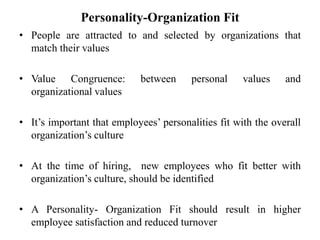
Personality-Organization Fit
• People are attracted to and selected by organizations that
match their values
• Value Congruence: between personal values and
organizational values
• It’s important that employees’ personalities fit with the overall
organization’s culture
• At the time of hiring, new employees who fit better with
organization’s culture, should be identified
• A Personality- Organization Fit should result in higher
employee satisfaction and reduced turnover
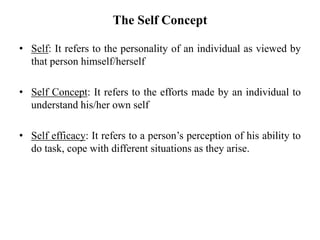
The Self Concept
• Self: It refers to the personality of an individual as viewed by
that person himself/herself
• Self Concept: It refers to the efforts made by an individual to
understand his/her own self
• Self efficacy: It refers to a person’s perception of his ability to
do task, cope with different situations as they arise.
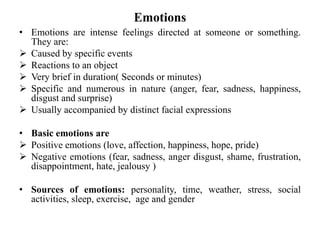
Emotions
• Emotions are intense feelings directed at someone or something.
They are:
 Caused by specific events
 Reactions to an object
 Very brief in duration( Seconds or minutes)
 Specific and numerous in nature (anger, fear, sadness, happiness,
disgust and surprise)
 Usually accompanied by distinct facial expressions
• Basic emotions are
 Positive emotions (love, affection, happiness, hope, pride)
 Negative emotions (fear, sadness, anger disgust, shame, frustration,
disappointment, hate, jealousy )
• Sources of emotions: personality, time, weather, stress, social
activities, sleep, exercise, age and gender
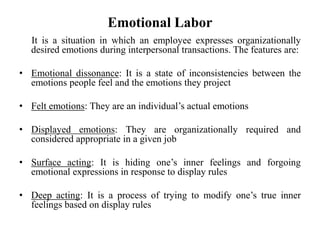
Emotional Labor
It is a situation in which an employee expresses organizationally
desired emotions during interpersonal transactions. The features are:
• Emotional dissonance: It is a state of inconsistencies between the
emotions people feel and the emotions they project
• Felt emotions: They are an individual’s actual emotions
• Displayed emotions: They are organizationally required and
considered appropriate in a given job
• Surface acting: It is hiding one’s inner feelings and forgoing
emotional expressions in response to display rules
• Deep acting: It is a process of trying to modify one’s true inner
feelings based on display rules
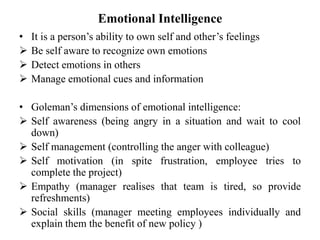
Emotional Intelligence
• It is a person’s ability to own self and other’s feelings
 Be self aware to recognize own emotions
 Detect emotions in others
 Manage emotional cues and information
• Goleman’s dimensions of emotional intelligence:
 Self awareness (being angry in a situation and wait to cool
down)
 Self management (controlling the anger with colleague)
 Self motivation (in spite frustration, employee tries to
complete the project)
 Empathy (manager realises that team is tired, so provide
refreshments)
 Social skills (manager meeting employees individually and
explain them the benefit of new policy )

chapter 5 - Personality.pptx

  • 1.
  • 2.
    Definition • Personality isthe relatively stable set of psychological attributes that distinguish one person from another • Personality can be defined as the sum total of ways in which an individual interacts with people and reacts to situations
  • 3.
    Big Five PersonalityTraits • Agreeableness: Ability to get long with others • Conscientiousness: Number of goals on which a person focuses. • Emotional stability/Neuroticism: Individual’s ability to experience unpleasant emotions such as anger, stress, anxiety depression etc • Extraversion: Extent to which a person is comfortable with other people/relationships • Openness to experience: Refers to an individual’s range of interests and indicates how innovative or how rigid he/she is in beliefs
  • 4.
    Personality Determinants • Biologicalfactors: physiological and psychological and hereditary characteristics inherited from parents • Environmental Factors: The environment (Cultural- values, traditions, norms; and social factors- community, society, organization, workplace, relationships, family) • Situational factors: The situation in which an individual is in (work/home) influence his/her personality
  • 5.
    Personality attributes atwork • Locus of Control: degree to which people believe that they can control their fate or any situation • Self efficacy: Person’s belief about his or her capability to perform task • Authoritarianism: degree to which person believes that power and status differences are appropriate in hierarchy • Machiavellianism: degree to which an individual is practical in approach, maintains an emotional distance, control other’s behaviour, willing to lie, unemotional • Self esteem: degree to which a person believes in self that he/she is worthwhile and deserving (higher/lower-status job, intrinsic /extrinsic motivation)
  • 6.
    Personality attributes atwork(Continued) • Self monitoring: It is the ability to adapt the behavior to the demands of the situation • Risk taking: It is the extent to which an individual is prepared to take risk • Type A Personality: Individuals who strive continuously to achieve more things in less time • Type B Personality: Individuals who are not obsessed with the desire to achieve too many things within a short span of time • Narcissism: It is the tendency to be arrogant, trying to impose self- importance, require excessive admiration and have a sense of entitlement • Core self-evaluation: tendency of individuals to evaluate themselves based on capability to handle the tasks and challenges they face
  • 7.
    Personality-Job Fit: Holland’sTypology Personality of employees --- Job assigned ----Productivity Holland’s Typology includes six personality types: • Realistic- Skill, strength and coordination • Investigative- Thinking, organizing and understanding • Artistic- creativity • Social- Helping and developing others • Enterprising- ambitious, leaders, powerful • Conventional- Rule regulated, orderly Motivates employees for better performance Employee feels connected
  • 8.
    Personality-Organization Fit • Peopleare attracted to and selected by organizations that match their values • Value Congruence: between personal values and organizational values • It’s important that employees’ personalities fit with the overall organization’s culture • At the time of hiring, new employees who fit better with organization’s culture, should be identified • A Personality- Organization Fit should result in higher employee satisfaction and reduced turnover
  • 9.
    The Self Concept •Self: It refers to the personality of an individual as viewed by that person himself/herself • Self Concept: It refers to the efforts made by an individual to understand his/her own self • Self efficacy: It refers to a person’s perception of his ability to do task, cope with different situations as they arise.
  • 10.
    Emotions • Emotions areintense feelings directed at someone or something. They are:  Caused by specific events  Reactions to an object  Very brief in duration( Seconds or minutes)  Specific and numerous in nature (anger, fear, sadness, happiness, disgust and surprise)  Usually accompanied by distinct facial expressions • Basic emotions are  Positive emotions (love, affection, happiness, hope, pride)  Negative emotions (fear, sadness, anger disgust, shame, frustration, disappointment, hate, jealousy ) • Sources of emotions: personality, time, weather, stress, social activities, sleep, exercise, age and gender
  • 11.
    Emotional Labor It isa situation in which an employee expresses organizationally desired emotions during interpersonal transactions. The features are: • Emotional dissonance: It is a state of inconsistencies between the emotions people feel and the emotions they project • Felt emotions: They are an individual’s actual emotions • Displayed emotions: They are organizationally required and considered appropriate in a given job • Surface acting: It is hiding one’s inner feelings and forgoing emotional expressions in response to display rules • Deep acting: It is a process of trying to modify one’s true inner feelings based on display rules
  • 12.
    Emotional Intelligence • Itis a person’s ability to own self and other’s feelings  Be self aware to recognize own emotions  Detect emotions in others  Manage emotional cues and information • Goleman’s dimensions of emotional intelligence:  Self awareness (being angry in a situation and wait to cool down)  Self management (controlling the anger with colleague)  Self motivation (in spite frustration, employee tries to complete the project)  Empathy (manager realises that team is tired, so provide refreshments)  Social skills (manager meeting employees individually and explain them the benefit of new policy )