1

Clinical pathology notes
LIVER FUNCTION TESTS
by Dr. Ashish Jawarkar (M.D. Pathology)
Consultant Pathologist
Parul Sevashram Hospital
Vadodara

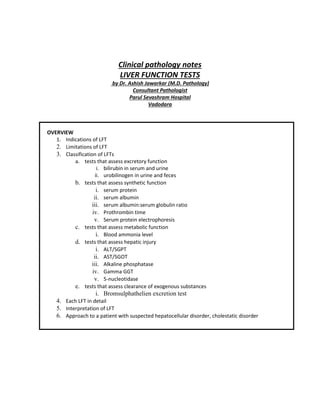
OVERVIEW
1. Indications of LFT
2. Limitations of LFT
3. Classification of LFTs
a. tests that assess excretory function
i. bilirubin in serum and urine
ii. urobilinogen in urine and feces
b. tests that assess synthetic function
i. serum protein
ii. serum albumin
iii. serum albumin:serum globulin ratio
iv. Prothrombin time
v. Serum protein electrophoresis
c. tests that assess metabolic function
i. Blood ammonia level
d. tests that assess hepatic injury
i. ALT/SGPT
ii. AST/SGOT
iii. Alkaline phosphatase
iv. Gamma GGT
v. 5-nucleotidase
e. tests that assess clearance of exogenous substances

i. Bromsulphathelien excretion test
4. Each LFT in detail
5. Interpretation of LFT
6. Approach to a patient with suspected hepatocellular disorder, cholestatic disorder

Notes on Liver function tests.. By Dr. Ashish Jawarkar
Contact: pathologybasics@gmail.com Web: pathologybasics.wix.com/notes
2

* INDICATIONS OF LIVER FUNCTION TESTS
1. Screening of suspected liver disorder
2. to find out type of liver disease

a. hepatocellular
b. cholestatic
c. infiltrative
3. assess the severity and prognosis of liver disease
4. follow up the course of liver disease through the recovery phase
* LIMITATIONS OF LIVER FUNCTION TESTS
1. Lack sensitivity
Liver has large anatomic and functional reserve; there has to be extensive liver damage
for LFTs to derange
2. Lack specificity
LFTs are abnormal in various non hepatic conditions:
a. raised bilirubin
i. hemolysis
ii. ineffective erythropoeisis
iii. large hematoma
b. raised aminotransferases
i. muscle injury
ii. alcohol abuse
iii. MI
c. raised alkaline phosphatase
i. pregnancy
ii. bone disorders
d. low serum albumin
i. poor nutrition
ii. proteinuria
iii. malabsorption
iv. severe illness causing catabolism

Notes on Liver function tests.. By Dr. Ashish Jawarkar
Contact: pathologybasics@gmail.com Web: pathologybasics.wix.com/notes
3

(i) BILIRUBIN:
Serum Bilirubin
Types:
Indirect Bilirubin (unconjugated)
90% more of total
1. Tightly bound to albumin
2. water insoluble
3. not excreted in urine

Direct Bilirubin (conjugated)
10% or less of total
1. includes bilirubin glucoronide, bilirubin
diglucoronide and delta bilirubin#
2. water soluble
3. can be excreted in urine
#

consists of conjugated bilirubin bound to
albumin, level is increased in cholestasis,
excreted slowly in urine
Method (Di azo method):

Serum + di azo reagent

Serum + diazo reagent

+ accelerator

Pink Azobilirubin
+ alkaline tartarate

Pink azobilirubin
+alkaline tartarate

Blue azobilirubin

Blue azobilirubin

Measure absorbance at 600nm

Measure absorbance at 600 nm

Total bilirubin

Direct bilirubin

Indirect bilirubin = total bilirubin – direct bilirubin

Notes on Liver function tests.. By Dr. Ashish Jawarkar
Contact: pathologybasics@gmail.com Web: pathologybasics.wix.com/notes
4

Normal Levels:
Total Bilirubin
Direct Bilirubin

0.3-1.0 mg/dl
0 – 0.2 mg/dl

Patterns:
Normal
Post hepatic type
Hepatic type
Pre hepatic type

Direct 10% of total
Direct >50% of total
Direct 20-50% of total
Direct <15% of total

Urine bilirubin
Rationale:
1. Presence of bilirubin in urine indicates conjugated hyperbilirubinemia due to obstructive
or hepatocellular causes.
2. Bilirubin is absent in urine in hemolytic jaundice because unconjugated bilirubin is not
soluble in water.
Methods:
1. Foam test
5 ml urine in test tube
shake
Yellow foam

Bilirubin present
2. Gmelin’s test
3 ml conc nitric acid in test tube + pour 3 ml urine slowly over it

Play of colors from yellow to violet to blue to green

Positive test

Notes on Liver function tests.. By Dr. Ashish Jawarkar
Contact: pathologybasics@gmail.com Web: pathologybasics.wix.com/notes
5

3. Lugol’s iodine
4 ml lugol’s iodine in test tube + 4 drops urine
shake
Green color indicates positive taste
4. Fouchet’s test
5 ml urine + 2.5 ml 10% BaCl2

Look for ppt formation

Obtain ppt on filter paper

Add 1 drop fouchet’s reagent

Blue green color immediately

Bilirubin is present

5. Reagent strips impregnated with diazo reagent
Can detect minimum 0.5 mg/dl of bilirubin
Patterns:
Urine
Bilirubin
Urobilinogen

Prehepatic
Absent
Increased

Hepatic
Present
Increased

Notes on Liver function tests.. By Dr. Ashish Jawarkar
Contact: pathologybasics@gmail.com Web: pathologybasics.wix.com/notes

Post Hepatic
Present
Absent
6

(ii) URINE UROBILINOGEN
Rationale:

Bile contains conjugated bilirubin

Converted by bacterial action in intestines to urobilinogen

Enterohepatic circulation

Some urobilinogen not taken up by liver is excreted in urine

On exposure to air (urine), urobilinogen is converted to urobilin which gives urine its pale yellow
color
Method:
1. Ehrlich’s aldehyde test

5 ml urine + 0.5 ml Ehrlich’s aldehyde reagent
5 min,
room temp

Pink color

Normal urobilinogen

Dark red color

Increased urobilinogen

Fallacy:
This test is positive with urobilinogen, bilirubin and porphobilinogen.
If bilirubin is suspected; before adding Ehrlich’s reagent, BaCl2 is added and ppt is
removed, which removes the bilirubin and test is performed on the filterate.

Notes on Liver function tests.. By Dr. Ashish Jawarkar
Contact: pathologybasics@gmail.com Web: pathologybasics.wix.com/notes
7

If Porphobilinogen is suspected – Watson-Shwartz test is performed
5ml urine + 0.5 ml Ehrlich’s aldehde reagent

Pink / Dark red solution

Add chloroform 1-2 ml

Pink color in aqueous layer

Acqueous layer

Chloroform layer
Porphobilinogen suspected

Pink color in chloroform layer

acqueous layer

Chloroform layer
Urobilinogen confirmed

Decant pink acqueous solution

Add butanol

Pink color in butanol layer
Butanol layer
Acqueous layer

Indicates porphobilinogen

Notes on Liver function tests.. By Dr. Ashish Jawarkar
Contact: pathologybasics@gmail.com Web: pathologybasics.wix.com/notes
8

2. Reagent strip method
On reagent strips, test area is impregnated with p-dimethylaminobenzal dehyde or 4methoxy benzene tetrafluoroborate

Normal levels:
Normal
Increased urobilinogen in urine

0.5-4mg in 24 hours
Hemolytic jaundice, hemorrhage in tissues

Decreased urobilinogen in urine

Obstructive jaundice, reduction of intestinal
flora

Fallacy:
False negative results may be obtained if 1. UTI – oxidizes urobilinogen to urobilin
2. antibiotic therapy – eliminates gut bacteria, no urobilinogen produced

Notes on Liver function tests.. By Dr. Ashish Jawarkar
Contact: pathologybasics@gmail.com Web: pathologybasics.wix.com/notes
9

(iii) Prothrombin time
Rationale:
1. Most of the clotting factors (except vWF) are synthesized in the liver, hence clotting
function would be deranged in liver disorders
2. Vitamin K dependent clotting factors include factor II, VII and IX, and X. PT measures the
activity of II, VII and X.
Method:
Platelet poor plasma
+
Tissue thromboplastin (activates extrinsic pathway)
+
Calcium chloride
Allowed to clot

Note time
Causes of raised PT:
1. Hepatocellular disease#
2. Obstructive jaundice# – malabsorption of vitamin K – lack of synthesis of vitamin K
dependent clotting factors
3. DIC – exhaustion of coagulation factors
4. Inherited deficiency of coagulation factors
#

To differentiate raised PT due to hepatocellular disease or obstructive causes, repeat after
administration of Vit K
Normal values:
PT

11 To 16 seconds

Notes on Liver function tests.. By Dr. Ashish Jawarkar
Contact: pathologybasics@gmail.com Web: pathologybasics.wix.com/notes
10

(iv) Serum Proteins
1. Total Proteins
Rationale:
1. Liver is the sole site for synthesis of all proteins except gammaglobulins (which is
synthesized by plasma cells).
2. Hence measurement of total proteins is a fair indicator of liver function
3. However, the decrease in proteins synthesized by liver is compensated by increased
synthesis of gamma globulins by plasma cells.
4. Hence overall value of total serum protein measurement is limited.
Methods:
1. Refractometer method:
Refractive index of serum is measured and read directly from the refractometer
2. Biuret method:
Copper ions in the reagent react with peptide bonds of the protein

Violet color compound

Color intensity read by colorimeter
Normal:
Total Protein

5.5 – 8 gm/dl

Notes on Liver function tests.. By Dr. Ashish Jawarkar
Contact: pathologybasics@gmail.com Web: pathologybasics.wix.com/notes
11

2. Serum Albumin
Rationale:
1. Albumin consists of 60% of total proteins and is exclusively synthesized in liver. Hence
its estimation can help in liver diseases (especially chronic). Serum albumin level is low
in chronic liver diseases like cirrhosis and also correlates with severity like progression of
ascites.
2. The half life of albumin is 20 days, hence its level does not fall with acute diseases such
as acute hepatitis.
3. Serum albumin measurement is not specific because albumin also falls in
a. Malnutrition
b. Malabsorption
c. Decreased sythesis – liver disease, chronic infection
d. Increased catabolism – thyrotoxicosis, malignancies, infection
e. Increased loss
i. Nephrotic syndrome
ii. Burns
iii. Protein loosing enteropathy
f. Increased blood volume (dilution – false low)
i. Pregnancy
ii. CCF
Method:
BROMOCRESOL GREEN METHOD;
Serum + Bromo cresol green

Binds to albumin

Blue color

Measured colorimetrically
Normal Values:
Serum albumin

3.5 – 5 gm/dl (60% of total proteins)

Notes on Liver function tests.. By Dr. Ashish Jawarkar
Contact: pathologybasics@gmail.com Web: pathologybasics.wix.com/notes
12

3. Serum albumin : Serum globulin ratio
Rationale:
1. The total serum plasma protein level is affected by compensatory increase of gamma
globulins as albumin falls
2. The ratio of serum albumin to globulin gives a better idea of the liver function
Normal:
Normal albumin:globulin ratio

>1:5

4. Serum Protein electrophoresis
Following pattern can be observed on electrophoresis:
Normal:

Notes on Liver function tests.. By Dr. Ashish Jawarkar
Contact: pathologybasics@gmail.com Web: pathologybasics.wix.com/notes
13

Cirrhosis of liver:

When liver function is sufficiently diminished, protein synthesizing capacity is
compromised and concentrations of albumin and proteins in the alpha and beta bands are
decreased. An additional common finding is beta-gamma bridging due to increased IgA.

Beta-gamma bridging

Alb

α1

α2

β

γ

The Nephrotic Syndrome -1. Renal disease involving the glomeruli is always associated with increased urinary protein
loss. When protein loss is greater than 3-4 g/day, the protein synthesizing capacity of
the liver is exceeded and hypoproteinemia, accompanied by anasarca, develops to
cause the nephrotic syndrome.
2. The massive urine protein loss is due to increased permeability of glomeruli to protein.
The permeability increase may be minimal so that only albumin and other smaller
molecular weight proteins are selectively filtered (selective nephrosis, as in Minimal
Change Disease) or may be greater so that larger proteins are also filtered (nonselective
nephrosis, as in membranous golmerulonephritis) as is the case in the example shown.
3. Alpha-2-macroglobulin is sufficiently large so that it is not filtered and increased
synthesis (from the general hepatic protein synthesis) causes its accumulation.
4. Lipoproteins are also sufficiently large to accumulate and hyperlipidemia is a
characteristic of the nephrotic syndrome, although lipoproteins are not stained with the
protein stain used in visualizing proteins.

Notes on Liver function tests.. By Dr. Ashish Jawarkar
Contact: pathologybasics@gmail.com Web: pathologybasics.wix.com/notes
14

Normal
Abnormal

Alb

α1

α2

β

γ

Alpha-1-Antitrypsin Deficiency:
A genetic defect causes a deficiency of alpha-1-antitrypsin. The antiprotease deficiency
results in a propensity to develop emphysema. Since alpha-1-antitrypsin is the major
component of the alpha-1 band, deficiency is suggested by a reduced alpha-1 band. Deficiency is
confirmed by specific immunochemical quantification.

Normal
Abnormal

Alb α1

α2

β

γ

Notes on Liver function tests.. By Dr. Ashish Jawarkar
Contact: pathologybasics@gmail.com Web: pathologybasics.wix.com/notes
15

Acute Inflammation
The alpha-1 and alpha-2 bands are increased during the inflammatory response from
increased hepatic synthesis of acute phase reactant proteins.

Normal
Abnormal

Alb α1

α2 β

γ

Chronic Inflammation -Immunoglobulin synthesis by antigen activated B lymphocytes transformed to plasma
cells is demonstrated by the increased polyclonal gamma band.

Normal
Abnormal

Alb

α1

α2

β

γ

Notes on Liver function tests.. By Dr. Ashish Jawarkar
Contact: pathologybasics@gmail.com Web: pathologybasics.wix.com/notes
16

Immunoglobulin Deficiency -Deficient immunoglobulin synthesis is revealed by a markedly diminished gamma band.
Effected individuals are prone to recurrent infection

Monoclonal Gammopathy -1. An unusually sharp band in the gamma region strongly suggests the presence of a
homogeneous immunoglobulin and, thus, the malignant proliferation of plasma cells
from a single cell (multiple myeloma) in contrast to the broad, heterogeneous, or
polyclonal, gamma band as exhibited above in chronic inflammation from
immunoglobulin synthesis by many different clones of plasma cells.
2. Homogeneous immunoglobulins are also found in Waldenstrom's macroglobulinemia
(where the sharp gamma band is always IgM). Specimens which exhibit a narrow
gamma band are further examined by immunofixation electrophoresis as described
below

Alb

α1

α2

β

γ

Notes on Liver function tests.. By Dr. Ashish Jawarkar
Contact: pathologybasics@gmail.com Web: pathologybasics.wix.com/notes
17

ImmunoFixation Electrophoresis
Immunofixation electrophoresis (IFE) is used to demonstrate that a narrow gamma band
is due to a homogeneous immunoglobulin. IFE has superceded immunoelectrophoresis, results
from which are considerably more difficult to interpret, for the purpose of evaluating
monoclonal gammopathy.
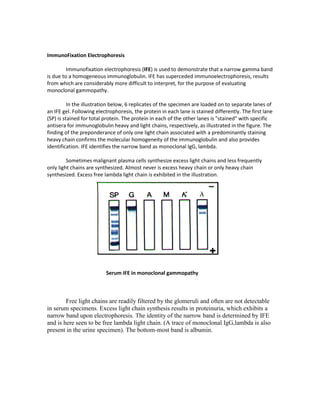
In the illustration below, 6 replicates of the specimen are loaded on to separate lanes of
an IFE gel. Following electrophoresis, the protein in each lane is stained differently. The first lane
(SP) is stained for total protein. The protein in each of the other lanes is "stained" with specific
antisera for immunoglobulin heavy and light chains, respectively, as illustrated in the figure. The
finding of the preponderance of only one light chain associated with a predominantly staining
heavy chain confirms the molecular homogeneity of the immunoglobulin and also provides
identification. IFE identifies the narrow band as monoclonal IgG, lambda.
Sometimes malignant plasma cells synthesize excess light chains and less frequently
only light chains are synthesized. Almost never is excess heavy chain or only heavy chain
synthesized. Excess free lambda light chain is exhibited in the illustration.

Serum IFE in monoclonal gammopathy

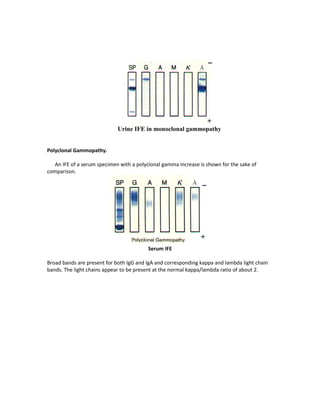
Free light chains are readily filtered by the glomeruli and often are not detectable
in serum specimens. Excess light chain synthesis results in proteinuria, which exhibits a
narrow band upon electrophoresis. The identity of the narrow band is determined by IFE
and is here seen to be free lambda light chain. (A trace of monoclonal IgG,lambda is also
present in the urine specimen). The bottom-most band is albumin.

Notes on Liver function tests.. By Dr. Ashish Jawarkar
Contact: pathologybasics@gmail.com Web: pathologybasics.wix.com/notes
18

Urine IFE in monoclonal gammopathy
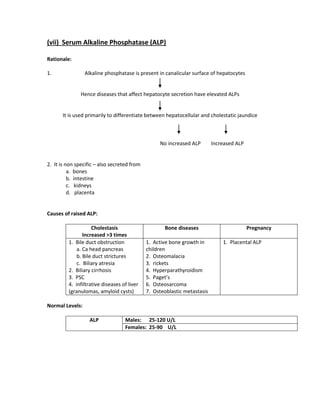
Polyclonal Gammopathy.
An IFE of a serum specimen with a polyclonal gamma increase is shown for the sake of
comparison.

Serum IFE
Broad bands are present for both IgG and IgA and corresponding kappa and lambda light chain
bands. The light chains appear to be present at the normal kappa/lambda ratio of about 2.

Notes on Liver function tests.. By Dr. Ashish Jawarkar
Contact: pathologybasics@gmail.com Web: pathologybasics.wix.com/notes
19

(v) Blood Ammonia Level
Rationale:
1. Ammonia is detoxified and converted to ammonia in liver, estimation of blood ammonia
is an indicator of metabolic function of the liver.
2. Estimation of blood ammonia helps in knowing the cause in patients of coma of
unknown origin
3. Very nonspecific because it is also raised in
a. Reyes syndrome
b. Shunting of portal to systemic blood
c. GI hemorrhage – increased production of ammonia
d. Inherited deficiency of urea cycle enzymes
Normal:
Ammonia

9-33 micromol/l

Notes on Liver function tests.. By Dr. Ashish Jawarkar
Contact: pathologybasics@gmail.com Web: pathologybasics.wix.com/notes
20

(vi) Serum aminotransferases (SGOT (AST) & SGPT (ALT))
ALT (cytosol)

GGT
Canalicular surface
and microsomes

Canalicular surface

5’ nucleotidase
ALP

LDH (cytosol)

AST (mito and cytosol)

Location of liver enzymes

Rationale:
Normally these enzymes are present in serum at low levels

When necrosis or cell death occurs, these are released into the blood

Levels correlate with extent of tissue damage
Normal levels:

AST / SGOT
ALT / SGPT
AST:ALT

5-40 U/L
5-42 U/L
0.7-1.4

Notes on Liver function tests.. By Dr. Ashish Jawarkar
Contact: pathologybasics@gmail.com Web: pathologybasics.wix.com/notes
21

Patterns:
>15 times increase

5-15 times increase

1.
2.
3.
1.
2.
3.
4.

Gradual decrease in enzymes

Hepatocellular jaundice
AST and ALT increase >500 U/L

Acute viral hepatitis
Toxin induced hepatocellular damage (CC l4)
Centrilobular necrosis due to ischemia (like CCF)
Chronic hepatitis
Autoimmune hepatitis
Alcoholic hepatitis
Drug induced hepatitis
Recovery from acute hepatitis
Vs
Massive liver necrosis

Cholestatic jaundice
AST and ALT increase <200 U/L

Alcoholic hepatitis
AST:ALT > 2

Acute viral hepatitis
AST:ALT <1

Notes on Liver function tests.. By Dr. Ashish Jawarkar
Contact: pathologybasics@gmail.com Web: pathologybasics.wix.com/notes
22

(vii) Serum Alkaline Phosphatase (ALP)
Rationale:
1.

Alkaline phosphatase is present in canalicular surface of hepatocytes

Hence diseases that affect hepatocyte secretion have elevated ALPs

It is used primarily to differentiate between hepatocellular and cholestatic jaundice

No increased ALP

Increased ALP

2. It is non specific – also secreted from
a. bones
b. intestine
c. kidneys
d. placenta

Causes of raised ALP:
Cholestasis
Increased >3 times
1. Bile duct obstruction
a. Ca head pancreas
b. Bile duct strictures
c. Biliary atresia
2. Biliary cirrhosis
3. PSC
4. infiltrative diseases of liver
(granulomas, amyloid cysts)

Bone diseases
1. Active bone growth in
children
2. Osteomalacia
3. rickets
4. Hyperparathyroidism
5. Paget’s
6. Osteosarcoma
7. Osteoblastic metastasis

Pregnancy
1. Placental ALP

Normal Levels:
ALP

Males: 25-120 U/L
Females: 25-90 U/L

Notes on Liver function tests.. By Dr. Ashish Jawarkar
Contact: pathologybasics@gmail.com Web: pathologybasics.wix.com/notes
23

(viii) Serum GGT
High levels also present in diseases of (organs with ducts)
- Pancreas
- Kidney
- Prostate
Causes of raised GGT:
1. Alcoholism –
a. Marked elevation occurs in acute alcoholic hepatitis
b. Also helpful in diagnosing occult alcoholism (with no notable liver damage)
2. Cholestasis –
a. Level parallels ALP and 5’ Nucleotidase
b. This enzyme is very helpful in combination with above two
3. Recovery from acute hepatitis –
a. This is the last enzyme to return to normal following acute hepatitis –
decrease in level indicates favourable outcome
Normal levels:
GGT

Males:
Females:

upto 40U/L
upto 25U/L

Notes on Liver function tests.. By Dr. Ashish Jawarkar
Contact: pathologybasics@gmail.com Web: pathologybasics.wix.com/notes
24

(ix) 5’ Nucleotidase
a. Is released from liver only
b. Used to know whether raised ALP is from liver or other sources

Notes on Liver function tests.. By Dr. Ashish Jawarkar
Contact: pathologybasics@gmail.com Web: pathologybasics.wix.com/notes
25

(x) Dye Excretion test
Rationale:
a. Some synthetic dyes when introduced in the body are excreted in bile
b. Their clearance depends on – hepatic circulation, hepatocyte function, uninterrupted bile
flow
c. These are sensitive tests for liver function but not used nowadays because of risk of adverse
drug reactions
d. Most common dyes used include
1. Bromsulphathlein (BSP)
2. Indocyanine green
3. Rose bengal
BSP Excretion test:
BSP injected IV

Taken up by hepatocytes

Conjugated to glutathione

Excreted in bile

Check for dye in blood at 45 min

If >50% retained – liver function is abnormal

Application:

Dubin Johnson syndrome
Rotor syndrome

@45 min in blood
Normal value
(>50% excreted in bile)
High
(<50% excreted in bile)

@2 hr in blood
Higher than expected
(slow excretion after 45 min)
Lower than expected
(Fast excretion after 45 min)

Notes on Liver function tests.. By Dr. Ashish Jawarkar
Contact: pathologybasics@gmail.com Web: pathologybasics.wix.com/notes
26

*INTERPRETATION OF LIVER FUNCTION TESTS
Typical LFT values in:

1.

2.
3.
4.

Hepatocellular diseases
Hyperbilirubinemia
Unconjugated>conjugated
Ie indirect>direct
Conjugated 20-50% of total
AST and ALT - >500 IU/L
ALP – raised <3 times
Usually no increase in GGT, 5’NT

1.

2.
3.
4.

Cholestatic diseases
Hyperbilirubinemia
Conjugated>unconjugated
Ie direct>indirect
Conjugated >50% of total
AST, ALT- 200-500 IU/L
ALP – raised >3 times
elevation of GGT and 5’NT

Notes on Liver function tests.. By Dr. Ashish Jawarkar
Contact: pathologybasics@gmail.com Web: pathologybasics.wix.com/notes
27

*APPROACH TO SUSPECTED HEPATOCELLULAR DISEASE:
Suspected hepatocellular disease (Higher indirect Bilirubin, clinically)

AST, ALT raised - >300IU/L

Acute hepatic injury

Acute Viral hepatitis

Alcoholic hepatitis
AST:ALT>2

Toxic or ischemic injury
AST,ALT>3000IU/L

Acute hepatitis A

Acute Hepatitis B

Acute hepatitis C

IgM Anti HAV

IgM anti HBcAg
HBsAg

Anti HCV
HCV RNA

Notes on Liver function tests.. By Dr. Ashish Jawarkar
Contact: pathologybasics@gmail.com Web: pathologybasics.wix.com/notes

Drug induced
28

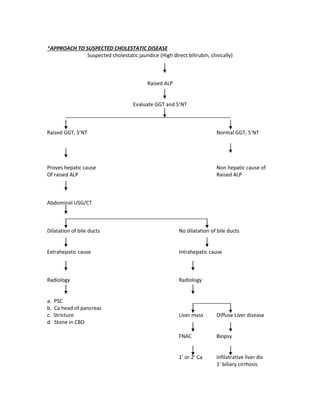
*APPROACH TO SUSPECTED CHOLESTATIC DISEASE
Suspected cholestatic jaundice (High direct bilirubin, clinically)

Raised ALP

Evaluate GGT and 5’NT

Raised GGT, 5’NT

Normal GGT, 5’NT

Proves hepatic cause
Of raised ALP

Non hepatic cause of
Raised ALP

Abdominal USG/CT

Dilatation of bile ducts

No dilatation of bile ducts

Extrahepatic cause

Intrahepatic cause

Radiology

Radiology

a.
b.
c.
d.

PSC
Ca head of pancreas
Stricture
Stone in CBD

Liver mass

Diffuse Liver disease

FNAC

Biopsy

1’ or 2’ Ca

Infilatrative liver dis
1’ biliary cirrhosis

Notes on Liver function tests.. By Dr. Ashish Jawarkar
Contact: pathologybasics@gmail.com Web: pathologybasics.wix.com/notes

Liver function tests

  • 1.
    1 Clinical pathology notes LIVERFUNCTION TESTS by Dr. Ashish Jawarkar (M.D. Pathology) Consultant Pathologist Parul Sevashram Hospital Vadodara OVERVIEW 1. Indications of LFT 2. Limitations of LFT 3. Classification of LFTs a. tests that assess excretory function i. bilirubin in serum and urine ii. urobilinogen in urine and feces b. tests that assess synthetic function i. serum protein ii. serum albumin iii. serum albumin:serum globulin ratio iv. Prothrombin time v. Serum protein electrophoresis c. tests that assess metabolic function i. Blood ammonia level d. tests that assess hepatic injury i. ALT/SGPT ii. AST/SGOT iii. Alkaline phosphatase iv. Gamma GGT v. 5-nucleotidase e. tests that assess clearance of exogenous substances i. Bromsulphathelien excretion test 4. Each LFT in detail 5. Interpretation of LFT 6. Approach to a patient with suspected hepatocellular disorder, cholestatic disorder Notes on Liver function tests.. By Dr. Ashish Jawarkar Contact: pathologybasics@gmail.com Web: pathologybasics.wix.com/notes
  • 2.
    2 * INDICATIONS OFLIVER FUNCTION TESTS 1. Screening of suspected liver disorder 2. to find out type of liver disease a. hepatocellular b. cholestatic c. infiltrative 3. assess the severity and prognosis of liver disease 4. follow up the course of liver disease through the recovery phase * LIMITATIONS OF LIVER FUNCTION TESTS 1. Lack sensitivity Liver has large anatomic and functional reserve; there has to be extensive liver damage for LFTs to derange 2. Lack specificity LFTs are abnormal in various non hepatic conditions: a. raised bilirubin i. hemolysis ii. ineffective erythropoeisis iii. large hematoma b. raised aminotransferases i. muscle injury ii. alcohol abuse iii. MI c. raised alkaline phosphatase i. pregnancy ii. bone disorders d. low serum albumin i. poor nutrition ii. proteinuria iii. malabsorption iv. severe illness causing catabolism Notes on Liver function tests.. By Dr. Ashish Jawarkar Contact: pathologybasics@gmail.com Web: pathologybasics.wix.com/notes
  • 3.
    3 (i) BILIRUBIN: Serum Bilirubin Types: IndirectBilirubin (unconjugated) 90% more of total 1. Tightly bound to albumin 2. water insoluble 3. not excreted in urine Direct Bilirubin (conjugated) 10% or less of total 1. includes bilirubin glucoronide, bilirubin diglucoronide and delta bilirubin# 2. water soluble 3. can be excreted in urine # consists of conjugated bilirubin bound to albumin, level is increased in cholestasis, excreted slowly in urine Method (Di azo method): Serum + di azo reagent Serum + diazo reagent + accelerator Pink Azobilirubin + alkaline tartarate Pink azobilirubin +alkaline tartarate Blue azobilirubin Blue azobilirubin Measure absorbance at 600nm Measure absorbance at 600 nm Total bilirubin Direct bilirubin Indirect bilirubin = total bilirubin – direct bilirubin Notes on Liver function tests.. By Dr. Ashish Jawarkar Contact: pathologybasics@gmail.com Web: pathologybasics.wix.com/notes
  • 4.
    4 Normal Levels: Total Bilirubin DirectBilirubin 0.3-1.0 mg/dl 0 – 0.2 mg/dl Patterns: Normal Post hepatic type Hepatic type Pre hepatic type Direct 10% of total Direct >50% of total Direct 20-50% of total Direct <15% of total Urine bilirubin Rationale: 1. Presence of bilirubin in urine indicates conjugated hyperbilirubinemia due to obstructive or hepatocellular causes. 2. Bilirubin is absent in urine in hemolytic jaundice because unconjugated bilirubin is not soluble in water. Methods: 1. Foam test 5 ml urine in test tube shake Yellow foam Bilirubin present 2. Gmelin’s test 3 ml conc nitric acid in test tube + pour 3 ml urine slowly over it Play of colors from yellow to violet to blue to green Positive test Notes on Liver function tests.. By Dr. Ashish Jawarkar Contact: pathologybasics@gmail.com Web: pathologybasics.wix.com/notes
  • 5.
    5 3. Lugol’s iodine 4ml lugol’s iodine in test tube + 4 drops urine shake Green color indicates positive taste 4. Fouchet’s test 5 ml urine + 2.5 ml 10% BaCl2 Look for ppt formation Obtain ppt on filter paper Add 1 drop fouchet’s reagent Blue green color immediately Bilirubin is present 5. Reagent strips impregnated with diazo reagent Can detect minimum 0.5 mg/dl of bilirubin Patterns: Urine Bilirubin Urobilinogen Prehepatic Absent Increased Hepatic Present Increased Notes on Liver function tests.. By Dr. Ashish Jawarkar Contact: pathologybasics@gmail.com Web: pathologybasics.wix.com/notes Post Hepatic Present Absent
  • 6.
    6 (ii) URINE UROBILINOGEN Rationale: Bilecontains conjugated bilirubin Converted by bacterial action in intestines to urobilinogen Enterohepatic circulation Some urobilinogen not taken up by liver is excreted in urine On exposure to air (urine), urobilinogen is converted to urobilin which gives urine its pale yellow color Method: 1. Ehrlich’s aldehyde test 5 ml urine + 0.5 ml Ehrlich’s aldehyde reagent 5 min, room temp Pink color Normal urobilinogen Dark red color Increased urobilinogen Fallacy: This test is positive with urobilinogen, bilirubin and porphobilinogen. If bilirubin is suspected; before adding Ehrlich’s reagent, BaCl2 is added and ppt is removed, which removes the bilirubin and test is performed on the filterate. Notes on Liver function tests.. By Dr. Ashish Jawarkar Contact: pathologybasics@gmail.com Web: pathologybasics.wix.com/notes
  • 7.
    7 If Porphobilinogen issuspected – Watson-Shwartz test is performed 5ml urine + 0.5 ml Ehrlich’s aldehde reagent Pink / Dark red solution Add chloroform 1-2 ml Pink color in aqueous layer Acqueous layer Chloroform layer Porphobilinogen suspected Pink color in chloroform layer acqueous layer Chloroform layer Urobilinogen confirmed Decant pink acqueous solution Add butanol Pink color in butanol layer Butanol layer Acqueous layer Indicates porphobilinogen Notes on Liver function tests.. By Dr. Ashish Jawarkar Contact: pathologybasics@gmail.com Web: pathologybasics.wix.com/notes
  • 8.
    8 2. Reagent stripmethod On reagent strips, test area is impregnated with p-dimethylaminobenzal dehyde or 4methoxy benzene tetrafluoroborate Normal levels: Normal Increased urobilinogen in urine 0.5-4mg in 24 hours Hemolytic jaundice, hemorrhage in tissues Decreased urobilinogen in urine Obstructive jaundice, reduction of intestinal flora Fallacy: False negative results may be obtained if 1. UTI – oxidizes urobilinogen to urobilin 2. antibiotic therapy – eliminates gut bacteria, no urobilinogen produced Notes on Liver function tests.. By Dr. Ashish Jawarkar Contact: pathologybasics@gmail.com Web: pathologybasics.wix.com/notes
  • 9.
    9 (iii) Prothrombin time Rationale: 1.Most of the clotting factors (except vWF) are synthesized in the liver, hence clotting function would be deranged in liver disorders 2. Vitamin K dependent clotting factors include factor II, VII and IX, and X. PT measures the activity of II, VII and X. Method: Platelet poor plasma + Tissue thromboplastin (activates extrinsic pathway) + Calcium chloride Allowed to clot Note time Causes of raised PT: 1. Hepatocellular disease# 2. Obstructive jaundice# – malabsorption of vitamin K – lack of synthesis of vitamin K dependent clotting factors 3. DIC – exhaustion of coagulation factors 4. Inherited deficiency of coagulation factors # To differentiate raised PT due to hepatocellular disease or obstructive causes, repeat after administration of Vit K Normal values: PT 11 To 16 seconds Notes on Liver function tests.. By Dr. Ashish Jawarkar Contact: pathologybasics@gmail.com Web: pathologybasics.wix.com/notes
  • 10.
    10 (iv) Serum Proteins 1.Total Proteins Rationale: 1. Liver is the sole site for synthesis of all proteins except gammaglobulins (which is synthesized by plasma cells). 2. Hence measurement of total proteins is a fair indicator of liver function 3. However, the decrease in proteins synthesized by liver is compensated by increased synthesis of gamma globulins by plasma cells. 4. Hence overall value of total serum protein measurement is limited. Methods: 1. Refractometer method: Refractive index of serum is measured and read directly from the refractometer 2. Biuret method: Copper ions in the reagent react with peptide bonds of the protein Violet color compound Color intensity read by colorimeter Normal: Total Protein 5.5 – 8 gm/dl Notes on Liver function tests.. By Dr. Ashish Jawarkar Contact: pathologybasics@gmail.com Web: pathologybasics.wix.com/notes
  • 11.
    11 2. Serum Albumin Rationale: 1.Albumin consists of 60% of total proteins and is exclusively synthesized in liver. Hence its estimation can help in liver diseases (especially chronic). Serum albumin level is low in chronic liver diseases like cirrhosis and also correlates with severity like progression of ascites. 2. The half life of albumin is 20 days, hence its level does not fall with acute diseases such as acute hepatitis. 3. Serum albumin measurement is not specific because albumin also falls in a. Malnutrition b. Malabsorption c. Decreased sythesis – liver disease, chronic infection d. Increased catabolism – thyrotoxicosis, malignancies, infection e. Increased loss i. Nephrotic syndrome ii. Burns iii. Protein loosing enteropathy f. Increased blood volume (dilution – false low) i. Pregnancy ii. CCF Method: BROMOCRESOL GREEN METHOD; Serum + Bromo cresol green Binds to albumin Blue color Measured colorimetrically Normal Values: Serum albumin 3.5 – 5 gm/dl (60% of total proteins) Notes on Liver function tests.. By Dr. Ashish Jawarkar Contact: pathologybasics@gmail.com Web: pathologybasics.wix.com/notes
  • 12.
    12 3. Serum albumin: Serum globulin ratio Rationale: 1. The total serum plasma protein level is affected by compensatory increase of gamma globulins as albumin falls 2. The ratio of serum albumin to globulin gives a better idea of the liver function Normal: Normal albumin:globulin ratio >1:5 4. Serum Protein electrophoresis Following pattern can be observed on electrophoresis: Normal: Notes on Liver function tests.. By Dr. Ashish Jawarkar Contact: pathologybasics@gmail.com Web: pathologybasics.wix.com/notes
  • 13.
    13 Cirrhosis of liver: Whenliver function is sufficiently diminished, protein synthesizing capacity is compromised and concentrations of albumin and proteins in the alpha and beta bands are decreased. An additional common finding is beta-gamma bridging due to increased IgA. Beta-gamma bridging Alb α1 α2 β γ The Nephrotic Syndrome -1. Renal disease involving the glomeruli is always associated with increased urinary protein loss. When protein loss is greater than 3-4 g/day, the protein synthesizing capacity of the liver is exceeded and hypoproteinemia, accompanied by anasarca, develops to cause the nephrotic syndrome. 2. The massive urine protein loss is due to increased permeability of glomeruli to protein. The permeability increase may be minimal so that only albumin and other smaller molecular weight proteins are selectively filtered (selective nephrosis, as in Minimal Change Disease) or may be greater so that larger proteins are also filtered (nonselective nephrosis, as in membranous golmerulonephritis) as is the case in the example shown. 3. Alpha-2-macroglobulin is sufficiently large so that it is not filtered and increased synthesis (from the general hepatic protein synthesis) causes its accumulation. 4. Lipoproteins are also sufficiently large to accumulate and hyperlipidemia is a characteristic of the nephrotic syndrome, although lipoproteins are not stained with the protein stain used in visualizing proteins. Notes on Liver function tests.. By Dr. Ashish Jawarkar Contact: pathologybasics@gmail.com Web: pathologybasics.wix.com/notes
  • 14.
    14 Normal Abnormal Alb α1 α2 β γ Alpha-1-Antitrypsin Deficiency: A geneticdefect causes a deficiency of alpha-1-antitrypsin. The antiprotease deficiency results in a propensity to develop emphysema. Since alpha-1-antitrypsin is the major component of the alpha-1 band, deficiency is suggested by a reduced alpha-1 band. Deficiency is confirmed by specific immunochemical quantification. Normal Abnormal Alb α1 α2 β γ Notes on Liver function tests.. By Dr. Ashish Jawarkar Contact: pathologybasics@gmail.com Web: pathologybasics.wix.com/notes
  • 15.
    15 Acute Inflammation The alpha-1and alpha-2 bands are increased during the inflammatory response from increased hepatic synthesis of acute phase reactant proteins. Normal Abnormal Alb α1 α2 β γ Chronic Inflammation -Immunoglobulin synthesis by antigen activated B lymphocytes transformed to plasma cells is demonstrated by the increased polyclonal gamma band. Normal Abnormal Alb α1 α2 β γ Notes on Liver function tests.. By Dr. Ashish Jawarkar Contact: pathologybasics@gmail.com Web: pathologybasics.wix.com/notes
  • 16.
    16 Immunoglobulin Deficiency -Deficientimmunoglobulin synthesis is revealed by a markedly diminished gamma band. Effected individuals are prone to recurrent infection Monoclonal Gammopathy -1. An unusually sharp band in the gamma region strongly suggests the presence of a homogeneous immunoglobulin and, thus, the malignant proliferation of plasma cells from a single cell (multiple myeloma) in contrast to the broad, heterogeneous, or polyclonal, gamma band as exhibited above in chronic inflammation from immunoglobulin synthesis by many different clones of plasma cells. 2. Homogeneous immunoglobulins are also found in Waldenstrom's macroglobulinemia (where the sharp gamma band is always IgM). Specimens which exhibit a narrow gamma band are further examined by immunofixation electrophoresis as described below Alb α1 α2 β γ Notes on Liver function tests.. By Dr. Ashish Jawarkar Contact: pathologybasics@gmail.com Web: pathologybasics.wix.com/notes
  • 17.
    17 ImmunoFixation Electrophoresis Immunofixation electrophoresis(IFE) is used to demonstrate that a narrow gamma band is due to a homogeneous immunoglobulin. IFE has superceded immunoelectrophoresis, results from which are considerably more difficult to interpret, for the purpose of evaluating monoclonal gammopathy. In the illustration below, 6 replicates of the specimen are loaded on to separate lanes of an IFE gel. Following electrophoresis, the protein in each lane is stained differently. The first lane (SP) is stained for total protein. The protein in each of the other lanes is "stained" with specific antisera for immunoglobulin heavy and light chains, respectively, as illustrated in the figure. The finding of the preponderance of only one light chain associated with a predominantly staining heavy chain confirms the molecular homogeneity of the immunoglobulin and also provides identification. IFE identifies the narrow band as monoclonal IgG, lambda. Sometimes malignant plasma cells synthesize excess light chains and less frequently only light chains are synthesized. Almost never is excess heavy chain or only heavy chain synthesized. Excess free lambda light chain is exhibited in the illustration. Serum IFE in monoclonal gammopathy Free light chains are readily filtered by the glomeruli and often are not detectable in serum specimens. Excess light chain synthesis results in proteinuria, which exhibits a narrow band upon electrophoresis. The identity of the narrow band is determined by IFE and is here seen to be free lambda light chain. (A trace of monoclonal IgG,lambda is also present in the urine specimen). The bottom-most band is albumin. Notes on Liver function tests.. By Dr. Ashish Jawarkar Contact: pathologybasics@gmail.com Web: pathologybasics.wix.com/notes
  • 18.
    18 Urine IFE inmonoclonal gammopathy Polyclonal Gammopathy. An IFE of a serum specimen with a polyclonal gamma increase is shown for the sake of comparison. Serum IFE Broad bands are present for both IgG and IgA and corresponding kappa and lambda light chain bands. The light chains appear to be present at the normal kappa/lambda ratio of about 2. Notes on Liver function tests.. By Dr. Ashish Jawarkar Contact: pathologybasics@gmail.com Web: pathologybasics.wix.com/notes
  • 19.
    19 (v) Blood AmmoniaLevel Rationale: 1. Ammonia is detoxified and converted to ammonia in liver, estimation of blood ammonia is an indicator of metabolic function of the liver. 2. Estimation of blood ammonia helps in knowing the cause in patients of coma of unknown origin 3. Very nonspecific because it is also raised in a. Reyes syndrome b. Shunting of portal to systemic blood c. GI hemorrhage – increased production of ammonia d. Inherited deficiency of urea cycle enzymes Normal: Ammonia 9-33 micromol/l Notes on Liver function tests.. By Dr. Ashish Jawarkar Contact: pathologybasics@gmail.com Web: pathologybasics.wix.com/notes
  • 20.
    20 (vi) Serum aminotransferases(SGOT (AST) & SGPT (ALT)) ALT (cytosol) GGT Canalicular surface and microsomes Canalicular surface 5’ nucleotidase ALP LDH (cytosol) AST (mito and cytosol) Location of liver enzymes Rationale: Normally these enzymes are present in serum at low levels When necrosis or cell death occurs, these are released into the blood Levels correlate with extent of tissue damage Normal levels: AST / SGOT ALT / SGPT AST:ALT 5-40 U/L 5-42 U/L 0.7-1.4 Notes on Liver function tests.. By Dr. Ashish Jawarkar Contact: pathologybasics@gmail.com Web: pathologybasics.wix.com/notes
  • 21.
    21 Patterns: >15 times increase 5-15times increase 1. 2. 3. 1. 2. 3. 4. Gradual decrease in enzymes Hepatocellular jaundice AST and ALT increase >500 U/L Acute viral hepatitis Toxin induced hepatocellular damage (CC l4) Centrilobular necrosis due to ischemia (like CCF) Chronic hepatitis Autoimmune hepatitis Alcoholic hepatitis Drug induced hepatitis Recovery from acute hepatitis Vs Massive liver necrosis Cholestatic jaundice AST and ALT increase <200 U/L Alcoholic hepatitis AST:ALT > 2 Acute viral hepatitis AST:ALT <1 Notes on Liver function tests.. By Dr. Ashish Jawarkar Contact: pathologybasics@gmail.com Web: pathologybasics.wix.com/notes
  • 22.
    22 (vii) Serum AlkalinePhosphatase (ALP) Rationale: 1. Alkaline phosphatase is present in canalicular surface of hepatocytes Hence diseases that affect hepatocyte secretion have elevated ALPs It is used primarily to differentiate between hepatocellular and cholestatic jaundice No increased ALP Increased ALP 2. It is non specific – also secreted from a. bones b. intestine c. kidneys d. placenta Causes of raised ALP: Cholestasis Increased >3 times 1. Bile duct obstruction a. Ca head pancreas b. Bile duct strictures c. Biliary atresia 2. Biliary cirrhosis 3. PSC 4. infiltrative diseases of liver (granulomas, amyloid cysts) Bone diseases 1. Active bone growth in children 2. Osteomalacia 3. rickets 4. Hyperparathyroidism 5. Paget’s 6. Osteosarcoma 7. Osteoblastic metastasis Pregnancy 1. Placental ALP Normal Levels: ALP Males: 25-120 U/L Females: 25-90 U/L Notes on Liver function tests.. By Dr. Ashish Jawarkar Contact: pathologybasics@gmail.com Web: pathologybasics.wix.com/notes
  • 23.
    23 (viii) Serum GGT Highlevels also present in diseases of (organs with ducts) - Pancreas - Kidney - Prostate Causes of raised GGT: 1. Alcoholism – a. Marked elevation occurs in acute alcoholic hepatitis b. Also helpful in diagnosing occult alcoholism (with no notable liver damage) 2. Cholestasis – a. Level parallels ALP and 5’ Nucleotidase b. This enzyme is very helpful in combination with above two 3. Recovery from acute hepatitis – a. This is the last enzyme to return to normal following acute hepatitis – decrease in level indicates favourable outcome Normal levels: GGT Males: Females: upto 40U/L upto 25U/L Notes on Liver function tests.. By Dr. Ashish Jawarkar Contact: pathologybasics@gmail.com Web: pathologybasics.wix.com/notes
  • 24.
    24 (ix) 5’ Nucleotidase a.Is released from liver only b. Used to know whether raised ALP is from liver or other sources Notes on Liver function tests.. By Dr. Ashish Jawarkar Contact: pathologybasics@gmail.com Web: pathologybasics.wix.com/notes
  • 25.
    25 (x) Dye Excretiontest Rationale: a. Some synthetic dyes when introduced in the body are excreted in bile b. Their clearance depends on – hepatic circulation, hepatocyte function, uninterrupted bile flow c. These are sensitive tests for liver function but not used nowadays because of risk of adverse drug reactions d. Most common dyes used include 1. Bromsulphathlein (BSP) 2. Indocyanine green 3. Rose bengal BSP Excretion test: BSP injected IV Taken up by hepatocytes Conjugated to glutathione Excreted in bile Check for dye in blood at 45 min If >50% retained – liver function is abnormal Application: Dubin Johnson syndrome Rotor syndrome @45 min in blood Normal value (>50% excreted in bile) High (<50% excreted in bile) @2 hr in blood Higher than expected (slow excretion after 45 min) Lower than expected (Fast excretion after 45 min) Notes on Liver function tests.. By Dr. Ashish Jawarkar Contact: pathologybasics@gmail.com Web: pathologybasics.wix.com/notes
  • 26.
    26 *INTERPRETATION OF LIVERFUNCTION TESTS Typical LFT values in: 1. 2. 3. 4. Hepatocellular diseases Hyperbilirubinemia Unconjugated>conjugated Ie indirect>direct Conjugated 20-50% of total AST and ALT - >500 IU/L ALP – raised <3 times Usually no increase in GGT, 5’NT 1. 2. 3. 4. Cholestatic diseases Hyperbilirubinemia Conjugated>unconjugated Ie direct>indirect Conjugated >50% of total AST, ALT- 200-500 IU/L ALP – raised >3 times elevation of GGT and 5’NT Notes on Liver function tests.. By Dr. Ashish Jawarkar Contact: pathologybasics@gmail.com Web: pathologybasics.wix.com/notes
  • 27.
    27 *APPROACH TO SUSPECTEDHEPATOCELLULAR DISEASE: Suspected hepatocellular disease (Higher indirect Bilirubin, clinically) AST, ALT raised - >300IU/L Acute hepatic injury Acute Viral hepatitis Alcoholic hepatitis AST:ALT>2 Toxic or ischemic injury AST,ALT>3000IU/L Acute hepatitis A Acute Hepatitis B Acute hepatitis C IgM Anti HAV IgM anti HBcAg HBsAg Anti HCV HCV RNA Notes on Liver function tests.. By Dr. Ashish Jawarkar Contact: pathologybasics@gmail.com Web: pathologybasics.wix.com/notes Drug induced
  • 28.
    28 *APPROACH TO SUSPECTEDCHOLESTATIC DISEASE Suspected cholestatic jaundice (High direct bilirubin, clinically) Raised ALP Evaluate GGT and 5’NT Raised GGT, 5’NT Normal GGT, 5’NT Proves hepatic cause Of raised ALP Non hepatic cause of Raised ALP Abdominal USG/CT Dilatation of bile ducts No dilatation of bile ducts Extrahepatic cause Intrahepatic cause Radiology Radiology a. b. c. d. PSC Ca head of pancreas Stricture Stone in CBD Liver mass Diffuse Liver disease FNAC Biopsy 1’ or 2’ Ca Infilatrative liver dis 1’ biliary cirrhosis Notes on Liver function tests.. By Dr. Ashish Jawarkar Contact: pathologybasics@gmail.com Web: pathologybasics.wix.com/notes