Is Learning
Invisible?
David Didau
London Festival of Education
28th February 2015
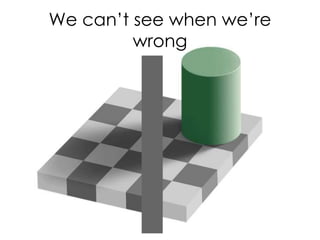
We can’t see when we’re
wrong
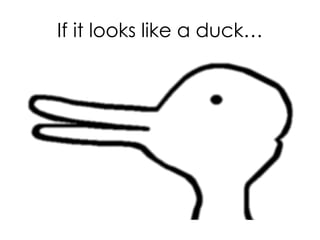
If it looks like a duck…
Two definitions of learning:
1. The long-term retention and
transfer of knowledge and skills
2. A change in how the world is
understood.
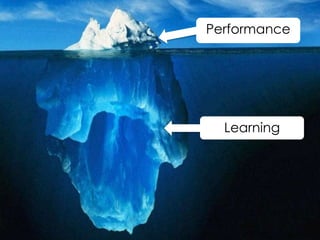
Performance
Learning
Warsaw
We believe “engaging in learning
activities…transfers the content of the activity to
the mind of the student…”
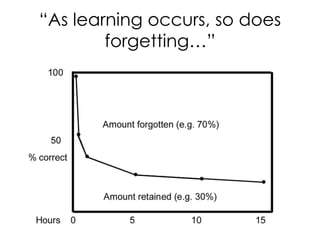
But “as learning occurs, so does forgetting…”
“learning takes time and is not
encapsulated in the visible here-and-now
of classroom activities.”
Graham Nuthall (2005)
The input/output myth
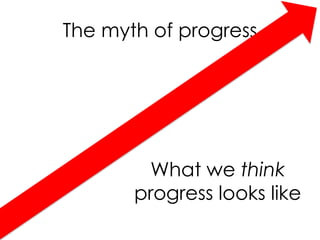
The myth of progress
What we think
progress looks like
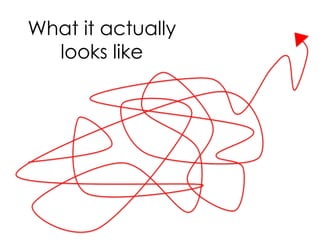
What it actually
looks like
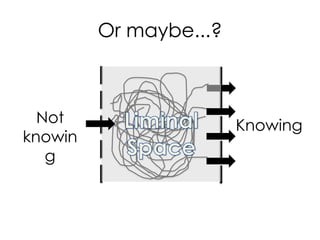
Or maybe...?
Not
knowin
g
Knowing
Learning vs performance
• We can only infer learning from
performance
• Performance is a very poor indicator of
learning
• Reducing performance might actually
increase learning
‘Poor proxies’ for learning
• Students are busy: lots of work is done
(especially written work)
• Students are engaged, interested, motivated
• Students are getting attention: feedback,
explanations
• Classroom is ordered, calm, under control
• Curriculum has been ‘covered’ (i.e. presented
to students in some form)
• (At least some) students have supplied correct
answers (whether or not they really understood
them or could reproduce them independently)
Robert Coe, Improving Education: a triumph of hope over
experience
So where does that leave us?
• Is lesson observation wrong?
The MET Project
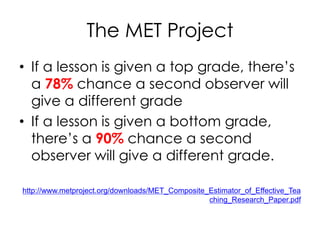
• If a lesson is given a top grade, there’s
a 78% chance a second observer will
give a different grade
• If a lesson is given a bottom grade,
there’s a 90% chance a second
observer will give a different grade.
http://www.metproject.org/downloads/MET_Composite_Estimator_of_Effective_Tea
ching_Research_Paper.pdf
Do we know a successful
teacher when we see one?
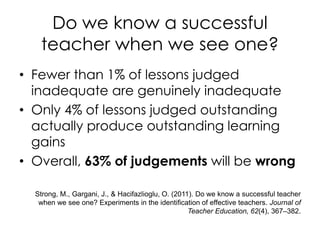
• Fewer than 1% of lessons judged
inadequate are genuinely inadequate
• Only 4% of lessons judged outstanding
actually produce outstanding learning
gains
• Overall, 63% of judgements will be wrong
Strong, M., Gargani, J., & Hacifazlioglu, O. (2011). Do we know a successful teacher
when we see one? Experiments in the identification of effective teachers. Journal of
Teacher Education, 62(4), 367–382.
So where does that leave us?
• Is lesson observation wrong?
• What about AfL?
• Outstanding teaching?
• Marking & feedback?
What can we do?
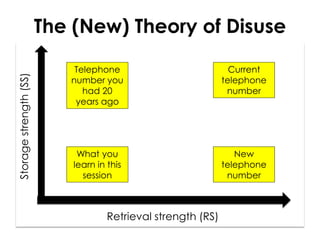
• Increasing retrieval strength only
improves performance
• Increasing storage strength depends
on the power of forgetting:
The (New) Theory of Disuse
Retrieval strength (RS)
Storagestrength(SS)
Current
telephone
number
New
telephone
number
Telephone
number you
had 20
years ago
What you
learn in this
session
“As learning occurs, so does
forgetting…”
Desirable difficulties
– Spacing
– Interleaving
– Variability
– Testing
– Reducing & delaying feedback
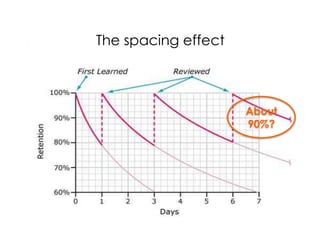
Hermann Ebbinghaus, 1885
The spacing effect
About
90%?
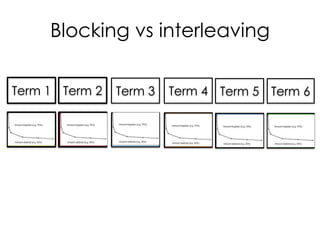
Blocking vs interleaving
Topic
1
Topic
2
Topic
3
Topic
4
Topic
5
Topic
6
Term 1 Term 2 Term 3 Term 4 Term 5 Term 6
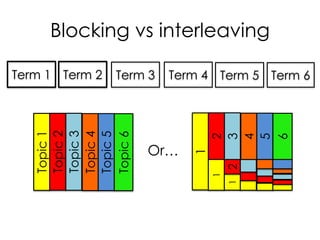
Blocking vs interleavingTopic1
Topic6
Topic4
Topic3
Topic5
Topic2
1
6
4
3
5
21
12
Or…
Term 1 Term 2 Term 3 Term 4 Term 5 Term 6
Liminality & threshold concepts
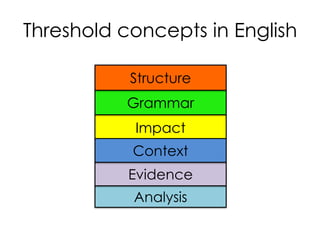
Threshold concepts in English
Impact
Grammar
Structure
Analysis
Evidence
Context
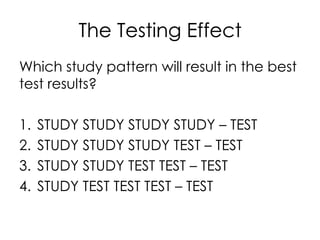
The Testing Effect
Which study pattern will result in the best
test results?
1. STUDY STUDY STUDY STUDY – TEST
2. STUDY STUDY STUDY TEST – TEST
3. STUDY STUDY TEST TEST – TEST
4. STUDY TEST TEST TEST – TEST
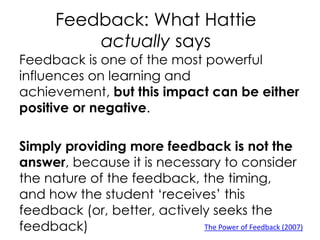
Feedback: What Hattie
actually says
Feedback is one of the most powerful
influences on learning and
achievement, but this impact can be either
positive or negative.
Simply providing more feedback is not the
answer, because it is necessary to consider
the nature of the feedback, the timing,
and how the student ‘receives’ this
feedback (or, better, actively seeks the
feedback) The Power of Feedback (2007)
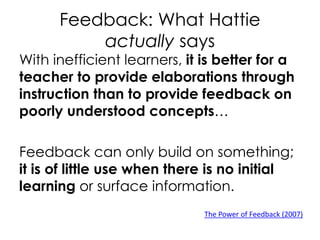
With inefficient learners, it is better for a
teacher to provide elaborations through
instruction than to provide feedback on
poorly understood concepts…
Feedback can only build on something;
it is of little use when there is no initial
learning or surface information.
The Power of Feedback (2007)
Feedback: What Hattie
actually says
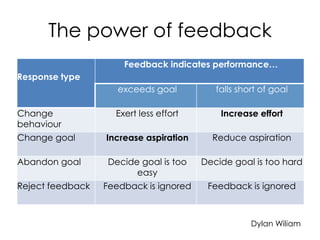
The power of feedback
Response type
Feedback indicates performance…
exceeds goal falls short of goal
Change
behaviour
Exert less effort Increase effort
Change goal Increase aspiration Reduce aspiration
Abandon goal Decide goal is too
easy
Decide goal is too hard
Reject feedback Feedback is ignored Feedback is ignored
Dylan Wiliam
Bjork on feedback
• Empirical evidence suggests that delaying,
reducing, and summarizing feedback can
be better for long-term learning than
providing immediate, trial-by-trial feedback.
• Numerous studies—some of them dating
back decades—have shown that frequent
and immediate feedback can, contrary to
intuition, degrade learning.
Learning vs Performance (2013)
But, why?
• Immediate feedback can prevent
memorisation
• Students can become dependent
• Slows down pace of learning
• Providing feedback of success is a waste
of effort (opportunity cost)
What should we do?
• Separate learning from performance
• Introduce desirable difficulties
• Question your assumptions – be
prepared to ‘murder your darlings’.
@LearningSpy
learningspy.co.uk
ddidau@gmail.com

#LFE15 Learning is invisible

  • 1.
    Is Learning Invisible? David Didau LondonFestival of Education 28th February 2015
  • 2.
    We can’t seewhen we’re wrong
  • 4.
    If it lookslike a duck…
  • 5.
    Two definitions oflearning: 1. The long-term retention and transfer of knowledge and skills 2. A change in how the world is understood.
  • 6.
  • 7.
  • 8.
    We believe “engagingin learning activities…transfers the content of the activity to the mind of the student…” But “as learning occurs, so does forgetting…” “learning takes time and is not encapsulated in the visible here-and-now of classroom activities.” Graham Nuthall (2005) The input/output myth
  • 9.
    The myth ofprogress What we think progress looks like
  • 10.
  • 11.
  • 12.
    Learning vs performance •We can only infer learning from performance • Performance is a very poor indicator of learning • Reducing performance might actually increase learning
  • 13.
    ‘Poor proxies’ forlearning • Students are busy: lots of work is done (especially written work) • Students are engaged, interested, motivated • Students are getting attention: feedback, explanations • Classroom is ordered, calm, under control • Curriculum has been ‘covered’ (i.e. presented to students in some form) • (At least some) students have supplied correct answers (whether or not they really understood them or could reproduce them independently) Robert Coe, Improving Education: a triumph of hope over experience
  • 14.
    So where doesthat leave us? • Is lesson observation wrong?
  • 15.
    The MET Project •If a lesson is given a top grade, there’s a 78% chance a second observer will give a different grade • If a lesson is given a bottom grade, there’s a 90% chance a second observer will give a different grade. http://www.metproject.org/downloads/MET_Composite_Estimator_of_Effective_Tea ching_Research_Paper.pdf
  • 16.
    Do we knowa successful teacher when we see one? • Fewer than 1% of lessons judged inadequate are genuinely inadequate • Only 4% of lessons judged outstanding actually produce outstanding learning gains • Overall, 63% of judgements will be wrong Strong, M., Gargani, J., & Hacifazlioglu, O. (2011). Do we know a successful teacher when we see one? Experiments in the identification of effective teachers. Journal of Teacher Education, 62(4), 367–382.
  • 17.
    So where doesthat leave us? • Is lesson observation wrong? • What about AfL? • Outstanding teaching? • Marking & feedback?
  • 18.
    What can wedo? • Increasing retrieval strength only improves performance • Increasing storage strength depends on the power of forgetting:
  • 19.
    The (New) Theoryof Disuse Retrieval strength (RS) Storagestrength(SS) Current telephone number New telephone number Telephone number you had 20 years ago What you learn in this session
  • 20.
    “As learning occurs,so does forgetting…”
  • 21.
    Desirable difficulties – Spacing –Interleaving – Variability – Testing – Reducing & delaying feedback
  • 22.
    Hermann Ebbinghaus, 1885 Thespacing effect About 90%?
  • 23.
  • 24.
  • 25.
  • 26.
    Threshold concepts inEnglish Impact Grammar Structure Analysis Evidence Context
  • 27.
    The Testing Effect Whichstudy pattern will result in the best test results? 1. STUDY STUDY STUDY STUDY – TEST 2. STUDY STUDY STUDY TEST – TEST 3. STUDY STUDY TEST TEST – TEST 4. STUDY TEST TEST TEST – TEST
  • 28.
    Feedback: What Hattie actuallysays Feedback is one of the most powerful influences on learning and achievement, but this impact can be either positive or negative. Simply providing more feedback is not the answer, because it is necessary to consider the nature of the feedback, the timing, and how the student ‘receives’ this feedback (or, better, actively seeks the feedback) The Power of Feedback (2007)
  • 29.
    With inefficient learners,it is better for a teacher to provide elaborations through instruction than to provide feedback on poorly understood concepts… Feedback can only build on something; it is of little use when there is no initial learning or surface information. The Power of Feedback (2007) Feedback: What Hattie actually says
  • 30.
    The power offeedback Response type Feedback indicates performance… exceeds goal falls short of goal Change behaviour Exert less effort Increase effort Change goal Increase aspiration Reduce aspiration Abandon goal Decide goal is too easy Decide goal is too hard Reject feedback Feedback is ignored Feedback is ignored Dylan Wiliam
  • 31.
    Bjork on feedback •Empirical evidence suggests that delaying, reducing, and summarizing feedback can be better for long-term learning than providing immediate, trial-by-trial feedback. • Numerous studies—some of them dating back decades—have shown that frequent and immediate feedback can, contrary to intuition, degrade learning. Learning vs Performance (2013)
  • 32.
    But, why? • Immediatefeedback can prevent memorisation • Students can become dependent • Slows down pace of learning • Providing feedback of success is a waste of effort (opportunity cost)
  • 33.
    What should wedo? • Separate learning from performance • Introduce desirable difficulties • Question your assumptions – be prepared to ‘murder your darlings’.
  • 34.

Editor's Notes

  • #29 http://education.qld.gov.au/staff/development/performance/resources/readings/power-feedback.pdf
  • #30 http://education.qld.gov.au/staff/development/performance/resources/readings/power-feedback.pdf
  • #32 http://bjorklab.psych.ucla.edu/pubs/Soderstrom_Bjork_Learning_versus_Performance.pdf