Deliberately difficult
Why it might be better to make
learning slower
David Didau
Wellington Education Festival
22nd June 2013
The most important role of
teaching is to promote
learning and to raise pupils‟
achievement.
Ofsted Inspection Handbook, 2013
Outstanding teaching and
learning will result in “almost
all pupils … making rapid and
sustained progress.”
Ofsted Inspection Handbook, 2013
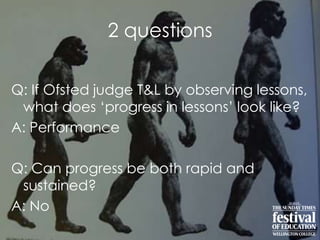
2 questions
Q: If Ofsted judge T&L by observing lessons,
what does „progress in lessons‟ look like?
A: Performance
Q: Can progress be both rapid and
sustained?
A: No
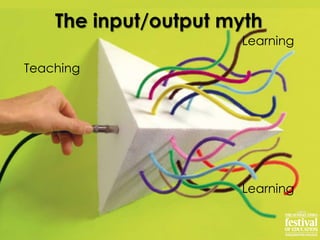
Teaching
Learning
Learning
The input/output myth
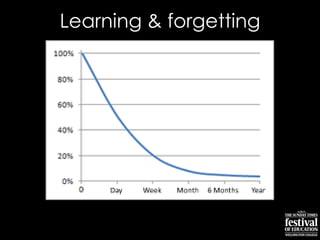
• But “as learning occurs, so does
forgetting…
…learning takes time and is not
encapsulated in the visible here-and-
now of classroom activities.”
Graham Nuthall, The Hidden Lives of Learners
The input/output myth
Learning & forgetting
What can be done?
1. Separate performance from learning
2. Introduce „desirable difficulties‟
Prf. Robert Bjork, UCLA
1.Separating learning from
performance
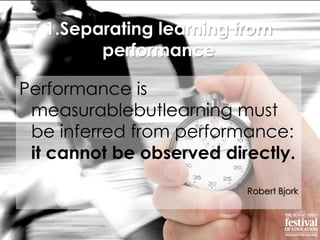
Performance is
measurablebutlearning must
be inferred from performance:
it cannot be observed directly.
Robert Bjork
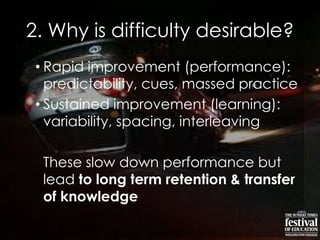
2. Why is difficulty desirable?
• Rapid improvement (performance):
predictability, cues, massed practice
• Sustained improvement (learning):
variability, spacing, interleaving
These slow down performance but
lead to long term retention & transfer
of knowledge
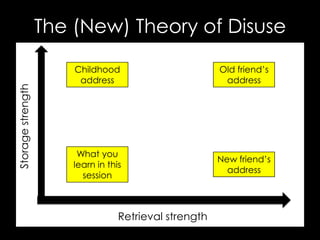
The (New) Theory of Disuse
Retrieval strength
Storagestrength
Old friend‟s
address
New friend‟s
address
Childhood
address
What you
learn in this
session
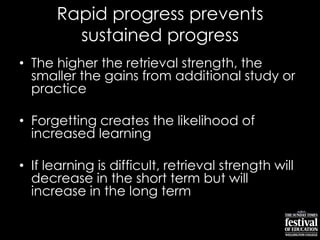
Rapid progress prevents
sustained progress
• The higher the retrieval strength, the
smaller the gains from additional study or
practice
• Forgetting creates the likelihood of
increased learning
• If learning is difficult, retrieval strength will
decrease in the short term but will
increase in the long term
“The illusion of knowing”
Everyone likes rapid progress
But…
The route to sustained progress is
counter intuitive
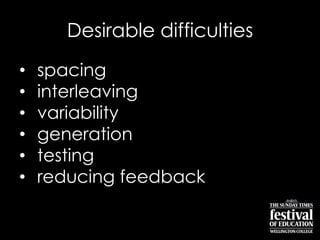
Desirable difficulties
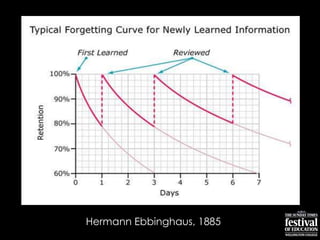
• spacing
• interleaving
• variability
• generation
• testing
• reducing feedback
Hermann Ebbinghaus, 1885
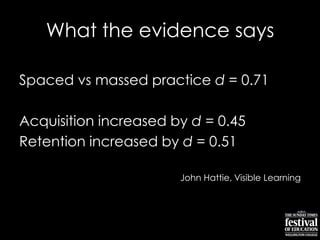
What the evidence says
Spaced vs massed practice d = 0.71
Acquisition increased by d = 0.45
Retention increased by d = 0.51
John Hattie, Visible Learning
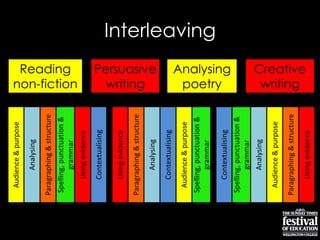
Interleaving
Reading
non-fiction
Persuasive
writing
Audience&purpose
Spelling,punctuation&
grammar
Paragraphing&structure
Analysing
Contextualising
Audience&purpose
Spelling,punctuation&
grammar
Paragraphing&structure
Analysing
Usingevidence
Contextualising
Audience&purpose
Spelling,punctuation&
grammar
Paragraphing&structure
Analysing
Contextualising
Usingevidence
Usingevidence
Analysing
poetry
Creative
writing
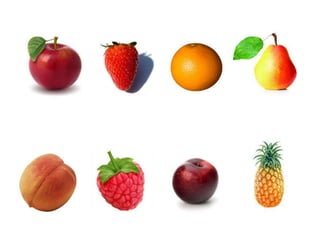
Generation
Generating information is more
memorable than just reading it
Apple
Pear
Or_____
Ra______
Items we‟ve not practised
retrieving are more likely to be
forgotten in the short term
But, forgetting increases chances
of retaining information that is
represented
Retrieval induced forgetting
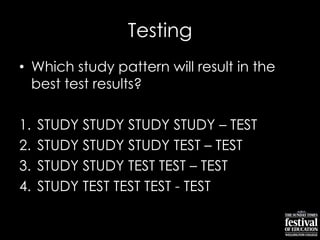
Testing
• Which study pattern will result in the
best test results?
1. STUDY STUDY STUDY STUDY – TEST
2. STUDY STUDY STUDY TEST – TEST
3. STUDY STUDY TEST TEST – TEST
4. STUDY TEST TEST TEST - TEST
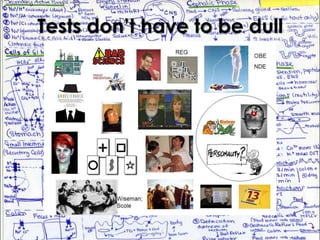
Tests don’t have to be dull
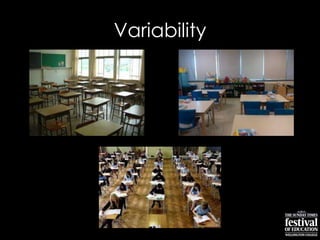
Variability
Reducing feedback
• Providing feedback of success is
counter productive
• Students become dependent
• Slows down pace of learning
• Prevents risk taking & challenge
A teacher‟s job is not to make work
easy. It is to make it difficult. if you
are not challenged, you do not
make mistakes. If you do not
make mistakes, feedback is
useless.
John Hattie, Visible Learning
Key messages
• Performance is not evidence of
learning
• Share the theory of „deliberate
difficulties‟ with your students
• Don‟t trust your gut!
Sapere aude!
David Didau
@LearningSpy
learningspy.co.uk
ddidau@gmail.com

Ed fest desirable difficulties

Editor's Notes

  • #5 Performance can be propped up by predictability and current cues that are present during the lesson but won’t be present when the information is needed later. This can make it seem that a student is making rapid progress but there may not actually be any learning happening.
  • #10 Learning occurs but performance in the short term doesn’t improve, or…Performance improves, but little learning seems to happen in the long term.
  • #13 represent, change context etc.
  • #20 Threshold concepts?
  • #23 Interference vs inhibiition??Items we’ve not practised retrieving are more likely to be forgotten in the short term but are more likely to be ‘learned’ in the long term
  • #26 We respond to familiar cuesIf you take a test in the room in which you’ve learned you’ll do better – but much worse in an unfamiliar settingBut, if you learn in lots of different configurations, you’ll do better in tests