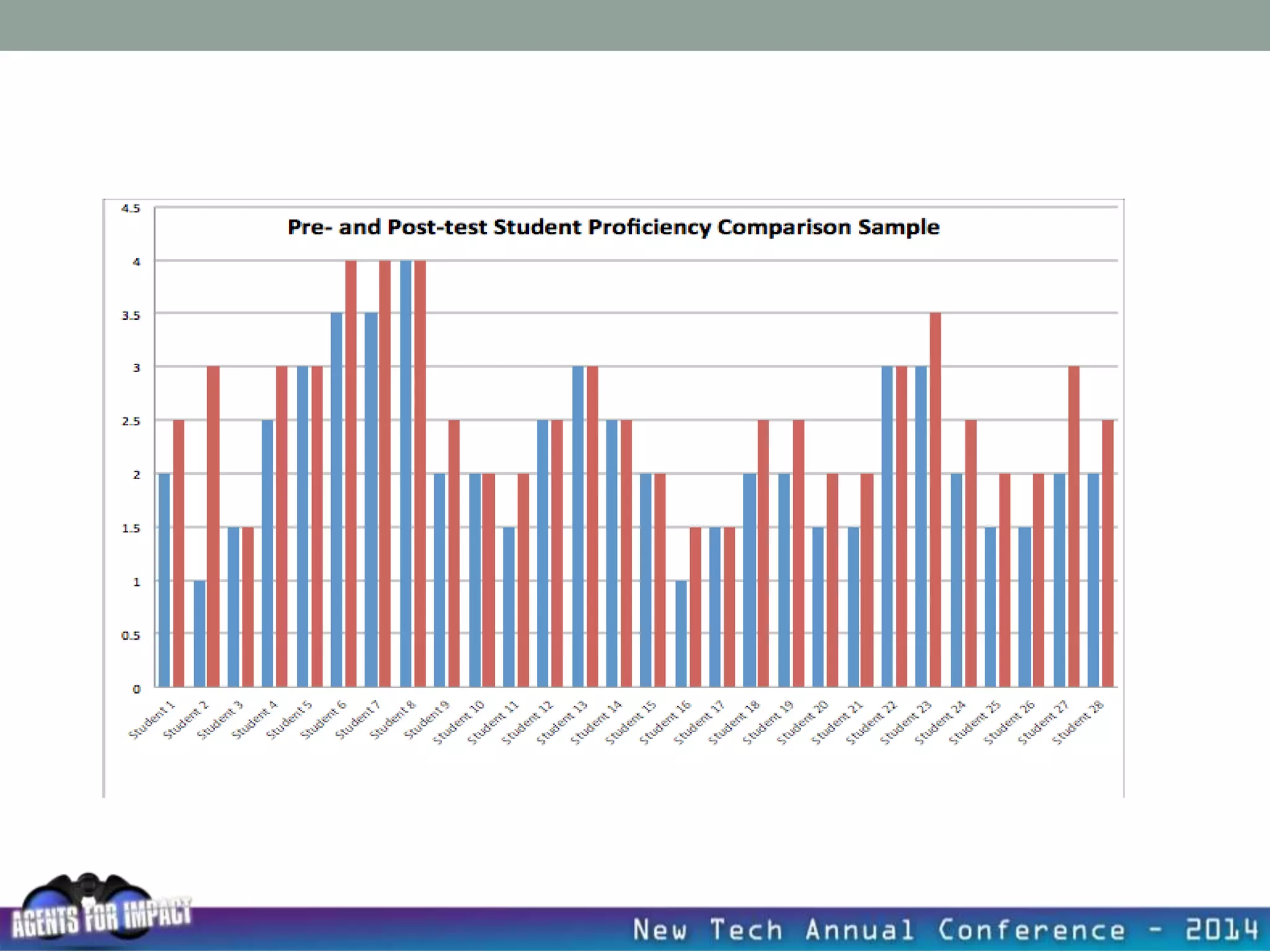
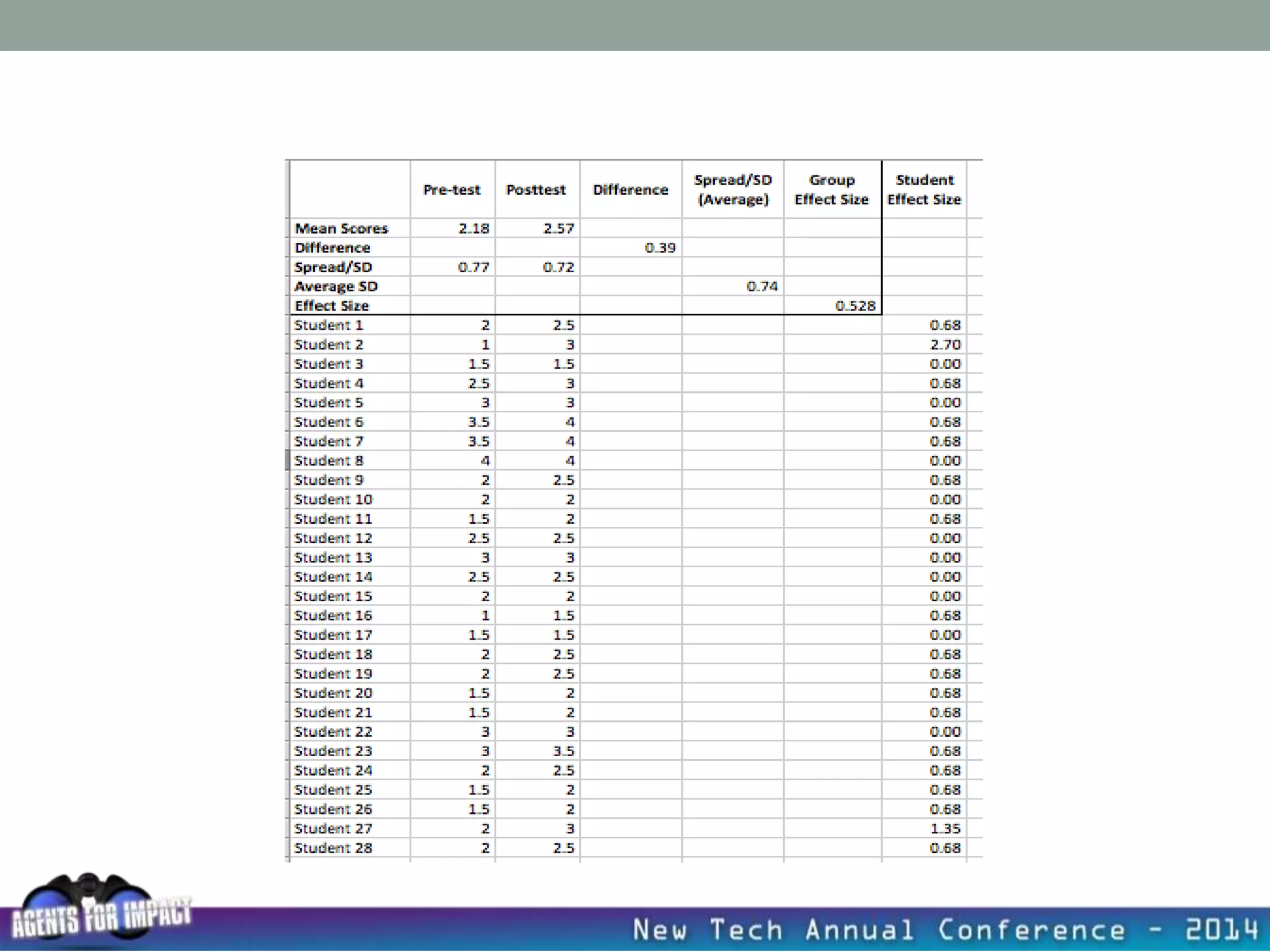
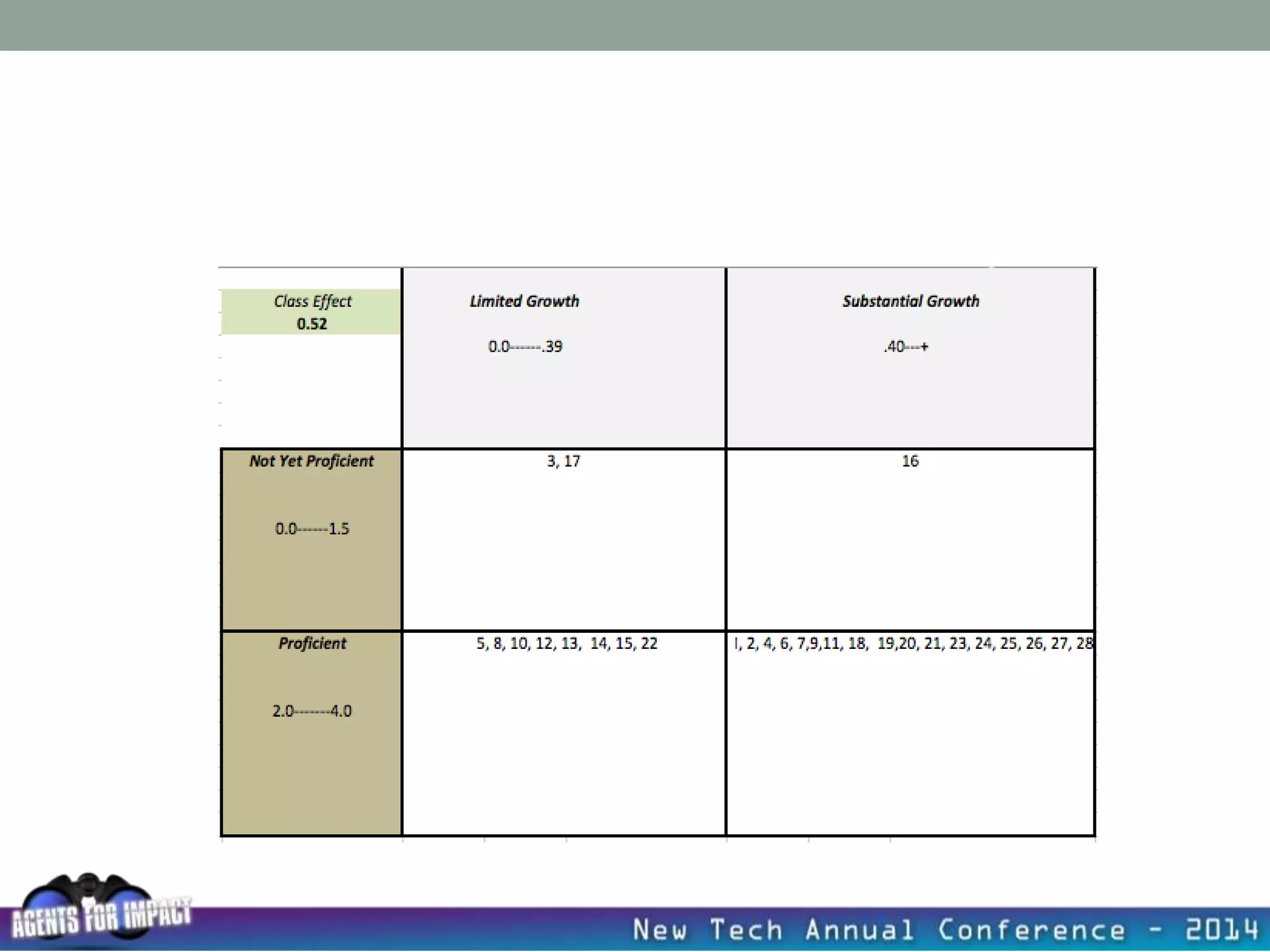
SYSTEM-WIDE IMPACT
ON STUDENT
LEARNING
Michael McDowell, Ed.D.
HOW DO YOU CREATE A SYSTEM
THAT SUBSTANTIALLY ENHANCES
STUDENT LEARNING IN CONTENT,
COGNITVE, AND CONATIVE
DOMAINS?
Table of Contents
• “Start with a story”
• “Defining Autonomy”
• “Seeing the both/and of student performance”
• “Space for PBL”
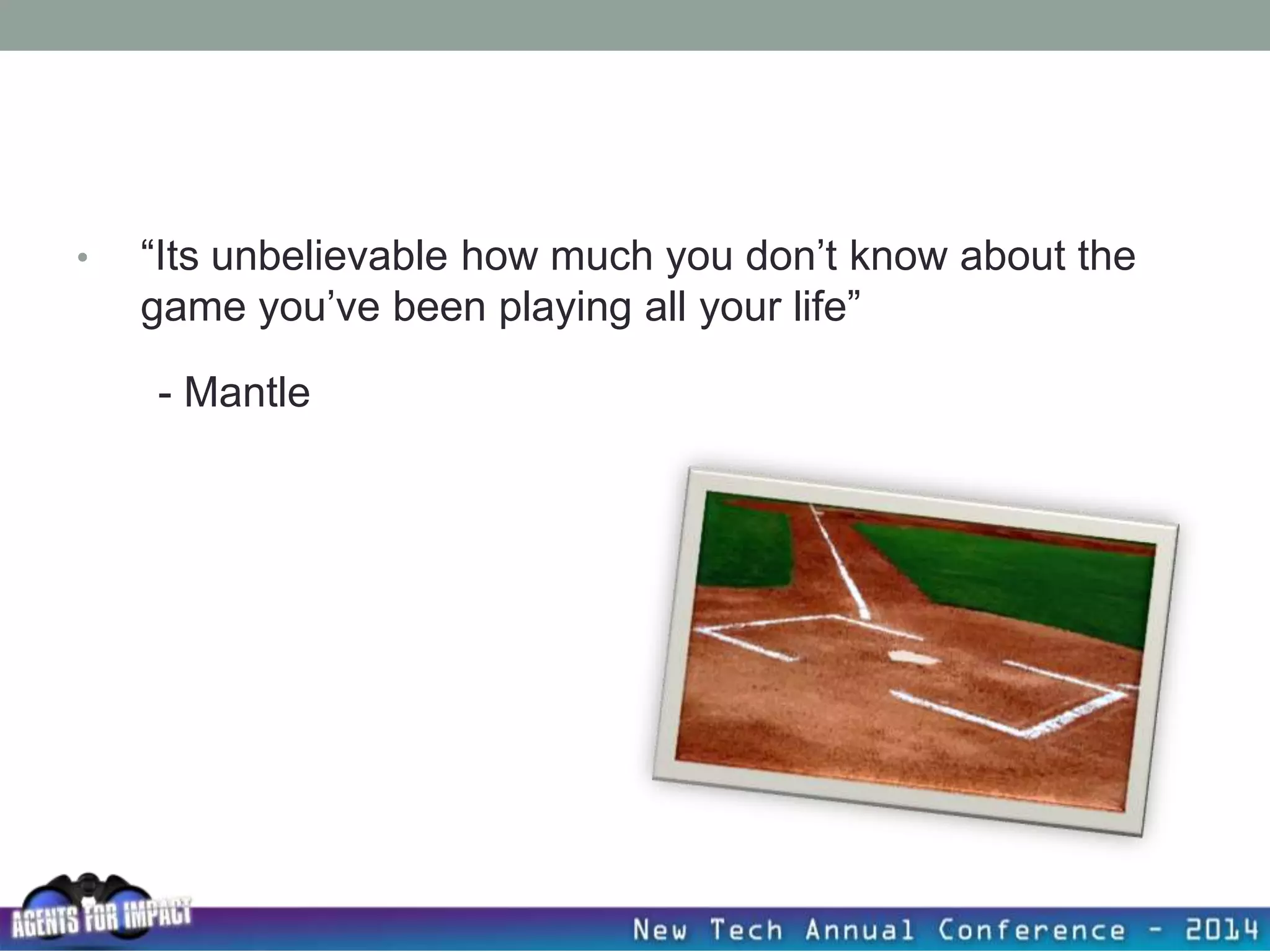
• “Its unbelievable how much you don’t know about the
game you’ve been playing all your life”
- Mantle
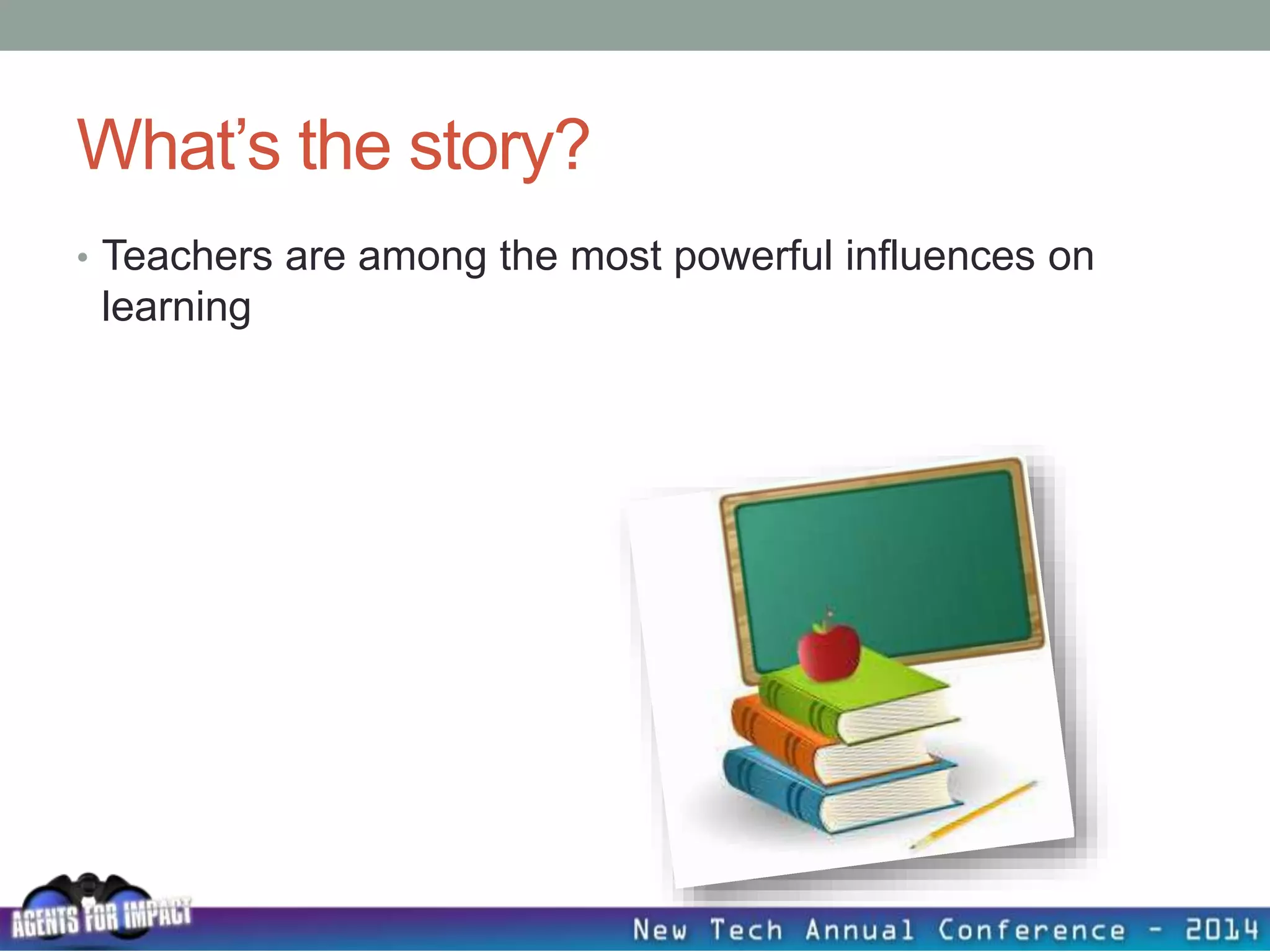
What’s the story?
• Teachers are among the most powerful influences on
learning
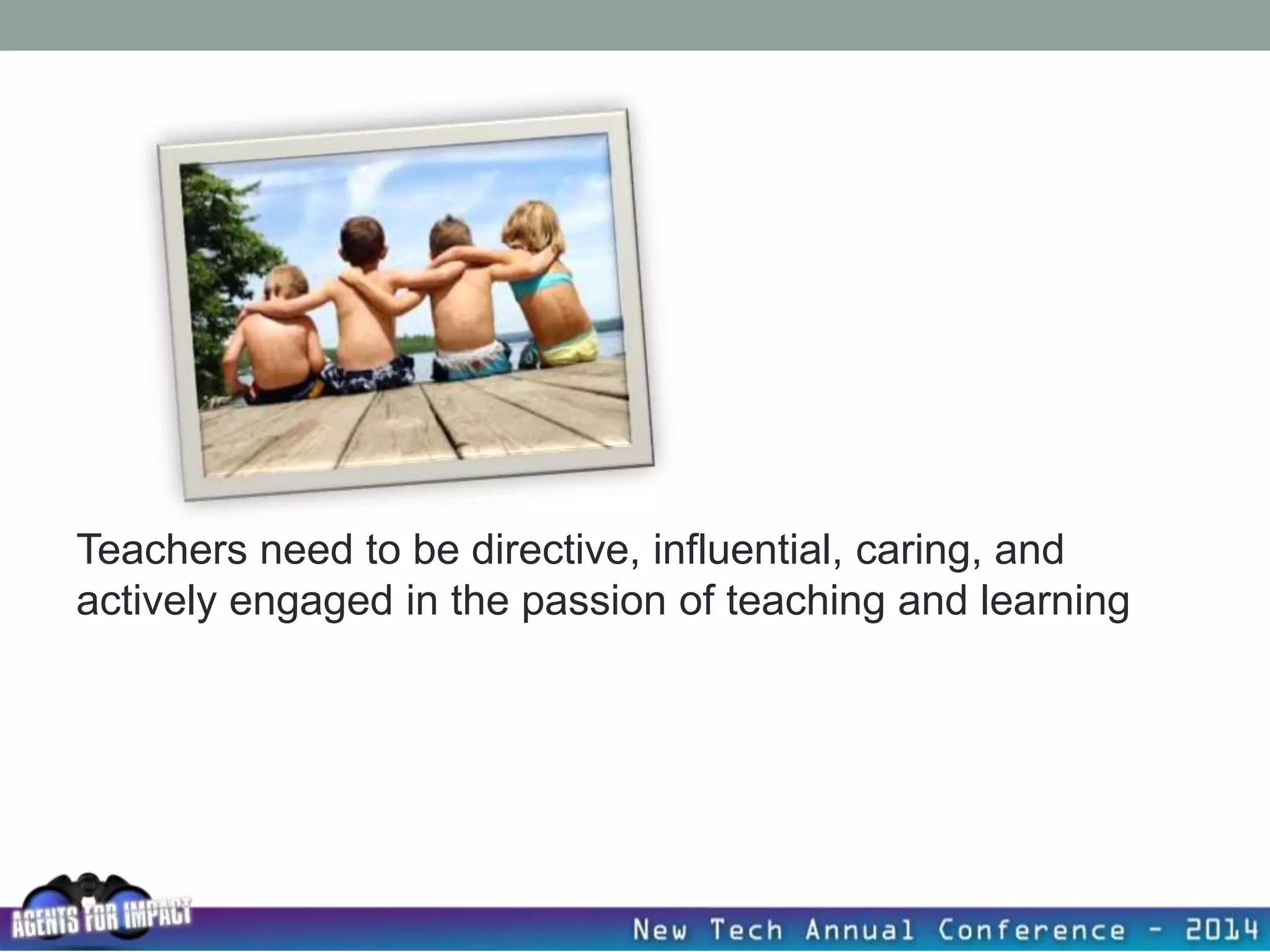
Teachers need to be directive, influential, caring, and
actively engaged in the passion of teaching and learning
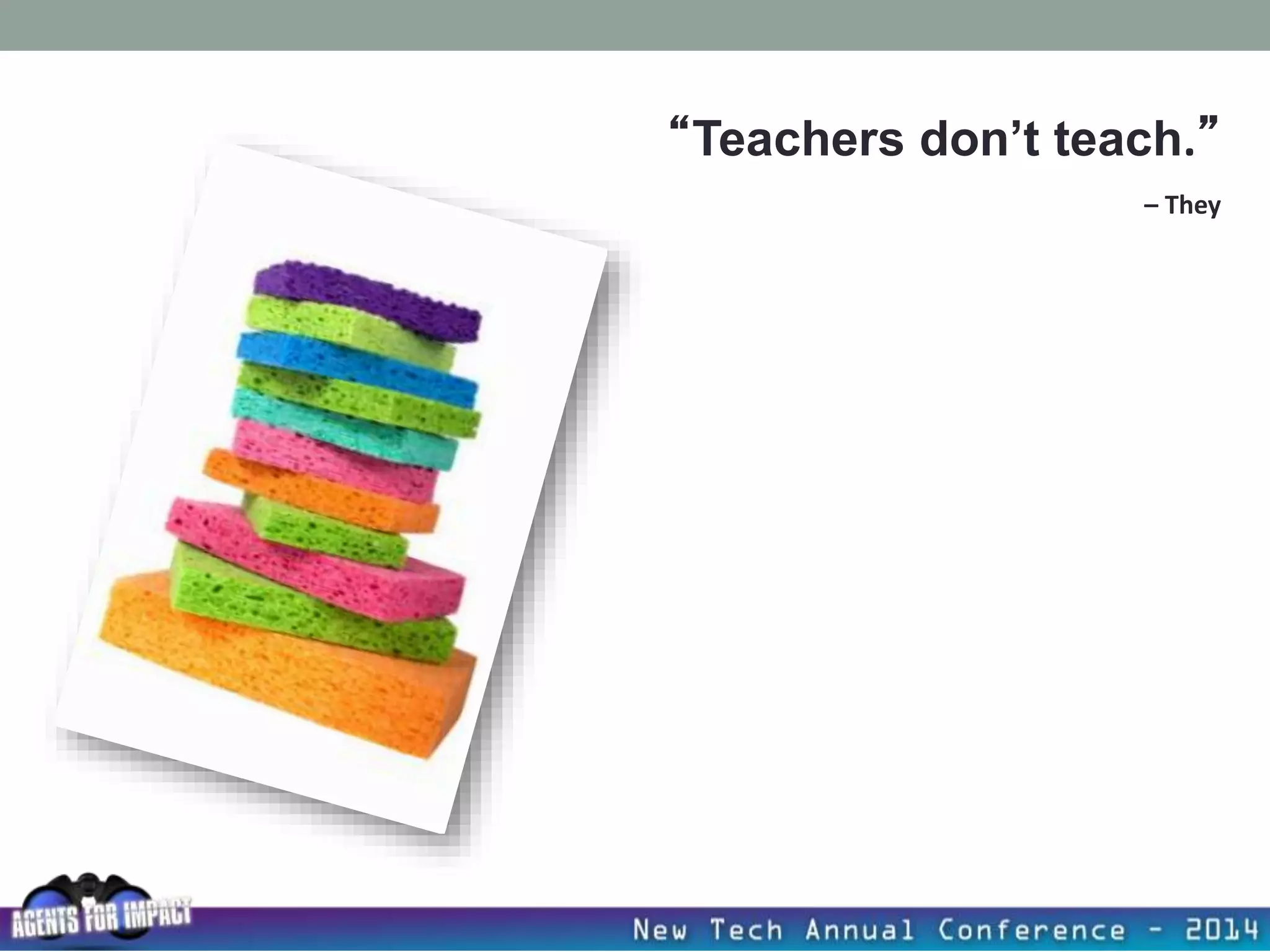
“Teachers don’t teach.”
– They
• Teachers need to be aware of what each and every
student is thinking and knowing, to construct meaning and
meaningful experiences in light of this knowledge, and
have proficient knowledge and understanding of their
content to provide meaningful and appropriate feedback
such that each student moves progressively through the
curriculum levels
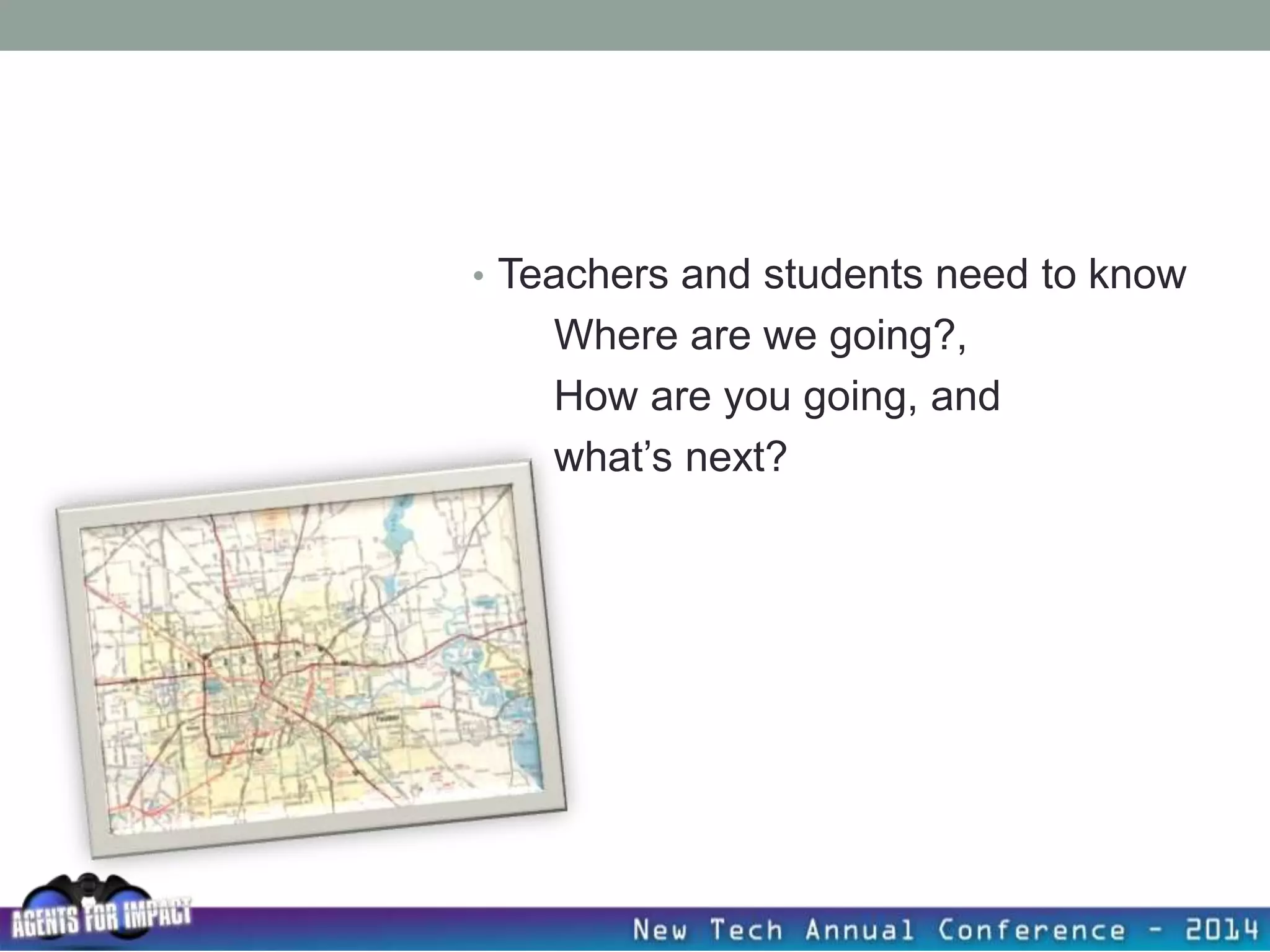
• Teachers and students need to know
Where are we going?,
How are you going, and
what’s next?
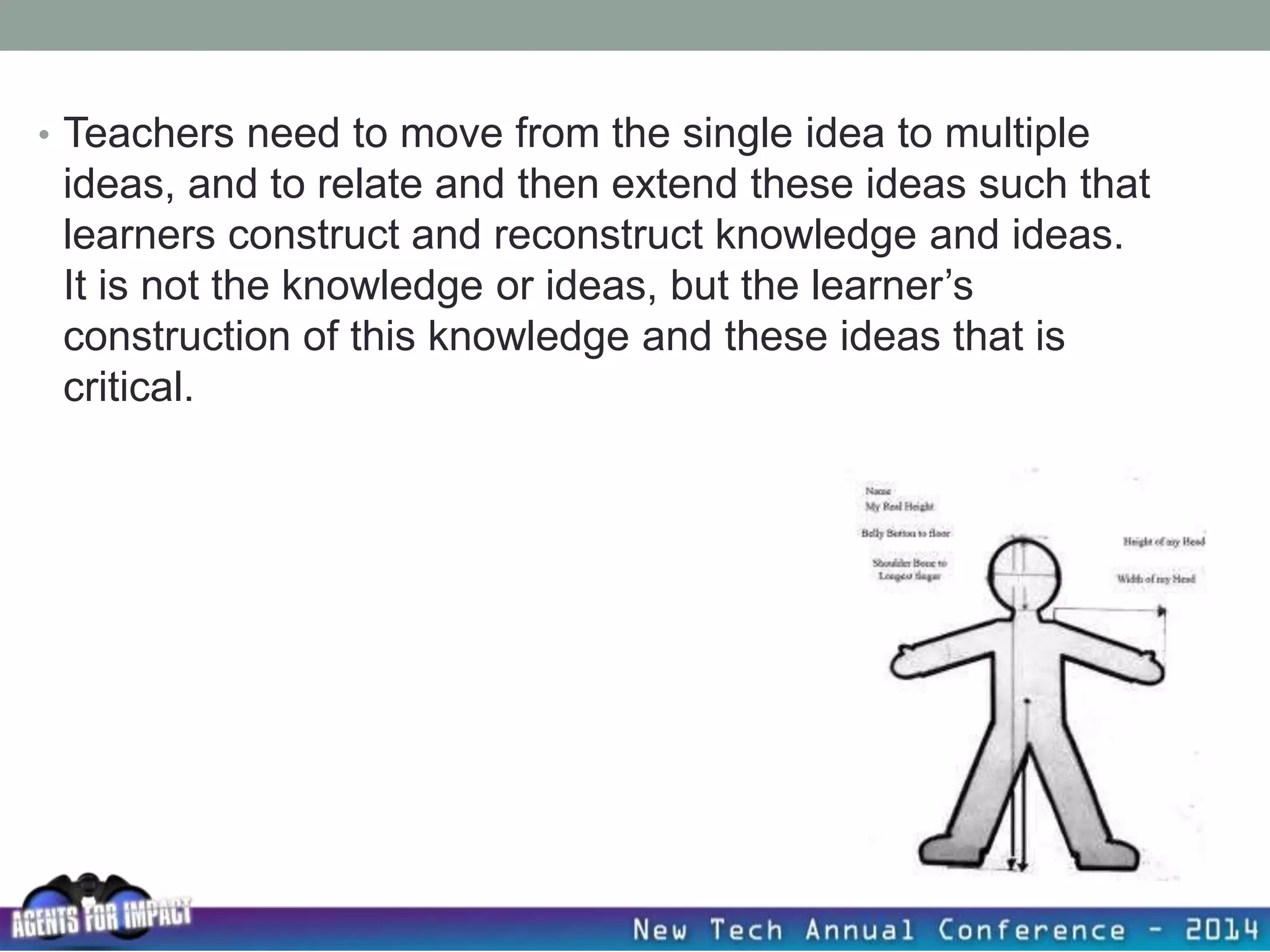
• Teachers need to move from the single idea to multiple
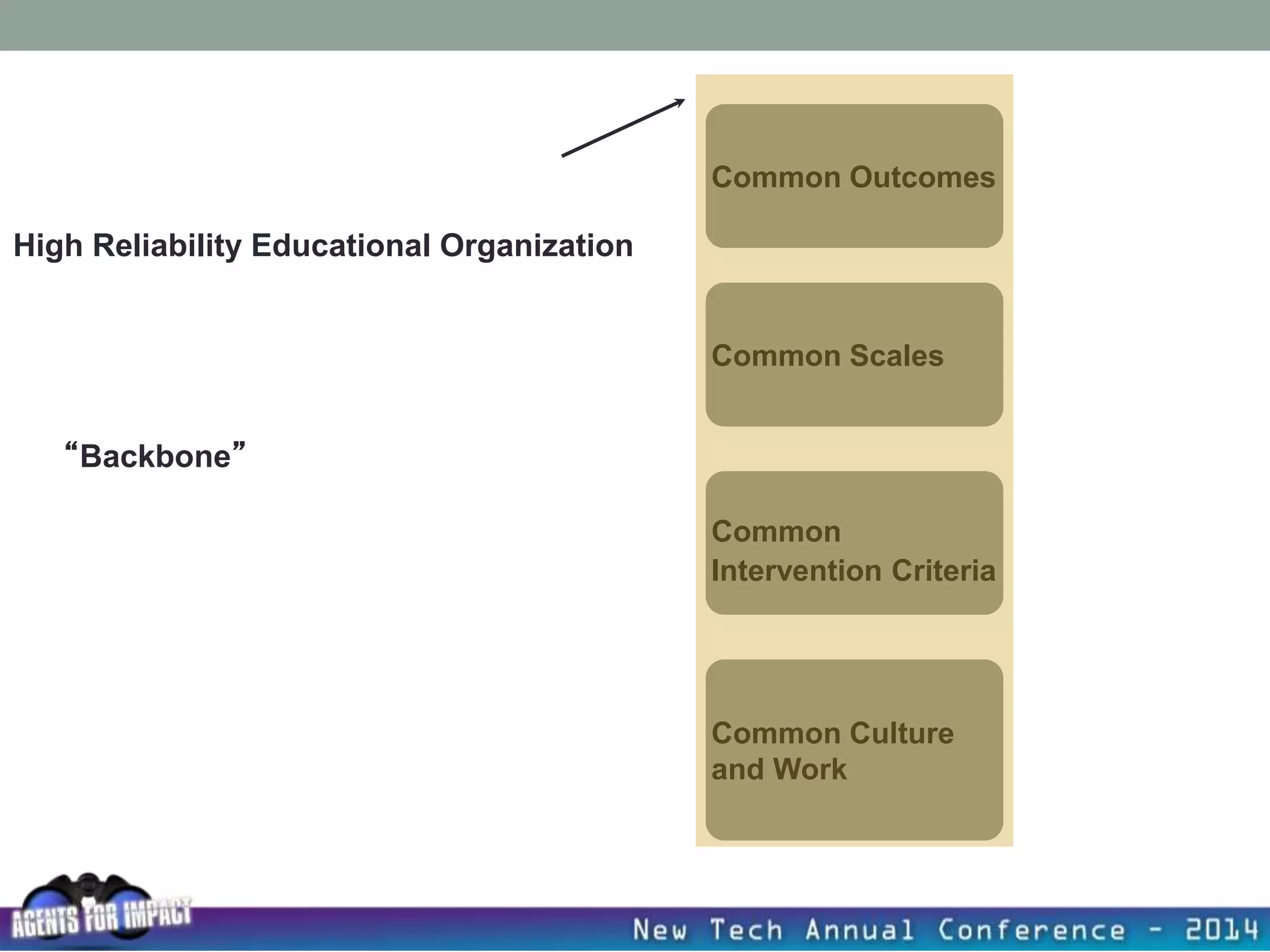
ideas, and to relate and then extend these ideas such that
learners construct and reconstruct knowledge and ideas.
It is not the knowledge or ideas, but the learner’s
construction of this knowledge and these ideas that is
critical.
• School leaders and teachers need to create school,
staffroom, and classroom environments where error is
welcomed as a learning opportunity, where discarding
incorrect knowledge and understandings is welcomed,
and where participants can feel safe to learn, re-learn,
and explore knowledge and understanding.
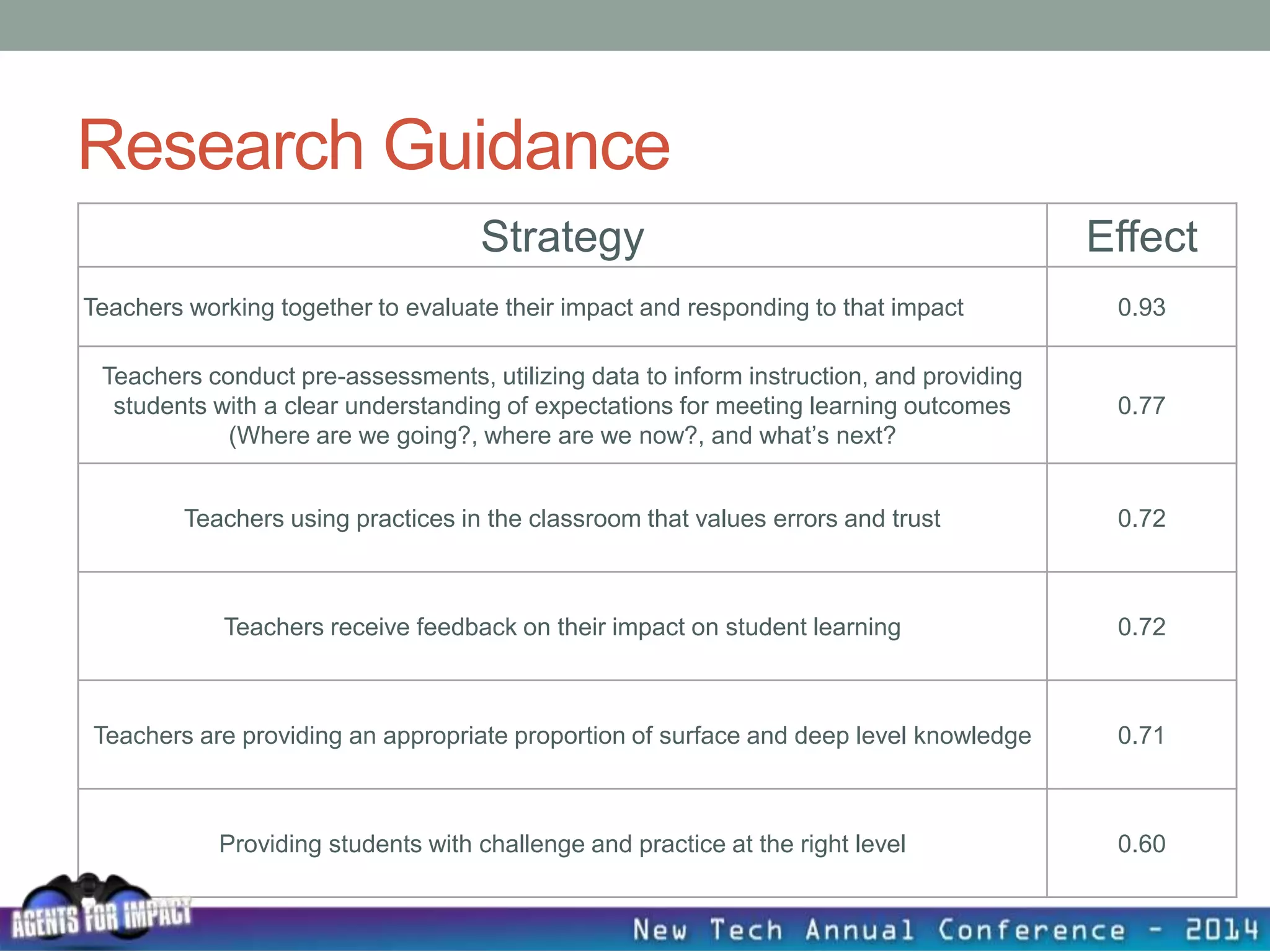
Research Guidance
Strategy Effect
Teachers working together to evaluate their impact and responding to that impact 0.93
Teachers conduct pre-assessments, utilizing data to inform instruction, and providing
students with a clear understanding of expectations for meeting learning outcomes
(Where are we going?, where are we now?, and what’s next?
0.77
Teachers using practices in the classroom that values errors and trust 0.72
Teachers receive feedback on their impact on student learning 0.72
Teachers are providing an appropriate proportion of surface and deep level knowledge 0.71
Providing students with challenge and practice at the right level 0.60
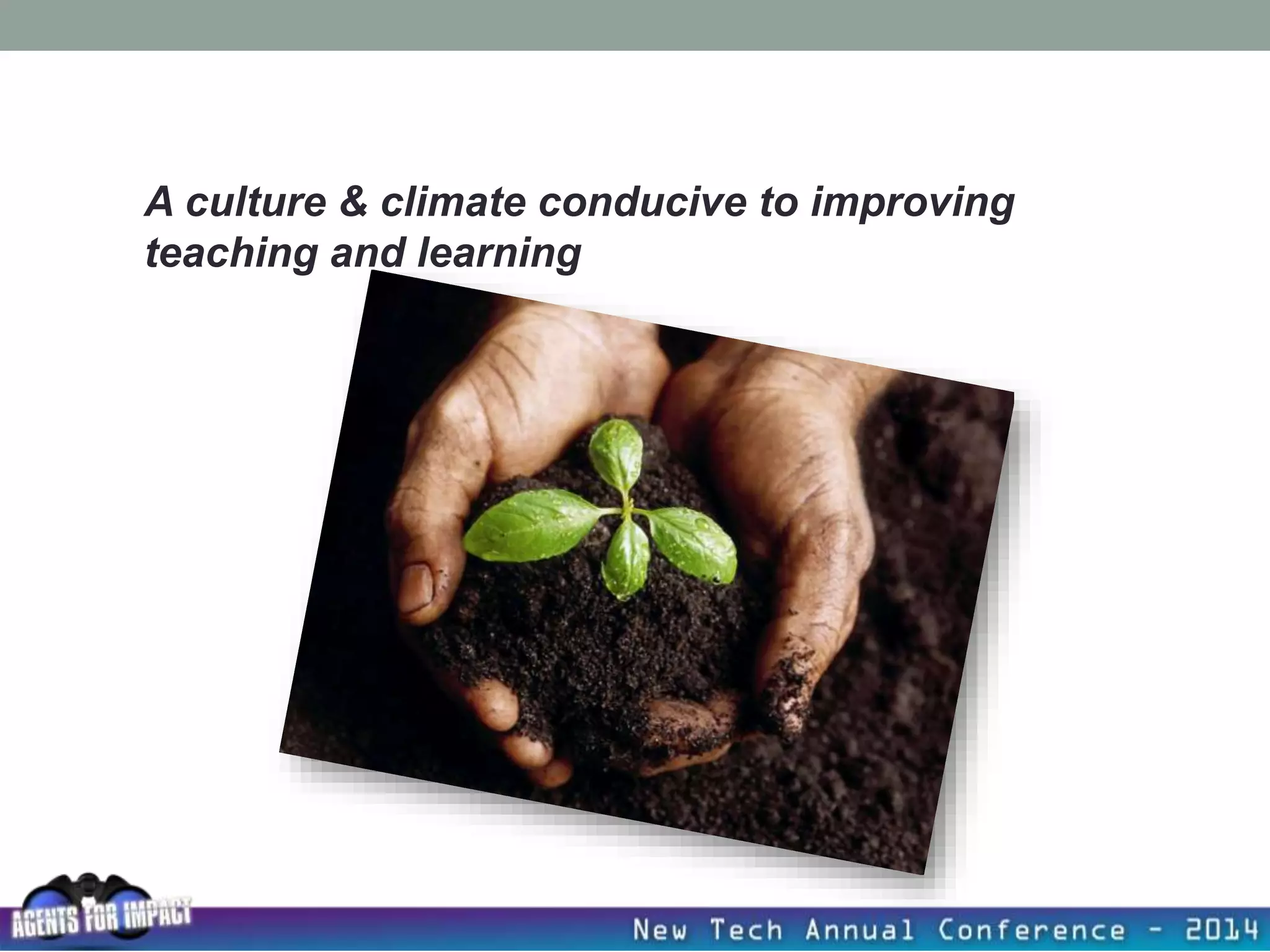
A culture & climate conducive to improving
teaching and learning
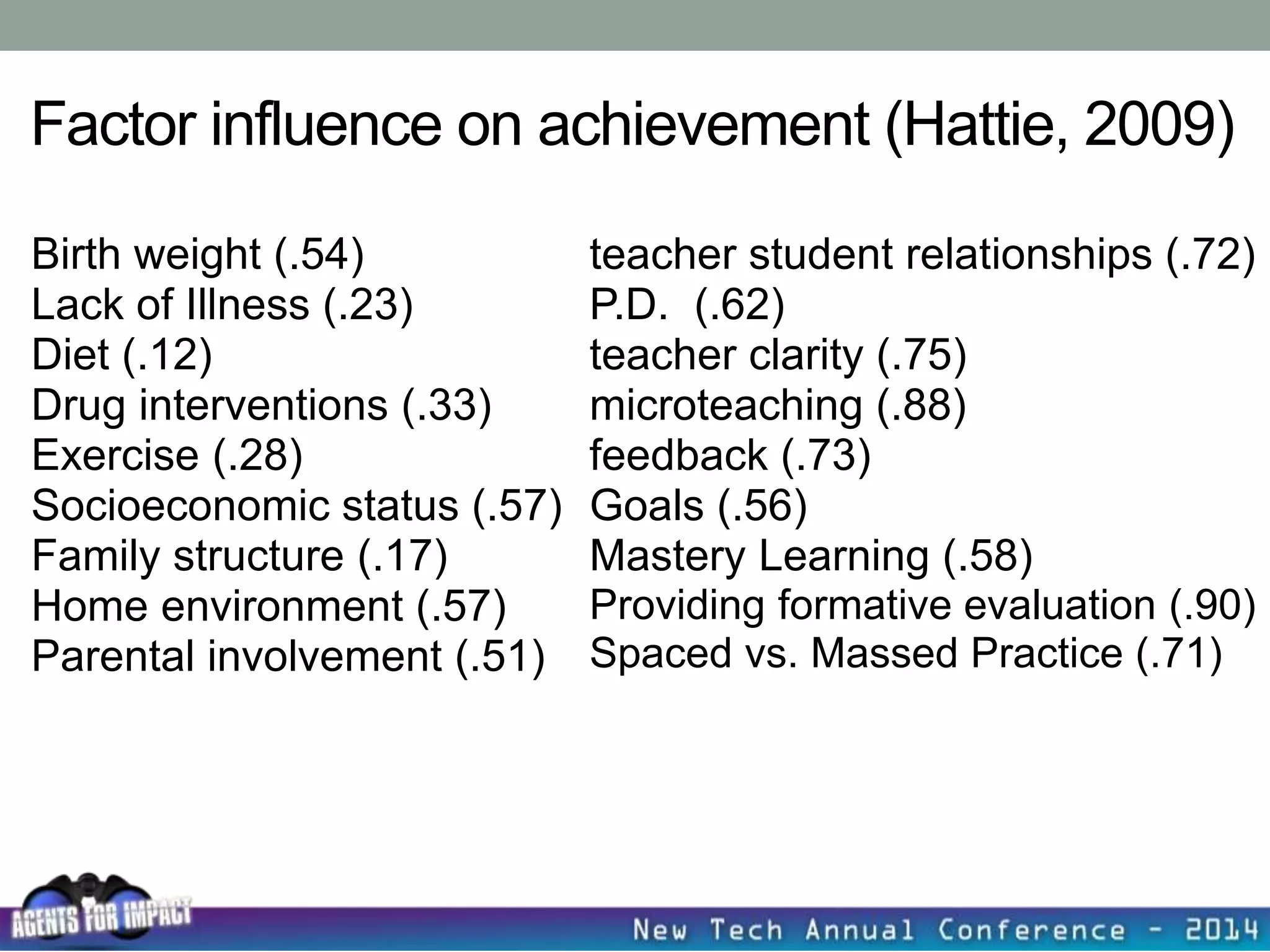
Factor influence on achievement (Hattie, 2009)
Birth weight (.54)
Lack of Illness (.23)
Diet (.12)
Drug interventions (.33)
Exercise (.28)
Socioeconomic status (.57)
Family structure (.17)
Home environment (.57)
Parental involvement (.51)
teacher student relationships (.72)
P.D. (.62)
teacher clarity (.75)
microteaching (.88)
feedback (.73)
Goals (.56)
Mastery Learning (.58)
Providing formative evaluation (.90)
Spaced vs. Massed Practice (.71)
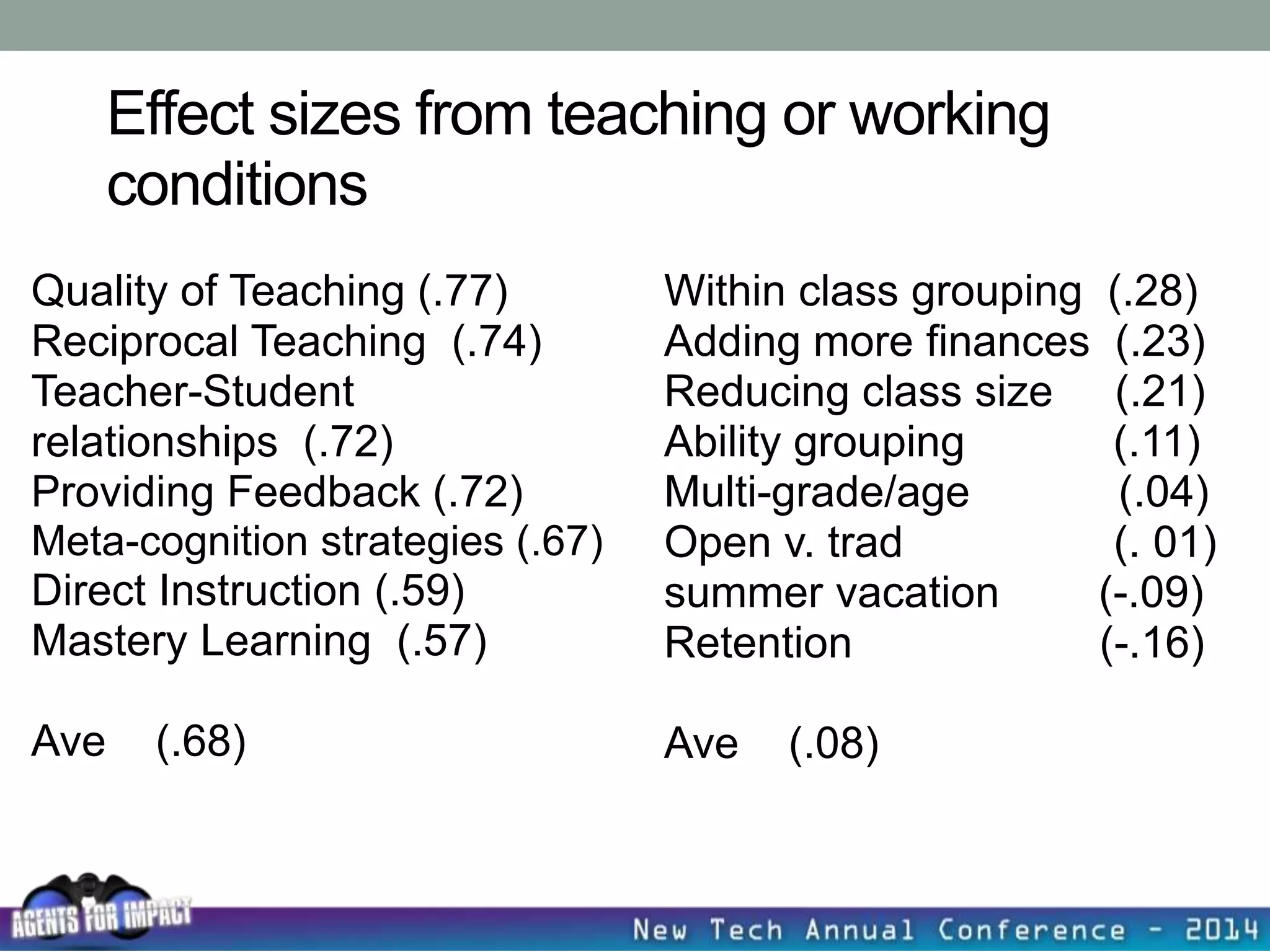
Effect sizes from teaching or working
conditions
Quality of Teaching (.77)
Reciprocal Teaching (.74)
Teacher-Student
relationships (.72)
Providing Feedback (.72)
Meta-cognition strategies (.67)
Direct Instruction (.59)
Mastery Learning (.57)
Ave (.68)
Within class grouping (.28)
Adding more finances (.23)
Reducing class size (.21)
Ability grouping (.11)
Multi-grade/age (.04)
Open v. trad (. 01)
summer vacation (-.09)
Retention (-.16)
Ave (.08)
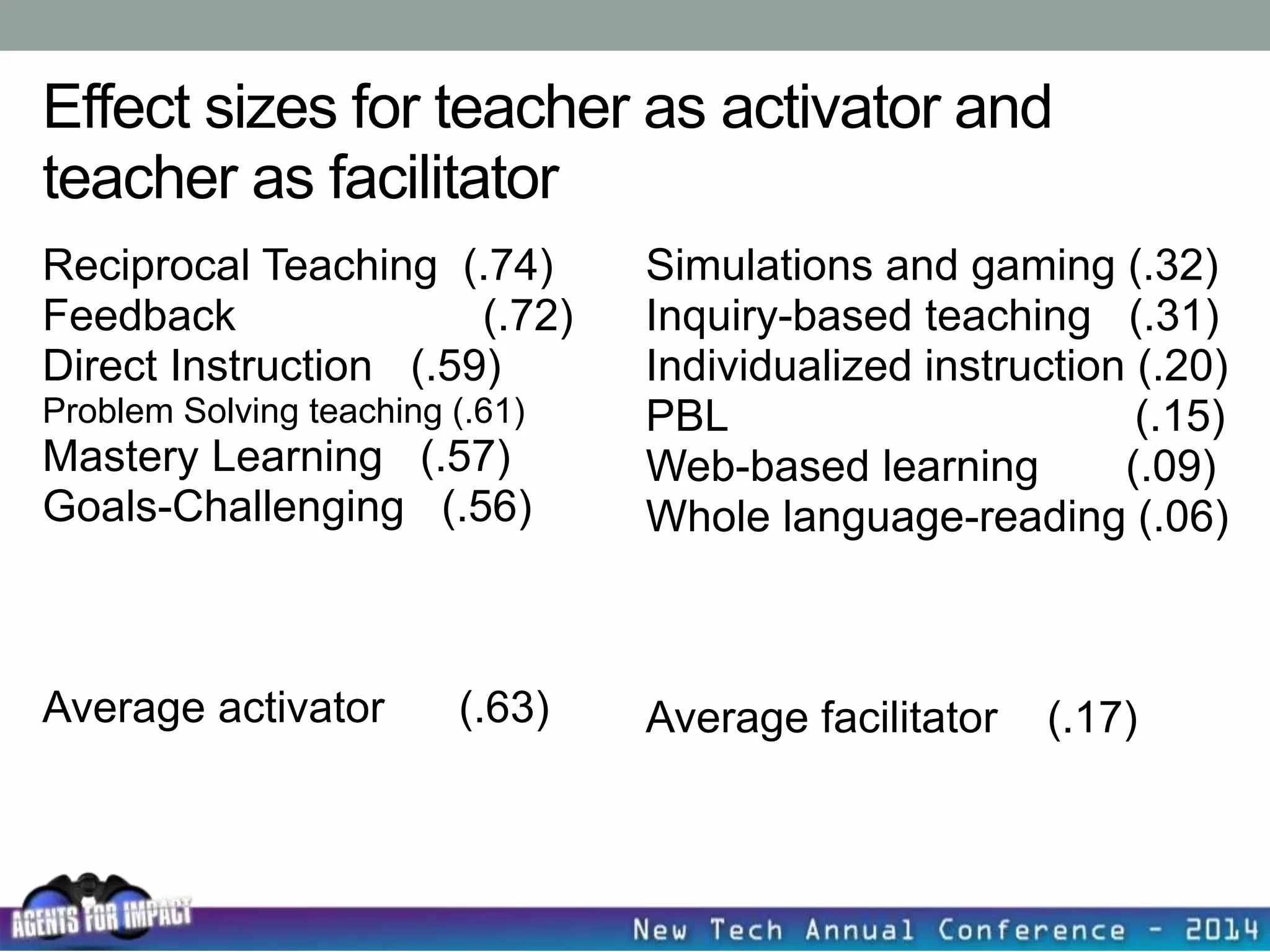
Effect sizes for teacher as activator and
teacher as facilitator
Reciprocal Teaching (.74)
Feedback (.72)
Direct Instruction (.59)
Problem Solving teaching (.61)
Mastery Learning (.57)
Goals-Challenging (.56)
Average activator (.63)
Simulations and gaming (.32)
Inquiry-based teaching (.31)
Individualized instruction (.20)
PBL (.15)
Web-based learning (.09)
Whole language-reading (.06)
Average facilitator (.17)
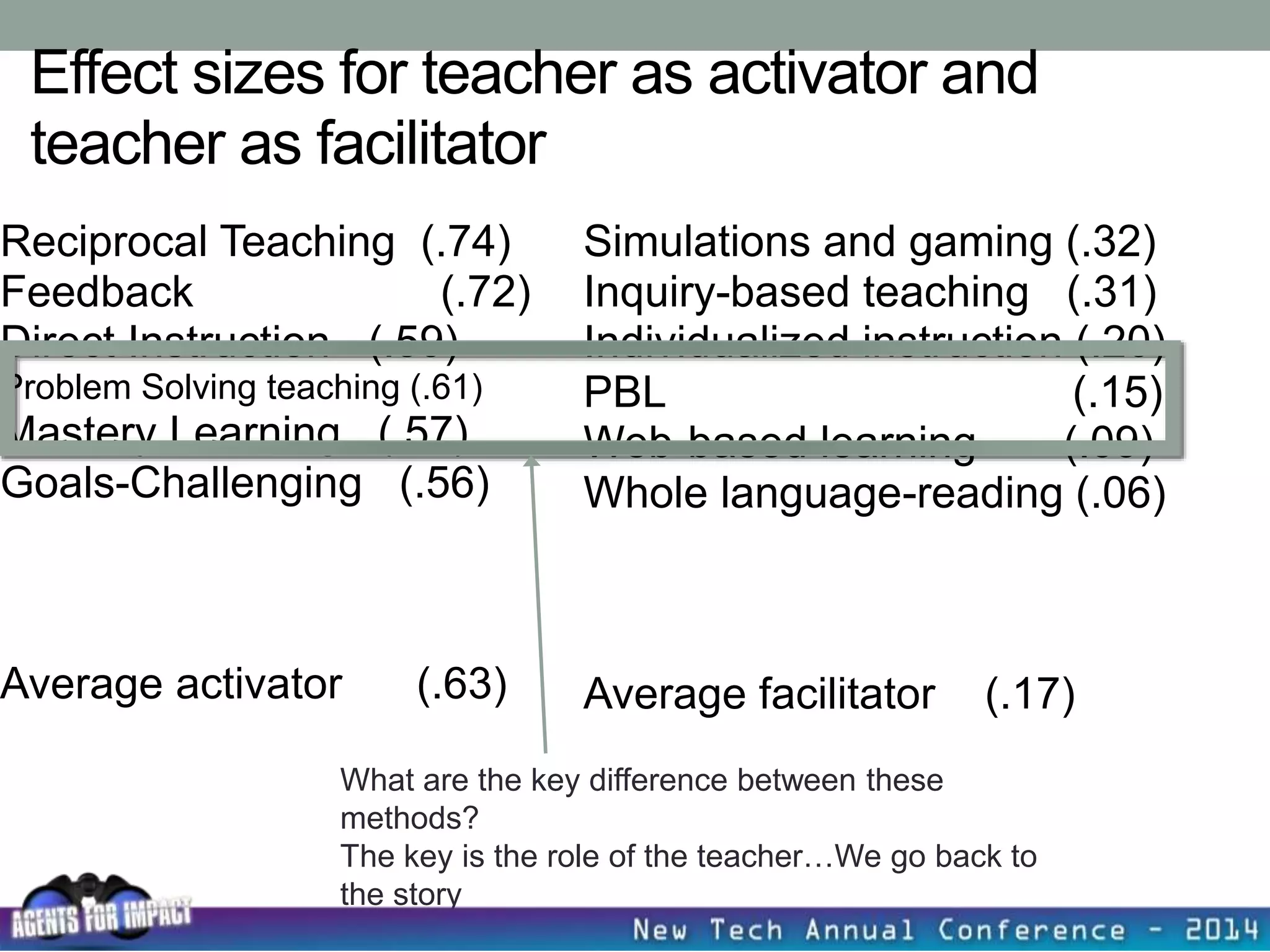
Effect sizes for teacher as activator and
teacher as facilitator
Reciprocal Teaching (.74)
Feedback (.72)
Direct Instruction (.59)
Problem Solving teaching (.61)
Mastery Learning (.57)
Goals-Challenging (.56)
Average activator (.63)
Simulations and gaming (.32)
Inquiry-based teaching (.31)
Individualized instruction (.20)
PBL (.15)
Web-based learning (.09)
Whole language-reading (.06)
Average facilitator (.17)
What are the key difference between these
methods?
The key is the role of the teacher…We go back to
the story
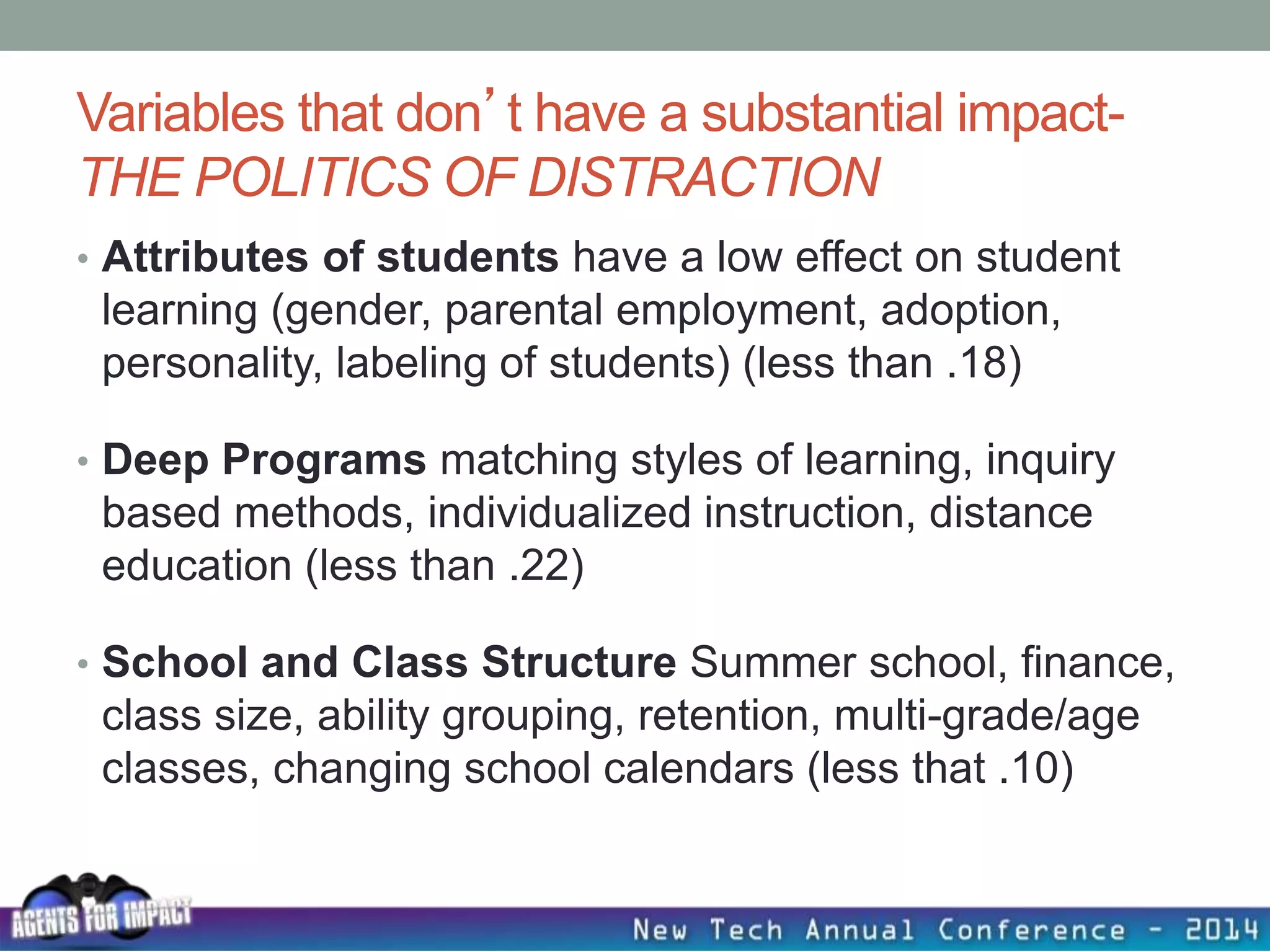
Variables that don’t have a substantial impact-
THE POLITICS OF DISTRACTION
• Attributes of students have a low effect on student
learning (gender, parental employment, adoption,
personality, labeling of students) (less than .18)
• Deep Programs matching styles of learning, inquiry
based methods, individualized instruction, distance
education (less than .22)
• School and Class Structure Summer school, finance,
class size, ability grouping, retention, multi-grade/age
classes, changing school calendars (less that .10)
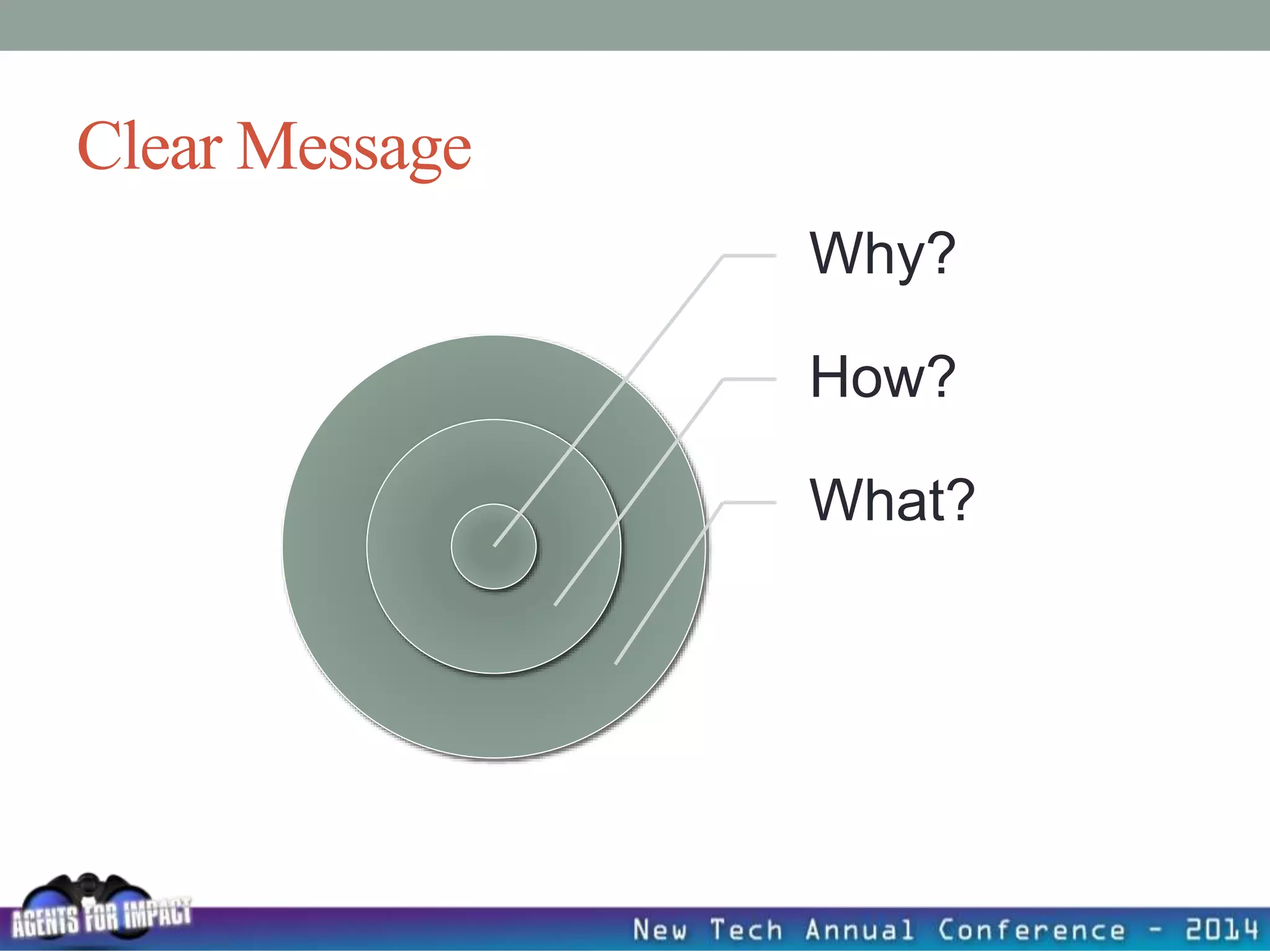
Clear Message
Why?
How?
What?
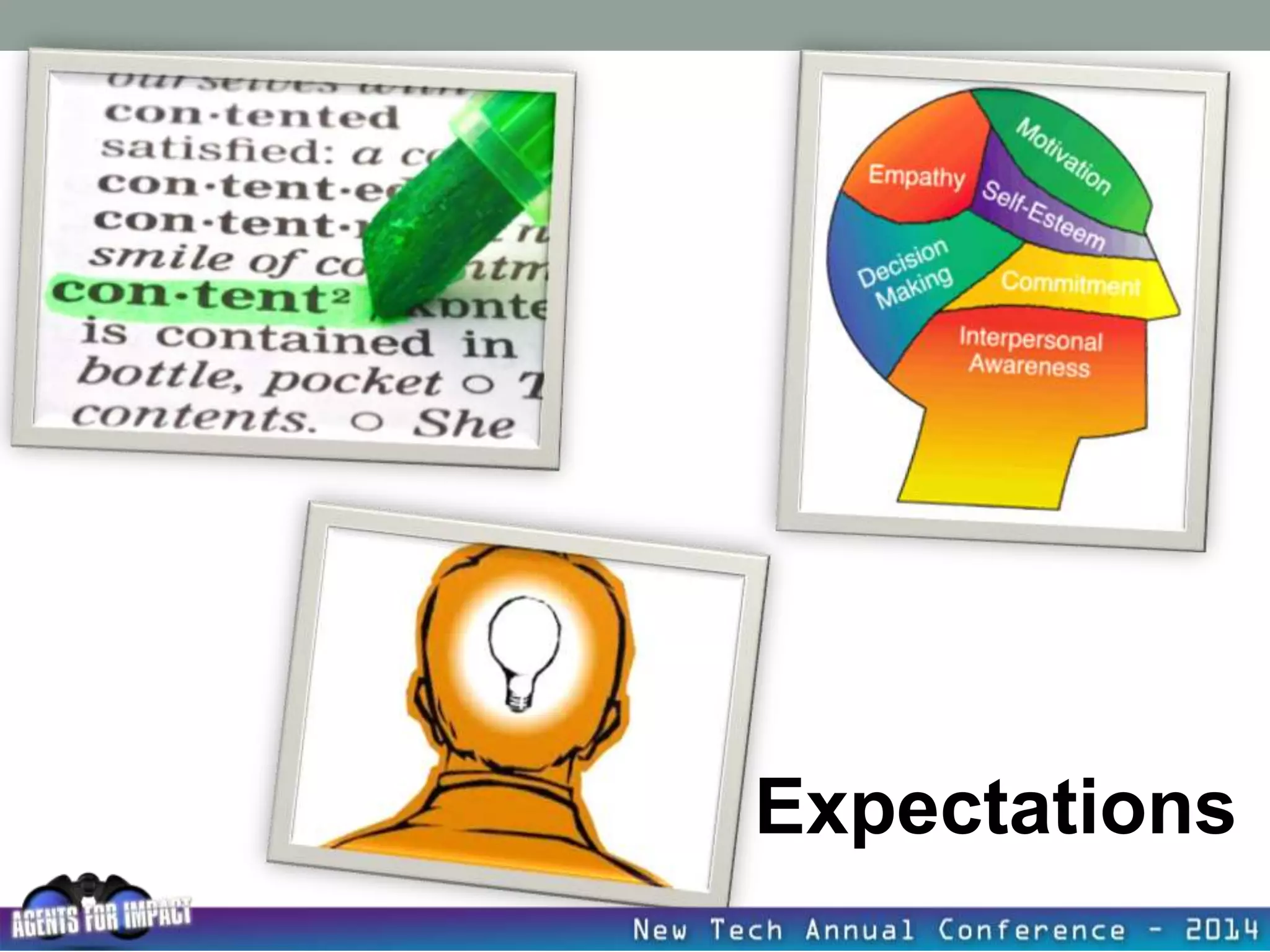
Expectations
Systems
Approach
Boundary
Management
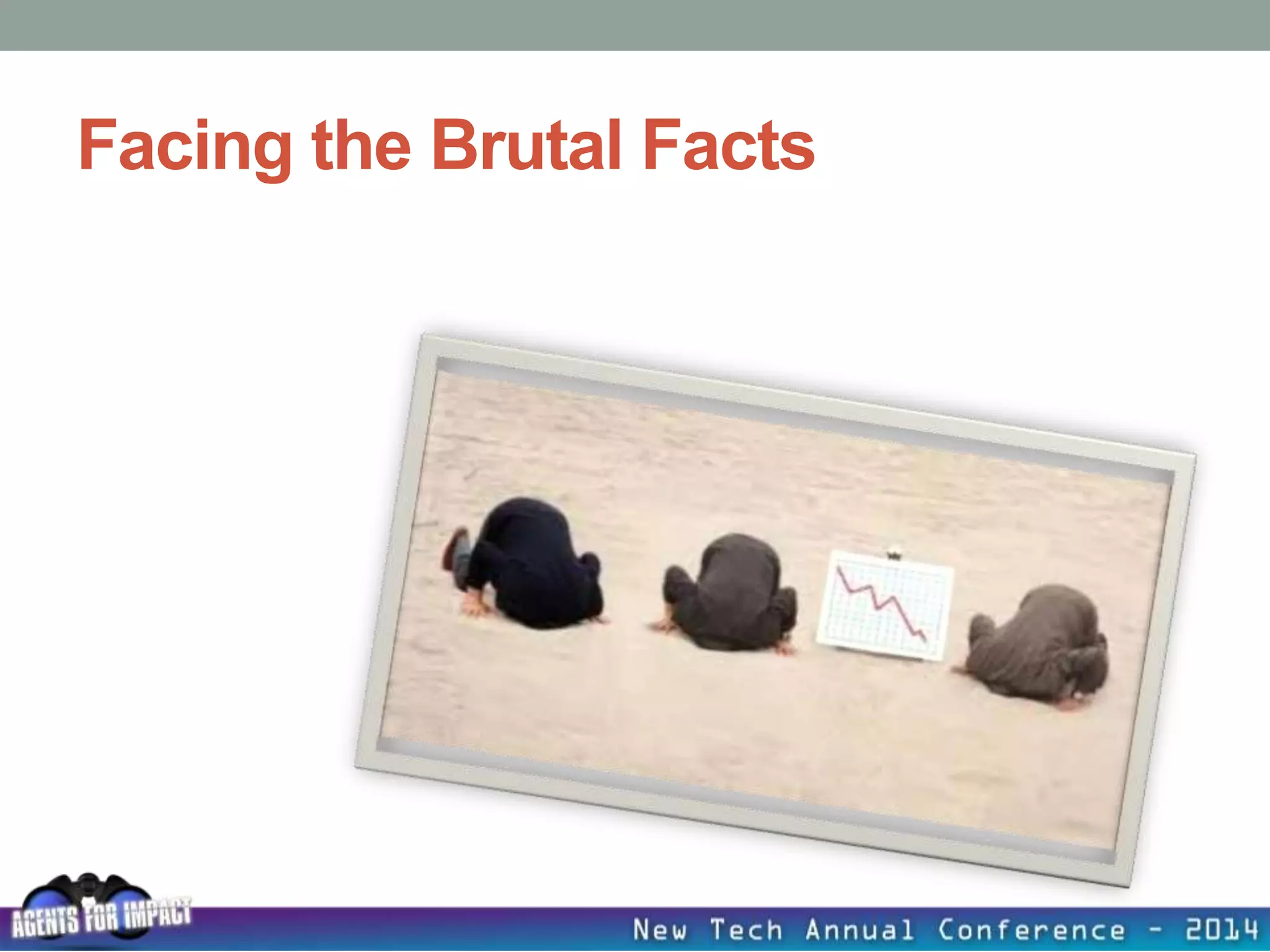
Facing the Brutal Facts
Know thy
Impact
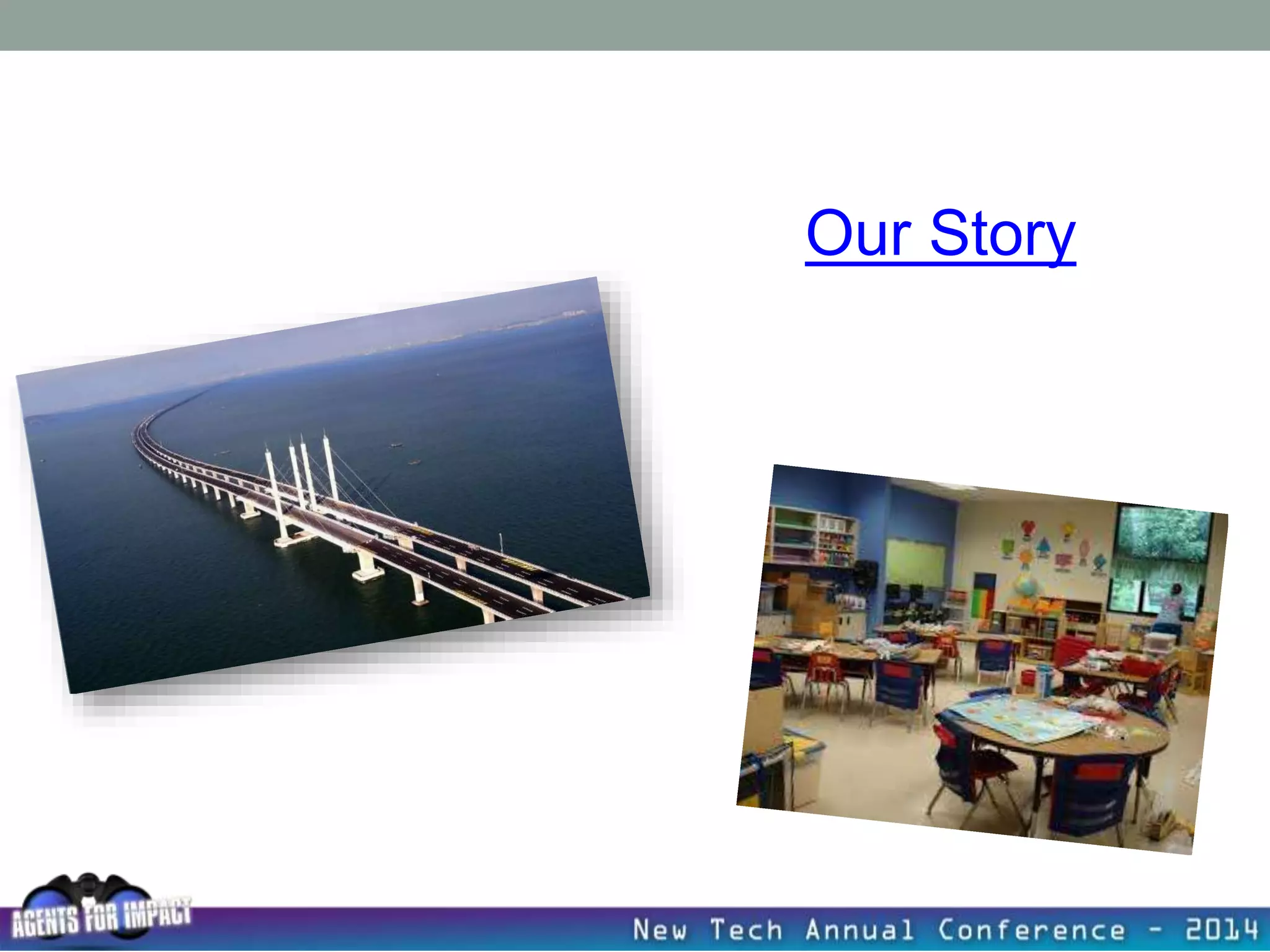
Our Story
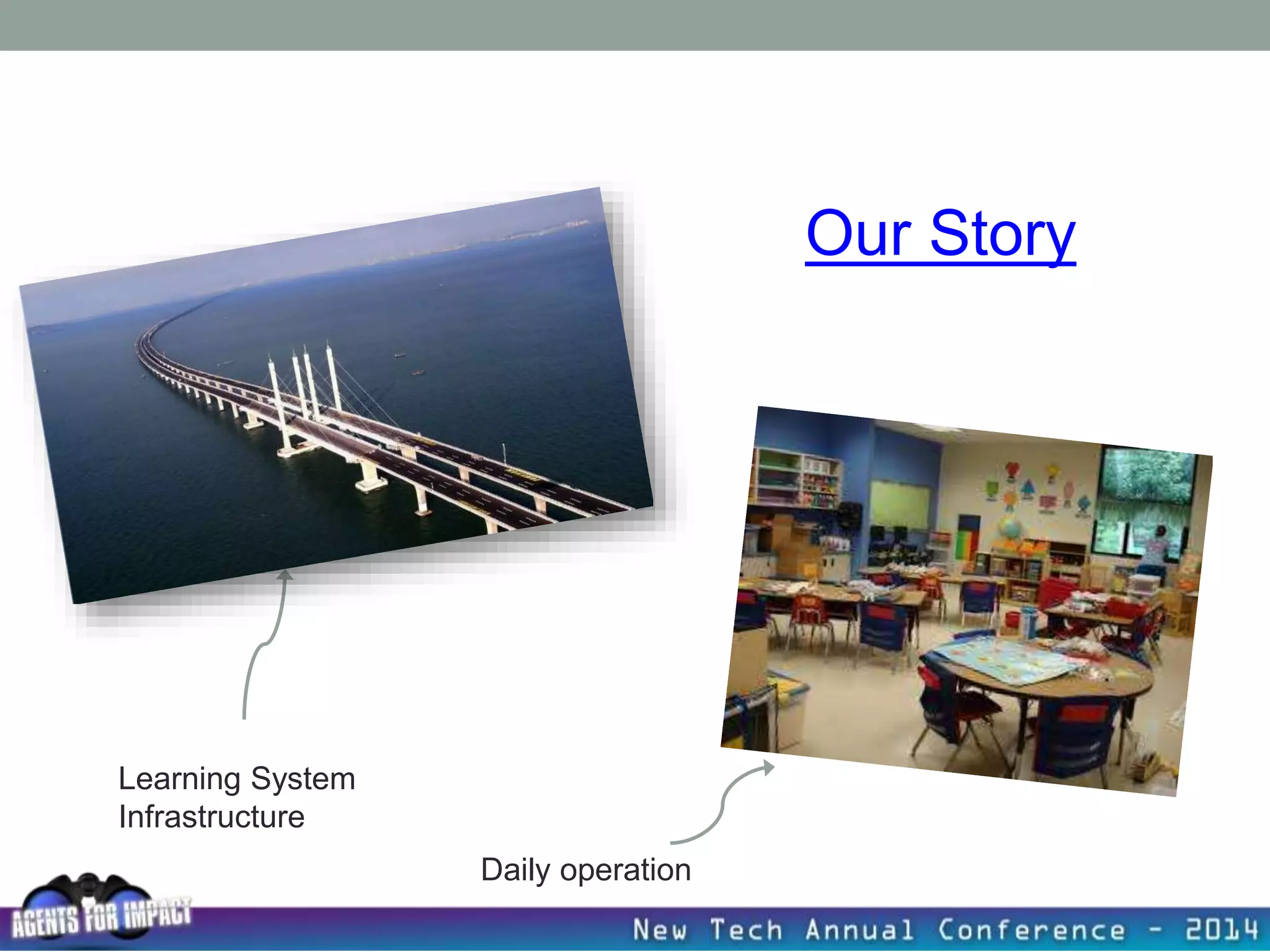
Our Story
Learning System
Infrastructure
Daily operation
#vlconf2014
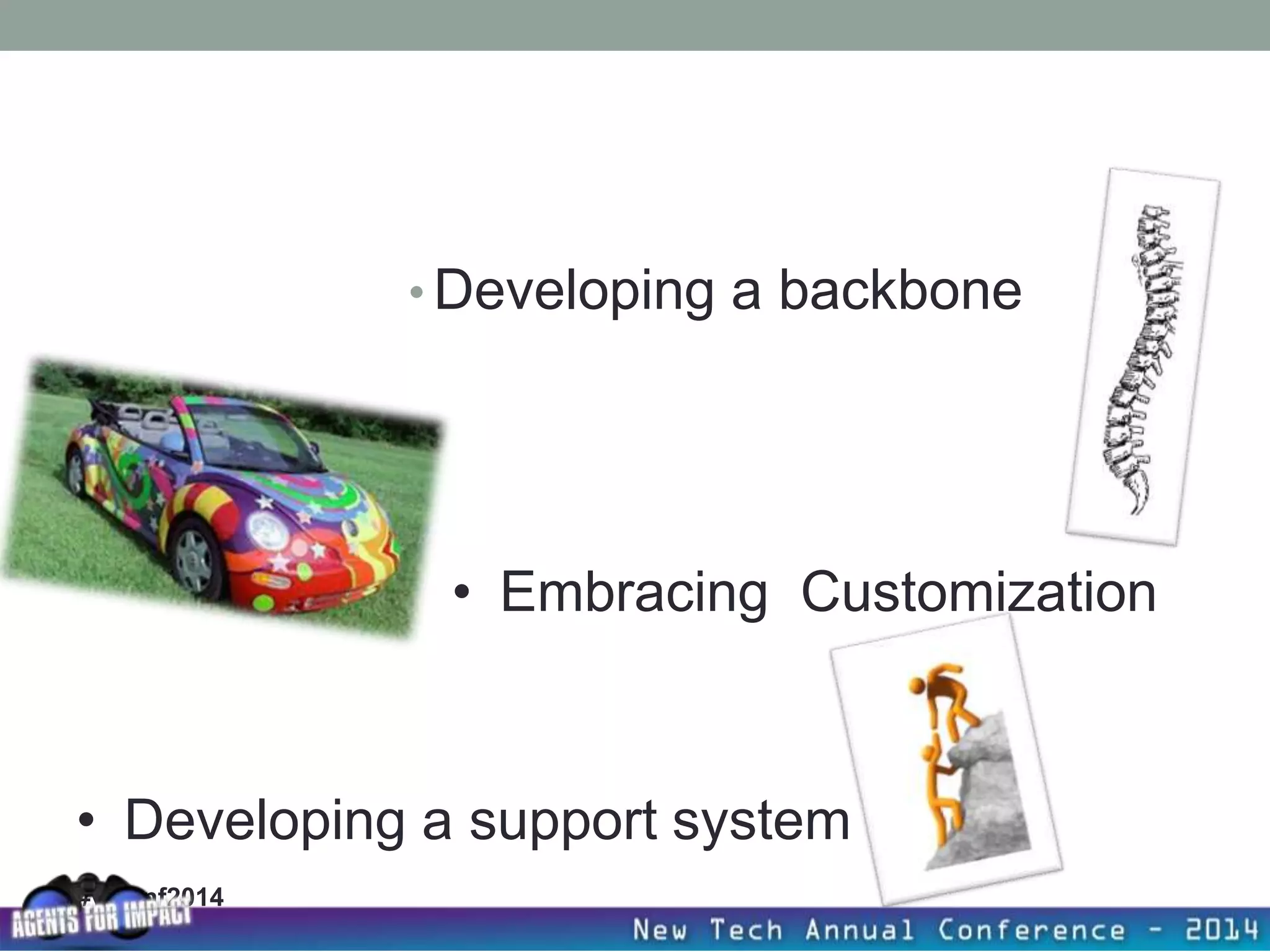
• Developing a backbone
• Embracing Customization
• Developing a support system
Few points of reference
- 915 Meta-analysis
- 60,155 studies
- 245 million students
- 159,570 effect sizes reported
- This data set is for the purpose of discussion
- There are moderators
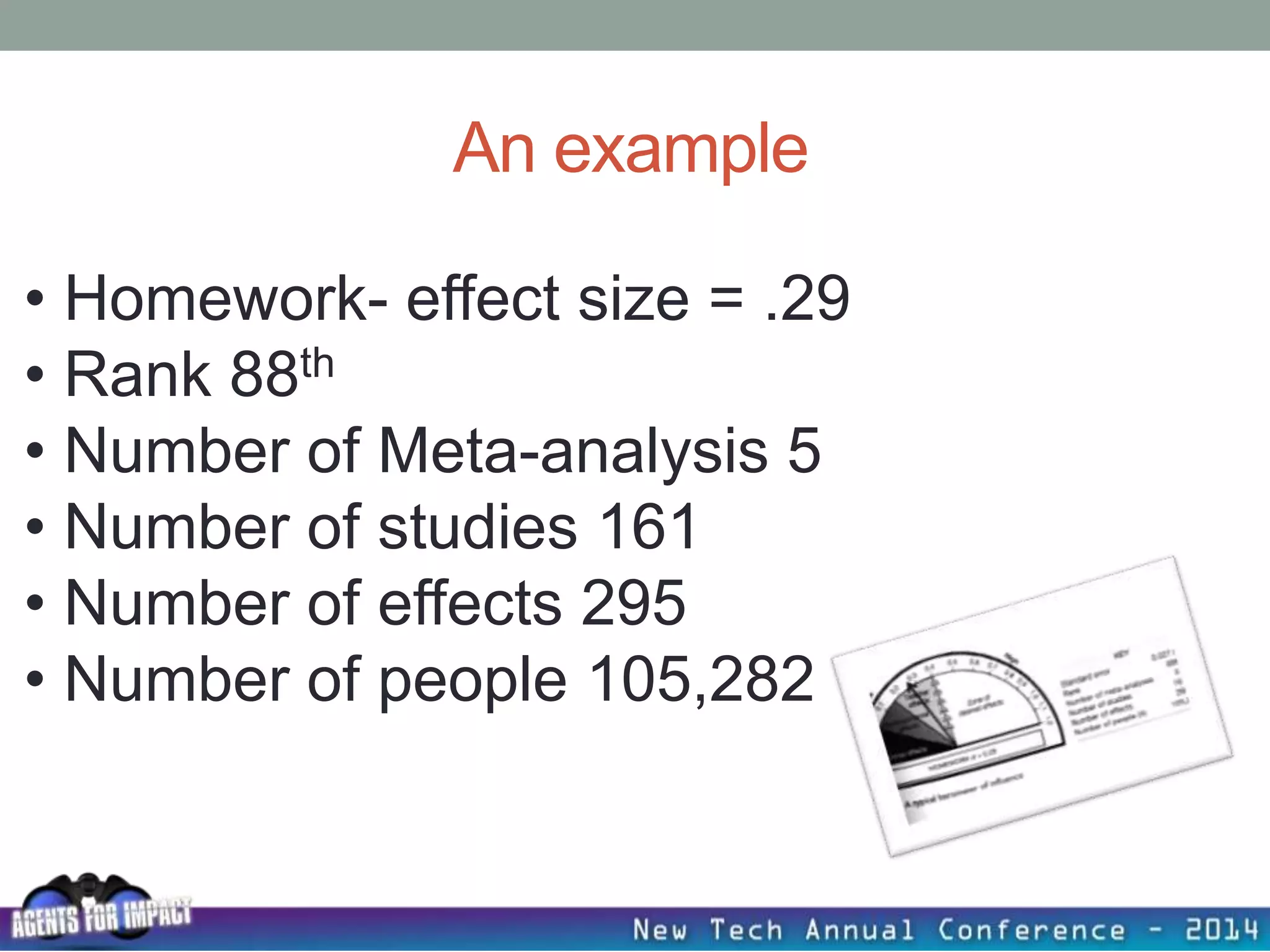
An example
• Homework- effect size = .29
• Rank 88th
• Number of Meta-analysis 5
• Number of studies 161
• Number of effects 295
• Number of people 105,282
• Exploring each variable-
• High school twice as large
• Short time periods are important
• Direct parent involvement had a
negative effect
• Lack of monitoring
• Difficulty
• Prescribing homework does not help
in time management skills
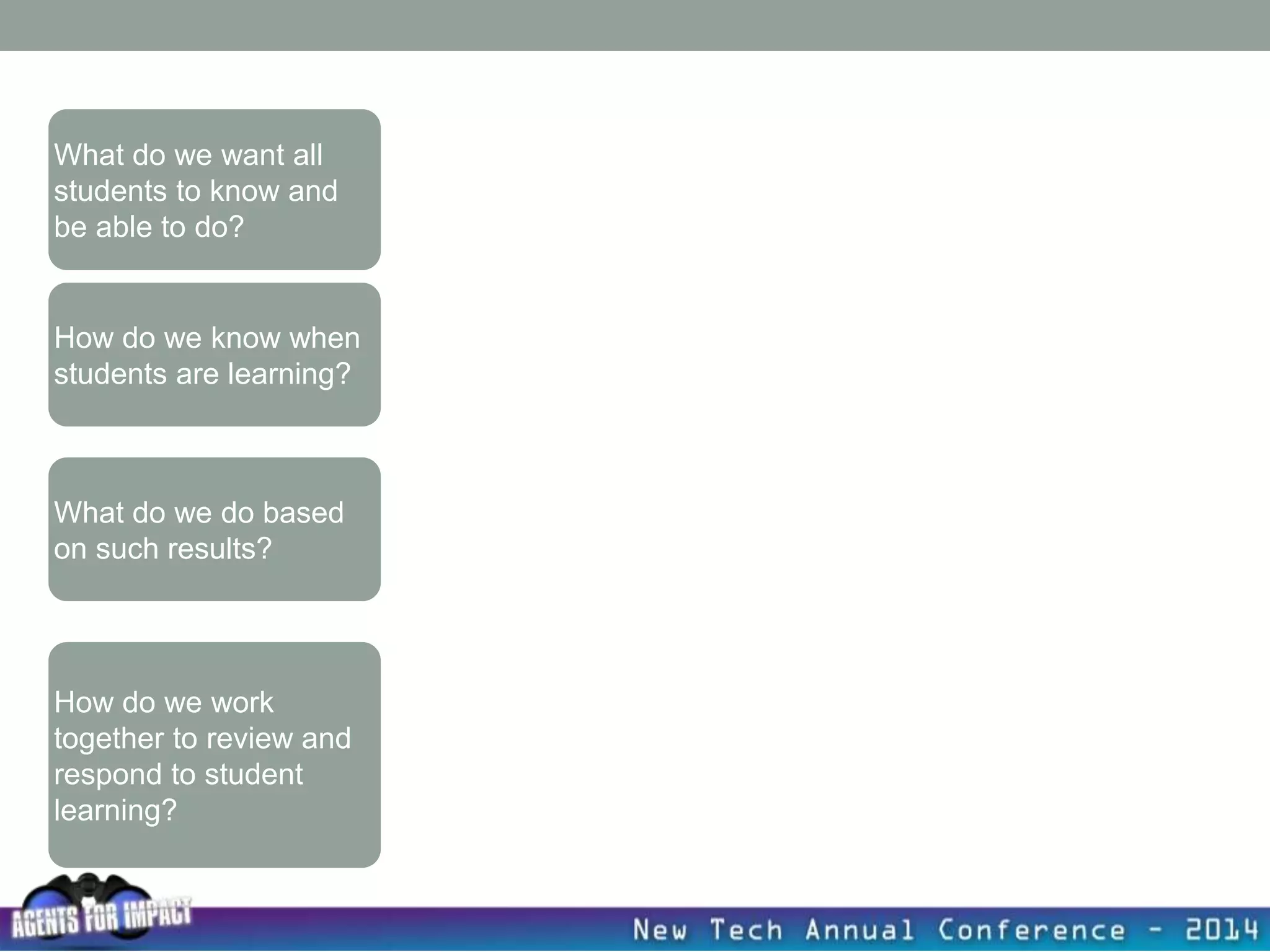
What do we want all
students to know and
be able to do?
How do we know when
students are learning?
What do we do based
on such results?
How do we work
together to review and
respond to student
learning?
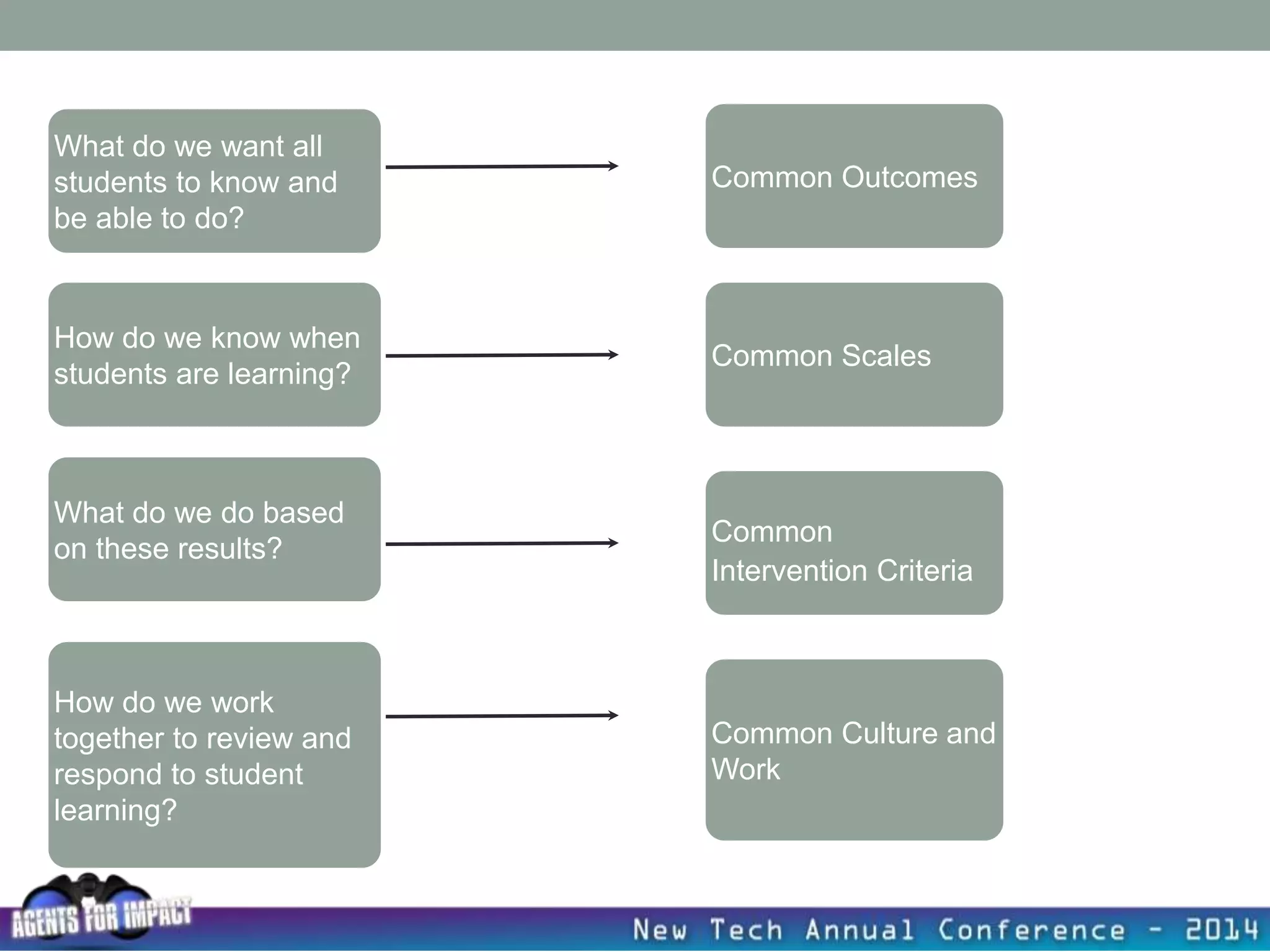
What do we want all
students to know and
be able to do?
What do we do based
on these results?
How do we work
together to review and
respond to student
learning?
Common Outcomes
Common Scales
Common
Intervention Criteria
Common Culture and
Work
How do we know when
students are learning?
Common Outcomes
Common Scales
Common
Intervention Criteria
Common Culture
and Work
High Reliability Educational Organization
“Backbone”
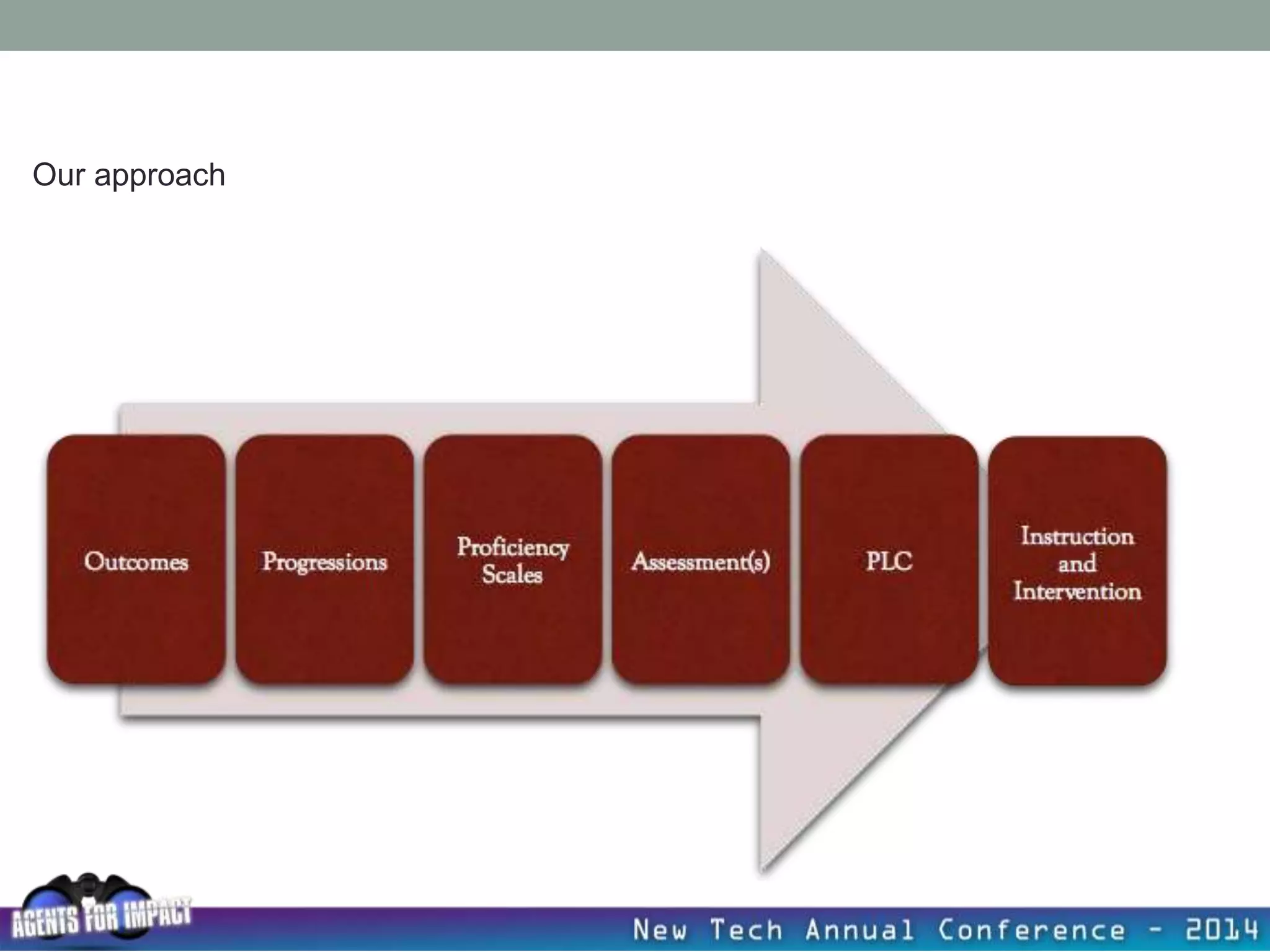
Our approach
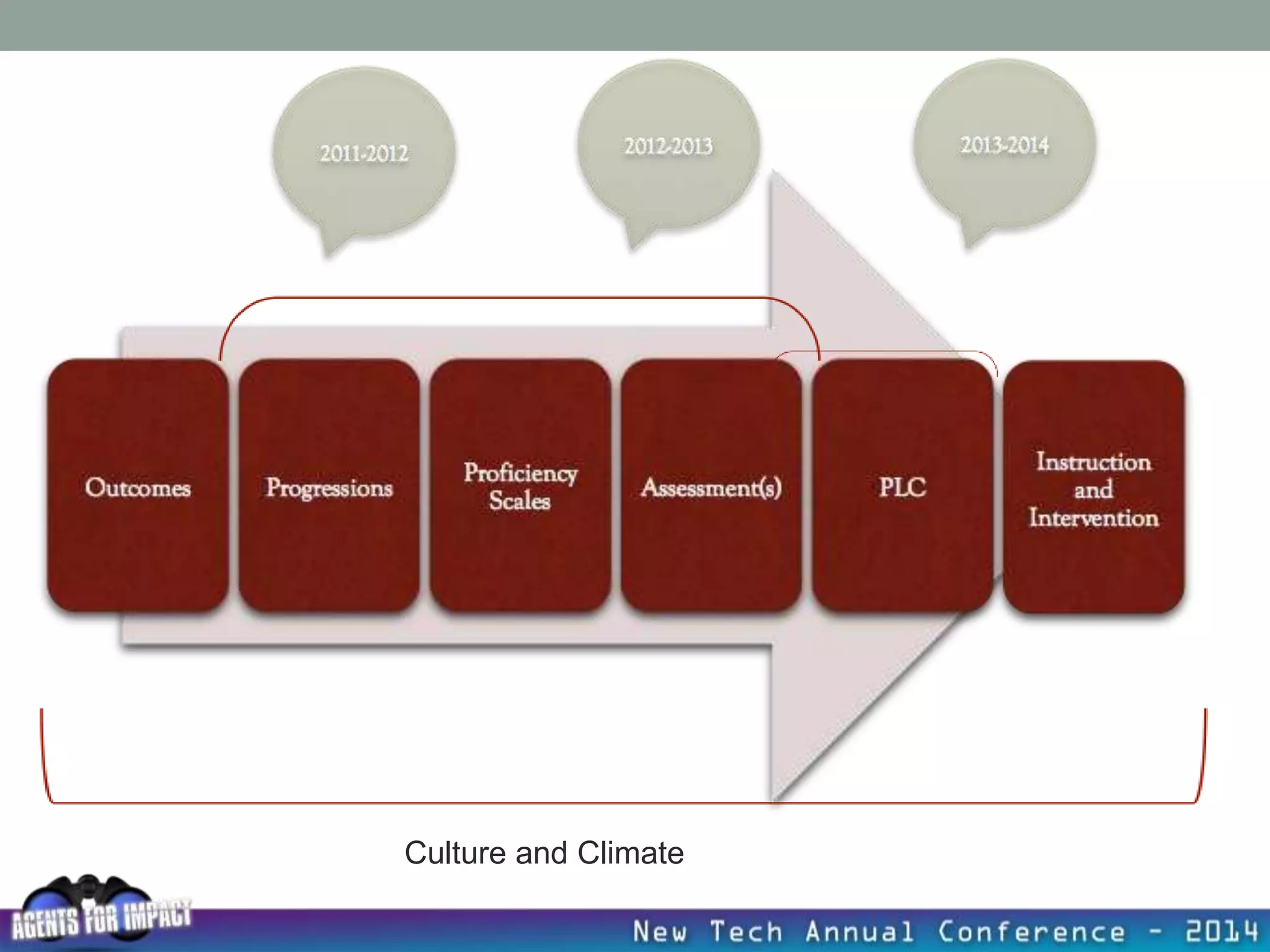
Culture and Climate
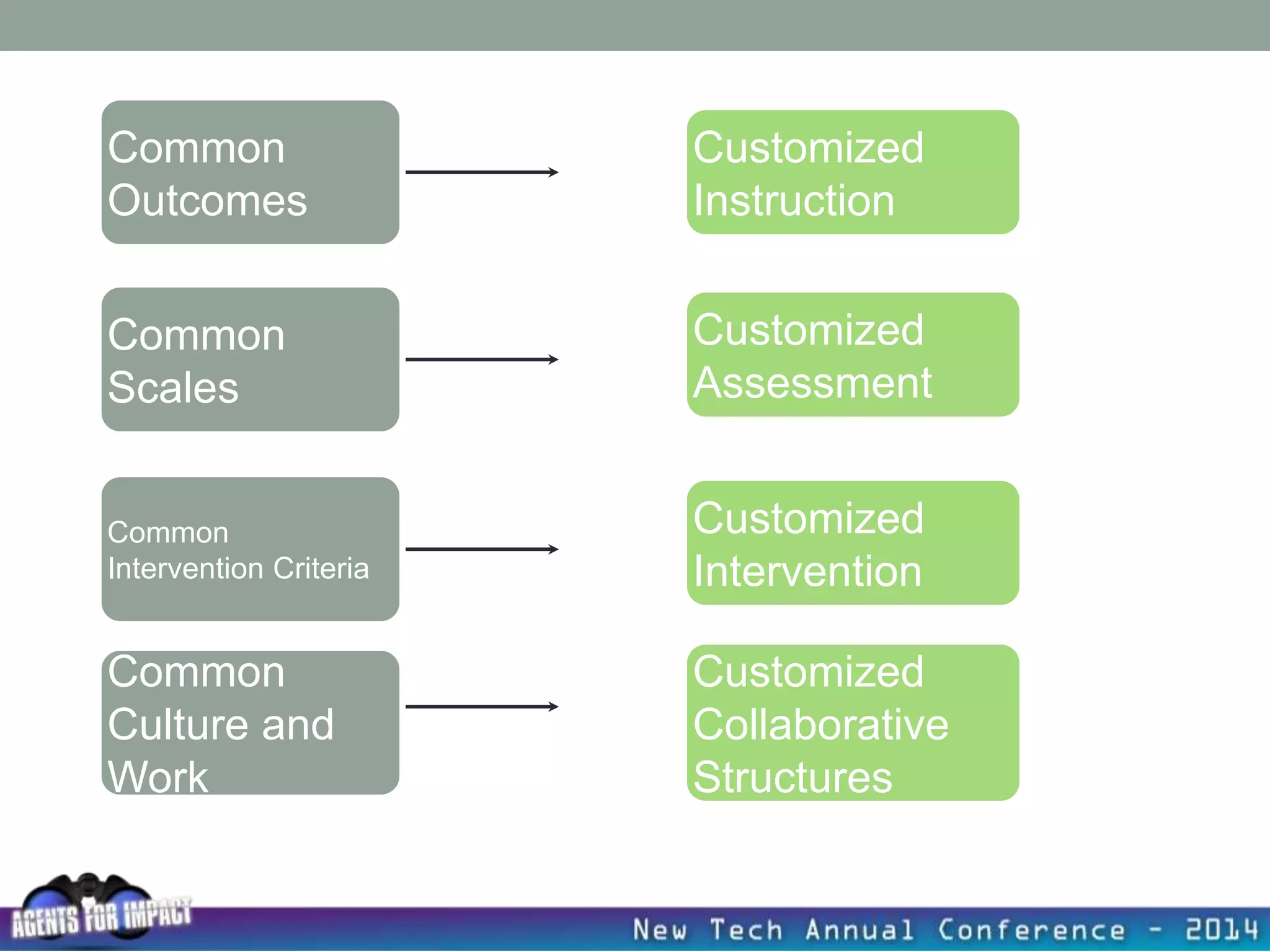
Common
Outcomes
Common
Scales
Common
Intervention Criteria
Common
Culture and
Work
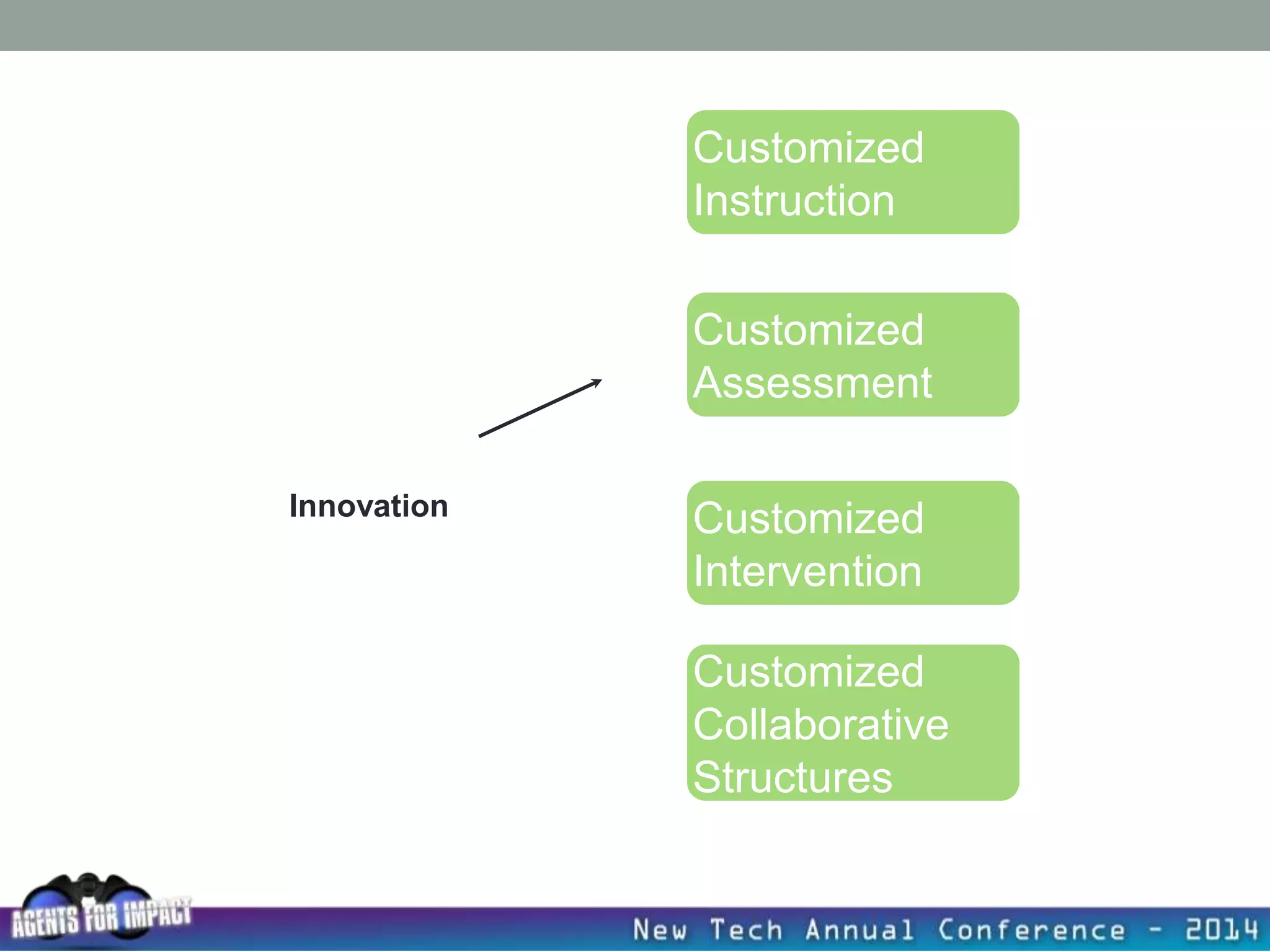
Customized
Instruction
Customized
Assessment
Customized
Collaborative
Structures
Customized
Intervention
Customized
Instruction
Customized
Assessment
Customized
Collaborative
Structures
Customized
Intervention
Innovation
Teaching [and learning] in the dark is a questionable
practice” (Taba, 1966)
#vlconf2014
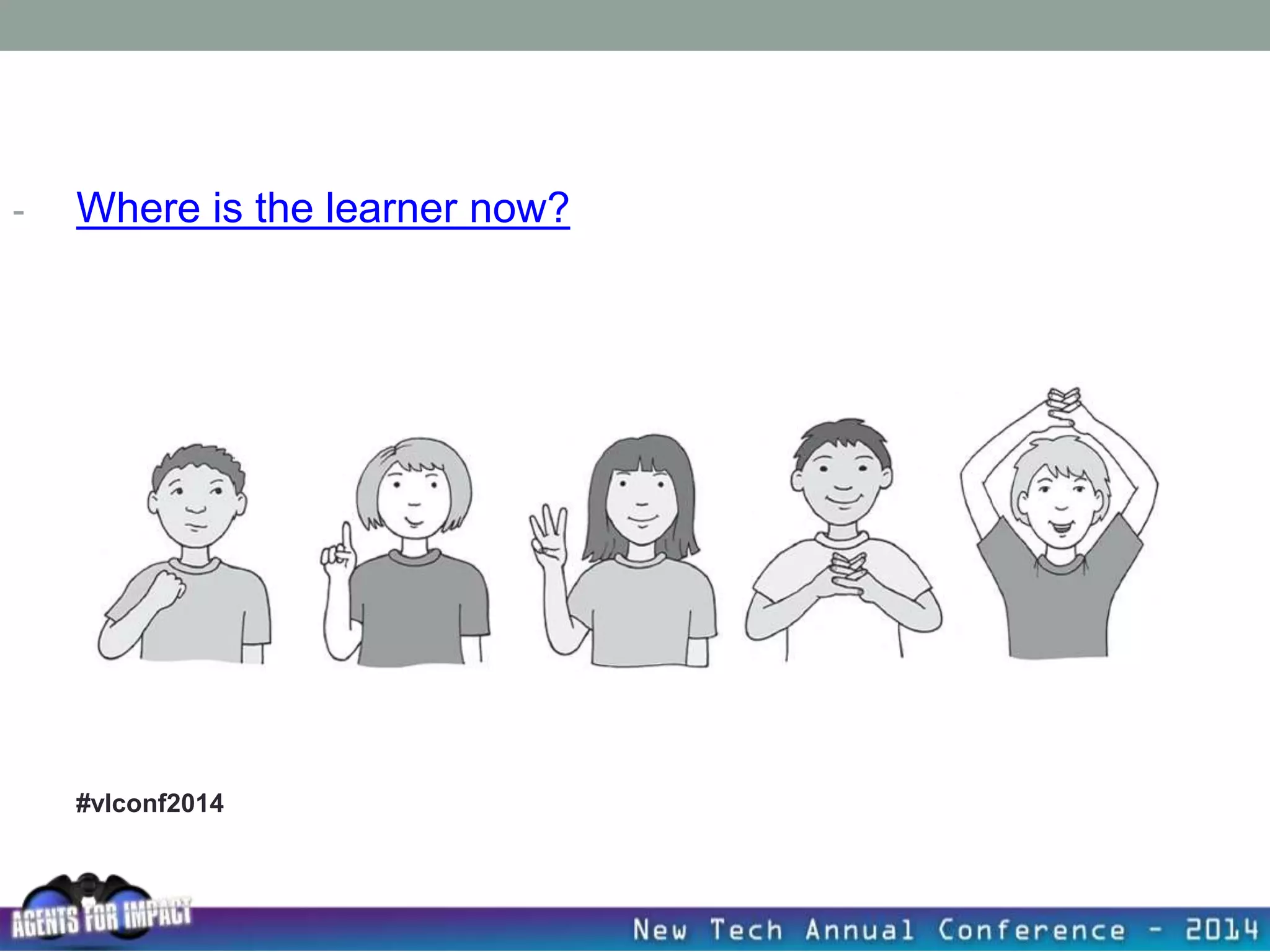
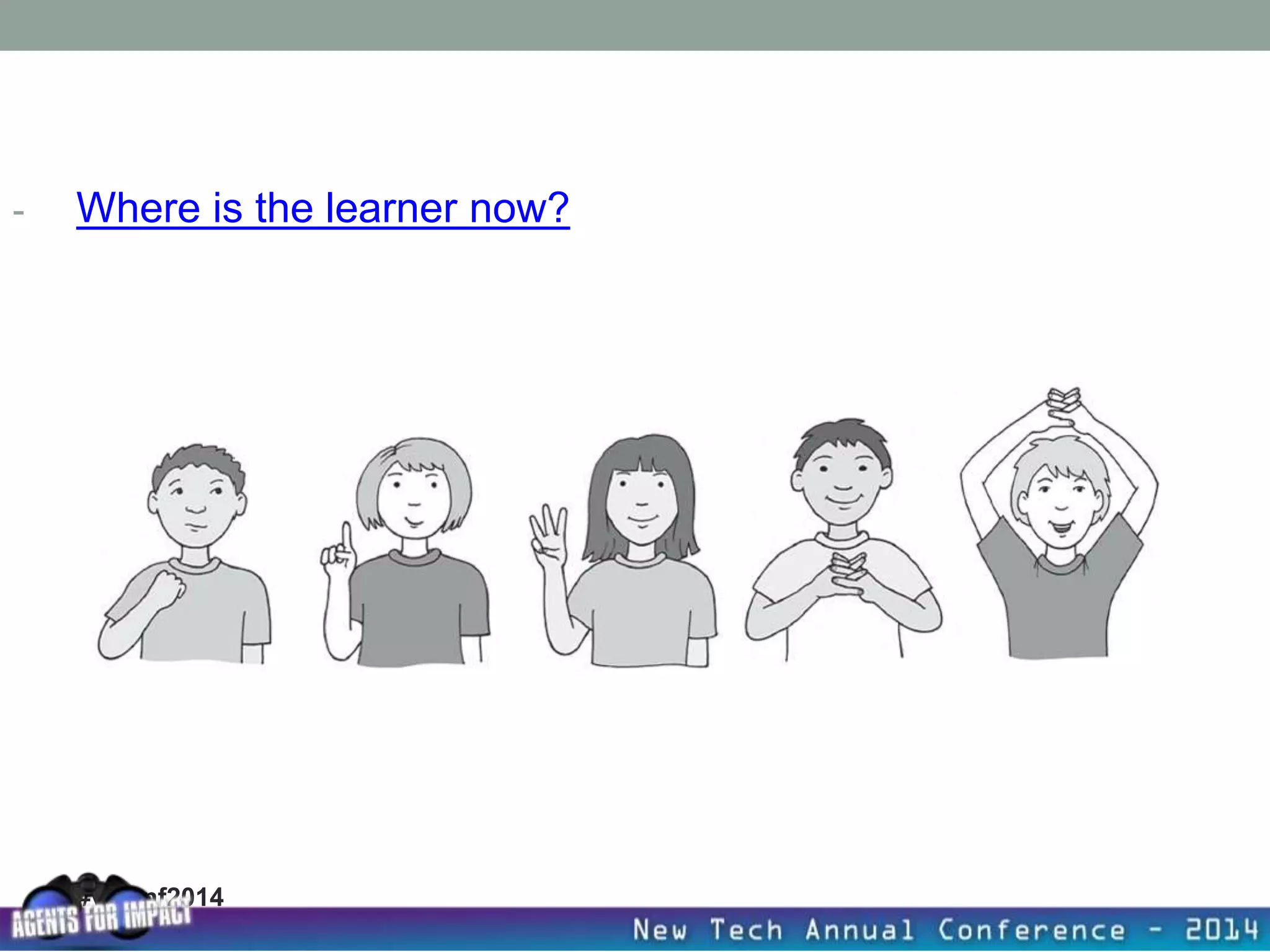
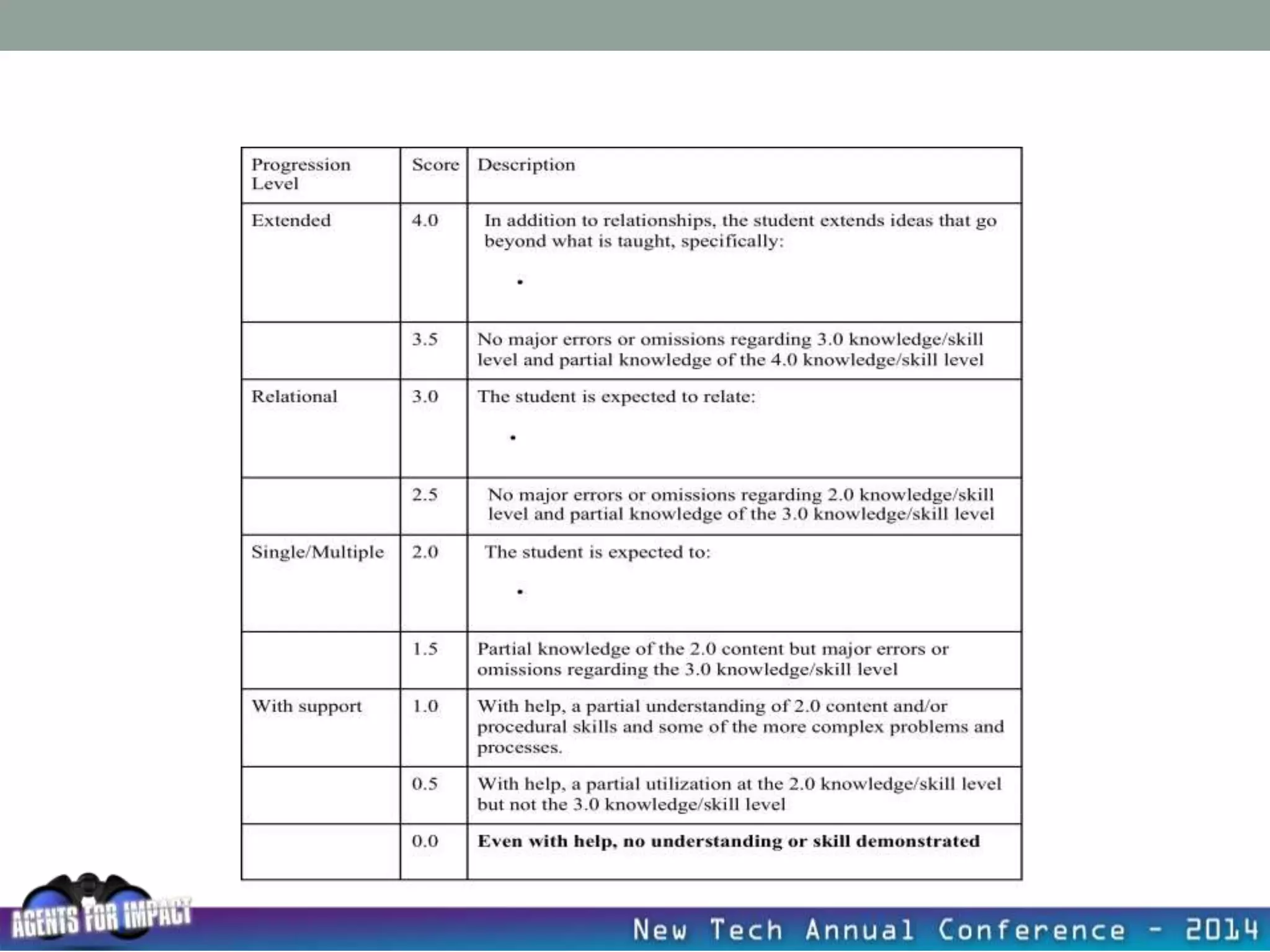
- Where is the learner now?
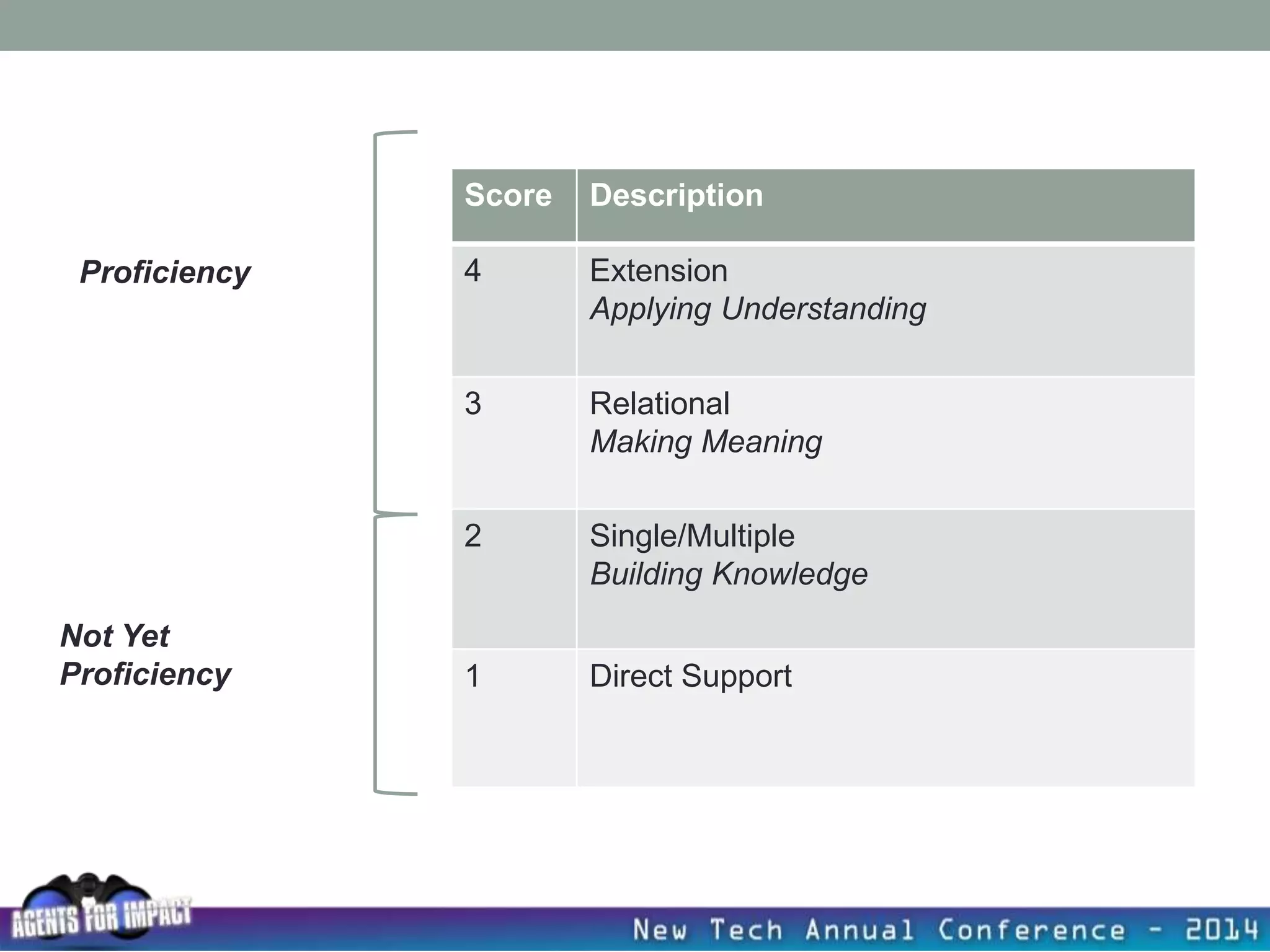
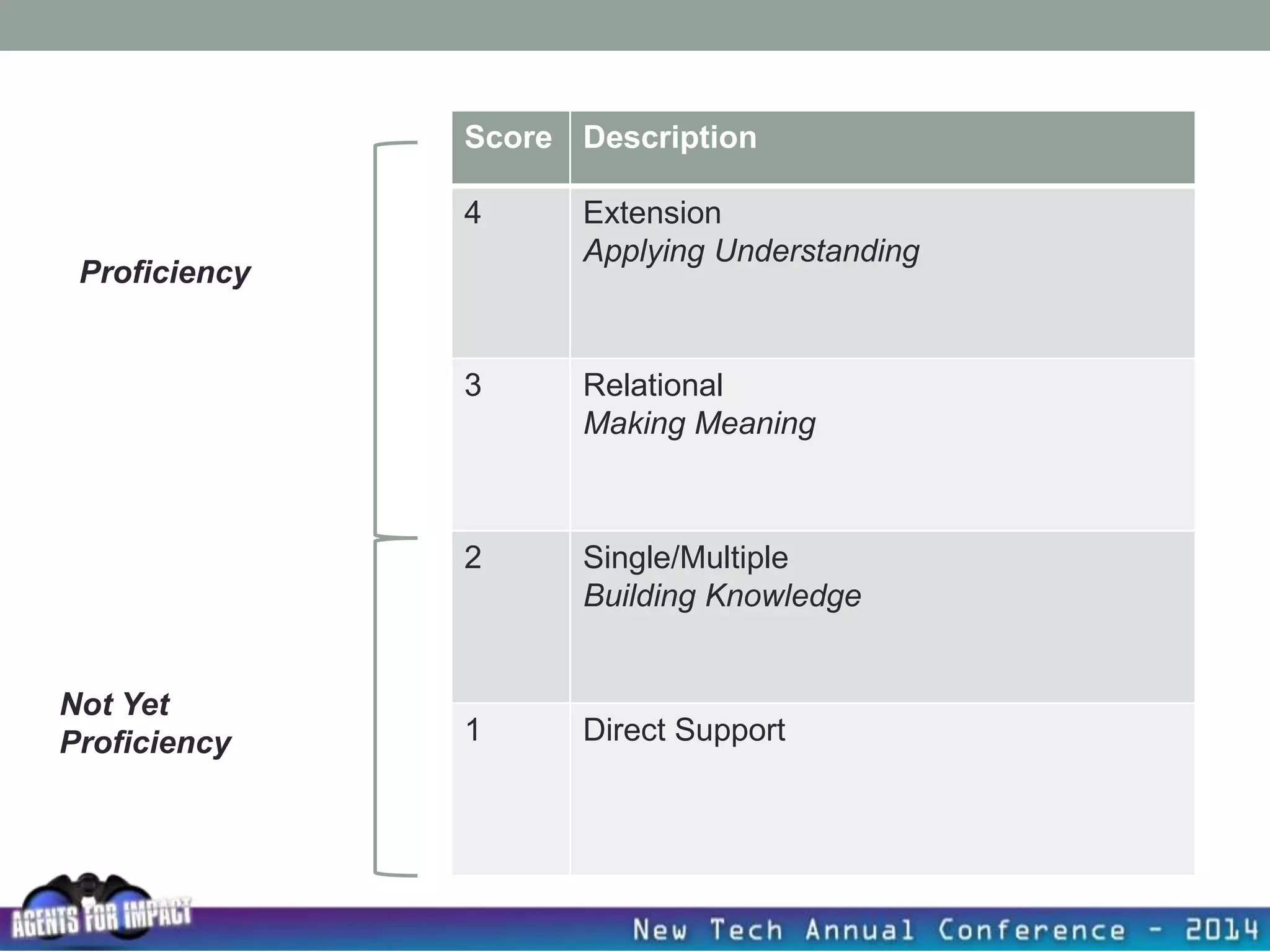
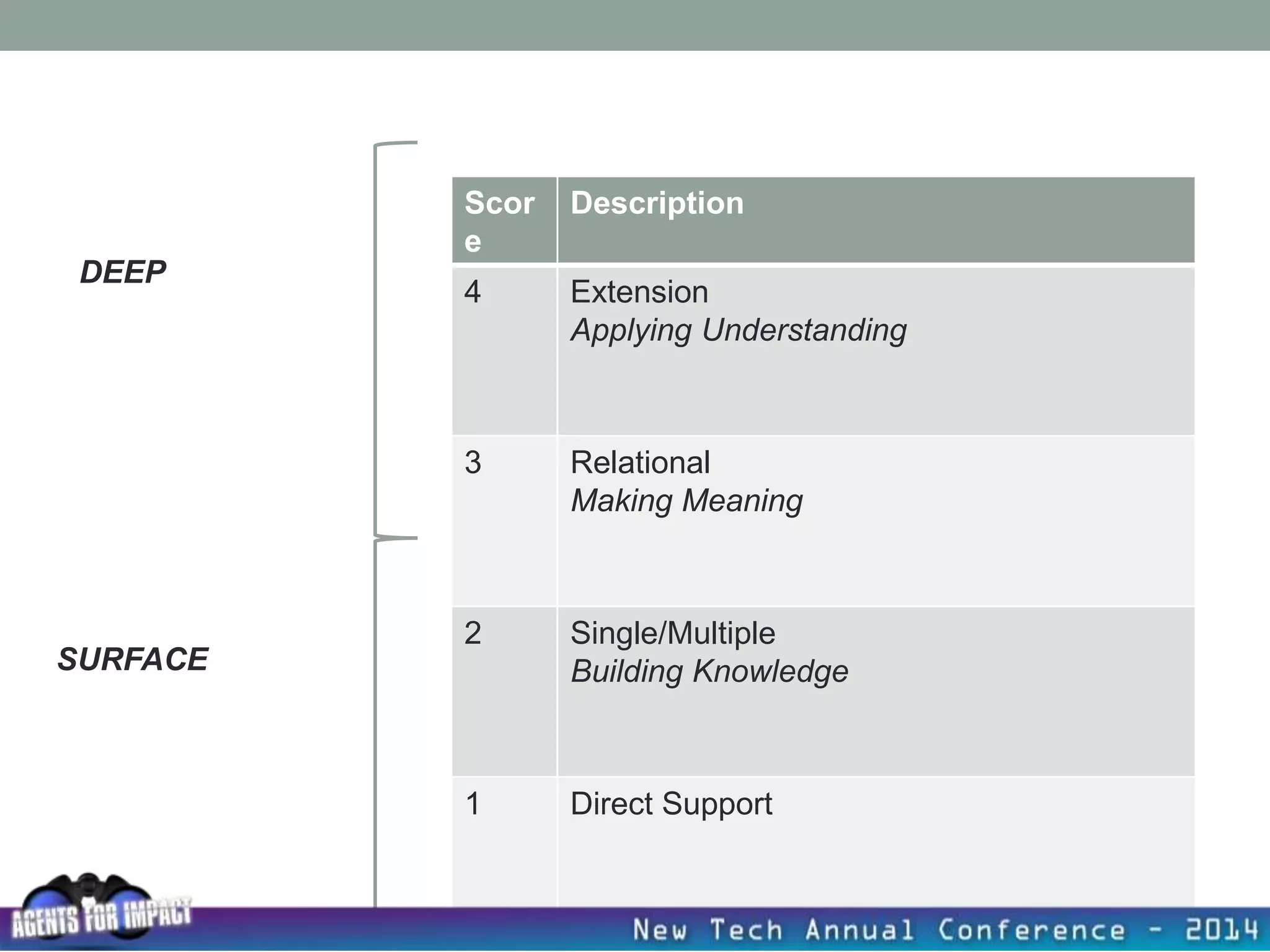
Score Description
4 Extension
Applying Understanding
3 Relational
Making Meaning
2 Single/Multiple
Building Knowledge
1 Direct Support
Proficiency
Not Yet
Proficiency
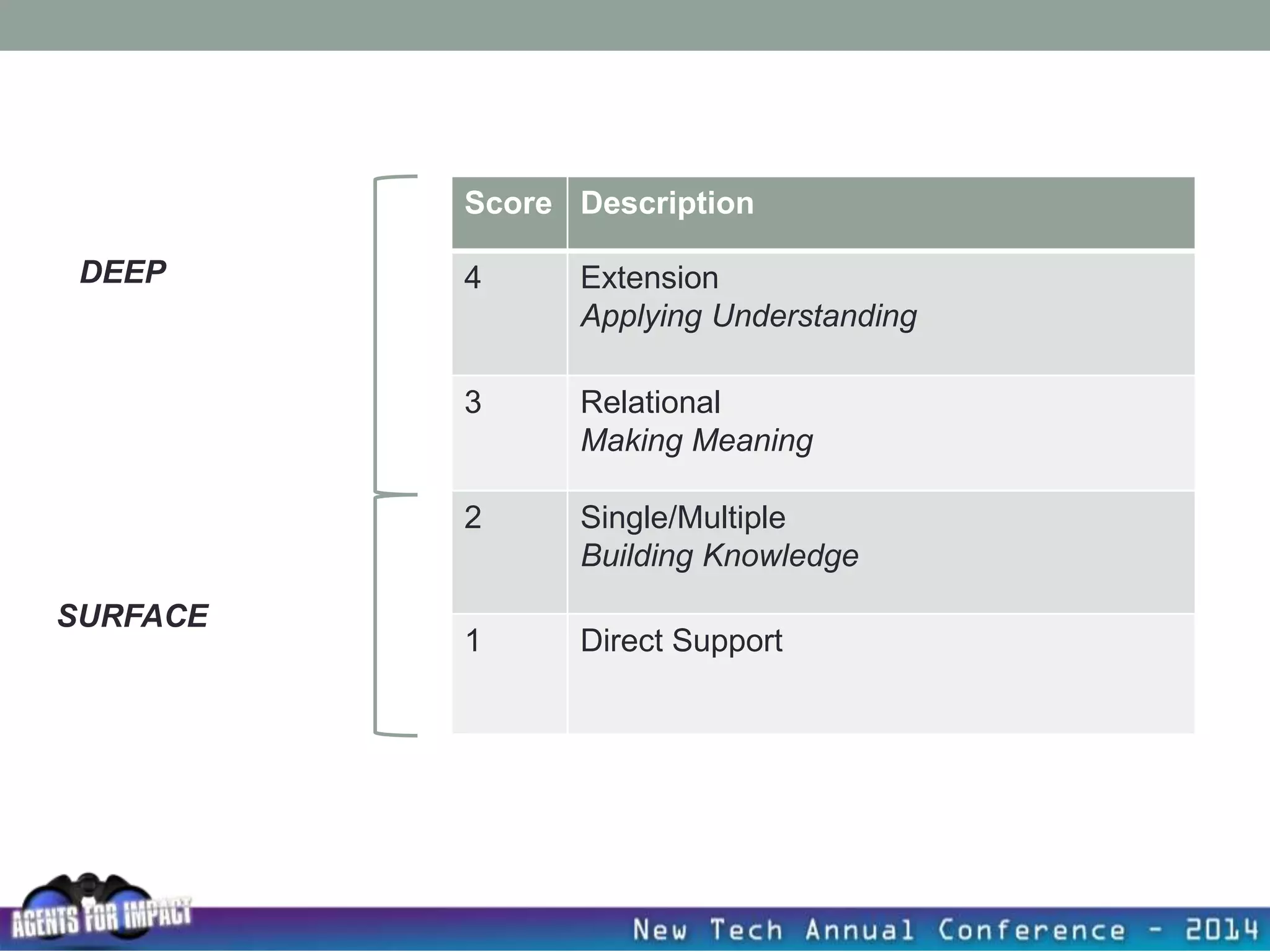
Score Description
4 Extension
Applying Understanding
3 Relational
Making Meaning
2 Single/Multiple
Building Knowledge
1 Direct Support
DEEP
SURFACE
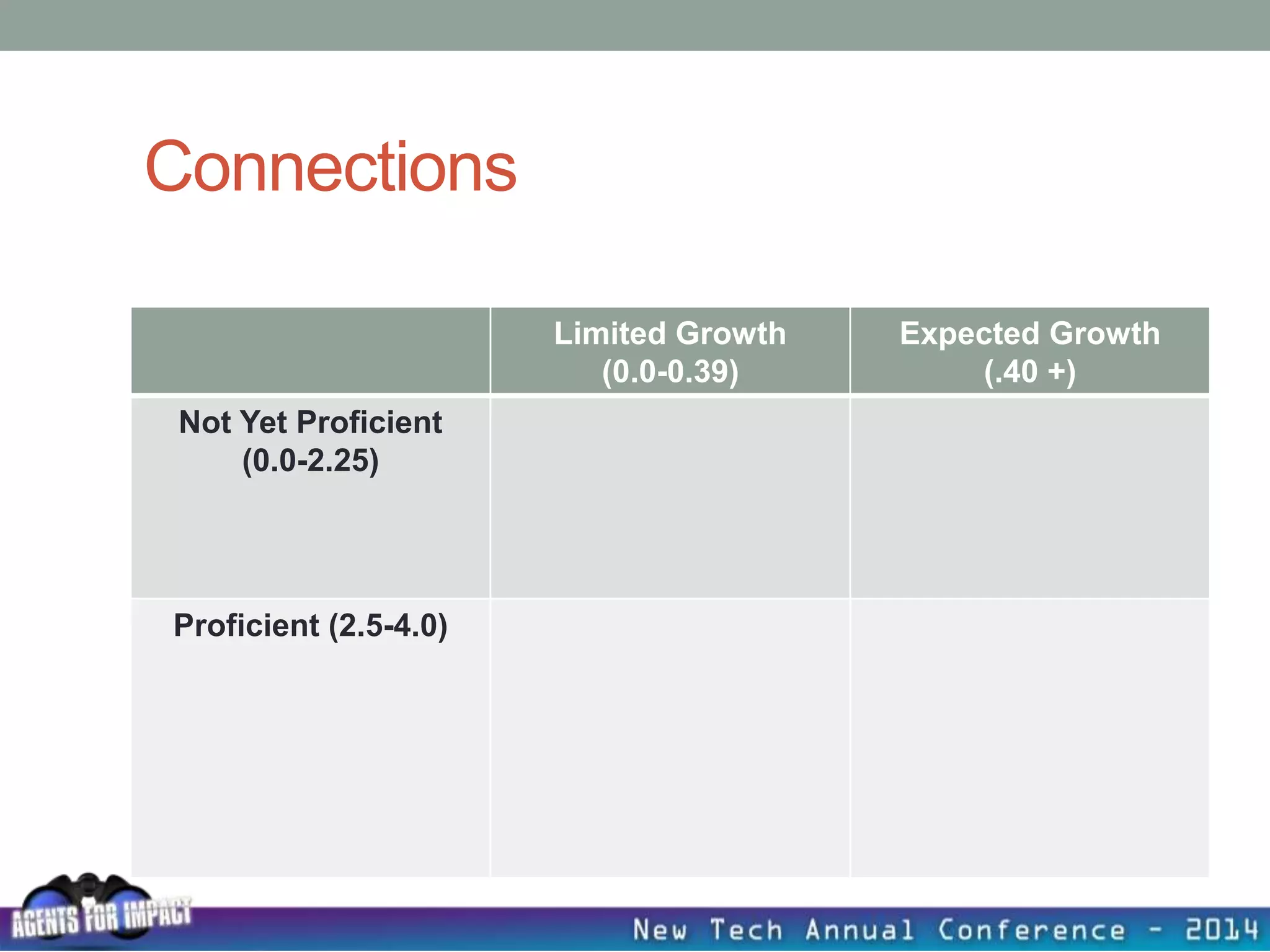
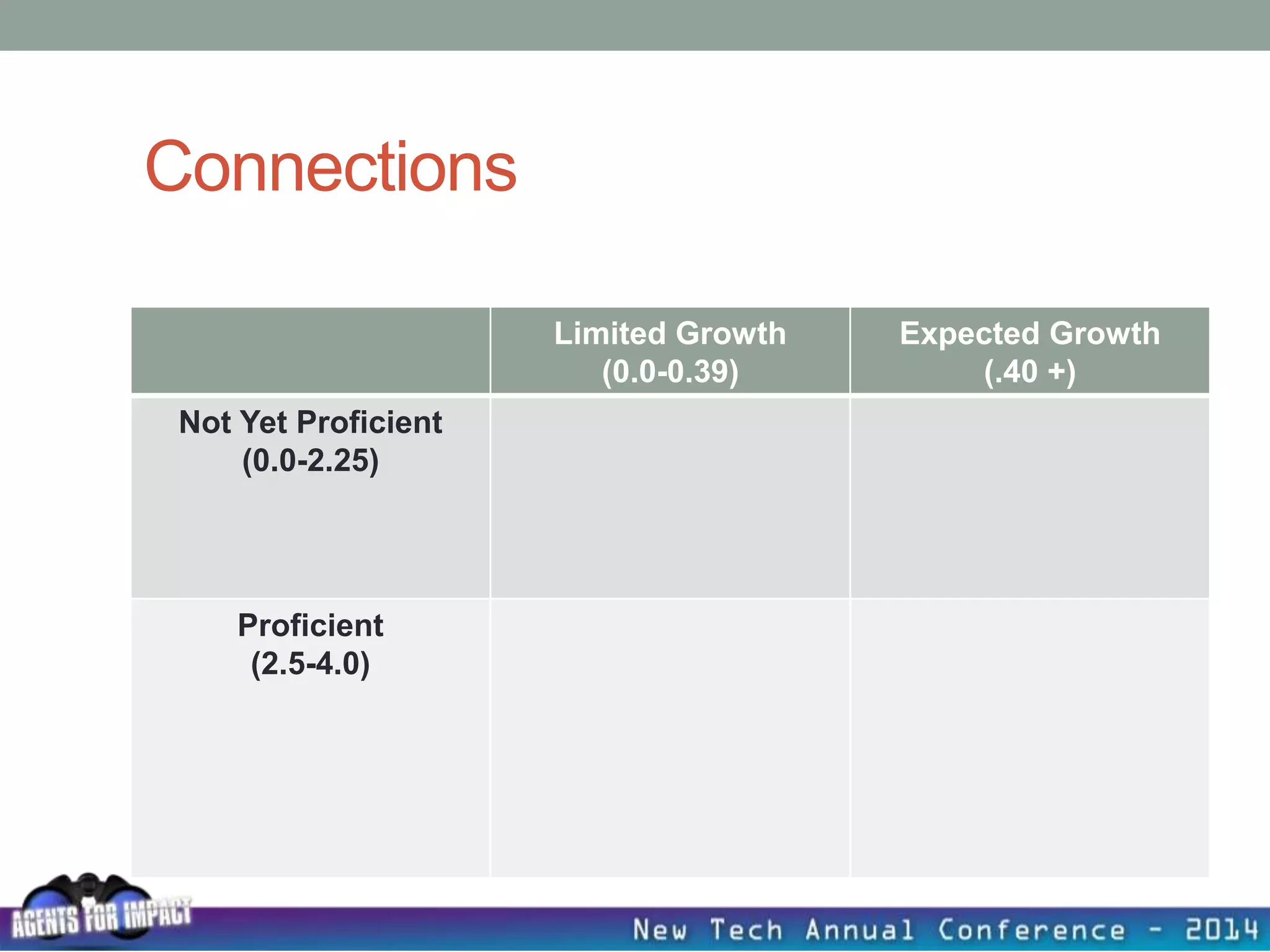
Connections
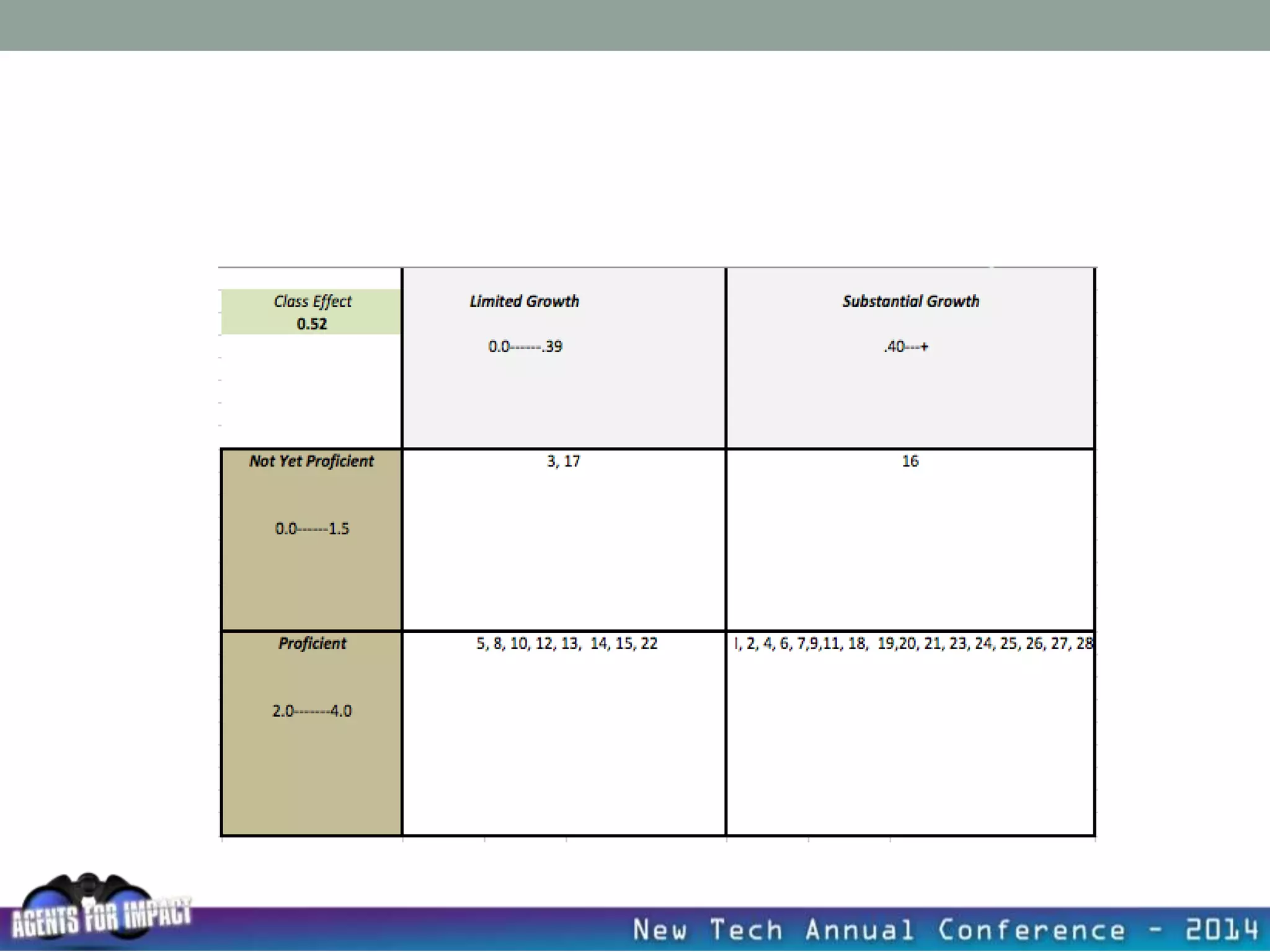
Limited Growth
(0.0-0.39)
Expected Growth
(.40 +)
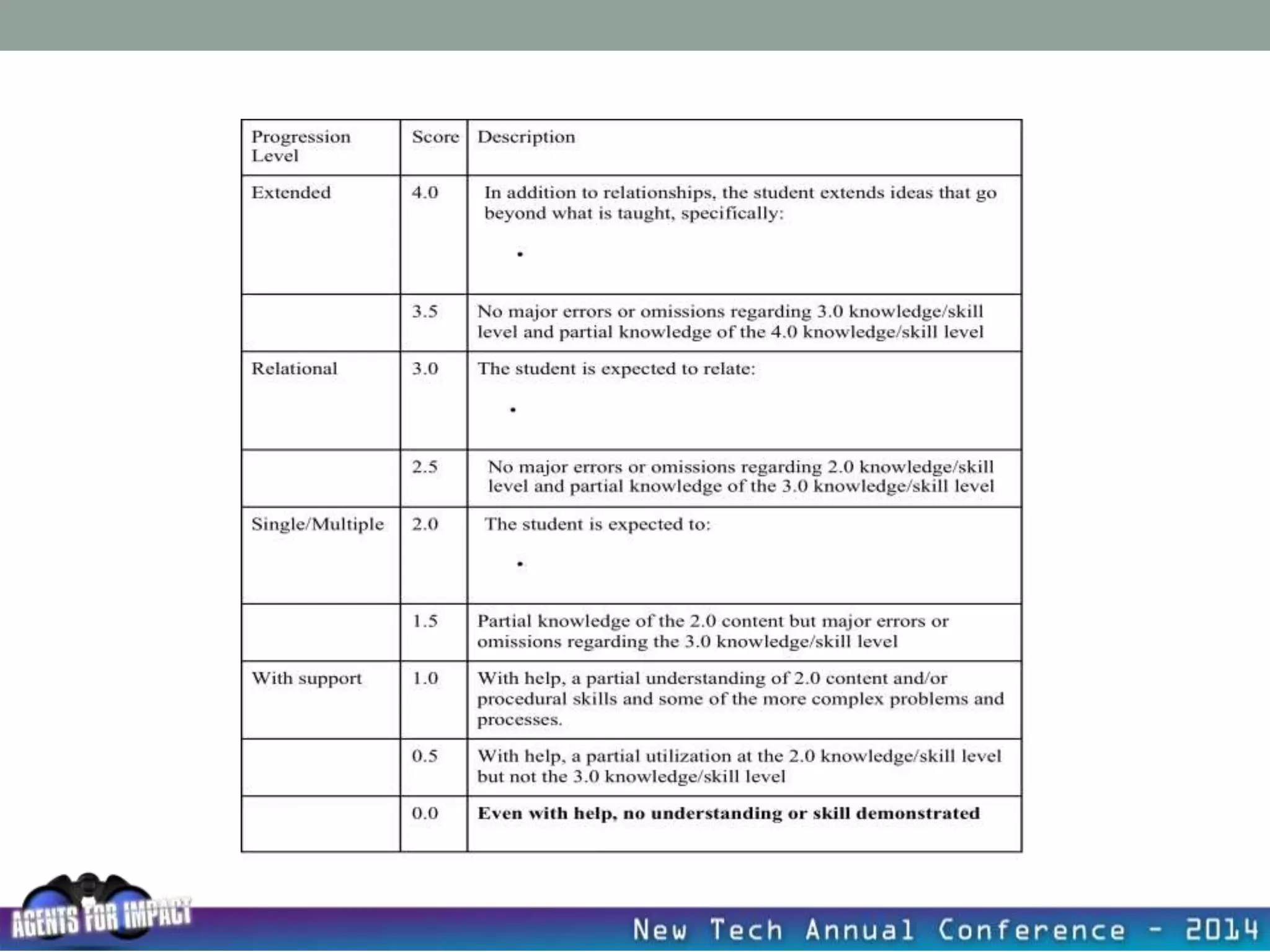
Not Yet Proficient
(0.0-2.25)
Proficient (2.5-4.0)
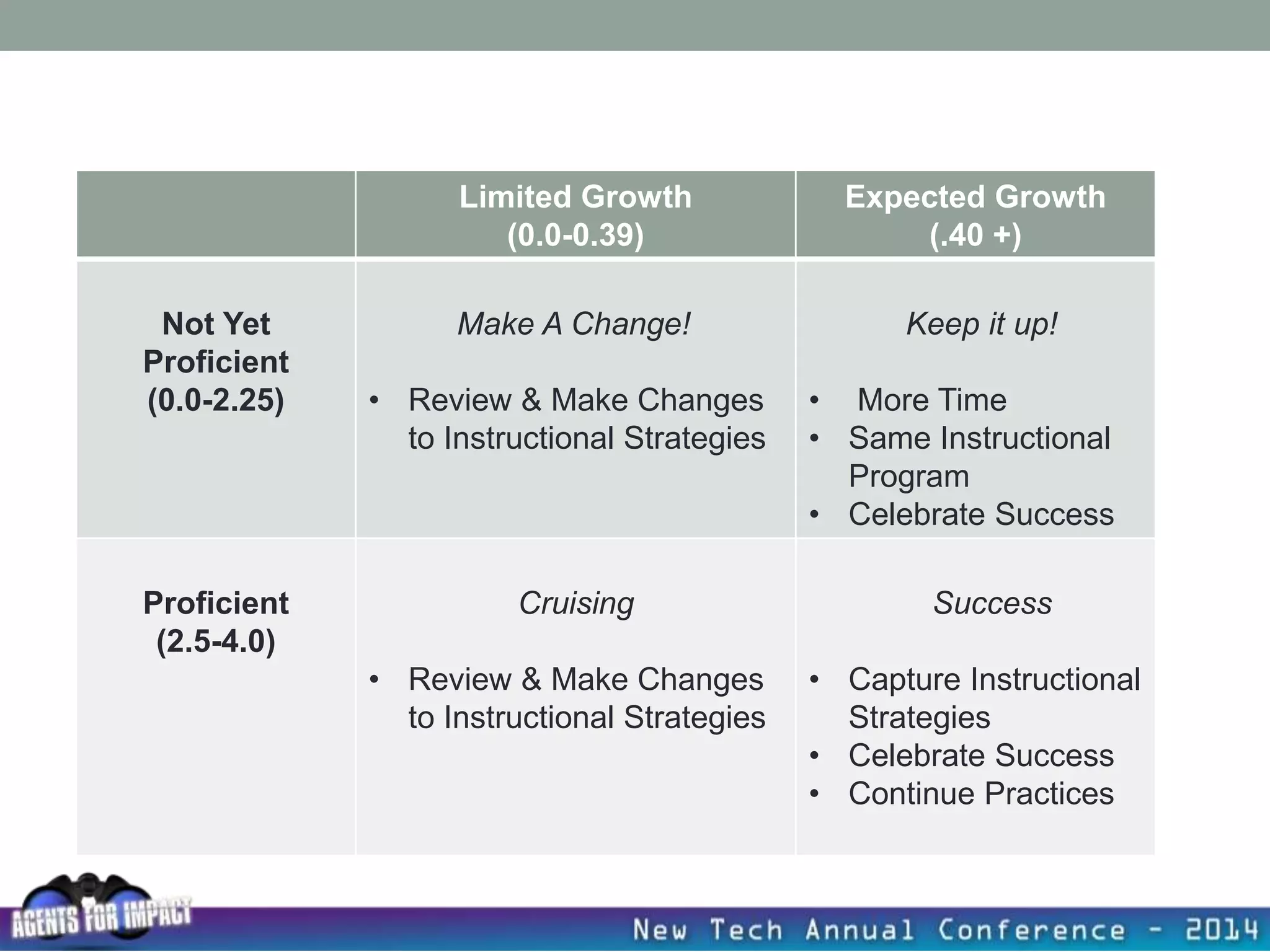
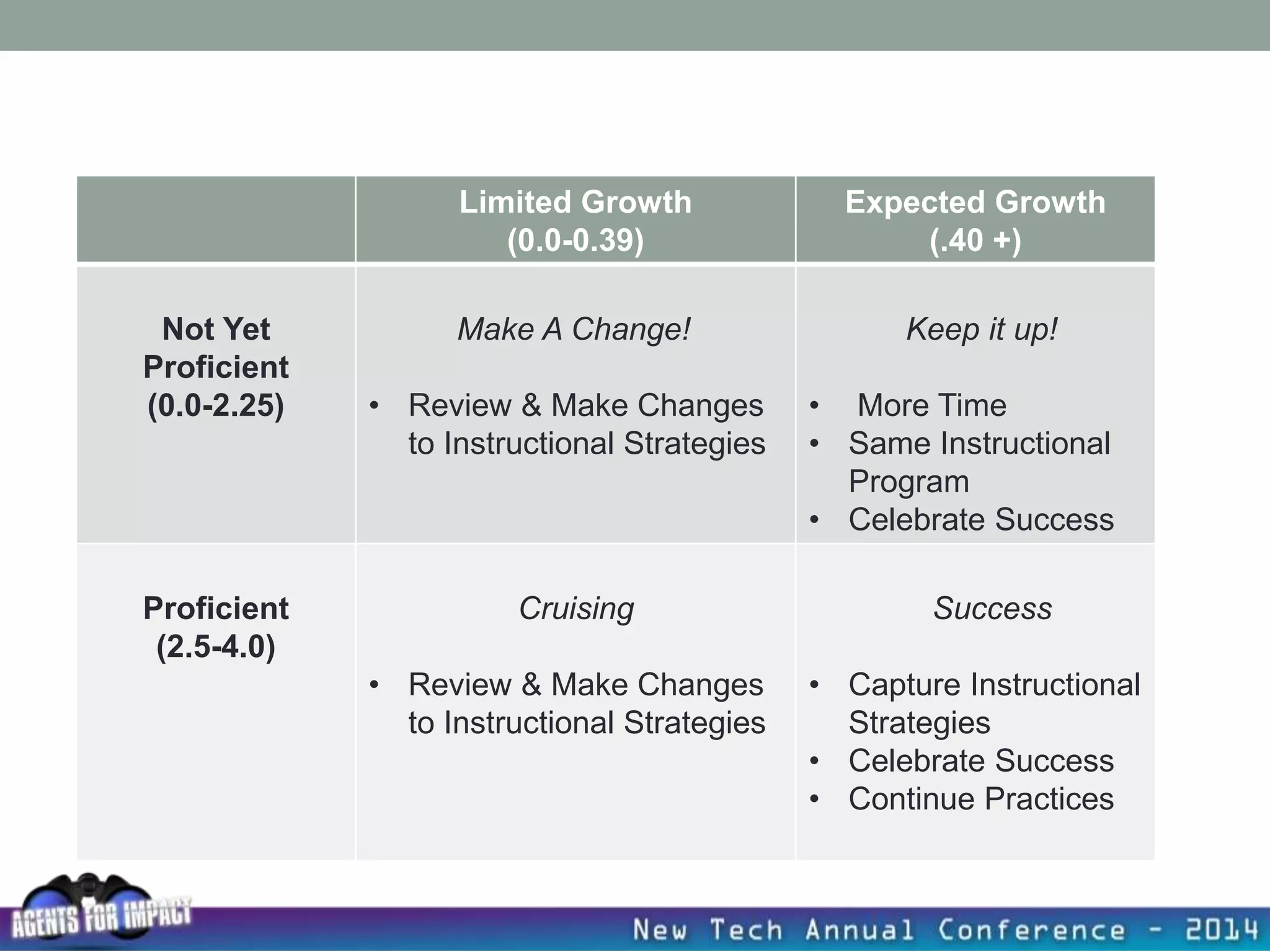
Limited Growth
(0.0-0.39)
Expected Growth
(.40 +)
Not Yet
Proficient
(0.0-2.25)
Make A Change!
• Review & Make Changes
to Instructional Strategies
Keep it up!
• More Time
• Same Instructional
Program
• Celebrate Success
Proficient
(2.5-4.0)
Cruising
• Review & Make Changes
to Instructional Strategies
Success
• Capture Instructional
Strategies
• Celebrate Success
• Continue Practices
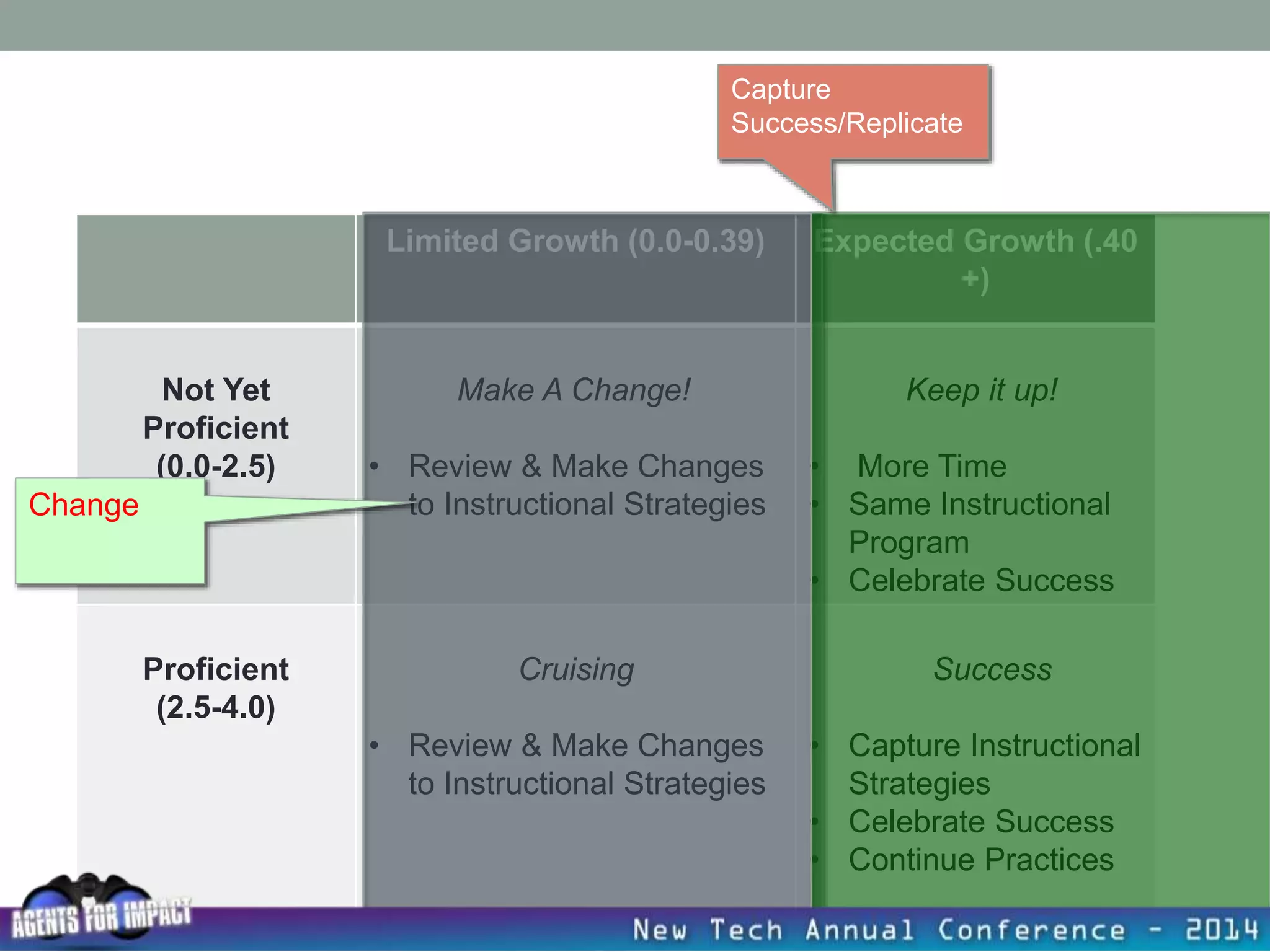
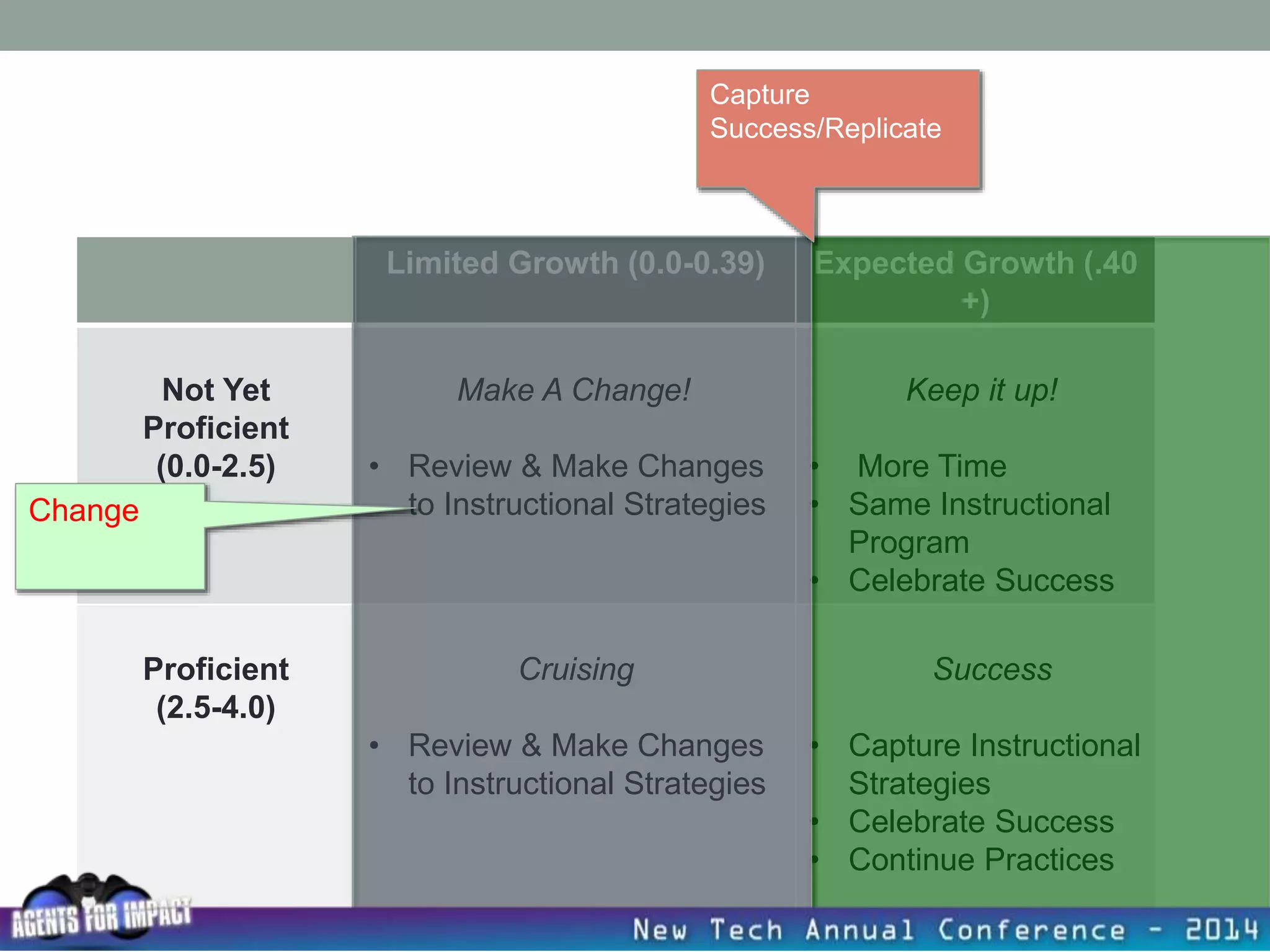
Limited Growth (0.0-0.39) Expected Growth (.40
+)
Not Yet
Proficient
(0.0-2.5)
Make A Change!
• Review & Make Changes
to Instructional Strategies
Keep it up!
• More Time
• Same Instructional
Program
• Celebrate Success
Proficient
(2.5-4.0)
Cruising
• Review & Make Changes
to Instructional Strategies
Success
• Capture Instructional
Strategies
• Celebrate Success
• Continue Practices
Capture
Success/Replicate
Change
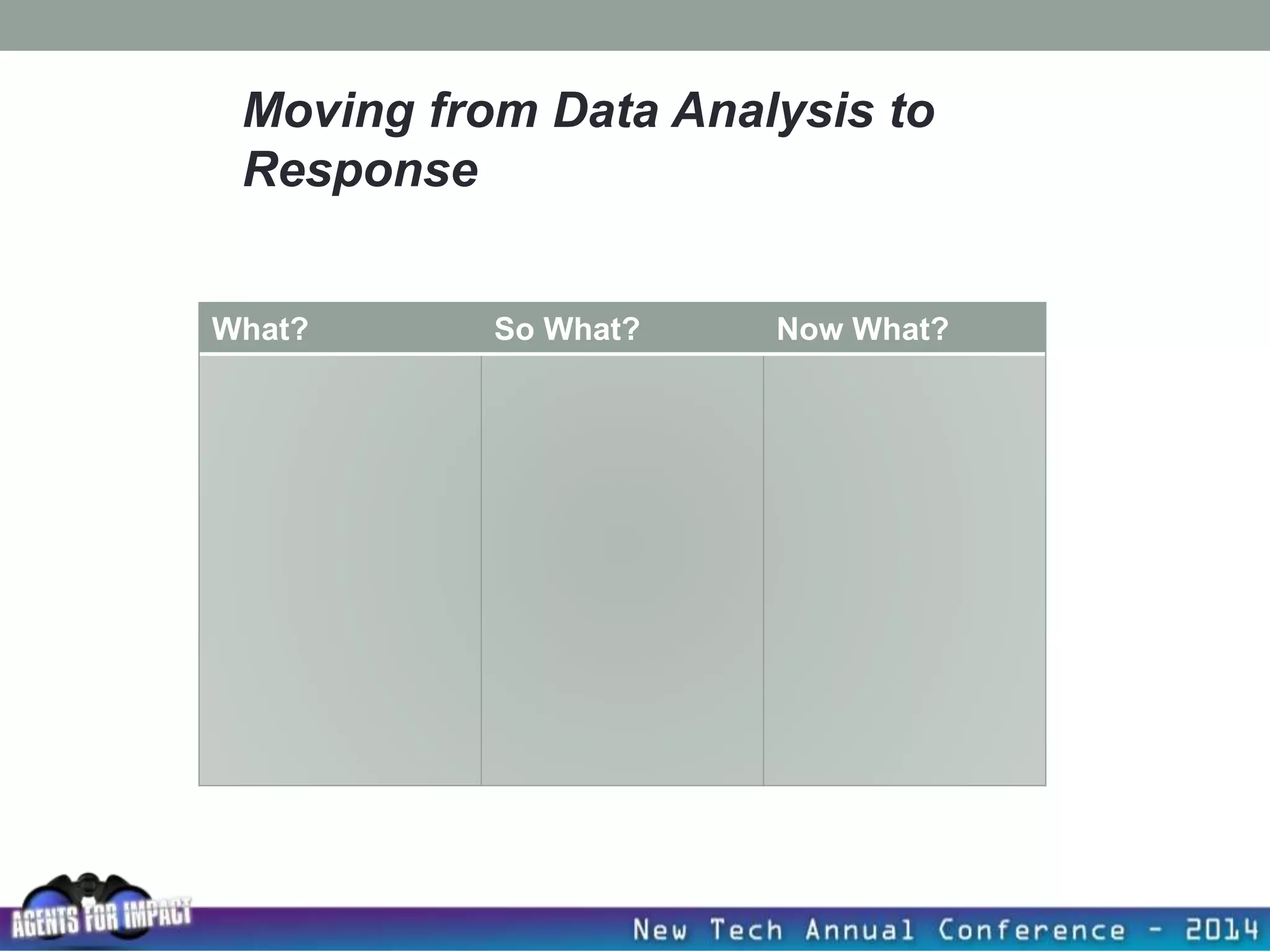
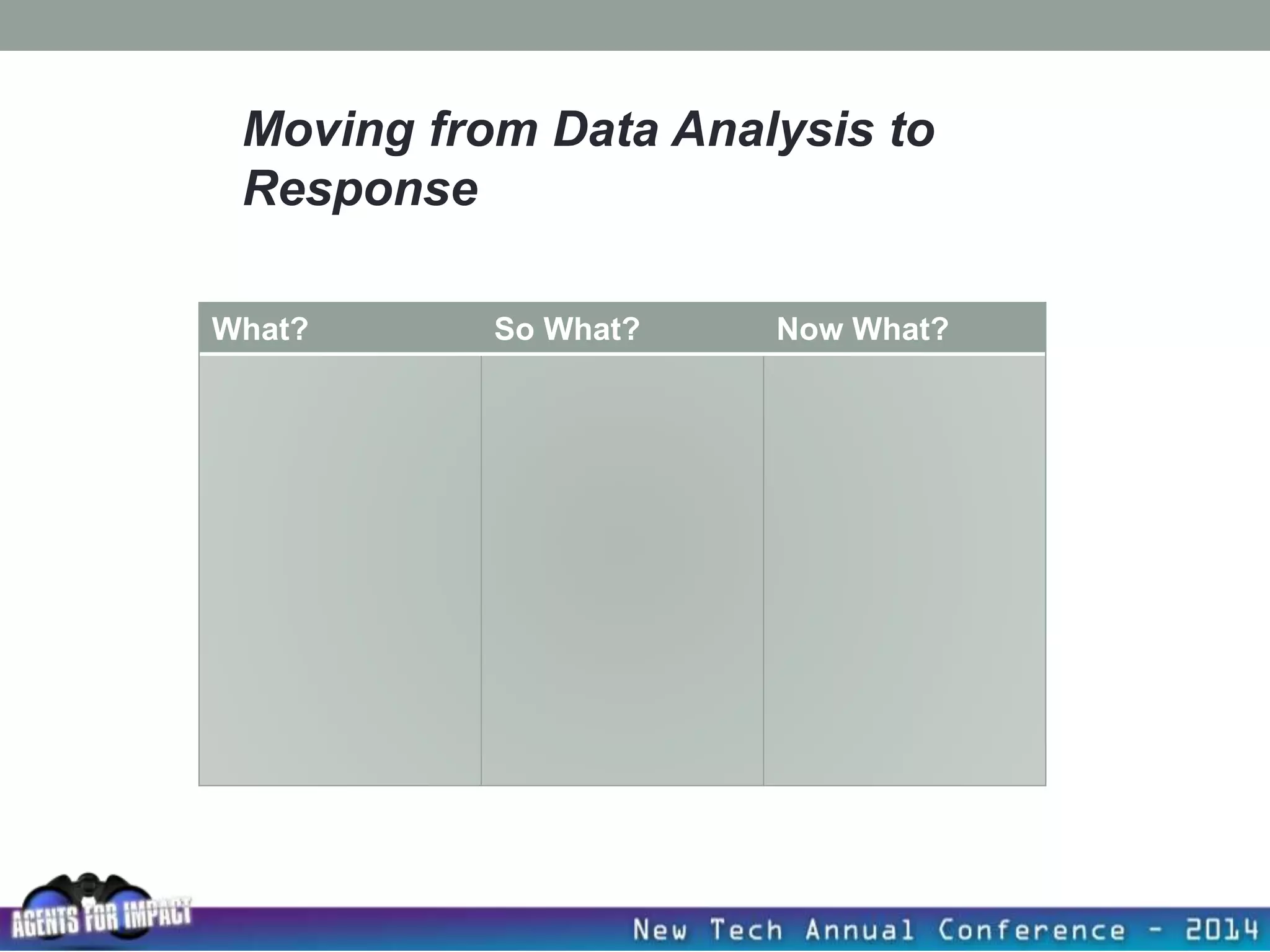
What? So What? Now What?
Moving from Data Analysis to
Response
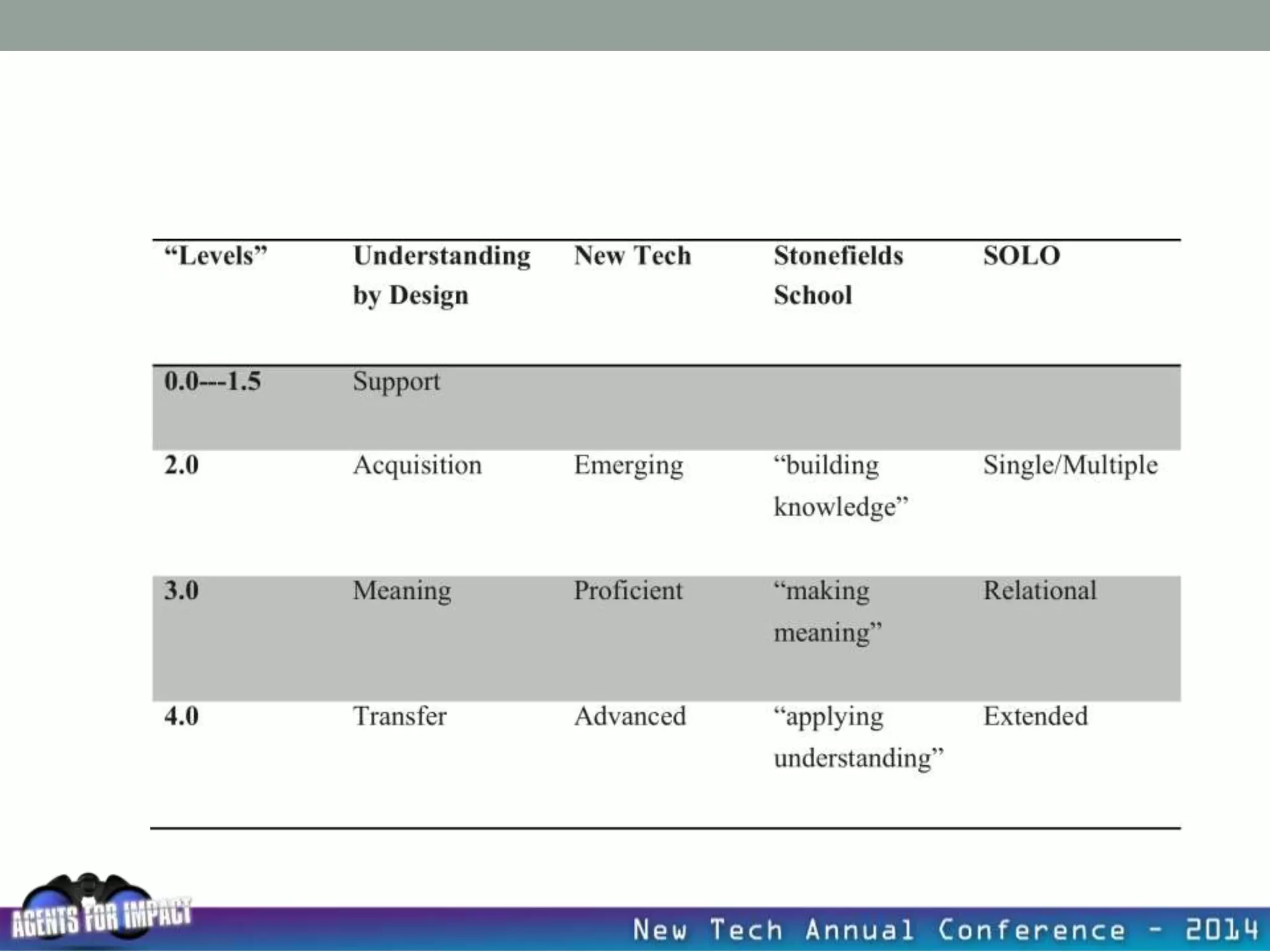
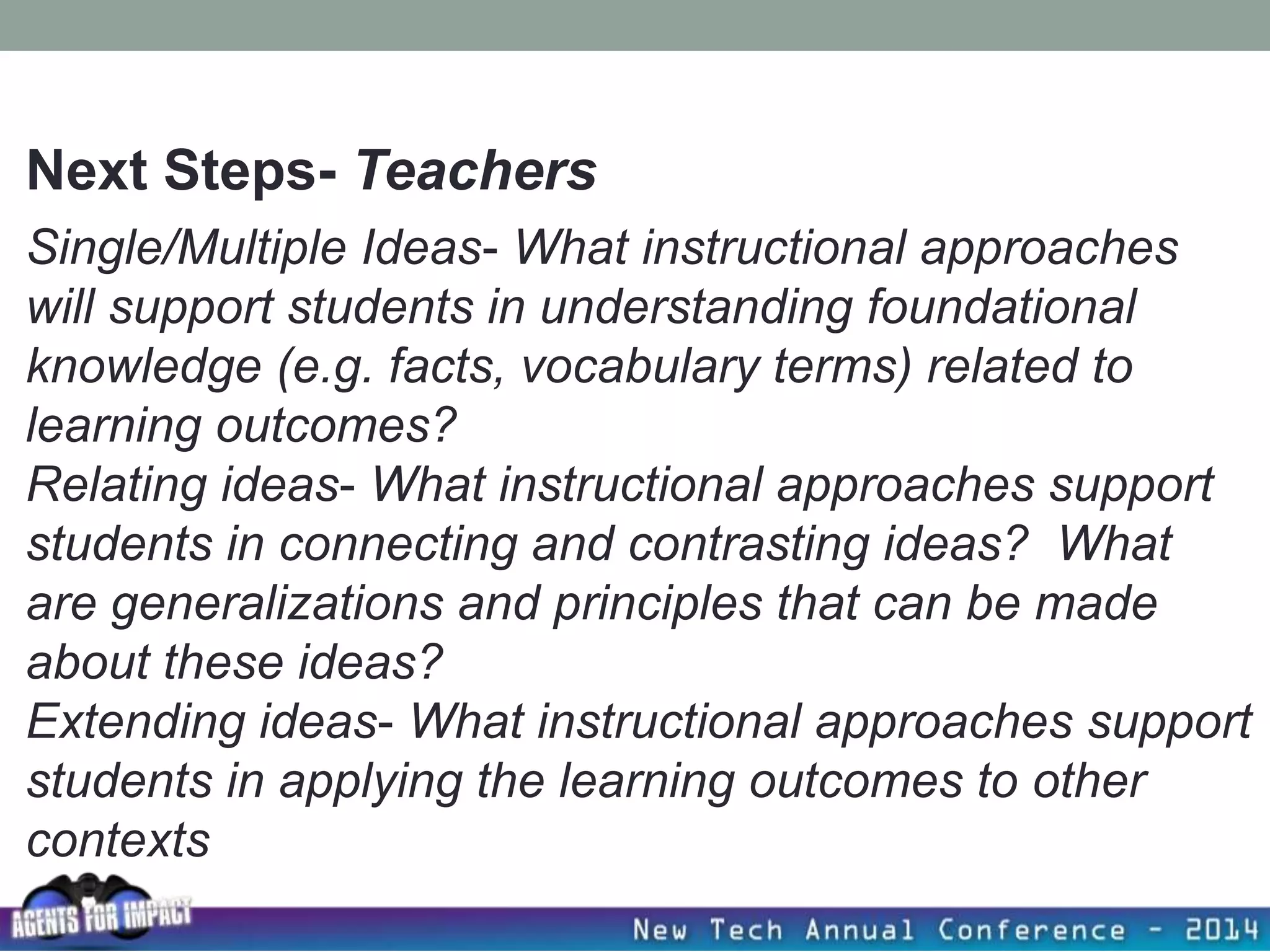
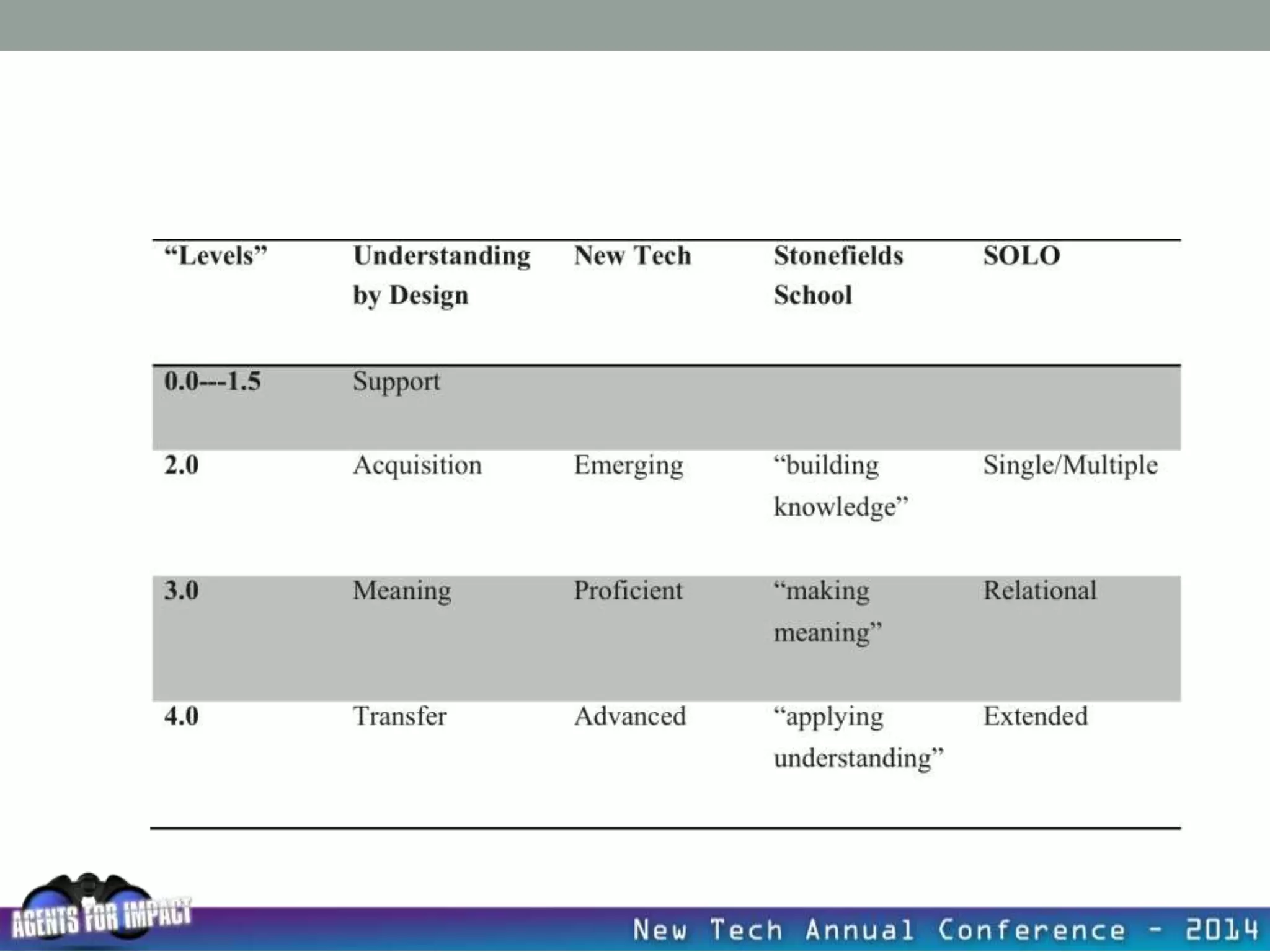
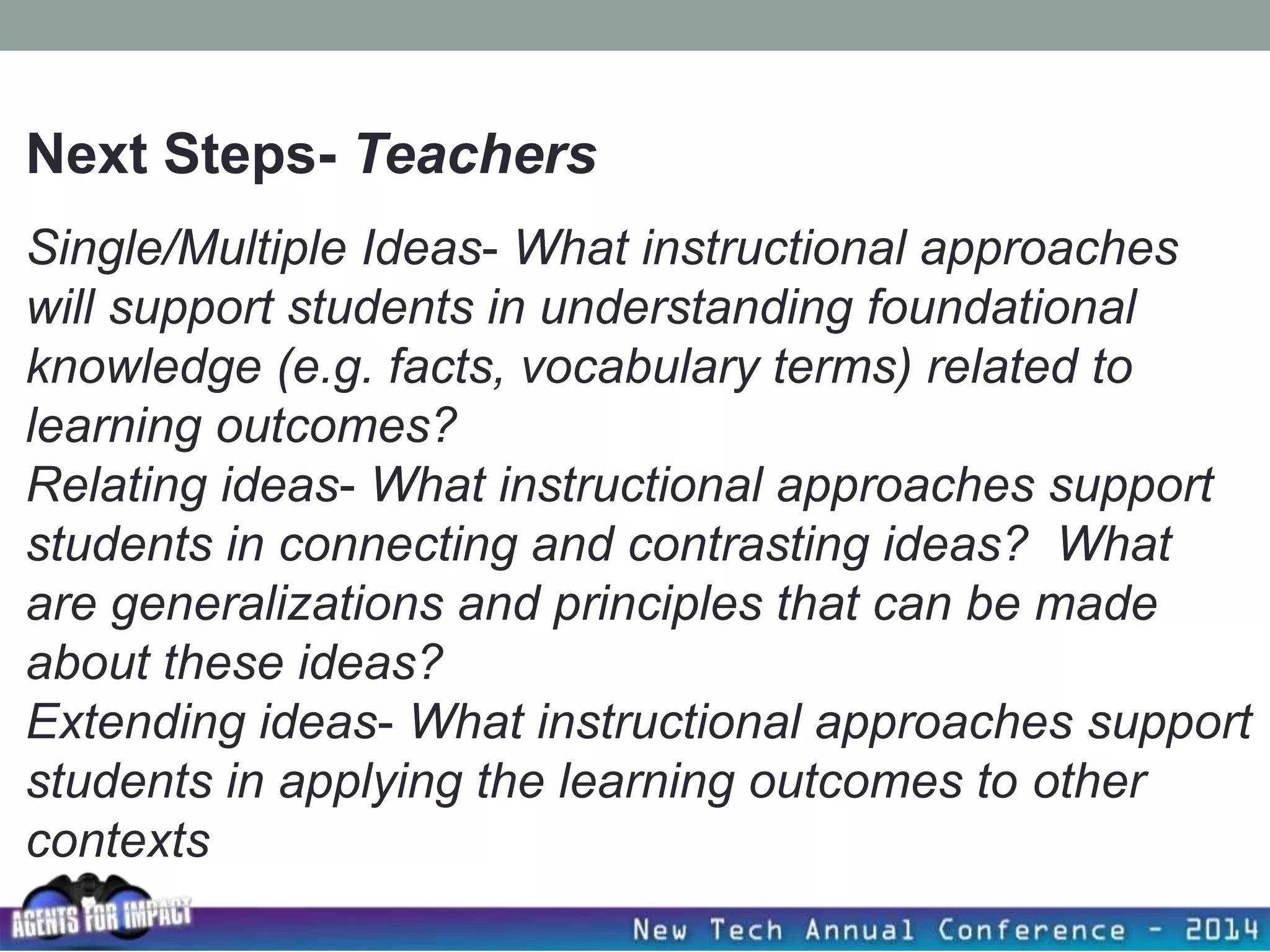
Single/Multiple Ideas- What instructional approaches
will support students in understanding foundational
knowledge (e.g. facts, vocabulary terms) related to
learning outcomes?
Relating ideas- What instructional approaches support
students in connecting and contrasting ideas? What
are generalizations and principles that can be made
about these ideas?
Extending ideas- What instructional approaches support
students in applying the learning outcomes to other
contexts
Next Steps- Teachers
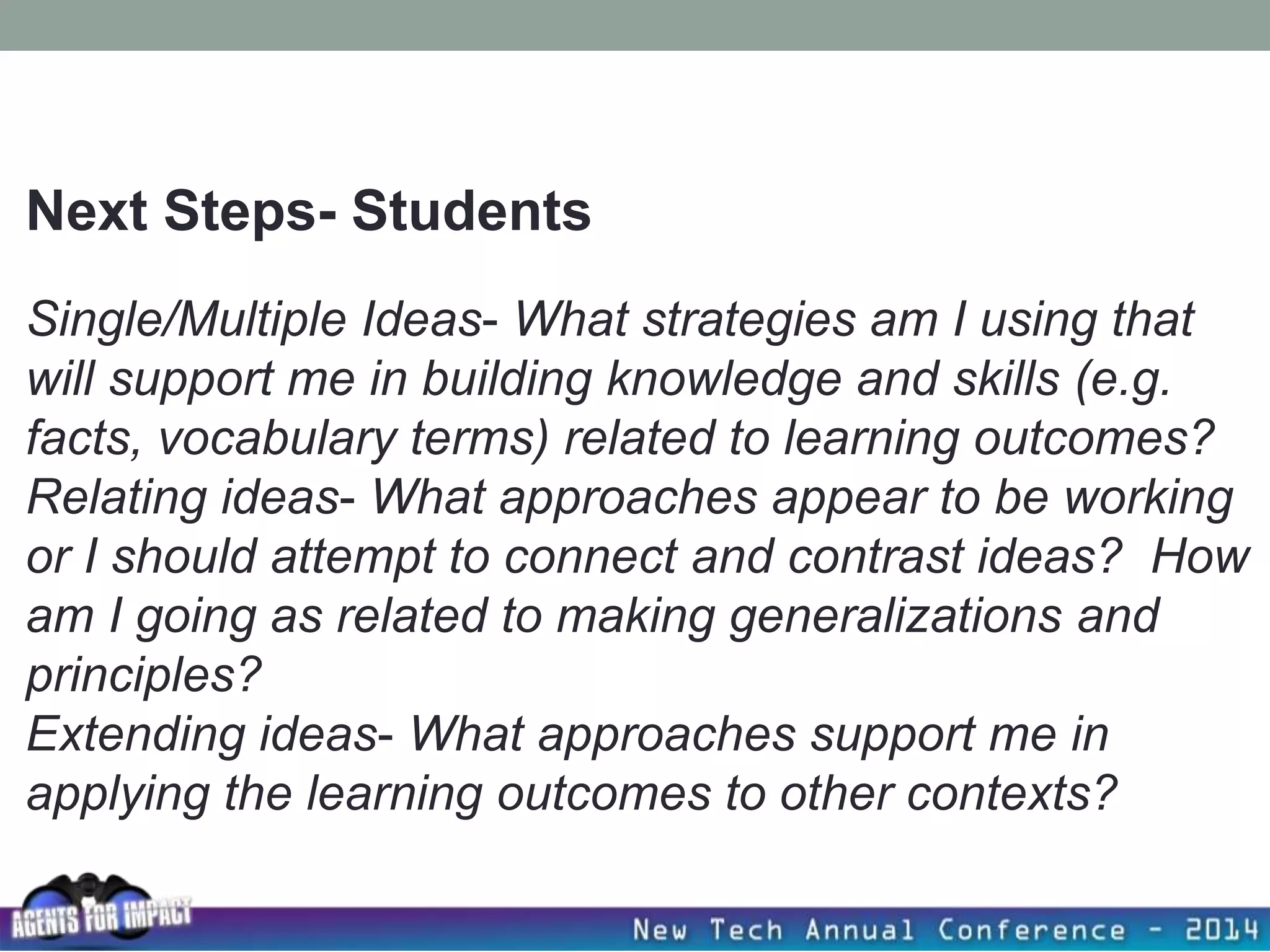
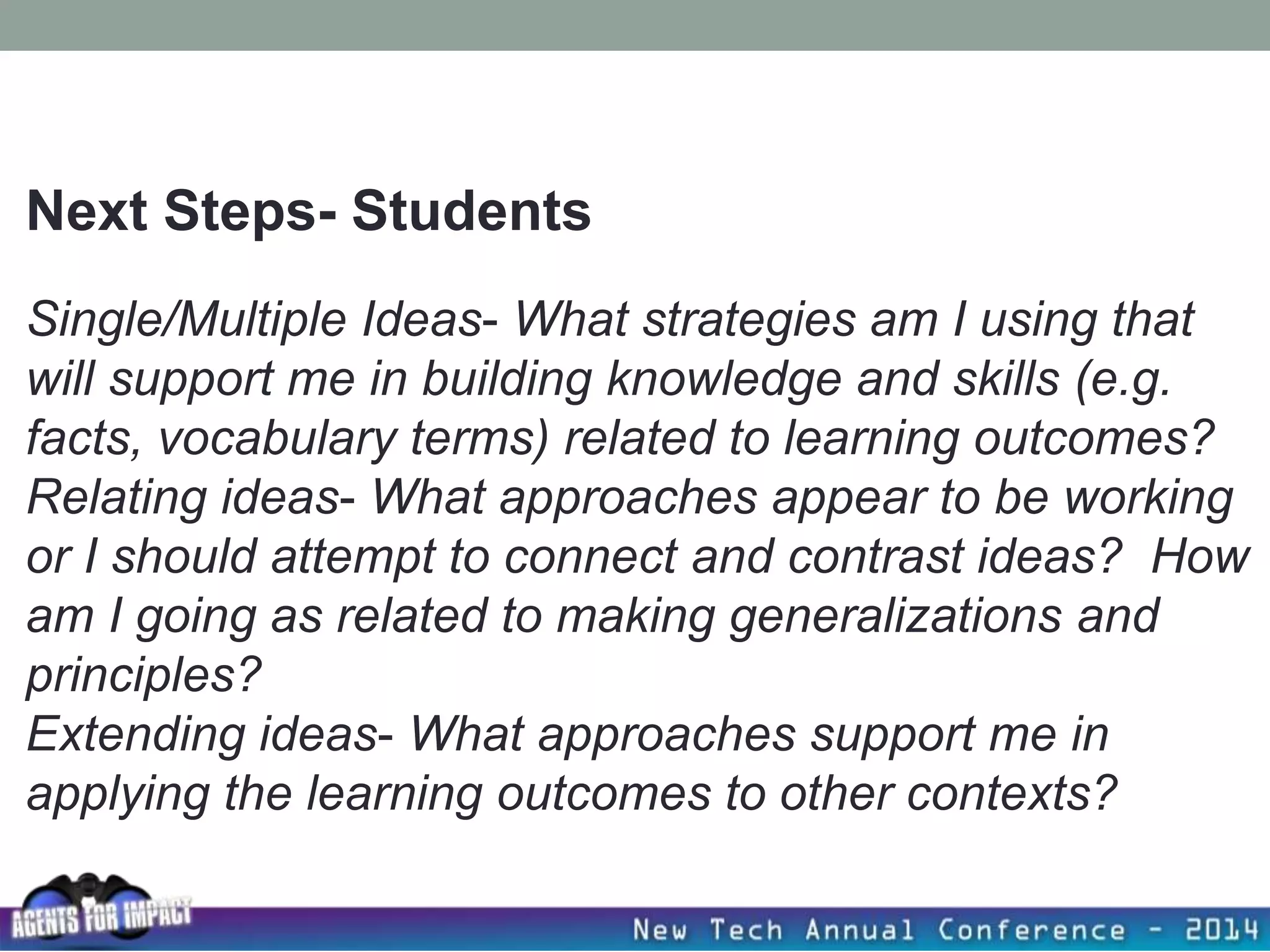
Single/Multiple Ideas- What strategies am I using that
will support me in building knowledge and skills (e.g.
facts, vocabulary terms) related to learning outcomes?
Relating ideas- What approaches appear to be working
or I should attempt to connect and contrast ideas? How
am I going as related to making generalizations and
principles?
Extending ideas- What approaches support me in
applying the learning outcomes to other contexts?
Next Steps- Students
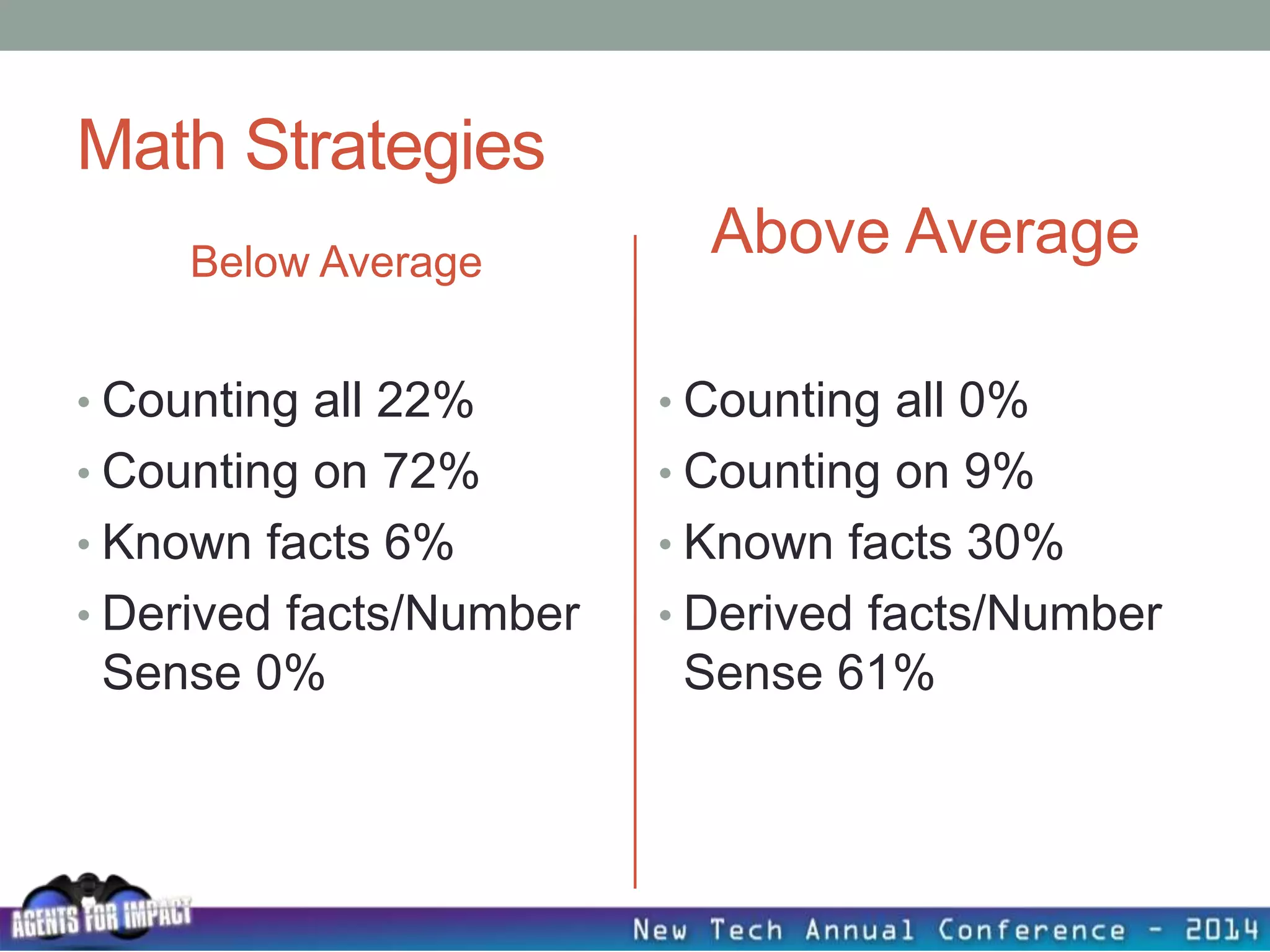
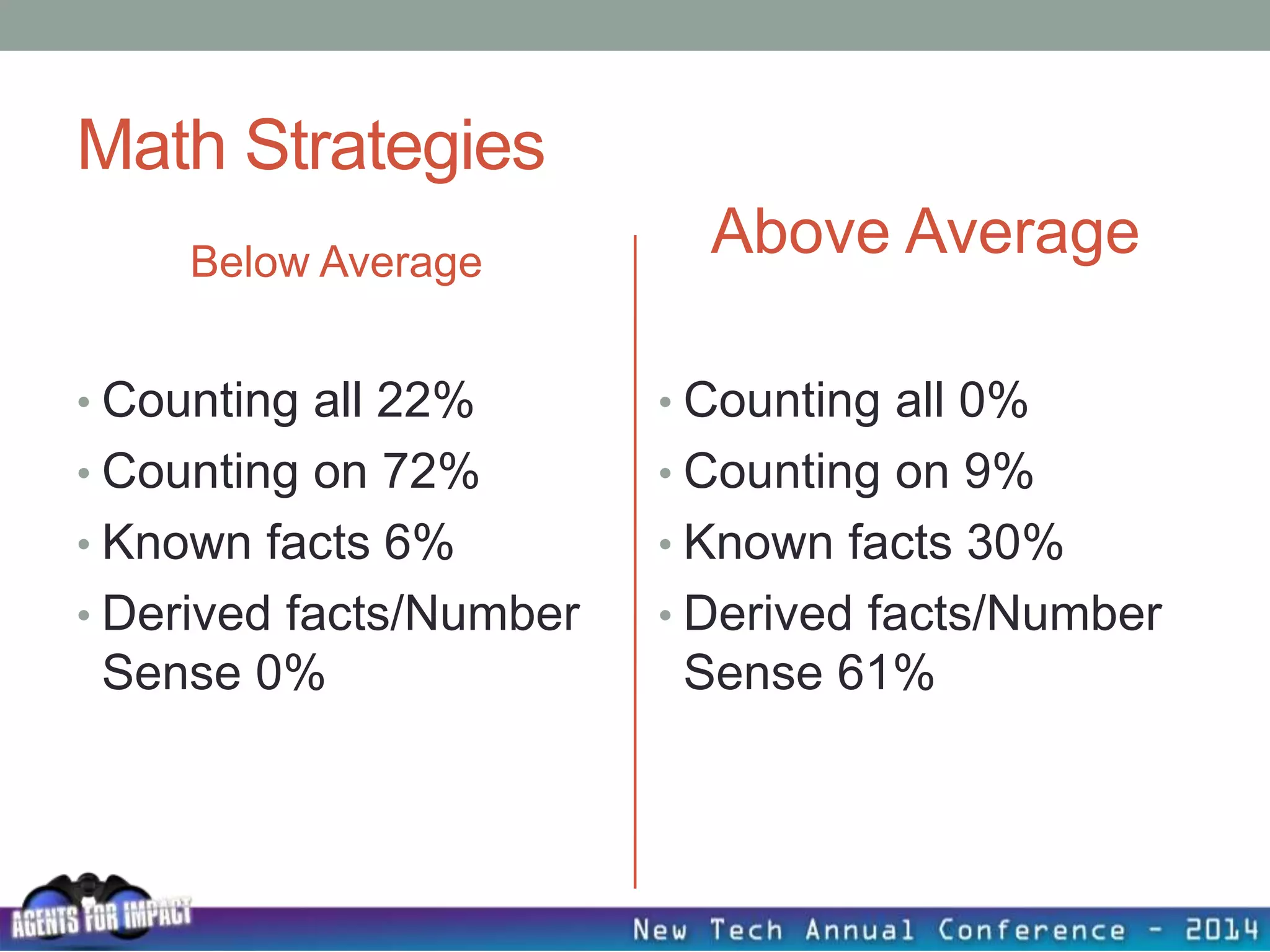
Math Strategies
Below Average
• Counting all 22%
• Counting on 72%
• Known facts 6%
• Derived facts/Number
Sense 0%
Above Average
• Counting all 0%
• Counting on 9%
• Known facts 30%
• Derived facts/Number
Sense 61%
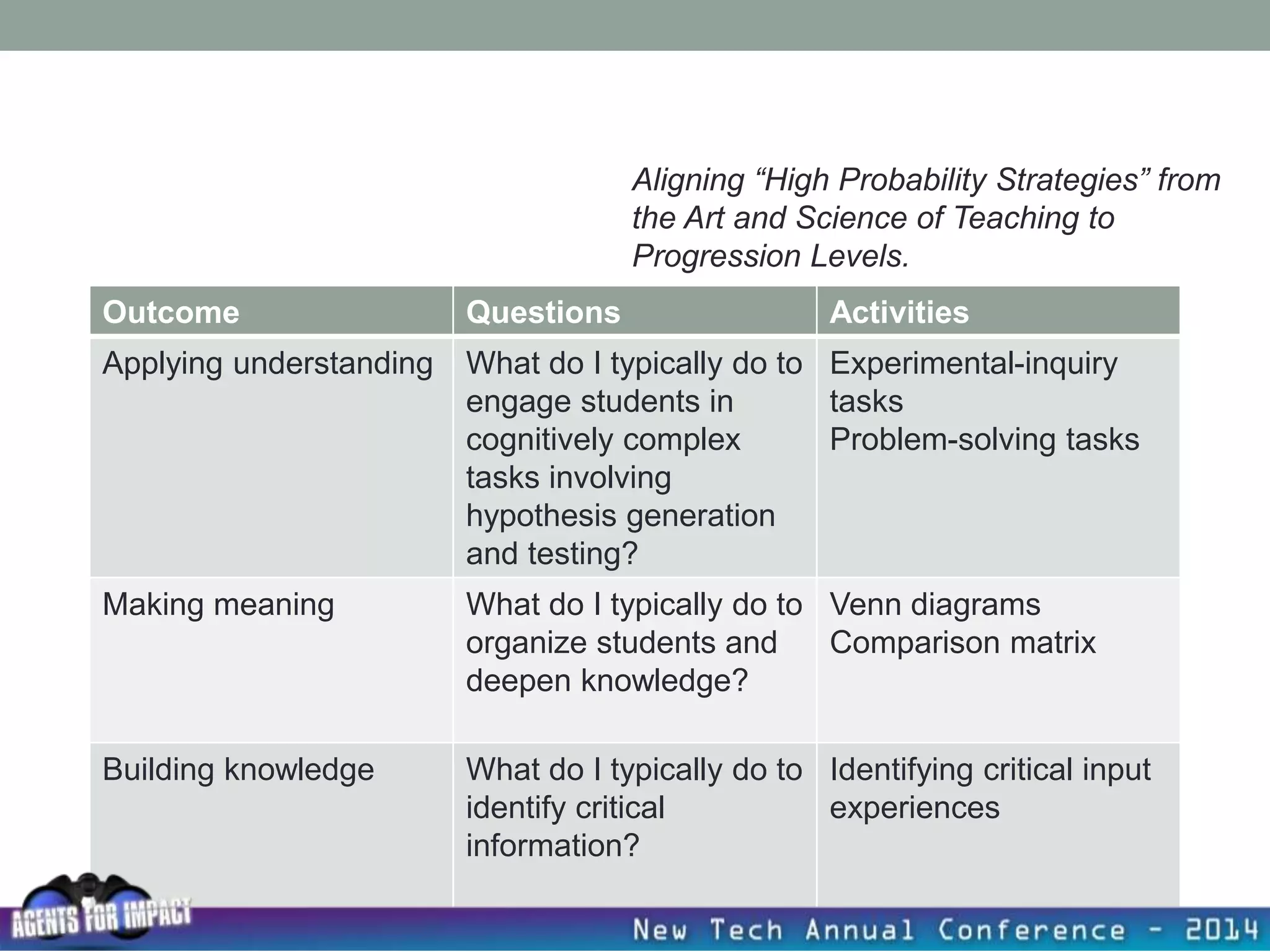
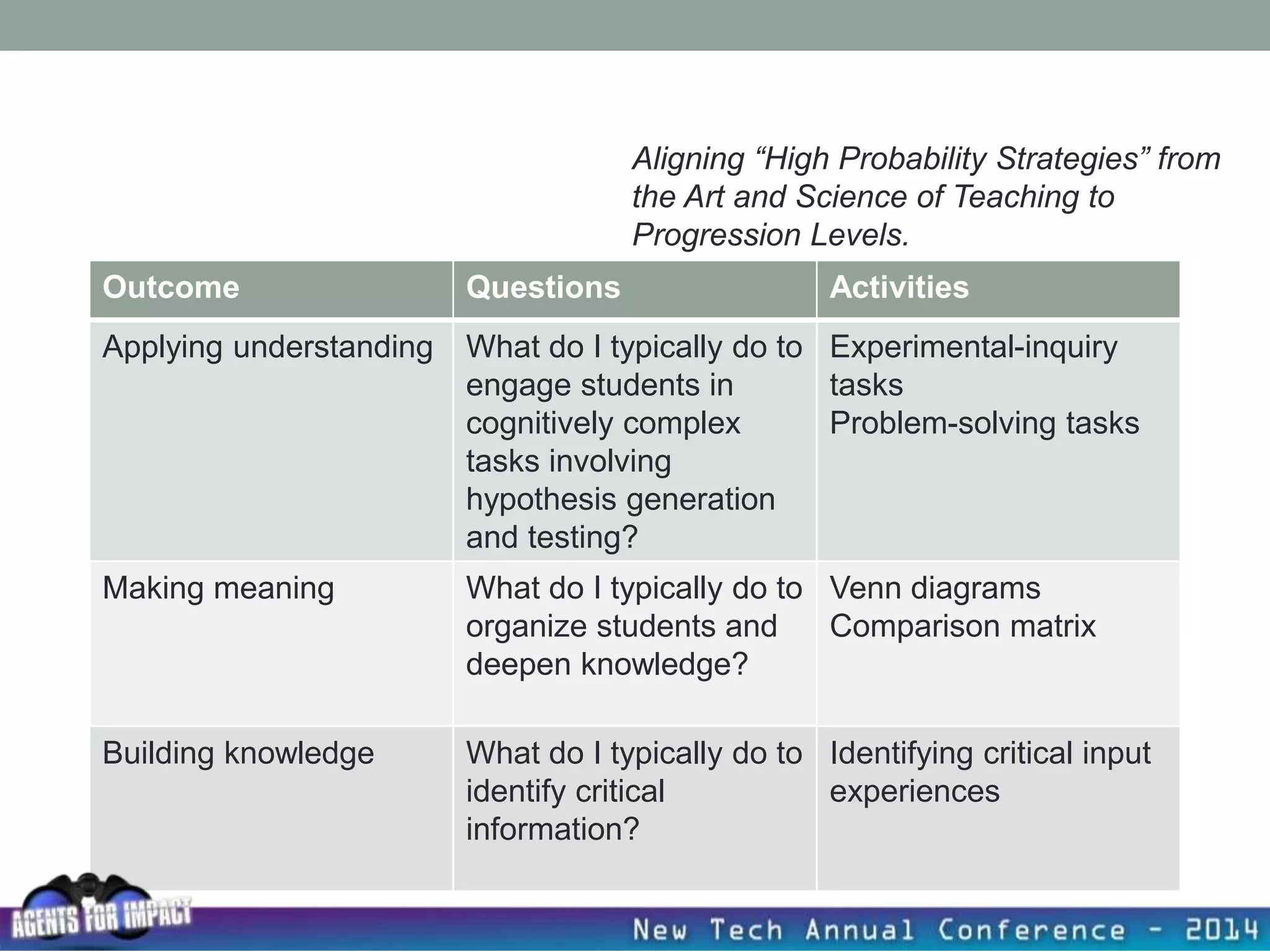
Aligning “High Probability Strategies” from
the Art and Science of Teaching to
Progression Levels.
Outcome Questions Activities
Applying understanding What do I typically do to
engage students in
cognitively complex
tasks involving
hypothesis generation
and testing?
Experimental-inquiry
tasks
Problem-solving tasks
Making meaning What do I typically do to
organize students and
deepen knowledge?
Venn diagrams
Comparison matrix
Building knowledge What do I typically do to
identify critical
information?
Identifying critical input
experiences
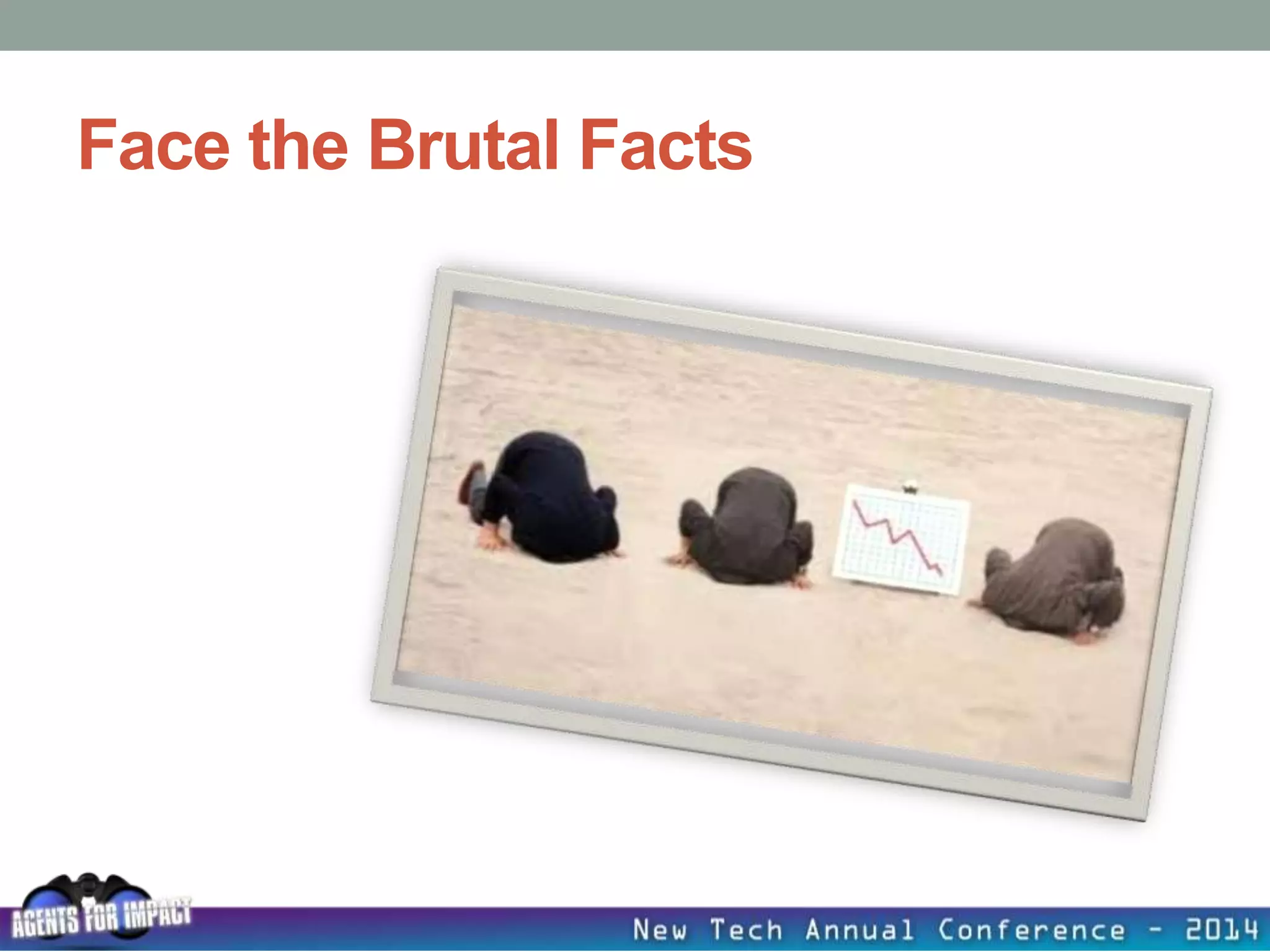
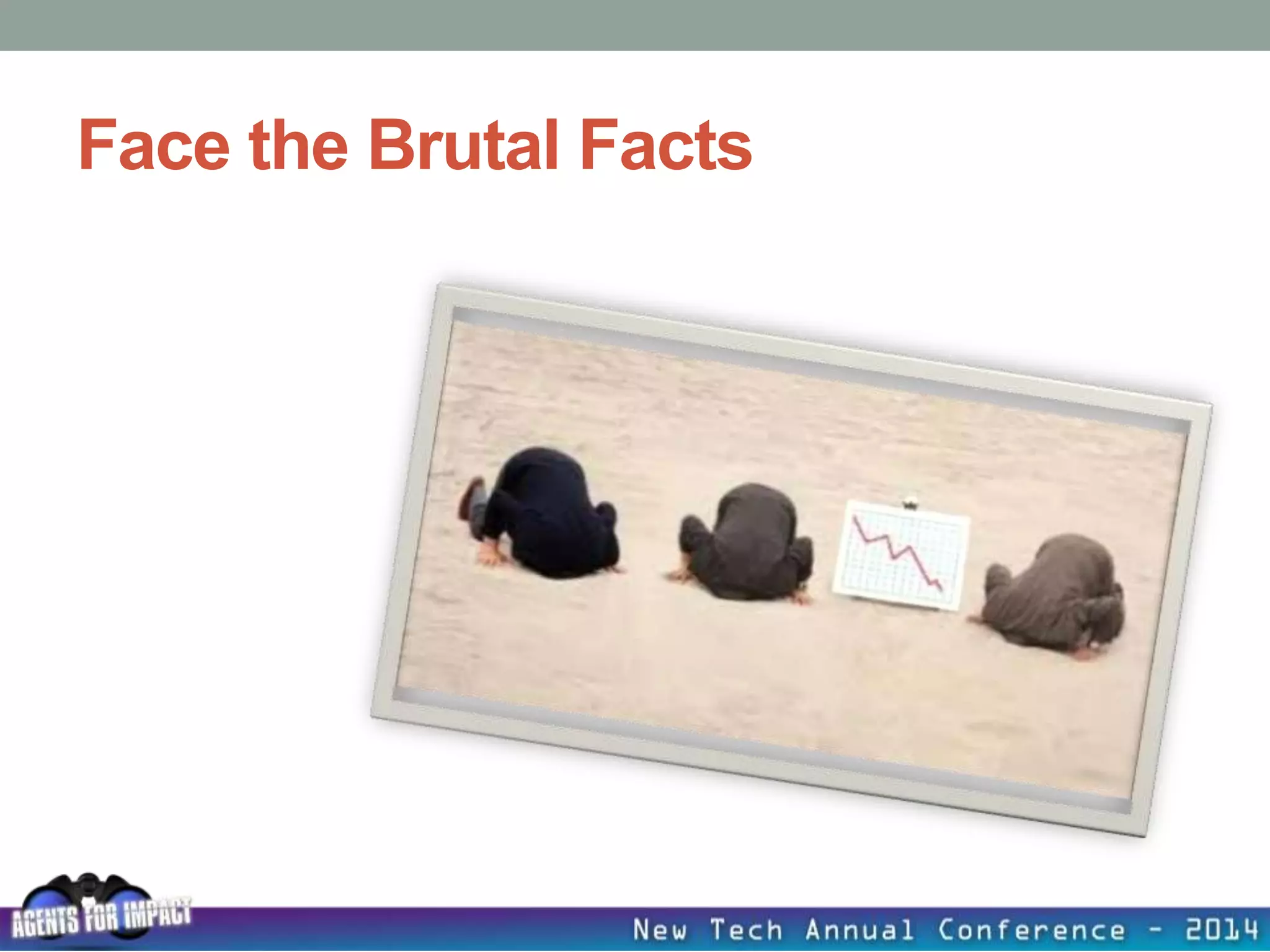
Face the Brutal Facts
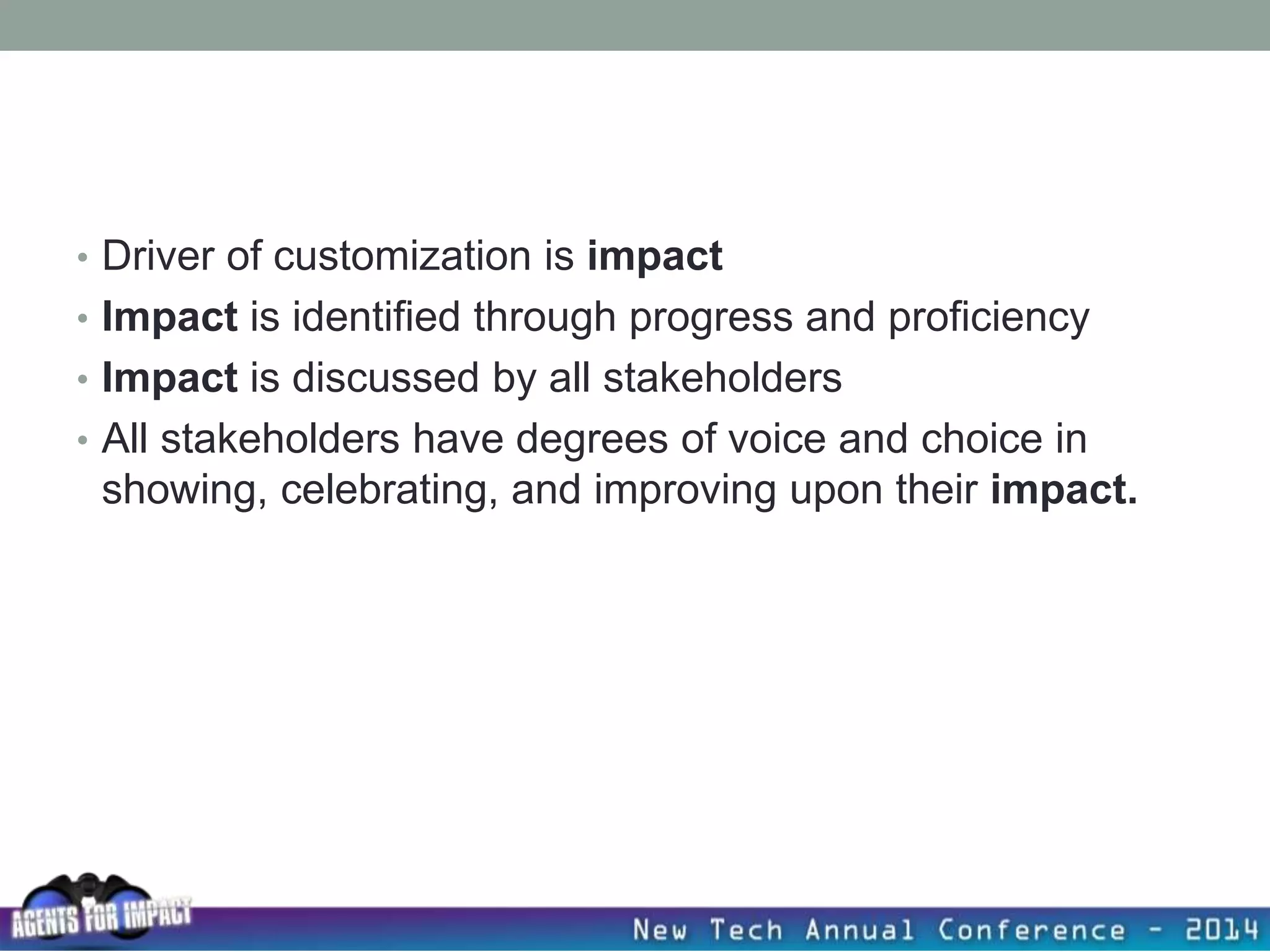
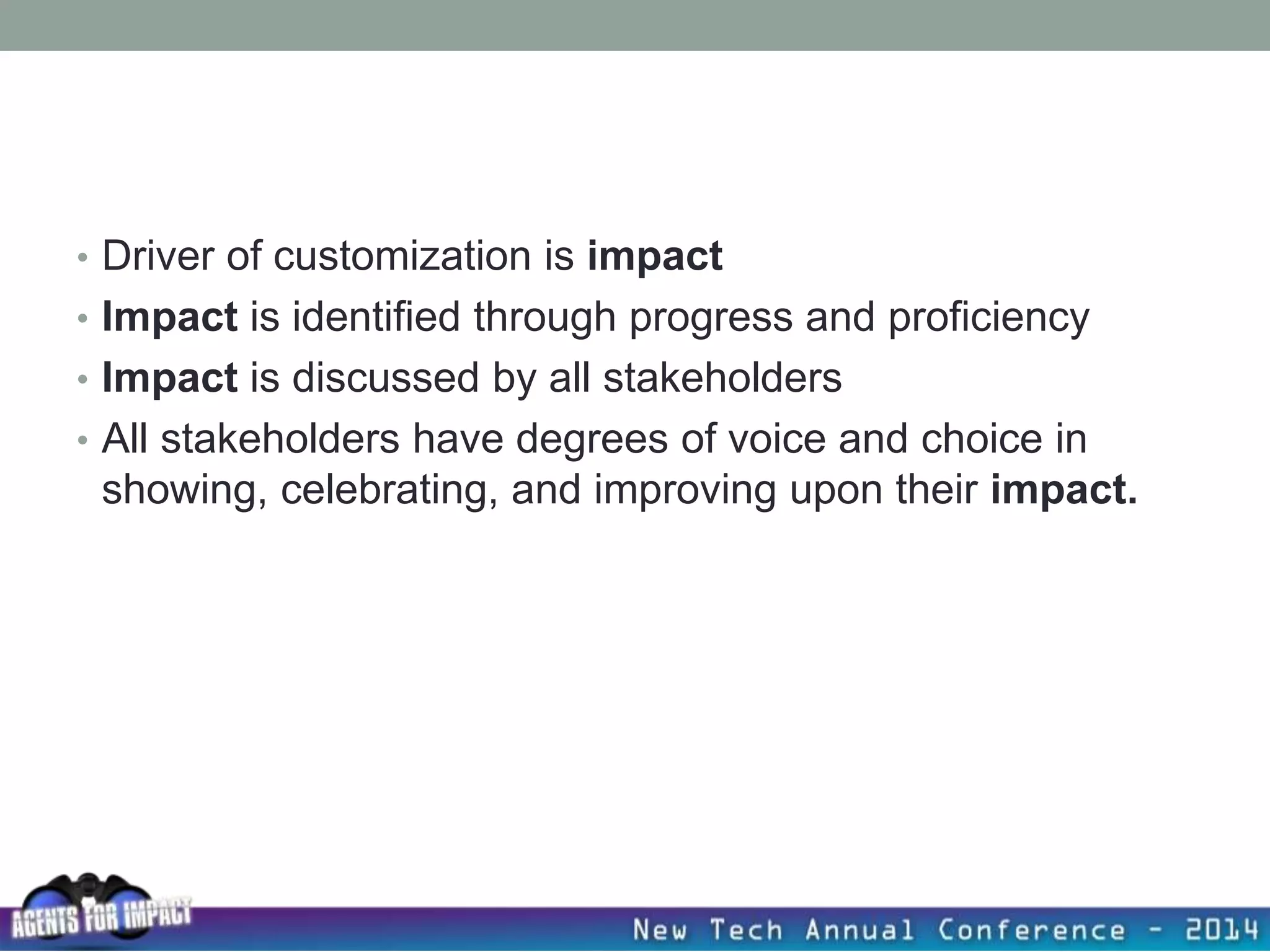
• Driver of customization is impact
• Impact is identified through progress and proficiency
• Impact is discussed by all stakeholders
• All stakeholders have degrees of voice and choice in
showing, celebrating, and improving upon their impact.
Teaching [and learning] in the dark is a questionable
practice” (Taba, 1966)
#vlconf2014
- Where is the learner now?
Score Description
4 Extension
Applying Understanding
3 Relational
Making Meaning
2 Single/Multiple
Building Knowledge
1 Direct Support
Proficiency
Not Yet
Proficiency
Scor
e
Description
4 Extension
Applying Understanding
3 Relational
Making Meaning
2 Single/Multiple
Building Knowledge
1 Direct Support
DEEP
SURFACE
Connections
Limited Growth
(0.0-0.39)
Expected Growth
(.40 +)
Not Yet Proficient
(0.0-2.25)
Proficient
(2.5-4.0)
Limited Growth
(0.0-0.39)
Expected Growth
(.40 +)
Not Yet
Proficient
(0.0-2.25)
Make A Change!
• Review & Make Changes
to Instructional Strategies
Keep it up!
• More Time
• Same Instructional
Program
• Celebrate Success
Proficient
(2.5-4.0)
Cruising
• Review & Make Changes
to Instructional Strategies
Success
• Capture Instructional
Strategies
• Celebrate Success
• Continue Practices
Limited Growth (0.0-0.39) Expected Growth (.40
+)
Not Yet
Proficient
(0.0-2.5)
Make A Change!
• Review & Make Changes
to Instructional Strategies
Keep it up!
• More Time
• Same Instructional
Program
• Celebrate Success
Proficient
(2.5-4.0)
Cruising
• Review & Make Changes
to Instructional Strategies
Success
• Capture Instructional
Strategies
• Celebrate Success
• Continue Practices
Capture
Success/Replicate
Change
What? So What? Now What?
Moving from Data Analysis to
Response
Single/Multiple Ideas- What instructional approaches
will support students in understanding foundational
knowledge (e.g. facts, vocabulary terms) related to
learning outcomes?
Relating ideas- What instructional approaches support
students in connecting and contrasting ideas? What
are generalizations and principles that can be made
about these ideas?
Extending ideas- What instructional approaches support
students in applying the learning outcomes to other
contexts
Next Steps- Teachers
Single/Multiple Ideas- What strategies am I using that
will support me in building knowledge and skills (e.g.
facts, vocabulary terms) related to learning outcomes?
Relating ideas- What approaches appear to be working
or I should attempt to connect and contrast ideas? How
am I going as related to making generalizations and
principles?
Extending ideas- What approaches support me in
applying the learning outcomes to other contexts?
Next Steps- Students
Math Strategies
Below Average
• Counting all 22%
• Counting on 72%
• Known facts 6%
• Derived facts/Number
Sense 0%
Above Average
• Counting all 0%
• Counting on 9%
• Known facts 30%
• Derived facts/Number
Sense 61%
Aligning “High Probability Strategies” from
the Art and Science of Teaching to
Progression Levels.
Outcome Questions Activities
Applying understanding What do I typically do to
engage students in
cognitively complex
tasks involving
hypothesis generation
and testing?
Experimental-inquiry
tasks
Problem-solving tasks
Making meaning What do I typically do to
organize students and
deepen knowledge?
Venn diagrams
Comparison matrix
Building knowledge What do I typically do to
identify critical
information?
Identifying critical input
experiences
Face the Brutal Facts
• Driver of customization is impact
• Impact is identified through progress and proficiency
• Impact is discussed by all stakeholders
• All stakeholders have degrees of voice and choice in
showing, celebrating, and improving upon their impact.
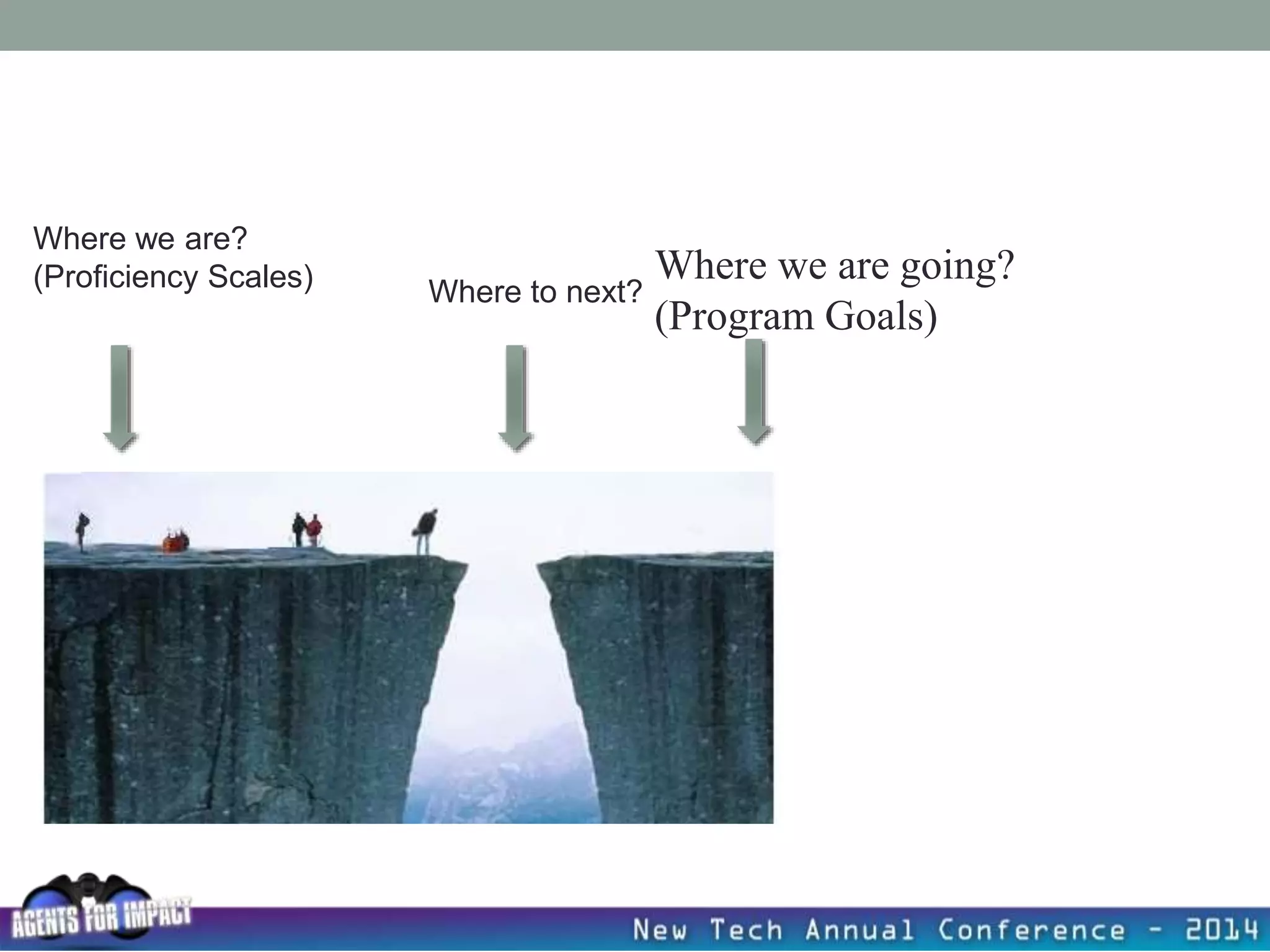
Where we are going?
(Program Goals)
Where we are?
(Proficiency Scales) Where to next?
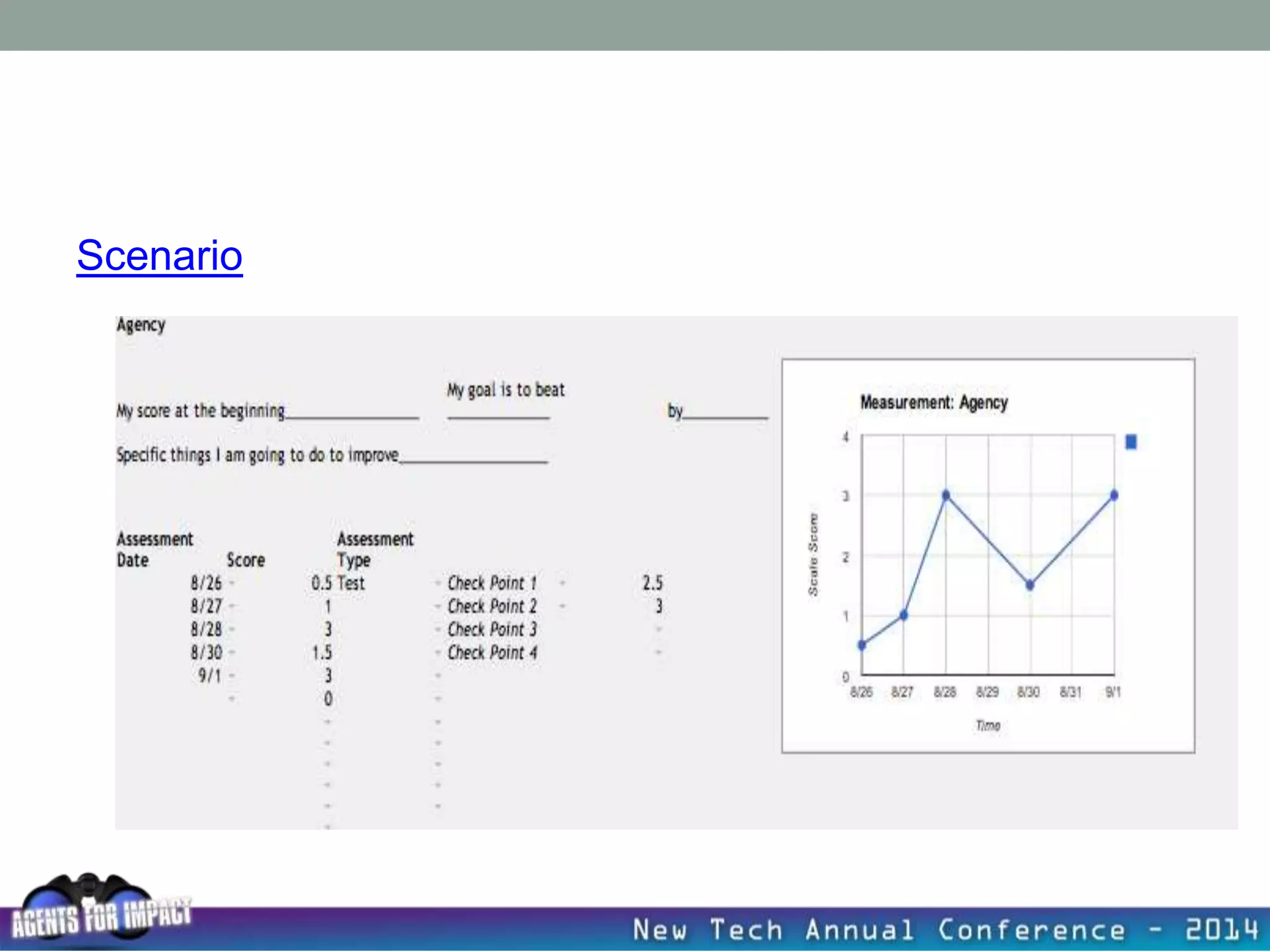
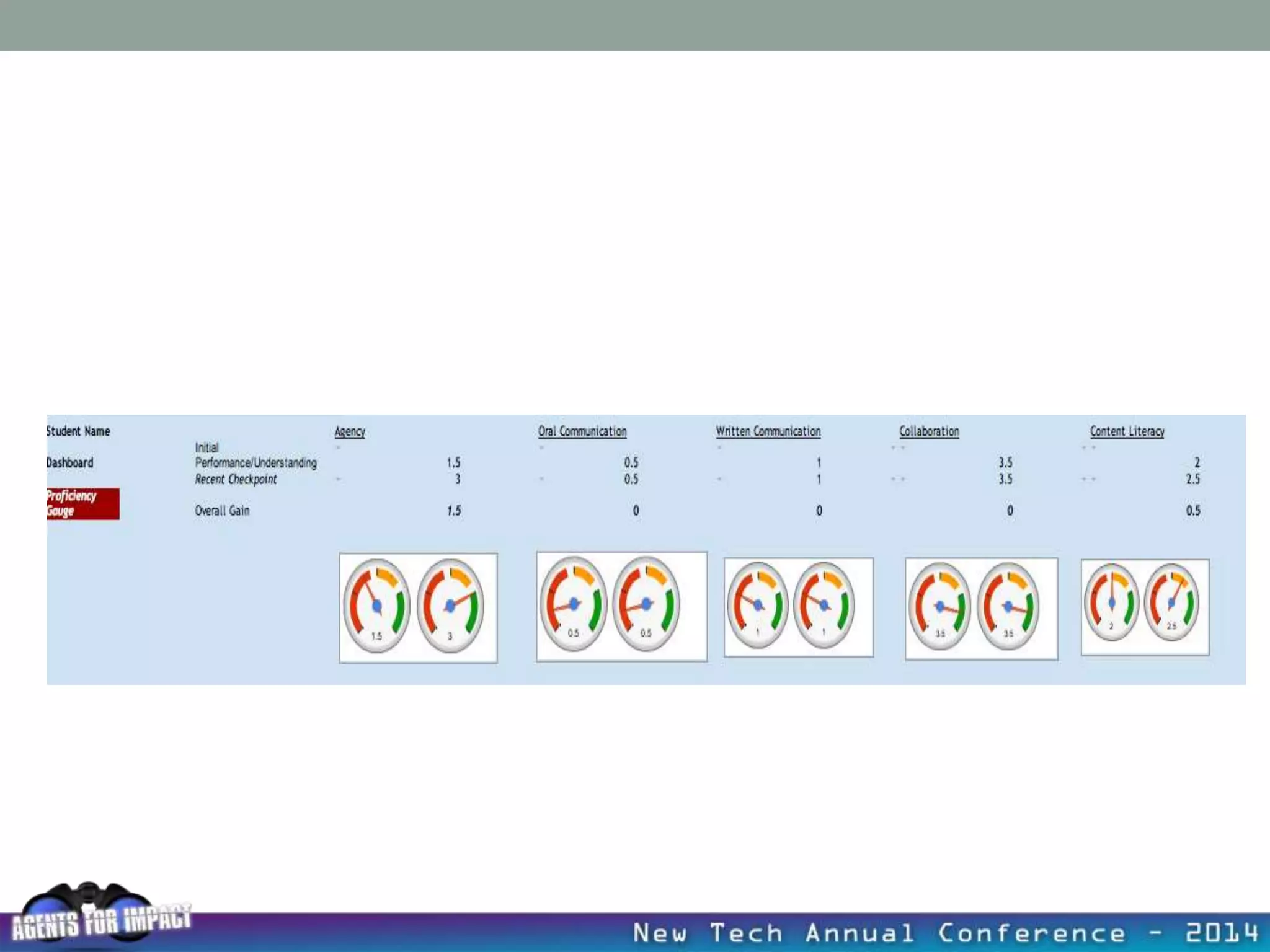
Scenario
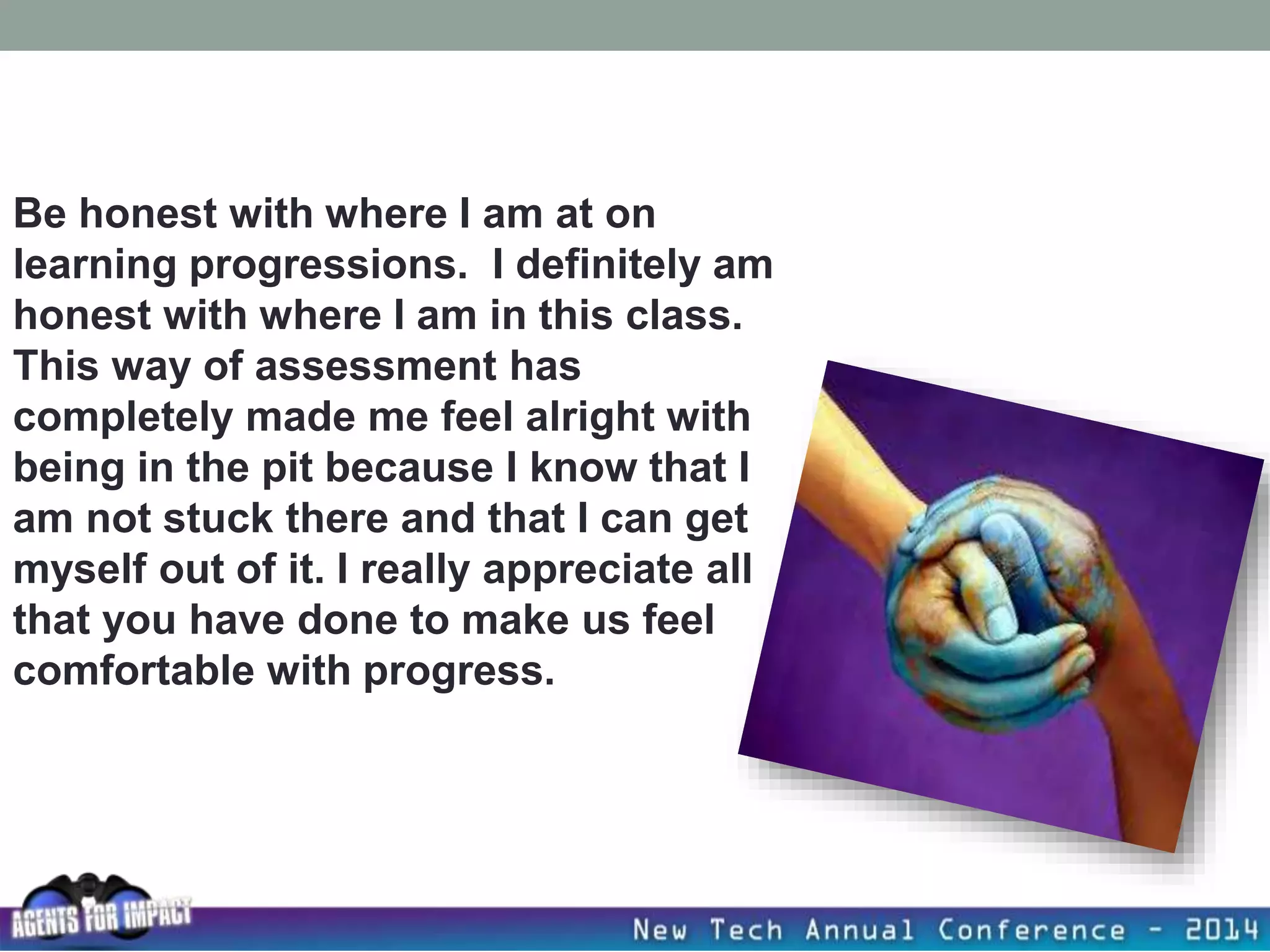
Be honest with where I am at on
learning progressions. I definitely am
honest with where I am in this class.
This way of assessment has
completely made me feel alright with
being in the pit because I know that I
am not stuck there and that I can get
myself out of it. I really appreciate all
that you have done to make us feel
comfortable with progress.
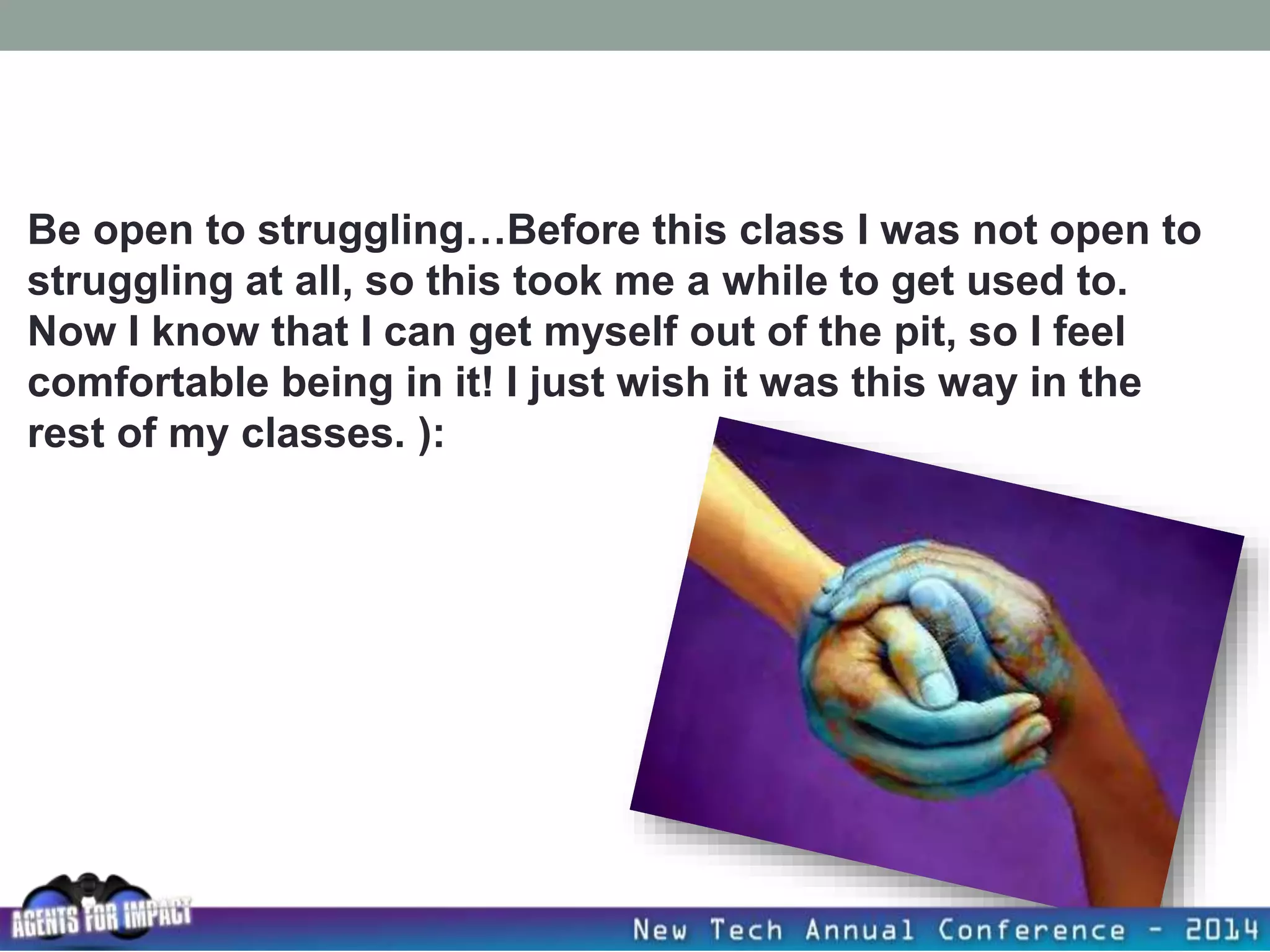
Be open to struggling…Before this class I was not open to
struggling at all, so this took me a while to get used to.
Now I know that I can get myself out of the pit, so I feel
comfortable being in it! I just wish it was this way in the
rest of my classes. ):
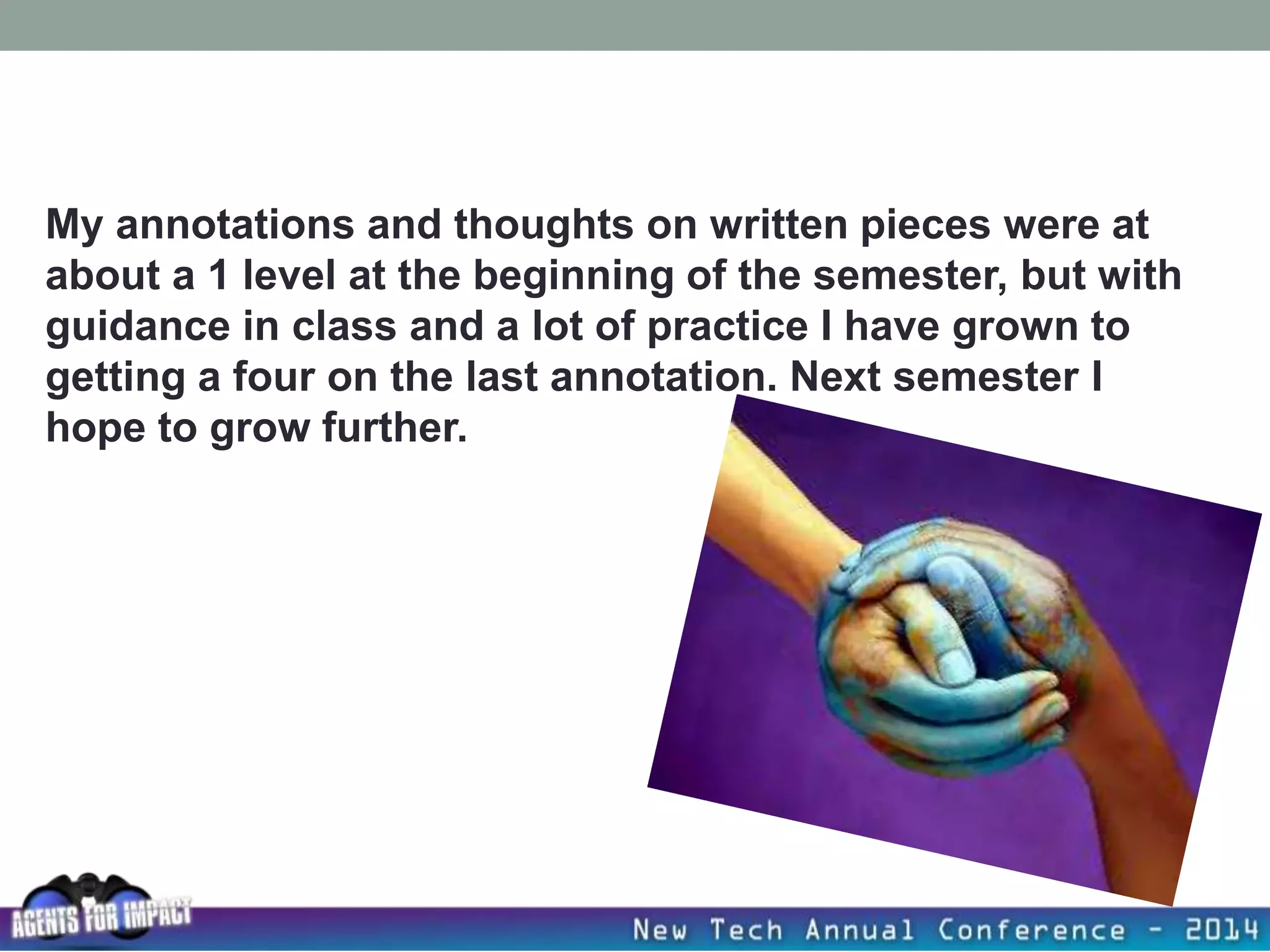
My annotations and thoughts on written pieces were at
about a 1 level at the beginning of the semester, but with
guidance in class and a lot of practice I have grown to
getting a four on the last annotation. Next semester I
hope to grow further.
Why PBL?
Assessment for
Learning
Learning
Centered
Culture
and
Climate
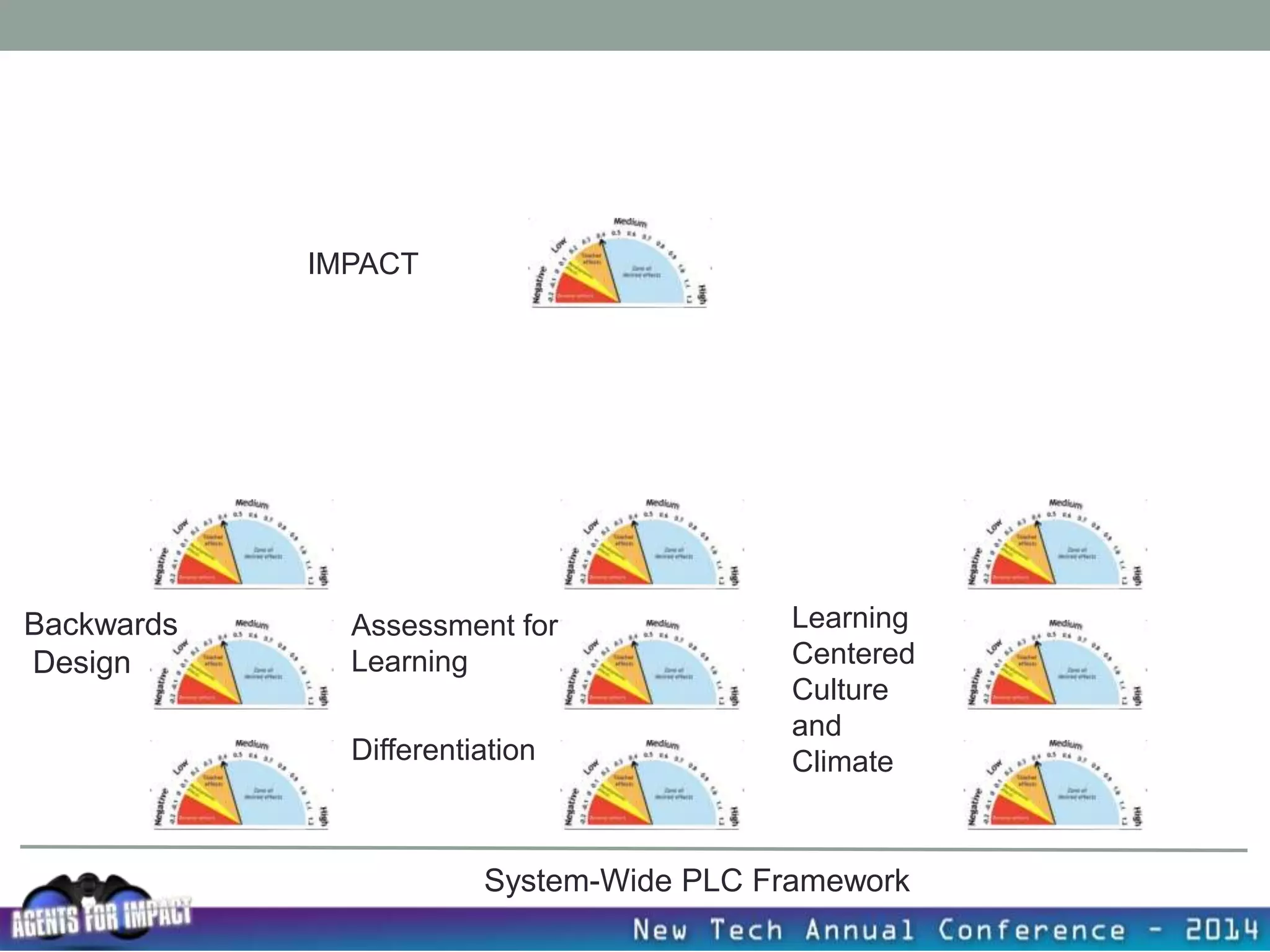
IMPACT
Backwards
Design
Differentiation
System-Wide PLC Framework
What
do you
need
to
know?

System Wide Impact on Student Learning

  • 2.
  • 3.
    HOW DO YOUCREATE A SYSTEM THAT SUBSTANTIALLY ENHANCES STUDENT LEARNING IN CONTENT, COGNITVE, AND CONATIVE DOMAINS?
  • 4.
    Table of Contents •“Start with a story” • “Defining Autonomy” • “Seeing the both/and of student performance” • “Space for PBL”
  • 5.
    • “Its unbelievablehow much you don’t know about the game you’ve been playing all your life” - Mantle
  • 8.
    What’s the story? •Teachers are among the most powerful influences on learning
  • 9.
    Teachers need tobe directive, influential, caring, and actively engaged in the passion of teaching and learning
  • 10.
  • 11.
    • Teachers needto be aware of what each and every student is thinking and knowing, to construct meaning and meaningful experiences in light of this knowledge, and have proficient knowledge and understanding of their content to provide meaningful and appropriate feedback such that each student moves progressively through the curriculum levels
  • 12.
    • Teachers andstudents need to know Where are we going?, How are you going, and what’s next?
  • 13.
    • Teachers needto move from the single idea to multiple ideas, and to relate and then extend these ideas such that learners construct and reconstruct knowledge and ideas. It is not the knowledge or ideas, but the learner’s construction of this knowledge and these ideas that is critical.
  • 14.
    • School leadersand teachers need to create school, staffroom, and classroom environments where error is welcomed as a learning opportunity, where discarding incorrect knowledge and understandings is welcomed, and where participants can feel safe to learn, re-learn, and explore knowledge and understanding.
  • 15.
    Research Guidance Strategy Effect Teachersworking together to evaluate their impact and responding to that impact 0.93 Teachers conduct pre-assessments, utilizing data to inform instruction, and providing students with a clear understanding of expectations for meeting learning outcomes (Where are we going?, where are we now?, and what’s next? 0.77 Teachers using practices in the classroom that values errors and trust 0.72 Teachers receive feedback on their impact on student learning 0.72 Teachers are providing an appropriate proportion of surface and deep level knowledge 0.71 Providing students with challenge and practice at the right level 0.60
  • 16.
    A culture &climate conducive to improving teaching and learning
  • 17.
    Factor influence onachievement (Hattie, 2009) Birth weight (.54) Lack of Illness (.23) Diet (.12) Drug interventions (.33) Exercise (.28) Socioeconomic status (.57) Family structure (.17) Home environment (.57) Parental involvement (.51) teacher student relationships (.72) P.D. (.62) teacher clarity (.75) microteaching (.88) feedback (.73) Goals (.56) Mastery Learning (.58) Providing formative evaluation (.90) Spaced vs. Massed Practice (.71)
  • 18.
    Effect sizes fromteaching or working conditions Quality of Teaching (.77) Reciprocal Teaching (.74) Teacher-Student relationships (.72) Providing Feedback (.72) Meta-cognition strategies (.67) Direct Instruction (.59) Mastery Learning (.57) Ave (.68) Within class grouping (.28) Adding more finances (.23) Reducing class size (.21) Ability grouping (.11) Multi-grade/age (.04) Open v. trad (. 01) summer vacation (-.09) Retention (-.16) Ave (.08)
  • 19.
    Effect sizes forteacher as activator and teacher as facilitator Reciprocal Teaching (.74) Feedback (.72) Direct Instruction (.59) Problem Solving teaching (.61) Mastery Learning (.57) Goals-Challenging (.56) Average activator (.63) Simulations and gaming (.32) Inquiry-based teaching (.31) Individualized instruction (.20) PBL (.15) Web-based learning (.09) Whole language-reading (.06) Average facilitator (.17)
  • 20.
    Effect sizes forteacher as activator and teacher as facilitator Reciprocal Teaching (.74) Feedback (.72) Direct Instruction (.59) Problem Solving teaching (.61) Mastery Learning (.57) Goals-Challenging (.56) Average activator (.63) Simulations and gaming (.32) Inquiry-based teaching (.31) Individualized instruction (.20) PBL (.15) Web-based learning (.09) Whole language-reading (.06) Average facilitator (.17) What are the key difference between these methods? The key is the role of the teacher…We go back to the story
  • 21.
    Variables that don’thave a substantial impact- THE POLITICS OF DISTRACTION • Attributes of students have a low effect on student learning (gender, parental employment, adoption, personality, labeling of students) (less than .18) • Deep Programs matching styles of learning, inquiry based methods, individualized instruction, distance education (less than .22) • School and Class Structure Summer school, finance, class size, ability grouping, retention, multi-grade/age classes, changing school calendars (less that .10)
  • 22.
  • 23.
  • 24.
  • 25.
  • 26.
  • 27.
  • 28.
  • 29.
  • 30.
    #vlconf2014 • Developing abackbone • Embracing Customization • Developing a support system
  • 31.
    Few points ofreference - 915 Meta-analysis - 60,155 studies - 245 million students - 159,570 effect sizes reported - This data set is for the purpose of discussion - There are moderators
  • 32.
    An example • Homework-effect size = .29 • Rank 88th • Number of Meta-analysis 5 • Number of studies 161 • Number of effects 295 • Number of people 105,282
  • 33.
    • Exploring eachvariable- • High school twice as large • Short time periods are important • Direct parent involvement had a negative effect • Lack of monitoring • Difficulty • Prescribing homework does not help in time management skills
  • 34.
    What do wewant all students to know and be able to do? How do we know when students are learning? What do we do based on such results? How do we work together to review and respond to student learning?
  • 35.
    What do wewant all students to know and be able to do? What do we do based on these results? How do we work together to review and respond to student learning? Common Outcomes Common Scales Common Intervention Criteria Common Culture and Work How do we know when students are learning?
  • 36.
    Common Outcomes Common Scales Common InterventionCriteria Common Culture and Work High Reliability Educational Organization “Backbone”
  • 37.
  • 38.
  • 39.
  • 40.
  • 41.
    Teaching [and learning]in the dark is a questionable practice” (Taba, 1966)
  • 42.
    #vlconf2014 - Where isthe learner now?
  • 44.
    Score Description 4 Extension ApplyingUnderstanding 3 Relational Making Meaning 2 Single/Multiple Building Knowledge 1 Direct Support Proficiency Not Yet Proficiency
  • 45.
    Score Description 4 Extension ApplyingUnderstanding 3 Relational Making Meaning 2 Single/Multiple Building Knowledge 1 Direct Support DEEP SURFACE
  • 47.
    Connections Limited Growth (0.0-0.39) Expected Growth (.40+) Not Yet Proficient (0.0-2.25) Proficient (2.5-4.0)
  • 48.
    Limited Growth (0.0-0.39) Expected Growth (.40+) Not Yet Proficient (0.0-2.25) Make A Change! • Review & Make Changes to Instructional Strategies Keep it up! • More Time • Same Instructional Program • Celebrate Success Proficient (2.5-4.0) Cruising • Review & Make Changes to Instructional Strategies Success • Capture Instructional Strategies • Celebrate Success • Continue Practices
  • 49.
    Limited Growth (0.0-0.39)Expected Growth (.40 +) Not Yet Proficient (0.0-2.5) Make A Change! • Review & Make Changes to Instructional Strategies Keep it up! • More Time • Same Instructional Program • Celebrate Success Proficient (2.5-4.0) Cruising • Review & Make Changes to Instructional Strategies Success • Capture Instructional Strategies • Celebrate Success • Continue Practices Capture Success/Replicate Change
  • 50.
    What? So What?Now What? Moving from Data Analysis to Response
  • 51.
    Single/Multiple Ideas- Whatinstructional approaches will support students in understanding foundational knowledge (e.g. facts, vocabulary terms) related to learning outcomes? Relating ideas- What instructional approaches support students in connecting and contrasting ideas? What are generalizations and principles that can be made about these ideas? Extending ideas- What instructional approaches support students in applying the learning outcomes to other contexts Next Steps- Teachers
  • 52.
    Single/Multiple Ideas- Whatstrategies am I using that will support me in building knowledge and skills (e.g. facts, vocabulary terms) related to learning outcomes? Relating ideas- What approaches appear to be working or I should attempt to connect and contrast ideas? How am I going as related to making generalizations and principles? Extending ideas- What approaches support me in applying the learning outcomes to other contexts? Next Steps- Students
  • 53.
    Math Strategies Below Average •Counting all 22% • Counting on 72% • Known facts 6% • Derived facts/Number Sense 0% Above Average • Counting all 0% • Counting on 9% • Known facts 30% • Derived facts/Number Sense 61%
  • 54.
    Aligning “High ProbabilityStrategies” from the Art and Science of Teaching to Progression Levels. Outcome Questions Activities Applying understanding What do I typically do to engage students in cognitively complex tasks involving hypothesis generation and testing? Experimental-inquiry tasks Problem-solving tasks Making meaning What do I typically do to organize students and deepen knowledge? Venn diagrams Comparison matrix Building knowledge What do I typically do to identify critical information? Identifying critical input experiences
  • 58.
  • 59.
    • Driver ofcustomization is impact • Impact is identified through progress and proficiency • Impact is discussed by all stakeholders • All stakeholders have degrees of voice and choice in showing, celebrating, and improving upon their impact.
  • 60.
    Teaching [and learning]in the dark is a questionable practice” (Taba, 1966)
  • 61.
    #vlconf2014 - Where isthe learner now?
  • 63.
    Score Description 4 Extension ApplyingUnderstanding 3 Relational Making Meaning 2 Single/Multiple Building Knowledge 1 Direct Support Proficiency Not Yet Proficiency
  • 64.
    Scor e Description 4 Extension Applying Understanding 3Relational Making Meaning 2 Single/Multiple Building Knowledge 1 Direct Support DEEP SURFACE
  • 66.
    Connections Limited Growth (0.0-0.39) Expected Growth (.40+) Not Yet Proficient (0.0-2.25) Proficient (2.5-4.0)
  • 67.
    Limited Growth (0.0-0.39) Expected Growth (.40+) Not Yet Proficient (0.0-2.25) Make A Change! • Review & Make Changes to Instructional Strategies Keep it up! • More Time • Same Instructional Program • Celebrate Success Proficient (2.5-4.0) Cruising • Review & Make Changes to Instructional Strategies Success • Capture Instructional Strategies • Celebrate Success • Continue Practices
  • 68.
    Limited Growth (0.0-0.39)Expected Growth (.40 +) Not Yet Proficient (0.0-2.5) Make A Change! • Review & Make Changes to Instructional Strategies Keep it up! • More Time • Same Instructional Program • Celebrate Success Proficient (2.5-4.0) Cruising • Review & Make Changes to Instructional Strategies Success • Capture Instructional Strategies • Celebrate Success • Continue Practices Capture Success/Replicate Change
  • 69.
    What? So What?Now What? Moving from Data Analysis to Response
  • 70.
    Single/Multiple Ideas- Whatinstructional approaches will support students in understanding foundational knowledge (e.g. facts, vocabulary terms) related to learning outcomes? Relating ideas- What instructional approaches support students in connecting and contrasting ideas? What are generalizations and principles that can be made about these ideas? Extending ideas- What instructional approaches support students in applying the learning outcomes to other contexts Next Steps- Teachers
  • 71.
    Single/Multiple Ideas- Whatstrategies am I using that will support me in building knowledge and skills (e.g. facts, vocabulary terms) related to learning outcomes? Relating ideas- What approaches appear to be working or I should attempt to connect and contrast ideas? How am I going as related to making generalizations and principles? Extending ideas- What approaches support me in applying the learning outcomes to other contexts? Next Steps- Students
  • 72.
    Math Strategies Below Average •Counting all 22% • Counting on 72% • Known facts 6% • Derived facts/Number Sense 0% Above Average • Counting all 0% • Counting on 9% • Known facts 30% • Derived facts/Number Sense 61%
  • 73.
    Aligning “High ProbabilityStrategies” from the Art and Science of Teaching to Progression Levels. Outcome Questions Activities Applying understanding What do I typically do to engage students in cognitively complex tasks involving hypothesis generation and testing? Experimental-inquiry tasks Problem-solving tasks Making meaning What do I typically do to organize students and deepen knowledge? Venn diagrams Comparison matrix Building knowledge What do I typically do to identify critical information? Identifying critical input experiences
  • 77.
  • 78.
    • Driver ofcustomization is impact • Impact is identified through progress and proficiency • Impact is discussed by all stakeholders • All stakeholders have degrees of voice and choice in showing, celebrating, and improving upon their impact.
  • 79.
    Where we aregoing? (Program Goals) Where we are? (Proficiency Scales) Where to next?
  • 80.
  • 82.
    Be honest withwhere I am at on learning progressions. I definitely am honest with where I am in this class. This way of assessment has completely made me feel alright with being in the pit because I know that I am not stuck there and that I can get myself out of it. I really appreciate all that you have done to make us feel comfortable with progress.
  • 83.
    Be open tostruggling…Before this class I was not open to struggling at all, so this took me a while to get used to. Now I know that I can get myself out of the pit, so I feel comfortable being in it! I just wish it was this way in the rest of my classes. ):
  • 84.
    My annotations andthoughts on written pieces were at about a 1 level at the beginning of the semester, but with guidance in class and a lot of practice I have grown to getting a four on the last annotation. Next semester I hope to grow further.
  • 85.
  • 86.
  • 88.

Editor's Notes

  • #8 Effect and the pattern
  • #11 Kids don’t learn important information that’s right in front of them, unless an adult is actively teaching them.  Butler & Markman, 2014 Sponges and Spoodles
  • #23 Golden Circle
  • #24 Confronting content and 21st Century skills and knowledge
  • #26 Boundary management
  • #28 It turns out its not about who teachers are, its not about what teachers do, its not who the students are, what really matters think about their impact on their students.
  • #41 Agnostic-
  • #54 72 children 7+18 Grey and Tall (1994)
  • #73 72 children 7+18 Grey and Tall (1994)
  • #80 Where we are going? Program Goals/Learning Targets, learning intentions, includes success criteria Where we are? The various forms of assessment to identify progress Where to next? Our response to that assessment. Think Gap
  • #82 Discuss Grading, CoS,