Feedback
Reflecting and Reviewing
Feedback and reflection
Learning intention:
To better understand effective feedback.
SHS 2013
Essential Questions
 How is the technique of feedback and reflection defined?
 What is teacher/student feedback?
 What is student/teacher feedback?
SHS 2013
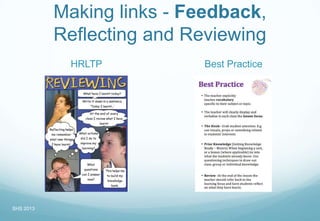
Making links - Feedback,
Reflecting and Reviewing
HRLTP Best Practice
SHS 2013
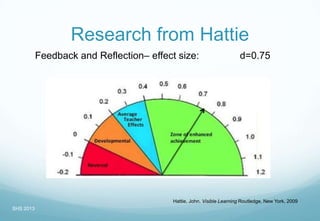
Research from Hattie
Feedback and Reflection– effect size: d=0.75
Hattie, John. Visible Learning Routledge, New York, 2009
SHS 2013
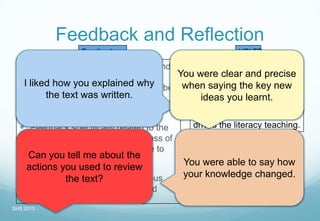
Feedback and Reflection
 Provide explicit, timely, relevant and
personalised feedback –
teacher/student (what is aimed to be
understood) and student/teacher
(what is actually understood).
 Feedback specifically related to the
learning intention, task or process of
learning and contains reference to
practical action.
 Uses assessment and continuous
monitoring to inform content and
teaching.
?
Feedback HRLTP
Throughout the HRLTPs,
Feedback and Reflection
drives the literacy teaching.
I liked how you explained why
the text was written.
You were clear and precise
when saying the key new
ideas you learnt.
Can you tell me about the
actions you used to review
the text?
You were able to say how
your knowledge changed.
SHS 2013
What does effective feedback and
reflection look like in the
classroom?
SHS 2013
Defining Review
 Review is where the students are able to revisit their
learning, identify what new knowledge has been learnt and
the strategies they used to understand it.
 It also includes the understanding of how they were able to
bridge the new knowledge to their existing knowledge.
SHS 2013
Understanding Review
SHS 2013
Why is Review important?
When students review they:
 draw together what they have learnt into an overall
understanding
 answer the questions: What do I know now that I didn’t know
earlier? What has the text told me/been about so far?
SHS 2013
When we review we:
 activate short-term memory and make space for new
learning
 link new knowledge to prior knowledge
 commit the new knowledge to long-term memory
 make our learning available to us for future use.
SHS 2013
When do we review?
 At the beginning of a lesson.
 Throughout a lesson.
 At the end of a lesson.
 Before beginning a new topic.
 Throughout a topic.
 At the end of a topic.
Review can occur at any stage of learning.
SHS 2013
Linking the learning intention and
success criteria
 It is important to link the students’ review of their learning
back to the original lesson/unit learning intention.
 The measures by which the students are able to review is
through the success criteria.
SHS 2013
Four areas of Review
SHS 2013
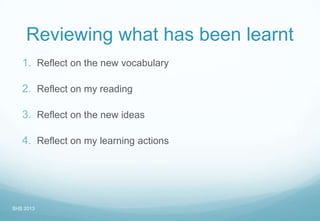
Reviewing what has been learnt
1. Reflect on the new vocabulary
2. Reflect on my reading
3. Reflect on the new ideas
4. Reflect on my learning actions
SHS 2013
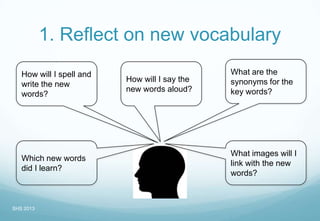
1. Reflect on new vocabulary
What are the
synonyms for the
key words?
Which new words
did I learn?
What images will I
link with the new
words?
How will I say the
new words aloud?
How will I spell and
write the new
words?
SHS 2013
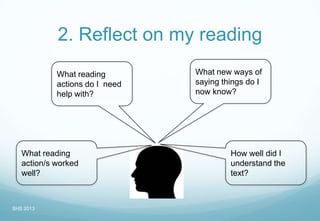
2. Reflect on my reading
What new ways of
saying things do I
now know?
What reading
action/s worked
well?
How well did I
understand the
text?
What reading
actions do I need
help with?
SHS 2013
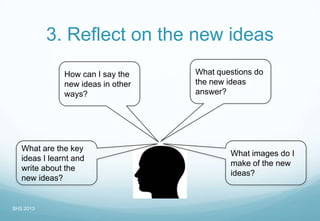
3. Reflect on the new ideas
What questions do
the new ideas
answer?
What are the key
ideas I learnt and
write about the
new ideas?
What images do I
make of the new
ideas?
How can I say the
new ideas in other
ways?
SHS 2013
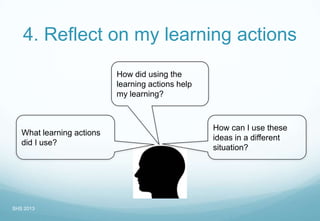
4. Reflect on my learning actions
What learning actions
did I use?
How can I use these
ideas in a different
situation?
How did using the
learning actions help
my learning?
SHS 2013
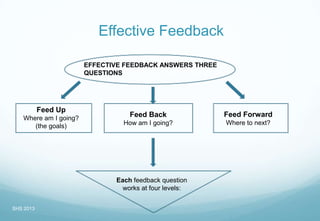
Effective Feedback
EFFECTIVE FEEDBACK ANSWERS THREE
QUESTIONS
Feed Up
Where am I going?
(the goals)
Feed Back
How am I going?
Feed Forward
Where to next?
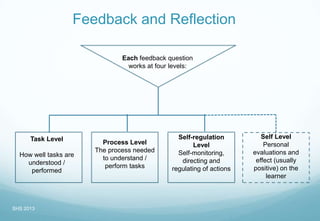
Each feedback question
works at four levels:
SHS 2013
Effective Feedback
Each feedback question
works at four levels:
Process Level
The process needed
to understand /
perform tasks
Task Level
How well tasks are
understood /
performed
Self-regulation
Level
Self-monitoring,
directing and
regulating of actions
Self Level
Personal
evaluations and
effect (usually
positive) on the
learner
Feedback and Reflection
SHS 2013
SHS 2013
What is my practice?
Read through the indicators 0 to 4 and identify which level
or combinations of levels you think best represents your
classroom practice with Feedback and reflection
Turn and Talk
2 minutes each in pairs, a quick reflection on:
‘What I do, and don’t do’
SHS 2013
Away Task
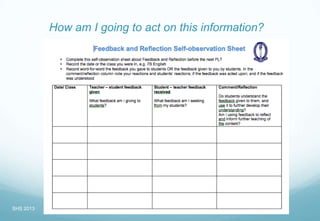
How am I going to act on this information?
SHS 2013
End

Feedback and Reflection - Staff Presentation

  • 1.
  • 2.
    Feedback and reflection Learningintention: To better understand effective feedback. SHS 2013
  • 3.
    Essential Questions  Howis the technique of feedback and reflection defined?  What is teacher/student feedback?  What is student/teacher feedback? SHS 2013
  • 4.
    Making links -Feedback, Reflecting and Reviewing HRLTP Best Practice SHS 2013
  • 5.
    Research from Hattie Feedbackand Reflection– effect size: d=0.75 Hattie, John. Visible Learning Routledge, New York, 2009 SHS 2013
  • 6.
    Feedback and Reflection Provide explicit, timely, relevant and personalised feedback – teacher/student (what is aimed to be understood) and student/teacher (what is actually understood).  Feedback specifically related to the learning intention, task or process of learning and contains reference to practical action.  Uses assessment and continuous monitoring to inform content and teaching. ? Feedback HRLTP Throughout the HRLTPs, Feedback and Reflection drives the literacy teaching. I liked how you explained why the text was written. You were clear and precise when saying the key new ideas you learnt. Can you tell me about the actions you used to review the text? You were able to say how your knowledge changed. SHS 2013
  • 7.
    What does effectivefeedback and reflection look like in the classroom? SHS 2013
  • 8.
    Defining Review  Reviewis where the students are able to revisit their learning, identify what new knowledge has been learnt and the strategies they used to understand it.  It also includes the understanding of how they were able to bridge the new knowledge to their existing knowledge. SHS 2013
  • 9.
  • 10.
    Why is Reviewimportant? When students review they:  draw together what they have learnt into an overall understanding  answer the questions: What do I know now that I didn’t know earlier? What has the text told me/been about so far? SHS 2013
  • 11.
    When we reviewwe:  activate short-term memory and make space for new learning  link new knowledge to prior knowledge  commit the new knowledge to long-term memory  make our learning available to us for future use. SHS 2013
  • 12.
    When do wereview?  At the beginning of a lesson.  Throughout a lesson.  At the end of a lesson.  Before beginning a new topic.  Throughout a topic.  At the end of a topic. Review can occur at any stage of learning. SHS 2013
  • 13.
    Linking the learningintention and success criteria  It is important to link the students’ review of their learning back to the original lesson/unit learning intention.  The measures by which the students are able to review is through the success criteria. SHS 2013
  • 14.
    Four areas ofReview SHS 2013
  • 15.
    Reviewing what hasbeen learnt 1. Reflect on the new vocabulary 2. Reflect on my reading 3. Reflect on the new ideas 4. Reflect on my learning actions SHS 2013
  • 16.
    1. Reflect onnew vocabulary What are the synonyms for the key words? Which new words did I learn? What images will I link with the new words? How will I say the new words aloud? How will I spell and write the new words? SHS 2013
  • 17.
    2. Reflect onmy reading What new ways of saying things do I now know? What reading action/s worked well? How well did I understand the text? What reading actions do I need help with? SHS 2013
  • 18.
    3. Reflect onthe new ideas What questions do the new ideas answer? What are the key ideas I learnt and write about the new ideas? What images do I make of the new ideas? How can I say the new ideas in other ways? SHS 2013
  • 19.
    4. Reflect onmy learning actions What learning actions did I use? How can I use these ideas in a different situation? How did using the learning actions help my learning? SHS 2013
  • 20.
  • 21.
    EFFECTIVE FEEDBACK ANSWERSTHREE QUESTIONS Feed Up Where am I going? (the goals) Feed Back How am I going? Feed Forward Where to next? Each feedback question works at four levels: SHS 2013 Effective Feedback
  • 22.
    Each feedback question worksat four levels: Process Level The process needed to understand / perform tasks Task Level How well tasks are understood / performed Self-regulation Level Self-monitoring, directing and regulating of actions Self Level Personal evaluations and effect (usually positive) on the learner Feedback and Reflection SHS 2013
  • 23.
  • 24.
    What is mypractice? Read through the indicators 0 to 4 and identify which level or combinations of levels you think best represents your classroom practice with Feedback and reflection Turn and Talk 2 minutes each in pairs, a quick reflection on: ‘What I do, and don’t do’ SHS 2013
  • 25.
  • 26.
    How am Igoing to act on this information? SHS 2013
  • 27.

Editor's Notes

  • #3 Slide 1Essential questions frame the goal or key focus of the professional learning. Explain the 3 essential questions that teachers will have knowledge about by the end of this professional learning. Staff may like to volunteer their ideas now.
  • #6 Hattie’s work is a meta-analysis of influences on student achievement. Colour code: Looking at the ‘barometer of influence’, any effect that falls in the red section of the barometer is having a negative or reverse effect on student achievement. Any effect that falls into the orange section indicates that student achievement is following the expected developmental progress of a student. The blue section shows the typical effect of the teacher on student learning. Any effect size in the green zone had the greatest impact on student learning.The average effect size is d+0.40. This average summarises the typical effect of all possible influences in education, and is therefore used as a benchmark to judge effects in education. A result above 0.40 suggests that the effects of the innovation or strategy increases achievement to a point where we can notice ‘real world’ differences. This diagram suggests that considered feedback and reflection have a positive effect size (d=0.75) on student achievement, beyond the expected level of typical teacher effect. Therefore, according to Hattie, feedback and reflection is a valid area for us to focus on to improve teaching and learning.
  • #7 Classroom Teaching Technique Seven - Feedback and Reflectionsupports Reviewing. We will now show how HRLTP and Classroom Teaching Technique Seven directly link together.The elements from Classroom Teaching Technique Seven - Feedback and Reflection are shown on this slide. Take a few moments to read through them.Click to reveal text box 1Throughout each of the four areas of Reviewing, the teacher is providing the student with personalised feedback. The teacher is also receiving feedback on the effectiveness of their instructions as students articulate how and why they are using these Literacy actions.Click to reveal speech bubbles x4 for examples of specific feedback and reflection.
  • #8 Slide 2Anchor: Facilitatorasks participants to complete a quick write on the above question. A quick write is a 3 minute writing task in which participants write down all their ideas relating to the prompt or stimulus, independently.
  • #9 When student review their learning they:Click to reveal bullet point 1revisit learningidentify and say new informationidentifying and say in full sentences the strategies used to understand informationClick to reveal bullet point 2make connections between their existing knowledge and the new knowledge in the text.
  • #11 Activity:Using the Fishbone worksheet, participants document why they think Reviewing is important in enhancing student learning.Review, along with consolidation and reflection, is part of the ‘value adding’ aspect of teaching. When students review, they are able to look at new texts differently and are more likely to store the new text knowledge.Click to reveal bullet point 1Students review the new information they have learnt and connect it to their existing knowledge.They say the comprehending actions they used while reading.Click to reveal bullet point 2Students say what new knowledge they now have and what the text has been about.
  • #12 Click to reveal bullet point 1Through reviewing/recalling knowledge, we activate our short term memory.Click to reveal bullet point 2When students turn information into knowledge, it becomes stored for later use.Click to reveal bullet point 3Students are explicitly linking new knowledge with existing knowledge.Click to reveal bullet point 4Students are enabling the new knowledge to go into their long term memory filing cabinet via the connections they make between existing knowledge and new knowledge.Click to reveal bullet point 5When knowledge is stored in our long term memory, it can be retrieved later when needed.
  • #13 Review is used constantly throughout all learning situations.Click to reveal bullet point 1Getting Knowledge Ready to find outstudents’ prior knowledge. Click to reveal bullet point 2Check in to see if the class is working towards the lesson intention (e.g. are we on track, are we meeting the success criteria of the learning intention).Click to reveal bullet point 3Once again, use the learning intention and success criteria as a measure of the students’ learning.Have students say what new knowledge they now know.Click to reveal bullet point 4Gathering information on students’ current knowledge will assist in planning future learning tasks.Click to reveal bullet point 5Once again, check back in with the students’ learning and adapt the learning tasks appropriately.Click to reveal bullet point 6This will assist when planning future learning based on students’ existing knowledge.Click to reveal statement
  • #14 As mentioned in the previous slide, it is important to link the learning intention and success criteria to the students’ learning.Click to reveal bullet point 1At the beginning of the lesson, have students list questions the text may answer. Use these questions as success criteria.When you review, you check back in with the learning intention.Was our learning goal met?Click to reveal bullet point 2Success criteria can assist students to measure their learning.Which questions can now be answered? What are the answers?What questions still need to be answered?What strategies did I use today to help me learn/remember my existing knowledge?
  • #16 Click to reveal bullet point 1VocabularyWhat new words do I know now?Do I understand what these new words mean? Was I able to work out the meaning of these new words? What strategies did I use?Click to reveal bullet point 2ReadingWhat strategies did I use to read today? (e.g. sound out words, reread sections)?Was my reading fluent?Did I understand what I read?Did I visualise as I read?Click to reveal bullet point 3New ideasWhat strategies did I use to find/investigate new ideas?Did I make connections with my existing knowledge?Was I able to infer and interpret the new ideas?Click to reveal bullet point 4Learning actionsWhat strategies did I use in my learning today?Was I able to use the most appropriate strategy?Can I say the learning actions I used?Can I explain why I used each of the actions?The next 4 slides will expand on each of these points
  • #17 When reviewing vocabularystudents are/should be able to:Click to reveal speech bubble 1Students select the new words that they learnt.Click to reveal speech bubble 2Students spell and write the new words.Click to reveal speech bubble 3Students say the new words.Click to reveal speech bubble 4Students suggest synonyms for the key words.Click to reveal speech bubble 5Students say what pictures (visualisations) come to mind.
  • #18 When reviewing their reading students are/should be able to say:Click to reveal speech bubble 1Students say what reading action/s worked well.Click to reveal speech bubble 2Students say what reading actions theyneed help with.Click to reveal speech bubble 3Students say what new ways of saying things they now know.Click to reveal speech bubble 4Student say how well they are understanding the text.
  • #19 When reflecting on the new ideas, students are/should be able to:Click to reveal speech bubble 1Students identify the key ideas learnt and write about the new ideas.Click to reveal speech bubble 2Students say the new ideas in other ways.Click to reveal speech bubble 3Students say the questions the new ideas answer.Click to reveal speech bubble 4Students visualise the key ideas.
  • #20 When reflecting on the new ideas, students are/should be able to say:Click to reveal speech bubble 1what learning actions they usedClick to reveal speech bubble 2how using the learning actions helped their learningClick to reveal speech bubble 3ways of how they can use these ideas in a different situation.It is really important that students are able to use ideas and strategies in a variety of learning situations.
  • #22 Slide 5This diagram shows a framework presented by Hattie in which feedback can be considered. Click Here: The main purpose of feedback is to reduce the discrepancies between current understandings and performance, and the learning intention or goal. Click Here: This discrepancy can be reduced by:Click Here: The use of appropriate goals that target students’ zone of proximal development.Click Here: Selective, targeted feedback to lift student performance.Click Here: Students’ increased effort and use of more effective strategies.Click Here: Changing goalsClick Here: Effective feedback answers 3 questions:Click Here x2: Feed Up: giving students a clear direction. This can be done through the use of clear learning goals or intentions and/or success criteria.Click Here: How am I going? Self assessments or evaluations fall into this category. This question leads naturally into the final question:Click Here: Where to next? What is the next piece of work for students?The major feedback questions are the three listed: ‘Where am I going?’, ‘How am I going?’ and ‘Where to next?’, and ideally both teachers and students are seeking the answers to these questions. Closing the gap between where a student is and where they are aiming to be leads to the power of feedback. Click Here: At the same time, feedback operates on four different levels.
  • #23 Slide 6Click here x2Feedback about the task (FT) For example: Your learning goal was to….you have done…..but then…..you need to now…. This type of feedback is most common and is often called corrective feedback. FT can be powerful, especially when it is about faulty interpretations. One problem with FT is that it does not transfer well to other tasks. Feedback aimed to move students from task to processing and then from processing to regulation is most effective. Too much feedback within one level of feedback can detract from overall performance. (For example, an overload of feedback about minor details can detract from the processing required to complete a task, and therefore the ultimate completion of the task.) Click hereFeedback about the processing of the task (FP) For example: You are asked to compare theseideas- for example you could try and see how they are similar, how they are different- how do they relate together?FP is more specific to the processes underlying the task. A deep understanding of learning involves the construction of meaning, and relates more to the cognitive processes and transference to other, more difficult tasks. A major type of FP relates to students’ strategies for error detection, thus providing oneself with feedback. Click hereFeedback about self regulation (FR) For example: One strategy is self-instruction, which is self-verbalising the steps to complete a given task. FR addresses the way students monitor, direct and regulate actions towards the learning goal. Click hereFeedback about the self as a person (FS). For example: Praise that directs the attention away from the task to the self, like ‘good girl’.FS is not an effective strategy, but it is commonly used instead of FT, FP or FR. (‘Good work’, or ‘Great effort’). It usually contains little task information and is rarely converted into more engagement, commitment to learning or understanding.
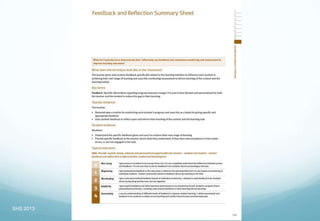
  • #24 Slide 9The summary sheet provides us with: a description of what the technique looks like in practice, definitions of key terms, teacher and students evidence of the technique, and a range of indicators that allow us to identify our current level of practice and where to next.
  • #25 Slide 10
  • #27 Slide 11Hand out the teacher self observation sheet.Walk the team members through the sheet. Explain the minimum requirement before the firstPLT 1 is to take notes on at least 4 classes, noting:Teacher/student feedback given, student/teacher feedback given, comment/reflection. Note: if this is not complete, they will not be able to participate in the PLT appropriately.