





Four Drivers of School Reform
               By
          Michael Fullan
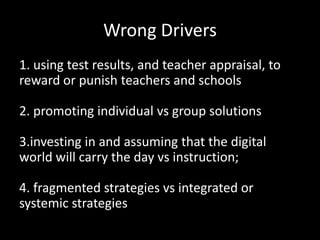
Wrong Drivers
1. using test results, and teacher appraisal, to
reward or punish teachers and schools

2. promoting individual vs group solutions

3.investing in and assuming that the digital
world will carry the day vs instruction;

4. fragmented strategies vs integrated or
systemic strategies
Instruction Should Lead Technology   Data That Is Non-judgmental


United Focus On Deeper Learning
Visible Learning

   John Hattie
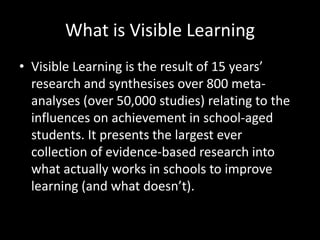
What is Visible Learning
• Visible Learning is the result of 15 years’
  research and synthesises over 800 meta-
  analyses (over 50,000 studies) relating to the
  influences on achievement in school-aged
  students. It presents the largest ever
  collection of evidence-based research into
  what actually works in schools to improve
  learning (and what doesn’t).
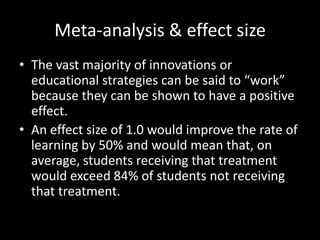
Meta-analysis & effect size
• The vast majority of innovations or
  educational strategies can be said to “work”
  because they can be shown to have a positive
  effect.
• An effect size of 1.0 would improve the rate of
  learning by 50% and would mean that, on
  average, students receiving that treatment
  would exceed 84% of students not receiving
  that treatment.
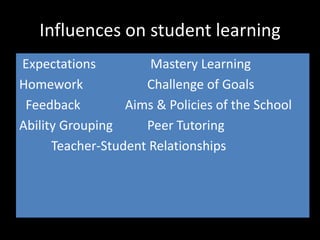
Influences on student learning
Expectations          Mastery Learning
Homework             Challenge of Goals
 Feedback         Aims & Policies of the School
Ability Grouping     Peer Tutoring
      Teacher-Student Relationships
Diamond Nine Activity
• With a partner discuss these nine factors that
  influence student achievement
• Place them in a diamond shape, in order of
  how great you think their positive influence is
  (on average)
• Think about why they have this effect
The Diamond 9 tool is
designed to help people
collectively explore
several issues by
prioritizing them
collaboratively. It
supports a focused
discussion in a relatively
short space of time.
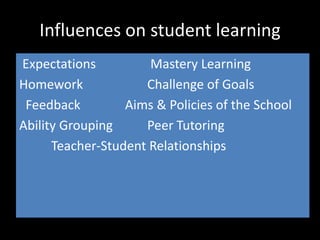
Influences on student learning
Expectations          Mastery Learning
Homework             Challenge of Goals
 Feedback         Aims & Policies of the School
Ability Grouping     Peer Tutoring
      Teacher-Student Relationships
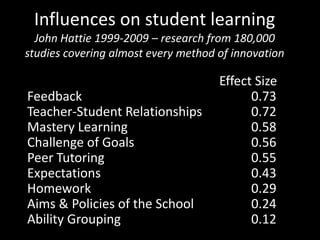
Influences on student learning
  John Hattie 1999-2009 – research from 180,000
studies covering almost every method of innovation

                                     Effect Size
Feedback                                   0.73
Teacher-Student Relationships              0.72
Mastery Learning                           0.58
Challenge of Goals                         0.56
Peer Tutoring                              0.55
Expectations                               0.43
Homework                                   0.29
Aims & Policies of the School              0.24
Ability Grouping                           0.12
Providing Feedback
If feedback is so important, what
    kind of feedback should be
 taking place in our classrooms?

  • Discuss in pairs for 2 minutes
“The most powerful single influence
  enhancing achievement is feedback”

• Quality feedback is needed, not more feedback
• Much of the feedback provided by the teacher to
  the student is not valued and not acted on
• Students with a Growth Mindset welcome
  feedback and are more likely to use it to improve
  their performance
• Oral feedback is much more effective than
  written
• The most powerful feedback is provided from
  the student to the teacher
How could we obtain more feedback
         from students?

   How can we ensure we act on
      this feedback to raise
          achievement?

          Discuss in pairs
Meaningful Goals
Setting Goals/Mastery Objective
• There is strong evidence that challenging,
  achievable goals influence achievement,
  provided the individual is involved in setting
  them.
• Goals have a self-energizing effect if they are
  appropriately challenging as they can motivate
  students to exert effort in line with the
  difficulty or demands of the goal.
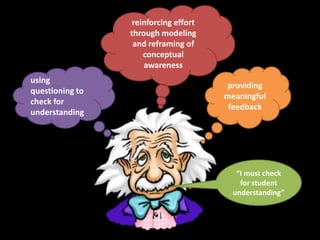
reinforcing effort
                 through modeling
                  and reframing of
                     conceptual
                     awareness
using
                                       providing
questioning to
                                       meaningful
check for
                                        feedback
understanding


                                          “I must check
                                           for student
                                         understanding”
Checking for Understanding
• using questioning to check for understanding
• providing meaningful feedback
• reinforcing effort by reframing of conceptual
  awareness on specific learning goals
Summary of Feedback
feedback must be informative rather
          than evaluative.
• Achievement is enhanced to the degree that
  students and teachers set and communicate
  appropriate, specific and challenging goals
• Achievement is enhanced as a function of
  feedback, using questioning of formative
  assessments
• Increases in student learning involves not only
  surface and deep learning but also a reframing
  conceptual awareness through meta-cognitive
  principles in teaching.

Drivers

  • 1.
    Four Drivers ofSchool Reform By Michael Fullan
  • 2.
    Wrong Drivers 1. usingtest results, and teacher appraisal, to reward or punish teachers and schools 2. promoting individual vs group solutions 3.investing in and assuming that the digital world will carry the day vs instruction; 4. fragmented strategies vs integrated or systemic strategies
  • 3.
    Instruction Should LeadTechnology Data That Is Non-judgmental United Focus On Deeper Learning
  • 4.
    Visible Learning John Hattie
  • 5.
    What is VisibleLearning • Visible Learning is the result of 15 years’ research and synthesises over 800 meta- analyses (over 50,000 studies) relating to the influences on achievement in school-aged students. It presents the largest ever collection of evidence-based research into what actually works in schools to improve learning (and what doesn’t).
  • 6.
    Meta-analysis & effectsize • The vast majority of innovations or educational strategies can be said to “work” because they can be shown to have a positive effect. • An effect size of 1.0 would improve the rate of learning by 50% and would mean that, on average, students receiving that treatment would exceed 84% of students not receiving that treatment.
  • 7.
    Influences on studentlearning Expectations Mastery Learning Homework Challenge of Goals Feedback Aims & Policies of the School Ability Grouping Peer Tutoring Teacher-Student Relationships
  • 8.
    Diamond Nine Activity •With a partner discuss these nine factors that influence student achievement • Place them in a diamond shape, in order of how great you think their positive influence is (on average) • Think about why they have this effect
  • 9.
    The Diamond 9tool is designed to help people collectively explore several issues by prioritizing them collaboratively. It supports a focused discussion in a relatively short space of time.
  • 10.
    Influences on studentlearning Expectations Mastery Learning Homework Challenge of Goals Feedback Aims & Policies of the School Ability Grouping Peer Tutoring Teacher-Student Relationships
  • 11.
    Influences on studentlearning John Hattie 1999-2009 – research from 180,000 studies covering almost every method of innovation Effect Size Feedback 0.73 Teacher-Student Relationships 0.72 Mastery Learning 0.58 Challenge of Goals 0.56 Peer Tutoring 0.55 Expectations 0.43 Homework 0.29 Aims & Policies of the School 0.24 Ability Grouping 0.12
  • 12.
  • 13.
    If feedback isso important, what kind of feedback should be taking place in our classrooms? • Discuss in pairs for 2 minutes
  • 14.
    “The most powerfulsingle influence enhancing achievement is feedback” • Quality feedback is needed, not more feedback • Much of the feedback provided by the teacher to the student is not valued and not acted on • Students with a Growth Mindset welcome feedback and are more likely to use it to improve their performance • Oral feedback is much more effective than written • The most powerful feedback is provided from the student to the teacher
  • 15.
    How could weobtain more feedback from students? How can we ensure we act on this feedback to raise achievement? Discuss in pairs
  • 16.
  • 17.
    Setting Goals/Mastery Objective •There is strong evidence that challenging, achievable goals influence achievement, provided the individual is involved in setting them. • Goals have a self-energizing effect if they are appropriately challenging as they can motivate students to exert effort in line with the difficulty or demands of the goal.
  • 18.
    reinforcing effort through modeling and reframing of conceptual awareness using providing questioning to meaningful check for feedback understanding “I must check for student understanding”
  • 19.
    Checking for Understanding •using questioning to check for understanding • providing meaningful feedback • reinforcing effort by reframing of conceptual awareness on specific learning goals
  • 20.
  • 21.
    feedback must beinformative rather than evaluative. • Achievement is enhanced to the degree that students and teachers set and communicate appropriate, specific and challenging goals • Achievement is enhanced as a function of feedback, using questioning of formative assessments • Increases in student learning involves not only surface and deep learning but also a reframing conceptual awareness through meta-cognitive principles in teaching.