Genres	
  in	
  geography	
  
Genre	
  family	
  

Genre	
  

Overall	
  purpose	
  

Explaining	
  

Sequential	


To	
  present	
  a	
  sequence	
  of	
  events	
  (e.g.	
  the	
  
formation	
  of	
  a	
  glaciated	
  feature)	
  

Factorial	


To	
  explain	
  multiple	
  causes	
  for	
  one	
  
phenomenon	
  (e.g.	
  the	
  factors	
  involved	
  in	
  
climate	
  change)	
  

Consequential	


To	
  explain	
  the	
  multiple	
  outcomes	
  from	
  
one	
  phenomenon	
  (e.g.	
  the	
  effects	
  of	
  a	
  
volcanic	
  eruption)	
  

Descriptive	


To	
  describe	
  a	
  phenomenon	
  –	
  the	
  text	
  
starts	
  with	
  a	
  classification	
  of	
  the	
  
phenomenon	
  and	
  then	
  describes	
  it	
  (e.g.	
  
the	
  structure	
  of	
  urban	
  areas)	


Classifying	


To	
  classify	
  and	
  then	
  describe	
  phenomena	
  
(e.g.	
  types	
  of	
  moraine)	
  

Compositional	
  

To	
  describe	
  the	
  parts	
  of	
  a	
  whole	
  
phenomenon	
  (e.g.	
  human	
  and	
  physical	
  
factors	
  of	
  industrial	
  location)	
  
To	
  instruct	
  on	
  how	
  to	
  do	
  an	
  activity	
  (e.g.	
  
where	
  instructions	
  are	
  given	
  on	
  
conducting	
  fieldwork)	
  

Reporting	
  

Procedural	
  

Instructional	
  

Arguments	
  

Exposition	
  

To	
  give	
  one	
  point	
  of	
  view	
  –	
  this	
  is	
  not	
  as	
  
common	
  in	
  geography	
  where	
  balanced	
  
approaches	
  are	
  normally	
  given	
  (e.g.	
  
argument	
  in	
  support	
  of	
  a	
  wind	
  farm)	
  

Discussion	
  

To	
  discuss	
  two	
  or	
  more	
  points	
  of	
  view	
  
identifying	
  the	
  issue,	
  giving	
  arguments	
  
from	
  both	
  sides	
  and	
  then	
  a	
  resolution	
  
(e.g.	
  discussion	
  on	
  the	
  impact	
  of	
  tourism	
  
in	
  Loch	
  Lomond	
  and	
  the	
  Trossachs	
  
National	
  Park)	
  

Interpretation	
  

This	
  is	
  a	
  common	
  activity	
  in	
  the	
  
geography	
  class	
  where	
  pupils	
  are	
  asked	
  to	
  
interpret	
  the	
  meaning	
  of	
  a	
  text	
  (e.g.	
  in	
  a	
  
text	
  describing	
  tourist	
  activities	
  the	
  
question	
  might	
  be:	
  What	
  problems	
  do	
  
you	
  think	
  are	
  caused	
  by	
  jet	
  skiers?)	


Text	
  responses	


Adapted	
  from	
  www.strath.ac.uk/media/faculties/hass/.../Geography_genre_outline.docx.	


Genres	
  in	
  history	
  
Genre	
  family	
  

Genre	
  

Overall	
  purpose	
  

Recording	
  

Autobiographical	
  
recount	
  

To	
  retell	
  the	
  events	
  of	
  your	
  own	
  life	


Biographical	
  recount	


Historical	
  recount	
  

To	
  retell	
  the	
  events	
  of	
  another	
  person’s	
  
life	
  
To	
  retell	
  events	
  in	
  the	
  past	


Historical	
  account	
  

To	
  account	
  for	
  why	
  events	
  happened	
  in	
  a	
  
particular	
  sequence	


Explaining	
  

Factorial	
  explanation	


To	
  explain	
  the	
  reasons	
  or	
  factors	
  that	
  
contribute	
  to	
  a	
  particular	
  outcome	


Consequential	
  
explanation	


Arguing	
  

To	
  explain	
  the	
  effects	
  or	
  consequences	
  of	
  
a	
  situation	


Exposition	


To	
  put	
  forward	
  a	
  point	
  of	
  view	
  or	
  
argument	


Discussion	


To	
  argue	
  the	
  case	
  for	
  two	
  or	
  more	
  points	
  
of	
  view	
  about	
  an	
  issue	


Challenge	


To	
  argue	
  against	
  a	
  view	


Source:	
  Adapted	
  from	
  Caroline	
  Coffin,	
  Learning	
  the	
  Language	
  of	
  School	
  History:	
  The	
  Role	
  of	
  Linguistics	
  
in	
  Mapping	
  the	
  Writing	
  Demands	
  of	
  the	
  Secondary	
  School	
  Curriculum,	
  Journal	
  of	
  Curriculum	
  Studies	
  
38(4)	
  (2006),	
  413–429.	


Genres	
  in	
  science	
  
Genre	
  family	
  

Genre	
  

Overall	
  purpose	
  

Doing	
  science	


Experiments	
  

To	
  instruct	
  someone	
  in	
  how	
  to	
  make	
  or	
  do	
  
something	
  

Practical	
  reports	
  

To	
  provide	
  a	
  recount	
  of	
  the	
  method	
  
undertaken	
  in	
  an	
  experiment,	
  as	
  well	
  as	
  the	
  
results	
  and	
  the	
  conclusions	
  

Investigations	
  

To	
  investigate	
  a	
  scientific	
  phenomenon	
  by	
  
combining	
  aspects	
  of	
  the	
  experiment	
  and	
  
practical	
  report	
  genres	
  

Acknowledging	
  scientists	
  	
   Biographical	
  recounts	
  

To	
  recount	
  the	
  major	
  events	
  in	
  a	
  famous	
  
scientist’s	
  life	
  

Describing	
  and	
  
organising	
  scientifically	


Descriptive	
  reports	
  

To	
  describe	
  the	
  features	
  of	
  scientific	
  
phenomena	
  

Comparative	
  reports	
  

To	
  compare	
  the	
  features	
  of	
  two	
  or	
  more	
  
examples	
  of	
  a	
  phenomenon	


Compositional	
  reports	
  

To	
  organise	
  knowledge	
  according	
  to	
  the	
  
component	
  parts	
  of	
  a	
  phenomenon	
  
(whole/part)	


Classifying	
  reports	
  

To	
  organise	
  knowledge	
  according	
  to	
  a	
  system	
  
of	
  classification	
  (class/subclass)	


Sequential	
  explanations	


To	
  explain	
  a	
  scientific	
  phenomenon	
  by	
  
presenting	
  the	
  events	
  producing	
  the	
  
phenomenon	
  in	
  chronological	
  order	
  

Causal	
  explanations	
  

To	
  explain	
  a	
  scientific	
  phenomenon	
  by	
  
presenting	
  the	
  events	
  producing	
  the	
  
phenomenon	
  in	
  chronological	
  order	
  with	
  
reasons	
  included	
  

Factorial	
  explanations	


To	
  explain	
  the	
  multiple	
  factors	
  that	
  
contribute	
  to	
  a	
  particular	
  phenomenon	
  

Consequential	
  
explanations	
  

To	
  explain	
  the	
  multiple	
  factors	
  that	
  
contribute	
  to	
  a	
  particular	
  phenomenon,	
  
whilst	
  focusing	
  on	
  the	
  consequences	
  

Theoretical	
  explanations	
  

To	
  define	
  and	
  then	
  illustrate	
  a	
  theoretical	
  
principle	
  or	
  law	
  

Analytical	
  arguments	
  

To	
  present	
  arguments	
  on	
  an	
  issue	
  in	
  order	
  to	
  
persuade	
  the	
  reader/listener	
  to	
  agree	
  with	
  a	
  
particular	
  point	
  of	
  view	
  

Explaining	
  events	
  
scientifically	


Arguing	
  and	
  challenging	
  
aspects	
  of	
  science	


Hortatory	
  arguments	
  

To	
  persuade	
  the	
  reader/listener	
  to	
  take	
  some	
  
action	
  

Discussion	


To	
  present	
  the	
  case	
  for	
  more	
  than	
  one	
  point	
  
of	
  view	
  about	
  an	
  issue	


Challenge	


To	
  challenge	
  an	
  established	
  point(s)	
  of	
  view	
  

Adapted	
  from	
  John	
  Polias,	
  Assessing	
  Learning:	
  A	
  Language-­‐Based	
  Approach.	
  I	
  Symposium	
  (2006).	
  
Available	
  at:	
  
http://www.su.se/polopoly_fs/1.84020.1333710072!/menu/standard/file/2006_3_Polias.pdf,	
  p.	
  46.	
  

Genres in geography, history and science

  • 1.
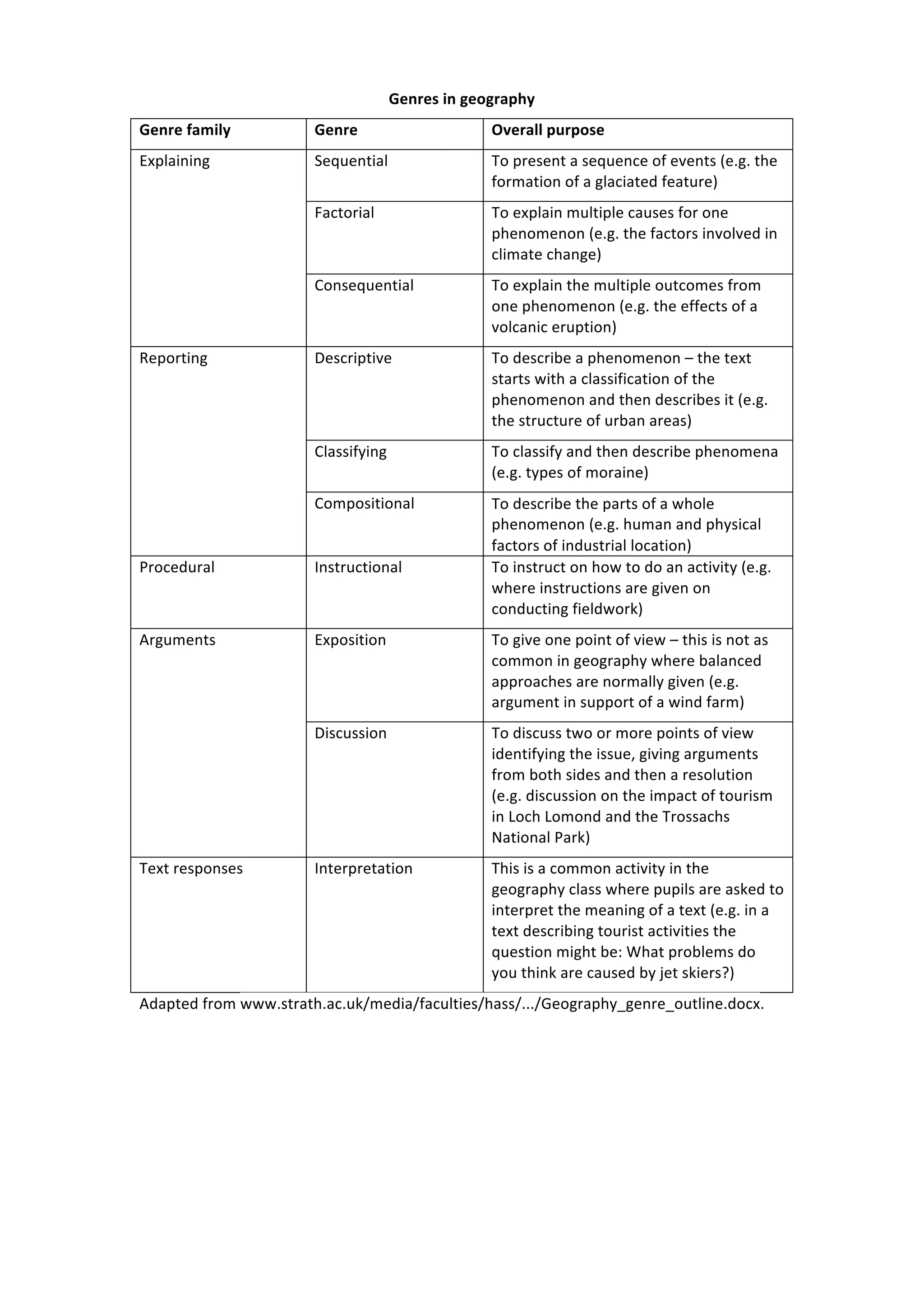
    Genres  in  geography   Genre  family   Genre   Overall  purpose   Explaining   Sequential     To  present  a  sequence  of  events  (e.g.  the   formation  of  a  glaciated  feature)   Factorial     To  explain  multiple  causes  for  one   phenomenon  (e.g.  the  factors  involved  in   climate  change)   Consequential     To  explain  the  multiple  outcomes  from   one  phenomenon  (e.g.  the  effects  of  a   volcanic  eruption)   Descriptive     To  describe  a  phenomenon  –  the  text   starts  with  a  classification  of  the   phenomenon  and  then  describes  it  (e.g.   the  structure  of  urban  areas)     Classifying     To  classify  and  then  describe  phenomena   (e.g.  types  of  moraine)   Compositional   To  describe  the  parts  of  a  whole   phenomenon  (e.g.  human  and  physical   factors  of  industrial  location)   To  instruct  on  how  to  do  an  activity  (e.g.   where  instructions  are  given  on   conducting  fieldwork)   Reporting   Procedural   Instructional   Arguments   Exposition   To  give  one  point  of  view  –  this  is  not  as   common  in  geography  where  balanced   approaches  are  normally  given  (e.g.   argument  in  support  of  a  wind  farm)   Discussion   To  discuss  two  or  more  points  of  view   identifying  the  issue,  giving  arguments   from  both  sides  and  then  a  resolution   (e.g.  discussion  on  the  impact  of  tourism   in  Loch  Lomond  and  the  Trossachs   National  Park)   Interpretation   This  is  a  common  activity  in  the   geography  class  where  pupils  are  asked  to   interpret  the  meaning  of  a  text  (e.g.  in  a   text  describing  tourist  activities  the   question  might  be:  What  problems  do   you  think  are  caused  by  jet  skiers?)     Text  responses     Adapted  from  www.strath.ac.uk/media/faculties/hass/.../Geography_genre_outline.docx.    
  • 2.
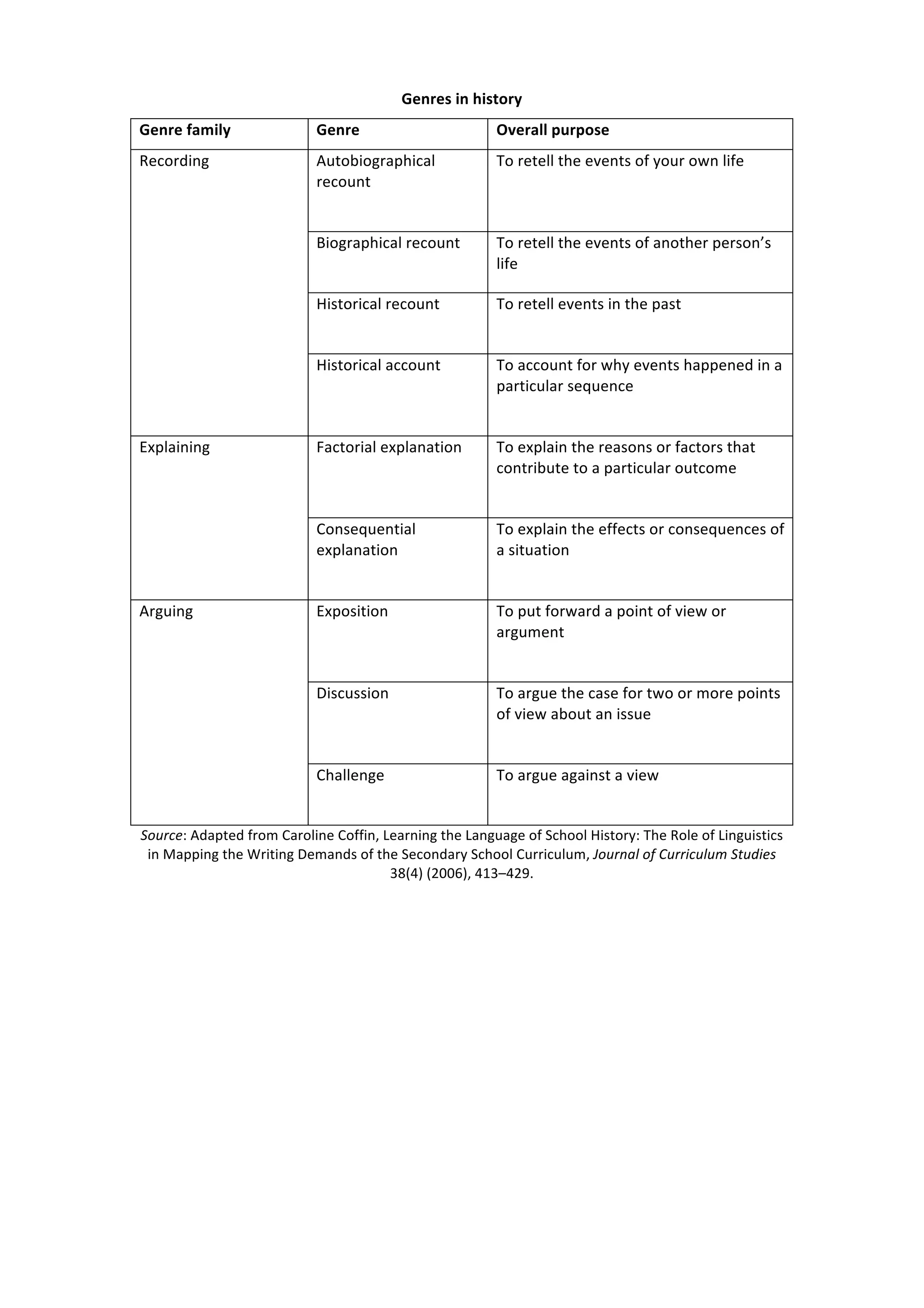
    Genres  in  history   Genre  family   Genre   Overall  purpose   Recording   Autobiographical   recount   To  retell  the  events  of  your  own  life     Biographical  recount     Historical  recount   To  retell  the  events  of  another  person’s   life   To  retell  events  in  the  past     Historical  account   To  account  for  why  events  happened  in  a   particular  sequence       Explaining   Factorial  explanation       To  explain  the  reasons  or  factors  that   contribute  to  a  particular  outcome       Consequential   explanation       Arguing   To  explain  the  effects  or  consequences  of   a  situation       Exposition     To  put  forward  a  point  of  view  or   argument         Discussion       To  argue  the  case  for  two  or  more  points   of  view  about  an  issue       Challenge     To  argue  against  a  view     Source:  Adapted  from  Caroline  Coffin,  Learning  the  Language  of  School  History:  The  Role  of  Linguistics   in  Mapping  the  Writing  Demands  of  the  Secondary  School  Curriculum,  Journal  of  Curriculum  Studies   38(4)  (2006),  413–429.      
  • 3.
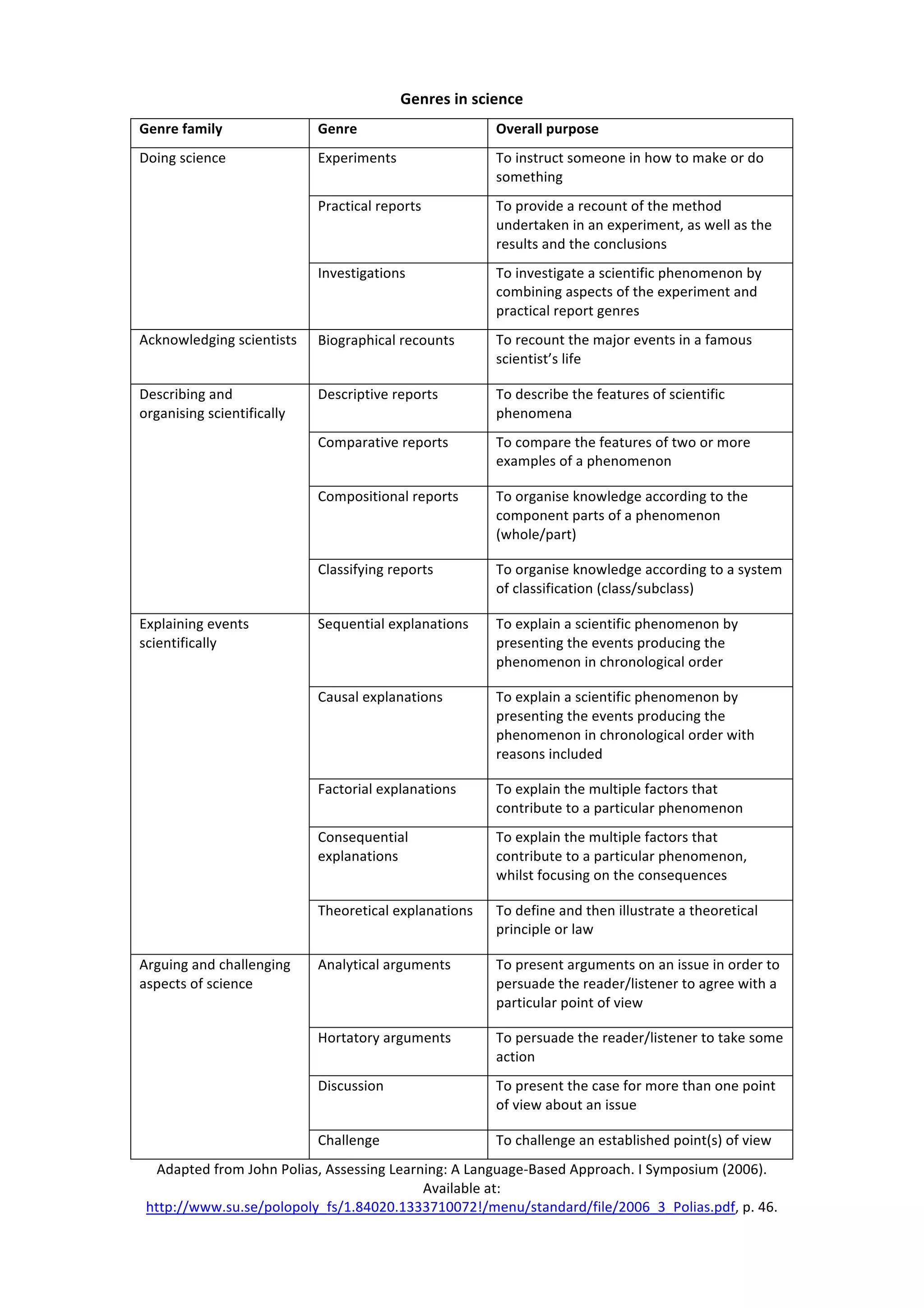
    Genres  in  science   Genre  family   Genre   Overall  purpose   Doing  science     Experiments   To  instruct  someone  in  how  to  make  or  do   something   Practical  reports   To  provide  a  recount  of  the  method   undertaken  in  an  experiment,  as  well  as  the   results  and  the  conclusions   Investigations   To  investigate  a  scientific  phenomenon  by   combining  aspects  of  the  experiment  and   practical  report  genres   Acknowledging  scientists     Biographical  recounts   To  recount  the  major  events  in  a  famous   scientist’s  life   Describing  and   organising  scientifically     Descriptive  reports   To  describe  the  features  of  scientific   phenomena   Comparative  reports   To  compare  the  features  of  two  or  more   examples  of  a  phenomenon     Compositional  reports   To  organise  knowledge  according  to  the   component  parts  of  a  phenomenon   (whole/part)     Classifying  reports   To  organise  knowledge  according  to  a  system   of  classification  (class/subclass)     Sequential  explanations     To  explain  a  scientific  phenomenon  by   presenting  the  events  producing  the   phenomenon  in  chronological  order   Causal  explanations   To  explain  a  scientific  phenomenon  by   presenting  the  events  producing  the   phenomenon  in  chronological  order  with   reasons  included   Factorial  explanations     To  explain  the  multiple  factors  that   contribute  to  a  particular  phenomenon   Consequential   explanations   To  explain  the  multiple  factors  that   contribute  to  a  particular  phenomenon,   whilst  focusing  on  the  consequences   Theoretical  explanations   To  define  and  then  illustrate  a  theoretical   principle  or  law   Analytical  arguments   To  present  arguments  on  an  issue  in  order  to   persuade  the  reader/listener  to  agree  with  a   particular  point  of  view   Explaining  events   scientifically       Arguing  and  challenging   aspects  of  science         Hortatory  arguments   To  persuade  the  reader/listener  to  take  some   action   Discussion     To  present  the  case  for  more  than  one  point   of  view  about  an  issue     Challenge     To  challenge  an  established  point(s)  of  view   Adapted  from  John  Polias,  Assessing  Learning:  A  Language-­‐Based  Approach.  I  Symposium  (2006).   Available  at:   http://www.su.se/polopoly_fs/1.84020.1333710072!/menu/standard/file/2006_3_Polias.pdf,  p.  46.