Giving Effective Feedback and Feedforward
Graduate Teaching Assistants Workshop,
January 2018
Sheila MacNeill
Senior Lecturer Academic Development: Digital
Learning, Dept. Academic Quality and
Development
Aims
• By the end of this session you should be able to:
– Define feedback in the context of learning and teaching
– Recognise and apply feedback principles in learning and
teaching practice
– Start developing skills in giving and receiving feedback
through practical activities
– Make use of personal experiences of feedback to inform
and enhance future practice
 Identify one ‘memorable’ example of a time when you
received feedback recently
 Write a brief description of the feedback on a post-it note
(e.g. written feedback on your PhD; verbal comment from
friends/ family on a meal you made etc. )
 Place the post-it under either the positive or negative
columns on the flipchart)
Activity 1
What do you think of this
feedback?
• https://www.youtube.com/watch?v=4dWj8O
hBxM4
Activity 2: What is good feedback?
Attempting a definition
 Use only single words, or a short phrase, to
describe what feedback is. Write your definition on
the padlet wall.
• http://bit.ly/2qn8M1s
Some definitions from the experts
• “Feedback is when you receive comments about your work,
so that you know how well your studies are going – and of
course there’s the other side to this- so you know how badly
your studies are going” (Race, 2008)
• “So what exactly is feedback? Feedback is any response from
a teacher in regard to a student’s performance or behavior. It
can be verbal, written or gestural. The purpose of feedback in
the learning process is to improve a student’s performance-
definitely not put a damper on it. The ultimate goal of
feedback is to provide students with an “I can do this”
attitude. (Reynolds, 2013)
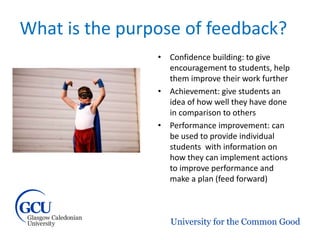
What is the purpose of feedback?
• Confidence building: to give
encouragement to students, help
them improve their work further
• Achievement: give students an
idea of how well they have done
in comparison to others
• Performance improvement: can
be used to provide individual
students with information on
how they can implement actions
to improve performance and
make a plan (feed forward)
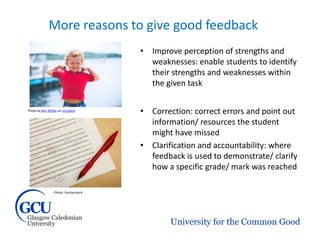
More reasons to give good feedback
• Improve perception of strengths and
weaknesses: enable students to identify
their strengths and weaknesses within
the given task
• Correction: correct errors and point out
information/ resources the student
might have missed
• Clarification and accountability: where
feedback is used to demonstrate/ clarify
how a specific grade/ mark was reached
Photo by Ben White on Unsplash
Photo: shutterstock
Bad feedback
 Saps students’ confidence
 Directs students’ activities in inappropriate directions
 Fails to articulate with learning outcomes
 Fails to relate clearly to evidence of achievement of
assessment criteria
 Relates only to what is easy to assess rather than what is at
the heart of learning
 Focuses on failings rather than achievements
Four strategies for giving good feedback
(Gavan Watson, University of Guelph see video on GCU LEARN)
• Good feedback has to be
1. Specific
2. Actionable
3. Timely
4. Respectful
• What do the students expect?
Use appropriate language
• Have you thought about /tried…?
• I was wondering whether this would work better
• It might be a good idea to … because / so that …
• Maybe the next time you could also …
• Another way to … is …
• It might be useful to …
• Have you considered…?
• I don’t understand ………….
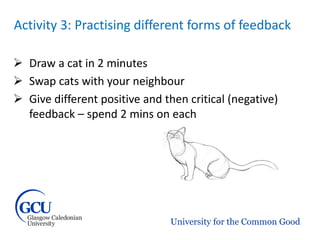
Activity 3: Practising different forms of feedback
 Draw a cat in 2 minutes
 Swap cats with your neighbour
 Give different positive and then critical (negative)
feedback – spend 2 mins on each
How did you feel?
 What feedback worked best?
 What did not work?
 How did it feel to receive positive/ negative feedback?
 How did it feel to give the feedback?
page 15
17
Feedback at GCU should be:
• A dialogue
• Supportive of future learning
• Timely
• Related to clear criteria
• Accessible to all students
• A continuous process
• Available on all forms of assessment
• Flexible and suited to students’ needs
GCU Feedback Principles
page 17
Activity 4
• What are the main challenges with giving useful
feedback?
• Discuss in your group and present the results to the
plenary.
• You have 5 minutes for this activity.
page 18
The challenge of judgement
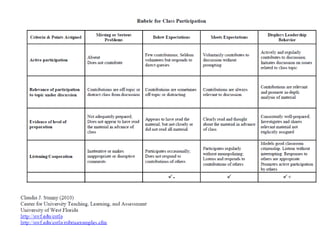
• Difficulties in assigning marks to assignments
• Using assessment criteria and rubrics
The Biscuit Challenge
• In your groups describe what a biscuit is in 240
characters (2 mins)
• Compare definitions
• Look at the plate on your table – based on your
definition does it contain biscuits?
• Agree criteria for: good, adequate, poor and
unacceptable biscuits – create a matrix
• Share your matrix with another group and assess the
(remaining) biscuits
page 21
page 22
References and resources
Nicol, D.J. and MacFarlane-Dick, D. (2006), Formative assessment and self-regulated learning: a model and
seven principles of good feedback practice, Studies in Higher Education, Vol. 31, No.2, April 2006, pp 199-218
Race, P. (2008) Using feedback to help students learn, Higher Education Academy
http://wap.rdg.ac.uk/web/FILES/EngageinFeedback/Race_using_feedback_to_help_students_learn.pdf
Reynolds, L. (2013) Giving student feedback: 20 tips to do it right
http://www.opencolleges.edu.au/informed/features/giving-student-feedback/
GCU Feedback for Future Learning
http://www.gcu.ac.uk/futurelearning/
Collated GCU assessment and Feedback policies and guidance
https://padlet.com/GCUAcademicDevelopment/assessment_feedback
page 23

Giving effective feedback and feedforward

  • 1.
    Giving Effective Feedbackand Feedforward Graduate Teaching Assistants Workshop, January 2018 Sheila MacNeill Senior Lecturer Academic Development: Digital Learning, Dept. Academic Quality and Development
  • 2.
    Aims • By theend of this session you should be able to: – Define feedback in the context of learning and teaching – Recognise and apply feedback principles in learning and teaching practice – Start developing skills in giving and receiving feedback through practical activities – Make use of personal experiences of feedback to inform and enhance future practice
  • 3.
     Identify one‘memorable’ example of a time when you received feedback recently  Write a brief description of the feedback on a post-it note (e.g. written feedback on your PhD; verbal comment from friends/ family on a meal you made etc. )  Place the post-it under either the positive or negative columns on the flipchart) Activity 1
  • 4.
    What do youthink of this feedback? • https://www.youtube.com/watch?v=4dWj8O hBxM4
  • 5.
    Activity 2: Whatis good feedback? Attempting a definition  Use only single words, or a short phrase, to describe what feedback is. Write your definition on the padlet wall. • http://bit.ly/2qn8M1s
  • 6.
    Some definitions fromthe experts • “Feedback is when you receive comments about your work, so that you know how well your studies are going – and of course there’s the other side to this- so you know how badly your studies are going” (Race, 2008) • “So what exactly is feedback? Feedback is any response from a teacher in regard to a student’s performance or behavior. It can be verbal, written or gestural. The purpose of feedback in the learning process is to improve a student’s performance- definitely not put a damper on it. The ultimate goal of feedback is to provide students with an “I can do this” attitude. (Reynolds, 2013)
  • 7.
    What is thepurpose of feedback? • Confidence building: to give encouragement to students, help them improve their work further • Achievement: give students an idea of how well they have done in comparison to others • Performance improvement: can be used to provide individual students with information on how they can implement actions to improve performance and make a plan (feed forward)
  • 8.
    More reasons togive good feedback • Improve perception of strengths and weaknesses: enable students to identify their strengths and weaknesses within the given task • Correction: correct errors and point out information/ resources the student might have missed • Clarification and accountability: where feedback is used to demonstrate/ clarify how a specific grade/ mark was reached Photo by Ben White on Unsplash Photo: shutterstock
  • 9.
    Bad feedback  Sapsstudents’ confidence  Directs students’ activities in inappropriate directions  Fails to articulate with learning outcomes  Fails to relate clearly to evidence of achievement of assessment criteria  Relates only to what is easy to assess rather than what is at the heart of learning  Focuses on failings rather than achievements
  • 10.
    Four strategies forgiving good feedback (Gavan Watson, University of Guelph see video on GCU LEARN) • Good feedback has to be 1. Specific 2. Actionable 3. Timely 4. Respectful
  • 11.
    • What dothe students expect?
  • 13.
    Use appropriate language •Have you thought about /tried…? • I was wondering whether this would work better • It might be a good idea to … because / so that … • Maybe the next time you could also … • Another way to … is … • It might be useful to … • Have you considered…? • I don’t understand ………….
  • 14.
    Activity 3: Practisingdifferent forms of feedback  Draw a cat in 2 minutes  Swap cats with your neighbour  Give different positive and then critical (negative) feedback – spend 2 mins on each
  • 15.
    How did youfeel?  What feedback worked best?  What did not work?  How did it feel to receive positive/ negative feedback?  How did it feel to give the feedback? page 15
  • 17.
    17 Feedback at GCUshould be: • A dialogue • Supportive of future learning • Timely • Related to clear criteria • Accessible to all students • A continuous process • Available on all forms of assessment • Flexible and suited to students’ needs GCU Feedback Principles page 17
  • 18.
    Activity 4 • Whatare the main challenges with giving useful feedback? • Discuss in your group and present the results to the plenary. • You have 5 minutes for this activity. page 18
  • 19.
    The challenge ofjudgement • Difficulties in assigning marks to assignments • Using assessment criteria and rubrics
  • 20.
    The Biscuit Challenge •In your groups describe what a biscuit is in 240 characters (2 mins) • Compare definitions • Look at the plate on your table – based on your definition does it contain biscuits? • Agree criteria for: good, adequate, poor and unacceptable biscuits – create a matrix • Share your matrix with another group and assess the (remaining) biscuits
  • 21.
  • 22.
  • 23.
    References and resources Nicol,D.J. and MacFarlane-Dick, D. (2006), Formative assessment and self-regulated learning: a model and seven principles of good feedback practice, Studies in Higher Education, Vol. 31, No.2, April 2006, pp 199-218 Race, P. (2008) Using feedback to help students learn, Higher Education Academy http://wap.rdg.ac.uk/web/FILES/EngageinFeedback/Race_using_feedback_to_help_students_learn.pdf Reynolds, L. (2013) Giving student feedback: 20 tips to do it right http://www.opencolleges.edu.au/informed/features/giving-student-feedback/ GCU Feedback for Future Learning http://www.gcu.ac.uk/futurelearning/ Collated GCU assessment and Feedback policies and guidance https://padlet.com/GCUAcademicDevelopment/assessment_feedback page 23