Historical Developments of English
(Historical Linguistics)
Level-8
What is English?
• English is a West Germanic language that was first spoken in early medieval
England and is now a global lingua franca.
• Lingua Franca is a bridge language, common language, or link language or a
dialect systematically used to make communication possible between people who
do not share a native language or dialect, particularly when it is a third language
that is distinct from both native languages.
• English has become the leading language of international discourse and the lingua
franca in many regions and professional contexts such as science, navigation and
law.
• English is the third most spoken native language in the world, after Standard
Chinese and Spanish. It is the most widely learned second language and is either
the official language or one of the official languages in almost 60 sovereign states.
History of English
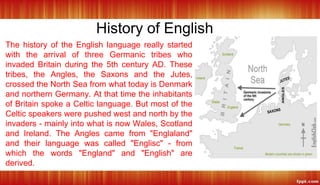
The history of the English language really started
with the arrival of three Germanic tribes who
invaded Britain during the 5th century AD. These
tribes, the Angles, the Saxons and the Jutes,
crossed the North Sea from what today is Denmark
and northern Germany. At that time the inhabitants
of Britain spoke a Celtic language. But most of the
Celtic speakers were pushed west and north by the
invaders - mainly into what is now Wales, Scotland
and Ireland. The Angles came from "Englaland"
and their language was called "Englisc" - from
which the words "England" and "English" are
derived.
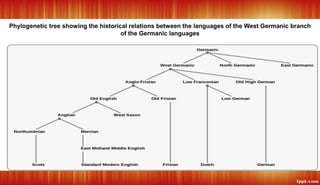
Phylogenetic tree showing the historical relations between the languages of the West Germanic branch
of the Germanic languages
Development of English
• English has developed over the course of more than 1,400 years. (1) The earliest
forms of English, a set of Anglo-Frisian dialects brought to Great Britain by Anglo-
Saxon settlers in the 5th century, are called Old English. (2) Middle English began
in the late 11th century with the Norman conquest of England and was a period in
which the language was influenced by French. (3) Early Modern English began in
the late 15th century with the introduction of the printing press to London, the
printing of the King James Bible and the start of the Great Vowel Shift.
• Modern English grammar is the result of a gradual change from a typical Indo-
European dependent marking pattern with a rich inflectional morphology and
relatively free word order to a mostly analytic pattern with little inflection, a fairly
fixed SVO word order and a complex syntax.
Key dates: Periods of English
Old English 450-1150 A.D
Middle English 1150-1500
Early Modern English 1500-1700
Modern English 1700-1900
Late Modern English 1900-present
Old English (450-1150)
• The dialects of the first Anglo-Saxons became what we now call Old English
(OE). There were four main dialects: West Saxon, Kentish, Mercian,
Northumbrian. Old English was almost completely Germanic. The dialects had
very few Celtic words. However, they borrowed some Celtic words, for example,
some English cities and rivers: London, Leeds and Thames.
• Monks from Rome to teach the Anglo-Saxons about Christianity, left Latin words
in education and some connected to the Church.
• Eighty-five per cent of the OE vocabulary has been replaced in Modern English
(ME) with words from Latin and Greek. However, the hundred most common
words in ME all come from the language used at that time.
Middle English (1150-1500)
• In the four hundred years that followed the Norman Conquest, the English
language changed more than in any other time in history. Thousands of words
from French came into the language, and many Old English ones left.
• At the same time Middle English changed grammatically, mainly by becoming
simpler.
 OE: climb - <past>- clomb
 ME: climb - <past> - climbed
• Between 1100 and 1500, about 10,000 French words were taken into English,
three-quarters of which are still in use. French words came into every part of life:
for example, chair, city, crime, fashion, fruit,…
Early Modern English (1500-1700)
• In this stage the printing press (established in the Middle English period) meant
spellings became more fixed and established.
• Science became a key factor in language change as more discoveries were
made. Many words introduced through scientists were ‘loan words’ which had
been borrowed from other languages as people struggled to name their
discoveries.
• Religion was still just as important in society as it had always been (during this
period the protestant reformation occurred, which also could have informed the
language / attitudes ).
• Exploration and colonization also affected the use of language and meant more
words were picked up.
• The grammar reflected the transition between Middle English and contemporary
English.
• Spelling and punctuation started to become more standardized (inconsistencies
remained but gradually began to disappear).
• Shakespeare’s work utilized unusual words, some inflections (such as ‘-est’ and ‘-
eth’) were favored while others completely rejected, and pronouns ‘thou’, ‘thee’ and
‘thy’ were used in his work.
• The use of inflections was reduced.
• Phonology was influenced by the Great Vowel Shift. This is where the pronunciation
of long vowel sounds transformed to become similar to the pronunciation we have
today.
• Many prefixes (anti-, post-, pre-) and suffixes (-ate, -ic, -al) were taken from Latin.
• Word order became more fixed: subject > verb > object.
Modern English (1700-1900)
• The industrial revolution influenced the English language as new ideas and
contraptions were being invented, along with a range of new fields people could
work in English started to become an international language at this point. New
varieties such as American English and Indian English began to form. The
expansion of the British Empire (19th century) and growing ‘superpower’ status of
the US (20th century) also influenced English language.
• Spelling became much more consistent and standardized.
• Regional differences in language lessened.
• Newly coined words were used more heavily and quickly.
• Use of auxiliary verbs became mandatory in interrogative sentences, e.g. ‘did he
go running?’
Late Modern English (1900-present)
• Technology has become one of the main influences of modern language.
• ‘Text speech’ such as ‘lol’ and ‘omg’ has filtered through into everyday usage,
including spoken language.
• The Internet, texting, new gadgets (iPads, tablets) come with entirely new lexical
sets as well as jargon and specialist language.
• Abbriviation/Acronym have become a normal part of language, e.g. ‘omg’, ‘lol’,
‘wtf’ etc.
• Grammar rules can be flouted more easily, e.g. experimenting with syntax and
fronted conjunctions. The grammar can be used to suit the formality of the text.
• Slang and jargon is heavily used.
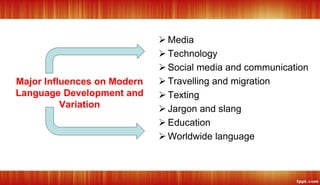
Major Influences on Modern
Language Development and
Variation
 Media
 Technology
 Social media and communication
 Travelling and migration
 Texting
 Jargon and slang
 Education
 Worldwide language
Comparing the Changes
Various sorts of changes from various stages of English can be compared from the translations of the Bible
(Matthew 27:73) at different time periods, starting with the present and working back to Old English. This particular
example reveals the changes that have taken place in English language.
1. Modern English (The New English Bible, 1961):
Shortly afterwards the bystanders carne up and said to Peter, 'Surely you are another of them; your accent gives
you away!'
2. Early Modern English (The King James Bible, 1611):
And after a while carne vnto him they that stood by, and saide to Peter, Surely thou also art one of them, for thy
speech bewrayeth thee.
3. Middle English (The Wycliff Bible, fourteenth century):
And a litil aftir, thei that stooden camen, and seiden to Petir, treuli thou art of hem; for thi speche makith thee
knowun.
4. Old English (The West-Saxon Gospels, c. 1050):
I'a refter lytlum fyrste geneaIreton I'a oe I'rer stodon, cwredon to petre. Soolice I'u eart of hym, I'yn sprrec I'e
gesweotolao. [Literally: then after little first approached they that there stood, said to Peter. Truly thou art of them,
thy speech thee makes clear.]
1- Modern English with Early Modern English
In comparing the Modern English with the Early Modern English (1476-1700) versions, we note several kinds of changes
discussed below;
(1) Lexical: in Early Modern English bewrayeth we have an example of lexical replacement. This word was archaic already in
the seventeenth century and has been replaced by other words. It meant 'to malign, speak evil of, to expose (a deception)'. In
this context, it means that Peter's way of speaking, his accent, gives him away.
(2) Grammatical (syntactic and morphological) change: from came vnto [unto] him they to the Modern English equivalent, they
came to him, there has been a syntactic change. Another grammatical change (syntactic and morphological) is seen in the
difference between thou . .. art and you are. Formerly, thou was 'you (singular familiar)' and contrasted with ye/you 'you (plural or
singular formal)" but this distinction was lost. The -eth of bewrayeth was the 'third person singular' verb agreement suffix; it was
replaced in time by -(e)s (giveth > gives).
(3) Sound change: early modern English was not pronounced in exactly the same way as Modern English. There are multiple
types of sound changes. (Will be discussed in coming lectures).
(4) Borrowing: the word accent in modern English is a loanword from Old French accent.
(5) Changes in orthography (spelling conventions): In vnto for modem unto we see a minor change in orthographic
convention. Earlier in many European languages, there was in effect no distinction between the letters v and u (the Latin
alphabet, upon which most European writing systems are based, had no such difference); both could be used to represent either
the vowel luI or the consonant Ivl or in other cases Iwl, though for both Ivl and luI usually v was used initially «vnder> 'under') and
u medially «haue> 'have').
2-Modern English with Middle English
Examples of kinds of changes seen in the comparison of the Middle English (1066-1476) text with
later versions include;
(1) Sound change: final -n was lost by regular sound change under certain conditions (for example,
not in past participles, such as written), as seen in the comparison of Middle English stooden, camen
and seiden with their modern equivalents stood, came and said.
(2) Grammatical change (morphological and syntactic): the forms stooden, camen and seiden
('stood', 'came' and 'said') each contain the final -n which marked agreement with the third person
plural subject ('they', spelled thei). When final -n was lost by sound change, the grammatical change
was brought about that verbs no longer had this agreement marker (-n) for the plural persons.
(3) Borrowing: the hem is the original third person plural object pronoun, which was replaced by
them, a borrowing from Scandinavian, which had great influence on English.
3- Modern English with Old English
Between Old English (c. 450--1066) and Modern English we see many changes. Some of the kinds
include;
(1) Lexical change: there are instances of loss of vocabulary items represented by the words in this
short verse, namely genealæton 'approached', cwædon 'said', soðlice 'truly‘ (soothly, compare
soothsayer 'one who speaks the truth').
(2) Sound change: English has undergone many changes in pronunciation since Old English times.
For example, A sporadic change is seen in the loss of r from spræc 'speech' (compare German
Sprache 'language, speech', where the r is retained). English vowels underwent a number of changes.
One is called the Great Vowel Shift (will be discussed in coming lectures), in which essentially long
vowels raised (and long high vowels /i:/ and /u:/ became diphthongs, /ai/ and /au/, respectively).
(3) Grammatical: the loss of the subject verb reversal when other material preceded in the clause, is
seen in a comparison of genealæton pa 'approached they' with the modem counterpart for 'they
approached'.
(4) Orthographic: there are many differences in how sounds are represented. Old English ƿ 'thorn'
and ð 'eth' have been dropped and are spelled today with th for both the voiceless (θ) and voiced (ð)
dental fricatives.

Historical developments of English

  • 1.
    Historical Developments ofEnglish (Historical Linguistics) Level-8
  • 2.
    What is English? •English is a West Germanic language that was first spoken in early medieval England and is now a global lingua franca. • Lingua Franca is a bridge language, common language, or link language or a dialect systematically used to make communication possible between people who do not share a native language or dialect, particularly when it is a third language that is distinct from both native languages. • English has become the leading language of international discourse and the lingua franca in many regions and professional contexts such as science, navigation and law. • English is the third most spoken native language in the world, after Standard Chinese and Spanish. It is the most widely learned second language and is either the official language or one of the official languages in almost 60 sovereign states.
  • 3.
    History of English Thehistory of the English language really started with the arrival of three Germanic tribes who invaded Britain during the 5th century AD. These tribes, the Angles, the Saxons and the Jutes, crossed the North Sea from what today is Denmark and northern Germany. At that time the inhabitants of Britain spoke a Celtic language. But most of the Celtic speakers were pushed west and north by the invaders - mainly into what is now Wales, Scotland and Ireland. The Angles came from "Englaland" and their language was called "Englisc" - from which the words "England" and "English" are derived.
  • 4.
    Phylogenetic tree showingthe historical relations between the languages of the West Germanic branch of the Germanic languages
  • 5.
    Development of English •English has developed over the course of more than 1,400 years. (1) The earliest forms of English, a set of Anglo-Frisian dialects brought to Great Britain by Anglo- Saxon settlers in the 5th century, are called Old English. (2) Middle English began in the late 11th century with the Norman conquest of England and was a period in which the language was influenced by French. (3) Early Modern English began in the late 15th century with the introduction of the printing press to London, the printing of the King James Bible and the start of the Great Vowel Shift. • Modern English grammar is the result of a gradual change from a typical Indo- European dependent marking pattern with a rich inflectional morphology and relatively free word order to a mostly analytic pattern with little inflection, a fairly fixed SVO word order and a complex syntax.
  • 6.
    Key dates: Periodsof English Old English 450-1150 A.D Middle English 1150-1500 Early Modern English 1500-1700 Modern English 1700-1900 Late Modern English 1900-present
  • 7.
    Old English (450-1150) •The dialects of the first Anglo-Saxons became what we now call Old English (OE). There were four main dialects: West Saxon, Kentish, Mercian, Northumbrian. Old English was almost completely Germanic. The dialects had very few Celtic words. However, they borrowed some Celtic words, for example, some English cities and rivers: London, Leeds and Thames. • Monks from Rome to teach the Anglo-Saxons about Christianity, left Latin words in education and some connected to the Church. • Eighty-five per cent of the OE vocabulary has been replaced in Modern English (ME) with words from Latin and Greek. However, the hundred most common words in ME all come from the language used at that time.
  • 8.
    Middle English (1150-1500) •In the four hundred years that followed the Norman Conquest, the English language changed more than in any other time in history. Thousands of words from French came into the language, and many Old English ones left. • At the same time Middle English changed grammatically, mainly by becoming simpler.  OE: climb - <past>- clomb  ME: climb - <past> - climbed • Between 1100 and 1500, about 10,000 French words were taken into English, three-quarters of which are still in use. French words came into every part of life: for example, chair, city, crime, fashion, fruit,…
  • 9.
    Early Modern English(1500-1700) • In this stage the printing press (established in the Middle English period) meant spellings became more fixed and established. • Science became a key factor in language change as more discoveries were made. Many words introduced through scientists were ‘loan words’ which had been borrowed from other languages as people struggled to name their discoveries. • Religion was still just as important in society as it had always been (during this period the protestant reformation occurred, which also could have informed the language / attitudes ). • Exploration and colonization also affected the use of language and meant more words were picked up.
  • 10.
    • The grammarreflected the transition between Middle English and contemporary English. • Spelling and punctuation started to become more standardized (inconsistencies remained but gradually began to disappear). • Shakespeare’s work utilized unusual words, some inflections (such as ‘-est’ and ‘- eth’) were favored while others completely rejected, and pronouns ‘thou’, ‘thee’ and ‘thy’ were used in his work. • The use of inflections was reduced. • Phonology was influenced by the Great Vowel Shift. This is where the pronunciation of long vowel sounds transformed to become similar to the pronunciation we have today. • Many prefixes (anti-, post-, pre-) and suffixes (-ate, -ic, -al) were taken from Latin. • Word order became more fixed: subject > verb > object.
  • 11.
    Modern English (1700-1900) •The industrial revolution influenced the English language as new ideas and contraptions were being invented, along with a range of new fields people could work in English started to become an international language at this point. New varieties such as American English and Indian English began to form. The expansion of the British Empire (19th century) and growing ‘superpower’ status of the US (20th century) also influenced English language. • Spelling became much more consistent and standardized. • Regional differences in language lessened. • Newly coined words were used more heavily and quickly. • Use of auxiliary verbs became mandatory in interrogative sentences, e.g. ‘did he go running?’
  • 12.
    Late Modern English(1900-present) • Technology has become one of the main influences of modern language. • ‘Text speech’ such as ‘lol’ and ‘omg’ has filtered through into everyday usage, including spoken language. • The Internet, texting, new gadgets (iPads, tablets) come with entirely new lexical sets as well as jargon and specialist language. • Abbriviation/Acronym have become a normal part of language, e.g. ‘omg’, ‘lol’, ‘wtf’ etc. • Grammar rules can be flouted more easily, e.g. experimenting with syntax and fronted conjunctions. The grammar can be used to suit the formality of the text. • Slang and jargon is heavily used.
  • 13.
    Major Influences onModern Language Development and Variation  Media  Technology  Social media and communication  Travelling and migration  Texting  Jargon and slang  Education  Worldwide language
  • 14.
    Comparing the Changes Varioussorts of changes from various stages of English can be compared from the translations of the Bible (Matthew 27:73) at different time periods, starting with the present and working back to Old English. This particular example reveals the changes that have taken place in English language. 1. Modern English (The New English Bible, 1961): Shortly afterwards the bystanders carne up and said to Peter, 'Surely you are another of them; your accent gives you away!' 2. Early Modern English (The King James Bible, 1611): And after a while carne vnto him they that stood by, and saide to Peter, Surely thou also art one of them, for thy speech bewrayeth thee. 3. Middle English (The Wycliff Bible, fourteenth century): And a litil aftir, thei that stooden camen, and seiden to Petir, treuli thou art of hem; for thi speche makith thee knowun. 4. Old English (The West-Saxon Gospels, c. 1050): I'a refter lytlum fyrste geneaIreton I'a oe I'rer stodon, cwredon to petre. Soolice I'u eart of hym, I'yn sprrec I'e gesweotolao. [Literally: then after little first approached they that there stood, said to Peter. Truly thou art of them, thy speech thee makes clear.]
  • 15.
    1- Modern Englishwith Early Modern English In comparing the Modern English with the Early Modern English (1476-1700) versions, we note several kinds of changes discussed below; (1) Lexical: in Early Modern English bewrayeth we have an example of lexical replacement. This word was archaic already in the seventeenth century and has been replaced by other words. It meant 'to malign, speak evil of, to expose (a deception)'. In this context, it means that Peter's way of speaking, his accent, gives him away. (2) Grammatical (syntactic and morphological) change: from came vnto [unto] him they to the Modern English equivalent, they came to him, there has been a syntactic change. Another grammatical change (syntactic and morphological) is seen in the difference between thou . .. art and you are. Formerly, thou was 'you (singular familiar)' and contrasted with ye/you 'you (plural or singular formal)" but this distinction was lost. The -eth of bewrayeth was the 'third person singular' verb agreement suffix; it was replaced in time by -(e)s (giveth > gives). (3) Sound change: early modern English was not pronounced in exactly the same way as Modern English. There are multiple types of sound changes. (Will be discussed in coming lectures). (4) Borrowing: the word accent in modern English is a loanword from Old French accent. (5) Changes in orthography (spelling conventions): In vnto for modem unto we see a minor change in orthographic convention. Earlier in many European languages, there was in effect no distinction between the letters v and u (the Latin alphabet, upon which most European writing systems are based, had no such difference); both could be used to represent either the vowel luI or the consonant Ivl or in other cases Iwl, though for both Ivl and luI usually v was used initially «vnder> 'under') and u medially «haue> 'have').
  • 16.
    2-Modern English withMiddle English Examples of kinds of changes seen in the comparison of the Middle English (1066-1476) text with later versions include; (1) Sound change: final -n was lost by regular sound change under certain conditions (for example, not in past participles, such as written), as seen in the comparison of Middle English stooden, camen and seiden with their modern equivalents stood, came and said. (2) Grammatical change (morphological and syntactic): the forms stooden, camen and seiden ('stood', 'came' and 'said') each contain the final -n which marked agreement with the third person plural subject ('they', spelled thei). When final -n was lost by sound change, the grammatical change was brought about that verbs no longer had this agreement marker (-n) for the plural persons. (3) Borrowing: the hem is the original third person plural object pronoun, which was replaced by them, a borrowing from Scandinavian, which had great influence on English.
  • 17.
    3- Modern Englishwith Old English Between Old English (c. 450--1066) and Modern English we see many changes. Some of the kinds include; (1) Lexical change: there are instances of loss of vocabulary items represented by the words in this short verse, namely genealæton 'approached', cwædon 'said', soðlice 'truly‘ (soothly, compare soothsayer 'one who speaks the truth'). (2) Sound change: English has undergone many changes in pronunciation since Old English times. For example, A sporadic change is seen in the loss of r from spræc 'speech' (compare German Sprache 'language, speech', where the r is retained). English vowels underwent a number of changes. One is called the Great Vowel Shift (will be discussed in coming lectures), in which essentially long vowels raised (and long high vowels /i:/ and /u:/ became diphthongs, /ai/ and /au/, respectively). (3) Grammatical: the loss of the subject verb reversal when other material preceded in the clause, is seen in a comparison of genealæton pa 'approached they' with the modem counterpart for 'they approached'. (4) Orthographic: there are many differences in how sounds are represented. Old English ƿ 'thorn' and ð 'eth' have been dropped and are spelled today with th for both the voiceless (θ) and voiced (ð) dental fricatives.