PRESENTATION
Social Networking Sites and Terminologies
CONTENTS
 Introduction
 Social Networking Sites
 Pros and Cons
 Terminologies
 Conclusion
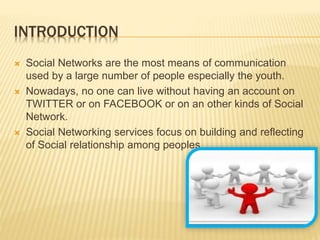
INTRODUCTION
 Social Networks are the most means of communication
used by a large number of people especially the youth.
 Nowadays, no one can live without having an account on
TWITTER or on FACEBOOK or on an other kinds of Social
Network.
 Social Networking services focus on building and reflecting
of Social relationship among peoples.
HISTORY OF SOCIAL NETWORKING SITES
 In 1978, the first Social Network was Bulletin Board
System (BBS) created by Ward Christensen and Randy
Suess used to announce meeting and sharing information
by posting it on BBC.
 It was the beginning of virtual community and the first dial-
up in History.
DEFINITION
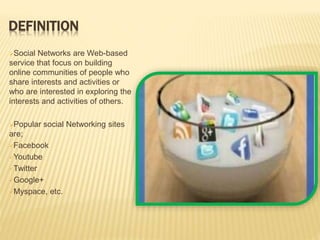
Social Networks are Web-based
service that focus on building
online communities of people who
share interests and activities or
who are interested in exploring the
interests and activities of others.
Popular social Networking sites
are;
Facebook
Youtube
Twitter
Google+
Myspace, etc.
FACEBOOK
Facebook is an online social networking
service.
Facebook was founded on February 4,
2004 by Mark Zuckerberg.
it’s name comes from a colloquialism
American universities.
FEATURES; uploading
Photos
Videos
Status update
Check info
Chatting
Video calling
Following
Like
Comment
App, etc.
FACEBOOK FACTS
 Monthly active facebook users:
1.4 billion
 In everyday almost 350 millions photos are uploading in to
facebook.
 Every sixty seconds 2,93,000 status are posted on
facebook.
 Average amount of time a person uses facebook per month;
15 hours 33 minutes
YOUTUBE
Youtube is a video sharing website,
created by three former paypal
employees Chad Hurley, Steve
Chen , and Jawed Karim in
February 2005 and owned by
Google since late 2006.
FEATURES;
Video playback
Uploading
Sharing
Localization, etc.
YOUTUBE FACTS
 The first youTube video was entitled “ Me at the zoo”, and
shows co-founder Jawed Karim at the San Diego Zoo.
 The site has 800 million + monthly unique visitors.
 An average internet user spends 15 minutes (900 seconds)
on YouTube daily.
 First video hits 1 billion views- “Gangnam style” by (Dec,
2012)
TWITTER
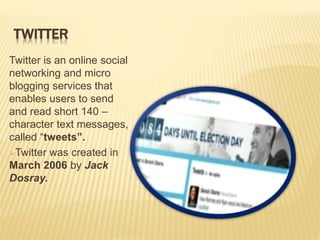
Twitter is an online social
networking and micro
blogging services that
enables users to send
and read short 140 –
character text messages,
called “tweets”.
Twitter was created in
March 2006 by Jack
Dosray.
TWITTER FACTS
 Twitter experiences more than 500 million tweets a day.
 Katy Perry is the most followed Twitter account with more
than 51 million followers.
 70 % of Twitter of accounts are outside the US.
 China is the country with the most Twitter users with 35.5
million.
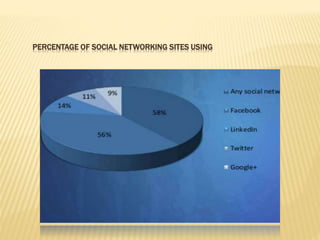
PERCENTAGE OF SOCIAL NETWORKING SITES USING
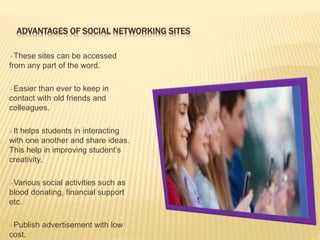
ADVANTAGES OF SOCIAL NETWORKING SITES
These sites can be accessed
from any part of the word.
Easier than ever to keep in
contact with old friends and
colleagues.
It helps students in interacting
with one another and share ideas.
This help in improving student’s
creativity.
Various social activities such as
blood donating, financial support
etc.
Publish advertisement with low
cost.
DISADVANTAGES OF SOCIAL NETWORKING SITES
The most common disadvantage of
social networking sites is addiction.
Often users of these sites get addicted
to it. They spend hours using these
sites and it harms their academic
performance.
Some peoples may tend to use to
these social networking sites till mid
night or even more which can
obviously lead to mental health
problems and sometimes it harms their
body too.
Peoples may spend time in facebook
through which they lack to spend time
with their family members.
Sometimes users provide their
personal information to others which is
insecure because they can easily
tracked down by strangers.
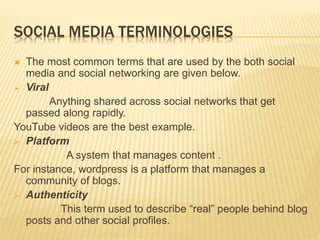
SOCIAL MEDIA TERMINOLOGIES
 The most common terms that are used by the both social
media and social networking are given below.
 Viral
Anything shared across social networks that get
passed along rapidly.
YouTube videos are the best example.
 Platform
A system that manages content .
For instance, wordpress is a platform that manages a
community of blogs.
 Authenticity
This term used to describe “real” people behind blog
posts and other social profiles.
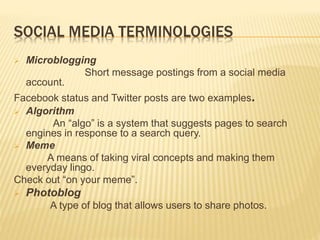
SOCIAL MEDIA TERMINOLOGIES
 Microblogging
Short message postings from a social media
account.
Facebook status and Twitter posts are two examples.
 Algorithm
An “algo” is a system that suggests pages to search
engines in response to a search query.
 Meme
A means of taking viral concepts and making them
everyday lingo.
Check out “on your meme”.
 Photoblog
A type of blog that allows users to share photos.
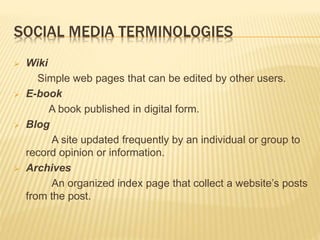
SOCIAL MEDIA TERMINOLOGIES
 Wiki
Simple web pages that can be edited by other users.
 E-book
A book published in digital form.
 Blog
A site updated frequently by an individual or group to
record opinion or information.
 Archives
An organized index page that collect a website’s posts
from the post.
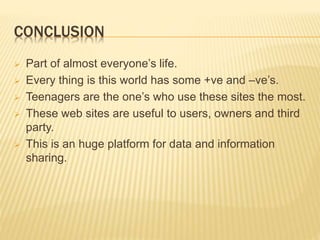
CONCLUSION
 Part of almost everyone’s life.
 Every thing is this world has some +ve and –ve’s.
 Teenagers are the one’s who use these sites the most.
 These web sites are useful to users, owners and third
party.
 This is an huge platform for data and information
sharing.
THANK YOU
FOR BEING WITH US….
Social Networking Sites and Terminologies

Social Networking Sites and Terminologies

  • 1.
  • 2.
    CONTENTS  Introduction  SocialNetworking Sites  Pros and Cons  Terminologies  Conclusion
  • 3.
    INTRODUCTION  Social Networksare the most means of communication used by a large number of people especially the youth.  Nowadays, no one can live without having an account on TWITTER or on FACEBOOK or on an other kinds of Social Network.  Social Networking services focus on building and reflecting of Social relationship among peoples.
  • 4.
    HISTORY OF SOCIALNETWORKING SITES  In 1978, the first Social Network was Bulletin Board System (BBS) created by Ward Christensen and Randy Suess used to announce meeting and sharing information by posting it on BBC.  It was the beginning of virtual community and the first dial- up in History.
  • 5.
    DEFINITION Social Networks areWeb-based service that focus on building online communities of people who share interests and activities or who are interested in exploring the interests and activities of others. Popular social Networking sites are; Facebook Youtube Twitter Google+ Myspace, etc.
  • 6.
    FACEBOOK Facebook is anonline social networking service. Facebook was founded on February 4, 2004 by Mark Zuckerberg. it’s name comes from a colloquialism American universities. FEATURES; uploading Photos Videos Status update Check info Chatting Video calling Following Like Comment App, etc.
  • 7.
    FACEBOOK FACTS  Monthlyactive facebook users: 1.4 billion  In everyday almost 350 millions photos are uploading in to facebook.  Every sixty seconds 2,93,000 status are posted on facebook.  Average amount of time a person uses facebook per month; 15 hours 33 minutes
  • 8.
    YOUTUBE Youtube is avideo sharing website, created by three former paypal employees Chad Hurley, Steve Chen , and Jawed Karim in February 2005 and owned by Google since late 2006. FEATURES; Video playback Uploading Sharing Localization, etc.
  • 9.
    YOUTUBE FACTS  Thefirst youTube video was entitled “ Me at the zoo”, and shows co-founder Jawed Karim at the San Diego Zoo.  The site has 800 million + monthly unique visitors.  An average internet user spends 15 minutes (900 seconds) on YouTube daily.  First video hits 1 billion views- “Gangnam style” by (Dec, 2012)
  • 10.
    TWITTER Twitter is anonline social networking and micro blogging services that enables users to send and read short 140 – character text messages, called “tweets”. Twitter was created in March 2006 by Jack Dosray.
  • 11.
    TWITTER FACTS  Twitterexperiences more than 500 million tweets a day.  Katy Perry is the most followed Twitter account with more than 51 million followers.  70 % of Twitter of accounts are outside the US.  China is the country with the most Twitter users with 35.5 million.
  • 12.
    PERCENTAGE OF SOCIALNETWORKING SITES USING
  • 13.
    ADVANTAGES OF SOCIALNETWORKING SITES These sites can be accessed from any part of the word. Easier than ever to keep in contact with old friends and colleagues. It helps students in interacting with one another and share ideas. This help in improving student’s creativity. Various social activities such as blood donating, financial support etc. Publish advertisement with low cost.
  • 14.
    DISADVANTAGES OF SOCIALNETWORKING SITES The most common disadvantage of social networking sites is addiction. Often users of these sites get addicted to it. They spend hours using these sites and it harms their academic performance. Some peoples may tend to use to these social networking sites till mid night or even more which can obviously lead to mental health problems and sometimes it harms their body too. Peoples may spend time in facebook through which they lack to spend time with their family members. Sometimes users provide their personal information to others which is insecure because they can easily tracked down by strangers.
  • 15.
    SOCIAL MEDIA TERMINOLOGIES The most common terms that are used by the both social media and social networking are given below.  Viral Anything shared across social networks that get passed along rapidly. YouTube videos are the best example.  Platform A system that manages content . For instance, wordpress is a platform that manages a community of blogs.  Authenticity This term used to describe “real” people behind blog posts and other social profiles.
  • 16.
    SOCIAL MEDIA TERMINOLOGIES Microblogging Short message postings from a social media account. Facebook status and Twitter posts are two examples.  Algorithm An “algo” is a system that suggests pages to search engines in response to a search query.  Meme A means of taking viral concepts and making them everyday lingo. Check out “on your meme”.  Photoblog A type of blog that allows users to share photos.
  • 17.
    SOCIAL MEDIA TERMINOLOGIES Wiki Simple web pages that can be edited by other users.  E-book A book published in digital form.  Blog A site updated frequently by an individual or group to record opinion or information.  Archives An organized index page that collect a website’s posts from the post.
  • 18.
    CONCLUSION  Part ofalmost everyone’s life.  Every thing is this world has some +ve and –ve’s.  Teenagers are the one’s who use these sites the most.  These web sites are useful to users, owners and third party.  This is an huge platform for data and information sharing.
  • 19.