Variations in Urdu
Language
Sociolinguistics Aspects
About Urdu
• Urdu enjoys the status of being the mother tongue of 80 millions people of
the world
• Urdu language, by its very nature, is an accommodative language
• Since its emergence, it has assimilated the linguistic features from all
languages with which it came into contact
• They differ only on the bases of script
• According to Dr. Tariq Rehman (1996), these different scripts are used for
political and ideological reasons
• According to the popular myth, Urdu is a ‘camp language’ or ‘lashkari zaban’
• Behind the so-called theory is that Urdu is a mixture of words taken from
different languages
• English, being most ‘open’ of them all, has, according to David Crystal,
borrowed from over 100 languages, but nobody has ever called English a
mixture of different languages
Phenomenon of Language
Change
• The phenomenon of language-change is assumed to be a result of the
interplay of various linguistic and non-linguistic factors
• Sociolinguistics deals with linguistic variations such as dialect, idiolect,
genderlect, register etc
• The scholars of Urdu language usually lament the changes in Urdu and deem
it as something corrupt that is a threat to the purity of Urdu
• It is paradoxical that while the changes caused by Oriental languages are
welcomed by the defenders of Urdu
• For instance, in Urdu the plural form of word Ustad is also Ustad but under
the influence of Persian grammar the correct plural form is often considered
as Usatza
• Similarly the rules for making feminine gender are predominantly Persio-
Arabic
Englishization of Urdu
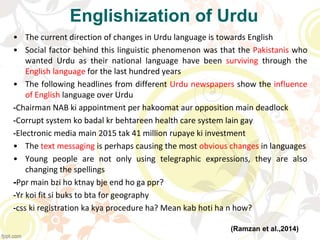
• The current direction of changes in Urdu language is towards English
• Social factor behind this linguistic phenomenon was that the Pakistanis who
wanted Urdu as their national language have been surviving through the
English language for the last hundred years
• The following headlines from different Urdu newspapers show the influence
of English language over Urdu
-Chairman NAB ki appointment per hakoomat aur opposition main deadlock
-Corrupt system ko badal kr behtareen health care system lain gay
-Electronic media main 2015 tak 41 million rupaye ki investment
• The text messaging is perhaps causing the most obvious changes in languages
• Young people are not only using telegraphic expressions, they are also
changing the spellings
-Ppr main bzi ho ktnay bje end ho ga ppr?
-Yr koi fit si buks to bta for geography
-css ki registration ka kya procedure ha? Mean kab hoti ha n how?
(Ramzan et al.,2014)
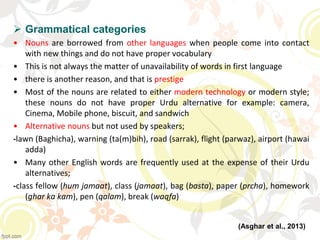
 Grammatical categories
• Nouns are borrowed from other languages when people come into contact
with new things and do not have proper vocabulary
• This is not always the matter of unavailability of words in first language
• there is another reason, and that is prestige
• Most of the nouns are related to either modern technology or modern style;
these nouns do not have proper Urdu alternative for example: camera,
Cinema, Mobile phone, biscuit, and sandwich
• Alternative nouns but not used by speakers;
-lawn (Baghicha), warning (ta(m)bih), road (sarrak), flight (parwaz), airport (hawai
adda)
• Many other English words are frequently used at the expense of their Urdu
alternatives;
-class fellow (hum jamaat), class (jamaat), bag (basta), paper (prcha), homework
(ghar ka kam), pen (qalam), break (waqfa)
(Asghar et al., 2013)
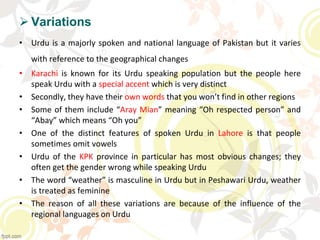
 Variations
• Urdu is a majorly spoken and national language of Pakistan but it varies
with reference to the geographical changes
• Karachi is known for its Urdu speaking population but the people here
speak Urdu with a special accent which is very distinct
• Secondly, they have their own words that you won’t find in other regions
• Some of them include “Aray Mian” meaning “Oh respected person” and
“Abay” which means “Oh you”
• One of the distinct features of spoken Urdu in Lahore is that people
sometimes omit vowels
• Urdu of the KPK province in particular has most obvious changes; they
often get the gender wrong while speaking Urdu
• The word “weather” is masculine in Urdu but in Peshawari Urdu, weather
is treated as feminine
• The reason of all these variations are because of the influence of the
regional languages on Urdu
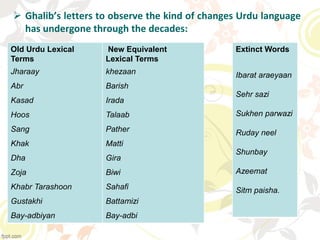
 Ghalib’s letters to observe the kind of changes Urdu language
has undergone through the decades:
Old Urdu Lexical
Terms
Jharaay
Abr
Kasad
Hoos
Sang
Khak
Dha
Zoja
Khabr Tarashoon
Gustakhi
Bay-adbiyan
New Equivalent
Lexical Terms
khezaan
Barish
Irada
Talaab
Pather
Matti
Gira
Biwi
Sahafi
Battamizi
Bay-adbi
Extinct Words
Ibarat araeyaan
Sehr sazi
Sukhen parwazi
Ruday neel
Shunbay
Azeemat
Sitm paisha.
Conclusion
• English vocabulary is increasing in Urdu with the passage of time
• In written language, this code-mixing is observed at word level only, thus it is
not marring the basic structure of Urdu language
• This is not solely due to the non-availability of Urdu correlates; there are
other issues involved, it may be prestige, social influence, phonological ease
• It also shows that language-change is not something negative. It is not
positive either
• Simply it is neutral; a natural process which is adopted by language to adjust
itself according to the linguistic needs of its speech community

Urdu Language (Variations)

  • 1.
  • 2.
    About Urdu • Urduenjoys the status of being the mother tongue of 80 millions people of the world • Urdu language, by its very nature, is an accommodative language • Since its emergence, it has assimilated the linguistic features from all languages with which it came into contact • They differ only on the bases of script • According to Dr. Tariq Rehman (1996), these different scripts are used for political and ideological reasons • According to the popular myth, Urdu is a ‘camp language’ or ‘lashkari zaban’ • Behind the so-called theory is that Urdu is a mixture of words taken from different languages • English, being most ‘open’ of them all, has, according to David Crystal, borrowed from over 100 languages, but nobody has ever called English a mixture of different languages
  • 3.
    Phenomenon of Language Change •The phenomenon of language-change is assumed to be a result of the interplay of various linguistic and non-linguistic factors • Sociolinguistics deals with linguistic variations such as dialect, idiolect, genderlect, register etc • The scholars of Urdu language usually lament the changes in Urdu and deem it as something corrupt that is a threat to the purity of Urdu • It is paradoxical that while the changes caused by Oriental languages are welcomed by the defenders of Urdu • For instance, in Urdu the plural form of word Ustad is also Ustad but under the influence of Persian grammar the correct plural form is often considered as Usatza • Similarly the rules for making feminine gender are predominantly Persio- Arabic
  • 4.
    Englishization of Urdu •The current direction of changes in Urdu language is towards English • Social factor behind this linguistic phenomenon was that the Pakistanis who wanted Urdu as their national language have been surviving through the English language for the last hundred years • The following headlines from different Urdu newspapers show the influence of English language over Urdu -Chairman NAB ki appointment per hakoomat aur opposition main deadlock -Corrupt system ko badal kr behtareen health care system lain gay -Electronic media main 2015 tak 41 million rupaye ki investment • The text messaging is perhaps causing the most obvious changes in languages • Young people are not only using telegraphic expressions, they are also changing the spellings -Ppr main bzi ho ktnay bje end ho ga ppr? -Yr koi fit si buks to bta for geography -css ki registration ka kya procedure ha? Mean kab hoti ha n how? (Ramzan et al.,2014)
  • 5.
     Grammatical categories •Nouns are borrowed from other languages when people come into contact with new things and do not have proper vocabulary • This is not always the matter of unavailability of words in first language • there is another reason, and that is prestige • Most of the nouns are related to either modern technology or modern style; these nouns do not have proper Urdu alternative for example: camera, Cinema, Mobile phone, biscuit, and sandwich • Alternative nouns but not used by speakers; -lawn (Baghicha), warning (ta(m)bih), road (sarrak), flight (parwaz), airport (hawai adda) • Many other English words are frequently used at the expense of their Urdu alternatives; -class fellow (hum jamaat), class (jamaat), bag (basta), paper (prcha), homework (ghar ka kam), pen (qalam), break (waqfa) (Asghar et al., 2013)
  • 6.
     Variations • Urduis a majorly spoken and national language of Pakistan but it varies with reference to the geographical changes • Karachi is known for its Urdu speaking population but the people here speak Urdu with a special accent which is very distinct • Secondly, they have their own words that you won’t find in other regions • Some of them include “Aray Mian” meaning “Oh respected person” and “Abay” which means “Oh you” • One of the distinct features of spoken Urdu in Lahore is that people sometimes omit vowels • Urdu of the KPK province in particular has most obvious changes; they often get the gender wrong while speaking Urdu • The word “weather” is masculine in Urdu but in Peshawari Urdu, weather is treated as feminine • The reason of all these variations are because of the influence of the regional languages on Urdu
  • 7.
     Ghalib’s lettersto observe the kind of changes Urdu language has undergone through the decades: Old Urdu Lexical Terms Jharaay Abr Kasad Hoos Sang Khak Dha Zoja Khabr Tarashoon Gustakhi Bay-adbiyan New Equivalent Lexical Terms khezaan Barish Irada Talaab Pather Matti Gira Biwi Sahafi Battamizi Bay-adbi Extinct Words Ibarat araeyaan Sehr sazi Sukhen parwazi Ruday neel Shunbay Azeemat Sitm paisha.
  • 8.
    Conclusion • English vocabularyis increasing in Urdu with the passage of time • In written language, this code-mixing is observed at word level only, thus it is not marring the basic structure of Urdu language • This is not solely due to the non-availability of Urdu correlates; there are other issues involved, it may be prestige, social influence, phonological ease • It also shows that language-change is not something negative. It is not positive either • Simply it is neutral; a natural process which is adopted by language to adjust itself according to the linguistic needs of its speech community