May Allah bless you all !
Cross Cultural
Communication
DOES SOCIETY AFFECT
LANGUAGE?
Presented BY
Asif Mushtaq
What is Language?
Language has been defined as
a phenomena or a systematic
way to communicate
effectively with other speakers.
What is Society?
Society is a group of people or
community living together and
sharing a set of norms .
RELATION BETWEEN
LANGUAGE AND SOCIETY
Language and society are complimentary to
each other; its difficult to imagine one without
considering other.
The connection between language and
society is tightly anchored. The relationship of
the two is deep rooted. Language performs
various functions in the society and the
society does the same way. If one does not
exist, the other one will be affected.
Language is the primary tool for communication
purposes, for establishing peace and order in our
society, for showing authority and power, and for
attaining goals and objectives. But, it can also
destruct the society if it is used inappropriately. It
must follow the conformity governing the society to
avoid conflicts and to meet the boundary of individual
differences.
Society however controls our language by giving us
preferences as what are acceptable and not, because
each one of us has our own perception or point of
view. A group of people may accept our language, but
for others, it could be kind of offence or insult. We
must know how, when and where to say it and for
what purpose.
Social changes produce changes in
language. This affects values in ways
that have not been accurately
understood. Language incorporates
social values. However, social values
are only the same as linguistic values
when the society is a stable and
unchanging one. Once society starts
changing, then language change
produces special effects.
Number of Languages Being
Spoken
According to a rough estimate, today,
about 6, 900 languages are spoken
throughout the world – more than 2
000 languages in Africa, 1 000 in the
Americas, more than 2, 250 in Asia,
about 220 in Europe, and more than
1300 in Australia. ( Dawn News)
To what extent does society
influence language
Borrowing
Coining
Spelling
Pronunciation
LIVING LANGUAGES
The process of loaning words from other
languages is a sign of a living and
progressing language.
Thus it is a foregone conclusion that society
has great contribution to keep languages
alive enriching the vocabulary by borrowing,
coining, variation in pronunciation and by
changing spellings. Languages would die if
society didn’t want them to be used.
Borrowing of Words
English has borrowed words from
as many as 120 languages
including Urdu. This is, perhaps,
one of the reasons why English
has one of the richest
vocabularies among the world
languages . Thus it is a living
language of today . Some of the
major influences are mentioned
below.
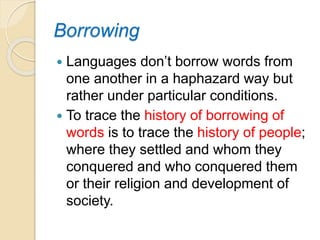
Borrowing
 Languages don’t borrow words from
one another in a haphazard way but
rather under particular conditions.
 To trace the history of borrowing of
words is to trace the history of people;
where they settled and whom they
conquered and who conquered them
or their religion and development of
society.
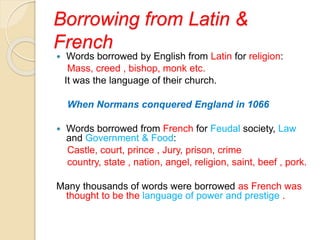
Borrowing from Latin &
French
 Words borrowed by English from Latin for religion:
Mass, creed , bishop, monk etc.
It was the language of their church.
When Normans conquered England in 1066
 Words borrowed from French for Feudal society, Law
and Government & Food:
Castle, court, prince , Jury, prison, crime
country, state , nation, angel, religion, saint, beef , pork.
Many thousands of words were borrowed as French was
thought to be the language of power and prestige .
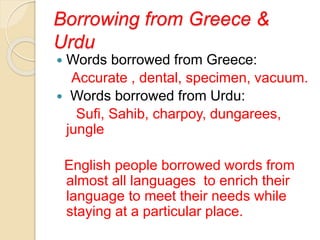
Borrowing from Greece &
Urdu
 Words borrowed from Greece:
Accurate , dental, specimen, vacuum.
 Words borrowed from Urdu:
Sufi, Sahib, charpoy, dungarees,
jungle
English people borrowed words from
almost all languages to enrich their
language to meet their needs while
staying at a particular place.
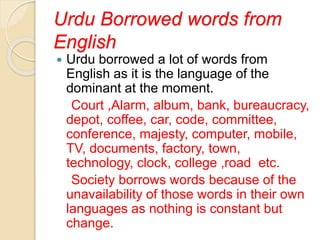
Urdu Borrowed words from
English
 Urdu borrowed a lot of words from
English as it is the language of the
dominant at the moment.
Court ,Alarm, album, bank, bureaucracy,
depot, coffee, car, code, committee,
conference, majesty, computer, mobile,
TV, documents, factory, town,
technology, clock, college ,road etc.
Society borrows words because of the
unavailability of those words in their own
languages as nothing is constant but
change.
Blend of Urdu & English
We see a copious blending of Urdu and
English with phrases
 “shaandaar offer”,
 “aur haasil kijiye amazing discounts”,
 “fun ko on karo”
 “raho connected everyday”.
Such blend is mostly seen on billboards
and advertisements to attract the
consumers.
Arabic words in Urdu
This list contains 1,546 pure Arabic words most of them
are Quranic words.
Ayat (Quranic verse), bait
(house), azeem (great), barq
(thunder), jahil (illiterate), jannat
(heaven), jamal (beauty), jaib
(pocket), jehad (holy war), dakhil
(interior), jurm (crime), dalil
(proof), deen (religion), ambiya
(prophets), ahim (important),
Common words in Urdu &
Turkish
The most interesting part of this
research is that the list of 2,608 words
common in Turkish and Urdu only
contains 24 words which are pure
Turkish. The rest are either Arabic,
Persian or English words used
commonly by Turks and Urdu
speakers.
Urdu borrowed Turkish words
 Words purely Turkish
Urdu, Begam, Baji, Quli, jouq dar
jouq,yalghar,Qanchi, Qanaat, Aailchi ,
Chougha
Coining
Coining : Creating something new, usually something related to
language. For example, you could coin a phrase or a new word.
Coining words is an English literary tradition. William
Shakespeare was an avid neologist. Some words that we still
use today, and many others that we don't, made their first
appearance in one of his plays.
Onomatopoeia, a modified kind of coining, is defined as a word,
which imitates the natural sounds of a thing. It creates a sound
effect that mimics the thing described, making the description
more expressive and interesting.
“whisper” not only represents the sound of people talking quietly,
but also describes the action of people talking quietly.
Tinkle, Buzz, Pop, Cuckoo, splash, gush, sprinkle, drizzle, drip
etc
Animal noises : Moo, Bow-wow, Meow,
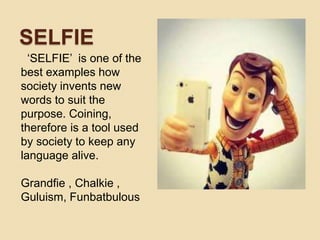
SELFIE
‘SELFIE’ is one of the
best examples how
society invents new
words to suit the
purpose. Coining,
therefore is a tool used
by society to keep any
language alive.
Grandfie , Chalkie ,
Guluism, Funbatbulous
Differences in Spelling
 Most words ending in an unstressed -
our in British English
colour, flavour, behaviour, harbour, honour,
humour, labour, neighbour, rumour, splen
dour
end in -or in American English
color, flavor, behavior, harbor, honor, hum
or, labor, neighbor, rumor, splendor
Influence of Society on
Spelling
Most words of this kind came from
Latin, where the ending was spelled -
or. They were first adopted into
English from early Old French, and the
ending was spelled -or or -ur. After
the Norman conquest of England, the
ending became -our to match the Old
French spelling. ( Concise Dictionary)
Webster’s VS Johnson’s
 Webster's 1828 dictionary had only -or and is
given much of the credit for the adoption of this
form in the United States.
 Johnson's 1755 dictionary used -our for all words
still so spelled in Britain (like colour), but also for
words where the u has since been dropped
Ambassadour, emperour, governour, perturbatou
r, inferiour, superiour;errour, horrour, mirrour, teno
ur, terrour, tremour.
Johnson, unlike Webster, was not an advocate of
spelling reform, but chose the spelling best
derived
Pronunciation
 Verbs ending in –ate
Most 2-syllable verbs ending -
ate have first-syllable stress in AmE
and second-syllable stress BrE
castrate, cremate, dictate, donate, loc
ate,
migrate,
narrate, prostrate, rotate, striate,
translate, vacate
Pronunciation
 Americans pronounce ‘r’ at the end of a
word while British people do not.
Brother , Sir, park, sharp, jar
Americans change /a:/ in /æ/ /ɔː/ in /a:/
Cant /kænt/ Talk /ta:k/
 Neutral pronunciation
Assume, Assumption, Comparison,
consumer, consumption, Suggestion,
Purpose, tomb, leisure, pleasure, treasure,
measure, engine, agree, agreement,
entertainment, truth, canal, asthma,
Photography, alternative , energy, chase,
Gourmet , chocolate, breakfast
SUMMARY
To recapitulate, I strongly believe that
society has an everlasting impact on
language to let it live . The languages
which are neglected by the society, they
loose their attraction and die out with the
passage of time.
‘IT TAKES A VILLAGE TO RAISE A
CHILD’
Language is a baby brought up society.
Does society affect language?

Does society affect language?

  • 1.
    May Allah blessyou all ! Cross Cultural Communication
  • 2.
  • 3.
    What is Language? Languagehas been defined as a phenomena or a systematic way to communicate effectively with other speakers.
  • 4.
    What is Society? Societyis a group of people or community living together and sharing a set of norms .
  • 5.
    RELATION BETWEEN LANGUAGE ANDSOCIETY Language and society are complimentary to each other; its difficult to imagine one without considering other. The connection between language and society is tightly anchored. The relationship of the two is deep rooted. Language performs various functions in the society and the society does the same way. If one does not exist, the other one will be affected.
  • 6.
    Language is theprimary tool for communication purposes, for establishing peace and order in our society, for showing authority and power, and for attaining goals and objectives. But, it can also destruct the society if it is used inappropriately. It must follow the conformity governing the society to avoid conflicts and to meet the boundary of individual differences. Society however controls our language by giving us preferences as what are acceptable and not, because each one of us has our own perception or point of view. A group of people may accept our language, but for others, it could be kind of offence or insult. We must know how, when and where to say it and for what purpose.
  • 7.
    Social changes producechanges in language. This affects values in ways that have not been accurately understood. Language incorporates social values. However, social values are only the same as linguistic values when the society is a stable and unchanging one. Once society starts changing, then language change produces special effects.
  • 8.
    Number of LanguagesBeing Spoken According to a rough estimate, today, about 6, 900 languages are spoken throughout the world – more than 2 000 languages in Africa, 1 000 in the Americas, more than 2, 250 in Asia, about 220 in Europe, and more than 1300 in Australia. ( Dawn News)
  • 9.
    To what extentdoes society influence language Borrowing Coining Spelling Pronunciation
  • 10.
    LIVING LANGUAGES The processof loaning words from other languages is a sign of a living and progressing language. Thus it is a foregone conclusion that society has great contribution to keep languages alive enriching the vocabulary by borrowing, coining, variation in pronunciation and by changing spellings. Languages would die if society didn’t want them to be used.
  • 11.
    Borrowing of Words Englishhas borrowed words from as many as 120 languages including Urdu. This is, perhaps, one of the reasons why English has one of the richest vocabularies among the world languages . Thus it is a living language of today . Some of the major influences are mentioned below.
  • 12.
    Borrowing  Languages don’tborrow words from one another in a haphazard way but rather under particular conditions.  To trace the history of borrowing of words is to trace the history of people; where they settled and whom they conquered and who conquered them or their religion and development of society.
  • 13.
    Borrowing from Latin& French  Words borrowed by English from Latin for religion: Mass, creed , bishop, monk etc. It was the language of their church. When Normans conquered England in 1066  Words borrowed from French for Feudal society, Law and Government & Food: Castle, court, prince , Jury, prison, crime country, state , nation, angel, religion, saint, beef , pork. Many thousands of words were borrowed as French was thought to be the language of power and prestige .
  • 14.
    Borrowing from Greece& Urdu  Words borrowed from Greece: Accurate , dental, specimen, vacuum.  Words borrowed from Urdu: Sufi, Sahib, charpoy, dungarees, jungle English people borrowed words from almost all languages to enrich their language to meet their needs while staying at a particular place.
  • 15.
    Urdu Borrowed wordsfrom English  Urdu borrowed a lot of words from English as it is the language of the dominant at the moment. Court ,Alarm, album, bank, bureaucracy, depot, coffee, car, code, committee, conference, majesty, computer, mobile, TV, documents, factory, town, technology, clock, college ,road etc. Society borrows words because of the unavailability of those words in their own languages as nothing is constant but change.
  • 16.
    Blend of Urdu& English We see a copious blending of Urdu and English with phrases  “shaandaar offer”,  “aur haasil kijiye amazing discounts”,  “fun ko on karo”  “raho connected everyday”. Such blend is mostly seen on billboards and advertisements to attract the consumers.
  • 17.
    Arabic words inUrdu This list contains 1,546 pure Arabic words most of them are Quranic words. Ayat (Quranic verse), bait (house), azeem (great), barq (thunder), jahil (illiterate), jannat (heaven), jamal (beauty), jaib (pocket), jehad (holy war), dakhil (interior), jurm (crime), dalil (proof), deen (religion), ambiya (prophets), ahim (important),
  • 18.
    Common words inUrdu & Turkish The most interesting part of this research is that the list of 2,608 words common in Turkish and Urdu only contains 24 words which are pure Turkish. The rest are either Arabic, Persian or English words used commonly by Turks and Urdu speakers.
  • 19.
    Urdu borrowed Turkishwords  Words purely Turkish Urdu, Begam, Baji, Quli, jouq dar jouq,yalghar,Qanchi, Qanaat, Aailchi , Chougha
  • 20.
    Coining Coining : Creatingsomething new, usually something related to language. For example, you could coin a phrase or a new word. Coining words is an English literary tradition. William Shakespeare was an avid neologist. Some words that we still use today, and many others that we don't, made their first appearance in one of his plays. Onomatopoeia, a modified kind of coining, is defined as a word, which imitates the natural sounds of a thing. It creates a sound effect that mimics the thing described, making the description more expressive and interesting. “whisper” not only represents the sound of people talking quietly, but also describes the action of people talking quietly. Tinkle, Buzz, Pop, Cuckoo, splash, gush, sprinkle, drizzle, drip etc Animal noises : Moo, Bow-wow, Meow,
  • 21.
    SELFIE ‘SELFIE’ is oneof the best examples how society invents new words to suit the purpose. Coining, therefore is a tool used by society to keep any language alive. Grandfie , Chalkie , Guluism, Funbatbulous
  • 22.
    Differences in Spelling Most words ending in an unstressed - our in British English colour, flavour, behaviour, harbour, honour, humour, labour, neighbour, rumour, splen dour end in -or in American English color, flavor, behavior, harbor, honor, hum or, labor, neighbor, rumor, splendor
  • 23.
    Influence of Societyon Spelling Most words of this kind came from Latin, where the ending was spelled - or. They were first adopted into English from early Old French, and the ending was spelled -or or -ur. After the Norman conquest of England, the ending became -our to match the Old French spelling. ( Concise Dictionary)
  • 24.
    Webster’s VS Johnson’s Webster's 1828 dictionary had only -or and is given much of the credit for the adoption of this form in the United States.  Johnson's 1755 dictionary used -our for all words still so spelled in Britain (like colour), but also for words where the u has since been dropped Ambassadour, emperour, governour, perturbatou r, inferiour, superiour;errour, horrour, mirrour, teno ur, terrour, tremour. Johnson, unlike Webster, was not an advocate of spelling reform, but chose the spelling best derived
  • 25.
    Pronunciation  Verbs endingin –ate Most 2-syllable verbs ending - ate have first-syllable stress in AmE and second-syllable stress BrE castrate, cremate, dictate, donate, loc ate, migrate, narrate, prostrate, rotate, striate, translate, vacate
  • 26.
    Pronunciation  Americans pronounce‘r’ at the end of a word while British people do not. Brother , Sir, park, sharp, jar Americans change /a:/ in /æ/ /ɔː/ in /a:/ Cant /kænt/ Talk /ta:k/  Neutral pronunciation Assume, Assumption, Comparison, consumer, consumption, Suggestion, Purpose, tomb, leisure, pleasure, treasure, measure, engine, agree, agreement, entertainment, truth, canal, asthma, Photography, alternative , energy, chase, Gourmet , chocolate, breakfast
  • 27.
    SUMMARY To recapitulate, Istrongly believe that society has an everlasting impact on language to let it live . The languages which are neglected by the society, they loose their attraction and die out with the passage of time. ‘IT TAKES A VILLAGE TO RAISE A CHILD’ Language is a baby brought up society.