Syed M Irteza 1
Lesson 01
Database Systems
Syed M Irteza 2
Introduction To Course
 Pre-Requisite:
None
 Textbook:
An Introduction To Database
Systems.
by C.J. Date.
8th Edition.
Syed M Irteza 3
Overview of DBMS
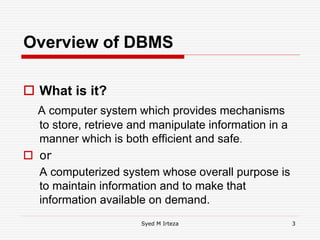
 What is it?
A computer system which provides mechanisms
to store, retrieve and manipulate information in a
manner which is both efficient and safe.
 or
A computerized system whose overall purpose is
to maintain information and to make that
information available on demand.
Syed M Irteza 4
Overview of DBMS
 Why is it necessary?
To provide a level of abstraction, control and functionality
between the data and the user(s) that is not possible using a
collection of conventional electronic files.
Syed M Irteza 5
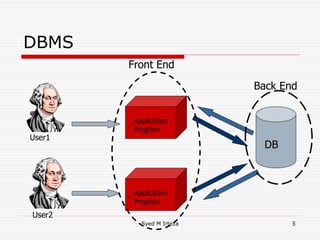
DBMS
Application
Program
Application
Program
DB
User1
User2
Front End
Back End
Syed M Irteza 6
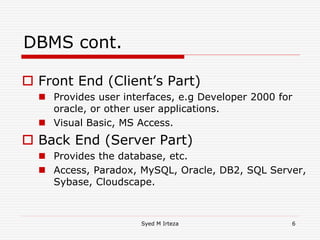
DBMS cont.
 Front End (Client’s Part)
 Provides user interfaces, e.g Developer 2000 for
oracle, or other user applications.
 Visual Basic, MS Access.
 Back End (Server Part)
 Provides the database, etc.
 Access, Paradox, MySQL, Oracle, DB2, SQL Server,
Sybase, Cloudscape.
Syed M Irteza 7
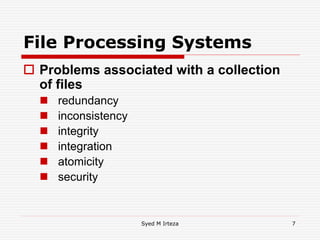
File Processing Systems
 Problems associated with a collection
of files
 redundancy
 inconsistency
 integrity
 integration
 atomicity
 security
Syed M Irteza 8
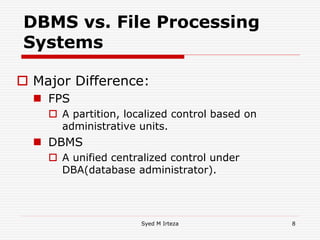
DBMS vs. File Processing
Systems
 Major Difference:
 FPS
 A partition, localized control based on
administrative units.
 DBMS
 A unified centralized control under
DBA(database administrator).
Syed M Irteza 9
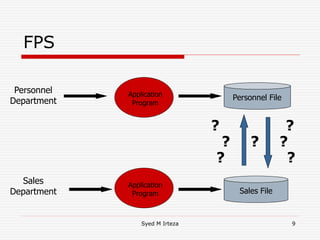
FPS
Personnel File
Sales File
Application
Program
Application
Program
Personnel
Department
Sales
Department
? ? ?
? ?
? ?
Syed M Irteza 10
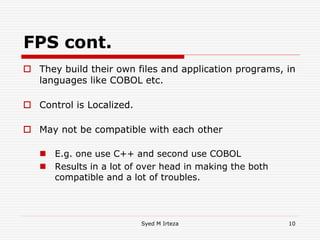
FPS cont.
 They build their own files and application programs, in
languages like COBOL etc.
 Control is Localized.
 May not be compatible with each other
 E.g. one use C++ and second use COBOL
 Results in a lot of over head in making the both
compatible and a lot of troubles.
Syed M Irteza 11
DBMS
 In a DBMS everything is under one
roof. And the DBA has complete
control over the entire database.
 Control is centralized.
Syed M Irteza 12
Benefits Of DBMS
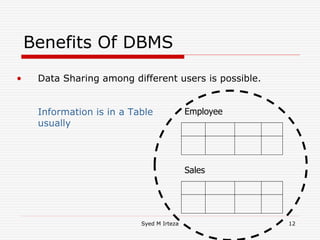
• Data Sharing among different users is possible.
Information is in a Table
usually
Sales
Employee
Syed M Irteza 13
Benefits Of DBMS cont.
 Data Redundancy is Reduced.
 Data Inconsistency is reduced, easier to update.
 In FPS we have to change every entry in every file
with the same data.
 In DBMS redundancy is reduced so only very rare
data inconsistency.
Usually only one record In DBMS.
Syed M Irteza 14
Benefits Of DBMS cont.
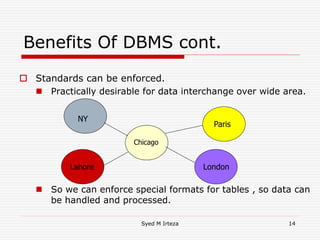
 Standards can be enforced.
 Practically desirable for data interchange over wide area.
 So we can enforce special formats for tables , so data can
be handled and processed.
NY
Lahore London
Chicago
Paris
Syed M Irteza 15
Benefits Of DBMS cont.
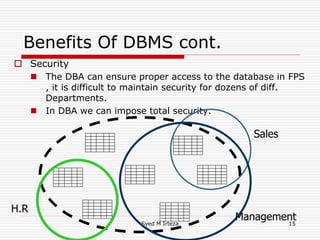
 Security
 The DBA can ensure proper access to the database in FPS
, it is difficult to maintain security for dozens of diff.
Departments.
 In DBA we can impose total security.
Sales
Management
H.R
Syed M Irteza 16
Benefits Of DBMS cont.
 Transaction Support
 Integrity Support
Syed M Irteza 17
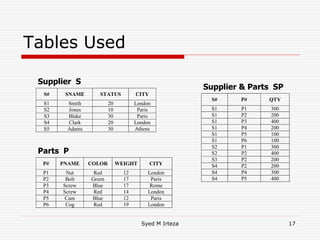
Tables Used
S# SNAME STATUS CITY
S1 Smith 20 London
S2 Jones 10 Paris
S3 Blake 30 Paris
S4 Clark 20 London
S5 Adams 30 Athens
Supplier S
P# PNAME COLOR WEIGHT CITY
P1 Nut Red 12 London
P2 Bolt Green 17 Paris
P3 Screw Blue 17 Rome
P4 Screw Red 14 London
P5 Cam Blue 12 Paris
P6 Cog Red 19 London
Parts P
S# P# QTY
S1 P1 300
S1 P2 200
S1 P3 400
S1 P4 200
S1 P5 100
S1 P6 100
S2 P1 300
S2 P2 400
S3 P2 200
S4 P2 200
S4 P4 300
S4 P5 400
Supplier & Parts SP
Syed M Irteza 18
End
END OF LESSON 01
(These slides were taken from M A Shahid)

Lesson01 Database introduction

  • 1.
    Syed M Irteza1 Lesson 01 Database Systems
  • 2.
    Syed M Irteza2 Introduction To Course  Pre-Requisite: None  Textbook: An Introduction To Database Systems. by C.J. Date. 8th Edition.
  • 3.
    Syed M Irteza3 Overview of DBMS  What is it? A computer system which provides mechanisms to store, retrieve and manipulate information in a manner which is both efficient and safe.  or A computerized system whose overall purpose is to maintain information and to make that information available on demand.
  • 4.
    Syed M Irteza4 Overview of DBMS  Why is it necessary? To provide a level of abstraction, control and functionality between the data and the user(s) that is not possible using a collection of conventional electronic files.
  • 5.
    Syed M Irteza5 DBMS Application Program Application Program DB User1 User2 Front End Back End
  • 6.
    Syed M Irteza6 DBMS cont.  Front End (Client’s Part)  Provides user interfaces, e.g Developer 2000 for oracle, or other user applications.  Visual Basic, MS Access.  Back End (Server Part)  Provides the database, etc.  Access, Paradox, MySQL, Oracle, DB2, SQL Server, Sybase, Cloudscape.
  • 7.
    Syed M Irteza7 File Processing Systems  Problems associated with a collection of files  redundancy  inconsistency  integrity  integration  atomicity  security
  • 8.
    Syed M Irteza8 DBMS vs. File Processing Systems  Major Difference:  FPS  A partition, localized control based on administrative units.  DBMS  A unified centralized control under DBA(database administrator).
  • 9.
    Syed M Irteza9 FPS Personnel File Sales File Application Program Application Program Personnel Department Sales Department ? ? ? ? ? ? ?
  • 10.
    Syed M Irteza10 FPS cont.  They build their own files and application programs, in languages like COBOL etc.  Control is Localized.  May not be compatible with each other  E.g. one use C++ and second use COBOL  Results in a lot of over head in making the both compatible and a lot of troubles.
  • 11.
    Syed M Irteza11 DBMS  In a DBMS everything is under one roof. And the DBA has complete control over the entire database.  Control is centralized.
  • 12.
    Syed M Irteza12 Benefits Of DBMS • Data Sharing among different users is possible. Information is in a Table usually Sales Employee
  • 13.
    Syed M Irteza13 Benefits Of DBMS cont.  Data Redundancy is Reduced.  Data Inconsistency is reduced, easier to update.  In FPS we have to change every entry in every file with the same data.  In DBMS redundancy is reduced so only very rare data inconsistency. Usually only one record In DBMS.
  • 14.
    Syed M Irteza14 Benefits Of DBMS cont.  Standards can be enforced.  Practically desirable for data interchange over wide area.  So we can enforce special formats for tables , so data can be handled and processed. NY Lahore London Chicago Paris
  • 15.
    Syed M Irteza15 Benefits Of DBMS cont.  Security  The DBA can ensure proper access to the database in FPS , it is difficult to maintain security for dozens of diff. Departments.  In DBA we can impose total security. Sales Management H.R
  • 16.
    Syed M Irteza16 Benefits Of DBMS cont.  Transaction Support  Integrity Support
  • 17.
    Syed M Irteza17 Tables Used S# SNAME STATUS CITY S1 Smith 20 London S2 Jones 10 Paris S3 Blake 30 Paris S4 Clark 20 London S5 Adams 30 Athens Supplier S P# PNAME COLOR WEIGHT CITY P1 Nut Red 12 London P2 Bolt Green 17 Paris P3 Screw Blue 17 Rome P4 Screw Red 14 London P5 Cam Blue 12 Paris P6 Cog Red 19 London Parts P S# P# QTY S1 P1 300 S1 P2 200 S1 P3 400 S1 P4 200 S1 P5 100 S1 P6 100 S2 P1 300 S2 P2 400 S3 P2 200 S4 P2 200 S4 P4 300 S4 P5 400 Supplier & Parts SP
  • 18.
    Syed M Irteza18 End END OF LESSON 01 (These slides were taken from M A Shahid)

Editor's Notes

  • #2 Instructor: Asad Naeem
  • #4 Instructor: Asad Naeem