Software Engineering
 Estimation
 The SPM begins with a set of activities
that are collectively called Project
planning
 Whenever estimates are are made we
look into future concern and so there is
some degree of uncertainty in
estimation
Software Engineering
 Observation on Estimation
 PM (manager) must have the ability to
estimate
 PM with the ability to know what will go wrong
before it actually does
 Estimation of resources, cost and schedule
for a software requires experience of past
projects and access to historical data
Software Engineering
 Project complexity has a strong effect
on uncertainty that is inherent in
planning.
 Complexity is affected by familiarity with
past efforts
 Real time projects are always complex
 Project size also effect the accuracy of
the estimates
Software Engineering
 If the requirements have been solidified
estimation is easy but if the requirement
are keep on changing estimation is
affects
Software Engineering
 Project Planning objectives
 The objectives of software project
planning is to provides the reasonable
estimates of cost, effort and schedule
 These estimates are made at the
beginning of the project and must be
updated with the passage of time.
Software Engineering
 Software Scope
 Estimation of scope
 Functional, non functional requirements.
Constraints
Software Engineering
 Obtaining information necessary for
scope
 Things are always hazy at the start of
the project
 There must be some meetings between
customer and analyst for obtaining the
scope of project
Software Engineering
 1st meeting question
 2nd meeting question
 3rd meeting question and so on
Software Engineering
 Resources
 The 2nd task of software planning is the
estimation of resources required to
accomplish the software development effort
 The development environment-----Hardware
and software tools, Reusable components
and people
Software Engineering
 Human Resource:
The no. of people required for a software
project can be determined only after an
estimate of development effort.
 Reusable Software component
Off the shelf components
Full experience components
Partial experience components
New components
Software Engineering
 Reusable Software component
 Off-the-shelf components. Existing software
that can be acquired from a third party or that
has been developed internally for a past
project.
 Full-experience components. Existing
specifications, designs, code, or test data
developed for past projects that are similar to
the software to be built for the current project.
Software Engineering
 Reusable Software component
 Partial-experience components. Existing
specifications, designs, code, or test data
developed for past projects that are related to
the software to be built for the current project
but will require substantial modification.
 New components. Software components that
must be built by the software team specifically
for the needs of the current project.
Software Engineering
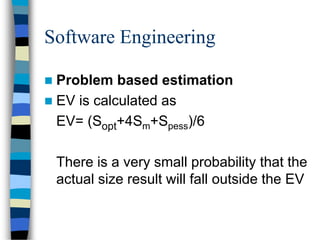
 Problem based estimation
 EV is calculated as
EV= (Sopt+4Sm+Spess)/6
There is a very small probability that the
actual size result will fall outside the EV
Software Engineering
 COCOMO Model
Constructive Cost model
Three model
Model 1
Model 2
Mode 3
Software Engineering
 Make Buy decision:
The software managers are often faced
with the problem of make buy decision.
In some cases it is cost effective to
acquire rather than internal
development

11. estimation-1

  • 1.
    Software Engineering  Estimation The SPM begins with a set of activities that are collectively called Project planning  Whenever estimates are are made we look into future concern and so there is some degree of uncertainty in estimation
  • 2.
    Software Engineering  Observationon Estimation  PM (manager) must have the ability to estimate  PM with the ability to know what will go wrong before it actually does  Estimation of resources, cost and schedule for a software requires experience of past projects and access to historical data
  • 3.
    Software Engineering  Projectcomplexity has a strong effect on uncertainty that is inherent in planning.  Complexity is affected by familiarity with past efforts  Real time projects are always complex  Project size also effect the accuracy of the estimates
  • 4.
    Software Engineering  Ifthe requirements have been solidified estimation is easy but if the requirement are keep on changing estimation is affects
  • 5.
    Software Engineering  ProjectPlanning objectives  The objectives of software project planning is to provides the reasonable estimates of cost, effort and schedule  These estimates are made at the beginning of the project and must be updated with the passage of time.
  • 6.
    Software Engineering  SoftwareScope  Estimation of scope  Functional, non functional requirements. Constraints
  • 7.
    Software Engineering  Obtaininginformation necessary for scope  Things are always hazy at the start of the project  There must be some meetings between customer and analyst for obtaining the scope of project
  • 8.
    Software Engineering  1stmeeting question  2nd meeting question  3rd meeting question and so on
  • 9.
    Software Engineering  Resources The 2nd task of software planning is the estimation of resources required to accomplish the software development effort  The development environment-----Hardware and software tools, Reusable components and people
  • 10.
    Software Engineering  HumanResource: The no. of people required for a software project can be determined only after an estimate of development effort.  Reusable Software component Off the shelf components Full experience components Partial experience components New components
  • 11.
    Software Engineering  ReusableSoftware component  Off-the-shelf components. Existing software that can be acquired from a third party or that has been developed internally for a past project.  Full-experience components. Existing specifications, designs, code, or test data developed for past projects that are similar to the software to be built for the current project.
  • 12.
    Software Engineering  ReusableSoftware component  Partial-experience components. Existing specifications, designs, code, or test data developed for past projects that are related to the software to be built for the current project but will require substantial modification.  New components. Software components that must be built by the software team specifically for the needs of the current project.
  • 13.
    Software Engineering  Problembased estimation  EV is calculated as EV= (Sopt+4Sm+Spess)/6 There is a very small probability that the actual size result will fall outside the EV
  • 14.
    Software Engineering  COCOMOModel Constructive Cost model Three model Model 1 Model 2 Mode 3
  • 15.
    Software Engineering  MakeBuy decision: The software managers are often faced with the problem of make buy decision. In some cases it is cost effective to acquire rather than internal development