Database
Management
System
IN HINDI
OMega TechEd
OMega TechEd
Database Management System.
DBMS Schema.
Advantages of DBMS.
Limitations of DBMS.
Database
Management
System
OMega TechEd
Definition
The Database management system is a collection of programs that enables the users to
create, maintain, store and modify a database. It is also used to extract data from a
database and contain various tools that enables the users to carry out these functions as
well as to generate reports.
Database management system is a software which is used to manage the database. For
example: MySQL, Microsoft Access, Oracle etc. are a very popular commercial database
which is used in different applications.
OMega TechEd
DBMS Schema (Logical Structure )
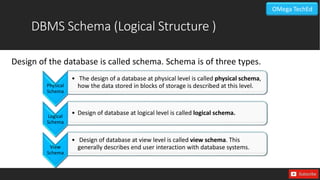
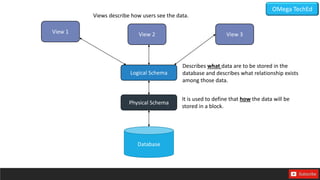
Design of the database is called schema. Schema is of three types.
Physical
Schema
• The design of a database at physical level is called physical schema,
how the data stored in blocks of storage is described at this level.
Logical
Schema
• Design of database at logical level is called logical schema.
View
Schema
• Design of database at view level is called view schema. This
generally describes end user interaction with database systems.
OMega TechEd
Database
Physical Schema
Logical Schema
View 2
View 1 View 3
OMega TechEd
Views describe how users see the data.
Describes what data are to be stored in the
database and describes what relationship exists
among those data.
It is used to define that how the data will be
stored in a block.
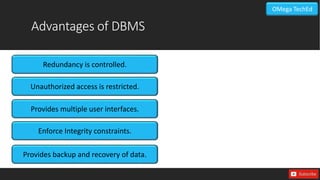
Advantages of DBMS
Unauthorized access is restricted.
Provides multiple user interfaces.
Enforce Integrity constraints.
Provides backup and recovery of data.
OMega TechEd
Redundancy is controlled.
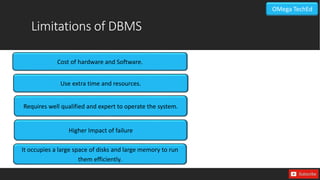
Limitations of DBMS
Use extra time and resources.
Requires well qualified and expert to operate the system.
Higher Impact of failure
It occupies a large space of disks and large memory to run
them efficiently.
OMega TechEd
Cost of hardware and Software.
LIKE &
Share
Thank You
OMega TechEd
Summary
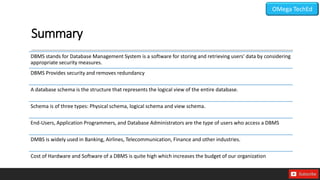
DBMS stands for Database Management System is a software for storing and retrieving users' data by considering
appropriate security measures.
DBMS Provides security and removes redundancy
A database schema is the structure that represents the logical view of the entire database.
Schema is of three types: Physical schema, logical schema and view schema.
End-Users, Application Programmers, and Database Administrators are the type of users who access a DBMS
DMBS is widely used in Banking, Airlines, Telecommunication, Finance and other industries.
Cost of Hardware and Software of a DBMS is quite high which increases the budget of our organization
OMega TechEd
If you have a question, you can reach me via e-mail at omega.teched@gmail.com
Social Media Handles:
omega.teched
megha_with
megha-sharma24
OMega TechEd

Introduction to DBMS

  • 1.
  • 2.
    OMega TechEd Database ManagementSystem. DBMS Schema. Advantages of DBMS. Limitations of DBMS.
  • 3.
  • 4.
    Definition The Database managementsystem is a collection of programs that enables the users to create, maintain, store and modify a database. It is also used to extract data from a database and contain various tools that enables the users to carry out these functions as well as to generate reports. Database management system is a software which is used to manage the database. For example: MySQL, Microsoft Access, Oracle etc. are a very popular commercial database which is used in different applications. OMega TechEd
  • 5.
    DBMS Schema (LogicalStructure ) Design of the database is called schema. Schema is of three types. Physical Schema • The design of a database at physical level is called physical schema, how the data stored in blocks of storage is described at this level. Logical Schema • Design of database at logical level is called logical schema. View Schema • Design of database at view level is called view schema. This generally describes end user interaction with database systems. OMega TechEd
  • 6.
    Database Physical Schema Logical Schema View2 View 1 View 3 OMega TechEd Views describe how users see the data. Describes what data are to be stored in the database and describes what relationship exists among those data. It is used to define that how the data will be stored in a block.
  • 7.
    Advantages of DBMS Unauthorizedaccess is restricted. Provides multiple user interfaces. Enforce Integrity constraints. Provides backup and recovery of data. OMega TechEd Redundancy is controlled.
  • 8.
    Limitations of DBMS Useextra time and resources. Requires well qualified and expert to operate the system. Higher Impact of failure It occupies a large space of disks and large memory to run them efficiently. OMega TechEd Cost of hardware and Software.
  • 9.
  • 10.
    Summary DBMS stands forDatabase Management System is a software for storing and retrieving users' data by considering appropriate security measures. DBMS Provides security and removes redundancy A database schema is the structure that represents the logical view of the entire database. Schema is of three types: Physical schema, logical schema and view schema. End-Users, Application Programmers, and Database Administrators are the type of users who access a DBMS DMBS is widely used in Banking, Airlines, Telecommunication, Finance and other industries. Cost of Hardware and Software of a DBMS is quite high which increases the budget of our organization OMega TechEd
  • 11.
    If you havea question, you can reach me via e-mail at omega.teched@gmail.com Social Media Handles: omega.teched megha_with megha-sharma24 OMega TechEd