Practice II, Didactics of ELT and Practicum at Primary School Level
LESSON PLAN 2:
MENTOR TEACHER: Joana Herrán.
NAMES: Nieto Paola and Corral Lucrecia.
DATE: Wednesday, September 5th .
4th C from 16:10 to 16:50,
and 4th D from 16:50 to 17:30.
CLASS: Fourth Grade
LENGTH OF THE LESSON: 40 MINUTES.
CLASS DESCRIPTION: There are twenty-three students in each course (4th D and
4th C), all between nine and ten years old. They have English classes once a week,
each class lasts forty minutes. This group of students work actively and they and her
teacher avoid speaking in L1. Their proficiency level is Pre-A1.
SKILLS TO BE EMPHASIZED: Listening, reading, writing and speaking.
LANGUAGE:
- Vocabulary about the time and events of the day.
- Structure: examples: It’s nine o’clock, it’s time for lunch (in positive sentences).
AIMS:
By the end of this class, students will be able to write and say the exact time in
English, differentiate a.m. from p.m. Also, they will learn events of the day , such as
lunch, dinner,etc and meals like fruits, vegetables and meat.
MATERIALS:
● Handmade clock
● Book
● CD
● CD player
● Board
● Marker
● Flashcards
EVALUATION: We expect that students show that they have learnt and understood
when to use the structures given (the time and the events of the day) after providing
them with visual aids, gestures and making a wise use of L1 and L2.
Procedures
Stage/stage
aim
Description
Interac
tion Timin
g
Warm-up
We’re going to start the
class singing:
Clap your hands, stamp
your feet, it’s time to say
Hello, Hello!
“If you are happy”
“Today is Wednesday, how
are you?”
We’re going to show
students flashcards about
the weather. Then we will
write on the board the date
and the weather.
Ts–Ss 5
minutes
Instructions
and Speaking
We will ask them “Do you
know the time in English?”
to start explaining them
about the topic. We will
show them a handmade
clock to teach students
o’clock times and the
difference between a.m.
and p.m.
Example:
T: What’s the time?
Ss: It is eight o’clock.
Ts-Ss 15
min.
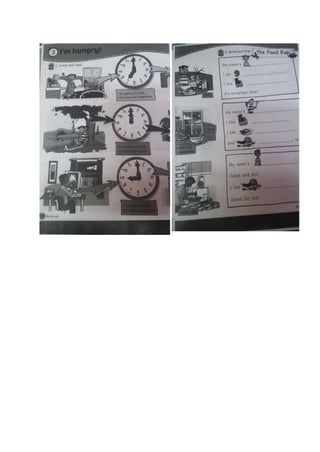
Recognition Students will work on page
36 explaining the time
according to the event of
the day.
We will show students
flashcards of children and
meals. e.g It is 8 o’clock.
Breakfast time.
Ts-Ss
5 min.
It is one o’clock: LUNCH
time, etc.
Listening and
Speaking
Students will listen to track
28 while they observe the
pictures and read in
silence.
To finish the class, the
teacher will write on the
board incomplete
sentences and students will
take down notes and
complete them with
personal information.
It’s……………… o’clock in
the morning. It’s time for
……….. .
It’s ………….. o’clock at
noon. It’s time for……. .
It’s …………. o’clock in the
evening. It’s time
for…………. .
We sing the song “See you
later”
Ts-Ss 15 min.
Lesson plan 2

Lesson plan 2

  • 1.
    Practice II, Didacticsof ELT and Practicum at Primary School Level LESSON PLAN 2: MENTOR TEACHER: Joana Herrán. NAMES: Nieto Paola and Corral Lucrecia. DATE: Wednesday, September 5th . 4th C from 16:10 to 16:50, and 4th D from 16:50 to 17:30. CLASS: Fourth Grade LENGTH OF THE LESSON: 40 MINUTES. CLASS DESCRIPTION: There are twenty-three students in each course (4th D and 4th C), all between nine and ten years old. They have English classes once a week, each class lasts forty minutes. This group of students work actively and they and her teacher avoid speaking in L1. Their proficiency level is Pre-A1. SKILLS TO BE EMPHASIZED: Listening, reading, writing and speaking. LANGUAGE: - Vocabulary about the time and events of the day. - Structure: examples: It’s nine o’clock, it’s time for lunch (in positive sentences). AIMS: By the end of this class, students will be able to write and say the exact time in English, differentiate a.m. from p.m. Also, they will learn events of the day , such as lunch, dinner,etc and meals like fruits, vegetables and meat. MATERIALS: ● Handmade clock ● Book ● CD ● CD player ● Board ● Marker ● Flashcards EVALUATION: We expect that students show that they have learnt and understood when to use the structures given (the time and the events of the day) after providing them with visual aids, gestures and making a wise use of L1 and L2. Procedures
  • 2.
    Stage/stage aim Description Interac tion Timin g Warm-up We’re goingto start the class singing: Clap your hands, stamp your feet, it’s time to say Hello, Hello! “If you are happy” “Today is Wednesday, how are you?” We’re going to show students flashcards about the weather. Then we will write on the board the date and the weather. Ts–Ss 5 minutes Instructions and Speaking We will ask them “Do you know the time in English?” to start explaining them about the topic. We will show them a handmade clock to teach students o’clock times and the difference between a.m. and p.m. Example: T: What’s the time? Ss: It is eight o’clock. Ts-Ss 15 min. Recognition Students will work on page 36 explaining the time according to the event of the day. We will show students flashcards of children and meals. e.g It is 8 o’clock. Breakfast time. Ts-Ss 5 min.
  • 3.
    It is oneo’clock: LUNCH time, etc. Listening and Speaking Students will listen to track 28 while they observe the pictures and read in silence. To finish the class, the teacher will write on the board incomplete sentences and students will take down notes and complete them with personal information. It’s……………… o’clock in the morning. It’s time for ……….. . It’s ………….. o’clock at noon. It’s time for……. . It’s …………. o’clock in the evening. It’s time for…………. . We sing the song “See you later” Ts-Ss 15 min.