Parenting…Just like running a country!


                                         1
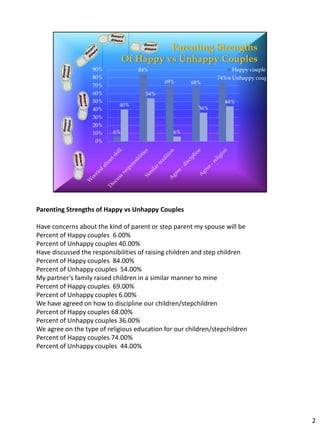
Parenting Strengths of Happy vs Unhappy Couples

Have concerns about the kind of parent or step parent my spouse will be
Percent of Happy couples 6.00%
Percent of Unhappy couples 40.00%
Have discussed the responsibilities of raising children and step children
Percent of Happy couples 84.00%
Percent of Unhappy couples 54.00%
My partner’s family raised children in a similar manner to mine
Percent of Happy couples 69.00%
Percent of Unhappy couples 6.00%
We have agreed on how to discipline our children/stepchildren
Percent of Happy couples 68.00%
Percent of Unhappy couples 36.00%
We agree on the type of religious education for our children/stepchildren
Percent of Happy couples 74.00%
Percent of Unhappy couples 44.00%


                                                                            2
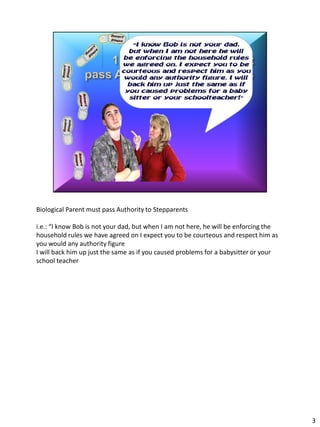
Biological Parent must pass Authority to Stepparents

i.e.: “I know Bob is not your dad, but when I am not here, he will be enforcing the
household rules we have agreed on I expect you to be courteous and respect him as
you would any authority figure
I will back him up just the same as if you caused problems for a babysitter or your
school teacher


                                                                                      3
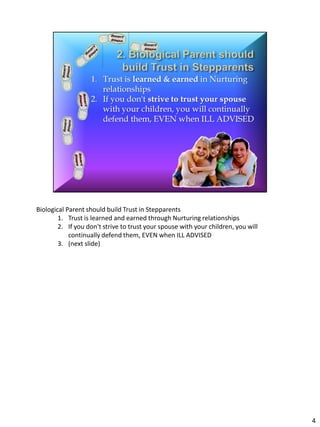
Biological Parent should build Trust in Stepparents
        1. Trust is learned and earned through Nurturing relationships
        2. If you don't strive to trust your spouse with your children, you will
            continually defend them, EVEN when ILL ADVISED
        3. (next slide)


                                                                                   4
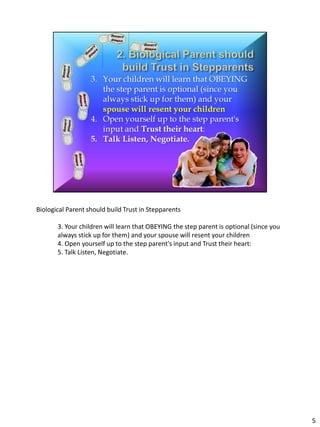
Biological Parent should build Trust in Stepparents

       3. Your children will learn that OBEYING the step parent is optional (since you
       always stick up for them) and your spouse will resent your children
       4. Open yourself up to the step parent's input and Trust their heart:
       5. Talk Listen, Negotiate.


                                                                                         5
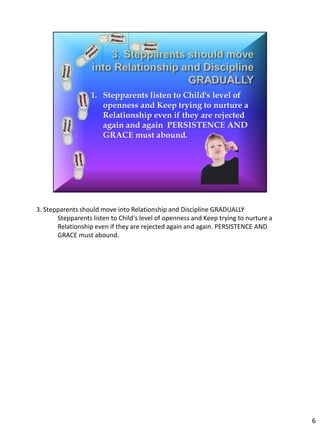
3. Stepparents should move into Relationship and Discipline GRADUALLY
       Stepparents listen to Child's level of openness and Keep trying to nurture a
       Relationship even if they are rejected again and again. PERSISTENCE AND
       GRACE must abound.


                                                                                      6
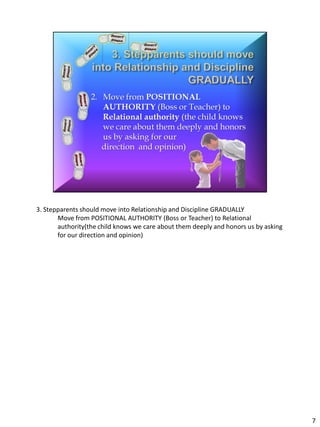
3. Stepparents should move into Relationship and Discipline GRADUALLY
       Move from POSITIONAL AUTHORITY (Boss or Teacher) to Relational
       authority(the child knows we care about them deeply and honors us by asking
       for our direction and opinion)


                                                                                     7
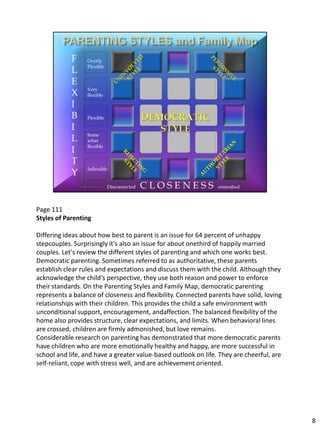
Page 111
Styles of Parenting

Differing ideas about how best to parent is an issue for 64 percent of unhappy
stepcouples. Surprisingly it's also an issue for about onethird of happily married
couples. Let's review the different styles of parenting and which one works best.
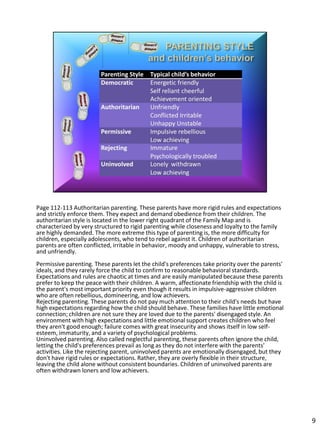
Democratic parenting. Sometimes referred to as authoritative, these parents
establish clear rules and expectations and discuss them with the child. Although they
acknowledge the child's perspective, they use both reason and power to enforce
their standards. On the Parenting Styles and Family Map, democratic parenting
represents a balance of closeness and flexibility. Connected parents have solid, loving
relationships with their children. This provides the child a safe environment with
unconditional support, encouragement, andaffection. The balanced flexibility of the
home also provides structure, clear expectations, and limits. When behavioral lines
are crossed, children are firmly admonished, but love remains.
Considerable research on parenting has demonstrated that more democratic parents
have children who are more emotionally healthy and happy, are more successful in
school and life, and have a greater value-based outlook on life. They are cheerful, are
self-reliant, cope with stress well, and are achievement oriented.


                                                                                          8
Page 112-113 Authoritarian parenting. These parents have more rigid rules and expectations
and strictly enforce them. They expect and demand obedience from their children. The
authoritarian style is located in the lower right quadrant of the Family Map and is
characterized by very structured to rigid parenting while closeness and loyalty to the family
are highly demanded. The more extreme this type of parenting is, the more difficulty for
children, especially adolescents, who tend to rebel against it. Children of authoritarian
parents are often conflicted, irritable in behavior, moody and unhappy, vulnerable to stress,
and unfriendly.
Permissive parenting. These parents let the child's preferences take priority over the parents'
ideals, and they rarely force the child to confirm to reasonable behavioral standards.
Expectations and rules are chaotic at times and are easily manipulated because these parents
prefer to keep the peace with their children. A warm, affectionate friendship with the child is
the parent's most important priority even though it results in impulsive-aggressive children
who are often rebellious, domineering, and low achievers.
Rejecting parenting. These parents do not pay much attention to their child's needs but have
high expectations regarding how the child should behave. These families have little emotional
connection; children are not sure they are loved due to the parents' disengaged style. An
environment with high expectations and little emotional support creates children who feel
they aren't good enough; failure comes with great insecurity and shows itself in low self-
esteem, immaturity, and a variety of psychological problems.
Uninvolved parenting. Also called neglectful parenting, these parents often ignore the child,
letting the child's preferences prevail as long as they do not interfere with the parents'
activities. Like the rejecting parent, uninvolved parents are emotionally disengaged, but they
don't have rigid rules or expectations. Rather, they are overly flexible in their structure,
leaving the child alone without consistent boundaries. Children of uninvolved parents are
often withdrawn loners and low achievers.


                                                                                                  9
10
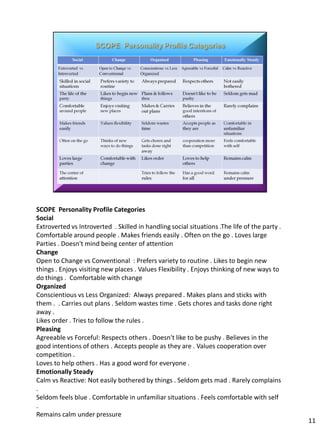
SCOPE Personality Profile Categories
Social
Extroverted vs Introverted . Skilled in handling social situations .The life of the party .
Comfortable around people . Makes friends easily . Often on the go . Loves large
Parties . Doesn't mind being center of attention
Change
Open to Change vs Conventional : Prefers variety to routine . Likes to begin new
things . Enjoys visiting new places . Values Flexibility . Enjoys thinking of new ways to
do things . Comfortable with change
Organized
Conscientious vs Less Organized: Always prepared . Makes plans and sticks with
them . . Carries out plans . Seldom wastes time . Gets chores and tasks done right
away .
Likes order . Tries to follow the rules .
Pleasing
Agreeable vs Forceful: Respects others . Doesn't like to be pushy . Believes in the
good intentions of others . Accepts people as they are . Values cooperation over
competition .
Loves to help others . Has a good word for everyone .
Emotionally Steady
Calm vs Reactive: Not easily bothered by things . Seldom gets mad . Rarely complains
.
Seldom feels blue . Comfortable in unfamiliar situations . Feels comfortable with self
.
Remains calm under pressure
                                                                                              11
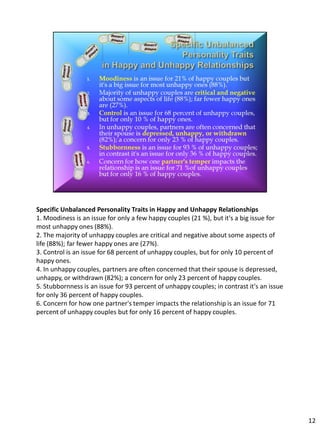
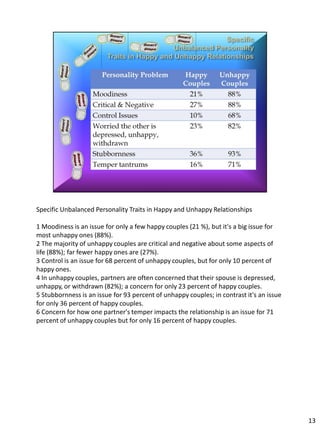
Specific Unbalanced Personality Traits in Happy and Unhappy Relationships
1. Moodiness is an issue for only a few happy couples (21 %), but it's a big issue for
most unhappy ones (88%).
2. The majority of unhappy couples are critical and negative about some aspects of
life (88%); far fewer happy ones are (27%).
3. Control is an issue for 68 percent of unhappy couples, but for only 10 percent of
happy ones.
4. In unhappy couples, partners are often concerned that their spouse is depressed,
unhappy, or withdrawn (82%); a concern for only 23 percent of happy couples.
5. Stubbornness is an issue for 93 percent of unhappy couples; in contrast it's an issue
for only 36 percent of happy couples.
6. Concern for how one partner's temper impacts the relationship is an issue for 71
percent of unhappy couples but for only 16 percent of happy couples.


                                                                                           12
Specific Unbalanced Personality Traits in Happy and Unhappy Relationships

1 Moodiness is an issue for only a few happy couples (21 %), but it's a big issue for
most unhappy ones (88%).
2 The majority of unhappy couples are critical and negative about some aspects of
life (88%); far fewer happy ones are (27%).
3 Control is an issue for 68 percent of unhappy couples, but for only 10 percent of
happy ones.
4 In unhappy couples, partners are often concerned that their spouse is depressed,
unhappy, or withdrawn (82%); a concern for only 23 percent of happy couples.
5 Stubbornness is an issue for 93 percent of unhappy couples; in contrast it's an issue
for only 36 percent of happy couples.
6 Concern for how one partner's temper impacts the relationship is an issue for 71
percent of unhappy couples but for only 16 percent of happy couples.


                                                                                          13
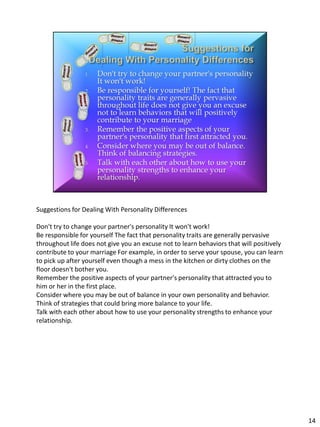
Suggestions for Dealing With Personality Differences

Don't try to change your partner's personality It won't work!
Be responsible for yourself The fact that personality traits are generally pervasive
throughout life does not give you an excuse not to learn behaviors that will positively
contribute to your marriage For example, in order to serve your spouse, you can learn
to pick up after yourself even though a mess in the kitchen or dirty clothes on the
floor doesn't bother you.
Remember the positive aspects of your partner's personality that attracted you to
him or her in the first place.
Consider where you may be out of balance in your own personality and behavior.
Think of strategies that could bring more balance to your life.
Talk with each other about how to use your personality strengths to enhance your
relationship.


                                                                                          14
Suggestions for Dealing With Personality Differences

Don't try to change your partner's personality It won't work!
Be responsible for yourself The fact that personality traits are generally pervasive
throughout life does not give you an excuse not to learn behaviors that will positively
contribute to your marriage For example, in order to serve your spouse, you can learn
to pick up after yourself even though a mess in the kitchen or dirty clothes on the
floor doesn't bother you.
Remember the positive aspects of your partner's personality that attracted you to
him or her in the first place.
Consider where you may be out of balance in your own personality and behavior.
Think of strategies that could bring more balance to your life.
Talk with each other about how to use your personality strengths to enhance your
relationship.


                                                                                          15

Lesson 5 Step Parenting Strengths NOTES

  • 1.
  • 2.
    Parenting Strengths ofHappy vs Unhappy Couples Have concerns about the kind of parent or step parent my spouse will be Percent of Happy couples 6.00% Percent of Unhappy couples 40.00% Have discussed the responsibilities of raising children and step children Percent of Happy couples 84.00% Percent of Unhappy couples 54.00% My partner’s family raised children in a similar manner to mine Percent of Happy couples 69.00% Percent of Unhappy couples 6.00% We have agreed on how to discipline our children/stepchildren Percent of Happy couples 68.00% Percent of Unhappy couples 36.00% We agree on the type of religious education for our children/stepchildren Percent of Happy couples 74.00% Percent of Unhappy couples 44.00% 2
  • 3.
    Biological Parent mustpass Authority to Stepparents i.e.: “I know Bob is not your dad, but when I am not here, he will be enforcing the household rules we have agreed on I expect you to be courteous and respect him as you would any authority figure I will back him up just the same as if you caused problems for a babysitter or your school teacher 3
  • 4.
    Biological Parent shouldbuild Trust in Stepparents 1. Trust is learned and earned through Nurturing relationships 2. If you don't strive to trust your spouse with your children, you will continually defend them, EVEN when ILL ADVISED 3. (next slide) 4
  • 5.
    Biological Parent shouldbuild Trust in Stepparents 3. Your children will learn that OBEYING the step parent is optional (since you always stick up for them) and your spouse will resent your children 4. Open yourself up to the step parent's input and Trust their heart: 5. Talk Listen, Negotiate. 5
  • 6.
    3. Stepparents shouldmove into Relationship and Discipline GRADUALLY Stepparents listen to Child's level of openness and Keep trying to nurture a Relationship even if they are rejected again and again. PERSISTENCE AND GRACE must abound. 6
  • 7.
    3. Stepparents shouldmove into Relationship and Discipline GRADUALLY Move from POSITIONAL AUTHORITY (Boss or Teacher) to Relational authority(the child knows we care about them deeply and honors us by asking for our direction and opinion) 7
  • 8.
    Page 111 Styles ofParenting Differing ideas about how best to parent is an issue for 64 percent of unhappy stepcouples. Surprisingly it's also an issue for about onethird of happily married couples. Let's review the different styles of parenting and which one works best. Democratic parenting. Sometimes referred to as authoritative, these parents establish clear rules and expectations and discuss them with the child. Although they acknowledge the child's perspective, they use both reason and power to enforce their standards. On the Parenting Styles and Family Map, democratic parenting represents a balance of closeness and flexibility. Connected parents have solid, loving relationships with their children. This provides the child a safe environment with unconditional support, encouragement, andaffection. The balanced flexibility of the home also provides structure, clear expectations, and limits. When behavioral lines are crossed, children are firmly admonished, but love remains. Considerable research on parenting has demonstrated that more democratic parents have children who are more emotionally healthy and happy, are more successful in school and life, and have a greater value-based outlook on life. They are cheerful, are self-reliant, cope with stress well, and are achievement oriented. 8
  • 9.
    Page 112-113 Authoritarianparenting. These parents have more rigid rules and expectations and strictly enforce them. They expect and demand obedience from their children. The authoritarian style is located in the lower right quadrant of the Family Map and is characterized by very structured to rigid parenting while closeness and loyalty to the family are highly demanded. The more extreme this type of parenting is, the more difficulty for children, especially adolescents, who tend to rebel against it. Children of authoritarian parents are often conflicted, irritable in behavior, moody and unhappy, vulnerable to stress, and unfriendly. Permissive parenting. These parents let the child's preferences take priority over the parents' ideals, and they rarely force the child to confirm to reasonable behavioral standards. Expectations and rules are chaotic at times and are easily manipulated because these parents prefer to keep the peace with their children. A warm, affectionate friendship with the child is the parent's most important priority even though it results in impulsive-aggressive children who are often rebellious, domineering, and low achievers. Rejecting parenting. These parents do not pay much attention to their child's needs but have high expectations regarding how the child should behave. These families have little emotional connection; children are not sure they are loved due to the parents' disengaged style. An environment with high expectations and little emotional support creates children who feel they aren't good enough; failure comes with great insecurity and shows itself in low self- esteem, immaturity, and a variety of psychological problems. Uninvolved parenting. Also called neglectful parenting, these parents often ignore the child, letting the child's preferences prevail as long as they do not interfere with the parents' activities. Like the rejecting parent, uninvolved parents are emotionally disengaged, but they don't have rigid rules or expectations. Rather, they are overly flexible in their structure, leaving the child alone without consistent boundaries. Children of uninvolved parents are often withdrawn loners and low achievers. 9
  • 10.
  • 11.
    SCOPE Personality ProfileCategories Social Extroverted vs Introverted . Skilled in handling social situations .The life of the party . Comfortable around people . Makes friends easily . Often on the go . Loves large Parties . Doesn't mind being center of attention Change Open to Change vs Conventional : Prefers variety to routine . Likes to begin new things . Enjoys visiting new places . Values Flexibility . Enjoys thinking of new ways to do things . Comfortable with change Organized Conscientious vs Less Organized: Always prepared . Makes plans and sticks with them . . Carries out plans . Seldom wastes time . Gets chores and tasks done right away . Likes order . Tries to follow the rules . Pleasing Agreeable vs Forceful: Respects others . Doesn't like to be pushy . Believes in the good intentions of others . Accepts people as they are . Values cooperation over competition . Loves to help others . Has a good word for everyone . Emotionally Steady Calm vs Reactive: Not easily bothered by things . Seldom gets mad . Rarely complains . Seldom feels blue . Comfortable in unfamiliar situations . Feels comfortable with self . Remains calm under pressure 11
  • 12.
    Specific Unbalanced PersonalityTraits in Happy and Unhappy Relationships 1. Moodiness is an issue for only a few happy couples (21 %), but it's a big issue for most unhappy ones (88%). 2. The majority of unhappy couples are critical and negative about some aspects of life (88%); far fewer happy ones are (27%). 3. Control is an issue for 68 percent of unhappy couples, but for only 10 percent of happy ones. 4. In unhappy couples, partners are often concerned that their spouse is depressed, unhappy, or withdrawn (82%); a concern for only 23 percent of happy couples. 5. Stubbornness is an issue for 93 percent of unhappy couples; in contrast it's an issue for only 36 percent of happy couples. 6. Concern for how one partner's temper impacts the relationship is an issue for 71 percent of unhappy couples but for only 16 percent of happy couples. 12
  • 13.
    Specific Unbalanced PersonalityTraits in Happy and Unhappy Relationships 1 Moodiness is an issue for only a few happy couples (21 %), but it's a big issue for most unhappy ones (88%). 2 The majority of unhappy couples are critical and negative about some aspects of life (88%); far fewer happy ones are (27%). 3 Control is an issue for 68 percent of unhappy couples, but for only 10 percent of happy ones. 4 In unhappy couples, partners are often concerned that their spouse is depressed, unhappy, or withdrawn (82%); a concern for only 23 percent of happy couples. 5 Stubbornness is an issue for 93 percent of unhappy couples; in contrast it's an issue for only 36 percent of happy couples. 6 Concern for how one partner's temper impacts the relationship is an issue for 71 percent of unhappy couples but for only 16 percent of happy couples. 13
  • 14.
    Suggestions for DealingWith Personality Differences Don't try to change your partner's personality It won't work! Be responsible for yourself The fact that personality traits are generally pervasive throughout life does not give you an excuse not to learn behaviors that will positively contribute to your marriage For example, in order to serve your spouse, you can learn to pick up after yourself even though a mess in the kitchen or dirty clothes on the floor doesn't bother you. Remember the positive aspects of your partner's personality that attracted you to him or her in the first place. Consider where you may be out of balance in your own personality and behavior. Think of strategies that could bring more balance to your life. Talk with each other about how to use your personality strengths to enhance your relationship. 14
  • 15.
    Suggestions for DealingWith Personality Differences Don't try to change your partner's personality It won't work! Be responsible for yourself The fact that personality traits are generally pervasive throughout life does not give you an excuse not to learn behaviors that will positively contribute to your marriage For example, in order to serve your spouse, you can learn to pick up after yourself even though a mess in the kitchen or dirty clothes on the floor doesn't bother you. Remember the positive aspects of your partner's personality that attracted you to him or her in the first place. Consider where you may be out of balance in your own personality and behavior. Think of strategies that could bring more balance to your life. Talk with each other about how to use your personality strengths to enhance your relationship. 15