Percentage of couples in Agreement
Communication Issue                       Happy     Unhappy
                                          Couples   Couples
My partner understands how I feel.         93%       21%

My partner makes comments that              8%       64%
put me down.
I am very satisfied with how my            97%       45%
partner and I talk with each other.
I feel good about how much my              72%       15%
partner shares feelings with
me.
When we are having a problem, my           17%       74%
partner often refuses to talk about it.
1.   Passive-- unwilling to honestly show
     thoughts, feelings, or desires
2.   Aggressive—characterized by blaming
     and accusatory actions: ―You Always‖
     ―You Never‖
3.   Assertive: Expressions in healthy, non-
     defensive and non-insistent ways.
     Asking clearly what we want: being
     positive and respectful
This encourages the partner to respond
      positively and assertively.
       Step mom         Father
 Try to set aside
5 – 10 minutes
daily and
 15-20 minutes
on weekends
 to share thoughts
and feelings about
your day, work,
stresses and life Use
                    “I” statements
together.
                   avoid “YOU”
                    statements
1. Focus on the good in each other
2. Praise each other often
3. Take time to listen to understand, not to
   judge :Reflect before countering.
4. Be assertive (using ―I‖ statements rather
   than ―You‖ statements) No guessing
   games!
5. Give your relationship the importance
   and attention you did when you first
   met.
If your partner
doesn’t understand
you, maybe it’s not
her (his) fault! Are
you speaking good
English?
A bit in the mouth of a horse controls the whole
horse. A small rudder on a huge ship in the
hands of a skilled captain sets a course in the face
of the strongest winds. A word out of your
mouth may seem of no account, but it can
accomplish nearly anything—or destroy it!
It only takes a spark, remember, to set off a forest
fire. A careless or wrongly placed word out of
your mouth can do that. By our speech we
can ruin the world, turn harmony to
chaos, throw mud on a reputation,
send the whole world up in smoke and
go up in smoke with it, smoke right
from the pit of hell.            James 3:5-6 (The Message)
                                           Eugene Peterson
Graphics, desktop publishing, sequencing and editing my OCOI Studios
              Xhilliwhack, BC OCOI.Studios@gmail.com
              Cartoons permission by cartoonstock.com
        Tables and graphs courtesy of Baker Publishing group

Lesson 6 Communication

  • 2.
    Percentage of couplesin Agreement Communication Issue Happy Unhappy Couples Couples My partner understands how I feel. 93% 21% My partner makes comments that 8% 64% put me down. I am very satisfied with how my 97% 45% partner and I talk with each other. I feel good about how much my 72% 15% partner shares feelings with me. When we are having a problem, my 17% 74% partner often refuses to talk about it.
  • 3.
    1. Passive-- unwilling to honestly show thoughts, feelings, or desires 2. Aggressive—characterized by blaming and accusatory actions: ―You Always‖ ―You Never‖ 3. Assertive: Expressions in healthy, non- defensive and non-insistent ways. Asking clearly what we want: being positive and respectful
  • 4.
    This encourages thepartner to respond positively and assertively. Step mom Father
  • 5.
     Try toset aside 5 – 10 minutes daily and  15-20 minutes on weekends to share thoughts and feelings about your day, work, stresses and life Use “I” statements together. avoid “YOU” statements
  • 6.
    1. Focus onthe good in each other 2. Praise each other often 3. Take time to listen to understand, not to judge :Reflect before countering. 4. Be assertive (using ―I‖ statements rather than ―You‖ statements) No guessing games! 5. Give your relationship the importance and attention you did when you first met.
  • 7.
    If your partner doesn’tunderstand you, maybe it’s not her (his) fault! Are you speaking good English?
  • 8.
    A bit inthe mouth of a horse controls the whole horse. A small rudder on a huge ship in the hands of a skilled captain sets a course in the face of the strongest winds. A word out of your mouth may seem of no account, but it can accomplish nearly anything—or destroy it! It only takes a spark, remember, to set off a forest fire. A careless or wrongly placed word out of your mouth can do that. By our speech we can ruin the world, turn harmony to chaos, throw mud on a reputation, send the whole world up in smoke and go up in smoke with it, smoke right from the pit of hell. James 3:5-6 (The Message) Eugene Peterson
  • 9.
    Graphics, desktop publishing,sequencing and editing my OCOI Studios Xhilliwhack, BC OCOI.Studios@gmail.com Cartoons permission by cartoonstock.com Tables and graphs courtesy of Baker Publishing group

Editor's Notes

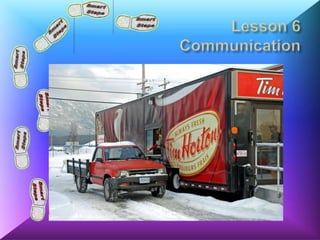
  • #2 Analysis of Ordering from a Tim Horton’s drive thru is the most basic and simple way to demonstrate good communication:i.e.: Incomplete Data: “I’d like a double double and a chocolate glazed donut”Incomplete Feedback: “coffee with a double cream, double sugar. what size?Additional Data: “a medium, please”Feedback “ A double double medium coffee and a chocolate donut?”Clarifying data: “NO, a LATTE and a chocolate GLAZED donut!”Clarifying Feedback: “a double double medium Latte and a chocolate glazed donut?”Confirming data: “Yes, that is correct”Conclusions: “that will be Three dollars and sixty nine cents, please”NO name calling or sarcastic remarks! How many marriages would be saved and how many children would be spared the trauma of being cut off from a parent if only couples used the simple techniques of communication used at a Tim Horton’s drivethru?
  • #3 Strengths of Happy vs Unhappy Couples Regarding Communication p 142  Percentage in AgreementCommunication IssueMy partner understands how I feel.93%HC 21% UCMy partner makes comments that put me down.8% HC 64% UCI am very satisfied with how my partner and I talk with each other.97% HC 45% UC4I feel good about how much my partner shares his/her feelings with me.72% HC 15% UC5When we are having a problem, my partner often refuses to talk about it.17% HC 74% UC 
  • #4 Three common styles of CommunicationPassive-- unwilling to honestly show thoughts, feelings, or desiresAggressive—characterized by blaming and accusatory actions: “You Always” “You Never” Assertive: Expressions in Healthy, non-defensive and non-insistent ways Asking clearly what we want: being positive and respectful
  • #5 Stepmom -- “I would like to spend more time with the children.”” Stepdad -- “Perhaps you could spend one evening alone with them and I can work late at the office.” This encourages the partner to respond positively and assertively.
  • #6 Communication requires Nurturing and AttentionTry to set aside 5 – 10 minutes daily and 15-20 minutes on weekends to share thoughts and feelings about your day, work, stresses and life together.Use “I” statements avoid “YOU” statements
  • #7 xx
  • #8 How many barmaids have heard a man complain that his wife doesn’t understand him? Finally, here is an honest barmaid! “Maybe your wife doesn’t understand you because you don’t make any sense!”
  • #9 A bit in the mouth of a horse controls the whole horse A small rudder on a huge ship in the hands of a skilled captain sets a course in the face of the strongest winds A word out of your mouth may seem of no account, but it can accomplish nearly anything—or destroy it! It only takes a spark, remember, to set off a forest fire A careless or wrongly placed word out of your mouth can do that By our speech we can ruin the world, turn harmony to chaos, throw mud on a reputation, send the whole world up in smoke and go up in smoke with it, smoke right from the pit of hell. James 3:5-6 (The Message by Eugene Peterson)