Data Collection and
Analysis Procedures
Lesson 3
Ask Yourself…
How should I plan the data gathering procedures for
my research?
Data Collection and
Analysis Procedures
Lesson 3
PRIMARY DATA COLLECTION
TECHNIQUES
 Interview
 Participant Observation
 Focus Group Interview
 Observational Evaluation
 Biography/Autobiography
 Questionnaire
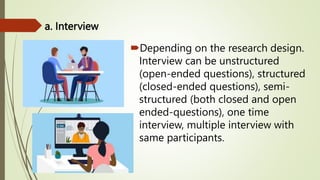
a. Interview
Depending on the research design.
Interview can be unstructured
(open-ended questions), structured
(closed-ended questions), semi-
structured (both closed and open
ended-questions), one time
interview, multiple interview with
same participants.
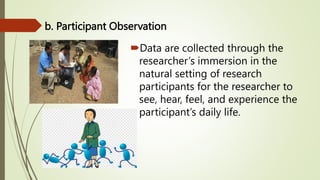
b. Participant Observation
Data are collected through the
researcher’s immersion in the
natural setting of research
participants for the researcher to
see, hear, feel, and experience the
participant’s daily life.
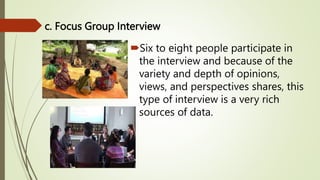
c. Focus Group Interview
Six to eight people participate in
the interview and because of the
variety and depth of opinions,
views, and perspectives shares, this
type of interview is a very rich
sources of data.
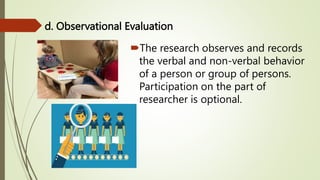
d. Observational Evaluation
The research observes and records
the verbal and non-verbal behavior
of a person or group of persons.
Participation on the part of
researcher is optional.
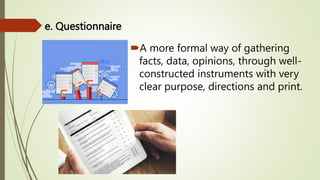
e. Questionnaire
A more formal way of gathering
facts, data, opinions, through well-
constructed instruments with very
clear purpose, directions and print.
BASIC TYPES OF DATA
COLLECTION PROCEDURES
 Observations
 Interviews
 Documents
 Audio and Visual materials
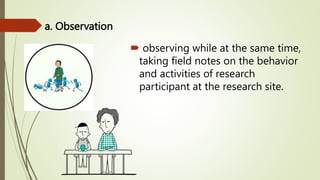
a. Observation
 observing while at the same time,
taking field notes on the behavior
and activities of research
participant at the research site.
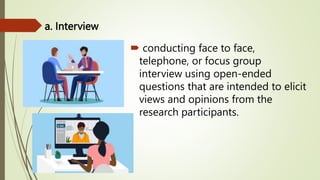
a. Interview
 conducting face to face,
telephone, or focus group
interview using open-ended
questions that are intended to elicit
views and opinions from the
research participants.
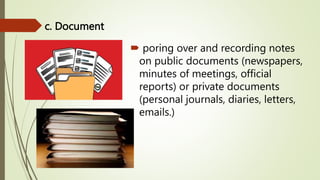
c. Document
 poring over and recording notes
on public documents (newspapers,
minutes of meetings, official
reports) or private documents
(personal journals, diaries, letters,
emails.)
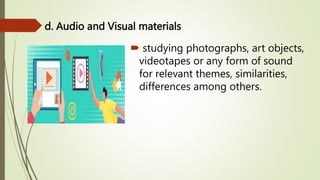
d. Audio and Visual materials
 studying photographs, art objects,
videotapes or any form of sound
for relevant themes, similarities,
differences among others.
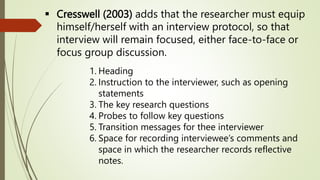
 Cresswell (2003) adds that the researcher must equip
himself/herself with an interview protocol, so that
interview will remain focused, either face-to-face or
focus group discussion.
1. Heading
2. Instruction to the interviewer, such as opening
statements
3. The key research questions
4. Probes to follow key questions
5. Transition messages for thee interviewer
6. Space for recording interviewee’s comments and
space in which the researcher records reflective
notes.
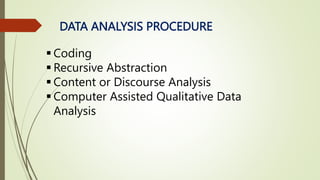
DATA ANALYSIS PROCEDURE
 Coding
 Recursive Abstraction
 Content or Discourse Analysis
 Computer Assisted Qualitative Data
Analysis
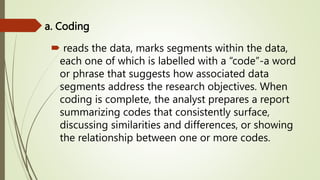
a. Coding
 reads the data, marks segments within the data,
each one of which is labelled with a “code”-a word
or phrase that suggests how associated data
segments address the research objectives. When
coding is complete, the analyst prepares a report
summarizing codes that consistently surface,
discussing similarities and differences, or showing
the relationship between one or more codes.
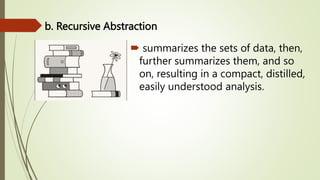
b. Recursive Abstraction
 summarizes the sets of data, then,
further summarizes them, and so
on, resulting in a compact, distilled,
easily understood analysis.
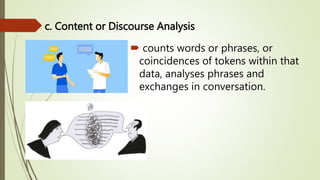
c. Content or Discourse Analysis
 counts words or phrases, or
coincidences of tokens within that
data, analyses phrases and
exchanges in conversation.
d. Computer Assisted Qualitative Data Analysis
 uses programs in editing, revising,
and coding which allow for work
sharing, peer reviews and recursive
examination of data through any of
the following qualitative data
analysis software.
GENERIC STEPS TO FOLLOW IN DATA ANALYSIS
PROCEDURE
 Organize and prepare the data for analysis.
 Read through all the data.
 Begin detailed analysis with coding process.
 Use the coding process to generate a description of the
setting or people, as well as categories or themes for
analysis
 decide how the description and themes will be presented.
 Make an interpretation of data-lessons, meanings,
suggestions for new questions that need to be asked.
PERFORMANCE TASK #3
• With your groupmates, start working
with gathering data you needed for
your own research, then analyzed the
data collected once done.
Research Presentation End

Lesson 3 - Data Collection and Analysis Procedure.pptx

  • 1.
    Data Collection and AnalysisProcedures Lesson 3
  • 2.
    Ask Yourself… How shouldI plan the data gathering procedures for my research?
  • 3.
    Data Collection and AnalysisProcedures Lesson 3
  • 4.
    PRIMARY DATA COLLECTION TECHNIQUES Interview  Participant Observation  Focus Group Interview  Observational Evaluation  Biography/Autobiography  Questionnaire
  • 5.
    a. Interview Depending onthe research design. Interview can be unstructured (open-ended questions), structured (closed-ended questions), semi- structured (both closed and open ended-questions), one time interview, multiple interview with same participants.
  • 6.
    b. Participant Observation Dataare collected through the researcher’s immersion in the natural setting of research participants for the researcher to see, hear, feel, and experience the participant’s daily life.
  • 7.
    c. Focus GroupInterview Six to eight people participate in the interview and because of the variety and depth of opinions, views, and perspectives shares, this type of interview is a very rich sources of data.
  • 8.
    d. Observational Evaluation Theresearch observes and records the verbal and non-verbal behavior of a person or group of persons. Participation on the part of researcher is optional.
  • 9.
    e. Questionnaire A moreformal way of gathering facts, data, opinions, through well- constructed instruments with very clear purpose, directions and print.
  • 10.
    BASIC TYPES OFDATA COLLECTION PROCEDURES  Observations  Interviews  Documents  Audio and Visual materials
  • 11.
    a. Observation  observingwhile at the same time, taking field notes on the behavior and activities of research participant at the research site.
  • 12.
    a. Interview  conductingface to face, telephone, or focus group interview using open-ended questions that are intended to elicit views and opinions from the research participants.
  • 13.
    c. Document  poringover and recording notes on public documents (newspapers, minutes of meetings, official reports) or private documents (personal journals, diaries, letters, emails.)
  • 14.
    d. Audio andVisual materials  studying photographs, art objects, videotapes or any form of sound for relevant themes, similarities, differences among others.
  • 15.
     Cresswell (2003)adds that the researcher must equip himself/herself with an interview protocol, so that interview will remain focused, either face-to-face or focus group discussion. 1. Heading 2. Instruction to the interviewer, such as opening statements 3. The key research questions 4. Probes to follow key questions 5. Transition messages for thee interviewer 6. Space for recording interviewee’s comments and space in which the researcher records reflective notes.
  • 16.
    DATA ANALYSIS PROCEDURE Coding  Recursive Abstraction  Content or Discourse Analysis  Computer Assisted Qualitative Data Analysis
  • 17.
    a. Coding  readsthe data, marks segments within the data, each one of which is labelled with a “code”-a word or phrase that suggests how associated data segments address the research objectives. When coding is complete, the analyst prepares a report summarizing codes that consistently surface, discussing similarities and differences, or showing the relationship between one or more codes.
  • 18.
    b. Recursive Abstraction summarizes the sets of data, then, further summarizes them, and so on, resulting in a compact, distilled, easily understood analysis.
  • 19.
    c. Content orDiscourse Analysis  counts words or phrases, or coincidences of tokens within that data, analyses phrases and exchanges in conversation.
  • 20.
    d. Computer AssistedQualitative Data Analysis  uses programs in editing, revising, and coding which allow for work sharing, peer reviews and recursive examination of data through any of the following qualitative data analysis software.
  • 21.
    GENERIC STEPS TOFOLLOW IN DATA ANALYSIS PROCEDURE  Organize and prepare the data for analysis.  Read through all the data.  Begin detailed analysis with coding process.  Use the coding process to generate a description of the setting or people, as well as categories or themes for analysis  decide how the description and themes will be presented.  Make an interpretation of data-lessons, meanings, suggestions for new questions that need to be asked.
  • 22.
    PERFORMANCE TASK #3 •With your groupmates, start working with gathering data you needed for your own research, then analyzed the data collected once done.
  • 23.

Editor's Notes

  • #24 You can use this slide as your opening or closing slide. Should you choose to use it as a closing, make sure you review the main points of your presentation. One creative way to do that is by adding animations to the various graphics on a slide. This slide has 4 different graphics, and, when you view the slideshow, you will see that you can click to reveal the next graphic. Similarly, as you review the main topics in your presentation, you may want each point to show up when you are addressing that topic. Add animation to images and graphics: Select your image or graphic. Click on the Animations tab. Choose from the options. The animation for this slide is “Split”. The drop-down menu in the Animation section gives even more animations you can use. If you have multiple graphics or images, you will see a number appear next to it that notes the order of the animations. Note: You will want to choose the animations carefully. You do not want to make your audience dizzy from your presentation.