PRACTICAL
RESEARCH
Senior High School Grade 11
LESSON 2: Characteristics of
Research
LESSON 2:
Characteristics
of Research
Characteristics
Are features or qualities that
distinguish a person, place, or thing.
LESSON 2:
Characteristics
of Research
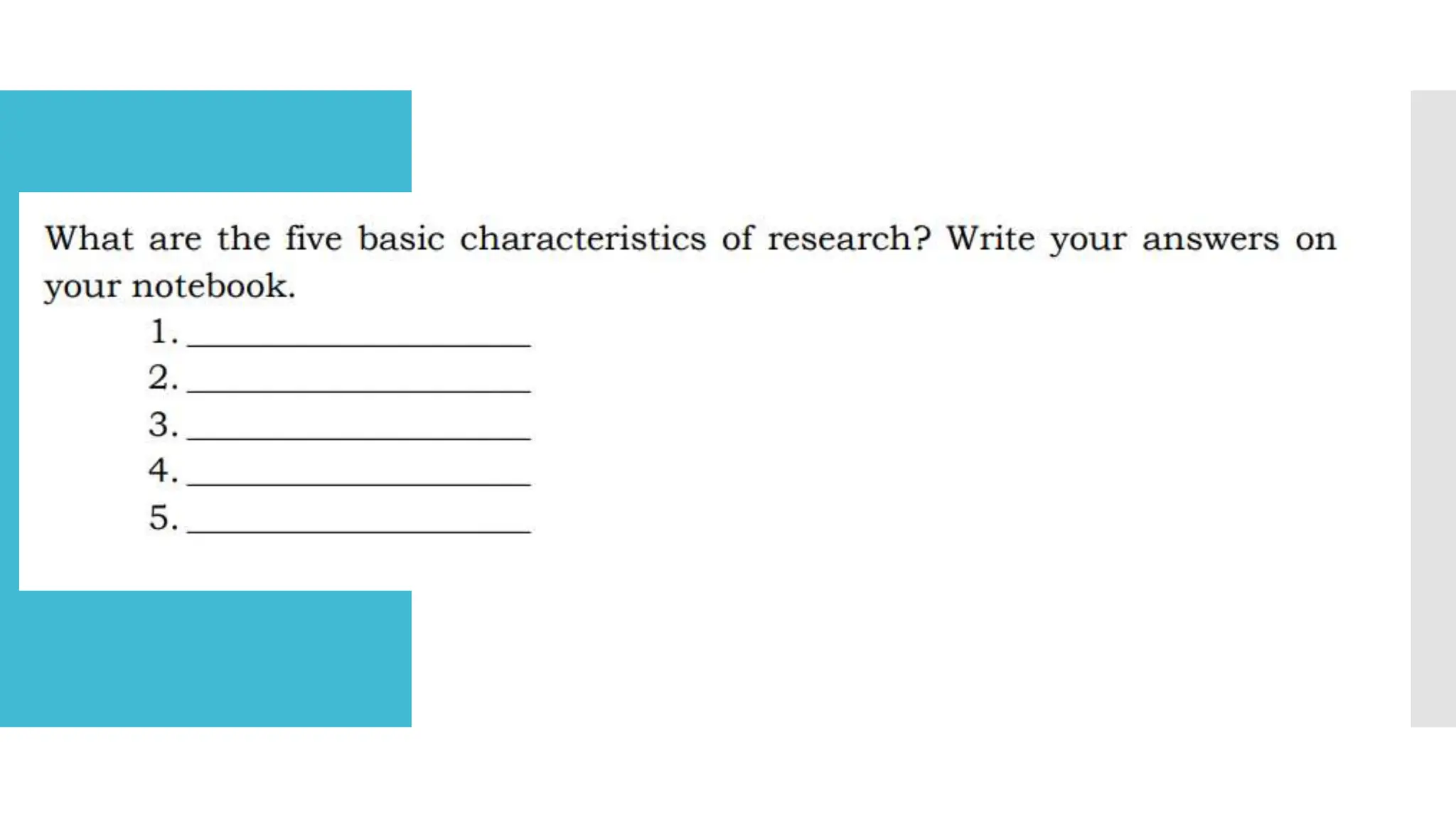
Characteristics of Research
(Cristobal & Cristobal, 2017)
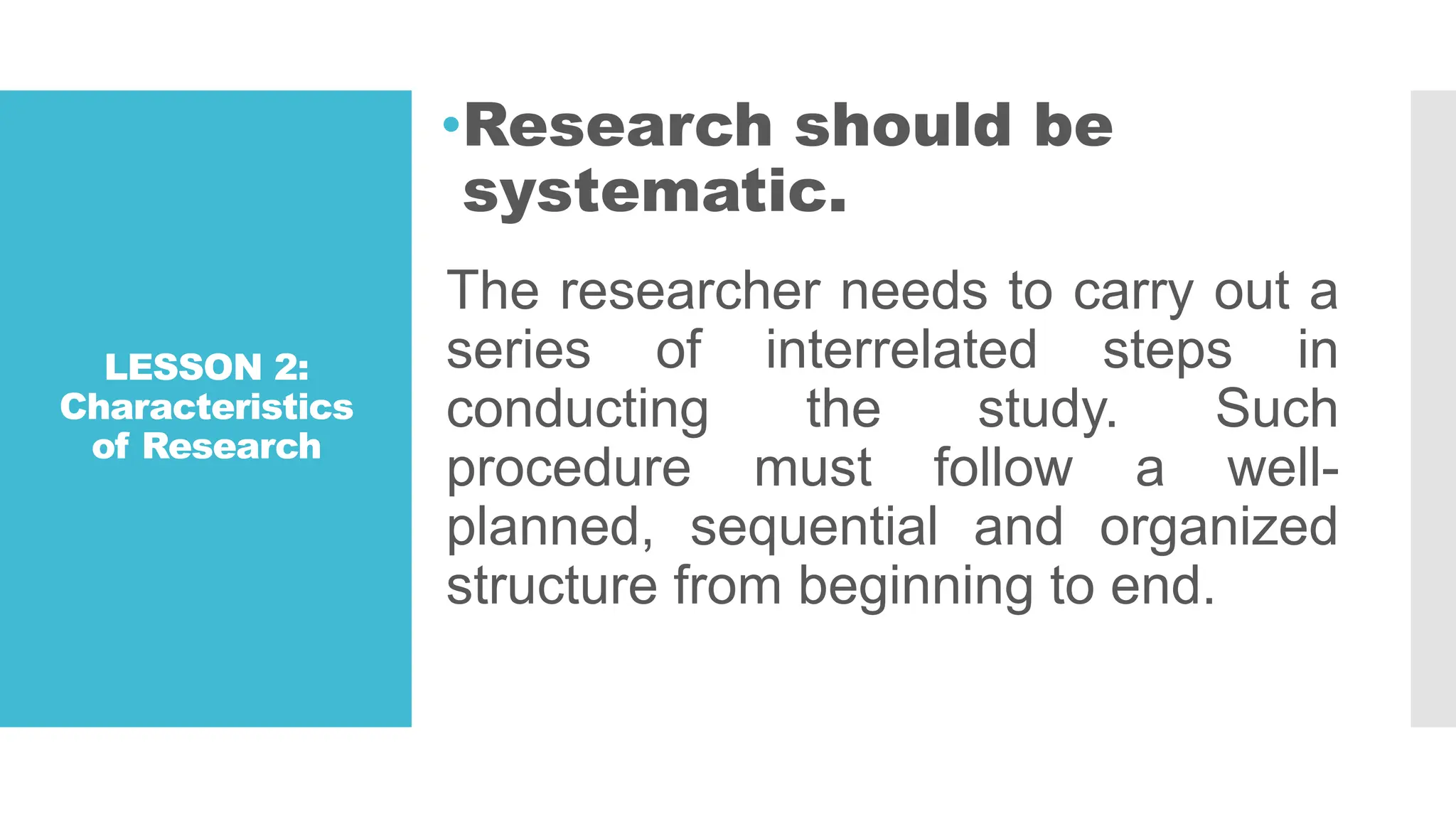
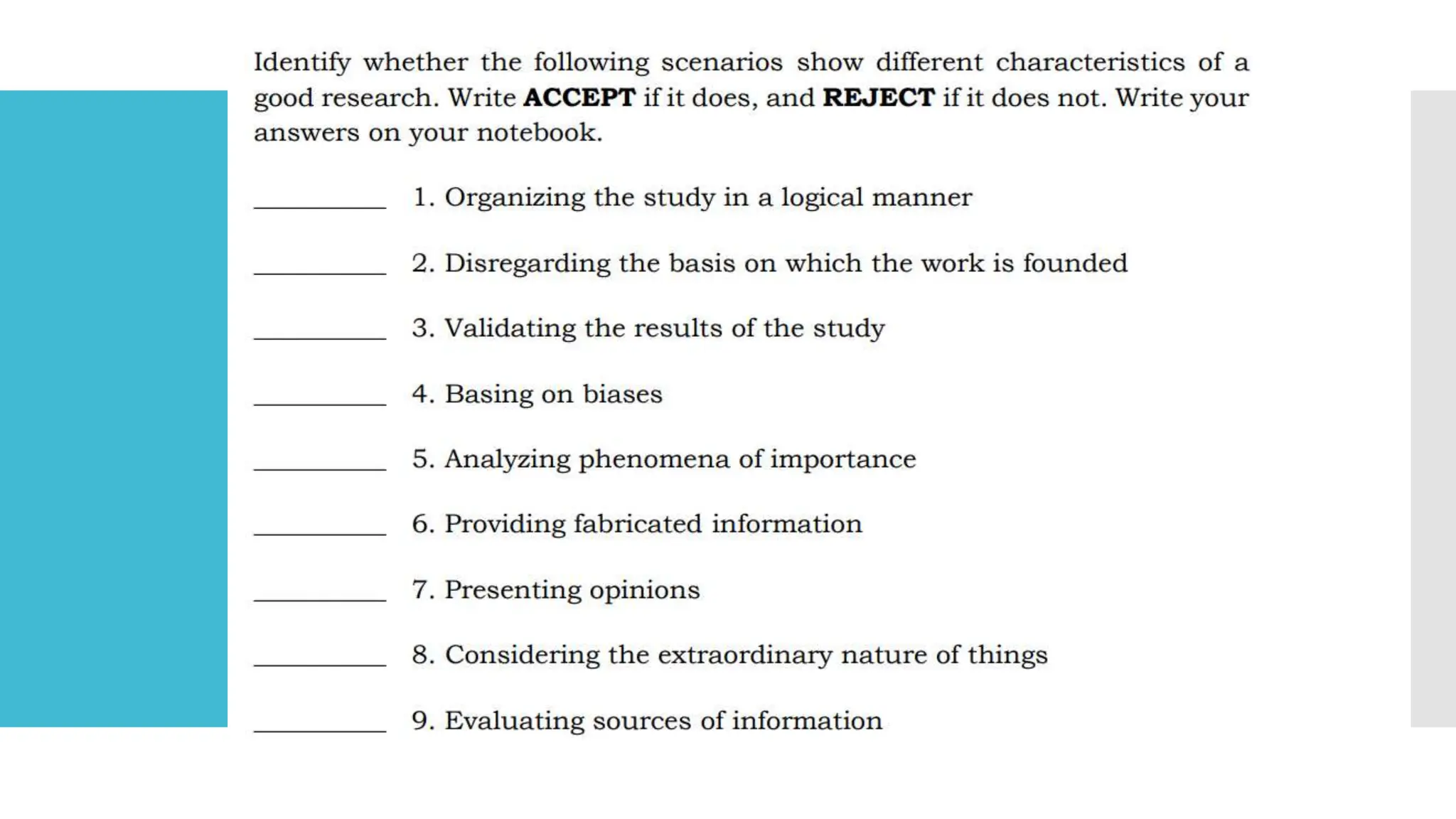
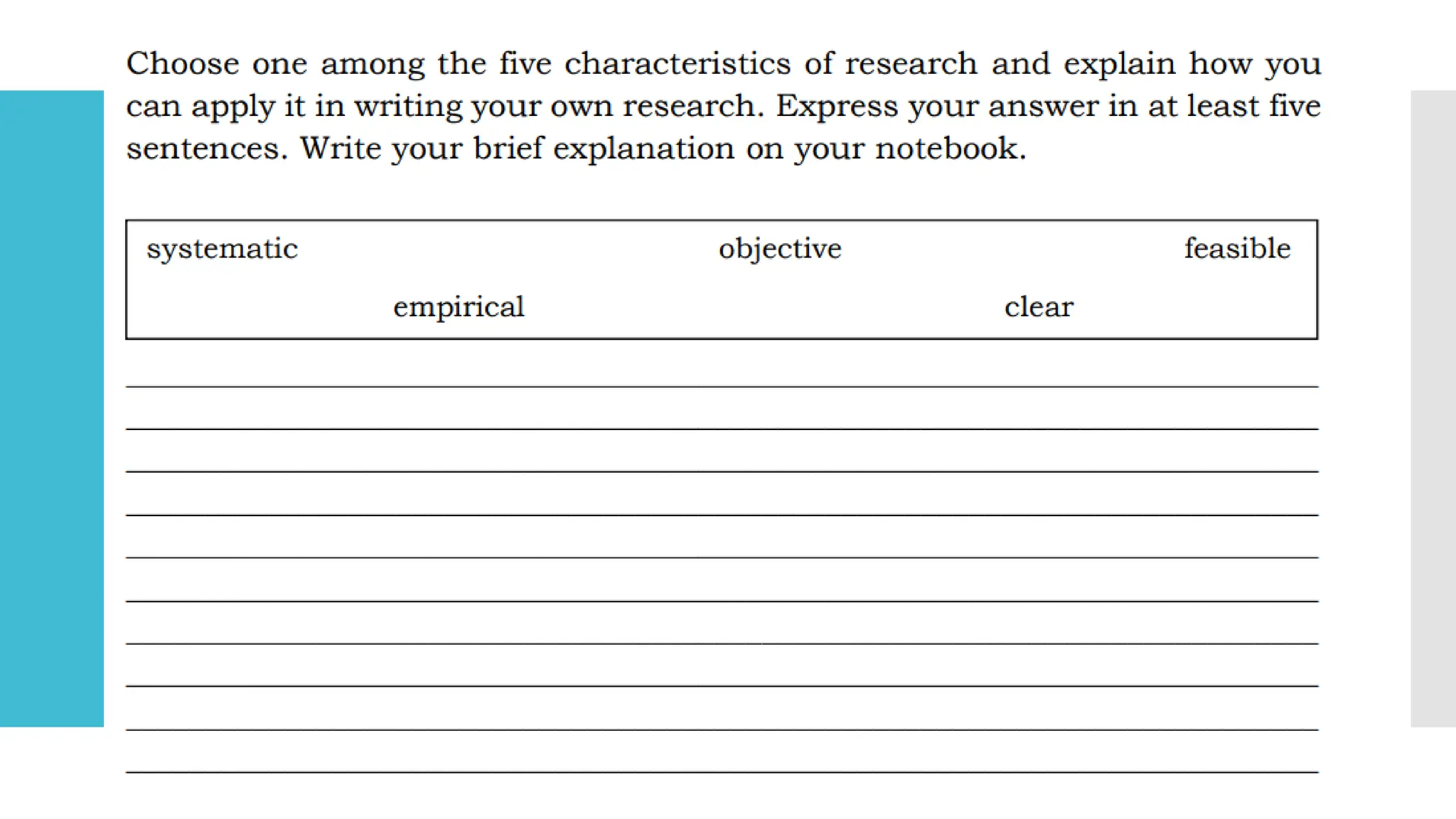
1. Research should be systematic.
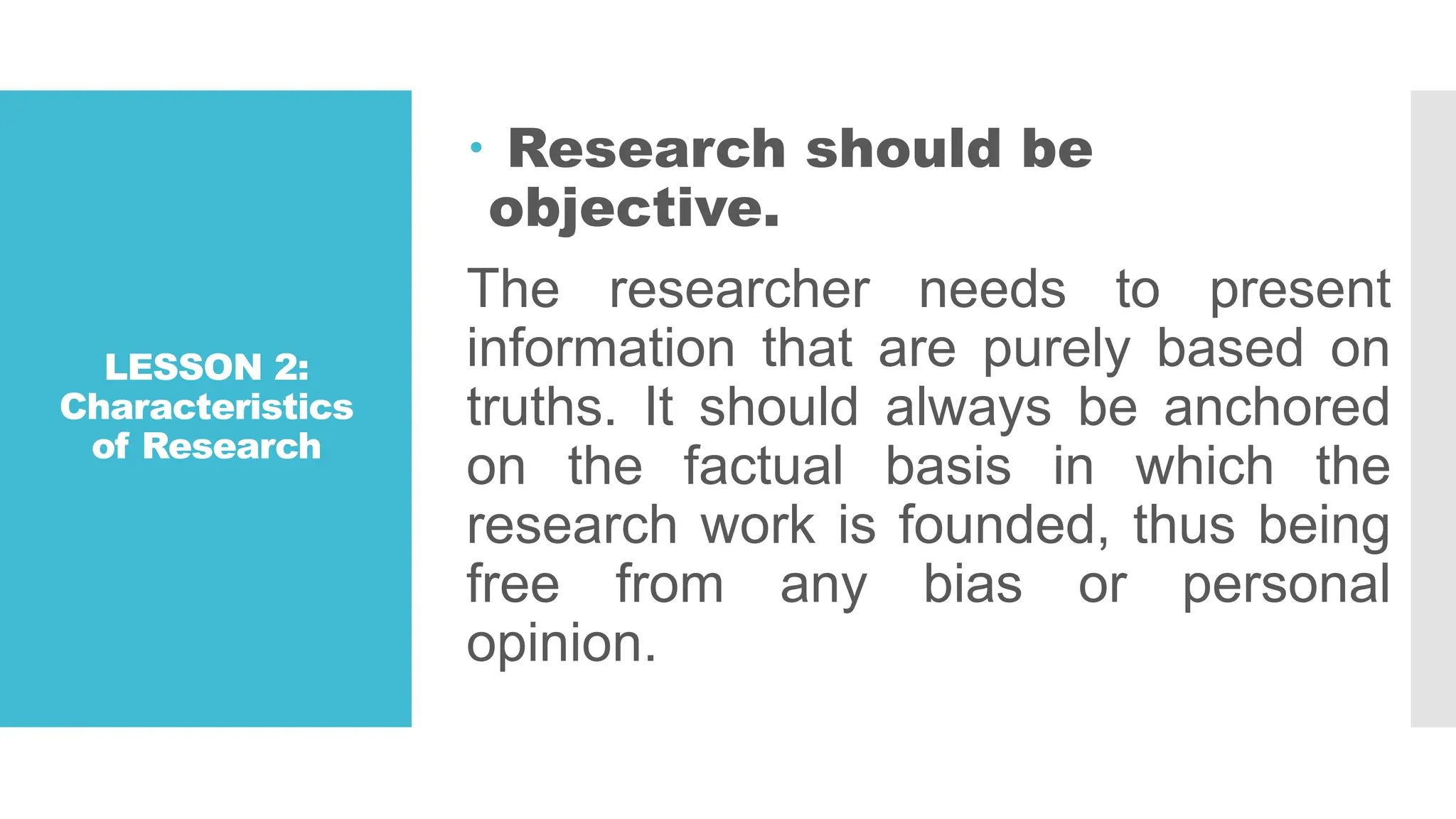
2. Research should be objective. .
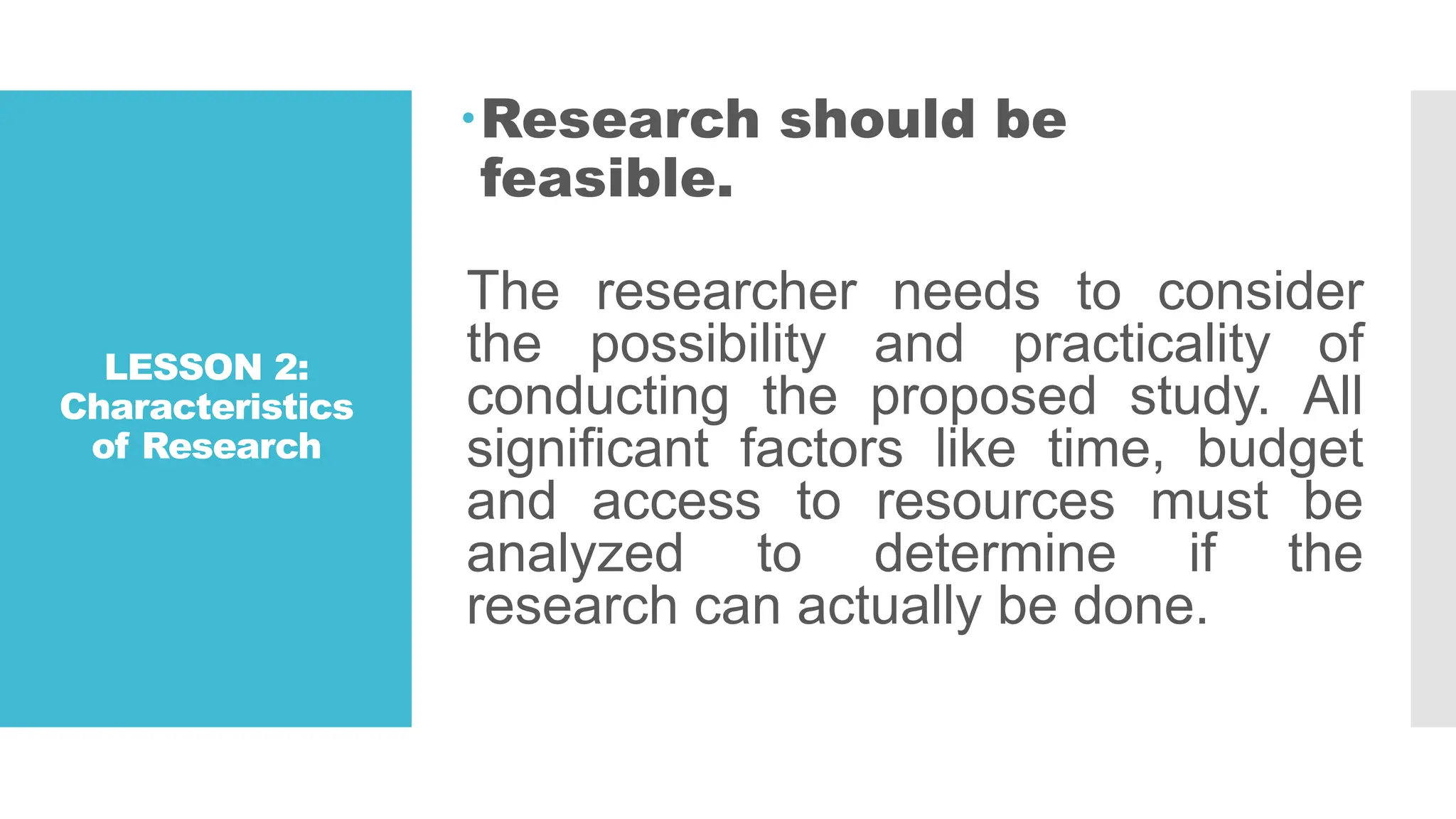
3. Research should be feasible.
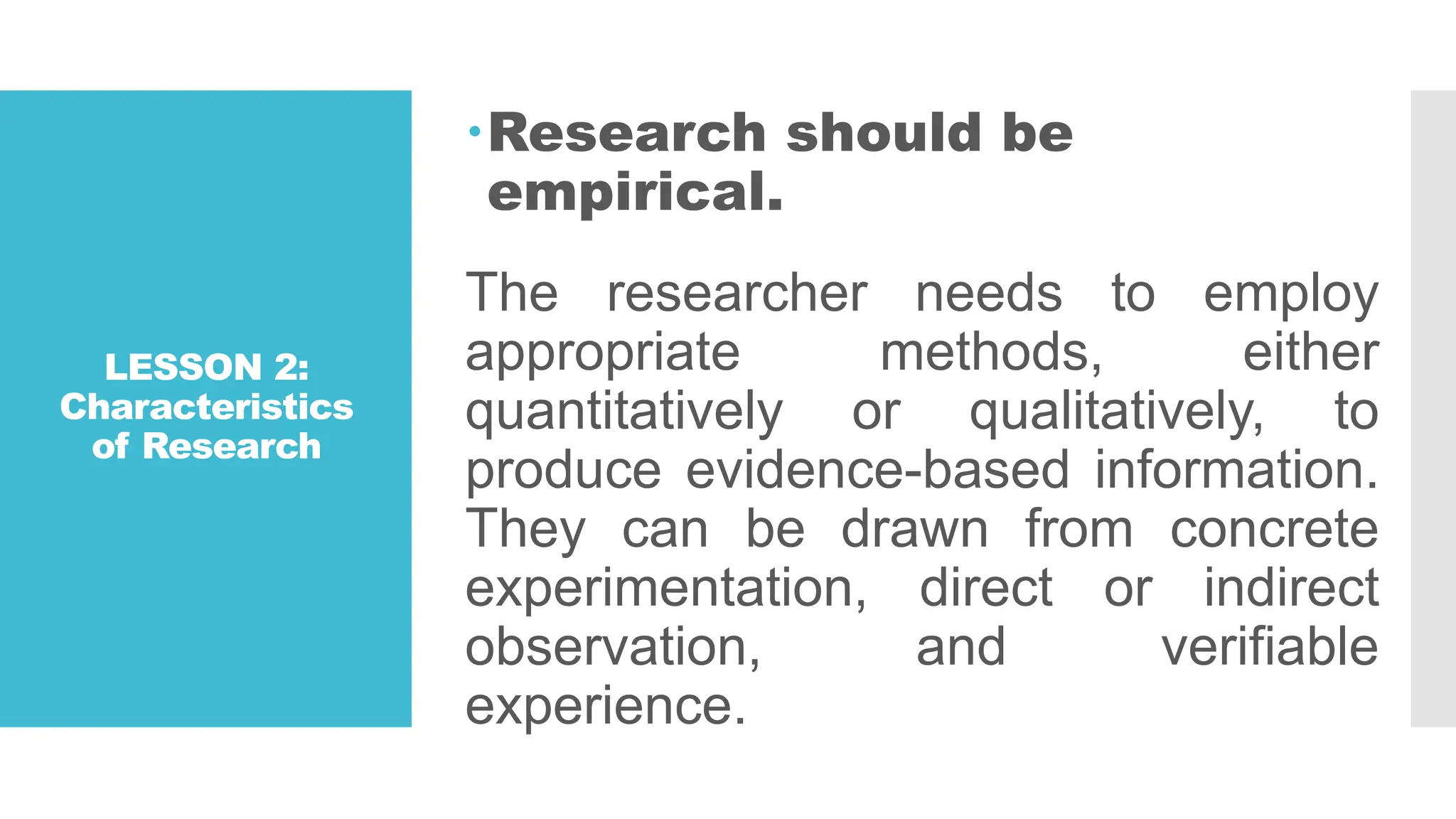
4. Research should be empirical.
5. Research should be clear
LESSON 2:
Characteristics
of Research
•Research should be
systematic.
The researcher needs to carry out a
series of interrelated steps in
conducting the study. Such
procedure must follow a well-
planned, sequential and organized
structure from beginning to end.
LESSON 2:
Characteristics
of Research
 Research should be
objective.
The researcher needs to present
information that are purely based on
truths. It should always be anchored
on the factual basis in which the
research work is founded, thus being
free from any bias or personal
opinion.
LESSON 2:
Characteristics
of Research
Research should be
feasible.
The researcher needs to consider
the possibility and practicality of
conducting the proposed study. All
significant factors like time, budget
and access to resources must be
analyzed to determine if the
research can actually be done.
LESSON 2:
Characteristics
of Research
Research should be
empirical.
The researcher needs to employ
appropriate methods, either
quantitatively or qualitatively, to
produce evidence-based information.
They can be drawn from concrete
experimentation, direct or indirect
observation, and verifiable
experience.
LESSON 2:
Characteristics
of Research
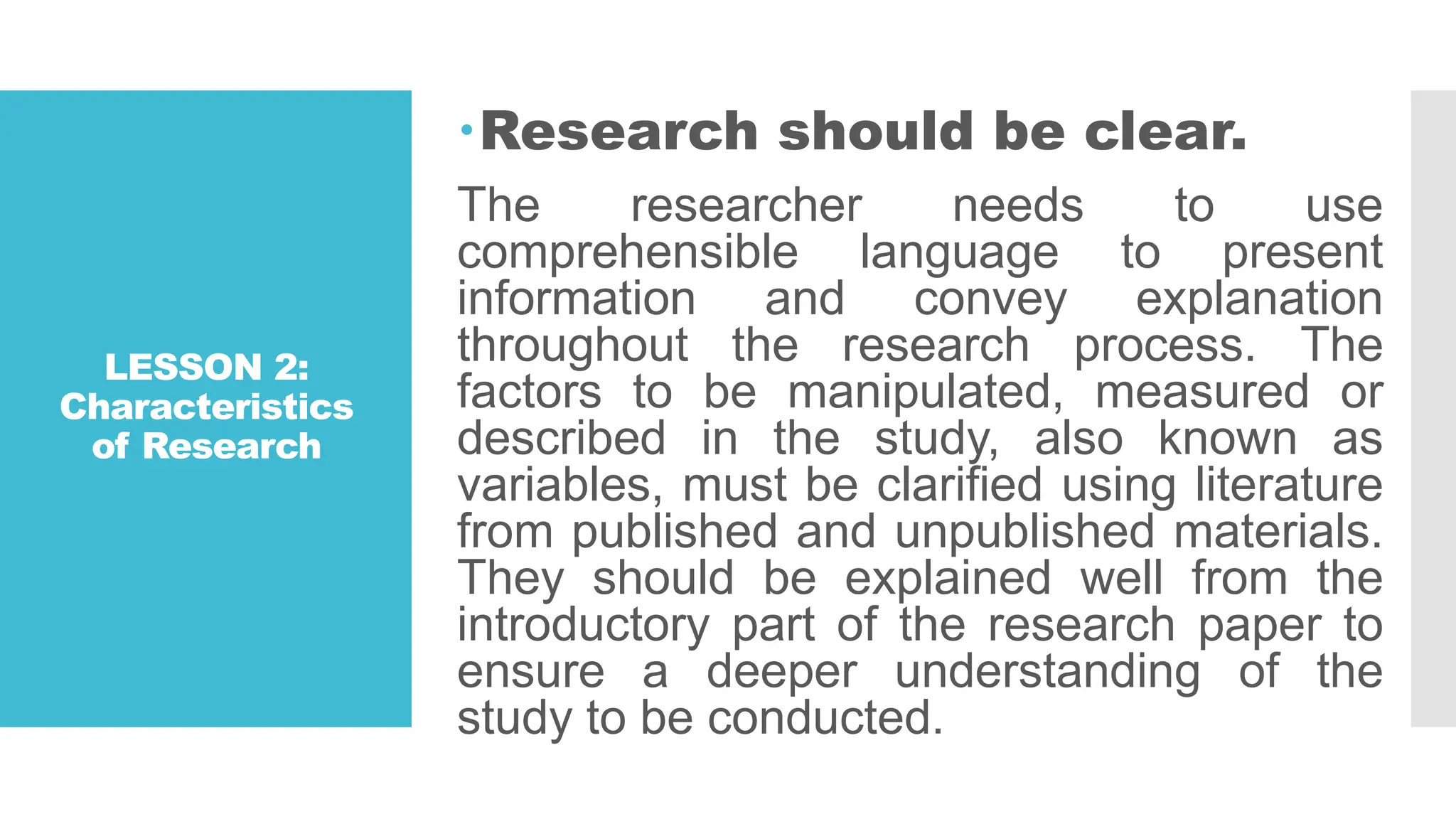
Research should be clear.
The researcher needs to use
comprehensible language to present
information and convey explanation
throughout the research process. The
factors to be manipulated, measured or
described in the study, also known as
variables, must be clarified using literature
from published and unpublished materials.
They should be explained well from the
introductory part of the research paper to
ensure a deeper understanding of the
study to be conducted.
LESSON 3:The
Research
Process
Process refers to a series of
steps or actions taken to achieve
a particular end or goal.
LESSON 3:The
Research
Process
The Research Process
Research process is a systematic manner
in which the researcher approaches
his/her area of study to produce
knowledge that the community will
consider to be worthwhile within the
field (Rao, 2017).
LESSON 3:The
Research
Process
The Research Process
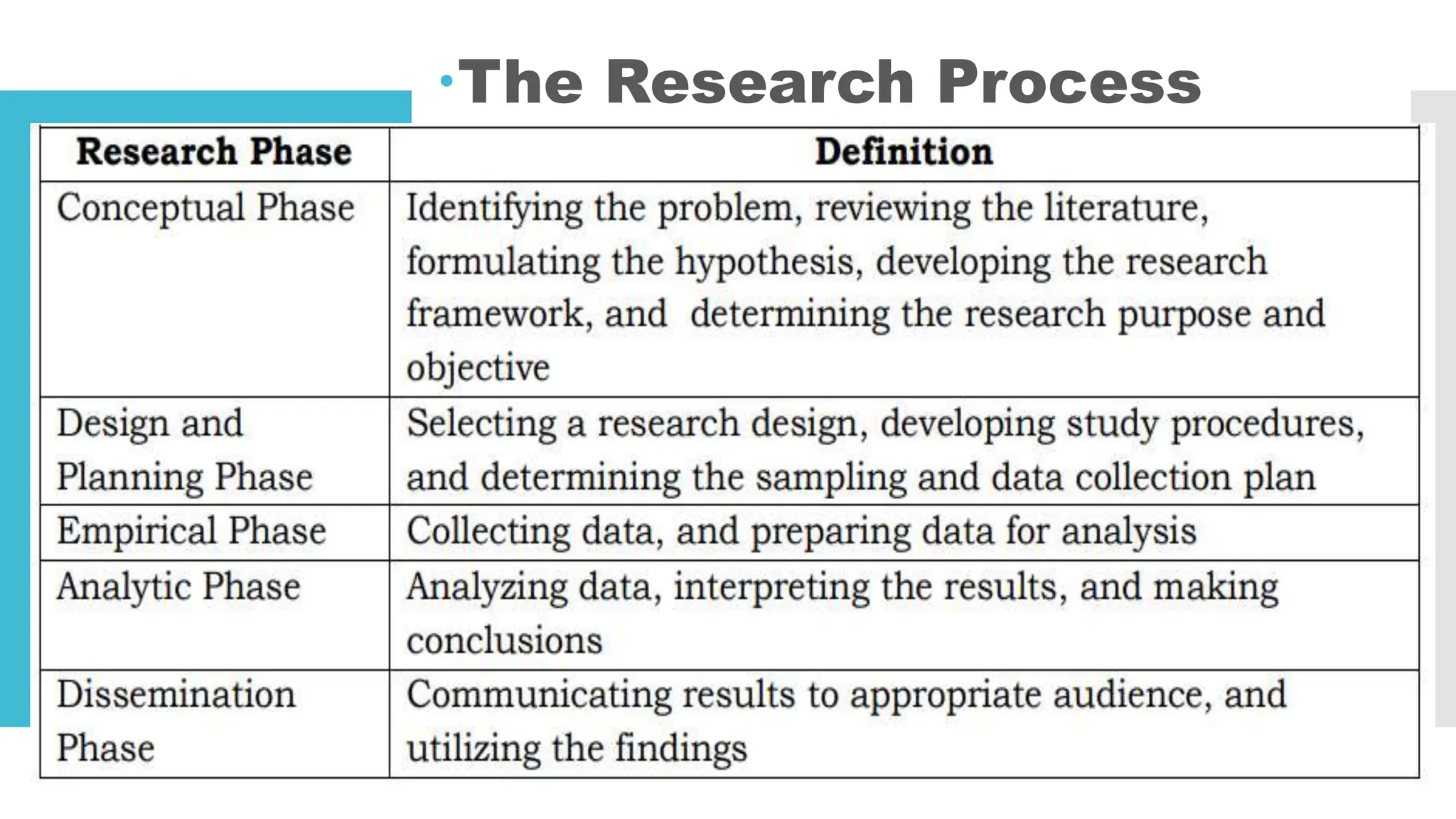
Understanding such process is an
important step towards executing any
study. The following table shows the
five phases of the research process
along with their definition (Whittemore
& Melkus, 2008).
LESSON 3:The
Research
Process
The Research Process
LESSON 3:The
Research
Process
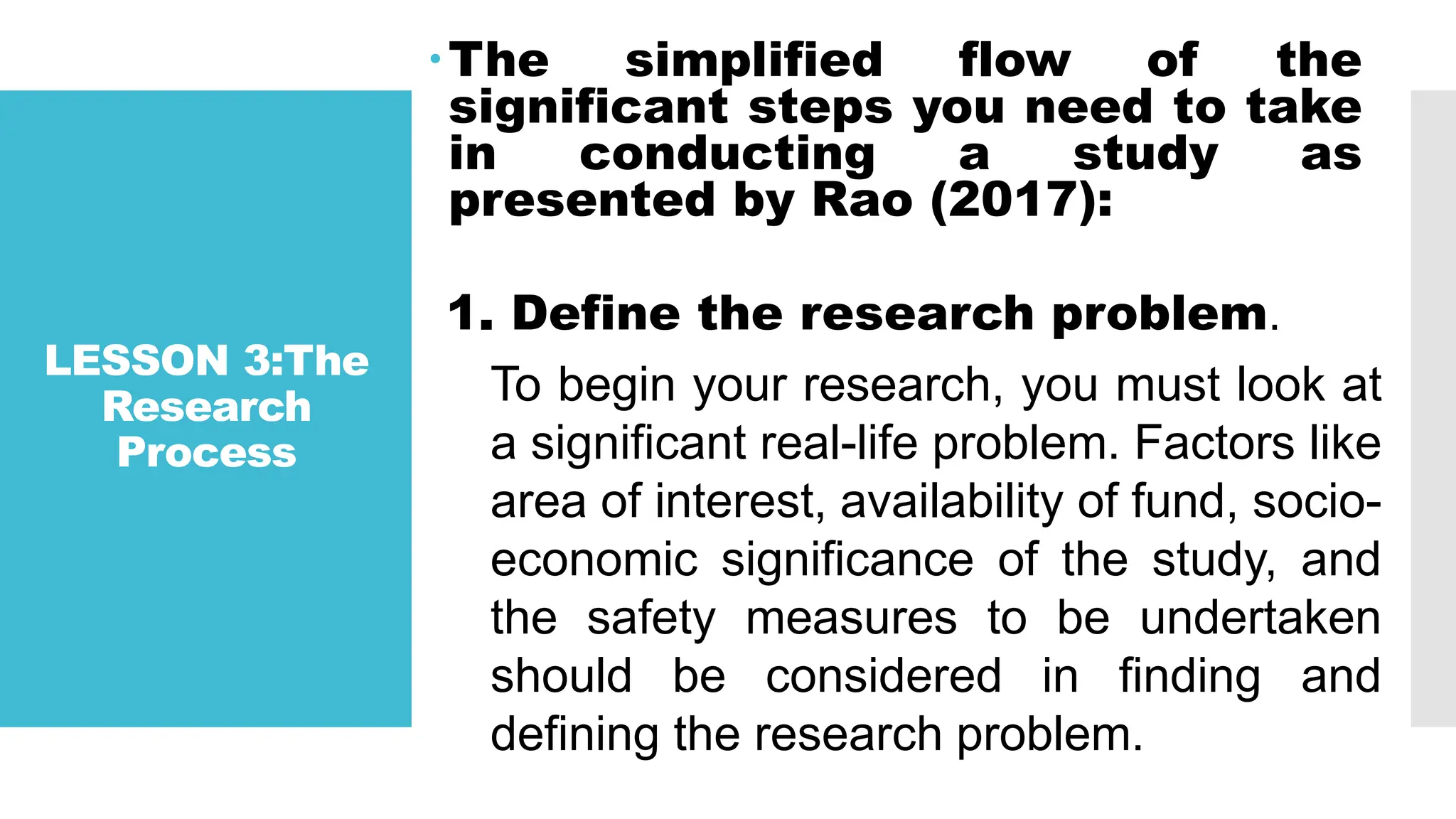
The simplified flow of the
significant steps you need to take
in conducting a study as
presented by Rao (2017):
1. Define the research problem.
To begin your research, you must look at
a significant real-life problem. Factors like
area of interest, availability of fund, socio-
economic significance of the study, and
the safety measures to be undertaken
should be considered in finding and
defining the research problem.
LESSON 3:The
Research
Process
The simplified flow of the
significant steps you need to take
in conducting a study as
presented by Rao (2017):
2. Review the literature.
Read various publications or surf the
internet to become aware of the
previous works already done about
the chosen topic. You may utilize
different resources like science books,
magazines, journals, newspapers, or
even in the internet.
LESSON 3:The
Research
Process
The simplified flow of the
significant steps you need to take
in conducting a study as
presented by Rao (2017):
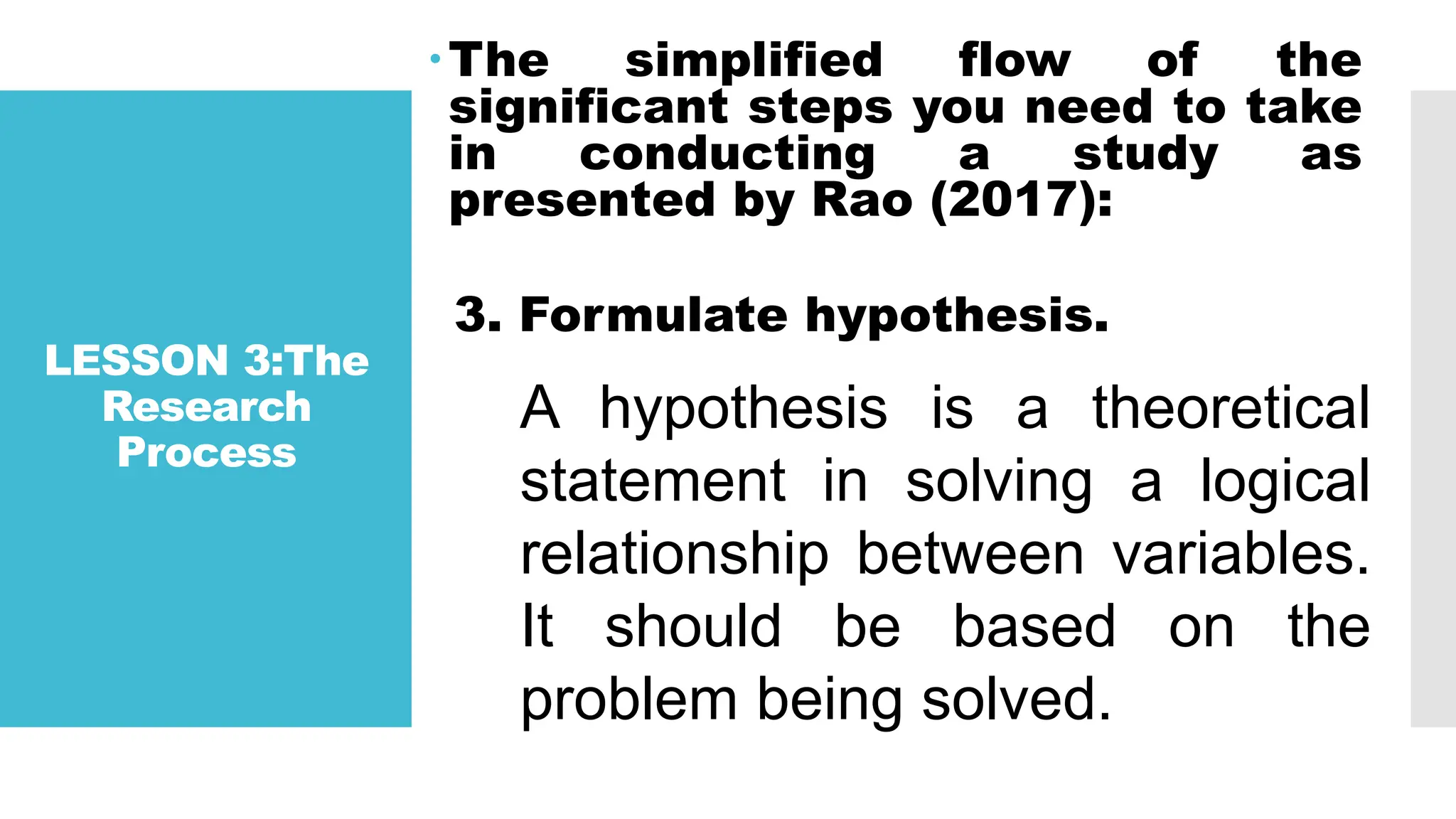
3. Formulate hypothesis.
A hypothesis is a theoretical
statement in solving a logical
relationship between variables.
It should be based on the
problem being solved.
LESSON 3:The
Research
Process
The simplified flow of the
significant steps you need to take
in conducting a study as
presented by Rao (2017):
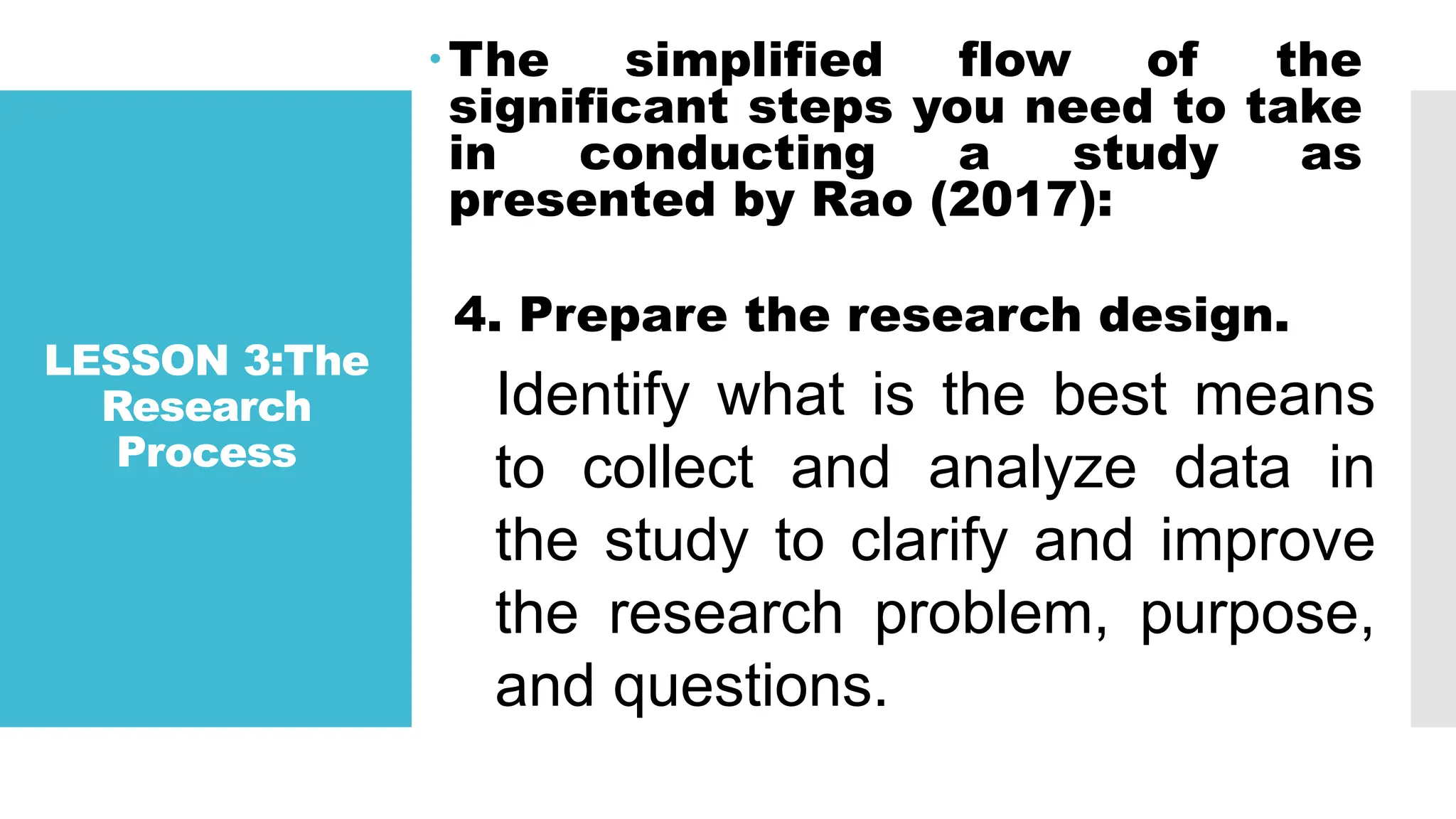
4. Prepare the research design.
Identify what is the best means
to collect and analyze data in
the study to clarify and improve
the research problem, purpose,
and questions.
LESSON 3:The
Research
Process
The simplified flow of the
significant steps you need to take
in conducting a study as
presented by Rao (2017):
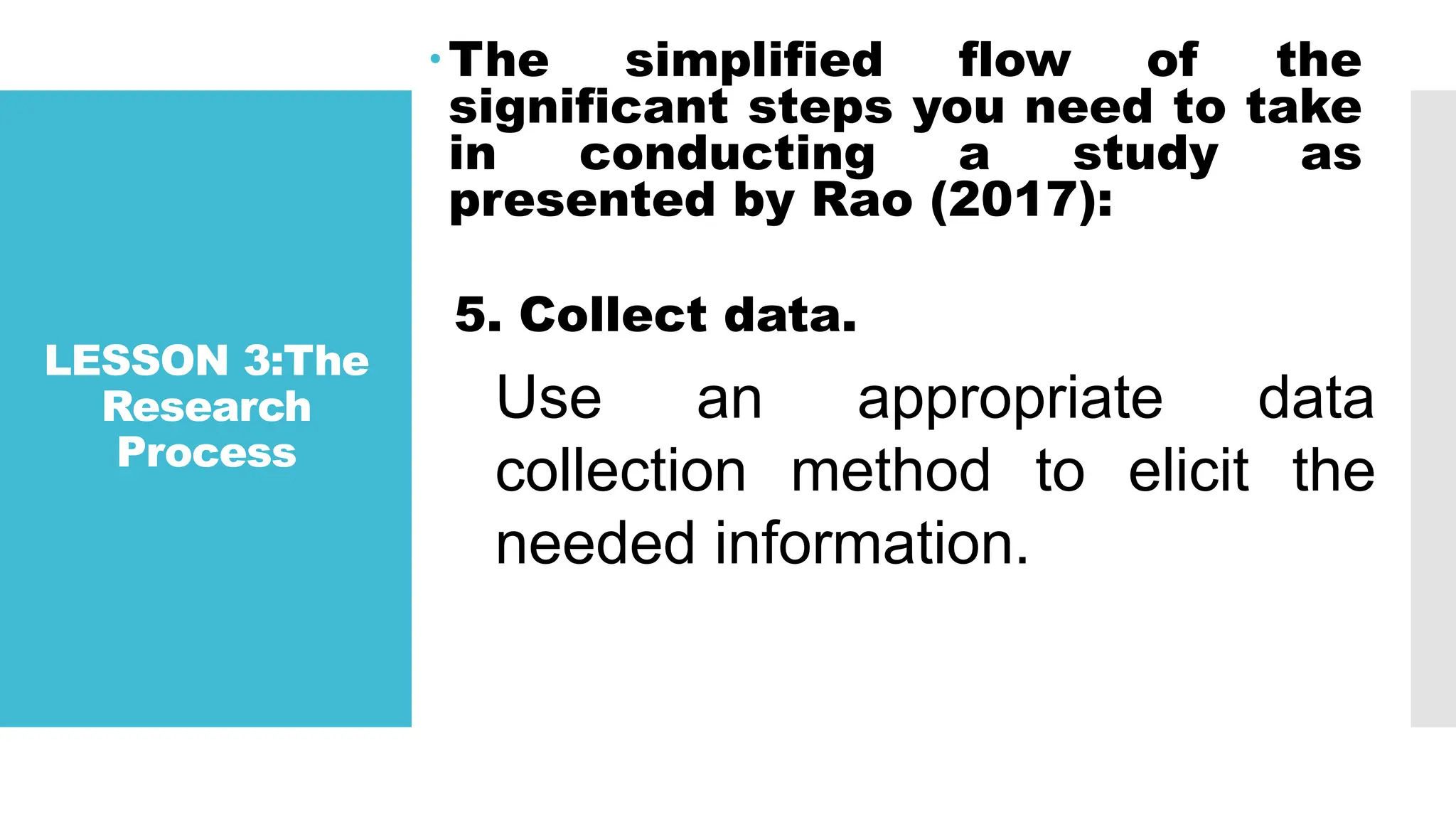
5. Collect data.
Use an appropriate data
collection method to elicit the
needed information.
LESSON 3:The
Research
Process
The simplified flow of the
significant steps you need to take
in conducting a study as
presented by Rao (2017):
6. Analyze data.
Utilize strategies and methods
that make sense of the data to
answer the research problem.
LESSON 3:The
Research
Process
The simplified flow of the
significant steps you need to take
in conducting a study as
presented by Rao (2017):
7. Interpret and report the findings.
Put the information in
perspective and present the
solution to the proposed
problem based on the findings of
the investigation.
LESSON 3:The
Research
Process
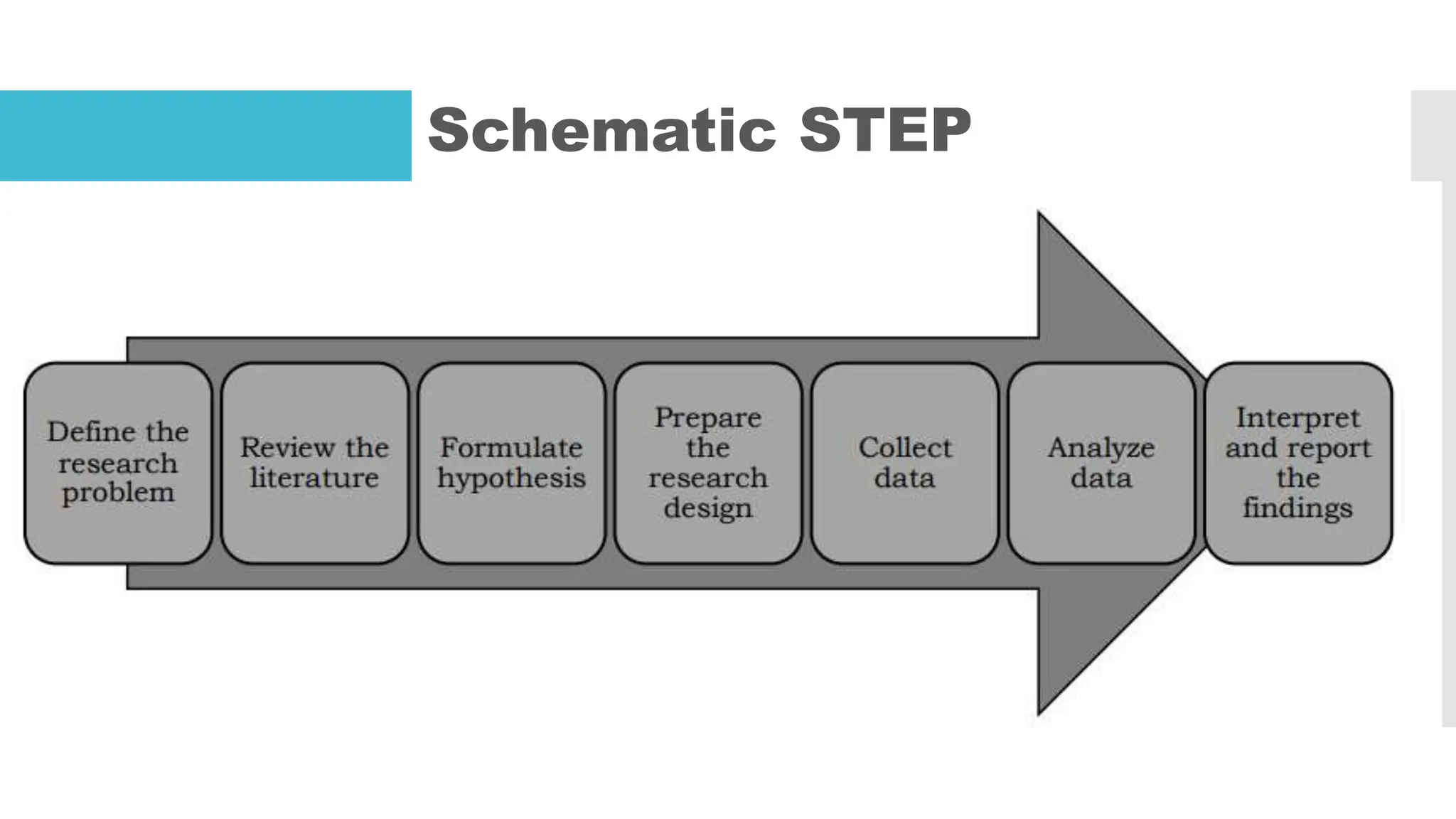
Schematic STEP
PRACTICAL RESEARCH LESSON 2.pptx

PRACTICAL RESEARCH LESSON 2.pptx

  • 1.
    PRACTICAL RESEARCH Senior High SchoolGrade 11 LESSON 2: Characteristics of Research
  • 2.
    LESSON 2: Characteristics of Research Characteristics Arefeatures or qualities that distinguish a person, place, or thing.
  • 4.
    LESSON 2: Characteristics of Research Characteristicsof Research (Cristobal & Cristobal, 2017) 1. Research should be systematic. 2. Research should be objective. . 3. Research should be feasible. 4. Research should be empirical. 5. Research should be clear
  • 5.
    LESSON 2: Characteristics of Research •Researchshould be systematic. The researcher needs to carry out a series of interrelated steps in conducting the study. Such procedure must follow a well- planned, sequential and organized structure from beginning to end.
  • 6.
    LESSON 2: Characteristics of Research Research should be objective. The researcher needs to present information that are purely based on truths. It should always be anchored on the factual basis in which the research work is founded, thus being free from any bias or personal opinion.
  • 7.
    LESSON 2: Characteristics of Research Researchshould be feasible. The researcher needs to consider the possibility and practicality of conducting the proposed study. All significant factors like time, budget and access to resources must be analyzed to determine if the research can actually be done.
  • 8.
    LESSON 2: Characteristics of Research Researchshould be empirical. The researcher needs to employ appropriate methods, either quantitatively or qualitatively, to produce evidence-based information. They can be drawn from concrete experimentation, direct or indirect observation, and verifiable experience.
  • 9.
    LESSON 2: Characteristics of Research Researchshould be clear. The researcher needs to use comprehensible language to present information and convey explanation throughout the research process. The factors to be manipulated, measured or described in the study, also known as variables, must be clarified using literature from published and unpublished materials. They should be explained well from the introductory part of the research paper to ensure a deeper understanding of the study to be conducted.
  • 13.
    LESSON 3:The Research Process Process refersto a series of steps or actions taken to achieve a particular end or goal.
  • 14.
    LESSON 3:The Research Process The ResearchProcess Research process is a systematic manner in which the researcher approaches his/her area of study to produce knowledge that the community will consider to be worthwhile within the field (Rao, 2017).
  • 15.
    LESSON 3:The Research Process The ResearchProcess Understanding such process is an important step towards executing any study. The following table shows the five phases of the research process along with their definition (Whittemore & Melkus, 2008).
  • 16.
  • 17.
    LESSON 3:The Research Process The simplifiedflow of the significant steps you need to take in conducting a study as presented by Rao (2017): 1. Define the research problem. To begin your research, you must look at a significant real-life problem. Factors like area of interest, availability of fund, socio- economic significance of the study, and the safety measures to be undertaken should be considered in finding and defining the research problem.
  • 18.
    LESSON 3:The Research Process The simplifiedflow of the significant steps you need to take in conducting a study as presented by Rao (2017): 2. Review the literature. Read various publications or surf the internet to become aware of the previous works already done about the chosen topic. You may utilize different resources like science books, magazines, journals, newspapers, or even in the internet.
  • 19.
    LESSON 3:The Research Process The simplifiedflow of the significant steps you need to take in conducting a study as presented by Rao (2017): 3. Formulate hypothesis. A hypothesis is a theoretical statement in solving a logical relationship between variables. It should be based on the problem being solved.
  • 20.
    LESSON 3:The Research Process The simplifiedflow of the significant steps you need to take in conducting a study as presented by Rao (2017): 4. Prepare the research design. Identify what is the best means to collect and analyze data in the study to clarify and improve the research problem, purpose, and questions.
  • 21.
    LESSON 3:The Research Process The simplifiedflow of the significant steps you need to take in conducting a study as presented by Rao (2017): 5. Collect data. Use an appropriate data collection method to elicit the needed information.
  • 22.
    LESSON 3:The Research Process The simplifiedflow of the significant steps you need to take in conducting a study as presented by Rao (2017): 6. Analyze data. Utilize strategies and methods that make sense of the data to answer the research problem.
  • 23.
    LESSON 3:The Research Process The simplifiedflow of the significant steps you need to take in conducting a study as presented by Rao (2017): 7. Interpret and report the findings. Put the information in perspective and present the solution to the proposed problem based on the findings of the investigation.
  • 24.