Grade 9 – Mathematics
Quarter I
SOLVING QUADRATIC
EQUATIONS BY FACTORING
& QUADRATIC FORMULA
OBJECTIVES:
•solve quadratic equations by factoring in the
form 𝑎𝑥2 + bx = 0; and 𝑎𝑥2 + bx + c = 0.
•solve quadratic equations using the
quadratic formula.
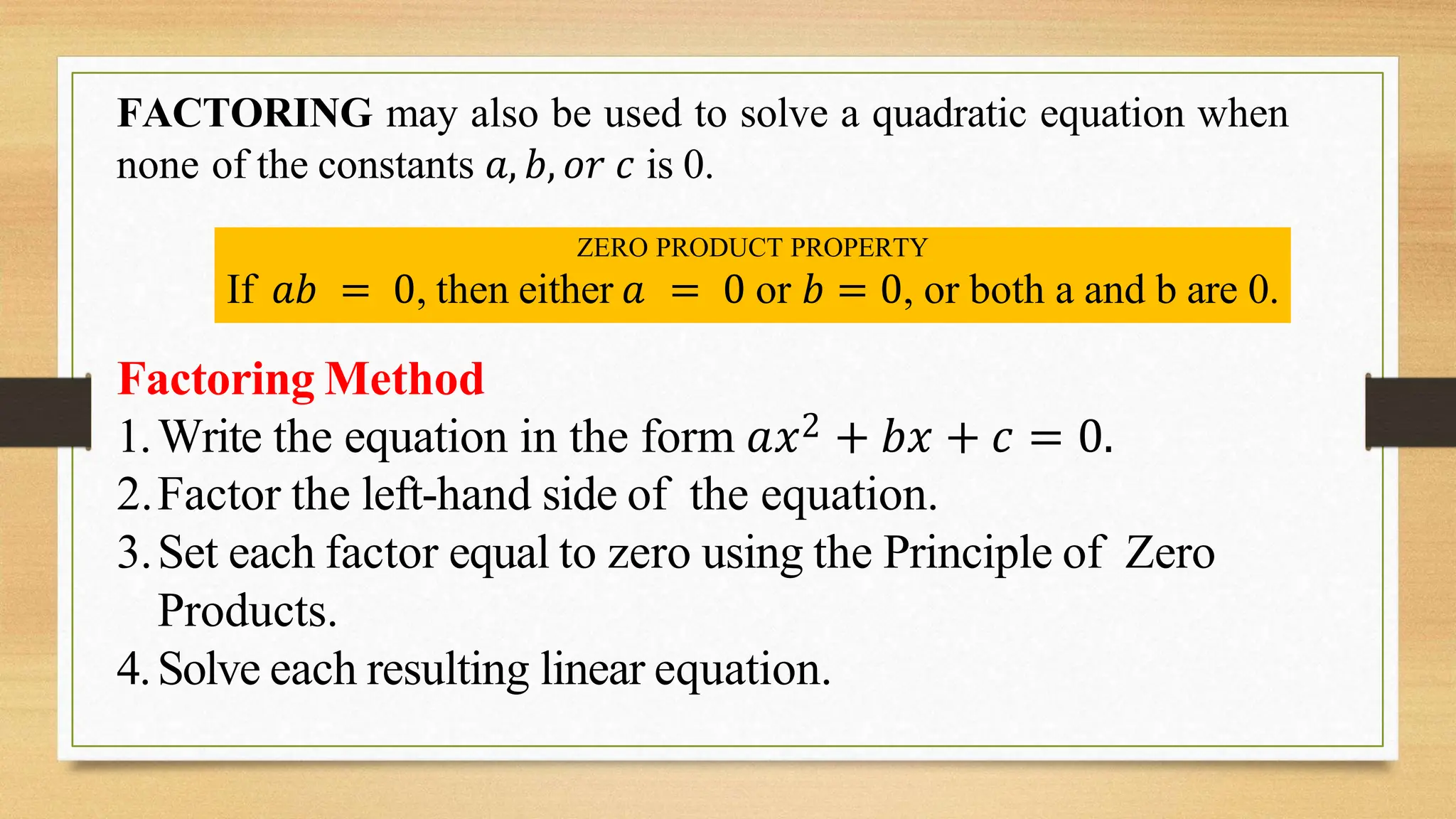
FACTORING may also be used to solve a quadratic equation when
none of the constants 𝑎, 𝑏, 𝑜𝑟 𝑐 is 0.
ZERO PRODUCT PROPERTY
If 𝑎𝑏 = 0, then either 𝑎 = 0 or 𝑏 = 0, or both a and b are 0.
Factoring Method
1.Write the equation in the form 𝑎𝑥2 + 𝑏𝑥 + 𝑐 = 0.
2.Factor the left-hand side of the equation.
3.Set each factor equal to zero using the Principle of Zero
Products.
4.Solve each resulting linear equation.
Solve. 9𝑥2 − 4 = 0
Factor. 3𝑥 + 2 3𝑥 − 2 = 0
Set each factor to 0. 3x + 2 = 0
3𝑥 = −2
2
𝑥 = −
3
3x − 2 = 0
3x = 2
2
𝑥 =
3
FACTORING THE
DIFFERENCE OF
TWO SQUARES
TAKE NOTE:
(a + b) and (a – b) are sum and
difference of two terms
respectively. Their product
a2 − b2 is a difference of two
squares
Solve.2𝑥2 − 5𝑥 − 3 = 0
Factor.
Set each factor to 0. x − 3 = 0
x = 3
2x + 1 = 0
2𝑥 = −1
1
𝑥 = −
2
− 3
1 x
2x = 0
+
FACTORING
GENERAL
TRINOMIAL
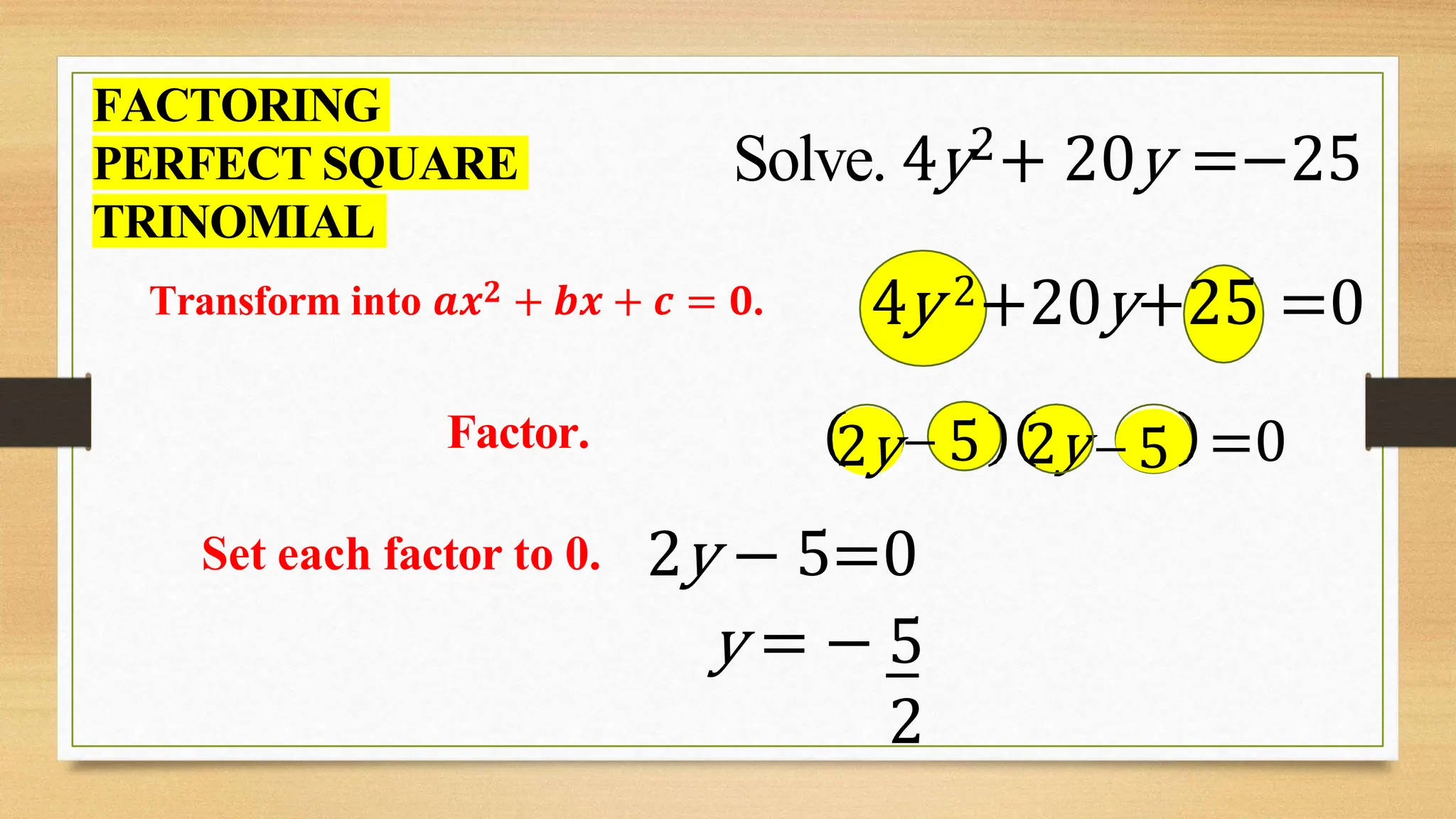
5 2y
Solve. 4y2+ 20y =−25
Transform into 𝒂𝒙𝟐 + 𝒃𝒙 + 𝒄 = 𝟎.
Factor. 5
2y
4y 2+20y+25 =0
Set each factor to 0. 2y − 5=0
y = − 5
2
FACTORING
PERFECT SQUARE
TRINOMIAL
− −
−
=0
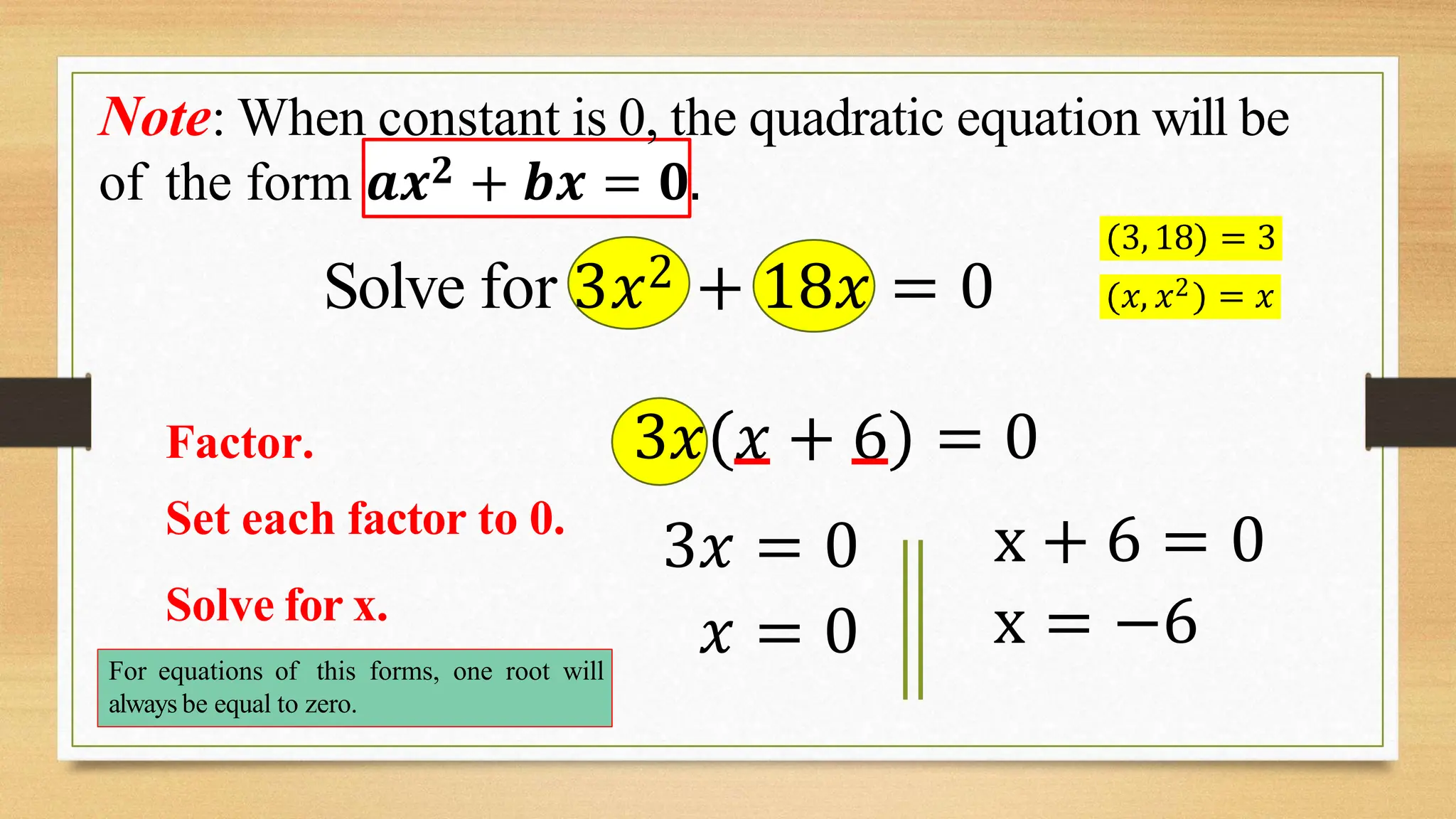
Note: When constant is 0, the quadratic equation will be
of the form 𝒂𝒙𝟐 + 𝒃𝒙 = 𝟎.
Solve for 3𝑥2 + 18𝑥 = 0
Factor.
Set each factor to 0.
Solve for x.
3𝑥 𝑥 + 6 = 0
3𝑥 = 0 x + 6 = 0
𝑥 = 0 x = −6
For equations of this forms, one root will
always be equal to zero.
3, 18 = 3
𝑥, 𝑥2 = 𝑥
Solve for 4𝑥2 − 2𝑥 = 0
Factor. 2𝑥 2𝑥 − 1 = 0
Set each factor to 0.
Solve for x.
2𝑥 = 0
𝑥 = 0
2x − 1 = 0
2x = 1
4, 2 = 2
𝑥, 𝑥2 = 𝑥
1
x =
2
The roots of quadratic equation of the form
𝒂
𝑎𝑥2 + 𝑏𝑥 = 0 are 𝒙 = 𝟎 and 𝒙 = −𝒃
.
𝑆𝑜𝑙𝑣𝑒. 7𝑥2 + 18𝑥 = 10𝑥2 + 12𝑥
7𝑥2 − 10𝑥2 + 18𝑥 − 12𝑥 = 0
−3𝑥2 + 6𝑥 = 0
𝒂
𝒙 = 𝟎 and 𝒙 = −𝒃
. 𝑎
−𝑏 −6
𝑥 = = = 2
−3
𝒙 = 𝟎 𝒙 = 𝟐
Solve the equations without factoring, Instead, use the fact that
𝒂
the roots of 𝑎𝑥2 + 𝑏𝑥 = 0 are 𝒙 = 𝟎 and 𝒙 = −𝒃
.
a. 𝑥2 + 3𝑥 = 0
b. 2𝑥2 + 8𝑥 = 0
c. 9𝑥2 − 𝑥 = 0
d. 4𝑥2 − 10𝑥 = 0
thus, 𝑥 = 0 and 𝑥 = −3.
thus, 𝑥 = 0 and 𝑥 = −4.
9
thus, 𝑥 = 0 and 𝑥 = 1
.
thus, 𝑥 = 0 and 𝑥 =
5
2
.
QUADRATIC FORMULA
𝑥 =
−𝑏 ± 𝑏2 − 4𝑎𝑐
2𝑎
• Write the quadratic equation in general form
• Substitute the value of a, b, and c in the quadratic
formula
• Solve the quadratic equation
Solve: 7𝑥2+18𝑥= − 10
𝑥 =
−𝑏 ± 𝑏2 − 4𝑎𝑐
2𝑎
a = 7; b = 18; c = 10
7𝑥2+18𝑥+10 = 0
𝑥 =
−18 ± 182 − 4(7)(10)
2(7)
𝑥 =
−18 ± 324 − 280
14
𝑥 =
−18 ± 44
14
𝑥 =
−18 ± 4 𝑥 11
14
𝑥 =
−18 ± 2 11
14
𝑥 =
−18 − 2 11
14
𝑥 =
−18 + 2 11
14
or
1st
2nd
3rd 4th
5th 6th 7th
8th

QE by Factoring & Quadratic Formula.pptx

  • 1.
    Grade 9 –Mathematics Quarter I SOLVING QUADRATIC EQUATIONS BY FACTORING & QUADRATIC FORMULA
  • 2.
    OBJECTIVES: •solve quadratic equationsby factoring in the form 𝑎𝑥2 + bx = 0; and 𝑎𝑥2 + bx + c = 0. •solve quadratic equations using the quadratic formula.
  • 3.
    FACTORING may alsobe used to solve a quadratic equation when none of the constants 𝑎, 𝑏, 𝑜𝑟 𝑐 is 0. ZERO PRODUCT PROPERTY If 𝑎𝑏 = 0, then either 𝑎 = 0 or 𝑏 = 0, or both a and b are 0. Factoring Method 1.Write the equation in the form 𝑎𝑥2 + 𝑏𝑥 + 𝑐 = 0. 2.Factor the left-hand side of the equation. 3.Set each factor equal to zero using the Principle of Zero Products. 4.Solve each resulting linear equation.
  • 4.
    Solve. 9𝑥2 −4 = 0 Factor. 3𝑥 + 2 3𝑥 − 2 = 0 Set each factor to 0. 3x + 2 = 0 3𝑥 = −2 2 𝑥 = − 3 3x − 2 = 0 3x = 2 2 𝑥 = 3 FACTORING THE DIFFERENCE OF TWO SQUARES TAKE NOTE: (a + b) and (a – b) are sum and difference of two terms respectively. Their product a2 − b2 is a difference of two squares
  • 5.
    Solve.2𝑥2 − 5𝑥− 3 = 0 Factor. Set each factor to 0. x − 3 = 0 x = 3 2x + 1 = 0 2𝑥 = −1 1 𝑥 = − 2 − 3 1 x 2x = 0 + FACTORING GENERAL TRINOMIAL
  • 6.
    5 2y Solve. 4y2+20y =−25 Transform into 𝒂𝒙𝟐 + 𝒃𝒙 + 𝒄 = 𝟎. Factor. 5 2y 4y 2+20y+25 =0 Set each factor to 0. 2y − 5=0 y = − 5 2 FACTORING PERFECT SQUARE TRINOMIAL − − − =0
  • 7.
    Note: When constantis 0, the quadratic equation will be of the form 𝒂𝒙𝟐 + 𝒃𝒙 = 𝟎. Solve for 3𝑥2 + 18𝑥 = 0 Factor. Set each factor to 0. Solve for x. 3𝑥 𝑥 + 6 = 0 3𝑥 = 0 x + 6 = 0 𝑥 = 0 x = −6 For equations of this forms, one root will always be equal to zero. 3, 18 = 3 𝑥, 𝑥2 = 𝑥
  • 8.
    Solve for 4𝑥2− 2𝑥 = 0 Factor. 2𝑥 2𝑥 − 1 = 0 Set each factor to 0. Solve for x. 2𝑥 = 0 𝑥 = 0 2x − 1 = 0 2x = 1 4, 2 = 2 𝑥, 𝑥2 = 𝑥 1 x = 2 The roots of quadratic equation of the form 𝒂 𝑎𝑥2 + 𝑏𝑥 = 0 are 𝒙 = 𝟎 and 𝒙 = −𝒃 .
  • 9.
    𝑆𝑜𝑙𝑣𝑒. 7𝑥2 +18𝑥 = 10𝑥2 + 12𝑥 7𝑥2 − 10𝑥2 + 18𝑥 − 12𝑥 = 0 −3𝑥2 + 6𝑥 = 0 𝒂 𝒙 = 𝟎 and 𝒙 = −𝒃 . 𝑎 −𝑏 −6 𝑥 = = = 2 −3 𝒙 = 𝟎 𝒙 = 𝟐
  • 10.
    Solve the equationswithout factoring, Instead, use the fact that 𝒂 the roots of 𝑎𝑥2 + 𝑏𝑥 = 0 are 𝒙 = 𝟎 and 𝒙 = −𝒃 . a. 𝑥2 + 3𝑥 = 0 b. 2𝑥2 + 8𝑥 = 0 c. 9𝑥2 − 𝑥 = 0 d. 4𝑥2 − 10𝑥 = 0 thus, 𝑥 = 0 and 𝑥 = −3. thus, 𝑥 = 0 and 𝑥 = −4. 9 thus, 𝑥 = 0 and 𝑥 = 1 . thus, 𝑥 = 0 and 𝑥 = 5 2 .
  • 11.
    QUADRATIC FORMULA 𝑥 = −𝑏± 𝑏2 − 4𝑎𝑐 2𝑎 • Write the quadratic equation in general form • Substitute the value of a, b, and c in the quadratic formula • Solve the quadratic equation
  • 12.
    Solve: 7𝑥2+18𝑥= −10 𝑥 = −𝑏 ± 𝑏2 − 4𝑎𝑐 2𝑎 a = 7; b = 18; c = 10 7𝑥2+18𝑥+10 = 0 𝑥 = −18 ± 182 − 4(7)(10) 2(7) 𝑥 = −18 ± 324 − 280 14 𝑥 = −18 ± 44 14 𝑥 = −18 ± 4 𝑥 11 14 𝑥 = −18 ± 2 11 14 𝑥 = −18 − 2 11 14 𝑥 = −18 + 2 11 14 or 1st 2nd 3rd 4th 5th 6th 7th 8th