OBJECTIVES
At the end of the lesson,
students are expected to:
a. Identify the concepts of using project-based multimedia learning in
education;
b. Create an infographics of the benefits of using project-based multimedia
learning; and
c. Develop positive attitude towards project-based multimedia learning,
recognizing its potential to foster creativity, collaboration, and critical
thinking skills.
WHY USE
PROJECT-BASED
MULTIMEDIA
LEARNING?
Presentation By:
Ma. Shaira L. Valdez
Why should you choose project-
based multimedia learning?
Teaching methods abound—some sound,
some not so sound. If you have been teaching for
many years, you've no doubt seen several new
ways of teaching come into vogue. Some have
taken hold; many have faded away; a few have
become infamous.
The answer lies in the concept of “value
added.” Project-based multimedia learning can
add value to your teaching. In economics, value is
added to a product when it is somehow made
better or more useful to the consumer.
In their book, Teaching the New Basic Skills, Richard
Murnane and Frank Levy (1996) describe three skill sets
students need to be competitive for today's jobs:
1.Hard skills (math, reading, and problem-solving skills
mastered at a much higher level than previously
expected of high school graduates);
2.Soft skills (for example, the ability to work in a group
and to make effective oral and written presentations);
and
3.The ability to use a personal computer to carry out
routine tasks (for example, word processing, data
management, and creating multimedia presentations).
In its 1991 report, the Secretary of
Labor's Commission on Achieving
Necessary Skills (popularly known as
“SCANS”) noted that to find meaningful
work, high school graduates need to
master a combination of foundation
skills and competencies.
Identifying, organizing, planning, and
allocating time, money, materials, and
workers.
Negotiating, exercising leadership, working
with diversity, teaching others new skills,
serving clients and customers, and
participating as a team member.
Selecting technology, applying technology to a
task, and maintaining and troubleshooting
technology.
Required competencies include:
Benefits of Project-based
Multimedia Learning
It is a powerful motivator and engages students
who might otherwise tune out
Students engaged in the creation of multimedia
projects spend more time on task, even to the
point of devoting recess, lunch, and after-school
time to the work.
Benefits of Project-based
Multimedia Learning
The work they do tends to be more complex.
Sharing their final products with peers, parents,
and others affords students an intense sense of
pride and accomplishment that rarely
accompanies the completion of a term paper or
set of textbook exercises.
Using the Project-
Based Multimedia
Learning as a
Teaching Strategy
Being a teacher is a bit like being a personal trainer. In general,
a trainer knows that all clients need a balanced workout. They
need to develop muscular strength, flexibility, and aerobic
fitness. They also need to adhere to a sound, balanced diet. At
the same time, each client will have specific needs or conditions
that require accommodation. The workout you design for your
client with asthma will be different from the one you create for
your client with arthritis.
Likewise, effective teachers employ various teaching methods
to achieve a balanced instructional program that is also
personalized and reflects the needs and interests of individual
students. You know that your students need a balanced diet of
academic content and process skills—and workouts that include
learning, practicing, analyzing, reflecting, and assessing. You
also know that students vary in their comfort with these
activities and the amount of support they need.
Project-based multimedia learning is one instructional
strategy that you can use in a school year that may also
include non-technical projects, lecture and note-taking, rote
practice, writing, and artistic or creative work. During this
part of the year, students may be spending less time on rote
practice and the breadth of material they cover may be
smaller. What they will be doing instead includes:
 Honing their planning and organizational skills;
 Learning to present information in compelling ways;
 Synthesizing and analyzing complex content and data;
 Practicing research and technical skills; and
 Learning how academic subject matter applies to the real
world.
ACTIVITY
Direction:
Create an infographics of the
benefits of project-based
multimedia learning using
graphic design software or any
online tools like Canva.
Evaluation
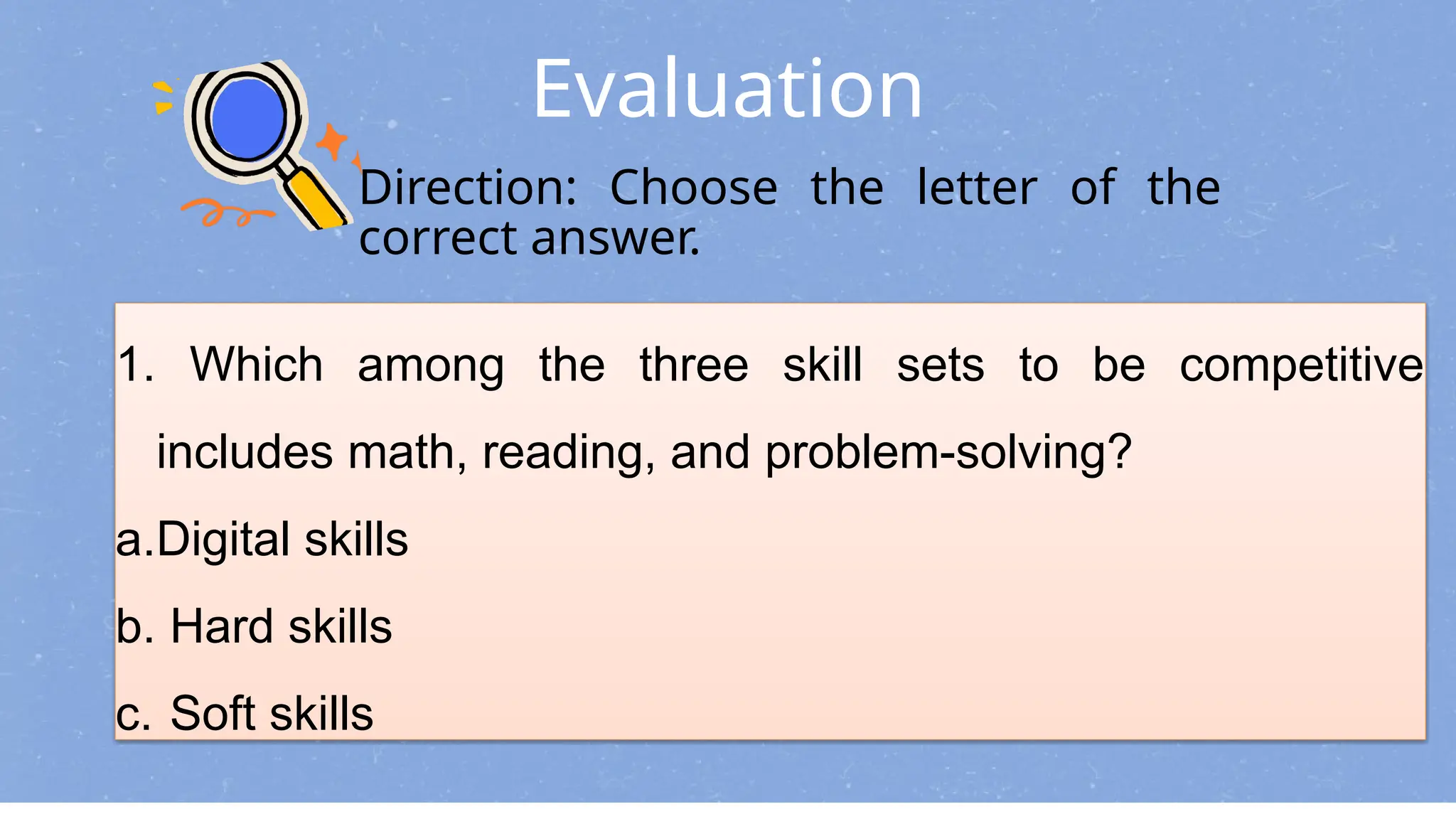
Direction: Choose the letter of the
correct answer.
1. Which among the three skill sets to be competitive
includes math, reading, and problem-solving?
a.Digital skills
b. Hard skills
c. Soft skills
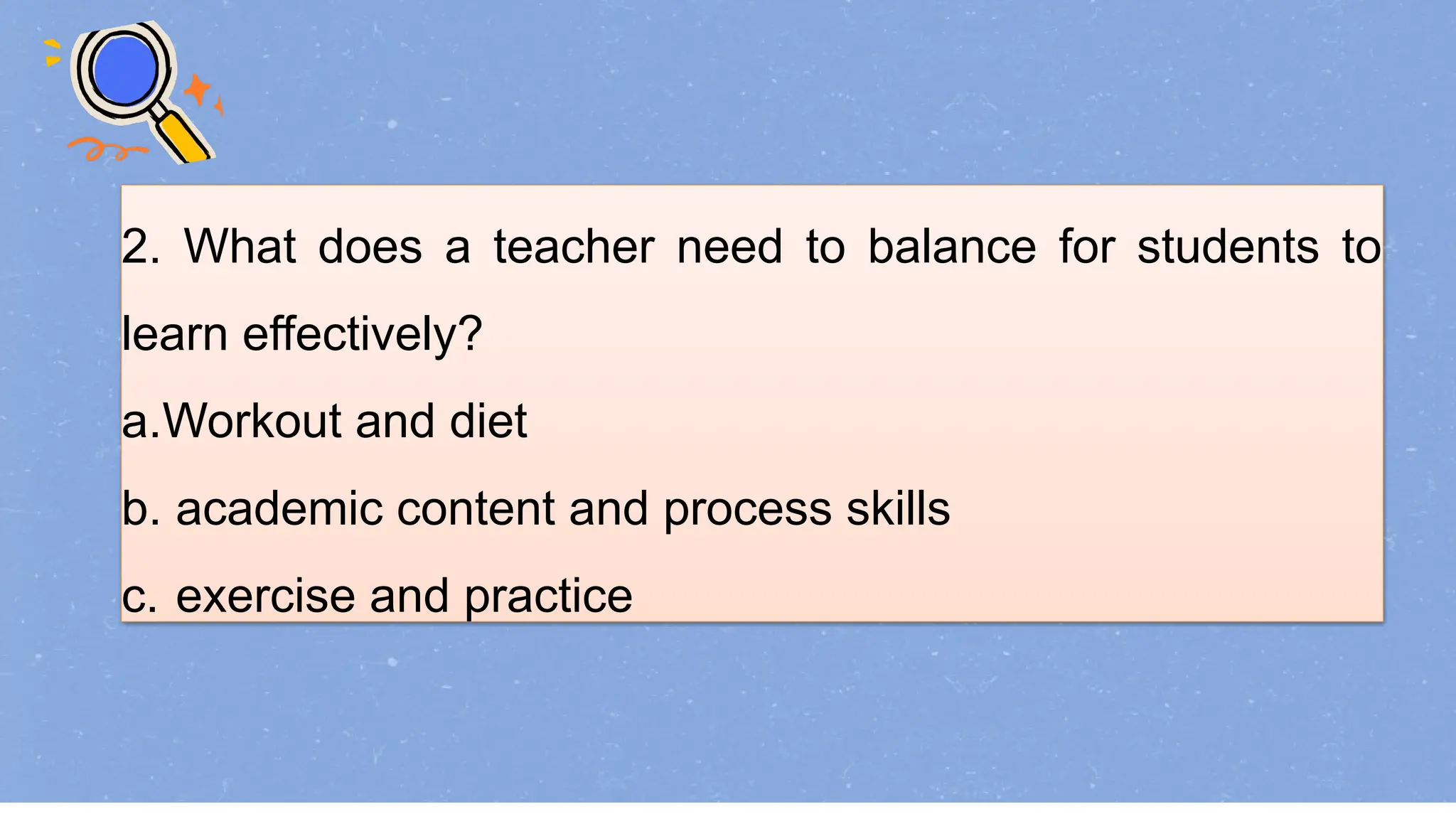
2. What does a teacher need to balance for students to
learn effectively?
a.Workout and diet
b. academic content and process skills
c. exercise and practice
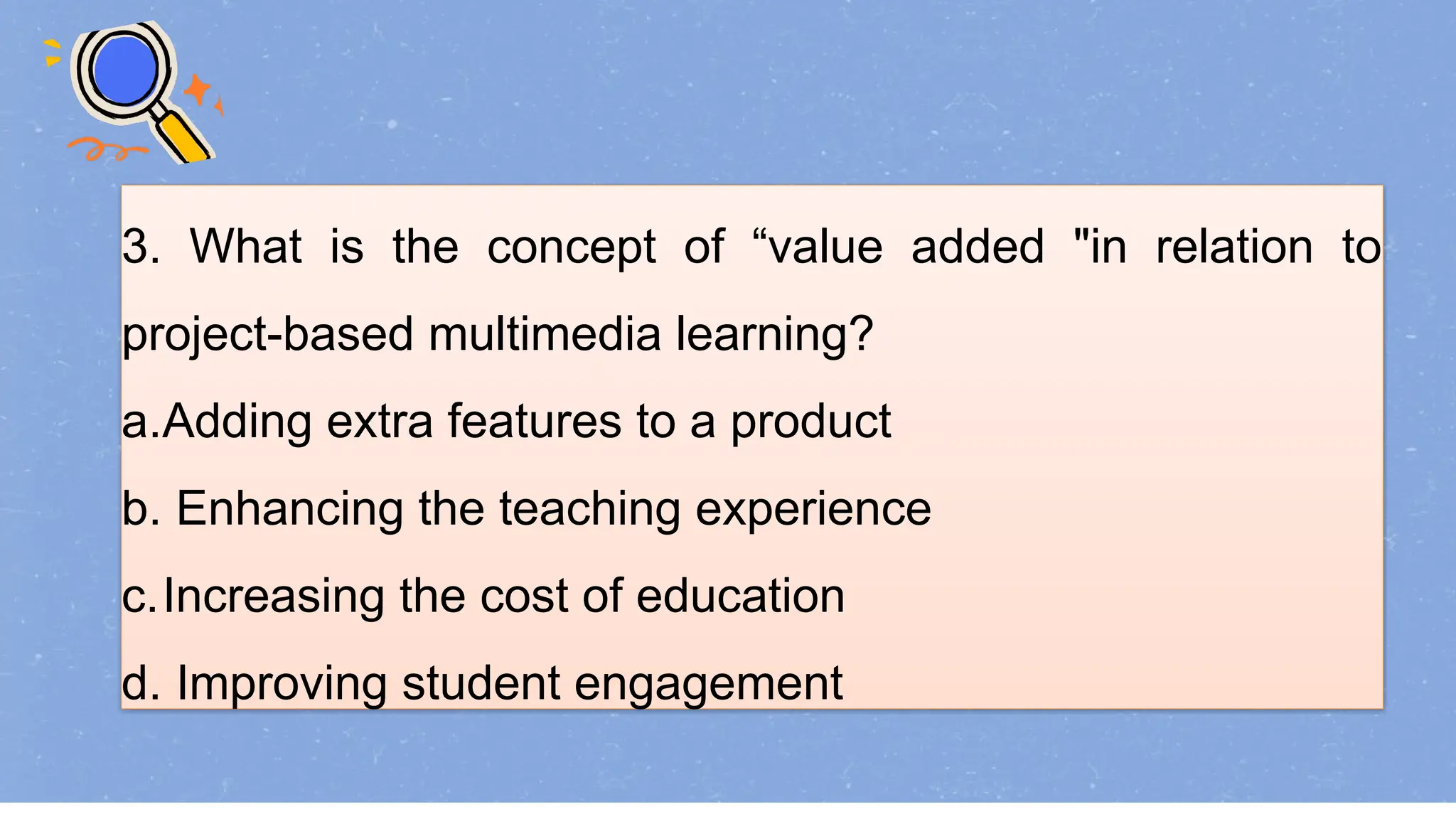
3. What is the concept of “value added "in relation to
project-based multimedia learning?
a.Adding extra features to a product
b. Enhancing the teaching experience
c.Increasing the cost of education
d. Improving student engagement
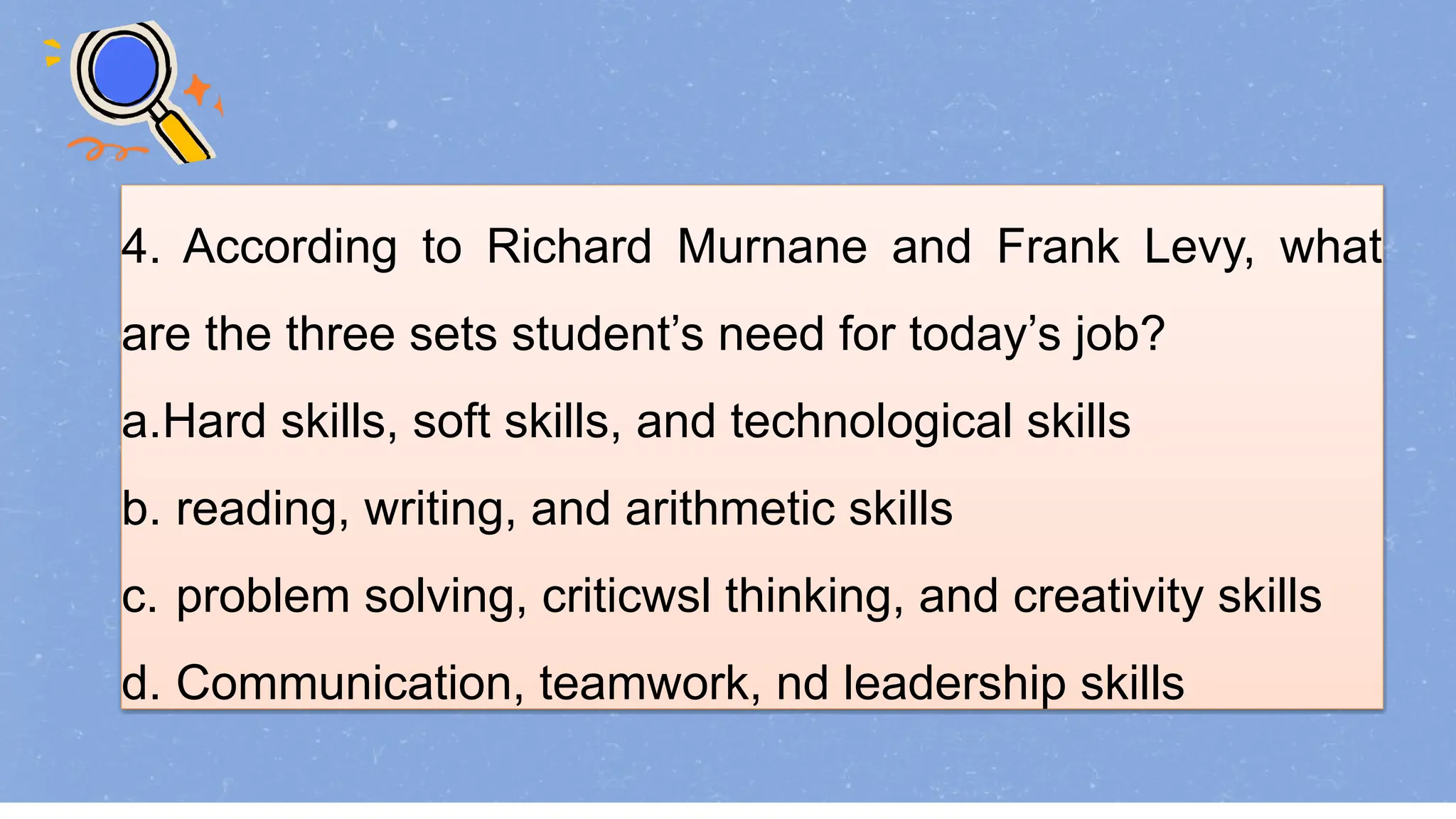
4. According to Richard Murnane and Frank Levy, what
are the three sets student’s need for today’s job?
a.Hard skills, soft skills, and technological skills
b. reading, writing, and arithmetic skills
c. problem solving, criticwsl thinking, and creativity skills
d. Communication, teamwork, nd leadership skills
5. What are some of the foundation skills included in
project-based multimedia learning?
a.Reasoning, decision-making, and problem solving
b.Time management, budgeting, and resource allocation
c. Negotiation, leadership, and teamwork
d. Technology selection
6. How does project-based multimedia learning connect to
the real world?
a.By reducing the breadth of material covered
b. By emphasizing rote practice and memorization
c. By incorporating non-technical projects and creative
work
d. By demonstrating the practical application of academic
content
7. What advantage does project-based multimedia
learning provide teachers?
a.It allows them to have more control over instruction
b. it reduces the need for individualized support
c. it frees up the time for other activities during class
d. it keeps students engaged and motivated
8. How does project-based multimedia learning motivate
students?
a.By providing additional recess and lunch breaks
b. By making the work more complex and challenging
c. by allowing students spend more time on computers
d. By offering a sense of pride and accomplishment
9. Which sets of skills does the ability to work in a group
and to make effective oral and written presentations do
belong
a.Hard skills
b. soft skills
c. computer skills
d. communication skills
10. What is the combination that is necessary for students
to be mastered?
a.Learning and reading
b. Computer and Technology
c. Foundation skills and Competencies
d. communication and reading skills
ASSIGNMENT
Direction:
Create a multimedia presentation
using project-based multimedia
learning strategies, incorporating
various multimedia elements
such as images, videos, and
audio.
THANK YOU
BTLED 3rd
Yr.
H.E & I.A

PROJECT BASED LEARNING demo-TTL-final.pptx

  • 1.
    OBJECTIVES At the endof the lesson, students are expected to: a. Identify the concepts of using project-based multimedia learning in education; b. Create an infographics of the benefits of using project-based multimedia learning; and c. Develop positive attitude towards project-based multimedia learning, recognizing its potential to foster creativity, collaboration, and critical thinking skills.
  • 3.
  • 4.
    Why should youchoose project- based multimedia learning? Teaching methods abound—some sound, some not so sound. If you have been teaching for many years, you've no doubt seen several new ways of teaching come into vogue. Some have taken hold; many have faded away; a few have become infamous. The answer lies in the concept of “value added.” Project-based multimedia learning can add value to your teaching. In economics, value is added to a product when it is somehow made better or more useful to the consumer.
  • 5.
    In their book,Teaching the New Basic Skills, Richard Murnane and Frank Levy (1996) describe three skill sets students need to be competitive for today's jobs: 1.Hard skills (math, reading, and problem-solving skills mastered at a much higher level than previously expected of high school graduates); 2.Soft skills (for example, the ability to work in a group and to make effective oral and written presentations); and 3.The ability to use a personal computer to carry out routine tasks (for example, word processing, data management, and creating multimedia presentations).
  • 6.
    In its 1991report, the Secretary of Labor's Commission on Achieving Necessary Skills (popularly known as “SCANS”) noted that to find meaningful work, high school graduates need to master a combination of foundation skills and competencies.
  • 7.
    Identifying, organizing, planning,and allocating time, money, materials, and workers. Negotiating, exercising leadership, working with diversity, teaching others new skills, serving clients and customers, and participating as a team member. Selecting technology, applying technology to a task, and maintaining and troubleshooting technology. Required competencies include:
  • 8.
    Benefits of Project-based MultimediaLearning It is a powerful motivator and engages students who might otherwise tune out Students engaged in the creation of multimedia projects spend more time on task, even to the point of devoting recess, lunch, and after-school time to the work.
  • 9.
    Benefits of Project-based MultimediaLearning The work they do tends to be more complex. Sharing their final products with peers, parents, and others affords students an intense sense of pride and accomplishment that rarely accompanies the completion of a term paper or set of textbook exercises.
  • 10.
    Using the Project- BasedMultimedia Learning as a Teaching Strategy
  • 11.
    Being a teacheris a bit like being a personal trainer. In general, a trainer knows that all clients need a balanced workout. They need to develop muscular strength, flexibility, and aerobic fitness. They also need to adhere to a sound, balanced diet. At the same time, each client will have specific needs or conditions that require accommodation. The workout you design for your client with asthma will be different from the one you create for your client with arthritis.
  • 12.
    Likewise, effective teachersemploy various teaching methods to achieve a balanced instructional program that is also personalized and reflects the needs and interests of individual students. You know that your students need a balanced diet of academic content and process skills—and workouts that include learning, practicing, analyzing, reflecting, and assessing. You also know that students vary in their comfort with these activities and the amount of support they need.
  • 13.
    Project-based multimedia learningis one instructional strategy that you can use in a school year that may also include non-technical projects, lecture and note-taking, rote practice, writing, and artistic or creative work. During this part of the year, students may be spending less time on rote practice and the breadth of material they cover may be smaller. What they will be doing instead includes:  Honing their planning and organizational skills;  Learning to present information in compelling ways;  Synthesizing and analyzing complex content and data;  Practicing research and technical skills; and  Learning how academic subject matter applies to the real world.
  • 14.
    ACTIVITY Direction: Create an infographicsof the benefits of project-based multimedia learning using graphic design software or any online tools like Canva.
  • 15.
    Evaluation Direction: Choose theletter of the correct answer. 1. Which among the three skill sets to be competitive includes math, reading, and problem-solving? a.Digital skills b. Hard skills c. Soft skills
  • 16.
    2. What doesa teacher need to balance for students to learn effectively? a.Workout and diet b. academic content and process skills c. exercise and practice
  • 17.
    3. What isthe concept of “value added "in relation to project-based multimedia learning? a.Adding extra features to a product b. Enhancing the teaching experience c.Increasing the cost of education d. Improving student engagement
  • 18.
    4. According toRichard Murnane and Frank Levy, what are the three sets student’s need for today’s job? a.Hard skills, soft skills, and technological skills b. reading, writing, and arithmetic skills c. problem solving, criticwsl thinking, and creativity skills d. Communication, teamwork, nd leadership skills
  • 19.
    5. What aresome of the foundation skills included in project-based multimedia learning? a.Reasoning, decision-making, and problem solving b.Time management, budgeting, and resource allocation c. Negotiation, leadership, and teamwork d. Technology selection
  • 20.
    6. How doesproject-based multimedia learning connect to the real world? a.By reducing the breadth of material covered b. By emphasizing rote practice and memorization c. By incorporating non-technical projects and creative work d. By demonstrating the practical application of academic content
  • 21.
    7. What advantagedoes project-based multimedia learning provide teachers? a.It allows them to have more control over instruction b. it reduces the need for individualized support c. it frees up the time for other activities during class d. it keeps students engaged and motivated
  • 22.
    8. How doesproject-based multimedia learning motivate students? a.By providing additional recess and lunch breaks b. By making the work more complex and challenging c. by allowing students spend more time on computers d. By offering a sense of pride and accomplishment
  • 23.
    9. Which setsof skills does the ability to work in a group and to make effective oral and written presentations do belong a.Hard skills b. soft skills c. computer skills d. communication skills
  • 24.
    10. What isthe combination that is necessary for students to be mastered? a.Learning and reading b. Computer and Technology c. Foundation skills and Competencies d. communication and reading skills
  • 25.
    ASSIGNMENT Direction: Create a multimediapresentation using project-based multimedia learning strategies, incorporating various multimedia elements such as images, videos, and audio.
  • 26.