



Section	2.5
                 The	Chain	Rule

                 V63.0121.027, Calculus	I


                      October	6, 2009


Announcements
   Quiz	2	this	week
   Midterm in	class	on	§§1.1–1.4

                                        .   .   .   .   .   .
Compositions
See	Section	1.2	for	review


     Definition
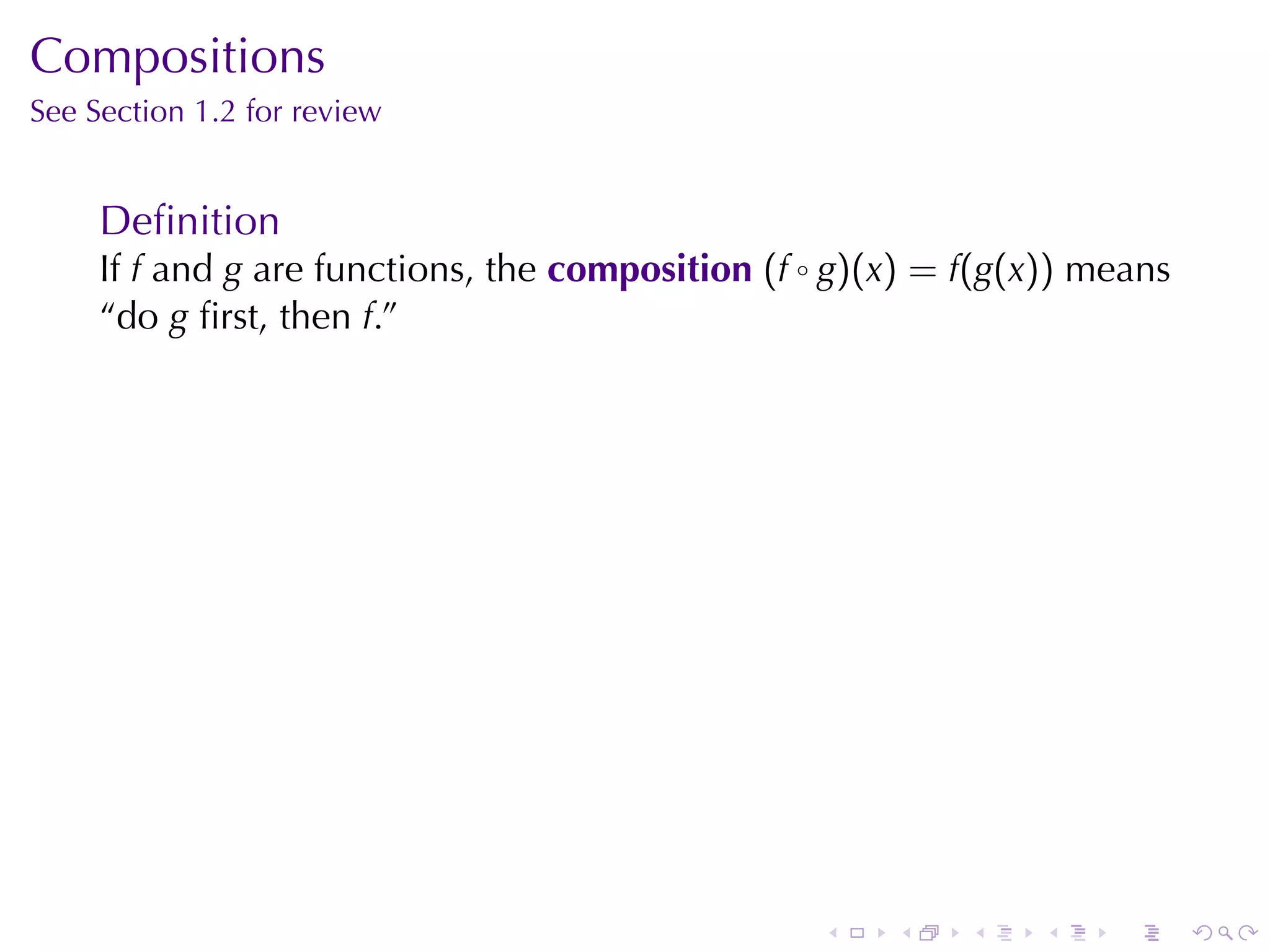
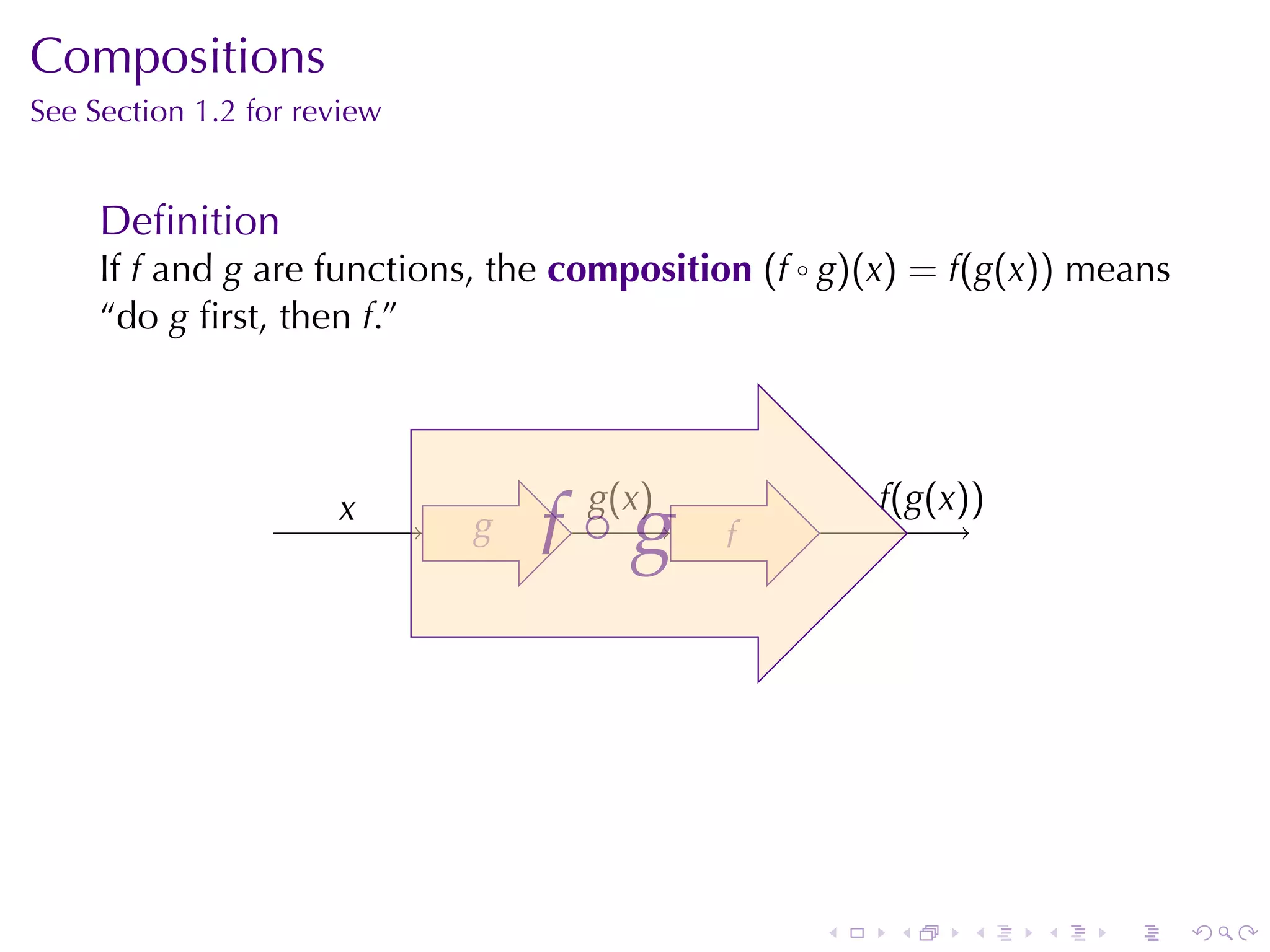
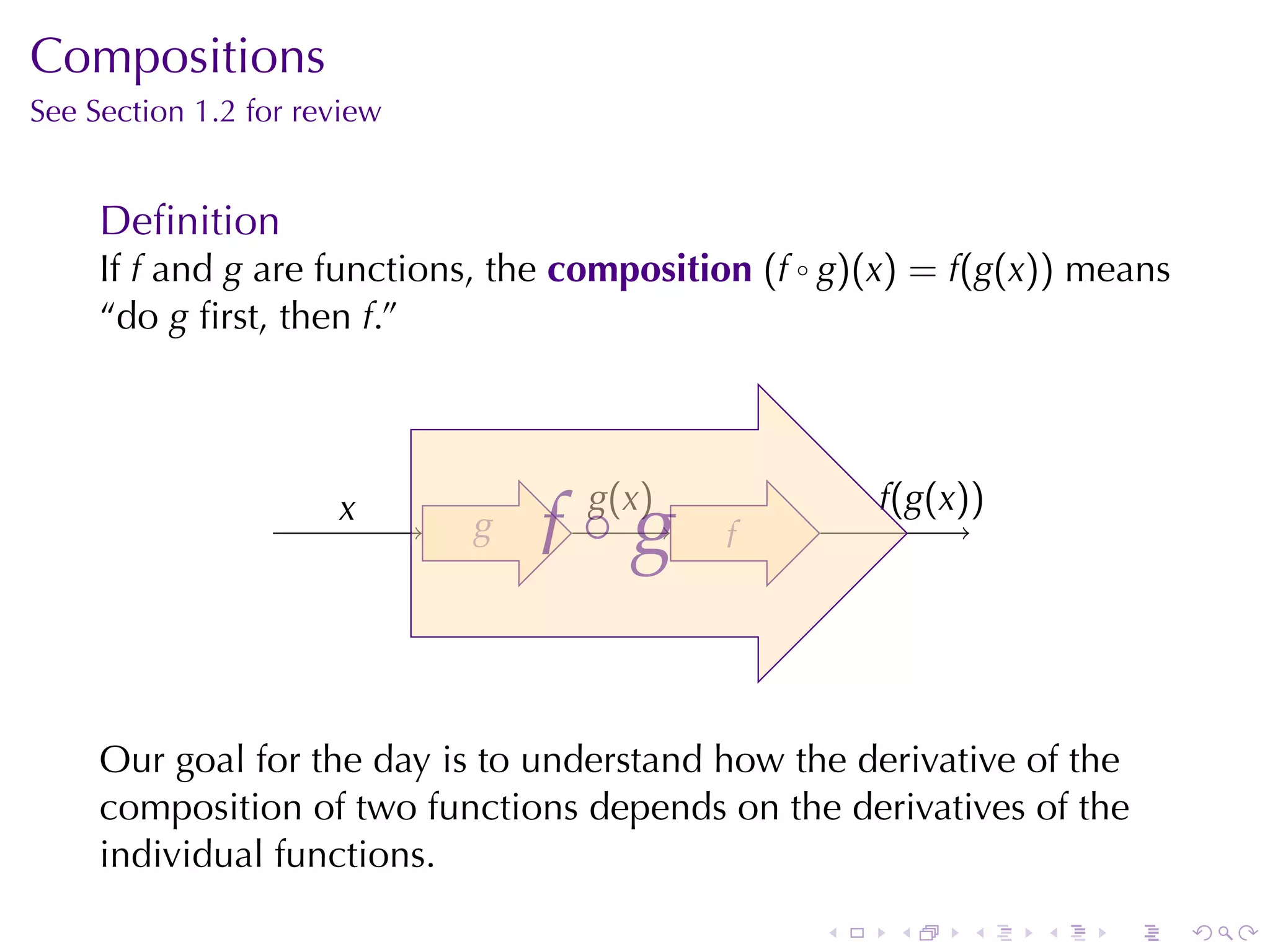
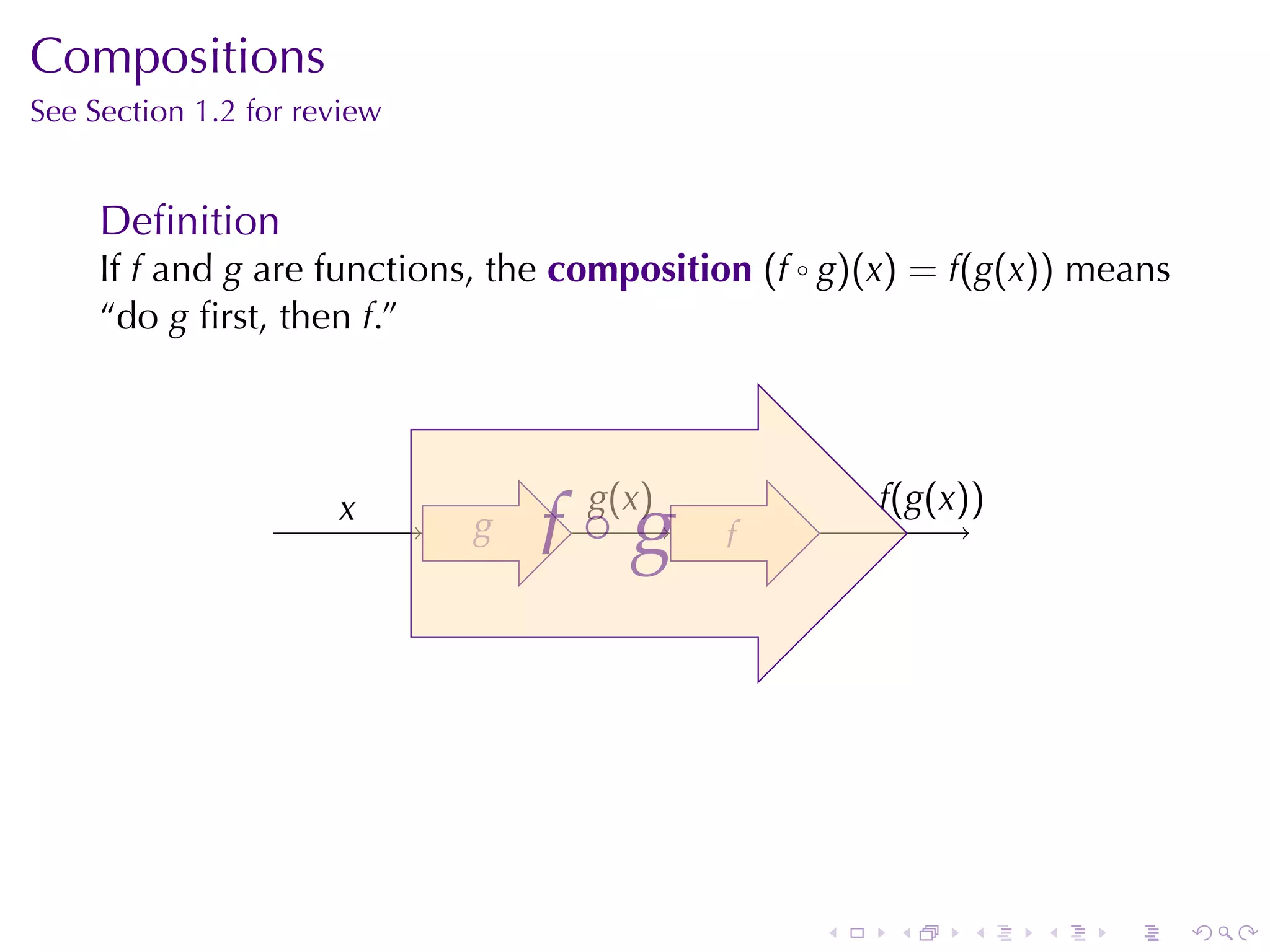
     If f and g are	functions, the composition (f ◦ g)(x) = f(g(x)) means
     “do g first, then f.”


                                     .


                                                  .    .    .   .    .      .
Compositions
See	Section	1.2	for	review


     Definition
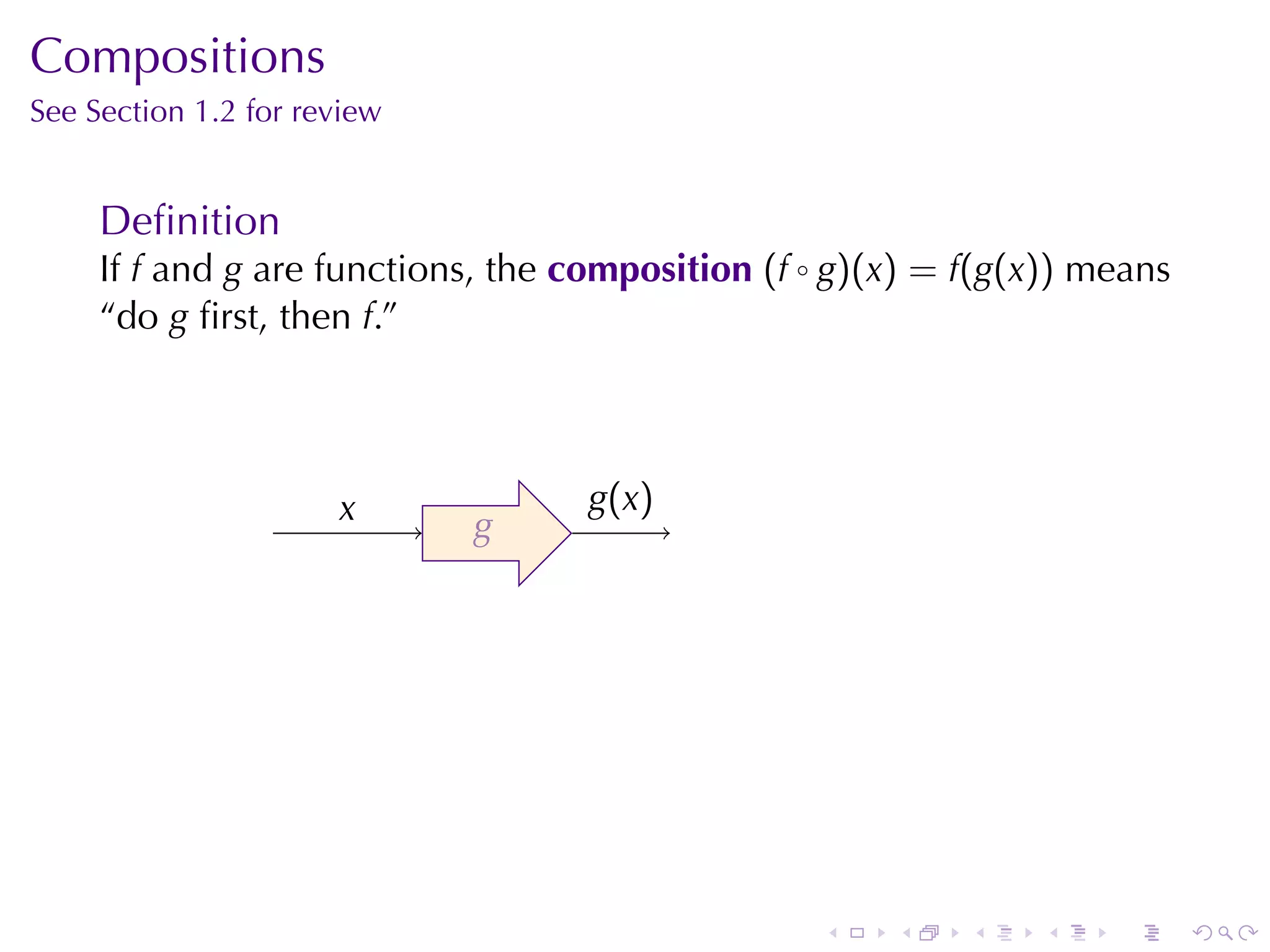
     If f and g are	functions, the composition (f ◦ g)(x) = f(g(x)) means
     “do g first, then f.”


                      x
                      .             g
                                    . (x)
                             g
                             .        .


                                                  .    .    .   .    .      .
Compositions
See	Section	1.2	for	review


     Definition
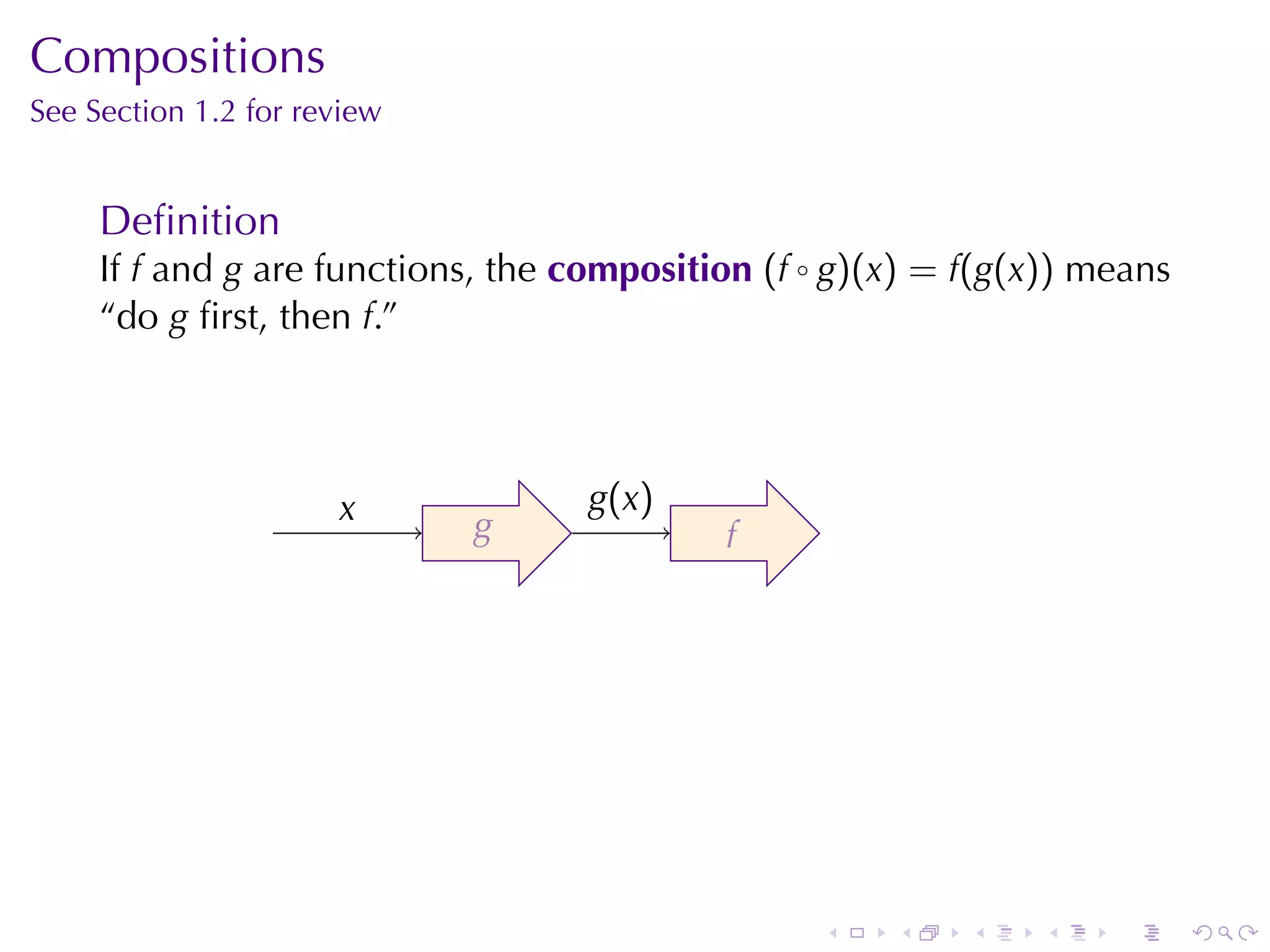
     If f and g are	functions, the composition (f ◦ g)(x) = f(g(x)) means
     “do g first, then f.”


                      x
                      .             g
                                    . (x)
                             g
                             .        .     f
                                            .


                                                  .    .    .   .    .      .
Compositions
See	Section	1.2	for	review


     Definition
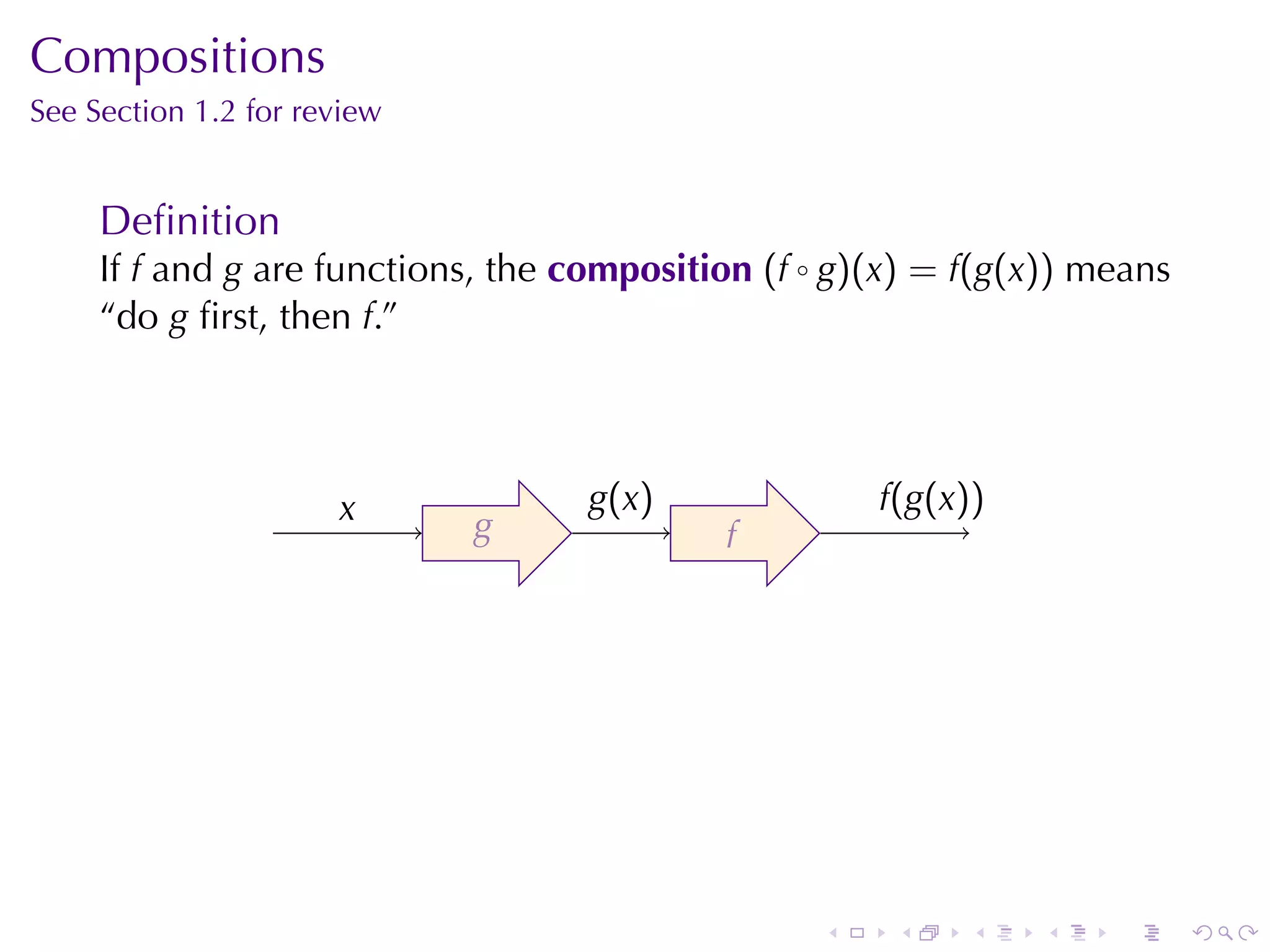
     If f and g are	functions, the composition (f ◦ g)(x) = f(g(x)) means
     “do g first, then f.”


                      x
                      .             g
                                    . (x)             f
                                                      .(g(x))
                             g
                             .        .     f
                                            .


                                                  .    .    .   .    .      .
Compositions
See	Section	1.2	for	review


     Definition
     If f and g are	functions, the composition (f ◦ g)(x) = f(g(x)) means
     “do g first, then f.”


                                 f .
                                 . ◦ g
                      x
                      .             g
                                    . (x)             f
                                                      .(g(x))
                             g
                             .              f
                                            .


                                                  .    .    .   .    .      .
Compositions
See	Section	1.2	for	review


     Definition
     If f and g are	functions, the composition (f ◦ g)(x) = f(g(x)) means
     “do g first, then f.”


                                 f .
                                 . ◦ g
                      x
                      .             g
                                    . (x)             f
                                                      .(g(x))
                             g
                             .              f
                                            .


     Our	goal	for	the	day	is	to	understand	how	the	derivative	of	the
     composition	of	two	functions	depends	on	the	derivatives	of	the
     individual	functions.
                                                  .    .    .   .    .      .
Outline


  Heuristics
    Analogy
    The	Linear	Case


  The	chain	rule


  Examples


  Related	rates	of	change


                            .   .   .   .   .   .
Analogy


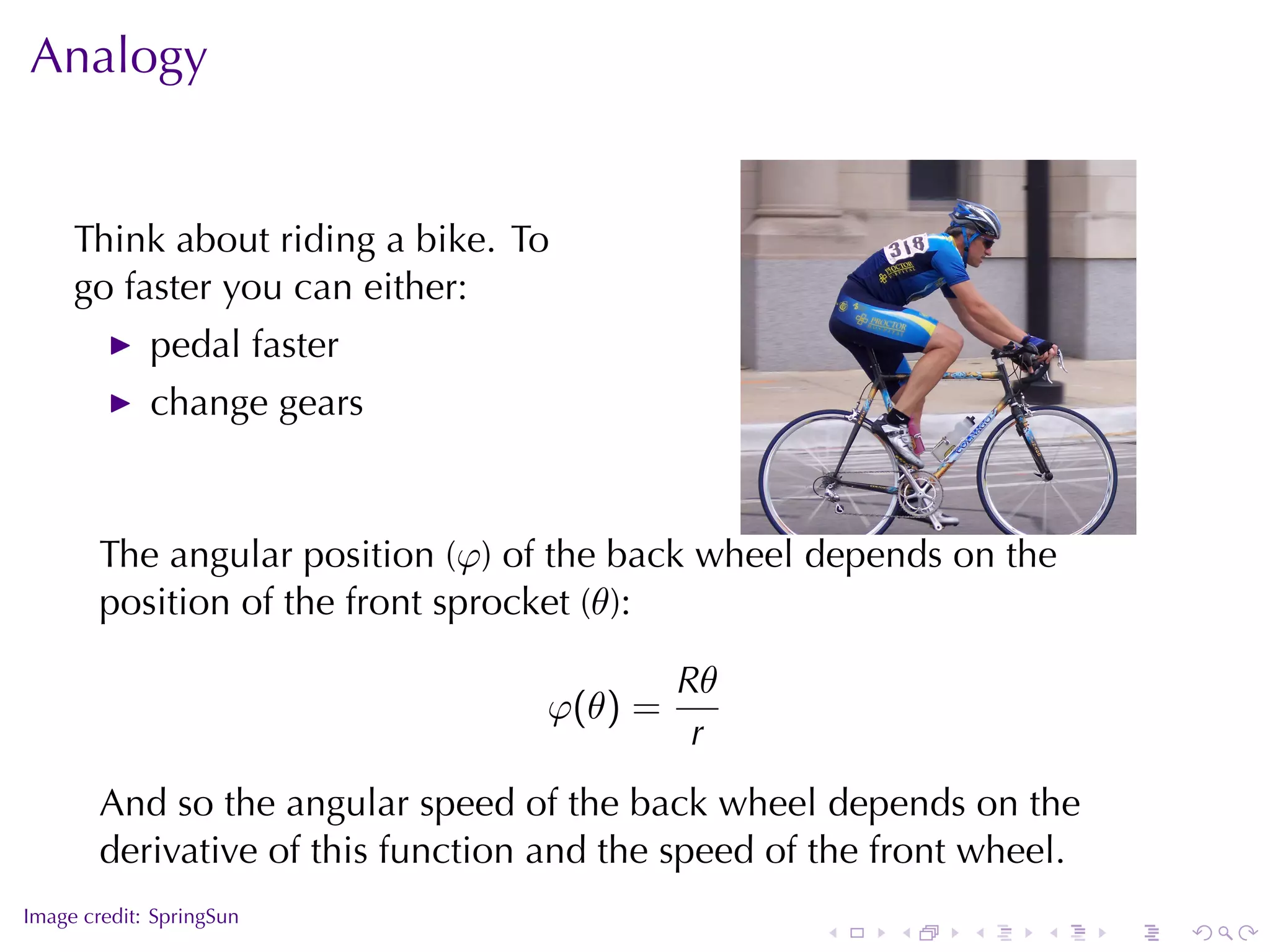
     Think	about	riding	a	bike. To
     go	faster	you	can	either:


                                                         .


.
Image	credit: SpringSun
                                     .   .   .   .   .       .
Analogy


     Think	about	riding	a	bike. To
     go	faster	you	can	either:
             pedal	faster


                                                         .


.
Image	credit: SpringSun
                                     .   .   .   .   .       .
Analogy


     Think	about	riding	a	bike. To
     go	faster	you	can	either:
             pedal	faster
             change	gears


                                                         .


.
Image	credit: SpringSun
                                     .   .   .   .   .       .
Analogy


     Think	about	riding	a	bike. To
     go	faster	you	can	either:
             pedal	faster
             change	gears


                                                                            .
        The	angular	position	(φ)	of	the	back	wheel	depends	on	the
        position	of	the	front	sprocket	(θ):

                                            Rθ
                                   φ(θ) =
                                             r
        And	so	the	angular	speed	of	the	back	wheel	depends	on	the
        derivative	of	this	function	and	the	speed	of	the	front	wheel.
.
Image	credit: SpringSun
                                                    .    .    .   .     .       .
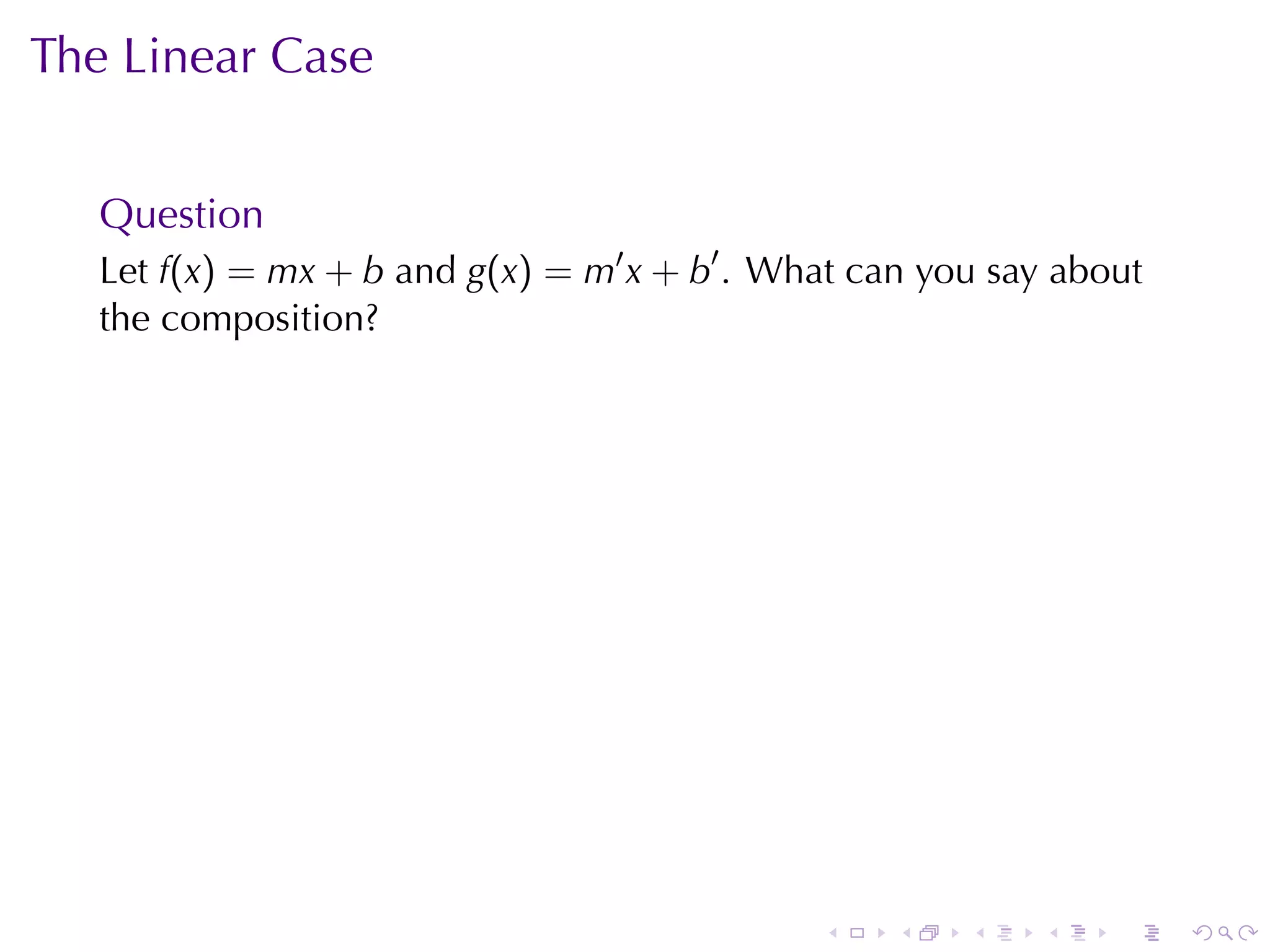
The	Linear	Case


   Question
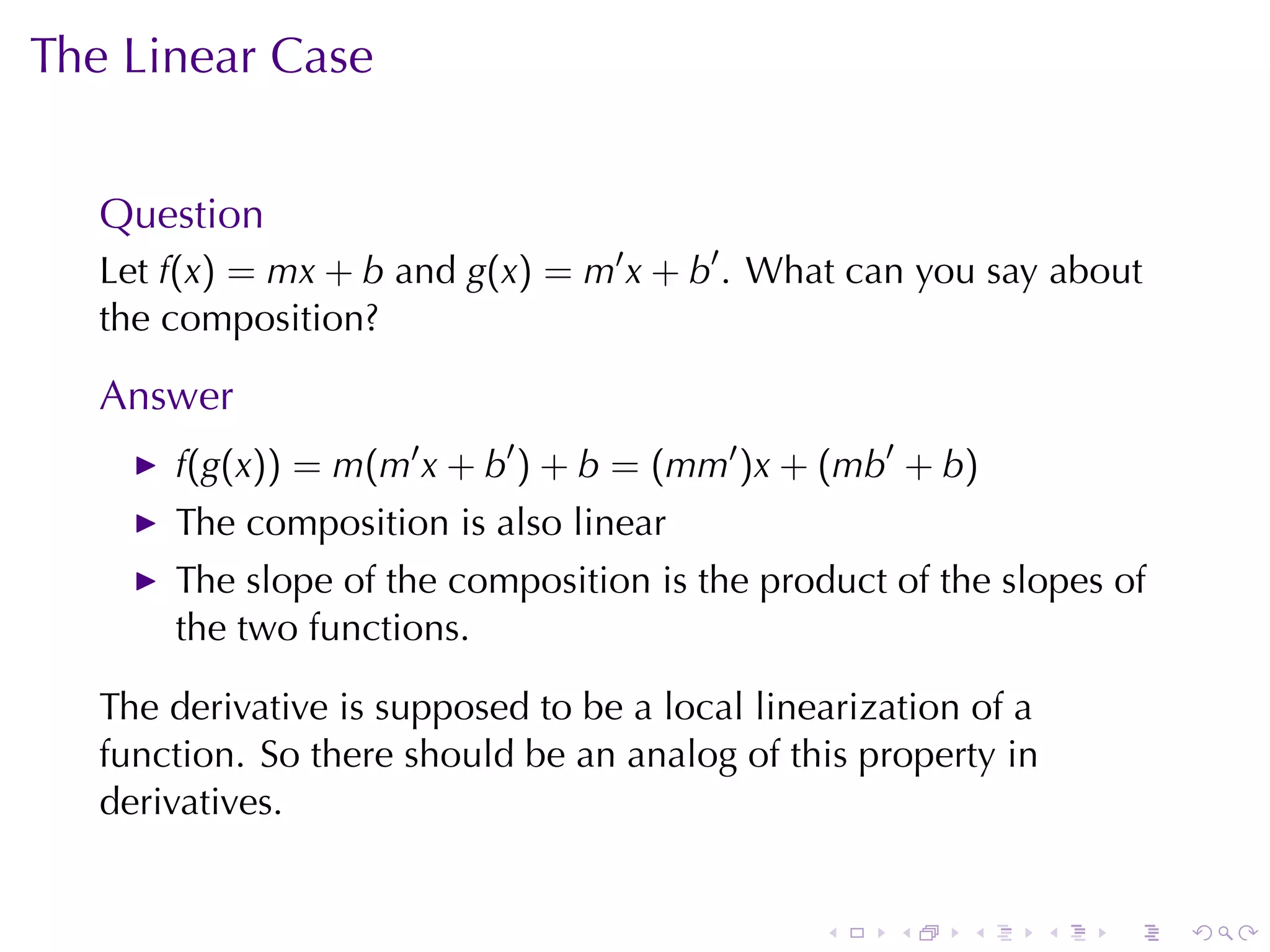
   Let f(x) = mx + b and g(x) = m′ x + b′ . What	can	you	say	about
   the	composition?


                                              .    .   .    .   .    .
The	Linear	Case


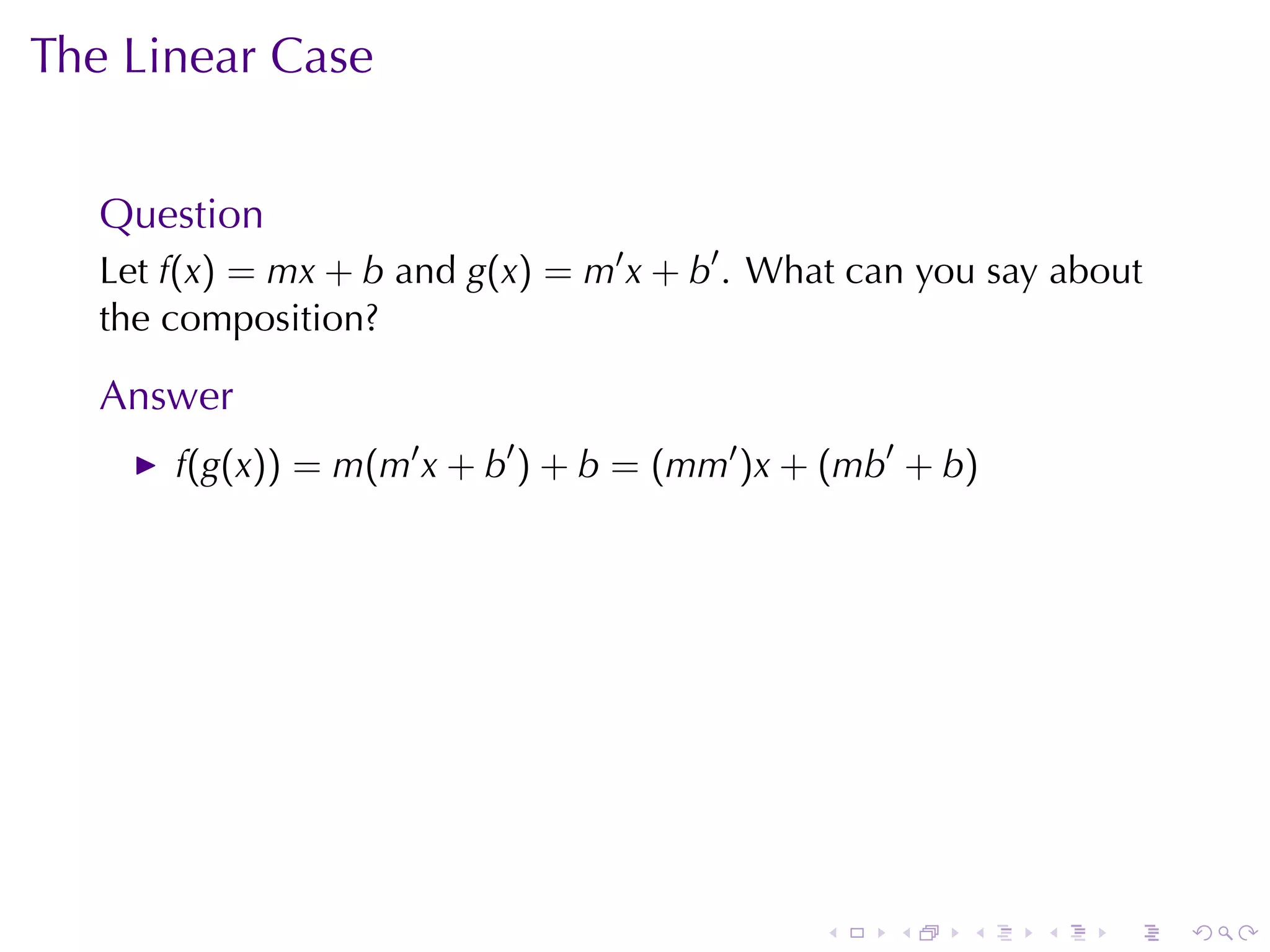
   Question
   Let f(x) = mx + b and g(x) = m′ x + b′ . What	can	you	say	about
   the	composition?

   Answer
       f(g(x)) = m(m′ x + b′ ) + b = (mm′ )x + (mb′ + b)


                                              .    .   .    .   .    .
The	Linear	Case


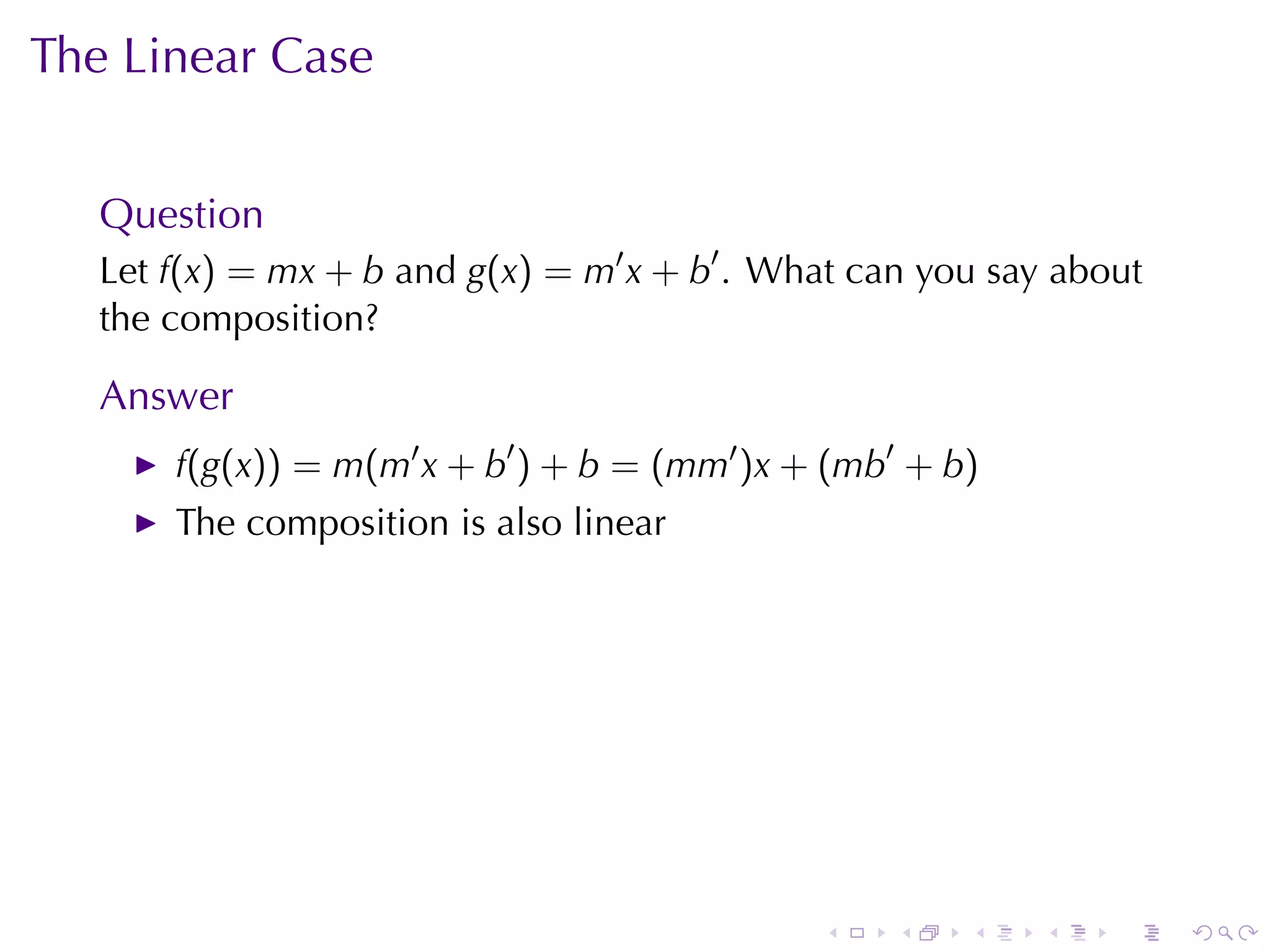
   Question
   Let f(x) = mx + b and g(x) = m′ x + b′ . What	can	you	say	about
   the	composition?

   Answer
       f(g(x)) = m(m′ x + b′ ) + b = (mm′ )x + (mb′ + b)
       The	composition	is	also	linear


                                              .    .   .    .   .    .
The	Linear	Case


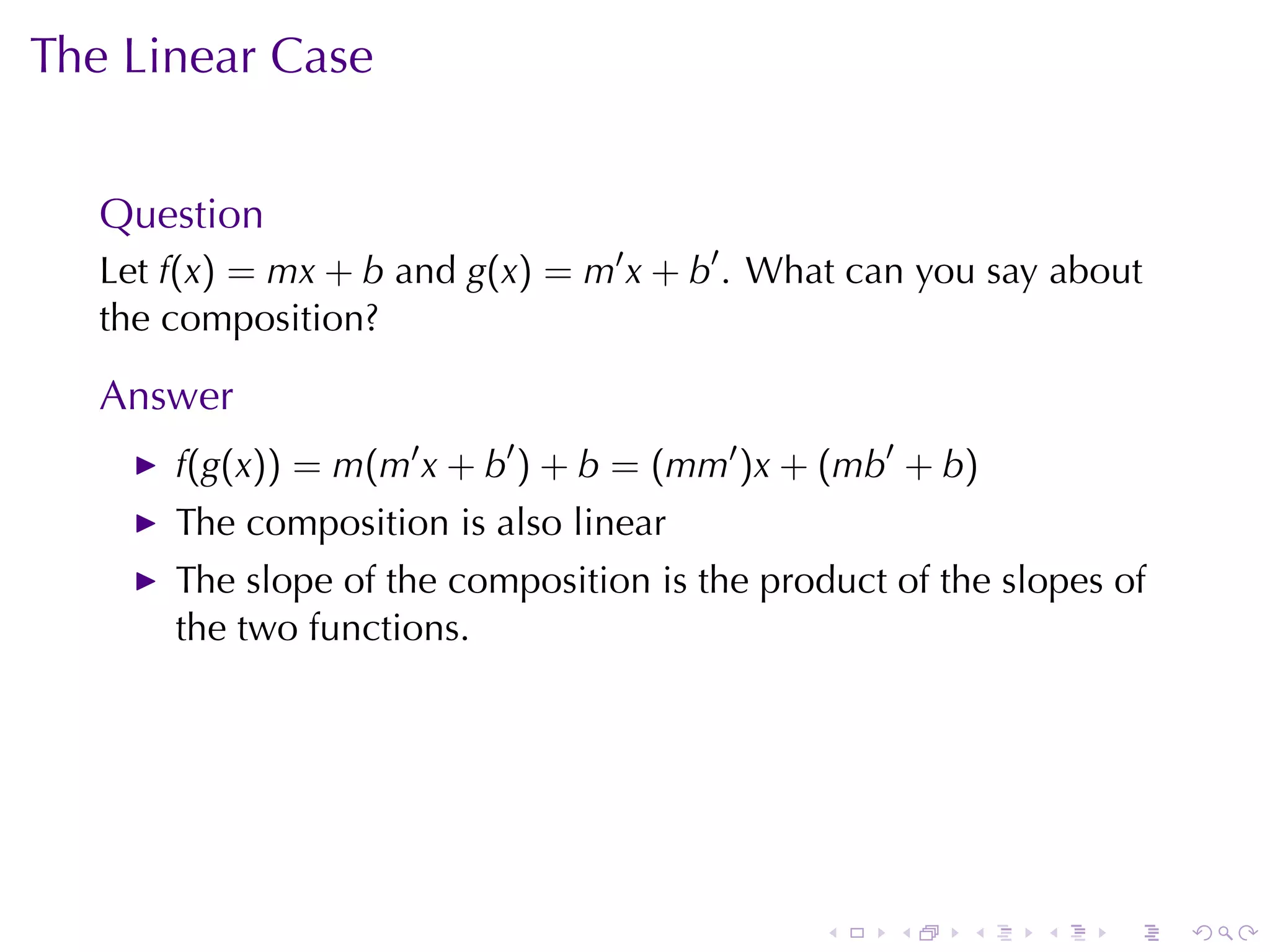
   Question
   Let f(x) = mx + b and g(x) = m′ x + b′ . What	can	you	say	about
   the	composition?

   Answer
       f(g(x)) = m(m′ x + b′ ) + b = (mm′ )x + (mb′ + b)
       The	composition	is	also	linear
       The	slope	of	the	composition	is	the	product	of	the	slopes	of
       the	two	functions.


                                              .    .    .   .    .    .
The	Linear	Case


   Question
   Let f(x) = mx + b and g(x) = m′ x + b′ . What	can	you	say	about
   the	composition?

   Answer
       f(g(x)) = m(m′ x + b′ ) + b = (mm′ )x + (mb′ + b)
       The	composition	is	also	linear
       The	slope	of	the	composition	is	the	product	of	the	slopes	of
       the	two	functions.

   The	derivative	is	supposed	to	be	a	local	linearization	of	a
   function. So	there	should	be	an	analog	of	this	property	in
   derivatives.


                                                .    .   .       .   .   .
The	Nonlinear	Case
See	the	Mathematica	applet


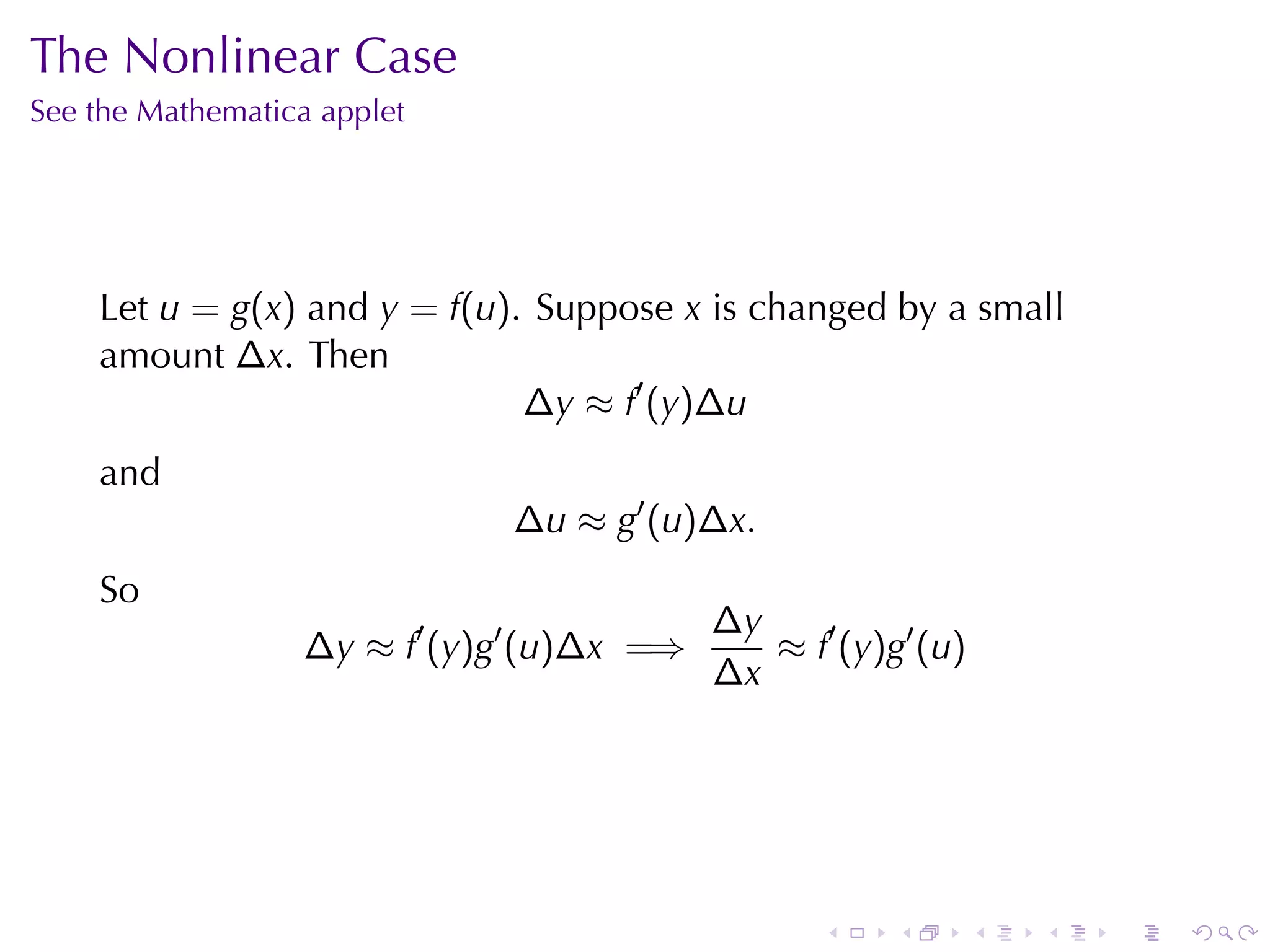
    Let u = g(x) and y = f(u). Suppose x is	changed	by	a	small
    amount ∆x. Then
                              ∆y ≈ f′ (y)∆u
    and
                              ∆u ≈ g′ (u)∆x.
    So
                                           ∆y
                  ∆y ≈ f′ (y)g′ (u)∆x =⇒      ≈ f′ (y)g′ (u)
                                           ∆x


                                                  .    .       .   .   .   .
Outline


  Heuristics
    Analogy
    The	Linear	Case


  The	chain	rule


  Examples


  Related	rates	of	change


                            .   .   .   .   .   .
Theorem	of	the	day: The	chain	rule


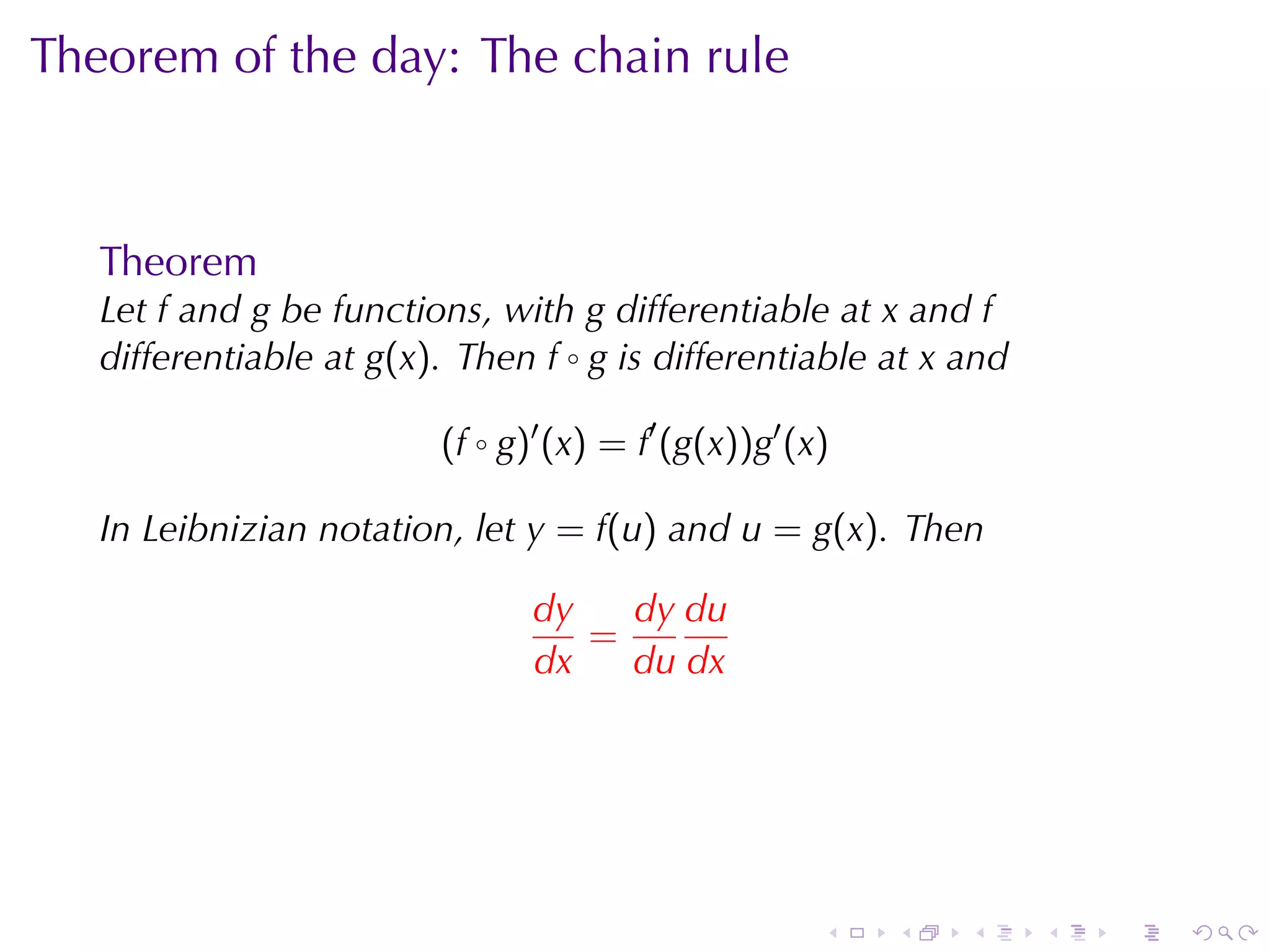
   Theorem
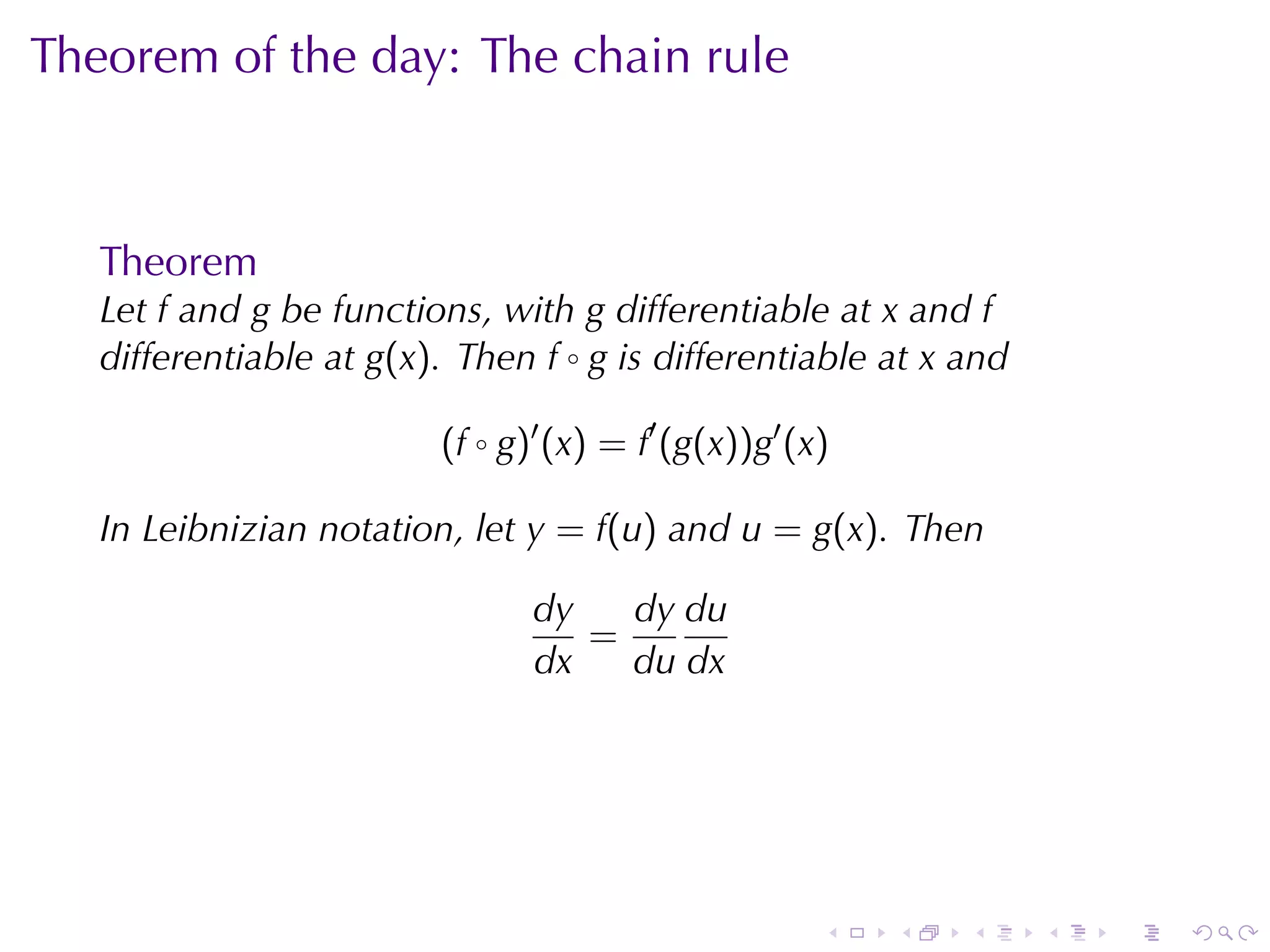
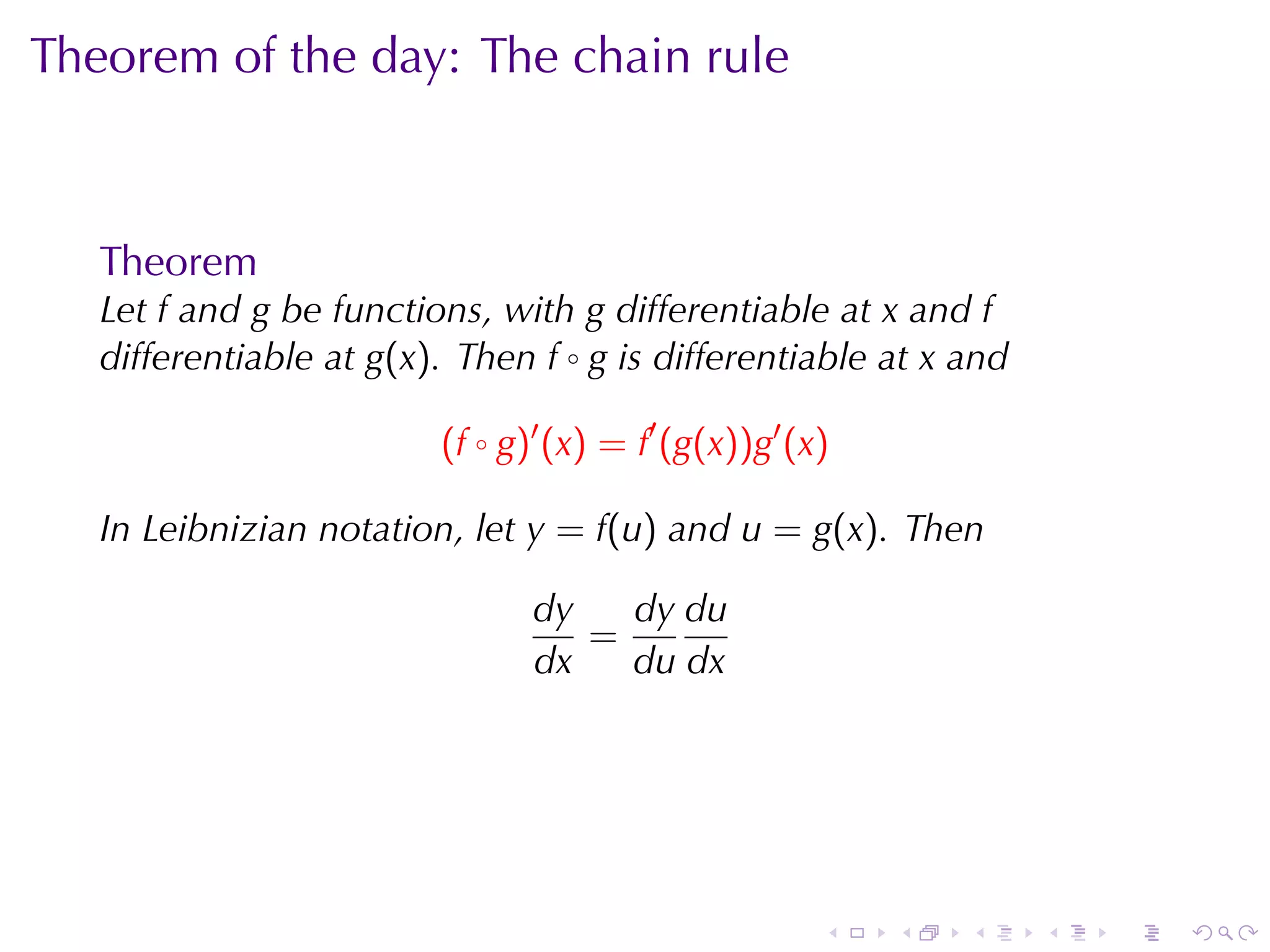
   Let f and g be	functions, with g differentiable	at x and f
   differentiable	at g(x). Then f ◦ g is	differentiable	at x and

                         (f ◦ g)′ (x) = f′ (g(x))g′ (x)

   In	Leibnizian	notation, let y = f(u) and u = g(x). Then

                                dy   dy du
                                   =
                                dx   du dx


                                                      .   .   .    .   .   .
Observations


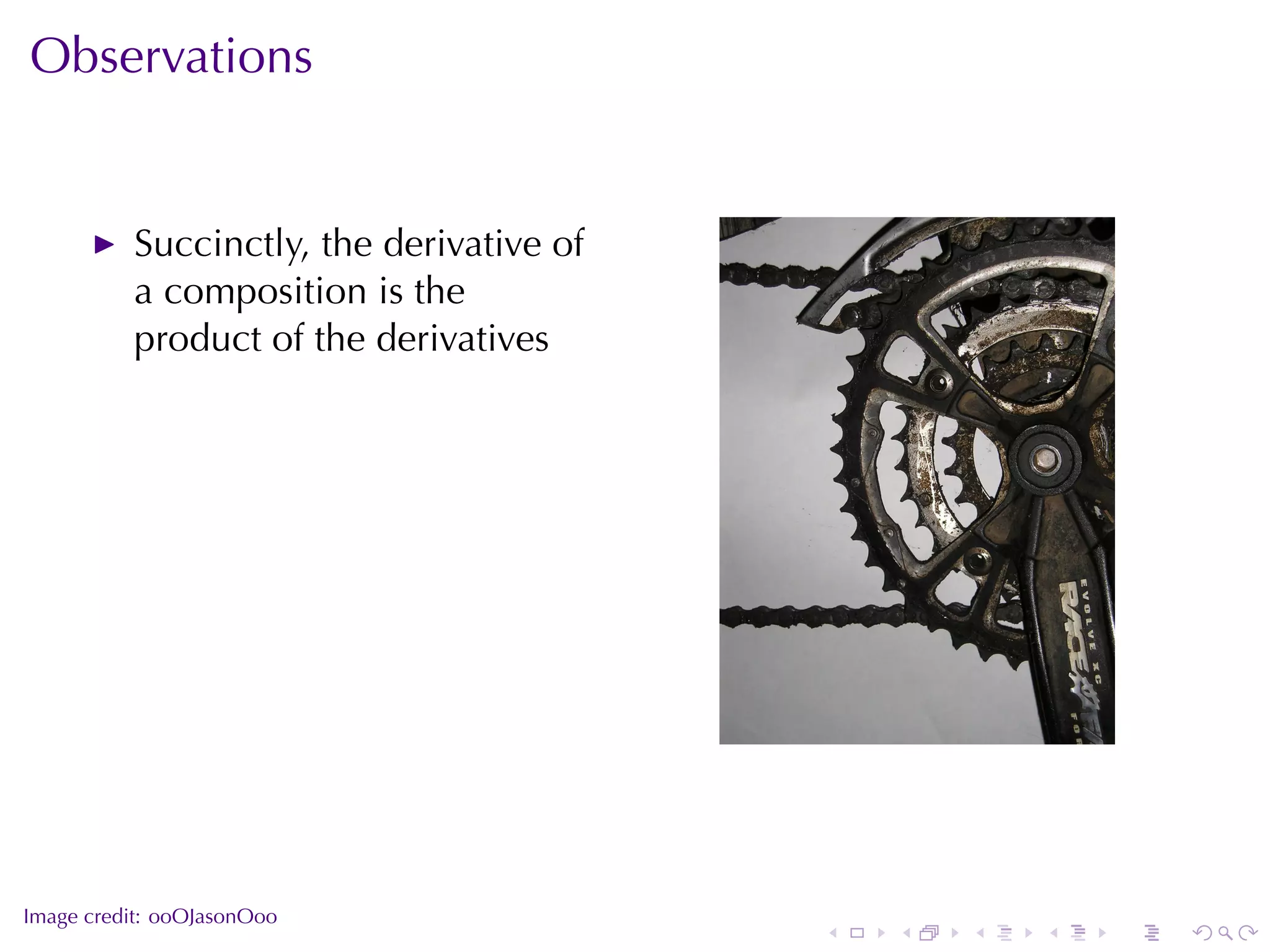
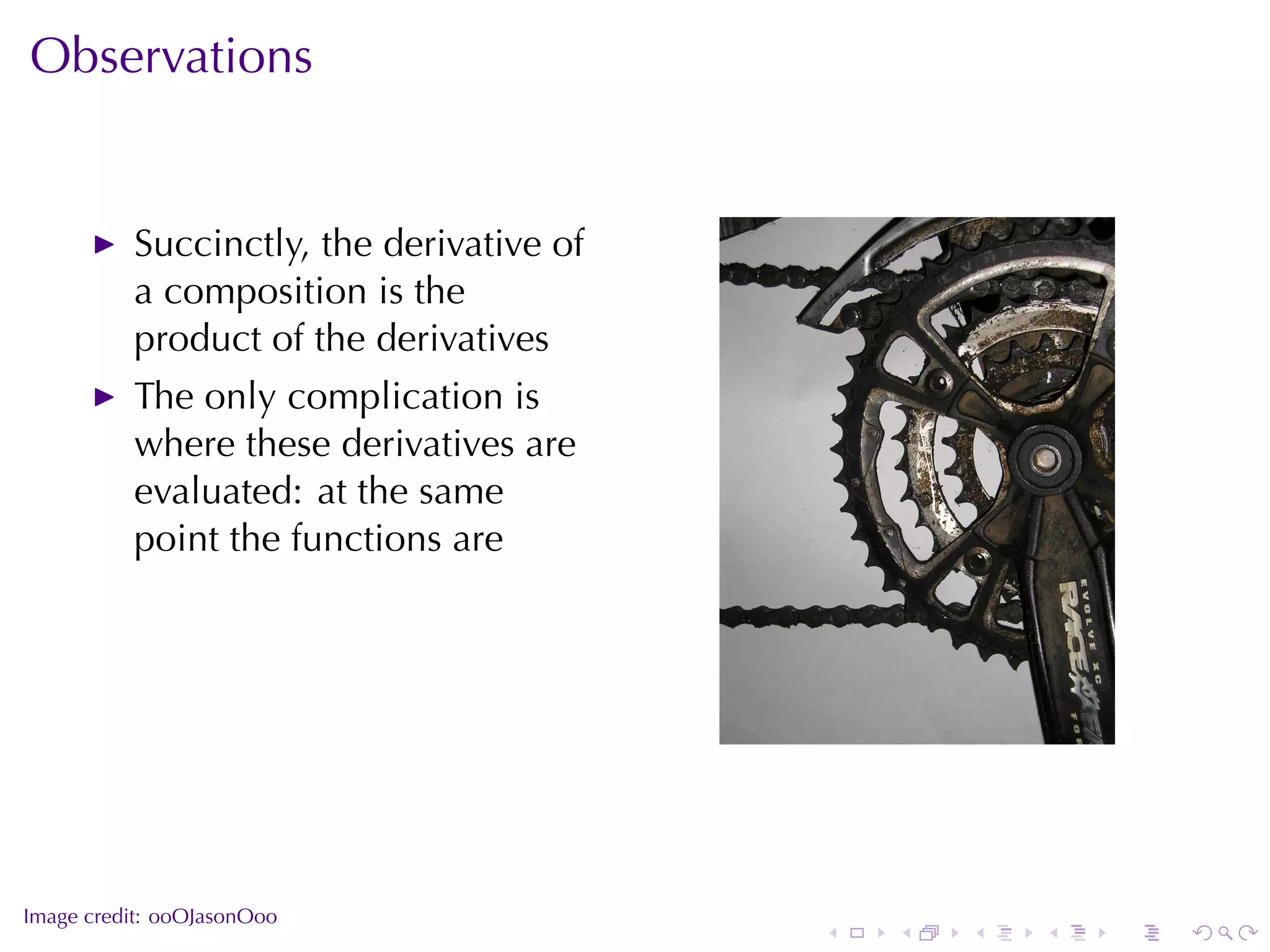
          Succinctly, the	derivative	of
          a	composition	is	the
          product	of	the	derivatives


                                                          .


.
Image	credit: ooOJasonOoo
                                          .   .   .   .   .   .
Theorem	of	the	day: The	chain	rule


   Theorem
   Let f and g be	functions, with g differentiable	at x and f
   differentiable	at g(x). Then f ◦ g is	differentiable	at x and

                         (f ◦ g)′ (x) = f′ (g(x))g′ (x)

   In	Leibnizian	notation, let y = f(u) and u = g(x). Then

                                dy   dy du
                                   =
                                dx   du dx


                                                      .   .   .    .   .   .
Observations


          Succinctly, the	derivative	of
          a	composition	is	the
          product	of	the	derivatives
          The	only	complication	is
          where	these	derivatives	are
          evaluated: at	the	same
          point	the	functions	are


                                                          .


.
Image	credit: ooOJasonOoo
                                          .   .   .   .   .   .
Compositions
See	Section	1.2	for	review


     Definition
     If f and g are	functions, the composition (f ◦ g)(x) = f(g(x)) means
     “do g first, then f.”


                                 f .
                                 . ◦ g
                      x
                      .             g
                                    . (x)             f
                                                      .(g(x))
                             g
                             .              f
                                            .


                                                  .    .    .   .    .      .
Observations


          Succinctly, the	derivative	of
          a	composition	is	the
          product	of	the	derivatives
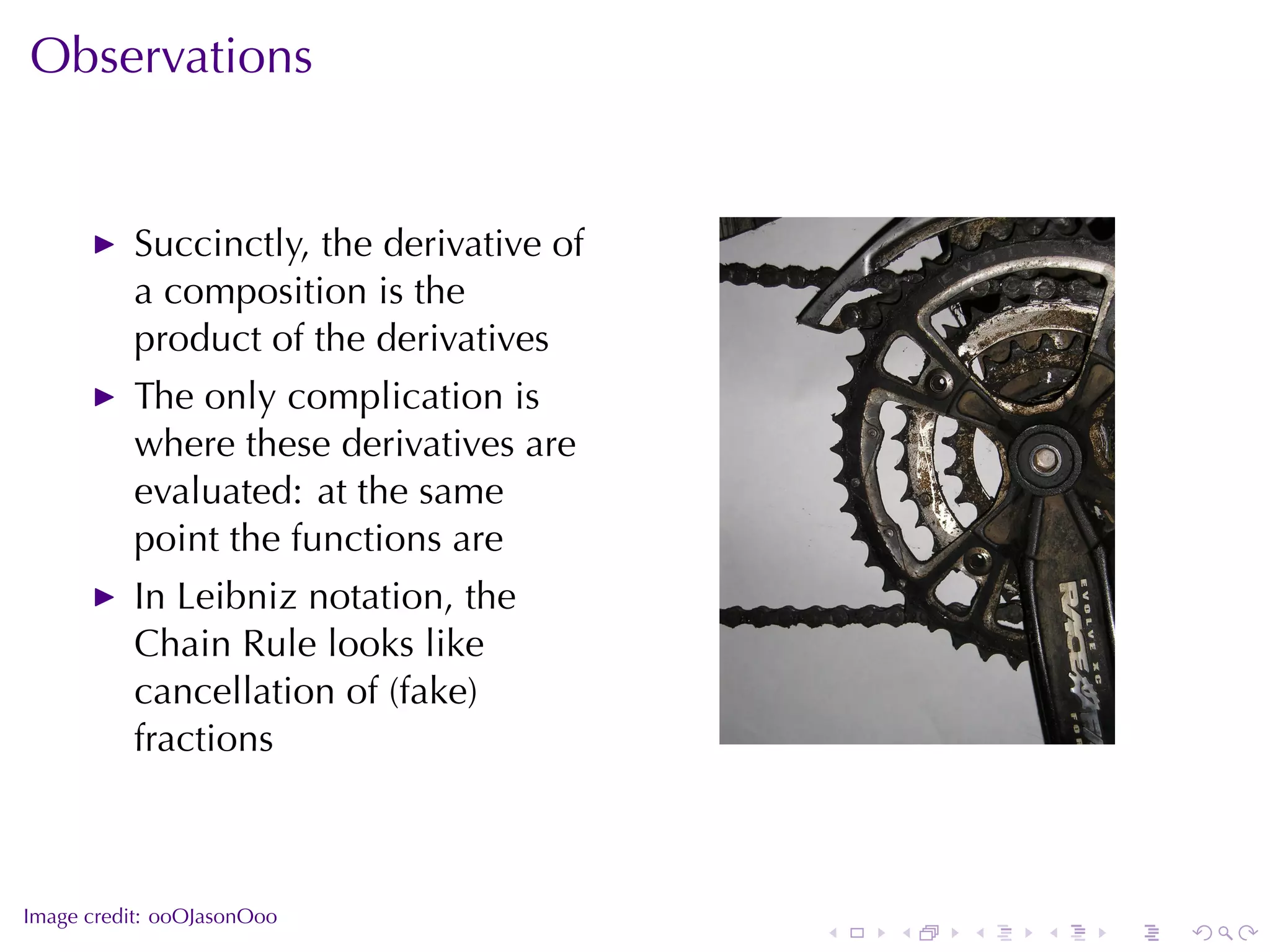
          The	only	complication	is
          where	these	derivatives	are
          evaluated: at	the	same
          point	the	functions	are
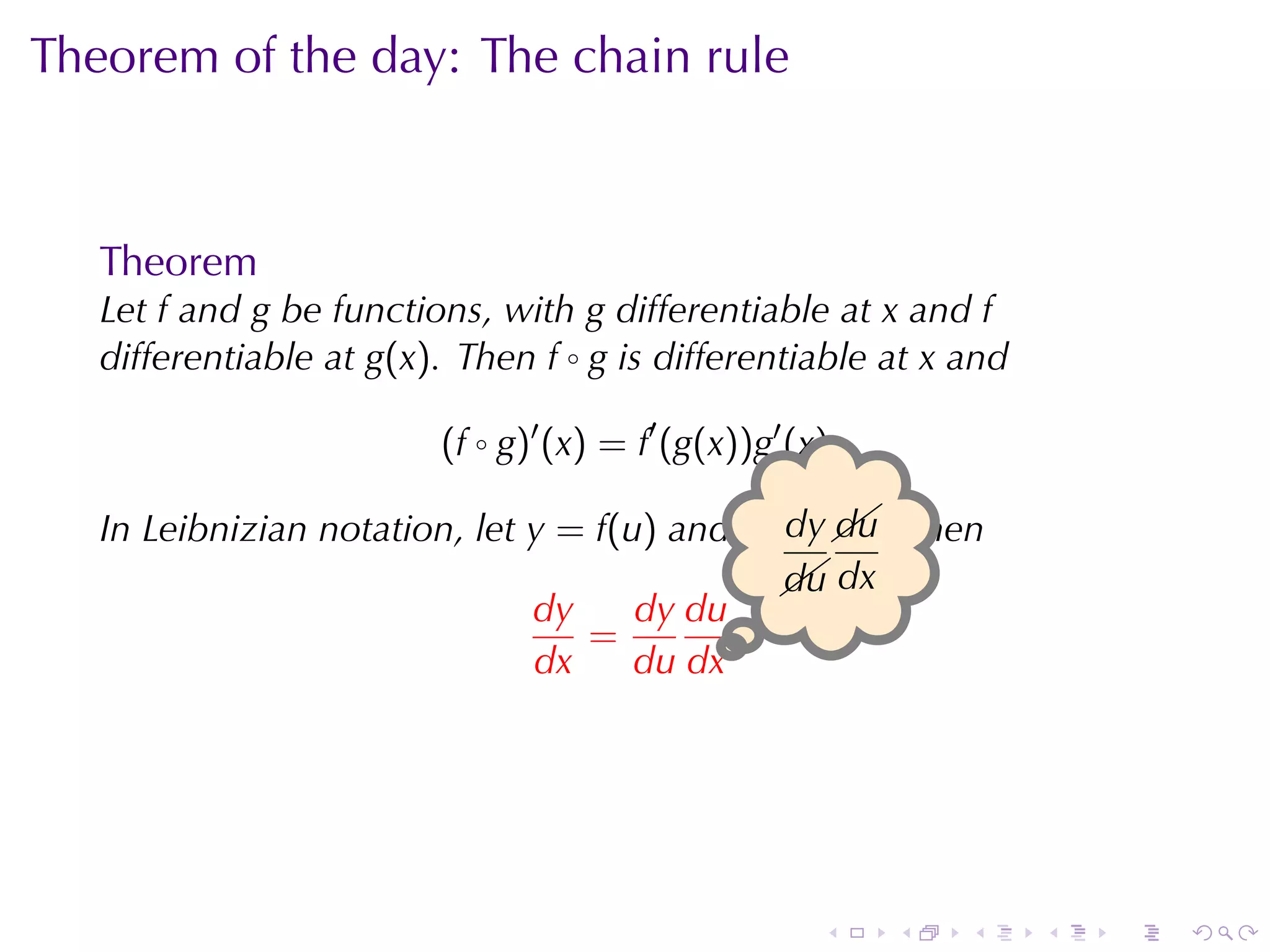
          In	Leibniz	notation, the
          Chain	Rule	looks	like
          cancellation	of	(fake)
          fractions                                       .


.
Image	credit: ooOJasonOoo
                                          .   .   .   .   .   .
Theorem	of	the	day: The	chain	rule


   Theorem
   Let f and g be	functions, with g differentiable	at x and f
   differentiable	at g(x). Then f ◦ g is	differentiable	at x and

                         (f ◦ g)′ (x) = f′ (g(x))g′ (x)

   In	Leibnizian	notation, let y = f(u) and u = g(x). Then

                                dy   dy du
                                   =
                                dx   du dx


                                                      .   .   .    .   .   .
Theorem	of	the	day: The	chain	rule


   Theorem
   Let f and g be	functions, with g differentiable	at x and f
   differentiable	at g(x). Then f ◦ g is	differentiable	at x and

                         (f ◦ g)′ (x) = f′ (g(x))g′ (x)

                                              dy )
   In	Leibnizian	notation, let y = f(u) and u = g.du. Then
                                                  (x
                                              .
                                                
                                               dx
                                              du
                               dy     dy du
                                  =
                               dx     du dx


                                                      .   .   .    .   .   .
Outline


  Heuristics
    Analogy
    The	Linear	Case


  The	chain	rule


  Examples


  Related	rates	of	change


                            .   .   .   .   .   .
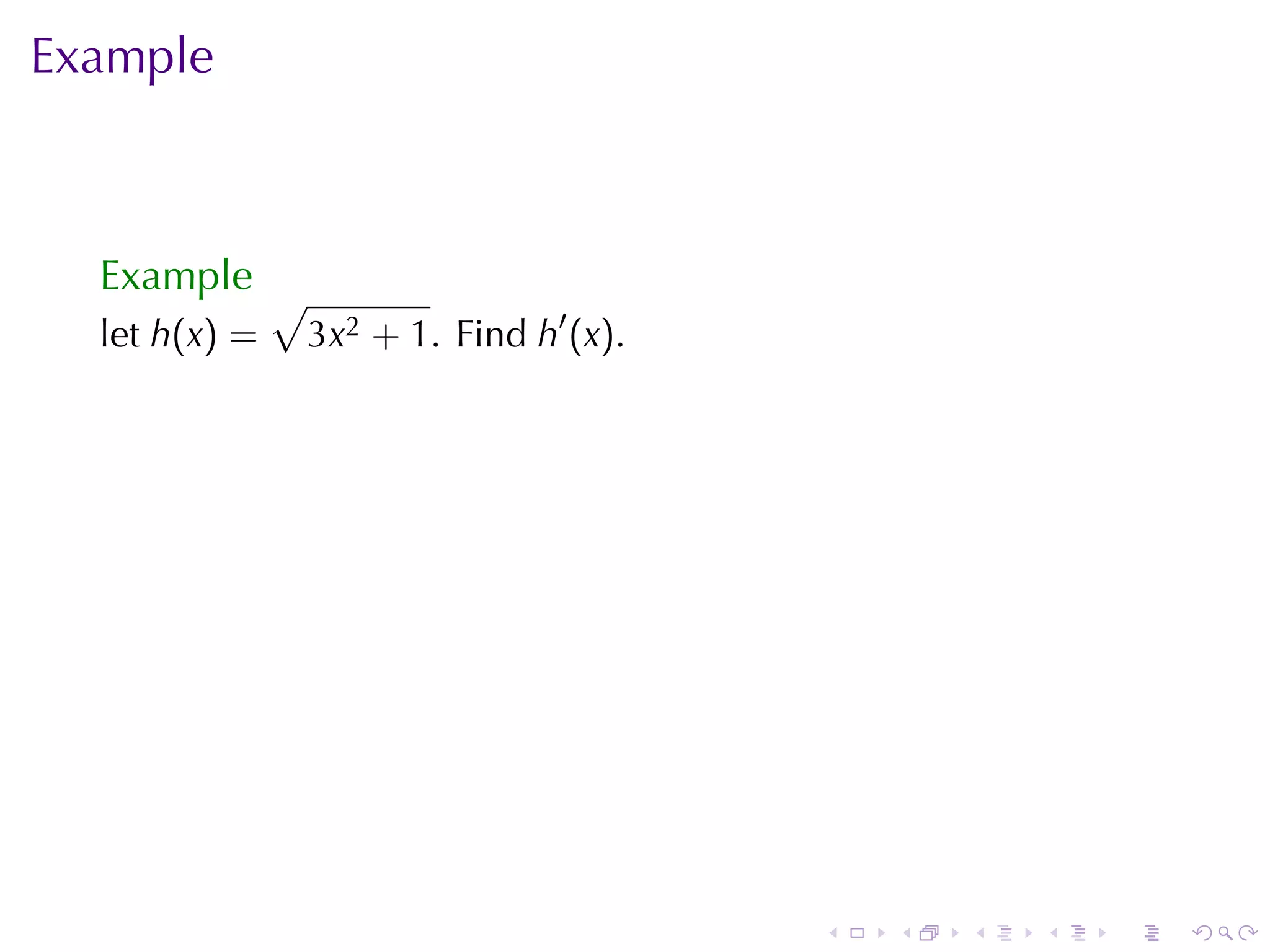
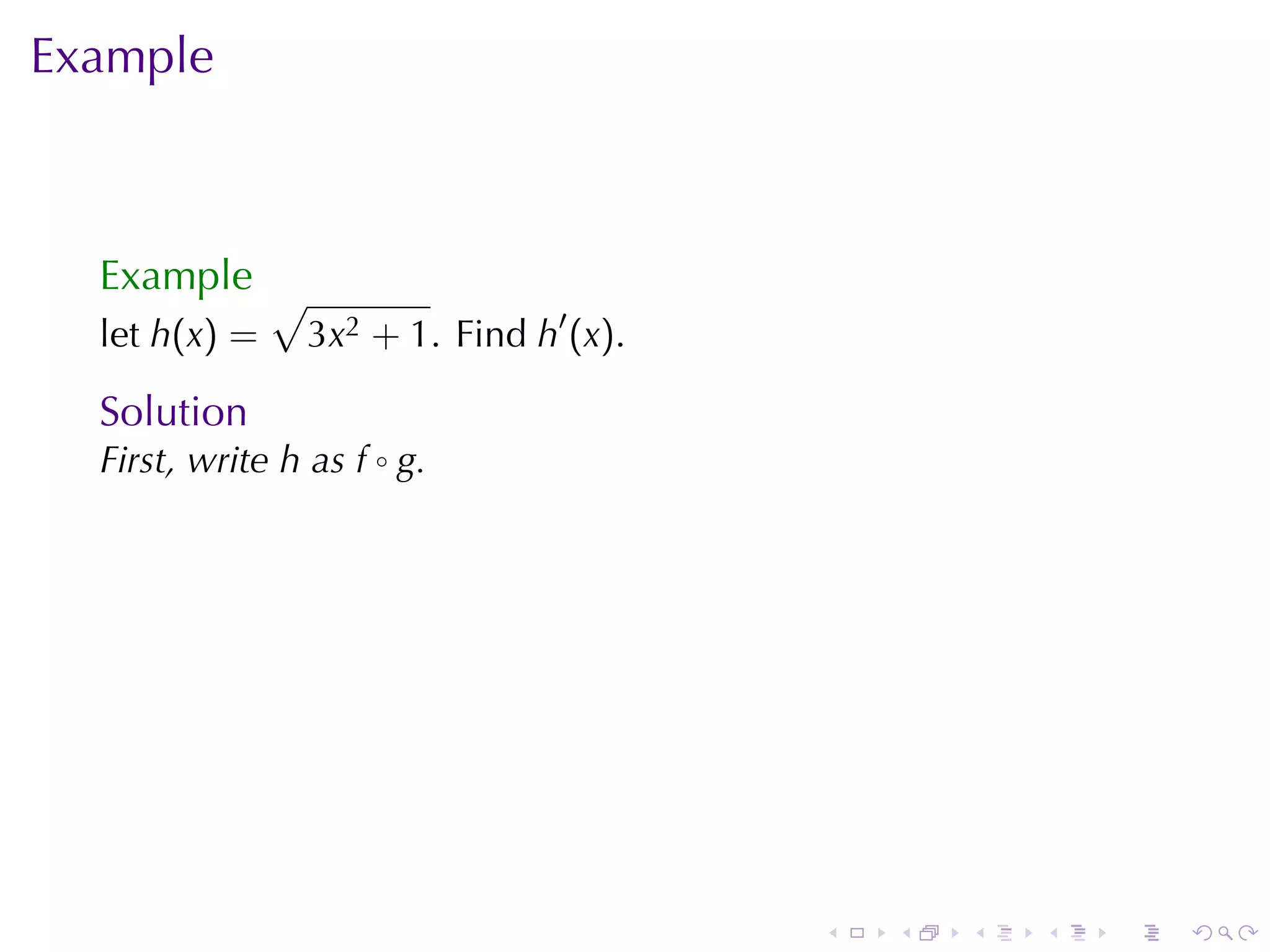
Example


  Example √
  let h(x) =   3x2 + 1. Find h′ (x).


                                       .   .   .   .   .   .
Example


  Example √
  let h(x) =     3x2 + 1. Find h′ (x).

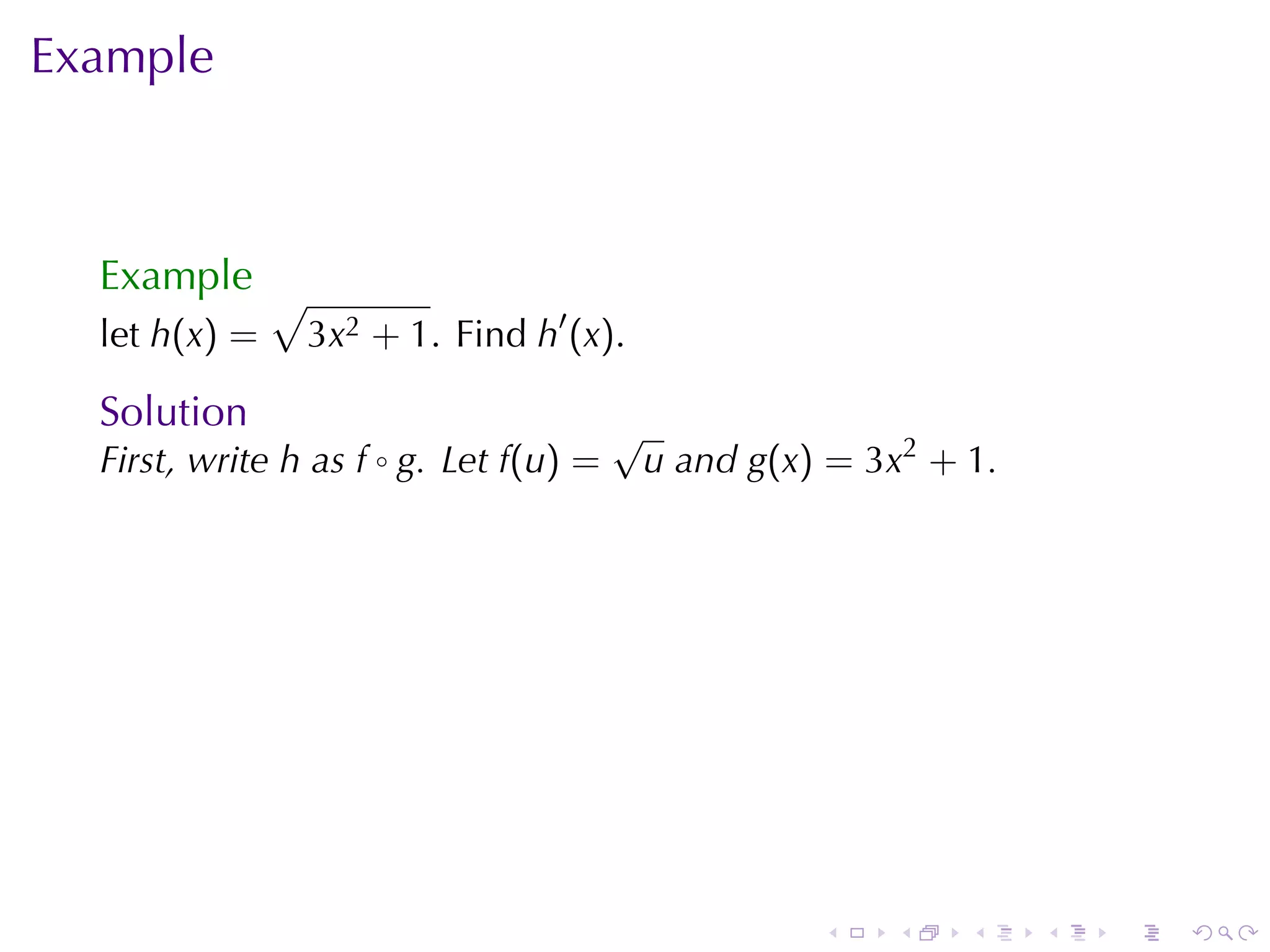
  Solution
  First, write h as f ◦ g.


                                         .   .   .   .   .   .
Example


  Example √
  let h(x) =    3x2 + 1. Find h′ (x).

  Solution                              √
  First, write h as f ◦ g. Let f(u) =       u and g(x) = 3x2 + 1.


                                                      .   .    .    .   .   .
Example


  Example √
  let h(x) =   3x2 + 1. Find h′ (x).

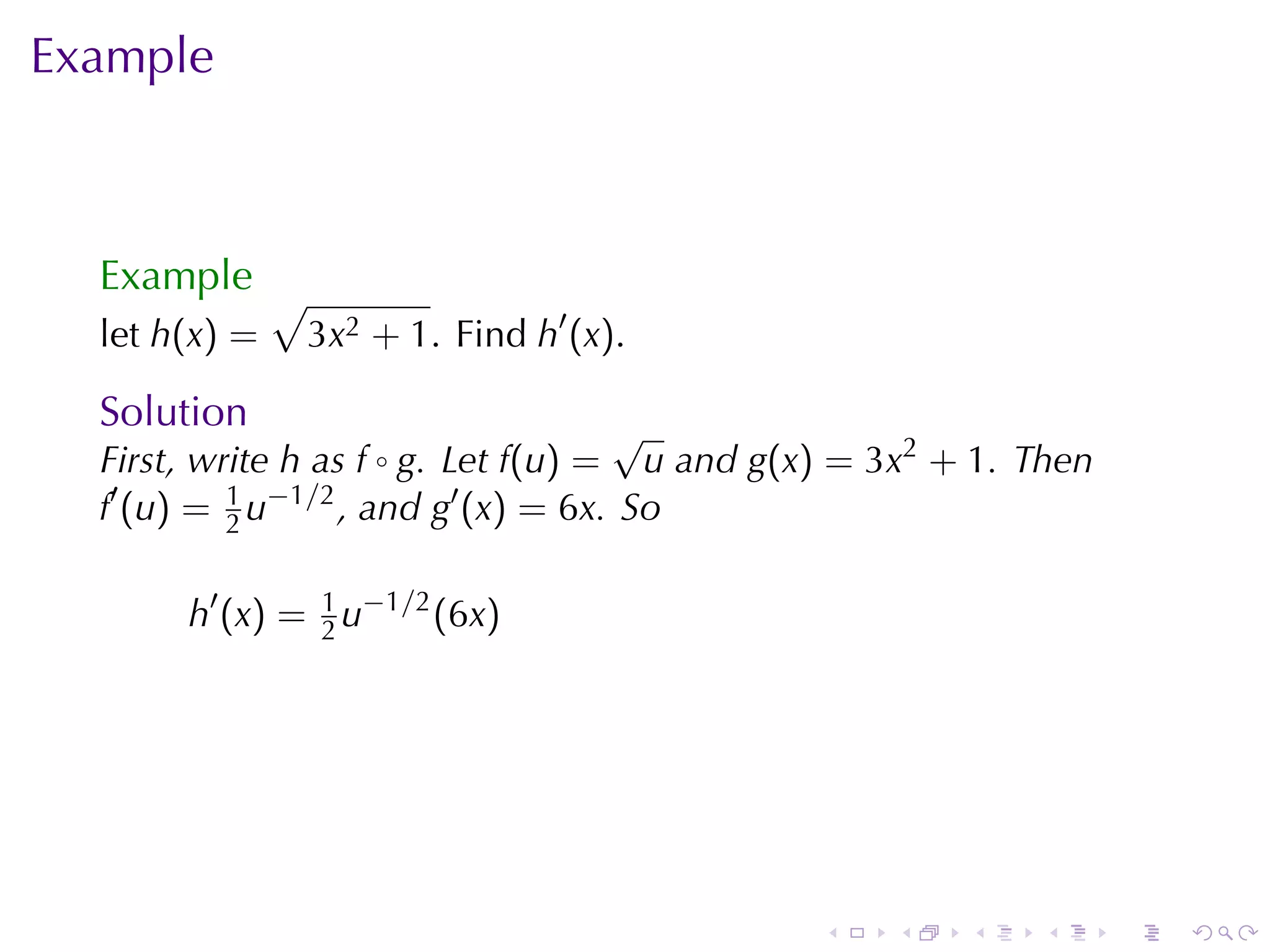
  Solution                           √
  First, write h as f ◦ g. Let f(u) = u and g(x) = 3x2 + 1. Then
  f′ (u) = 2 u−1/2 , and g′ (x) = 6x. So
           1


       h′ (x) = 1 u−1/2 (6x)
                2


                                               .   .    .   .      .   .
Example


  Example √
  let h(x) =   3x2 + 1. Find h′ (x).

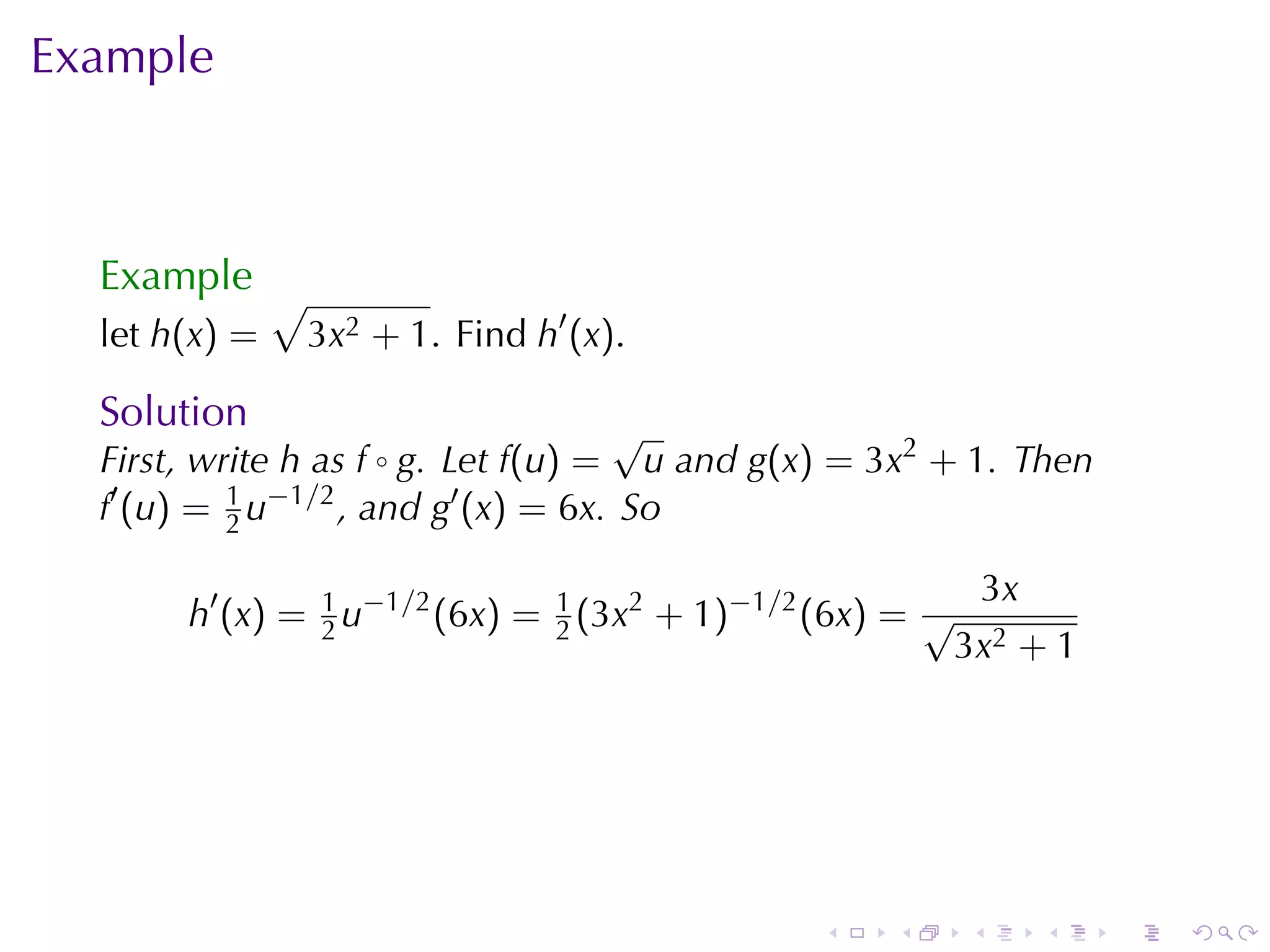
  Solution                           √
  First, write h as f ◦ g. Let f(u) = u and g(x) = 3x2 + 1. Then
  f′ (u) = 2 u−1/2 , and g′ (x) = 6x. So
           1


                                                              3x
       h′ (x) = 1 u−1/2 (6x) = 1 (3x2 + 1)−1/2 (6x) = √
                2              2
                                                          3x2 + 1


                                               .   .      .        .   .   .
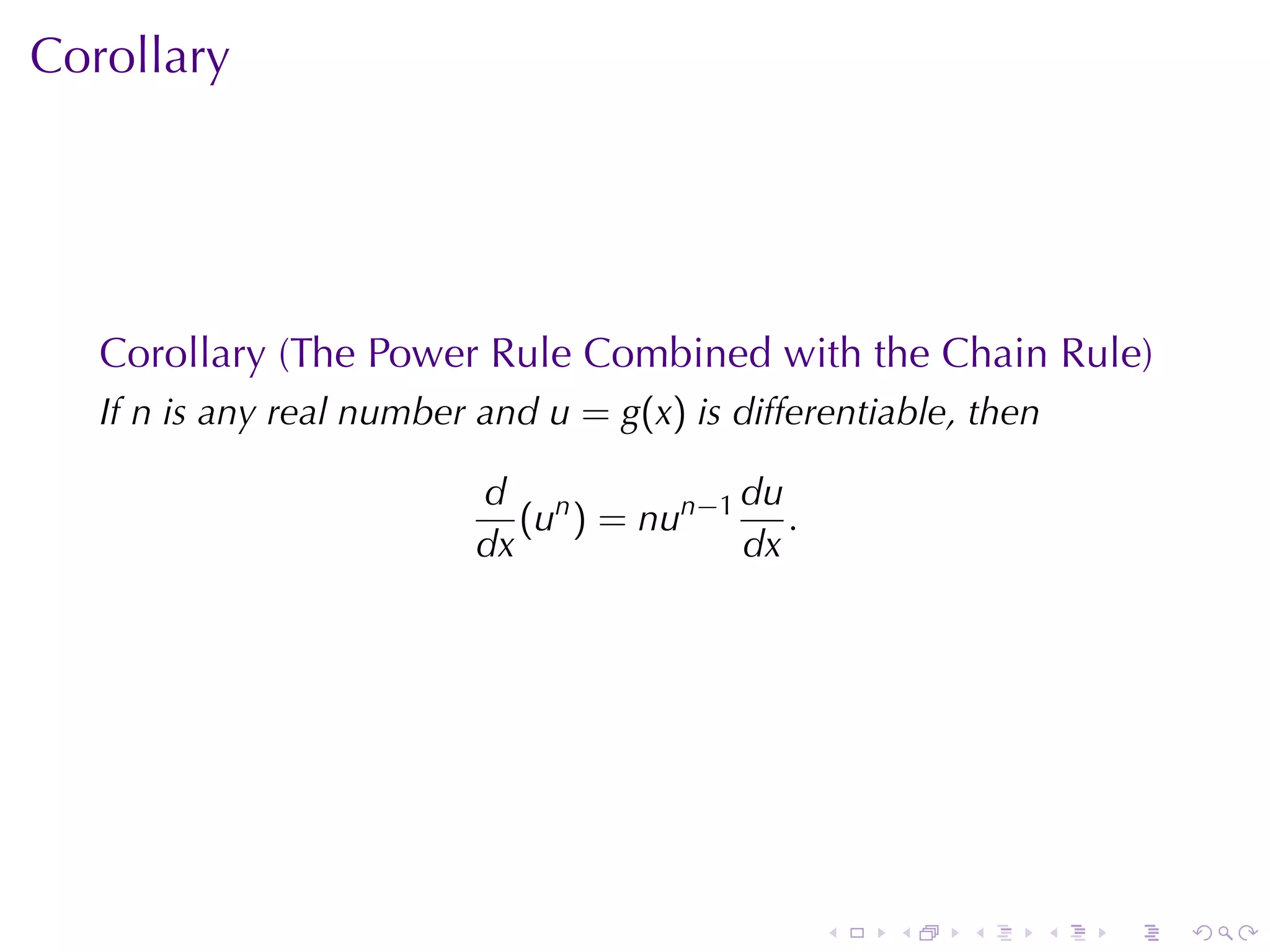
Corollary


   Corollary	(The	Power	Rule	Combined	with	the	Chain	Rule)
   If n is	any	real	number	and u = g(x) is	differentiable, then

                           d n            du
                              (u ) = nun−1 .
                           dx             dx


                                                 .   .    .       .   .   .
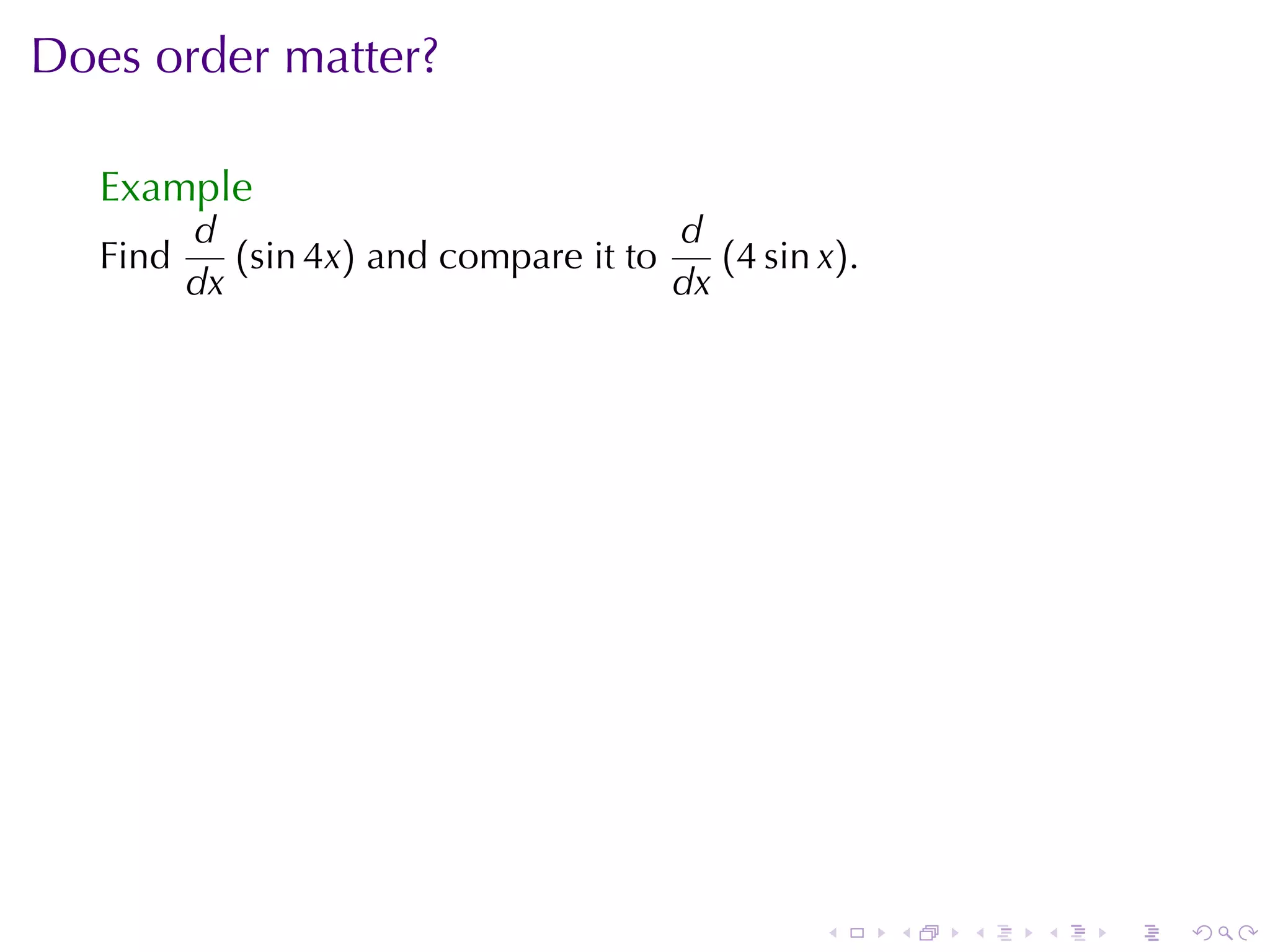
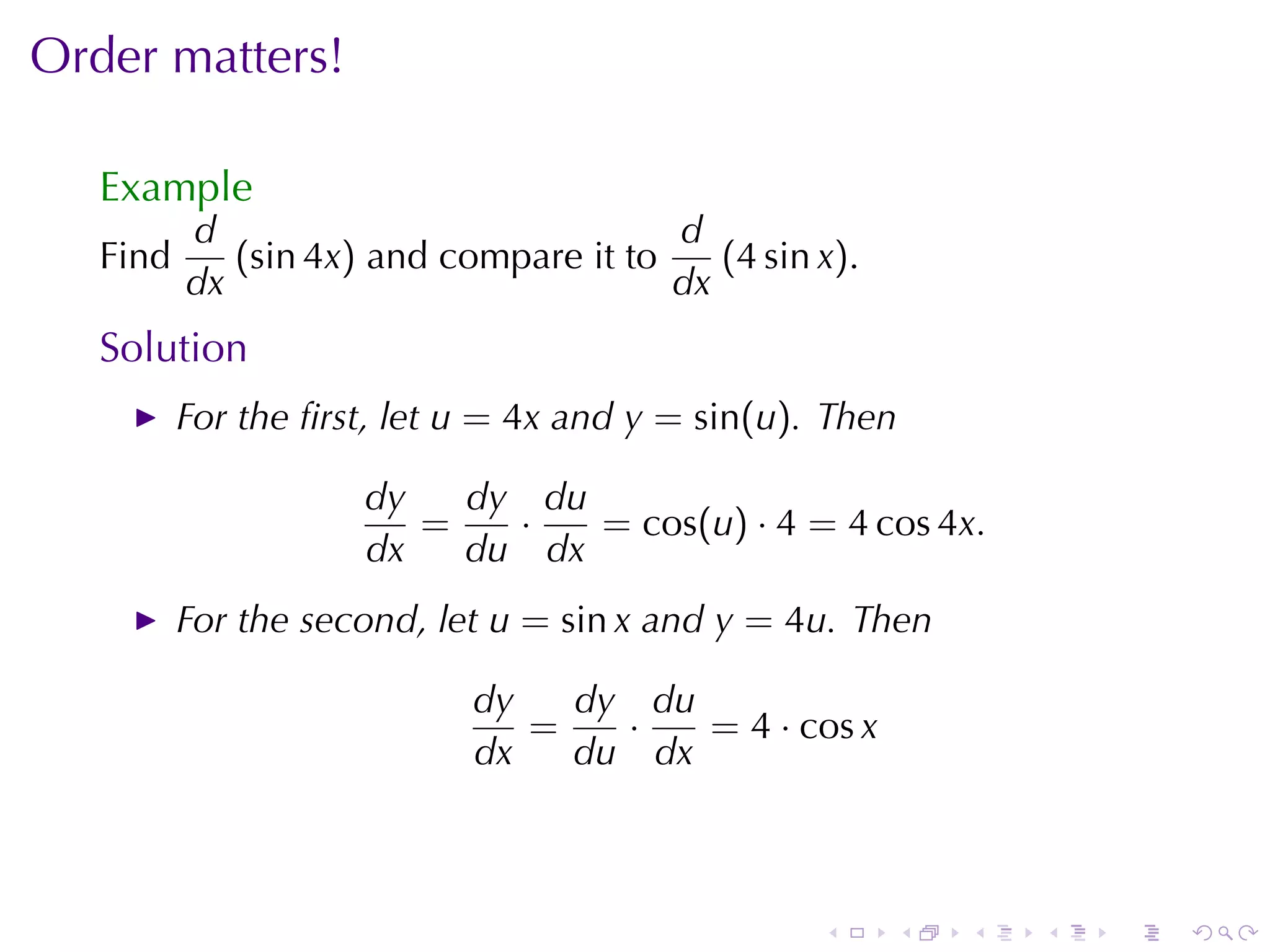
Does	order	matter?

   Example
          d                             d
   Find      (sin 4x) and	compare	it	to    (4 sin x).
          dx                            dx


                                                  .     .   .   .   .   .
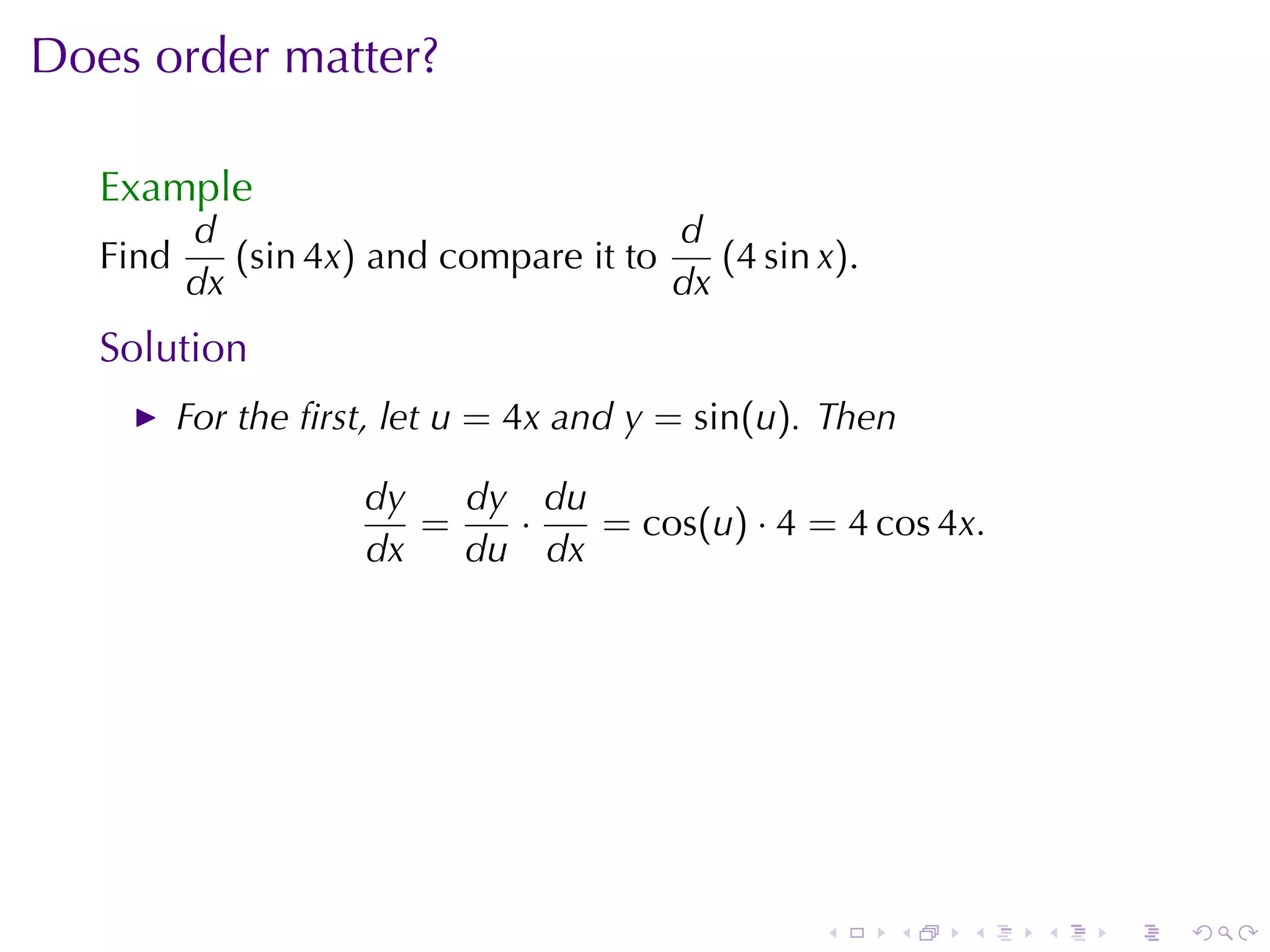
Does	order	matter?

   Example
          d                             d
   Find      (sin 4x) and	compare	it	to    (4 sin x).
          dx                            dx
   Solution
          For	the	first, let u = 4x and y = sin(u). Then

                     dy   dy du
                        =   ·   = cos(u) · 4 = 4 cos 4x.
                     dx   du dx


                                                  .     .   .   .   .   .
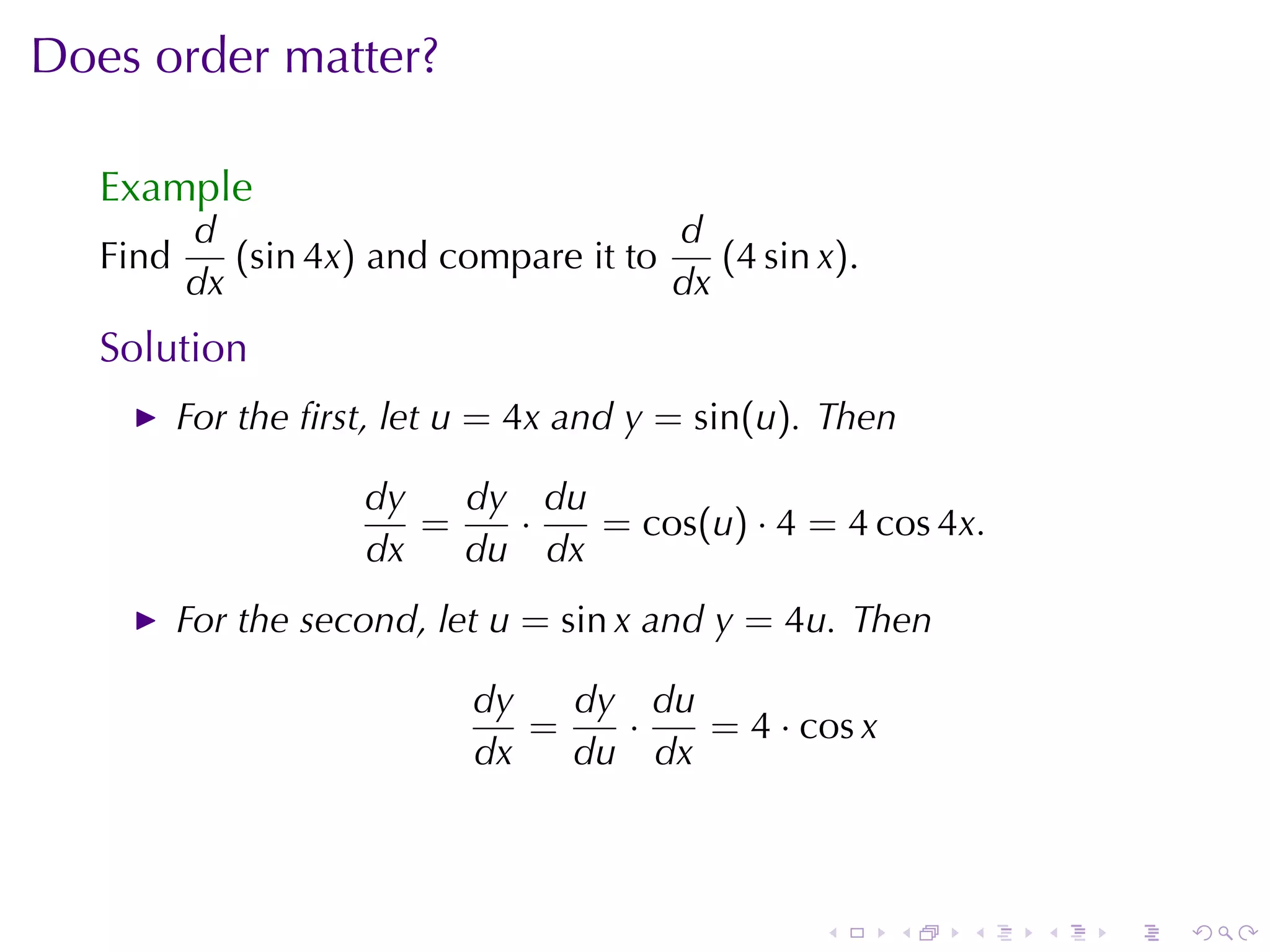
Does	order	matter?

   Example
          d                             d
   Find      (sin 4x) and	compare	it	to    (4 sin x).
          dx                            dx
   Solution
          For	the	first, let u = 4x and y = sin(u). Then

                     dy   dy du
                        =   ·   = cos(u) · 4 = 4 cos 4x.
                     dx   du dx
          For	the	second, let u = sin x and y = 4u. Then

                            dy   dy du
                               =   ·   = 4 · cos x
                            dx   du dx


                                                  .     .   .   .   .   .
Order	matters!

   Example
          d                             d
   Find      (sin 4x) and	compare	it	to    (4 sin x).
          dx                            dx
   Solution
          For	the	first, let u = 4x and y = sin(u). Then

                     dy   dy du
                        =   ·   = cos(u) · 4 = 4 cos 4x.
                     dx   du dx
          For	the	second, let u = sin x and y = 4u. Then

                            dy   dy du
                               =   ·   = 4 · cos x
                            dx   du dx


                                                  .     .   .   .   .   .
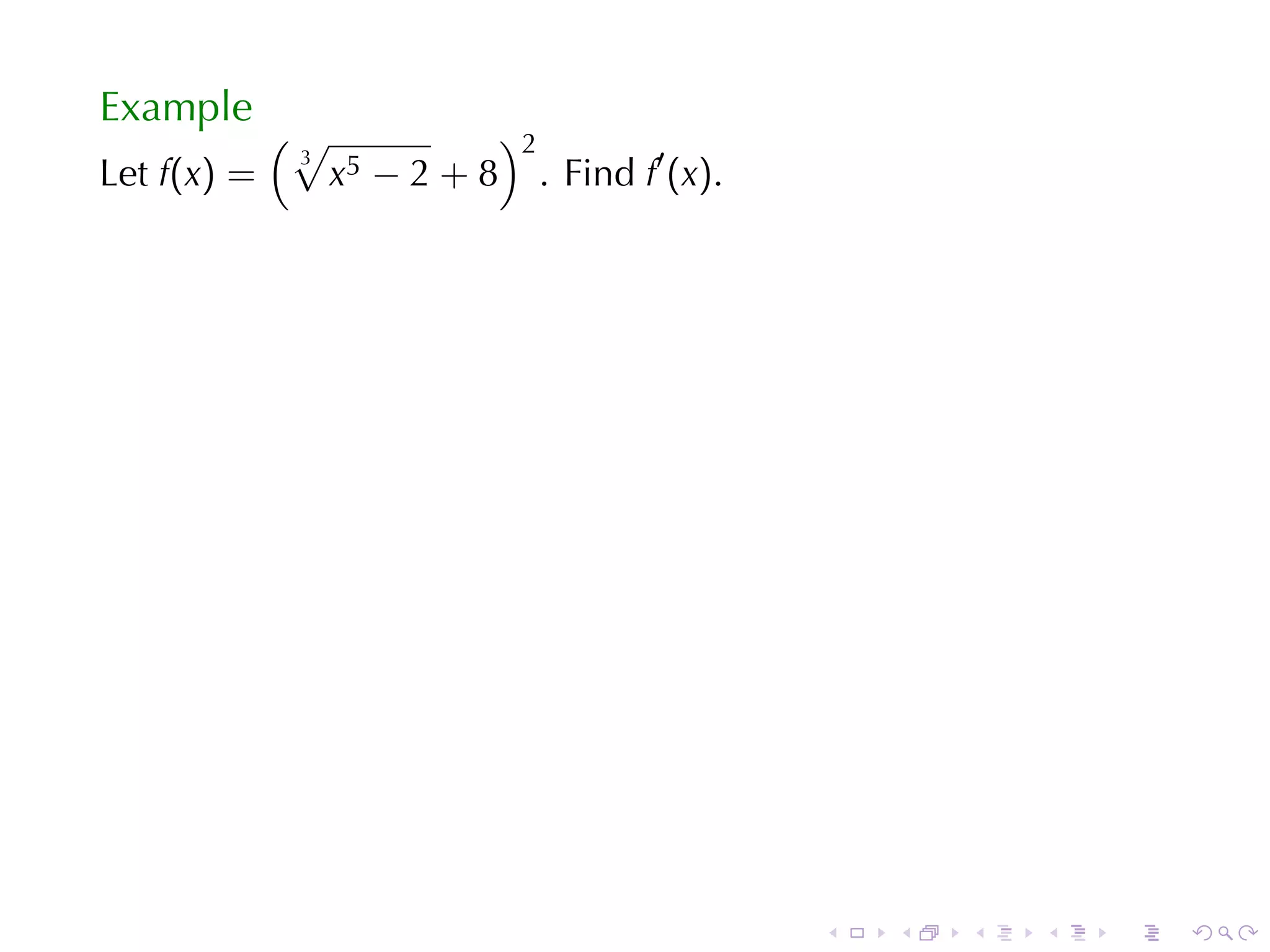
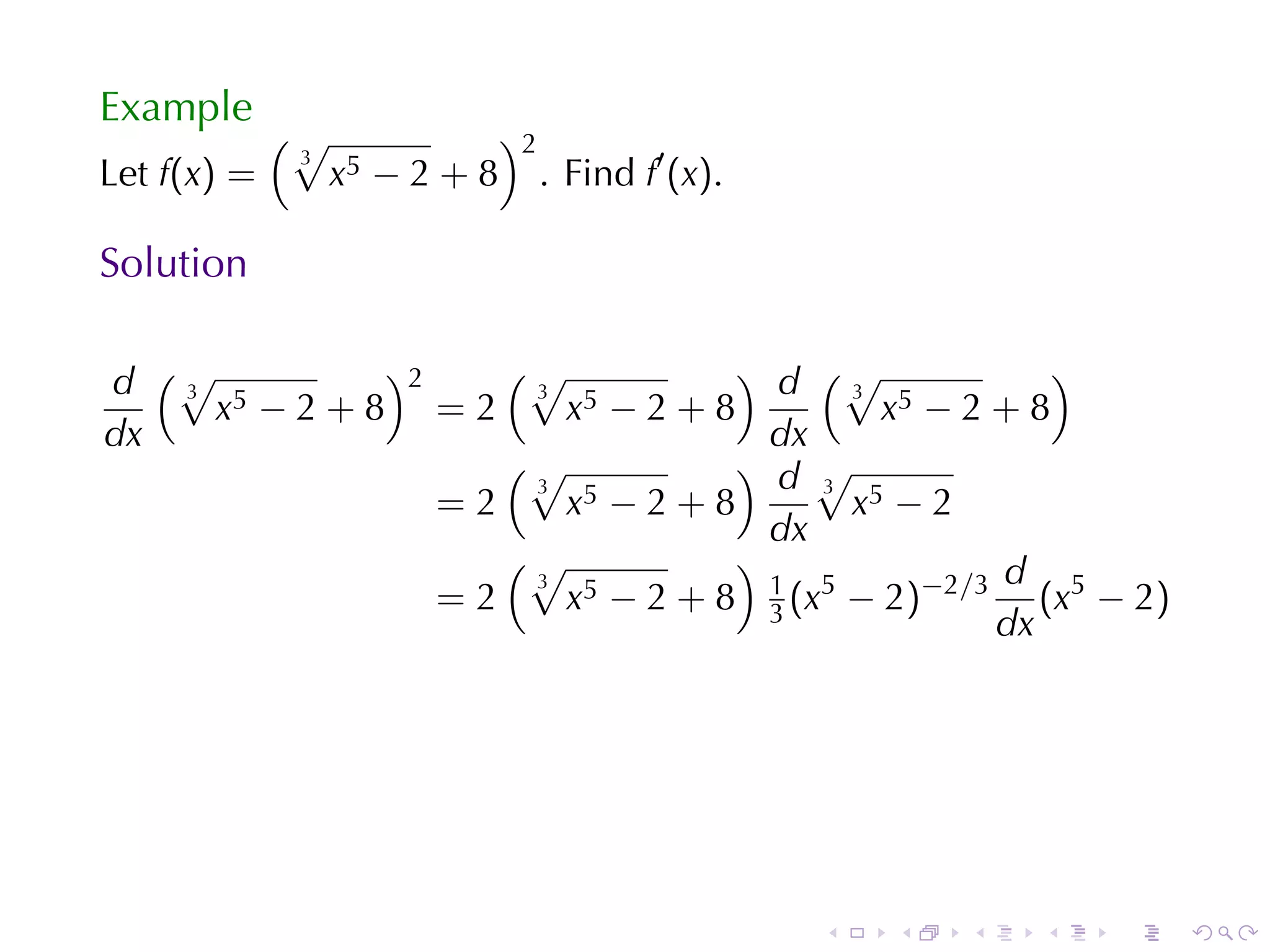
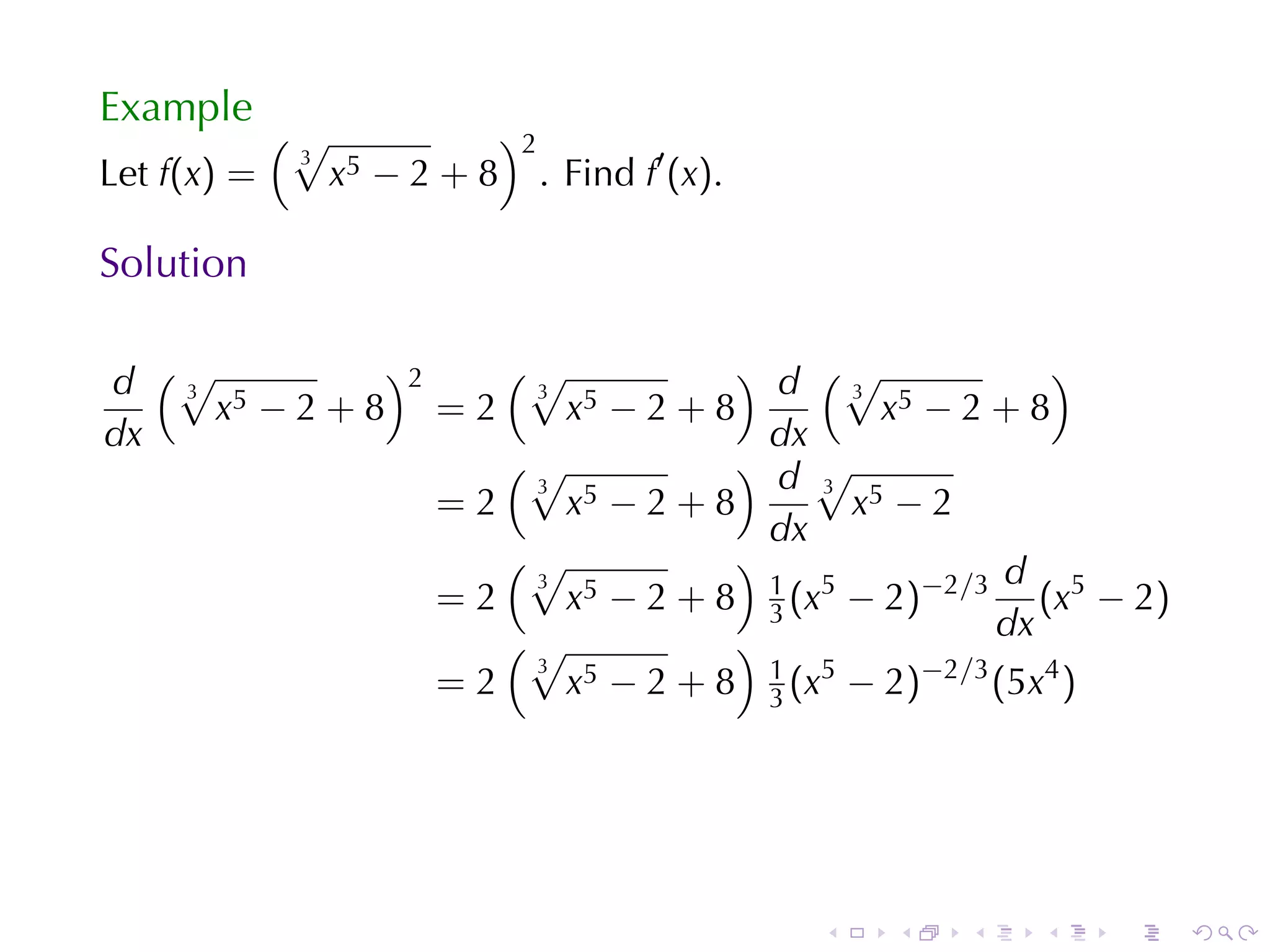
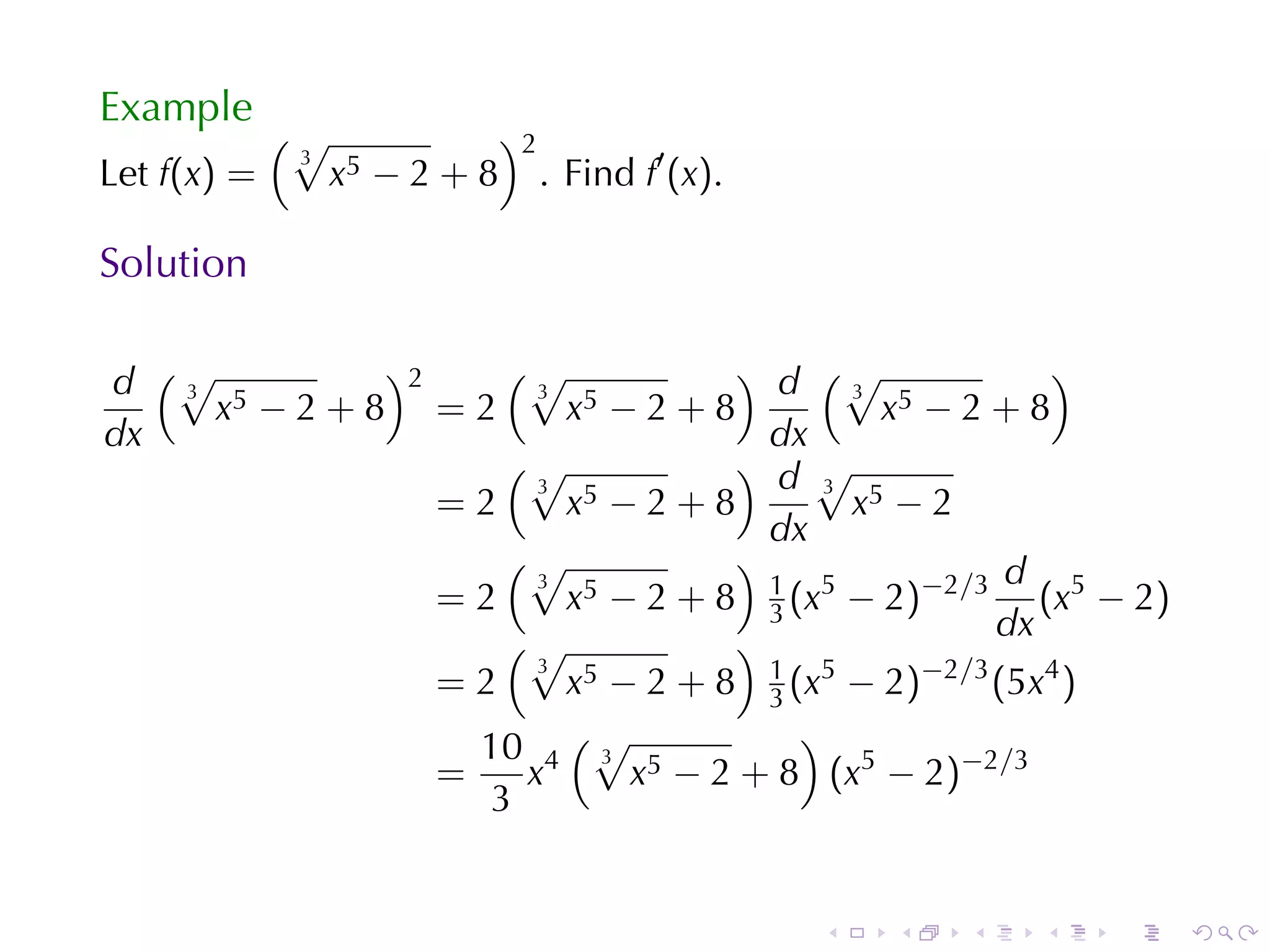
Example
             (√                )2
                                    . Find f′ (x).
              3
Let f(x) =        x5 − 2 + 8


                                                     .   .   .   .   .   .
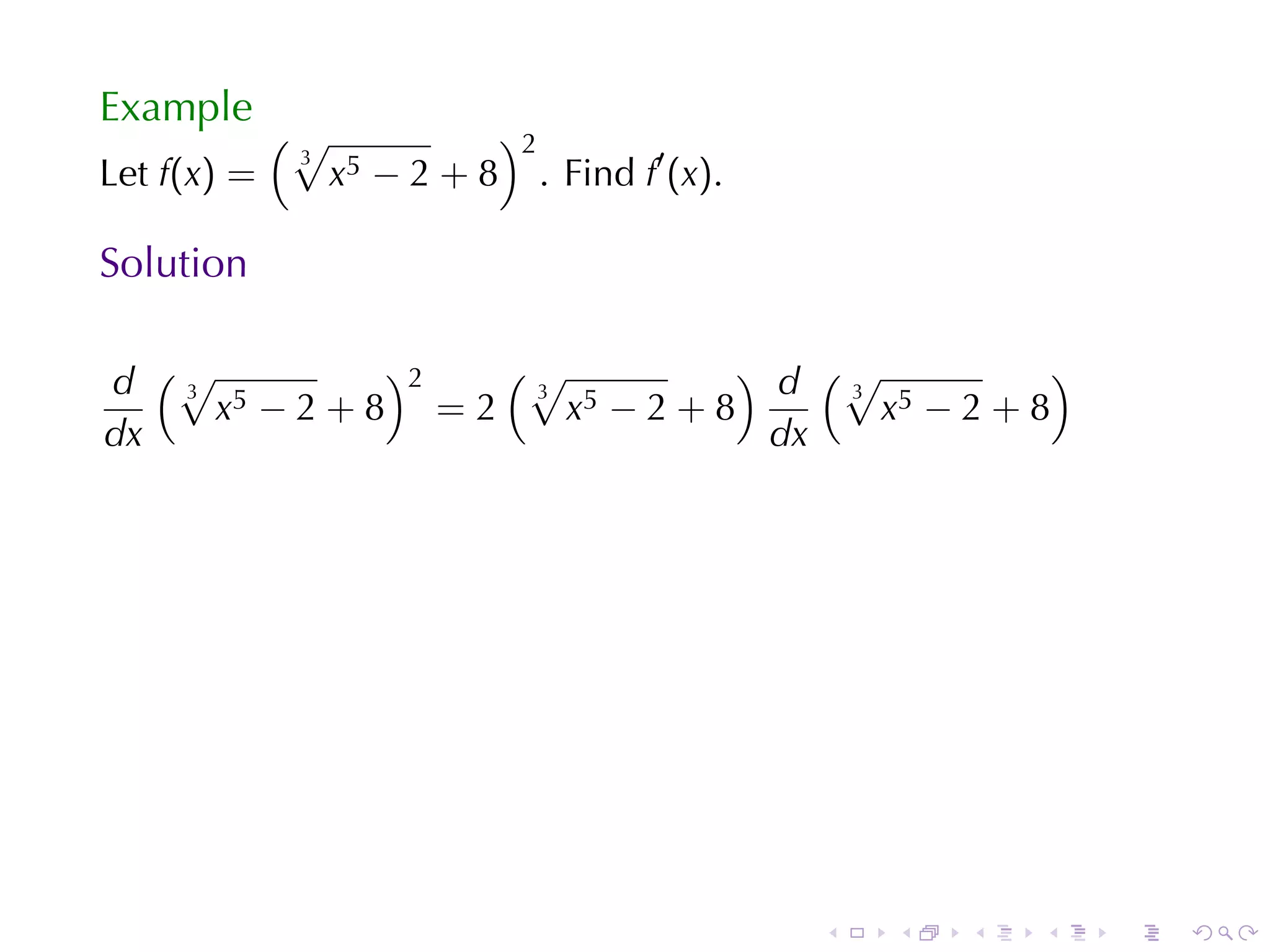
Example
             (√                )2
                                    . Find f′ (x).
              3
Let f(x) =        x5 − 2 + 8

Solution

d (√ 5
   3
           )2  (√
                3
                             ) d (√
                                  3
                                               )
     x −2+8 =2    x5 − 2 + 8        x5 − 2 + 8
dx                             dx


                                                     .   .   .   .   .   .
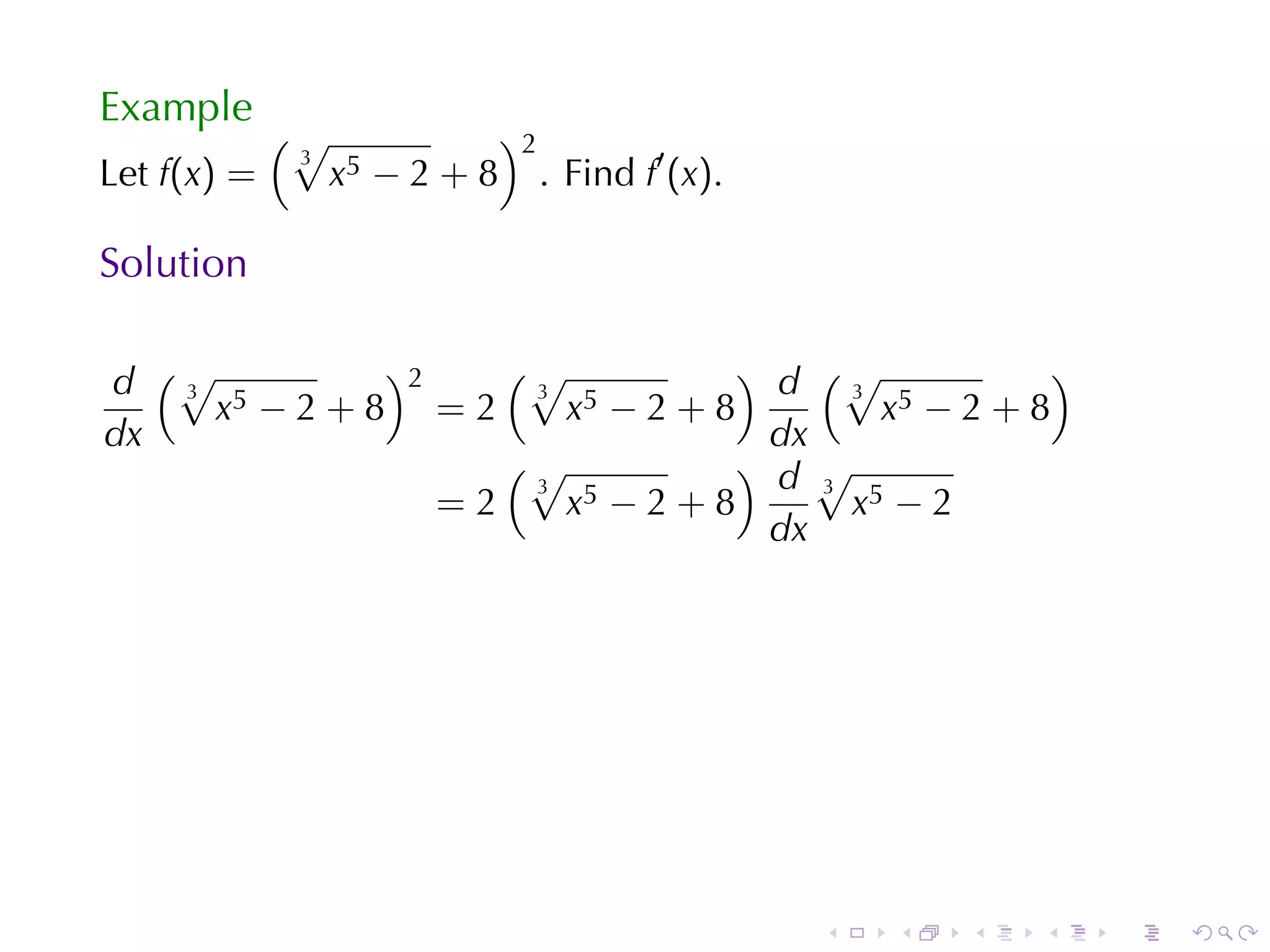
Example
             (√                )2
                                    . Find f′ (x).
              3
Let f(x) =        x5 − 2 + 8

Solution

d (√ 5
   3
           )2    (√
                  3
                               ) d (√
                                      3
                                                   )
     x −2+8 =2      x5 − 2 + 8          x5 − 2 + 8
dx                               dx
                 (√            ) d√
                  3                 3
              =2    x5 − 2 + 8        x5 − 2
                                 dx


                                                     .   .   .   .   .   .
Example
             (√                )2
                                    . Find f′ (x).
              3
Let f(x) =        x5 − 2 + 8

Solution

d (√ 5
   3
           )2    (√
                  3
                               ) d (√
                                      3
                                                   )
     x −2+8 =2      x5 − 2 + 8          x5 − 2 + 8
dx                               dx
                 (√            ) d√
                  3                 3
              =2    x5 − 2 + 8        x5 − 2
                                 dx
                 (√            )               d
                    x5 − 2 + 8 1 (x5 − 2)−2/3 (x5 − 2)
                  3
              =2                 3             dx


                                                     .   .   .   .   .   .
Example
             (√                )2
                                    . Find f′ (x).
              3
Let f(x) =        x5 − 2 + 8

Solution

d (√ 5
   3
           )2    (√
                  3
                               ) d (√
                                      3
                                                   )
     x −2+8 =2      x5 − 2 + 8          x5 − 2 + 8
dx                               dx
                 (√            ) d√
                  3                 3
              =2    x5 − 2 + 8        x5 − 2
                                 dx
                 (√            )                d
                    x5 − 2 + 8 1 (x5 − 2)−2/3 (x5 − 2)
                  3
              =2                 3
                 (√            )               dx
              =2
                  3
                    x 5 − 2 + 8 1 (x5 − 2)−2/3 (5x4 )
                                 3


                                                     .   .   .   .   .   .
Example
             (√                )2
                                    . Find f′ (x).
              3
Let f(x) =        x5 − 2 + 8

Solution

d (√ 5
   3
           )2    (√
                   3
                                ) d (√
                                        3
                                                     )
     x −2+8 =2       x5 − 2 + 8           x5 − 2 + 8
dx                                dx
                 (√             ) d√
                   3                  3
              =2     x5 − 2 + 8         x5 − 2
                                  dx
                 (√             )                d
                     x5 − 2 + 8 1 (x5 − 2)−2/3 (x5 − 2)
                   3
              =2                  3
                 (√             )                dx
              =2
                   3
                     x 5 − 2 + 8 1 (x5 − 2)−2/3 (5x4 )
                                  3
                     (√
                10 4 3 5            )
              =   x       x − 2 + 8 (x5 − 2)−2/3
                3


                                                     .   .   .   .   .   .
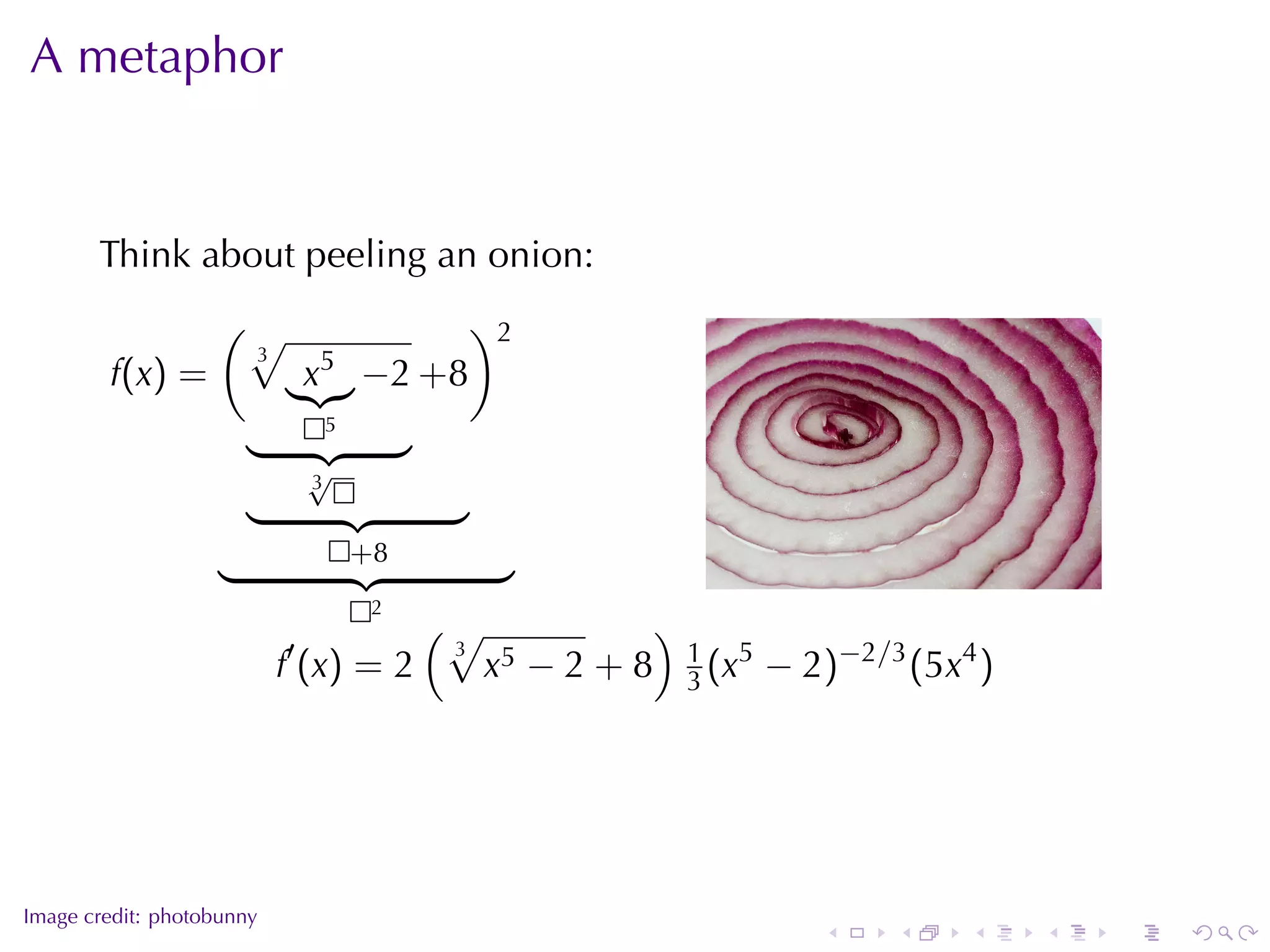
A metaphor


       Think	about	peeling	an	onion:
                   (√                       )2
                       3        5
        f(x) =              x       −2 +8
                                5

                            √
                            3


                                    +8
                                                                                .
                                     2
                                      (√           )
                           f′ (x) = 2    x5 − 2 + 8 1 (x5 − 2)−2/3 (5x4 )
                                       3
                                                     3


.
Image	credit: photobunny
                                                             .    .    .    .   .   .
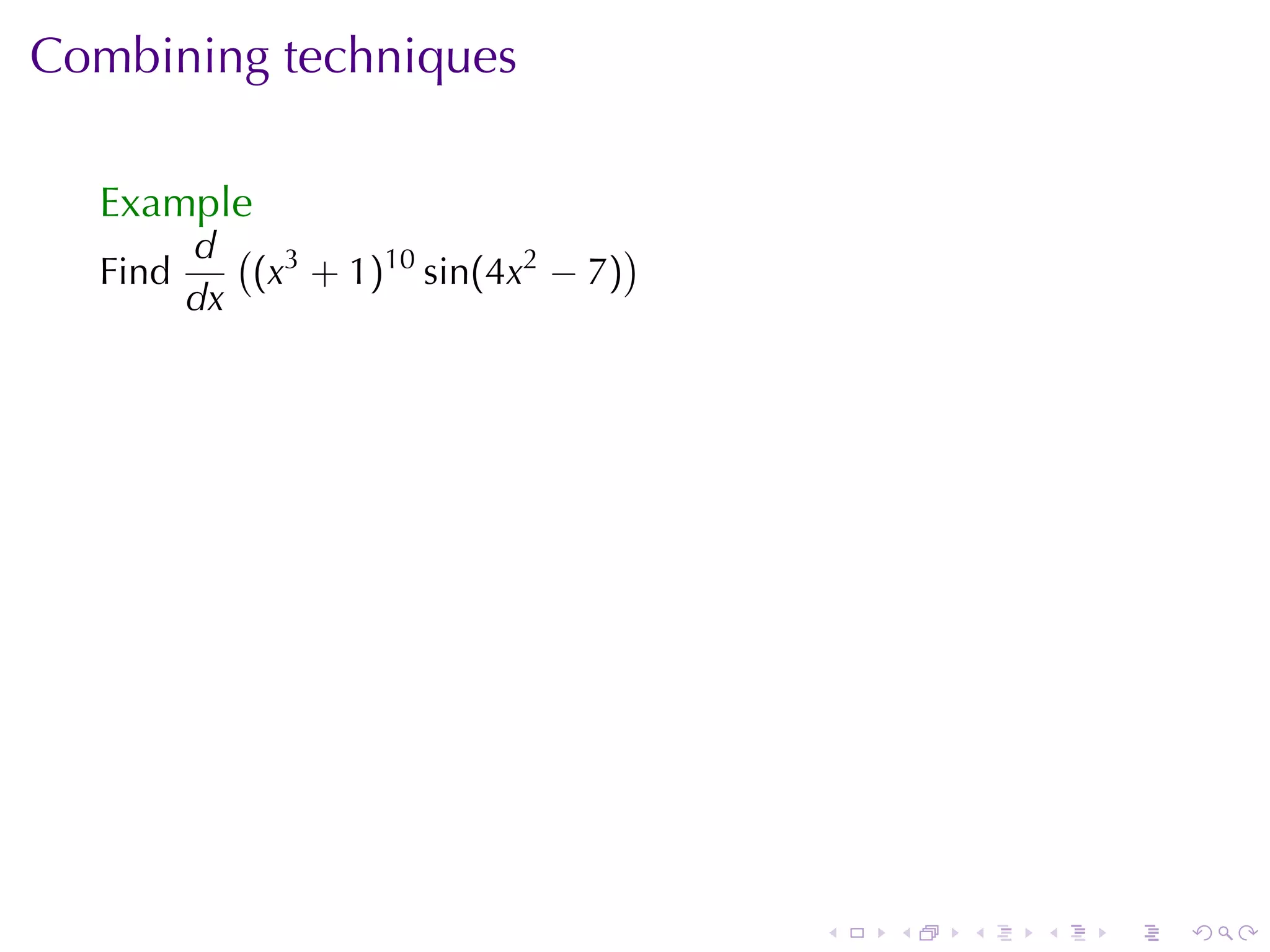
Combining	techniques

  Example
         d ( 3                     )
  Find      (x + 1)10 sin(4x2 − 7)
         dx


                                       .   .   .   .   .   .
Combining	techniques

  Example
         d ( 3                     )
  Find      (x + 1)10 sin(4x2 − 7)
         dx
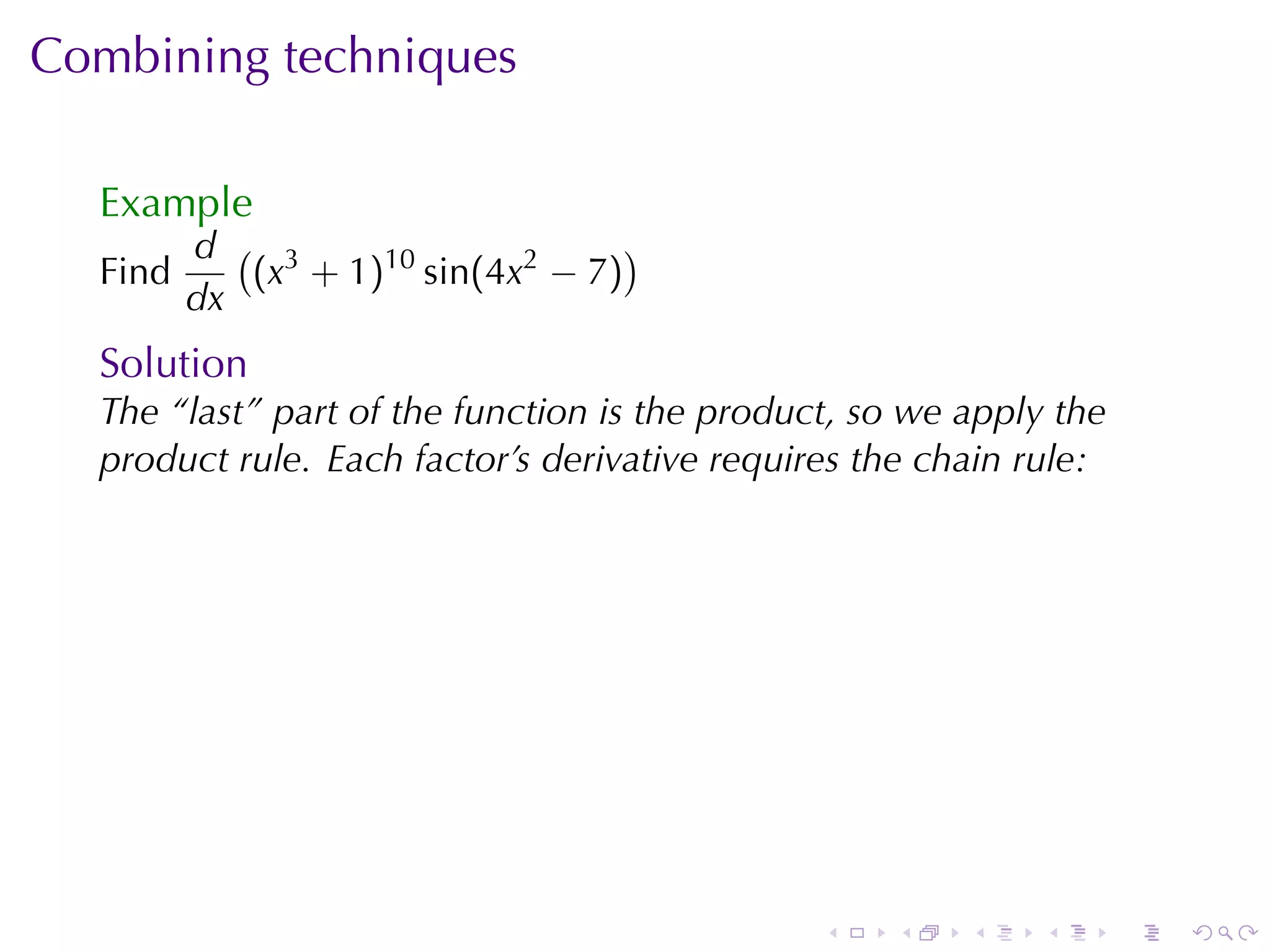
  Solution
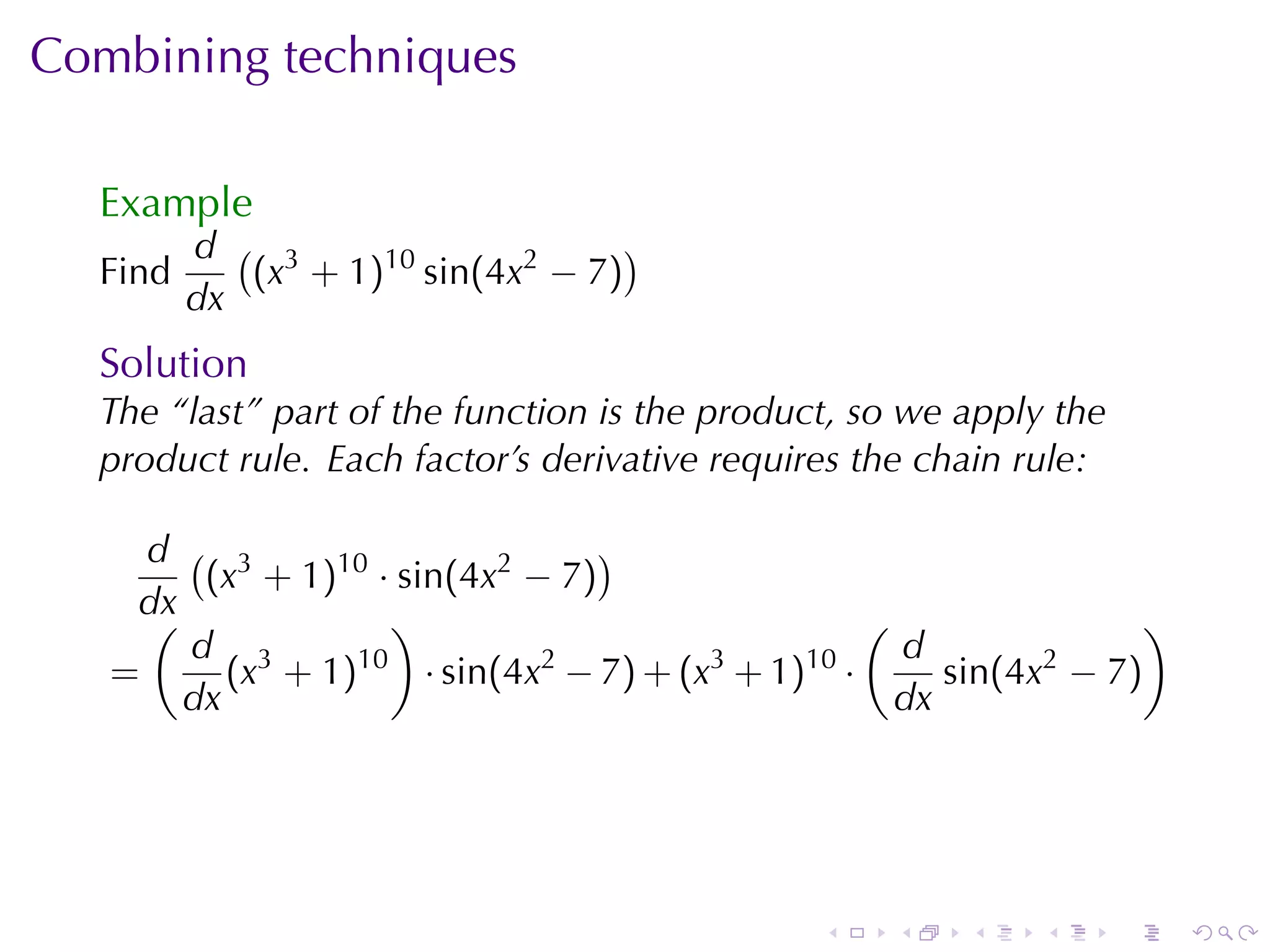
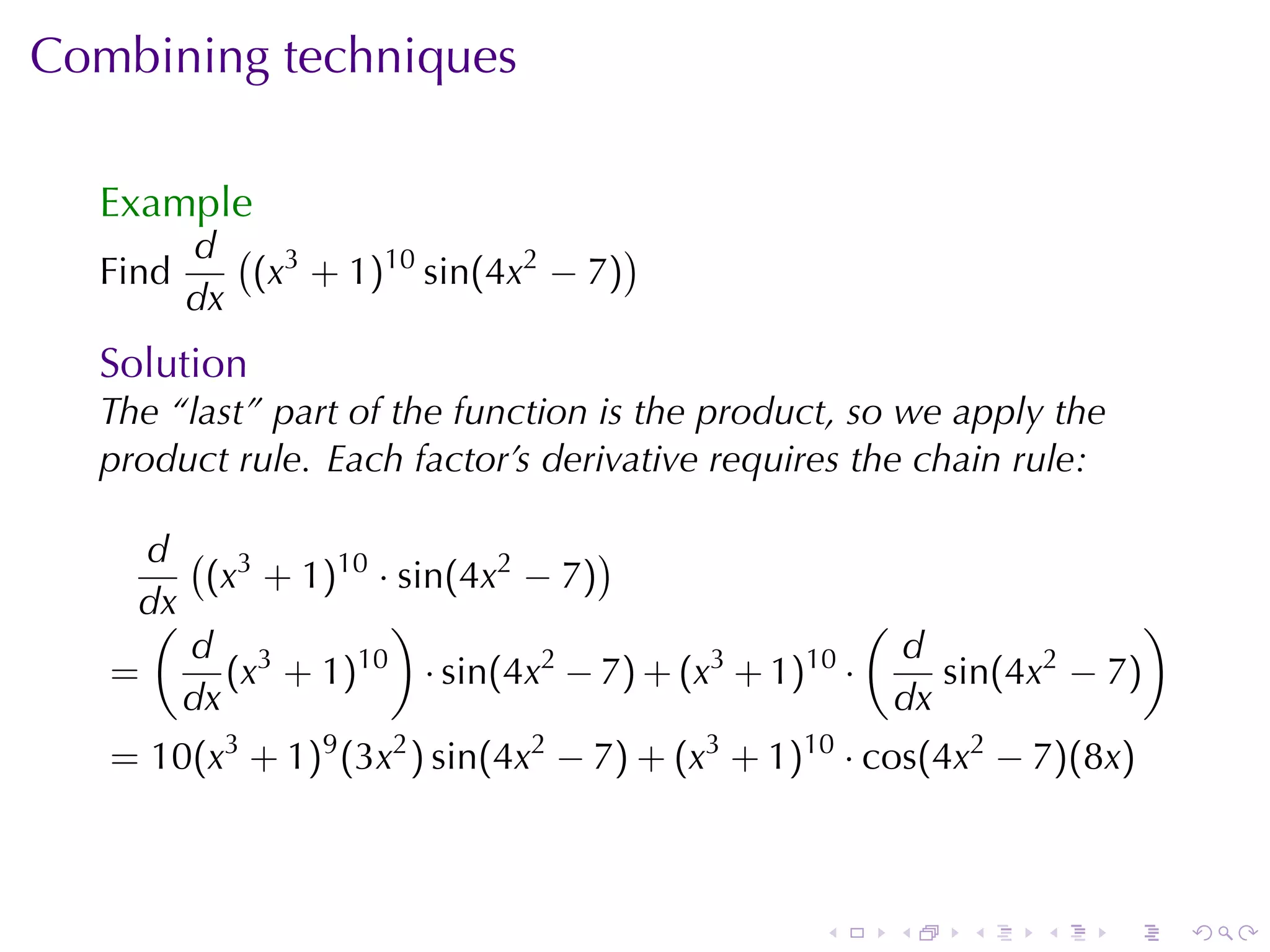
  The	“last”	part	of	the	function	is	the	product, so	we	apply	the
  product	rule. Each	factor’s	derivative	requires	the	chain	rule:


                                               .   .    .    .      .   .
Combining	techniques

  Example
         d ( 3                     )
  Find      (x + 1)10 sin(4x2 − 7)
         dx
  Solution
  The	“last”	part	of	the	function	is	the	product, so	we	apply	the
  product	rule. Each	factor’s	derivative	requires	the	chain	rule:

     d ( 3                      )
        (x + 1)10 · sin(4x2 − 7)
    dx
     (             )                              (                )
       d 3                                          d
   =      (x + 1)10 · sin(4x2 − 7) + (x3 + 1)10 ·      sin(4x2 − 7)
       dx                                           dx


                                               .   .    .    .      .   .
Combining	techniques

  Example
         d ( 3                     )
  Find      (x + 1)10 sin(4x2 − 7)
         dx
  Solution
  The	“last”	part	of	the	function	is	the	product, so	we	apply	the
  product	rule. Each	factor’s	derivative	requires	the	chain	rule:

     d ( 3                      )
        (x + 1)10 · sin(4x2 − 7)
    dx
     (             )                              (                )
       d 3                                          d
   =      (x + 1)10 · sin(4x2 − 7) + (x3 + 1)10 ·      sin(4x2 − 7)
       dx                                           dx
   = 10(x3 + 1)9 (3x2 ) sin(4x2 − 7) + (x3 + 1)10 · cos(4x2 − 7)(8x)


                                                .   .    .    .     .   .
Your	Turn


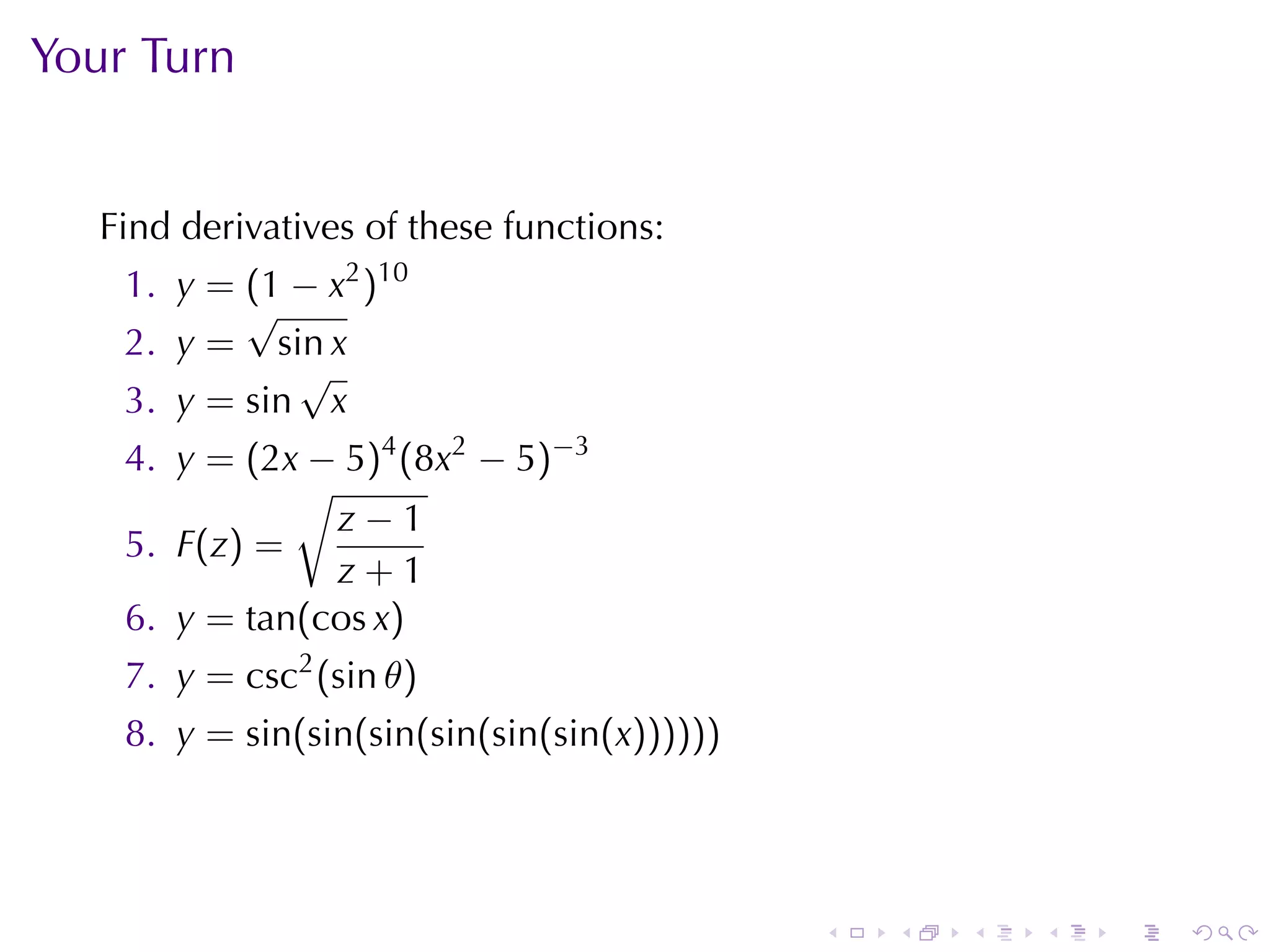
   Find	derivatives	of	these	functions:
    1. y = (1 − x2 )10
           √
    2. y = sin x
              √
    3. y = sin x
    4. y = (2x − 5)4 (8x2 − 5)−3
              √
                z−1
    5. F(z) =
                z+1
    6. y = tan(cos x)
    7. y = csc2 (sin θ)
    8. y = sin(sin(sin(sin(sin(sin(x))))))


                                             .   .   .   .   .   .
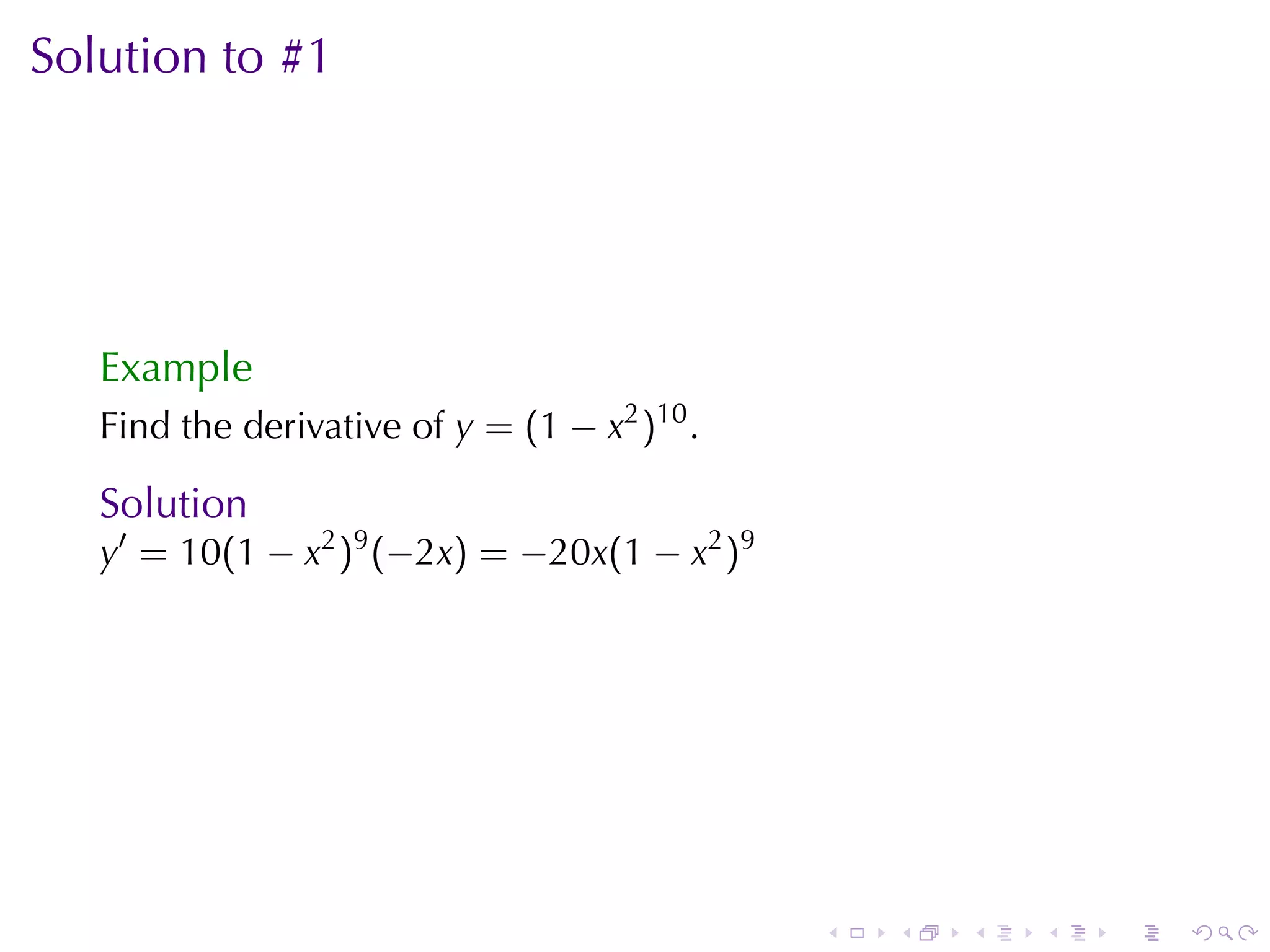
Solution	to	#1


   Example
   Find	the	derivative	of y = (1 − x2 )10 .

   Solution
   y′ = 10(1 − x2 )9 (−2x) = −20x(1 − x2 )9


                                              .   .   .   .   .   .
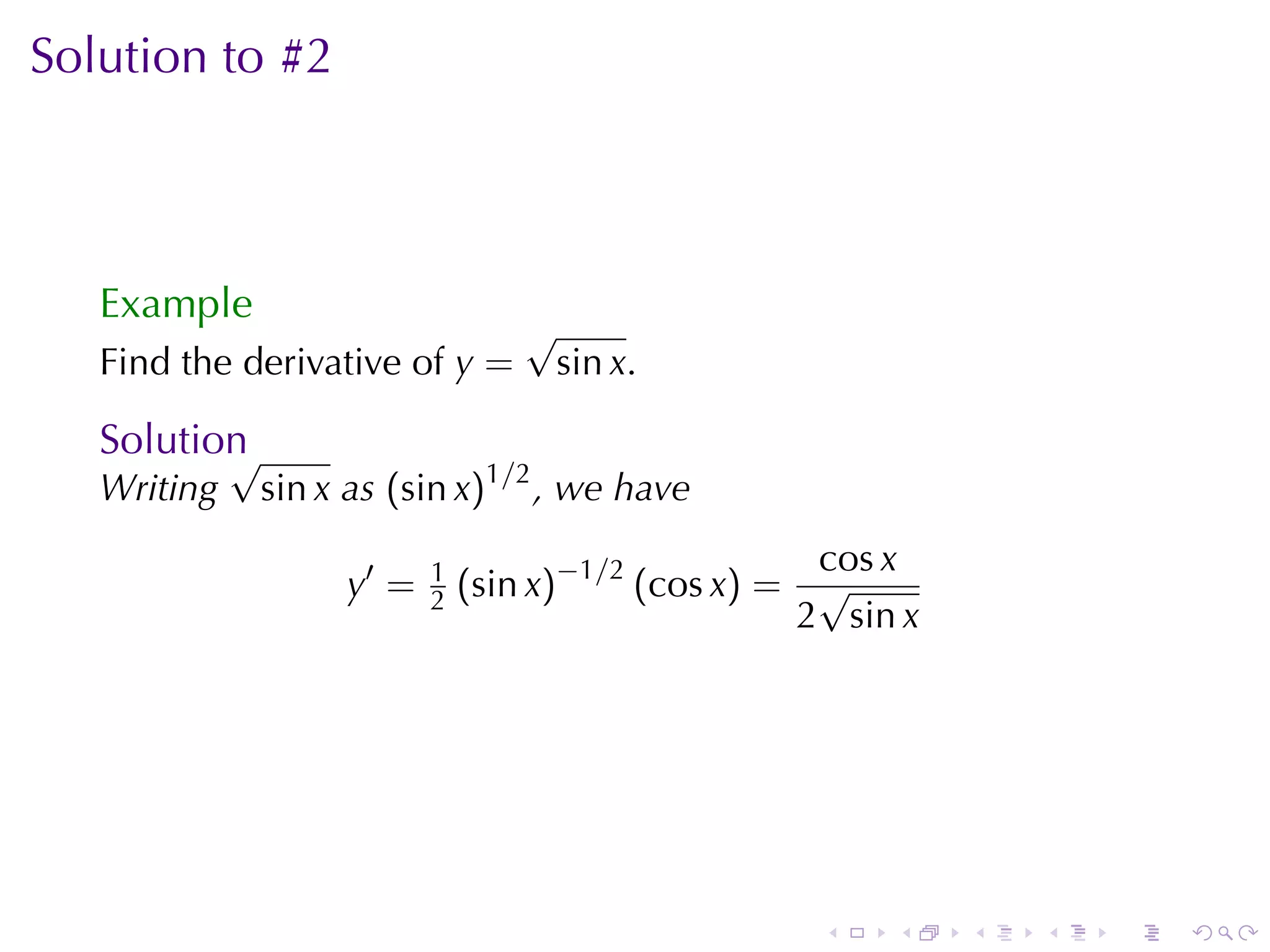
Solution	to	#2


   Example
                                  √
   Find	the	derivative	of y =         sin x.

   Solution
          √
   Writing    sin x as (sin x)1/2 , we	have
                                                    cos x
                   y′ =   1
                          2   (sin x)−1/2 (cos x) = √
                                                   2 sin x


                                                    .   .    .   .   .   .
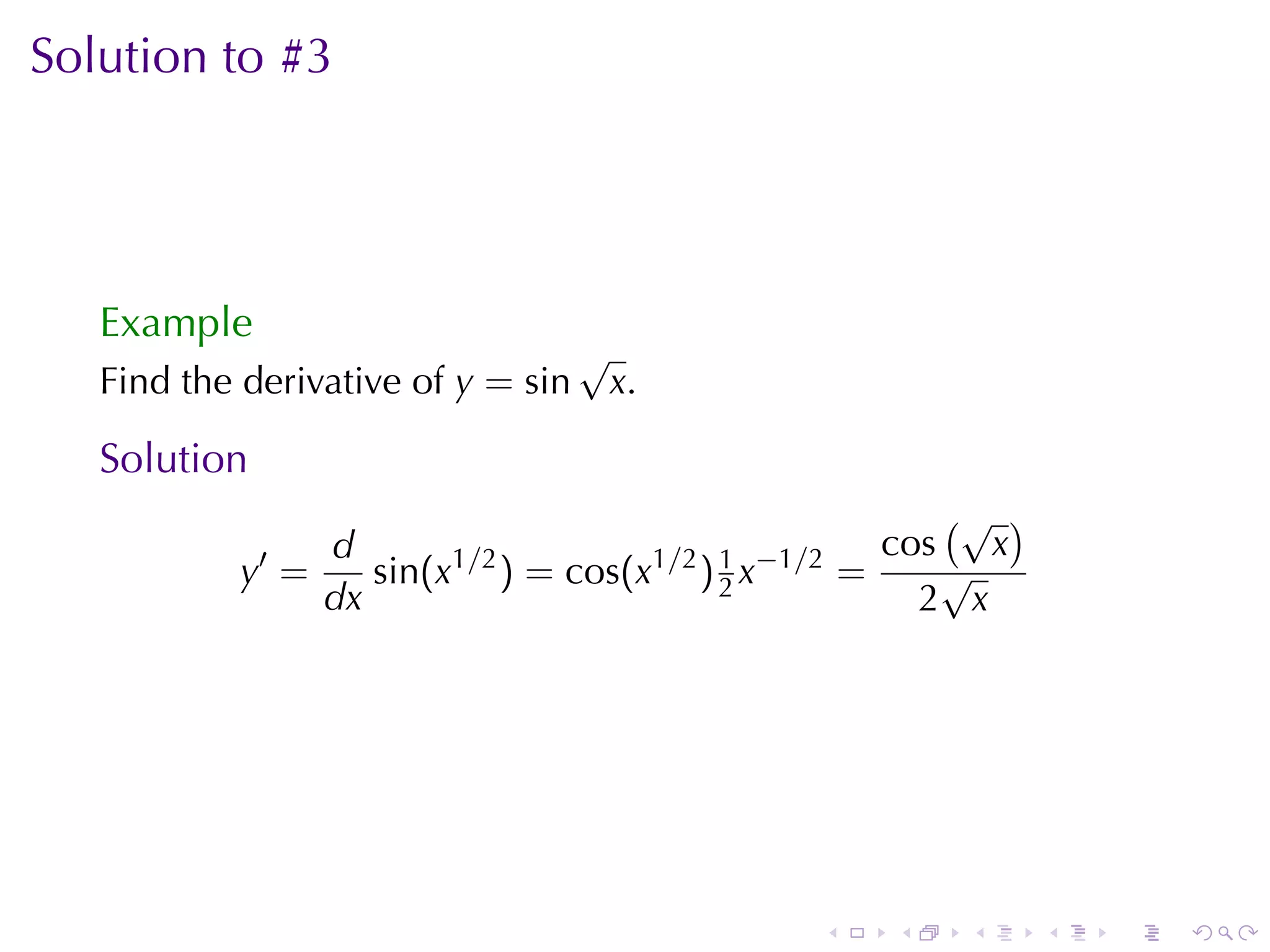
Solution	to	#3


   Example
                                    √
   Find	the	derivative	of y = sin       x.

   Solution
                                                 (√ )
              ′d       1 /2      1/2 1 −1/2   cos x
           y =    sin(x ) = cos(x ) 2 x     =    √
               dx                               2 x


                                             .   .   .   .   .   .
Solution	to	#4

   Example
   Find	the	derivative	of y = (2x − 5)4 (8x2 − 5)−3

   Solution
   We	need	to	use	the	product	rule	and	the	chain	rule:

   y′ = 4(2x − 5)3 (2)(8x2 − 5)−3 + (2x − 5)4 (−3)(8x2 − 5)−4 (16x)

   The	rest	is	a	bit	of	algebra, useful	if	you	wanted	to	solve	the
   equation y′ = 0:
                                         [                       ]
         y′ = 8(2x − 5)3 (8x2 − 5)−4 (8x2 − 5) − 6x(2x − 5)
                                         (                )
             = 8(2x − 5)3 (8x2 − 5)−4 −4x2 + 30x − 5
                                            (             )
             = −8(2x − 5)3 (8x2 − 5)−4 4x2 − 30x + 5


                                                 .    .    .    .    .   .
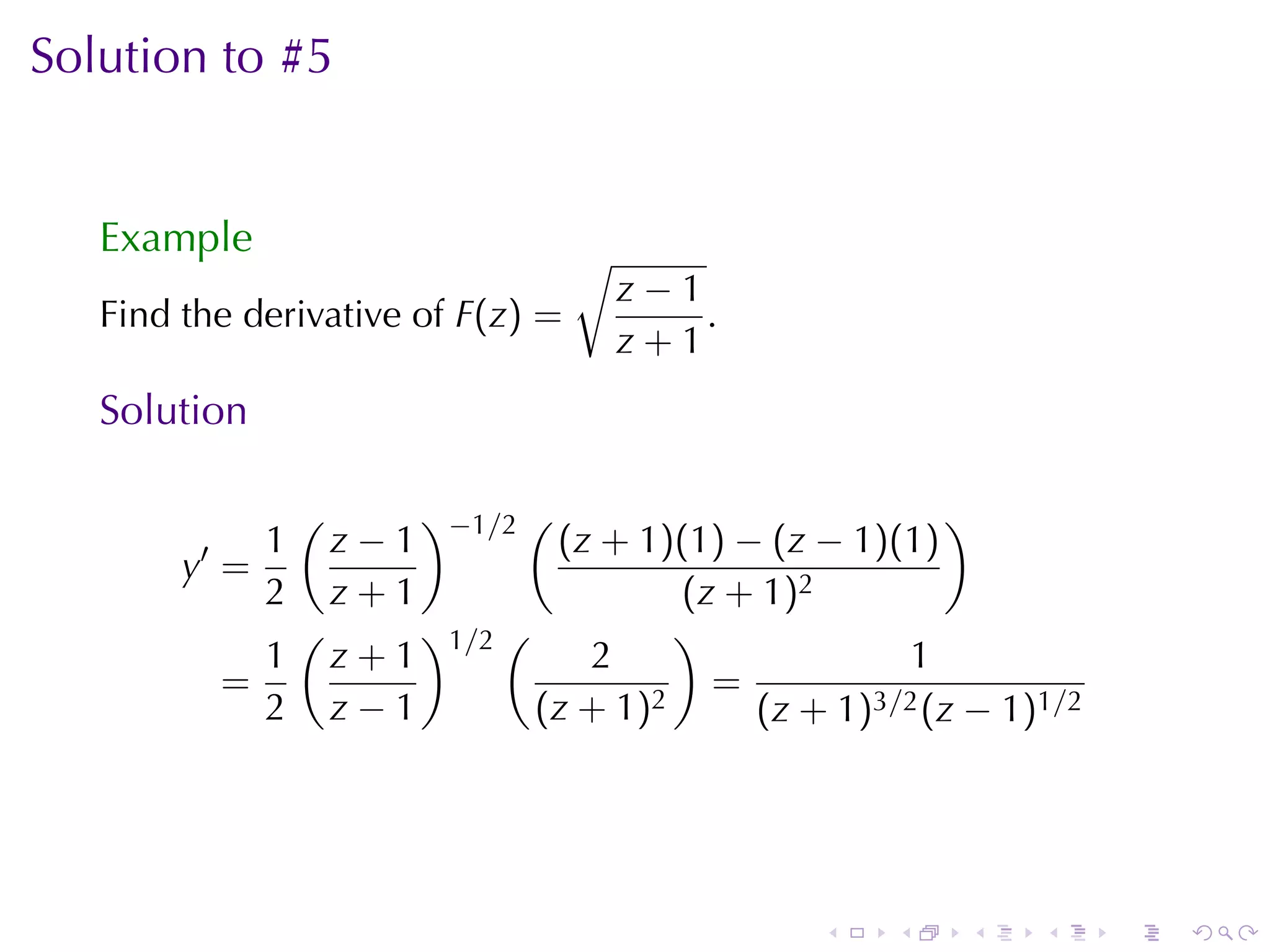
Solution	to	#5


   Example                           √
                                         z−1
   Find	the	derivative	of F(z) =             .
                                         z+1
   Solution

                 (         )−1/2 (                   )
         ′  1        z−1     (z + 1)(1) − (z − 1)(1)
        y =
            2        z+1             (z + 1)2
                (    )1/2 (          )
               1 z+1           2                  1
             =                     2
                                       =
               2 z−1        (z + 1)      (z + 1)3/2 (z − 1)1/2


                                                 .   .   .   .   .   .
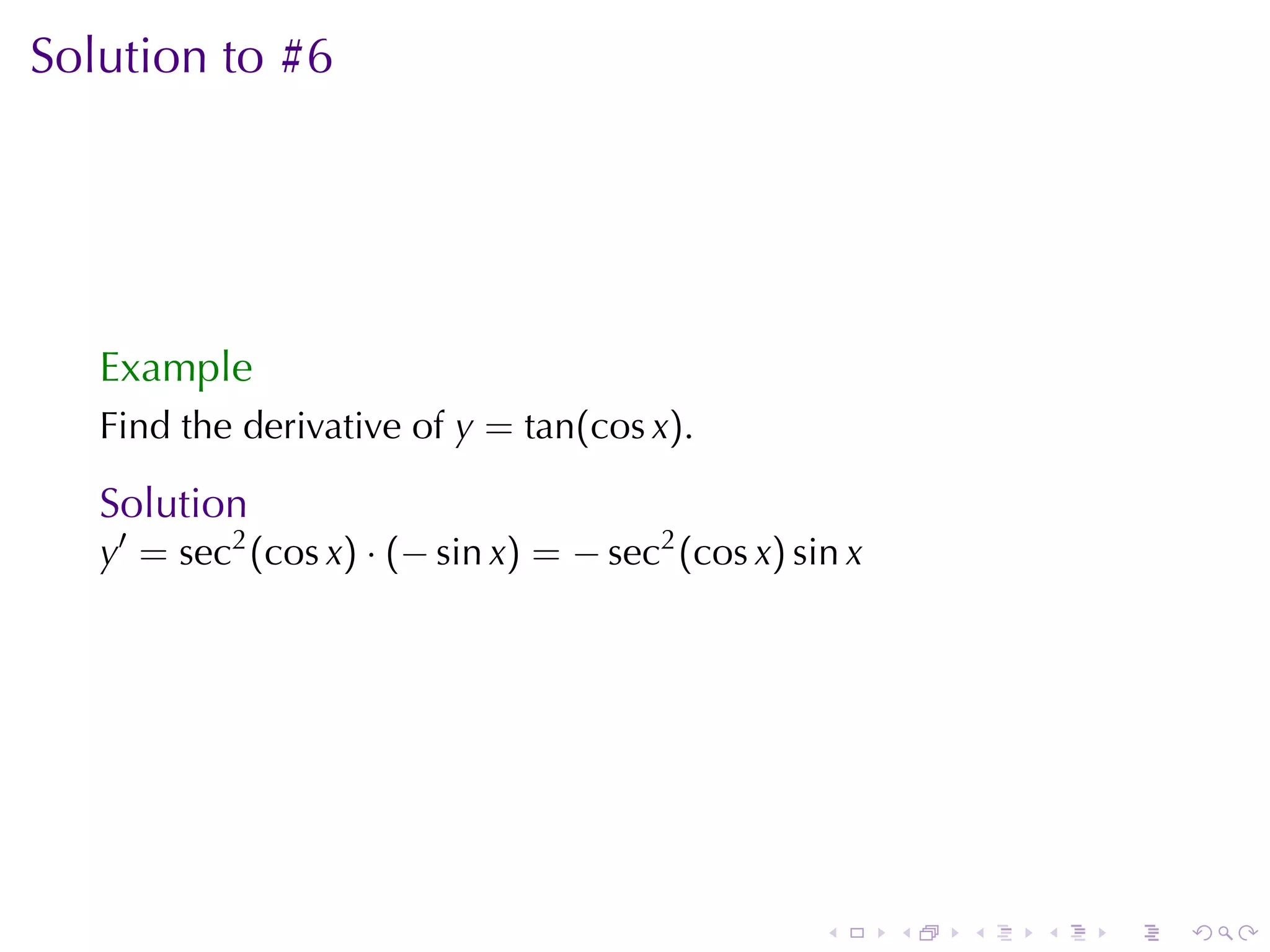
Solution	to	#6


   Example
   Find	the	derivative	of y = tan(cos x).

   Solution
   y′ = sec2 (cos x) · (− sin x) = − sec2 (cos x) sin x


                                                    .     .   .   .   .   .
Solution	to	#7


   Example
   Find	the	derivative	of y = csc2 (sin θ).

   Solution
   Remember	the	notation:

                      y = csc2 (sin θ) = [csc(sin θ)]2

   So
            y′ = 2 csc(sin θ) · [− csc(sin θ) cot(sin θ)] · cos(θ)
              = −2 csc2 (sin θ) cot(sin θ) cos θ


                                                   .     .   .       .   .   .
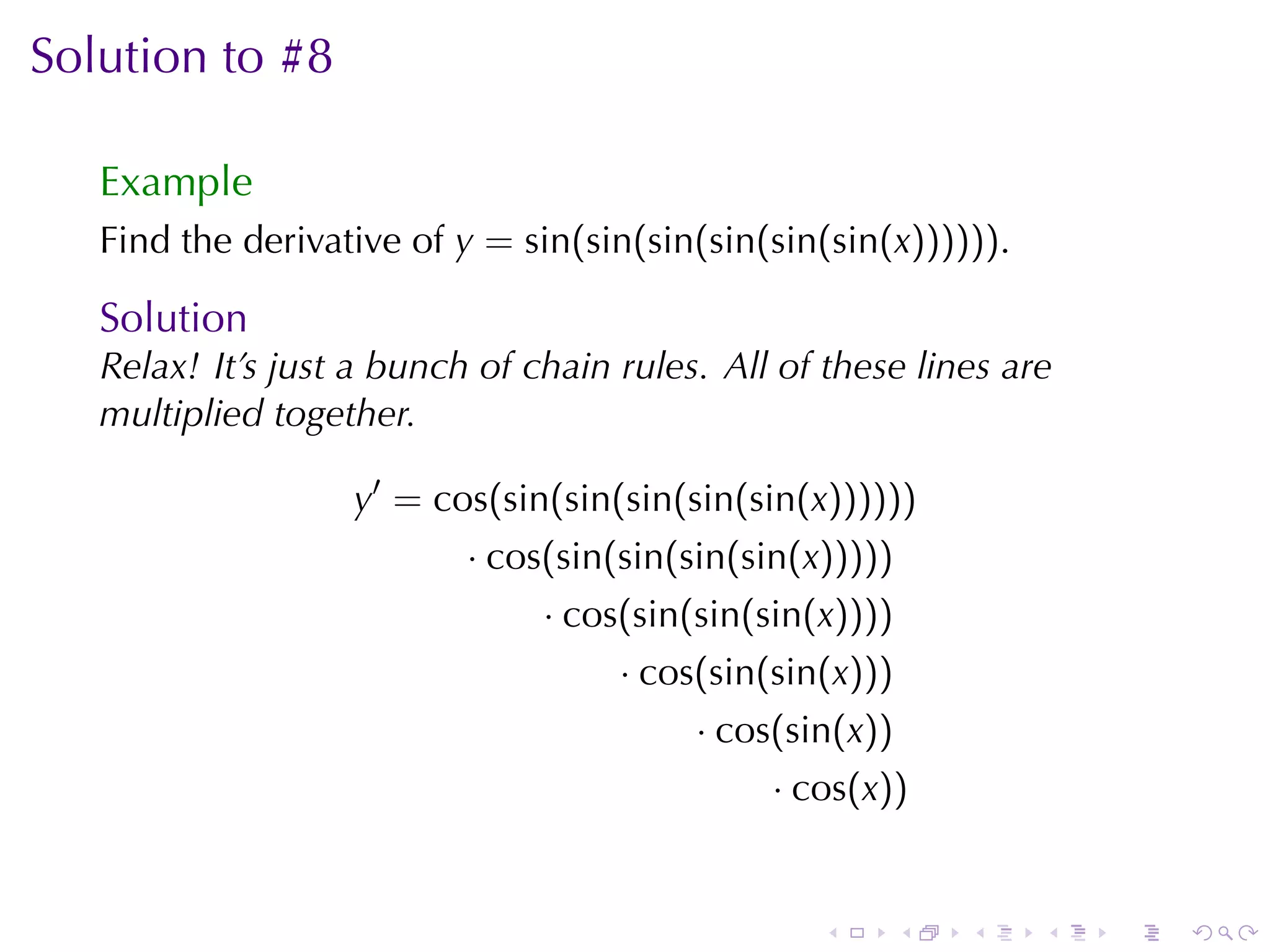
Solution	to	#8

   Example
   Find	the	derivative	of y = sin(sin(sin(sin(sin(sin(x)))))).

   Solution
   Relax! It’s	just	a	bunch	of	chain	rules. All	of	these	lines	are
   multiplied	together.

                   y′ = cos(sin(sin(sin(sin(sin(x))))))
                           · cos(sin(sin(sin(sin(x)))))
                                · cos(sin(sin(sin(x))))
                                     · cos(sin(sin(x)))
                                          · cos(sin(x))
                                               · cos(x))


                                                  .       .   .   .   .   .
Outline


  Heuristics
    Analogy
    The	Linear	Case


  The	chain	rule


  Examples


  Related	rates	of	change


                            .   .   .   .   .   .
Related	rates	of	change

     Question
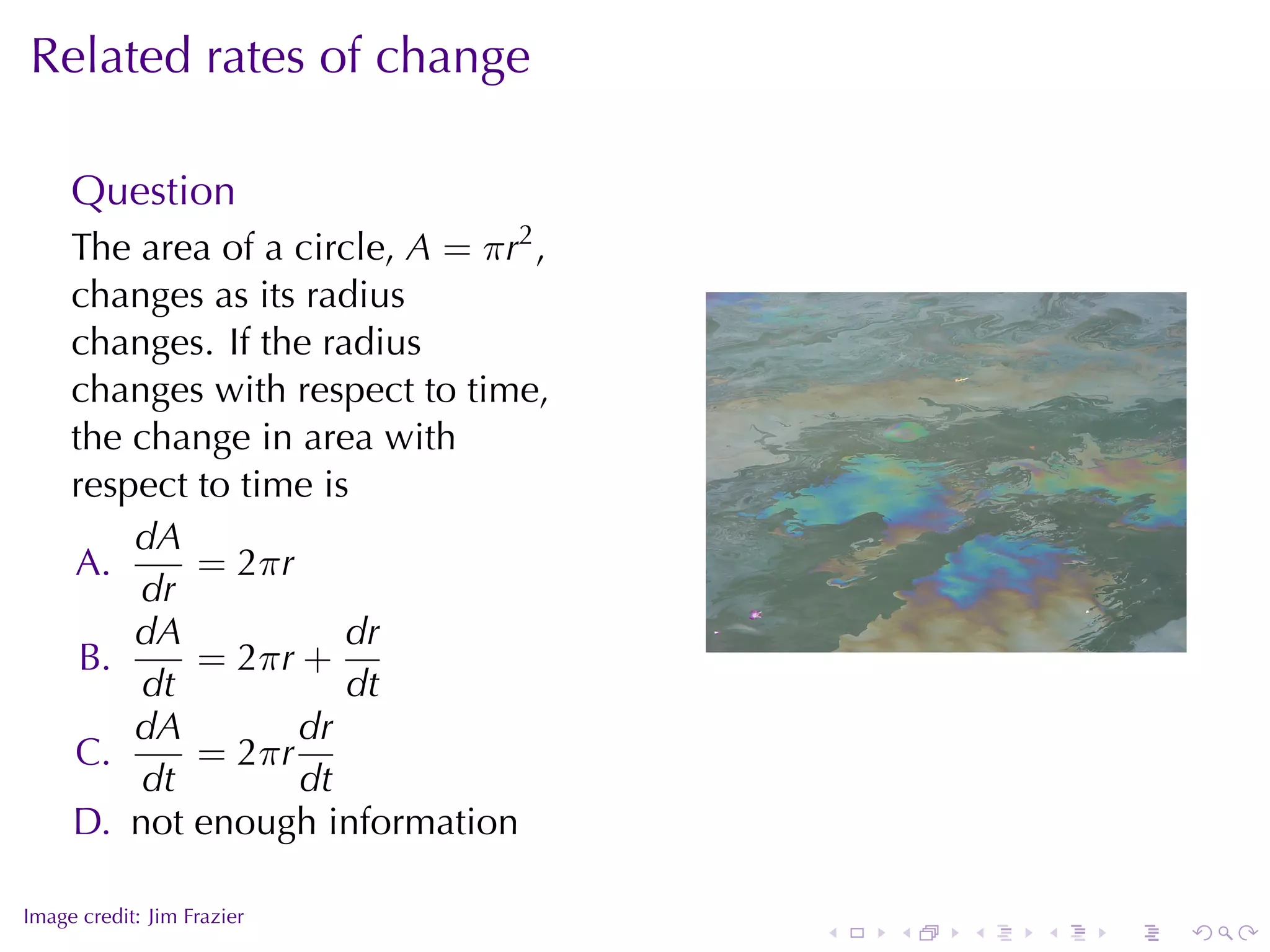
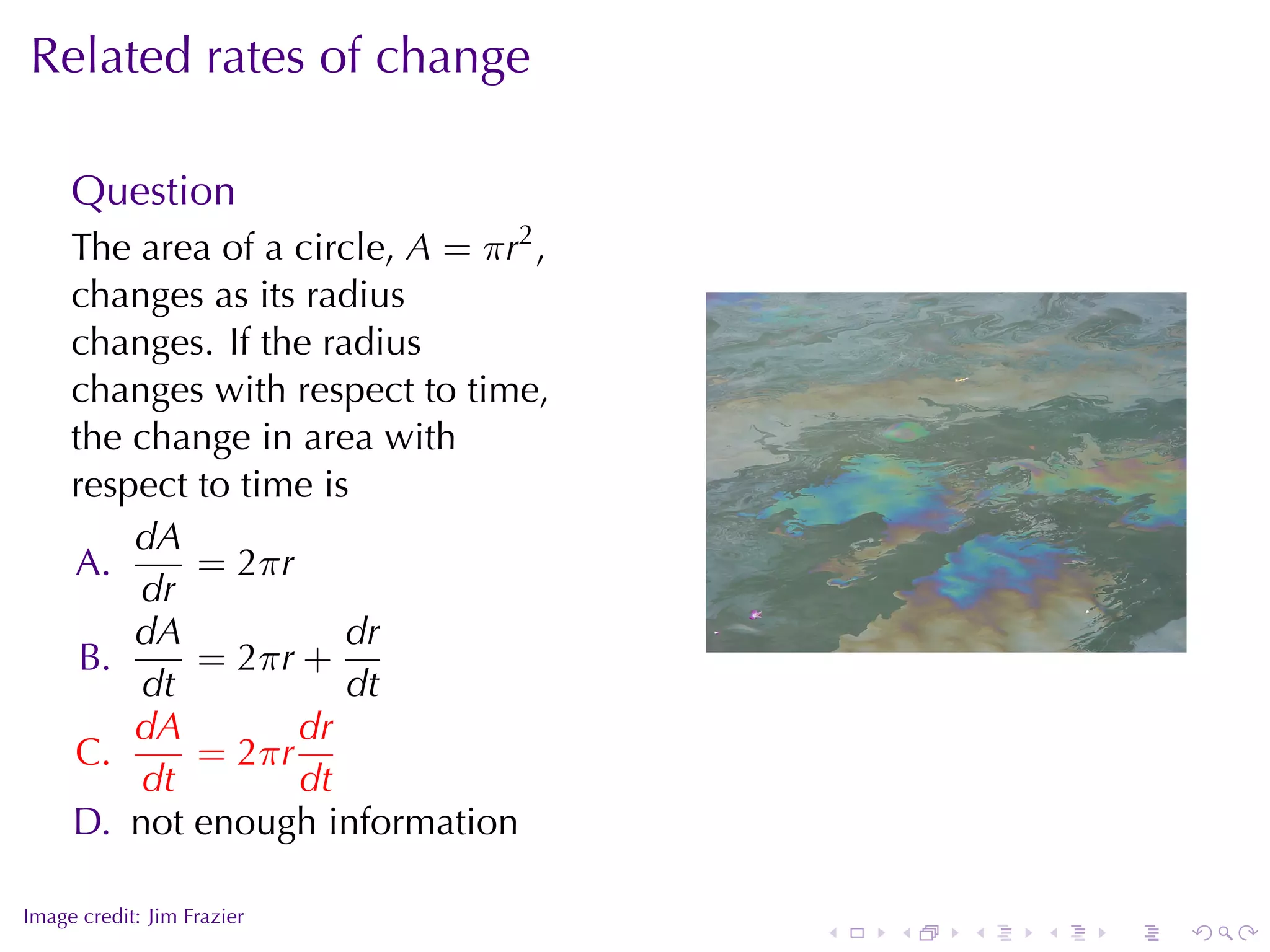
     The	area	of	a	circle, A = π r2 ,
     changes	as	its	radius
     changes. If	the	radius
     changes	with	respect	to	time,
     the	change	in	area	with
     respect	to	time	is
         dA
     A.      = 2π r
         dr
         dA            dr                                   .
      B.     = 2π r +
         dt            dt
         dA         dr
     C.      = 2π r
         dt         dt
     D. not	enough	information

.
Image	credit: Jim	Frazier
                                        .   .   .   .   .   .
Related	rates	of	change

     Question
     The	area	of	a	circle, A = π r2 ,
     changes	as	its	radius
     changes. If	the	radius
     changes	with	respect	to	time,
     the	change	in	area	with
     respect	to	time	is
         dA
     A.      = 2π r
         dr
         dA            dr                                   .
      B.     = 2π r +
         dt            dt
         dA         dr
     C.      = 2π r
         dt         dt
     D. not	enough	information

.
Image	credit: Jim	Frazier
                                        .   .   .   .   .   .
What	have	we	learned	today?


     The	derivative	of	a
     composition	is	the
     product	of	derivatives
     In	symbols:
     (f ◦ g)′ (x) = f′ (g(x))g′ (x)
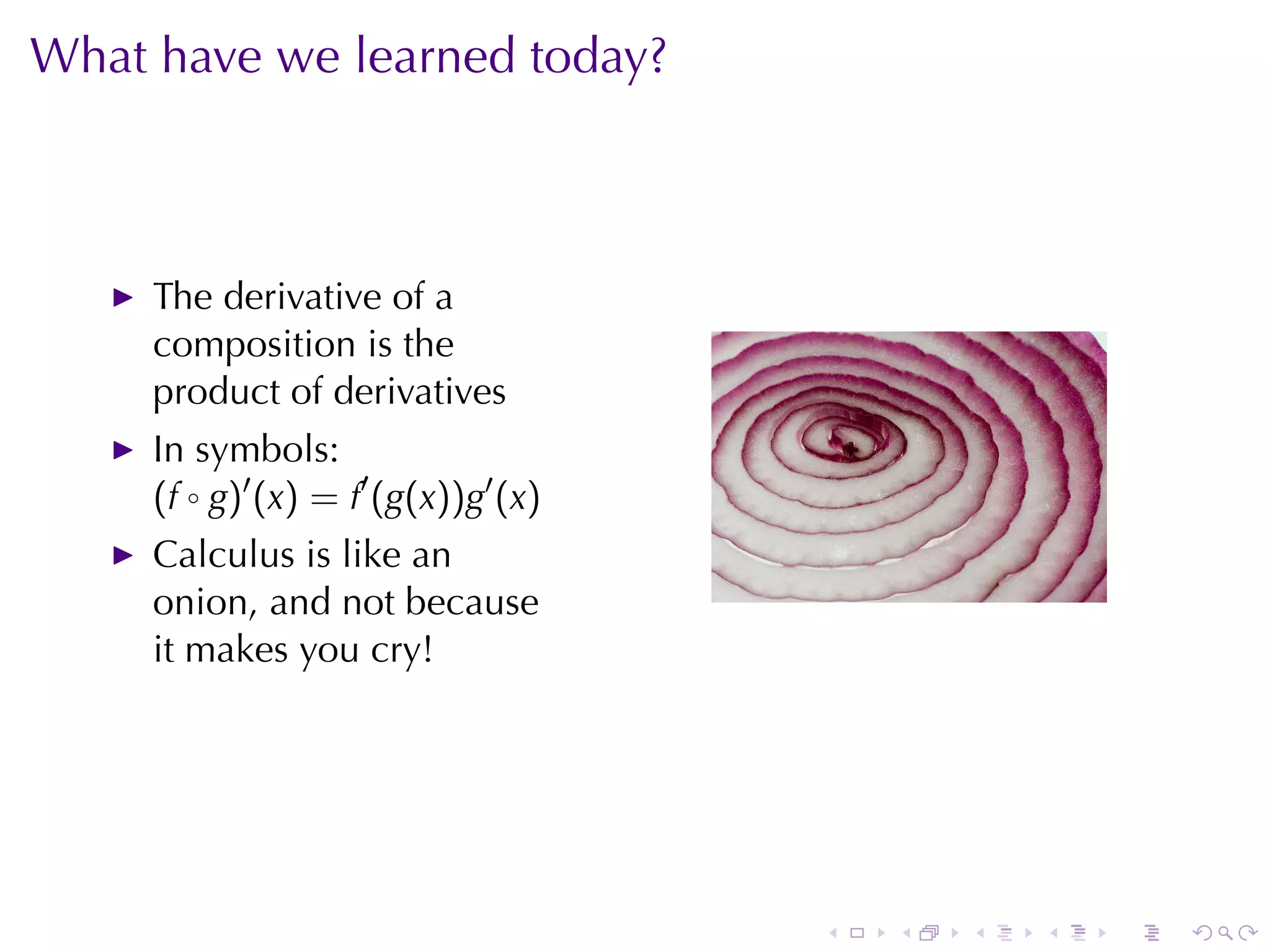
     Calculus	is	like	an
     onion, and	not	because
     it	makes	you	cry!


                                      .   .   .   .   .   .

Lesson 10: The Chain Rule

  • 1.
    Section 2.5 The Chain Rule V63.0121.027, Calculus I October 6, 2009 Announcements Quiz 2 this week Midterm in class on §§1.1–1.4 . . . . . .
  • 2.
    Compositions See Section 1.2 for review Definition If f and g are functions, the composition (f ◦ g)(x) = f(g(x)) means “do g first, then f.” . . . . . . .
  • 3.
    Compositions See Section 1.2 for review Definition If f and g are functions, the composition (f ◦ g)(x) = f(g(x)) means “do g first, then f.” x . g . (x) g . . . . . . . .
  • 4.
    Compositions See Section 1.2 for review Definition If f and g are functions, the composition (f ◦ g)(x) = f(g(x)) means “do g first, then f.” x . g . (x) g . . f . . . . . . .
  • 5.
    Compositions See Section 1.2 for review Definition If f and g are functions, the composition (f ◦ g)(x) = f(g(x)) means “do g first, then f.” x . g . (x) f .(g(x)) g . . f . . . . . . .
  • 6.
    Compositions See Section 1.2 for review Definition If f and g are functions, the composition (f ◦ g)(x) = f(g(x)) means “do g first, then f.” f . . ◦ g x . g . (x) f .(g(x)) g . f . . . . . . .
  • 7.
    Compositions See Section 1.2 for review Definition If f and g are functions, the composition (f ◦ g)(x) = f(g(x)) means “do g first, then f.” f . . ◦ g x . g . (x) f .(g(x)) g . f . Our goal for the day is to understand how the derivative of the composition of two functions depends on the derivatives of the individual functions. . . . . . .
  • 8.
    Outline Heuristics Analogy The Linear Case The chain rule Examples Related rates of change . . . . . .
  • 9.
    Analogy Think about riding a bike. To go faster you can either: . . Image credit: SpringSun . . . . . .
  • 10.
    Analogy Think about riding a bike. To go faster you can either: pedal faster . . Image credit: SpringSun . . . . . .
  • 11.
    Analogy Think about riding a bike. To go faster you can either: pedal faster change gears . . Image credit: SpringSun . . . . . .
  • 12.
    Analogy Think about riding a bike. To go faster you can either: pedal faster change gears . The angular position (φ) of the back wheel depends on the position of the front sprocket (θ): Rθ φ(θ) = r And so the angular speed of the back wheel depends on the derivative of this function and the speed of the front wheel. . Image credit: SpringSun . . . . . .
  • 13.
    The Linear Case Question Let f(x) = mx + b and g(x) = m′ x + b′ . What can you say about the composition? . . . . . .
  • 14.
    The Linear Case Question Let f(x) = mx + b and g(x) = m′ x + b′ . What can you say about the composition? Answer f(g(x)) = m(m′ x + b′ ) + b = (mm′ )x + (mb′ + b) . . . . . .
  • 15.
    The Linear Case Question Let f(x) = mx + b and g(x) = m′ x + b′ . What can you say about the composition? Answer f(g(x)) = m(m′ x + b′ ) + b = (mm′ )x + (mb′ + b) The composition is also linear . . . . . .
  • 16.
    The Linear Case Question Let f(x) = mx + b and g(x) = m′ x + b′ . What can you say about the composition? Answer f(g(x)) = m(m′ x + b′ ) + b = (mm′ )x + (mb′ + b) The composition is also linear The slope of the composition is the product of the slopes of the two functions. . . . . . .
  • 17.
    The Linear Case Question Let f(x) = mx + b and g(x) = m′ x + b′ . What can you say about the composition? Answer f(g(x)) = m(m′ x + b′ ) + b = (mm′ )x + (mb′ + b) The composition is also linear The slope of the composition is the product of the slopes of the two functions. The derivative is supposed to be a local linearization of a function. So there should be an analog of this property in derivatives. . . . . . .
  • 18.
    The Nonlinear Case See the Mathematica applet Let u = g(x) and y = f(u). Suppose x is changed by a small amount ∆x. Then ∆y ≈ f′ (y)∆u and ∆u ≈ g′ (u)∆x. So ∆y ∆y ≈ f′ (y)g′ (u)∆x =⇒ ≈ f′ (y)g′ (u) ∆x . . . . . .
  • 19.
    Outline Heuristics Analogy The Linear Case The chain rule Examples Related rates of change . . . . . .
  • 20.
    Theorem of the day: The chain rule Theorem Let f and g be functions, with g differentiable at x and f differentiable at g(x). Then f ◦ g is differentiable at x and (f ◦ g)′ (x) = f′ (g(x))g′ (x) In Leibnizian notation, let y = f(u) and u = g(x). Then dy dy du = dx du dx . . . . . .
  • 21.
    Observations Succinctly, the derivative of a composition is the product of the derivatives . . Image credit: ooOJasonOoo . . . . . .
  • 22.
    Theorem of the day: The chain rule Theorem Let f and g be functions, with g differentiable at x and f differentiable at g(x). Then f ◦ g is differentiable at x and (f ◦ g)′ (x) = f′ (g(x))g′ (x) In Leibnizian notation, let y = f(u) and u = g(x). Then dy dy du = dx du dx . . . . . .
  • 23.
    Observations Succinctly, the derivative of a composition is the product of the derivatives The only complication is where these derivatives are evaluated: at the same point the functions are . . Image credit: ooOJasonOoo . . . . . .
  • 24.
    Compositions See Section 1.2 for review Definition If f and g are functions, the composition (f ◦ g)(x) = f(g(x)) means “do g first, then f.” f . . ◦ g x . g . (x) f .(g(x)) g . f . . . . . . .
  • 25.
    Observations Succinctly, the derivative of a composition is the product of the derivatives The only complication is where these derivatives are evaluated: at the same point the functions are In Leibniz notation, the Chain Rule looks like cancellation of (fake) fractions . . Image credit: ooOJasonOoo . . . . . .
  • 26.
    Theorem of the day: The chain rule Theorem Let f and g be functions, with g differentiable at x and f differentiable at g(x). Then f ◦ g is differentiable at x and (f ◦ g)′ (x) = f′ (g(x))g′ (x) In Leibnizian notation, let y = f(u) and u = g(x). Then dy dy du = dx du dx . . . . . .
  • 27.
    Theorem of the day: The chain rule Theorem Let f and g be functions, with g differentiable at x and f differentiable at g(x). Then f ◦ g is differentiable at x and (f ◦ g)′ (x) = f′ (g(x))g′ (x) dy ) In Leibnizian notation, let y = f(u) and u = g.du. Then (x . dx du dy dy du = dx du dx . . . . . .
  • 28.
    Outline Heuristics Analogy The Linear Case The chain rule Examples Related rates of change . . . . . .
  • 29.
    Example Example√ let h(x) = 3x2 + 1. Find h′ (x). . . . . . .
  • 30.
    Example Example√ let h(x) = 3x2 + 1. Find h′ (x). Solution First, write h as f ◦ g. . . . . . .
  • 31.
    Example Example√ let h(x) = 3x2 + 1. Find h′ (x). Solution √ First, write h as f ◦ g. Let f(u) = u and g(x) = 3x2 + 1. . . . . . .
  • 32.
    Example Example√ let h(x) = 3x2 + 1. Find h′ (x). Solution √ First, write h as f ◦ g. Let f(u) = u and g(x) = 3x2 + 1. Then f′ (u) = 2 u−1/2 , and g′ (x) = 6x. So 1 h′ (x) = 1 u−1/2 (6x) 2 . . . . . .
  • 33.
    Example Example√ let h(x) = 3x2 + 1. Find h′ (x). Solution √ First, write h as f ◦ g. Let f(u) = u and g(x) = 3x2 + 1. Then f′ (u) = 2 u−1/2 , and g′ (x) = 6x. So 1 3x h′ (x) = 1 u−1/2 (6x) = 1 (3x2 + 1)−1/2 (6x) = √ 2 2 3x2 + 1 . . . . . .
  • 34.
    Corollary Corollary (The Power Rule Combined with the Chain Rule) If n is any real number and u = g(x) is differentiable, then d n du (u ) = nun−1 . dx dx . . . . . .
  • 35.
    Does order matter? Example d d Find (sin 4x) and compare it to (4 sin x). dx dx . . . . . .
  • 36.
    Does order matter? Example d d Find (sin 4x) and compare it to (4 sin x). dx dx Solution For the first, let u = 4x and y = sin(u). Then dy dy du = · = cos(u) · 4 = 4 cos 4x. dx du dx . . . . . .
  • 37.
    Does order matter? Example d d Find (sin 4x) and compare it to (4 sin x). dx dx Solution For the first, let u = 4x and y = sin(u). Then dy dy du = · = cos(u) · 4 = 4 cos 4x. dx du dx For the second, let u = sin x and y = 4u. Then dy dy du = · = 4 · cos x dx du dx . . . . . .
  • 38.
    Order matters! Example d d Find (sin 4x) and compare it to (4 sin x). dx dx Solution For the first, let u = 4x and y = sin(u). Then dy dy du = · = cos(u) · 4 = 4 cos 4x. dx du dx For the second, let u = sin x and y = 4u. Then dy dy du = · = 4 · cos x dx du dx . . . . . .
  • 39.
    Example (√ )2 . Find f′ (x). 3 Let f(x) = x5 − 2 + 8 . . . . . .
  • 40.
    Example (√ )2 . Find f′ (x). 3 Let f(x) = x5 − 2 + 8 Solution d (√ 5 3 )2 (√ 3 ) d (√ 3 ) x −2+8 =2 x5 − 2 + 8 x5 − 2 + 8 dx dx . . . . . .
  • 41.
    Example (√ )2 . Find f′ (x). 3 Let f(x) = x5 − 2 + 8 Solution d (√ 5 3 )2 (√ 3 ) d (√ 3 ) x −2+8 =2 x5 − 2 + 8 x5 − 2 + 8 dx dx (√ ) d√ 3 3 =2 x5 − 2 + 8 x5 − 2 dx . . . . . .
  • 42.
    Example (√ )2 . Find f′ (x). 3 Let f(x) = x5 − 2 + 8 Solution d (√ 5 3 )2 (√ 3 ) d (√ 3 ) x −2+8 =2 x5 − 2 + 8 x5 − 2 + 8 dx dx (√ ) d√ 3 3 =2 x5 − 2 + 8 x5 − 2 dx (√ ) d x5 − 2 + 8 1 (x5 − 2)−2/3 (x5 − 2) 3 =2 3 dx . . . . . .
  • 43.
    Example (√ )2 . Find f′ (x). 3 Let f(x) = x5 − 2 + 8 Solution d (√ 5 3 )2 (√ 3 ) d (√ 3 ) x −2+8 =2 x5 − 2 + 8 x5 − 2 + 8 dx dx (√ ) d√ 3 3 =2 x5 − 2 + 8 x5 − 2 dx (√ ) d x5 − 2 + 8 1 (x5 − 2)−2/3 (x5 − 2) 3 =2 3 (√ ) dx =2 3 x 5 − 2 + 8 1 (x5 − 2)−2/3 (5x4 ) 3 . . . . . .
  • 44.
    Example (√ )2 . Find f′ (x). 3 Let f(x) = x5 − 2 + 8 Solution d (√ 5 3 )2 (√ 3 ) d (√ 3 ) x −2+8 =2 x5 − 2 + 8 x5 − 2 + 8 dx dx (√ ) d√ 3 3 =2 x5 − 2 + 8 x5 − 2 dx (√ ) d x5 − 2 + 8 1 (x5 − 2)−2/3 (x5 − 2) 3 =2 3 (√ ) dx =2 3 x 5 − 2 + 8 1 (x5 − 2)−2/3 (5x4 ) 3 (√ 10 4 3 5 ) = x x − 2 + 8 (x5 − 2)−2/3 3 . . . . . .
  • 45.
    A metaphor Think about peeling an onion: (√ )2 3 5 f(x) = x −2 +8 5 √ 3 +8 . 2 (√ ) f′ (x) = 2 x5 − 2 + 8 1 (x5 − 2)−2/3 (5x4 ) 3 3 . Image credit: photobunny . . . . . .
  • 46.
    Combining techniques Example d ( 3 ) Find (x + 1)10 sin(4x2 − 7) dx . . . . . .
  • 47.
    Combining techniques Example d ( 3 ) Find (x + 1)10 sin(4x2 − 7) dx Solution The “last” part of the function is the product, so we apply the product rule. Each factor’s derivative requires the chain rule: . . . . . .
  • 48.
    Combining techniques Example d ( 3 ) Find (x + 1)10 sin(4x2 − 7) dx Solution The “last” part of the function is the product, so we apply the product rule. Each factor’s derivative requires the chain rule: d ( 3 ) (x + 1)10 · sin(4x2 − 7) dx ( ) ( ) d 3 d = (x + 1)10 · sin(4x2 − 7) + (x3 + 1)10 · sin(4x2 − 7) dx dx . . . . . .
  • 49.
    Combining techniques Example d ( 3 ) Find (x + 1)10 sin(4x2 − 7) dx Solution The “last” part of the function is the product, so we apply the product rule. Each factor’s derivative requires the chain rule: d ( 3 ) (x + 1)10 · sin(4x2 − 7) dx ( ) ( ) d 3 d = (x + 1)10 · sin(4x2 − 7) + (x3 + 1)10 · sin(4x2 − 7) dx dx = 10(x3 + 1)9 (3x2 ) sin(4x2 − 7) + (x3 + 1)10 · cos(4x2 − 7)(8x) . . . . . .
  • 50.
    Your Turn Find derivatives of these functions: 1. y = (1 − x2 )10 √ 2. y = sin x √ 3. y = sin x 4. y = (2x − 5)4 (8x2 − 5)−3 √ z−1 5. F(z) = z+1 6. y = tan(cos x) 7. y = csc2 (sin θ) 8. y = sin(sin(sin(sin(sin(sin(x)))))) . . . . . .
  • 51.
    Solution to #1 Example Find the derivative of y = (1 − x2 )10 . Solution y′ = 10(1 − x2 )9 (−2x) = −20x(1 − x2 )9 . . . . . .
  • 52.
    Solution to #2 Example √ Find the derivative of y = sin x. Solution √ Writing sin x as (sin x)1/2 , we have cos x y′ = 1 2 (sin x)−1/2 (cos x) = √ 2 sin x . . . . . .
  • 53.
    Solution to #3 Example √ Find the derivative of y = sin x. Solution (√ ) ′d 1 /2 1/2 1 −1/2 cos x y = sin(x ) = cos(x ) 2 x = √ dx 2 x . . . . . .
  • 54.
    Solution to #4 Example Find the derivative of y = (2x − 5)4 (8x2 − 5)−3 Solution We need to use the product rule and the chain rule: y′ = 4(2x − 5)3 (2)(8x2 − 5)−3 + (2x − 5)4 (−3)(8x2 − 5)−4 (16x) The rest is a bit of algebra, useful if you wanted to solve the equation y′ = 0: [ ] y′ = 8(2x − 5)3 (8x2 − 5)−4 (8x2 − 5) − 6x(2x − 5) ( ) = 8(2x − 5)3 (8x2 − 5)−4 −4x2 + 30x − 5 ( ) = −8(2x − 5)3 (8x2 − 5)−4 4x2 − 30x + 5 . . . . . .
  • 55.
    Solution to #5 Example √ z−1 Find the derivative of F(z) = . z+1 Solution ( )−1/2 ( ) ′ 1 z−1 (z + 1)(1) − (z − 1)(1) y = 2 z+1 (z + 1)2 ( )1/2 ( ) 1 z+1 2 1 = 2 = 2 z−1 (z + 1) (z + 1)3/2 (z − 1)1/2 . . . . . .
  • 56.
    Solution to #6 Example Find the derivative of y = tan(cos x). Solution y′ = sec2 (cos x) · (− sin x) = − sec2 (cos x) sin x . . . . . .
  • 57.
    Solution to #7 Example Find the derivative of y = csc2 (sin θ). Solution Remember the notation: y = csc2 (sin θ) = [csc(sin θ)]2 So y′ = 2 csc(sin θ) · [− csc(sin θ) cot(sin θ)] · cos(θ) = −2 csc2 (sin θ) cot(sin θ) cos θ . . . . . .
  • 58.
    Solution to #8 Example Find the derivative of y = sin(sin(sin(sin(sin(sin(x)))))). Solution Relax! It’s just a bunch of chain rules. All of these lines are multiplied together. y′ = cos(sin(sin(sin(sin(sin(x)))))) · cos(sin(sin(sin(sin(x))))) · cos(sin(sin(sin(x)))) · cos(sin(sin(x))) · cos(sin(x)) · cos(x)) . . . . . .
  • 59.
    Outline Heuristics Analogy The Linear Case The chain rule Examples Related rates of change . . . . . .
  • 60.
    Related rates of change Question The area of a circle, A = π r2 , changes as its radius changes. If the radius changes with respect to time, the change in area with respect to time is dA A. = 2π r dr dA dr . B. = 2π r + dt dt dA dr C. = 2π r dt dt D. not enough information . Image credit: Jim Frazier . . . . . .
  • 61.
    Related rates of change Question The area of a circle, A = π r2 , changes as its radius changes. If the radius changes with respect to time, the change in area with respect to time is dA A. = 2π r dr dA dr . B. = 2π r + dt dt dA dr C. = 2π r dt dt D. not enough information . Image credit: Jim Frazier . . . . . .
  • 62.
    What have we learned today? The derivative of a composition is the product of derivatives In symbols: (f ◦ g)′ (x) = f′ (g(x))g′ (x) Calculus is like an onion, and not because it makes you cry! . . . . . .