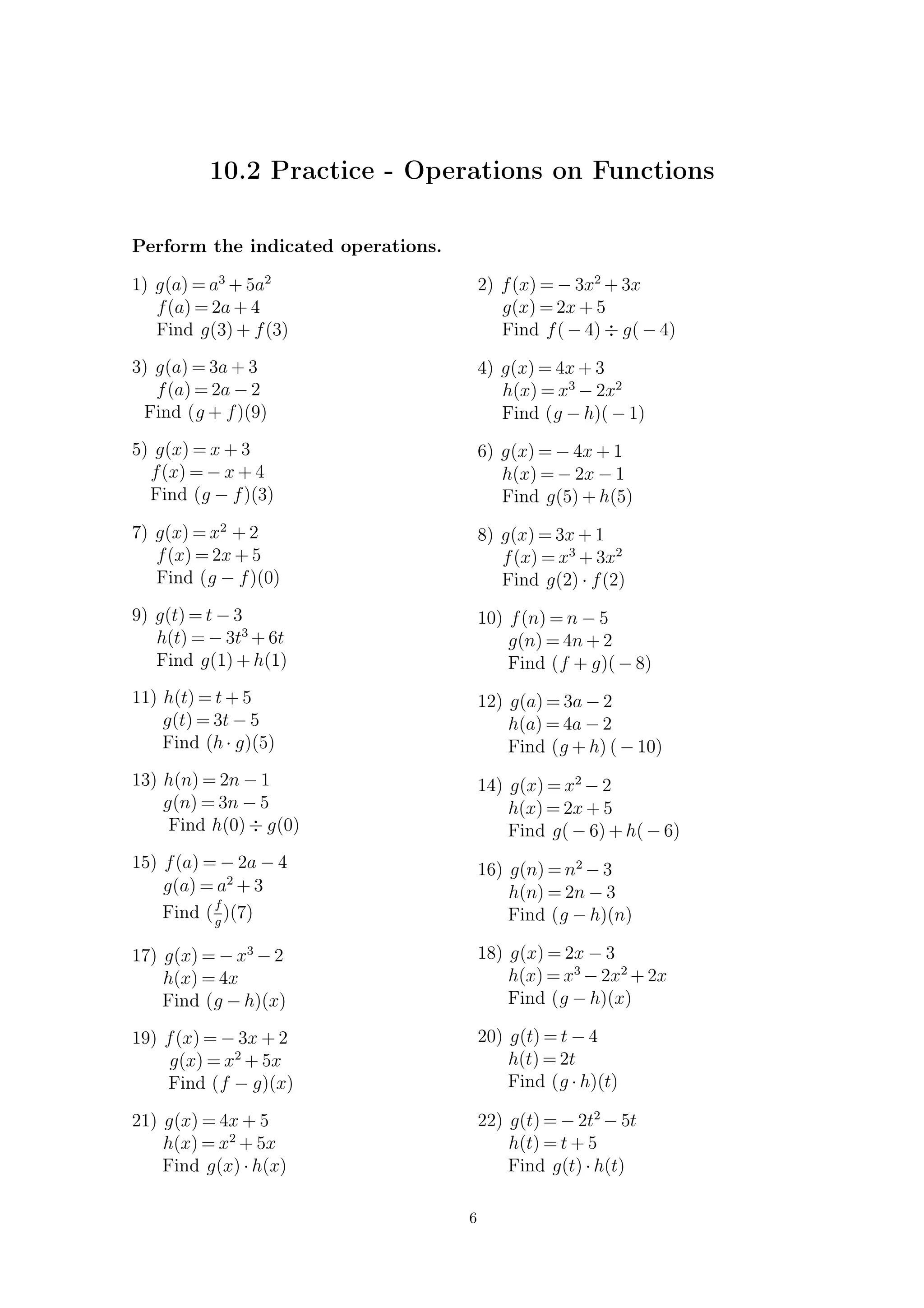
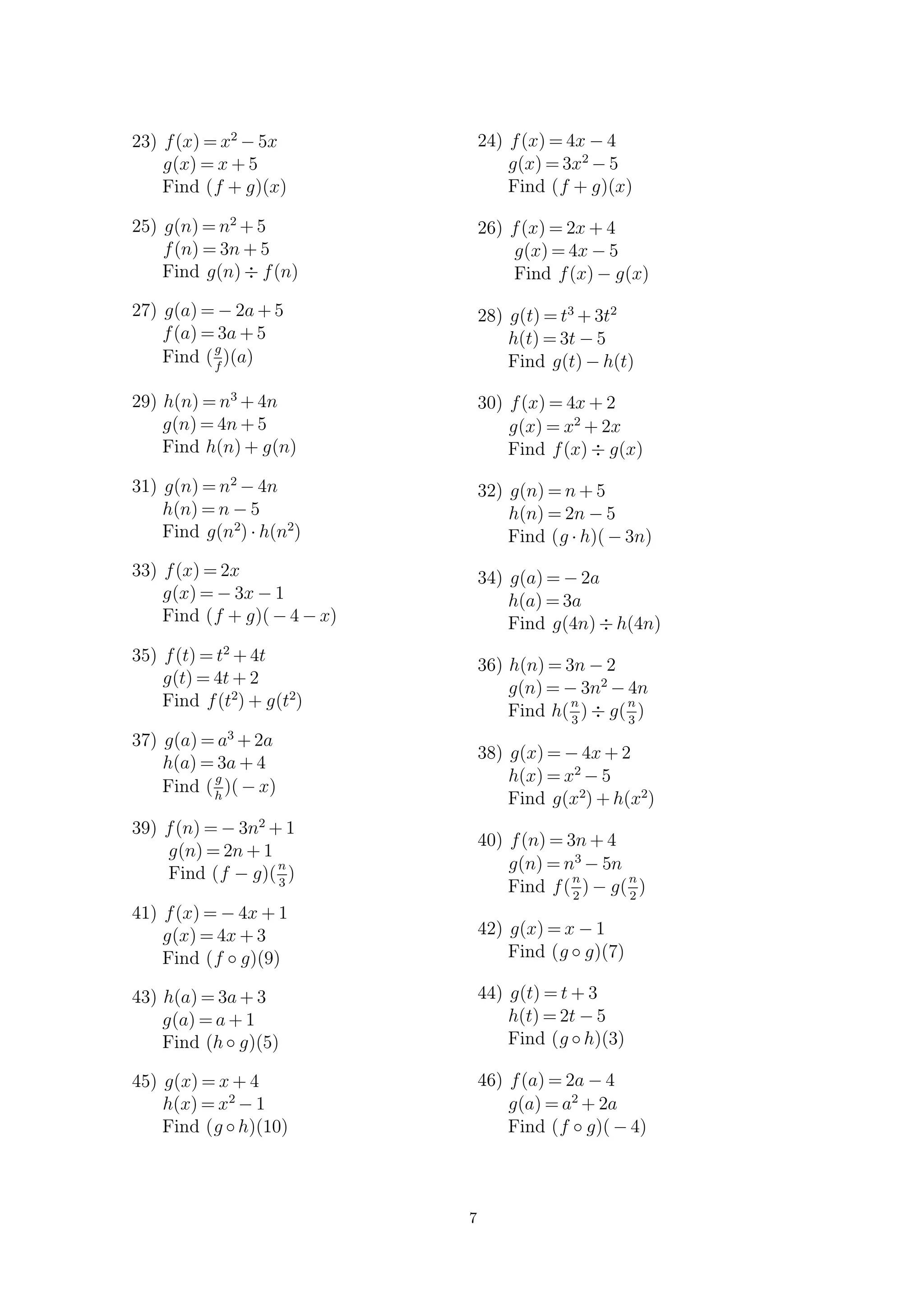
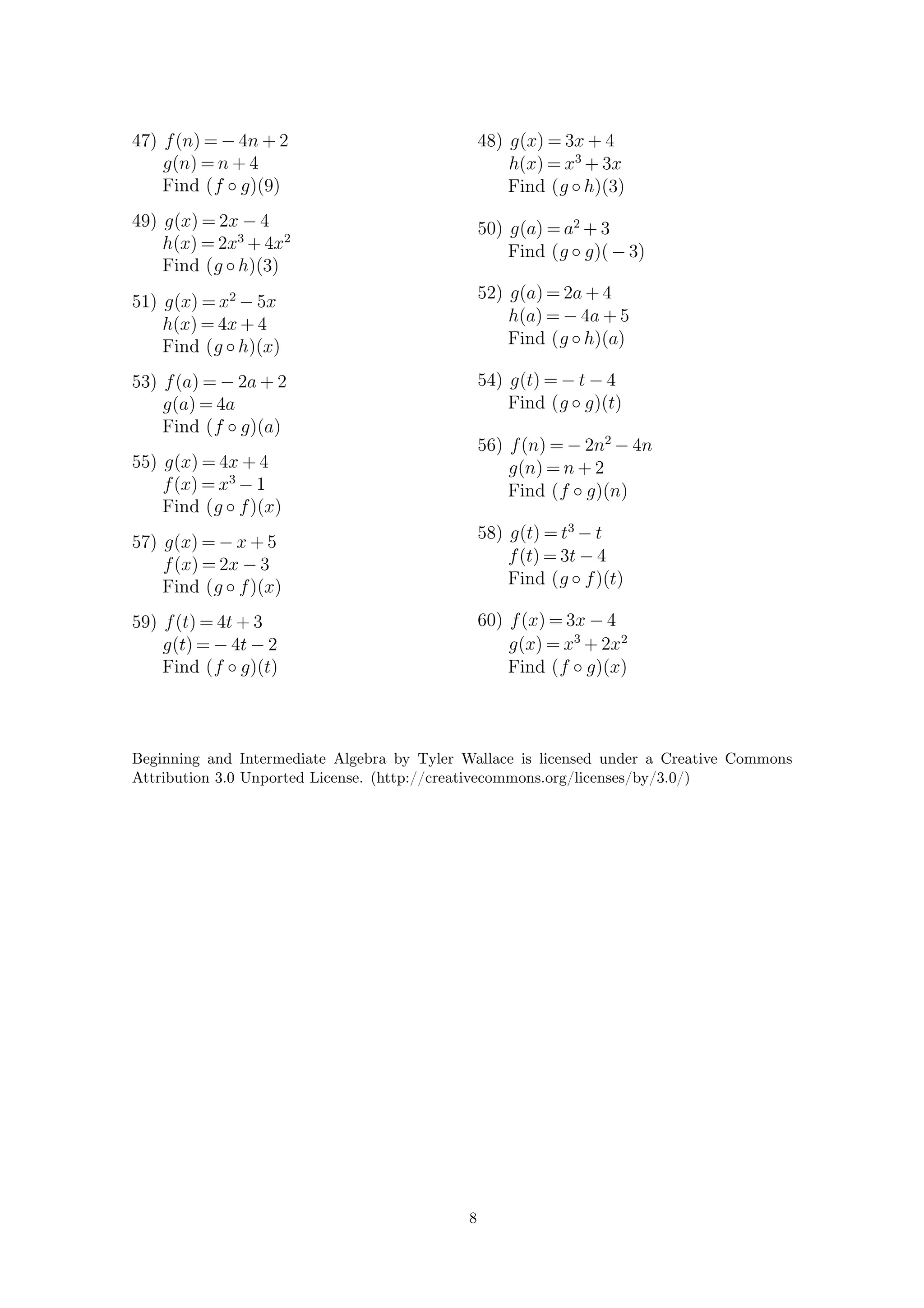
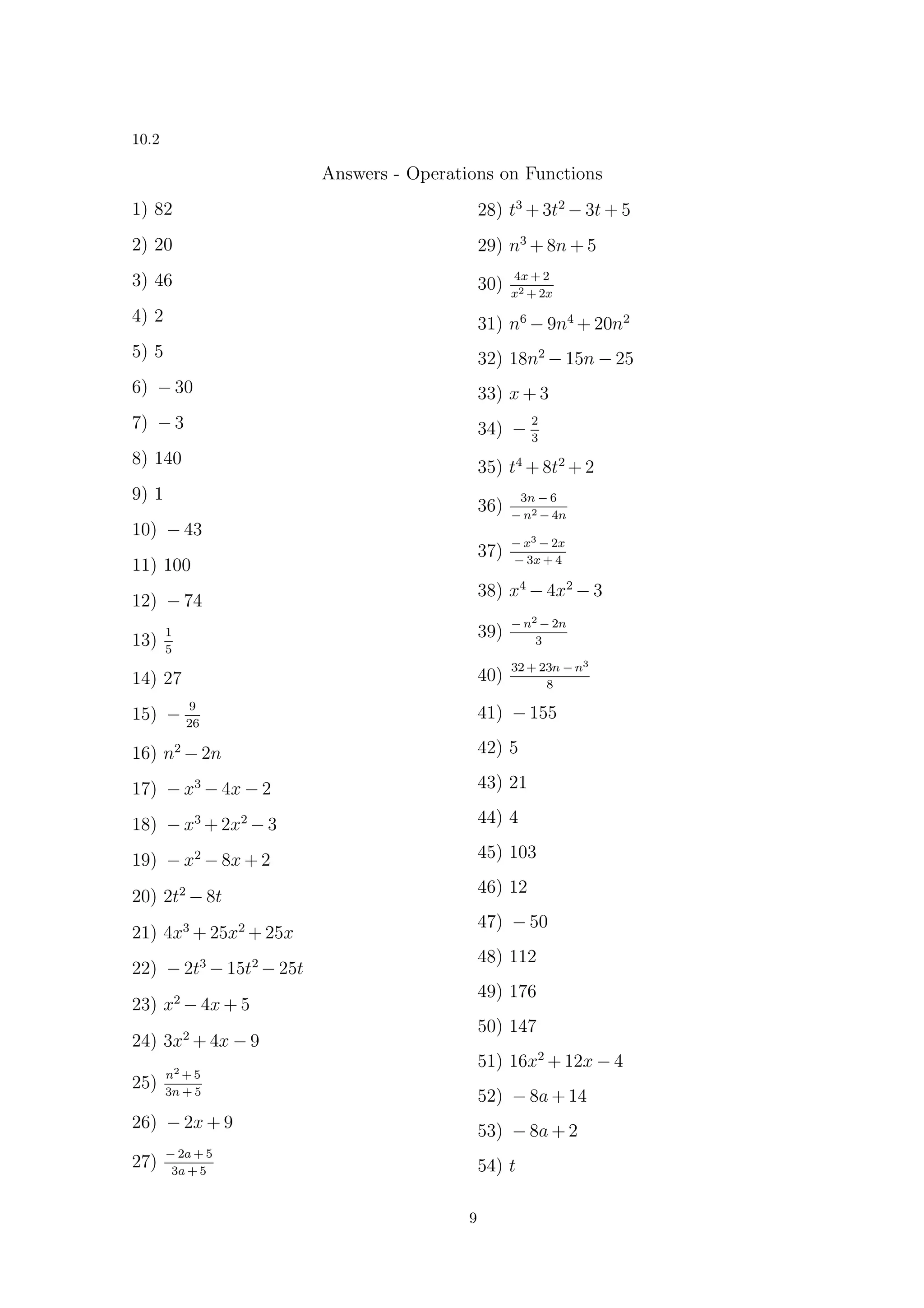
The document discusses operations that can be performed on functions, including addition, subtraction, multiplication, division, and composition. It provides examples of evaluating each type of operation on functions by first evaluating the individual functions at a given value or variable and then performing the indicated operation on the results. Composition involves evaluating the inner function first and substituting its result into the outer function.
10.2
Functions - Operationson Functions
Objective: Combine functions using sum, difference, product, quotient
and composition of functions.
Several functions can work together in one larger function. There are 5 common
operations that can be performed on functions. The four basic operations on func-
tions are adding, subtracting, multiplying, and dividing. The notation for these
functions is as follows.
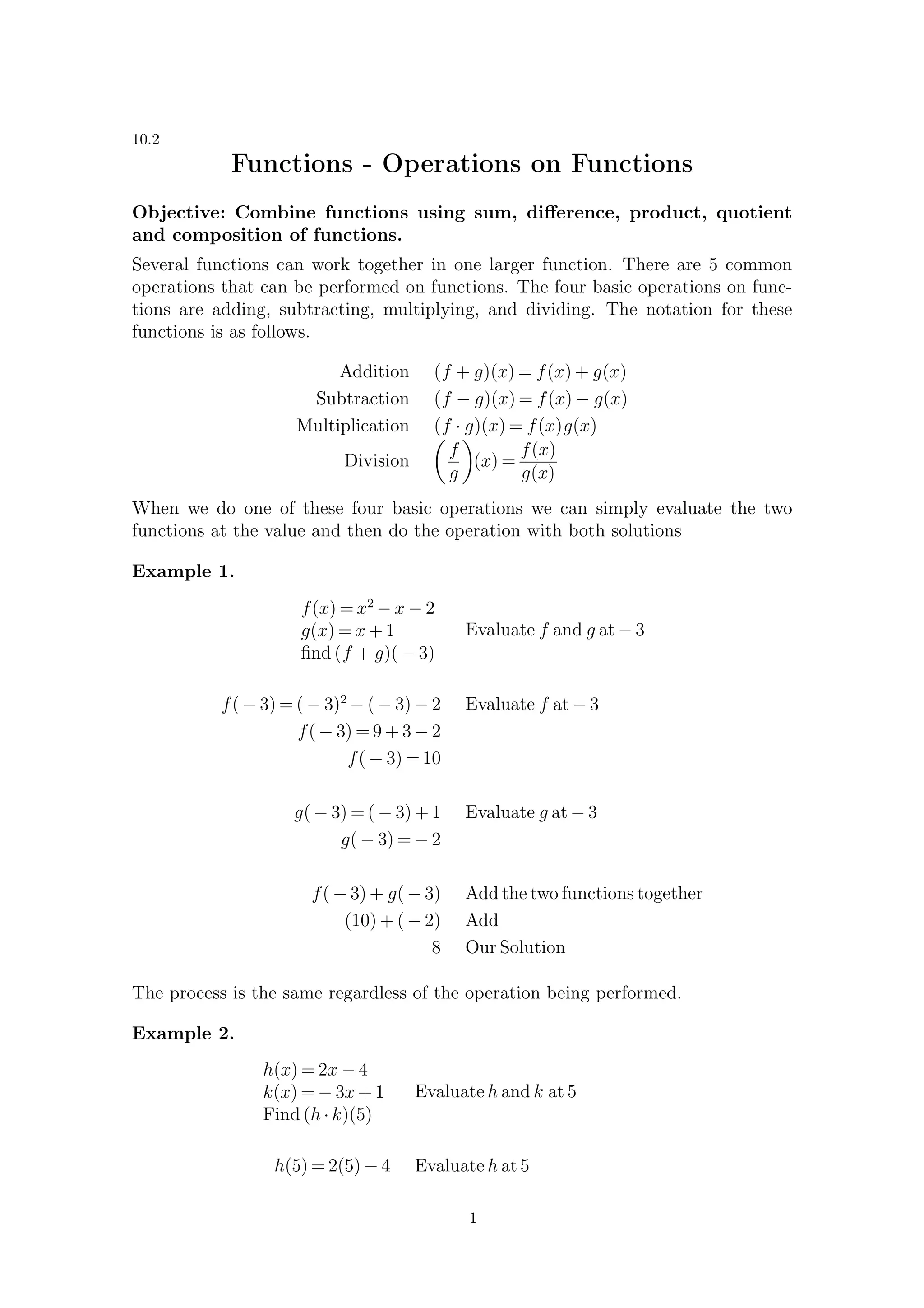
Addition (f + g)(x) = f(x) + g(x)
Subtraction (f − g)(x) = f(x) − g(x)
Multiplication (f · g)(x) = f(x)g(x)
Division
f
g
(x) =
f(x)
g(x)
When we do one of these four basic operations we can simply evaluate the two
functions at the value and then do the operation with both solutions
Example 1.
f(x) = x2
− x − 2
g(x) = x + 1
find (f + g)( − 3)
Evaluate f and g at − 3
f( − 3) = ( − 3)2
− ( − 3) − 2 Evaluate f at − 3
f( − 3) = 9 + 3 − 2
f( − 3) = 10
g( − 3) = ( − 3) + 1 Evaluate g at − 3
g( − 3) = − 2
f( − 3) + g( − 3) Add the two functions together
(10) + ( − 2) Add
8 Our Solution
The process is the same regardless of the operation being performed.
Example 2.
h(x) = 2x − 4
k(x) = − 3x + 1
Find (h· k)(5)
Evaluate h and k at 5
h(5) = 2(5) − 4 Evaluate h at 5
1
2.
h(5) = 10− 4
h(5) = 6
k(5) = − 3(5) + 1 Evaluate k at 5
k(5) = − 15 + 1
k(5) = − 14
h(5)k(5) Multiply the two results together
(6)( − 14) Multiply
− 84 Our Solution
Often as we add, subtract, multiply, or divide functions, we do so in a way that
keeps the variable. If there is no number to plug into the equations we will simply
use each equation, in parenthesis, and simplify the expression.
Example 3.
f(x) = 2x − 4
g(x) = x2
− x + 5 Write subtraction problem of functions
Find (f − g)(x)
f(x) − g(x) Replace f(x) with (2x − 3) and g(x) with (x2
− x + 5)
(2x − 4) − (x2
− x + 5) Distribute the negative
2x − 4 − x2
+ x − 5 Combine like terms
− x2
+ 3x − 9 Our Solution
The parenthesis are very important when we are replacing f(x) and g(x) with a
variable. In the previous example we needed the parenthesis to know to distribute
the negative.
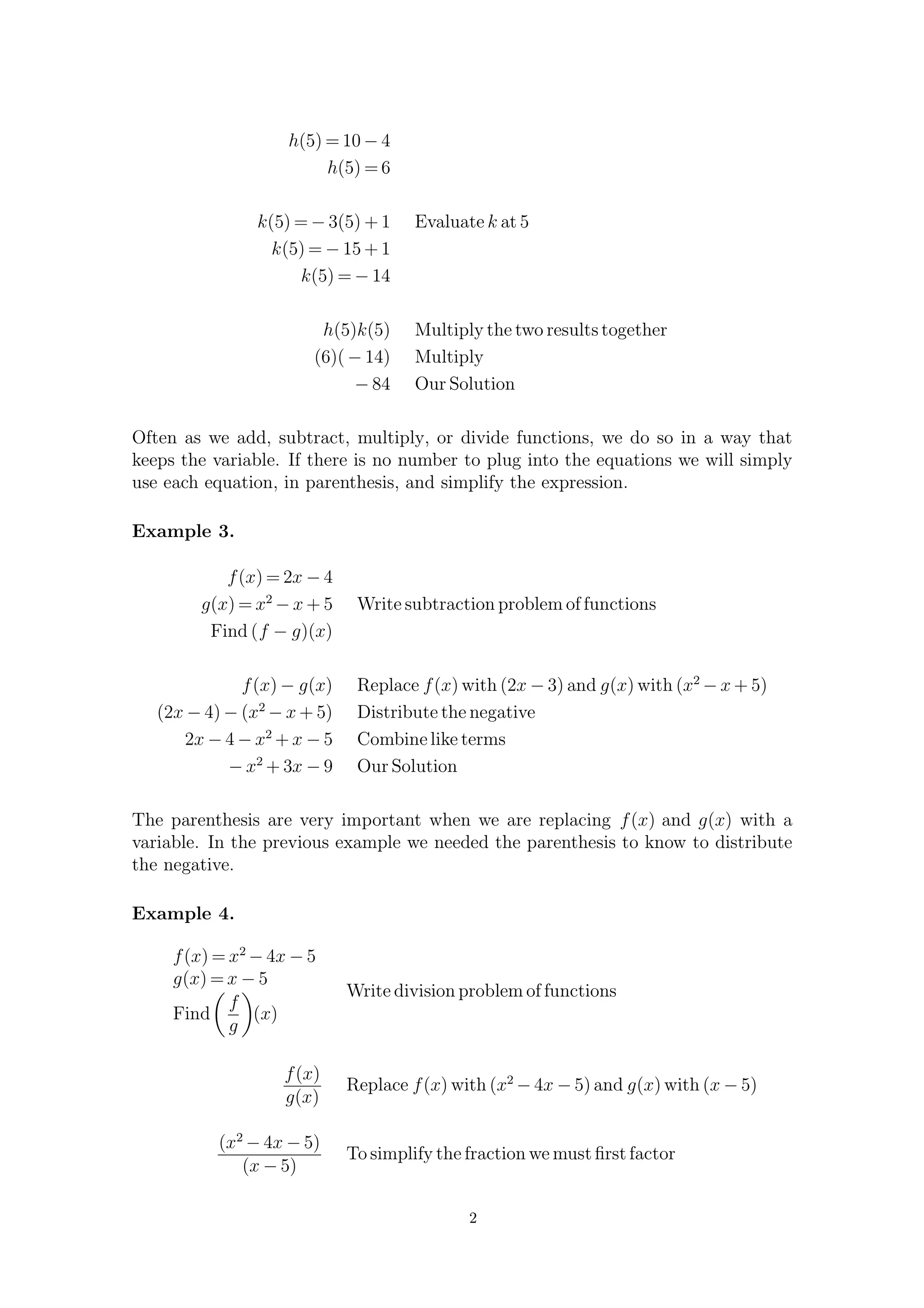
Example 4.
f(x) = x2
− 4x − 5
g(x) = x − 5
Find
f
g
(x)
Write division problem of functions
f(x)
g(x)
Replace f(x) with (x2
− 4x − 5) and g(x) with (x − 5)
(x2
− 4x − 5)
(x − 5)
To simplify the fraction we must first factor
2
3.
(x − 5)(x+ 1)
(x − 5)
Divide out common factor of x − 5
x + 1 Our Solution
Just as we could substitute an expression into evaluating functions, we can substi-
tute an expression into the operations on functions.
Example 5.
f(x) = 2x − 1
g(x) = x + 4 Write as a sum of functions
Find (f + g)(x2
)
f(x2
) + g(x2
) Replace x in f(x) and g(x) with x2
[2(x2
) − 1] + [(x2
) + 4] Distribute the + does not change the problem
2x2
− 1 + x2
+ 4 Combine like terms
3x2
+ 3 Our Solution
Example 6.
f(x) = 2x − 1
g(x) = x + 4 Write as a product of functions
Find (f · g)(3x)
f(3x)g(3x) Replace x in f(x) and g(x) with 3x
[2(3x) − 1][(3x) + 4] Multiply our 2(3x)
(6x − 1)(3x + 4) FOIL
18x2
+ 24x − 3x − 4 Combine like terms
18x2
+ 21x − 4 Our Solution
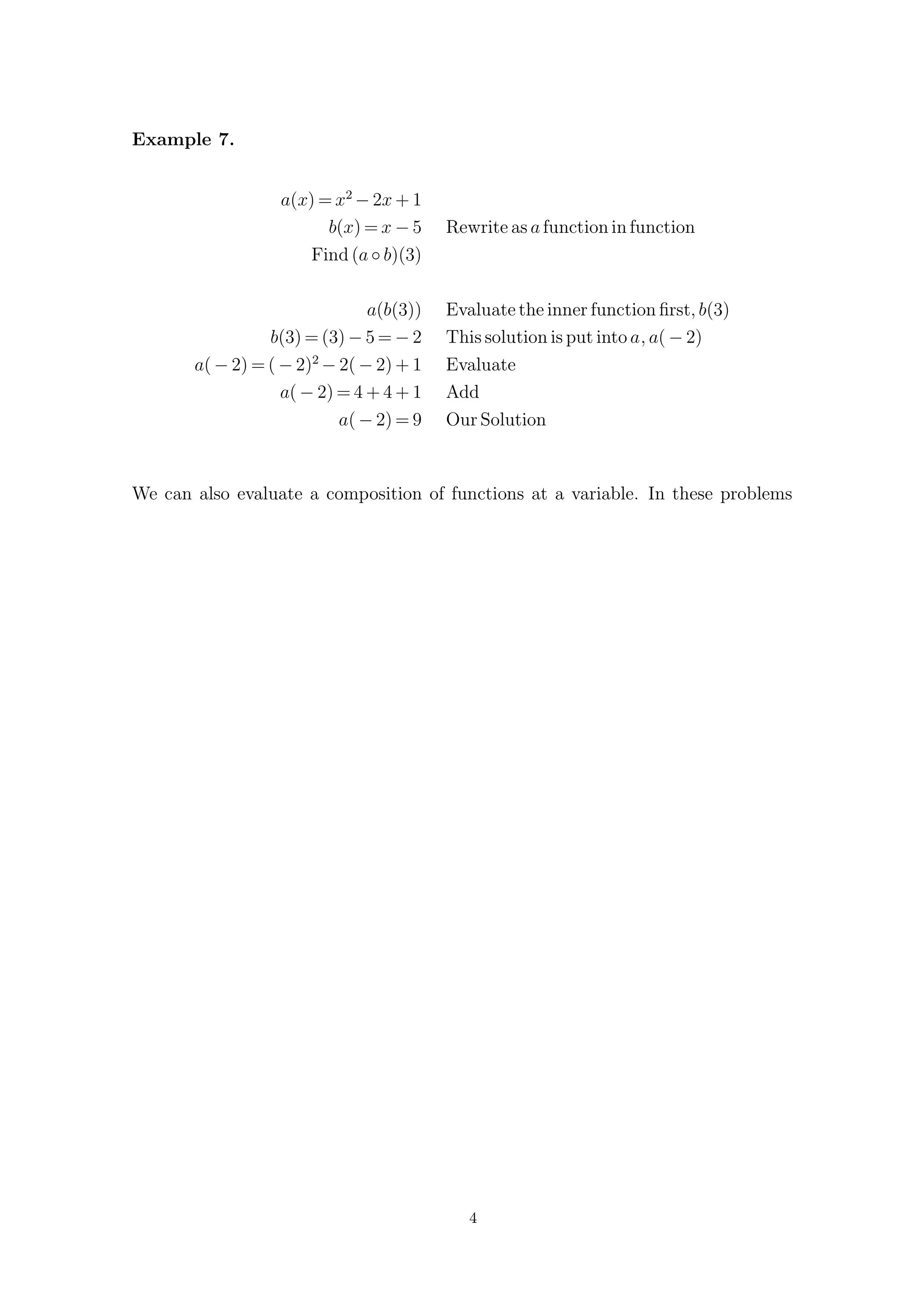
The fifth operation of functions is called composition of functions. A composition
of functions is a function inside of a function. The notation used for composition
of functions is:
(f ◦ g)(x) = f(g(x))
To calculate a composition of function we will evaluate the inner function and
substitute the answer into the outer function. This is shown in the following
example.
3
4.
Example 7.
a(x) =x2
− 2x + 1
b(x) = x − 5 Rewrite as a function in function
Find (a ◦ b)(3)
a(b(3)) Evaluate the inner function first, b(3)
b(3) = (3) − 5 = − 2 This solution is put into a, a( − 2)
a( − 2) = ( − 2)2
− 2( − 2) + 1 Evaluate
a( − 2) = 4 + 4 + 1 Add
a( − 2) = 9 Our Solution
We can also evaluate a composition of functions at a variable. In these problems
4
5.
we will takethe inside function and substitute into the outside function.
Example 8.
f(x) = x2
− x
g(x) = x + 3
Find (f ◦ g)(x)
Rewrite as a function in function
f(g(x)) Replace g(x) with x + 3
f(x + 3) Replace the variables in f with (x + 3)
(x + 3)2
− (x + 3) Evaluate exponent
(x2
+ 6x + 9) − (x + 3) Distribute negative
x2
+ 6x + 9 − x − 3 Combine like terms
x2
+ 5x + 6 Our Solution
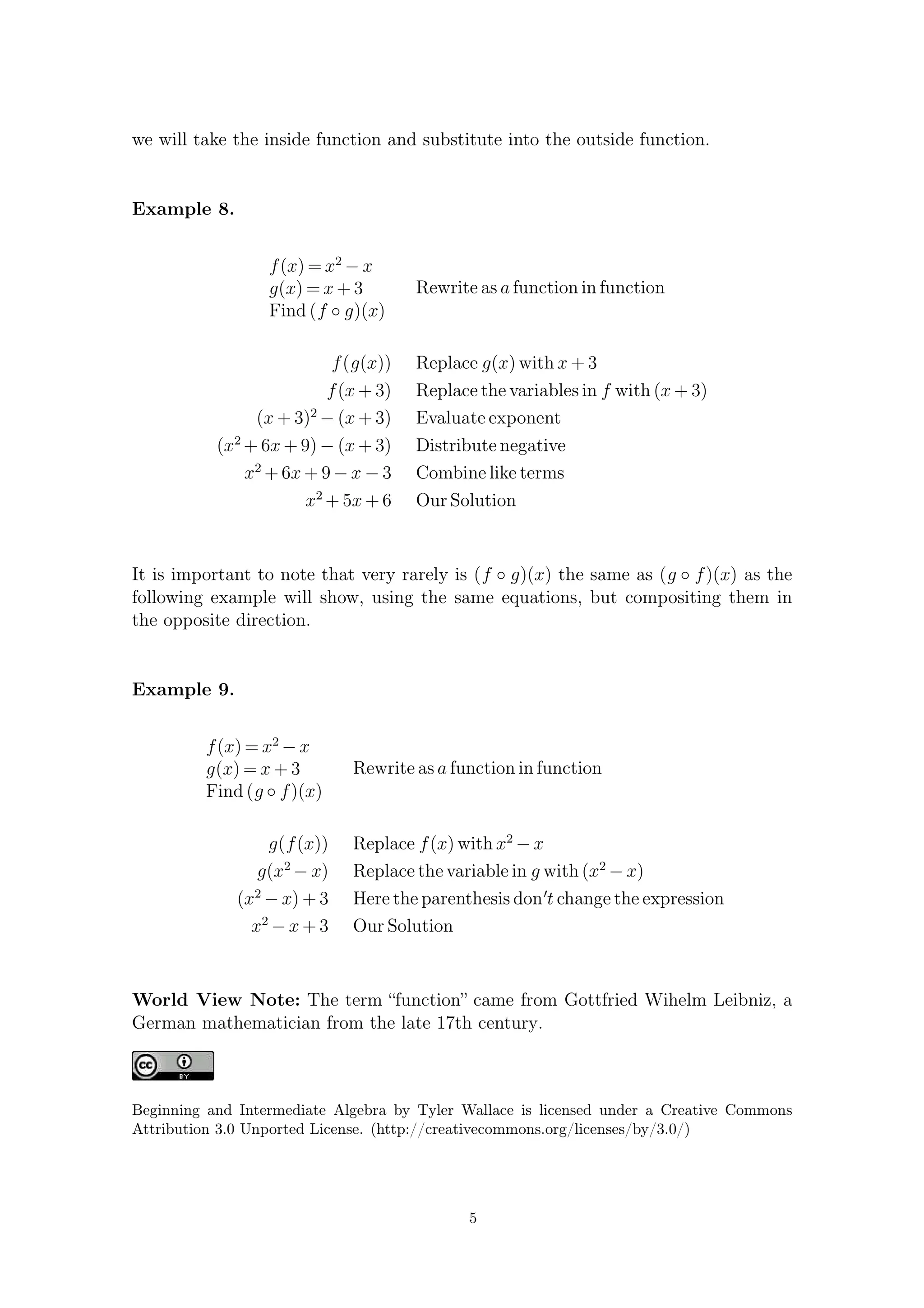
It is important to note that very rarely is (f ◦ g)(x) the same as (g ◦ f)(x) as the
following example will show, using the same equations, but compositing them in
the opposite direction.
Example 9.
f(x) = x2
− x
g(x) = x + 3
Find (g ◦ f)(x)
Rewrite as a function in function
g(f(x)) Replace f(x) with x2
− x
g(x2
− x) Replace the variable in g with (x2
− x)
(x2
− x) + 3 Here the parenthesis don′
t change the expression
x2
− x + 3 Our Solution
World View Note: The term “function” came from Gottfried Wihelm Leibniz, a
German mathematician from the late 17th century.
Beginning and Intermediate Algebra by Tyler Wallace is licensed under a Creative Commons
Attribution 3.0 Unported License. (http://creativecommons.org/licenses/by/3.0/)
5