Section	1.4
                Calculating	Limits

                 V63.0121.034, Calculus	I


                   September	14, 2009


Announcements
   First	written	assignment	due	Wednesday
   First	web	assignment	due	Monday, September	21

                                        .   .   .   .   .   .
Outline


  Limits	and	Pathologies

  Basic	Limits

  Limit	Laws
     The	direct	substitution	property

  Limits	with	Algebra
     Two	more	limit	theorems

  Two	important	trigonometric	limits


                                        .   .   .   .   .   .
Heuristic	Definition	of	a	Limit


   Definition
   We	write
                                lim f(x) = L
                               x→a

   and	say

              “the	limit	of f(x), as x approaches a, equals L”

   if	we	can	make	the	values	of f(x) arbitrarily	close	to L (as	close	to
   L as	we	like)	by	taking x to	be	sufficiently	close	to a (on	either
   side	of a)	but	not	equal	to a.


                                                  .   .    .     .   .     .
The	error-tolerance	game


   A game	between	two	players	to	decide	if	a	limit lim f(x) exists.
                                                      x→a
       Player	1: Choose L to	be	the	limit.
       Player	2: Propose	an	“error”	level	around L.
       Player	1: Choose	a	“tolerance”	level	around a so	that
       x-points	within	that	tolerance	level	are	taken	to y-values
       within	the	error	level.
   If	Player	1	can	always	win, lim f(x) = L.
                               x→a


                                                .     .     .   .   .   .
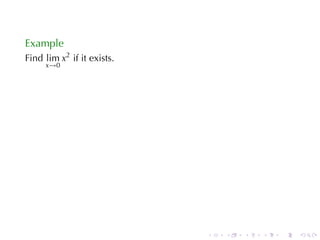
Example
Find lim x2 if	it	exists.
     x→0


                            .   .   .   .   .   .
Example
Find lim x2 if	it	exists.
     x→0

Solution
     I claim	the	limit	is	zero.


                                  .   .   .   .   .   .
Example
Find lim x2 if	it	exists.
     x→0

Solution
     I claim	the	limit	is	zero.
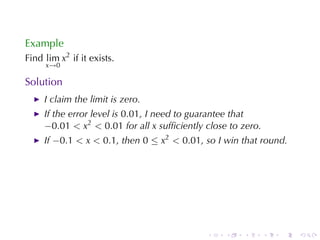
     If	the	error	level	is 0.01, I need	to	guarantee	that
     −0.01 < x2 < 0.01 for	all x sufficiently	close	to	zero.


                                             .    .   .       .   .   .
Example
Find lim x2 if	it	exists.
     x→0

Solution
     I claim	the	limit	is	zero.
     If	the	error	level	is 0.01, I need	to	guarantee	that
     −0.01 < x2 < 0.01 for	all x sufficiently	close	to	zero.
     If −0.1 < x < 0.1, then 0 ≤ x2 < 0.01, so	I win	that	round.


                                             .    .   .       .   .   .
Example
Find lim x2 if	it	exists.
     x→0

Solution
     I claim	the	limit	is	zero.
     If	the	error	level	is 0.01, I need	to	guarantee	that
     −0.01 < x2 < 0.01 for	all x sufficiently	close	to	zero.
     If −0.1 < x < 0.1, then 0 ≤ x2 < 0.01, so	I win	that	round.
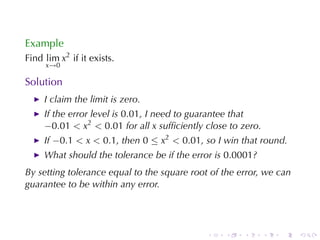
     What	should	the	tolerance	be	if	the	error	is 0.0001?


                                             .    .   .       .   .   .
Example
Find lim x2 if	it	exists.
     x→0

Solution
     I claim	the	limit	is	zero.
     If	the	error	level	is 0.01, I need	to	guarantee	that
     −0.01 < x2 < 0.01 for	all x sufficiently	close	to	zero.
     If −0.1 < x < 0.1, then 0 ≤ x2 < 0.01, so	I win	that	round.
     What	should	the	tolerance	be	if	the	error	is 0.0001?
By	setting	tolerance	equal	to	the	square	root	of	the	error, we	can
guarantee	to	be	within	any	error.


                                             .    .   .       .   .   .
Example
       |x|
Find lim   if	it	exists.
    x→0 x


                           .   .   .   .   .   .
Example
        |x|
Find lim    if	it	exists.
     x→0 x

Solution
The	function	can	also	be	written	as
                            {
                      |x|     1     if x > 0;
                          =
                       x      −1 if x < 0

What	would	be	the	limit?


                                                .   .   .   .   .   .
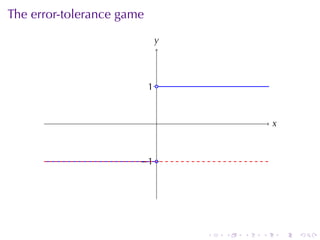
The	error-tolerance	game
                            y
                            .


                           . .
                           1


                             .                   x
                                                 .


                       . 1.
                       −


                                 .   .   .   .       .   .
The	error-tolerance	game
                            y
                            .


                           . .
                           1


                             .                   x
                                                 .


                       . 1.
                       −


                                 .   .   .   .       .   .
The	error-tolerance	game
                            y
                            .


                           . .
                           1


                             .                   x
                                                 .


                       . 1.
                       −


                                 .   .   .   .       .   .
The	error-tolerance	game
                            y
                            .


                           . .
                           1


                             .                   x
                                                 .


                       . 1.
                       −


                                 .   .   .   .       .   .
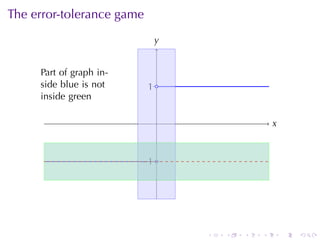
The	error-tolerance	game
                            y
                            .


                           . .
                           1


                             .                       x
                                                     .

                                 .
                                 Part of graph in-
                       . 1.
                       −         side blue is not
                                 inside green


                                   .    .   .    .       .   .
The	error-tolerance	game
                            y
                            .


                           . .
                           1


                             .                   x
                                                 .


                       . 1.
                       −


                                 .   .   .   .       .   .
The	error-tolerance	game
                            y
                            .


                           . .
                           1


                             .                   x
                                                 .


                       . 1.
                       −


                                 .   .   .   .       .   .
The	error-tolerance	game
                            y
                            .

     .
     Part of graph in-
     side blue is not      . .
                           1
     inside green

                             .                   x
                                                 .


                         . 1.
                         −


                                 .   .   .   .       .   .
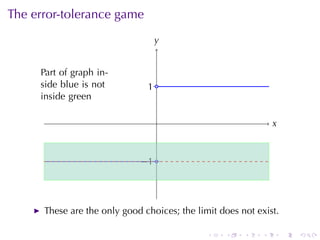
The	error-tolerance	game
                                 y
                                 .

     .
     Part of graph in-
     side blue is not          . .
                               1
     inside green

                                 .                              x
                                                                .


                             . 1.
                             −


      These	are	the	only	good	choices; the	limit	does	not	exist.

                                              .   .    .    .       .   .
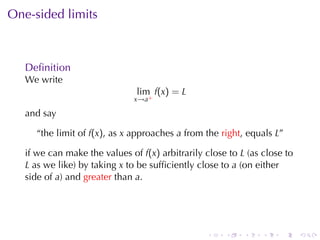
One-sided	limits


   Definition
   We	write
                               lim f(x) = L
                               x→a+

   and	say

     “the	limit	of f(x), as x approaches a from	the right, equals L”

   if	we	can	make	the	values	of f(x) arbitrarily	close	to L (as	close	to
   L as	we	like)	by	taking x to	be	sufficiently	close	to a (on	either
   side	of a)	and greater than a.


                                                 .    .    .    .   .      .
One-sided	limits


   Definition
   We	write
                               lim f(x) = L
                              x→a−

   and	say

      “the	limit	of f(x), as x approaches a from	the left, equals L”

   if	we	can	make	the	values	of f(x) arbitrarily	close	to L (as	close	to
   L as	we	like)	by	taking x to	be	sufficiently	close	to a (on	either
   side	of a)	and less than a.


                                                 .    .    .    .      .   .
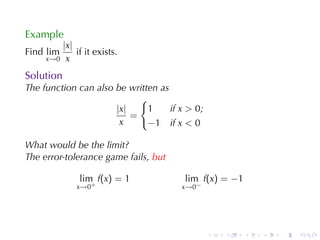
Example
        |x|
Find lim    if	it	exists.
     x→0 x

Solution
The	function	can	also	be	written	as
                            {
                      |x|     1     if x > 0;
                          =
                       x      −1 if x < 0

What	would	be	the	limit?
The	error-tolerance	game	fails, but

              lim f(x) = 1              lim f(x) = −1
             x→0+                      x→0−


                                                .   .   .   .   .   .
Example
           1
Find lim     if	it	exists.
    x→0+   x


                             .   .   .   .   .   .
The	error-tolerance	game
             y
             .


           .? .
           L


              .                            x
                                           .
                  0
                  .


                           .   .   .   .       .   .
The	error-tolerance	game
             y
             .


           .? .
           L


              .                            x
                                           .
                  0
                  .


                           .   .   .   .       .   .
The	error-tolerance	game
             y
             .


           .? .
           L


              .                            x
                                           .
                  0
                  .


                           .   .   .   .       .   .
The	error-tolerance	game
             y
             .


                      .
                      The graph escapes the
                      green, so no good


           .? .
           L


              .                                           x
                                                          .
                  0
                  .


                                       .      .   .   .       .   .
The	error-tolerance	game
             y
             .


           .? .
           L


              .                            x
                                           .
                  0
                  .


                           .   .   .   .       .   .
The	error-tolerance	game
             y
             .


                           E
                           . ven	worse!


           .? .
           L


              .                                           x
                                                          .
                  0
                  .


                                          .   .   .   .       .   .
The	error-tolerance	game
             y
             .

                      .
                      The limit does not exist
                      because the function is
                      unbounded near 0

           .? .
           L


              .                                          x
                                                         .
                  0
                  .


                                         .   .   .   .       .   .
Example
           1
Find lim     if	it	exists.
    x→0+   x
Solution
The	limit	does	not	exist	because	the	function	is	unbounded	near
0. Next	week	we	will	understand	the	statement	that
                                    1
                             lim      = +∞
                             x→0+   x


                                             .   .   .   .   .    .
Weird, wild	stuff


   Example        (π )
   Find lim sin          if	it	exists.
        x→0        x


                                         .   .   .   .   .   .
Weird, wild	stuff


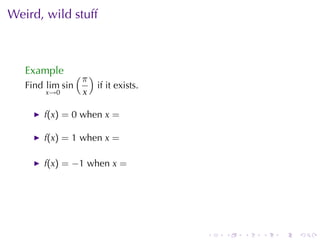
   Example        (π )
   Find lim sin          if	it	exists.
        x→0        x

       f(x) = 0 when x =

       f(x) = 1 when x =

       f(x) = −1 when x =


                                         .   .   .   .   .   .
Weird, wild	stuff


   Example        (π )
   Find lim sin          if	it	exists.
        x→0        x
                                 1
       f(x) = 0 when x =           for	any	integer k
                                 k
       f(x) = 1 when x =

       f(x) = −1 when x =


                                                       .   .   .   .   .   .
Weird, wild	stuff


   Example        (π )
   Find lim sin          if	it	exists.
        x→0        x
                         1
       f(x) = 0 when x =   for	any	integer k
                         k
                             1
       f(x) = 1 when x =           for	any	integer k
                         2k + 1/2
       f(x) = −1 when x =


                                              .   .    .   .   .   .
Weird, wild	stuff


   Example        (π )
   Find lim sin          if	it	exists.
        x→0        x
                         1
       f(x) = 0 when x =   for	any	integer k
                         k
                             1
       f(x) = 1 when x =           for	any	integer k
                         2k + 1/2
                               1
       f(x) = −1 when x =            for	any	integer k
                           2k − 1/2


                                              .   .      .   .   .   .
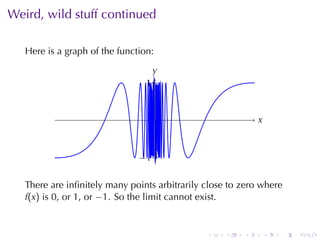
Weird, wild	stuff	continued

   Here	is	a	graph	of	the	function:
                                   y
                                   .
                                 . .
                                 1


                                      .                     x
                                                            .


                               . 1.
                               −

   There	are	infinitely	many	points	arbitrarily	close	to	zero	where
   f(x) is 0, or 1, or −1. So	the	limit	cannot	exist.


                                               .    .   .       .   .   .
What	could	go	wrong?
Summary	of	Limit	Pathologies


    How	could	a	function	fail	to	have	a	limit? Some	possibilities:
          left-	and	right-	hand	limits	exist	but	are	not	equal
          The	function	is	unbounded	near a (possible	infinite	limits,
          more	later)
          Oscillation	with	increasingly	high	frequency	near a


                                                   .    .    .   .   .   .
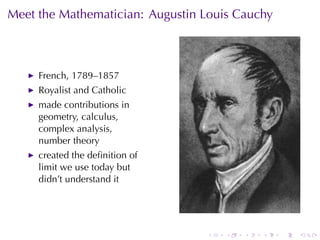
Meet	the	Mathematician: Augustin	Louis	Cauchy


     French, 1789–1857
     Royalist	and	Catholic
     made	contributions	in
     geometry, calculus,
     complex	analysis,
     number	theory
     created	the	definition	of
     limit	we	use	today	but
     didn’t	understand	it


                                 .   .   .   .   .   .
Outline


  Limits	and	Pathologies

  Basic	Limits

  Limit	Laws
     The	direct	substitution	property

  Limits	with	Algebra
     Two	more	limit	theorems

  Two	important	trigonometric	limits


                                        .   .   .   .   .   .
Really	basic	limits


   Fact
   Let c be	a	constant	and a a	real	number.
     (i) lim x = a
          x→a
    (ii) lim c = c
          x→a


                                              .   .   .   .   .   .
Really	basic	limits


   Fact
   Let c be	a	constant	and a a	real	number.
     (i) lim x = a
          x→a
    (ii) lim c = c
          x→a


   Proof.
   The	first	is	tautological, the	second	is	trivial.


                                                      .   .   .   .   .   .
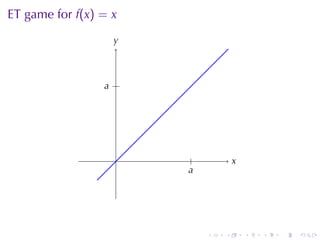
ET game	for f(x) = x
                   y
                   .


                   .           x
                               .


                       .   .       .   .   .   .
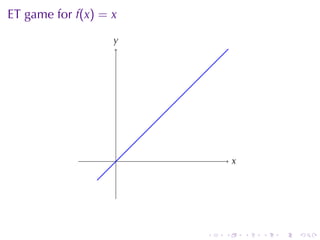
ET game	for f(x) = x
                   y
                   .


                   .           x
                               .


                       .   .       .   .   .   .
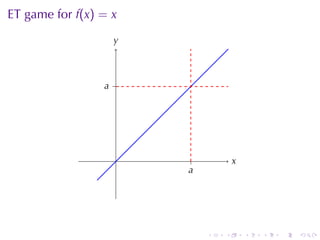
ET game	for f(x) = x
                   y
                   .


                 . .
                 a


                   .    .           x
                                    .
                       a
                       .


                            .   .       .   .   .   .
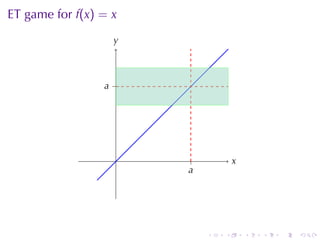
ET game	for f(x) = x
                   y
                   .


                 . .
                 a


                   .    .           x
                                    .
                       a
                       .


                            .   .       .   .   .   .
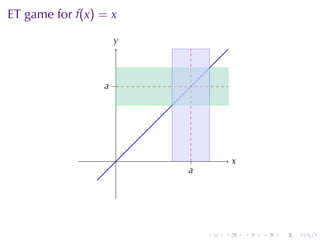
ET game	for f(x) = x
                   y
                   .


                 . .
                 a


                   .    .           x
                                    .
                       a
                       .


                            .   .       .   .   .   .
ET game	for f(x) = x
                   y
                   .


                 . .
                 a


                   .    .           x
                                    .
                       a
                       .


                            .   .       .   .   .   .
ET game	for f(x) = x
                       y
                       .


                    . .
                    a


                       .                  .             x
                                                        .
                                         a
                                         .


      Setting	error	equal	to	tolerance	works!

                                                .   .       .   .   .   .
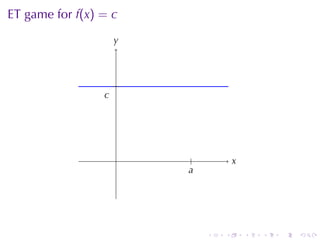
ET game	for f(x) = c


                   .


                       .   .   .   .   .   .
ET game	for f(x) = c
                   y
                   .


                   .           x
                               .


                       .   .       .   .   .   .
ET game	for f(x) = c
                   y
                   .


                   .           x
                               .


                       .   .       .   .   .   .
ET game	for f(x) = c
                     y
                     .


                     .
                 c
                 .


                     .    .           x
                                      .
                         a
                         .


                              .   .       .   .   .   .
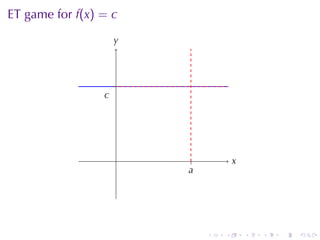
ET game	for f(x) = c
                     y
                     .


                     .
                 c
                 .


                     .    .           x
                                      .
                         a
                         .


                              .   .       .   .   .   .
ET game	for f(x) = c
                     y
                     .


                     .
                 c
                 .


                     .    .           x
                                      .
                         a
                         .


                              .   .       .   .   .   .
ET game	for f(x) = c
                       y
                       .


                       .
                   c
                   .


                       .      .           x
                                          .
                             a
                             .


      any	tolerance	works!

                                  .   .       .   .   .   .
Really	basic	limits


   Fact
   Let c be	a	constant	and a a	real	number.
     (i) lim x = a
          x→a
    (ii) lim c = c
          x→a


   Proof.
   The	first	is	tautological, the	second	is	trivial.


                                                      .   .   .   .   .   .
Outline


  Limits	and	Pathologies

  Basic	Limits

  Limit	Laws
     The	direct	substitution	property

  Limits	with	Algebra
     Two	more	limit	theorems

  Two	important	trigonometric	limits


                                        .   .   .   .   .   .
Limits	and	arithmetic


   Fact
   Suppose lim f(x) and lim g(x) exist	and c is	a	constant. Then
                x→a      x→a
    1. lim [f(x) + g(x)] = lim f(x) + lim g(x)
          x→a             x→a        x→a


                                                 .   .   .   .     .   .
Limits	and	arithmetic


   Fact
   Suppose lim f(x) and lim g(x) exist	and c is	a	constant. Then
                x→a      x→a
    1. lim [f(x) + g(x)] = lim f(x) + lim g(x) (errors	add)
          x→a             x→a        x→a


                                                .    .    .   .    .   .
Limits	and	arithmetic


   Fact
   Suppose lim f(x) and lim g(x) exist	and c is	a	constant. Then
                x→a      x→a
    1. lim [f(x) + g(x)] = lim f(x) + lim g(x) (errors	add)
          x→a              x→a       x→a
    2. lim [f(x) − g(x)] = lim f(x) − lim g(x)
          x→a              x→a       x→a


                                                 .   .    .   .    .   .
Limits	and	arithmetic


   Fact
   Suppose lim f(x) and lim g(x) exist	and c is	a	constant. Then
                x→a      x→a
    1. lim [f(x) + g(x)] = lim f(x) + lim g(x) (errors	add)
          x→a                x→a     x→a
    2. lim [f(x) − g(x)] = lim f(x) − lim g(x)
          x→a                x→a     x→a


    3. lim [cf(x)] = c lim f(x)
          x→a          x→a


                                                 .   .    .   .    .   .
Limits	and	arithmetic


   Fact
   Suppose lim f(x) and lim g(x) exist	and c is	a	constant. Then
                x→a      x→a
    1. lim [f(x) + g(x)] = lim f(x) + lim g(x) (errors	add)
          x→a                x→a      x→a
    2. lim [f(x) − g(x)] = lim f(x) − lim g(x)
          x→a                x→a      x→a


    3. lim [cf(x)] = c lim f(x) (error	scales)
          x→a          x→a


                                                 .   .    .   .    .   .
Limits	and	arithmetic


   Fact
   Suppose lim f(x) and lim g(x) exist	and c is	a	constant. Then
                x→a        x→a
    1. lim [f(x) + g(x)] = lim f(x) + lim g(x) (errors	add)
          x→a                  x→a    x→a
    2. lim [f(x) − g(x)] = lim f(x) − lim g(x) (combination	of	adding
          x→a                  x→a    x→a
          and	scaling)
    3. lim [cf(x)] = c lim f(x) (error	scales)
          x→a            x→a


                                                 .   .    .   .    .    .
Limits	and	arithmetic


   Fact
   Suppose lim f(x) and lim g(x) exist	and c is	a	constant. Then
                x→a        x→a
    1. lim [f(x) + g(x)] = lim f(x) + lim g(x) (errors	add)
          x→a                  x→a         x→a
    2. lim [f(x) − g(x)] = lim f(x) − lim g(x) (combination	of	adding
          x→a                  x→a         x→a
          and	scaling)
    3. lim [cf(x)] = c lim f(x) (error	scales)
          x→a            x→a
    4. lim [f(x)g(x)] = lim f(x) · lim g(x)
          x→a             x→a        x→a


                                                 .   .    .   .    .    .
Limits	and	arithmetic


   Fact
   Suppose lim f(x) and lim g(x) exist	and c is	a	constant. Then
                x→a        x→a
    1. lim [f(x) + g(x)] = lim f(x) + lim g(x) (errors	add)
          x→a                  x→a         x→a
    2. lim [f(x) − g(x)] = lim f(x) − lim g(x) (combination	of	adding
          x→a                  x→a         x→a
          and	scaling)
    3. lim [cf(x)] = c lim f(x) (error	scales)
          x→a            x→a
    4. lim [f(x)g(x)] = lim f(x) · lim g(x) (more	complicated, but
          x→a             x→a        x→a
          doable)


                                                 .   .    .   .      .   .
Limits	and	arithmetic	II


   Fact	(Continued)
           f (x )   lim f(x)
    5. lim        = x→a      , if lim g(x) ̸= 0.
       x→a g(x)     lim g(x) x→a
                    x→a


                                                   .   .   .   .   .   .
Limits	and	arithmetic	II


   Fact	(Continued)
            f (x )   lim f(x)
    5. lim         = x→a      , if lim g(x) ̸= 0.
       x→a g(x)      lim g(x) x→a
                     x→a
                       [        ]n
    6. lim [f(x)]n = lim f(x)
       x→a             x→a


                                                    .   .   .   .   .   .
Limits	and	arithmetic	II


   Fact	(Continued)
            f (x )   lim f(x)
    5. lim         = x→a      , if lim g(x) ̸= 0.
       x→a g(x)      lim g(x) x→a
                     x→a
                       [        ]n
    6. lim [f(x)]n = lim f(x) (follows	from	4	repeatedly)
       x→a            x→a


                                             .   .    .     .   .   .
Limits	and	arithmetic	II


   Fact	(Continued)
            f (x )   lim f(x)
    5. lim         = x→a      , if lim g(x) ̸= 0.
       x→a g(x)      lim g(x) x→a
                     x→a
                       [        ]n
    6. lim [f(x)]n = lim f(x) (follows	from	4	repeatedly)
       x→a             x→a
             n     n
    7. lim x = a
       x→a


                                             .   .    .     .   .   .
Limits	and	arithmetic	II


   Fact	(Continued)
            f (x )   lim f(x)
    5. lim         = x→a      , if lim g(x) ̸= 0.
       x→a g(x)      lim g(x) x→a
                     x→a
                       [        ]n
    6. lim [f(x)]n = lim f(x) (follows	from	4	repeatedly)
       x→a             x→a
             n   n
    7. lim x = a
       x→a
           √     √
    8. lim n x = n a
       x→a


                                             .   .    .     .   .   .
Limits	and	arithmetic	II


   Fact	(Continued)
            f (x )   lim f(x)
    5. lim         = x→a      , if lim g(x) ̸= 0.
       x→a g(x)      lim g(x) x→a
                     x→a
                       [        ]n
    6. lim [f(x)]n = lim f(x) (follows	from	4	repeatedly)
       x→a            x→a
             n   n
    7. lim x = a (follows	from	6)
       x→a
           √     √
    8. lim n x = n a
       x→a


                                             .   .    .     .   .   .
Limits	and	arithmetic	II


   Fact	(Continued)
            f (x )   lim f(x)
    5. lim         = x→a      , if lim g(x) ̸= 0.
       x→a g(x)      lim g(x) x→a
                     x→a
                       [        ]n
    6. lim [f(x)]n = lim f(x) (follows	from	4	repeatedly)
       x→a            x→a
             n   n
    7. lim x = a (follows	from	6)
       x→a
           √     √
    8. lim n x = n a
       x→a
           √        √
    9. lim n f(x) = n lim f(x) (If n is	even, we	must	additionally
       x→a             x→a
       assume	that lim f(x) > 0)
                     x→a


                                               .    .    .   .       .   .
Applying	the	limit	laws


   Example
           (           )
   Find lim x2 + 2x + 4 .
       x→3


                            .   .   .   .   .   .
Applying	the	limit	laws


   Example
           (           )
   Find lim x2 + 2x + 4 .
        x→3

   Solution
   By	applying	the	limit	laws	repeatedly:
              (             )
          lim x2 + 2x + 4
          x→3


                                            .   .   .   .   .   .
Applying	the	limit	laws


   Example
           (           )
   Find lim x2 + 2x + 4 .
       x→3

   Solution
   By	applying	the	limit	laws	repeatedly:
              (             )       ( )
          lim x2 + 2x + 4 = lim x2 + lim (2x) + lim (4)
          x→3               x→3       x→3           x→3


                                            .   .     .   .   .   .
Applying	the	limit	laws


   Example
           (           )
   Find lim x2 + 2x + 4 .
       x→3

   Solution
   By	applying	the	limit	laws	repeatedly:
              (             )       ( )
          lim x2 + 2x + 4 = lim x2 + lim (2x) + lim (4)
          x→3                   x→3       x→3      x→3
                                (      )2
                              = lim x + 2 · lim (x) + 4
                              x→3         x→3


                                          .     .   .   .   .   .
Applying	the	limit	laws


   Example
           (           )
   Find lim x2 + 2x + 4 .
       x→3

   Solution
   By	applying	the	limit	laws	repeatedly:
              (             )       ( )
          lim x2 + 2x + 4 = lim x2 + lim (2x) + lim (4)
          x→3                   x→3       x→3      x→3
                                (      )2
                              = lim x + 2 · lim (x) + 4
                               x→3          x→3
                                 2
                            = (3) + 2 · 3 + 4


                                            .     .   .   .   .   .
Applying	the	limit	laws


   Example
           (           )
   Find lim x2 + 2x + 4 .
       x→3

   Solution
   By	applying	the	limit	laws	repeatedly:
              (             )       ( )
          lim x2 + 2x + 4 = lim x2 + lim (2x) + lim (4)
          x→3                   x→3       x→3      x→3
                                (      )2
                              = lim x + 2 · lim (x) + 4
                               x→3          x→3
                                 2
                            = (3) + 2 · 3 + 4
                            = 9 + 6 + 4 = 19.


                                            .     .   .   .   .   .
Your	turn


   Example
           x2 + 2x + 4
   Find lim
       x→3   x3 + 11


                         .   .   .   .   .   .
Your	turn


   Example
           x2 + 2x + 4
   Find lim
       x→3   x3 + 11
   Solution
                   19  1
   The	answer	is      = .
                   38  2


                            .   .   .   .   .   .
Direct	Substitution	Property


   Theorem	(The	Direct	Substitution	Property)
   If f is	a	polynomial	or	a	rational	function	and a is	in	the	domain	of
   f, then
                               lim f(x) = f(a)
                              x→a


                                                 .    .    .   .    .      .
Outline


  Limits	and	Pathologies

  Basic	Limits

  Limit	Laws
     The	direct	substitution	property

  Limits	with	Algebra
     Two	more	limit	theorems

  Two	important	trigonometric	limits


                                        .   .   .   .   .   .
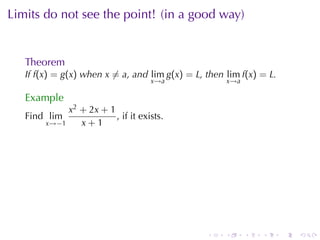
Limits	do	not	see	the	point! (in	a	good	way)


   Theorem
   If f(x) = g(x) when x ̸= a, and lim g(x) = L, then lim f(x) = L.
                                  x→a                 x→a


                                                 .    .     .   .     .   .
Limits	do	not	see	the	point! (in	a	good	way)


   Theorem
   If f(x) = g(x) when x ̸= a, and lim g(x) = L, then lim f(x) = L.
                                    x→a               x→a

   Example
             x2 + 2x + 1
   Find lim              , if	it	exists.
        x→−1    x+1


                                                 .    .     .   .     .   .
Limits	do	not	see	the	point! (in	a	good	way)


   Theorem
   If f(x) = g(x) when x ̸= a, and lim g(x) = L, then lim f(x) = L.
                                    x→a               x→a

   Example
             x2 + 2x + 1
   Find lim              , if	it	exists.
        x→−1    x+1
   Solution
         x2 + 2x + 1
   Since             = x + 1 whenever x ̸= −1, and	since
            x+1
                                x2 + 2x + 1
    lim x + 1 = 0, we	have lim              = 0.
   x→−1                    x→−1    x+1


                                                 .    .     .   .     .   .
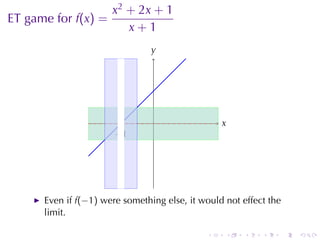
x2 + 2x + 1
ET game	for f(x) =
                      x+1
                                y
                                .


                         .      .                x
                                                 .
                       −
                       . 1


      Even	if f(−1) were	something	else, it	would	not	effect	the
      limit.

                                             .    .    .   .       .   .
x2 + 2x + 1
ET game	for f(x) =
                      x+1
                                y
                                .


                         .      .                x
                                                 .
                       −
                       . 1


      Even	if f(−1) were	something	else, it	would	not	effect	the
      limit.

                                             .    .    .   .       .   .
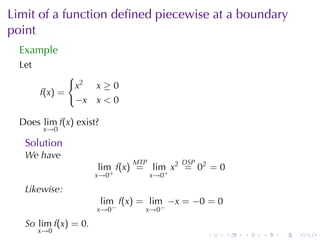
Limit	of	a	function	defined	piecewise	at	a	boundary
point
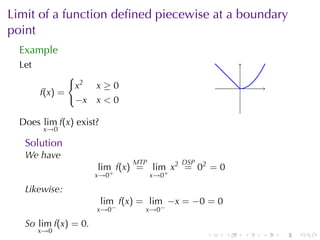
  Example
  Let
               {
                x2   x≥0
        f(x) =
                −x   x<0

  Does lim f(x) exist?
        x→0


                                   .   .   .   .   .   .
Limit	of	a	function	defined	piecewise	at	a	boundary
point
  Example
  Let
               {
                x2    x≥0
        f(x) =
                −x    x<0

  Does lim f(x) exist?
         x→0

   Solution
   We	have
                               MTP          DSP
                      lim f(x) = lim x2 = 02 = 0
                      x→0+           x→0+

   Likewise:
                         lim f(x) = lim −x = −0 = 0
                      x→0−        x→0−

   So lim f(x) = 0.
        x→0
                                                  .   .   .   .   .   .
Limit	of	a	function	defined	piecewise	at	a	boundary
point
  Example
  Let
               {
                x2    x≥0                                 .
        f(x) =
                −x    x<0

  Does lim f(x) exist?
         x→0

   Solution
   We	have
                               MTP          DSP
                      lim f(x) = lim x2 = 02 = 0
                      x→0+           x→0+

   Likewise:
                         lim f(x) = lim −x = −0 = 0
                      x→0−        x→0−

   So lim f(x) = 0.
        x→0
                                                  .   .       .   .   .   .
Finding	limits	by	algebraic	manipulations


   Example√
               x−2
   Find lim        .
       x→4    x−4


                                    .   .   .   .   .   .
Finding	limits	by	algebraic	manipulations


   Example√
               x−2
   Find lim        .
       x→4    x−4
   Solution                           √            √       √
                                           2
   Write	the	denominator	as x − 4 =       x − 4 = ( x − 2)( x + 2).


                                                 .   .   .   .   .    .
Finding	limits	by	algebraic	manipulations


   Example√
               x−2
   Find lim        .
       x→4    x−4
   Solution                         √ 2        √     √
   Write	the	denominator	as x − 4 = x − 4 = ( x − 2)( x + 2).
   So
                     √                  √
                       x−2                x−2
                 lim        = lim √         √
                x→4 x − 4      x→4 ( x − 2)( x + 2)
                                      1     1
                            = lim √       =
                               x→4   x+2    4


                                          .   .    .   .   .    .
Your	turn

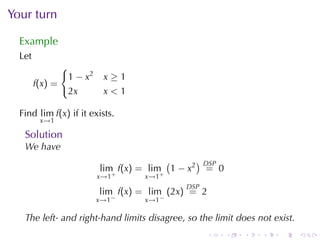
  Example
  Let
               {
                1 − x2   x≥1
        f(x) =
                2x       x<1

  Find lim f(x) if	it	exists.
         x→1


                                .   .   .   .   .   .
Your	turn

  Example
  Let
               {
                1 − x2    x≥1
        f(x) =
                2x        x<1

  Find lim f(x) if	it	exists.
         x→1

   Solution
   We	have
                                        (     ) DSP
                         lim f(x) = lim 1 − x2 = 0
                         x→1+      x→1+
                                             DSP
                         lim f(x) = lim (2x) = 2
                               −         −
                         x→1       x→1

   The	left-	and	right-hand	limits	disagree, so	the	limit	does	not	exist.
                                                   .   .   .    .    .      .
Your	turn

  Example                                                          .
  Let
               {
                1 − x2    x≥1
        f(x) =
                2x        x<1                          .         .
  Find lim f(x) if	it	exists.                                  1
                                                               .
         x→1

   Solution
   We	have
                                        (     ) DSP
                         lim f(x) = lim 1 − x2 = 0
                         x→1+      x→1+
                                             DSP
                         lim f(x) = lim (2x) = 2
                               −         −
                         x→1       x→1

   The	left-	and	right-hand	limits	disagree, so	the	limit	does	not	exist.
                                                   .       .   .       .   .   .
Two	More	Important	Limit	Theorems

  Theorem
  If f(x) ≤ g(x) when x is	near a (except	possibly	at a), then

                           lim f(x) ≤ lim g(x)
                           x→a        x→a

  (as	usual, provided	these	limits	exist).

  Theorem	(The	Squeeze/Sandwich/Pinching	Theorem)
  If f(x) ≤ g(x) ≤ h(x) when x is	near a (as	usual, except	possibly	at
  a), and
                        lim f(x) = lim h(x) = L,
                        x→a         x→a

  then
                              lim g(x) = L.
                              x→a


                                                 .   .   .       .   .   .
We	can	use	the	Squeeze	Theorem	to	make	complicated	limits
simple.


                                        .   .   .    .      .   .
We	can	use	the	Squeeze	Theorem	to	make	complicated	limits
simple.
Example                (π )
Show	that lim x2 sin          = 0.
          x→0           x


                                        .   .   .    .      .   .
We	can	use	the	Squeeze	Theorem	to	make	complicated	limits
simple.
Example                (π )
Show	that lim x2 sin          = 0.
           x→0          x
Solution
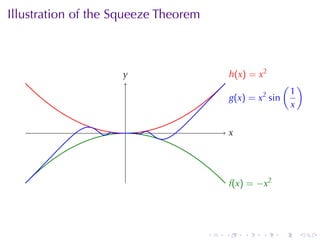
We	have	for	all x,
                                       (π )
                        −x2 ≤ x2 sin          ≤ x2
                                        x
The	left	and	right	sides	go	to	zero	as x → 0.


                                                     .   .   .   .   .   .
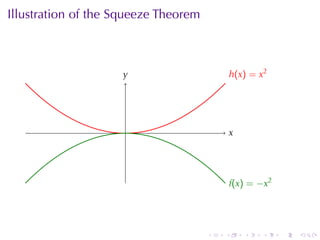
Illustration	of	the	Squeeze	Theorem


                    y
                    .                         . (x) = x2
                                              h


                     .                        x
                                              .


                                      .   .       .   .    .   .
Illustration	of	the	Squeeze	Theorem


                    y
                    .                         . (x) = x2
                                              h


                     .                        x
                                              .


                                              .(x) = −x2
                                              f


                                      .   .       .   .    .   .
Illustration	of	the	Squeeze	Theorem


                    y
                    .                         . (x) = x2
                                              h
                                                            ( )
                                                      2      1
                                              g
                                              . (x) = x sin
                                                             x

                     .                        x
                                              .


                                              .(x) = −x2
                                              f


                                      .   .       .   .    .   .
Outline


  Limits	and	Pathologies

  Basic	Limits

  Limit	Laws
     The	direct	substitution	property

  Limits	with	Algebra
     Two	more	limit	theorems

  Two	important	trigonometric	limits


                                        .   .   .   .   .   .
Two	important	trigonometric	limits


   Theorem
   The	following	two	limits	hold:
            sin θ
        lim        =1
        θ→0 θ
            cos θ − 1
        lim           =0
        θ→0      θ


                                     .   .   .   .   .   .
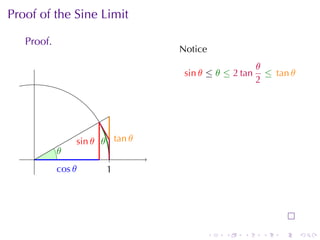
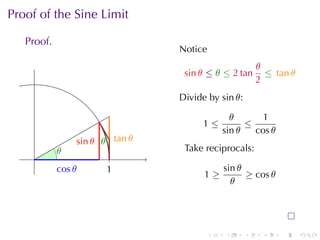
Proof	of	the	Sine	Limit

   Proof.
                          Notice

                                       θ


                 .
                 θ
            .
            θ
     .
                     1
                     .


                                   .       .   .   .   .   .
Proof	of	the	Sine	Limit

   Proof.
                                Notice

                                 sin θ ≤ θ


                 s
                 . in θ .
                        θ
            .
            θ
     .
            c
            . os θ          1
                            .


                                         .   .   .   .   .   .
Proof	of	the	Sine	Limit

   Proof.
                                  Notice

                                   sin θ ≤ θ               tan θ


                 . in θ . .an θ
                 s      θ t
            .
            θ
     .
            c
            . os θ      1
                        .


                                           .   .   .   .    .      .
Proof	of	the	Sine	Limit

   Proof.
                                  Notice
                                                       θ
                                   sin θ ≤ θ ≤ 2 tan     ≤ tan θ
                                                       2


                 . in θ . .an θ
                 s      θ t
            .
            θ
     .
            c
            . os θ      1
                        .


                                           .   .   .    .   .      .
Proof	of	the	Sine	Limit

   Proof.
                                  Notice
                                                         θ
                                   sin θ ≤ θ ≤ 2 tan       ≤ tan θ
                                                         2
                                  Divide	by sin θ:

                                                 θ      1
                                       1≤            ≤
                                               sin θ   cos θ
                 . in θ . .an θ
                 s      θ t
            .
            θ
     .
            c
            . os θ      1
                        .


                                           .   .     .    .    .     .
Proof	of	the	Sine	Limit

   Proof.
                                  Notice
                                                         θ
                                   sin θ ≤ θ ≤ 2 tan       ≤ tan θ
                                                         2
                                  Divide	by sin θ:

                                                 θ      1
                                       1≤            ≤
                                               sin θ   cos θ
                 . in θ . .an θ
                 s      θ t
            .
            θ                      Take	reciprocals:
     .
            c
            . os θ      1
                        .                      sin θ
                                        1≥           ≥ cos θ
                                                 θ


                                           .   .     .    .    .     .
Proof	of	the	Sine	Limit

   Proof.
                                         Notice
                                                                θ
                                           sin θ ≤ θ ≤ 2 tan      ≤ tan θ
                                                                2
                                         Divide	by sin θ:

                                                        θ      1
                                               1≤           ≤
                                                      sin θ   cos θ
                 . in θ . .an θ
                 s      θ t
            .
            θ                              Take	reciprocals:
     .
            c
            . os θ      1
                        .                             sin θ
                                                1≥          ≥ cos θ
                                                        θ

   As θ → 0, the	left	and	right	sides	tend	to 1. So, then, must	the
   middle	expression.
                                                  .   .     .    .    .     .
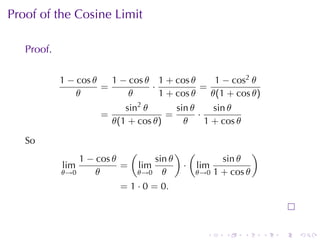
Proof	of	the	Cosine	Limit

   Proof.

            1 − cos θ   1 − cos θ 1 + cos θ     1 − cos2 θ
                      =          ·           =
                θ           θ      1 + cos θ   θ(1 + cos θ)
                            sin2 θ      sin θ     sin θ
                     =                =       ·
                         θ(1 + cos θ)     θ     1 + cos θ

   So
                              (               ) (                )
                1 − cos θ             sin θ            sin θ
            lim           =       lim          · lim
            θ→0     θ             θ→0 θ          θ→0 1 + cos θ

                           = 1 · 0 = 0.


                                                   .    .   .        .   .   .
Try	these


   Example
          tan θ
       lim
      θ→0 θ
          sin 2θ
      lim
      θ→0    θ


                   .   .   .   .   .   .
Try	these


   Example
          tan θ
       lim
      θ→0 θ
          sin 2θ
      lim
      θ→0    θ

   Answer
      1
      2


                   .   .   .   .   .   .

Lesson 4: Calculating Limits

  • 1.
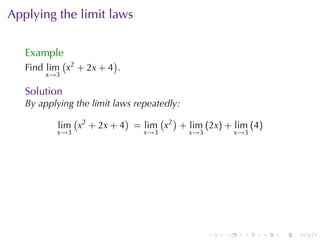
    Section 1.4 Calculating Limits V63.0121.034, Calculus I September 14, 2009 Announcements First written assignment due Wednesday First web assignment due Monday, September 21 . . . . . .
  • 2.
    Outline Limits and Pathologies Basic Limits Limit Laws The direct substitution property Limits with Algebra Two more limit theorems Two important trigonometric limits . . . . . .
  • 3.
    Heuristic Definition of a Limit Definition We write lim f(x) = L x→a and say “the limit of f(x), as x approaches a, equals L” if we can make the values of f(x) arbitrarily close to L (as close to L as we like) by taking x to be sufficiently close to a (on either side of a) but not equal to a. . . . . . .
  • 4.
    The error-tolerance game A game between two players to decide if a limit lim f(x) exists. x→a Player 1: Choose L to be the limit. Player 2: Propose an “error” level around L. Player 1: Choose a “tolerance” level around a so that x-points within that tolerance level are taken to y-values within the error level. If Player 1 can always win, lim f(x) = L. x→a . . . . . .
  • 5.
    Example Find lim x2if it exists. x→0 . . . . . .
  • 6.
    Example Find lim x2if it exists. x→0 Solution I claim the limit is zero. . . . . . .
  • 7.
    Example Find lim x2if it exists. x→0 Solution I claim the limit is zero. If the error level is 0.01, I need to guarantee that −0.01 < x2 < 0.01 for all x sufficiently close to zero. . . . . . .
  • 8.
    Example Find lim x2if it exists. x→0 Solution I claim the limit is zero. If the error level is 0.01, I need to guarantee that −0.01 < x2 < 0.01 for all x sufficiently close to zero. If −0.1 < x < 0.1, then 0 ≤ x2 < 0.01, so I win that round. . . . . . .
  • 9.
    Example Find lim x2if it exists. x→0 Solution I claim the limit is zero. If the error level is 0.01, I need to guarantee that −0.01 < x2 < 0.01 for all x sufficiently close to zero. If −0.1 < x < 0.1, then 0 ≤ x2 < 0.01, so I win that round. What should the tolerance be if the error is 0.0001? . . . . . .
  • 10.
    Example Find lim x2if it exists. x→0 Solution I claim the limit is zero. If the error level is 0.01, I need to guarantee that −0.01 < x2 < 0.01 for all x sufficiently close to zero. If −0.1 < x < 0.1, then 0 ≤ x2 < 0.01, so I win that round. What should the tolerance be if the error is 0.0001? By setting tolerance equal to the square root of the error, we can guarantee to be within any error. . . . . . .
  • 11.
    Example |x| Find lim if it exists. x→0 x . . . . . .
  • 12.
    Example |x| Find lim if it exists. x→0 x Solution The function can also be written as { |x| 1 if x > 0; = x −1 if x < 0 What would be the limit? . . . . . .
  • 13.
    The error-tolerance game y . . . 1 . x . . 1. − . . . . . .
  • 14.
    The error-tolerance game y . . . 1 . x . . 1. − . . . . . .
  • 15.
    The error-tolerance game y . . . 1 . x . . 1. − . . . . . .
  • 16.
    The error-tolerance game y . . . 1 . x . . 1. − . . . . . .
  • 17.
    The error-tolerance game y . . . 1 . x . . Part of graph in- . 1. − side blue is not inside green . . . . . .
  • 18.
    The error-tolerance game y . . . 1 . x . . 1. − . . . . . .
  • 19.
    The error-tolerance game y . . . 1 . x . . 1. − . . . . . .
  • 20.
    The error-tolerance game y . . Part of graph in- side blue is not . . 1 inside green . x . . 1. − . . . . . .
  • 21.
    The error-tolerance game y . . Part of graph in- side blue is not . . 1 inside green . x . . 1. − These are the only good choices; the limit does not exist. . . . . . .
  • 22.
    One-sided limits Definition We write lim f(x) = L x→a+ and say “the limit of f(x), as x approaches a from the right, equals L” if we can make the values of f(x) arbitrarily close to L (as close to L as we like) by taking x to be sufficiently close to a (on either side of a) and greater than a. . . . . . .
  • 23.
    One-sided limits Definition We write lim f(x) = L x→a− and say “the limit of f(x), as x approaches a from the left, equals L” if we can make the values of f(x) arbitrarily close to L (as close to L as we like) by taking x to be sufficiently close to a (on either side of a) and less than a. . . . . . .
  • 24.
    Example |x| Find lim if it exists. x→0 x Solution The function can also be written as { |x| 1 if x > 0; = x −1 if x < 0 What would be the limit? The error-tolerance game fails, but lim f(x) = 1 lim f(x) = −1 x→0+ x→0− . . . . . .
  • 25.
    Example 1 Find lim if it exists. x→0+ x . . . . . .
  • 26.
    The error-tolerance game y . .? . L . x . 0 . . . . . . .
  • 27.
    The error-tolerance game y . .? . L . x . 0 . . . . . . .
  • 28.
    The error-tolerance game y . .? . L . x . 0 . . . . . . .
  • 29.
    The error-tolerance game y . . The graph escapes the green, so no good .? . L . x . 0 . . . . . . .
  • 30.
    The error-tolerance game y . .? . L . x . 0 . . . . . . .
  • 31.
    The error-tolerance game y . E . ven worse! .? . L . x . 0 . . . . . . .
  • 32.
    The error-tolerance game y . . The limit does not exist because the function is unbounded near 0 .? . L . x . 0 . . . . . . .
  • 33.
    Example 1 Find lim if it exists. x→0+ x Solution The limit does not exist because the function is unbounded near 0. Next week we will understand the statement that 1 lim = +∞ x→0+ x . . . . . .
  • 34.
    Weird, wild stuff Example (π ) Find lim sin if it exists. x→0 x . . . . . .
  • 35.
    Weird, wild stuff Example (π ) Find lim sin if it exists. x→0 x f(x) = 0 when x = f(x) = 1 when x = f(x) = −1 when x = . . . . . .
  • 36.
    Weird, wild stuff Example (π ) Find lim sin if it exists. x→0 x 1 f(x) = 0 when x = for any integer k k f(x) = 1 when x = f(x) = −1 when x = . . . . . .
  • 37.
    Weird, wild stuff Example (π ) Find lim sin if it exists. x→0 x 1 f(x) = 0 when x = for any integer k k 1 f(x) = 1 when x = for any integer k 2k + 1/2 f(x) = −1 when x = . . . . . .
  • 38.
    Weird, wild stuff Example (π ) Find lim sin if it exists. x→0 x 1 f(x) = 0 when x = for any integer k k 1 f(x) = 1 when x = for any integer k 2k + 1/2 1 f(x) = −1 when x = for any integer k 2k − 1/2 . . . . . .
  • 39.
    Weird, wild stuff continued Here is a graph of the function: y . . . 1 . x . . 1. − There are infinitely many points arbitrarily close to zero where f(x) is 0, or 1, or −1. So the limit cannot exist. . . . . . .
  • 40.
    What could go wrong? Summary of Limit Pathologies How could a function fail to have a limit? Some possibilities: left- and right- hand limits exist but are not equal The function is unbounded near a (possible infinite limits, more later) Oscillation with increasingly high frequency near a . . . . . .
  • 41.
    Meet the Mathematician: Augustin Louis Cauchy French, 1789–1857 Royalist and Catholic made contributions in geometry, calculus, complex analysis, number theory created the definition of limit we use today but didn’t understand it . . . . . .
  • 42.
    Outline Limits and Pathologies Basic Limits Limit Laws The direct substitution property Limits with Algebra Two more limit theorems Two important trigonometric limits . . . . . .
  • 43.
    Really basic limits Fact Let c be a constant and a a real number. (i) lim x = a x→a (ii) lim c = c x→a . . . . . .
  • 44.
    Really basic limits Fact Let c be a constant and a a real number. (i) lim x = a x→a (ii) lim c = c x→a Proof. The first is tautological, the second is trivial. . . . . . .
  • 45.
    ET game for f(x)= x y . . x . . . . . . .
  • 46.
    ET game for f(x)= x y . . x . . . . . . .
  • 47.
    ET game for f(x)= x y . . . a . . x . a . . . . . . .
  • 48.
    ET game for f(x)= x y . . . a . . x . a . . . . . . .
  • 49.
    ET game for f(x)= x y . . . a . . x . a . . . . . . .
  • 50.
    ET game for f(x)= x y . . . a . . x . a . . . . . . .
  • 51.
    ET game for f(x)= x y . . . a . . x . a . Setting error equal to tolerance works! . . . . . .
  • 52.
    ET game for f(x)= c . . . . . . .
  • 53.
    ET game for f(x)= c y . . x . . . . . . .
  • 54.
    ET game for f(x)= c y . . x . . . . . . .
  • 55.
    ET game for f(x)= c y . . c . . . x . a . . . . . . .
  • 56.
    ET game for f(x)= c y . . c . . . x . a . . . . . . .
  • 57.
    ET game for f(x)= c y . . c . . . x . a . . . . . . .
  • 58.
    ET game for f(x)= c y . . c . . . x . a . any tolerance works! . . . . . .
  • 59.
    Really basic limits Fact Let c be a constant and a a real number. (i) lim x = a x→a (ii) lim c = c x→a Proof. The first is tautological, the second is trivial. . . . . . .
  • 60.
    Outline Limits and Pathologies Basic Limits Limit Laws The direct substitution property Limits with Algebra Two more limit theorems Two important trigonometric limits . . . . . .
  • 61.
    Limits and arithmetic Fact Suppose lim f(x) and lim g(x) exist and c is a constant. Then x→a x→a 1. lim [f(x) + g(x)] = lim f(x) + lim g(x) x→a x→a x→a . . . . . .
  • 62.
    Limits and arithmetic Fact Suppose lim f(x) and lim g(x) exist and c is a constant. Then x→a x→a 1. lim [f(x) + g(x)] = lim f(x) + lim g(x) (errors add) x→a x→a x→a . . . . . .
  • 63.
    Limits and arithmetic Fact Suppose lim f(x) and lim g(x) exist and c is a constant. Then x→a x→a 1. lim [f(x) + g(x)] = lim f(x) + lim g(x) (errors add) x→a x→a x→a 2. lim [f(x) − g(x)] = lim f(x) − lim g(x) x→a x→a x→a . . . . . .
  • 64.
    Limits and arithmetic Fact Suppose lim f(x) and lim g(x) exist and c is a constant. Then x→a x→a 1. lim [f(x) + g(x)] = lim f(x) + lim g(x) (errors add) x→a x→a x→a 2. lim [f(x) − g(x)] = lim f(x) − lim g(x) x→a x→a x→a 3. lim [cf(x)] = c lim f(x) x→a x→a . . . . . .
  • 65.
    Limits and arithmetic Fact Suppose lim f(x) and lim g(x) exist and c is a constant. Then x→a x→a 1. lim [f(x) + g(x)] = lim f(x) + lim g(x) (errors add) x→a x→a x→a 2. lim [f(x) − g(x)] = lim f(x) − lim g(x) x→a x→a x→a 3. lim [cf(x)] = c lim f(x) (error scales) x→a x→a . . . . . .
  • 66.
    Limits and arithmetic Fact Suppose lim f(x) and lim g(x) exist and c is a constant. Then x→a x→a 1. lim [f(x) + g(x)] = lim f(x) + lim g(x) (errors add) x→a x→a x→a 2. lim [f(x) − g(x)] = lim f(x) − lim g(x) (combination of adding x→a x→a x→a and scaling) 3. lim [cf(x)] = c lim f(x) (error scales) x→a x→a . . . . . .
  • 67.
    Limits and arithmetic Fact Suppose lim f(x) and lim g(x) exist and c is a constant. Then x→a x→a 1. lim [f(x) + g(x)] = lim f(x) + lim g(x) (errors add) x→a x→a x→a 2. lim [f(x) − g(x)] = lim f(x) − lim g(x) (combination of adding x→a x→a x→a and scaling) 3. lim [cf(x)] = c lim f(x) (error scales) x→a x→a 4. lim [f(x)g(x)] = lim f(x) · lim g(x) x→a x→a x→a . . . . . .
  • 68.
    Limits and arithmetic Fact Suppose lim f(x) and lim g(x) exist and c is a constant. Then x→a x→a 1. lim [f(x) + g(x)] = lim f(x) + lim g(x) (errors add) x→a x→a x→a 2. lim [f(x) − g(x)] = lim f(x) − lim g(x) (combination of adding x→a x→a x→a and scaling) 3. lim [cf(x)] = c lim f(x) (error scales) x→a x→a 4. lim [f(x)g(x)] = lim f(x) · lim g(x) (more complicated, but x→a x→a x→a doable) . . . . . .
  • 69.
    Limits and arithmetic II Fact (Continued) f (x ) lim f(x) 5. lim = x→a , if lim g(x) ̸= 0. x→a g(x) lim g(x) x→a x→a . . . . . .
  • 70.
    Limits and arithmetic II Fact (Continued) f (x ) lim f(x) 5. lim = x→a , if lim g(x) ̸= 0. x→a g(x) lim g(x) x→a x→a [ ]n 6. lim [f(x)]n = lim f(x) x→a x→a . . . . . .
  • 71.
    Limits and arithmetic II Fact (Continued) f (x ) lim f(x) 5. lim = x→a , if lim g(x) ̸= 0. x→a g(x) lim g(x) x→a x→a [ ]n 6. lim [f(x)]n = lim f(x) (follows from 4 repeatedly) x→a x→a . . . . . .
  • 72.
    Limits and arithmetic II Fact (Continued) f (x ) lim f(x) 5. lim = x→a , if lim g(x) ̸= 0. x→a g(x) lim g(x) x→a x→a [ ]n 6. lim [f(x)]n = lim f(x) (follows from 4 repeatedly) x→a x→a n n 7. lim x = a x→a . . . . . .
  • 73.
    Limits and arithmetic II Fact (Continued) f (x ) lim f(x) 5. lim = x→a , if lim g(x) ̸= 0. x→a g(x) lim g(x) x→a x→a [ ]n 6. lim [f(x)]n = lim f(x) (follows from 4 repeatedly) x→a x→a n n 7. lim x = a x→a √ √ 8. lim n x = n a x→a . . . . . .
  • 74.
    Limits and arithmetic II Fact (Continued) f (x ) lim f(x) 5. lim = x→a , if lim g(x) ̸= 0. x→a g(x) lim g(x) x→a x→a [ ]n 6. lim [f(x)]n = lim f(x) (follows from 4 repeatedly) x→a x→a n n 7. lim x = a (follows from 6) x→a √ √ 8. lim n x = n a x→a . . . . . .
  • 75.
    Limits and arithmetic II Fact (Continued) f (x ) lim f(x) 5. lim = x→a , if lim g(x) ̸= 0. x→a g(x) lim g(x) x→a x→a [ ]n 6. lim [f(x)]n = lim f(x) (follows from 4 repeatedly) x→a x→a n n 7. lim x = a (follows from 6) x→a √ √ 8. lim n x = n a x→a √ √ 9. lim n f(x) = n lim f(x) (If n is even, we must additionally x→a x→a assume that lim f(x) > 0) x→a . . . . . .
  • 76.
    Applying the limit laws Example ( ) Find lim x2 + 2x + 4 . x→3 . . . . . .
  • 77.
    Applying the limit laws Example ( ) Find lim x2 + 2x + 4 . x→3 Solution By applying the limit laws repeatedly: ( ) lim x2 + 2x + 4 x→3 . . . . . .
  • 78.
    Applying the limit laws Example ( ) Find lim x2 + 2x + 4 . x→3 Solution By applying the limit laws repeatedly: ( ) ( ) lim x2 + 2x + 4 = lim x2 + lim (2x) + lim (4) x→3 x→3 x→3 x→3 . . . . . .
  • 79.
    Applying the limit laws Example ( ) Find lim x2 + 2x + 4 . x→3 Solution By applying the limit laws repeatedly: ( ) ( ) lim x2 + 2x + 4 = lim x2 + lim (2x) + lim (4) x→3 x→3 x→3 x→3 ( )2 = lim x + 2 · lim (x) + 4 x→3 x→3 . . . . . .
  • 80.
    Applying the limit laws Example ( ) Find lim x2 + 2x + 4 . x→3 Solution By applying the limit laws repeatedly: ( ) ( ) lim x2 + 2x + 4 = lim x2 + lim (2x) + lim (4) x→3 x→3 x→3 x→3 ( )2 = lim x + 2 · lim (x) + 4 x→3 x→3 2 = (3) + 2 · 3 + 4 . . . . . .
  • 81.
    Applying the limit laws Example ( ) Find lim x2 + 2x + 4 . x→3 Solution By applying the limit laws repeatedly: ( ) ( ) lim x2 + 2x + 4 = lim x2 + lim (2x) + lim (4) x→3 x→3 x→3 x→3 ( )2 = lim x + 2 · lim (x) + 4 x→3 x→3 2 = (3) + 2 · 3 + 4 = 9 + 6 + 4 = 19. . . . . . .
  • 82.
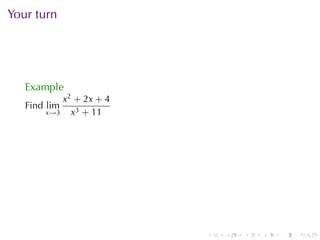
    Your turn Example x2 + 2x + 4 Find lim x→3 x3 + 11 . . . . . .
  • 83.
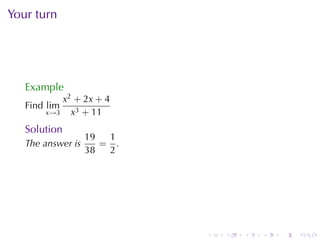
    Your turn Example x2 + 2x + 4 Find lim x→3 x3 + 11 Solution 19 1 The answer is = . 38 2 . . . . . .
  • 84.
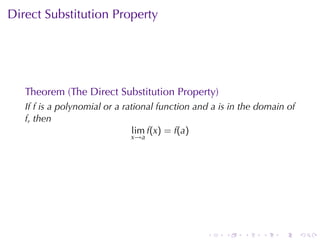
    Direct Substitution Property Theorem (The Direct Substitution Property) If f is a polynomial or a rational function and a is in the domain of f, then lim f(x) = f(a) x→a . . . . . .
  • 85.
    Outline Limits and Pathologies Basic Limits Limit Laws The direct substitution property Limits with Algebra Two more limit theorems Two important trigonometric limits . . . . . .
  • 86.
    Limits do not see the point! (in a good way) Theorem If f(x) = g(x) when x ̸= a, and lim g(x) = L, then lim f(x) = L. x→a x→a . . . . . .
  • 87.
    Limits do not see the point! (in a good way) Theorem If f(x) = g(x) when x ̸= a, and lim g(x) = L, then lim f(x) = L. x→a x→a Example x2 + 2x + 1 Find lim , if it exists. x→−1 x+1 . . . . . .
  • 88.
    Limits do not see the point! (in a good way) Theorem If f(x) = g(x) when x ̸= a, and lim g(x) = L, then lim f(x) = L. x→a x→a Example x2 + 2x + 1 Find lim , if it exists. x→−1 x+1 Solution x2 + 2x + 1 Since = x + 1 whenever x ̸= −1, and since x+1 x2 + 2x + 1 lim x + 1 = 0, we have lim = 0. x→−1 x→−1 x+1 . . . . . .
  • 89.
    x2 + 2x+ 1 ET game for f(x) = x+1 y . . . x . − . 1 Even if f(−1) were something else, it would not effect the limit. . . . . . .
  • 90.
    x2 + 2x+ 1 ET game for f(x) = x+1 y . . . x . − . 1 Even if f(−1) were something else, it would not effect the limit. . . . . . .
  • 91.
    Limit of a function defined piecewise at a boundary point Example Let { x2 x≥0 f(x) = −x x<0 Does lim f(x) exist? x→0 . . . . . .
  • 92.
    Limit of a function defined piecewise at a boundary point Example Let { x2 x≥0 f(x) = −x x<0 Does lim f(x) exist? x→0 Solution We have MTP DSP lim f(x) = lim x2 = 02 = 0 x→0+ x→0+ Likewise: lim f(x) = lim −x = −0 = 0 x→0− x→0− So lim f(x) = 0. x→0 . . . . . .
  • 93.
    Limit of a function defined piecewise at a boundary point Example Let { x2 x≥0 . f(x) = −x x<0 Does lim f(x) exist? x→0 Solution We have MTP DSP lim f(x) = lim x2 = 02 = 0 x→0+ x→0+ Likewise: lim f(x) = lim −x = −0 = 0 x→0− x→0− So lim f(x) = 0. x→0 . . . . . .
  • 94.
    Finding limits by algebraic manipulations Example√ x−2 Find lim . x→4 x−4 . . . . . .
  • 95.
    Finding limits by algebraic manipulations Example√ x−2 Find lim . x→4 x−4 Solution √ √ √ 2 Write the denominator as x − 4 = x − 4 = ( x − 2)( x + 2). . . . . . .
  • 96.
    Finding limits by algebraic manipulations Example√ x−2 Find lim . x→4 x−4 Solution √ 2 √ √ Write the denominator as x − 4 = x − 4 = ( x − 2)( x + 2). So √ √ x−2 x−2 lim = lim √ √ x→4 x − 4 x→4 ( x − 2)( x + 2) 1 1 = lim √ = x→4 x+2 4 . . . . . .
  • 97.
    Your turn Example Let { 1 − x2 x≥1 f(x) = 2x x<1 Find lim f(x) if it exists. x→1 . . . . . .
  • 98.
    Your turn Example Let { 1 − x2 x≥1 f(x) = 2x x<1 Find lim f(x) if it exists. x→1 Solution We have ( ) DSP lim f(x) = lim 1 − x2 = 0 x→1+ x→1+ DSP lim f(x) = lim (2x) = 2 − − x→1 x→1 The left- and right-hand limits disagree, so the limit does not exist. . . . . . .
  • 99.
    Your turn Example . Let { 1 − x2 x≥1 f(x) = 2x x<1 . . Find lim f(x) if it exists. 1 . x→1 Solution We have ( ) DSP lim f(x) = lim 1 − x2 = 0 x→1+ x→1+ DSP lim f(x) = lim (2x) = 2 − − x→1 x→1 The left- and right-hand limits disagree, so the limit does not exist. . . . . . .
  • 100.
    Two More Important Limit Theorems Theorem If f(x) ≤ g(x) when x is near a (except possibly at a), then lim f(x) ≤ lim g(x) x→a x→a (as usual, provided these limits exist). Theorem (The Squeeze/Sandwich/Pinching Theorem) If f(x) ≤ g(x) ≤ h(x) when x is near a (as usual, except possibly at a), and lim f(x) = lim h(x) = L, x→a x→a then lim g(x) = L. x→a . . . . . .
  • 101.
  • 102.
    We can use the Squeeze Theorem to make complicated limits simple. Example (π ) Show that lim x2 sin = 0. x→0 x . . . . . .
  • 103.
    We can use the Squeeze Theorem to make complicated limits simple. Example (π ) Show that lim x2 sin = 0. x→0 x Solution We have for all x, (π ) −x2 ≤ x2 sin ≤ x2 x The left and right sides go to zero as x → 0. . . . . . .
  • 104.
    Illustration of the Squeeze Theorem y . . (x) = x2 h . x . . . . . . .
  • 105.
    Illustration of the Squeeze Theorem y . . (x) = x2 h . x . .(x) = −x2 f . . . . . .
  • 106.
    Illustration of the Squeeze Theorem y . . (x) = x2 h ( ) 2 1 g . (x) = x sin x . x . .(x) = −x2 f . . . . . .
  • 107.
    Outline Limits and Pathologies Basic Limits Limit Laws The direct substitution property Limits with Algebra Two more limit theorems Two important trigonometric limits . . . . . .
  • 108.
    Two important trigonometric limits Theorem The following two limits hold: sin θ lim =1 θ→0 θ cos θ − 1 lim =0 θ→0 θ . . . . . .
  • 109.
    Proof of the Sine Limit Proof. Notice θ . θ . θ . 1 . . . . . . .
  • 110.
    Proof of the Sine Limit Proof. Notice sin θ ≤ θ s . in θ . θ . θ . c . os θ 1 . . . . . . .
  • 111.
    Proof of the Sine Limit Proof. Notice sin θ ≤ θ tan θ . in θ . .an θ s θ t . θ . c . os θ 1 . . . . . . .
  • 112.
    Proof of the Sine Limit Proof. Notice θ sin θ ≤ θ ≤ 2 tan ≤ tan θ 2 . in θ . .an θ s θ t . θ . c . os θ 1 . . . . . . .
  • 113.
    Proof of the Sine Limit Proof. Notice θ sin θ ≤ θ ≤ 2 tan ≤ tan θ 2 Divide by sin θ: θ 1 1≤ ≤ sin θ cos θ . in θ . .an θ s θ t . θ . c . os θ 1 . . . . . . .
  • 114.
    Proof of the Sine Limit Proof. Notice θ sin θ ≤ θ ≤ 2 tan ≤ tan θ 2 Divide by sin θ: θ 1 1≤ ≤ sin θ cos θ . in θ . .an θ s θ t . θ Take reciprocals: . c . os θ 1 . sin θ 1≥ ≥ cos θ θ . . . . . .
  • 115.
    Proof of the Sine Limit Proof. Notice θ sin θ ≤ θ ≤ 2 tan ≤ tan θ 2 Divide by sin θ: θ 1 1≤ ≤ sin θ cos θ . in θ . .an θ s θ t . θ Take reciprocals: . c . os θ 1 . sin θ 1≥ ≥ cos θ θ As θ → 0, the left and right sides tend to 1. So, then, must the middle expression. . . . . . .
  • 116.
    Proof of the Cosine Limit Proof. 1 − cos θ 1 − cos θ 1 + cos θ 1 − cos2 θ = · = θ θ 1 + cos θ θ(1 + cos θ) sin2 θ sin θ sin θ = = · θ(1 + cos θ) θ 1 + cos θ So ( ) ( ) 1 − cos θ sin θ sin θ lim = lim · lim θ→0 θ θ→0 θ θ→0 1 + cos θ = 1 · 0 = 0. . . . . . .
  • 117.
    Try these Example tan θ lim θ→0 θ sin 2θ lim θ→0 θ . . . . . .
  • 118.
    Try these Example tan θ lim θ→0 θ sin 2θ lim θ→0 θ Answer 1 2 . . . . . .