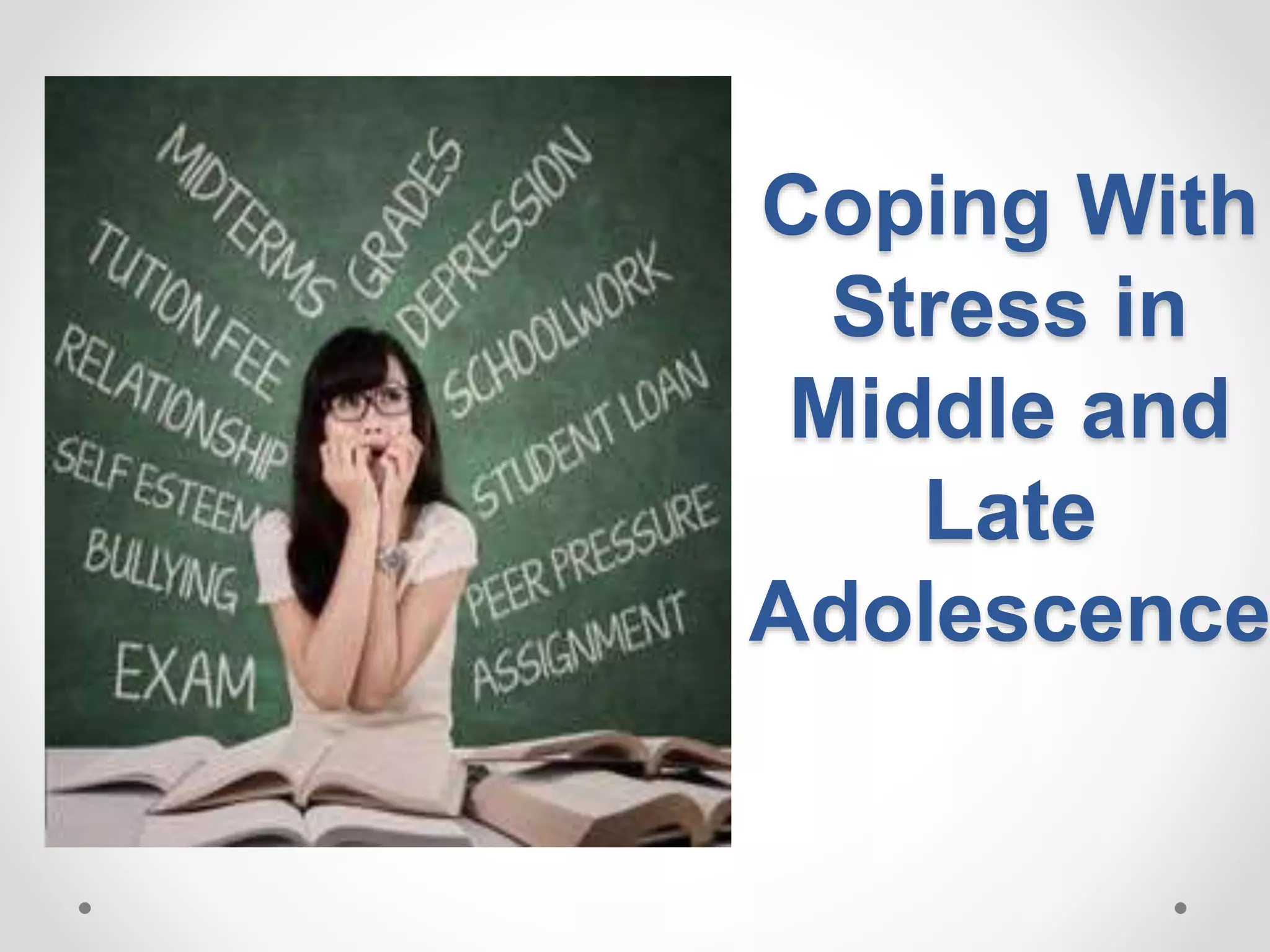
Coping With
Stress in
Middle and
Late
Adolescence
Stress is a feeling that people
experience whenever they are
overloaded and they are not able to
cope with demands of time and the
people.
stress?
• According to Zimbrado and Weber
(1997), an unstressed organism is an
unmotivated organism, taking no action
and reaping no benefits of living.
• Basic stress is an unavoidable part of
living.
• Every organism faces challenges and
problems in life which the organism like
us, must solve to survive and thrive
(Zimbrado and Weber 1997),
• Stress is being define us a state of
psychological and physiological
imbalance resulting from the disparity
between situational demand and the
individual’s ability and motivation to
meet those needs (Akrani 2011).
• For some psychologist- Stress is a
response to a condition that threatens
man’s capacity to adjust to the inner
and outer demand of any circumstance.
• Stress can be considered positive or
negative.
• It is positive when it opens opportunities for
us to gain something or if it acts as a
motivator of our performance.
• Stress become negative when we face social,
physical, organizational and emotional
problems (Akrani 2011)
Events that lead to stress is called stressors.
They focus on life events, catastrophes, and
daily hassles.
Categorizing Stressors
Three general types of stressors according
to Felman (2008):
1) Cataclysmic events- considered as
strong stressors that occur suddenly
and may affect many people
simultaneously. (e.g natural disaster
such as super typhoon)
2) Personal stressor- includes major life
events such as the death of a special
someone, loss of one’s career, and
major personal failures;
3.) Posttraumatic stress disorder (PTSD)-
in which a person has experienced a
significantly stressful event that has
long-lasting effects that may include re-
experiencing the event in vivid flashback
or dreams
Some Common Reactions
to a Stressful event
according to Baum (1994) as
cited by Feldman (2008)
Stress Direct
Physiological effects
Elevated blood pressure
Decreased in immune system
functioning
Increased hormonal activity
Psychophysical conditions
Stress Harmful
behaviors
Increased smoking, alcohol use
Decreased nutrition
Decreased help
Increased drug use
Stress Indirect Health-
Related Behaviors
Decreased compliance with
medical advice
Increase in delays in seeking
medical advice
Decrease in likelihood of seeking
medical advice
Effects of Prolonged Stress
• When we can no longer handle situations
such as pressures and problems in our daily
living, our personality and our way of thinking
get adversely affected.
• We are too preoccupied with many things in
our mind and more of bad experiences than
the good ones.
• We will turn out as stressed individuals.
Prolonged stress affects our human body like
it can cause damage to our organs.
Coping Mechanism for
Stress
• Since stress is always part of our life, we
need to cope with stress to lessen our
frustration and problem.
• According to Sevilla, Punsalan and et al,
(2006), coping is an active effort to
eliminate stress or to get rid of it.
• We try to deal directly with anxiety-
producing situations by 1) Appraising the
situation and 2) by doing something to
avoid it or change its course.
According to Tria, Gaerlan, Limpia (2012), the
following are stress- coping strategies:
Problem-focused- dealing with the stressor
itself. It include reducing, modifying, or
eliminating the source of stress.
Emotion-focused- efforts to modify the
unpleasant emotional consequences of
stress;
Proactive coping- anticipating some
stressful situations and taking active
measure to avoid or minimize its
consequences.
Other healthy ways to
cope with stress:
1) Take care of ourselves, it means we need to
eat regularly and healthy;
2) Do things that make us happy;
3) Learn to manage our time wisely;
4) Exercise on a regular basis;
5) Get plenty of sleep and give a break if you feel
that you are so stressed already;
6) Talk to others or seek group or social support;
7) And avoid using drug and alcohol
Activity : Stress Reflection
Answer the following guide questions.
1. Is there something or someone that has
been bothering or disturbing you for the few
days? How does it affect you as a person?
2. Are you taking care of yourself physically
and emotionally?
3. Are you achieving the goals that you have
set for yourself?
4. Do you let matters that are out of your
control stress you out?

Coping with stress

  • 2.
    Coping With Stress in Middleand Late Adolescence
  • 3.
    Stress is afeeling that people experience whenever they are overloaded and they are not able to cope with demands of time and the people.
  • 4.
  • 5.
    • According toZimbrado and Weber (1997), an unstressed organism is an unmotivated organism, taking no action and reaping no benefits of living. • Basic stress is an unavoidable part of living. • Every organism faces challenges and problems in life which the organism like us, must solve to survive and thrive (Zimbrado and Weber 1997),
  • 6.
    • Stress isbeing define us a state of psychological and physiological imbalance resulting from the disparity between situational demand and the individual’s ability and motivation to meet those needs (Akrani 2011). • For some psychologist- Stress is a response to a condition that threatens man’s capacity to adjust to the inner and outer demand of any circumstance.
  • 7.
    • Stress canbe considered positive or negative. • It is positive when it opens opportunities for us to gain something or if it acts as a motivator of our performance. • Stress become negative when we face social, physical, organizational and emotional problems (Akrani 2011) Events that lead to stress is called stressors. They focus on life events, catastrophes, and daily hassles.
  • 8.
    Categorizing Stressors Three generaltypes of stressors according to Felman (2008): 1) Cataclysmic events- considered as strong stressors that occur suddenly and may affect many people simultaneously. (e.g natural disaster such as super typhoon) 2) Personal stressor- includes major life events such as the death of a special someone, loss of one’s career, and major personal failures;
  • 9.
    3.) Posttraumatic stressdisorder (PTSD)- in which a person has experienced a significantly stressful event that has long-lasting effects that may include re- experiencing the event in vivid flashback or dreams
  • 10.
    Some Common Reactions toa Stressful event according to Baum (1994) as cited by Feldman (2008)
  • 11.
    Stress Direct Physiological effects Elevatedblood pressure Decreased in immune system functioning Increased hormonal activity Psychophysical conditions
  • 12.
    Stress Harmful behaviors Increased smoking,alcohol use Decreased nutrition Decreased help Increased drug use
  • 13.
    Stress Indirect Health- RelatedBehaviors Decreased compliance with medical advice Increase in delays in seeking medical advice Decrease in likelihood of seeking medical advice
  • 14.
    Effects of ProlongedStress • When we can no longer handle situations such as pressures and problems in our daily living, our personality and our way of thinking get adversely affected. • We are too preoccupied with many things in our mind and more of bad experiences than the good ones. • We will turn out as stressed individuals. Prolonged stress affects our human body like it can cause damage to our organs.
  • 15.
    Coping Mechanism for Stress •Since stress is always part of our life, we need to cope with stress to lessen our frustration and problem. • According to Sevilla, Punsalan and et al, (2006), coping is an active effort to eliminate stress or to get rid of it. • We try to deal directly with anxiety- producing situations by 1) Appraising the situation and 2) by doing something to avoid it or change its course.
  • 16.
    According to Tria,Gaerlan, Limpia (2012), the following are stress- coping strategies: Problem-focused- dealing with the stressor itself. It include reducing, modifying, or eliminating the source of stress. Emotion-focused- efforts to modify the unpleasant emotional consequences of stress; Proactive coping- anticipating some stressful situations and taking active measure to avoid or minimize its consequences.
  • 17.
    Other healthy waysto cope with stress: 1) Take care of ourselves, it means we need to eat regularly and healthy; 2) Do things that make us happy; 3) Learn to manage our time wisely; 4) Exercise on a regular basis; 5) Get plenty of sleep and give a break if you feel that you are so stressed already; 6) Talk to others or seek group or social support; 7) And avoid using drug and alcohol
  • 18.
    Activity : StressReflection Answer the following guide questions. 1. Is there something or someone that has been bothering or disturbing you for the few days? How does it affect you as a person? 2. Are you taking care of yourself physically and emotionally? 3. Are you achieving the goals that you have set for yourself? 4. Do you let matters that are out of your control stress you out?