WEEK 1
SCIENCE | GRADE 7
MATATAG CURRICULUM
Quarter 3
Scientists and engineers
analyze forces to predict their
effects on movement.
CONTENT Standards
Identify that forces act between objects and can be
measured.
Lesson Objective 1: Describe what a force is
Lesson Objective 2: Describe the effects of forces on
objects
Lesson Objective 3: Classify forces as contact and
non-contact
Lesson Objective 4: Identify the different forces
acting on an object
Lesson Objective 5: Measure the forces acting on an
object
LEARNING Competencies &
Objectives
Balanced and unbalanced forces
• A force is a push or a pull that may cause the
object to move, move faster or slower, stop moving,
or even change its shape.
• There are different types of forces. These may be
classified as contact forces and non-contact forces.
• A spring balance may BE used to measure the
magnitude of a force.
• The SI unit of the force is Newton (N).
CONTENT
ACTIVATING
PRIOR
KNOWLEDGE
SCIENCE | GRADE 7
QUARTER 3 WEEK 1
Short
Review
a. What are the everyday household
chores where you exert effort?
b. Can you identify some household
chores that you do? Share also how
much effort you exert in these chores.
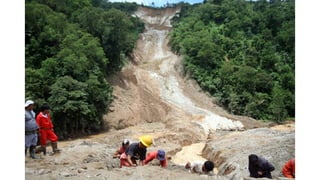
c. Why are natural events like lahar,
landslides, earthquakes, and typhoons
considered dangerous?
Short Review
Short Review
Lesson
Purpose
SCIENCE | GRADE 7
QUARTER 3 WEEK 1
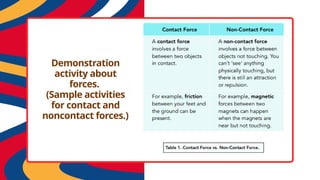
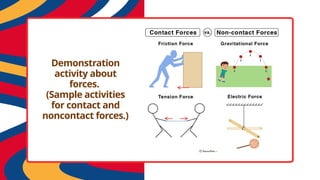
Demonstration activity about
forces.
(Sample activities for contact
and noncontact forces.)
Lesson Purpose
Demonstration
activity about
forces.
(Sample activities
for contact and
noncontact forces.)
Demonstration
activity about
forces.
(Sample activities
for contact and
noncontact forces.)
Unlocking
Content Area
Vocabulary
SCIENCE | GRADE 7
QUARTER 3 WEEK 1
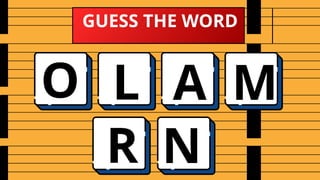
GUESS THE WORD
O L A M
R N
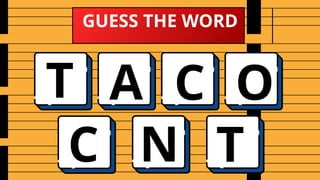
GUESS THE WORD
T A C O
N T
C
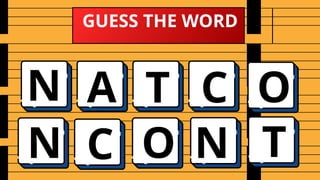
GUESS THE WORD
N A T C
O N
C
O
T
N
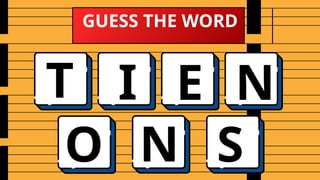
GUESS THE WORD
T I E N
N S
O
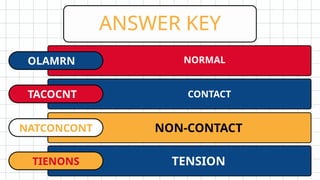
ANSWER KEY
NORMAL
OLAMRN
CONTACT
TACOCNT
NON-CONTACT
NATCONCONT
TENSION
TIENONS
Developing
and
Deepening
Understanding
SCIENCE | GRADE 7
QUARTER 3 WEEK 1
Activity 1. What Forces Can
Do
Objectives:
At the end of the demonstration, the
student should be able to describe what
a force is and its effect on objects.
Soft rubber ball
Toy car
Rubber band
MATERIALS
Procedure 1
Observe and explain
what happened to the
ball. Pull the opposite
ends of the rubber
band
a. What happened to
the ball when you
pushed it against a
wall or table?
b. What is applied in
the two instances?
Procedure 2
Place the toy car on
the table or the floor.
How to make the toy
car move?
Procedure 3
Push the toy car.
How to make the toy car
move faster, slower, stop, or
even change direction?
Procedure 5
How can you
describe a force
and its effect on
object?
Procedure 6
Can you give an Examples of
real-life situations where forces
are applied?
For example,
pushing a cart, kicking a soccer
ball, modeling a lump of clay,
the strong
wind that moves a sailboat, or
kicking hard an empty can used
in a game of Tumbang Preso.
• A force can change the size and shape of an
object.
• A force can make a stationary object move.
• A force can speed up, slow down, or stop a
moving object.
• A force can change the direction of a
moving object.
Worked
Example
SCIENCE | GRADE 7
QUARTER 3 WEEK 1
Objectives:
At the end of the POE
demonstration, you should be
able to identify how forces act
on objects.
Activity 2. Ways by which forces
act on an object
SOFT RUBBER
BALL
MATERIALS
Procedure 1
Place the ball on top of
a table.
What will happen if the
ball is gently pushed?
a. What caused the ball
to move?
b. Was the hand in
contact with the ball
when it moved?
This is called contact
forces.
Procedure 2
Put back the ball on
top of the table.
What will happen if the
ball this time is
pushed.
a. What have you observed?
What do you think is the caused
why the ball move towards the
edge of the table?
b. What happened to the ball as
it reached the edge of the table?
Do the ball travel on the same
direction?
c. Was there anything that was
physically in contact with the
ball that changed its direction?
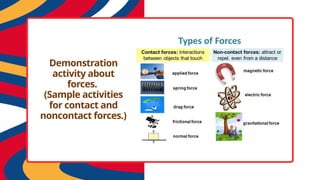
Demonstration
activity about
forces.
(Sample activities
for contact and
noncontact forces.)
Lesson
Activity
SCIENCE | GRADE 7
QUARTER 3 WEEK 1
Objective: At the end of the activity,
the students should be able to
identify different forces acting on an
object and differentiate contact
from noncontact forces.
Activity 3. Contact and
Noncontact Forces
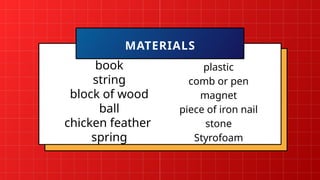
book
string
block of wood
ball
chicken feather
spring
MATERIALS
plastic
comb or pen
magnet
piece of iron nail
stone
Styrofoam
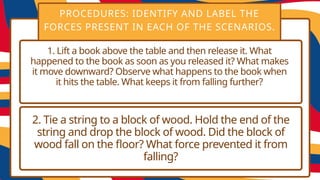
PROCEDURES: IDENTIFY AND LABEL THE
FORCES PRESENT IN EACH OF THE SCENARIOS.
1. Lift a book above the table and then release it. What
happened to the book as soon as you released it? What makes
it move downward? Observe what happens to the book when
it hits the table. What keeps it from falling further?
2. Tie a string to a block of wood. Hold the end of the
string and drop the block of wood. Did the block of
wood fall on the floor? What force prevented it from
falling?
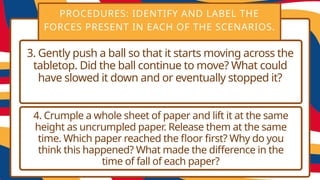
PROCEDURES: IDENTIFY AND LABEL THE
FORCES PRESENT IN EACH OF THE SCENARIOS.
3. Gently push a ball so that it starts moving across the
tabletop. Did the ball continue to move? What could
have slowed it down and or eventually stopped it?
4. Crumple a whole sheet of paper and lift it at the same
height as uncrumpled paper. Release them at the same
time. Which paper reached the floor first? Why do you
think this happened? What made the difference in the
time of fall of each paper?
PROCEDURES: IDENTIFY AND LABEL THE
FORCES PRESENT IN EACH OF THE SCENARIOS.
5. Attach the block of wood at the end of a spring. Fixed one end of the
spring by holding it firmly. Stretch the spring by pulling the wood away
from the fixed end of the spring. Do you feel something pulling it back?
Release the block of wood? Observe what happened. Why do you think
it moved towards the fixed end? What made it move toward the fixed
end?
6. Using a cloth, rub a plastic pen several times.
Place the plastic pen near bits of paper, but do
not touch them. Observe what happens. What
made it possible?
PROCEDURES: IDENTIFY AND LABEL THE
FORCES PRESENT IN EACH OF THE SCENARIOS.
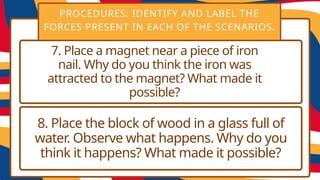
7. Place a magnet near a piece of iron
nail. Why do you think the iron was
attracted to the magnet? What made it
possible?
8. Place the block of wood in a glass full of
water. Observe what happens. Why do you
think it happens? What made it possible?
1. How can you
differentiate contact and
noncontact forces?
Guide Questions:
2. Are the scenarios
presented are
classified as contact
or noncontact force?
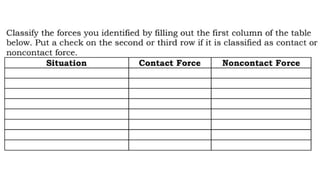
Activity 3
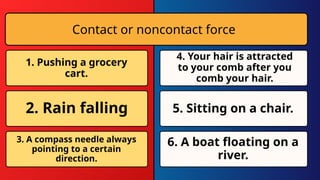
Contact or noncontact force
1. Pushing a grocery
cart.
2. Rain falling
3. A compass needle always
pointing to a certain
direction.
4. Your hair is attracted
to your comb after you
comb your hair.
5. Sitting on a chair.
6. A boat floating on a
river.
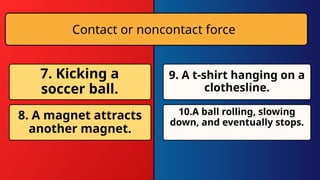
Contact or noncontact force
7. Kicking a
soccer ball.
8. A magnet attracts
another magnet.
9. A t-shirt hanging on a
clothesline.
10.A ball rolling, slowing
down, and eventually stops.
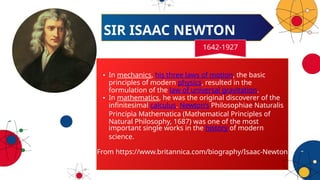
• He was an English physicist and mathematician
who was the culminating figure of the
Scientific Revolution of the 17th century.
• In optics, his discovery of the composition of
white light integrated the phenomena of
colours into the science of light and laid the
foundation for modern physical optics.
From https://www.britannica.com/biography/Isaac-
Newton
SIR ISAAC NEWTON
1642-1927
• In mechanics, his three laws of motion, the basic
principles of modern physics, resulted in the
formulation of the law of universal gravitation.
• In mathematics, he was the original discoverer of the
infinitesimal calculus. Newton’s Philosophiae Naturalis
Principia Mathematica (Mathematical Principles of
Natural Philosophy, 1687) was one of the most
important single works in the history of modern
science.
From https://www.britannica.com/biography/Isaac-Newton
SIR ISAAC NEWTON
1642-1927
Part A. Designing a force measurer
Objective: At the end of the activity,
the students should be able to
make an improvised force measurer.
Activity 4. Measuring a Force
Ruler
Small Spring (or Coil or
Rubber band)
Paper clip
MATERIALS
PROCEDURES:
1. Attach the spring to the ruler.
2. Hook one end of the spring on
the zero-mark of the ruler.
PROCEDURES:
3. Stretch the spring along the
ruler, ensuring it is taut.
4. Use the paperclip to secure the
other end of the spring at a specific
measurement on the ruler.
PROCEDURES:
5. Calibrate the device by applying known forces
to the spring at marked intervals and adjust the
paperclip accordingly to ensure accurate
measurements.
6. To measure the force, attach the
object to the paperclip and pull the
force measurer.
Part B. Measuring the force applied
by the Earth on Objects
Objective: At the end of the activity,
the students should be able to
measure the force applied by the
Earth on different objects.
Activity 4. Measuring a Force
Improvised force measurer
constructed in Part A
Cup
String
Nine marbles of equal masses
MATERIALS
PROCEDURES:
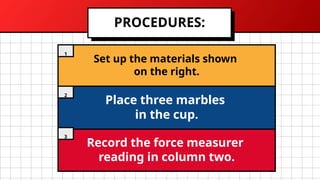
Set up the materials shown
on the right.
Place three marbles
in the cup.
Record the force measurer
reading in column two.
1
2
3
PROCEDURES:
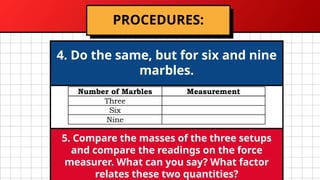
4. Do the same, but for six and nine
marbles.
5. Compare the masses of the three setups
and compare the readings on the force
measurer. What can you say? What factor
relates these two quantities?
Part C. Measuring the applied force to
start moving an object
Objective: At the end of the activity, the
student should be able to measure the
applied force by a person to move an
object at different surfaces.
Activity 4. Measuring a Force
Improvised force measurer
Three different surfaces (e.i.
very smooth, smooth, and
rough surface)
Block of wood with a hook
MATERIALS
PROCEDURES:
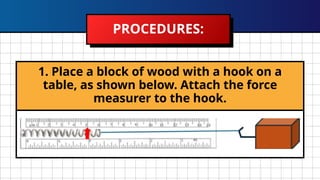
1. Place a block of wood with a hook on a
table, as shown below. Attach the force
measurer to the hook.
PROCEDURES:
2. Gently pull the measurer horizontally. Measure the
reading on the force measurer before the block of wood
starts moving on the three different surfaces.
3. Compare the measurements in the three
setups. What factors affect the readings?
Making
Generalizations
SCIENCE | GRADE 7
QUARTER 3 WEEK 1
1. Why is it important to
understand the different
types of forces and their
effects?
Learners’
Takeaways
2. How can measuring
forces accurately benefit
scientific experiments and
practical applications?
Learners’
Takeaways
Compose a one-page
reflection discussing
what you learned, what
you do not understand,
and what you want to
learn further.
Reflection
on
Learning
Formative
Assessment
SCIENCE | GRADE 7
QUARTER 3 WEEK 1
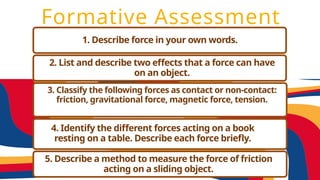
Formative Assessment
1. Describe force in your own words.
2. List and describe two effects that a force can have
on an object.
3. Classify the following forces as contact or non-contact:
friction, gravitational force, magnetic force, tension.
4. Identify the different forces acting on a book
resting on a table. Describe each force briefly.
5. Describe a method to measure the force of friction
acting on a sliding object.
WEEK 1
SCIENCE | GRADE 7
MATATAG CURRICULUM
Quarter 3

Science 7 - Quarter 3 Full Week 1.pptx

  • 1.
    WEEK 1 SCIENCE |GRADE 7 MATATAG CURRICULUM Quarter 3
  • 2.
    Scientists and engineers analyzeforces to predict their effects on movement. CONTENT Standards
  • 3.
    Identify that forcesact between objects and can be measured. Lesson Objective 1: Describe what a force is Lesson Objective 2: Describe the effects of forces on objects Lesson Objective 3: Classify forces as contact and non-contact Lesson Objective 4: Identify the different forces acting on an object Lesson Objective 5: Measure the forces acting on an object LEARNING Competencies & Objectives
  • 4.
    Balanced and unbalancedforces • A force is a push or a pull that may cause the object to move, move faster or slower, stop moving, or even change its shape. • There are different types of forces. These may be classified as contact forces and non-contact forces. • A spring balance may BE used to measure the magnitude of a force. • The SI unit of the force is Newton (N). CONTENT
  • 5.
  • 7.
    Short Review a. What arethe everyday household chores where you exert effort? b. Can you identify some household chores that you do? Share also how much effort you exert in these chores. c. Why are natural events like lahar, landslides, earthquakes, and typhoons considered dangerous?
  • 8.
  • 9.
  • 10.
  • 11.
    Demonstration activity about forces. (Sampleactivities for contact and noncontact forces.) Lesson Purpose
  • 12.
  • 13.
  • 14.
  • 15.
  • 16.
    GUESS THE WORD TA C O N T C
  • 17.
    GUESS THE WORD NA T C O N C O T N
  • 18.
    GUESS THE WORD TI E N N S O
  • 19.
  • 20.
  • 21.
    Activity 1. WhatForces Can Do Objectives: At the end of the demonstration, the student should be able to describe what a force is and its effect on objects.
  • 22.
    Soft rubber ball Toycar Rubber band MATERIALS
  • 23.
    Procedure 1 Observe andexplain what happened to the ball. Pull the opposite ends of the rubber band a. What happened to the ball when you pushed it against a wall or table? b. What is applied in the two instances?
  • 24.
    Procedure 2 Place thetoy car on the table or the floor. How to make the toy car move? Procedure 3 Push the toy car. How to make the toy car move faster, slower, stop, or even change direction?
  • 25.
    Procedure 5 How canyou describe a force and its effect on object? Procedure 6 Can you give an Examples of real-life situations where forces are applied? For example, pushing a cart, kicking a soccer ball, modeling a lump of clay, the strong wind that moves a sailboat, or kicking hard an empty can used in a game of Tumbang Preso.
  • 26.
    • A forcecan change the size and shape of an object. • A force can make a stationary object move. • A force can speed up, slow down, or stop a moving object. • A force can change the direction of a moving object.
  • 27.
  • 28.
    Objectives: At the endof the POE demonstration, you should be able to identify how forces act on objects. Activity 2. Ways by which forces act on an object
  • 29.
  • 30.
    Procedure 1 Place theball on top of a table. What will happen if the ball is gently pushed? a. What caused the ball to move? b. Was the hand in contact with the ball when it moved? This is called contact forces.
  • 31.
    Procedure 2 Put backthe ball on top of the table. What will happen if the ball this time is pushed. a. What have you observed? What do you think is the caused why the ball move towards the edge of the table? b. What happened to the ball as it reached the edge of the table? Do the ball travel on the same direction? c. Was there anything that was physically in contact with the ball that changed its direction?
  • 32.
  • 33.
  • 34.
    Objective: At theend of the activity, the students should be able to identify different forces acting on an object and differentiate contact from noncontact forces. Activity 3. Contact and Noncontact Forces
  • 35.
    book string block of wood ball chickenfeather spring MATERIALS plastic comb or pen magnet piece of iron nail stone Styrofoam
  • 36.
    PROCEDURES: IDENTIFY ANDLABEL THE FORCES PRESENT IN EACH OF THE SCENARIOS. 1. Lift a book above the table and then release it. What happened to the book as soon as you released it? What makes it move downward? Observe what happens to the book when it hits the table. What keeps it from falling further? 2. Tie a string to a block of wood. Hold the end of the string and drop the block of wood. Did the block of wood fall on the floor? What force prevented it from falling?
  • 37.
    PROCEDURES: IDENTIFY ANDLABEL THE FORCES PRESENT IN EACH OF THE SCENARIOS. 3. Gently push a ball so that it starts moving across the tabletop. Did the ball continue to move? What could have slowed it down and or eventually stopped it? 4. Crumple a whole sheet of paper and lift it at the same height as uncrumpled paper. Release them at the same time. Which paper reached the floor first? Why do you think this happened? What made the difference in the time of fall of each paper?
  • 38.
    PROCEDURES: IDENTIFY ANDLABEL THE FORCES PRESENT IN EACH OF THE SCENARIOS. 5. Attach the block of wood at the end of a spring. Fixed one end of the spring by holding it firmly. Stretch the spring by pulling the wood away from the fixed end of the spring. Do you feel something pulling it back? Release the block of wood? Observe what happened. Why do you think it moved towards the fixed end? What made it move toward the fixed end? 6. Using a cloth, rub a plastic pen several times. Place the plastic pen near bits of paper, but do not touch them. Observe what happens. What made it possible?
  • 39.
    PROCEDURES: IDENTIFY ANDLABEL THE FORCES PRESENT IN EACH OF THE SCENARIOS. 7. Place a magnet near a piece of iron nail. Why do you think the iron was attracted to the magnet? What made it possible? 8. Place the block of wood in a glass full of water. Observe what happens. Why do you think it happens? What made it possible?
  • 41.
    1. How canyou differentiate contact and noncontact forces? Guide Questions:
  • 42.
    2. Are thescenarios presented are classified as contact or noncontact force? Activity 3
  • 43.
    Contact or noncontactforce 1. Pushing a grocery cart. 2. Rain falling 3. A compass needle always pointing to a certain direction. 4. Your hair is attracted to your comb after you comb your hair. 5. Sitting on a chair. 6. A boat floating on a river.
  • 44.
    Contact or noncontactforce 7. Kicking a soccer ball. 8. A magnet attracts another magnet. 9. A t-shirt hanging on a clothesline. 10.A ball rolling, slowing down, and eventually stops.
  • 45.
    • He wasan English physicist and mathematician who was the culminating figure of the Scientific Revolution of the 17th century. • In optics, his discovery of the composition of white light integrated the phenomena of colours into the science of light and laid the foundation for modern physical optics. From https://www.britannica.com/biography/Isaac- Newton SIR ISAAC NEWTON 1642-1927
  • 46.
    • In mechanics,his three laws of motion, the basic principles of modern physics, resulted in the formulation of the law of universal gravitation. • In mathematics, he was the original discoverer of the infinitesimal calculus. Newton’s Philosophiae Naturalis Principia Mathematica (Mathematical Principles of Natural Philosophy, 1687) was one of the most important single works in the history of modern science. From https://www.britannica.com/biography/Isaac-Newton SIR ISAAC NEWTON 1642-1927
  • 47.
    Part A. Designinga force measurer Objective: At the end of the activity, the students should be able to make an improvised force measurer. Activity 4. Measuring a Force
  • 48.
    Ruler Small Spring (orCoil or Rubber band) Paper clip MATERIALS
  • 49.
    PROCEDURES: 1. Attach thespring to the ruler. 2. Hook one end of the spring on the zero-mark of the ruler.
  • 50.
    PROCEDURES: 3. Stretch thespring along the ruler, ensuring it is taut. 4. Use the paperclip to secure the other end of the spring at a specific measurement on the ruler.
  • 51.
    PROCEDURES: 5. Calibrate thedevice by applying known forces to the spring at marked intervals and adjust the paperclip accordingly to ensure accurate measurements. 6. To measure the force, attach the object to the paperclip and pull the force measurer.
  • 52.
    Part B. Measuringthe force applied by the Earth on Objects Objective: At the end of the activity, the students should be able to measure the force applied by the Earth on different objects. Activity 4. Measuring a Force
  • 53.
    Improvised force measurer constructedin Part A Cup String Nine marbles of equal masses MATERIALS
  • 54.
    PROCEDURES: Set up thematerials shown on the right. Place three marbles in the cup. Record the force measurer reading in column two. 1 2 3
  • 55.
    PROCEDURES: 4. Do thesame, but for six and nine marbles. 5. Compare the masses of the three setups and compare the readings on the force measurer. What can you say? What factor relates these two quantities?
  • 56.
    Part C. Measuringthe applied force to start moving an object Objective: At the end of the activity, the student should be able to measure the applied force by a person to move an object at different surfaces. Activity 4. Measuring a Force
  • 57.
    Improvised force measurer Threedifferent surfaces (e.i. very smooth, smooth, and rough surface) Block of wood with a hook MATERIALS
  • 58.
    PROCEDURES: 1. Place ablock of wood with a hook on a table, as shown below. Attach the force measurer to the hook.
  • 59.
    PROCEDURES: 2. Gently pullthe measurer horizontally. Measure the reading on the force measurer before the block of wood starts moving on the three different surfaces. 3. Compare the measurements in the three setups. What factors affect the readings?
  • 60.
  • 61.
    1. Why isit important to understand the different types of forces and their effects? Learners’ Takeaways
  • 62.
    2. How canmeasuring forces accurately benefit scientific experiments and practical applications? Learners’ Takeaways
  • 63.
    Compose a one-page reflectiondiscussing what you learned, what you do not understand, and what you want to learn further. Reflection on Learning
  • 64.
  • 65.
    Formative Assessment 1. Describeforce in your own words. 2. List and describe two effects that a force can have on an object. 3. Classify the following forces as contact or non-contact: friction, gravitational force, magnetic force, tension. 4. Identify the different forces acting on a book resting on a table. Describe each force briefly. 5. Describe a method to measure the force of friction acting on a sliding object.
  • 66.
    WEEK 1 SCIENCE |GRADE 7 MATATAG CURRICULUM Quarter 3