MATTER IN OUR
SURROUNDINGS
Chapter 1
Presented by Agna Yashin
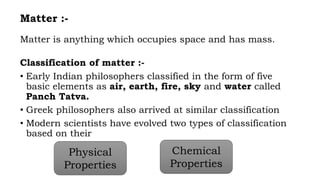
Matter :-
Matter is anything which occupies space and has mass.
Classification of matter :-
• Early Indian philosophers classified in the form of five
basic elements as air, earth, fire, sky and water called
Panch Tatva.
• Greek philosophers also arrived at similar classification
• Modern scientists have evolved two types of classification
based on their
Physical
Properties
Chemical
Properties
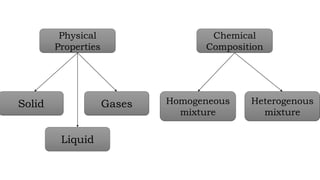
Physical
Properties
Solid Gases Homogeneous
mixture
Heterogenous
mixture
Chemical
Composition
Liquid
Physical State of matter:-
Chemical Composition of
matter:-
Physical Nature of Matter:-
1. Matter is made up of particles.
2. The particles of matter are very tiny.
3. The particles of matter have space between them.
4. The particles of matter are continuously moving.
5. The particles of matter attract each other
1. Matter is made up particles :-
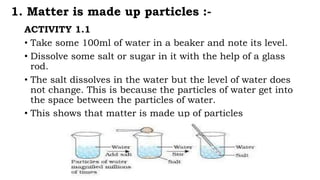
ACTIVITY 1.1
• Take some 100ml of water in a beaker and note its level.
• Dissolve some salt or sugar in it with the help of a glass
rod.
• The salt dissolves in the water but the level of water does
not change. This is because the particles of water get into
the space between the particles of water.
• This shows that matter is made up of particles
2. The particles of matter are very tiny.
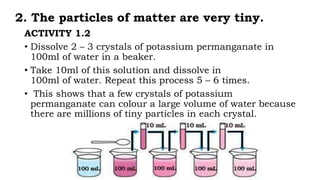
ACTIVITY 1.2
• Dissolve 2 – 3 crystals of potassium permanganate in
100ml of water in a beaker.
• Take 10ml of this solution and dissolve in
100ml of water. Repeat this process 5 – 6 times.
• This shows that a few crystals of potassium
permanganate can colour a large volume of water because
there are millions of tiny particles in each crystal.
3. Particles of Matter Have Space Between
Them:-
• In activities 1.1 and 1.2 we saw that particles of
sugar, salt, or potassium permanganate got evenly
distributed in water.
• Similarly, when we make tea, coffee or lemonade
particles of one type of matter get into the spaces
between particles
of the other.
• This shows that there is enough space between
particles of matter
4. The particles of matter are continuously moving.
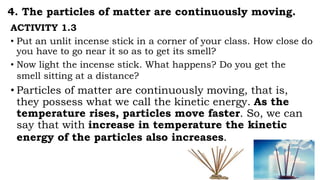
ACTIVITY 1.3
• Put an unlit incense stick in a corner of your class. How close do
you have to go near it so as to get its smell?
• Now light the incense stick. What happens? Do you get the
smell sitting at a distance?
• Particles of matter are continuously moving, that is,
they possess what we call the kinetic energy. As the
temperature rises, particles move faster. So, we can
say that with increase in temperature the kinetic
energy of the particles also increases.
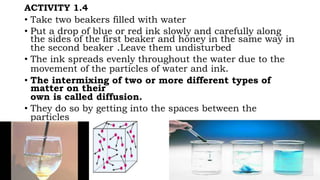
ACTIVITY 1.4
• Take two beakers filled with water
• Put a drop of blue or red ink slowly and carefully along
the sides of the first beaker and honey in the same way in
the second beaker .Leave them undisturbed
• The ink spreads evenly throughout the water due to the
movement of the particles of water and ink.
• The intermixing of two or more different types of
matter on their
own is called diffusion.
• They do so by getting into the spaces between the
particles
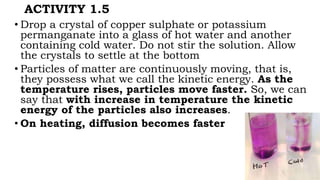
ACTIVITY 1.5
• Drop a crystal of copper sulphate or potassium
permanganate into a glass of hot water and another
containing cold water. Do not stir the solution. Allow
the crystals to settle at the bottom
• Particles of matter are continuously moving, that is,
they possess what we call the kinetic energy. As the
temperature rises, particles move faster. So, we can
say that with increase in temperature the kinetic
energy of the particles also increases.
• On heating, diffusion becomes faster
5. The particles of matter attract each other
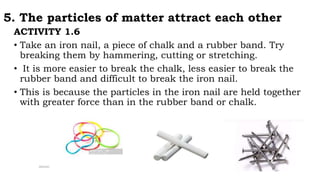
ACTIVITY 1.6
• Take an iron nail, a piece of chalk and a rubber band. Try
breaking them by hammering, cutting or stretching.
• It is more easier to break the chalk, less easier to break the
rubber band and difficult to break the iron nail.
• This is because the particles in the iron nail are held together
with greater force than in the rubber band or chalk.
ACTIVITY 1.8
• Take some water in a container, try cutting the surface of
water with your fingers.
• Were you able to cut the surface of
water?
• Particles of matter have force acting between them. This force
keeps the particles together. The strength of this force of
attraction varies from one kind of matter to another.
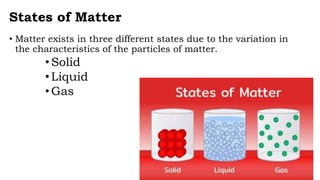
States of Matter
• Matter exists in three different states due to the variation in
the characteristics of the particles of matter.
•Solid
•Liquid
•Gas
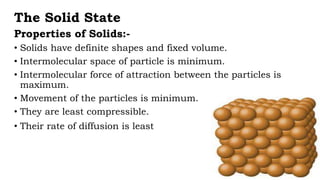
The Solid State
Properties of Solids:-
• Solids have definite shapes and fixed volume.
• Intermolecular space of particle is minimum.
• Intermolecular force of attraction between the particles is
maximum.
• Movement of the particles is minimum.
• They are least compressible.
• Their rate of diffusion is least
Activity 1.9
1. Take a pen, a book, a needle and a piece of wooden
stick
• Sketch the shape of above stuffs
• All the given articles have DEFINITE SHAPE, DISTINCT
BOUNDARIES and a FIXED VOLUME
2. Observe what happens if they are hammered, pulled or
dropped
• They have NEGLIGIBLE COMPRESSIBILITY and
LEAST DIFFUSION
• Solids have a tendency to maintain their shape when
subjected to outside force.
• Solids may break under force but it is difficult to change
their shape, so they are rigid
1. Consider Rubber .Can it change their shape on stretching
A rubber band changes shape under force and regains the same
shape when the force is removed. If excessive force is applied, it
breaks.
2. Consider Sugar & Salt. When kept in different jars these take the
shape of the jar. Are they solid?
The shape of each individual sugar or salt crystal remains fixed,
whether we take it in our hand, put it in a plate or in a jar.
3. What about a sponge? It is a solid yet we are able to compress it. Why?
A sponge has minute holes, in which air is trapped, when we press it,
the air is expelled out and we are able to compress it.
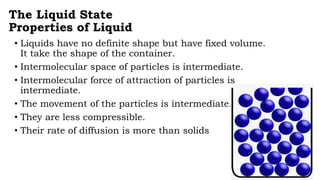
The Liquid State
Properties of Liquid
• Liquids have no definite shape but have fixed volume.
It take the shape of the container.
• Intermolecular space of particles is intermediate.
• Intermolecular force of attraction of particles is
intermediate.
• The movement of the particles is intermediate.
• They are less compressible.
• Their rate of diffusion is more than solids
ACTIVITY 1.10
• Collect the following: Water, Cooking Oil, Milk, Juice & a Cold drink
• Take containers of different shape & mark 50ml on these containers
• Observe what happened when liquids spills on floor.
We observe THAT LIQUIDS HAVE NO FIXED SHAPE BUT HAVE A
FIXED VOLUME
• Measure 50 mL of any one liquid and transfer it into different
containers one by one. Observe the volume and shape of the liquid
when you pour from one container to other.
We observe that liquids HAVE NO FIXED SHAPE BUT HAVE A
FIXED VOLUME. THEY TAKE UP THE SHAPE OF THE
CONTAINER in which they are kept. LIQUIDS FLOW AND
CHANGE SHAPE, so they are not rigid but can be called fluid.
Diffusion Of Liquids
• Solids and liquids can diffuse into liquids.
• The gases from the atmosphere diffuse and dissolve in water.
• These gases, especially oxygen and carbon dioxide, are essential
for the survival of aquatic animals and plants. All living
creatures need to breathe for survival. The aquatic animals can
breathe
under water due to the presence of dissolved oxygen in water.
• Thus, we may conclude that solids, liquids and gases can
diffuse into liquids.
• RATE OF DIFFUSION OF LIQUIDS IS HIGHER THAN THAT OF
SOLIDS. This is due to the fact that in the liquid state, particles
move freely and have greater space between each other as compared
to particles in the solid state
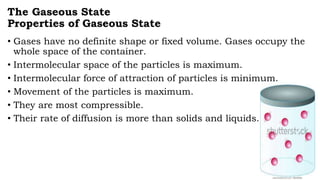
The Gaseous State
Properties of Gaseous State
• Gases have no definite shape or fixed volume. Gases occupy the
whole space of the container.
• Intermolecular space of the particles is maximum.
• Intermolecular force of attraction of particles is minimum.
• Movement of the particles is maximum.
• They are most compressible.
• Their rate of diffusion is more than solids and liquids.
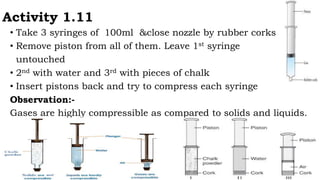
Activity 1.11
• Take 3 syringes of 100ml &close nozzle by rubber corks
• Remove piston from all of them. Leave 1st syringe
untouched
• 2nd with water and 3rd with pieces of chalk
• Insert pistons back and try to compress each syringe
Observation:-
Gases are highly compressible as compared to solids and liquids.
Compressed Gas
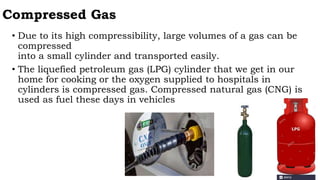
• Due to its high compressibility, large volumes of a gas can be
compressed
into a small cylinder and transported easily.
• The liquefied petroleum gas (LPG) cylinder that we get in our
home for cooking or the oxygen supplied to hospitals in
cylinders is compressed gas. Compressed natural gas (CNG) is
used as fuel these days in vehicles
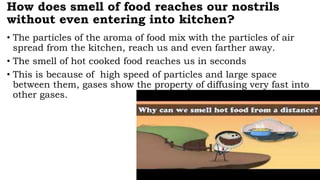
How does smell of food reaches our nostrils
without even entering into kitchen?
• The particles of the aroma of food mix with the particles of air
spread from the kitchen, reach us and even farther away.
• The smell of hot cooked food reaches us in seconds
• This is because of high speed of particles and large space
between them, gases show the property of diffusing very fast into
other gases.
Motion of Gaseous particles
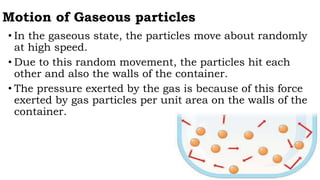
• In the gaseous state, the particles move about randomly
at high speed.
• Due to this random movement, the particles hit each
other and also the walls of the container.
• The pressure exerted by the gas is because of this force
exerted by gas particles per unit area on the walls of the
container.
Change of State
Change of substance from one physical state to another is called
Change of state
It occurs during heating or cooling of substance
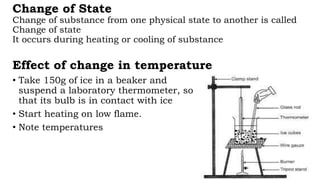
Effect of change in temperature
• Take 150g of ice in a beaker and
suspend a laboratory thermometer, so
that its bulb is in contact with ice
• Start heating on low flame.
• Note temperatures
Observation
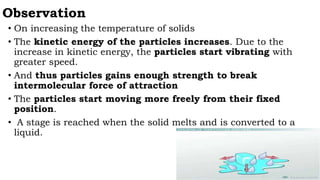
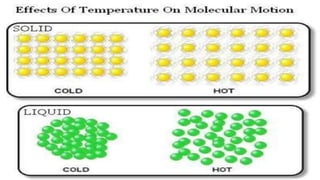
• On increasing the temperature of solids
• The kinetic energy of the particles increases. Due to the
increase in kinetic energy, the particles start vibrating with
greater speed.
• And thus particles gains enough strength to break
intermolecular force of attraction
• The particles start moving more freely from their fixed
position.
• A stage is reached when the solid melts and is converted to a
liquid.
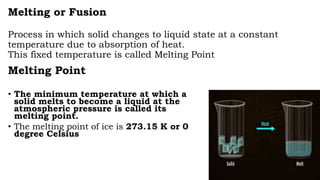
Melting or Fusion
Process in which solid changes to liquid state at a constant
temperature due to absorption of heat.
This fixed temperature is called Melting Point
Melting Point
• The minimum temperature at which a
solid melts to become a liquid at the
atmospheric pressure is called its
melting point.
• The melting point of ice is 273.15 K or 0
degree Celsius
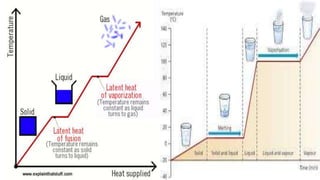
When a solid melts, its temperature remains the
same, so where does the heat energy go?
• During the experiment of melting, that the temperature of the
system does not change after the melting point is reached, till all the
ice melt
• Even though we continue to supply heat.
• This heat energy is absorbed by ice without showing rise in
temperature
• This heat gets used up in breaking the force of attraction
between particles.
• It is considered that it gets hidden into the contents of the beaker
and is known as the latent heat
• Latent means hidden
Latent Heat of Fusion.
The amount of heat energy that is required to change 1 kg
of a solid into liquid at atmospheric pressure at its melting
point is known as the latent heat of fusion.
• So, particles in water at 0degree C (273 K) have more energy as
compared to particles in ice at the same temperature.
Kelvin Scale
• Kelvin is the SI unit of temperature, 0 degree C =273.15 K.
• For convenience, we take 0 degree C = 273 K after rounding
off the decimal.
• To change a temperature on the Kelvin scale to the Celsius
scale you have to subtract 273 from the given temperature
• To convert a temperature on the Celsius scale to the Kelvin
scale you have to add 273 to the given temperature.
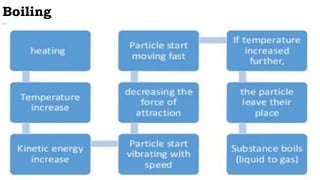
Boiling
Boiling Point
• Now supply heat energy to water
• Particles start moving even faster.
• At a certain temperature, a point is reached when the particles
have enough energy to break the forces of attraction.
• At this temperature the liquid starts changing into gas.
• The temperature at which a liquid starts boiling at the
atmospheric pressure is known as its boiling point.
• Boiling is a bulk phenomenon. Particles from the bulk of the
liquid gain enough energy to change into the vapour state.
• For water this temperature is 373 K (100 degree C = 273 + 100
= 373 K).
Latent Heat of Vaporisation
• Amount of heat required to convert 1 kilogram of the
liquid to vapour or gas at its boiling point , without any
change in temperature.
• Water vapour at 373 K (100 degree C) have more energy
than water at the same temperature.
• This is because particles in steam have absorbed extra
energy in the form of latent heat of vaporisation
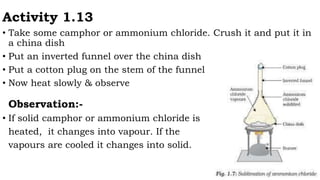
Activity 1.13
• Take some camphor or ammonium chloride. Crush it and put it in
a china dish
• Put an inverted funnel over the china dish
• Put a cotton plug on the stem of the funnel
• Now heat slowly & observe
Observation:-
• If solid camphor or ammonium chloride is
heated, it changes into vapour. If the
vapours are cooled it changes into solid.
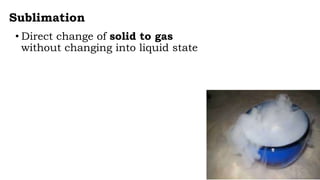
Sublimation
• Direct change of solid to gas
without changing into liquid state
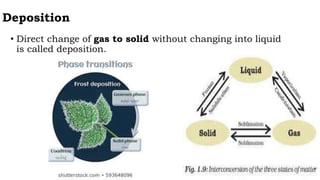
Deposition
• Direct change of gas to solid without changing into liquid
is called deposition.
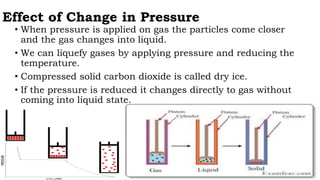
Effect of Change in Pressure
• When pressure is applied on gas the particles come closer
and the gas changes into liquid.
• We can liquefy gases by applying pressure and reducing the
temperature.
• Compressed solid carbon dioxide is called dry ice.
• If the pressure is reduced it changes directly to gas without
coming into liquid state.
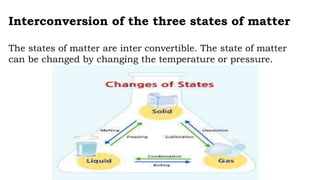
Interconversion of the three states of matter
The states of matter are inter convertible. The state of matter
can be changed by changing the temperature or pressure.
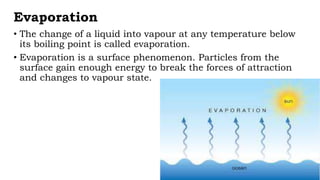
Evaporation
• The change of a liquid into vapour at any temperature below
its boiling point is called evaporation.
• Evaporation is a surface phenomenon. Particles from the
surface gain enough energy to break the forces of attraction
and changes to vapour state.
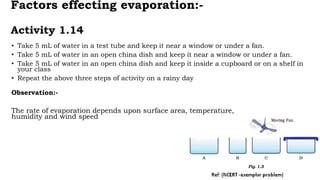
Factors effecting evaporation:-
Activity 1.14
• Take 5 mL of water in a test tube and keep it near a window or under a fan.
• Take 5 mL of water in an open china dish and keep it near a window or under a fan.
• Take 5 mL of water in an open china dish and keep it inside a cupboard or on a shelf in
your class
• Repeat the above three steps of activity on a rainy day
Observation:-
The rate of evaporation depends upon surface area, temperature,
humidity and wind speed
Factors affecting evaporation :-
The rate of evaporation depends upon surface area,
temperature, humidity and wind speed.
1. Increase in the surface area increases the rate of evaporation.
2. Increase in temperature increases the rate of evaporation.
3. Increase in humidity decreases the rate of evaporation.
4. Increase in wind speed increases the rate of evaporation
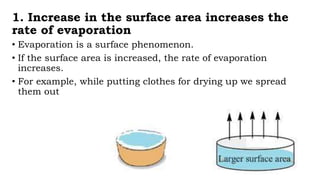
1. Increase in the surface area increases the
rate of evaporation
• Evaporation is a surface phenomenon.
• If the surface area is increased, the rate of evaporation
increases.
• For example, while putting clothes for drying up we spread
them out
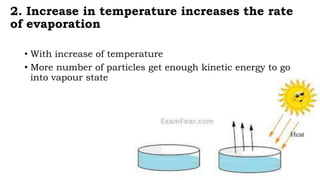
2. Increase in temperature increases the rate
of evaporation
• With increase of temperature
• More number of particles get enough kinetic energy to go
into vapour state
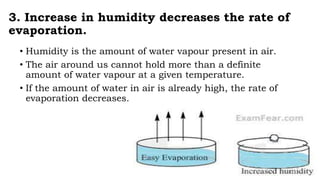
3. Increase in humidity decreases the rate of
evaporation.
• Humidity is the amount of water vapour present in air.
• The air around us cannot hold more than a definite
amount of water vapour at a given temperature.
• If the amount of water in air is already high, the rate of
evaporation decreases.
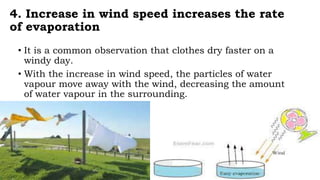
4. Increase in wind speed increases the rate
of evaporation
• It is a common observation that clothes dry faster on a
windy day.
• With the increase in wind speed, the particles of water
vapour move away with the wind, decreasing the amount
of water vapour in the surrounding.
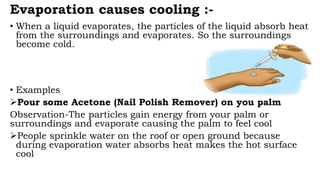
Evaporation causes cooling :-
• When a liquid evaporates, the particles of the liquid absorb heat
from the surroundings and evaporates. So the surroundings
become cold.
• Examples
Pour some Acetone (Nail Polish Remover) on you palm
Observation-The particles gain energy from your palm or
surroundings and evaporate causing the palm to feel cool
People sprinkle water on the roof or open ground because
during evaporation water absorbs heat makes the hot surface
cool
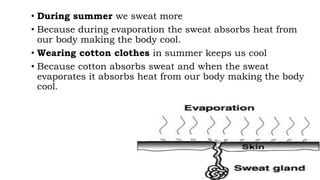
• During summer we sweat more
• Because during evaporation the sweat absorbs heat from
our body making the body cool.
• Wearing cotton clothes in summer keeps us cool
• Because cotton absorbs sweat and when the sweat
evaporates it absorbs heat from our body making the body
cool.
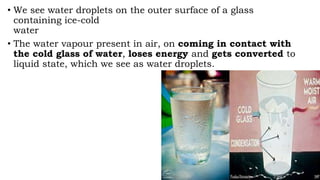
• We see water droplets on the outer surface of a glass
containing ice-cold
water
• The water vapour present in air, on coming in contact with
the cold glass of water, loses energy and gets converted to
liquid state, which we see as water droplets.

Matter in our Surroundings || Class 9 || NCERT

  • 1.
    MATTER IN OUR SURROUNDINGS Chapter1 Presented by Agna Yashin
  • 2.
    Matter :- Matter isanything which occupies space and has mass. Classification of matter :- • Early Indian philosophers classified in the form of five basic elements as air, earth, fire, sky and water called Panch Tatva. • Greek philosophers also arrived at similar classification • Modern scientists have evolved two types of classification based on their Physical Properties Chemical Properties
  • 3.
  • 5.
    Physical State ofmatter:- Chemical Composition of matter:-
  • 6.
    Physical Nature ofMatter:- 1. Matter is made up of particles. 2. The particles of matter are very tiny. 3. The particles of matter have space between them. 4. The particles of matter are continuously moving. 5. The particles of matter attract each other
  • 7.
    1. Matter ismade up particles :- ACTIVITY 1.1 • Take some 100ml of water in a beaker and note its level. • Dissolve some salt or sugar in it with the help of a glass rod. • The salt dissolves in the water but the level of water does not change. This is because the particles of water get into the space between the particles of water. • This shows that matter is made up of particles
  • 8.
    2. The particlesof matter are very tiny. ACTIVITY 1.2 • Dissolve 2 – 3 crystals of potassium permanganate in 100ml of water in a beaker. • Take 10ml of this solution and dissolve in 100ml of water. Repeat this process 5 – 6 times. • This shows that a few crystals of potassium permanganate can colour a large volume of water because there are millions of tiny particles in each crystal.
  • 9.
    3. Particles ofMatter Have Space Between Them:- • In activities 1.1 and 1.2 we saw that particles of sugar, salt, or potassium permanganate got evenly distributed in water. • Similarly, when we make tea, coffee or lemonade particles of one type of matter get into the spaces between particles of the other. • This shows that there is enough space between particles of matter
  • 10.
    4. The particlesof matter are continuously moving. ACTIVITY 1.3 • Put an unlit incense stick in a corner of your class. How close do you have to go near it so as to get its smell? • Now light the incense stick. What happens? Do you get the smell sitting at a distance? • Particles of matter are continuously moving, that is, they possess what we call the kinetic energy. As the temperature rises, particles move faster. So, we can say that with increase in temperature the kinetic energy of the particles also increases.
  • 11.
    ACTIVITY 1.4 • Taketwo beakers filled with water • Put a drop of blue or red ink slowly and carefully along the sides of the first beaker and honey in the same way in the second beaker .Leave them undisturbed • The ink spreads evenly throughout the water due to the movement of the particles of water and ink. • The intermixing of two or more different types of matter on their own is called diffusion. • They do so by getting into the spaces between the particles
  • 12.
    ACTIVITY 1.5 • Dropa crystal of copper sulphate or potassium permanganate into a glass of hot water and another containing cold water. Do not stir the solution. Allow the crystals to settle at the bottom • Particles of matter are continuously moving, that is, they possess what we call the kinetic energy. As the temperature rises, particles move faster. So, we can say that with increase in temperature the kinetic energy of the particles also increases. • On heating, diffusion becomes faster
  • 13.
    5. The particlesof matter attract each other ACTIVITY 1.6 • Take an iron nail, a piece of chalk and a rubber band. Try breaking them by hammering, cutting or stretching. • It is more easier to break the chalk, less easier to break the rubber band and difficult to break the iron nail. • This is because the particles in the iron nail are held together with greater force than in the rubber band or chalk.
  • 14.
    ACTIVITY 1.8 • Takesome water in a container, try cutting the surface of water with your fingers. • Were you able to cut the surface of water? • Particles of matter have force acting between them. This force keeps the particles together. The strength of this force of attraction varies from one kind of matter to another.
  • 15.
    States of Matter •Matter exists in three different states due to the variation in the characteristics of the particles of matter. •Solid •Liquid •Gas
  • 16.
    The Solid State Propertiesof Solids:- • Solids have definite shapes and fixed volume. • Intermolecular space of particle is minimum. • Intermolecular force of attraction between the particles is maximum. • Movement of the particles is minimum. • They are least compressible. • Their rate of diffusion is least
  • 17.
    Activity 1.9 1. Takea pen, a book, a needle and a piece of wooden stick • Sketch the shape of above stuffs • All the given articles have DEFINITE SHAPE, DISTINCT BOUNDARIES and a FIXED VOLUME 2. Observe what happens if they are hammered, pulled or dropped • They have NEGLIGIBLE COMPRESSIBILITY and LEAST DIFFUSION • Solids have a tendency to maintain their shape when subjected to outside force. • Solids may break under force but it is difficult to change their shape, so they are rigid
  • 18.
    1. Consider Rubber.Can it change their shape on stretching A rubber band changes shape under force and regains the same shape when the force is removed. If excessive force is applied, it breaks. 2. Consider Sugar & Salt. When kept in different jars these take the shape of the jar. Are they solid? The shape of each individual sugar or salt crystal remains fixed, whether we take it in our hand, put it in a plate or in a jar. 3. What about a sponge? It is a solid yet we are able to compress it. Why? A sponge has minute holes, in which air is trapped, when we press it, the air is expelled out and we are able to compress it.
  • 19.
    The Liquid State Propertiesof Liquid • Liquids have no definite shape but have fixed volume. It take the shape of the container. • Intermolecular space of particles is intermediate. • Intermolecular force of attraction of particles is intermediate. • The movement of the particles is intermediate. • They are less compressible. • Their rate of diffusion is more than solids
  • 20.
    ACTIVITY 1.10 • Collectthe following: Water, Cooking Oil, Milk, Juice & a Cold drink • Take containers of different shape & mark 50ml on these containers • Observe what happened when liquids spills on floor. We observe THAT LIQUIDS HAVE NO FIXED SHAPE BUT HAVE A FIXED VOLUME • Measure 50 mL of any one liquid and transfer it into different containers one by one. Observe the volume and shape of the liquid when you pour from one container to other. We observe that liquids HAVE NO FIXED SHAPE BUT HAVE A FIXED VOLUME. THEY TAKE UP THE SHAPE OF THE CONTAINER in which they are kept. LIQUIDS FLOW AND CHANGE SHAPE, so they are not rigid but can be called fluid.
  • 21.
    Diffusion Of Liquids •Solids and liquids can diffuse into liquids. • The gases from the atmosphere diffuse and dissolve in water. • These gases, especially oxygen and carbon dioxide, are essential for the survival of aquatic animals and plants. All living creatures need to breathe for survival. The aquatic animals can breathe under water due to the presence of dissolved oxygen in water. • Thus, we may conclude that solids, liquids and gases can diffuse into liquids. • RATE OF DIFFUSION OF LIQUIDS IS HIGHER THAN THAT OF SOLIDS. This is due to the fact that in the liquid state, particles move freely and have greater space between each other as compared to particles in the solid state
  • 22.
    The Gaseous State Propertiesof Gaseous State • Gases have no definite shape or fixed volume. Gases occupy the whole space of the container. • Intermolecular space of the particles is maximum. • Intermolecular force of attraction of particles is minimum. • Movement of the particles is maximum. • They are most compressible. • Their rate of diffusion is more than solids and liquids.
  • 23.
    Activity 1.11 • Take3 syringes of 100ml &close nozzle by rubber corks • Remove piston from all of them. Leave 1st syringe untouched • 2nd with water and 3rd with pieces of chalk • Insert pistons back and try to compress each syringe Observation:- Gases are highly compressible as compared to solids and liquids.
  • 24.
    Compressed Gas • Dueto its high compressibility, large volumes of a gas can be compressed into a small cylinder and transported easily. • The liquefied petroleum gas (LPG) cylinder that we get in our home for cooking or the oxygen supplied to hospitals in cylinders is compressed gas. Compressed natural gas (CNG) is used as fuel these days in vehicles
  • 25.
    How does smellof food reaches our nostrils without even entering into kitchen? • The particles of the aroma of food mix with the particles of air spread from the kitchen, reach us and even farther away. • The smell of hot cooked food reaches us in seconds • This is because of high speed of particles and large space between them, gases show the property of diffusing very fast into other gases.
  • 26.
    Motion of Gaseousparticles • In the gaseous state, the particles move about randomly at high speed. • Due to this random movement, the particles hit each other and also the walls of the container. • The pressure exerted by the gas is because of this force exerted by gas particles per unit area on the walls of the container.
  • 27.
    Change of State Changeof substance from one physical state to another is called Change of state It occurs during heating or cooling of substance Effect of change in temperature • Take 150g of ice in a beaker and suspend a laboratory thermometer, so that its bulb is in contact with ice • Start heating on low flame. • Note temperatures
  • 28.
    Observation • On increasingthe temperature of solids • The kinetic energy of the particles increases. Due to the increase in kinetic energy, the particles start vibrating with greater speed. • And thus particles gains enough strength to break intermolecular force of attraction • The particles start moving more freely from their fixed position. • A stage is reached when the solid melts and is converted to a liquid.
  • 30.
    Melting or Fusion Processin which solid changes to liquid state at a constant temperature due to absorption of heat. This fixed temperature is called Melting Point Melting Point • The minimum temperature at which a solid melts to become a liquid at the atmospheric pressure is called its melting point. • The melting point of ice is 273.15 K or 0 degree Celsius
  • 31.
    When a solidmelts, its temperature remains the same, so where does the heat energy go? • During the experiment of melting, that the temperature of the system does not change after the melting point is reached, till all the ice melt • Even though we continue to supply heat. • This heat energy is absorbed by ice without showing rise in temperature • This heat gets used up in breaking the force of attraction between particles. • It is considered that it gets hidden into the contents of the beaker and is known as the latent heat • Latent means hidden
  • 32.
    Latent Heat ofFusion. The amount of heat energy that is required to change 1 kg of a solid into liquid at atmospheric pressure at its melting point is known as the latent heat of fusion. • So, particles in water at 0degree C (273 K) have more energy as compared to particles in ice at the same temperature.
  • 33.
    Kelvin Scale • Kelvinis the SI unit of temperature, 0 degree C =273.15 K. • For convenience, we take 0 degree C = 273 K after rounding off the decimal. • To change a temperature on the Kelvin scale to the Celsius scale you have to subtract 273 from the given temperature • To convert a temperature on the Celsius scale to the Kelvin scale you have to add 273 to the given temperature.
  • 34.
  • 35.
    Boiling Point • Nowsupply heat energy to water • Particles start moving even faster. • At a certain temperature, a point is reached when the particles have enough energy to break the forces of attraction. • At this temperature the liquid starts changing into gas. • The temperature at which a liquid starts boiling at the atmospheric pressure is known as its boiling point. • Boiling is a bulk phenomenon. Particles from the bulk of the liquid gain enough energy to change into the vapour state. • For water this temperature is 373 K (100 degree C = 273 + 100 = 373 K).
  • 36.
    Latent Heat ofVaporisation • Amount of heat required to convert 1 kilogram of the liquid to vapour or gas at its boiling point , without any change in temperature. • Water vapour at 373 K (100 degree C) have more energy than water at the same temperature. • This is because particles in steam have absorbed extra energy in the form of latent heat of vaporisation
  • 39.
    Activity 1.13 • Takesome camphor or ammonium chloride. Crush it and put it in a china dish • Put an inverted funnel over the china dish • Put a cotton plug on the stem of the funnel • Now heat slowly & observe Observation:- • If solid camphor or ammonium chloride is heated, it changes into vapour. If the vapours are cooled it changes into solid.
  • 40.
    Sublimation • Direct changeof solid to gas without changing into liquid state
  • 41.
    Deposition • Direct changeof gas to solid without changing into liquid is called deposition.
  • 42.
    Effect of Changein Pressure • When pressure is applied on gas the particles come closer and the gas changes into liquid. • We can liquefy gases by applying pressure and reducing the temperature. • Compressed solid carbon dioxide is called dry ice. • If the pressure is reduced it changes directly to gas without coming into liquid state.
  • 43.
    Interconversion of thethree states of matter The states of matter are inter convertible. The state of matter can be changed by changing the temperature or pressure.
  • 44.
    Evaporation • The changeof a liquid into vapour at any temperature below its boiling point is called evaporation. • Evaporation is a surface phenomenon. Particles from the surface gain enough energy to break the forces of attraction and changes to vapour state.
  • 45.
    Factors effecting evaporation:- Activity1.14 • Take 5 mL of water in a test tube and keep it near a window or under a fan. • Take 5 mL of water in an open china dish and keep it near a window or under a fan. • Take 5 mL of water in an open china dish and keep it inside a cupboard or on a shelf in your class • Repeat the above three steps of activity on a rainy day Observation:- The rate of evaporation depends upon surface area, temperature, humidity and wind speed
  • 46.
    Factors affecting evaporation:- The rate of evaporation depends upon surface area, temperature, humidity and wind speed. 1. Increase in the surface area increases the rate of evaporation. 2. Increase in temperature increases the rate of evaporation. 3. Increase in humidity decreases the rate of evaporation. 4. Increase in wind speed increases the rate of evaporation
  • 47.
    1. Increase inthe surface area increases the rate of evaporation • Evaporation is a surface phenomenon. • If the surface area is increased, the rate of evaporation increases. • For example, while putting clothes for drying up we spread them out
  • 48.
    2. Increase intemperature increases the rate of evaporation • With increase of temperature • More number of particles get enough kinetic energy to go into vapour state
  • 49.
    3. Increase inhumidity decreases the rate of evaporation. • Humidity is the amount of water vapour present in air. • The air around us cannot hold more than a definite amount of water vapour at a given temperature. • If the amount of water in air is already high, the rate of evaporation decreases.
  • 50.
    4. Increase inwind speed increases the rate of evaporation • It is a common observation that clothes dry faster on a windy day. • With the increase in wind speed, the particles of water vapour move away with the wind, decreasing the amount of water vapour in the surrounding.
  • 51.
    Evaporation causes cooling:- • When a liquid evaporates, the particles of the liquid absorb heat from the surroundings and evaporates. So the surroundings become cold. • Examples Pour some Acetone (Nail Polish Remover) on you palm Observation-The particles gain energy from your palm or surroundings and evaporate causing the palm to feel cool People sprinkle water on the roof or open ground because during evaporation water absorbs heat makes the hot surface cool
  • 52.
    • During summerwe sweat more • Because during evaporation the sweat absorbs heat from our body making the body cool. • Wearing cotton clothes in summer keeps us cool • Because cotton absorbs sweat and when the sweat evaporates it absorbs heat from our body making the body cool.
  • 53.
    • We seewater droplets on the outer surface of a glass containing ice-cold water • The water vapour present in air, on coming in contact with the cold glass of water, loses energy and gets converted to liquid state, which we see as water droplets.