Auteur
The Story Tellers of Film
LESSON OBJECTIVE: TO UNDERSTAND
AUTEUR THEORY (AND HOW IT MIGHT
APPLY TO MY COURSEWORK)
We are looking at this before we move on to study of early talkies and
the Hollywood studio system as this weaves through the different
times.
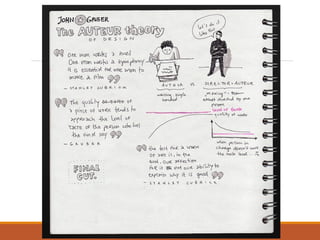
Auteur Theory
“auteur” – author (French)
Theory advances that film reflects the director’s personal creative vision
Director’s creative touch as distinct from the collective and industrial
process of filmmaking
Director outshines the studio interference
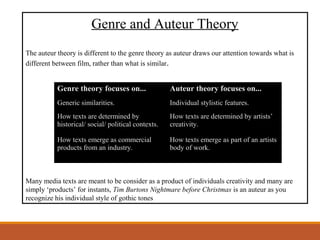
Genre and Auteur Theory
The auteur theory is different to the genre theory as auteur draws our attention towards what is
different between film, rather than what is similar.
Many media texts are meant to be consider as a product of individuals creativity and many are
simply ‘products’ for instants, Tim Burtons Nightmare before Christmas is an auteur as you
recognize his individual style of gothic tones
Genre theory focuses on... Auteur theory focuses on...
Generic similarities. Individual stylistic features.
How texts are determined by
historical/ social/ political contexts.
How texts are determined by artists’
creativity.
How texts emerge as commercial
products from an industry.
How texts emerge as part of an artists
body of work.
Legal Implication
Film as a work of art
The auteur, the creator of the film, is the original copyright holder
(under the European Union law).
The director is the author or one of the authors of a film (largely
because of the auteur theory).
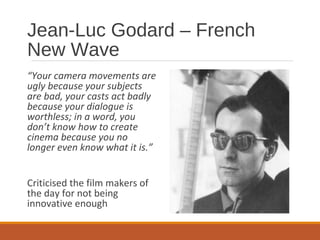
Jean-Luc Godard – French
New Wave
“Your camera movements are
ugly because your subjects
are bad, your casts act badly
because your dialogue is
worthless; in a word, you
don’t know how to create
cinema because you no
longer even know what it is.”
Criticised the film makers of
the day for not being
innovative enough
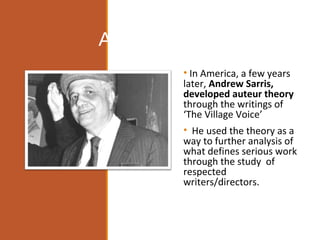
Andrew Sarris
• In America, a few years
later, Andrew Sarris,
developed auteur theory
through the writings of
‘The Village Voice’
• He used the theory as a
way to further analysis of
what defines serious work
through the study of
respected
writers/directors.
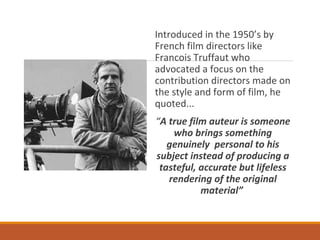
Introduced in the 1950’s by
French film directors like
Francois Truffaut who
advocated a focus on the
contribution directors made on
the style and form of film, he
quoted...
“A true film auteur is someone
who brings something
genuinely personal to his
subject instead of producing a
tasteful, accurate but lifeless
rendering of the original
material”
The Birth of the Auteur
◦ Started as myth of “individual creator”
◦ Grew from political and economic issues between U.S. and France after
WWII
◦ Popularity of US films threatened the viability of the country’s own cinema
◦ New Wave of filmmakers: Francois Truffaut, Jean-Luc Godard, Jacques
Rivette, Eric Rohmer and Claude Chabrol
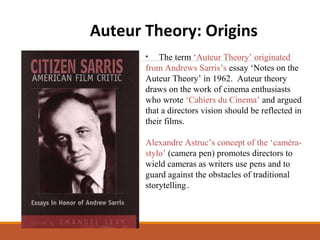
Auteur Theory: Origins
• The term ‘Auteur Theory’ originated
from Andrews Sarris’s essay ‘Notes on the
Auteur Theory’ in 1962. Auteur theory
draws on the work of cinema enthusiasts
who wrote ‘Cahiers du Cinema’ and argued
that a directors vision should be reflected in
their films.
Alexandre Astruc’s concept of the ‘caméra-
stylo’ (camera pen) promotes directors to
wield cameras as writers use pens and to
guard against the obstacles of traditional
storytelling.
French Filmmakers
American directors were placed as model
filmmakers in France.
The French discovered the “personal style” of the
American directors.
Despite the anonymity and mass production of
Hollywood studio system: personal style emerged.
Continuity discovered across a group of films: style
of the director
Auteur Theory
Principles of Stylistic
Continuity
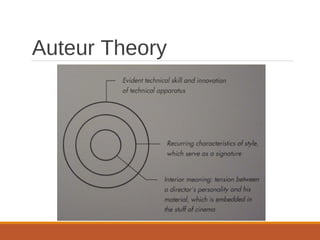
Studied extensively by film critic Andrew Sarris
Based on the given: the director as the controlling force in the structure
of the film
(a) Technical competence
(b) Coherent personal style
(c) consistent view of the world/ a coherent set of attitudes and ideas
Stylistic Continuity
• Truffaut expressed that directors should use the mise-en-
scène to imprint their vision on their work.
• Andre Bazin and Roger Leenhardt also expressed that the
director brings the film to life and uses it to express their
feelings on the subject matter.
• An auteur can also use lighting, setting, staging, and editing
to add to their vision.
• According to Andrew Sarris in his ‘Notes on the Auteur
Theory’, a director must accomplish technical competence in
their technique, personal style in terms of how the movie
looks and feels, and interior meaning.
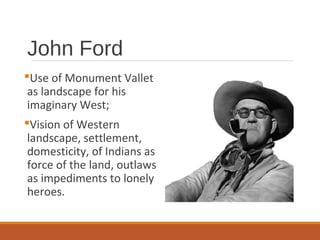
John Ford
Use of Monument Vallet
as landscape for his
imaginary West;
Vision of Western
landscape, settlement,
domesticity, of Indians as
force of the land, outlaws
as impediments to lonely
heroes.
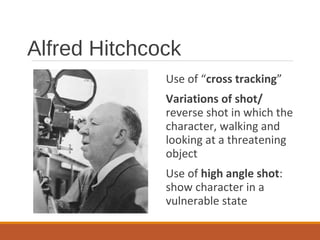
Alfred Hitchcock
Use of “cross tracking”
Variations of shot/
reverse shot in which the
character, walking and
looking at a threatening
object
Use of high angle shot:
show character in a
vulnerable state
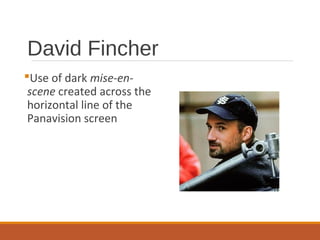
David Fincher
Use of dark mise-en-
scene created across the
horizontal line of the
Panavision screen
Ingmar Bergman
Intense close-ups of a
character in a profound
state of existential
despair
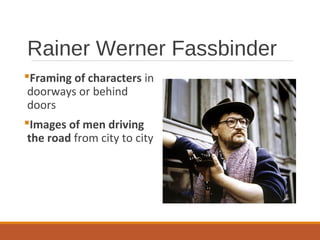
Rainer Werner Fassbinder
Framing of characters in
doorways or behind
doors
Images of men driving
the road from city to city
Auteurism
Central point: identification of the director’s
stylistic traits, view of people in the world, ideas
about politics, history, social order, psychology,
sexuality and power
The director’s structure of basic thematic and
stylistic traits
A kind of abstract pattern of ways of seeing and
understanding the world cinematically
Jean Renoir
“A director really makes just
one film in the course of his
career.”
Auteur Theory: made film
studies possible as an
academic discipline.
French discovered auteur
within the Hollywood
production.
It is a redemption of the
anonymity of the Hollywood.
Critique of Auteur Theory
•Starting in the 1960s film critics began to
criticise the auteur theory’s focus on the
authorial role of the director.
•One reason for this is the collaborative aspect of
film making.
• Aljean Harmetz argued that the auteur theory
“collapses against the reality of the studio
system”.
•The New Critics argued that speculation about
an author’s intention was secondary to the
words on the page as the basis of the experience
of reading literature.

Auteur theory

  • 1.
    Auteur The Story Tellersof Film LESSON OBJECTIVE: TO UNDERSTAND AUTEUR THEORY (AND HOW IT MIGHT APPLY TO MY COURSEWORK)
  • 2.
    We are lookingat this before we move on to study of early talkies and the Hollywood studio system as this weaves through the different times.
  • 3.
    Auteur Theory “auteur” –author (French) Theory advances that film reflects the director’s personal creative vision Director’s creative touch as distinct from the collective and industrial process of filmmaking Director outshines the studio interference
  • 4.
    Genre and AuteurTheory The auteur theory is different to the genre theory as auteur draws our attention towards what is different between film, rather than what is similar. Many media texts are meant to be consider as a product of individuals creativity and many are simply ‘products’ for instants, Tim Burtons Nightmare before Christmas is an auteur as you recognize his individual style of gothic tones Genre theory focuses on... Auteur theory focuses on... Generic similarities. Individual stylistic features. How texts are determined by historical/ social/ political contexts. How texts are determined by artists’ creativity. How texts emerge as commercial products from an industry. How texts emerge as part of an artists body of work.
  • 5.
    Legal Implication Film asa work of art The auteur, the creator of the film, is the original copyright holder (under the European Union law). The director is the author or one of the authors of a film (largely because of the auteur theory).
  • 6.
    Jean-Luc Godard –French New Wave “Your camera movements are ugly because your subjects are bad, your casts act badly because your dialogue is worthless; in a word, you don’t know how to create cinema because you no longer even know what it is.” Criticised the film makers of the day for not being innovative enough
  • 7.
    Andrew Sarris • InAmerica, a few years later, Andrew Sarris, developed auteur theory through the writings of ‘The Village Voice’ • He used the theory as a way to further analysis of what defines serious work through the study of respected writers/directors.
  • 8.
    Introduced in the1950’s by French film directors like Francois Truffaut who advocated a focus on the contribution directors made on the style and form of film, he quoted... “A true film auteur is someone who brings something genuinely personal to his subject instead of producing a tasteful, accurate but lifeless rendering of the original material”
  • 9.
    The Birth ofthe Auteur ◦ Started as myth of “individual creator” ◦ Grew from political and economic issues between U.S. and France after WWII ◦ Popularity of US films threatened the viability of the country’s own cinema ◦ New Wave of filmmakers: Francois Truffaut, Jean-Luc Godard, Jacques Rivette, Eric Rohmer and Claude Chabrol
  • 10.
    Auteur Theory: Origins •The term ‘Auteur Theory’ originated from Andrews Sarris’s essay ‘Notes on the Auteur Theory’ in 1962. Auteur theory draws on the work of cinema enthusiasts who wrote ‘Cahiers du Cinema’ and argued that a directors vision should be reflected in their films. Alexandre Astruc’s concept of the ‘caméra- stylo’ (camera pen) promotes directors to wield cameras as writers use pens and to guard against the obstacles of traditional storytelling.
  • 11.
    French Filmmakers American directorswere placed as model filmmakers in France. The French discovered the “personal style” of the American directors. Despite the anonymity and mass production of Hollywood studio system: personal style emerged. Continuity discovered across a group of films: style of the director
  • 13.
  • 14.
    Principles of Stylistic Continuity Studiedextensively by film critic Andrew Sarris Based on the given: the director as the controlling force in the structure of the film (a) Technical competence (b) Coherent personal style (c) consistent view of the world/ a coherent set of attitudes and ideas
  • 15.
    Stylistic Continuity • Truffautexpressed that directors should use the mise-en- scène to imprint their vision on their work. • Andre Bazin and Roger Leenhardt also expressed that the director brings the film to life and uses it to express their feelings on the subject matter. • An auteur can also use lighting, setting, staging, and editing to add to their vision. • According to Andrew Sarris in his ‘Notes on the Auteur Theory’, a director must accomplish technical competence in their technique, personal style in terms of how the movie looks and feels, and interior meaning.
  • 16.
    John Ford Use ofMonument Vallet as landscape for his imaginary West; Vision of Western landscape, settlement, domesticity, of Indians as force of the land, outlaws as impediments to lonely heroes.
  • 17.
    Alfred Hitchcock Use of“cross tracking” Variations of shot/ reverse shot in which the character, walking and looking at a threatening object Use of high angle shot: show character in a vulnerable state
  • 18.
    David Fincher Use ofdark mise-en- scene created across the horizontal line of the Panavision screen
  • 19.
    Ingmar Bergman Intense close-upsof a character in a profound state of existential despair
  • 20.
    Rainer Werner Fassbinder Framingof characters in doorways or behind doors Images of men driving the road from city to city
  • 21.
    Auteurism Central point: identificationof the director’s stylistic traits, view of people in the world, ideas about politics, history, social order, psychology, sexuality and power The director’s structure of basic thematic and stylistic traits A kind of abstract pattern of ways of seeing and understanding the world cinematically
  • 22.
    Jean Renoir “A directorreally makes just one film in the course of his career.” Auteur Theory: made film studies possible as an academic discipline. French discovered auteur within the Hollywood production. It is a redemption of the anonymity of the Hollywood.
  • 23.
    Critique of AuteurTheory •Starting in the 1960s film critics began to criticise the auteur theory’s focus on the authorial role of the director. •One reason for this is the collaborative aspect of film making. • Aljean Harmetz argued that the auteur theory “collapses against the reality of the studio system”. •The New Critics argued that speculation about an author’s intention was secondary to the words on the page as the basis of the experience of reading literature.