LEPTOSPIROSIS
Madeleine D. Soriño
 also known as Weil's syndrome, canicola
fever, canefield fever, nanukayami
fever, 7-day fever, Rat Catcher's
Yellows, Fort Bragg fever, black jaundice
and Pretibial fever
PATHOGEN
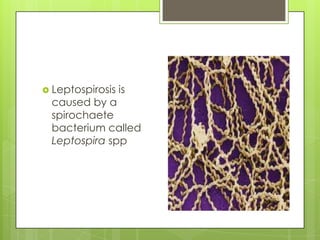
 Leptospirosis is
caused by a
spirochaete
bacterium called
Leptospira spp
SIGNS AND SYMPTOMS
 high fever
 severe headache
 Chills
 muscle aches
 Vomiting
 jaundice (yellow skin and eyes)
 red eyes
 abdominal pain
 Diarrhea
 rash
If the disease is not treated the patient could
develop:
 kidney damage
 meningitis (inflammation of the membrane
around the brain and spinal cord)
 liver failure
 respiratory distress
In rare cases death occurs.
 The incubation period (time of exposure
to first symptoms) in animals is anywhere
from 2 to 20 days.
MODE OF TRANSMISSION
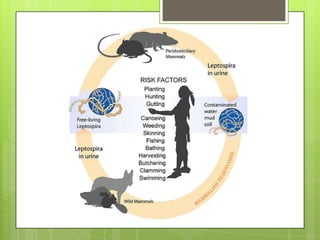
 Humans become infected through
contact with water, food, or soil
containing urine from infected animals.
 This may happen by swallowing
contaminated food or water or through
skin contact, especially with mucosal
surfaces, such as the eyes or nose, or with
broken skin.
Leptospira organisms have been found in
(also in their urine):
 Cattle
 Pigs
 horses
 Dogs
 Rodents
 and wild animals.
TREATMENT
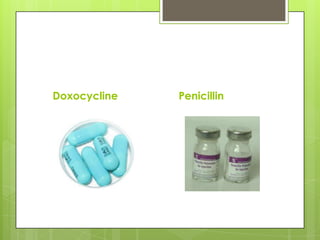
 antibiotics, such as doxycycline or
penicillin, which should be given early in
the course of the disease
 Intravenous antibiotics may be required
for persons with more severe symptoms.
Doxocycline Penicillin
Tests for Leptospirosis
 Complete Blood Count
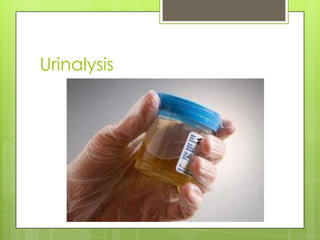
 Urinalysis
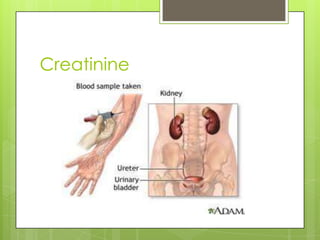
 Creatinine
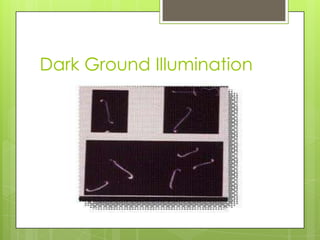
 Dark Ground Illumination
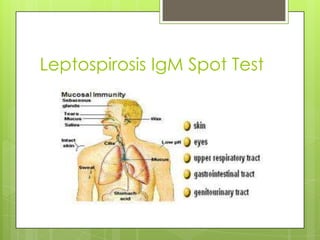
 Leptospirosis IgM Spot Test
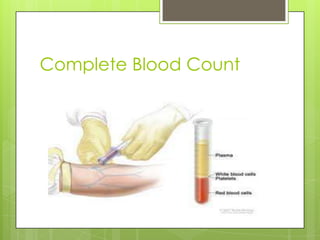
Complete Blood Count
Urinalysis
Creatinine
Dark Ground Illumination
Leptospirosis IgM Spot Test
PREVENTIVE MEASURES
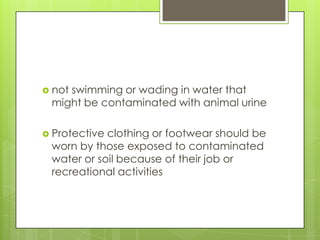
 not swimming or wading in water that
might be contaminated with animal urine
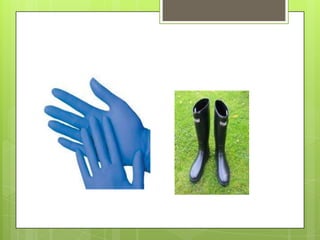
 Protective clothing or footwear should be
worn by those exposed to contaminated
water or soil because of their job or
recreational activities
Reference
 http://www.pathologylabindia.com/lepto
spirosis.htm
 http://en.wikipedia.org/wiki/Leptospirosis
END

Leptospirosis