•Leptospirosis is essentially animal infection
by several serotypes of Leptospira
(Spirocheates) and transmitted to man
under certain environmental conditions.
• The disease manifestations are many and
varied, ranging in severity from a mild febrile
illness to severe, and sometimes fatal
disease with liver and kidney involvement.
• Weils disease is one of the many
manifestations of human leptospirosis.
AGENT FACTORS
(a) AGENT :
Leptospira are thin and light motile spirocheates 0.1-0.2 μm wide
and 5-15 μm long with hooked ends. Only the strains of L.
interrogans are pathogenic. The organisms are visible by dark-field
illumination and silver staining.
(a) SOURCE OF INFECTION:
Leptospira are excreted in the urine of infected animals for a long
time, often for an entire life time in cases of rodents.
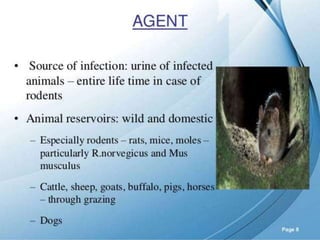
(c) ANIMAL RESERVOIRS :
Leptospirosis affects wild and domestic animals worldwide
especially rodents such as rats, mice and voles. Most domestic
animals including cattle, sheep, goats, water buffalo, pigs and
horses may be infected through grazing in areas contaminated by
the urine of the carrier host. Pet animals, particularly dogs may
also be infected.
Infection may spread from wild animals to domestic livestock, and
thence to humans. Rats and small rodents - particularly R.
norvegicus and Mus musculus are the most important reservoirs.
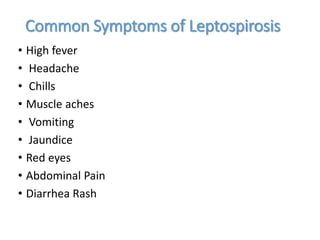
Common Symptoms of Leptospirosis
• High fever
• Headache
• Chills
• Muscle aches
• Vomiting
• Jaundice
• Red eyes
• Abdominal Pain
• Diarrhea Rash
Diagnosis
• Early in the disease, the organism may be identified by
dark-field examination of the patient's blood or by
culture on a semisolid medium. Culture takes 1-6 weeks
to become positive. The organism may also be grown
from the urine from 10th day to 6 weeks.
• Agglutination tests (microscopic using live organism, and
macroscopic using killed antigen) become positive after
7-10 days of illness and peak at 3-4 weeks and may
persist at high level for many years.
• Indirect haemagglutination, immunoflourescent antibody
and ELISA tests are also available.
• The IgM ELISA is particularly useful in making an early
diagnosis, as it is positive as early as 2days into illness
• Now Leptodipstick test is also available.
Leptospiros
Leptospiros

Leptospiros

  • 2.
    •Leptospirosis is essentiallyanimal infection by several serotypes of Leptospira (Spirocheates) and transmitted to man under certain environmental conditions. • The disease manifestations are many and varied, ranging in severity from a mild febrile illness to severe, and sometimes fatal disease with liver and kidney involvement. • Weils disease is one of the many manifestations of human leptospirosis.
  • 4.
    AGENT FACTORS (a) AGENT: Leptospira are thin and light motile spirocheates 0.1-0.2 μm wide and 5-15 μm long with hooked ends. Only the strains of L. interrogans are pathogenic. The organisms are visible by dark-field illumination and silver staining. (a) SOURCE OF INFECTION: Leptospira are excreted in the urine of infected animals for a long time, often for an entire life time in cases of rodents. (c) ANIMAL RESERVOIRS : Leptospirosis affects wild and domestic animals worldwide especially rodents such as rats, mice and voles. Most domestic animals including cattle, sheep, goats, water buffalo, pigs and horses may be infected through grazing in areas contaminated by the urine of the carrier host. Pet animals, particularly dogs may also be infected. Infection may spread from wild animals to domestic livestock, and thence to humans. Rats and small rodents - particularly R. norvegicus and Mus musculus are the most important reservoirs.
  • 8.
    Common Symptoms ofLeptospirosis • High fever • Headache • Chills • Muscle aches • Vomiting • Jaundice • Red eyes • Abdominal Pain • Diarrhea Rash
  • 11.
    Diagnosis • Early inthe disease, the organism may be identified by dark-field examination of the patient's blood or by culture on a semisolid medium. Culture takes 1-6 weeks to become positive. The organism may also be grown from the urine from 10th day to 6 weeks. • Agglutination tests (microscopic using live organism, and macroscopic using killed antigen) become positive after 7-10 days of illness and peak at 3-4 weeks and may persist at high level for many years. • Indirect haemagglutination, immunoflourescent antibody and ELISA tests are also available. • The IgM ELISA is particularly useful in making an early diagnosis, as it is positive as early as 2days into illness • Now Leptodipstick test is also available.